Systems Thinking

Systems thinking examines how interdependence, feedback, emergence, and nonlinear relationships shape the behavior of complex systems over time. In interdisciplinary fields such as sustainability, governance, economics, infrastructure, and organizational analysis, outcomes rarely emerge from isolated causes. Instead, they arise from patterns of interaction among multiple components whose relationships generate dynamics that are often difficult to perceive through linear reasoning alone.

This mode of thought involves tracing connections between parts, identifying reinforcing and balancing feedback loops, recognizing delays, and understanding how system structure influences behavior. Systems thinking shifts attention away from isolated events and toward the deeper relationships, dependencies, and recurring patterns that produce long-term outcomes across social, ecological, and technological domains.

Systems thinking plays a foundational role in strategy, policy analysis, resilience planning, and institutional design. By helping people understand how complex wholes behave, it supports more coherent analysis of unintended consequences, systemic risk, and long-range change, making it an essential intellectual framework for navigating complexity in an interconnected world.

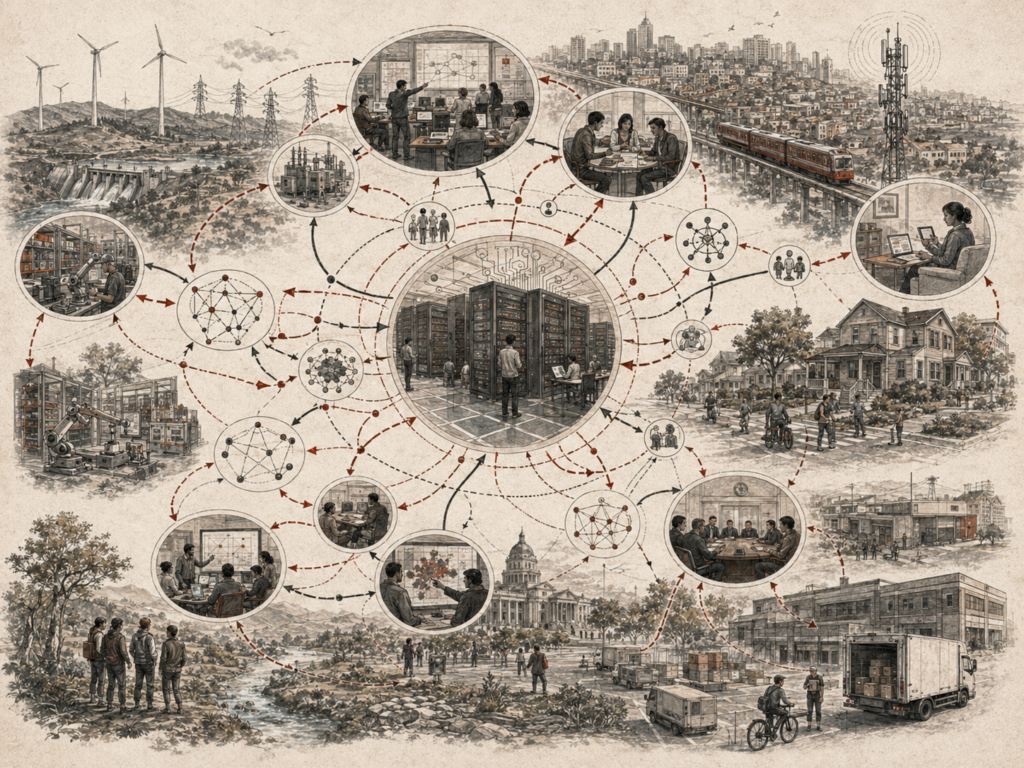
Scholarly systems-thinking illustration of digital platforms, data centers, energy grids, manufacturing, civic institutions, communities, logistics, and feedback pathways connected across a regional technology system.

Platforms, Feedback Loops, and Digital Systems

Platforms, Feedback Loops, and Digital Systems explains digital platforms as sociotechnical feedback systems shaped by algorithms, attention markets, user behavior, creator incentives, moderation, data extraction, network effects, labor, infrastructure, and governance. The article shows why platforms are not neutral containers for content, commerce, work, communication, or social life. They structure what becomes visible, profitable, repeated, contested, and dependent. It examines engagement loops, recommendation systems, algorithmic amplification, creator adaptation, misinformation, harassment, moderation capacity, data surveillance, platform labor, lock-in, interoperability, public value, and platform accountability. Through examples from social feeds, video recommendations, search, marketplaces, gig-work platforms, app stores, education platforms, and generative AI interfaces, readers learn how to diagnose platform feedback loops, evaluate harmful cascades, measure dependency, protect user dignity, improve governance, and design digital systems that support trust, autonomy, fair labor, resilience, and public responsibility.
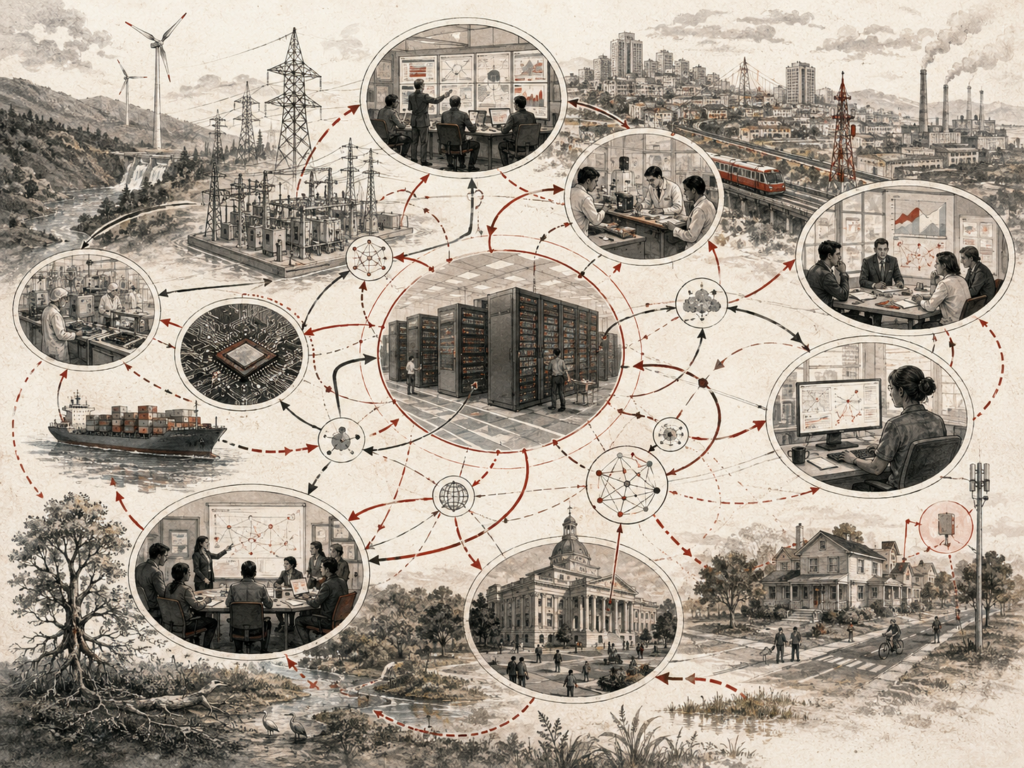
Scholarly systems-thinking illustration of AI and technology infrastructure connected to energy grids, data centers, manufacturing, civic institutions, homes, supply chains, environmental systems, and human decision-making.

Systems Thinking in AI and Technology

Systems Thinking in AI and Technology explains artificial intelligence and digital technology as sociotechnical systems shaped by data, infrastructure, institutions, incentives, labor, governance, feedback loops, and public consequences. The article shows why AI failures are rarely just technical failures and why responsible technology cannot be reduced to accuracy, efficiency, or innovation rhetoric alone. It examines data flows, model boundaries, algorithmic bias, automation, human judgment, platform incentives, attention systems, model drift, infrastructure dependency, invisible labor, governance readiness, contestability, public trust, and emergent harm. Through examples from recommendation systems, predictive policing, hiring algorithms, healthcare decision support, public-benefit automation, generative AI, smart infrastructure, and content moderation, readers learn how to diagnose AI systems, map feedback loops, evaluate group-level outcomes, monitor drift, assess dependency risk, preserve accountability, and design technology that strengthens human dignity, institutional responsibility, resilience, and public value.

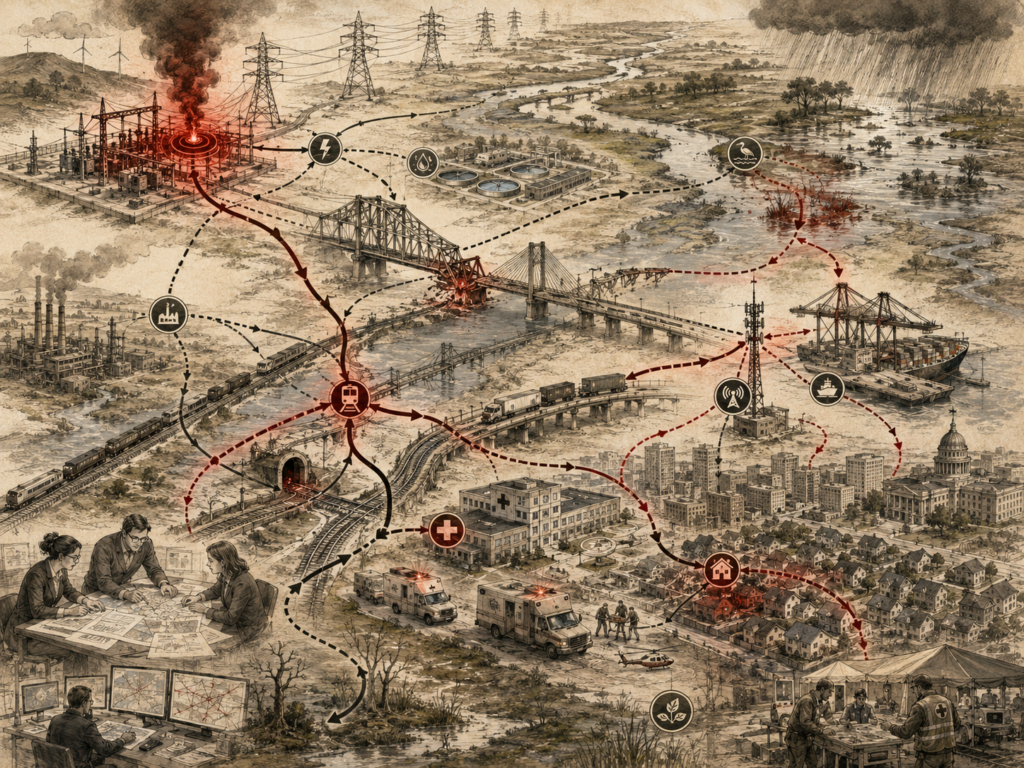
Scholarly systems-thinking illustration of interconnected infrastructure networks, including power grids, bridges, rail, ports, hospitals, neighborhoods, water systems, and emergency response pathways showing cascading risk.

Networks, Dependencies, and Cascade Risk

Networks, Dependencies, and Cascade Risk explains how modern systems depend on patterns of connection that create both resilience and fragility. The article shows why power grids, water systems, hospitals, supply chains, digital platforms, financial systems, public-health networks, and institutions cannot be understood as isolated components. It examines nodes, edges, hubs, bridges, bottlenecks, dependency direction, tight coupling, hidden fragility, redundancy, diversity, modularity, infrastructure interdependence, supply-chain concentration, information cascades, financial contagion, and governance across public-private boundaries. Through examples from grid failure, cloud outages, supply-chain bottlenecks, public-health transmission, financial shocks, transit hubs, digital platforms, and ecosystem food webs, readers learn how to map dependencies, identify critical nodes, simulate cascade scenarios, evaluate redundancy, protect vulnerable communities, and design networks that can absorb, contain, reroute, and recover from disruption during crises without shifting hidden risk unfairly onto workers, households, institutions, ecosystems, or future generations.

Scholarly systems-thinking illustration of an adaptive regional system with wetlands, farms, transit, neighborhoods, cities, community planning, ecological restoration, and networked feedback pathways.

Emergence, Adaptation, and Complexity

Emergence, Adaptation, and Complexity explains how complex systems generate patterns that cannot be understood by isolated parts alone. The article shows how local interactions, adaptive agents, feedback loops, path dependence, self-organization, co-evolution, thresholds, and nonlinear change produce system-level behavior across ecosystems, cities, organizations, markets, public institutions, digital platforms, artificial intelligence, and social movements. It distinguishes complexity from mere complication, showing why intervention requires humility, monitoring, adaptive governance, and accountability for emergent harm. Through examples from traffic flow, ecosystem succession, financial bubbles, public trust, platform behavior, organizational culture, urban segregation, and social movements, readers learn how to diagnose emergent patterns, compare scenarios, model adaptive behavior, identify lock-in, evaluate cascade risk, preserve diversity and resilience, and design institutions capable of learning responsibly under uncertainty, feedback, change, unequal power, historical memory, shifting incentives, institutional constraints, technological infrastructures, and public responsibility across generations.

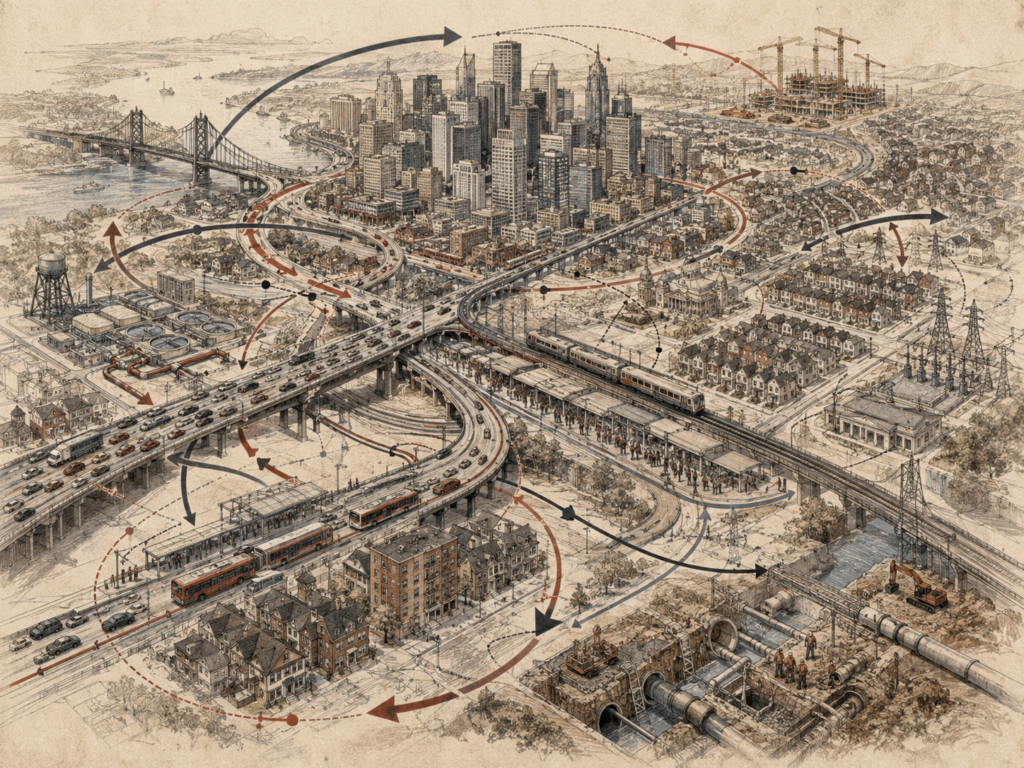
Scholarly systems-thinking illustration of a dense urban region with highways, transit, housing, construction, utilities, water infrastructure, bridges, neighborhoods, and directional flow pathways.

Urban Systems: Congestion, Housing, and Infrastructure

Urban Systems: Congestion, Housing, and Infrastructure explains cities as complex adaptive systems shaped by land use, housing markets, transportation networks, infrastructure maintenance, climate risk, public finance, and unequal power. The article shows why congestion is not only a road-capacity problem, housing affordability is not only a supply problem, and infrastructure failure is not only an engineering problem. It examines induced demand, housing-transport cost burden, transit access, land-value feedback, displacement, deferred maintenance, urban heat, stormwater, public services, spatial injustice, and institutional coordination. Through examples from highway expansion, transit-oriented development, parking reform, green infrastructure, housing near jobs, heat mitigation, maintenance backlogs, and regional housing imbalance, readers learn how to diagnose urban feedback loops, compare policy scenarios, measure access, evaluate total household burden, reduce displacement risk, and design cities that are more accessible, affordable, resilient, maintainable, healthy, and accountable across future generations.

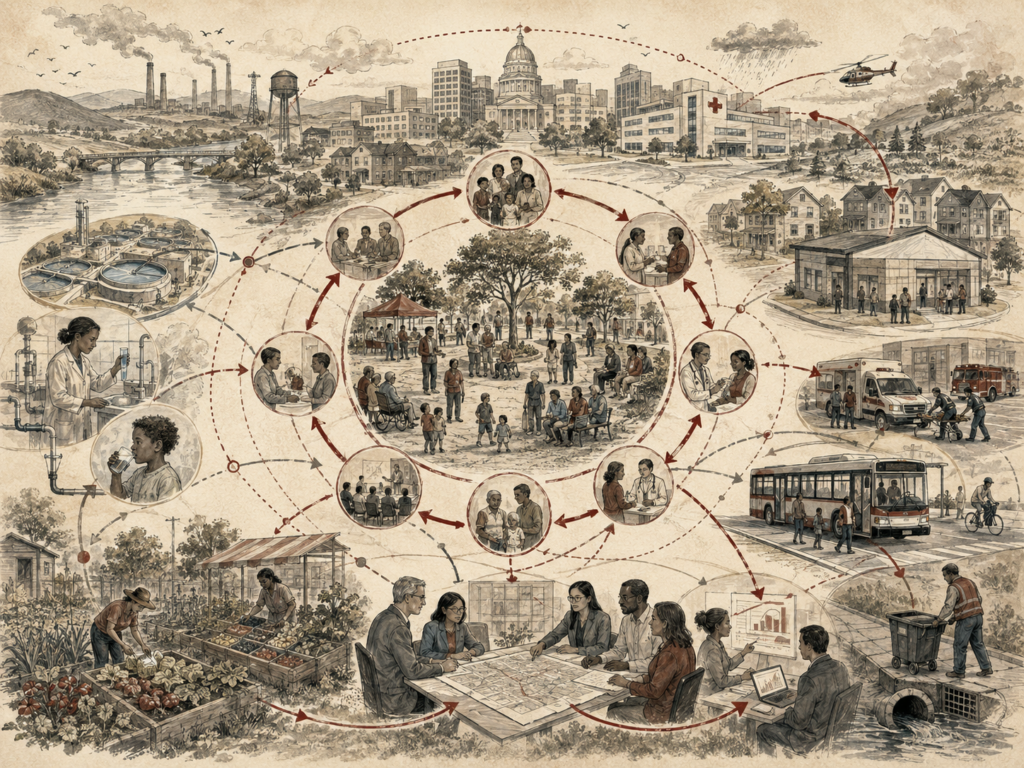
Scholarly systems-thinking illustration of public health as an interconnected community system, showing hospitals, clinics, water systems, housing, transit, food access, emergency response, environmental conditions, public agencies, and feedback pathways.

Public Health as a System: A Systems Thinking Deep Dive

Public Health as a System explains population health as the outcome of interacting biological, social, environmental, infrastructural, institutional, and political systems. The article shows why public health cannot be reduced to hospitals, individual behavior, or disease treatment alone. It examines disease dynamics, prevention, care capacity, public trust, social determinants of health, structural vulnerability, chronic exposure, environmental risk, climate stress, health equity, and institutional learning. Through examples from infectious disease, chronic illness, heat waves, asthma, vaccination, maternal health, water safety, food insecurity, substance use, and pandemic preparedness, readers learn how health outcomes emerge from feedback loops, stocks and flows, delays, exposure, vulnerability, and protective capacity. The article offers a systems method for diagnosing public-health patterns, comparing intervention scenarios, reducing inequity, strengthening prevention, and designing institutions that protect dignity, care, trust, and collective wellbeing over time.

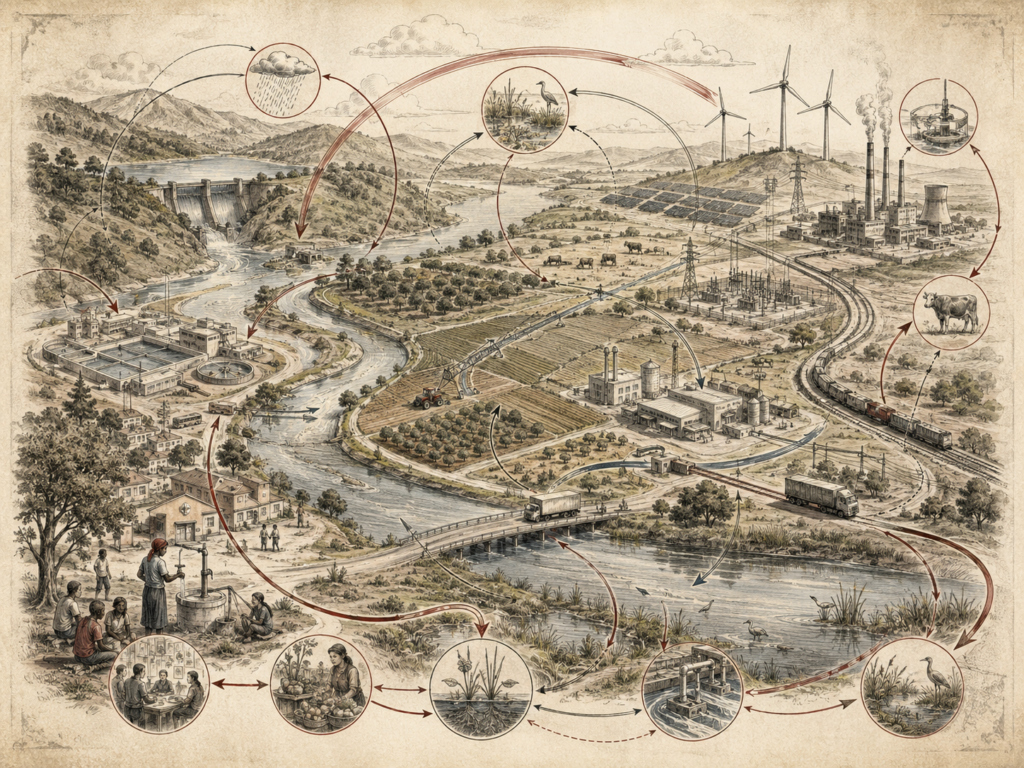
Scholarly systems-thinking illustration of interconnected food, water, and energy systems, showing rivers, dams, farms, irrigation, livestock, wetlands, renewable energy, industry, transport, and communities connected by feedback pathways.

Food-Water-Energy Systems Thinking

Food-Water-Energy Systems Thinking explains the interdependence of food security, water security, energy security, ecological resilience, infrastructure, governance, and social justice. The article shows why food, water, and energy cannot be planned as separate sectors: irrigation depends on water and power, water systems require energy, energy systems depend on water and land, and climate stress can destabilize all three at once. It examines groundwater depletion, soil health, pumping energy, renewable transition, hydropower, desalination, food supply chains, cold storage, land use, biodiversity, ecosystem services, compounding climate risk, and household vulnerability. Through systems examples and modeling workflows, readers learn how to map stocks and flows, identify feedback loops, evaluate cross-sector trade-offs, compare resilience scenarios, diagnose resource stress, and design food-water-energy systems that protect access, affordability, ecological foundations, public trust, and long-term stewardship across communities, regions, farms, utilities, households, institutions, ecosystems, and generations.

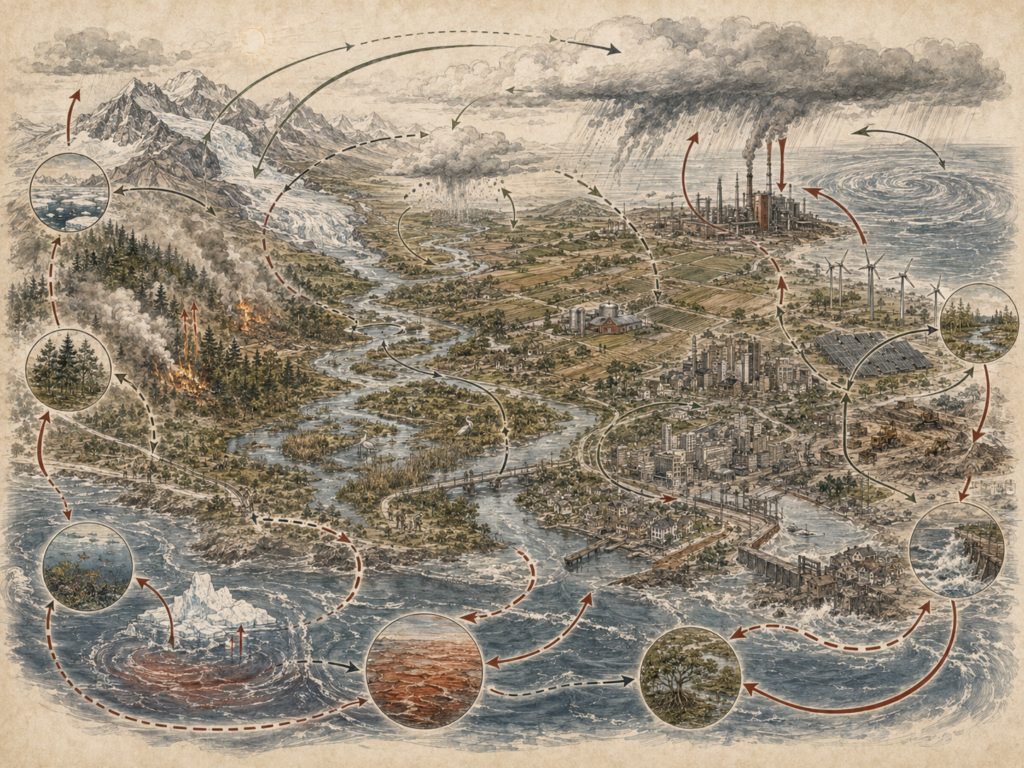
Scholarly systems-thinking illustration of climate feedback dynamics across mountains, glaciers, forests, rivers, cities, industry, oceans, storms, agriculture, renewable energy, and ecological systems.

Climate Systems and Feedback Dynamics

Climate Systems and Feedback Dynamics explains climate change as a coupled Earth-system and social-system problem shaped by greenhouse gas accumulation, radiative forcing, ocean heat uptake, feedback loops, thresholds, infrastructure, governance, and unequal vulnerability. The article shows why emissions are flows, atmospheric concentration and ocean heat are stocks, and climate risk grows through delay, cumulative pressure, and feedback amplification. It examines water vapor, cloud, lapse-rate, ice-albedo, cryosphere, carbon-cycle, land-system, ocean, and human-policy feedbacks, while connecting physical climate science to energy systems, adaptation, resilience, public trust, land use, infrastructure, and climate justice. Through examples from Arctic amplification, coral bleaching, permafrost thaw, urban heat, wildfire regimes, migration, energy transition, and insurance risk, readers learn how to diagnose climate dynamics, compare scenarios, identify leverage points, and connect mitigation with adaptation, equity, and long-term public responsibility across communities, institutions, ecosystems, infrastructure, policy, and generations.

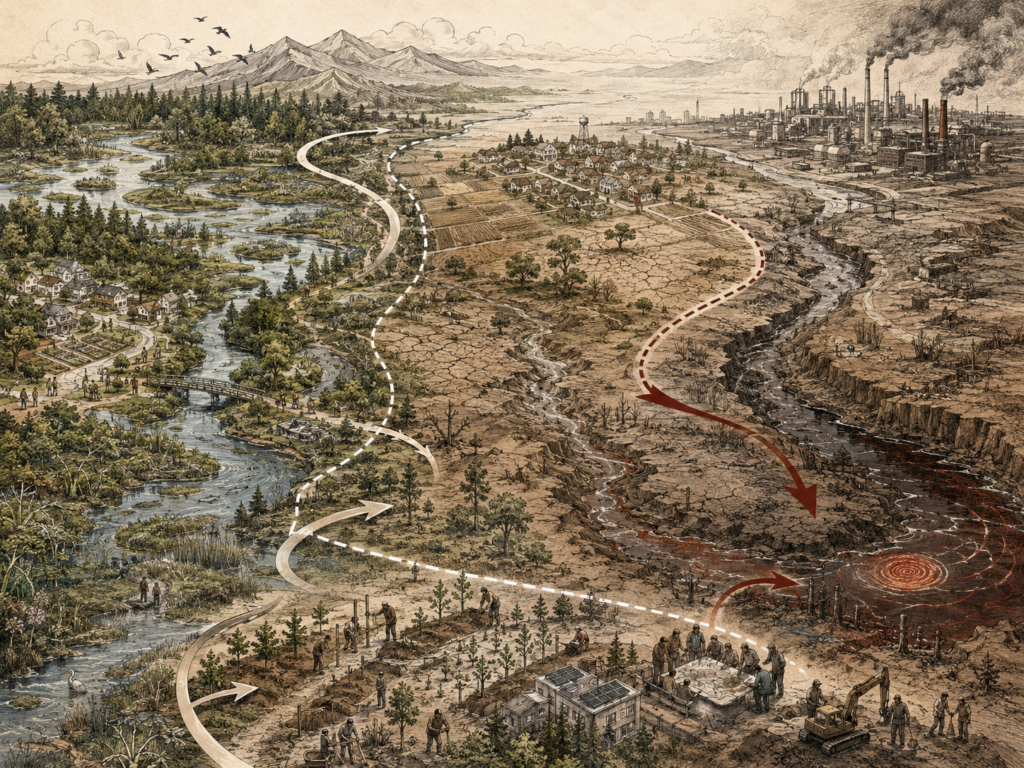
Scholarly systems-thinking illustration of a landscape divided between resilient wetlands, restoration work, stressed farmland, degraded waterways, industrial damage, and ecological collapse, with threshold pathways and regime-shift arrows.

Resilience, Thresholds, and Regime Shifts

Resilience, Thresholds, and Regime Shifts explains why complex systems can appear stable while quietly losing the capacity to recover. The article examines resilience as absorptive, adaptive, and transformative capacity, showing how ecological, institutional, organizational, urban, technological, and social systems can cross thresholds into new regimes when pressure exceeds recovery capacity. It explains tipping points, hysteresis, early warning signals, critical slowing down, adaptive capacity, social-ecological resilience, institutional resilience, and the difference between stability, robustness, and resilience. Through examples from lakes, forests, climate systems, public institutions, organizations, cities, food systems, digital platforms, and democratic systems, readers learn how to diagnose threshold risk, monitor recovery time, identify regime-shift warning signs, evaluate distributional vulnerability, and redesign systems so resilience means not passive endurance, but ethical recovery, adaptive learning, and transformation where the old regime is harmful before crisis hardens into irreversible structural change.

Scroll to Top