
Last Updated May 3, 2026
Ancient Near Eastern and Mediterranean Healing Traditions examine the healing systems of Egypt, Mesopotamia, the Levant, the eastern Mediterranean, and the wider ancient Mediterranean world through practices of diagnosis, remedy, ritual, temple healing, pharmacology, surgery, childbirth care, sacred environments, medical writing, environmental awareness, and the interpretation of suffering within larger religious, natural, civic, and cosmological orders. As a major category within the Healing Traditions knowledge series, it studies ancient healing first through primary sources, medical papyri, cuneiform tablets, ritual texts, sanctuary evidence, archaeological contexts, and internal cultural frameworks, and only after that through modern medical history, anthropology, comparative religion, and the history of science.
In the history of ideas, these traditions developed important approaches to illness, protection, restoration, and wellbeing through practical treatment, plant knowledge, incantation, surgery, divination, temple ritual, sacred sleep, water, household care, professional specialization, and early empirical observation. They often linked bodily disturbance to divine, cosmic, social, environmental, and moral conditions. Ancient healing was therefore not a primitive stage waiting for medicine to become “real.” It was a complex field of interpretation and intervention in which the body, the gods, the environment, the household, the city, and the written archive could all belong to the same therapeutic world.
This category explores Egyptian medicine, Mesopotamian healing, Levantine and eastern Mediterranean traditions, Greek sanctuary healing, Asclepian incubation, sacred springs and baths, early pharmacology, trauma care, surgery, women’s health, reproductive care, household medicine, ritual protection, medical specialists, temple environments, rivers and ecological health, and the transmission of medical knowledge through papyrus, tablet, inscription, and later Mediterranean medical literature. It considers how ancient cultures understood the body as vulnerable to imbalance, injury, impurity, spiritual danger, environmental stress, reproductive risk, and social disorder, while also tracing the practical traditions through which healers sought to restore order, relieve suffering, and preserve life.
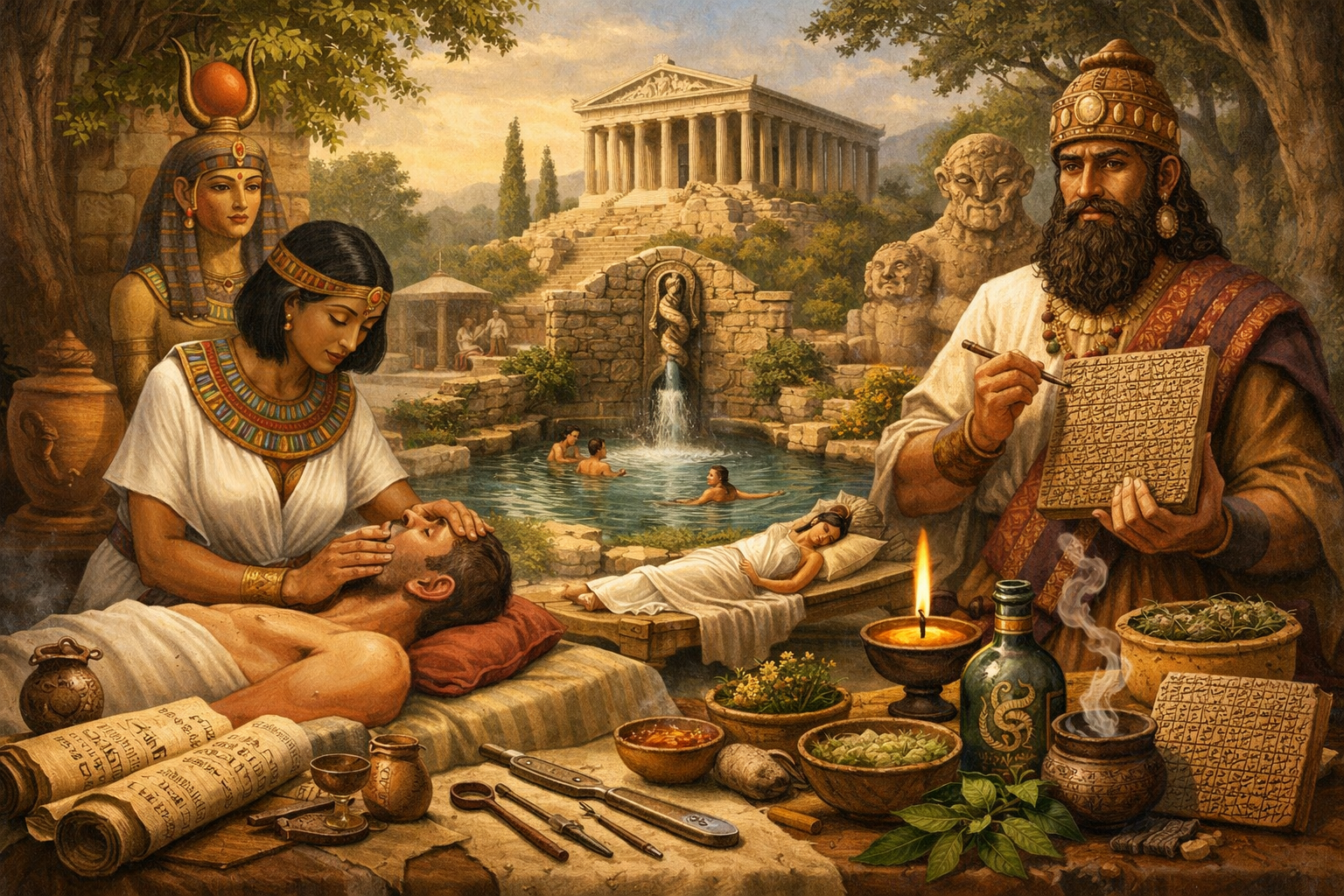
Ancient Near Eastern and Mediterranean healing traditions play an important role in comparative inquiry because they reveal the deep civilizational background of medicine before and alongside Greek systematization. Egyptian medical papyri, Mesopotamian cuneiform tablets, Levantine ritual worlds, Greek sanctuary healing, and later Greco-Roman medical writing show that ancient healing was never reducible to one method. It could involve examination, prognosis, plant remedies, surgical intervention, purification, dream interpretation, divine mediation, protective ritual, household care, and environmental knowledge within the same broader field of practice.
This category is especially important to the broader architecture of this site because it connects Healing Traditions to Religious Studies, Religion and Ecology, Greek & Roman Medicine, Healing Spaces, Baths & Sacred Environments, Herbalism & Traditional Knowledge, Islamic Medicine, Diet, Nourishment & Food as Medicine, Environmental Science, Biology, and Cultural Anthropology. It shows that healing has always been a social, environmental, ritual, textual, and embodied practice, not merely a technical response to isolated symptoms.
The goal of this pillar is not to romanticize ancient medicine or treat all ancient practices as effective by modern standards. It is to understand how ancient civilizations organized care before the modern separation of medicine, religion, environment, and public life. Ancient healers did not always distinguish sharply between bodily disorder, ritual danger, divine displeasure, environmental exposure, impurity, trauma, reproductive risk, and social disruption. To study these traditions well is to study the body within a larger moral, ecological, civic, and cosmological order.
Why This Series Matters
Ancient healing traditions matter because they show that medicine did not begin as a purely technical science separated from religion, place, household, ritual, environment, or moral order. In Egypt, Mesopotamia, the Levant, and the wider ancient Mediterranean, healing often involved practical treatment and ritual action at once. The physician, ritual specialist, exorcist, priest, midwife, herbal expert, temple attendant, or sanctuary healer was expected not simply to suppress symptoms but to interpret what kind of disorder had occurred, where it came from, and how bodily restoration related to wider forces of gods, impurity, injury, water, weather, food, fertility, city life, social disruption, or cosmic imbalance.
This series also matters because these traditions form a major background to later Greek, Roman, Islamic, and European medicine. They produced archives of remedies, case descriptions, diagnostic omens, anatomical observations, surgical procedures, ritual prescriptions, household practices, and sanctuary inscriptions that later traditions inherited, translated, contested, and reorganized. Greek rational medicine did not appear in an empty world. It developed in a Mediterranean and Near Eastern landscape already rich with healing institutions, therapeutic substances, ritual techniques, and written medical knowledge.
Ancient Near Eastern and Mediterranean healing also complicates modern stories about progress. It is tempting to divide the past into “magic” and the present into “science,” but that division obscures the intellectual richness of ancient care. Ancient healers could observe wounds carefully, classify injuries, prescribe plants and compounds, perform procedures, and preserve medical cases in writing while also invoking gods, reciting incantations, reading omens, or using temple environments as spaces of restoration. Their world was not irrational because it combined these registers. It was organized by a different account of the body’s place within the visible and invisible order.
For this site, the series is especially valuable because it places healing at the intersection of civilization, ecology, religion, textual transmission, and embodied care. It shows how early medicine emerged from practical need but was never merely practical. It was also ritual, environmental, institutional, and interpretive.
The Civilizational Frame of Ancient Healing
Ancient Near Eastern and Mediterranean healing should be understood as a plural field rather than a single system. Egyptian medicine, Mesopotamian medicine, Levantine ritual practices, Greek sanctuary healing, and later Greco-Roman developments overlap historically but differ in language, institutions, cosmology, methods, and social authority. Some traditions rely heavily on written prescriptions and practical remedies; others foreground ritual sleep, divination, incantation, purification, sacred water, or temple space; many combine these modes.
This plural field matters because it prevents any single civilization from being treated as the origin of medicine. Egypt preserves one of the oldest and most substantial written medical traditions. Mesopotamia preserves cuneiform archives of diagnosis, omen interpretation, prescriptions, and ritual-therapeutic practice. The Levant and eastern Mediterranean served as zones of transmission where remedies, cults, purity systems, and medical habits moved across borders. Greek healing sanctuaries made sacred environments into institutional spaces of restoration. Greco-Roman medicine later systematized, theorized, and extended many forms of practical and observational healing.
The ancient healing world was also geographically rooted. River valleys, irrigation systems, agricultural cycles, urban density, temple economies, trade routes, sacred springs, and port cities all shaped the conditions of health and disease. Healing knowledge moved with merchants, scribes, soldiers, priests, captives, migrants, pilgrims, and physicians. The ancient Mediterranean and Near East should therefore be studied not as isolated civilizations, but as an interconnected healing landscape.
The result is a healing field in which technical skill, sacred power, environmental attentiveness, written transmission, and social authority coexist rather than cleanly replace one another. That coexistence is the central intellectual feature of the category.
Medicine Before the Modern Separation of Science and Religion
One of the most important lessons of this pillar is that ancient medicine existed before the modern separation of science, religion, psychology, ecology, and social care. Ancient healers frequently worked in a world where bodily symptoms could have multiple meanings at once. A wound might require binding, cleansing, and prognosis. A fever might require remedies and ritual protection. A pregnancy might require practical care and divine safeguarding. A dream might be diagnostic. A polluted place might be dangerous. A sanctuary might serve both as sacred institution and healing environment.
This does not mean that ancient medicine lacked observation. On the contrary, some ancient materials show careful attention to symptoms, prognosis, wounds, fractures, bodily substances, dosage, and therapeutic procedure. What differs from modern biomedicine is the larger explanatory frame. The body was often understood as vulnerable to forces that exceeded physical mechanism alone: gods, spirits, curses, impurity, fate, social disorder, environment, and cosmic imbalance.
This wider frame also shaped treatment. Care could involve plants, resins, minerals, bandages, oils, surgery, baths, diet, ritual speech, offerings, amulets, incantations, dream incubation, or purification. The therapeutic world was layered. A remedy did not necessarily exclude ritual, and ritual did not necessarily exclude practical intervention. The ancient healer often treated the body and interpreted the world around the body at the same time.
For comparative healing studies, this is not a defect to be corrected by modern categories. It is a major historical insight. Ancient medicine reveals how deeply human beings have linked bodily suffering to meaning, environment, sacred order, household vulnerability, and the search for restored balance.
Egyptian Medicine: Text, Ritual, and Practical Care
Egyptian medicine deserves major place in this pillar because it preserves one of the oldest and most substantial written medical traditions in the ancient world. Egyptian healing included physicians, written remedies, anatomical knowledge, surgical attention, materia medica, priestly contexts, protective ritual, household care, and religious understandings of bodily vulnerability. It was neither purely magical nor purely technical. It was a mixed therapeutic world in which ritual power and practical care could operate together.
What makes Egyptian medicine especially important is that it resists easy modern categories. It includes spells and ritual formulas, but it also includes observation, classification of injuries, and practical intervention. Egyptian medical writing shows concern for wounds, fractures, bodily disorders, reproductive health, eyes, skin, digestion, pain, parasites, and other recurring conditions of embodied life. The body appears not only as a sacred or symbolic object, but as a practical field requiring treatment.
Egyptian healing also reflects the larger order of Egyptian civilization. The body was situated within a universe shaped by divine forces, ritual order, funerary belief, temple knowledge, and the maintenance of balance. Illness could be approached through practical remedies, but the restoration of health also belonged to a wider concern with order, protection, and harmony. Medicine thus belonged to the same civilizational world as ritual, writing, architecture, funerary practice, and kingship.
A strong reading of Egyptian medicine therefore avoids two errors. It does not dismiss the tradition as superstition because it includes ritual. It also does not pretend that every ancient remedy corresponds to modern biomedical efficacy. Instead, it studies Egyptian healing as an early and sophisticated therapeutic culture in which writing, observation, remedy, ritual, and cosmology were mutually entangled.
The Egyptian Medical Papyri: Remedy, Ritual, and Clinical Observation
The Egyptian medical papyri are central to this field because they show medicine becoming textual, teachable, archivable, and transmissible. Ancient Egyptian medical knowledge was not merely oral improvisation or priestly secrecy. It was copied, organized, preserved, and used through written materials. These papyri include prescriptions, spells, diagnostic observations, therapeutic procedures, and specialized materials dealing with different parts of bodily care.
A strongest-sense account should distinguish among the papyri themselves. The Ebers Papyrus is a vast therapeutic and pharmacological compilation. The Edwin Smith Papyrus is especially important for trauma and surgical reasoning. Other papyri preserve material related to gynecology, reproductive care, bodily disorders, and ritual protection. Together, they show a diverse medical archive rather than one homogeneous text.
These papyri matter because they make visible a culture of medical transmission. Remedies could be listed, copied, organized, taught, modified, and preserved. The act of writing gave healing knowledge a durable form. It allowed recipes, procedures, and observations to move beyond a single healer’s memory and enter a broader scribal and professional world.
The papyri also show that ancient medicine was often practical and symbolic at once. A prescription might include ingredients and a ritual formula. A diagnosis might include observation and cosmological assumption. A treatment might involve both material application and protective speech. The written archive therefore preserves not the separation of medicine and religion, but their organized coexistence.
The Edwin Smith Papyrus and the Early Logic of Trauma Care
The Edwin Smith Papyrus deserves special prominence because it is widely treated as a landmark in the history of surgery and trauma medicine. Unlike more general therapeutic compilations, it is notable for its practical attention to wounds, fractures, head injuries, examination, prognosis, and clinical judgment. It helps reveal that one major strand of ancient healing was deeply concerned with bodily mechanism, observable injury, and the disciplined handling of trauma.
This text matters because it complicates any assumption that ancient healing was only ritual. The logic of trauma care requires attention to the visible body: where the wound is, how severe the injury appears, what signs are present, whether the condition can be treated, and what outcome may be expected. The Edwin Smith Papyrus therefore belongs not only to the history of Egyptian medicine, but to the broader history of clinical reasoning.
Its significance also lies in prognosis. Ancient healers were not only asking what remedy to apply. They were also judging whether a condition was treatable, uncertain, or beyond intervention. This shows a disciplined awareness of medical limits. Healing knowledge included the capacity to recognize what could not be healed.
For the article series, the Edwin Smith Papyrus should become a central standalone article because it provides one of the clearest early examples of medicine as observation, classification, procedure, and judgment. It is a crucial counterweight to simplified accounts of ancient medicine as only magical or priestly.
The Ebers Papyrus and the Therapeutic Archive
The Ebers Papyrus represents another major dimension of Egyptian medicine: the therapeutic and pharmacological archive. It preserves a large body of remedies and treatments, showing how healing knowledge could be organized around substances, recipes, bodily conditions, and practical therapeutic use. It is therefore one of the most important sources for understanding ancient materia medica and the textual preservation of remedies.
This matters because pharmacology is one of the strongest continuities between ancient and later medicine. Plants, resins, minerals, animal products, oils, honey, beer, wine, fats, and other substances could be combined into treatments. Whether or not particular remedies align with modern expectations, the larger practice shows sustained attention to material intervention. Ancient healing did not merely ask what illness meant; it also asked what could be applied, ingested, washed, bound, inhaled, or prepared.
The Ebers Papyrus also reveals the social world of medicine. Such a text presupposes practitioners able to read, prepare, remember, and apply remedies. It presupposes access to ingredients, knowledge of preparation, and a culture of transmission. The medical papyrus is therefore both a therapeutic document and a sign of institutional knowledge.
A dedicated article on the Ebers Papyrus should explore not only its age and fame, but its role as a therapeutic infrastructure: a written system through which remedies, bodily concerns, ritual language, and pharmacological knowledge were preserved across generations.
Women, Childbirth, and Reproductive Care
Women’s health and childbirth should be central to this pillar, not treated as a secondary topic. Ancient healing traditions everywhere involved fertility, menstruation, pregnancy, delivery, lactation, infant care, reproductive danger, household protection, and ritual safeguarding. Birth was both a biological event and a socially charged threshold. It involved risk, family continuity, gendered knowledge, ritual care, and the vulnerability of mother and child.
Egyptian medical writing includes material relevant to gynecology and reproductive care, while the broader ancient world preserved practices for fertility, contraception, pregnancy testing, childbirth assistance, postpartum care, and protection against reproductive danger. Such materials reveal that healing was not confined to public institutions or male professional spaces. Much of ancient care took place within households and through women’s embodied experience.
This section also matters because reproductive care links medicine to gender, family, inheritance, ritual purity, infant survival, and social continuity. The body of the pregnant or birthing woman was not only a medical concern. It was a site where household, lineage, divine protection, danger, and community future converged.
A mature Healing Traditions pillar should therefore foreground childbirth and women’s health as fundamental to ancient medicine. The history of healing is incomplete if it privileges trauma, surgery, and elite textual archives while minimizing the everyday and life-threatening realities of reproduction.
Mesopotamian Healing: Diagnosis, Divination, and Therapy
Mesopotamian medicine is equally essential to the ancient healing landscape. Mesopotamia preserved many different kinds of medical and medically related sources, including prescriptions, diagnostic materials, therapeutic procedures, incantations, omen traditions, and ritual practices. Mesopotamian healing is especially important because it reveals a world in which medical practice could involve both empirical treatment and interpretive work around omens, divine displeasure, ritual danger, demonic affliction, or supernatural causation.
A strong comparative reading should not reduce Mesopotamian medicine to “magic.” It included plant-based remedies, practical care, protective rites, prophylaxis, and specialist knowledge. What distinguishes it is that diagnosis often moved across bodily, spiritual, and cosmological registers at once. A symptom could be a bodily sign, but it could also be an interpretive sign within a larger field of divine, demonic, or ritual meaning.
This interpretive dimension does not make Mesopotamian healing irrational. It shows that ancient diagnosis often asked a wider question than modern medicine usually asks: not only what process is occurring in the body, but what kind of disorder has entered the person’s world. Illness could be read as a sign requiring remedy, ritual, protection, or divine negotiation.
Mesopotamian healing therefore deserves its own substantial branch within the article map. It represents one of the clearest ancient examples of medicine as diagnosis, omen, remedy, ritual, and scribal learning within a single civilizational system.
Mesopotamian Healers, Omens, and the Interpretation of Illness
A fuller version of the pillar should make clear that Mesopotamian healing involved different specialist roles. Ancient scholarship often distinguishes therapeutic and ritual-diagnostic functions, helping explain how bodily treatment, omen-reading, incantation, and exorcistic practice could belong to one broader medical world without collapsing into one undifferentiated role. Specialist plurality is one of the most important features of Mesopotamian medicine.
This matters because ancient healing authority was not singular. Different specialists may have been responsible for different dimensions of illness: preparing remedies, reading signs, reciting incantations, performing ritual protection, interpreting omens, or addressing supernatural danger. Their roles could overlap, but the existence of differentiated expertise suggests a structured healing culture.
Illness interpretation also depended on signs. Symptoms, timing, bodily location, dreams, omens, ritual conditions, and social circumstances could all matter. Diagnosis was therefore not simply a label attached to disease. It was a process of locating the illness within a larger map of causation and meaning.
This specialist system should be a major article cluster within the series because it reveals medicine as an institution of interpretation. Mesopotamian healers were not only remedy-givers. They were readers of disorder.
Cuneiform Prescriptions and the Medical Knowledge of Mesopotamia
Cuneiform medical tablets show that Mesopotamian healing knowledge was textual, learned, and transmissible. Prescriptions, remedies, diagnostic sequences, and ritual instructions could be written, copied, studied, and preserved. Like Egyptian papyri, Mesopotamian tablets made healing into an archive. They allowed knowledge to move across generations, institutions, and scribal communities.
This matters because medical writing is a major turning point in the history of care. It transforms local experience into repeatable and teachable form. It also makes comparison possible: ingredients, procedures, symptoms, and ritual acts can be studied across documents, regions, and periods. Written medicine produces continuity, but it also allows variation and reinterpretation.
Mesopotamian prescriptions also reveal the materiality of healing. Plants, minerals, oils, animal substances, beer, water, and other materials could become therapeutic substances. Their use required practical knowledge of preparation, dosage, combination, and application. Healing was therefore not only interpretive but materially skilled.
A dedicated article on cuneiform prescriptions should explore the tablet as a medical technology. The clay tablet was not merely a record. It was a medium through which therapeutic authority, scribal learning, and practical knowledge became durable.
Levantine and Eastern Mediterranean Healing Worlds
The Levant and eastern Mediterranean should be treated as active healing worlds rather than mere corridors between Egypt, Mesopotamia, and Greece. The region participated in overlapping traditions of ritual purity, temple culture, sacred waters, household remedies, herbal knowledge, practical care, and religious interpretation of illness. It also served as a space of circulation where remedies, symbols, cults, medical habits, and ritual practices moved across political and linguistic borders.
This matters because healing traditions rarely remain sealed within one civilization. Trade, migration, empire, war, pilgrimage, and translation all move knowledge. A plant remedy may travel farther than the language in which it was first recorded. A cult of healing may adapt to local gods and sacred places. A ritual of purification may be reinterpreted in a new theological setting. The eastern Mediterranean was precisely this kind of contact zone.
Levantine healing worlds also link medicine to religion and law. Ritual purity, bodily vulnerability, food, childbirth, skin conditions, death, mourning, and household order all appear in the broader religious and social systems of the region. Healing was not only about curing disease; it was often about restoring a person to social, ritual, and communal life.
A mature pillar should therefore include the Levant and eastern Mediterranean as active fields of healing practice, not simply as background geography. This region helps reveal ancient medicine as a network of exchange, reinterpretation, and local adaptation.
Temples, Springs, and Sacred Healing Environments
Sacred healing environments are one of the strongest unifying themes across this category. Springs, baths, sanctuaries, temple precincts, caves, groves, and sacred buildings were often understood not as neutral settings but as active parts of restoration. Healing in the ancient Mediterranean frequently took place in spaces structured for purification, offering, washing, sleep, incubation, dream reception, ritual preparation, and divine encounter.
A broad ancient healing pillar should therefore treat sacred environments as central institutions of care. These spaces connected bodily treatment, ritual purification, public gathering, offerings, sleep, dreams, architecture, water, and divine mediation. They also help explain why healing cannot be reduced to substances or procedures alone. Place itself could become therapeutic.
Sacred healing environments also created social structures around care. Patients traveled, waited, slept, prayed, gave offerings, interpreted dreams, received instructions, and returned with stories of healing. Sanctuaries generated memory, reputation, and institutional authority. They were not merely symbolic. They were organized therapeutic spaces.
This theme links directly to Healing Spaces, Baths & Sacred Environments. It also connects to religion and ecology because springs, water, air, architecture, landscape, and ritual movement all shaped the experience of healing.
Asclepius, Incubation, and the Institutional Space of Sanctuary Healing
Asclepius and the great healing sanctuaries of the Greek world deserve fuller treatment because they represent one of the clearest examples of institutional sacred healing. Sanctuary healing involved more than sleeping in a temple. Patients entered complex environments that could include baths, gymnasia, sacred architecture, an abaton, offerings, ritual preparation, inscriptions, and spaces of communal expectation. The sanctuary functioned as both sacred precinct and therapeutic institution.
Incubation is especially important because it reveals a distinct ancient logic of healing. The patient sleeps in a sacred space and seeks healing or instruction through divine encounter, often mediated through dream. In modern terms, this may seem distant from clinical medicine, but in its own world it made sense: the god, the sacred place, the dream, the ritual preparation, and the patient’s body formed one therapeutic system.
Asclepian sanctuaries also produced public memory through stories of cures. Healing inscriptions and sanctuary narratives helped build institutional authority. They told visitors that healing had happened here before and could happen again. The sanctuary was therefore not only a place of treatment but a place of testimony.
This branch should eventually connect strongly to Greek and Roman Medicine because Asclepian healing did not simply disappear with the rise of more naturalistic medical theories. Sacred healing and medical reasoning coexisted, competed, and interacted across the ancient Mediterranean.
The Body, Disorder, and the Interpretation of Illness
One of the central questions in ancient healing is how illness was interpreted. In some traditions, disease appears as imbalance, corruption, trauma, impurity, environmental stress, reproductive danger, or bodily invasion; in others, it may also signify divine anger, spiritual attack, broken order, demonic affliction, curse, fate, or danger within the larger moral-cosmic field. Ancient medicine is therefore not just about remedies. It is also about explanatory worlds.
This matters because the meaning of illness shapes the form of care. If illness is understood as physical injury, the healer examines the wound. If it is understood as impurity, purification may be required. If it is understood as divine or demonic affliction, ritual specialist intervention may be needed. If it is understood as environmental exposure, water, air, diet, and place matter. If it is understood as reproductive danger, household and protective practices become central.
Ancient healing therefore often worked through layered causation. The same condition might be treated with practical remedies while also being interpreted ritually. That layered model is not unique to one civilization; it appears across many premodern healing traditions. It reflects the fact that illness threatens not only the body but the person’s relation to household, community, gods, place, and order.
To understand these traditions comparatively is to ask how they linked bodily suffering to nature, ritual, social order, and the unseen. The history of medicine is also a history of how human beings explain disorder.
Plants, Compounds, and Early Pharmacology
Ancient healing traditions were deeply material. Egyptian and Mesopotamian texts preserve recipes and therapeutic substances, while later Greco-Roman pharmacology culminated in major compilations and traditions of materia medica. This long continuity matters because ancient medicine joined textual knowledge, plant observation, trade, household practice, and therapeutic experimentation into one broad material culture of care.
Plants, resins, oils, minerals, animal substances, honey, wine, beer, water, fats, and aromatic compounds all appear across ancient healing traditions. Their use required practical knowledge: how to gather, prepare, mix, preserve, heat, grind, apply, drink, inhale, bind, or wash with them. Ancient pharmacology was therefore not merely symbolic. It involved material skill and accumulated observation.
Pharmacology also connects medicine to ecology and trade. A remedy depends on access to substances, and substances depend on landscapes, agriculture, harvesting, storage, and exchange. Healing knowledge therefore moved along with trade networks, imperial contact, and household economies. The history of remedies is also a history of plants, rivers, soils, markets, and cultural exchange.
This section links directly to Herbalism & Traditional Knowledge. It also prepares later connections to Greek and Roman medicine, Islamic medicine, and the long history of pharmacological compilation.
Surgery, Trauma, and Practical Intervention
A comprehensive pillar must stress that ancient healing was not only ritual and pharmacology. The Edwin Smith Papyrus preserves a practical guide to wounds and trauma and is regarded as a landmark in the history of surgery, while Mesopotamian materials also indicate the presence of practical intervention. The hands-on, procedural dimension of ancient care is one of the strongest correctives to any assumption that early medicine lacked technique.
Trauma care required direct engagement with the injured body. Wounds had to be examined, cleaned, bandaged, stabilized, or judged untreatable. Fractures, head injuries, dislocations, cuts, and battlefield or labor-related injuries required practical skill. Ancient surgery may not resemble modern surgery in anatomical precision or technological sophistication, but it represents a serious tradition of bodily intervention.
Trauma also reveals the social world of ancient medicine. Injuries came from labor, warfare, punishment, childbirth, travel, animals, tools, architecture, and daily life. Healing was therefore tied to the physical risks of ancient civilization. Medicine developed where bodies were repeatedly exposed to work, violence, accident, and environmental danger.
This branch should eventually include a dedicated article on trauma and the ancient body because practical intervention is one of the strongest bridges between ancient healing and the later development of clinical medicine.
Healers, Priests, and Medical Specialists
Ancient healing traditions raise the question of who counted as a healer. Egyptian physicians, Mesopotamian therapeutic specialists, ritual-diagnostic experts, temple priests, exorcists, midwives, sanctuary attendants, herbal experts, household caregivers, and later Greco-Roman doctors all occupied different but overlapping roles. Some traditions distinguished ritual and therapeutic specialists more sharply than others; some combined them. This plurality of experts matters because it shows medicine emerging not from one professional identity but from several forms of authority competing and cooperating within the same civilizational space.
Healing authority could come from writing, temple affiliation, inherited training, ritual office, practical success, household experience, social status, divine association, or specialist learning. A healer might be trusted because of technical skill, sacred access, institutional role, knowledge of plants, capacity to read omens, or familiarity with childbirth and household care. Authority was therefore plural.
This plurality also shaped how illness was treated. A condition might call for a remedy expert, a ritual specialist, a midwife, a temple visit, a family caregiver, or a combination of these. The patient’s path through healing was often social and institutional, not merely individual.
Studying healers and specialists also helps prevent elite textual sources from dominating the field. Papyri and tablets preserve important knowledge, but much ancient healing likely occurred through household practice, oral transmission, women’s care, local remedy knowledge, and ritual specialists whose work was not always preserved in formal medical archives.
Medicine, Religion, and Cosmological Order
Ancient Near Eastern and Mediterranean healing traditions are especially important because they show that medicine and religion were rarely cleanly separated. The same culture could preserve diagnostic reasoning, recipe collections, and practical surgery while also understanding illness through gods, curses, impurity, dream messages, demonic danger, or ritual pollution. For comparative work, this is not a defect to be explained away. It is a major clue to how ancient societies imagined the body inside a larger cosmological order.
The body was not isolated from the sacred. It was porous to divine influence, ritual danger, environmental conditions, social obligations, and invisible powers. Healing therefore sought to restore more than biological function. It sought to repair order: bodily order, household order, ritual order, divine relation, or social belonging.
This helps explain why healing traditions so often involve purification, offering, prayer, incubation, incantation, amulets, and sacred places alongside remedies and procedures. These practices addressed dimensions of illness that ancient cultures understood as real and consequential. They also gave patients and communities ways to interpret suffering when technical intervention alone was insufficient.
For this site’s broader Healing Traditions architecture, this section is foundational. It shows that the history of medicine is also the history of how human beings placed the suffering body inside a meaningful cosmos.
Environment, Rivers, Water, and the Conditions of Health
Ancient healing was also environmental. River valleys, irrigation systems, agriculture, urban density, sacred springs, baths, temple sites, diet, climate, animal life, sanitation, and water access all shaped how people understood health and restoration. In Egypt and Mesopotamia especially, river systems were inseparable from agriculture, settlement, disease burden, ritual life, and civilizational survival.
Water deserves special attention because it appears both practically and symbolically. It sustains life, cleanses bodies, irrigates fields, supports cities, carries disease, enables ritual washing, marks sacred space, and becomes central to healing springs and baths. Water is therefore one of the clearest bridges between ecology, medicine, ritual, and public life.
Environmental conditions also shaped vulnerability. Urban density, labor, warfare, parasites, contaminated water, seasonal cycles, childbirth risk, food insecurity, and agricultural dependence all affected ancient bodies. Healing traditions emerged in response to these conditions, not in abstraction from them.
A serious pillar should therefore foreground rivers, water, and environmental setting as part of healing’s ancient logic, not just as background scenery. Ancient health was always ecological because ancient bodies lived within river systems, climates, soils, animals, cities, temples, and households.
Writing, Archives, and the Transmission of Healing Knowledge
One of the great strengths of ancient Near Eastern and Mediterranean healing is that so much of it survives through writing. Papyrus rolls, cuneiform tablets, sanctuary inscriptions, later compilations, and medical commentaries preserved remedies, case logic, ritual actions, diagnostic sequences, named authorities, and institutional memory. These archives matter because they transformed healing from local practice alone into transmissible knowledge.
The ancient world did not only heal; it recorded, copied, taught, and debated its methods. Writing made healing portable across time. It allowed a remedy, case, omen, or ritual instruction to outlive the healer who first used it. It also allowed medical knowledge to become part of scribal and institutional culture.
Archives also shape what modern readers can see. Written texts preserve some practices while excluding others. Elite, literate, institutional, and professional forms of healing are more likely to survive than household remedies, oral traditions, women’s practical knowledge, and informal care. A mature pillar must therefore read written archives critically: they are precious, but they are not the whole healing world.
This section connects healing traditions to knowledge architecture. The history of medicine is also the history of documentation, classification, memory, and transmission.
From Temple, Papyrus, and Tablet to Greek Systematization
Greek medicine later gave some of these older healing worlds new forms of naturalistic and theoretical organization, but it did not emerge in isolation. Egyptian, Mesopotamian, Levantine, and sanctuary traditions formed a deep background of healing knowledge out of which later Greek systematization drew, argued, and differentiated itself. The strongest way to frame this pillar is therefore not as a prelude that vanishes once Hippocrates appears, but as a living background of medical, ritual, and institutional forms.
This matters because Greek medicine is often treated as the decisive beginning of rational medicine. Greek developments were indeed enormously important, especially in naturalistic explanation, humoral theory, case observation, medical ethics, and later Galenic systematization. But those developments emerged in a world already shaped by older archives of remedy, surgery, temple healing, ritual care, and written medical knowledge.
The relation between older Near Eastern healing and Greek medicine should therefore be framed as continuity, rupture, translation, critique, and reorganization rather than simple replacement. Greek medicine did not merely inherit; it theorized. It did not merely reject sacred healing; it existed alongside it. It did not erase temples and sanctuaries; it developed in the same wider Mediterranean world in which sacred healing remained active.
This framing creates a natural transition to Greek & Roman Medicine and later to Islamic Medicine. Ancient healing traditions should be understood as an interconnected civilizational sequence rather than a ladder from superstition to science.
Core Themes in This Series
One major theme in this field is plurality: the coexistence of practical, ritual, environmental, and sacred healing modes. Ancient healing rarely belongs to one category. Remedy, ritual, prognosis, prayer, dream, water, writing, household care, and sacred place often appear together.
A second theme is interpretation: illness as sign, imbalance, injury, impurity, omen, environmental disturbance, reproductive danger, divine communication, or social disorder. Ancient healing was not only treatment; it was meaning-making around the suffering body.
A third theme is material care: remedies, plants, resins, oils, compounds, bandages, procedures, surgery, and pharmacological knowledge. Ancient medicine was deeply material, practical, and embodied.
A fourth theme is place: temples, baths, springs, river valleys, sanctuaries, households, and civic spaces as active parts of healing. The ancient body was always somewhere, and place shaped both illness and restoration.
A fifth theme is transmission: the movement of healing knowledge through papyri, tablets, inscriptions, oral practice, household care, sanctuary memory, and later Mediterranean medical traditions. Healing became durable through archives, institutions, and repeated practice.
Ancient Near Eastern and Mediterranean Healing Traditions Pillar Map
The following article map is designed as a serious research agenda for the Ancient Near Eastern and Mediterranean Healing Traditions pillar, with emphasis on Egyptian medicine, Mesopotamian healing, Levantine and eastern Mediterranean exchange, sacred healing environments, practical intervention, pharmacology, women’s health, environmental conditions, medical archives, and the transition toward Greek and Roman systematization.
Ancient Near Eastern and Mediterranean Healing Traditions is organized to move from foundational questions about ancient healing into Egyptian papyri, Mesopotamian tablets, temple healing, sacred environments, pharmacology, surgery, women’s care, medical specialists, writing, ecology, and later Greek systematization. The goal is to treat ancient healing as a serious civilizational field: practical, ritual, environmental, textual, institutional, and cosmological.
Foundational Frames
- What Are Ancient Near Eastern and Mediterranean Healing Traditions? (planned)
Introduces ancient healing as a plural field of remedy, ritual, diagnosis, environmental awareness, sacred interpretation, and practical care. - Medicine Before the Separation of Science and Religion (planned)
Explains why ancient healing often combined empirical observation, ritual action, sacred meaning, and practical intervention. - The Body, Illness, and Cosmological Order in Ancient Healing (planned)
Studies how ancient cultures interpreted sickness as bodily, ritual, divine, social, environmental, or cosmic disorder. - Healing as Restoration of Order (planned)
Examines healing as restoration of bodily integrity, ritual purity, household stability, divine relation, and communal continuity. - Ancient Healing and the History of Medical Knowledge (planned)
Situates Egyptian, Mesopotamian, Levantine, and Mediterranean healing within the longer history of medicine.
Egyptian Medicine
- Egyptian Medicine and the World of the Medical Papyri (planned)
Studies Egyptian medicine through papyri, practical remedies, ritual formulas, physicians, materia medica, and bodily care. - The Ebers Papyrus and the Therapeutic Knowledge of Ancient Egypt (planned)
Explores the Ebers Papyrus as a major archive of remedies, pharmacology, disease categories, and therapeutic practice. - The Edwin Smith Papyrus and the Practical Logic of Ancient Surgery (planned)
Examines trauma care, wounds, prognosis, examination, fractures, and early surgical reasoning. - Egyptian Anatomy, Injury, and the Observed Body (planned)
Studies how Egyptian texts and practices reveal attention to the body, injury, organs, wounds, and practical observation. - Magic, Medicine, and Ritual Speech in Ancient Egypt (planned)
Explores spells, protective formulas, divine invocation, and ritual language as part of Egyptian therapeutic practice. - Women’s Health and Reproductive Care in Ancient Egypt (planned)
Studies gynecology, pregnancy, fertility, childbirth, household care, and protective ritual in Egyptian medical sources.
Mesopotamian Healing
- Mesopotamian Medicine: Diagnosis, Omen, and Remedy (planned)
Introduces Mesopotamian healing through prescriptions, diagnostic omens, therapeutic practice, ritual danger, and divine interpretation. - Healing Specialists in Mesopotamia: Ritual, Interpretation, and Treatment (planned)
Studies therapeutic and ritual-diagnostic specialists, exorcistic practice, incantation, and the plurality of healing authority. - Cuneiform Prescriptions and the Medical Knowledge of Mesopotamia (planned)
Explores tablets, remedies, ingredients, procedures, scribal transmission, and the material culture of Mesopotamian medicine. - Omens, Symptoms, and the Mesopotamian Interpretation of Illness (planned)
Examines how symptoms, timing, signs, dreams, and ritual conditions were interpreted within larger systems of meaning. - Incantation, Exorcism, and Ritual Protection in Ancient Healing (planned)
Studies protective speech, ritual action, supernatural causation, and the treatment of illness as spiritual danger. - Plants, Oils, Minerals, and Remedies in Mesopotamian Medicine (planned)
Explores the materia medica of Mesopotamian healing and its practical use in therapeutic procedures.
Levantine and Eastern Mediterranean Worlds
- Levantine Healing Traditions Between Egypt, Mesopotamia, and Greece (planned)
Studies the Levant as a zone of exchange for remedies, ritual practice, purity systems, temple culture, and medical knowledge. - Ritual Purity, Illness, and Social Restoration in the Eastern Mediterranean (planned)
Examines illness, impurity, bodily disorder, and the restoration of communal and ritual belonging. - Sacred Waters, Springs, and Healing Landscapes in the Eastern Mediterranean (planned)
Explores water, bathing, springs, purification, pilgrimage, and sacred landscapes as therapeutic spaces. - Household Healing, Food, and Everyday Care in the Ancient Mediterranean (planned)
Studies household remedies, diet, women’s care, family practice, and ordinary therapeutic labor. - Transmission and Exchange Across Ancient Healing Worlds (planned)
Examines how remedies, rituals, specialists, and healing cults moved through trade, empire, migration, and pilgrimage.
Temple and Sanctuary Healing
- Sacred Healing, Springs, and Temple Environments in the Ancient Mediterranean (planned)
Studies healing environments as active therapeutic institutions shaped by ritual, water, sleep, offering, and sacred architecture. - Asclepius and the Architecture of Sacred Healing (planned)
Explores Asclepian sanctuaries as institutional healing spaces that combined divine encounter, ritual preparation, and public testimony. - Epidaurus, Incubation, and the Dream of Restoration (planned)
Examines incubation, sacred sleep, dream interpretation, healing inscriptions, and the social memory of cures. - Baths, Gymnasia, and the Therapeutic Body in Sanctuary Healing (planned)
Studies the relationship among bathing, exercise, architecture, purification, and bodily restoration in sacred healing spaces. - Offerings, Inscriptions, and Testimonies of Healing (planned)
Explores how sanctuaries preserved public memory through votive offerings, inscriptions, and narratives of divine healing.
Material Medicine and Practical Intervention
- Plants, Resins, and Early Pharmacology in Egypt and Mesopotamia (planned)
Studies plant knowledge, compounds, trade, preparation, and the ancient material culture of remedies. - Surgery, Trauma, and Practical Intervention in Ancient Healing (planned)
Explores wounds, fractures, battlefield injury, bandaging, prognosis, and the practical handling of bodily trauma. - Bandages, Oils, Honey, Beer, Wine, and Therapeutic Substances (planned)
Examines the everyday materials of ancient care and their medical, ritual, and symbolic uses. - Diet, Digestion, and Bodily Regulation in Ancient Medicine (planned)
Studies food, drink, digestion, appetite, regimen, and the ancient management of bodily balance. - Pain, Injury, and the Limits of Ancient Therapeutic Knowledge (planned)
Examines how ancient healers confronted suffering, uncertainty, prognosis, incurability, and medical limitation.
Gender, Reproduction, and Household Care
- Women, Childbirth, and Household Care in the Ancient Near East (planned)
Centers fertility, menstruation, pregnancy, delivery, postpartum care, infant survival, and protective ritual. - Midwives, Mothers, and Gendered Knowledge in Ancient Healing (planned)
Studies women’s practical care, household medicine, oral transmission, and reproductive expertise. - Fertility, Protection, and Ritual Safeguarding (planned)
Explores fertility rites, amulets, protective prayers, pregnancy risk, and the sacred management of reproductive vulnerability. - Infancy, Childhood, and Vulnerability in Ancient Medicine (planned)
Examines infant care, childhood illness, household protection, and the social importance of survival in ancient societies.
Healers, Institutions, and Archives
- Healers, Priests, and Specialists in Ancient Medical Worlds (planned)
Studies physicians, priests, exorcists, midwives, herbal experts, ritual specialists, and sanctuary attendants as forms of healing authority. - Writing Healing: Papyrus, Tablet, Inscription, and Archive (planned)
Explores how healing knowledge became durable through medical papyri, cuneiform tablets, sanctuary inscriptions, and later compilations. - Medical Records and the Ancient History of Documentation (planned)
Examines case description, prognosis, prescription, inscription, and the early archival logic of medical knowledge. - Teaching, Copying, and Transmitting Ancient Medical Knowledge (planned)
Studies scribal culture, professional learning, temple knowledge, and the movement of remedies across generations. - Medical Authority and the Social Trust of Healers (planned)
Explores how ancient communities recognized expertise, evaluated healing, and trusted different kinds of specialists.
Environment, Place, and Ecological Health
- Water, River Valley Life, and the Ecology of Ancient Health (planned)
Studies rivers, irrigation, sanitation, agriculture, disease burden, ritual water, and the environmental conditions of healing. - Urban Life, Disease, and Public Health in Ancient Cities (planned)
Examines density, waste, water access, labor, animals, contagion, and the health challenges of ancient urbanism. - Climate, Agriculture, and the Ancient Body (planned)
Explores how food supply, seasons, labor, heat, flood cycles, and environmental stress shaped ancient health. - Sacred Springs, Baths, and Environmental Restoration (planned)
Connects healing spaces to water, landscape, ritual purification, and the environmental experience of recovery.
Continuity, Transformation, and Later Traditions
- From Ancient Healing to Greek Medicine: Continuity, Rupture, and Systematization (planned)
Explores how Greek medicine emerged within a wider world of Egyptian, Mesopotamian, Levantine, and sanctuary healing traditions. - Hippocratic Medicine and the Reordering of Ancient Healing (planned)
Studies naturalistic explanation, prognosis, regimen, ethics, and the transformation of medical authority in Greek traditions. - Galen and the Long Mediterranean Medical Synthesis (planned)
Examines Galenic systematization, anatomy, physiology, therapy, and later transmission into Islamic and European medicine. - Ancient Healing and the Background of Islamic Medicine (planned)
Connects Egyptian, Mesopotamian, Greek, and Roman medical inheritance to later Islamic medical scholarship. - Why Ancient Near Eastern and Mediterranean Healing Traditions Still Matter (planned)
Concludes the series by connecting ancient healing to modern questions of medicine, ritual, environment, textual knowledge, and holistic care.
This structure allows the category to remain historically grounded while giving it the full scholarly range needed for a serious Healing Traditions pillar. It treats ancient medicine as practical, sacred, environmental, institutional, textual, gendered, and civilizational rather than as a simple prelude to Greek rational medicine.
Closing Perspective
Ancient Near Eastern and Mediterranean Healing Traditions give the Healing Traditions knowledge series one of its deepest historical foundations. They show that healing has always involved more than technique. It has involved interpretation, environment, ritual, writing, household care, professional trust, sacred place, plant knowledge, injury management, reproductive vulnerability, and the search to restore order when the body suffers.
The strongest reason to study this field is that it corrects simplistic histories of medicine. Medicine did not begin when religion disappeared. Nor did practical care wait for modern science to become meaningful. Ancient healers observed, classified, prescribed, bandaged, prayed, interpreted, purified, wrote, copied, slept in sanctuaries, attended childbirth, and treated injury within worlds where body, place, divine order, and social life remained inseparable.
For the broader Sustainable Catalyst architecture, this pillar is essential. It links Healing Traditions to Religious Studies, Greek and Roman Medicine, Herbalism, Healing Spaces, Islamic Medicine, Environmental Science, Biology, Cultural Anthropology, and the history of knowledge systems. Ancient healing reminds us that care is always situated: in bodies, places, institutions, languages, materials, memories, and moral worlds.
Related Reading
- Healing Traditions
- Greek & Roman Medicine
- Healing Spaces, Baths & Sacred Environments
- Herbalism & Traditional Knowledge
- Shamanism, Ritual & Spiritual Healing
- Islamic Medicine
- African Healing Traditions
- Chinese Medicine
- Ayurveda and South Asian Healing Traditions
- Vital Energy Healing Traditions
- Diet, Nourishment & Food as Medicine
- Religious Studies
- Religion and Ecology
- Biology
- Environmental Science
- Cultural Anthropology
Primary Sources and Archives
- Egyptian medical papyri: Egyptian medical papyri, including materials associated with the Ebers Papyrus, the Edwin Smith Papyrus, gynecological papyri, remedy collections, surgical materials, and ritual-medical texts, form a core textual infrastructure for the study of ancient Egyptian medicine.
- Mesopotamian cuneiform tablets: Diagnostic texts, prescriptions, incantations, omen materials, therapeutic procedures, and ritual-medical tablets preserve major evidence for Mesopotamian healing practice.
- Sanctuary inscriptions and material evidence: Greek healing sanctuaries, especially Asclepian contexts, preserve inscriptions, offerings, architectural evidence, and testimony to healing practices involving incubation, bathing, ritual preparation, and divine encounter.
- ORACC: ORACC (n.d.) Introduction to Mesopotamian medicine. Available at: https://oracc.museum.upenn.edu/asbp/ninmed/Historyofmedicine/Mesopotamianmedicine/index.html (Accessed: 12 April 2026).
- National Library of Medicine Digital Collections: National Library of Medicine Digital Collections (n.d.) Medicine in ancient Egypt. Available at: https://collections.nlm.nih.gov/catalog/nlm:nlmuid-101651528-img (Accessed: 12 April 2026).
- Later Mediterranean medical corpora: Hippocratic, Galenic, Dioscoridean, and later Greek and Roman medical texts provide important comparative materials for the transformation and systematization of older healing worlds.
Internal Interpretive Traditions
- Egyptian healing traditions: physicians, scribes, priestly contexts, ritual specialists, papyrus traditions, household healers, and practical remedy traditions.
- Mesopotamian healing traditions: therapeutic specialists, ritual-diagnostic specialists, scribes, incantation traditions, omen readers, exorcistic practitioners, and cuneiform medical archives.
- Levantine and eastern Mediterranean traditions: ritual purity systems, temple culture, household medicine, sacred water practices, herbal knowledge, and regional exchange networks.
- Greek sanctuary traditions: Asclepian sanctuaries, incubation, sacred sleep, offerings, baths, gymnasia, dream interpretation, cure inscriptions, and ritual preparation.
- Household and gendered healing traditions: midwives, mothers, reproductive care, infant care, domestic remedy knowledge, and protective practices not always preserved in elite textual archives.
- Environmental healing traditions: river valley health, water access, sacred springs, baths, climate, agriculture, urban conditions, and the ecological settings of ancient care.
- Transmission traditions: papyri, tablets, inscriptions, copied texts, teaching environments, later compilations, and the movement of healing knowledge across civilizations.
Modern Scholarship
- Metwaly, A.M. et al. Work on traditional ancient Egyptian medicine.
- Retief, F.P. and Cilliers, L. Work on Mesopotamian medicine.
- Lorkowski, J. and Brzoska, T. Work on the history of medical records.
- Papageorgiou, C., Sifaki-Pistolla, D. and Mavrikaki, V. Work on the Asclepion of Epidaurus and healing environments.
- Pavli, A., Maltezou, H.C. and Tsakris, A. Work on Asclepieia, pilgrimage, and healing through modern medical interpretation.
- Sullivan, R. Work on women’s reproductive health in ancient Egypt.
- Serageldin, I. Work on ancient Alexandria and the development of medical science.
- Singer, P.N. Work on Galen and ancient medicine.
- Tzeferakos, G. and Douzenis, A. Work on sacred psychiatry in ancient Greece.
- van Schaik, K.D. Work on ancient clinical examination and physical diagnosis.
Further Reading
- Lorkowski, J. and Brzoska, T. (2022) ‘Medical records: a historical narrative’, Journal of Contemporary Chiropractic, 5(1), pp. 141–146. Available at: https://pmc.ncbi.nlm.nih.gov/articles/PMC9599146/ (Accessed: 12 April 2026).
- Metwaly, A.M., Abourehab, M.A.S., El-Hosari, D.G., Alqahtani, A.M., Alzahrani, A., Al-Warhi, T., Alotaibi, A., El-Demerdash, A. and Mahmoud, A.M. (2021) ‘Traditional ancient Egyptian medicine: A review’, Saudi Journal of Biological Sciences, 28(10), pp. 5823–5832. Available at: https://pmc.ncbi.nlm.nih.gov/articles/PMC8459052/ (Accessed: 12 April 2026).
- Papageorgiou, C., Sifaki-Pistolla, D. and Mavrikaki, V. (2022) ‘Asclepion of Epidaurus: the application of a historical model to contemporary healing environments’, Journal of Environmental and Public Health, 2022, 2148697. Available at: https://pmc.ncbi.nlm.nih.gov/articles/PMC9020009/ (Accessed: 12 April 2026).
- Pavli, A., Maltezou, H.C. and Tsakris, A. (2024) ‘Asclepieia in ancient Greece: pilgrimage and healing through the eyes of modern medicine’, Journal of Travel Medicine, 31(2). Available at: https://pmc.ncbi.nlm.nih.gov/articles/PMC10917557/ (Accessed: 12 April 2026).
- Retief, F.P. and Cilliers, L. (2007) ‘Mesopotamian medicine’, South African Medical Journal, 97(1), pp. 27–30. Available at: https://pubmed.ncbi.nlm.nih.gov/17378276/ (Accessed: 12 April 2026).
- Serageldin, I. (2013) ‘Ancient Alexandria and the dawn of medical science’, Global Cardiology Science and Practice. Available at: https://pmc.ncbi.nlm.nih.gov/articles/PMC3991212/ (Accessed: 12 April 2026).
- Sullivan, R. (1997) ‘The reproductive health of women in ancient Egypt’, Journal of the Royal Society of Medicine, 90(10), pp. 569–573. Available at: https://pubmed.ncbi.nlm.nih.gov/9326756/ (Accessed: 12 April 2026).
- Tzeferakos, G. and Douzenis, A. (2014) ‘Sacred psychiatry in ancient Greece’, Annals of General Psychiatry, 13, 11. Available at: https://pmc.ncbi.nlm.nih.gov/articles/PMC3991897/ (Accessed: 12 April 2026).
- van Schaik, K.D. (2018) ‘The focused history and physical – circa 100 BCE’, Proceedings (Baylor University Medical Center), 31(4), pp. 521–522. Available at: https://pmc.ncbi.nlm.nih.gov/articles/PMC6258198/ (Accessed: 12 April 2026).
References
- Britannica (n.d.) ‘Ancient Middle East: Science and law’. Available at: https://www.britannica.com/place/ancient-Middle-East/Science-and-law (Accessed: 12 April 2026).
- Britannica (n.d.) ‘Asclepius’. Available at: https://www.britannica.com/topic/Asclepius (Accessed: 12 April 2026).
- Britannica (n.d.) ‘Ebers papyrus’. Available at: https://www.britannica.com/topic/Ebers-papyrus (Accessed: 12 April 2026).
- Britannica (n.d.) ‘Edwin Smith papyrus’. Available at: https://www.britannica.com/topic/Edwin-Smith-papyrus (Accessed: 12 April 2026).
- Britannica (n.d.) ‘Epidaurus’. Available at: https://www.britannica.com/place/Epidaurus (Accessed: 12 April 2026).
- Britannica (n.d.) ‘Incubation (religion)’. Available at: https://www.britannica.com/topic/incubation-religion (Accessed: 12 April 2026).
- Lorkowski, J. and Brzoska, T. (2022) ‘Medical records: a historical narrative’, Journal of Contemporary Chiropractic, 5(1), pp. 141–146. Available at: https://pmc.ncbi.nlm.nih.gov/articles/PMC9599146/ (Accessed: 12 April 2026).
- Metwaly, A.M., Abourehab, M.A.S., El-Hosari, D.G., Alqahtani, A.M., Alzahrani, A., Al-Warhi, T., Alotaibi, A., El-Demerdash, A. and Mahmoud, A.M. (2021) ‘Traditional ancient Egyptian medicine: A review’, Saudi Journal of Biological Sciences, 28(10), pp. 5823–5832. Available at: https://pmc.ncbi.nlm.nih.gov/articles/PMC8459052/ (Accessed: 12 April 2026).
- National Library of Medicine Digital Collections (n.d.) Medicine in ancient Egypt. Available at: https://collections.nlm.nih.gov/catalog/nlm:nlmuid-101651528-img (Accessed: 12 April 2026).
- ORACC (n.d.) Introduction to Mesopotamian medicine. Available at: https://oracc.museum.upenn.edu/asbp/ninmed/Historyofmedicine/Mesopotamianmedicine/index.html (Accessed: 12 April 2026).
- Papageorgiou, C., Sifaki-Pistolla, D. and Mavrikaki, V. (2022) ‘Asclepion of Epidaurus: the application of a historical model to contemporary healing environments’, Journal of Environmental and Public Health, 2022, 2148697. Available at: https://pmc.ncbi.nlm.nih.gov/articles/PMC9020009/ (Accessed: 12 April 2026).
- Pavli, A., Maltezou, H.C. and Tsakris, A. (2024) ‘Asclepieia in ancient Greece: pilgrimage and healing through the eyes of modern medicine’, Journal of Travel Medicine, 31(2). Available at: https://pmc.ncbi.nlm.nih.gov/articles/PMC10917557/ (Accessed: 12 April 2026).
- Retief, F.P. and Cilliers, L. (2007) ‘Mesopotamian medicine’, South African Medical Journal, 97(1), pp. 27–30. Available at: https://pubmed.ncbi.nlm.nih.gov/17378276/ (Accessed: 12 April 2026).
- Serageldin, I. (2013) ‘Ancient Alexandria and the dawn of medical science’, Global Cardiology Science and Practice. Available at: https://pmc.ncbi.nlm.nih.gov/articles/PMC3991212/ (Accessed: 12 April 2026).
- Singer, P.N. (2016) ‘Galen’, Stanford Encyclopedia of Philosophy. Available at: https://plato.stanford.edu/entries/galen/ (Accessed: 12 April 2026).
- Sullivan, R. (1997) ‘The reproductive health of women in ancient Egypt’, Journal of the Royal Society of Medicine, 90(10), pp. 569–573. Available at: https://pubmed.ncbi.nlm.nih.gov/9326756/ (Accessed: 12 April 2026).
- Tzeferakos, G. and Douzenis, A. (2014) ‘Sacred psychiatry in ancient Greece’, Annals of General Psychiatry, 13, 11. Available at: https://pmc.ncbi.nlm.nih.gov/articles/PMC3991897/ (Accessed: 12 April 2026).
- van Schaik, K.D. (2018) ‘The focused history and physical – circa 100 BCE’, Proceedings (Baylor University Medical Center), 31(4), pp. 521–522. Available at: https://pmc.ncbi.nlm.nih.gov/articles/PMC6258198/ (Accessed: 12 April 2026).