
Last Updated May 3, 2026
Korean literature preserves one of the world’s most concentrated archives of historical memory, disciplined feeling, moral witness, spiritual inheritance, and cultural survival under repeated rupture. Across classical poetry, sijo, kasa, hyangga, Buddhist prose, Confucian learning, women’s vernacular writing, court memoir, pansori, oral narrative, shamanic and folk residue, vernacular fiction, colonial modernism, war literature, division literature, prison writing, dissident poetry, democratic testimony, diaspora writing, and contemporary global fiction, Korean literary culture has carried forward the forms through which grief is voiced, duty is endured, family memory is preserved, and dignity survives history’s violence.
This content pillar approaches Korean Literature and Historical Memory not as a loose survey of periods and genres, but as a civilizational archive in which formal restraint and historical sorrow repeatedly meet. Korean writing preserves dynastic refinement and vernacular intimacy, ritual order and private lament, Confucian discipline and Buddhist impermanence, shamanic spiritual mediation and modern testimony, family memory and national catastrophe, cultivated composure and moral resistance. It is a tradition in which language, script, kinship, grief, war, division, and witness are never merely themes. They are structures through which literature remembers.
Current Space
Literature & Cultural Memory
Related Topic
East Asian Traditions
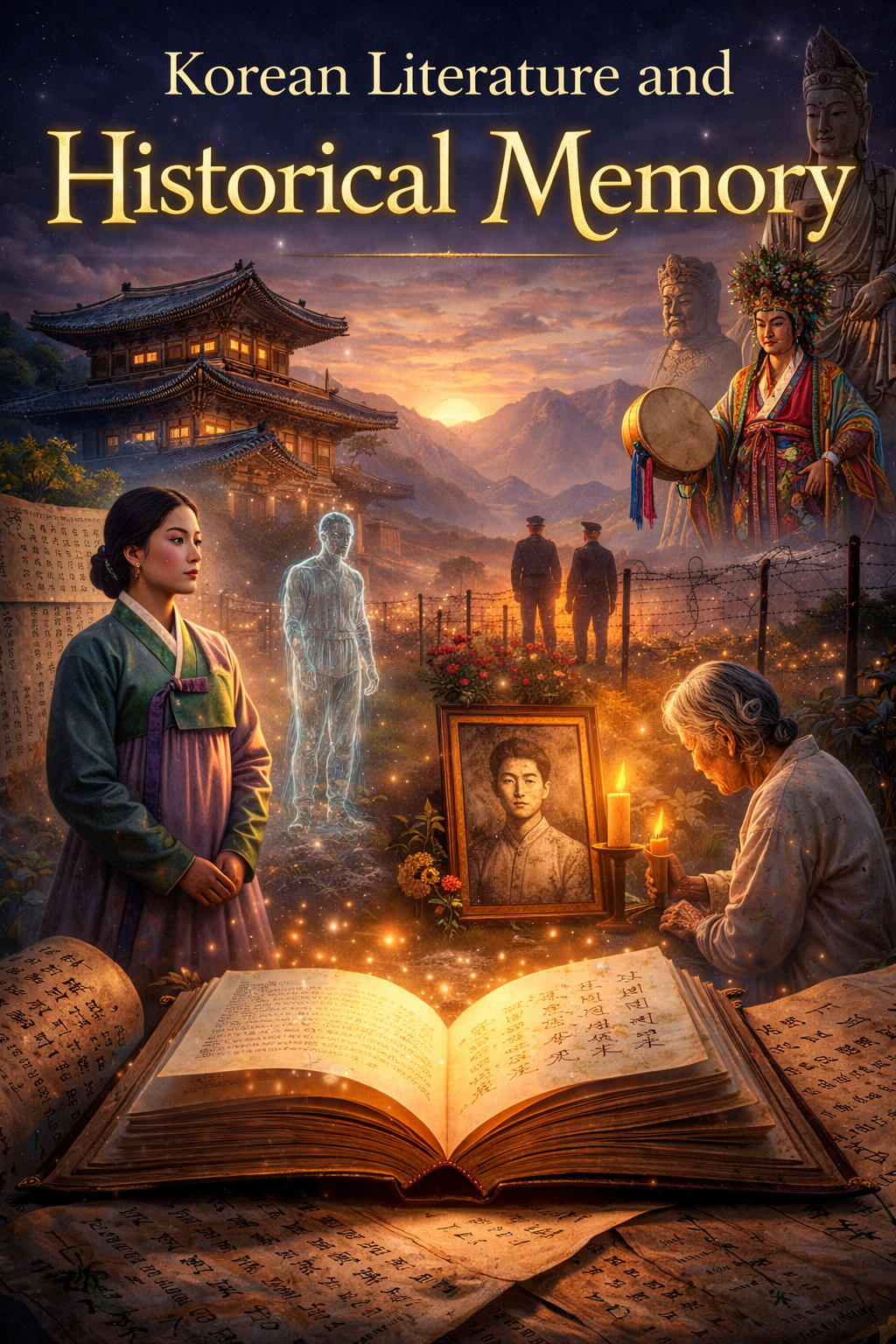
Read in this way, Korean literature becomes more than literary history. It becomes a record of how a civilization has repeatedly converted pressure into form: how sorrow becomes lyric compression; how family becomes archive; how script becomes access; how women’s writing alters the record of inner life; how pansori and oral performance preserve communal feeling differently from elite textual forms; how colonial rule turns language into a site of survival; how war and partition make absence a continuing literary condition; and how testimony, prison writing, dissident poetry, and contemporary fiction bear witness without surrendering aesthetic discipline.
Korean Literature and Historical Memory therefore stands at the intersection of literary history, East Asian intellectual history, Confucian ethics, Buddhist reflection, shamanic and folk traditions, gender history, colonial modernity, war memory, democracy movements, diaspora studies, translation, and world literature. It asks how literature preserves memory when public history is interrupted, censored, divided, occupied, or made unbearable. It also asks how refinement, wit, intimacy, spiritual depth, and moral intelligence survive beside catastrophe. Korean literature is not only a record of suffering. It is one of the great archives of endurance: a tradition that gives grief cadence, memory discipline, and historical rupture a human voice.
Korean Literature as Historical Memory
Korean literature is one of the great historical-memory systems of world literature because it repeatedly transforms rupture into forms of disciplined remembrance. It preserves not only events, but the emotional and ethical structures through which events become bearable: restraint, lament, filial memory, moral witness, spiritual endurance, household recollection, communal performance, and the unfinished work of testimony. The tradition is marked by deep continuity, but also by repeated breaks: invasion, dynastic transformation, Japanese colonial rule, linguistic coercion, war, partition, authoritarian repression, migration, and global translation.
Its power lies in the fact that Korean literature often carries immense historical pressure through forms that refuse spectacle. Sorrow is not always amplified; it is condensed. Witness is not always declarative; it may be restrained, fragmentary, domestic, symbolic, or quiet. Division is not only a geopolitical condition; it becomes a structure of narrative absence, broken family memory, inaccessible homeland, and suspended mourning. The literary archive is therefore not merely descriptive. It is ethical. It asks how a people remembers when history has repeatedly injured the conditions of memory itself.
To study Korean Literature and Historical Memory is to study literature as endurance: not endurance as passive survival, but as the formal, moral, and imaginative labor of carrying grief, beauty, duty, and witness across historical fracture.
Why This Pillar Matters
Korean Literature and Historical Memory matters because few literary traditions so powerfully join civilizational inheritance with historical rupture. Korean writing repeatedly asks how one lives under damaged conditions without surrendering dignity; how one remembers catastrophe without being wholly consumed by it; how literary form can sustain moral intelligence when public life becomes violent, divided, or false; and how feeling can remain disciplined without becoming numb. Its central power lies in the relation between historical pressure and formal restraint.
It also matters because Korean literature shows how language and access shape memory. The relation among Classical Chinese, elite literary prestige, vernacular Korean, and Hangul is not a narrow technical issue. It determines who can write, who can read, whose grief enters the archive, how women’s voices become legible, and how national literary identity becomes possible. Script is therefore one of the major memory structures of the tradition.
Just as importantly, Korean literature matters because it preserves the relation between public catastrophe and private feeling. Courtly order, family hierarchy, filial duty, feminine interiority, colonial humiliation, wartime loss, separation of kin, state violence, censorship, exile, adoption, and diaspora all become literary problems. Korean writing does not simply report these histories. It gives them cadence, emotional texture, ritual depth, and moral form.
Scope and Method
This pillar is expansive by design, but ordered by a clear historical-memory center. It includes classical poetry, hyangga, sijo, kasa, Buddhist prose, Confucian literati writing, travel records, court memoir, women’s vernacular writing, oral narrative, pansori, folktale, vernacular fiction, colonial modernist writing, resistance literature, war narrative, division literature, prison writing, dissident poetry, testimony, democratic movement writing, North-South memory studies, diaspora literature, adoption narratives, contemporary Korean fiction, and translated Korean literature in world circulation.
The method throughout is to read Korean literature as both art and memory. That means attending to genre, script, language, rhythm, voice, performance, gender, religious inheritance, historical setting, and formal pressure while also asking what these works preserve about duty, grief, kinship, colonization, war, division, repression, migration, and survival. How does sijo compress moral and emotional reflection? How does pansori preserve communal feeling through voice and performance? How does Hangul alter literary access? How do women’s memoirs and household writings change the archive? How does colonial rule turn language into a contested field? How does division structure narrative absence? How does modern testimony preserve truth under repression? How does contemporary Korean literature carry older memory structures into global translation?
This pillar also reads critically. It does not reduce Korean literature to sorrow, nor does it treat concepts such as han as timeless national essence. It asks how such terms are historically produced, contested, formalized, and sometimes overused. It preserves the gravity of grief while resisting stereotype. It foregrounds beauty, wit, intimacy, moral intelligence, and renewal alongside catastrophe.
Reading Architecture for a Humanities Pillar
This literature pillar does not require a GitHub repository. Its research infrastructure is textual, bibliographic, historical, performative, philological, archival, and interpretive rather than code-based. The appropriate scholarly architecture consists of primary texts, reliable translations, anthologies, literary histories, performance studies, Hangul and script history, colonial-era scholarship, war and division studies, women’s writing, diaspora studies, translation studies, university press resources, and carefully ordered reading pathways.
A strong Korean Literature and Historical Memory pillar should therefore foreground:
- primary texts in reliable translation, scholarly edition, anthology, or archival form where appropriate;
- major forms including hyangga, sijo, kasa, Buddhist prose, Confucian literati writing, women’s vernacular writing, memoir, pansori, vernacular fiction, modern fiction, testimony, prison writing, and diaspora writing;
- script and language history, including Classical Chinese, Idu, vernacular Korean, Hangul, colonial language pressure, and translation;
- spiritual inheritances including Confucianism, Buddhism, shamanic and folk traditions, ritual mourning, ancestor relation, and the literary handling of unseen worlds;
- historical rupture including Japanese colonial rule, the Korean War, national division, authoritarian repression, democratization, massacre memory, migration, adoption, and diaspora;
- major writers and traditions including classical poets, Lady Hyegyeong, Kim Man-jung, Yi Kwang-su, Kim Sowol, Hwang Sun-won, Hwang Sok-yong, Ko Un, Park Wan-suh, Han Kang, and other modern and contemporary writers;
- critical attention to gender, class, state violence, censorship, ideology, translation, diaspora, and the politics of canon formation.
The Canonical Spine of the Tradition
The canonical spine of Korean Literature and Historical Memory should be organized around forms and historical pressures rather than only individual authors. One center is classical and dynastic: hyangga, sijo, kasa, Buddhist writing, Confucian literati culture, courtly prose, and the moral literary order of the Joseon world. Another is script and access: the long relation between Classical Chinese and vernacular Korean, and the transformative cultural significance of Hangul. A third is women’s writing and domestic memory: court memoir, household texts, vernacular narrative, and the archive of inner life. A fourth is oral and performed memory: pansori, folktale, popular narrative, and communal voice. A fifth is modern rupture: colonial rule, war, division, authoritarianism, migration, and contemporary world-literary circulation.
Within this structure stand key works, forms, and figures. Sijo preserves lyric compression and disciplined feeling. Kasa carries extended reflection. Pansori preserves voice, satire, lament, and communal emotional force. The Memoirs of Lady Hyegyeong remains central to court memory, women’s writing, trauma, and political family history. The Nine Cloud Dream opens major questions of vernacular narrative, Buddhist illusion, and classical fiction. Kim Sowol’s poetry preserves lyric sorrow and national feeling. Hwang Sok-yong, Park Wan-suh, and Han Kang help define modern and contemporary memory of war, violence, democratization, gender, and human dignity.
The tradition’s strength lies in its ability to hold refinement and rupture together. Korean literature is never only a literature of historical wound. It is also a literature of lyric intelligence, spiritual depth, moral discipline, household continuity, and the search for renewal after fracture.
Foundational Questions
- How does Korean literature preserve historical memory across dynastic continuity, colonization, war, division, repression, migration, and global translation?
- How do literary forms such as sijo, kasa, pansori, memoir, testimony, and modern fiction carry memory differently?
- How did Hangul and vernacularization reshape literary access, gendered authorship, and the social archive?
- How do Confucian, Buddhist, and shamanic inheritances structure feeling, family, mourning, spirit, and moral imagination?
- How should concepts such as grief, sorrow, endurance, and han be read without turning them into stereotype?
- What role do women’s voices play in transforming the archive of family, court, domestic life, violence, and inner memory?
- How do oral tradition and pansori preserve communal feeling differently from elite literary forms?
- How did Japanese colonial rule transform language, modernity, censorship, national memory, and literary survival?
- How do war and division become ongoing literary conditions rather than completed historical events?
- How does modern Korean literature bear witness to authoritarian violence, democratic struggle, massacre memory, and moral repair?
- How do diaspora, adoption, migration, translation, and world literature reshape Korean literary memory beyond the peninsula?
I. Form as Memory: Sijo, Kasa, Pansori, Memoir, Testimony, and the Korean Archive
One of the clearest organizing principles of Korean literature is that form itself carries memory. Korean literary culture preserves historical consciousness not only through subject matter, but through inherited structures of writing, performance, rhythm, compression, repetition, restraint, lament, testimony, and voice. Sijo condenses reflection into disciplined brevity. Kasa extends meditative and didactic movement through patterned narration. Vernacular fiction opens social and emotional interiors. Memoir and testimony preserve moral witness through personal address. Pansori and oral traditions retain collective cadence and emotional force that differ from elite literate forms.
This matters because dynasty, colonization, war, and division do not simply enter neutral genres as content. They are shaped by the capacities and pressures of form itself. Korean literary memory therefore cannot be understood by theme alone. It must be read through the forms by which memory is made durable.
- Form as Memory in Korean Literature (planned) — A foundational article on how sijo, kasa, pansori, memoir, testimony, and fiction preserve memory through distinct formal structures.
- Sijo and the Discipline of Lyric Compression (planned) — A study of sijo as a form of concentrated reflection, moral restraint, and historical feeling.
- Kasa and the Extended Voice of Reflection (planned) — An article on kasa as meditative movement, moral narration, travel reflection, and didactic literary form.
- Pansori, Voice, and the Performed Archive of Feeling (planned) — A study of performance, rhythm, communal participation, humor, lament, and vocal endurance.
- Memoir and Testimony as Moral Witness in Korean Literature (planned) — An article on personal record, trauma, political witness, family history, and ethical narration.
- How Korean Literary Forms Carry Historical Pressure (planned) — A synthetic article on restraint, compression, repetition, fragmentation, and testimony as memory structures.
II. Script, Language, Hangul, and Literary Access
No serious account of Korean literature can avoid the question of script and language. Korean literary history is profoundly marked by the relation among Classical Chinese, literary prestige, scholarly authority, vernacular Korean, and Hangul. This is not a merely technical matter. It shapes who can write, who can read, whose voice enters the archive, how education is distributed, how hierarchy is maintained, and how a national literary tradition becomes imaginable.
The politics of script also intersect with gender and class. Elite male literary culture long operated through forms inaccessible to many others, while vernacularization expanded participation and transformed the emotional range of the written record. Hangul is therefore not only a writing system. It is one of the great turning points in Korean literary memory because it alters the relation between formal learning and lived language, elite archive and household voice, state culture and vernacular self-expression.
- Classical Chinese, Hangul, and the Politics of Literary Access (planned) — A foundational article on script, hierarchy, literacy, vernacularization, and cultural memory.
- Script and Social Hierarchy in Korean Literary History (planned) — A study of how script systems shaped class, education, gender, and literary authority.
- Hangul and the Making of a National Literary Imagination (planned) — An article on Hangul as cultural infrastructure, memory medium, and literary turning point.
- Vernacularization and the Expansion of Literary Voice (planned) — A study of how vernacular writing expanded who could speak within the literary archive.
- Women, Hangul, and the Household Archive (planned) — An article on script, women’s writing, domestic memory, and inner life.
- Language Pressure, Translation, and Korean Literary Survival (planned) — A study of language as a site of power from classical hierarchy through colonial rule and global translation.
III. Confucian Order, Dynastic Worlds, and Moral Literary Culture
Confucian order forms one of the deepest frameworks of Korean literary history. Dynastic, and especially Neo-Confucian, culture shaped moral vocabulary, education, family structure, official identity, mourning practices, political reflection, and ideals of cultivated selfhood. Literature became a medium for ethical refinement, loyalty, remonstrance, self-discipline, filial memory, and meditations on duty under imperfect rule.
Yet Confucian literary culture is not reducible to official orthodoxy. It also shapes intimacy, loss, and interior life. Mourning, family obligation, restrained feeling, ritual propriety, and the burden of moral conduct all become literary pressures. Even modern Korean literature, including works that resist or expose social order, continues to inherit the tonal and ethical force of Confucian structures.
- Confucian Order and Literary Culture in Korea (planned) — A major article on moral education, family hierarchy, self-cultivation, ritual, and literary form.
- Court Poetry, Scholarship, and Moral Reflection (planned) — A study of dynastic literary culture, official writing, cultivated selfhood, and ethical expression.
- Loyalty, Mourning, and the Ethics of Dynastic Writing (planned) — An article on duty, grief, remonstrance, and memory within Confucian literary worlds.
- The Literati Tradition in Korean Cultural Memory (planned) — A study of scholars, officials, poetry, letters, travel writing, and moral authorship.
- Family as Moral Archive in Korean Literature (planned) — An article on filial obligation, ancestry, domestic hierarchy, and intergenerational memory.
- Neo-Confucianism and the Literary Discipline of Feeling (planned) — A study of restraint, propriety, learning, self-cultivation, and emotional form.
IV. Buddhist, Shamanic, and Spiritual Inheritances
Korean literary memory is shaped not by a single doctrinal tradition but by overlapping spiritual inheritances. Buddhist writing contributes meditations on suffering, impermanence, compassion, emptiness, detachment, and release. It offers literary resources for confronting grief, vanity, transience, and the instability of worldly life. Shamanic and folk traditions contribute ritual mediation, spirit presence, fate, communal healing, cosmological permeability, and the survival of non-elite sacred worlds within everyday experience.
These inheritances do not remain sealed off from one another. Korean literature often carries their combined pressure. A Confucian moral order may frame the social world, while Buddhist sensibility deepens awareness of loss and impermanence, and shamanic residue preserves more porous relations between life, death, memory, and unseen presence.
- Buddhist Writing and the Literature of Impermanence in Korea (planned) — A study of suffering, release, compassion, detachment, and impermanence in literary form.
- Compassion, Emptiness, and Spiritual Reflection in Korean Literature (planned) — An article on Buddhist thought and the shaping of literary memory.
- Shamanic Residue and Spirit Worlds in Korean Cultural Memory (planned) — A study of ritual mediation, unseen presence, folk cosmology, and literary imagination.
- Sacred Continuity Beyond Official Orthodoxy (planned) — An article on non-elite spiritual worlds, ritual practice, and the persistence of folk memory.
- Confucian, Buddhist, and Shamanic Overlap in Korean Literature (planned) — A synthetic article on layered spiritual inheritance and literary form.
- Death, Ritual, and the Unseen in Korean Writing (planned) — A study of mourning, spirit, ancestor relation, ritual obligation, and memory.
V. Grief, Han, Sorrow, and the Problem of Historical Feeling
Korean literature cannot be understood without a serious account of grief, sorrow, wounded endurance, and unresolved feeling. These should not be reduced to cliché or national essence. They are literary problems: how suffering is voiced, compressed, ritualized, inherited, or carried in silence. Repeated invasion, social constraint, family separation, colonial humiliation, war, massacre, ideology, exile, and authoritarian violence all produce forms of sorrow that are historically specific and formally mediated.
One of the striking features of Korean literary culture is that intense feeling is often transmitted through restraint rather than expansion. Lament may appear in compressed lyric, domestic recollection, quiet testimony, or morally disciplined reflection. The burden of the field lies partly here: memory is preserved not only through declaration, but through withheld grief, moral tension, and endurance that refuse easy closure.
- Grief and Historical Sorrow in Korean Literature (planned) — A foundational article on grief as formal, ethical, and historical memory rather than stereotype.
- Han as Literary Problem, Not Cultural Stereotype (planned) — A critical article on the uses, risks, and literary complexity of han.
- Restraint, Silence, and the Compression of Feeling (planned) — A study of understated grief, lyric control, pauses, fragments, and withheld expression.
- Lament, Endurance, and Unresolved Memory (planned) — An article on lament as historical carrying rather than closure.
- How Korean Literature Carries Collective Woundedness (planned) — A study of shared injury, historical burden, and formal mediation.
- The Ethics of Sorrow in Korean Writing (planned) — A synthetic article on grief, dignity, witness, restraint, and moral seriousness.
VI. Women, Family, Household Writing, and the Inner Archive
Korean literature must be read through the voices and records that emerge from women’s experience, domestic life, and family memory. Women’s writing, court memoir, vernacular narrative, household reflection, lyric expression, and modern fiction reveal aspects of the tradition that elite male textuality alone cannot capture. Through these writings, family becomes not only a site of moral order but of emotional confinement, intimacy, sacrifice, memory transmission, and historical survival.
Women’s voices are central to the preservation of inner life. They reshape the archive of longing, domestic discipline, kinship, education, motherhood, daughterhood, widowhood, social expectation, and private resilience. A serious pillar on Korean literature cannot relegate women’s writing to a subsection of representation; it must recognize it as one of the main ways the civilization remembers itself from within.
- Women’s Voices in Korean Literary History (planned) — A major article on women’s writing, vernacular access, domestic memory, and literary authority.
- The Memoirs of Lady Hyegyeong and the Politics of Court Memory (planned) — A focused article on court trauma, family, politics, gender, and autobiographical authority.
- Household Writing and the Inner Archive (planned) — A study of domestic record, family memory, women’s voice, and private history.
- Vernacular Memory, Domestic Space, and Female Expression (planned) — An article on Hangul, household texts, emotional access, and literary interiority.
- Family, Daughterhood, Motherhood, and Literary Continuity (planned) — A study of kinship, care, sacrifice, mourning, and intergenerational memory.
- Gender, Constraint, and Emotional Intelligence in Korean Literature (planned) — A critical article on gendered expectation, constraint, survival, and literary power.
VII. Oral Tradition, Pansori, and Performed Memory
Korean literary memory is not exclusively textual. Oral tradition and performed forms such as pansori preserve communal modes of narration, rhythm, emotional accumulation, humor, lament, and endurance that differ from elite written genres. Performance allows collective feeling to be staged, shared, reiterated, and socially embodied. It preserves voices that do not enter the archive in the same way as court literature or scholarly prose.
Pansori is especially important because it joins narrative intensity, vocal endurance, emotional range, and communal memory. It carries satire, moral conflict, pathos, resilience, and social intelligence through performance rather than silent reading. The literary field is therefore both textual and performed, elite and vernacular, codified and communal.
- Pansori and the Performed Archive of Korean Memory (planned) — A major article on voice, story, emotional accumulation, humor, and communal memory.
- Oral Tradition and Communal Feeling in Korean Literature (planned) — A study of folktale, oral narrative, shared memory, and popular literary intelligence.
- Performance, Lament, and Collective Endurance (planned) — An article on rhythm, repetition, suffering, resilience, and performance as archive.
- Popular Narrative Beyond Elite Textual Culture (planned) — A study of popular story, vernacular memory, social critique, and non-elite voice.
- Voice, Rhythm, and Social Memory in Korean Performance Traditions (planned) — An article on sonic memory, embodiment, and performed transmission.
- How Performance Preserves What the Archive Misses (planned) — A synthetic article on oral, communal, and embodied memory.
VIII. Colonial Rule, Language Pressure, and Literary Survival
Japanese colonial rule introduced one of the defining ruptures of modern Korean literary history. Colonization was not only a political condition but a crisis of language, script, cultural legitimacy, authorship, censorship, education, collaboration, and survival. Literature written during this period must be read through competing pressures: resistance, adaptation, coded expression, assimilation demands, fractured modernity, linguistic struggle, and the attempt to preserve Korean cultural memory under conditions designed to subordinate or erase it.
Colonial-era literature confronts the problem of speaking in damaged conditions: how to write when one’s language is under pressure, when national continuity is threatened, and when modernity itself arrives through occupation and coercion. Colonial modernity becomes one of the principal engines of modern Korean literary form and historical memory.
- Korean Literature under Japanese Colonial Rule (planned) — A foundational article on language, censorship, occupation, resistance, assimilation, and literary survival.
- Language Pressure, Cultural Survival, and Literary Resistance (planned) — A study of Korean language, script, colonial policy, and literary self-preservation.
- Colonial Modernity and the Fracturing of Literary Selfhood (planned) — An article on modernity under coercion, identity, form, and cultural rupture.
- Censorship, Assimilation, and the Politics of Voice (planned) — A study of literary constraint, coded writing, collaboration, and silence.
- Resistance Literature and the Burden of National Preservation (planned) — An article on literature as cultural continuity under colonial domination.
- Writing Korea under Occupation (planned) — A synthetic article on colonial-era literary memory, ambiguity, and survival.
IX. War, Division, and the Fractured Nation
The Korean War and the partition of the peninsula transformed Korean literature at every level. They produced mass death, displacement, ideological rupture, family separation, silence, propaganda, grief, and unending absence. But division is not simply a past event that literature revisits. It remains an ongoing literary condition. It structures longing, return, memory, estrangement, testimony, and the imagination of nationhood itself.
In literary terms, division often appears through broken kinship, suspended mourning, inaccessible homeland, silence across borders, ideological distortion, and the painful awareness that the nation remains narratively incomplete. Korean literature after war is therefore not merely war literature. It is literature shaped by unresolved fracture.
- The Korean War in Literary Memory (planned) — A major article on war, displacement, death, family separation, ideology, and testimony.
- Partition as Ongoing Literary Condition (planned) — A study of division as narrative structure, emotional absence, and national incompletion.
- Family Separation and the Narrative of Absence (planned) — An article on kinship rupture, longing, inaccessible relatives, and suspended mourning.
- Exile, Return, and the Impossible Homeland (planned) — A study of return, longing, border, memory, and the broken geography of belonging.
- National Fracture and the Literature of Unfinished Mourning (planned) — An article on grief that remains historically unresolved.
- Silence, Ruin, and the Broken Social World after War (planned) — A study of postwar silence, trauma, social damage, and literary reconstruction.
X. Authoritarianism, Dissent, and Moral Witness
Modern Korean literature also bears the weight of authoritarian rule, censorship, state violence, imprisonment, democratic struggle, and moral witness. These should be approached as literary problems, not only political events. How does one narrate repression under censorship? How does literature testify when public language is falsified? How does one preserve the dignity of witnesses, prisoners, workers, protesters, and bereaved families without reducing them to symbols?
Dissident writing, prison literature, documentary fiction, testimonial prose, and morally charged modern poetry become central here. They preserve not only the facts of repression but the ethical difficulty of speaking under distorted conditions. Korean literature repeatedly asks how truth can survive official silence.
- Authoritarian Violence and the Korean Literary Conscience (planned) — A major article on dictatorship, censorship, fear, state violence, and moral witness.
- Dissident Writing and the Ethics of Truth (planned) — A study of writers, activists, prisoners, and public speech under repression.
- Prison Literature, Testimony, and Moral Witness (planned) — An article on imprisonment, memory, witness, and ethical narration.
- Literature and Democratic Struggle in Modern Korea (planned) — A study of protest, democratization, massacre memory, and literary responsibility.
- Massacre, Silence, and the Work of Recovery (planned) — An article on public grief, hidden histories, and the literary recovery of suppressed violence.
- How Korean Literature Speaks under Repression (planned) — A synthetic article on censorship, coded form, testimony, and dignity.
XI. North, South, and Asymmetrical Memory Worlds
A serious account of Korean literary memory must acknowledge that after division there is not simply one literary nation with a wound, but two asymmetrical memory worlds shaped by radically different political and ideological conditions. North and South preserve, erase, discipline, and narrate the past differently. Their literary institutions, permissible themes, official myths, silences, and memorial structures are not the same.
This does not eliminate the possibility of a shared civilizational inheritance. But it does mean that post-division Korean literature cannot be approached as though memory were singular. The fracture affects archive, voice, reception, and the imagination of return. Korean literary history after division is therefore both continuous and broken.
- North and South as Asymmetrical Literary Memory Worlds (planned) — A major article on division, literary institutions, ideology, silence, and shared inheritance.
- Official Narrative and Silence after Division (planned) — A study of state memory, propaganda, censorship, and what cannot be said.
- Shared Heritage, Broken Archive (planned) — An article on premodern continuity and post-division rupture.
- Ideology and the Fate of Literary Form on the Peninsula (planned) — A study of form under different regimes of memory and control.
- Comparing Memory Regimes in Korean Literature (planned) — An article on South Korean, North Korean, exile, and diaspora memory systems.
- The Literary Imagination of Reunification and Distance (planned) — A study of reunion, impossibility, longing, and unresolved national narrative.
XII. Diaspora, Migration, Adoption, and Return
Korean literary memory extends beyond the peninsula. Diasporic and migrant writing preserves other forms of rupture and continuity: colonial displacement, war diaspora, labor migration, transnational family separation, adoption, exile, and the uneasy relation between homeland memory and new linguistic worlds. In such writing, return may be desired, impossible, symbolic, or incomplete. Language itself may become unstable, divided between inheritance and reinvention.
These diasporic traditions expand the category by showing that Korean literary memory is not confined to national territory. It survives in displaced households, multilingual lives, inherited longing, and reconstructed belonging. Diasporic writing reopens the question of identity: what remains Korean when place, language, generation, and political formation have all shifted?
- Korean Diasporic Writing and the Memory of Displacement (planned) — A major article on migration, exile, return, inherited memory, and transnational identity.
- Migration, Language Loss, and Literary Reinvention (planned) — A study of multilingual writing, generational distance, and cultural reconstruction.
- Adoption, Separation, and the Search for Return (planned) — An article on transnational adoption, family rupture, memory, and identity.
- Homeland, Distance, and Intergenerational Memory (planned) — A study of longing, inherited history, family stories, and uncertain belonging.
- Transnational Korean Identity in Literature (planned) — An article on diaspora, translation, hybrid identity, and global Korean writing.
- What Diaspora Adds to Korean Historical Memory (planned) — A synthetic article on movement, loss, reinvention, and memory beyond the peninsula.
XIII. Modern and Contemporary Korean Writers as Memory Workers
Modern and contemporary Korean writers are not merely individual authors within a national canon. Many function as memory workers: figures who transform colonial modernity, war, division, authoritarian violence, gendered injury, and unresolved grief into literary form. Yi Kwang-su opens difficult questions of colonial modernity and national literature. Kim Sowol condenses sorrow into lyric form. Hwang Sun-won preserves fragile human bonds under historical pressure. Hwang Sok-yong bears witness to war, division, and political violence. Park Wan-suh records the domestic afterlife of war with extraordinary clarity. Han Kang gives contemporary Korean literature one of its most powerful global languages of violence, body, memory, and human dignity.
A serious pillar should treat these writers not only as names to list, but as deep-dive centers through which Korean historical memory becomes legible in specific forms.
- Sijo and the Classical Korean Lyric Tradition (planned) — A deep-dive article on classical lyric form, compression, ethics, and historical memory.
- The Memoirs of Lady Hyegyeong and the Politics of Court Memory (planned) — A focused study of autobiography, gender, court trauma, and dynastic memory.
- Kim Man-jung and Vernacular Narrative Worlds (planned) — An article on The Nine Cloud Dream, Buddhist illusion, vernacular fiction, and narrative memory.
- Yi Kwang-su and the Problem of Colonial Modernity (planned) — A study of modern fiction, nationalism, collaboration, and colonial-era literary difficulty.
- Kim Sowol and the Lyric of National Sorrow (planned) — An article on lyric compression, longing, sorrow, and modern poetic memory.
- Hwang Sun-won and the Fragility of Human Bonds (planned) — A study of memory, childhood, war pressure, and fragile relational life.
- Hwang Sok-yong and the Burden of Historical Witness (planned) — An article on war, division, labor, political violence, and literary testimony.
- Ko Un and the Poetics of Collective Memory (planned) — A study of poetry, history, testimony, and the collective archive of lives.
- Park Wan-suh and the Domestic Afterlife of War (planned) — An article on women’s memory, family, war, domestic space, and postwar survival.
- Han Kang and the Literature of Violence, Memory, and Human Dignity (planned) — A study of body, massacre memory, grief, dignity, and global contemporary Korean literature.
XIV. Korean Literature, Translation, and World Literature
Korean literature contributes something distinctive to world literature: a powerful conjunction of formal restraint, ethical seriousness, historical sorrow, ritual intelligence, and durable human dignity. It is a tradition in which lyric compression and moral reflection often coexist; in which private feeling is shaped by collective discipline; in which grief is mediated through form rather than overflow; and in which repeated catastrophe does not erase refinement, intimacy, or literary beauty.
Its importance to world literature lies not only in national specificity but in the way it enlarges our understanding of literary memory itself. Korean writing shows that literature can preserve civilizational continuity without denying rupture, and can bear witness to suffering without surrendering formal intelligence. Translation has made this archive increasingly visible, but translation also raises questions of tone, cultural specificity, historical context, and the global reception of Korean sorrow, violence, and beauty.
- Korean Literature and World Literature (planned) — A major article on Korean literature’s global importance, translation, reception, and literary distinctiveness.
- Translation and the Global Circulation of Korean Memory (planned) — A study of what translation preserves, transforms, or risks flattening.
- Why Korean Literature Matters Beyond National Literature (planned) — An article on historical memory, ethical form, and world-literary significance.
- Contemporary Korean Fiction in Global Translation (planned) — A study of global readership, literary prizes, publishing, and translation politics.
- How Korean Literature Enlarges the Study of Cultural Memory (planned) — A synthetic article on grief, form, witness, and global literary thought.
XV. Major Genres Across Korean Historical Memory
A comprehensive pillar should also organize the archive by genre. Sijo preserves reflective compression. Kasa extends moral, travel, and meditative voice. Buddhist prose preserves impermanence and spiritual reflection. Confucian writing preserves moral order, family duty, and cultivated selfhood. Women’s vernacular writing preserves domestic and court memory. Pansori preserves communal performance, humor, and lament. Vernacular fiction opens narrative worlds beyond elite textuality. Colonial modern fiction records damaged modernity. War and division literature preserve fracture. Testimony and prison writing preserve moral witness. Diasporic writing carries memory across language, adoption, migration, and return.
- Sijo as Classical Korean Lyric Memory (planned) — A genre article on compression, reflection, moral discipline, and emotional restraint.
- Kasa as Extended Reflection and Literary Movement (planned) — A study of meditative, didactic, travel, and reflective poetic form.
- Pansori as Narrative Performance and Communal Archive (planned) — An article on voice, rhythm, humor, grief, and collective memory.
- Memoir and Court Memory in Korean Literature (planned) — A study of autobiography, court politics, trauma, and historical record.
- Vernacular Fiction and the Expansion of Korean Literary Worlds (planned) — An article on narrative, access, social life, and vernacular imagination.
- War Literature and the Narrative of Division (planned) — A study of battle, displacement, family separation, ideology, and absence.
- Testimony, Prison Writing, and Democratic Witness (planned) — An article on repression, truth, moral speech, and political memory.
- Diaspora Literature and the Rewriting of Belonging (planned) — A study of migration, adoption, exile, language, and reconstructed memory.
XVI. Recurring Themes and Memory Structures
Across these genres, certain structures recur with unusual force: script and access; filial memory and family obligation; grief and restraint; Buddhist impermanence; shamanic unseen presence; colonial pressure; war and partition; testimony under repression; household memory; women’s inner archive; diaspora and return; national longing and narrative incompletion. These themes help explain why Korean literature remains so powerful. It preserves not only historical events, but the patterned emotional and ethical worlds through which those events are endured and transmitted.
- Script, Memory, and the Politics of Access in Korean Literature (planned) — A thematic article on language, hierarchy, Hangul, and literary participation.
- Family, Filial Memory, and the Burden of Inheritance (planned) — A study of kinship, duty, mourning, hierarchy, and domestic archive.
- Grief, Restraint, and the Literary Shape of Endurance (planned) — An article on sorrow, compression, silence, and formal discipline.
- War, Division, and the Unfinished Nation (planned) — A study of partition, absence, ideological rupture, and unresolved national memory.
- Women’s Writing and the Inner History of Korea (planned) — An article on gendered memory, domestic life, vernacular expression, and literary authority.
- Spiritual Inheritance and the Literary Life of the Unseen (planned) — A study of Buddhism, shamanic residue, ancestors, spirits, and ritual memory.
- Witness, Repression, and the Ethics of Truth (planned) — An article on authoritarianism, testimony, prison writing, and democratic struggle.
- Migration, Return, and the Broken Geography of Belonging (planned) — A study of diaspora, adoption, exile, language, and reconstructed identity.
Expanded Article Architecture
The following long-range architecture preserves the full breadth of the category while clarifying its major centers of gravity: form, script, dynastic memory, spiritual inheritance, grief, women’s writing, performance, colonial rupture, war, division, authoritarian witness, diaspora, contemporary writers, translation, genres, and recurring memory structures.
Foundations of Korean Literary Memory
- Korean Literature and the Preservation of Historical Memory (planned)
- Why Korean Literary Form Matters (planned)
- Dynasty, Rupture, and Cultural Continuity in Korean Writing (planned)
- Literature as Moral Witness in Korean History (planned)
- Refinement, Restraint, and Historical Pressure in Korean Literary Tradition (planned)
- Korean Literature as a Civilizational Archive (planned)
Script, Language, and Literary Access
- Classical Chinese, Hangul, and the Politics of Literary Access (planned)
- Script and Social Hierarchy in Korean Literary History (planned)
- Vernacularization and the Expansion of Literary Voice (planned)
- Hangul and the Making of a National Literary Imagination (planned)
- Language, Literacy, and Cultural Memory in Korea (planned)
- How Script Shapes the Archive of Feeling (planned)
- Women, Hangul, and the Household Archive (planned)
Classical and Dynastic Literary Worlds
- Confucian Order and Literary Culture in Korea (planned)
- Court Poetry, Scholarship, and Moral Reflection (planned)
- Sijo and the Discipline of Lyric Form (planned)
- Kasa and the Extended Voice of Reflection (planned)
- Loyalty, Mourning, and the Ethics of Dynastic Writing (planned)
- The Literati Tradition in Korean Cultural Memory (planned)
- Family as Moral Archive in Korean Literature (planned)
Buddhist, Shamanic, and Spiritual Inheritances
- Buddhist Writing and the Literature of Impermanence in Korea (planned)
- Compassion, Emptiness, and Spiritual Reflection in Korean Literature (planned)
- Shamanic Residue and Spirit Worlds in Korean Cultural Memory (planned)
- Sacred Continuity Beyond Official Orthodoxy (planned)
- Confucian, Buddhist, and Shamanic Overlap in Korean Literary Imagination (planned)
- Death, Ritual, and the Unseen in Korean Writing (planned)
Grief, Han, and the Problem of Historical Feeling
- Grief and Historical Sorrow in Korean Literature (planned)
- Han as Literary Problem, Not Cultural Stereotype (planned)
- Restraint, Silence, and the Compression of Feeling (planned)
- Lament, Endurance, and Unresolved Memory (planned)
- How Korean Literature Carries Collective Woundedness (planned)
- The Ethics of Sorrow in Korean Writing (planned)
Women, Household Writing, and Family Memory
- Women’s Voices in Korean Literary History (planned)
- The Memoirs of Lady Hyegyeong and the Politics of Court Memory (planned)
- Household Writing and the Inner Archive (planned)
- Vernacular Memory, Domestic Space, and Female Expression (planned)
- Family, Daughterhood, Motherhood, and Literary Continuity (planned)
- Women’s Memoir and the Preservation of Intimate History (planned)
- Gender, Constraint, and Emotional Intelligence in Korean Literature (planned)
Orality, Performance, and Popular Memory
- Pansori and the Performed Archive of Korean Memory (planned)
- Oral Tradition and Communal Feeling in Korean Literature (planned)
- Performance, Lament, and Collective Endurance (planned)
- Popular Narrative Beyond Elite Textual Culture (planned)
- Voice, Rhythm, and Social Memory in Korean Performance Traditions (planned)
- How Performance Preserves What the Archive Misses (planned)
Colonial Rule and Literary Survival
- Korean Literature under Japanese Colonial Rule (planned)
- Language Pressure, Cultural Survival, and Literary Resistance (planned)
- Colonial Modernity and the Fracturing of Literary Selfhood (planned)
- Censorship, Assimilation, and the Politics of Voice (planned)
- Resistance Literature and the Burden of National Preservation (planned)
- Writing Korea under Occupation (planned)
War, Partition, and the Literature of Division
- The Korean War in Literary Memory (planned)
- Partition as Ongoing Literary Condition (planned)
- Family Separation and the Narrative of Absence (planned)
- Exile, Return, and the Impossible Homeland (planned)
- National Fracture and the Literature of Unfinished Mourning (planned)
- Silence, Ruin, and the Broken Social World after War (planned)
Authoritarianism, Witness, and Democratic Struggle
- Authoritarian Violence and the Korean Literary Conscience (planned)
- Dissident Writing and the Ethics of Truth (planned)
- Prison Literature, Testimony, and Moral Witness (planned)
- Literature and Democratic Struggle in Modern Korea (planned)
- Massacre, Silence, and the Work of Recovery (planned)
- How Korean Literature Speaks under Repression (planned)
North, South, and Divided Memory Systems
- North and South as Asymmetrical Literary Memory Worlds (planned)
- Official Narrative and Silence after Division (planned)
- Shared Heritage, Broken Archive (planned)
- Ideology and the Fate of Literary Form on the Peninsula (planned)
- Comparing Memory Regimes in Korean Literature (planned)
- The Literary Imagination of Reunification and Distance (planned)
Diaspora, Migration, Adoption, and Transnational Korean Writing
- Korean Diasporic Writing and the Memory of Displacement (planned)
- Migration, Language Loss, and Literary Reinvention (planned)
- Adoption, Separation, and the Search for Return (planned)
- Homeland, Distance, and Intergenerational Memory (planned)
- Transnational Korean Identity in Literature (planned)
- What Diaspora Adds to Korean Historical Memory (planned)
Major Writers and Deep-Dive Studies
- Sijo and the Classical Korean Lyric Tradition (planned)
- The Memoirs of Lady Hyegyeong and the Politics of Court Memory (planned)
- Kim Man-jung and Vernacular Narrative Worlds (planned)
- Yi Kwang-su and the Problem of Colonial Modernity (planned)
- Kim Sowol and the Lyric of National Sorrow (planned)
- Hwang Sun-won and the Fragility of Human Bonds (planned)
- Hwang Sok-yong and the Burden of Historical Witness (planned)
- Ko Un and the Poetics of Collective Memory (planned)
- Park Wan-suh and the Domestic Afterlife of War (planned)
- Han Kang and the Literature of Violence, Memory, and Human Dignity (planned)
Genres, Themes, and World Literature
- Korean Literature and World Literature (planned)
- Translation and the Global Circulation of Korean Memory (planned)
- Why Korean Literature Matters Beyond National Literature (planned)
- Contemporary Korean Fiction in Global Translation (planned)
- How Korean Literature Enlarges the Study of Cultural Memory (planned)
- Witness, Repression, and the Ethics of Truth (planned)
- Migration, Return, and the Broken Geography of Belonging (planned)
Closing Perspective
Korean Literature and Historical Memory reveals a tradition in which literary form has repeatedly become a vessel for survival. It preserves dynastic refinement and vernacular intimacy, ritual order and spiritual depth, domestic life and national catastrophe, private sorrow and collective fracture. It shows how a civilization can endure repeated rupture without surrendering either moral seriousness or aesthetic discipline. In Korean writing, grief is often compressed rather than theatrical, witness is often restrained rather than declarative, and memory remains active even where history has been violently broken.
This is what makes the tradition so important within Literature & Cultural Memory. Korean literature does not merely recount invasion, colonization, war, division, repression, and migration. It gives those histories shape, cadence, ethical intelligence, and human depth. It also preserves what catastrophe did not destroy: lyric refinement, household continuity, cultivated selfhood, spiritual reflection, communal voice, and the persistent search for dignity. As a long-range knowledge series, this pillar follows those tensions across classical, modern, and contemporary writing, showing how Korea’s literary traditions have carried memory not only as burden, but as one of the deepest sources of endurance and renewal.
Related Reading
- Literature & Cultural Memory
- East Asian Traditions
- Chinese Literature and Classical Memory
- Japanese Literature and Poetic Memory
- Chinese Thought
- Religious Studies
- Poetry, Memory, and Imagination
- Tragedy, Drama, and Collective Memory
Further Reading
- Lee, P.H. (ed.) (2003). A History of Korean Literature. Cambridge: Cambridge University Press. https://www.cambridge.org/core/books/history-of-korean-literature/5979C96693F5A406F75DD4E6E1FA9804
- Lee, P.H. (ed.) (2002). Columbia Anthology of Traditional Korean Poetry. New York: Columbia University Press. https://cup.columbia.edu/book/the-columbia-anthology-of-traditional-korean-poetry/9780231111133/
- Lee, P.H. (ed.) (2004). An Anthology of Traditional Korean Literature. Honolulu: University of Hawai‘i Press. https://uhpress.hawaii.edu/title/an-anthology-of-traditional-korean-literature/
- McCann, D.R. (2000). Early Korean Literature: Selections and Introductions. New York: Columbia University Press. https://korea.fas.harvard.edu/publications/early-korean-literature-selections-and-introductions
- Haboush, J.K. (2013). The Memoirs of Lady Hyegyong: The Autobiographical Writings of a Crown Princess of Eighteenth-Century Korea. Berkeley: University of California Press. https://www.ucpress.edu/books/the-memoirs-of-lady-hyegyong/paper
- Park, S.N. (2020). The Korean Vernacular Story: Telling Tales of Contemporary Chosŏn in Sinographic Writing. New York: Columbia University Press. https://cup.columbia.edu/book/the-korean-vernacular-story/9780231182812/
- Park, S.N. (2020). Premodern Korean Literary Prose: An Anthology. New York: Columbia University Press. https://cup.columbia.edu/book/premodern-korean-literary-prose/9780231186179/
- Fulton, B. and Fulton, J. (eds.) (2005). Modern Korean Fiction: An Anthology. New York: Columbia University Press.
- Kim, K.-D. and Fulton, B. (eds.) (1998). Wayfarer: New Fiction by Korean Women. Seattle: Women in Translation.
- Kihl, Y.W. and Kim, H.N. (eds.) (2006). North Korea: The Politics of Regime Survival. Armonk, NY: M.E. Sharpe.
- Seth, M.J. (2011). A Concise History of Modern Korea: From the Late Nineteenth Century to the Present. Lanham, MD: Rowman & Littlefield. https://www.bloomsbury.com/us/concise-history-of-modern-korea-9781538197745/
- Shin, G.-W. and Hwang, K. (eds.) (2003). Contentious Kwangju: The May 18 Uprising in Korea’s Past and Present. Lanham, MD: Rowman & Littlefield. https://www.bloomsbury.com/us/contentious-kwangju-9798216236498/
- Yun, S. and Fulton, B. (eds.) (2018). Readymade Bodhisattva: The Kaya Anthology of South Korean Science Fiction. New York: Kaya Press. https://kaya.com/books/readymade-bodhisattva/
References
- Haboush, J.K. (2013). The Memoirs of Lady Hyegyong: The Autobiographical Writings of a Crown Princess of Eighteenth-Century Korea. Berkeley: University of California Press. https://www.ucpress.edu/books/the-memoirs-of-lady-hyegyong/paper
- Han, K. (2017). Human Acts. Translated by D. Smith. New York: Hogarth. https://www.penguinrandomhouse.com/books/536652/human-acts-by-han-kang/
- Han, K. (2018). The White Book. Translated by D. Smith. New York: Hogarth. https://www.penguinrandomhouse.com/books/566130/the-white-book-by-han-kang/
- Han, K. (2025). We Do Not Part. Translated by E. Yaewon and P.A. Morris. New York: Hogarth. https://www.penguinrandomhouse.com/books/743885/we-do-not-part-by-han-kang-translated-by-e-yaewon-and-paige-aniyah-morris/
- Hwang, S.-w. (1989). The Shadow of Arms. Translated by S. Yi. Armonk, NY: M.E. Sharpe.
- Hwang, S.-w. (2009). The Guest. Translated by K.J. Chun and M. West. New York: Seven Stories Press. https://sevenstories.com/books/3575-the-guest
- Kim, M.-j. (2000). A Nine Cloud Dream. Translated by J.R. Ryu. New York: Penguin Classics.
- Kim, S. (2007). Azaleas: A Book of Poems. Translated by D.R. McCann. New York: Columbia University Press. https://www.jstor.org/stable/10.7312/sowo13972
- Ko, U. (2004). Ten Thousand Lives. Translated by B. Brother Anthony, C. Sister Anthony, and G. McCann. Los Angeles: Green Integer. https://www.greeninteger.com/book.cfm?-Ko-Un-Ten-Thousand-Lives-=&BookID=132
- Lee, P.H. (ed.) (2003). A History of Korean Literature. Cambridge: Cambridge University Press. https://www.cambridge.org/core/books/history-of-korean-literature/5979C96693F5A406F75DD4E6E1FA9804
- Lee, P.H. (ed.) (2002). Columbia Anthology of Traditional Korean Poetry. New York: Columbia University Press. https://cup.columbia.edu/book/the-columbia-anthology-of-traditional-korean-poetry/9780231111133/
- Lee, P.H. (ed.) (2004). An Anthology of Traditional Korean Literature. Honolulu: University of Hawai‘i Press. https://uhpress.hawaii.edu/title/an-anthology-of-traditional-korean-literature/
- McCann, D.R. (2000). Early Korean Literature: Selections and Introductions. New York: Columbia University Press. https://korea.fas.harvard.edu/publications/early-korean-literature-selections-and-introductions
- Park, S.N. (2020). Premodern Korean Literary Prose: An Anthology. New York: Columbia University Press. https://cup.columbia.edu/book/premodern-korean-literary-prose/9780231186179/
- Park, S.N. (2020). The Korean Vernacular Story: Telling Tales of Contemporary Chosŏn in Sinographic Writing. New York: Columbia University Press. https://cup.columbia.edu/book/the-korean-vernacular-story/9780231182812/
- Park, W.-s. (2007). Who Ate Up All the Shinga? Translated by Y. Chun and B. Fulton. New York: Columbia University Press. https://cup.columbia.edu/book/who-ate-up-all-the-shinga/9780231148986/
- Seth, M.J. (2011). A Concise History of Modern Korea: From the Late Nineteenth Century to the Present. Lanham, MD: Rowman & Littlefield. https://www.bloomsbury.com/us/concise-history-of-modern-korea-9781538197745/
- Shin, G.-W. and Hwang, K. (eds.) (2003). Contentious Kwangju: The May 18 Uprising in Korea’s Past and Present. Lanham, MD: Rowman & Littlefield. https://www.bloomsbury.com/us/contentious-kwangju-9798216236498/
- Yi, K.-su. (2005). Mujŏng / The Heartless. Seoul: Seoul National University Press.
- Yun, S. and Fulton, B. (eds.) (2018). Readymade Bodhisattva: The Kaya Anthology of South Korean Science Fiction. New York: Kaya Press. https://kaya.com/books/readymade-bodhisattva/