
Last Updated June 2, 2026
Resilience thinking examines how complex systems absorb disturbance, adapt to change, maintain essential functions, and reorganize under conditions of uncertainty, stress, volatility, and disruption. Rather than treating disturbance as an anomaly, resilience thinking begins from the premise that shock, change, surprise, and structural instability are normal features of ecological, social, economic, institutional, technological, and infrastructural life. The central question is therefore not whether systems will be disturbed, but how they respond when disturbance occurs.
This content pillar brings together the major domains through which resilience thinking interprets persistence, recovery, adaptation, transformation, threshold risk, cross-scale dynamics, and long-term viability. It treats resilience not as a slogan for “bouncing back,” but as a rigorous systems framework for understanding how ecological systems, communities, institutions, infrastructures, supply chains, economies, governance arrangements, and social-ecological systems remain functional, reorganize, or transform under stress. Across ecology, sustainability science, disaster risk reduction, climate adaptation, infrastructure planning, governance research, community development, risk analysis, and strategic foresight, resilience thinking provides an indispensable language for understanding how systems survive, fail, adapt, or change regime.
Resilience thinking also belongs to the contemporary sciences of systems modeling, scenario analysis, threshold modeling, network resilience, adaptive governance, climate-risk analysis, infrastructure analytics, social-ecological indicators, disaster preparedness, institutional learning, and reproducible analytical workflows. Many resilience questions now require not only conceptual explanation, but programmable environments capable of modeling disturbance loads, adaptive capacity, recovery pathways, threshold distance, redundancy, diversity, modularity, cascading failure, social vulnerability, institutional capacity, transformation risk, and long-horizon viability. The field therefore stands at the intersection of systems thinking, ecology, sustainability, governance, risk, infrastructure, economics, public policy, futures thinking, and computational modeling.
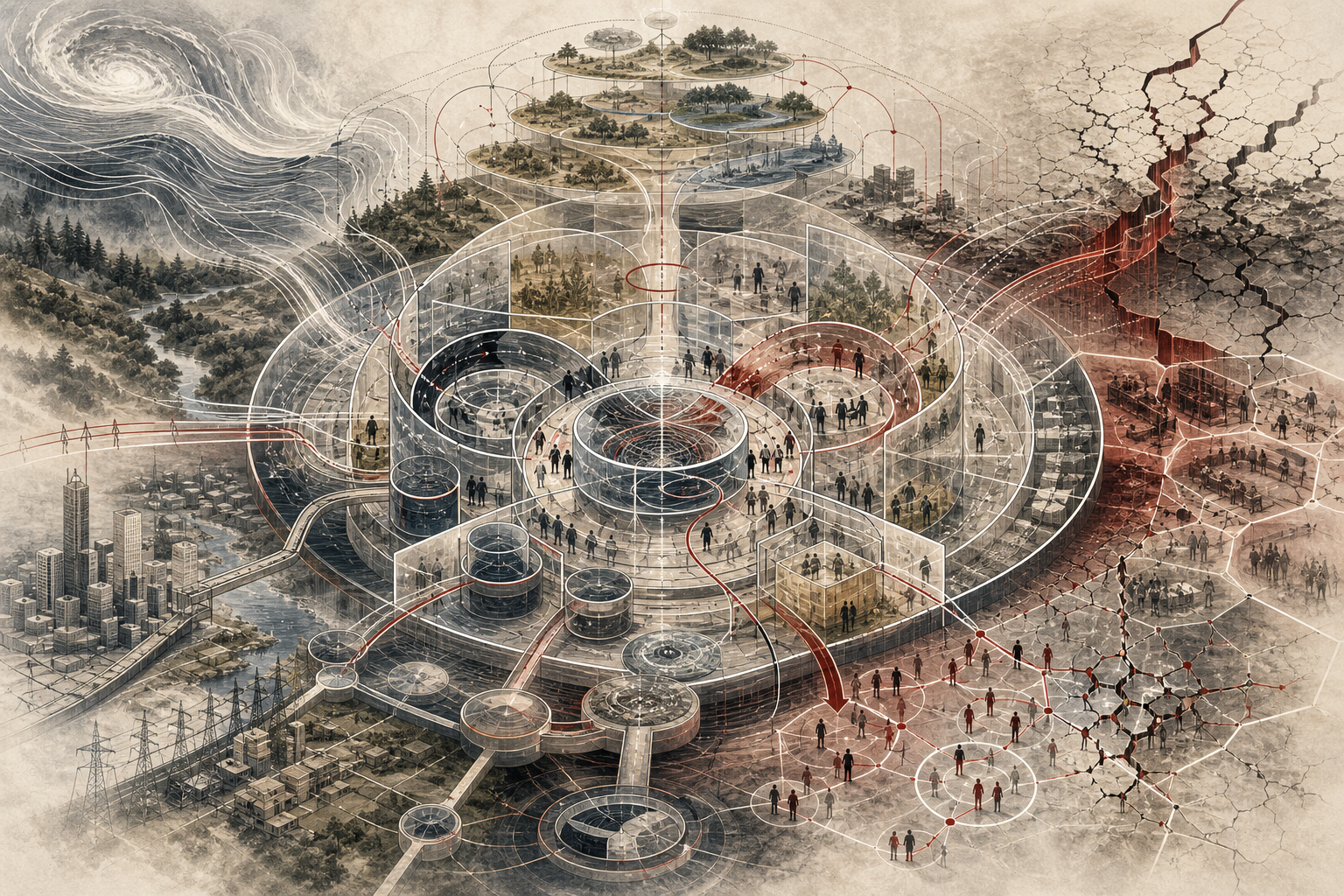
Resilience thinking appears here not merely as a vocabulary of endurance, but as a rigorous discipline of viability under disturbance. It explains why highly optimized systems can become brittle, why diversity and redundancy matter, why some crises trigger recovery while others produce regime shifts, why adaptation is not always enough, and why transformation may be necessary when existing systems can no longer remain viable or justifiable.
The field matters because many of the defining challenges of the twenty-first century are not isolated failures. They are recurring disturbances that reveal hidden fragility: climate hazards, ecological degradation, supply-chain shocks, public-health emergencies, infrastructure breakdown, institutional distrust, financial contagion, food and water insecurity, displacement, disaster recovery, and governance strain. Resilience thinking helps explain how systems absorb stress, where they are vulnerable, how close they may be to thresholds, and whether continuity, adaptation, or transformation is the responsible response.
Complete Research & Modeling Repository
This knowledge series is supported by a computational companion repository with article-level folders, reproducible examples, synthetic datasets, resilience-profile models, disturbance simulations, threshold-risk workflows, adaptive-cycle examples, panarchy diagrams, social-ecological systems schemas, network-resilience diagnostics, infrastructure-continuity models, disaster-risk scenarios, governance-capacity indicators, SQL schemas, documentation, and scientific-computing examples across Python, R, Julia, C++, Fortran, C, Rust, SQL, Go, and notebooks where appropriate.
Resilience Thinking as a Foundational Discipline
Resilience thinking occupies a foundational place within contemporary systems analysis because it asks how systems remain viable under disturbance. Many frameworks evaluate performance under ordinary conditions. Resilience thinking evaluates what happens when ordinary conditions fail. It asks how systems absorb shock, preserve function, reorganize, learn, adapt, or transform when exposed to stress, volatility, disruption, and uncertainty.
This foundational role does not mean that resilience thinking replaces systems thinking, sustainability science, ecology, disaster risk reduction, climate adaptation, infrastructure planning, institutional analysis, public health, economics, or governance research. Rather, it provides a bridge among them. Systems thinking explains feedback, interdependence, stocks, flows, and leverage. Sustainability asks whether systems can remain ecologically viable and socially just over the long term. Risk analysis studies exposure, hazard, vulnerability, and consequence. Resilience thinking asks how systems behave when risk materializes and whether they can preserve or reorganize core functions under stress.
The field matters because systems can appear strong under stable conditions and brittle under disruption. A lean supply chain may perform efficiently until one node fails. A city may function well until flood, heat, housing pressure, and infrastructure limits interact. An institution may appear durable until trust erodes under repeated crisis. An ecosystem may absorb stress for years before crossing a threshold into a new regime. Resilience thinking studies these hidden vulnerabilities before they become irreversible failures.
Resilience Thinking as Viability Under Disturbance
Resilience thinking may be understood as the study of viability under disturbance. It does not ask only whether a system returns quickly to a previous state. It asks whether the system can preserve essential function, identity, adaptability, and legitimacy under changing conditions. In some cases, recovery is desirable. In others, returning to the prior state means restoring the very vulnerability that caused the crisis.
This makes resilience thinking different from simple recovery language. “Bouncing back” may be useful after a temporary disruption, but it is insufficient when the old system is brittle, unjust, ecologically damaging, or no longer viable. A flood-prone city may need redesign rather than repeated restoration. A monoculture-based food system may need diversification rather than rapid return to prior production. A governance institution facing chronic legitimacy crisis may require transformation rather than cosmetic stabilization.
Resilience thinking therefore distinguishes continuity, adaptation, and transformation. Continuity preserves essential function. Adaptation modifies behavior, structure, or management while retaining system identity. Transformation reorganizes the system when the existing configuration can no longer endure or should no longer be preserved. A mature resilience framework must be able to evaluate all three.
Resilience Thinking as a Quantitative and Computational Practice
Resilience thinking is often introduced through concepts such as adaptive capacity, threshold distance, diversity, redundancy, modularity, feedback, transformation, and panarchy. These remain central. Yet serious resilience analysis increasingly benefits from quantitative and computational practice. Systems under disturbance can be modeled, stress-tested, simulated, mapped, compared across scenarios, and evaluated with indicators that make vulnerability and adaptive capacity more visible.
This does not mean that resilience becomes a single score. A resilience score can be useful, but it can also conceal power, inequality, distribution, local knowledge, and political judgment. Resilience depends on what is being sustained, for whom, against what disturbance, at what scale, and with what trade-offs. A system can be resilient in ways that preserve injustice. A fragile system can appear efficient because hidden vulnerabilities have not yet been tested.
For that reason, this series treats mathematics, scenario analysis, network modeling, R, Python, Julia, SQL metadata, reproducible notebooks, and open code repositories as useful parts of resilience literacy. Some articles remain primarily conceptual, historical, ecological, ethical, or governance-focused. Others naturally require threshold modeling, repeated disturbance simulation, adaptive-capacity indicators, infrastructure-continuity modeling, social-vulnerability analysis, supply-chain network diagnostics, or reproducible code. The aim is not to reduce resilience to metrics, but to make assumptions about viability, disturbance, and adaptation explicit.
What Resilience Thinking Studies
Resilience thinking studies how systems behave under stress. At the disturbance level, it examines shocks, hazards, volatility, disruption, pressure, cumulative stress, and uncertainty. At the system level, it studies identity, function, adaptive capacity, recovery, transformation, thresholds, feedback loops, redundancy, diversity, modularity, memory, learning, and reorganization.
At the ecological level, resilience thinking studies ecosystems, regime shifts, biodiversity, landscape change, disturbance regimes, and social-ecological systems. At the infrastructure level, it studies continuity, redundancy, failure propagation, cascading risk, critical services, and adaptive recovery. At the institutional level, it studies legitimacy, trust, learning, coordination, governance capacity, and crisis response. At the social level, it studies vulnerability, community capacity, social capital, inequality, local knowledge, and collective recovery.
Resilience thinking further studies the gap between apparent strength and actual viability. A system may be stable but brittle. It may be efficient but fragile. It may recover quickly but degrade long-term adaptive capacity. It may endure but sustain harm. The field is strongest when it distinguishes surface continuity from deeper resilience.
What This Pillar Covers
This pillar brings together the major domains through which resilience thinking interprets complex systems under disturbance. It includes resilience theory, ecological resilience, social-ecological systems, adaptive capacity, adaptive cycles, panarchy, thresholds, regime shifts, tipping points, feedback loops, redundancy, diversity, modularity, resilience metrics, climate resilience, infrastructure resilience, community resilience, institutional resilience, economic resilience, supply-chain resilience, disaster risk reduction, sustainable development, food and water systems, financial systems, transformation, ethics, politics, governance, technology, AI, and future directions in resilience thinking.
These domains differ in method and scale, but together they form a coherent intellectual project: understanding how systems persist, adapt, fail, reorganize, or transform under disturbance. Resilience thinking is therefore not only a theory of coping. It is a way of asking whether systems have the capacities needed to remain viable under uncertain futures.
The series also treats resilience thinking as a bridge between systems analysis and normative judgment. Systems analysis clarifies thresholds, feedback, vulnerability, and adaptive capacity. Normative judgment asks what should be preserved, what should change, who benefits from continuity, who bears disturbance, and whether resilience is being used to protect people or to excuse abandonment. A serious resilience framework must hold both together.
Mathematics, Computation, and Modeling in Resilience Thinking
Mathematics provides part of the formal language through which resilience thinking clarifies viability, disturbance, thresholds, adaptive capacity, and transformation. A simple conceptual model of resilience can be written as:
R_t = B_t – D_t + A_t
\]
Interpretation: Resilience at time \(t\) depends on disturbance tolerance, accumulated disturbance, and adaptive capacity. The model is stylized, but it clarifies that resilience is not only resistance; it also depends on the capacity to adapt before thresholds are crossed.
where \(R_t\) is resilience, \(B_t\) is basin width or disturbance tolerance, \(D_t\) is accumulated disturbance, and \(A_t\) is adaptive capacity.
System viability over time can be represented as:
V_{t+1} = V_t – \alpha K_t + \beta A_t + \gamma L_t
\]
Interpretation: System viability declines under disturbance load and improves through adaptive capacity and learning. Resilience depends not only on the size of the shock, but on the system’s ability to respond and learn.
where \(V_t\) is viability, \(K_t\) is disturbance load, \(A_t\) is adaptive capacity, \(L_t\) is learning capacity, and \(\alpha, \beta,\) and \(\gamma\) scale the effects.
Threshold risk can be represented as proximity to a critical boundary:
TR_t = \frac{P_t}{\Theta_t}
\]
Interpretation: Threshold risk rises as system pressure approaches the system’s threshold. When pressure becomes large relative to threshold distance, regime-shift risk increases.
where \(P_t\) is pressure and \(\Theta_t\) is threshold distance.
A stylized nonlinear system can show why small changes sometimes produce large shifts:
\frac{dx}{dt} = rx – x^3 + p
\]
Interpretation: The system state \(x\) changes under internal dynamics and external pressure. As pressure changes, the system may approach a threshold beyond which it reorganizes into a different regime.
A broader semi-formal model of resilience capacity can be written as:
RC = f(AC, TD, DV, RD, MD, LG, GV, EQ)
\]
Interpretation: Resilience capacity depends on adaptive capacity, threshold distance, diversity, redundancy, modularity, learning, governance capacity, and equity.
A simple additive representation is:
RC = \beta_1 AC + \beta_2 TD + \beta_3 DV + \beta_4 RD + \beta_5 MD + \beta_6 LG + \beta_7 GV + \beta_8 EQ
\]
Interpretation: This model does not measure resilience directly; it clarifies that resilience emerges from multiple interacting capacities rather than from one performance variable.
These formulations do not reduce resilience thinking to equations. They clarify a central insight: resilience is dynamic. It depends on disturbance load, system memory, adaptive capacity, learning, redundancy, diversity, modularity, governance, and threshold distance over time.
Computation is especially valuable where resilience depends on repeated disturbance, network dependency, cascading failure, or nonlinear thresholds. R supports resilience indicator analysis, profile comparison, vulnerability mapping, and reproducible reporting. Python supports repeated disturbance simulation, network-resilience diagnostics, threshold modeling, Monte Carlo analysis, and scenario comparison. Julia supports high-performance nonlinear dynamics and threshold simulation. SQL supports structured resilience indicators, system variables, scenario assumptions, shock records, model runs, and provenance. C++, Fortran, C, Rust, and Go support performance-sensitive simulation, command-line tools, and reusable analytical infrastructure.
Major Domains of Resilience Thinking
Resilience thinking includes a wide range of major domains, each of which illuminates a different layer of system viability under disturbance. Ecological resilience studies ecosystems, disturbance regimes, biodiversity, recovery, and regime shifts. Social-ecological systems research studies coupled human and natural systems in which ecology, institutions, livelihoods, governance, and culture interact.
Adaptive capacity research studies the ability to adjust behavior, structure, or function in response to change. Threshold research studies critical boundaries beyond which systems reorganize. Panarchy studies cross-scale interaction among fast and slow systems. Disaster risk reduction studies preparedness, absorptive capacity, emergency response, recovery, and risk governance. Climate resilience studies adaptation, vulnerability, exposure, infrastructure, ecosystems, livelihoods, and climate-resilient development.
Infrastructure resilience studies continuity, redundancy, cascading failure, critical services, and recovery under hazard. Community resilience studies social capital, local knowledge, mutual aid, vulnerability, and recovery pathways. Institutional resilience studies legitimacy, trust, coordination, policy learning, and administrative capacity under stress. Economic and financial resilience study supply chains, labor markets, regional economies, systemic risk, and shock propagation. Ethics and politics of resilience study power, justice, responsibility, and the risk of using resilience language to normalize harm.
Why Resilience Thinking Matters
Resilience thinking matters because many systems are evaluated under conditions that do not reveal their fragility. A system can appear efficient, profitable, stable, or well-managed in ordinary periods while lacking the capacity to withstand disturbance. When shock arrives, hidden vulnerabilities become visible: inadequate redundancy, weak learning, brittle infrastructure, low trust, overcentralized networks, rigid institutions, ecological depletion, or social inequality.
The field also matters because disturbance is not evenly distributed. Vulnerability is shaped by class, race, geography, gender, infrastructure access, disability, age, political power, institutional trust, and historical injustice. A resilience strategy that strengthens the system while shifting burden onto the least powerful is not ethically adequate. Resilience thinking must therefore ask not only whether a system survives, but who is protected, who adapts, who pays, and whose losses are treated as acceptable.
Finally, resilience thinking matters because the future is unlikely to be a simple extension of the recent past. Climate change, biodiversity loss, technological acceleration, geopolitical fragmentation, infrastructure stress, migration, economic volatility, and institutional distrust all make disturbance more central to strategic reasoning. Resilience thinking gives decision-makers a language for planning under uncertainty without pretending that uncertainty can be eliminated.
Resilience Thinking and Human Self-Understanding
Resilience thinking changes how human beings understand crisis. It shows that disturbance is not merely an interruption of normal life. Disturbance reveals how systems are organized. A crisis exposes hidden dependencies, uneven vulnerabilities, weak feedback channels, brittle assumptions, lost redundancy, and failures of institutional memory. In that sense, disturbance can become a diagnostic event.
The field also changes how people understand strength. Strength is not always rigidity. A system that refuses to change may persist for a time, but it can become more vulnerable as conditions shift. Resilience often depends on flexibility, diversity, learning, distributed capacity, and the ability to reorganize without losing essential function. Sometimes the resilient response is not to hold the old form together, but to transform into a more viable one.
For that reason, resilience thinking has philosophical as well as practical significance. It raises enduring questions about continuity, identity, vulnerability, adaptation, transformation, justice, loss, memory, and responsibility. A serious Resilience Thinking pillar should therefore not end with recovery metrics alone. It should clarify what kinds of continuity are worth preserving and when transformation becomes the more responsible form of resilience.
Resilience Thinking Pillar Map
The map below organizes the Resilience Thinking knowledge series into conceptual domains, moving from foundations and ecological origins toward adaptive capacity, thresholds, panarchy, design principles, measurement, governance, climate, infrastructure, communities, supply chains, economics, ethics, and future resilience practice. Expansion articles are placed inside the sections where they belong once the pillar is complete.
The Resilience Thinking pillar is organized to move from foundational definitions and history into ecological resilience, social-ecological systems, adaptive capacity, adaptive cycles, panarchy, feedback, thresholds, diversity, redundancy, modularity, resilience measurement, climate resilience, infrastructure resilience, community resilience, institutional resilience, economic resilience, supply-chain resilience, disaster risk reduction, sustainable development, food and water systems, finance, transformation, ethics, politics, technology, and future directions. Mathematics, R, Python, Julia, C++, Fortran, C, Rust, SQL, Go, and computational notebooks are integrated where they deepen understanding, especially in areas such as resilience profiles, repeated disturbance simulation, threshold risk, network resilience, adaptive capacity indicators, scenario comparison, and reproducible resilience workflows.
Foundations, Definitions, and Intellectual History
- What Is Resilience Thinking? — An opening article defining resilience thinking as a framework for understanding disturbance, adaptation, recovery, transformation, and system viability.
- Resilience vs Stability vs Robustness — A foundational article distinguishing resilience from stability, robustness, reliability, recovery, and efficiency.
- The History of Resilience Theory — A historical treatment of resilience from ecology through social-ecological systems, sustainability science, disaster risk reduction, and governance.
- Engineering Resilience and Ecological Resilience — An article on the difference between rapid return to equilibrium and persistence within changing regimes.
- Resilience Thinking and Systems Thinking — A bridge article connecting resilience to feedback, stocks and flows, system boundaries, interdependence, and structural change.
- Resilience Thinking and Risk Governance — A study of how resilience reframes risk from isolated hazard probability toward systemic vulnerability, capacity, and recovery.
Ecological Resilience and Social-Ecological Systems
- Ecological Resilience and Ecosystem Stability — A major article on ecosystems, disturbance regimes, biodiversity, feedback, recovery, and regime shifts.
- Social-Ecological Systems — A treatment of coupled human and natural systems, including governance, livelihoods, ecosystems, institutions, and knowledge systems.
- Ecosystem Services and Resilience — An article on how ecosystem functions support human well-being and how resilience protects or transforms those relationships.
- Biodiversity, Redundancy, and Ecological Function — A focused study of functional diversity, redundancy, ecological insurance, and adaptive capacity.
- Landscape Resilience and Disturbance Regimes — An article on fire, flood, drought, land-use change, habitat fragmentation, and landscape-scale resilience.
Adaptive Capacity, Panarchy, Thresholds, and Regime Shifts
- Adaptive Capacity in Complex Systems — An article on the ability of systems to adjust behavior, structure, or function in response to disturbance and uncertainty.
- Adaptive Cycles and Panarchy — A major article on growth, conservation, release, reorganization, nested systems, cross-scale dynamics, and transformation.
- System Thresholds and Tipping Points — A treatment of nonlinear change, critical thresholds, regime shifts, tipping dynamics, and slow variables.
- Feedback Loops in Resilient Systems — An article on reinforcing and balancing processes that shape resilience, degradation, recovery, and transformation.
- Slow Variables and Hidden System Change — An article on variables that change gradually until they reshape system behavior or trigger threshold crossing.
- Regime Shifts and Early Warning Signals — A study of indicators such as rising variance, autocorrelation, slowing recovery, and other signals of approaching transition.
- Transformation in Complex Systems — A major article on when adaptation is insufficient and deeper reorganization becomes necessary.
Design Principles: Diversity, Redundancy, Modularity, Learning, and Measurement
- Redundancy and Diversity in System Design — An article on why overlapping capacity and variation reduce brittleness and improve adaptation.
- Resilience Metrics and Measurement — A methodological article on indicators, profiles, capacities, thresholds, vulnerability, recovery, and measurement limits.
- Modularity and Cascading Failure — A study of how partial compartmentalization can limit shock propagation across interconnected systems.
- Learning, Memory, and Adaptive Management — An article on how systems learn from disturbance, preserve memory, revise action, and avoid repeated failure.
- Resilience Indicators and Dashboard Risk — A critical article on the value and danger of simplifying resilience into indicators, dashboards, or composite scores.
Climate, Disaster Risk, Infrastructure, and Public Systems
- Climate Resilience — A major article on climate hazards, adaptation, vulnerability, exposure, infrastructure, livelihoods, ecosystems, and climate-resilient development.
- Disaster Risk Reduction and Resilience — A treatment of preparedness, absorptive capacity, emergency management, recovery, Sendai Framework principles, and hazard governance.
- Infrastructure Resilience — An article on critical infrastructure, continuity, redundancy, interdependence, cascading failure, and recovery under disruption.
- Resilience in Food and Water Systems — A study of food security, water stress, agricultural systems, supply networks, climate risk, and resource governance.
- Urban Resilience and Adaptation — An article on cities, housing, heat, flooding, transport, public services, infrastructure, and social vulnerability.
- Public Health System Resilience — A treatment of health-system capacity, surveillance, trust, emergency response, workforce resilience, and crisis learning.
- Energy System Resilience — An article on grids, distributed energy, storage, redundancy, decarbonization, climate hazards, and critical-service continuity.
Community, Institutions, Governance, and Social Capacity
- Community Resilience — An article on social capital, local knowledge, mutual aid, collective response, vulnerability, recovery, and community capacity.
- Institutional Resilience — A treatment of legitimacy, trust, coordination, crisis response, institutional learning, administrative capacity, and governance under stress.
- Resilience and Sustainable Development — A major article connecting resilience to ecological viability, social well-being, adaptation, equity, and long-term development.
- Adaptive Governance and Resilience — An article on polycentric governance, learning institutions, public participation, flexible rules, and cross-scale coordination.
- Social Vulnerability and Resilience — A critical article on inequality, exposure, adaptive capacity, historical injustice, and uneven recovery.
- Local Knowledge and Resilience Practice — A study of community knowledge, Indigenous knowledge, participation, place-based adaptation, and institutional listening.
Economic, Financial, Supply-Chain, and Organizational Resilience
- Economic Resilience — An article on labor markets, regional economies, shock absorption, industrial diversity, adaptation, and recovery.
- Resilience in Global Supply Chains — A treatment of supply networks, chokepoints, inventory, diversification, supplier risk, cascading disruption, and strategic redundancy.
- Financial System Resilience — An article on systemic risk, contagion, buffers, stress testing, liquidity, regulation, and financial stability.
- Organizational Resilience and Learning — A study of organizational capacity, burnout, redundancy, crisis learning, leadership, culture, and adaptive recovery.
- Resilience and Strategic Slack — An article on why reserves, buffers, redundancy, and spare capacity can be strategic assets rather than inefficiencies.
- Resilience in Small Business and Local Economies — A treatment of local economic networks, shock exposure, adaptation, finance, community support, and recovery capacity.
Technology, AI, Infrastructure Intelligence, and Future Resilience
- Technology System Resilience — An article on digital infrastructure, platform dependency, cybersecurity, redundancy, failure modes, and technological continuity.
- AI and Resilience Thinking — A systems article on AI as both resilience tool and resilience risk, including monitoring, fragility, dependence, governance, and adaptive capacity.
- Intelligent Infrastructure and Resilience — A treatment of sensor networks, digital twins, predictive maintenance, edge systems, emergency response, and infrastructure adaptation.
- Resilience Scenarios and Futures Thinking — An article on foresight, scenario design, uncertainty, stress testing, transition pathways, and long-horizon preparedness.
- Future Directions in Resilience Thinking — A capstone-style article on resilience across climate, governance, AI, infrastructure, finance, social vulnerability, and transformation.
Ethics, Politics, and Critical Resilience
- Ethics and Politics of Resilience — A critical article on power, justice, vulnerability, burden shifting, responsibility, and the political uses of resilience language.
- Resilience or Abandonment? — An article on the danger of using resilience rhetoric to normalize harm, underinvestment, austerity, or abandonment of vulnerable communities.
- Maladaptive Resilience — A study of systems that persist despite being unjust, ecologically harmful, authoritarian, exclusionary, or exploitative.
- Just Transformation and Resilience — An article on transformation that preserves dignity, equity, ecological viability, and democratic accountability.
This structure keeps the pillar grounded in resilience thinking while making room for full expansion across ecology, social-ecological systems, climate adaptation, disaster risk, infrastructure, governance, economic systems, technology, ethics, and future resilience practice.
Methods, Measurement, and Resilience Practice
One of resilience thinking’s central challenges is that resilience is often invisible until disturbance occurs. A system may appear strong because it has not yet been tested. A community may appear stable because hidden vulnerabilities have not surfaced. An infrastructure system may appear reliable until a cascading failure reveals deep interdependence. A governance system may appear legitimate until repeated crises expose weak trust, poor coordination, or inadequate learning.
This is why resilience practice uses multiple methods. Historical analysis reveals past disturbance and recovery. Indicator systems compare adaptive capacity, vulnerability, redundancy, diversity, and threshold distance. Scenario analysis tests system behavior under plausible futures. Network analysis reveals dependencies, bottlenecks, and cascade risks. Simulation models examine repeated disturbance, recovery, and threshold crossing. Participatory methods incorporate local knowledge, lived experience, institutional memory, and community priorities.
Modern resilience practice should combine measurement with interpretation. Metrics can help identify vulnerability, but they cannot determine what should be preserved. Scenarios can reveal risk, but they cannot decide who should bear the cost of adaptation. Models can clarify threshold dynamics, but they cannot replace public judgment. Resilience practice becomes strongest when analytical discipline is joined to democratic accountability, ethical reasoning, and attention to unequal vulnerability.
Resilience Thinking, Technology, and the Modern World
Resilience thinking has become increasingly important because modern technologies create both new resilience capacities and new fragilities. Digital infrastructure, AI systems, smart grids, logistics platforms, financial networks, sensor systems, public-service portals, cloud services, cybersecurity systems, and intelligent infrastructure all mediate how societies absorb and respond to disturbance.
Technology can strengthen resilience when it improves monitoring, early warning, coordination, redundancy, adaptive response, predictive maintenance, scenario modeling, and emergency communication. It can weaken resilience when it creates dependency, opacity, overcentralization, cyber vulnerability, brittle automation, cascading digital failure, or loss of human skill and institutional memory.
A mature resilience approach to technology must therefore ask not only whether a technology improves efficiency, but whether it increases adaptive capacity under stress. Does it preserve fallback options? Does it increase dependency on a single platform? Does it create new cascade pathways? Does it improve local capacity or centralize control? Does it strengthen public trust or reduce contestability? The future of resilience thinking will increasingly depend on understanding sociotechnical resilience: the resilience of systems where technology, institutions, infrastructure, behavior, and governance are inseparable.
Resilience Thinking, Computation, and Threshold Simulation
Computation has become valuable for resilience thinking because resilience is dynamic, nonlinear, and scenario-dependent. A system may recover from one shock but fail under repeated disturbance. A network may appear robust until a bridge node fails. An ecosystem may absorb stress for years before shifting regime. A city may adapt to average climate stress while remaining vulnerable to compound events. A supply chain may survive one disruption but fail under correlated shocks.
Threshold simulation allows researchers, analysts, educators, and decision-makers to formalize assumptions about resilience. A model can test how adaptive capacity changes recovery, how redundancy limits failure propagation, how modularity reduces cascading risk, how repeated shocks erode viability, how learning improves response, or how systems approach tipping points. These models do not replace empirical knowledge or public judgment. They make structural assumptions visible.
For that reason, this pillar treats computation as a supporting discipline of resilience thinking, not as a substitute for interpretation. Models must remain transparent, contestable, documented, and ethically bounded. The strongest form of computational resilience thinking is auditable viability reasoning: clear system boundaries, explicit disturbance assumptions, reproducible workflows, visible uncertainty, and careful interpretation of what should be preserved, adapted, or transformed.
R Section: Mapping Resilience Dimensions Across Systems
The R workflow below compares several stylized system types across adaptive capacity, threshold distance, learning ability, modularity, redundancy, governance capacity, and equity. It is designed as an evergreen demonstration of how resilience thinking evaluates viability across multiple interacting dimensions rather than only one performance variable.
# Resilience Thinking: Mapping Resilience Dimensions Across Systems in R
# Educational example only.

# install.packages(c("tidyverse"))
library(tidyverse)

# -------------------------------------------------------------------
# Synthetic resilience profiles across system types.
# -------------------------------------------------------------------

systems <- tibble(
  system_type = c(
    "Ecological System",
    "Urban Infrastructure",
    "Institutional System",
    "Supply Chain Network",
    "Community System",
    "Public Health System"
  ),
  adaptive_capacity = c(0.82, 0.58, 0.63, 0.49, 0.76, 0.66),
  threshold_distance = c(0.74, 0.55, 0.60, 0.44, 0.68, 0.57),
  learning_capacity = c(0.71, 0.52, 0.72, 0.46, 0.79, 0.69),
  modularity = c(0.62, 0.70, 0.48, 0.51, 0.57, 0.54),
  redundancy = c(0.69, 0.66, 0.43, 0.38, 0.61, 0.58),
  governance_capacity = c(0.64, 0.61, 0.70, 0.45, 0.72, 0.68),
  equity_capacity = c(0.58, 0.50, 0.52, 0.42, 0.74, 0.60)
)

# -------------------------------------------------------------------
# Stylized resilience profile.
# -------------------------------------------------------------------

systems <- systems |>
  mutate(
    resilience_profile =
      0.18 * adaptive_capacity +
      0.17 * threshold_distance +
      0.16 * learning_capacity +
      0.13 * modularity +
      0.13 * redundancy +
      0.12 * governance_capacity +
      0.11 * equity_capacity
  )

print(systems)

# -------------------------------------------------------------------
# Long format for dimensional comparison.
# -------------------------------------------------------------------

systems_long <- systems |>
  pivot_longer(
    cols = c(
      adaptive_capacity,
      threshold_distance,
      learning_capacity,
      modularity,
      redundancy,
      governance_capacity,
      equity_capacity
    ),
    names_to = "dimension",
    values_to = "value"
  )

ggplot(systems_long, aes(x = dimension, y = value, group = system_type)) +
  geom_line(aes(linetype = system_type)) +
  geom_point() +
  coord_flip() +
  labs(
    title = "Stylized Resilience Dimensions Across System Types",
    x = "Resilience dimension",
    y = "Dimension value",
    linetype = "System type"
  ) +
  theme_minimal(base_size = 12)

# -------------------------------------------------------------------
# Profile comparison.
# -------------------------------------------------------------------

ggplot(systems, aes(x = reorder(system_type, resilience_profile), y = resilience_profile)) +
  geom_col() +
  coord_flip() +
  labs(
    title = "Stylized Resilience Profile by System Type",
    x = "System type",
    y = "Resilience profile"
  ) +
  theme_minimal(base_size = 12)

# -------------------------------------------------------------------
# Identify systems with high vulnerability.
# -------------------------------------------------------------------

vulnerability_flags <- systems |>
  mutate(
    low_threshold_distance = threshold_distance < 0.55,
    low_redundancy = redundancy < 0.50,
    low_equity_capacity = equity_capacity < 0.50,
    vulnerability_flag =
      low_threshold_distance | low_redundancy | low_equity_capacity
  )

print(vulnerability_flags)

# -------------------------------------------------------------------
# Export outputs.
# -------------------------------------------------------------------

dir.create("outputs", showWarnings = FALSE, recursive = TRUE)

write_csv(systems, "outputs/resilience_thinking_profiles.csv")
write_csv(systems_long, "outputs/resilience_thinking_dimensions_long.csv")
write_csv(vulnerability_flags, "outputs/resilience_vulnerability_flags.csv")
This workflow models a core resilience-thinking principle: resilience is multidimensional. A system with strong adaptive capacity may still be vulnerable if threshold distance, redundancy, governance capacity, or equity are weak. The model is not a real-world assessment, but it shows how resilience claims can be translated into explicit dimensions and assumptions.
Python Section: Simulating Viability Under Repeated Disturbance
The Python workflow below simulates stylized systems under repeated shocks. It incorporates disturbance load, adaptive capacity, threshold distance, learning capacity, and redundancy to show how systems with superficially similar performance can diverge when resilience-related qualities differ.
# Resilience Thinking: Simulating Viability Under Repeated Disturbance in Python
# Educational example only.

from __future__ import annotations

import numpy as np
import pandas as pd
import matplotlib.pyplot as plt


systems = pd.DataFrame({
    "system_type": [
        "Ecological System",
        "Urban Infrastructure",
        "Institutional System",
        "Supply Chain Network",
        "Community System"
    ],
    "adaptive_capacity": [0.82, 0.58, 0.63, 0.49, 0.76],
    "threshold_distance": [0.74, 0.55, 0.60, 0.44, 0.68],
    "learning_capacity": [0.71, 0.52, 0.72, 0.46, 0.79],
    "redundancy": [0.69, 0.66, 0.43, 0.38, 0.61]
})

systems["resilience_profile"] = (
    0.30 * systems["adaptive_capacity"] +
    0.28 * systems["threshold_distance"] +
    0.24 * systems["learning_capacity"] +
    0.18 * systems["redundancy"]
)

print("Synthetic resilience profiles:")
print(systems)

time_steps = np.arange(1, 61)

# Repeated disturbance pattern with periodic shocks.
disturbance = np.resize(
    np.array([0.06, 0.09, 0.12, 0.18, 0.08, 0.11, 0.22, 0.10]),
    len(time_steps)
)


def simulate_viability(
    resilience_profile: float,
    threshold_distance: float,
    learning_capacity: float,
    initial_state: float = 1.0
) -> pd.DataFrame:
    """
    Simulate viability under repeated disturbance.

    Viability declines under disturbance and improves through resilience profile
    and learning. Threshold breach is flagged when viability falls below a
    stylized threshold.
    """
    viability = np.zeros(len(time_steps))
    threshold_risk = np.zeros(len(time_steps))

    viability[0] = initial_state

    for t in range(1, len(time_steps)):
        disturbance_load = disturbance[t]

        learning_gain = 0.08 * learning_capacity * (1.2 - viability[t - 1])
        adaptive_response = 0.18 * resilience_profile

        viability[t] = (
            viability[t - 1]
            - 0.60 * disturbance_load
            + adaptive_response
            + learning_gain
        )

        viability[t] = np.clip(viability[t], 0.0, 1.5)

        threshold_risk[t] = disturbance_load / max(threshold_distance, 0.01)

    return pd.DataFrame({
        "time": time_steps,
        "viability": viability,
        "threshold_risk": threshold_risk,
        "threshold_breach": viability < 0.35
    })


rows = []

for _, row in systems.iterrows():
    result = simulate_viability(
        resilience_profile=row["resilience_profile"],
        threshold_distance=row["threshold_distance"],
        learning_capacity=row["learning_capacity"]
    )

    result["system_type"] = row["system_type"]
    rows.append(result)

simulation_df = pd.concat(rows, ignore_index=True)

print("\nSimulation preview:")
print(simulation_df.head())

summary = simulation_df.groupby("system_type").agg(
    min_viability=("viability", "min"),
    final_viability=("viability", "last"),
    max_threshold_risk=("threshold_risk", "max"),
    threshold_breaches=("threshold_breach", "sum")
).reset_index()

print("\nSimulation summary:")
print(summary)

plt.figure(figsize=(10, 6))

for system_name in simulation_df["system_type"].unique():
    subset = simulation_df[simulation_df["system_type"] == system_name]
    plt.plot(subset["time"], subset["viability"], label=system_name)

plt.axhline(0.35, linestyle="--")
plt.xlabel("Time step")
plt.ylabel("Viability")
plt.title("Stylized Viability Under Repeated Disturbance")
plt.legend()
plt.tight_layout()
plt.show()

simulation_df.to_csv("resilience_thinking_viability_simulation.csv", index=False)
summary.to_csv("resilience_thinking_viability_summary.csv", index=False)
systems.to_csv("resilience_thinking_profiles.csv", index=False)
This workflow reinforces a central resilience-thinking distinction. Systems that look similar under ordinary conditions can diverge under repeated disturbance. Resilience depends not only on present performance, but on adaptive capacity, threshold distance, redundancy, learning, and the ability to reorganize before viability collapses.
Interpretive Limits and Resilience Cautions
Resilience thinking is powerful, but it can be misused. Not every system deserves to be preserved. Some systems are resilient because they are exclusionary, coercive, exploitative, or ecologically destructive. An unjust system may adapt to criticism while preserving its core harms. A harmful industry may become resilient to regulation. An authoritarian institution may remain durable under disturbance. Resilience is therefore not automatically good.
Analysts and practitioners should also avoid using resilience as a language of abandonment. Communities should not be told to become resilient while institutions withdraw support. Workers should not be asked to show resilience in systems that produce chronic burnout. Climate-vulnerable regions should not be praised for resilience while avoidable exposure and historical responsibility are ignored. Resilience must not become a substitute for justice, repair, mitigation, investment, or transformation.
The field is strongest when it combines systems rigor with ethical clarity. It should help people understand disturbance, vulnerability, capacity, and transformation without normalizing preventable harm. Resilience thinking should make strategy more honest about uncertainty, more attentive to unequal vulnerability, and more capable of distinguishing what should be preserved from what must be changed.
Resilience Thinking in a Wider Intellectual Context
Resilience thinking belongs not only to ecology, climate adaptation, or disaster planning, but to the broader history of human thought about continuity, disruption, transformation, and survival. Societies have always faced disturbance. What resilience thinking contributes is a systems language for understanding how disturbance interacts with structure, memory, feedback, threshold, learning, and adaptation.
The field changes the imagination of crisis. A crisis is not only an event. It is a test of system structure. It reveals whether capacity was real, whether redundancy existed, whether learning had occurred, whether institutions were trusted, whether ecosystems retained function, and whether vulnerable people were protected. Resilience thinking therefore turns disturbance into a form of diagnosis.
For that reason, resilience thinking should be understood as both a scientific and civic achievement. It brings together ecology, systems theory, sustainability, governance, disaster risk reduction, infrastructure planning, ethics, and computation in a sustained effort to understand viability under uncertainty. It remains indispensable for any serious framework concerned with climate change, public systems, institutional trust, infrastructure, community well-being, and long-term transformation.
Related Reading
- Systems Thinking
- Systems Modeling
- Risk & Resilience
- Sustainable Development
- Futures Thinking
- Climate Change
- Planetary Boundaries
- Institutions & Governance
- Data Systems & Analytics
Further Reading
- Biggs, R., Schlüter, M. and Schoon, M.L. (eds.) (2015) Principles for Building Resilience: Sustaining Ecosystem Services in Social-Ecological Systems. Cambridge: Cambridge University Press.
- Carpenter, S.R. (2024) Complexity and Resilience in Social-Ecological Systems. Princeton: Princeton University Press.
- Folke, C. (2006) ‘Resilience: The emergence of a perspective for social-ecological systems analyses’, Global Environmental Change, 16(3), pp. 253–267.
- Folke, C., Carpenter, S.R., Walker, B., Scheffer, M., Chapin, T. and Rockström, J. (2010) ‘Resilience thinking: integrating resilience, adaptability and transformability’, Ecology and Society, 15(4), 20. Available at: https://ecologyandsociety.org/vol15/iss4/art20/.
- Gunderson, L.H. and Holling, C.S. (eds.) (2002) Panarchy: Understanding Transformations in Human and Natural Systems. Washington, DC: Island Press.
- Holling, C.S. (1973) ‘Resilience and stability of ecological systems’, Annual Review of Ecology and Systematics, 4, pp. 1–23. Available at: https://www.annualreviews.org/content/journals/10.1146/annurev.es.04.110173.000245.
- Norris, F.H., Stevens, S.P., Pfefferbaum, B., Wyche, K.F. and Pfefferbaum, R.L. (2008) ‘Community resilience as a metaphor, theory, set of capacities, and strategy for disaster readiness’, American Journal of Community Psychology, 41(1–2), pp. 127–150.
- Walker, B. and Salt, D. (2012) Resilience Practice: Building Capacity to Absorb Disturbance and Maintain Function. Washington, DC: Island Press.
References
- Biggs, R., Schlüter, M. and Schoon, M.L. (eds.) (2015) Principles for Building Resilience: Sustaining Ecosystem Services in Social-Ecological Systems. Cambridge: Cambridge University Press.
- Folke, C. (2006) ‘Resilience: The emergence of a perspective for social-ecological systems analyses’, Global Environmental Change, 16(3), pp. 253–267.
- Folke, C., Carpenter, S.R., Walker, B., Scheffer, M., Chapin, T. and Rockström, J. (2010) ‘Resilience thinking: integrating resilience, adaptability and transformability’, Ecology and Society, 15(4), 20. Available at: https://ecologyandsociety.org/vol15/iss4/art20/.
- Gunderson, L.H. and Holling, C.S. (eds.) (2002) Panarchy: Understanding Transformations in Human and Natural Systems. Washington, DC: Island Press.
- Holling, C.S. (1973) ‘Resilience and stability of ecological systems’, Annual Review of Ecology and Systematics, 4, pp. 1–23. Available at: https://www.annualreviews.org/content/journals/10.1146/annurev.es.04.110173.000245.
- Intergovernmental Panel on Climate Change (IPCC) (2023) AR6 Synthesis Report: Annex I Glossary. Available at: https://www.ipcc.ch/report/ar6/syr/downloads/report/IPCC_AR6_SYR_Annex-I.pdf.
- Resilience Alliance (n.d.) Key Concepts. Available at: https://www.resalliance.org/key-concepts.
- Resilience Alliance (n.d.) Adaptive Cycle. Available at: https://www.resalliance.org/adaptive-cycle.
- Resilience Alliance (n.d.) Panarchy. Available at: https://www.resalliance.org/panarchy.
- United Nations Office for Disaster Risk Reduction (UNDRR) (2022) What is the Sendai Framework for Disaster Risk Reduction? Available at: https://www.undrr.org/implementing-sendai-framework/what-sendai-framework.
- United Nations Office for Disaster Risk Reduction (UNDRR) (no date) Definition: Resilience. Available at: https://www.undrr.org/terminology/resilience.
- Walker, B., Holling, C.S., Carpenter, S.R. and Kinzig, A. (2004) ‘Resilience, adaptability and transformability in social-ecological systems’, Ecology and Society, 9(2), 5. Available at: https://ecologyandsociety.org/vol9/iss2/art5/.