
Last Updated April 11, 2026
East Asian Traditions examines the religious, philosophical, ritual, and civilizational worlds that emerged across China, Korea, Japan, and the wider Sinosphere through sacred texts, canonical teachings, contemplative disciplines, ritual orders, ethical traditions, state formations, and enduring reflections on harmony, self-cultivation, cosmic order, moral duty, emptiness, transformation, and the relationship between Heaven, Earth, and human life. As a major category within the Religious Studies knowledge series, it studies these traditions first through their own primary texts and internal interpretive lineages, and only after that through modern scholarship.
The religious traditions of East Asia are among the most sophisticated and historically influential in the world. They have produced major canons of ethical teaching, political thought, cosmology, ritual practice, contemplative discipline, monastic life, devotional expression, literary symbolism, and metaphysical speculation. They cannot be reduced to a single model of religion. Rather, they comprise overlapping worlds of scripture, commentary, family ethics, state ritual, philosophical inquiry, meditation, liturgy, sacred landscape, and aesthetic cultivation.
This category includes traditions commonly associated with Confucianism, Daoism, East Asian Buddhism, Shinto, and the broader ritual and philosophical inheritances that shaped East Asian civilization. These worlds were formed through the Analects, the Dao De Jing, the Zhuangzi, major Buddhist sutras and commentarial traditions, ancestral rites, temple life, cosmological systems, literary and artistic transmission, and the long historical interplay between ethical order, statecraft, spiritual cultivation, and metaphysical reflection.
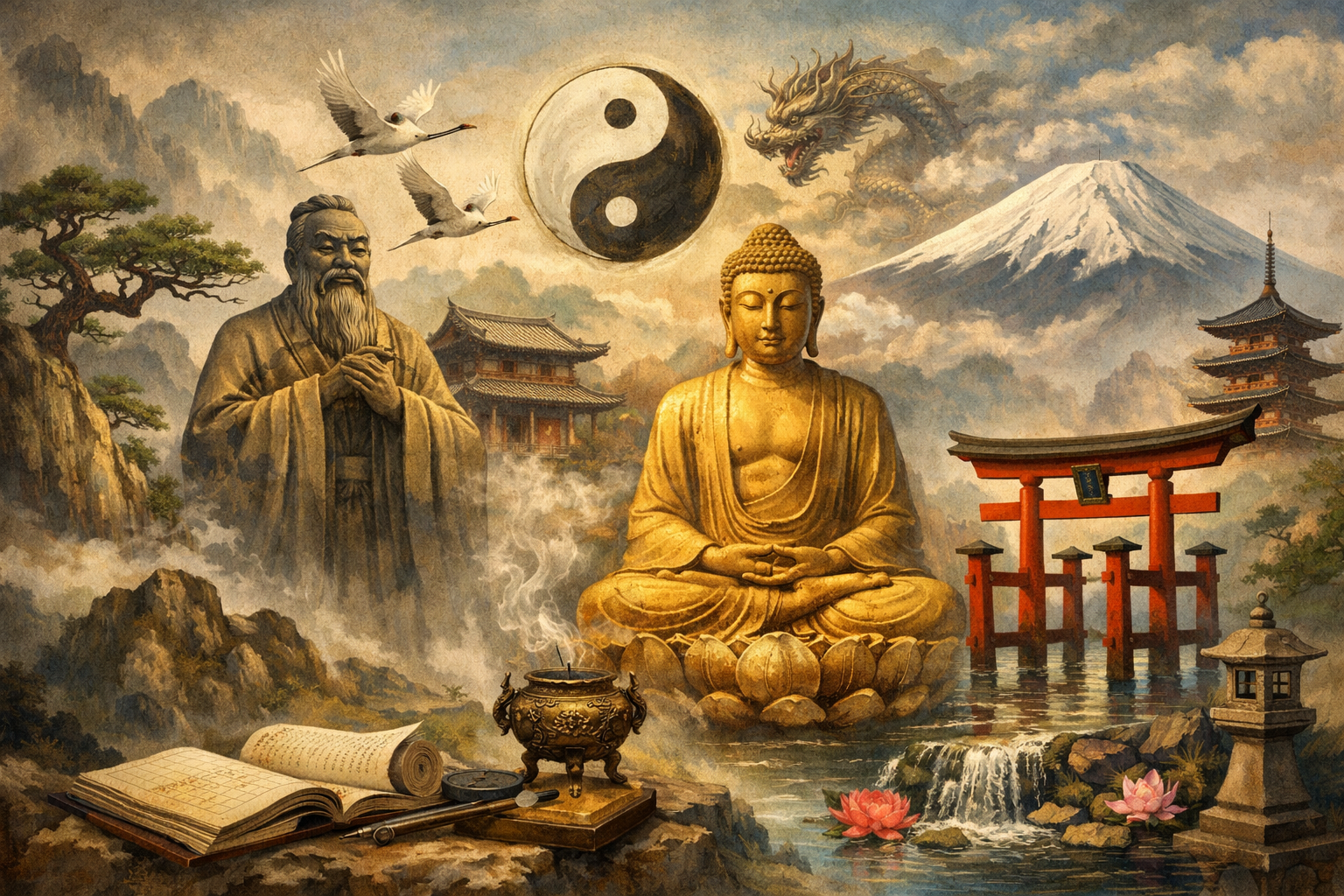
East Asian Traditions is especially important to the broader architecture of this site because it provides one of the deepest reservoirs of reflection on harmony, moral cultivation, social order, natural process, emptiness, interdependence, ritual form, and the disciplined shaping of perception. In this respect, the category links not only to Foundations of Religion and Comparative Sacred Themes, but also to Philosophy, Psychology, Mysticism and Contemplative Traditions, Religion and Law, and Mythology.
The goal of this pillar is not to flatten East Asian traditions into a vague spirituality or a romantic language of “balance.” It is to take them seriously as internally differentiated civilizational worlds with their own sacred texts, ethical systems, contemplative methods, ritual structures, political histories, and philosophical depth. These traditions have shaped not only East Asian history, but the global history of religion, ethics, metaphysics, aesthetics, and the study of mind and society.
Table of Contents
- Why East Asian Traditions Matter
- The Problem of Category and Civilizational Scope
- Shared Questions Across East Asian Traditions
- Confucian Order, Ethics, and Self-Cultivation
- Daoist Cosmology, Nature, and Transformation
- East Asian Buddhism: Emptiness, Compassion, and Practice
- Shinto: Kami, Ritual, and Sacred Place
- Ritual, Ancestry, and the Ordering of Life
- State Order, Civilization, and Sacred Legitimacy
- Meditation, Discipline, and the Transformation of Perception
- Metaphysics, Emptiness, Harmony, and the East Asian Study of Reality
- Article Map
- Related Reading
- Primary Texts
- Internal Interpretive Traditions
- Modern Scholarship
- Further Reading
- References
Why East Asian Traditions Matter
East Asian traditions matter because they preserve some of the most sustained reflections in human history on moral formation, ritual order, human relationship, social harmony, natural process, contemplative awareness, and the relation between visible life and invisible pattern. They ask what it means to become fully human through discipline, whether the highest wisdom lies in ethical cultivation or non-forcing, whether social order depends on ritual propriety or spontaneous alignment, whether reality is relational or empty, and how peace is cultivated in self, family, society, and cosmos.
These traditions also matter because they challenge narrow assumptions about what religion must look like. They do not always separate philosophy, ethics, politics, ritual, and spirituality into distinct domains. In East Asia, these dimensions often remain closely joined. Sacred life can take shape in family reverence, state ceremony, meditation halls, mountain retreats, poetic sensibility, temple devotion, textual study, monastic institutions, and everyday forms of disciplined conduct.
At the same time, East Asian traditions are not purely contemplative or aesthetic. They include legal orders, dynastic statecraft, bureaucratic institutions, communal rites, ancestor veneration, monastic economies, educational systems, and complex relations between authority, moral legitimacy, and sacred tradition. The category must therefore hold together metaphysics and governance, ritual and philosophy, contemplation and social order. Only then does its civilizational depth become visible.
The Problem of Category and Civilizational Scope
The term “East Asian Traditions” is useful because it identifies a broad civilizational field shaped by shared textual inheritances, ritual forms, political structures, aesthetic sensibilities, and philosophical debates across China, Korea, Japan, and neighboring cultural spheres. Yet the category must be used carefully. It is not a claim that Confucian, Daoist, Buddhist, and Shinto traditions are all expressions of one thing. Each is a distinct world of texts, practices, institutions, metaphysical claims, and historical developments.
At the same time, these traditions do share a historical and intellectual environment in which certain questions recur with unusual persistence: the cultivation of virtue, the harmonization of self and society, the role of ritual, the place of nature, the relation between emptiness and form, the authority of tradition, the significance of ancestors, and the disciplined refinement of mind and conduct. Even where these traditions disagree, they often do so within the same larger field of civilizational conversation.
For that reason, East Asian Traditions works best as a comparative civilizational framework rather than as a total explanation. It highlights common inheritances, recurring questions, and long patterns of cross-fertilization while preserving the internal particularity of each tradition. Done well, this makes possible a richer understanding of religion than a model based only on isolated doctrinal systems.
Shared Questions Across East Asian Traditions
Across the East Asian religious world, certain questions recur with extraordinary depth. What makes a human life rightly ordered? How does one cultivate virtue? What is the relation between family reverence and political legitimacy? Is harmony achieved by disciplined ritual or by alignment with spontaneous natural process? What is the role of sacred text, commentary, and lineage in the pursuit of wisdom? Can contemplative practice transform the structure of perception itself?
Other questions are equally central. What is the relation between emptiness and form? What is the meaning of cosmic pattern? What does it mean to live in accord with Heaven, the Dao, or Buddha-nature? How does ritual shape moral life? What is the place of ancestors, spirits, and sacred place in the continuity of community? Is the highest path one of social service, contemplative withdrawal, devotional piety, or refined balance among them?
These shared questions do not make East Asian traditions identical. On the contrary, they help explain why East Asian civilization generated such elaborate and disciplined systems of debate. The power of the region lies partly in the fact that it produced not one answer to these questions, but a long and sophisticated plurality of answers.
Confucian Order, Ethics, and Self-Cultivation
Confucian traditions give East Asia one of its most influential visions of moral and social life. Through texts such as the Analects, the Mencius, the Great Learning, and the Doctrine of the Mean, Confucian thought joins virtue, ritual, education, hierarchy, self-cultivation, and political order into a single ethical world. The person is not understood in isolation, but within a field of relation: child and parent, ruler and minister, friend and friend, teacher and student.
In this world, ritual is not empty form. It is one of the means by which human conduct becomes ordered, reverent, measured, and morally refined. To cultivate the self is also to cultivate the family, the state, and the wider world. This gives Confucian traditions a civilizational significance far beyond philosophy in a narrow sense. They shaped educational systems, bureaucratic ideals, political ethics, and the moral vocabulary of East Asia for centuries.
Confucianism is therefore indispensable to this pillar because it shows how religion, philosophy, social hierarchy, and ethical formation can remain deeply intertwined. It offers one of the clearest historical examples of a tradition in which moral cultivation becomes the foundation of civilization itself.
Daoist Cosmology, Nature, and Transformation
Daoist traditions give East Asia one of its most subtle languages for nature, spontaneity, transformation, non-forcing, and alignment with the deeper processes of reality. Through the Dao De Jing, the Zhuangzi, later ritual Daoism, internal cultivation traditions, and cosmological speculation, Daoism opens a vision in which the world is not mastered through domination but entered through attunement.
The Daoist world is especially important because it resists overly rigid moralism and instrumental control. It asks whether human beings become more whole not by imposing order but by learning to inhabit process, emptiness, receptivity, and balance. Yet Daoism is not merely quietism. It also developed liturgical traditions, priestly roles, alchemical teachings, sacred geographies, communal rituals, and complex cosmologies that shaped Chinese religious life on a broad scale.
Daoism therefore matters to this pillar because it reveals a civilizational path in which metaphysics, ritual, embodiment, natural symbolism, and contemplative transformation converge. It stands as one of the great East Asian alternatives to purely legal, bureaucratic, or dogmatic order.
East Asian Buddhism: Emptiness, Compassion, and Practice
East Asian Buddhism is one of the great transformations in the history of religion. Originating from South Asian Buddhism but reshaped through Chinese, Korean, and Japanese reception, it became a major civilizational world of sutras, monasteries, devotion, metaphysics, ritual, translation, art, and contemplative discipline. Through traditions associated with Tiantai, Huayan, Chan/Zen, Pure Land, and others, East Asian Buddhism developed distinctive syntheses of emptiness, compassion, Buddha-nature, interdependence, and meditative practice.
This Buddhist world matters because it links rigorous metaphysical thought to disciplined transformation of mind and conduct. The doctrines of emptiness and dependent arising do not remain abstract. They inform compassion, ritual life, monastic discipline, devotional aspiration, and the cultivation of insight. East Asian Buddhism therefore joins philosophy, contemplation, and communal religious life in especially powerful ways.
It is also crucial because it shows how traditions move across civilizations without simply repeating themselves. In East Asia, Buddhism was translated, debated, ritualized, aestheticized, and transformed. The result is not derivative repetition, but a major new religious and philosophical world.
Shinto: Kami, Ritual, and Sacred Place
Shinto gives East Asian traditions one of their most important languages of sacred presence, place, purity, seasonal continuity, and relation to the land. Through shrines, rites, festivals, myths, and reverence for kami, Shinto preserves a world in which sacred power is not confined to doctrine or abstract belief. It inheres in places, lineages, communal rites, natural forms, and the continuity between the living and inherited worlds.
Shinto is especially significant because it shows a mode of religion grounded in ritual practice, communal memory, sacred geography, and purification rather than in systematic theology. Yet it also became deeply entangled with monarchy, national mythology, and state formation, giving it a larger political and civilizational significance.
For this pillar, Shinto matters because it broadens the East Asian field beyond text-centered ethics and metaphysical contemplation. It preserves a strong sense of sacred place, inherited community, and ritual continuity in ways that are central to Japanese religious history.
Ritual, Ancestry, and the Ordering of Life
One of the most distinctive features of East Asian traditions is the centrality of ritual to ordinary life. Ritual in this world is not confined to temple or monastery. It shapes family reverence, seasonal observance, social etiquette, funeral practice, state ceremony, educational discipline, and the continuing presence of the dead in communal memory. Ancestors are not simply remembered; they remain part of the moral structure of the living world.
This matters because East Asian traditions often understand order as something enacted rather than merely believed. Proper form, reverence, sequence, and disciplined conduct become modes of moral and even sacred reality. Ritual gives visible shape to continuity across generations, between household and polity, and between personal cultivation and public order.
For this reason, East Asian Traditions should connect directly to Religion and Law and Religion and Society. Its traditions show how family, ceremony, memory, and political structure can remain tightly joined.
State Order, Civilization, and Sacred Legitimacy
East Asian traditions cannot be understood apart from questions of political legitimacy, civilizational order, and state formation. Confucian moral philosophy shaped educational and bureaucratic ideals. Buddhist institutions often entered complex relations with kingship and imperial power. Daoist and Shinto traditions could both support and challenge official forms of authority. The Mandate of Heaven, imperial rite, dynastic morality, and the sacred dimensions of rule all made religion inseparable from public order.
This means East Asian religion must be studied not only through contemplation and philosophy, but also through governance, education, social hierarchy, administrative order, and state ritual. The problem of legitimate rule, the moral quality of authority, and the relation between cosmic order and political order all belong within the category.
East Asian Traditions therefore strengthen the broader site by offering major examples of how sacred vision and civilizational structure become mutually reinforcing. In this respect, the category connects powerfully to Global Governance.
Meditation, Discipline, and the Transformation of Perception
East Asian traditions are among the great civilizational laboratories of discipline, contemplative awareness, and the reshaping of perception. Whether through Buddhist meditation, Daoist internal cultivation, recitation, ritual repetition, monastic practice, calligraphic refinement, breath discipline, or ethical self-examination, these traditions repeatedly ask how the human being may be transformed through sustained practice.
This matters because East Asian religion often treats wisdom not as mere opinion or doctrine, but as something embodied through repetition, refinement, posture, attention, and cultivated sensitivity. Practice becomes a way of seeing differently, feeling differently, and inhabiting reality differently.
These practices make East Asian Traditions especially important for the wider site because they connect directly to questions of consciousness, psychology, attention, and contemplative transformation. They are among the deepest historical archives for the disciplined study of mind and perception.
Metaphysics, Emptiness, Harmony, and the East Asian Study of Reality
Few religious civilizations have contributed more to the philosophical study of relation, emptiness, process, harmony, and the structure of lived reality than East Asia. The traditions gathered here ask whether ultimate reality is best approached through moral refinement, ontological attunement, realization of emptiness, or participation in a pattern deeper than the isolated self. They ask whether form and emptiness oppose one another, whether harmony is moral or cosmic or both, and whether wisdom lies in naming truth or in dissolving rigid conceptual grasping.
This metaphysical depth makes East Asian Traditions indispensable to your broader site architecture. It connects directly to questions of ontology, relation, perception, ethics, ritual efficacy, embodiment, and the disciplined reordering of consciousness. It also makes the category central to your later work in Metaphysics, Psychology, and Thinking.
East Asian traditions therefore do not belong on the margins of a global map of religion and philosophy. They are among the central civilizational sites in which humanity has asked what harmony is, what emptiness means, how perception changes, what moral cultivation requires, and how disciplined life can transform both self and society.
Article Map
The following article map is designed as a serious research agenda for the East Asian Traditions pillar, with emphasis on primary texts, internal interpretive traditions, and civilizational depth.
Foundational Frames
- What Are East Asian Traditions? (planned)
- Religion, Civilization, and the East Asian World (planned)
- Harmony, Ritual, and the Moral Order of Life (planned)
- Self-Cultivation, Emptiness, and the Problem of Perception (planned)
Confucian Worlds
- Analects (planned)
- Mencius (planned)
- Confucian Ethics, Ritual, and Self-Cultivation (planned)
- Family, State, and the Ordering of Civilization (planned)
Daoist Worlds
- Dao De Jing (planned)
- Zhuangzi (planned)
- Dao, Nature, and Non-Forcing (planned)
- Daoist Ritual, Cosmology, and Inner Cultivation (planned)
East Asian Buddhist Traditions
- Key Buddhist Sutras in East Asia (planned)
- Chan / Zen and the Discipline of Mind (planned)
- Pure Land and Devotional Aspiration (planned)
- Huayan, Tiantai, and Buddhist Metaphysics in East Asia (planned)
Japanese Religious Worlds
- Shinto (planned)
- Kami, Shrine, and Sacred Place (planned)
- Ritual Purity and the Order of the Living World (planned)
Comparative Themes
- Ancestry, Ritual, and Civilizational Memory (planned)
- Emptiness, Harmony, and the Structure of Reality (planned)
- East Asian Traditions and the Question of Law (planned)
- East Asian Traditions and the Social Order (planned)
- State Ritual, Sacred Legitimacy, and Political Order (planned)
This structure allows the category to remain civilizational and comparative while still making room for distinct religious traditions to speak from their own texts and internal lineages.
Related Reading
- Religious Studies
- Foundations of Religion
- Mysticism and Contemplative Traditions
- Religion and Law
- Religion and Society
- Comparative Sacred Themes
- Philosophy
- Psychology
- Mythology
Primary Texts
- Analects
- Dao De Jing
- Zhuangzi
- Major East Asian Buddhist sutras and canonical texts
- Kojiki and Nihon Shoki
Internal Interpretive Traditions
- Confucian traditions: classical commentaries, Neo-Confucian lineages, state ritual traditions, educational and moral exegesis.
- Daoist traditions: ritual Daoism, internal alchemical traditions, cosmological and liturgical commentaries.
- Buddhist traditions: East Asian commentarial traditions, Chan/Zen lineages, Pure Land traditions, Tiantai and Huayan scholastic worlds.
- Shinto traditions: shrine ritual, mythic interpretation, liturgical and communal practice.
Modern Scholarship
- Berthrong, J.H. Transformations of the Confucian Way.
- Gregory, P.N. (ed.) Traditions of Meditation in Chinese Buddhism.
- Poceski, M. Introducing Chinese Religions.
- Robinet, I. Taoism: Growth of a Religion.
- Teeuwen, M. and Breen, J. A New History of Shinto.
- Yao, X. An Introduction to Confucianism.
Further Reading
- Berthrong, J.H. (1998) Transformations of the Confucian Way. Boulder, CO: Westview Press.
- Gregory, P.N. (ed.) (1986) Traditions of Meditation in Chinese Buddhism. Honolulu: University of Hawai‘i Press.
- Poceski, M. (2009) Introducing Chinese Religions. London: Routledge.
- Robinet, I. (1997) Taoism: Growth of a Religion. Stanford, CA: Stanford University Press.
- Teeuwen, M. and Breen, J. (2010) A New History of Shinto. Chichester: Wiley-Blackwell.
- Yao, X. (2000) An Introduction to Confucianism. Cambridge: Cambridge University Press.
References
- BDK America (n.d.) The English Tripiṭaka. Available at: https://www.bdkamerica.org/tripitaka-list/ (Accessed: 10 April 2026).
- Britannica (n.d.) Shinto. Available at: https://www.britannica.com/topic/Shinto (Accessed: 10 April 2026).
- Chinese Text Project (n.d.) The Analects. Available at: https://ctext.org/analects (Accessed: 10 April 2026).
- Chinese Text Project (n.d.) Dao De Jing. Available at: https://ctext.org/dao-de-jing (Accessed: 10 April 2026).
- Chinese Text Project (n.d.) Zhuangzi. Available at: https://ctext.org/zhuangzi (Accessed: 10 April 2026).
- Japanese Historical Text Initiative (n.d.) Nihon Shoki. Available at: https://jhti.berkeley.edu/Nihon%20shoki.html (Accessed: 10 April 2026).
- Stanford Encyclopedia of Philosophy (2020) Confucius. Available at: https://plato.stanford.edu/entries/confucius/ (Accessed: 10 April 2026).
- Stanford Encyclopedia of Philosophy (2025) Daoism. Available at: https://plato.stanford.edu/entries/daoism/ (Accessed: 10 April 2026).
- Stanford Encyclopedia of Philosophy (2019) Huayan Buddhism. Available at: https://plato.stanford.edu/entries/buddhism-huayan/ (Accessed: 10 April 2026).
- Stanford Encyclopedia of Philosophy (2024) Korean Buddhism. Available at: https://plato.stanford.edu/entries/korean-buddhism/ (Accessed: 10 April 2026).
- Stanford Encyclopedia of Philosophy (2006) Japanese Zen Buddhist Philosophy. Available at: https://plato.stanford.edu/entries/japanese-zen/ (Accessed: 10 April 2026).
- Stanford Encyclopedia of Philosophy (2008) Japanese Confucian Philosophy. Available at: https://plato.stanford.edu/entries/japanese-confucian/ (Accessed: 10 April 2026).
- Stanford Encyclopedia of Philosophy (2019) Japanese Philosophy. Available at: https://plato.stanford.edu/entries/japanese-philosophy/ (Accessed: 10 April 2026).