Behavioral Science & Behavioral Psychology

Behavioral Science & Behavioral Psychology examines why people act the way they do, how behavior is shaped by cognition, environment, incentives, habits, social context, and institutions, and how behavioral patterns can be studied, interpreted, and responsibly influenced. It connects classic psychological questions about learning, motivation, and action with applied fields such as public policy, economics, design, health, education, sustainability, and organizational life.

This hub treats behavior not simply as individual choice, but as something produced within systems: decision environments, social norms, feedback loops, cultural expectations, institutional rules, technologies, and material constraints. It provides a bridge between psychology and applied problem solving, helping explain why good information alone often fails to change behavior, why defaults and habits matter, and how ethical interventions can support better individual and collective outcomes.

Editorial illustration of ethics of behavioral intervention as a scholarly governance workspace, with autonomy pathways, consent flows, behavioral intervention maps, equity grids, oversight structures, audit trails, review checkpoints, and public accountability materials.

Ethics of Behavioral Intervention: Autonomy, Consent, and Behavioral Power

Ethics of Behavioral Intervention examines the moral, political, institutional, and human questions raised when behavioral science is used to shape choices, habits, motivation, attention, participation, compliance, or public behavior. This article map studies autonomy, consent, transparency, manipulation, paternalism, welfare, dignity, equity, vulnerability, public justification, democratic legitimacy, accountability, digital influence, algorithmic nudging, dark patterns, research ethics, and responsible behavioral governance. It sits within Behavioral Science & Behavioral Psychology while linking to behavioral economics, choice architecture, behavioral public policy, social psychology, research methods, technology governance, law, moral philosophy, sustainability, and institutional ethics. The series asks when influence is legitimate, when it becomes coercive or manipulative, and how systems can support agency rather than reduce people to targets. It provides a serious framework for evaluating behavioral influence across governments, platforms, workplaces, schools, health systems, financial products, public services, and digital environments responsibly.


Editorial illustration of behavioral research methods as a scholarly evidence workspace, with observation records, survey grids, experimental pathways, causal diagrams, treatment and control markers, notebooks, clipboards, overlays, and measurement tools.

Behavioral Research Methods: Measurement, Evidence, and Ethical Behavioral Science

Behavioral Research Methods examines how behavioral science studies action, decision-making, learning, habits, social influence, institutions, interventions, and public systems through rigorous, ethical, and interpretable evidence. This article map studies observation, measurement, operationalization, surveys, experiments, field trials, qualitative inquiry, mixed methods, psychometrics, causal inference, digital trace data, program evaluation, replication, reproducibility, privacy, and research ethics. It sits within Behavioral Science & Behavioral Psychology while linking to behavioral economics, social psychology, public policy, decision science, statistics, data science, causal inference, technology governance, and sustainability. The series asks how behavioral evidence can be valid, transparent, reproducible, context-sensitive, and useful for responsible intervention. It provides a serious framework for measuring behavior carefully, evaluating interventions responsibly, interpreting evidence with humility, and building research systems that support public learning rather than mere optimization across institutions, platforms, communities, public agencies, and everyday life with accountability carefully.

Editorial illustration of behavioral public policy as a scholarly public-systems workspace, with policy pathways, administrative burden maps, public-service flows, civic participation networks, evaluation grids, institutional folders, and oversight symbols.

Behavioral Public Policy: Behavioral Science, Public Systems, and Civic Design

Behavioral Public Policy examines how governments, public agencies, institutions, and civic systems use behavioral science to design policies, services, regulations, communications, and decision environments that shape public behavior. This article map studies policy uptake, administrative burden, public-service access, compliance, institutional trust, incentives, defaults, reminders, social norms, risk communication, public health, sustainability, digital government, behavioral regulation, and ethical intervention design. It sits within Behavioral Science & Behavioral Psychology while linking to behavioral economics, choice architecture, social psychology, public administration, governance, law, technology policy, and sustainability. The series asks how public systems can be designed around real human behavior while preserving dignity, fairness, transparency, agency, and democratic accountability. It provides a serious framework for understanding behaviorally informed governance, evidence-based intervention, institutional learning, public trust, policy evaluation, and the ethical use of behavioral influence in civic life and public systems today.

Editorial illustration of social norms and behavioral influence as a scholarly research workspace, with social network maps, peer-influence pathways, diffusion diagrams, group behavior patterns, institutional scenes, notebooks, overlays, and archival materials.

Social Norms and Behavioral Influence: Peer Effects, Norm Change, and Social Behavior

Social Norms and Behavioral Influence examines how behavior is shaped by what people believe others do, expect, approve, reward, punish, model, imitate, or make visible. This article map studies conformity, peer influence, social learning, descriptive norms, injunctive norms, reference groups, identity, reputation, status, sanctions, trust, collective behavior, diffusion, networks, institutions, media, and digital platforms. It sits within Behavioral Science & Behavioral Psychology while linking to social psychology, behavioral economics, sociology, public policy, technology design, sustainability, moral psychology, organizational behavior, governance, and ethics. The series asks how social environments influence behavior, how norms emerge and change, when influence supports cooperation, and when it produces manipulation, exclusion, misinformation, or coercive conformity. It provides a serious framework for understanding social influence, norm change, peer effects, collective action, digital contagion, institutional legitimacy, and the ethical governance of behavioral influence across public life today.

Editorial illustration of motivation, reinforcement, and learning as a scholarly research workspace, with reward pathways, feedback loops, learning curves, progress grids, social-learning networks, notebooks, tokens, and timing instruments.

Motivation, Reinforcement, and Learning: Reward, Feedback, and Behavioral Adaptation

Motivation, Reinforcement, and Learning examines how behavior begins, strengthens, weakens, adapts, and becomes organized through feedback, reward, expectation, practice, social modeling, and meaning. This article map studies motivation as more than inner drive, connecting goals, autonomy, competence, reinforcement, punishment, conditioning, feedback loops, intrinsic and extrinsic motivation, self-determination, skill acquisition, social learning, gamification, incentive systems, and ethical learning environments. It sits within Behavioral Science & Behavioral Psychology while linking to behavior change, education, health, organizational development, technology design, sustainability, and public policy. The series asks what makes action more likely, what helps people learn, when rewards support growth, and when reinforcement systems become controlling or manipulative. It provides a serious framework for understanding motivation, learning, adaptation, feedback, agency, and the ethical design of systems that shape behavior across institutions, platforms, classrooms, workplaces, communities, and everyday life over sustained time carefully.

Editorial illustration of choice architecture and nudging as a scholarly policy-design workspace, with branching pathways, default checkboxes, friction maps, institutional forms, interface sketches, timing markers, and ethical oversight symbols.

Choice Architecture and Nudging: Defaults, Friction, and Decision Environments

Motivation, Reinforcement, and Learning examines how behavior begins, strengthens, weakens, adapts, and becomes organized through feedback, reward, expectation, practice, social modeling, and meaning. This article map studies motivation as more than inner drive, connecting goals, autonomy, competence, reinforcement, punishment, conditioning, feedback loops, intrinsic and extrinsic motivation, self-determination, skill acquisition, social learning, gamification, incentive systems, and ethical learning environments. It sits within Behavioral Science & Behavioral Psychology while linking to behavior change, education, health, organizational development, technology design, sustainability, and public policy. The series asks what makes action more likely, what helps people learn, when rewards support growth, and when reinforcement systems become controlling or manipulative. It provides a serious framework for understanding motivation, learning, adaptation, feedback, agency, and the ethical design of systems that shape behavior across institutions, platforms, classrooms, workplaces, communities, and everyday life over sustained time carefully.

Editorial illustration of behavior change and habit formation as a scholarly research workspace, with habit loops, progress grids, repetition cycles, feedback pathways, cue cards, timing devices, notebooks, and institutional folders.

Behavior Change and Habit Formation: Habits, Routines, and Sustainable Action

Behavior Change and Habit Formation examines how actions become routines, how routines become durable patterns, and how those patterns can be intentionally, ethically, and sustainably changed. This article map studies cues, repetition, reinforcement, motivation, self-regulation, friction, feedback, implementation intentions, commitment devices, social support, identity, environment, and institutional design. Rather than treating behavior change as willpower alone, the series examines action within real contexts: homes, schools, workplaces, platforms, agencies, communities, and public systems. It connects behavioral psychology, habit research, motivation science, behavioral economics, choice architecture, sustainability, health, education, technology use, civic participation, and organizational change. The series provides a serious framework for understanding why people keep doing what they do, why change is difficult, how relapse occurs, and how ethical design can support sustained action without manipulation or behavioral blame over time.

Editorial illustration of behavioral science and behavioral psychology as a research archive workspace, with layered diagrams showing habit loops, decision trees, social networks, reinforcement pathways, observational records, and institutional design materials.

Behavioral Science & Behavioral Psychology: Behavior, Habits, Choice, and Change

Behavioral Science & Behavioral Psychology examines how human behavior is shaped by learning, motivation, habit, reinforcement, cognition, emotion, social influence, incentives, institutions, environments, and decision design. This article map introduces behavioral science as a psychology-rooted field with applied reach across economics, public policy, sustainability, health, education, organizations, technology, and governance. It connects behavioral economics, habit formation, motivation, reinforcement, choice architecture, social norms, behavioral public policy, research methods, and the ethics of behavioral intervention. Rather than treating behavior as isolated individual choice, the series studies action within real systems: routines, cues, defaults, friction, social expectations, material constraints, digital platforms, institutional rules, and public decision environments. It provides a serious framework for understanding why people act, why change is difficult, and how ethical behavioral design can support agency, access, resilience, and sustainable transformation.

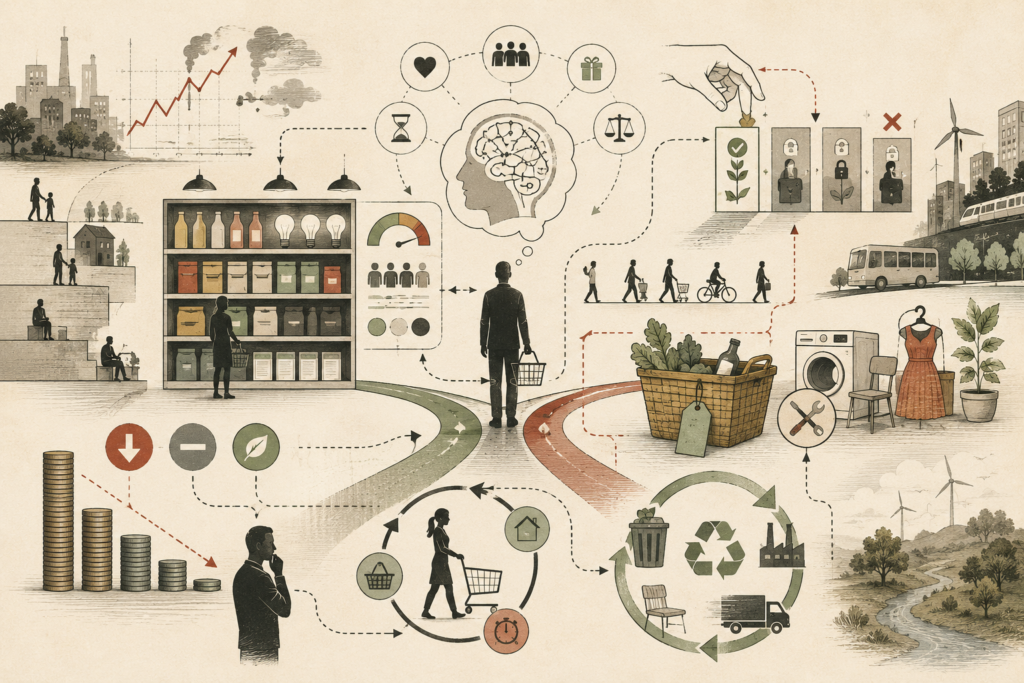
Editorial systems illustration showing sustainable consumption as a behavioral decision environment shaped by incentives, defaults, habits, social norms, pricing, infrastructure, reuse, and environmental feedback loops.

Behavioral Economics and Sustainable Consumption

Behavioral economics offers a stronger account of sustainable consumption than models that assume households respond cleanly to prices and information. Environmentally consequential decisions are made under conditions of limited attention, habit, present bias, uncertainty, status competition, and institutional constraint. This article examines the attitude-behavior gap, the role of norms and conditional cooperation, the power of defaults and choice architecture, and the limits of purely informational approaches. It also develops a formal analytical framework for sustainable choice and includes substantial R and Python sections for simulation and welfare analysis. The broader argument is that sustainable consumption is not simply a matter of individual virtue, but of governance, incentive design, and the architecture of feasible everyday action.

Scroll to Top