
Last Updated May 3, 2026
Celtic mythology constitutes a major field of cultural, literary, religious, and historical inquiry in which divine sovereignty, heroic memory, sacred landscape, poetic power, otherworld encounter, genealogical imagination, and oral tradition converge. The archive is not preserved in a single canonical scripture, unified pagan theology, or ancient mythographic handbook. Instead, it survives across medieval Irish and Welsh manuscripts, heroic tales, pseudo-historical compilations, origin narratives, saints’ lives, genealogical material, courtly prose, oral legend, folklore, antiquarian recovery, philological reconstruction, and modern cultural revival. Celtic mythology is therefore best understood not as one fixed system, but as a layered comparative field shaped by regional traditions, oral inheritance, scribal mediation, Christian-era preservation, and long historical afterlives.
The strongest surviving primary archive is Insular rather than pan-Celtic. On the Irish side, texts such as the Táin Bó Cúailnge, Cath Maige Tuired, Lebor Gabála Érenn, Tochmarc Étaíne, the Fenian materials, and related saga traditions preserve mythic kingship, divine races, warrior culture, sovereignty motifs, heroic excess, otherworld contact, and the great narrative cycles of medieval Ireland. On the Welsh side, the tales later grouped under the label Mabinogion preserve a distinct but related narrative world of dynastic conflict, magical transformation, sovereignty testing, otherworld crossing, kinship tragedy, enchanted objects, and mythic memory. These archives are indispensable, but they are also medieval literary witnesses rather than transparent transcripts of pre-Christian belief.
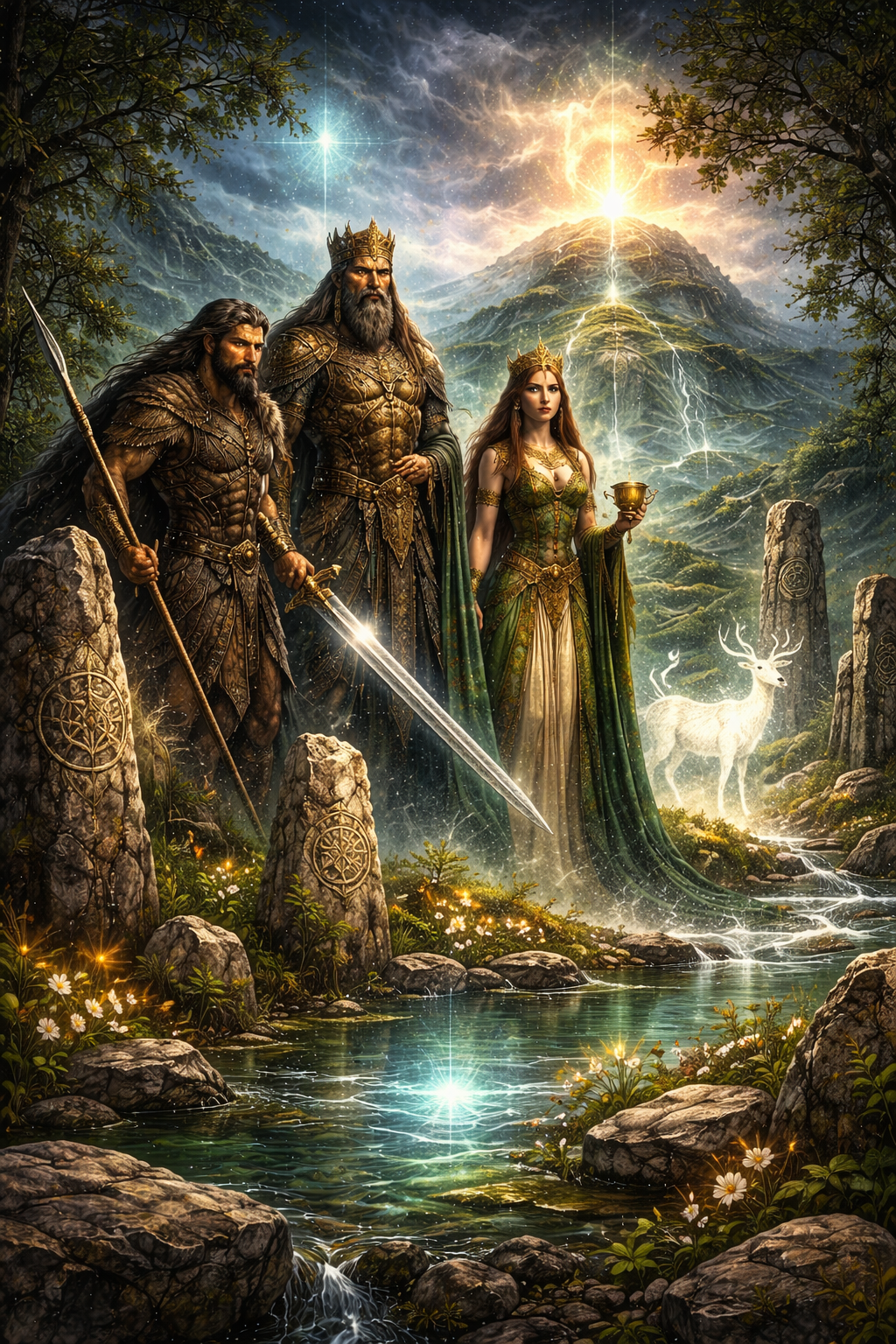
Any serious treatment of Celtic mythology must therefore attend to transmission. What modern readers call “Celtic myth” survives largely through Christian-era manuscripts, learned compilation, antiquarian editions, philological reconstruction, and later folkloric or literary recovery. The manuscripts preserve older materials while also reshaping them through monastic framing, dynastic interest, pseudo-history, learned prose, Christian moral language, and medieval literary artistry. A research-grade synthesis must therefore move carefully between mythology, heroic legend, folklore, manuscript culture, oral poetics, and retrospective cultural memory.
Celtic mythology also matters because it preserves one of the most symbolically charged narrative worlds in medieval Europe: a world of cattle raids and enchanted cauldrons, warrior champions and shape-shifting sovereignty figures, islands of youth and otherworld feasts, sacred wells and taboo-bound kings, poets whose speech has power, and landscapes alive with memory, danger, prophecy, and sacred presence. The field illuminates not only Irish and Welsh literary history, but broader questions of kingship, fate, kinship, gender, poetic authority, sacred geography, Christian redaction, and the endurance of mythic form across historical rupture.
This pillar approaches Celtic mythology as a regionally differentiated and historically mediated archive rather than as a unified ancient religion reconstructed too confidently from later sources. It asks how Irish and Welsh materials can be compared without being collapsed; how medieval manuscripts preserve and transform older oral traditions; how sovereignty, otherworlds, heroic violence, sacred speech, and enchanted landscapes structure the archive; how women, poets, animals, cauldrons, wells, taboos, and kings carry mythic meaning; and how Celtic mythology continued to live through folklore, antiquarianism, revival literature, nationalism, popular culture, and modern spiritual imagination.
Why This Field Matters
Celtic mythology matters because it preserves one of the great mythic and heroic archives of medieval Europe. Its narratives join divine sovereignty, heroic violence, sacred landscape, otherworld enchantment, poetic authority, royal legitimacy, kinship tragedy, and the memory of older oral traditions. The field is not merely a collection of attractive stories about warriors, gods, faeries, and enchanted islands. It is a major archive for understanding how medieval Irish and Welsh cultures imagined power, land, speech, lineage, fate, gender, and sacred presence.
The field also matters because it challenges simple categories. Celtic myth is not preserved in a pagan scripture. It is not one pan-Celtic canon. It is not a direct transcript of Iron Age religion. It survives through Christian-era literary witnesses, manuscript compilations, heroic sagas, learned pseudo-history, courtly prose, saints’ lives, genealogies, folklore, and later revivalist interpretation. Its value lies partly in this mediation: the archive shows how older narrative patterns can survive by being translated into new religious, literary, and political forms.
Celtic mythology is especially important for the study of sovereignty. Irish and Welsh materials repeatedly link land, rule, feminine figures, marriage, taboo, fertility, justice, and rightful kingship. The ruler’s authority is rarely mere force. It depends on relationship to the land, fulfillment of obligations, respect for taboo, proper speech, and alignment with a moral order that can be violated. Myth becomes a language for thinking the fragility of legitimate power.
The field also matters because it preserves a remarkable otherworld imagination. Islands, mounds, lakes, wells, halls, enchanted feasts, cauldrons, animals, and time-altering journeys create a world in which ordinary reality is porous. The otherworld is not simply a fantasy realm. It is a domain of desire, danger, renewal, prophecy, testing, and contact with powers that exceed ordinary human order.
The Problem of the Archive
A research-grade account must begin with the archive itself. Celtic mythology does not survive in one ancient pagan book or unified mythographic system. It survives unevenly across medieval Irish and Welsh manuscripts, Latin and vernacular texts, heroic cycles, mythological tales, pseudo-historical compilations, saints’ lives, genealogies, legal material, place-name lore, folklore collections, antiquarian editions, and modern scholarly reconstructions.
The Irish archive includes mythological materials associated with the Tuatha Dé Danann, pseudo-historical origins in Lebor Gabála Érenn, battle narratives such as Cath Maige Tuired, heroic materials centered on the Ulster Cycle and Táin Bó Cúailnge, Fenian and kingly traditions, voyage tales, otherworld narratives, and place-lore. The Welsh archive includes the Four Branches of the Mabinogi, tales involving figures such as Pwyll, Rhiannon, Branwen, Bendigeidfran, Math, Blodeuwedd, Lleu, and Pryderi, Arthurian-adjacent materials, triads, poetry, and later folklore.
This archive requires caution because its witnesses are medieval. Christian scribes preserved, reorganized, moralized, translated, and sometimes reframed earlier materials. They did not simply invent the myths, but neither did they transmit them without change. Monastic learning, dynastic politics, medieval prose style, Latin historiography, biblical frameworks, and local literary traditions all shaped what survives.
The archive is therefore both precious and mediated. It gives access to deep mythic structures, but only through layers of textual transmission. The task is not to strip away the medieval form in search of a pure pagan original. The task is to understand how mythic memory survived through medieval literary and scribal life.
Myth Without a Single Canon
Celtic mythology is best approached as a plural and regionally differentiated field rather than as a single canon. “Celtic” is a useful linguistic and cultural umbrella, but it can become misleading if it erases differences among Irish, Welsh, Scottish Gaelic, Manx, Cornish, Breton, and continental Celtic contexts. The strongest surviving mythic corpora are Irish and Welsh, and even these are not identical.
The Irish materials are especially rich in divine races, invasion schemes, heroic cattle-raiding, warrior initiation, sovereignty motifs, prophetic geasa, otherworld women, sacred kingship, and place-lore. The Welsh materials preserve a different narrative texture: dynastic conflict, magical transformation, exchange between realms, kinship catastrophe, sovereignty testing, enchanted objects, and courtly narrative form. Comparison is productive only when it preserves these differences.
The absence of one canon also means that genre matters. A heroic tale does different work from a place-name legend. A pseudo-history does different work from a prose tale. A saint’s life preserves mythic motifs differently from a saga. A Welsh triad condenses memory differently from an Irish recension. A folklore collection preserves afterlife differently from a medieval manuscript.
This pillar therefore treats Celtic mythology as a field of related archives, not as a flattened system. It studies recurring motifs—sovereignty, otherworlds, enchanted objects, divine races, poetic speech, animal transformation, sacred landscape—while keeping local textual histories and regional forms visible.
Irish and Welsh Archives: Comparison Without Collapse
The comparison of Irish and Welsh mythic archives is one of the most rewarding but dangerous tasks in Celtic studies. Similarities are real. Both traditions preserve otherworld crossings, magical animals, sovereignty motifs, enchanted objects, powerful women, dynastic conflict, poetic authority, and landscapes charged with memory. Yet the archives do not form one interchangeable mythic system.
Irish mythology often foregrounds invasion history, divine races, heroic cattle wealth, royal legitimacy, taboo, and the intense violence of heroic identity. The Tuatha Dé Danann, the Fomorians, the sons of Míl, the Ulster heroes, and the kingly materials of Tara and other centers create a world where origin, sovereignty, battle, and land are deeply entangled.
Welsh mythic narrative is especially powerful in its treatment of kinship, magical transformation, insult, compensation, sovereignty, and dynastic damage. The Four Branches of the Mabinogi create a tightly interrelated narrative world in which actions echo across generations and ordinary politics repeatedly opens onto supernatural consequence.
Comparison should therefore proceed by motif, structure, and function rather than by forcing one-to-one equations. Irish and Welsh archives may share older Celtic inheritances, but they also reflect distinct medieval literary systems. Their difference is part of their value.
Oral Tradition, Manuscript Culture, and Scribal Mediation
Celtic mythology cannot be understood without the relation between oral tradition and manuscript culture. Many narratives likely circulated in oral or performative forms before being written down, yet the forms that survive are manuscripts shaped by scribes, compilers, patrons, schools, monastic communities, and later editors. The archive is therefore oral and textual at once.
Oral tradition helps explain formulaic patterns, repetition, stock scenes, heroic naming, genealogical depth, episodic structure, and the adaptability of stories across contexts. Performance would have shaped pacing, emphasis, audience response, and local variation. The storyteller, poet, or learned reciter was not merely a transmitter but an interpreter of inherited memory.
Manuscript culture gives the archive durability while also changing it. Once written, a story enters a new world of compilation, recension, marginalia, ordering, translation, preservation, and scholarly classification. The Book of Leinster, the White Book of Rhydderch, the Red Book of Hergest, and related manuscript witnesses are therefore not neutral containers. They are historical actors in the survival of myth.
Scribal mediation is not a problem to be bypassed. It is part of what Celtic mythology is. The medieval written archive preserves older narrative material by making it legible within new religious, political, and literary worlds.
Christian Redaction and the Preservation of Pagan Memory
Christian redaction is central to the study of Celtic mythology. The surviving manuscripts were copied in Christian contexts, and the scribes who preserved them often worked within monastic, learned, or clerical settings. Older divine figures could be euhemerized as ancient peoples, demons, heroes, or wondrous beings. Mythic origins could be fitted into biblical world-history. Pagan memory could be preserved precisely by being reframed.
This creates interpretive complexity. Christian scribes sometimes softened, moralized, rationalized, or reorganized mythic materials. But they also preserved extraordinary narrative worlds that might otherwise have disappeared. Their work cannot be reduced simply to distortion. It is also conservation, translation, and literary transformation.
Lebor Gabála Érenn is a powerful example. It organizes Irish origins through a pseudo-historical sequence of arrivals, invasions, peoples, and genealogies that align local memory with broader Christian historical imagination. The result is not pure pagan myth, but neither is it merely fabricated medieval history. It is a hybrid archive of myth, identity, learning, and legitimation.
Christian redaction therefore requires a double reading. We must ask what older motifs survive, and also what medieval Christian forms made that survival possible. Celtic mythology is not outside medieval Christianity; much of it survives through Christian manuscript culture.
Origins, Invasions, and Divine Races
Irish mythic archives frequently imagine beginnings through arrivals, invasions, settlements, battles, and genealogical ordering. Origin is not a single creation moment but a sequence of peoples and claims to land. The mythic taking of Ireland binds territory, ancestry, kingship, sacred legitimacy, and historical imagination together.
Lebor Gabála Érenn, or the Book of the Taking of Ireland, is central to this structure. It presents Irish origins through successive groups who arrive, inhabit, fight, rule, and are displaced. The text participates in medieval universal history, but it also preserves local mythic material concerning divine and semi-divine peoples, especially the Tuatha Dé Danann.
Invasion narratives are not merely about conquest. They organize memory around claims to land, continuity across rupture, the relation between older and newer peoples, and the legitimacy of rule. They also dramatize a basic mythic question: who has the right to inhabit and govern a sacred landscape?
The language of origin in Celtic mythology is therefore often migratory, genealogical, and political. Peoples arrive; gods become ancestors; battles establish orders; land remembers those who held it before.
Tuatha Dé Danann and the Divine World of Ireland
The Tuatha Dé Danann stand at the center of Irish mythological imagination. They are presented in medieval texts as a people of extraordinary skill, beauty, power, and knowledge, associated with divine figures, enchanted objects, sovereignty, battle, craft, poetry, and the otherworld. Their status in the surviving archive is complex: they are gods remembered as peoples, divine beings historicized by medieval writers, and mythic presences transformed by Christian-era textualization.
Figures associated with this world—such as the Dagda, Lug, Brigid, Nuadu, the Morrígan, Goibniu, Dian Cécht, Manannán mac Lir, and others—preserve traces of divine functions: kingship, skill, healing, craft, fertility, battle, sovereignty, poetry, sea, and otherworld passage. Yet their meanings must be reconstructed cautiously from medieval literary evidence, comparative material, and later folklore.
The Tuatha Dé Danann also preserve the theme of displacement into the otherworld. After defeat or transition, they become associated with síd mounds, hidden dwellings, and the unseen life of the land. This transformation links divine memory to landscape. The gods do not vanish; they become immanent in place.
Their world is therefore essential for understanding Irish mythology as a field where divinity, ancestry, land, and otherworld presence remain deeply intertwined.
The Ulster Cycle and Heroic Memory
The Ulster Cycle preserves one of the great heroic archives of medieval Europe. Its world is structured by cattle wealth, honor, youth, fosterage, kinship, prophecy, feasting, single combat, heroic display, and fatal violence. At its center stands Táin Bó Cúailnge, the Cattle Raid of Cooley, one of the most important heroic narratives in Irish literature.
The Ulster world is heroic but not morally simple. Its champions pursue fame, honor, and obligation under conditions of extreme violence. Heroic identity is beautiful, terrifying, unstable, and often doomed. The young warrior may be celebrated for impossible courage while also consumed by excess.
The social world of the Ulster Cycle is equally important. Kings, queens, warriors, charioteers, women, druids, poets, and messengers all participate in a network of obligation and rivalry. Cattle wealth is not mere property; it is status, power, fertility, and political symbol.
Heroic memory in the Ulster Cycle therefore becomes a way of thinking the cost of glory. The stories do not simply glorify warriors. They expose the destructive force of honor when bound to pride, rivalry, prophecy, and taboo.
Cú Chulainn, Medb, and the Logic of Heroic Excess
Cú Chulainn is the central heroic figure of the Ulster Cycle and one of the most powerful warrior figures in world mythology. His youth, ferocity, beauty, loyalty, monstrous battle-fury, and tragic destiny make him a figure of heroic excess. He protects Ulster with superhuman force, yet that same intensity places him outside ordinary human measure.
His ríastrad, or battle distortion, is especially important because it makes heroic violence visible as transformation. The hero becomes something more and less than human. Glory is inseparable from danger. Cú Chulainn’s greatness is not calm excellence but extreme intensity under fatal pressure.
Medb of Connacht is equally important. She is not merely an antagonist. She is a figure of sovereignty, desire, political calculation, sexual autonomy, wealth, rivalry, and royal ambition. In the Táin, her dispute over status and cattle wealth helps unleash the great raid. She embodies the dangerous entanglement of sovereignty, desire, and power.
Together, Cú Chulainn and Medb reveal the archive’s political and psychological force. Heroic society is animated by honor, desire, competition, and speech acts whose consequences become catastrophic. Celtic heroic myth repeatedly asks what happens when power, youth, pride, and fate exceed social containment.
The Four Branches of the Mabinogi and Welsh Mythic Memory
The Four Branches of the Mabinogi preserve the most important Welsh mythic prose sequence. Their world is one of dynastic relations, insult and compensation, marriage alliance, magical transformation, otherworld exchange, child loss, sovereignty, kinship damage, and recurring consequences across generations. The narrative world is compact, interlaced, and morally charged.
The First Branch, centered on Pwyll, Rhiannon, Arawn, and Pryderi, introduces key structures: exchange between realms, sovereignty through marriage, the testing of honor, and the birth of a child whose fate echoes through later branches. The Second Branch, centered on Branwen and Bendigeidfran, transforms marriage alliance into catastrophic war between Britain and Ireland. The Third Branch follows return, enchantment, dispossession, and restoration. The Fourth Branch centers on Math, Gwydion, Arianrhod, Lleu, and Blodeuwedd, making transformation, gender, punishment, and magical making central.
The Four Branches are not simple pagan survivals. They are medieval Welsh literary works shaped by courtly prose and manuscript transmission. Yet they preserve mythic structures of remarkable depth. Otherworld sovereignty, magical animals, enchanted cauldrons, reproductive crisis, name-giving, taboo, and territorial order all carry sacred and symbolic force.
Welsh mythic memory therefore adds a distinctive dimension to Celtic mythology: less dominated by heroic battle-fury than the Ulster Cycle, but equally profound in its treatment of kinship, sovereignty, transformation, and loss.
Pwyll, Rhiannon, Branwen, Math, and Pryderi
The major figures of the Mabinogi reveal the Welsh archive’s symbolic density. Pwyll’s exchange with Arawn, lord of Annwn, makes kingship depend on restraint, honor, and otherworld relation. He must act properly in another realm before he can be fully understood as ruler in his own. The otherworld tests political identity.
Rhiannon is one of the great sovereignty figures of medieval Welsh narrative. She is associated with horses, otherworld aura, marriage, accusation, endurance, and restored honor. Her story reveals both the power and vulnerability of women within dynastic systems. She carries sovereignty, but she is also subjected to slander and punishment.
Branwen’s story turns marriage alliance into tragedy. Her suffering in Ireland, the mutilation of messengers, the catastrophic war, and the wounded survival of Bendigeidfran create one of the great kinship tragedies of Celtic literature. The tale imagines political alliance as fragile and female suffering as the center of historical catastrophe.
Math, Gwydion, Arianrhod, Lleu, Blodeuwedd, and Pryderi deepen the archive’s concern with transformation, naming, sexual control, punishment, inheritance, and magical making. The Welsh tradition repeatedly shows that family, sovereignty, and magic are never separate from consequence.
Sovereignty, Kingship, and the Moral Condition of the Land
Sovereignty is one of the central themes of Celtic mythology. Rightful rule is not merely military control. It depends on a relationship among ruler, land, feminine power, taboo, justice, prosperity, and sacred order. The king’s body, behavior, marriage, and speech may affect the condition of the land itself.
Irish materials often dramatize sovereignty through women, feasts, tests, and symbolic unions. The sovereignty goddess may appear as beautiful, terrifying, demanding, or transformative. She grants legitimacy but also tests worthiness. The land is not passive territory; it is a sacred and moral partner in rule.
Kingship is also bound to taboo and obligation. A ruler who violates a geis, neglects justice, breaks hospitality, or fails in proper relation may endanger the kingdom. Sovereignty is therefore conditional and fragile. Power must remain aligned with moral and ritual order.
This makes Celtic mythology a powerful archive for political thought. It asks what makes rule legitimate, what damages the land, what obligations bind the powerful, and why sovereignty cannot be reduced to domination.
Women, Sovereignty, and the Testing of Rule
Women occupy central symbolic roles in Celtic mythology. They are not merely wives, lovers, or prizes in male heroic narratives. They often function as sovereignty figures, initiators of action, truth-tellers, prophetesses, otherworld mediators, sources of transformation, and centers of dynastic crisis. Their presence reveals the relation between gender, land, legitimacy, and power.
Medb, Rhiannon, Branwen, Étaín, Macha, the Morrígan, Blodeuwedd, Arianrhod, and other figures show the range of female power in the archive. Some grant or test kingship. Some expose the violence of heroic society. Some embody land, desire, prophecy, or transformation. Some are punished by systems they also sustain.
The sovereignty woman is especially important because she makes political legitimacy relational. Rule must be received, tested, joined, or recognized. The feminine figure may represent the land, but she is not only an abstraction. Her suffering, refusal, accusation, sexuality, or endurance often drives the story’s moral structure.
Celtic mythology therefore requires a gendered reading. Without women, sovereignty cannot be understood; without sovereignty, many female figures are misread as merely decorative or romantic.
Otherworlds, Enchantment, and Transformation
The Celtic otherworld is one of the field’s defining imaginative structures. It appears through islands, mounds, halls, lakes, feasts, beautiful strangers, time distortion, enchanted animals, cauldrons, and journeys beyond ordinary human space. It may be beneath the land, across the sea, inside the mound, through the mist, or adjacent to ordinary life but hidden from normal perception.
Otherworld narratives are not escapist fantasy. They test identity, desire, hospitality, kingship, and perception. A mortal who enters another realm may receive gifts, lose time, marry an otherworld woman, break a taboo, or return changed. The otherworld is attractive and dangerous because it reveals that ordinary reality is not complete.
Transformation is closely linked to otherworld contact. Humans become animals; flowers become women; warriors become monstrous in battle; divine beings become hidden peoples; time becomes unstable. Transformation reveals the unstable boundary between human, animal, divine, and enchanted states.
This makes Celtic mythology especially important for thinking liminality. The most charged stories often occur at thresholds: between worlds, between human and animal, between king and land, between speech and spell, between life and death, between ordinary time and mythic duration.
Cauldrons, Animals, and Enchanted Objects
Objects in Celtic mythology often carry more than practical function. Cauldrons, swords, spears, stones, cups, horns, chariots, mantles, wells, and other objects may concentrate sovereignty, abundance, healing, rebirth, prophecy, or destructive power. Material things become carriers of sacred force.
The cauldron is especially important. In Irish and Welsh materials, cauldrons may be associated with abundance, restoration, inspiration, or uncanny renewal. They are not mere domestic vessels. They become symbols of transformation, nourishment, and otherworld power.
Animals also occupy central roles. Boars, hounds, horses, birds, cattle, salmon, deer, swans, and other beings appear as guides, enemies, omens, transformations, companions, or signs of otherworld presence. Animality in Celtic myth often destabilizes the boundary of the human. A person may be transformed into an animal; an animal may carry divine or prophetic force; a hunt may become an encounter with the sacred.
Enchanted objects and animals reveal the material imagination of the archive. Power does not remain abstract. It enters vessels, weapons, animals, food, wells, and landscapes.
Poetry, Speech, and Sacred Knowledge
Poetry and speech hold exceptional power in Celtic narrative worlds. Bards, poets, seers, satirists, druids, and inspired speakers are not mere entertainers. They mediate memory, law, praise, curse, prophecy, genealogy, and public reputation. Speech can bless, shame, bind, reveal, transform, or destroy.
In Irish tradition especially, satire can have social and even bodily force. Praise poetry preserves honor; genealogy secures identity; prophecy directs action; legal speech orders society. The poet’s authority rests on memory, form, and disciplined language. Words are not neutral. They act.
Welsh tradition also gives great power to poetic memory and inspired speech. The bardic order, praise tradition, prophetic poetry, and the later mythic image of Taliesin all show how poetic authority becomes sacred and political at once.
This makes Celtic mythology one of the great archives of verbal power. Language is not only a medium for myth. It is one of myth’s central forces.
Druids, Seers, and the Problem of Reconstruction
Druids occupy a powerful place in the modern imagination, but they also require careful source criticism. Classical writers, medieval Irish texts, later folklore, antiquarian speculation, nationalist revival, and modern spiritual movements have all shaped the image of the druid. The result is a figure both historically important and heavily mediated.
In ancient and medieval sources, druids and related learned figures are associated with ritual, wisdom, prophecy, judgment, teaching, sacrifice, and sacred knowledge. Yet the evidence is fragmentary, regionally uneven, and often filtered through outsiders or later Christian writers. We should avoid both dismissing druids as purely invented and reconstructing them with false certainty.
The problem of druids illustrates a larger issue in Celtic mythology: the desire to recover pre-Christian religion from medieval and classical sources can easily outrun the evidence. A responsible account must distinguish between ancient testimony, medieval literary function, folklore, revivalism, and modern reconstruction.
Druids therefore belong in the pillar not only as figures of sacred knowledge, but as a case study in the ethics of reconstructing lost religious worlds.
Landscape, Place-Memory, and Sacred Geography
Celtic mythology is deeply tied to landscape. Hills, mounds, wells, rivers, islands, lakes, caves, battlefields, roads, forts, and named places are not passive settings. They are carriers of memory. Myth often explains why a place is named, why it is sacred, why a battle happened there, why a well heals, why a mound is inhabited, or why the land responds to rightful rule.
Irish dindshenchas, or place-name lore, is especially important because it reveals a world in which geography is narrativized. Place becomes archive. A hill, ford, lake, or mound can preserve the memory of a death, battle, transformation, divine encounter, or royal event.
The síd mounds are central to this sacred geography. They link the land to the Tuatha Dé Danann and to the hidden otherworld. The divine is not absent; it is concealed within the landscape. Place becomes a threshold between visible and invisible realities.
Welsh landscapes are also deeply storied: islands, courts, rivers, and regions carry mythic memory through the Mabinogi and related traditions. Celtic mythology therefore teaches that land is never merely terrain. It is memory, power, and presence.
Folklore, Revival, and Modern Afterlives
Celtic mythology did not end with the medieval manuscript archive. It continued through folklore, local legend, fairy belief, place-name traditions, seasonal customs, literary revival, antiquarian scholarship, nationalist cultural projects, music, visual art, fantasy literature, modern paganism, and popular culture. These afterlives are part of the field, though they must be distinguished from medieval sources.
Folklore preserved many motifs associated with the otherworld, fairy mounds, enchanted places, supernatural women, healing wells, omens, household spirits, and dangerous crossings. Later collectors recorded materials that sometimes echo older mythic structures while also belonging to distinct local and historical contexts.
The Celtic Revival transformed the archive again. Writers, artists, and political movements reimagined Celtic myth as cultural heritage, national memory, spiritual alternative, and artistic resource. This revival preserved interest in the myths but also reshaped them through modern needs and romantic projections.
Modern popular culture continues the process, often blending Irish, Welsh, Scottish, Arthurian, fairy, and fantasy materials into new forms. A responsible pillar should study these afterlives without confusing them with the medieval archive. Myth survives by being reinterpreted, but interpretation must remain historically clear.
Major Questions of Interpretation
This pillar is organized around several major questions. How should Celtic mythology be studied when its primary witnesses are medieval manuscripts shaped by Christian scribal culture? How can Irish and Welsh archives be compared without collapsing them into one system? How should scholars distinguish older mythic structures from medieval literary artistry, Christian redaction, antiquarian reconstruction, folklore, revivalism, and modern popular adaptation?
The pillar also asks how sovereignty, heroic violence, poetic speech, otherworld encounter, enchanted objects, animal transformation, sacred landscape, and women’s symbolic authority structure the archive. How does the land become a moral partner in kingship? Why do otherworld women, cauldrons, wells, mounds, and taboos recur with such force? How does heroic glory become tragic excess? How does manuscript preservation both save and transform myth?
These questions keep the category from becoming a romantic inventory of gods, warriors, and magical places. They open Celtic mythology as a field of textual, oral, religious, political, gendered, geographical, performative, and comparative inquiry. The tradition is not only a collection of tales. It is a layered archive through which medieval Ireland and Wales preserved older questions about power, land, speech, desire, transformation, and the unseen life of place.
Expanded Article Architecture
The following structure gathers the pillar into a long-range architecture suitable for a major mythology knowledge series. It is designed to support source criticism, Irish and Welsh differentiation, manuscript transmission, Christian redaction, divine races, heroic cycles, sovereignty, otherworlds, poetic authority, sacred geography, animal transformation, enchanted objects, folklore, revival, and modern afterlives. All entries below should be treated as planned unless already completed elsewhere on the site.
Foundations and Source Problems
- What Is Celtic Mythology? (planned)
- The Problem of Sources in Celtic Mythology (planned)
- Celtic Mythology Without a Single Canon (planned)
- Irish and Welsh Mythic Archives: Comparison Without Collapse (planned)
- Oral Tradition, Manuscript Culture, and the Survival of Celtic Myth (planned)
- Christian Redaction and the Medieval Preservation of Pagan Memory (planned)
- How to Read Celtic Myth Without Romantic Reconstruction (planned)
Manuscripts, Scribes, and Transmission
- Manuscripts of the Celtic Mythic Archive: Book of Leinster, White Book, and Red Book (planned)
- The Book of Leinster and the Irish Heroic Archive (planned)
- The White Book of Rhydderch and the Welsh Tale Tradition (planned)
- The Red Book of Hergest and the Preservation of Welsh Mythic Prose (planned)
- Scribal Mediation, Compilation, and the Literary Life of Myth (planned)
- Antiquarian Editions, Philology, and the Modern Recovery of Celtic Myth (planned)
Irish Origins, Invasions, and Divine Races
- Origins, Invasions, and the Mythic Taking of Ireland (planned)
- The Lebor Gabála Érenn and the Pseudo-History of Origins (planned)
- The Tuatha Dé Danann and the Divine Races of Ireland (planned)
- The Fomorians, Disorder, and the Mythic Enemy (planned)
- The Sons of Míl and the Human Claim to Ireland (planned)
- Genealogy, Land, and Sacred Legitimacy in Irish Origin Tradition (planned)
Irish Mythological Tales and Divine Powers
- The Battles of Mag Tuired and the Crisis of Sacred Rule (planned)
- Lug, Skill, and the Many-Gifted Hero-God (planned)
- The Dagda, Abundance, Kingship, and Comic Sacred Power (planned)
- Brigid, Poetry, Healing, Craft, and Sacred Continuity (planned)
- The Morrígan, Battle, Sovereignty, and Prophetic Terror (planned)
- Nuadu, Kingship, Wounding, and the Fitness to Rule (planned)
- Manannán mac Lir, the Sea, and Otherworld Mediation (planned)
The Ulster Cycle and Heroic Excess
- The Táin Bó Cúailnge and the Heroic Imagination of Ulster (planned)
- Cú Chulainn, Youth, Violence, and the Logic of Heroic Excess (planned)
- Medb, Sovereignty, and the Politics of Desire and Power (planned)
- Fergus, Conchobar, and the Broken Ethics of Heroic Kingship (planned)
- Prophecy, Geis, and the Fatal Structure of Heroic Life (planned)
- Cattle Wealth, Honor, and the Political Economy of the Táin (planned)
- Heroic Glory and the Tragedy of Violence in the Ulster Cycle (planned)
Welsh Mythic Prose and the Four Branches
- The Four Branches of the Mabinogi and the Welsh Mythic Imagination (planned)
- Pwyll, Arawn, and the Otherworld Test of Rule (planned)
- Rhiannon, Horses, Sovereignty, and the Burden of Accusation (planned)
- Branwen, Violence, and the Tragic Geography of Kinship (planned)
- Math, Blodeuwedd, and Transformation in Welsh Myth (planned)
- Pryderi and the Problem of Inheritance, Memory, and Rule (planned)
- Gwydion, Arianrhod, Lleu, and the Ethics of Magical Power (planned)
Sovereignty, Kingship, and the Land
- Kingship, Taboo, and the Moral Condition of the Land (planned)
- Women, Sovereignty, and the Testing of Rule (planned)
- Sovereignty Goddesses and the Marriage of King and Land (planned)
- Feasts, Hospitality, and the Ritual Performance of Rule (planned)
- Wounding, Blemish, and the Fitness of the King (planned)
- Justice, Fertility, and the Sacred Ecology of Sovereignty (planned)
Otherworlds, Enchantment, and Transformation
- Arawn, Annwn, and the Celtic Otherworld (planned)
- Síd Mounds, Hidden Peoples, and the Unseen Life of the Land (planned)
- Voyage Tales, Islands of Youth, and the Sea Road to Enchantment (planned)
- Otherworld Women and the Crisis of Human Desire (planned)
- Time Distortion, Feast, and the Unstable Boundary of Worlds (planned)
- Shape-Shifting, Animal Presence, and the Unstable Human (planned)
Objects, Animals, and Material Powers
- Cauldrons, Boars, Hounds, and Enchanted Objects (planned)
- The Cauldron as Abundance, Rebirth, and Otherworld Power (planned)
- Horses, Sovereignty, and the Mythic Movement of Power (planned)
- Boar Hunts, Hounds, and the Animal Worlds of Celtic Myth (planned)
- Swords, Spears, Stones, and the Material Signs of Kingship (planned)
- Food, Feast, and the Sacred Object Economy of Celtic Narrative (planned)
Poetry, Druids, and Sacred Speech
- Bards, Poets, and the Sacred Authority of Speech (planned)
- Druids, Wisdom, and the Problem of Reconstruction (planned)
- Satire, Praise, and the Social Power of Words in Irish Tradition (planned)
- Prophecy, Vision, and Inspired Knowledge in Celtic Narrative (planned)
- Taliesin, Poetic Transformation, and Welsh Inspired Speech (planned)
- Genealogy, Memory, and the Verbal Architecture of Identity (planned)
Landscape, Place-Lore, and Sacred Geography
- Sacred Wells, Islands, and the Geography of Enchantment (planned)
- Hills, Mounds, Rivers, and the Mythic Life of Place (planned)
- Dindshenchas and the Irish Narrative Memory of Place (planned)
- Tara, Emain Macha, and the Sacred Centers of Irish Memory (planned)
- Welsh Courts, Islands, and the Geography of the Mabinogi (planned)
- Battlefields, Fords, and the Landscape of Heroic Death (planned)
Folklore, Revival, and Modern Afterlives
- Folklore, Fairy Belief, and the Local Afterlife of Celtic Myth (planned)
- Healing Wells, Seasonal Customs, and the Living Sacred Landscape (planned)
- The Celtic Revival and the Reinvention of Mythic Memory (planned)
- Antiquarianism, Nationalism, and the Politics of Celtic Myth (planned)
- Celtic Mythology in Modern Literature, Fantasy, Art, and Popular Culture (planned)
- Celtic Mythology in Comparative Perspective (planned)
- Why Celtic Mythology Still Matters (planned)
Closing Perspective
Celtic mythology reveals one of the great layered archives of medieval and post-medieval cultural memory. It preserves divine races and heroic cycles, sovereignty women and taboo-bound kings, enchanted cauldrons and animal transformations, otherworld journeys and sacred wells, bardic speech and prophetic knowledge, manuscripts and folklore, Christian redaction and pagan memory, Irish and Welsh difference, and the continuing afterlife of myth in modern cultural imagination.
This is what makes the category so important within Mythology. Celtic mythic culture shows how mythology can survive through manuscript mediation, oral performance, place-lore, heroic saga, courtly prose, learned pseudo-history, folklore, and revival. It also shows why mythology must be studied through language, land, text, performance, gender, politics, and transmission history, not only through story summary.
The strongest reason to study this field is that Celtic mythology clarifies how communities remember sacred power under conditions of change. The gods become hidden in the land; sovereignty survives through women and place; poets keep memory alive through speech; heroes become glorious and doomed; Christian scribes preserve what they also transform; folklore carries medieval motifs into later life. These traditions do not belong only to the past. They continue to shape how readers imagine landscape, enchantment, power, identity, and the unseen life of story.
Related Reading
- Mythology
- Norse Mythology
- Greek and Roman Mythology
- Classical Literature and Civilizational Memory
- Shakespeare and Early Modern Literature
- British Literature and Cultural Memory
- Poetry, Memory, and Imagination
- Tragedy, Drama, and Collective Memory
- Culture, Meaning, and Symbolism
- Comparative Sacred Themes
Primary Sources
Irish Mythic and Heroic Texts
- Táin Bó Cúailnge from the Book of Leinster. CELT edition and translation, central for the Ulster Cycle, heroic violence, cattle wealth, Medb, Cú Chulainn, and the heroic imagination of medieval Ireland: https://celt.ucc.ie/published/T301035.html
- TEI header and bibliographic information for Táin Bó Cúailnge in CELT, useful for textual and editorial context: https://celt.ucc.ie/published/T301035/header.html
- Lebor Gabála Érenn (The Book of the Taking of Ireland). Macalister edition in CELT-linked PDF form, central for origin, invasion, pseudo-history, and the mythic taking of Ireland: https://celt.ucc.ie/LGQS.pdf
- CELT: Corpus of Electronic Texts. Essential for open access to Irish medieval texts, including mythological, heroic, historical, legal, and ecclesiastical materials: https://celt.ucc.ie/
Welsh Mythic Texts
- The tales later grouped as the Mabinogion, preserved in medieval Welsh manuscripts such as the White Book of Rhydderch and the Red Book of Hergest, are central for Welsh mythic prose, otherworld exchange, sovereignty, transformation, kinship, and enchanted objects.
- Museum Wales, “Folk Tales from Wales.” Useful for contextualizing Welsh tale traditions, manuscript survival, and cultural afterlives: https://museum.wales/collections/folktales/?action=background
- General guide to the Mabinogion manuscript and tale tradition: https://www.mabinogion.info/
- Medieval Welsh manuscript traditions associated with the White Book of Rhydderch and the Red Book of Hergest, especially as witnesses to the Four Branches of the Mabinogi and related tales.
Manuscript and Archive Context
- National Library of Scotland finding aid for a manuscript containing Táin Bó Cúailnge and related tales, useful for later transmission history: https://manuscripts.nls.uk/repositories/2/resources/20140
- Manuscript witnesses associated with the Book of Leinster, the Book of the Dun Cow, the Yellow Book of Lecan, the White Book of Rhydderch, and the Red Book of Hergest, all of which are crucial for understanding transmission, compilation, and medieval textual mediation.
Folklore and Later Transmission
- Irish and Welsh folklore collections preserving fairy belief, sacred wells, place-lore, seasonal customs, otherworld motifs, enchanted animals, and local legend after the medieval manuscript period.
- Antiquarian and revival-era publications that shaped modern reception of Celtic mythology, used with source-critical caution because they often blend scholarship, nationalism, romanticism, and creative reconstruction.
- Place-name lore, local legend, and oral traditions connected to sacred hills, mounds, wells, islands, battlefields, and royal centers across Ireland and Wales.
Further Reading
- CELT: Corpus of Electronic Texts. Essential for open access to major Irish mythic and heroic texts, including the Táin Bó Cúailnge and related medieval materials. https://celt.ucc.ie/
- Museum Wales, “Folk Tales from Wales.” Useful for contextualizing the medieval Welsh tale archive and its cultural afterlives. https://museum.wales/collections/folktales/?action=background
- Mabinogion.info. Helpful as a guide to the Welsh manuscript tradition and tale structure. https://www.mabinogion.info/
- National Library of Scotland manuscript records. Useful for the later manuscript life of Gaelic heroic material. https://manuscripts.nls.uk/repositories/2/resources/20140
- Carey, J. (1994) A New Introduction to Lebor Gabála Érenn. London: Irish Texts Society.
- Davies, S. (2007) The Mabinogion. Oxford: Oxford University Press.
- Ford, P.K. (1977) The Mabinogi and Other Medieval Welsh Tales. Berkeley: University of California Press.
- Green, M. (1992) Dictionary of Celtic Myth and Legend. London: Thames & Hudson.
- Koch, J.T. (ed.) (2006) Celtic Culture: A Historical Encyclopedia. Santa Barbara, CA: ABC-CLIO.
- Mac Cana, P. (1970) Celtic Mythology. London: Hamlyn.
- MacKillop, J. (1998) Dictionary of Celtic Mythology. Oxford: Oxford University Press.
- Ó Cathasaigh, T. (2014) Coire Sois, The Cauldron of Knowledge: A Companion to Early Irish Saga. Notre Dame, IN: University of Notre Dame Press.
- O’Rahilly, C. (ed. and trans.) (1967) Táin Bó Cúalnge from the Book of Leinster. Dublin: Dublin Institute for Advanced Studies.
- Rees, A. and Rees, B. (1961) Celtic Heritage: Ancient Tradition in Ireland and Wales. London: Thames & Hudson.
- Sims-Williams, P. (2011) Irish Influence on Medieval Welsh Literature. Oxford: Oxford University Press.
- Sjoestedt, M.-L. (1949) Gods and Heroes of the Celts. London: Methuen.
- Wooding, J.M. (ed.) (2000) The Otherworld Voyage in Early Irish Literature. Dublin: Four Courts Press.
References
- Carey, J. (1994) A New Introduction to Lebor Gabála Érenn. London: Irish Texts Society.
- CELT (n.d.) Táin Bó Cúailnge from the Book of Leinster. Available at: https://celt.ucc.ie/published/T301035.html
- CELT (n.d.) ‘TEI header for Táin Bó Cúailnge from the Book of Leinster’. Available at: https://celt.ucc.ie/published/T301035/header.html
- CELT (n.d.) ‘Corpus of Electronic Texts’. Available at: https://celt.ucc.ie/
- Davies, S. (2007) The Mabinogion. Oxford: Oxford University Press.
- Ford, P.K. (1977) The Mabinogi and Other Medieval Welsh Tales. Berkeley: University of California Press.
- Green, M. (1992) Dictionary of Celtic Myth and Legend. London: Thames & Hudson.
- Koch, J.T. (ed.) (2006) Celtic Culture: A Historical Encyclopedia. Santa Barbara, CA: ABC-CLIO.
- Mac Cana, P. (1970) Celtic Mythology. London: Hamlyn.
- Macalister, R.A.S. (ed.) (n.d.) Lebor Gabála Érenn: The Book of the Taking of Ireland. Available at: https://celt.ucc.ie/LGQS.pdf
- MacKillop, J. (1998) Dictionary of Celtic Mythology. Oxford: Oxford University Press.
- Mabinogion.info (n.d.) ‘Mabinogion’. Available at: https://www.mabinogion.info/
- Museum Wales (n.d.) ‘Folk Tales from Wales’. Available at: https://museum.wales/collections/folktales/?action=background
- National Library of Scotland (n.d.) ‘Manuscript of Táin Bó Cuailnge and other tales’. Available at: https://manuscripts.nls.uk/repositories/2/resources/20140
- Ó Cathasaigh, T. (2014) Coire Sois, The Cauldron of Knowledge: A Companion to Early Irish Saga. Notre Dame, IN: University of Notre Dame Press.
- O’Rahilly, C. (ed. and trans.) (1967) Táin Bó Cúalnge from the Book of Leinster. Dublin: Dublin Institute for Advanced Studies.
- Rees, A. and Rees, B. (1961) Celtic Heritage: Ancient Tradition in Ireland and Wales. London: Thames & Hudson.
- Sims-Williams, P. (2011) Irish Influence on Medieval Welsh Literature. Oxford: Oxford University Press.
- Sjoestedt, M.-L. (1949) Gods and Heroes of the Celts. London: Methuen.
- Wooding, J.M. (ed.) (2000) The Otherworld Voyage in Early Irish Literature. Dublin: Four Courts Press.