
Last Updated May 4, 2026
Lakota Thought, Memory, and Living Tradition examines the intellectual, moral, spiritual, political, ecological, and historical worlds through which Lakota communities have understood existence, sacred order, land, kinship, sovereignty, memory, and collective continuity across generations. As a major category within the Philosophy knowledge series, this pillar studies Lakota thought not as folklore, legend, symbolic residue, or anthropological material, but as a living and internally coherent field of thought carried through language, oral teaching, ceremonial life, ecological relation, political memory, visual recordkeeping, treaty consciousness, and intergenerational systems of transmission.
This field approaches Lakota tradition as a serious philosophical world whose first principles concern relation, personhood, sacred order, obligation, memory, land, authority, continuity, sovereignty, and right conduct. It begins from the premise that thought does not require confinement to the textual genres favored by modern academic philosophy in order to possess rigor, coherence, or depth. Lakota philosophy lives through oral teaching, ceremonial practice, linguistic precision, place-based knowledge, inherited narrative, visual recordkeeping, political memory, ecological responsibility, and the ethical disciplines by which a people remains accountable to itself.
It also proceeds from a methodological conviction: Lakota thought should not be treated as raw cultural material awaiting translation into outside frameworks before it can count as philosophy. Its categories are not secondary illustrations of ideas developed elsewhere. They are themselves modes of reasoning, interpretation, judgment, and world-disclosure. To approach Lakota tradition philosophically therefore requires attention not only to concepts in isolation, but to the forms of transmission, authority, embodiment, land relation, historical memory, and communal accountability through which those concepts remain living and intelligible.
The goal of this pillar is not to romanticize Lakota life, generalize Indigenous traditions into a single undifferentiated worldview, or convert living knowledge into outsider abstraction. It is to show why Lakota thought remains philosophically indispensable precisely because it joins relation, memory, land, ceremony, kinship, sovereignty, language, historical endurance, and future responsibility into a coherent field of meaning. It also insists that colonial violence, dispossession, treaty violation, boarding schools, and suppression of language and ceremony must be understood without allowing those injuries to define Lakota tradition more deeply than Lakota continuity, authority, and renewal define it.
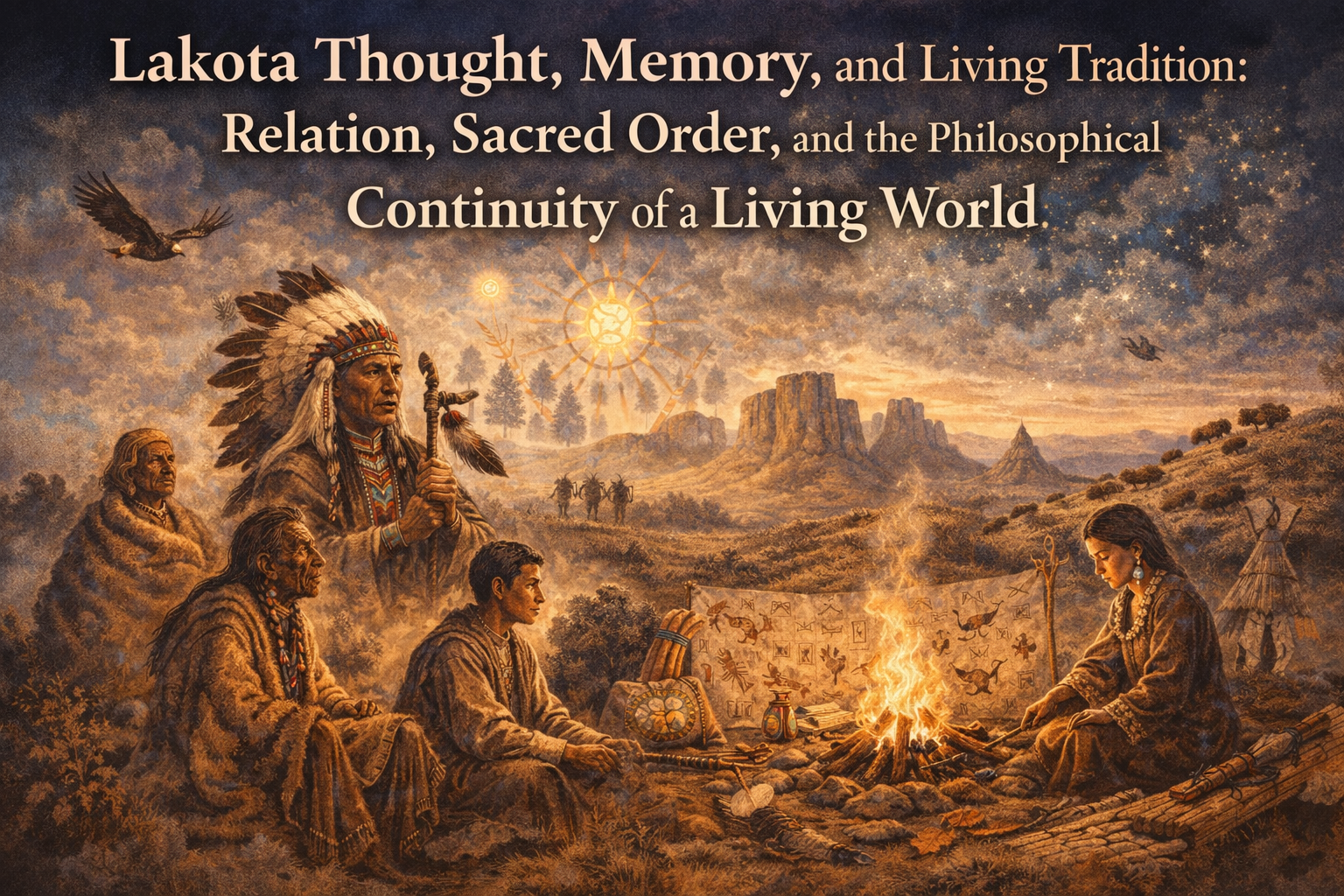
Lakota thought is especially important to a broader philosophy architecture because it challenges inherited assumptions about where philosophy lives, how knowledge is transmitted, and what counts as intellectual authority. In this respect, the category links not only to Ethics and Moral Philosophy and Political Philosophy and Justice, but also to Indigenous and Oral Traditions, Religion and Ecology, Stewardship and Ethics, Environment, Place, and Ecological Knowledge, and Culture, Meaning, and Symbolism. Questions of relation, sacred order, memory, land, treaty obligation, sovereignty, embodiment, and continuity become sharper when Lakota thought is treated not as a symbolic appendix to philosophy, but as a living philosophical world in its own right.
This category explores Lakota oral tradition, narrative memory, winter counts, language and translation, cosmology, sacred geography, kinship systems, ceremonial life, ethical formation, governance, treaty history, sovereignty, education, historical trauma, resilience, and cultural renewal. It considers how collective memory is preserved not only in written archives but through oral narration, seasonal knowledge, naming practices, ritual continuity, sacred landscapes, visual records, elder transmission, and inherited forms of responsibility. It also examines how Lakota language carries philosophical, relational, and cosmological meanings that resist reduction to outside categories, and how social life is shaped by obligations to family, community, ancestors, the more-than-human world, and future generations.
A serious treatment of this field must also address the immense pressures that sought to fracture Lakota continuity, including dispossession, military violence, forced assimilation, missionary intervention, boarding schools, administrative control, language suppression, treaty violation, the attempted suppression of ceremony, and the reclassification of living nations as objects of external governance. Yet the structure of this pillar refuses any narrative of disappearance. Lakota thought is approached as a living and enduring domain in which memory is a mode of governance, land is a bearer of relation and obligation, spirituality is inseparable from communal order, and survival itself becomes an archive of knowledge.
Why This Field Matters
This field matters because Lakota tradition preserves one of the great living archives of relational thought in North America. It offers a way of understanding life in which land, language, ceremony, kinship, memory, governance, sacred order, ecological relation, and political obligation are not neatly separable domains but mutually sustaining dimensions of a coherent world. Such a tradition cannot be adequately grasped by reducing it either to spirituality detached from history or to culture detached from philosophy. Its force lies precisely in the refusal of those divisions.
It also matters because Lakota thought confronts one of the central problems of intellectual history: how a people carries knowledge through disruption without surrendering the integrity of its categories. Under conditions of conquest, forced assimilation, institutional violence, dispossession, and epistemic attack, Lakota memory has remained not merely a record of what was endangered but an active means of continuity, renewal, and judgment. This makes the category important not only for Indigenous thought, but for philosophy more broadly, because it shows how thought may remain rigorous, transmitted, embodied, and alive outside the textual and disciplinary assumptions of the modern academy.
The field also matters because it reveals the philosophical seriousness of place. Land is not merely an object of ownership or a geographic setting for human action. It is a field of relation, memory, obligation, and sacred meaning. That makes Lakota thought indispensable for any serious philosophy of environment, sovereignty, historical repair, moral ecology, or intergenerational responsibility. It offers a profound challenge to systems of thought that treat land as passive resource, memory as private recollection, and political relation as only a matter of state recognition.
Finally, this field matters because it changes the meaning of survival. Survival is not only endurance after harm. It is the disciplined continuance of knowledge, language, relation, and ceremony under conditions designed to interrupt them. In this sense, survival becomes intellectual, ethical, political, and spiritual at once. Lakota thought remains living because it is renewed in teaching, memory, place, practice, language revitalization, and the continuing obligations of community.
Lakota Thought as Philosophical Tradition
Lakota tradition should be approached as a philosophical field in the fullest sense: one concerned with the nature of being, relation, obligation, order, knowledge, historical continuity, authority, sovereignty, and the conditions of right life. Its philosophical character does not depend on resemblance to modern European treatise-writing. It is carried instead through oral teaching, narrative instruction, ceremonial discipline, linguistic precision, inherited memory, visual recordkeeping, and forms of collective reflection embedded in social life.
This means the category must take seriously the possibility that philosophical rigor can be distributed across story, practice, place, kinship, seasonal continuity, and ceremonial form rather than isolated in abstract argument alone. Lakota thought is coherent not because it mirrors outside systems, but because its concepts arise from a lived and transmitted world in which meaning is repeatedly tested through relation, responsibility, continuity, and repair.
To treat Lakota thought as philosophy also requires rejecting a hierarchy in which written abstraction is considered more rigorous than oral, ceremonial, ecological, or communal knowledge. Such a hierarchy often reveals the limits of the outsider method rather than the limits of the tradition being studied. Lakota philosophy is not less philosophical because it is carried through living transmission. Its form is part of its thought.
This pillar therefore reads Lakota tradition as a philosophical world of its own. It does not ask whether Lakota categories can be made respectable by translation into external philosophical vocabulary. It asks what philosophy itself must learn when thought appears through relation, land, memory, ceremony, law, and communal continuity rather than through detached theory alone.
Method, Voice, and the Ethics of Approach
Because this pillar sits within Philosophy, it must be especially careful not to reproduce the old mistake by which Indigenous traditions are admitted into philosophy only when translated into outsider forms and categories. Lakota thought does not require validation by resemblance to European systems. It requires disciplined attention to its own categories, forms of authority, and modes of transmission.
This means the ethics of approach matter. One does not simply extract concepts from story, ceremony, language, or memory as though they were detachable data points. The category must remain attentive to context, relation, living communities, and the difference between philosophical engagement and epistemic appropriation. Method here is inseparable from respect, and analytic language must remain answerable to Lakota categories rather than silently displacing them.
A serious approach must also distinguish between public knowledge, scholarly interpretation, community-authorized teaching, ceremonial knowledge, and knowledge that may not be appropriate for general treatment. Not all knowledge becomes more respected by being explained publicly. Some forms of knowledge carry obligations, restrictions, or contexts of transmission that should not be flattened into general content.
This methodological caution is not an obstacle to philosophical seriousness. It is part of philosophical seriousness. It recognizes that knowledge has social location, ethical conditions, and responsibilities of transmission. A pillar on Lakota thought should therefore model intellectual care: cite responsibly, avoid sensationalism, preserve context, foreground living continuity, and resist the conversion of sacred or communal knowledge into extractive interpretation.
First Principles: Relation, Order, and Responsibility
The strongest approach to Lakota philosophy requires identifying its deepest recurring principles. Relation is one of them, but relation alone is not enough. The tradition also turns around order, obligation, memory, authority, reciprocity, continuity, land, future responsibility, and the need to keep life aligned with a larger sacred and communal structure. These are not isolated themes. They are the governing coordinates through which many other questions become intelligible.
This philosophical architecture matters because it shows that Lakota thought is not simply a collection of values or practices. It is a way of understanding how a world holds together, what threatens that order, how disorder is recognized, and how right relation may be restored. The category should therefore be read as an inquiry into a coherent moral-intellectual field rather than as a descriptive cluster of cultural features.
Relation is especially important because it changes the starting point of philosophy. The self is not imagined first as an isolated unit that later enters contracts or communities. The person exists through relation: to family, community, ancestors, land, language, sacred order, more-than-human life, and future generations. Responsibility is therefore not a secondary moral addition. It belongs to the structure of existence itself.
Order, in this context, is not mere control. It concerns the proper arrangement of relation, obligation, memory, and conduct. Disorder is not only social breakdown but a disturbance in the relations that sustain life. This makes repair, renewal, and responsible continuity central philosophical themes rather than secondary cultural practices.
Cosmology and Lived Metaphysics
Lakota cosmology is not merely an account of supernatural belief appended to social life. It is a lived metaphysics, a way of understanding reality as ordered, animate, morally charged, and relationally structured. The world is not composed of inert background matter upon which human meaning is later imposed. It is already a field of significance in which sacred order, human conduct, more-than-human life, and historical continuity belong together.
This cosmological dimension is essential because it grounds many other features of the tradition. Ceremony, land, kinship, memory, and governance derive their force not from arbitrary custom but from a larger understanding of how existence is ordered. Lakota philosophy thus treats cosmology not as speculative abstraction but as the lived horizon within which right conduct and meaningful continuity become possible.
A lived metaphysics also changes how knowledge is understood. If the world is already relationally and spiritually charged, then knowledge is not merely representation of external facts. It is disciplined participation in a world of meaning. Knowing requires conduct, relation, humility, attention, and proper orientation. This is why ceremony, language, and elder transmission matter philosophically: they help form the kind of person capable of receiving and carrying knowledge rightly.
Such a view also resists the modern separation between metaphysics and ethics. In Lakota thought, what reality is and how one ought to live are not entirely separate questions. The order of existence carries obligations. To know the world rightly is already to be implicated in how one lives within it.
Relation, Personhood, and the Order of Existence
One of the deepest organizing principles of Lakota thought is relation. The human person does not stand as an isolated consciousness facing a neutral world. Personhood emerges within a field of obligations and mutuality linking family, community, ancestors, land, ceremony, nonhuman life, sacred powers, and those yet to come. To exist is already to stand in relation.
This relational ontology matters because it reorients many of the assumptions modern philosophy often makes about selfhood and agency. The self is not primary in abstraction from its world. It is formed through kinship, responsibility, memory, discipline, and recognition of dependence. Lakota thought therefore understands existence not first as autonomy, but as accountable participation in an ordered and living whole.
This does not mean individuality disappears. Rather, individuality is understood through responsibility and relation rather than through separation. A person becomes fully recognizable through conduct, obligation, courage, generosity, respect, and the ability to sustain right relations. Personhood is therefore ethical, social, and cosmological at once.
This relational understanding also has political significance. If persons are made through relations, then harm to land, language, ceremony, family, and collective memory is not external to personhood. It is harm to the conditions through which persons and communities remain intelligible to themselves. This is one reason colonial disruption must be understood not only as material dispossession but as assault on relational existence.
Knowledge, Orality, and the Disciplines of Transmission
Lakota knowledge cannot be reduced to unwritten content awaiting preservation in text. Oral tradition is not merely a substitute for writing. It is a disciplined mode of transmission, interpretation, verification, and renewal. Story, teaching, repetition, elder guidance, ceremonial participation, seasonal recurrence, and place-based recollection all contribute to how knowledge is carried and authorized.
This epistemic structure is central to the category. Knowledge is not only possessed; it is inherited, enacted, and kept in right relation to community and responsibility. A strongest understanding of Lakota thought must therefore treat orality as a form of intellectual discipline rather than as the absence of textuality. It is a way of knowing sustained through memory, presence, and accountable continuity.
Orality also changes the relation between knowledge and personhood. Knowledge is not simply detached information available to anyone in any context. It may require proper timing, readiness, relation, teacher, community, and responsibility. The mode of transmission is part of the knowledge itself. The listener is not passive. The listener is formed through attention, repetition, humility, and relation to those who teach.
This is why modern archival assumptions can distort living traditions. A text can preserve, but it can also detach. Oral transmission keeps knowledge embedded in relation, voice, memory, and accountability. A serious philosophical account should therefore avoid treating orality as fragile pre-text. It is a disciplined intellectual form with its own standards of authority and continuity.
Language, Translation, and the Worlds Carried in Words
Lakota language is not simply a medium through which preexisting concepts are expressed. It is one of the places where those concepts live. Its terms carry relational, cosmological, and ethical distinctions that cannot be fully transferred into English without remainder. Translation may illuminate, but it may also flatten, separate what is joined, or force equivalence where a more careful encounter would preserve difference.
This makes language central to philosophical interpretation. The category must attend not only to what Lakota words may be rendered to mean for outside readers, but to the worlds of relation and value they carry within Lakota thought itself. Language here is not a transparent vessel. It is one of the forms thought takes, and any serious philosophical reading must remain alert to the losses produced when language is treated as merely interchangeable.
Language is also inseparable from continuity. Language carries categories of relation, memory, address, kinship, place, and sacred order that cannot simply be replicated through English explanation. When language is suppressed, a community does not only lose vocabulary. It is forced to fight for the survival of a world of distinctions, obligations, and ways of perceiving.
This is why language revitalization is philosophically significant. It is not only cultural preservation or educational recovery. It is the renewal of a thought-world. To recover language is to recover forms of relation, memory, moral precision, and cosmological orientation that have been carried in words across generations.
Memory, Time, and the Active Archive
In Lakota tradition, memory is not merely recollection of what has passed. It is active orientation: a mode of carrying law, relation, warning, identity, instruction, and continuity across generations. Memory is therefore not static archive but living discipline. It shapes how a community understands what it owes to ancestors, to the present, and to those not yet born.
This active temporality matters because it shifts the meaning of historical consciousness. The past does not simply recede into distance. It remains charged with obligation. Lakota memory lives not only in record but in repeated narration, seasonal recurrence, naming, place, ceremony, and moral expectation. It is an order of time in which continuity depends on responsible renewal rather than passive preservation alone.
Memory also functions politically. Treaty memory, land memory, ceremonial memory, and family memory all preserve obligations that outside authorities may attempt to deny, reinterpret, or erase. To remember is not merely to look backward. It is to sustain a claim about truth, relation, and responsibility in the present.
In this sense, memory becomes a form of governance. It tells a people who they are, what has been promised, what has been violated, what must be carried, and what must not be surrendered. Lakota thought therefore treats memory not as nostalgia but as an active structure of accountability.
Winter Counts, Visual Records, and Historical Consciousness
Winter counts and related visual recordkeeping practices show that Lakota memory is neither merely oral nor reducible to written archive. They preserve history through visual condensation, collective recall, and intergenerational interpretation. Such forms remind us that the archive may be graphic, mnemonic, spatial, and communal at once.
This matters philosophically because it expands what counts as record. Winter counts do not simply list events; they organize historical consciousness through communal selection, remembered significance, and patterned transmission. They are part of a broader Lakota understanding in which memory is carried through multiple, interrelated forms rather than through writing alone. They also show that historical thought can be visually ordered without ceasing to be interpretive and communal.
A winter count is not merely a picture of the past. It is a disciplined aid to remembering, teaching, and narrating history. Its meaning depends on communal interpretation and transmission. The image condenses; the narration unfolds. Together, visual mark and oral memory sustain historical consciousness.
This has broader philosophical significance because it challenges text-centered assumptions about archive and evidence. Historical knowledge can be visual, oral, performative, communal, and place-linked. Lakota recordkeeping demonstrates that memory systems need not resemble state archives in order to preserve serious historical knowledge.
Land, Place, and Sacred Geography
Land in Lakota thought is not merely territory, property, resource, or scenic background. It is a bearer of relation, obligation, instruction, and sacred presence. Place carries memory. Geography is moral and historical, not just physical. Sacred sites, pathways, ecological patterns, and place-based narratives all participate in how a people understands continuity and right relation.
This gives land a philosophical significance beyond environmental attachment in the modern sense. Land is epistemic because it teaches. It is ethical because it binds. It is historical because it holds memory. It is sacred because relation to it is never merely instrumental. A strongest-sense pillar must therefore treat sacred geography as one of the central thought-forms of the tradition and must also remember that specific places matter, not land in abstraction alone.
This is especially important because settler-colonial frameworks often convert land into surveyed property, administrative territory, mineral asset, national park, or strategic resource. Such frameworks do not merely change ownership. They change the meaning of land by severing it from relation, memory, ceremony, and obligation. Lakota thought resists that severing.
Sacred geography is therefore philosophical because it reveals a different ontology of place. Place is not empty space filled later by human use. It is already relationally meaningful. To harm place is to harm memory, relation, ceremony, and continuity. To defend place is to defend a world of obligation.
Ceremony, Embodiment, and Knowledge
Ceremonial life is not an external religious supplement to Lakota thought. It is one of the ways thought is enacted, renewed, disciplined, and embodied. Ceremony carries memory, reorders relation, trains attention, and preserves continuity under conditions that test the community’s capacity to remain itself. It joins spirituality to ethics, knowledge to practice, and communal life to sacred order.
This is why ceremony must be treated as knowledge-bearing practice. It does not merely symbolize ideas that could be separated from it without loss. Rather, it is one of the means by which those ideas are lived, transmitted, and kept intelligible. Embodiment is central here: movement, presence, discipline, gesture, participation, and repeated practice all shape what can be known and how it can be carried forward.
Ceremony also makes clear that knowledge is not only conceptual. It may be formed through body, breath, attention, relation, endurance, fasting, song, silence, movement, and shared presence. To know ceremonially is to be formed in relation to the sacred and the community in ways that cannot be fully replaced by detached explanation.
This is one reason ceremonial suppression was an epistemic assault as well as a religious and political one. To interrupt ceremony is to interrupt a mode of knowing, transmitting, and renewing a world. Conversely, ceremonial continuity is an act of philosophical endurance: a living restoration of relation, memory, order, and responsibility.
Kinship, Ethics, and Communal Formation
Lakota ethics emerge not chiefly as abstract rule systems but as lived formation within kinship, community, and inherited responsibility. The categories of family, elderhood, obligation, respect, courage, generosity, reciprocity, humility, and care are not merely private virtues. They are the conditions under which communal continuity becomes possible. Ethical life is social, intergenerational, and accountable.
This gives Lakota thought a powerful conception of moral formation. The person becomes worthy of relation through discipline, instruction, and conduct. Ethics are therefore not only about choosing rightly in isolated moments; they are about becoming the kind of person capable of sustaining a world of responsibilities larger than the self. Wrongdoing is not merely personal failure; it is also disorder in relation. Repair becomes as philosophically important as prohibition.
Kinship also expands the field of responsibility. Relation includes human family and community, but also ancestors, future generations, land, animals, plants, waters, and sacred powers. This makes ethics ecological and cosmological as well as social. The moral person is not one who asserts independence, but one who carries relation rightly.
A serious philosophical treatment should therefore not translate kinship into generic “community values.” Kinship is an ordering structure of reality, memory, obligation, identity, and care. It forms the person and sustains the world in which personhood becomes meaningful.
Authority, Legitimacy, and the Ordering of Community
A strong philosophical account of Lakota tradition must address authority with precision. Authority operates across multiple domains: ceremonial authority, elder authority, linguistic authority, communal authority, kinship authority, political authority, and treaty authority. It is not simply imposed from above. It is recognized through relation, transmission, legitimacy, responsibility, and continuity with the conditions that make communal life intelligible.
This matters because authority is one of the places where knowledge, ethics, and governance meet. The category must therefore ask not only who speaks, leads, or teaches, but how legitimacy is recognized, how distortion is resisted, and how right order is maintained without severing power from responsibility. Lakota political and moral life cannot be understood without this layered structure of authority.
Authority also has epistemic significance. Not everyone has the same standing to teach all things in all contexts. Authority may depend on age, experience, ceremonial role, lineage, community recognition, language knowledge, or lived responsibility. This does not make knowledge arbitrary. It makes knowledge accountable.
A philosophical account must therefore distinguish authority from domination. Legitimate authority sustains relation and continuity; domination severs authority from responsibility. This distinction becomes especially important when analyzing colonial administration, imposed governance, missionary control, and state systems that attempted to displace Indigenous authority with external authority.
Governance, Treaty Memory, and Political Thought
Lakota thought also contains political reasoning. Governance, leadership, collective responsibility, treaty relation, sovereignty, and the moral terms of authority are not merely historical matters imposed from outside. They belong to the intellectual life of the tradition itself. Political memory is carried not only in documents but in oral teaching, communal experience, ceremonial continuity, and inherited judgment about what has been promised, broken, defended, or endured.
This matters because treaty history and sovereignty must not be treated as external legal topics detached from philosophy. They concern authority, obligation, relation between peoples, legitimacy, and memory as governance. Lakota political thought emerges from a lived world in which communal order and sacred responsibility are inseparable from historical struggle and from the ongoing demand to remember what has been owed and violated.
Treaties are especially important because they reveal a collision of legal worlds. For outside powers, treaties were often treated as instruments of policy, property transfer, or administrative control. For Lakota political memory, they remain bound to obligation, promise, land, sovereignty, and historical truth. The philosophical issue is not only what a treaty says, but what kind of relation a treaty establishes and what it means when that relation is broken.
This makes sovereignty a philosophical as well as political concept. Sovereignty concerns the authority of a people to continue as itself, to remember according to its own categories, to govern its relations, and to sustain the conditions of language, land, ceremony, and communal life.
Black Hills, Wounded Knee, Standing Rock, and Political Memory
A fuller Lakota pillar should include specific historical sites and struggles where memory, land, treaty obligation, and political thought become inseparable. The Black Hills are not merely a geographic region or a legal dispute. They are central to sacred geography, treaty history, historical injury, and continuing claims about relation, obligation, and sovereignty. A philosophical treatment must therefore avoid reducing the Black Hills to property, compensation, or federal administration alone. The deeper issue concerns the meaning of sacred place and the moral failure of broken relation.
Wounded Knee likewise belongs in this pillar not only as a historical event but as a site of memory, mourning, political consciousness, and intergenerational witness. It marks catastrophe, but also the refusal to let catastrophe erase truth. To remember Wounded Knee is to preserve moral knowledge about violence, vulnerability, survival, and the burden of historical continuity.
Standing Rock belongs in the series because it shows how questions of land, water, treaty relation, environmental protection, sovereignty, and future generations continue in the present. It reveals that Lakota political thought is not a closed historical topic. It remains active wherever land, water, responsibility, and collective continuity are at stake.
Leonard Peltier and the broader history of Indigenous political struggle should also be approached with care and precision. The issue is not to reduce Lakota thought to a single legal case or political symbol, but to understand how incarceration, movement memory, state power, activism, and contested justice become part of a wider field of Indigenous political thought. These topics require careful sourcing, but they belong in the expanded architecture because they show how memory, law, sovereignty, and moral witness continue under modern conditions.
Colonial Pressure, Epistemic Assault, and Historical Trauma
The category must confront the immense pressures that sought to fracture Lakota continuity: dispossession, military violence, missionary intervention, boarding schools, administrative surveillance, linguistic suppression, treaty violation, and the attempted severing of ceremonial and intergenerational transmission. These were not only political injuries. They were epistemic assaults aimed at breaking the conditions under which Lakota knowledge could continue to reproduce itself.
To name this clearly is essential. Historical trauma here is not only suffering remembered after the fact. It is part of a longer struggle over memory, language, land, authority, and the legitimacy of Lakota worlds of meaning. Yet the category must also refuse any narrative in which these pressures define Lakota tradition more deeply than its own continuity does. Colonial pressure is real, but it is not ontologically prior to Lakota thought itself.
The term epistemic assault is important because colonial systems did not only seek land or labor. They sought to reorder knowledge: what counted as religion, what counted as education, what counted as law, what counted as family, what counted as legitimate authority, and what counted as history. This reclassification was part of the violence.
A serious pillar must therefore hold together injury and endurance. It must describe colonial violence without making Lakota people appear only as victims of it. The philosophical center remains Lakota continuity, renewal, and authority, even while the historical record of violence is treated with full seriousness.
Boarding Schools, Language Loss, and Epistemic Violence
Boarding schools require focused treatment because they attacked the conditions of intergenerational continuity. They did not simply remove children from home. They attempted to interrupt language, kinship, ceremony, naming, memory, and the authority of elders. Their purpose was not only social assimilation but the reorganization of personhood itself.
This matters because language loss is not only communicative loss. It is philosophical loss. When children are punished for speaking their language, the harm extends into memory, relation, cosmology, ethical formation, and identity. A language carries a world of distinctions and responsibilities. To suppress it is to attack a people’s capacity to think and transmit according to its own categories.
Boarding schools also altered family and communal structures, producing trauma that could move across generations. But again, the philosophical point is not disappearance. It is the struggle to renew transmission after targeted interruption. Language revitalization, community education, elder teaching, and cultural renewal become forms of intellectual repair.
This section belongs centrally in the pillar because it shows that education can be either a tool of epistemic violence or a means of living continuity. The contrast between imposed schooling and community-grounded transmission is one of the major philosophical issues in the field.
Adaptation, Renewal, and Continuity Without Surrender
Lakota continuity should not be framed as mere survival in diminished form. It is also renewal: the ongoing reanimation of language, ceremony, memory, education, governance, and communal relation under altered conditions. Renewal here is not simple return to a frozen past. It is the living work of carrying inheritance forward without surrendering its coherence.
This makes adaptation philosophically important. A living tradition changes under pressure, but change does not necessarily mean conceptual surrender. The strongest version of continuity is not rigid repetition but responsible transmission under new conditions. Lakota thought endures not by refusing history, but by meeting it without abandoning its deepest terms of intelligibility.
This distinction matters because outside observers often misread change as loss of authenticity. But living traditions do not remain living by becoming museum objects. They remain living by teaching, adapting, protecting, renewing, and transmitting meaning under new historical conditions. The question is not whether change occurs. The question is whether change remains accountable to the tradition’s own principles and authorities.
Renewal therefore belongs to philosophy, not only to culture. It asks what must be carried, what can be reinterpreted, what must be protected, and how continuity can remain faithful without becoming frozen.
Survival, Futurity, and the Ethics of Continuance
Survival in this tradition should be understood as more than persistence through harm. It is also an epistemic achievement: the practical and moral knowledge of what must be carried, what may be altered, what must be protected, and how a people remains intelligible to itself. Survival is therefore not only biological or demographic. It is intellectual, ceremonial, linguistic, political, ecological, and ethical.
This also gives future generations a central place in Lakota philosophy. The unborn are not merely later recipients of continuity. They are part of the moral structure of the present. Responsibility extends forward as well as backward. Ancestors, the living, and those yet to come form a continuous field of obligation. Futurity is therefore not abstract hope, but a philosophical demand built into present conduct.
This future orientation also reframes environmental and political responsibility. Land, water, language, and ceremony are not only inherited goods. They are responsibilities held for those who will come later. The present generation is not owner but carrier.
The ethics of continuance therefore asks how a people remains accountable across time. It is a philosophy of memory and future together: to remember rightly is also to prepare the conditions for future life.
Plurality Within Living Tradition
To emphasize coherence should not mean presenting Lakota thought as monolithic. Living traditions contain variation of emphasis, differences of transmission, regional particularity, historical change, and internal interpretive plurality. Such plurality does not weaken the claim that Lakota tradition is philosophically serious and internally ordered. It makes that claim more intellectually credible.
A strongest-sense pillar must therefore hold together continuity and plurality at once. Lakota thought remains a coherent field not because every formulation is identical, but because a living people can sustain shared first principles while still allowing history, place, and community to shape how those principles are taught, enacted, and renewed.
This is especially important when dealing with oral and ceremonial traditions. Different teachers, families, communities, and historical contexts may preserve different emphases. Respectful interpretation should not collapse those differences into a single simplified system. Nor should it treat plurality as incoherence. Living thought is often plural because living people interpret, remember, and renew.
This section also cautions against outsider overconfidence. The appropriate posture is careful, sourced, humble, and attentive to community authority. Philosophy can engage Lakota thought deeply, but it must not pretend to own it.
Major Questions of Interpretation
This pillar is organized around several major questions. What makes Lakota tradition philosophical in its own terms? Which first principles organize its understanding of personhood, obligation, memory, land, and sacred order? How do oral tradition, ceremony, language, and visual recordkeeping function as disciplined modes of knowledge rather than as secondary supplements to text? How are authority, legitimacy, and governance understood within communal life? In what ways do adaptation and renewal differ from assimilation or conceptual surrender? How do treaty history, sacred geography, and sovereignty belong to philosophy? And how do historical dispossession, boarding schools, and linguistic suppression alter but not erase a living philosophical tradition?
These questions keep the category from becoming either respectful generality or ethnographic summary. They open Lakota Thought, Memory, and Living Tradition as a field of philosophical, linguistic, historical, ethical, political, ecological, and ceremonial inquiry. The tradition is not approached here as a vanished worldview or as a symbolic resource for outsider theory, but as a living and enduring domain of thought.
The central interpretive challenge is therefore to preserve relation. Concepts should not be detached from language, language from community, community from land, land from memory, memory from ceremony, ceremony from authority, or authority from responsibility. Lakota thought asks to be read as a world of relations because relation is not merely one theme among others. It is the structure through which the field becomes intelligible.
Expanded Article Architecture
The following structure gathers the Lakota Thought, Memory, and Living Tradition pillar into a long-range article architecture. It preserves the planned article architecture from the source draft while adding short descriptions under every planned article and expanding the map to include treaty memory, Wounded Knee, the Black Hills, Standing Rock, Leonard Peltier, language revitalization, sacred geography, boarding schools, sovereignty, and contemporary continuance.
Foundations of the Field
- Lakota Thought and the Philosophical Life of Living Tradition (planned)
Introduces Lakota thought as a living philosophical tradition carried through relation, language, ceremony, memory, land, and intergenerational responsibility. - Why Lakota Tradition Must Be Approached as Thought (planned)
Explains why Lakota tradition should not be reduced to folklore, anthropology, spirituality, or cultural data, but approached as a coherent field of reasoning and judgment. - Story, Ceremony, Language, and the Structure of Meaning (planned)
Studies how story, ceremony, and language work together as forms of meaning, memory, instruction, and philosophical transmission. - Memory, Land, and Obligation in Lakota Intellectual Life (planned)
Examines memory and land as active structures of obligation, identity, historical consciousness, and communal continuity. - What a Living Indigenous Philosophy Requires of Its Readers (planned)
Establishes a careful method for reading living Indigenous philosophy without extraction, flattening, romanticization, or outsider category dominance. - Beyond Folklore: Lakota Tradition as Intellectual Inheritance (planned)
Reframes Lakota tradition as a serious intellectual inheritance that carries ethics, metaphysics, epistemology, political thought, and ecological relation.
First Principles and Ontology
- Relation as a First Principle in Lakota Thought (planned)
Studies relation as a foundational principle connecting personhood, kinship, land, ancestors, ceremony, nonhuman life, and future generations. - Sacred Order and the Structure of Existence (planned)
Examines sacred order as a metaphysical and ethical structure through which reality, conduct, ceremony, and communal life become intelligible. - Personhood, Community, and the More-Than-Human World (planned)
Explores personhood as relationally formed through community, land, animals, plants, waters, ancestors, and sacred powers. - Being in Relation Rather Than Being Alone (planned)
Contrasts relational ontology with isolated models of the self, showing how existence is understood through accountable participation in a living world. - Ancestors, Future Generations, and the Shape of Responsibility (planned)
Studies responsibility as a temporal relation linking ancestors, the living, and future generations in a continuous field of obligation. - What Lakota Thought Suggests About Existence (planned)
Synthesizes Lakota metaphysical insights into relation, sacred order, personhood, land, ceremony, and the conditions of right life.
Epistemology, Orality, and Transmission
- Oral Tradition as a Discipline of Knowledge (planned)
Examines oral tradition as a rigorous mode of knowledge transmission, interpretation, verification, and renewal. - How Lakota Communities Carry and Verify Memory (planned)
Studies communal memory through repetition, elder teaching, place, ceremony, visual record, family knowledge, and accountable transmission. - Elders, Teaching, and the Authority of Transmission (planned)
Explores elder authority, teaching responsibility, readiness, listening, and the ethical conditions under which knowledge is carried. - Knowledge Beyond the Textual Archive (planned)
Challenges text-centered models of philosophy by showing how knowledge can be oral, embodied, visual, ceremonial, ecological, and communal. - Story as Instruction, Memory, and Judgment (planned)
Studies story as a disciplined form of teaching that carries moral judgment, historical memory, cosmological meaning, and practical instruction. - What It Means to Know in a Living Tradition (planned)
Synthesizes Lakota epistemology around relation, responsibility, authority, memory, practice, and continuity.
Language, Translation, and Conceptual Worlds
- Lakota Language as a World of Thought (planned)
Studies Lakota language as a bearer of relational, cosmological, ethical, and philosophical distinctions that cannot be fully replaced by English translation. - Translation and the Limits of English Categories (planned)
Examines how translation can illuminate but also flatten Lakota concepts by forcing them into outsider categories. - What Gets Lost When Relation Becomes Abstraction (planned)
Explores how relational concepts can be distorted when translated into abstract terms detached from language, land, community, and practice. - Language, Cosmology, and Moral Precision (planned)
Studies the connection between language, sacred order, ethical distinction, and the precision of communal knowledge. - Naming, Meaning, and the Structure of Memory (planned)
Examines naming practices as forms of relation, memory, identity, and continuity across generations. - Why Philosophy Cannot Ignore Language Difference (planned)
Explains why philosophical interpretation must account for linguistic difference rather than assuming all concepts can be translated without loss.
Memory, Time, and Recordkeeping
- Memory as Active Continuity in Lakota Tradition (planned)
Studies memory as a living discipline that carries law, relation, instruction, warning, identity, and responsibility. - Winter Counts and the Visual Archive of History (planned)
Examines winter counts as visual, mnemonic, communal, and interpretive forms of historical consciousness. - Seasonal Knowledge and the Ordering of Time (planned)
Explores seasonal recurrence as a structure of ecological knowledge, memory, ceremony, and communal orientation. - Historical Consciousness Beyond Written Chronology (planned)
Challenges written-only models of history by studying oral, visual, place-based, and ceremonial forms of historical knowledge. - Remembering as a Form of Governance (planned)
Studies memory as a political and ethical practice that sustains treaty obligation, collective identity, and communal accountability. - How a People Carries Time Across Rupture (planned)
Examines how Lakota memory carries continuity through dispossession, violence, forced schooling, language suppression, and renewal.
Land, Place, and Sacred Geography
- Land as Relation in Lakota Thought (planned)
Introduces land as a bearer of relation, obligation, memory, teaching, and sacred presence rather than as mere property or resource. - Sacred Geography and the Moral Meaning of Place (planned)
Studies sacred sites, place-based memory, landscape, and geography as moral and spiritual structures. - Place-Based Knowledge and Ecological Memory (planned)
Examines ecological memory through place, season, animals, plants, waters, movement, and intergenerational teaching. - Why Land Is More Than Territory (planned)
Explains why land cannot be reduced to territory, ownership, resource extraction, or administrative jurisdiction. - Landscape, Instruction, and Communal Continuity (planned)
Studies landscape as a teacher that carries memory, orientation, responsibility, and continuity. - The Philosophical Significance of Sacred Sites (planned)
Examines sacred sites as places where metaphysics, ethics, memory, ceremony, and sovereignty converge. - The Black Hills and the Philosophy of Sacred Place (planned)
Studies the Black Hills as a central case in sacred geography, treaty memory, land relation, sovereignty, and moral obligation. - Water, Land, and Responsibility to Future Generations (planned)
Examines water protection, land relation, and intergenerational responsibility as philosophical and political questions.
Ceremony, Embodiment, and Ethics
- Ceremony as Knowledge-Bearing Practice (planned)
Studies ceremony as a mode of knowledge, transmission, renewal, discipline, and embodied relation to sacred order. - Embodiment and Disciplined Participation (planned)
Examines how bodily presence, gesture, movement, endurance, and participation shape what can be known and carried. - Kinship, Obligation, and Ethical Formation (planned)
Studies kinship as a moral structure through which persons are formed into responsibility, respect, generosity, and relation. - Respect, Generosity, and the Moral Order of Community (planned)
Explores respect, generosity, courage, care, humility, and reciprocity as conditions of communal continuity. - How Ritual Preserves Thought (planned)
Examines ritual as a disciplined form through which knowledge, memory, sacred order, and relation are preserved and renewed. - Ethics as the Formation of Right Relation (planned)
Synthesizes Lakota ethical thought around relation, repair, responsibility, community, and sacred order.
Authority, Governance, and Political Memory
- Authority and Legitimacy in Lakota Community Life (planned)
Studies ceremonial, elder, linguistic, communal, and political authority as forms of responsibility rather than domination. - Lakota Political Thought and Collective Responsibility (planned)
Examines governance, leadership, collective obligation, sovereignty, and communal decision-making as philosophical problems. - Treaty Memory as a Philosophy of Obligation (planned)
Studies treaty memory as a living political and ethical archive of promise, violation, responsibility, and sovereignty. - Sovereignty, Leadership, and Historical Continuity (planned)
Explores sovereignty as the authority of a people to continue through land, law, language, memory, and communal order. - Colonial Administration and the Assault on Lakota Order (planned)
Examines how imposed administration attempted to displace Indigenous governance, authority, land relation, and communal structures. - Why Political Memory Belongs to Philosophy (planned)
Explains why memory, treaty obligation, sovereignty, and historical truth are philosophical as well as legal and political matters. - The Fort Laramie Treaties and the Moral Structure of Promise (planned)
Studies treaty obligation through the philosophical questions of promise, authority, consent, sovereignty, and broken relation. - Standing Rock, Water Protection, and Contemporary Lakota Political Thought (planned)
Examines Standing Rock through sovereignty, water, environmental responsibility, treaty memory, future generations, and the ethics of land defense. - Leonard Peltier, Incarceration, and Indigenous Political Memory (planned)
Studies Leonard Peltier as part of a broader field of Indigenous political memory, contested justice, state power, activism, incarceration, and moral witness.
Trauma, Assault, and Endurance
- Dispossession and the Assault on Lakota Worlds of Meaning (planned)
Studies dispossession as an assault not only on land but on relation, memory, sovereignty, ceremony, and the conditions of continuity. - Boarding Schools and Epistemic Violence (planned)
Examines boarding schools as attacks on language, kinship, ceremony, memory, family structure, and intergenerational transmission. - Missionary Intervention and the Suppression of Ceremony (planned)
Studies missionary intervention and ceremonial suppression as attempts to disrupt spiritual authority, knowledge, and communal continuity. - Historical Trauma and the Burden of Continuity (planned)
Examines historical trauma without reducing Lakota thought to injury, emphasizing endurance, repair, memory, and renewal. - Survival as an Archive of Knowledge (planned)
Studies survival as an intellectual, ethical, ceremonial, linguistic, and political achievement. - Why Endurance Is Not the Same as Disappearance Deferred (planned)
Rejects disappearance narratives by treating endurance as active continuity, renewal, responsibility, and living thought. - Wounded Knee and the Moral Memory of Violence (planned)
Examines Wounded Knee as a site of grief, historical consciousness, political memory, mourning, and the refusal of erasure. - Historical Trauma, Repair, and the Ethics of Remembering (planned)
Studies memory as a practice of repair that carries truth, responsibility, mourning, and continuity across generations.
Renewal, Futurity, and Living Continuity
- Language Revitalization and the Future of Lakota Thought (planned)
Studies language revitalization as the renewal of a philosophical world, not only the recovery of vocabulary. - Ceremonial Continuity in the Present (planned)
Examines contemporary ceremonial continuity as living renewal, knowledge transmission, communal responsibility, and sacred order. - Education, Youth, and Intergenerational Renewal (planned)
Studies education as a site of renewal when grounded in language, elders, land, memory, and community authority. - Adaptation Without Conceptual Surrender (planned)
Explores how living traditions adapt to new conditions while remaining accountable to their own categories and authorities. - Future Generations and the Ethics of the Present (planned)
Examines future generations as part of present moral responsibility, shaping decisions about land, language, ceremony, and governance. - What Renewal Means in a Philosophy of Continuity (planned)
Synthesizes renewal as a philosophical practice of carrying inheritance forward without freezing, diluting, or surrendering it.
Method, Comparison, and Intellectual Care
- How to Read Lakota Thought Without Reducing It (planned)
Establishes interpretive principles for reading Lakota thought with care, context, humility, and attention to authority. - Orality, Philosophy, and the Limits of Western Genre (planned)
Examines how philosophy changes when oral, ceremonial, visual, and place-based knowledge are treated as rigorous intellectual forms. - Comparison Without Erasure (planned)
Studies how Lakota thought may be placed in conversation with other traditions without being absorbed into outsider categories. - The Ethics of Intellectual Approach in Indigenous Philosophy (planned)
Explores intellectual responsibility, appropriation, citation, sacred knowledge, public knowledge, and the obligations of interpretation. - Why Category Mistakes Matter (planned)
Examines how misclassifying Lakota thought as myth, folklore, religion, anthropology, or culture alone distorts its philosophical seriousness. - What Philosophy Learns from Lakota Tradition (planned)
Concludes the methodological arc by showing how Lakota thought expands philosophy’s understanding of knowledge, relation, land, memory, and responsibility.
Additional Expansion Articles for a Fuller Pillar
- Lakota Thought and Environmental Philosophy (planned)
Places Lakota land relation, water responsibility, sacred geography, and future obligation in conversation with environmental philosophy. - Lakota Thought and the Philosophy of Law (planned)
Studies law through treaty obligation, sovereignty, communal authority, promise, legitimacy, and the limits of external legal recognition. - Lakota Thought and Moral Psychology (planned)
Examines courage, grief, humility, endurance, generosity, respect, fear, responsibility, and repair as dimensions of moral formation. - Lakota Thought and the Philosophy of History (planned)
Studies Lakota historical consciousness through oral memory, winter counts, treaty memory, trauma, continuity, and future responsibility. - Lakota Thought and Comparative Indigenous Philosophy (planned)
Places Lakota thought in careful conversation with other Indigenous philosophical traditions while preserving specificity and avoiding generalization. - Lakota Thought and the Critique of Property (planned)
Examines how land relation challenges property-centered frameworks that sever place from obligation, memory, and sacred order. - Lakota Thought, Sovereignty, and International Law (planned)
Studies sovereignty, treaty relation, Indigenous nationhood, and the philosophical limits of state-centered legal frameworks. - Lakota Thought and the Ethics of Water (planned)
Examines water as relation, life, responsibility, sacred concern, and intergenerational obligation. - Lakota Thought and the Future of Philosophy (planned)
Concludes the expanded pillar by asking how living Indigenous traditions reshape philosophy’s assumptions about knowledge, place, memory, and responsibility.
Closing Perspective
Lakota Thought, Memory, and Living Tradition reveals a domain of philosophy in which relation, memory, land, ceremony, kinship, governance, sovereignty, and sacred order belong to one another as dimensions of a coherent world. It preserves a tradition that does not separate knowledge from responsibility, spirituality from communal order, language from thought, political memory from treaty obligation, or historical survival from intellectual continuity. What endures here is not merely identity in the abstract, but a disciplined world of meaning carried across generations through teaching, practice, record, relation, and renewal.
This is what makes the category so important within Philosophy. Lakota tradition does not ask to be admitted as a symbolic supplement to already recognized systems of thought. It stands as a serious and enduring field of reflection in its own right. As a long-range knowledge series, this pillar is meant to follow that field across language, memory, ceremony, land, governance, treaty history, plurality, trauma, renewal, and futurity, showing how one of North America’s great living traditions continues to think the relations among truth, obligation, land, survival, sovereignty, and the conditions of a rightly ordered life.
The strongest reason to study Lakota thought is that it changes the questions philosophy asks. What is a person if relation comes first? What is knowledge if it is carried through oral, visual, ceremonial, ecological, and communal forms? What is land if it is not property but relation? What is memory if it governs the present? What is survival if it is also the preservation of a world of thought? These are not secondary questions. They belong to the center of philosophy.
Related Reading
- Ethics and Moral Philosophy — for moral formation, responsibility, obligation, repair, dignity, and the conditions of right life.
- Political Philosophy and Justice — for sovereignty, authority, law, legitimacy, collective life, justice, and political obligation.
- Indigenous and Oral Traditions — for oral teaching, sacred memory, living tradition, and Indigenous religious-intellectual worlds.
- Religion and Ecology — for sacred land, ecological relation, more-than-human life, water, and environmental responsibility.
- Environment, Place, and Ecological Knowledge — for place-based knowledge, landscape, ecological memory, and relational understandings of land.
- Stewardship and Ethics — for intergenerational responsibility, care, ecological obligation, and the ethics of continuance.
- Culture, Meaning, and Symbolism — for symbolic systems, visual recordkeeping, story, meaning, and cultural memory.
Further Reading
- Posthumus, D.C. (2025) All My Relatives: Exploring Lakota Ontology, Belief, and Ritual. Lincoln, NE: University of Nebraska Press. Available at: https://www.nebraskapress.unl.edu/nebraska/9781496230393/all-my-relatives/.
- Pexa, C.J. (2019) Translated Nation: Rewriting the Dakhóta Oyáte. Minneapolis, MN: University of Minnesota Press. Available at: https://www.upress.umn.edu/9781517900717/translated-nation/.
- Deloria, E.C. (2023) The Dakota Way of Life. Lincoln, NE: University of Nebraska Press. Available at: https://www.nebraskapress.unl.edu/bison-books/9781496234261/the-dakota-way-of-life/.
- Landrum, C.L. (2021) The Dakota Sioux Experience at Flandreau and Pipestone Indian Schools: “Community at the Heart of Education”. Lincoln, NE: University of Nebraska Press. Available at: https://www.nebraskapress.unl.edu/nebraska/9781496212078/the-dakota-sioux-experience-at-flandreau-and-pipestone-indian-schools/.
- DeMallie, R.J. (ed.) (1984) The Sixth Grandfather: Black Elk’s Teachings Given to John G. Neihardt. Lincoln, NE: University of Nebraska Press. Available at: https://www.nebraskapress.unl.edu/bison-books/9780803265646/the-sixth-grandfather/.
- Levine, E. (ed.) (1998) With My Own Eyes: A Lakota Woman Tells Her People’s History. Lincoln, NE: University of Nebraska Press. Available at: https://www.nebraskapress.unl.edu/bison-books/9780803261648/with-my-own-eyes/.
- Lakota Language Consortium (2022) New Lakota Dictionary, 3rd edn. Bloomington, IN: Lakota Language Consortium. Available at: https://lakhota.org/product/new-lakota-dictionary-3rd-edition/.
- National Museum of the American Indian (n.d.) Lone Dog’s Winter Count | Native Knowledge 360°. Washington, DC: Smithsonian Institution. Available at: https://americanindian.si.edu/nk360/resources/Lone-Dogs-Winter-Count.
- National Museum of the American Indian (n.d.) Horse Creek Treaty Case Study. Washington, DC: Smithsonian Institution. Available at: https://americanindian.si.edu/nk360/plains-treaties-horse-creek.
- Ullrich, J. (2024) Lakhóta. Norman, OK: University of Oklahoma Press. Available at: https://www.oupress.com/9780806190754/lakhota/.
References
- Jahner, E.A. (ed.) (2006) Lakota Myth. Lincoln, NE: University of Nebraska Press. Available at: https://www.nebraskapress.unl.edu/bison-books/9780803298606/lakota-myth/.
- Walker, J.R. and Jahner, E.A. (eds.) (1991) Lakota Belief and Ritual. Lincoln, NE: University of Nebraska Press. Available at: https://www.nebraskapress.unl.edu/nebraska/9780803298866/lakota-belief-and-ritual/.
- Walker, J.R. and DeMallie, R.J. (eds.) (1992) Lakota Society. Lincoln, NE: University of Nebraska Press. Available at: https://www.nebraskapress.unl.edu/bison-books/9780803297371/lakota-society/.
- DeMallie, R.J. (ed.) (1984) The Sixth Grandfather: Black Elk’s Teachings Given to John G. Neihardt. Lincoln, NE: University of Nebraska Press. Available at: https://www.nebraskapress.unl.edu/bison-books/9780803265646/the-sixth-grandfather/.
- Levine, E. (ed.) (1998) With My Own Eyes: A Lakota Woman Tells Her People’s History. Lincoln, NE: University of Nebraska Press. Available at: https://www.nebraskapress.unl.edu/bison-books/9780803261648/with-my-own-eyes/.
- Posthumus, D.C. (2025) All My Relatives: Exploring Lakota Ontology, Belief, and Ritual. Lincoln, NE: University of Nebraska Press. Available at: https://www.nebraskapress.unl.edu/nebraska/9781496230393/all-my-relatives/.
- Ullrich, J. (2024) Lakhóta. Norman, OK: University of Oklahoma Press. Available at: https://www.oupress.com/9780806190754/lakhota/.
- Lakota Language Consortium (2022) New Lakota Dictionary, 3rd edn. Bloomington, IN: Lakota Language Consortium. Available at: https://lakhota.org/product/new-lakota-dictionary-3rd-edition/.
- National Museum of the American Indian (n.d.) Lone Dog’s Winter Count | Native Knowledge 360°. Washington, DC: Smithsonian Institution. Available at: https://americanindian.si.edu/nk360/resources/Lone-Dogs-Winter-Count.
- National Museum of the American Indian (n.d.) Winter Count | A Song for the Horse Nation. Washington, DC: Smithsonian Institution. Available at: https://americanindian.si.edu/exhibitions/horsenation/wintercount.html.
- National Museum of the American Indian (n.d.) Horse Creek Treaty Case Study. Washington, DC: Smithsonian Institution. Available at: https://americanindian.si.edu/nk360/plains-treaties-horse-creek.
- Pexa, C.J. (2019) Translated Nation: Rewriting the Dakhóta Oyáte. Minneapolis, MN: University of Minnesota Press. Available at: https://www.upress.umn.edu/9781517900717/translated-nation/.