
Last Updated May 3, 2026
South Slavic myth, epic, and folklore constitute a major field of cultural, historical, religious, literary, ecological, and performative inquiry in which sacred nature, heroic memory, ancestral continuity, supernatural danger, women’s song, household protection, frontier violence, ritual time, and the moral burden of collective life converge. This is not a single canon preserved in one authoritative mythological corpus. It is a layered narrative world shaped by pre-Christian Slavic inheritances, oral epic traditions, Orthodox and Catholic sacred culture, Islamic and Ottoman-era influence, seasonal ritual life, women’s ballads, healing practice, household custom, pastoral and mountain ecologies, sacred geography, village performance, and the long contact histories of the Balkans.
This knowledge series treats South Slavic myth, epic, and folklore as a civilizational archive of southeastern Europe rather than as a narrow collection of national traditions considered in isolation. The field includes Serbian, Croatian, Bosnian, Montenegrin, Bulgarian, Macedonian, Slovene, and other South Slavic-speaking worlds, each shaped by distinct histories of language, religion, empire, ecology, regional memory, and local practice. Its traditions preserve thunder and storm symbolism, dragons and serpents, wolves and horses, vila beings and vampires, saints and monasteries, Marian devotion and miracle legends, Muslim heroic song and Ottoman frontier memory, guslar performance, women’s lament, wedding song, charm speech, feast custom, pastoral lore, and the political afterlives of oral epic.
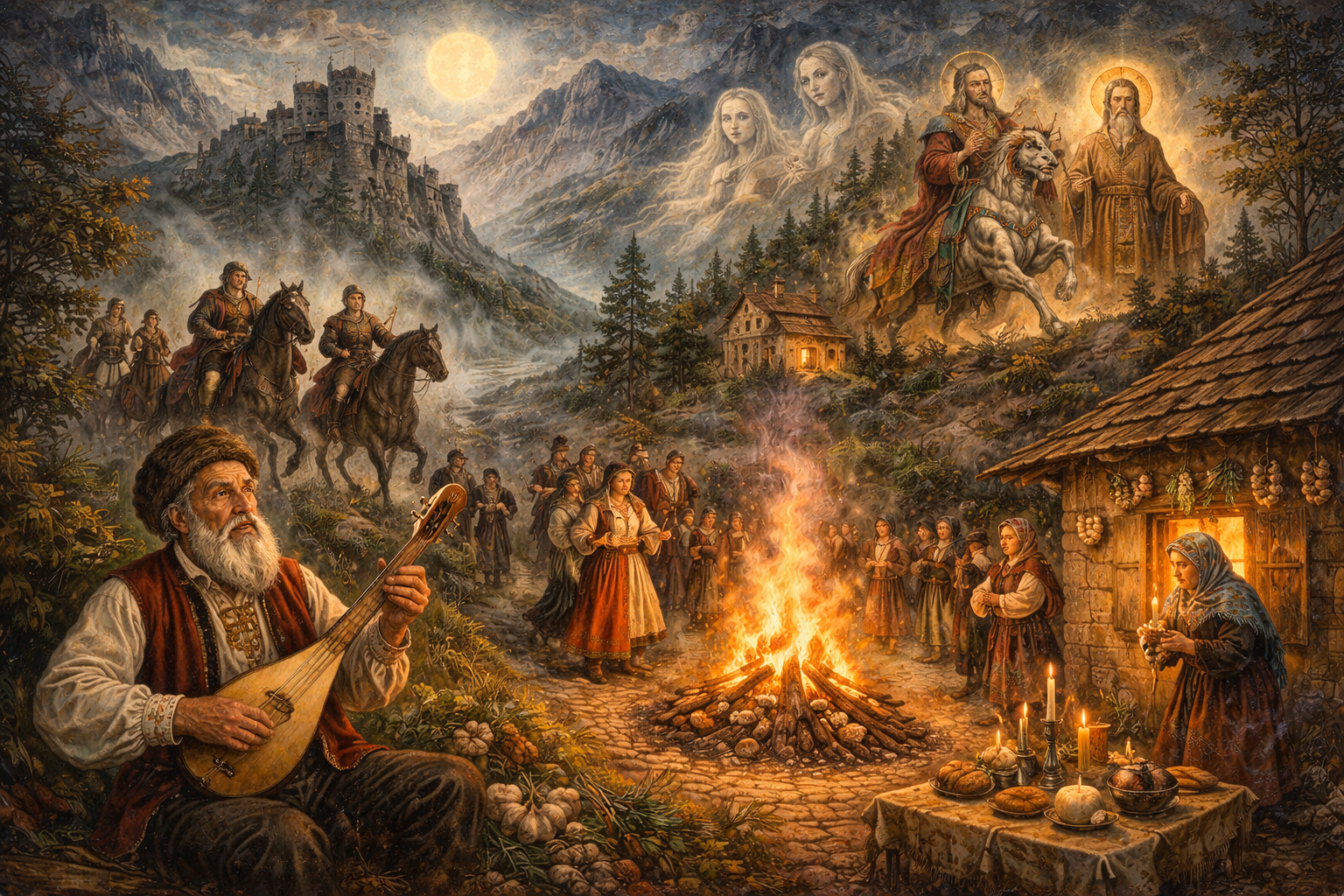
The South Slavic archive includes several overlapping layers of tradition. One concerns the pre-Christian South Slavic world: storm and sky symbolism, chthonic and underworld associations, solar and seasonal rhythm, sacred trees, serpents, dragons, wolves, horses, ancestor memory, household protection, fertility rites, and the charged relation between settlement and wilderness. Another concerns the immense oral world of guslars, heroic singers, women’s ballads, lament traditions, ritual song, and regional performance cultures through which battle, kinship, captivity, revenge, sacrifice, marriage, grief, and moral endurance were narrated across generations. A third concerns the Christian and post-Christian layers through which Orthodox, Catholic, and vernacular sacred traditions reshaped older materials without erasing them, especially in saints’ legends, Marian devotion, monasteries, feast customs, miracle stories, sacred springs, and local holy landscapes. A fourth concerns the Ottoman and Islamicate layers through which frontier warfare, Muslim heroic traditions, Bosnian and other confessional contact zones, imperial pressure, coexistence, conversion, and shared folkloric environments transformed South Slavic symbolic life.
A fullest account must also recognize that “South Slavic” is not a simple or homogeneous category. Serbian, Croatian, Bosnian, Montenegrin, Bulgarian, Macedonian, Slovene, and other South Slavic-speaking communities preserved overlapping but distinct traditions shaped by religion, empire, ecology, dialect, locality, and historical memory. Coastal, mountain, pastoral, monastic, urban, agrarian, and frontier zones all produced different narrative emphases. Some traditions privilege heroic warfare and clan loyalty; others preserve saints, spirits, women’s ritual speech, vampire fears, healing specialists, harvest custom, miracle legend, or songs of courtship, mourning, and exile. South Slavic myth, epic, and folklore therefore belong to a world of regional variation within a larger shared symbolic field.
The category also includes the immense literary, musical, ethnographic, philological, political, and ideological afterlife of South Slavic folklore. Epic songs, ballads, legends, seasonal customs, sacred stories, demonological memorates, and household rites did not remain confined to oral performance alone. They were collected, transcribed, translated, nationalized, romanticized, contested, politicized, and reimagined in folklore studies, musicology, philology, religious memory, nationalist culture, modern literature, and comparative epic scholarship. This does not diminish the folkloric force of the tradition. It shows that South Slavic mythic worlds persisted by adapting their symbolic life to new historical conditions while continuing to preserve older structures of fate, honor, communal suffering, sacred protection, and historical memory.
Why This Field Matters
South Slavic myth, epic, and folklore deserve serious study because they preserve one of Europe’s richest archives of living oral epic, ritual custom, sacred legend, demonological memory, women’s song, and household practice. The field reveals how communities imagined nature, ancestry, sacred protection, heroic struggle, spiritual danger, death, fate, kinship, sacrifice, and the moral order of collective life. These traditions are not merely old tales or picturesque survivals. They are cultural systems through which communities have interpreted historical pressure, imperial domination, local vulnerability, religious plurality, and the hard conditions of survival.
The field also matters because it broadens mythology beyond the search for ancient gods alone. South Slavic mythic imagination survives not through one complete pre-Christian canon, but through song, ritual, seasonal custom, feast days, saints’ legends, epic performance, women’s lament, healing practice, vampire belief, household protection, pastoral lore, mountain legend, and political memory. Some of the strongest mythic forms in the region are not isolated stories about divine beings, but repeated practices: singing the dead, blessing the house, guarding the newborn, crossing the mountain, honoring the saint, fearing the revenant, marking the season, and remembering battle through song.
South Slavic folklore is also indispensable for understanding the Balkans as a civilizational contact zone rather than a sealed ethnic world. Orthodox, Catholic, Muslim, Jewish, and vernacular local traditions repeatedly intersect in shared landscapes, contested memories, overlapping supernatural systems, and adapted narrative motifs. The region’s folklore does not simply divide by confessional line. It often reveals contact, borrowing, coexistence, anxiety, rivalry, and shared symbolic environments.
Finally, the field matters because it preserves emotional histories often only partially visible in chronicles and state archives. Epic song, women’s ballad, mourning ritual, vampire fear, saint legend, haiduk memory, and household custom preserve moral experiences of captivity, frontier pressure, marriage anxiety, grief, betrayal, displacement, ecological vulnerability, and communal endurance. To study South Slavic myth, epic, and folklore is to study how communities made suffering narratable and survival meaningful.
The Problem of the Archive
A research-grade account must begin with the archive itself. South Slavic myth, epic, and folklore do not survive in a single sacred book, ancient mythology, or authoritative folkloric corpus. They are dispersed across oral performance, epic song, women’s ballad, ritual lament, saints’ legends, demonological memorates, seasonal customs, household rites, charm texts, ethnographic records, monastic stories, Muslim heroic traditions, Catholic and Orthodox devotional materials, philological collections, travel accounts, music recordings, and modern literary adaptations.
The archive is strongly mediated. Many epic songs and folktales were collected, transcribed, edited, translated, and classified by nineteenth- and twentieth-century scholars, collectors, national cultural workers, and foreign researchers. This preservation was invaluable, but it also transformed the traditions. Oral songs became written texts; local performances became national literature; regional variants became canonical examples; singers became informants; and songs once embedded in social life became objects of philological, political, and comparative study.
The archive is also confessional and political. Serbian epic, Croatian ballad, Bosnian Muslim heroic song, Bulgarian ritual folklore, Macedonian legend, Montenegrin clan memory, Slovene seasonal and local folklore, and other regional materials have often been read through national frames. Those frames can preserve important local specificity, but they can also distort the shared and entangled symbolic life of the Balkans. A South Slavic pillar must resist both homogenization and nationalist isolation.
Interpretation must therefore ask not only what a story says, but where it was performed, who sang or told it, who collected it, what language or dialect carried it, what ritual or social setting sustained it, how it was edited, and what political afterlife it acquired. The archive is not simply a warehouse of old stories. It is a layered field of performance, mediation, memory, and power.
Myth Without a Single Canon
South Slavic myth, epic, and folklore are best approached as a plural and historically adaptive field rather than as a single mythology. There is no complete surviving ancient South Slavic mythological handbook comparable to some classical textual corpora. Instead, older symbolic structures survive through later Christian and Muslim layers, ritual survivals, comparative Slavic materials, seasonal customs, demonological belief, place-lore, household practice, and oral poetic memory.
This absence of a single canon is not a weakness. It is the structure of the field. South Slavic mythology lives in fragments, practices, recurring beings, ritual forms, sung histories, local legends, and symbolic patterns. Thunder, dragon, wolf, vampire, vila, saint, mountain, battlefield, monastery, house threshold, feast table, wedding procession, and mourning song all carry mythic force.
The field also requires genre awareness. An epic song does different work from a healing charm. A women’s lament does different work from a vampire memorate. A saint’s miracle does different work from a haiduk legend. A wedding song does different work from a nationalized heroic cycle. A proverb carries different authority than a sung battle narrative. Each form must be read in relation to its social setting.
This pillar therefore treats “myth” broadly but carefully: as a field of stories, beings, places, rituals, performances, symbols, and practices through which communities imagine sacred power, moral order, danger, fate, kinship, and the relationship between visible and invisible worlds.
The Civilizational Frame of South Slavic Myth, Epic, and Folklore
The phrase “South Slavic myth, epic, and folklore” is useful because it names a field broader than formal mythology alone and deeper than modern national culture. It points to a narrative world formed across the Balkans among South Slavic-speaking communities shaped by mountains, karst zones, river valleys, monasteries, villages, courts, empires, battlefields, harvest cycles, pilgrimage routes, trade routes, pastoral movement, and sacred landscapes.
This is not a claim of uniformity. It is a claim of overlapping symbolic systems. Across the region, communities developed narrative ways of imagining sacred nature, ancestral memory, heroic endurance, supernatural danger, ritual repetition, and communal survival. These systems differ locally but speak to a shared Balkan condition: the struggle to preserve moral order under historical pressure.
At the earliest recoverable layers lie pre-Christian South Slavic worlds of thunder, fertility, solar and seasonal order, sacred trees, serpents, dragons, wolves, horses, ancestor continuity, household protection, and the charged relation between human settlement and dangerous wilderness. Because these worlds were later preserved fragmentarily and often through Christian or Islamic mediation, caution is necessary. Yet the symbolic field remains visible in ritual survivals, place-lore, seasonal custom, demonology, and comparative Slavic reconstruction.
Over time these worlds were reshaped by Christianization, Byzantine influence, Catholic and Latin environments, Ottoman imperial rule, Islamization in some regions, local monastic culture, frontier militarization, trade routes, and later philological collection. The result was not a clean succession of one worldview by another, but a stratified narrative order in which saints inhabited older landscapes, heroic songs absorbed historical struggle, demonology survived within Christian or Muslim everyday life, and ritual custom continued across confessional boundaries.
Plurality, Layering, and Narrative Transformation
No full account can proceed as though South Slavic traditions belonged to one fixed worldview. The field is internally plural. Serbian epic and Kosovo memory, Croatian inland and coastal traditions, Bosnian Muslim heroic song, Montenegrin clan and mountain lore, Bulgarian ritual folklore and demonology, Macedonian song and sacred-local legend, Slovene seasonal and local traditions, and other regional formations preserve overlapping but distinct symbolic emphases.
Mountain zones, Adriatic-associated regions, monastery landscapes, Ottoman frontier areas, agrarian interiors, pastoral migration routes, and urban environments all generate different relationships to myth, legend, and ritual life. The symbolism of a coastal saint’s legend is not identical to that of a mountain haiduk song. A Bosnian Muslim epic cannot be reduced to Orthodox heroic song. Bulgarian seasonal ritual cannot be treated as a minor variant of Serbian epic. Croatian Catholic legend, Macedonian village custom, Montenegrin mountain memory, and Slovene folklore each belong to wider South Slavic relations without losing local texture.
This layered condition is especially important for avoiding reduction. To describe South Slavic myth only as pagan Slavic inheritance misses the immense role of Orthodox and Catholic sacred cultures, sainthood, pilgrimage, Marian devotion, feast custom, monastery memory, and local miracle traditions. To describe it only as Christian folk culture erases the persistence of vila figures, dragons, vampires, household beings, seasonal fertility symbolism, and older cosmological structures. To describe it only through heroic song misses healing traditions, women’s lament, wedding ritual, small-form oral culture, memorates of uncanny encounter, and everyday household protections.
The field is most fully grasped when these layers remain distinct yet connected. South Slavic myth, epic, and folklore are a contact zone of sacred inheritances and symbolic worlds: pre-Christian Slavic cosmology, heroic oral tradition, Orthodox and Catholic sacred culture, Ottoman and Islamicate frontier experience, village ritual life, women’s traditions, pastoral ecologies, outlaw memory, demonological belief, and literary-ethnographic afterlife.
Pre-Christian South Slavic Inheritances
The pre-Christian South Slavic layer survives fragmentarily but powerfully. It appears in comparative Slavic mythology, ritual custom, sacred tree traditions, storm and sky symbolism, chthonic beings, seasonal fertility rites, animal symbolism, ancestor memory, household protection, and the moral geography of wilderness. Because no complete ancient South Slavic pagan canon survives, reconstruction must be cautious and evidence-based.
Yet the persistence of older symbolic structures is unmistakable. Thunder, lightning, the oak, the serpent, the dragon, the wolf, the horse, the hearth, the boundary, and the cultivated field all carry sacred or supernatural charge in later folklore. These motifs do not prove a single ancient doctrine, but they reveal enduring patterns of relation between human communities and the powers believed to inhabit nature, weather, household, and land.
Pre-Christian inheritance also survives through ritual time. Spring renewal, midsummer fire, harvest protection, winter danger, ancestor remembrance, and fertility symbolism often preserve older cosmological rhythms within Christian or later village calendars. Feast days may absorb older seasonal energy; saints may inherit functions once associated with older powers; local rites may continue under changed religious interpretation.
A serious pillar should therefore avoid two errors: romantic reconstruction of a lost pagan system beyond the evidence, and dismissive reduction of older residues as meaningless superstition. The pre-Christian layer matters precisely because it survives through transformation.
Thunder, Sky, Serpent, Dragon, Wolf, and Horse
Several symbolic complexes recur across South Slavic folklore and deserve sustained attention. Storm and sky symbolism connect weather, violence, fertility, sacred force, and cosmic conflict. Thunder may be associated with divine power, saintly protection, or older storm structures. Lightning, hail, drought, and storm clouds become part of a moral and ritual world in which weather must be interpreted, feared, and sometimes ritually negotiated.
Serpents and dragons occupy a rich field of meaning. They may be chthonic, protective, dangerous, fertility-linked, heroic adversaries, weather beings, or guardians of treasure and hidden power. In some traditions, dragon-like beings are connected with storm, sexuality, lineage, heroic birth, or atmospheric struggle. The dragon is not merely a monster; it is a form through which untamed power becomes narratable.
The wolf is equally important. Wolves inhabit the border between village and wilderness, domestic animals and predation, settlement and danger. Wolf lore often connects pastoral vulnerability, protection, fear, liminality, and the sacred management of animals. The wolf is not only feared. It is also respected as a being of power and threshold.
Horses carry martial, ritual, heroic, and sometimes supernatural meanings. The horse belongs to mobility, status, warrior identity, wedding procession, frontier passage, and symbolic movement between worlds. Together, storm, serpent, dragon, wolf, and horse reveal the ecological depth of South Slavic folklore: myth lives through weather, animals, fields, mountains, and the dangerous nearness of wilderness.
Christianization, Saints, and Sacred Protection
Christian sacred culture transformed South Slavic folklore without erasing older symbolic worlds. Orthodox and Catholic traditions introduced saints, monasteries, icons, relics, Marian devotion, feast days, miracle stories, pilgrimage routes, sacred springs, patronal celebrations, and local holy landscapes. These became central to the region’s religious imagination and everyday protection.
Saints often function as protectors of households, villages, animals, fields, travelers, and communities. Their stories may sanctify springs, mountains, monasteries, battlefields, roads, or local shrines. Miracle-working icons, Marian apparitions, healing waters, and monastery legends reveal how sacred power becomes localized in place.
Christianization also provided new frameworks for older beings and fears. Spirits, vampires, witches, weather powers, and household dangers could be interpreted through Christian categories of blessing, sin, demonic force, saintly protection, and ritual remedy. Yet vernacular practice often remained more complex than formal theology. People might seek both priestly blessing and folk healing, observe both church feast and local taboo, invoke both saint and household custom.
This layer is crucial because South Slavic sacred folklore is not merely pagan residue. It is a living Christian and vernacular religious world, shaped by theology, ritual, local memory, and older symbolic continuity.
Muslim Frontier Traditions and Ottoman-Era Narrative Worlds
South Slavic folklore also includes Muslim heroic, sacred, and vernacular traditions shaped by Ottoman-era history, especially in Bosnian and related contexts. These traditions belong fully within the South Slavic archive, not at its margins. They preserve frontier memory, piety, honor, martial struggle, loyalty, conversion histories, saintly memory, local legend, and shared folkloric environments.
Bosnian Muslim epic song is especially important because it reveals the South Slavic oral epic tradition as religiously and culturally plural. Muslim singers, heroes, and audiences participated in the same larger world of oral epic performance while preserving distinct confessional identities, values, and historical memories. The frontier was not only a line of conflict; it was also a zone of narrative exchange.
Ottoman-era materials complicate simplistic binaries. Christian and Muslim communities often shared motifs, landscapes, performance forms, supernatural fears, and ritual practices while also preserving sharply different memories of power, loyalty, betrayal, and suffering. A serious pillar must acknowledge both conflict and entanglement.
Islamicate and Ottoman layers also connect South Slavic folklore to broader Balkan, Turkish, Persianate, and Mediterranean narrative worlds. This expands the field beyond a purely Slavic frame and helps explain why South Slavic folklore is best understood as a layered Balkan archive.
Oral Epic and the Guslar Tradition
Among the most important formations in the field is South Slavic heroic song, especially the guslar tradition and related forms of sung epic performance. The guslar does not simply recite a fixed text. In the classic oral-formulaic understanding, the singer works with inherited patterns, formulas, themes, narrative structures, and performance skill to create a song in the moment of performance.
South Slavic epic song preserves worlds of warriors, captives, mothers, brides, traitors, martyrs, raiders, borders, sieges, oaths, vengeance, sacrifice, and morally burdened heroes. It stands at the intersection of oral performance, historical memory, communal identity, and poetic improvisation. Its authority is not only narrative but sonic: voice, instrument, rhythm, formula, and audience response all matter.
The gusle itself is not merely an instrument. It is an object of memory, a sound-bearing archive of heroic identity. In performance, history becomes sung, and sung history becomes morally charged. The event of performance joins past and present by making communal memory audible.
This tradition is also central to world oral epic scholarship. South Slavic heroic song played a major role in comparative studies of oral composition, including research that helped illuminate the dynamics of Homeric epic, formulaic language, and performance-based poetics.
Heroism, Kinship, Oath, and Revenge
Heroism in South Slavic epic is rarely purely individual. It is embedded in kinship, oath, honor, revenge, hospitality, loyalty, captivity, sacrifice, and collective memory. The hero acts for family, clan, faith, homeland, lord, or community, but these obligations often conflict. Epic greatness is therefore morally burdened.
Oath and promise are central. A sworn word binds the hero to action, even when action leads toward death. Betrayal carries immense symbolic weight because it violates not merely personal trust but the moral architecture of communal life. Kinship loyalty may demand vengeance; hospitality may demand protection of the stranger; honor may demand endurance; grief may demand song.
Revenge traditions should be read carefully. They do not simply celebrate violence. They dramatize a world in which justice, shame, kin obligation, and public reputation become entangled under conditions where official order may be weak, imperial, distant, or distrusted. Epic song gives that world moral form, but it also reveals its costs.
Heroic narrative therefore becomes a way of thinking what it means to live under obligation. The hero is powerful, but rarely free. He is bound by memory, oath, kinship, and history.
Kosovo Memory, Battle, and the Burden of Heroic History
Kosovo memory occupies a central place in Serbian epic and in the wider political and cultural afterlife of South Slavic heroic tradition. The Battle of Kosovo became far more than an event. Through oral song, religious memory, martyr imagery, national interpretation, and later political mobilization, it became a symbolic structure for thinking sacrifice, defeat, loyalty, betrayal, sanctity, and historical destiny.
This material requires care because its afterlives are powerful and contested. Kosovo epic cannot be read only as medieval memory, only as religious myth, only as national ideology, or only as folklore. It is a layered tradition whose meaning changed across performance, collection, romantic nationalism, state politics, religious commemoration, and modern conflict.
The Kosovo cycle also reveals the double edge of heroic memory. It can preserve moral seriousness, grief, and historical consciousness, but it can also be mobilized toward exclusion, resentment, or political violence. A responsible pillar should neither dismiss the tradition nor romanticize its ideological afterlife.
Kosovo memory is therefore one of the most important case studies in the field: a reminder that folklore and epic are not politically innocent. They are forms of cultural power.
Women, Ballads, Lament, and Domestic Story Worlds
No full treatment of South Slavic folklore is adequate without giving central place to women as singers, mourners, ritual actors, healers, keepers of household custom, transmitters of fear and blessing, and guardians of emotional memory. Wedding laments, lullabies, mourning songs, domestic sayings, healing gestures, and women’s ballads preserve cosmological and ethical textures often absent from male heroic archives.
Women’s song reveals the emotional cost of the social order. Marriage may appear not only as celebration but as rupture, departure, and danger. Captivity may be sung from the perspective of vulnerability. Mourning may preserve the moral truth of death more sharply than heroic praise. A mother’s lament may judge the hero’s world more powerfully than the hero himself.
Women also occupy decisive symbolic roles inside epic and legendary worlds. Mothers of heroes, mourners of the dead, captive brides, betrayed wives, prophetic women, saintly mothers, healers, and women exposed to marriage politics all carry moral weight. Their speech may judge the hero, preserve the dead, expose injustice, mediate between households, or reveal the social cost of honor and warfare.
Domestic story worlds are equally important. Household protections, birth rituals, child safeguards, illness rites, evil-eye precautions, and mourning customs reveal a practical cosmology of vulnerability. The house is both sacred and exposed. Women’s traditions often preserve the knowledge needed to keep it morally and ritually intact.
Vila, Dragon, Vampire, and the Supernatural Ecology of the Balkans
South Slavic folklore preserves a dense supernatural ecology. Vila figures, dragons, vampires, revenants, witches, werewolves, household spirits, weather beings, omens, curses, and uncanny guardians of thresholds and landscapes all belong to the moral and ritual structure of everyday life. These beings are not decorative fantasy motifs. They give form to danger, power, sexuality, death, wilderness, and social disorder.
The vila is especially important: often associated with mountains, forests, waters, beauty, song, danger, healing, and otherworldly female power. Vila beings may bless, wound, seduce, protect, punish, or assist heroes. They embody the ambivalent force of the wild and the feminine supernatural.
Vampire and revenant belief is one of the most globally influential features of Balkan folklore. Anxiety over improper burial, unfinished obligation, dangerous return, corpse management, disease, moral disorder, and anti-vampire ritual forms a major stratum of South Slavic supernatural culture. The vampire is not simply a monster. It is a social fear about death that has not been properly contained.
Dragons, witches, and other beings deepen this supernatural ecology. They connect weather, fertility, sexuality, danger, healing, and local explanation. South Slavic folklore imagines ordinary life as surrounded by powers that must be respected, guarded against, or ritually managed.
Healing, Charmers, and Ritual Response to Danger
Healing specialists, charmers, herbal knowledge, blessing speech, anti-witchcraft practice, exorcistic gestures, anti-evil-eye protections, weather rites, and rituals around illness or infertility reveal a practical cosmology of defense and restoration embedded in everyday life. These traditions are central to folklore, not peripheral curiosities.
Illness may be interpreted through bodily, social, spiritual, moral, and environmental frameworks at once. A person may suffer from envy, curse, improper contact, fear, spirit attack, weather influence, or ordinary disease. Folk healing practices offer ways of naming and responding to vulnerability when formal institutions are insufficient or distant.
Charm speech is especially important. Words do not merely describe danger; they act against it. Blessings, curses, whispered formulas, protective prayers, and spoken remedies reveal a world in which language has practical force. Speech can bind, heal, protect, expose, or harm.
This layer shows that South Slavic folklore is a lived system of risk management. It addresses childbirth, livestock, weather, crops, illness, death, marriage, envy, and household continuity. It is mythology in practical form.
Seasonal Ritual, Feast Custom, and Village Performance
Seasonal ritual is one of the deep structures of South Slavic folklore. Calendar custom, saint days, spring songs, harvest observances, midsummer rites, winter protections, carnival inversions, house blessings, processions, village feasts, and communal meals all create a mythic rhythm of time. Ritual repetition renews the social world.
Feast days often carry layered meanings. A Christian saint’s day may also mark seasonal transition, family identity, household protection, agricultural rhythm, or village belonging. The ritual calendar does not merely commemorate sacred history; it organizes labor, kinship, memory, and communal time.
Village performance is equally important. Singing, dancing, masked performance, ritual joking, lament, procession, and festive inversion give folklore public embodiment. The community does not only tell stories; it performs its relation to sacred order, danger, fertility, death, and renewal.
Seasonal custom therefore reveals mythology as time-practice. The year itself becomes a narrative system: spring and winter, sowing and harvest, feast and fast, mourning and renewal, danger and protection.
Pastoral, Mountain, and Frontier Worlds
Pastoral life, shepherd lore, and mountain ecologies are among the deepest layers of South Slavic folklore. Shepherding, transhumance, wolf danger, livestock protection, mountain isolation, exposed weather, and seasonal movement shape symbolic worlds of vulnerability and endurance. The mountain is not scenery; it is a moral environment.
Mountain worlds often preserve ambivalent values. They may represent freedom, resistance, refuge, danger, sacred encounter, outlaw justice, or marginal independence. The mountain is where saints retreat, outlaws hide, shepherds endure, wolves threaten, and vila beings appear. It is both sanctuary and peril.
Frontier worlds add another layer. Ottoman-Christian borderlands, military frontiers, raiding zones, conversion histories, captivity stories, and mixed communities produced narratives of anxiety, loyalty, violence, and cultural exchange. The frontier is not merely a political line. It is a moral and mythic space.
Pastoral and frontier traditions therefore help explain the emotional intensity of South Slavic folklore. They arise from exposed environments where survival depends on courage, caution, solidarity, mobility, and ritual protection.
Haiduks, Outlaws, and Rebel Justice
The haiduk and related outlaw traditions transform resistance, banditry, rebel justice, anti-imperial struggle, vengeance, and rough moral order into one of the major symbolic languages of Balkan memory. The haiduk may be robber, freedom fighter, avenger, protector, rebel, or social bandit depending on narrative context and historical interpretation.
These traditions stand between history, legend, and political myth. They often arise from worlds in which official law is associated with empire, taxation, coercion, or injustice. Outlaw justice becomes morally attractive when institutional justice appears unavailable. Yet haiduk narratives can also reveal the violence and ambiguity of rebellion.
The haiduk figure is powerful because he inhabits the border between criminality and justice. He lives outside ordinary society but acts in the name of a deeper communal truth. Like many heroic figures, he is morally charged rather than morally simple.
Haiduk folklore belongs centrally to South Slavic mythic memory because it dramatizes one of the region’s recurring questions: where does justice live when official order is compromised?
Sacred Geography, Place-Memory, and the Social Life of Landscape
No serious treatment can ignore sacred geography. Mountains, monasteries, churches, mosques, shrines, springs, caves, battlefields, village crosses, feast sites, borders, graveyards, roads, bridges, and thresholds are not merely settings. They are narrative institutions. Around them gather miracle stories, local fears, pilgrimage, vows, hauntings, heroic memory, and legends of rescue or betrayal.
This is especially important in the Balkans, where sacred geography often condenses devotion and conflict. A monastery may preserve sanctity, local protection, and heroic-historical memory. A Marian shrine may gather regional Catholic devotion while also entering broader folklore. A battlefield may be a site of mourning, oath, and collective identity. A spring may be naturally uncanny and ritually healing. A frontier pass may remain morally charged long after the political border shifts.
Place in these traditions is morally and spiritually alive. The village, the mountain path, the churchyard, the saint’s feast site, the battlefield, the border crossing, the shepherd’s summer ground, and the family house each belong to different economies of protection, danger, memory, and revelation.
To map South Slavic mythic worlds is therefore to map a civilization’s lived relationship to place itself.
Ritual, Material Culture, and the Embodied Life of Story
Stories in South Slavic tradition do not survive only in recorded texts or remembered plots. They also survive in ritual and material form: icons, crosses, rosaries, amulets, written charms, weapons, textiles, wedding objects, grave offerings, feast foods, house protections, musical instruments such as the gusle, ritual costumes, procession items, and repeated bodily gestures of blessing, mourning, oath, lament, dance, and commemoration.
Communities do not merely remember stories intellectually. They inhabit them through sound, repetition, procession, song, touch, taboo, and shared performance. The sung epic, the feast table, the wedding procession, the funeral lament, the saint’s icon, the household charm, and the grave ritual all participate in the narrative life of the community.
This material dimension matters because it reveals how folklore and sacred narrative enter everyday negotiations with illness, marriage, death, fertility, envy, weather, war, livestock protection, and boundary threat. A gusle may carry epic memory in sound. A mourning gesture may preserve the moral truth of a death more powerfully than an official record. A household protection may condense cosmology into practice.
A fullest treatment must therefore attend not only to stories as verbal artifacts but to story as embodied social life.
Small Forms: Proverbs, Riddles, Charms, Curses, and Memorates
A complete account must also include the small forms through which folklore enters everyday life: proverbs, riddles, blessings, curse formulas, charm speech, memorates of uncanny encounter, household warnings, omens, short narrative exempla, and practical sayings. These forms may appear minor beside epic song, but they often carry the densest everyday wisdom.
Proverbs condense social judgment. Riddles train perception. Blessings and curses reveal the force of speech. Charms defend against danger. Memorates record encounters with the uncanny in ways that blur the boundary between story, belief, and testimony. Household warnings teach children how to move through a dangerous world.
Small forms are also highly portable. They move across families, villages, regions, and languages more easily than long epics. They preserve practical intelligence around weather, animals, marriage, illness, envy, work, death, luck, and moral conduct.
South Slavic folklore therefore lives not only in major heroic cycles but in daily speech. The smallest forms often reveal the deepest structures of fear, humor, caution, and social order.
Philology, Collection, Nationalization, and the Politics of Memory
South Slavic folklore was extensively collected, edited, translated, and nationalized, especially in the nineteenth and twentieth centuries. This philological and literary afterlife is part of the tradition itself, not merely an external scholarly layer, because the act of collection transformed how epic and folklore were imagined, owned, politicized, and canonized.
Collectors and scholars helped preserve oral materials that might otherwise have disappeared or remained inaccessible to broader audiences. At the same time, they often selected, edited, standardized, and interpreted materials in ways that served national literary projects, romantic cultural politics, or comparative theories of epic. Oral plurality became printed canon.
The work of oral-formulaic scholarship brought South Slavic epic into global comparison, especially through the study of singers, performance, formula, and composition. But the same archive also became entangled with nationalist mythmaking, especially where epic memory was mobilized as evidence of ancient identity, heroic destiny, or collective grievance.
A research-grade pillar must therefore treat collection history as part of the subject. Folklore does not simply pass from village to book. It changes as it enters scholarly, national, and political life.
Ethics, Symbolism, and the Moral Imagination
The narrative traditions of South Slavic myth, epic, and folklore repeatedly ask what it means to live honorably under conditions of exposure, hierarchy, warfare, kinship pressure, communal memory, sacred obligation, and historical uncertainty. Their symbols are morally dense. The mountain may signify freedom, ancestral endurance, trial, or marginal independence. The saint’s monastery may turn danger into protection. The dragon may externalize adversarial force or untamed power. The vila may represent enchantment, blessing, peril, or female otherworldliness. The vampire may dramatize unfinished death and social anxiety. The hero may embody strength burdened by sacrifice and communal duty. The mourning woman may reveal the ethical cost of honor more sharply than the warrior himself.
These narratives also contain political intelligence, though often indirectly. Epic traditions reflect on rightful rule, betrayal, imperial domination, communal loyalty, conversion, captivity, and the moral costs of violence. Folklore reflects on poverty, labor, jealousy, marriage, vulnerability, ritual obligation, and the uneven distribution of suffering. Saints’ legends and miracle traditions often place sacred authority above worldly power, while comic and small-form traditions expose vanity, foolishness, and moral weakness.
Haiduk and outlaw traditions question whether justice survives within official order or only against it. Vampire traditions ask whether death can be socially contained. Women’s laments ask what honor costs the living. Feast customs ask how community is ritually renewed. Healing traditions ask how danger can be named and repaired.
At their highest level, these traditions show how South Slavic civilizations have thought through story. They disclose a cosmology of land and season, an ethics of kinship and sacrifice, a theology of sacred protection, a demonology of everyday danger, a poetics of mourning and heroism, and a persistent symbolic effort to make historical struggle morally intelligible.
Major Questions of Interpretation
This pillar is organized around several major questions. How should South Slavic myth, epic, and folklore be studied when its archive includes fragmentary pre-Christian survivals, oral epic, Christian sacred culture, Muslim frontier song, women’s ballads, healing charms, vampire belief, seasonal ritual, household practice, and nationalist collection history? How can the field be studied without reducing it to one nation, one confession, one genre, or one ancient pagan inheritance?
The pillar also asks how heroic memory becomes moral memory. How do guslars, women singers, charmers, priests, healers, mourners, and collectors shape the archive? How do mountains, monasteries, borders, villages, springs, battlefields, and households become sacred or dangerous places? How do dragons, vila figures, vampires, saints, wolves, and haiduks carry symbolic force? How do Christian, Muslim, and vernacular traditions overlap without becoming identical?
These questions keep the category from becoming a simple inventory of Balkan legends. They open South Slavic myth, epic, and folklore as a field of oral, ritual, religious, political, gendered, ecological, performative, and historical inquiry. The tradition is not only a collection of stories. It is a major archive through which Balkan communities have imagined fate, honor, danger, sanctity, suffering, and survival.
Expanded Article Architecture
The following structure gathers the pillar into a long-range architecture suitable for a major mythology knowledge series. It is designed to support pre-Christian symbolic reconstruction, South Slavic oral epic, guslar performance, women’s ballads, saints’ legends, Muslim frontier traditions, supernatural beings, vampire belief, healing practice, seasonal ritual, pastoral ecologies, sacred geography, haiduk memory, small-form folklore, collection history, and modern political afterlives. All entries below should be treated as planned unless already completed elsewhere on the site.
Foundations and Source Problems
- What Is South Slavic Myth, Epic, and Folklore? (planned)
- The Problem of Sources in South Slavic Mythology and Folklore (planned)
- South Slavic Myth Without a Single Canon (planned)
- Pre-Christian South Slavic Myth and the Problem of Reconstruction (planned)
- Oral Tradition, Ritual Practice, and the Survival of Mythic Memory (planned)
- How to Read South Slavic Folklore Without Nationalist Reduction (planned)
- Philology, Collection, and the Archive of Balkan Story (planned)
Pre-Christian Slavic and Balkan Symbolic Inheritances
- Storm, Sky, and Sacred Violence in South Slavic Belief (planned)
- Perun, Thunder, and the Problem of South Slavic Reconstruction (planned)
- Serpent, Dragon, Wolf, and Horse in Balkan Mythic Symbolism (planned)
- Sacred Trees, Ancestors, and Household Protection in South Slavic Tradition (planned)
- Chthonic Powers, Fertility, and the Living Earth (planned)
- Settlement, Wilderness, and the Sacred Boundary of the Village (planned)
- From Pagan Cosmology to Christian and Muslim Folk Worlds in the Balkans (planned)
Christian Sacred Culture and Vernacular Devotion
- Saints, Marian Devotion, Monasteries, and Miracle in South Slavic Sacred Narrative (planned)
- Orthodox Sacred Folklore, Icons, Relics, and Monastery Memory (planned)
- Croatian Catholic Sacred Folklore and Adriatic Legendary Worlds (planned)
- Feast Days, Patron Saints, and the Ritual Calendar of the Household (planned)
- Sacred Springs, Healing Places, and Local Miracle Traditions (planned)
- Christianization and the Transformation of Older Sacred Landscapes (planned)
Muslim, Ottoman, and Frontier Narrative Worlds
- Bosnian Muslim Epic and the Ottoman Frontier Imagination (planned)
- Muslim Heroism, Piety, and Honor in South Slavic Oral Tradition (planned)
- Christian, Muslim, and Vernacular Contact Zones in Balkan Story Worlds (planned)
- Conversion, Coexistence, Captivity, and Shared Folkloric Environments (planned)
- Ottoman-Era Borderlands and the Moral Imagination of Frontier Life (planned)
- Islamicate Layers in South Slavic Legend and Epic Memory (planned)
Oral Epic and the Guslar Tradition
- What Is the South Slavic Oral Epic Tradition? (planned)
- Guslars, Performance, and the Living World of Heroic Song (planned)
- The Gusle as Instrument, Archive, and Symbol of Memory (planned)
- Formula, Theme, and Improvisation in South Slavic Epic Song (planned)
- Heroic Song, Audience, and the Social Life of Performance (planned)
- South Slavic Epic and the Oral-Formulaic Theory of Poetry (planned)
Heroic Memory, Kinship, and Historical Burden
- Kinship, Oath, Captivity, and Revenge in South Slavic Epic (planned)
- Kosovo Memory, Battle, and the Burden of Heroic History (planned)
- Marko Kraljević and the Ambiguity of Heroic Power (planned)
- Montenegrin Warrior Memory and the Symbolics of Mountain Resistance (planned)
- Battlefield, Border, and Homeland in South Slavic Legendary Memory (planned)
- Sacrifice, Betrayal, and the Moral Cost of Heroic History (planned)
Women’s Ballads, Lament, and Domestic Worlds
- South Slavic Women’s Ballads and the Moral World of Lament (planned)
- Mothers, Brides, Widows, and Female Moral Witness in Balkan Tradition (planned)
- Wedding Lament, Marriage Anxiety, and Ritual Separation (planned)
- Women’s Song, Captivity, Mourning, and the Ethics of Grief (planned)
- Lullabies, Household Speech, and the Domestic Transmission of Folklore (planned)
- Female Voice and the Social Cost of Heroism (planned)
Supernatural Beings, Demonology, and Dangerous Death
- Vila, Dragon, and the Otherworldly Feminine in South Slavic Folklore (planned)
- Vampires, Revenants, and the Ritual Management of Dangerous Death (planned)
- Witches, Evil Eye, Omens, and the Folklore of Everyday Danger (planned)
- Dragons, Weather Powers, and Atmospheric Combat (planned)
- Household Spirits, Threshold Beings, and Domestic Vulnerability (planned)
- Death, Burial, Mourning, and the Nearness of the Dead (planned)
Healing, Charm Speech, and Practical Ritual
- Healers, Charmers, and Folk Ritual Specialists in the Balkans (planned)
- Charms, Blessings, Curses, and the Power of Spoken Words (planned)
- Evil Eye, Envy, and Protective Practice in South Slavic Folklore (planned)
- Illness, Infertility, Weather, and Ritual Response to Danger (planned)
- Herbal Knowledge, Exorcistic Gesture, and Household Healing (planned)
- Practical Cosmology and the Everyday Management of Threat (planned)
Seasonal Ritual, Life-Cycle Custom, and Village Performance
- Village, Household, and Life-Cycle Ritual in South Slavic Folklore (planned)
- Wedding, Birth, Mourning, and Ritual Transition in Balkan Tradition (planned)
- Calendar Custom, Harvest, Carnival, and the Mythic Life of Time (planned)
- Spring Renewal, Midsummer Fire, and Seasonal Protection (planned)
- Feast Table, Procession, Dance, and Communal Repetition (planned)
- Ritual Time and the Renewal of Social Order (planned)
Pastoral, Mountain, and Environmental Worlds
- Pastoralism, Shepherd Lore, and Mountain Survival in South Slavic Tradition (planned)
- Wolves, Livestock, and the Moral Ecology of Pastoral Life (planned)
- Mountains, Caves, Forests, and the Supernatural Geography of Danger (planned)
- Transhumance, Seasonal Movement, and Folklore of the High Places (planned)
- Karst, River, Field, and Village Boundary in Balkan Story Worlds (planned)
- Weather, Drought, Hail, and the Ritual Management of Ecology (planned)
Haiduks, Outlaws, and Rebel Justice
- Haiduks, Outlaws, and the Folklore of Rebel Justice (planned)
- Social Banditry, Anti-Imperial Memory, and Moral Ambiguity (planned)
- Mountain Refuge, Violence, and the Legend of Resistance (planned)
- Outlaw Heroes Between Justice and Criminality (planned)
- Haiduk Song, National Memory, and Political Myth (planned)
Regional Traditions and Local Archives
- Serbian Epic, Kosovo Memory, and the Nationalization of Heroic Song (planned)
- Croatian Inland and Adriatic Folklore Worlds (planned)
- Bosnian Oral Traditions Across Muslim, Orthodox, and Catholic Contexts (planned)
- Montenegrin Clan Memory, Mountain Ethics, and Heroic Legend (planned)
- Bulgarian and Macedonian Ritual Folklore Beyond Heroic Song (planned)
- Slovene Seasonal Folklore, Local Legend, and Alpine-Slavic Memory (planned)
Small Forms, Everyday Speech, and Local Testimony
- Proverbs, Riddles, Blessings, Curses, and Memorates in South Slavic Oral Culture (planned)
- Household Warnings, Omens, and Short Forms of Folkloric Knowledge (planned)
- Comic Tales, Trickery, and Moral Satire in Balkan Folklore (planned)
- Memorates of Uncanny Encounter and the Testimony of Belief (planned)
- Everyday Speech as Folkloric Archive (planned)
Collection, Politics, and Modern Afterlives
- Philology, Collection, and the Nationalization of South Slavic Epic (planned)
- Vuk Karadžić, Folklore Collection, and the Making of Literary Memory (planned)
- South Slavic Epic in Comparative Oral Tradition Studies (planned)
- Myth, Folklore, and Civilizational Memory in the Balkans (planned)
- Folklore, Nationalism, and the Politics of Symbol in Southeastern Europe (planned)
- South Slavic Myth, Epic, and Folklore in Comparative Perspective (planned)
- Why South Slavic Myth, Epic, and Folklore Still Matter (planned)
Closing Perspective
South Slavic myth, epic, and folklore reveal one of Europe’s great layered archives of oral memory, sacred protection, heroic burden, supernatural danger, ritual practice, and civilizational contact. They preserve storm and serpent symbolism, dragon and wolf lore, vampire fear and anti-revenant ritual, saints and monasteries, Muslim frontier epic, guslar performance, women’s lament, wedding custom, household charms, pastoral survival, haiduk justice, sacred springs, battlefields, feast days, and the long political afterlife of song.
This is what makes the category so important within Mythology. South Slavic traditions show how mythology can survive through oral epic, ritual repetition, sacred geography, women’s song, small-form speech, healing practice, household protection, and contested historical memory. They also show why mythology must be studied through landscape, religion, gender, performance, empire, language, and political afterlife, not only through story summary.
The strongest reason to study this field is that it clarifies how communities turn historical pressure into symbolic memory. The mountain becomes refuge; the saint becomes protector; the vampire becomes dangerous death; the vila becomes wild beauty and peril; the guslar makes history audible; the lament gives grief moral force; the household charm condenses cosmology into practice; the haiduk tests the boundary between crime and justice. These traditions do not belong only to the past. They continue to shape how Balkan cultures remember suffering, sanctity, honor, danger, and endurance.
Related Reading
- Mythology
- Turkic and Ottoman Myth, Epic, and Folklore
- Russian Myth, Epic, and Folklore
- South Slavic Thought
- Arabian and Levantine Myth, Folklore, and Sacred Narrative
- Celtic Mythology
- Norse Mythology
- Culture, Meaning, and Symbolism
- Environment, Place, and Ecological Knowledge
- Comparative Sacred Themes
Primary Sources
Oral Epic, Song, and Performance Traditions
- South Slavic heroic songs performed by guslars and related singers, especially Serbian, Bosnian, Montenegrin, Croatian, and other regional epic materials collected in the nineteenth and twentieth centuries.
- Vuk Stefanović Karadžić’s collections of Serbian oral poetry and folk tradition, central to the printed and philological afterlife of South Slavic epic, used with attention to collection history, editorial framing, and nationalization.
- Milman Parry and Albert B. Lord’s South Slavic oral epic recordings and transcriptions, central to the study of oral-formulaic composition and comparative epic performance.
- Women’s ballads, wedding songs, laments, lullabies, mourning songs, and ritual speech traditions preserved in regional collections and performance archives.
Christian, Muslim, and Vernacular Sacred Traditions
- Orthodox and Catholic saints’ legends, monastery traditions, Marian devotion, miracle stories, icon legends, feast customs, sacred springs, pilgrimage narratives, and local holy-place traditions.
- Bosnian Muslim epic songs, frontier legends, pious narratives, local saintly traditions, and Ottoman-era heroic materials preserved in oral and written collections.
- Village feast customs, slava traditions, patron-saint commemorations, church and monastery legends, and household devotional practices transmitted through community memory and ethnographic records.
Demonology, Healing, and Ritual Practice
- Vampire, revenant, vila, dragon, witch, evil-eye, omen, charm, and household-spirit traditions preserved in local memorates, ethnographic accounts, folklore collections, and oral testimony.
- Healing charms, blessing formulas, curse speech, anti-evil-eye practices, anti-vampire procedures, weather rites, fertility rituals, and household protection practices.
- Seasonal customs, harvest rites, spring and midsummer traditions, carnival practices, wedding rituals, childbirth customs, funeral practices, and mourning cycles.
Ethnographic, Philological, and Comparative Archives
- South Slavic folklore collections in Serbian, Croatian, Bosnian, Bulgarian, Macedonian, Slovene, and related regional archives, used with attention to collector, language, region, genre, and political context.
- Comparative Slavic materials relevant to pre-Christian reconstruction, especially where South Slavic evidence is fragmentary and mediated through later custom.
- Musicological and performance archives documenting gusle performance, heroic singing, village song, lament, ritual music, and regional performance practice.
Further Reading
- Beissinger, M.H. (ed.) (2022) The Oxford Handbook of Slavic and East European Folklore. Oxford: Oxford University Press.
- Vidan, A. (2022) ‘South Slavic Women’s Ballads’, in Beissinger, M.H. (ed.) The Oxford Handbook of Slavic and East European Folklore. Oxford: Oxford University Press.
- Jurić, D. (2022) ‘Supernatural Legends in the Western Balkans’, in Beissinger, M.H. (ed.) The Oxford Handbook of Slavic and East European Folklore. Oxford: Oxford University Press.
- Foley, J.M. (1990) Traditional Oral Epic: The Odyssey, Beowulf, and the Serbo-Croatian Return Song. Berkeley: University of California Press.
- Lord, A.B. (1960) The Singer of Tales. Cambridge, MA: Harvard University Press.
- Fine, J.V.A. Jr. (2006) When Ethnicity Did Not Matter in the Balkans. Ann Arbor: University of Michigan Press.
- Friedman, V.A. and Joseph, B.D. (2006) The Balkan Languages. Cambridge: Cambridge University Press.
- McClelland, B. (2006) Slayers and Their Vampires: A Cultural History of Killing the Dead. Ann Arbor: University of Michigan Press.
- Čolović, I. (2002) The Politics of Symbol in Serbia. London: Hurst.
- Detelić, M. (1992) Mythical Space and Epic Space. Belgrade: Serbian Academy of Sciences and Arts.
- Djurić, V. (1969) Antologija narodnih junačkih pesama. Belgrade: Srpska književna zadruga.
- Ivanova, R. (1984) Bulgarska obredna poezija. Sofia: Bulgarian Academy of Sciences.
- Kerewsky-Halpern, B. and Foley, J.M. (eds.) (1978) Oral Literature and the Formula. Ann Arbor: University of Michigan.
- Kulišić, Š., Petrović, P.Ž. and Pantelić, N. (1970) Srpski mitološki rečnik. Belgrade: Nolit.
- Malcolm, N. (1994) Bosnia: A Short History. London: Macmillan.
- Norris, H.T. (1993) Islam in the Balkans: Religion and Society Between Europe and the Arab World. Columbia: University of South Carolina Press.
- Sikimić, B. and Hristov, P. (eds.) (2007) The Balkans: Language, Culture, History. Munich: Otto Sagner.
- Relevant oral tradition, folklore, JSTOR, and regional-language scholarship on Serbo-Croatian heroic poetry, South Slavic women’s ballads, vampire belief, Balkan demonology, and ritual custom.
References
- Beissinger, M.H. (ed.) (2022) The Oxford Handbook of Slavic and East European Folklore. Oxford: Oxford University Press.
- Čolović, I. (2002) The Politics of Symbol in Serbia. London: Hurst.
- Detelić, M. (1992) Mythical Space and Epic Space. Belgrade: Serbian Academy of Sciences and Arts.
- Djurić, V. (1969) Antologija narodnih junačkih pesama. Belgrade: Srpska književna zadruga.
- Fine, J.V.A. Jr. (2006) When Ethnicity Did Not Matter in the Balkans. Ann Arbor: University of Michigan Press.
- Foley, J.M. (1986) ‘Oral Epic, Textual Meaning, and Receptionalist Theory’, New Literary History.
- Foley, J.M. (1990) Traditional Oral Epic: The Odyssey, Beowulf, and the Serbo-Croatian Return Song. Berkeley: University of California Press.
- Friedman, V.A. and Joseph, B.D. (2006) The Balkan Languages. Cambridge: Cambridge University Press.
- Herzog, G. (1951) ‘The Music of Yugoslav Heroic Epic Poetry’, Journal of the International Folk Music Council.
- Ivanova, R. (1984) Bulgarska obredna poezija. Sofia: Bulgarian Academy of Sciences.
- Jurić, D. (2022) ‘Supernatural Legends in the Western Balkans’, in Beissinger, M.H. (ed.) The Oxford Handbook of Slavic and East European Folklore. Oxford: Oxford University Press.
- Kerewsky-Halpern, B. and Foley, J.M. (eds.) (1978) Oral Literature and the Formula. Ann Arbor: University of Michigan.
- Kulišić, Š., Petrović, P.Ž. and Pantelić, N. (1970) Srpski mitološki rečnik. Belgrade: Nolit.
- Lord, A.B. (1960) The Singer of Tales. Cambridge, MA: Harvard University Press.
- Malcolm, N. (1994) Bosnia: A Short History. London: Macmillan.
- McClelland, B. (2006) Slayers and Their Vampires: A Cultural History of Killing the Dead. Ann Arbor: University of Michigan Press.
- Norris, H.T. (1993) Islam in the Balkans: Religion and Society Between Europe and the Arab World. Columbia: University of South Carolina Press.
- Sikimić, B. and Hristov, P. (eds.) (2007) The Balkans: Language, Culture, History. Munich: Otto Sagner.
- Stolz, B.A. (1967) ‘Historicity in the Serbo-Croatian Heroic Epic’, The Journal of American Folklore.
- Vidan, A. (2022) ‘South Slavic Women’s Ballads’, in Beissinger, M.H. (ed.) The Oxford Handbook of Slavic and East European Folklore. Oxford: Oxford University Press.