
Last Updated June 4, 2026
Futures thinking examines how individuals, organizations, institutions, and societies explore possible futures in order to improve present-day decision-making under uncertainty, complexity, disruption, and long-term change. Rather than attempting to predict a single outcome, futures thinking investigates multiple plausible trajectories that may emerge from interacting social, technological, economic, environmental, political, cultural, institutional, and geopolitical dynamics. It is concerned less with prophecy than with preparation: the disciplined exploration of how change might unfold, how uncertainty might widen, how assumptions might fail, and how strategy can remain viable across different possible futures.
This content pillar brings together the major domains through which futures thinking interprets long-horizon change. It treats the future not as a fixed destination waiting to be forecast, but as a plural field of possibility shaped by decisions, institutions, technologies, ecosystems, risks, values, power, imagination, and structural constraint. Across scenario planning, strategic foresight, horizon scanning, weak signals, trend analysis, backcasting, futures literacy, anticipatory governance, sustainability transitions, climate futures, technology foresight, public policy, business strategy, infrastructure planning, geopolitical uncertainty, and institutional adaptation, futures thinking provides an indispensable language for preparing under uncertainty without surrendering to false certainty.
Futures thinking also belongs to the contemporary sciences and practices of scenario modeling, strategic foresight, uncertainty analysis, systems mapping, risk governance, long-range planning, anticipatory intelligence, emerging-technology assessment, sustainability pathways, futures literacy, and reproducible analytical workflows. Many futures-thinking questions now require not only narrative scenarios and expert judgment, but programmable environments capable of modeling alternative futures, stress-testing strategies, comparing scenario robustness, mapping drivers and uncertainties, tracking weak signals, evaluating assumptions, and testing readiness across multiple plausible conditions. The field therefore stands at the intersection of systems thinking, resilience thinking, decision science, strategy, governance, sustainability, technology assessment, public policy, and computational modeling.
Main Library
Publications
Article Map
Futures Thinking
Related Topic
Systems Thinking
Related Topic
Resilience Thinking
Related Topic
Decision Science
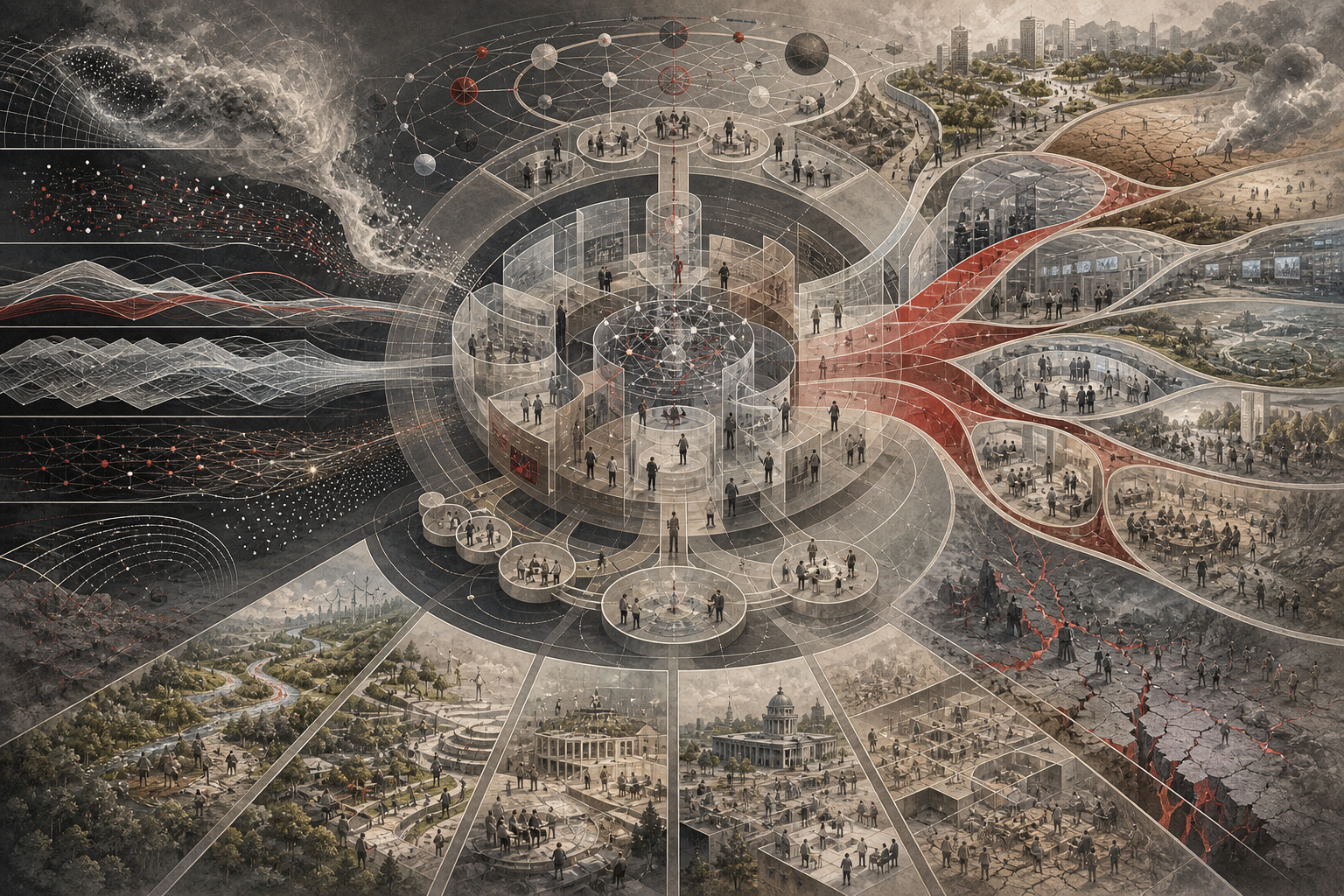
Futures thinking appears here not merely as a planning tool, but as a disciplined architecture of anticipation. It explains why the future should not be treated as a single forecast, why uncertainty must be structured rather than ignored, why strategy should be tested against multiple plausible conditions, and why long-term thinking requires attention to values, power, institutions, risk, imagination, and systems change.
The field matters because many of the defining challenges of the twenty-first century cannot be addressed through short-term projection alone. Climate change, artificial intelligence, biotechnology, demographic transition, geopolitical fragmentation, institutional distrust, infrastructure stress, economic volatility, public-health risk, and ecological disruption unfold through complex systems where uncertainty is deep and consequences are unevenly distributed. Futures thinking helps decision-makers widen the range of possibilities they examine before change becomes unavoidable.
GitHub Repository
This Futures Thinking article map is supported by a computational companion repository with article-level folders, reproducible examples, synthetic datasets, scenario-planning models, strategic-readiness workflows, horizon-scanning schemas, weak-signal tracking templates, futures-literacy exercises, backcasting examples, robustness analysis, uncertainty matrices, driver-interaction models, SQL schemas, documentation, and scientific-computing examples.
Complete Research & Modeling Repository
This knowledge series is supported by a computational companion repository with Python, R, Julia, C++, Fortran, C, Rust, SQL, Go, notebooks, documentation, synthetic datasets, scenario-planning workflows, uncertainty matrices, horizon-scanning schemas, weak-signal tracking tools, and reproducible foresight examples.
Futures Thinking as a Foundational Discipline
Futures thinking occupies a foundational place within contemporary strategy because it asks how people, organizations, institutions, and societies can act responsibly when the future cannot be known in advance. Traditional planning often assumes continuity: present trends are extended forward, risks are estimated, objectives are defined, and strategies are built around an expected pathway. Futures thinking widens that frame. It asks what else could happen, what assumptions might fail, what discontinuities may emerge, and what strategies remain viable across several plausible futures.
This foundational role does not mean that futures thinking replaces forecasting, policy analysis, risk assessment, strategic planning, systems thinking, resilience thinking, or decision science. Rather, it connects them. Forecasting estimates likely trajectories under defined assumptions. Risk analysis studies hazards, probability, and consequence. Systems thinking explains feedback, interdependence, and structural behavior. Resilience thinking asks how systems remain viable under disturbance. Decision science studies judgment under uncertainty. Futures thinking asks how alternative futures can be explored before choices become locked in.
The field matters because strategic failure often begins with a failure of imagination. Institutions may optimize for the future they expect while neglecting futures that are plausible, disruptive, undesirable, or preferable. They may treat uncertainty as noise rather than as a central strategic condition. Futures thinking helps correct this by making uncertainty visible, plural, structured, and actionable.
Futures Thinking as Anticipatory Reasoning
Futures thinking may be understood as anticipatory reasoning. It does not claim that the future can be predicted with certainty. It asks how present action changes when multiple futures are considered. Anticipatory reasoning means identifying drivers of change, mapping uncertainty, testing assumptions, imagining alternative pathways, recognizing weak signals, and asking what present decisions would remain robust if the expected future does not occur.
This makes futures thinking different from speculation. Speculation may imagine possibilities without discipline. Futures thinking uses structured methods: horizon scanning, scenario planning, trend analysis, weak-signal interpretation, backcasting, Delphi processes, systems foresight, causal layered analysis, strategic option testing, and anticipatory governance. It does not eliminate uncertainty. It gives uncertainty form.
Anticipatory reasoning also changes the meaning of strategy. A strategy is not strong merely because it performs well under one expected future. It is stronger when it can survive contact with uncertainty, adapt under changing conditions, preserve optionality, identify early warning signs, and remain aligned with long-term purpose. Futures thinking therefore shifts strategy from prediction-centered planning toward readiness-centered judgment.
Futures Thinking as a Quantitative and Computational Practice
Futures thinking is often introduced through narratives, workshops, scenario matrices, futures wheels, trend cards, and foresight exercises. These remain useful. Yet serious futures work increasingly benefits from quantitative and computational practice. Alternative futures can be modeled, compared, stress-tested, scored, visualized, and documented through reproducible workflows.
This does not mean that futures thinking becomes a forecasting machine. A model cannot determine which future will occur. A dashboard cannot decide which future is desirable. A scenario score cannot replace judgment about uncertainty, ethics, politics, or social consequences. Computation is valuable when it makes assumptions explicit, compares strategy performance across futures, tracks signals over time, and helps institutions see where their plans are fragile.
For that reason, this series treats mathematics, scenario analysis, strategic-readiness modeling, R, Python, Julia, SQL metadata, reproducible notebooks, and open code repositories as useful parts of futures-thinking literacy. Some articles remain primarily conceptual, strategic, ethical, historical, or governance-focused. Others naturally require scenario comparison, uncertainty matrices, robustness testing, weak-signal databases, trend simulations, decision-readiness metrics, or reproducible code. The aim is not to reduce the future to numbers, but to make anticipatory assumptions inspectable.
What Futures Thinking Studies
Futures thinking studies how possible futures are imagined, structured, compared, contested, and used to improve present decisions. At the methodological level, it studies scenario planning, strategic foresight, horizon scanning, weak-signal analysis, trend analysis, megatrends, backcasting, Delphi methods, futures literacy, systems foresight, and anticipatory governance.
At the systems level, it studies how technological, social, economic, ecological, political, demographic, cultural, infrastructural, and institutional forces interact over time. At the strategic level, it studies how organizations can prepare for uncertainty, preserve optionality, test assumptions, identify vulnerabilities, and build adaptive strategies. At the ethical and political level, it studies whose futures are imagined, whose futures are ignored, whose assumptions dominate, and whose risks are treated as acceptable.
Futures thinking further studies the gap between projection and possibility. A forecast may describe one expected path, but decision-makers often need to prepare for several. A trend may appear stable until disrupted by policy, technology, social change, climate shock, or institutional breakdown. A future may be probable but undesirable, preferable but difficult, plausible but neglected, or dangerous but avoidable. Futures thinking provides a framework for examining those distinctions.
What This Pillar Covers
This pillar brings together the major domains through which futures thinking interprets long-term change. It includes strategic foresight, scenario planning, trend analysis, megatrends, horizon scanning, weak signals, early indicators, backcasting, Delphi methods, futures literacy, systems foresight, scenario modeling, emerging technologies, societal transformation, public policy, business strategy, sustainability, climate futures, economic futures, geopolitical futures, urban futures, infrastructure futures, risk analysis, AI and future decision-making, institutional adaptation, ethics, politics, anticipatory governance, and future directions in strategic foresight.
These domains differ in method and emphasis, but together they form a coherent intellectual project: the disciplined exploration of possible futures for the purpose of better present action. Futures thinking is therefore not a prediction exercise. It is a way of expanding strategic imagination while keeping it accountable to evidence, uncertainty, systems interaction, and ethical judgment.
The series also treats futures thinking as a bridge between uncertainty and responsibility. Uncertainty does not excuse inaction. It changes the kind of action required. When the future is plural, strategy must become more adaptive, more robust, more participatory, more explicit about assumptions, and more attentive to long-term consequences.
Mathematics, Computation, and Modeling in Futures Thinking
Mathematics provides part of the formal language through which futures thinking clarifies plural futures, uncertainty, strategic readiness, and robustness. A simple forecasting logic assumes a projected continuation of present conditions:
X_{t+1} = X_t + \Delta_t
\]
Interpretation: A simple forecast updates the current state by an expected change. This can be useful, but it can become fragile when the underlying assumptions fail.
where \(X_t\) is the current state and \(\Delta_t\) is expected change.
Futures thinking expands this by treating the future as a set of alternative pathways:
\Pi = \{F_1, F_2, \ldots, F_n\}
\]
Interpretation: The future is represented as a set of plausible futures rather than a single expected path. Each future reflects a different combination of drivers, uncertainties, choices, and system conditions.
where \(\Pi\) is the set of plausible futures and each \(F_i\) is one future condition or scenario.
Strategic readiness can be represented conceptually as:
R_k = \min_{i \in \Pi} V_{ki}
\]
Interpretation: The robustness of strategy \(k\) can be evaluated by its weakest performance across the plausible futures set. This captures the idea that resilient strategy must survive more than one expected future.
where \(R_k\) is readiness or robustness for strategy \(k\), and \(V_{ki}\) is the value of strategy \(k\) under future \(F_i\).
A scenario-weighted value model can be written as:
E[V_k] = \sum_{i=1}^{n} p_i V_{ki}
\]
Interpretation: When rough probabilities or plausibility weights are available, a strategy’s expected value can be compared across futures. Futures thinking still cautions against overconfidence in these weights.
where \(p_i\) is a scenario weight.
A broader semi-formal model of futures capability can be represented as:
FC = f(UT, AV, FL, SB, HS, WS, LG, GV)
\]
Interpretation: Futures capability depends on uncertainty tolerance, assumption visibility, flexibility, scenario breadth, horizon scanning, weak-signal literacy, learning capacity, and governance capacity.
A simple additive representation is:
FC = \beta_1 UT + \beta_2 AV + \beta_3 FL + \beta_4 SB + \beta_5 HS + \beta_6 WS + \beta_7 LG + \beta_8 GV
\]
Interpretation: Futures capability is not one skill. It emerges from multiple capacities that allow institutions to anticipate, learn, adapt, and act under uncertainty.
These formulations do not reduce futures thinking to equations. They clarify a central insight: futures thinking is not optimization for one expected outcome. It is structured readiness across multiple plausible conditions.
Computation is especially valuable where futures work involves many drivers, scenarios, assumptions, indicators, and strategies. R supports scenario comparison, uncertainty visualization, signal tracking, and reproducible reporting. Python supports readiness simulation, scenario stress testing, weak-signal databases, Monte Carlo analysis, networked-driver modeling, and decision support. Julia supports high-performance dynamic and scenario models. SQL supports structured futures datasets, drivers, uncertainties, signals, scenarios, assumptions, strategy evaluations, and provenance. C++, Fortran, C, Rust, and Go support performance-sensitive simulation, command-line tools, and reusable analytical infrastructure.
Major Domains of Futures Thinking
Futures thinking includes a wide range of major domains, each of which illuminates a different layer of anticipatory reasoning. Strategic foresight studies long-term change and institutional preparedness. Scenario planning studies alternative future conditions and their implications. Trend analysis studies long-term directional change. Horizon scanning studies emerging developments and early signals. Weak-signal analysis studies small indicators that may later become major shifts. Backcasting studies how to move backward from desirable futures to present action.
Technology foresight studies emerging technologies, diffusion, disruption, governance, and societal transformation. Sustainability futures study ecological limits, development pathways, climate risk, energy transition, food systems, and social well-being. Public-policy foresight studies how governments can plan under uncertainty. Business foresight studies market disruption, consumer change, regulation, platform shifts, and strategic adaptation. Geopolitical futures study power, conflict, alliances, institutions, and world-order change.
Ethical futures work studies who defines desirable futures, whose assumptions shape scenarios, and how future-oriented strategy can reproduce or challenge inequality. Futures literacy studies the human capacity to imagine, use, and critique futures. Anticipatory governance studies how institutions can act before risk becomes crisis while remaining accountable, participatory, and open to revision.
Why Futures Thinking Matters
Futures thinking matters because many of the most significant challenges facing contemporary societies involve long time horizons and deep uncertainty. Climate change unfolds across decades and centuries. Artificial intelligence, biotechnology, and digital platforms can transform institutions within only a few years. Demographic shifts reshape labor markets, public systems, and social expectations across generations. Financial crises, pandemics, infrastructure failure, and geopolitical conflict can cascade rapidly across tightly connected global systems.
These dynamics make it dangerous to rely on conventional forecasting alone. Futures thinking helps decision-makers navigate uncertainty by exploring a range of plausible futures rather than attempting to predict one correct answer in advance. By mapping alternative pathways, analysts can identify risks earlier, recognize opportunities sooner, challenge hidden assumptions, and design strategies that remain useful under changing conditions.
The field also matters because futures are political. What societies imagine as possible influences what they invest in, what they neglect, what they normalize, and what they resist. A narrow future imagination can lock institutions into brittle paths. A wider, more disciplined futures practice can expand public choice, reveal avoidable harm, and support more responsible long-term decision-making.
Futures Thinking and Human Self-Understanding
Futures thinking changes how human beings understand agency because it shows that the future is neither fully predetermined nor fully open. It emerges from interaction among decisions, structures, technologies, institutions, ecosystems, social movements, infrastructures, and chance. Present choices matter, but they do not operate in empty space. They operate inside systems with feedback, inertia, path dependence, conflict, and constraint.
The field also changes how people understand uncertainty. Uncertainty is not simply a lack of knowledge. It is a feature of complex systems, plural values, human agency, and nonlinear change. Futures thinking does not ask people to eliminate uncertainty. It asks them to become more intelligent in relation to uncertainty: more aware of assumptions, more open to alternatives, more prepared for disruption, and more responsible toward long-term consequences.
For that reason, futures thinking has philosophical as well as practical significance. It raises enduring questions about time, responsibility, imagination, risk, hope, power, memory, possibility, and obligation to future generations. A serious Futures Thinking pillar should therefore not end with methods alone. It should clarify what it means to act responsibly when the future cannot be known in advance.
Futures Thinking Pillar Map
The map below organizes the Futures Thinking knowledge series into conceptual domains, moving from foundations and methods toward systems foresight, domain applications, decision-making, risk, governance, ethics, technology, sustainability, and future strategic foresight. Expansion articles are placed inside the sections where they belong once the pillar is complete.
The Futures Thinking pillar is organized to move from foundational definitions and foresight methods into scenario planning, trend analysis, horizon scanning, weak signals, backcasting, Delphi methods, futures literacy, systems foresight, technology foresight, societal transformation, public policy, business strategy, sustainability, climate futures, economic futures, geopolitical futures, urban futures, infrastructure futures, risk analysis, AI and future decision-making, institutional adaptation, ethics, anticipatory governance, and future directions. Mathematics, R, Python, Julia, C++, Fortran, C, Rust, SQL, Go, and computational notebooks are integrated where they deepen understanding, especially in areas such as scenario comparison, strategic-readiness simulation, robustness analysis, weak-signal tracking, driver mapping, uncertainty matrices, and reproducible foresight workflows.
Foundations, Definitions, and Futures Literacy
- What Is Futures Thinking? — An opening article defining futures thinking as disciplined exploration of possible futures for better present decision-making under uncertainty.
- Forecasting, Foresight, and Futures Studies — A foundational article distinguishing prediction, projection, foresight, scenario work, and futures literacy.
- Futures Literacy and Anticipatory Capacity — An article on how people and institutions learn to use the future as a way to improve present action.
- Possible, Plausible, Probable, and Preferable Futures — A conceptual article on the distinctions among future categories and why they matter for strategy.
- The History of Futures Thinking — A historical treatment of futures studies, strategic foresight, scenario planning, and anticipatory governance traditions.
Core Methods and Foresight Frameworks
- Scenario Planning — A major article on structured alternative futures, scenario logics, uncertainty axes, narrative discipline, and strategic implications.
- Strategic Foresight Methods — A broad methodological article on foresight processes, participatory methods, driver mapping, scanning, scenario design, and strategy integration.
- Trend Analysis and Megatrends — A treatment of long-term patterns, structural drivers, megatrends, discontinuities, and the limits of extrapolation.
- Horizon Scanning — An article on identifying emerging developments, signals, disruptions, and early indicators of change.
- Weak Signals and Early Indicators — A focused study of small, ambiguous, or early signals that may later become strategically significant.
- Backcasting and Strategic Planning — An article on working backward from desired futures to identify pathways, milestones, and present-day decisions.
- Delphi Method and Expert Foresight — A study of structured expert judgment, uncertainty, iteration, consensus, disagreement, and long-range assessment.
- Causal Layered Analysis — An article on litany, systems, worldview, metaphor, and the deeper cultural layers of future imagination.
- Futures Wheel and Impact Mapping — A practical article on mapping first-, second-, and third-order consequences of change.
Systems Foresight, Modeling, and Scenario Analytics
- Scenario Modeling for Complex Systems — An article on combining scenario analysis with systems thinking, feedback loops, uncertainty, and structural interaction.
- Systems Foresight and Structural Change — A bridge article connecting futures thinking to systems thinking, feedback, leverage, and long-term system behavior.
- Uncertainty Matrices and Driver Mapping — A methodological article on ranking drivers by uncertainty, impact, interaction, and strategic relevance.
- Strategic Robustness Across Futures — An article on testing strategies across multiple plausible futures rather than optimizing for one expected pathway.
- Early Warning Systems and Futures Intelligence — A study of signal tracking, indicators, thresholds, monitoring systems, and institutional interpretation.
- Foresight Data Systems and Reproducible Workflows — An article on storing drivers, signals, scenarios, assumptions, strategy tests, and learning records in reproducible systems.
Technology, AI, and Societal Transformation
- Technology Foresight — A major article on emerging technologies, diffusion, disruption, regulation, societal impact, and strategic anticipation.
- Societal Transformation and Long-Term Change — A broad article on demographic, cultural, technological, institutional, and ecological transformation across long time horizons.
- AI and the Future of Decision-Making — An article on AI, automation, predictive systems, governance, uncertainty, institutional judgment, and decision futures.
- The Future of Work and Automation — A treatment of labor markets, skills, platforms, AI, robotics, workplace transformation, and social protection.
- Biotechnology Futures — An article on synthetic biology, health, agriculture, ethics, regulation, risk, and long-term societal change.
- Digital Platform Futures — A study of platform power, data infrastructures, algorithmic mediation, governance, competition, and public accountability.
- Energy Transition Futures — An article on decarbonization pathways, energy systems, infrastructure, geopolitics, storage, demand, and transition risk.
Public Policy, Governance, and Institutional Adaptation
- Futures Thinking in Public Policy — An article on how governments use foresight to plan for uncertainty, risk, technology, climate, demographics, and institutional change.
- Institutional Adaptation to Long-Term Change — A study of how institutions learn, adapt, coordinate, and remain legitimate under changing long-term conditions.
- Anticipatory Governance — An article on governing emerging risks, technologies, and social transformations before consequences fully materialize.
- Public-Sector Foresight Capacity — A practical article on building foresight units, scanning systems, policy labs, scenario cycles, and institutional learning routines.
- Democratic Futures and Public Participation — A critical article on public imagination, citizen participation, contestability, and whose futures shape policy.
- Law, Regulation, and Emerging Futures — A study of regulatory anticipation, adaptive rules, legal lag, emerging technologies, and long-term public interest.
Business Strategy, Markets, Economics, and Global Development
- Futures Thinking in Business Strategy — An article on scenario planning, market uncertainty, disruption, strategic options, innovation, and organizational readiness.
- Economic Futures and Global Development — A treatment of growth pathways, inequality, development models, financial systems, trade, labor, and global transitions.
- Future Consumer Behavior and Market Change — An article on changing consumption, demographics, digital behavior, sustainability preferences, and market transformation.
- Supply Chain Futures — A study of globalization, regionalization, resilience, automation, climate risk, chokepoints, and strategic redundancy.
- Financial Futures and Systemic Risk — An article on financial instability, digital finance, climate risk, debt, inequality, and long-range economic uncertainty.
Sustainability, Climate, Cities, Infrastructure, and Global Systems
- Futures Thinking and Sustainability — A major article on sustainability pathways, ecological limits, climate transition, social well-being, and long-term development futures.
- Climate Futures and Environmental Change — A treatment of climate pathways, adaptation, mitigation, biodiversity, environmental risk, and societal transformation.
- Urban Futures — An article on cities, housing, mobility, infrastructure, climate risk, inequality, governance, and urban transformation.
- Infrastructure Futures — A study of energy, transport, water, digital infrastructure, resilience, maintenance, adaptation, and long-term investment.
- Food, Water, and Land-Use Futures — An article on agriculture, water stress, land systems, biodiversity, food security, and ecological constraint.
- Planetary Boundaries and Future Pathways — A systems article on planetary limits, development choices, ecological risk, and long-term societal pathways.
- Health Futures and Public Systems — A study of public health, aging, disease ecology, biotechnology, health systems, and preparedness.
Geopolitics, Risk, Security, and Global Order
- Geopolitical Futures — An article on power shifts, alliances, conflict risk, international institutions, regional orders, and strategic uncertainty.
- Futures Thinking and Risk Analysis — A treatment of uncertainty, risk registers, scenario stress testing, systemic risk, and preparedness under alternative futures.
- Global Governance Futures — An article on international cooperation, fragmentation, institutions, law, legitimacy, and planetary problem-solving.
- Security Futures and Hybrid Risk — A study of cyber risk, information conflict, infrastructure vulnerability, climate-security links, and hybrid threats.
- Migration, Demography, and Future Societies — A treatment of population change, mobility, aging, urbanization, labor, and social cohesion.
Ethics, Politics, and Future Imagination
- Ethics of Futures Thinking — A critical article on power, participation, uncertainty, responsibility, future generations, and the politics of imagined futures.
- Colonial Futures and Contested Imagination — An article on whose futures dominate, whose possibilities are erased, and how foresight can reproduce or challenge power.
- Future Generations and Long-Term Responsibility — A study of intergenerational ethics, stewardship, sustainability, law, governance, and long-horizon obligation.
- Hope, Dread, and the Politics of the Future — A reflective article on fear, optimism, collapse narratives, techno-solutionism, and disciplined hope.
- Future Directions in Strategic Foresight — A capstone-style article on how foresight is evolving across governance, technology, sustainability, institutions, and public decision-making.
This structure keeps the pillar grounded in futures thinking while making room for full expansion across methods, modeling, sustainability, governance, technology, public policy, business strategy, global systems, ethics, and long-term strategic readiness.
Methods, Measurement, and Foresight Practice
One of futures thinking’s central challenges is that futures work must be disciplined without pretending to be certain. A forecast can be evaluated against later outcomes, but a foresight exercise must often be evaluated by different standards: whether it widened strategic perception, surfaced hidden assumptions, improved readiness, expanded options, identified early signals, clarified trade-offs, and helped decision-makers avoid being trapped by one expected future.
This is why futures practice uses multiple methods. Horizon scanning helps identify emerging developments. Trend analysis clarifies long-term patterns. Weak-signal analysis tracks ambiguous indicators. Scenario planning structures alternative future conditions. Backcasting links preferred futures to present action. Delphi methods organize expert judgment. Systems foresight maps interactions and feedback. Strategy stress testing evaluates whether plans remain viable across different future environments.
Modern foresight practice should combine qualitative judgment with quantitative support. Scenario narratives help people think meaningfully about uncertainty, values, institutions, and lived futures. Quantitative workflows help compare assumptions, track signals, score readiness, test robustness, and preserve reproducible reasoning. A serious futures practice should not choose between narrative and analytics. It should integrate both.
Futures Thinking, Technology, and the Modern World
Futures thinking has become increasingly important because technological change now reshapes social, institutional, economic, and ecological futures at high speed. Artificial intelligence, biotechnology, robotics, digital platforms, surveillance systems, energy technologies, financial technologies, climate technologies, and infrastructure systems all create future pathways that are uncertain, contested, and unevenly distributed.
Technology can support futures thinking when it improves horizon scanning, signal detection, scenario modeling, participatory foresight, data visualization, and strategic learning. It can weaken futures thinking when it narrows attention to technical possibility while ignoring governance, inequality, ecological limits, public trust, and unintended consequences. A technology-centered future can become a form of tunnel vision if social and institutional dynamics are treated as secondary.
A mature futures approach to technology must therefore ask not only what might be invented, but what systems technologies enter, what incentives they create, what risks they amplify, who governs them, who benefits from them, and what futures they make harder to imagine. The future of technology is never only technical. It is institutional, political, ecological, ethical, and social.
Futures Thinking, Computation, and Strategic Readiness
Computation has become valuable for futures thinking because strategic uncertainty often involves many interacting drivers. A scenario may combine technological acceleration, climate stress, demographic change, institutional fragmentation, geopolitical risk, infrastructure limits, public trust, and economic volatility. No single forecast can capture the range of possible interactions. Computational workflows can help document assumptions, compare scenarios, test strategies, and identify where readiness is fragile.
Strategic-readiness modeling allows analysts to ask whether a strategy is overfit to one expected future. A plan may perform well under stable continuity and fail under climate stress. Another may sacrifice short-term efficiency but remain more useful across disruption, institutional fragmentation, and technological change. Futures thinking often values strategic breadth over narrow optimization.
For that reason, this pillar treats computation as a supporting discipline of futures thinking, not as a substitute for judgment. Models must remain transparent, contestable, documented, and ethically bounded. The strongest form of computational futures thinking is auditable anticipation: clear drivers, explicit assumptions, reproducible scenarios, visible uncertainty, and careful interpretation of strategic implications.
R Section: Comparing Futures Thinking Orientations
The R workflow below compares stylized strategic orientations across uncertainty tolerance, assumption visibility, flexibility, scenario breadth, long-horizon readiness, weak-signal literacy, and governance learning. It is designed as an evergreen illustration of how futures thinking differs from narrower planning styles.
# Futures Thinking: Comparing Strategic Orientations in R
# Educational example only.

# install.packages(c("tidyverse"))
library(tidyverse)

# -------------------------------------------------------------------
# Synthetic strategic orientations.
# -------------------------------------------------------------------

orientations <- tibble(
  orientation = c(
    "Short-Term Forecast Orientation",
    "Mixed Planning Orientation",
    "Futures Thinking Orientation",
    "Anticipatory Governance Orientation"
  ),
  uncertainty_tolerance = c(0.28, 0.58, 0.86, 0.82),
  assumption_visibility = c(0.22, 0.54, 0.82, 0.88),
  flexibility = c(0.31, 0.66, 0.84, 0.80),
  scenario_breadth = c(0.18, 0.57, 0.88, 0.86),
  long_horizon_readiness = c(0.26, 0.63, 0.87, 0.84),
  weak_signal_literacy = c(0.20, 0.52, 0.81, 0.85),
  governance_learning = c(0.24, 0.59, 0.78, 0.90)
)

orientations <- orientations |>
  mutate(
    futures_profile =
      0.16 * uncertainty_tolerance +
      0.14 * assumption_visibility +
      0.15 * flexibility +
      0.16 * scenario_breadth +
      0.16 * long_horizon_readiness +
      0.12 * weak_signal_literacy +
      0.11 * governance_learning
  )

print(orientations)

# -------------------------------------------------------------------
# Long format for dimension comparison.
# -------------------------------------------------------------------

orientations_long <- orientations |>
  pivot_longer(
    cols = c(
      uncertainty_tolerance,
      assumption_visibility,
      flexibility,
      scenario_breadth,
      long_horizon_readiness,
      weak_signal_literacy,
      governance_learning
    ),
    names_to = "dimension",
    values_to = "value"
  )

ggplot(orientations_long, aes(x = dimension, y = value, group = orientation)) +
  geom_line(aes(linetype = orientation)) +
  geom_point() +
  coord_flip() +
  labs(
    title = "Stylized Futures Thinking Dimensions",
    x = "Dimension",
    y = "Value",
    linetype = "Orientation"
  ) +
  theme_minimal(base_size = 12)

# -------------------------------------------------------------------
# Profile comparison.
# -------------------------------------------------------------------

ggplot(orientations, aes(x = reorder(orientation, futures_profile), y = futures_profile)) +
  geom_col() +
  coord_flip() +
  labs(
    title = "Stylized Futures Thinking Profile",
    x = "Orientation",
    y = "Profile score"
  ) +
  theme_minimal(base_size = 12)

# -------------------------------------------------------------------
# Identify narrow planning risk.
# -------------------------------------------------------------------

planning_risk_flags <- orientations |>
  mutate(
    low_scenario_breadth = scenario_breadth < 0.60,
    low_assumption_visibility = assumption_visibility < 0.60,
    low_long_horizon_readiness = long_horizon_readiness < 0.60,
    planning_risk_flag =
      low_scenario_breadth | low_assumption_visibility | low_long_horizon_readiness
  )

print(planning_risk_flags)

# -------------------------------------------------------------------
# Export outputs.
# -------------------------------------------------------------------

dir.create("outputs", showWarnings = FALSE, recursive = TRUE)

write_csv(orientations, "outputs/futures_thinking_profiles.csv")
write_csv(orientations_long, "outputs/futures_thinking_dimensions_long.csv")
write_csv(planning_risk_flags, "outputs/futures_planning_risk_flags.csv")
This workflow models a core futures-thinking principle: strategic readiness is multidimensional. An institution may have strong short-term planning capacity while remaining weak in uncertainty tolerance, assumption visibility, weak-signal literacy, and scenario breadth.
Python Section: Simulating Strategic Readiness Across Multiple Futures
The Python workflow below simulates stylized strategic performance under several future conditions. It illustrates why futures-oriented planning often sacrifices some short-term precision in exchange for wider resilience across uncertainty.
# Futures Thinking: Strategic Readiness Across Multiple Futures in Python
# Educational example only.

from __future__ import annotations

import numpy as np
import pandas as pd
import matplotlib.pyplot as plt


futures = [
    "Stable Continuity",
    "Technology Disruption",
    "Climate Stress",
    "Institutional Fragmentation",
    "Geopolitical Shock",
    "Sustainability Transition"
]

strategies = {
    "Short-Term Optimization": [0.88, 0.38, 0.32, 0.34, 0.30, 0.42],
    "Incremental Adaptation": [0.78, 0.60, 0.56, 0.55, 0.50, 0.62],
    "Futures-Oriented Strategy": [0.72, 0.78, 0.74, 0.73, 0.69, 0.80],
    "Transformational Strategy": [0.62, 0.82, 0.84, 0.70, 0.66, 0.88]
}

rows = []

for strategy, values in strategies.items():
    for future, value in zip(futures, values):
        rows.append({
            "strategy": strategy,
            "future": future,
            "performance": value
        })

df = pd.DataFrame(rows)

summary = (
    df.groupby("strategy")["performance"]
    .agg(
        mean_performance="mean",
        worst_case="min",
        best_case="max",
        performance_range=lambda x: x.max() - x.min()
    )
    .reset_index()
)

summary["robustness_score"] = (
    0.50 * summary["worst_case"] +
    0.30 * summary["mean_performance"] -
    0.20 * summary["performance_range"]
)

print("Scenario performance:")
print(df.head())

print("\nStrategy summary:")
print(summary.sort_values("robustness_score", ascending=False))

plt.figure(figsize=(11, 6))

for strategy in df["strategy"].unique():
    subset = df[df["strategy"] == strategy]
    plt.plot(subset["future"], subset["performance"], marker="o", label=strategy)

plt.xticks(rotation=25, ha="right")
plt.ylabel("Performance")
plt.title("Strategic Readiness Across Multiple Futures")
plt.legend()
plt.tight_layout()
plt.show()

df.to_csv("futures_thinking_strategy_performance.csv", index=False)
summary.to_csv("futures_thinking_strategy_summary.csv", index=False)
This workflow reinforces a central futures-thinking distinction. The best strategy is not always the one that maximizes performance in the expected future. It may be the strategy that remains useful across futures, avoids catastrophic downside, preserves flexibility, and supports adaptation when conditions change.
Interpretive Limits and Futures Cautions
Futures thinking is powerful, but it can be misused. Scenarios can appear inclusive while reproducing the assumptions of powerful institutions. Trend analysis can disguise ideology as inevitability. Technology foresight can become techno-solutionism. Collapse narratives can paralyze action. Optimistic visions can ignore structural injustice. A futures exercise can become decorative if it does not change decisions.
Analysts and practitioners should therefore avoid confusing imagination with strategy. A scenario is not useful merely because it is vivid. A preferred future is not responsible merely because it is hopeful. A forecast is not neutral merely because it is quantitative. A foresight process is not democratic merely because it invites participation. Futures thinking must ask who frames the future, whose knowledge counts, whose risks are visible, and whose possibilities are excluded.
The field is strongest when it combines imagination with discipline. It should widen possibility without abandoning evidence, support long-term responsibility without pretending to control the future, and help institutions prepare without converting uncertainty into fear. Futures thinking should make strategy more humble, more adaptive, more accountable, and more capable of acting before crisis closes the field of choice.
Futures Thinking in a Wider Intellectual Context
Futures thinking belongs not only to planning, strategy, or governance, but to the broader history of human thought about time, uncertainty, imagination, responsibility, and possibility. Human beings have always imagined futures through prophecy, myth, utopia, planning, science, modeling, and political struggle. What futures thinking contributes is a disciplined way of using imagined futures to improve present decisions.
The field changes the imagination of strategy. It shows that the future is not merely something that happens to institutions. It is partly shaped by the assumptions, investments, infrastructures, values, and decisions made before uncertainty becomes visible. Futures thinking therefore turns anticipation into a civic and strategic capacity.
For that reason, futures thinking should be understood as both a practical and intellectual achievement. It brings together evidence, imagination, systems analysis, uncertainty, ethics, governance, and long-term responsibility. It remains indispensable for any serious framework concerned with climate change, technology, public institutions, sustainability, geopolitical uncertainty, economic transition, and future generations.
Related Reading
- Systems Thinking
- Resilience Thinking
- Systems Modeling
- Decision Science
- Risk & Resilience
- Sustainable Development
- Climate Change
- Institutions & Governance
- Artificial Intelligence Systems
- Data Systems & Analytics
Authoritative Sources
- OECD — Strategic Foresight
- OECD — Strategic Foresight Toolkit for Resilient Public Policy
- OECD — Building Anticipatory Capacity with Strategic Foresight in Government
- OECD OPSI — Futures & Foresight
- UNESCO — Futures Literacy & Foresight
- UNESCO Digital Library — Transforming the Future: Anticipation in the 21st Century
- UK Government Office for Science — A Brief Guide to Futures Thinking and Foresight
- UK Government Office for Science — Futures, Foresight and Emerging Technologies
Further Reading
- Bell, W. (2003) Foundations of Futures Studies: Volume 1: History, Purposes, and Knowledge. New York: Routledge. Available at: Routledge.
- Inayatullah, S. (2008) ‘Six pillars: futures thinking for transforming’, Foresight, 10(1), pp. 4–21. Available at: DOI.
- Miller, R. (ed.) (2018) Transforming the Future: Anticipation in the 21st Century. Paris: UNESCO Publishing. Available at: UNESCO Digital Library.
- Schwartz, P. (1991) The Art of the Long View: Planning for the Future in an Uncertain World. New York: Doubleday. Available at: Penguin Random House.
- Voros, J. (2003) ‘A generic foresight process framework’, Foresight, 5(3), pp. 10–21. Available at: DOI.
- Organisation for Economic Co-operation and Development (OECD) (2025) Strategic Foresight Toolkit for Resilient Public Policy. Paris: OECD Publishing. Available at: OECD.
- Organisation for Economic Co-operation and Development (OECD) (2025) Building Anticipatory Capacity with Strategic Foresight in Government. Paris: OECD Publishing. Available at: OECD.
- UK Government Office for Science (2025) A Brief Guide to Futures Thinking and Foresight. London: Government Office for Science. Available at: GOV.UK.
References
- Bell, W. (2003) Foundations of Futures Studies: Volume 1: History, Purposes, and Knowledge. New York: Routledge. Available at: https://www.routledge.com/Foundations-of-Futures-Studies-Volume-1-History-Purposes-and-Knowledge/Bell/p/book/9780765805393.
- Inayatullah, S. (2008) ‘Six pillars: futures thinking for transforming’, Foresight, 10(1), pp. 4–21. Available at: https://doi.org/10.1108/14636680810855991.
- Miller, R. (ed.) (2018) Transforming the Future: Anticipation in the 21st Century. Paris: UNESCO Publishing. Available at: https://unesdoc.unesco.org/ark:/48223/pf0000264644.
- Organisation for Economic Co-operation and Development (OECD) (no date) Strategic Foresight. Available at: https://www.oecd.org/en/about/programmes/strategic-foresight.html.
- Organisation for Economic Co-operation and Development Observatory of Public Sector Innovation (OECD OPSI) (no date) Futures & Foresight. Available at: https://oecd-opsi.org/guide/futures-and-foresight/.
- Organisation for Economic Co-operation and Development (OECD) (2025) Strategic Foresight Toolkit for Resilient Public Policy. Paris: OECD Publishing. Available at: https://www.oecd.org/en/publications/foresight-toolkit-for-resilient-public-policy_bcdd9304-en.html.
- Organisation for Economic Co-operation and Development (OECD) (2025) Building Anticipatory Capacity with Strategic Foresight in Government. Paris: OECD Publishing. Available at: https://www.oecd.org/en/publications/building-anticipatory-capacity-with-strategic-foresight-in-government_d7eb0bb6-en.html.
- Schwartz, P. (1991) The Art of the Long View: Planning for the Future in an Uncertain World. New York: Doubleday. Available at: https://www.penguinrandomhouse.com/books/162919/the-art-of-the-long-view-by-peter-schwartz/.
- United Nations Educational, Scientific and Cultural Organization (UNESCO) (no date) Futures Literacy & Foresight. Available at: https://www.unesco.org/en/futures-literacy.
- UK Government Office for Science (2025) A Brief Guide to Futures Thinking and Foresight. London: Government Office for Science. Available at: https://www.gov.uk/government/publications/futures-thinking-and-foresight-a-brief-guide/a-brief-guide-to-futures-thinking-and-foresight.
- UK Government Office for Science (no date) Futures, Foresight and Emerging Technologies. Available at: https://www.gov.uk/government/groups/futures-and-foresight.
- Voros, J. (2003) ‘A generic foresight process framework’, Foresight, 5(3), pp. 10–21. Available at: https://doi.org/10.1108/14636680310698379.