
Last Updated May 4, 2026
Ottoman and Turkish Thought: Sovereignty, Law, Memory, and Transformation Across Empire and Republic examines the philosophical, political, literary, religious, ethical, legal, scientific, and historical traditions through which thinkers across Anatolia and the Ottoman world reflected on sovereignty, law, faith, reform, civilization, memory, and the meaning of order in a changing world. As a major category within the Philosophy knowledge series, this pillar studies Ottoman and Turkish thought not as a narrow national tradition, but as a long, polycentric intellectual world extending from early Turkic and Anatolian formations through Ottoman imperial institutions and into the contested modernities of constitutionalism, nationalism, secularism, republican transformation, and contemporary memory politics.
This field includes early Turkic literary and epic inheritances, the making of Muslim Anatolia, Ottoman jurisprudence and dynastic legitimacy, the role of the ulema and legal schools, post-classical theology and philosophy, Sufi orders and devotional life, courtly and vernacular literature, Ottoman historiography, the sciences of administration, medicine, astronomy, education, translation, print, reform discourse, Tanzimat statecraft, constitutionalism, Ottomanism, Islamic renewal, Turkism, republican ideology, and the continuing struggle to reconcile empire, religion, law, nation, language, and historical memory. Ottoman and Turkish thought is therefore not one doctrine but a many-sided argument about authority, order, reform, civilization, ethics, plurality, belonging, and the moral tensions of historical change.
The series proceeds from a central methodological claim: Ottoman and Turkish thought cannot be understood only through modern political ideology or narrow national historiography. Its deepest arguments often appear in law codes, fatwas, chronicles, mirrors-for-princes literature, commentaries, Sufi manuals, poetry, court histories, reform memoranda, constitutional documents, journals, novels, educational programs, bureaucratic institutions, archival practices, translation projects, and debates over language and public memory. The field therefore requires a broad understanding of philosophy, one capable of reading empire, law, theology, literature, science, administration, and historical self-interpretation as mutually connected forms of thought.
The goal of this pillar is not to romanticize empire, reduce Ottoman life to statecraft, flatten Turkish thought into republican ideology, or treat modern Turkey as a simple break with its Ottoman past. It is to show why Ottoman and Turkish thought remains philosophically indispensable precisely because it joins sovereignty, law, faith, reform, language, plurality, literature, education, memory, and modernity within one of the most important archives of civilizational transformation in Eurasian history.
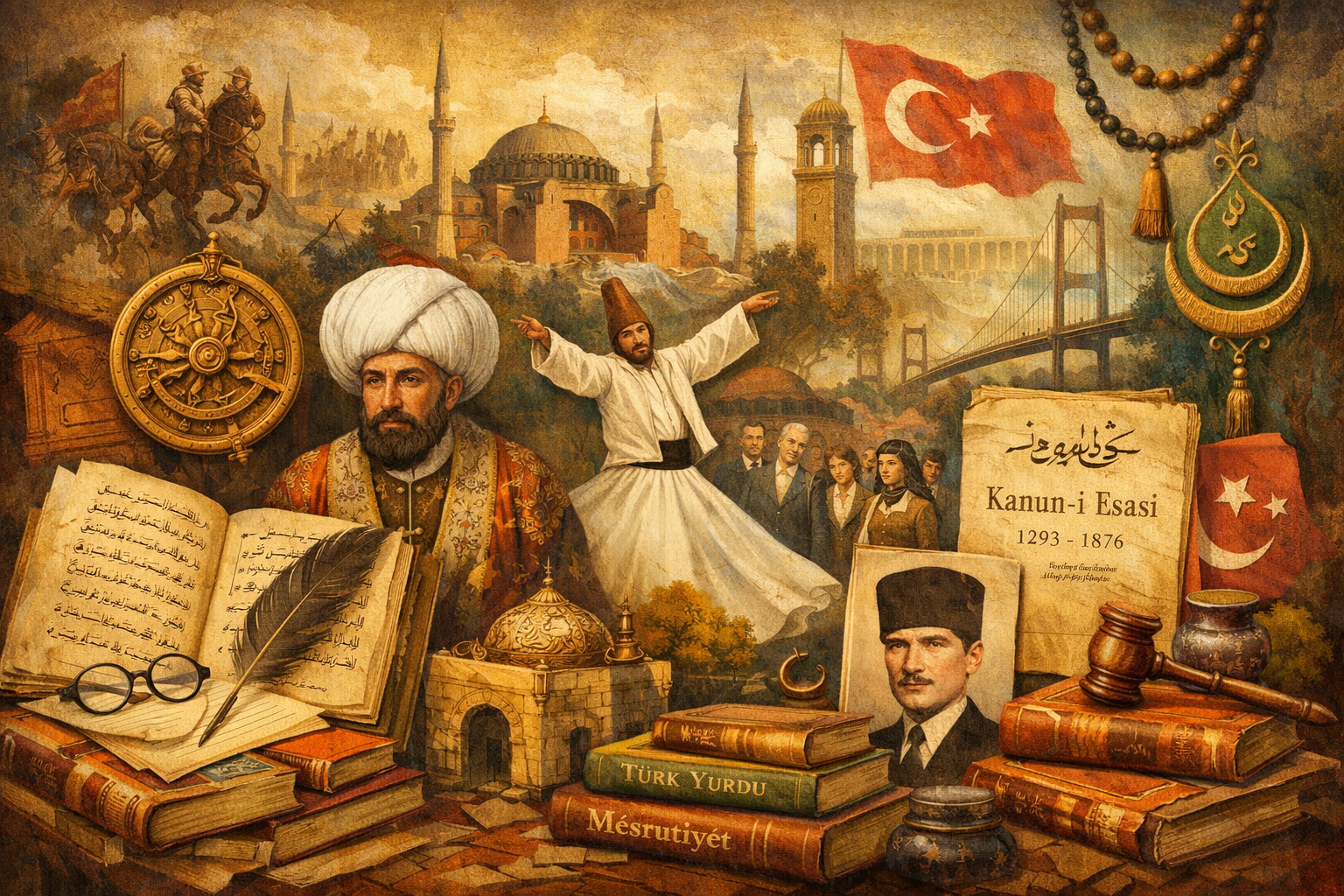
Ottoman and Turkish thought is especially important to a broader philosophy architecture because it shows how civilizations negotiate law, sovereignty, plurality, reform, and historical memory across radically changing political forms. In this respect, the category connects not only to Arabian and Levantine Thought, Persian Thought, and South Slavic Thought, but also to Islamic and Mystical Thought, Political Philosophy and Justice, Ethics and Moral Philosophy, Metaphysics, Religion and Law, and Religion and Society. Questions of authority, law, reform, statecraft, plurality, public order, translation, education, gender, secularism, and memory become sharper when Ottoman and Turkish thought is treated as a major intellectual world rather than as a background to modern nationalism.
Its enduring importance lies in the way it joins political authority to moral and civilizational self-understanding. It asks what makes rule legitimate, how law orders society, how empire and religion shape one another, how reform can preserve continuity while enabling change, how literature becomes a vehicle of ethical and political reflection, how modern philosophy entered Ottoman debates, how constitutionalism and nationalism reconfigured collective life, how women’s education and family reform became central to modernity, how non-Muslim and provincial intellectual worlds shaped imperial public life, and how the memory of empire survives rupture. At its strongest, Ottoman and Turkish thought becomes one of the most revealing traditions for understanding how historical societies negotiate sovereignty, reform, faith, plurality, language, and modernity under pressure.
Why Ottoman and Turkish Thought Matters
Ottoman and Turkish thought matters because it preserves one of the most consequential traditions for understanding how law, empire, religion, literature, education, administration, reform, and public memory become intellectually entangled. It shows how sovereignty is justified, how legal and scholarly cultures sustain state power, how spiritual and literary traditions shape moral life, how institutions reproduce thought, and how reformist and revolutionary moments reorganize civilizational self-understanding.
In this tradition, political and moral questions are rarely separable. The ordering of the state, the legitimacy of authority, the preservation of religion, the education of elites and subjects, the interpretation of history, the training of bureaucrats, the management of plurality, and the ethical formation of public life all belong to the same field of concern. Ottoman and Turkish thought therefore offers a sustained archive for studying how societies think through the relation between law and power, faith and governance, empire and reform, continuity and rupture.
This field also matters because it confronts problems that remain globally recognizable: how to preserve continuity while reforming institutions; how to negotiate imperial plurality; how to understand the relation between religion and politics; how legal order and bureaucratic centralization reshape society; how modern science and philosophy enter inherited traditions; how nationalism transforms the memory of empire; how education produces citizens; and how the state narrates itself through language, history, and public culture.
It also broadens philosophy itself. Ottoman and Turkish thought develops not only in treatises of political theory or scholastic theology, but also in imperial law codes, fatwas, advice literature, chronicles, Sufi manuals, poetry, novels, journalism, educational programs, constitutional debates, translation projects, philological reforms, administrative memoranda, and the institutions of state and civil society. It belongs near the center of any serious account of how civilizations think through authority, reform, plurality, and historical change.
The Civilizational Frame of Ottoman and Turkish Thought
The phrase “Ottoman and Turkish thought” is useful because it names a field broader than Ottoman dynastic history and deeper than modern Turkish nationalism. It points to a civilizational zone formed across Anatolia, the Balkans, the eastern Mediterranean, the Arab provinces, the Black Sea world, and the wider Ottoman sphere through political institutions, legal traditions, spiritual lineages, literary cultures, and bureaucratic transformations. This is not a claim of homogeneity. It is a claim that these worlds participated in overlapping concerns with sovereignty, law, piety, memory, reform, and order.
At its deepest layers, this field includes early Turkic literary, epic, and ethical inheritances; the making of Muslim Anatolia within Persianate, Turkic, and Byzantine worlds; the consolidation of Ottoman dynastic and legal legitimacy; the place of Hanafi jurisprudence and the ulema; the role of Sufi orders in shaping social and devotional life; the literary and courtly worlds of Ottoman Turkish; the historical self-representation of empire; and the later reconfiguration of political thought through Tanzimat reform, constitutionalism, social theory, nationalism, secularism, and republican transformation.
Ottoman and Turkish thought is therefore best understood as a long argument across empire and post-imperial modernity rather than as a single school. Its core questions change across time, but they remain connected: how is authority justified? How does law order society? How does religion shape public life? How does a multilingual empire govern plurality? How does a civilization respond to military, economic, and intellectual crisis? How does a republic inherit an empire it claims to surpass? These questions make the field structurally philosophical, even when its arguments appear through legal, literary, institutional, or historical forms.
Sources and Textual Foundations
A serious series in Ottoman and Turkish thought begins with a wide range of sources: chronicles, mirrors-for-princes literature, legal compilations, fatwa collections, biographical dictionaries, theological and philosophical commentaries, Sufi manuals, poetry, court histories, reform memoranda, constitutional documents, journals, novels, educational texts, economic and administrative registers, translation archives, and the later political writing of Tanzimat, Young Ottoman, Young Turk, and republican thinkers. The field cannot be reduced to “philosophy” in the narrow sense, because its deepest arguments often emerge in literary, legal, bureaucratic, and historical forms.
A cornerstone series should therefore move between early Turkic texts, medieval Anatolian literary and religious writing, Ottoman dynastic and legal sources, major Sufi and poetic traditions, madrasa and commentarial traditions, the sciences of governance and medicine, nineteenth-century reformist and constitutionalist texts, non-Muslim Ottoman intellectual production, and modern Turkish political and cultural criticism.
Modern scholarship remains indispensable, but it should clarify the primary materials rather than replace them. A fully comprehensive pillar must therefore move repeatedly between law, literature, religion, political institutions, philosophy, education, language, science, administration, and historical self-interpretation.
This broad source base also prevents a common distortion: reading Ottoman and Turkish thought only through the endpoint of republican nationalism. The field must be allowed to appear in its full historical range, from early Anatolian Sufi and literary worlds to imperial law, from Byzantine inheritance to Arab provincial intellectual life, from non-Muslim public culture to constitutionalism, from late Ottoman print culture to republican secularism, and from memory politics to contemporary public history.
Early Turkic and Anatolian Foundations
A fully comprehensive account must begin before the high Ottoman period. Ottoman and Turkish thought does not emerge fully formed in the imperial age. It stands on earlier Turkic literary, ethical, and political inheritances, as well as the making of Muslim Anatolia after the Seljuq and Mongol periods. Early Anatolian literary production, frontier ethics, Sufi writing, Persian and Arabic scholarly influence, and the emergence of Turkish as a literary language all belong to the groundwork of later Ottoman thought.
This matters because Ottoman thought was never simply “Islamic law plus imperial administration.” It developed through the making of Anatolia as a multilingual, multi-institutional intellectual world. Turkish, Persian, Arabic, Greek, Armenian, and other languages participated in a regional environment where political authority, religious life, literary expression, and social organization were still being formed.
Early Anatolian Sufism, frontier society, and literary production help explain why later Ottoman thought remained so deeply shaped by both imperial form and inward devotional life. The early Anatolian world carried Persianate literary refinement, Islamic scholarship, Turkic heroic and ethical memory, Byzantine urban and political inheritance, and frontier forms of social authority into a new synthesis.
A serious pillar should therefore treat early Turkic and Anatolian foundations not as preface alone, but as one of the deep layers through which later Ottoman legitimacy, language, literature, spirituality, and statecraft became possible.
Byzantine Inheritance, Romanity, and Imperial Universalism
A strongest-sense pillar must develop the Byzantine and Eastern Roman inheritance explicitly. The Ottoman Empire did not simply conquer Byzantine territories and replace them with an entirely new civilizational language. It inherited cities, administrative cultures, ceremonial forms, political geographies, Christian communities, and symbolic claims that shaped how Ottoman universal sovereignty was imagined. Constantinople’s transformation into Istanbul was not merely a geographic event. It was one of the great acts of imperial transfer in world history.
This matters because Ottoman political thought repeatedly engaged the problem of universal empire, succession, and Romanity. The conquest of Constantinople helped authorize the dynasty not only as a military power but as a claimant to a broader ecumenical and civilizational role. Greek Orthodox intellectual life, Byzantine urban continuity, and the Ottoman management of Roman imperial residues therefore belong within the field rather than at its margins.
Byzantine inheritance also complicates simplified civilizational narratives. Ottoman thought did not develop in isolation from Christian, Greek, Balkan, Mediterranean, or Roman worlds. It governed them, absorbed them, negotiated with them, and reinterpreted them. This is one reason Ottoman sovereignty should be understood as layered rather than singular: Islamic, Turkic, Persianate, Byzantine, Mediterranean, and imperial universalist elements all intersected.
To include Romanity is not to deny Islamic legitimacy. It is to show how imperial thought often works through multiple inheritances at once. The Ottoman dynasty could claim sacred, legal, military, dynastic, and imperial authority simultaneously, and the conquest of Constantinople intensified that synthesis.
Empire, Law, and Sovereignty
Ottoman and Turkish thought is inseparable from the question of sovereignty. The Ottoman imperial order was not only a political structure; it was also an intellectual world in which dynastic legitimacy, the protection of religion, the ordering of subjects, fiscal governance, military authority, legal plurality, and public order all had to be justified. Advice literature, dynastic ideology, political chronicles, and legal practice all became ways of thinking about order.
This matters because Ottoman political thought repeatedly returns to the problem of how authority should be embodied and constrained. Sovereignty in the Ottoman context was not reducible to a simple theory of divine kingship or unbounded despotism. It was mediated by law, the learned class, imperial bureaucracy, custom, provincial practice, military order, fiscal necessity, and an ongoing argument over the relation between sultanic authority, sharia, and public welfare.
The Ottoman state also developed a distinctive vocabulary of order. Sovereignty was tied to justice, protection, discipline, hierarchy, and the maintenance of balance across social groups and institutions. The ruler’s legitimacy depended not only on conquest or dynastic succession, but on the capacity to preserve order and uphold a recognizable moral-legal world.
This makes Ottoman sovereignty a major topic for political philosophy. It asks how imperial authority is justified when governing many peoples, confessions, languages, provinces, and legal arrangements. It also asks how law can both authorize and restrain power.
Ulema, Jurisprudence, and Legal Culture
A strongest-sense pillar should give major weight to the ulema, the legal schools, and the institutional life of jurisprudence. Ottoman intellectual culture was deeply shaped by jurists, judges, teachers, muftis, and legal scholars, especially within Hanafi frameworks. Law was not an isolated technical specialty. It was one of the principal means through which moral order, social hierarchy, imperial power, and everyday conduct were organized.
This layer becomes especially important in the nineteenth century, when new legal institutions, borrowing, codification, and procedural reform reshaped Ottoman legal culture. Reform did not simply import foreign law wholesale. It generated a syncretic legal culture in which new court systems, procedures, commercial codes, bureaucratic norms, and indigenous legal traditions interacted in lasting ways.
Ottoman legal thought therefore belongs at the center of the pillar. It includes the relation between sharia and sultanic law, fatwa and administration, court practice and imperial command, custom and jurisprudence, reform and continuity, legal plurality and centralization. To understand Ottoman and Turkish thought without law is impossible because law was one of the empire’s principal languages of order.
This legal culture also bridges empire and republic. Later Turkish legal reform, secularization, codification, and citizenship were not simply abrupt innovations. They reworked a longer history in which law had already been a central site of reform, legitimacy, state-building, and public order.
Theology, Kalam, and Orthodoxy in the Ottoman Scholarly World
Theological architecture deserves fuller treatment than it often receives in broad narratives of Ottoman thought. Ottoman intellectual life was not only legal, political, and literary. It was also scholastic and doctrinal. Questions of creed, causation, prophecy, divine justice, cosmology, legitimate belief, and the relation between reason and revelation remained central to the madrasa world and to the broader moral logic of empire.
Ottoman scholarship inherited and transmitted post-classical kalam traditions, especially in conversation with Maturidi and Ashʿari currents. These traditions helped structure the doctrinal atmosphere within which jurisprudence, philosophy, logic, and Sufism operated. Orthodoxy in the Ottoman world was not merely imposed from above. It was argued, taught, codified, transmitted, and institutionalized.
This matters because theological reasoning shaped public order indirectly as well as directly. Creed, legitimacy, communal identity, scholarly authority, and the boundaries of acceptable teaching all contributed to the intellectual architecture of empire. Theology was not a private supplement to political life; it helped define the world within which law, power, education, and social morality were understood.
A fully comprehensive pillar should therefore place kalam beside law rather than outside it, showing how the empire’s learned culture joined creed, argument, and social order.
Philosophy, Logic, and the Post-Classical Islamic Inheritance
A fully comprehensive pillar must also give greater weight to philosophy proper. Ottoman and Turkish thought includes more than political theory and legal culture. It also inherits post-Avicennan metaphysics, logic, ethics, commentarial traditions, Illuminationist strands, and Ibn ʿArabi’s metaphysical afterlives. Philosophy in Ottoman settings did not always appear as a separate self-declared discipline in the modern sense. It frequently lived in commentaries, scholastic syntheses, madrasa curricula, and the intertwined study of logic, theology, and metaphysics.
This matters because Ottoman thought participated in the longer history of Islamic philosophy rather than standing outside it. Questions of being, causality, knowledge, logic, demonstration, intellect, soul, and the relation between rational proof and revealed truth continued to matter, even when expressed through pedagogical and institutional forms rather than through highly original standalone systems.
Logic is especially important because it served as an intellectual tool across theology, jurisprudence, philosophy, and education. It helped discipline argument and organize scholarly formation. The commentarial tradition, often dismissed as derivative, should be treated more carefully as a means of preservation, refinement, pedagogy, and institutional continuity.
A strongest-sense pillar should therefore include philosophy as a sustained inheritance rather than as a vanished classical prelude. Ottoman philosophy may often appear through commentary, curriculum, and synthesis, but those forms are themselves part of the history of thought.
Science, Medicine, and the Classification of Knowledge
A strongest-sense Ottoman and Turkish pillar should also include science, medicine, mathematics, astronomy, geography, and the broader classification of knowledge. Ottoman intellectual life was not purely legal and literary. It also involved practical, observational, and administrative sciences through which the empire ordered time, territory, health, warfare, and governance. Astronomy mattered for calendrical precision and ritual life; geography and cartography mattered for imperial vision; medicine mattered for body, regimen, and care; mathematics and accounting mattered for administration and military organization.
This matters because the Ottoman world inherited and transformed older Islamicate scientific traditions while also encountering new European sciences in increasingly urgent ways. Scientific education, medical reform, technical translation, and institutional reorganization became central to later Ottoman modernity. Science was not simply a Western import that arrived late; it entered an already existing knowledge world and reshaped its classifications, institutions, and ambitions.
Medicine is especially important because it sits at the intersection of body, ethics, care, administration, and modern institutions. Military medicine, public health, medical schools, translation, and hospital reform all became part of the intellectual transformation of the late Ottoman and republican worlds.
A comprehensive pillar should therefore treat the sciences as part of the larger civilizational architecture of thought rather than as merely practical add-ons. Ottoman and Turkish thought includes the ordering of knowledge itself.
Education, Schools, and Bureaucratic Reproduction
No comprehensive account can neglect institutions of reproduction. Ottoman and Turkish thought endured not only because people wrote texts, but because institutions trained scholars, jurists, officials, soldiers, physicians, translators, and teachers. Madrasas, palace schools, scribal training, translation bureaus, military academies, modernizing schools, medical schools, law schools, and later republican educational systems all shaped what kinds of thought were possible, legitimate, and transmissible.
This matters because education is one of the chief mechanisms through which empire and republic reproduce themselves intellectually. The Ottoman and Turkish worlds repeatedly refashioned curricula, languages of knowledge, and institutional hierarchies in response to crisis. Educational reform was therefore never only pedagogical. It was political, legal, linguistic, scientific, and civilizational.
Bureaucratic reproduction is equally important. The empire depended on trained officials capable of writing, recording, classifying, administering, translating, taxing, governing, and reforming. Bureaucratic knowledge shaped how society was seen and governed. The modern state then intensified these processes through schools, statistics, law, technical expertise, and public instruction.
A strongest-sense pillar therefore treats educational and bureaucratic institutions as central engines of thought, not as neutral containers. Institutions do not merely transmit ideas; they define which ideas become actionable.
Sufism, Devotion, and Spiritual Authority
No comprehensive pillar on Ottoman and Turkish thought can neglect Sufism. Sufi orders, lodges, saints, ritual life, and devotional literature shaped the ethical and spiritual texture of Ottoman society across centuries. The Ottoman and Anatolian world was not structured by law and imperial administration alone. It was also structured by practices of remembrance, discipline, companionship, sacred authority, and spiritual pedagogy.
This matters because Ottoman thought repeatedly joins political and legal order to inward formation and devotional authority. Sufi lineages were not marginal to social life. They were major institutions of education, sociability, memory, moral formation, and cultural transmission. Anatolian and later Ottoman history show the rise of Sufism as a social, literary, and institutional force whose afterlife continued into the republican period, even when repressed, transformed, or driven into new forms of survival.
Sufi orders also complicate any simple distinction between religion and society. Lodges were devotional spaces, but also social networks, educational institutions, literary centers, and sometimes political actors. They shaped music, poetry, ritual, ethics, public sociability, and regional identity.
A serious pillar should therefore treat Sufism neither as decorative mysticism nor as mere opposition to official Islam. It was a central component of Ottoman social and intellectual order.
Literature, Poetry, and Ethical Reflection
Ottoman and Turkish thought develops not only in legal and political writing but also in literature. Poetry, prose, courtly writing, religious verse, novels, memoirs, and journalism all become media through which power, morality, civilization, longing, decline, reform, and memory are interpreted. A fully comprehensive pillar should therefore give literature real philosophical weight rather than treating it as cultural ornament.
This matters because in the Ottoman-Turkish sphere, literature often carries the moral and political imagination of an age. Divan poetry encodes hierarchy, refinement, metaphysical longing, and courtly discipline. Vernacular and folk traditions carry social memory and communal ethics. Sufi verse gives voice to inward discipline and divine love. Modern prose and journalism stage the conflicts of reform, constitutionalism, national identity, gender, secularism, and civilizational anxiety.
Literature also becomes one of the places where the movement from empire to republic can be felt most intensely. The modern novel, theater, memoir, and press all helped translate institutional reform into lived moral and social experience. Writers explored the family, the school, the bureaucrat, the woman reader, the Westernized intellectual, the provincial subject, the nostalgic imperial memory, and the desired republican citizen.
Ottoman and Turkish thought therefore includes literary form as one of its most important vehicles of reflection. Literature shows how reform enters feeling, language, family, and everyday life.
Historiography, Memory, and Civilizational Self-Understanding
Ottoman and Turkish thought is deeply historical. Chroniclers, historians, reformers, and later nationalist writers repeatedly interpreted the past to justify present action. Historical writing becomes a site where empire reflects on its own legitimacy, decline, reform, plurality, and possible renewal. A comprehensive pillar should therefore include historiography as one of the tradition’s core intellectual forms.
This matters especially in the late Ottoman period, when history became increasingly public, disciplinary, and politically charged. Historical writing was tied to changing political perceptions, constitutional ideals, national claims, educational projects, and the use of history as a tool of social and political reorientation. The Ottoman-Turkish archive is therefore one of the clearest places to study how history becomes a weapon, a discipline, and a moral language all at once.
Historiography also changes across the imperial-republican divide. The republic reorganized the past through new narratives of nation, language, civilization, secular progress, and rupture from the Ottoman order. Ottoman memory was not simply preserved or discarded; it was reclassified.
This makes memory one of the central philosophical topics of the field. How should a society remember an empire after founding a republic? What must be carried forward, what must be rejected, what must be silenced, and what returns despite official rupture?
Political Economy, Administration, and State Reason
A strongest-sense pillar should also include the moral and administrative logic of the state. Ottoman and Turkish thought was not only about theology, sovereignty, or literature. It also involved taxation, land tenure, military finance, bureaucratic rationality, inflation, provisioning, corruption, reform of officeholding, and the relation between fiscal order and political legitimacy. In many periods, the health of the state was imagined through the management of resources, hierarchy, discipline, and just administration.
This matters because empire is sustained through reasoning about revenue, land, army, and population as much as through symbolism and law. Advice literature, administrative memoranda, reform treatises, and later economic and social theory therefore belong inside the field of thought rather than outside it.
Political economy also illuminates the moral logic of reform. Fiscal crisis, military pressure, debt, trade, provincial autonomy, and European economic power forced Ottoman thinkers and officials to rethink administration, legal order, education, and state capacity. Economic life was therefore not merely a background condition. It shaped the intellectual urgency of reform.
In the republican period, state-led modernization, statism, industrial policy, rural transformation, and development all continued this tradition of linking political authority to economic order. Ottoman and Turkish thought is therefore one of the important fields for studying state reason as a moral and administrative project.
Arab Provinces and Distributed Intellectual Life
A fully comprehensive pillar should resist treating Ottoman thought as if it were produced only in Istanbul and Anatolia. The Arab provinces were not passive recipients of an imperial center’s ideas. Damascus, Cairo, Jerusalem, Baghdad, Beirut, Aleppo, and other provincial or regional centers were active producers of legal, theological, literary, reformist, and pedagogical thought. Ottoman intellectual life was distributed across the empire.
This matters because imperial thought was shaped through circulation, not one-way command. Provincial centers helped define the meaning of reform, legality, constitutionalism, education, print culture, public discourse, and religious renewal. Arab-Ottoman intellectual life therefore belongs structurally inside the field.
This distributed perspective also helps avoid a narrow Turkish-centered account of Ottoman intellectual history. The empire was multilingual and multi-regional. Arabic scholarship, local legal traditions, provincial reformers, journalists, teachers, and religious scholars all contributed to the larger Ottoman world of thought.
A strongest-sense pillar therefore includes Arab-Ottoman intellectual life as a constitutive part of the field. Ottoman thought becomes clearer when empire is understood as a network of centers, provinces, languages, and publics rather than as a single capital speaking to passive peripheries.
The Balkans, Rumelia, and Southeastern Europe
The Balkan and Rumelian dimensions of Ottoman thought also deserve fuller weight. Southeastern Europe was not merely governed by the empire; it was one of its principal intellectual and administrative zones. Bosnian, Albanian, Rumelian, and other Balkan Muslim intellectual traditions, along with multilingual provincial cultures, contributed to the empire’s legal, literary, and political life.
This matters because the Ottoman world in southeastern Europe was a frontier of coexistence, military organization, provincial administration, legal plurality, religious mixture, and political negotiation. The Balkans were not peripheral to Ottoman identity; they were one of the spaces through which empire imagined itself. Rumelia carried military, administrative, and cultural significance at the heart of Ottoman history.
The Balkan dimension also connects Ottoman and Turkish thought to South Slavic, Albanian, Greek, Jewish, Armenian, and other regional intellectual traditions. It forces the field to think across communities rather than through a single national genealogy.
A fully comprehensive pillar therefore includes Rumelia and the Balkans as producers of thought rather than as background geography. Ottoman sovereignty was European and Asian, Mediterranean and Black Sea, Balkan and Anatolian, Arab and imperial at once.
Greek, Armenian, Jewish, and Other Non-Muslim Traditions
A fully comprehensive pillar should resist collapsing Ottoman and Turkish thought into a single Muslim-Turkish line. The Ottoman world was multilingual and multi-confessional. Greek Orthodox, Armenian, Jewish, Arab Christian, and other non-Muslim intellectuals participated in translation, law, philosophy, journalism, pedagogy, constitutional debate, commerce, medicine, printing, and social critique. These traditions belong inside the field not merely as minorities governed by the empire, but as active participants in shaping its intellectual life.
This matters because Ottoman and Turkish thought developed through imperial plurality as much as through later national consolidation. Armenian and Greek encounters with modern philosophy, Jewish communal and legal thought, Arab Christian journalism and pedagogy, and the broader participation of non-Muslim publics in education and reform all expand the field beyond a narrowed dynastic or national story.
The late Ottoman public sphere especially cannot be understood without non-Muslim participation. Translation, journalism, modern schooling, constitutional debate, theater, economic thought, and legal reform were all shaped by multiple communities. Non-Muslim intellectuals did not merely respond to Ottoman modernity; they helped produce it.
The strongest version of this pillar must therefore integrate non-Muslim traditions structurally, not as an afterthought. Imperial plurality was not decorative. It was one of the conditions under which Ottoman thought became modern.
Reform, Tanzimat, and the Problem of Modernity
A fully comprehensive pillar must give major weight to Tanzimat reform. In Ottoman history, the Tanzimat names not only a period of administrative and legal change beginning in 1839, but a deep reorganization of political imagination. Reform raised the question of who governs, by what authority, under which legal principles, and in the name of what conception of civilization. It reshaped bureaucracy, law, education, public discourse, taxation, military institutions, and literature.
This matters because Ottoman modernity was not simply a derivative copy of Europe. It was a contested effort to preserve imperial order while transforming the means through which it was justified and administered. Tanzimat thought therefore belongs near the center of the pillar as one of the major sites where empire, law, reform, and modernity are argued together.
The Tanzimat also reorganized the relation between subjects and state. New legal and administrative categories, equality language, citizenship-like concepts, court systems, schools, and bureaucratic reforms all changed how political belonging could be imagined. Reform became a moral and civilizational project as well as an administrative one.
The philosophical importance of the Tanzimat lies in its double character. It sought to rescue empire through reform, but reform also destabilized older forms of legitimacy. It aimed at order, but it opened new questions about representation, legality, equality, and identity.
Constitutionalism, Ottomanism, and Political Thought
A strongest-sense account should foreground constitutionalism. Ottoman constitutional thought did not simply imitate European models; it was articulated under Ottoman conditions, in relation to rule of law, imperial plurality, legal reform, education, Islam, state authority, and the problem of preserving political order under pressure. Constitutional thought emerged from within a broader imperial and legal debate rather than from an abstract importation of liberal categories.
This matters because constitutionalism, Ottomanism, and the Young Ottoman tradition become major sites of reflection on liberty, representation, legality, religion, and state power. They show how Ottoman thought negotiated the tension between centralization and participation, reform and continuity, imperial unity and emerging national claims.
Ottomanism was especially important because it attempted to imagine a shared political belonging across religious and ethnic difference. It was a response to imperial crisis, but also a philosophical experiment in plural citizenship before empire fully gave way to nation-state frameworks.
The constitutional moment therefore belongs to political philosophy. It asks whether empire can be made lawful, participatory, and equal; whether religion and representation can coexist; whether legality can restrain sovereign authority; and whether imperial plurality can be transformed into a shared political subject.
Late Ottoman Public Sphere and Intellectual Plurality
A fully comprehensive pillar should give sustained attention to the late Ottoman public sphere. The nineteenth and early twentieth centuries saw the rapid expansion of journalism, print culture, translation, serialized literature, public controversy, educational reform, and political commentary. This public sphere was not unified, but it was dynamic. It included Muslim, Armenian, Greek, Arab, Jewish, and other participants who contested the meaning of constitution, nation, religion, progress, science, and civilizational survival.
This matters because Ottoman and Turkish thought in its modern form develops not only in the palace or madrasa, but also in newspapers, journals, salons, schools, associations, theaters, translation bureaus, and public debate. The late Ottoman public sphere is therefore one of the essential sites where empire becomes self-conscious, fractured, and philosophically modern.
Print culture also changed the speed and scale of intellectual life. Ideas circulated faster, audiences widened, polemics intensified, and new publics emerged. Reform, gender, education, literature, constitutionalism, nationalism, Islam, science, and history all became public topics.
The late Ottoman public sphere belongs in the pillar because it shows thought becoming social. Modern Ottoman ideas were not only produced by isolated thinkers. They were produced by networks, journals, controversies, translations, schools, and publics.
Ottomanism, Islamic Renewal, and Turkism in the Age of Imperial Crisis
In the late Ottoman period, debates over reform increasingly became debates over identity. Ottomanism, currents of Islamic renewal, Turkism, and later nationalist projects offered competing answers to the question of what kind of collective subject could survive imperial crisis. These currents did not simply replace one another in neat sequence. They overlapped, contested one another, and often shared concerns with education, morality, social theory, religion, language, and political order.
This matters because Ottoman and Turkish thought is one of the clearest archives for seeing how empire becomes nation, and how the languages of religion, civilization, science, custom, and historical mission are reorganized in that transition. Social theory, evolutionism, moral pedagogy, and nationalist sociology all contributed to this redefinition of collective life.
Ottomanism sought imperial unity; Islamic renewal sought religious and civilizational regeneration; Turkism increasingly sought linguistic, cultural, and national consolidation. Each responded to crisis, and each attempted to produce a viable future out of historical pressure.
This section is central because it reveals identity not as a fixed inheritance but as an intellectual and political construction under stress. Late Ottoman thought did not merely ask “who are we?” It asked which form of collective identity could survive modernity.
Women, Family, Education, and Gendered Transformation
One of the largest missing layers in many broad accounts of Ottoman and Turkish thought is gender. A strongest-sense pillar should give women, family, domesticity, education, and gendered reform real structural weight. Women were not only subjects of law and morality; they were also participants in literary culture, education, reform discourse, religious life, philanthropy, journalism, and later republican debates about citizenship and modernity.
This matters because many of the deepest transformations of Ottoman and Turkish thought were staged through arguments about family, public virtue, female education, domestic order, morality, law, and the meaning of civilizational progress. Gender is not peripheral to reform. It is one of its central battlegrounds.
The late Ottoman and early republican periods both treated the family as a site where civilization, morality, education, religion, and citizenship were to be reorganized. The woman reader, the educated mother, the modern wife, the professional woman, and the republican citizen all became figures through which reformers imagined social transformation.
A comprehensive pillar therefore integrates women as both subjects and producers of intellectual life. It asks not only what men wrote about women, but how women wrote, organized, educated, critiqued, and participated in modern public life.
Language, Translation, Print, and Philology
A strongest-sense pillar should also make language central. Ottoman and Turkish thought developed through multilingual interaction among Ottoman Turkish, Arabic, Persian, Armenian, Greek, Judeo-Spanish, and other languages. Translation was not merely instrumental. It transformed categories, genres, and political imagination. Philology, language simplification, lexical borrowing, print expansion, and later script reform all reshaped the structure of knowledge itself.
This matters because language reform is never only linguistic. It is also political, epistemic, and civilizational. The passage from Ottoman Turkish to modern Turkish, and the broader transformation of print culture, translation, and public speech, belong at the center of any serious account of Ottoman and Turkish thought.
Translation also changed intellectual horizons. Modern philosophy, science, political theory, legal vocabulary, sociology, medicine, and education entered Ottoman debates through translation and adaptation. The question was never only how to translate words, but how to translate worlds.
Script reform then intensified the relation between language and historical rupture. It changed literacy, archive access, public education, and the relation between republican citizens and Ottoman textual memory. Language therefore becomes one of the deepest sites where continuity and rupture are enacted.
Republican Transformation, Kemalism, and Secularism
A comprehensive pillar must give full weight to republican transformation. The early Turkish Republic did not simply mark a political regime change. It represented a radical reorganization of law, authority, secularism, education, public culture, language, historical narrative, gender, citizenship, and the desired citizen. Kemalism became one of the central frameworks through which the Ottoman past was reinterpreted, appropriated, silenced, or rejected.
This matters because republican transformation remains one of the key sites where Ottoman and Turkish thought confront the relation between religion and state, tradition and revolution, empire and nation, historical continuity and deliberate civilizational refounding. A strongest version of the pillar should differentiate among secularism, nationalism, populism, statism, educational reform, and social engineering rather than treating Kemalism as a single undivided block.
Secularism is especially important because it was not merely a doctrine of church-state separation in a Western Christian sense. In Turkey, it involved the reorganization of Islamic institutions, legal authority, education, public symbols, Sufi orders, language, and state control over religion. It was both a project of modernization and a project of state formation.
Republican thought therefore belongs to philosophy because it asks what kind of subject the modern state seeks to produce. The republican citizen was imagined through education, language, discipline, secular public culture, national history, and participation in a new political order.
Continuity, Rupture, and the Afterlife of Empire
One of the deepest themes in Ottoman and Turkish thought is the tension between continuity and rupture. Modern Turkey did not emerge from nowhere, and the Ottoman past did not simply disappear in 1923. Reform, constitutionalism, nationalism, secularism, Sufism, historical writing, legal transformation, education, bureaucracy, and language change all carried older imperial inheritances forward, even when they redefined them under new names and institutions.
This matters because Ottoman and Turkish thought remains philosophically important precisely as an archive of historical transformation. It illuminates how civilizations live through crisis, how institutions and memory outlast regimes, and how modernity is negotiated not by a simple break with the past but through repeated reinterpretation of inherited worlds.
Rupture was real. The republic transformed law, script, education, public culture, religion-state relations, and national identity. Yet continuity was also real. Administrative habits, elite formation, geopolitical memory, reformist language, state centrality, and unresolved religious questions persisted.
The afterlife of empire is therefore not nostalgia alone. It is a philosophical problem: how does a post-imperial society remember, reject, inherit, and reinterpret the world that formed it?
Contemporary Memory, Neo-Ottomanism, and Public History
A strongest-sense pillar should also include the contemporary afterlife of Ottoman and Turkish thought. The Ottoman past continues to function as a live political and cultural resource in modern Turkey. It is invoked through public history, television, architecture, education, tourism, diplomatic symbolism, conservative identity, museum culture, and debates over secularism and civilizational heritage. Neo-Ottomanism, whether used analytically or polemically, names part of this continuing struggle over the meaning of empire in the present.
This matters because Ottoman and Turkish thought is not only a historical archive. It is also a living field of contestation. Public uses of history, memory politics, debates over religion and nation, renewed arguments over the empire’s legacy, and changing interpretations of the republic all show that the intellectual life of Ottoman and Turkish worlds continues beyond the republican founding moment.
Contemporary memory politics also raises difficult ethical questions. When does imperial memory become historical depth, and when does it become political myth? When does religious heritage enrich public culture, and when does it harden into exclusion? How should a society remember plurality, violence, reform, and rupture without turning history into propaganda?
The contemporary afterlife of Ottoman and Turkish thought therefore belongs in the pillar because public history is not only representation of the past. It is one of the ways societies argue about legitimacy in the present.
Core Themes in Ottoman and Turkish Thought
One major theme in this field is sovereignty. Ottoman and Turkish thinkers repeatedly ask what makes rule legitimate, how authority should be embodied, and how political order should be preserved under conditions of change.
A second theme is law. Jurisprudence, procedure, codification, legal reform, and court practice are not merely administrative concerns; they are central to the moral and political formation of society.
A third theme is religion and spiritual authority. The ulema, theology, Sufism, devotional institutions, and republican reorganization of religion shape the relation between inward life and public order.
A fourth theme is philosophy and reason. Logic, metaphysics, scholastic theology, science, and translation shape how Ottoman and Turkish worlds think about truth, order, reality, and knowledge.
A fifth theme is literature. Poetry, prose, fiction, journalism, and memoir become ways of thinking about ethics, civilization, reform, decline, longing, and historical destiny.
A sixth theme is reform. Tanzimat, constitutionalism, and later republican transformation force the tradition to confront modernity, bureaucracy, science, education, and the changing structure of sovereignty.
A seventh theme is plurality. Empire compels thought about diversity, legal multiplicity, confessional coexistence, provincial circulation, translation, and the challenge of governing difference.
An eighth theme is national identity. Ottomanism, Islamic renewal, Turkism, and Kemalism all confront the question of how collective identity should be imagined after imperial crisis.
A ninth theme is language. Translation, print, philology, simplification, script reform, and education shape the relation between knowledge, memory, and political transformation.
Finally, this field returns constantly to continuity and rupture. Ottoman and Turkish thought endures because it joins empire, law, faith, reform, language, memory, and modernity within one of the most intense archives of civilizational transformation in Eurasian history.
Expanded Article Architecture
The following structure gathers the Ottoman and Turkish Thought pillar into a long-range article architecture. It preserves the planned article list from the source draft while adding short descriptions under every planned article.
Foundations of Ottoman and Turkish Thought
- Introduction to Ottoman and Turkish Thought (planned)
Introduces Ottoman and Turkish thought as a long intellectual field shaped by sovereignty, law, faith, reform, literature, plurality, education, memory, and the transition from empire to republic. - Ottoman and Turkish Thought: Sovereignty, Law, Memory, and Transformation Across Empire and Republic (planned)
Frames the pillar around the central problem of how Ottoman and Turkish worlds negotiated authority, legal order, civilizational change, imperial memory, and republican transformation.
Early Turkic, Anatolian, and Imperial Foundations
- Early Turkic Literary and Ethical Worlds (planned)
Studies early Turkic literary, epic, ethical, and political inheritances that helped shape later Anatolian and Ottoman understandings of order, virtue, rule, and memory. - The Making of Muslim Anatolia and the Formation of a New Intellectual World (planned)
Examines the formation of Muslim Anatolia through Turkic, Persianate, Arabic, Byzantine, Sufi, and frontier influences. - The Emergence of Literary Turkish in Anatolia (planned)
Studies the rise of Turkish as a literary language in Anatolia and its relation to Persian, Arabic, devotional writing, vernacular expression, and cultural formation. - Byzantine Legacy and Ottoman Imperial Universalism (planned)
Examines Byzantine inheritance, Eastern Roman continuity, urban institutions, ceremonial memory, and Ottoman claims to universal imperial authority. - Romanity, Conquest, and the Making of Istanbul (planned)
Studies the conquest of Constantinople, the transformation of Istanbul, and the symbolic transfer of imperial geography, legitimacy, and Roman universalism.
Dynasty, Law, Ulema, and Scholarly Order
- Dynasty, Legitimacy, and the Political Idea of the Ottoman State (planned)
Examines Ottoman dynastic legitimacy through conquest, law, religion, justice, protection, imperial order, and the symbolic authority of the sultan. - Law, Hanafi Jurisprudence, and the Ottoman Imperial Order (planned)
Studies Hanafi jurisprudence, sharia, sultanic law, court practice, legal hierarchy, and the role of law in imperial governance. - The Ulema and the Scholarly Architecture of the Empire (planned)
Examines the ulema as jurists, teachers, judges, muftis, scholars, and institutional guardians of legal and intellectual continuity. - Kalam and Orthodoxy in the Ottoman Madrasa (planned)
Studies Ottoman theological instruction through kalam, creed, Maturidi and Ashʿari inheritances, doctrinal boundaries, and scholastic formation. - Ottoman Philosophy after Avicenna and Razi (planned)
Examines Ottoman engagement with post-Avicennan metaphysics, Fakhr al-Din al-Razi’s legacy, logic, theology, and philosophical commentary. - Logic, Commentary, and the Post-Classical Islamic Inheritance in Ottoman Lands (planned)
Studies logic and commentary as central intellectual practices through which Ottoman scholars preserved, refined, taught, and extended Islamic philosophical inheritance.
Science, Education, Sufism, Literature, and Memory
- Science, Astronomy, and Medicine in the Ottoman Intellectual World (planned)
Examines Ottoman scientific life through astronomy, medicine, mathematics, geography, ritual timekeeping, technical translation, and institutional reform. - Education, Bureaucracy, and the Reproduction of Empire (planned)
Studies madrasas, palace schools, scribal training, military academies, translation bureaus, and modern schools as institutions that reproduced Ottoman thought. - Sufism, Lodges, and Spiritual Authority in Ottoman Society (planned)
Examines Sufi orders, lodges, saints, devotional life, remembrance, ritual practice, spiritual authority, and the social role of Sufi institutions. - Poetry, Court Culture, and Ethical Refinement in Ottoman Literature (planned)
Studies courtly poetry, refinement, hierarchy, metaphysical longing, aesthetics, patronage, and ethical cultivation in Ottoman literary culture. - Divan Literature, Vernacular Traditions, and the Ottoman Literary Imagination (planned)
Examines the relation between Divan literature, vernacular traditions, Sufi verse, folk expression, and the moral imagination of Ottoman society. - Historiography and the Ottoman Interpretation of the Past (planned)
Studies chronicles, court histories, reform histories, decline narratives, and the use of historical writing to interpret legitimacy, crisis, and renewal. - Political Economy, Administration, and the Moral Logic of the State (planned)
Examines taxation, land tenure, provisioning, corruption, fiscal order, bureaucracy, and the relation between state reason and moral legitimacy.
Provincial, Balkan, and Non-Muslim Intellectual Worlds
- Arab Provincial Intellectual Life Under Ottoman Rule (planned)
Studies Damascus, Cairo, Jerusalem, Baghdad, Beirut, Aleppo, and other Arab-Ottoman centers as producers of legal, theological, literary, reformist, and educational thought. - The Balkans as an Ottoman Intellectual Region (planned)
Examines Rumelia and the Balkans as major Ottoman intellectual zones shaped by administration, law, coexistence, provincial culture, and multilingual public life. - Armenian, Greek, and Jewish Thought in the Ottoman Public Sphere (planned)
Studies non-Muslim Ottoman intellectual participation in philosophy, translation, journalism, education, law, constitutionalism, commerce, and public debate.
Reform, Tanzimat, Constitutionalism, and Late Ottoman Modernity
- Reform Before Reform: Crisis, Renewal, and the Pre-Tanzimat World (planned)
Examines earlier Ottoman reform efforts, military crisis, administrative renewal, fiscal pressure, and debates over order before the Tanzimat. - The Tanzimat and the Reorganization of Sovereignty (planned)
Studies Tanzimat reform as a reorganization of law, bureaucracy, citizenship-like belonging, imperial equality, administration, and political legitimacy. - Legal Reform, Borrowing, and the Transformation of Ottoman Legal Culture (planned)
Examines new courts, codification, legal borrowing, procedure, commercial law, and the interaction between indigenous legal culture and reform institutions. - Rule of Law, Constitutionalism, and the Ottoman Political Imagination (planned)
Studies Ottoman constitutional thought through legality, representation, imperial plurality, state authority, religion, reform, and the problem of lawful sovereignty. - The Young Ottomans and the Search for Liberty and Order (planned)
Examines Young Ottoman thought through liberty, Islam, constitutionalism, public reason, reform, Ottomanism, and the moral limits of state power. - The First Constitutional Period and the Politics of Emergency (planned)
Studies the first constitutional experiment, political crisis, emergency rule, representation, centralization, and the fragility of constitutional order. - History, Discipline, and the Public Uses of the Past in the Late Ottoman Empire (planned)
Examines the formation of historical discipline, public history, educational memory, political legitimacy, and the late Ottoman use of the past. - Evolutionism, Social Theory, and the Late Ottoman Intelligentsia (planned)
Studies late Ottoman social theory, evolutionism, science, civilization discourse, reformist sociology, and intellectual responses to uneven global modernity.
Identity, Gender, Language, Republic, and Memory
- Ottomanism, Islamic Renewal, and Turkism in the Age of Imperial Crisis (planned)
Examines competing late Ottoman identity projects through imperial citizenship, Islamic renewal, Turkism, education, civilization, and political survival. - Ziya Gökalp, Society, and the Recasting of Turkish Identity (planned)
Studies Ziya Gökalp’s sociology, nationalism, culture-civilization distinction, education, solidarity, and role in modern Turkish identity formation. - Women, Reform, and Gender in Ottoman and Turkish Modernity (planned)
Examines women’s education, journalism, family reform, public virtue, citizenship, domesticity, gendered law, and women as producers of modern intellectual life. - Language Reform, Script Reform, and the Politics of Knowledge (planned)
Studies translation, print, philology, language simplification, script reform, archive access, literacy, and the political meaning of linguistic transformation. - Kemalism and the Construction of Republican Order (planned)
Examines Kemalism through secularism, nationalism, populism, statism, reform, education, citizenship, historical narrative, and state-led modernization. - Secularism, Citizenship, and the Desired Citizen in Republican Turkey (planned)
Studies republican secularism, education, law, religion-state relations, citizenship formation, public culture, and the production of the modern national subject. - Sufi Orders, Suppression, and Survival in the Early Republic (planned)
Examines the suppression of Sufi orders, the reorganization of religious authority, informal survival, devotional continuity, and the politics of secular reform. - Republican Ideology and Its Critics (planned)
Studies critiques of republican ideology from religious, liberal, socialist, conservative, Kurdish, feminist, and historical-memory perspectives. - Ottoman Memory and the Afterlife of Empire in Modern Turkey (planned)
Examines how Ottoman memory survives in institutions, literature, public history, politics, architecture, education, nostalgia, and debates over national identity. - Neo-Ottoman Memory in Contemporary Turkish Thought (planned)
Studies neo-Ottoman memory through public history, media, diplomacy, conservative identity, architecture, heritage politics, and contemporary debates over empire. - Why Ottoman and Turkish Thought Still Matters (planned)
Concludes the series by explaining why Ottoman and Turkish thought remains vital for philosophy, political theory, Islamic studies, legal history, memory studies, and modernity studies.
Closing Perspective
Ottoman and Turkish thought remains indispensable because it gives philosophy one of its most important archives of civilizational transformation. It shows how sovereignty, law, religion, literature, education, science, bureaucracy, translation, gender, plurality, memory, and reform become intertwined across the life of empire and the founding of a republic. It also shows that modernity is rarely a clean break. It is more often a long struggle over inherited institutions, languages, archives, authorities, and public narratives.
This does not mean Ottoman and Turkish thought should be romanticized. Its power lies in its complexity: imperial plurality and hierarchy, legal order and domination, Sufi devotion and state suspicion, reform and coercion, constitutional aspiration and emergency rule, republican emancipation and social engineering, secularism and religious continuity, language reform and archival rupture. A serious pillar must hold these tensions together without reducing the field to nostalgia, nationalism, or anti-modern critique.
The strongest reason to study Ottoman and Turkish thought is that its questions remain alive. How does law authorize power and restrain it? How does a civilization reform without erasing itself? How does empire become nation? How does a republic inherit an imperial archive? How does language shape political memory? How does public history become a field of legitimacy? These are not only Ottoman or Turkish questions. They are enduring questions of political life, and this tradition is one of the major ways they can be studied with depth.
Related Reading
- Arabian and Levantine Thought — for Arab-Ottoman intellectual life, reform, public discourse, language, religion, law, and modern political thought.
- Persian Thought — for Persianate literary, philosophical, mystical, and courtly traditions that shaped Ottoman intellectual culture.
- South Slavic Thought — for Balkan, Rumelian, Orthodox, Catholic, Muslim, and post-imperial intellectual worlds shaped by Ottoman history.
- Islamic and Mystical Thought — for Sufism, kalam, philosophy, spiritual authority, metaphysics, and the wider Islamic intellectual inheritance.
- Political Philosophy and Justice — for sovereignty, law, legitimacy, authority, constitutionalism, citizenship, and collective life.
- Ethics and Moral Philosophy — for virtue, duty, reform, public responsibility, moral order, and the ethical formation of social life.
- Metaphysics — for being, causality, logic, divine order, rational demonstration, and the structure of reality.
- Religion and Law — for jurisprudence, legal pluralism, sacred authority, codification, reform, and the relation between religious and state law.
Primary Sources and Archives
- T.C. Cumhurbaşkanlığı Devlet Arşivleri Başkanlığı (n.d.) Devlet Arşivleri. Available at: https://www.devletarsivleri.gov.tr/ (Accessed: 12 April 2026).
- İSAM Kütüphanesi (n.d.) İSAM Library Catalog, including Books in Ottoman Turkish, Treatises in Ottoman Turkish, Periodicals in Ottoman Turkish, and Salnâmes. Available at: https://kutuphane.isam.org.tr/ (Accessed: 12 April 2026).
- İSAM Arşivi (n.d.) İSAM Archive. Available at: https://arsiv.isam.org.tr/ (Accessed: 12 April 2026).
- TDV İslâm Ansiklopedisi (n.d.) OSMANLILAR. Available at: https://islamansiklopedisi.org.tr/osmanlilar (Accessed: 12 April 2026).
- TDV İslâm Ansiklopedisi (n.d.) MEDRESE. Available at: https://islamansiklopedisi.org.tr/medrese (Accessed: 12 April 2026).
- TDV İslâm Ansiklopedisi (n.d.) YENİ OSMANLILAR CEMİYETİ. Available at: https://islamansiklopedisi.org.tr/yeni-osmanlilar-cemiyeti (Accessed: 12 April 2026).
- TDV İslâm Ansiklopedisi (n.d.) DÂRÜLFÜNUN. Available at: https://islamansiklopedisi.org.tr/darulfunun (Accessed: 12 April 2026).
- TBMM (n.d.) 23 Aralık 1876 Kanun-ı Esasi. Available at: https://www.tbmm.gov.tr/anayasa/yetmis-alti-kanuni-esasi (Accessed: 12 April 2026).
- TBMM (2021) 1921 Teşkîlât-ı Esâsîye Kanunu. Available at: https://cdn.tbmm.gov.tr/TbmmWeb/Yayinlar/Dosya/50585885-5266-4c5e-97ed-018672b830fd.pdf (Accessed: 12 April 2026).
- ATAM (2023) 1921 Teşkilât-ı Esâsiye Kanunu ve Makaleler. Available at: https://atam.gov.tr/wp-content/uploads/2023/06/1921-TESKILAT-I-ESASIYE-KANUNU-VE-MAKALELER-1.pdf (Accessed: 12 April 2026).
- SALT Research (n.d.) SALT Research. Available at: https://saltonline.org/en/182/salt-research (Accessed: 12 April 2026).
- SALT Research (n.d.) Öktem and Barutçuoğlu Archive. Available at: https://saltonline.org/en/2971/salt-research-oktem-and-barutcuoglu-archive (Accessed: 12 April 2026).
- Türk Dil Kurumu (n.d.) Türk Dil Kurumu. Available at: https://tdk.gov.tr/ (Accessed: 12 April 2026).
Further Reading
- Ágoston, G. and Faroqhi, S. (eds.) (2021) The Cambridge History of the Ottoman Empire. Cambridge: Cambridge University Press.
- Findley, C.V. (2010) Turkey, Islam, Nationalism, and Modernity: A History, 1789–2007. New Haven, CT: Yale University Press.
- Hammond, A. (2022) Late Ottoman Origins of Modern Islamic Thought: Turkish and Egyptian Thinkers on the Disruption of Islamic Knowledge. Cambridge: Cambridge University Press.
- Mardin, Ş. (1962) The Genesis of Young Ottoman Thought. Princeton, NJ: Princeton University Press.
- Peacock, A.C.S. (2019) Islam, Literature and Society in Mongol Anatolia. Cambridge: Cambridge University Press.
- Rubin, A. (2011) Ottoman Nizamiye Courts: Law and Modernity. New York: Palgrave Macmillan.
- Shaw, S.J. and Shaw, E.K. (1977) History of the Ottoman Empire and Modern Turkey. Cambridge: Cambridge University Press.
- Wick, A. (ed.) (2025) The Cambridge Companion to Ottoman History. Cambridge: Cambridge University Press.
- Zürcher, E.J. (2004) Turkey: A Modern History. 3rd edn. London: I.B. Tauris.
References
- ATAM (2023) 1921 Teşkilât-ı Esâsiye Kanunu ve Makaleler. Available at: https://atam.gov.tr/wp-content/uploads/2023/06/1921-TESKILAT-I-ESASIYE-KANUNU-VE-MAKALELER-1.pdf (Accessed: 12 April 2026).
- Devlet Arşivleri Başkanlığı (n.d.) T.C. Cumhurbaşkanlığı Devlet Arşivleri Başkanlığı. Available at: https://www.devletarsivleri.gov.tr/ (Accessed: 12 April 2026).
- Findley, C.V. (2010) Turkey, Islam, Nationalism, and Modernity: A History, 1789–2007. New Haven, CT: Yale University Press.
- Hammond, A. (2022) Late Ottoman Origins of Modern Islamic Thought: Turkish and Egyptian Thinkers on the Disruption of Islamic Knowledge. Cambridge: Cambridge University Press.
- İSAM Arşivi (n.d.) İSAM Archive. Available at: https://arsiv.isam.org.tr/ (Accessed: 12 April 2026).
- İSAM Kütüphanesi (n.d.) İSAM Library Catalog. Available at: https://kutuphane.isam.org.tr/ (Accessed: 12 April 2026).
- Karademir, A. (2024) ‘The Introduction of Modern Western Philosophy in the Ottoman Empire: Armenian Thinkers’, Modern Intellectual History.
- Kolland, D. (2024) ‘A Strategic Eurocentrism: The Construction of Ottoman Evolutionism in an Uneven World, 1870–1900’, Modern Intellectual History.
- Mardin, Ş. (1962) The Genesis of Young Ottoman Thought. Princeton, NJ: Princeton University Press.
- Peacock, A.C.S. (2019) Islam, Literature and Society in Mongol Anatolia. Cambridge: Cambridge University Press.
- Philipp, T. (2017) ‘From Rule of Law to Constitutionalism: The Ottoman Context of Arab Political Thought’, in Hanssen, J. and Weiss, M. (eds.) Arabic Thought beyond the Liberal Age. Cambridge: Cambridge University Press.
- Rubin, A. (2007) ‘Legal Borrowing and Its Impact on Ottoman Legal Culture in the Late Nineteenth Century’, Continuity and Change.
- Rubin, A. (2011) Ottoman Nizamiye Courts: Law and Modernity. New York: Palgrave Macmillan.
- SALT Research (n.d.) SALT Research. Available at: https://saltonline.org/en/182/salt-research (Accessed: 12 April 2026).
- SALT Research (n.d.) Öktem and Barutçuoğlu Archive. Available at: https://saltonline.org/en/2971/salt-research-oktem-and-barutcuoglu-archive (Accessed: 12 April 2026).
- Shaw, S.J. and Shaw, E.K. (1977) History of the Ottoman Empire and Modern Turkey. Cambridge: Cambridge University Press.
- Sönmez, E. (2024) ‘Clio Between Revolution and Collapse: The Making of the Historical Discipline in the Late Ottoman Empire’, Modern Intellectual History.
- TBMM (n.d.) 23 Aralık 1876 Kanun-ı Esasi. Available at: https://www.tbmm.gov.tr/anayasa/yetmis-alti-kanuni-esasi (Accessed: 12 April 2026).
- TBMM (2021) 1921 Teşkîlât-ı Esâsîye Kanunu. Available at: https://cdn.tbmm.gov.tr/TbmmWeb/Yayinlar/Dosya/50585885-5266-4c5e-97ed-018672b830fd.pdf (Accessed: 12 April 2026).
- TDK (n.d.) Türk Dil Kurumu. Available at: https://tdk.gov.tr/ (Accessed: 12 April 2026).
- TDV İslâm Ansiklopedisi (n.d.) DÂRÜLFÜNUN. Available at: https://islamansiklopedisi.org.tr/darulfunun (Accessed: 12 April 2026).
- TDV İslâm Ansiklopedisi (n.d.) MEDRESE. Available at: https://islamansiklopedisi.org.tr/medrese (Accessed: 12 April 2026).
- TDV İslâm Ansiklopedisi (n.d.) OSMANLILAR. Available at: https://islamansiklopedisi.org.tr/osmanlilar (Accessed: 12 April 2026).
- TDV İslâm Ansiklopedisi (n.d.) YENİ OSMANLILAR CEMİYETİ. Available at: https://islamansiklopedisi.org.tr/yeni-osmanlilar-cemiyeti (Accessed: 12 April 2026).
- Wick, A. (ed.) (2025) The Cambridge Companion to Ottoman History. Cambridge: Cambridge University Press.
- Wilson, M.B. (2017) ‘The Twilight of Ottoman Sufism: Antiquity, Immorality, and Nation in Yakup Kadri Karaosmanoğlu’s Nur Baba’, International Journal of Middle East Studies.
- Wilson, M.B. (2024) ‘Sufi Leaders in the Early Turkish Republic: Profession, Privilege, and Persecution, 1925–1950’, New Perspectives on Turkey.
- Zürcher, E.J. (2004) Turkey: A Modern History. 3rd edn. London: I.B. Tauris.