Healing Traditions

Healing Traditions examines the medical, ritual, philosophical, and cultural systems through which societies have understood illness, balance, restoration, and the cultivation of human wellbeing. In the history of ideas, healing has rarely been limited to technical treatment alone. It has also involved conceptions of harmony, nature, spirit, ethics, and the proper ordering of life within larger cosmological, communal, and environmental frameworks.

This category explores healing as a civilizational expression of knowledge and care, including traditional medical systems, plant knowledge, ritual practices, symbolic forms of restoration, and everyday disciplines of balance and cultivation. It considers how different cultures have interpreted the causes of suffering, the relationship between body and world, the moral dimensions of care, and the roles of ritual, environment, and inherited wisdom in sustaining life.

Healing traditions play an important role in comparative inquiry because they reveal how societies have linked medicine, philosophy, spirituality, and practical knowledge in attempts to preserve health and respond to vulnerability. By engaging these traditions seriously, this category deepens understanding of healing as both a material and symbolic practice, and broadens reflection on care, wholeness, and the diverse ways human beings have sought restoration.

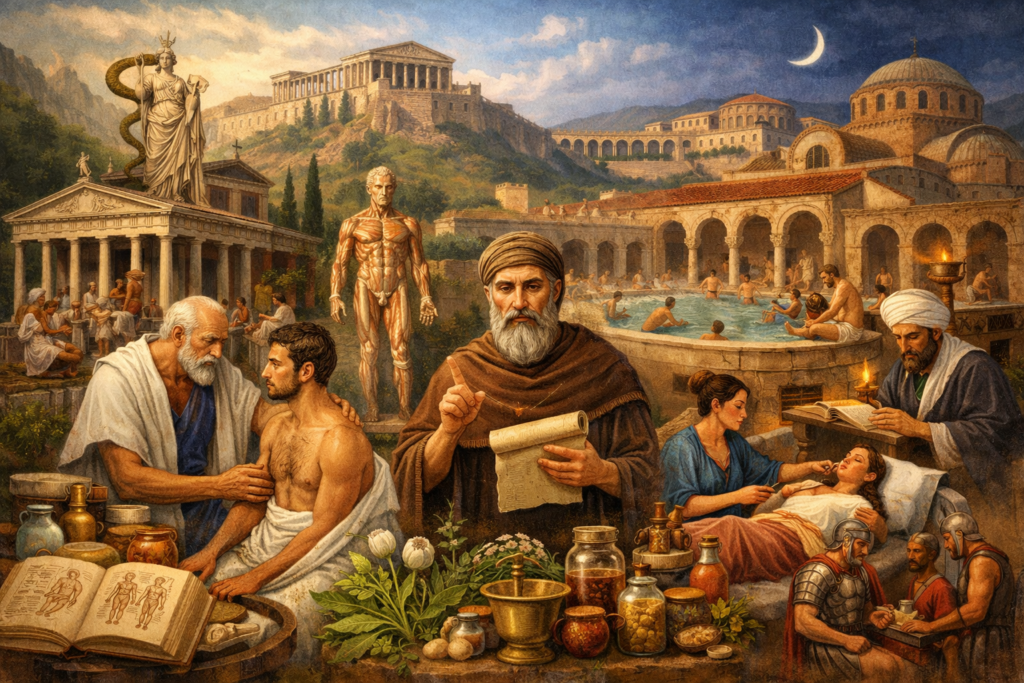
Composite illustration of Greek and Roman medicine showing physicians treating patients, medicinal herbs and jars, an anatomical figure, temple healing, Roman baths, and military care within a classical Mediterranean setting.

Greek & Roman Medicine: Healing, Balance, and the Classical Traditions of Care

Greek and Roman medicine examines one of the foundational healing traditions of the ancient world through theories of balance, regimen, environment, diagnosis, prognosis, anatomy, pharmacology, ethics, and care. This content pillar explores Hippocratic medicine, Galenic systematization, Alexandrian anatomy, surgery, women’s medicine, public health, military care, temple healing, and the transmission of classical medicine into Byzantine, Islamic, and later European traditions. By bringing together intellectual history, practical healing, social life, and material culture, it reveals how the classical Mediterranean understood the body, suffering, and the disciplined art of restoring health within a larger order of nature and life.
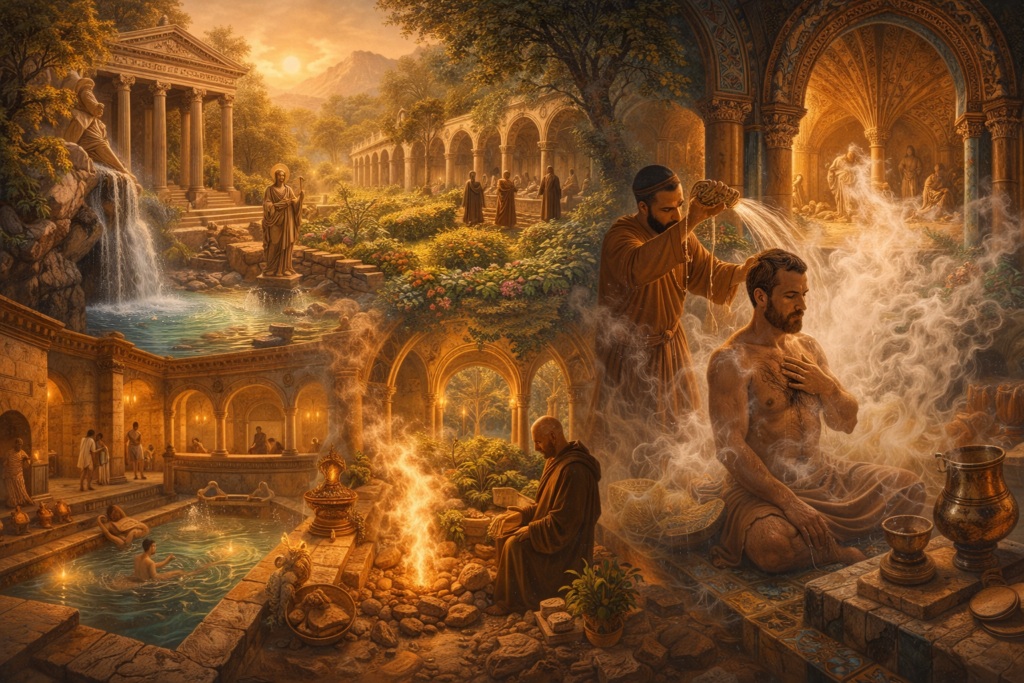
Editorial illustration of healing spaces, baths, and sacred environments featuring a sanctuary spring, Roman bath architecture, Islamic ablution and steam bathing, monastic garden space, and layered atmospheres of purification and restoration

Healing Spaces, Baths & Sacred Environments: Water, Ritual, and the Architecture of Restoration

Healing spaces, baths, and sacred environments examine the places, structures, and landscapes through which cultures have pursued cleansing, restoration, ritual healing, bodily care, and the renewal of life. This category explores sacred springs, temple healing, Epidaurus, Roman baths, hammams, Islamic ablution, monastic infirmaries, hospices, pilgrimage environments, therapeutic gardens, and the modern afterlife of healing architecture, revealing how water, atmosphere, architecture, ritual, and environmental design have long shaped the restoration of body and spirit.

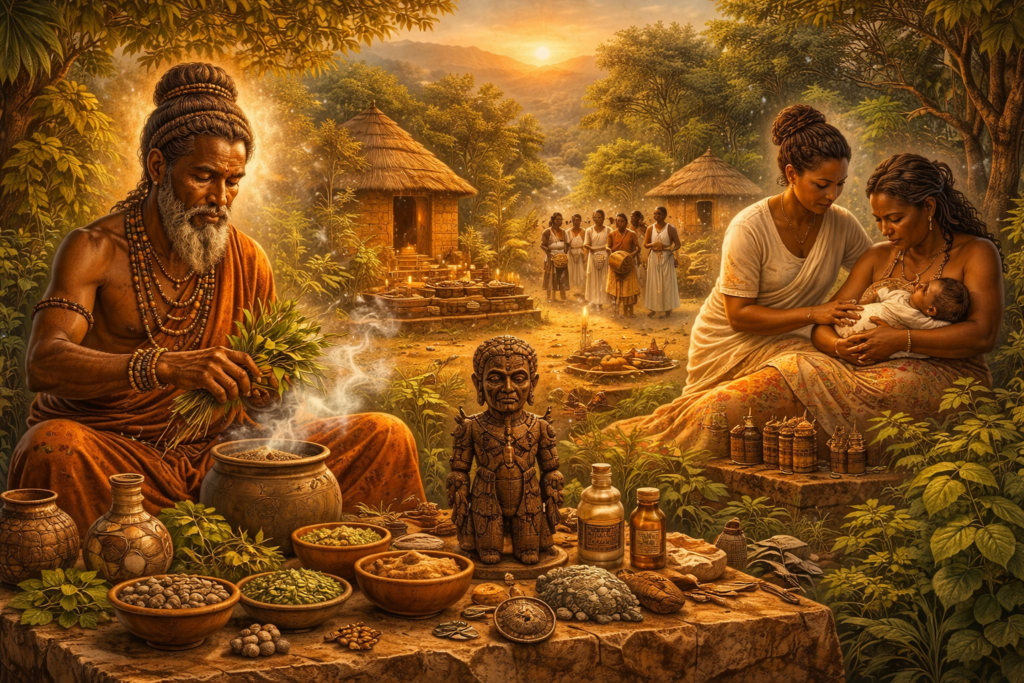
Editorial illustration of African healing traditions featuring a healer preparing herbs, ritual and protective objects, women providing maternal care, ancestral symbolism, and a communal landscape of restoration

African Healing Traditions: Body, Spirit, Community, and the Work of Restoration

African healing traditions examine the diverse systems of care through which African societies have understood illness, vitality, danger, protection, and restoration across bodily, spiritual, communal, ecological, and moral dimensions of life. This category explores herbal medicine, divination, ancestral mediation, ritual healing, women’s and household care, material forms of protection, social diagnosis, regional healing worlds, colonial suppression, public-health integration, and diaspora afterlives, revealing African healing traditions as major civilizational systems of practical care, ritual knowledge, and relational restoration.

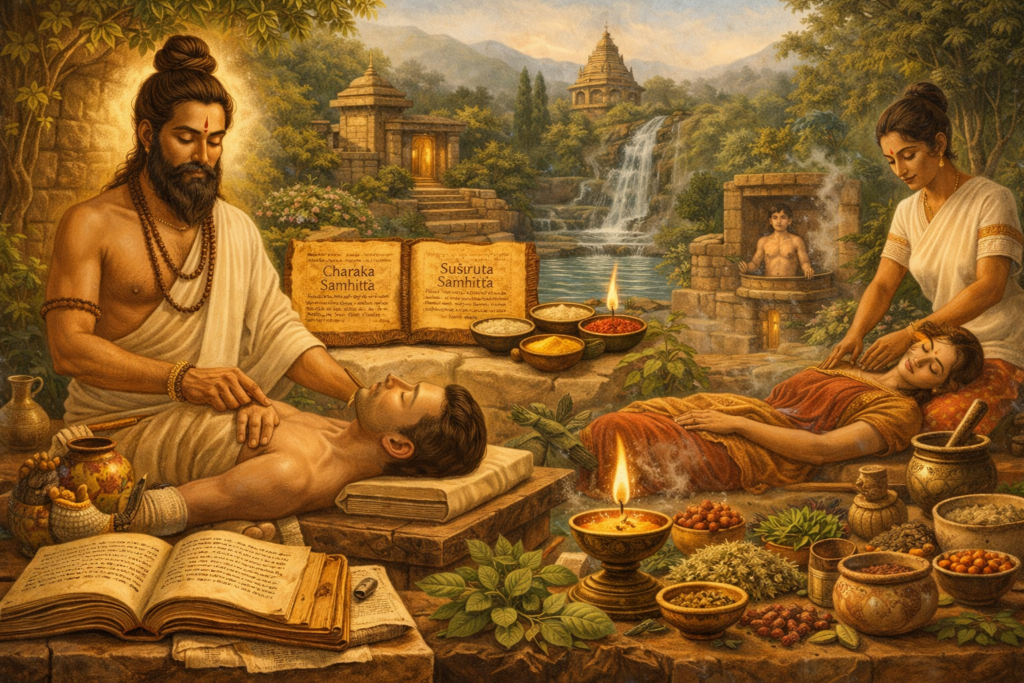
Editorial illustration of Ayurveda and South Asian healing traditions featuring a practitioner taking pulse, classical medical manuscripts, herbs and preparation vessels, oil massage, steam therapy, and a serene healing landscape

Ayurveda and South Asian Healing Traditions: Balance, Constitution, and the Art of Healing

Ayurveda and South Asian healing traditions examine the medical systems of South Asia through concepts of balance, constitution, digestion, vitality, environment, regimen, and the disciplined care of life. This category explores classical Ayurvedic medicine through doṣa, dhātu, mala, agni, ojas, prakṛti, the Charaka and Suśruta traditions, dietetics, purification, rejuvenation, surgery, women’s health, and the wider plural healing world of South Asia, including intersections with Yoga, Siddha, and Unani, revealing one of the world’s great civilizational frameworks for embodiment, care, and the ordering of life.

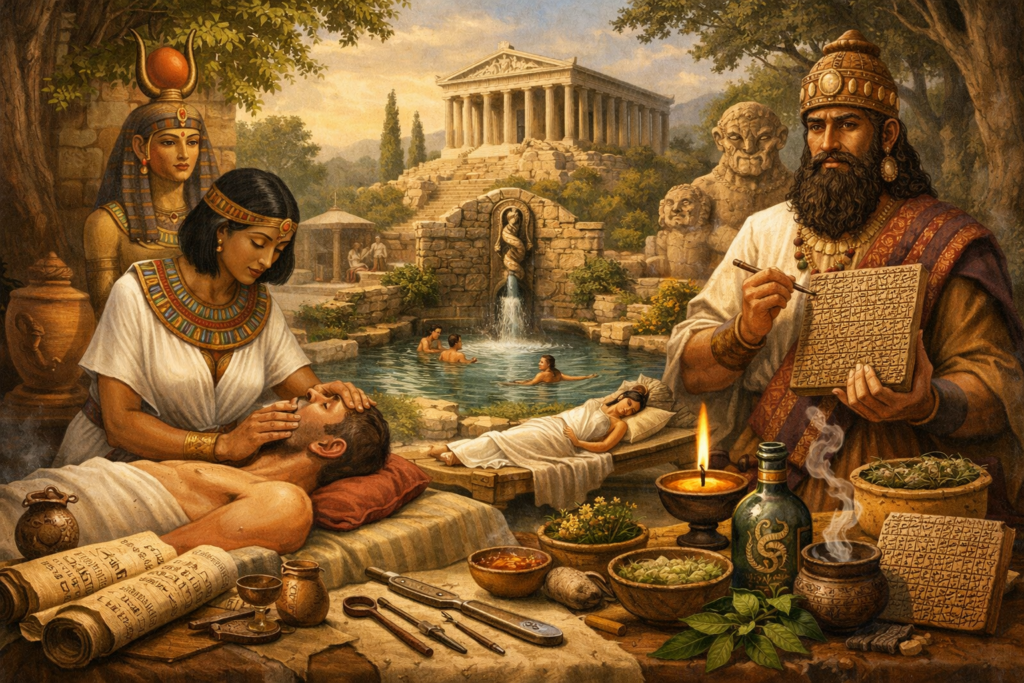
Editorial illustration of ancient Near Eastern and Mediterranean healing traditions featuring an Egyptian healer, a Mesopotamian tablet-bearing specialist, sacred spring and temple healing, herbs, ritual vessels, papyri, and early surgical tools

Ancient Near Eastern and Mediterranean Healing Traditions: Ritual, Remedy, and the Origins of Healing

Ancient Near Eastern and Mediterranean healing traditions examine the medical, ritual, and environmental systems through which ancient societies interpreted illness, protection, bodily disorder, and restoration within larger religious and natural worlds. This category explores Egyptian medicine, Mesopotamian healing, temple and sanctuary care, sacred springs, incantation, pharmacology, surgery, women’s health, specialist healers, and the transmission of early healing knowledge into later Mediterranean medicine, revealing the deep civilizational background from which later classical medical traditions emerged.

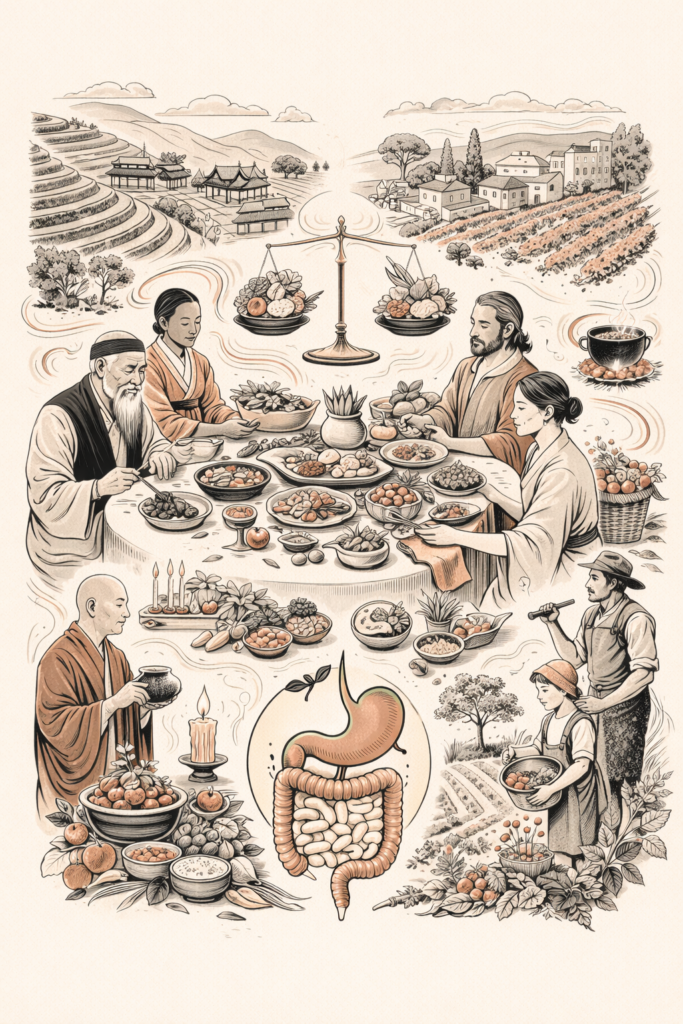
Editorial illustration of diet, nourishment, and food as medicine, showing a shared table, traditional meals, agricultural landscapes, ritual food practices, and a central digestive motif linking nourishment to health.

Diet, Nourishment & Food as Medicine: Eating, Balance, and the Civilizational Practices of Health

Diet, nourishment, and food as medicine examine one of the oldest convictions in the history of healing: that health is shaped not only by remedies and interventions, but by the ordinary, repeated practices through which people eat, digest, fast, prepare, share, and live. Across civilizations, food has been understood as more than fuel. It has been treated as a source of balance, prevention, vitality, restoration, moral discipline, and cultural continuity. This content pillar explores food as a field of medicine, ritual, heritage, ecology, and ethics, linking traditional dietetic systems, foodways, fasting, digestive balance, sustainability, and modern public-health evidence in a serious comparative framework.

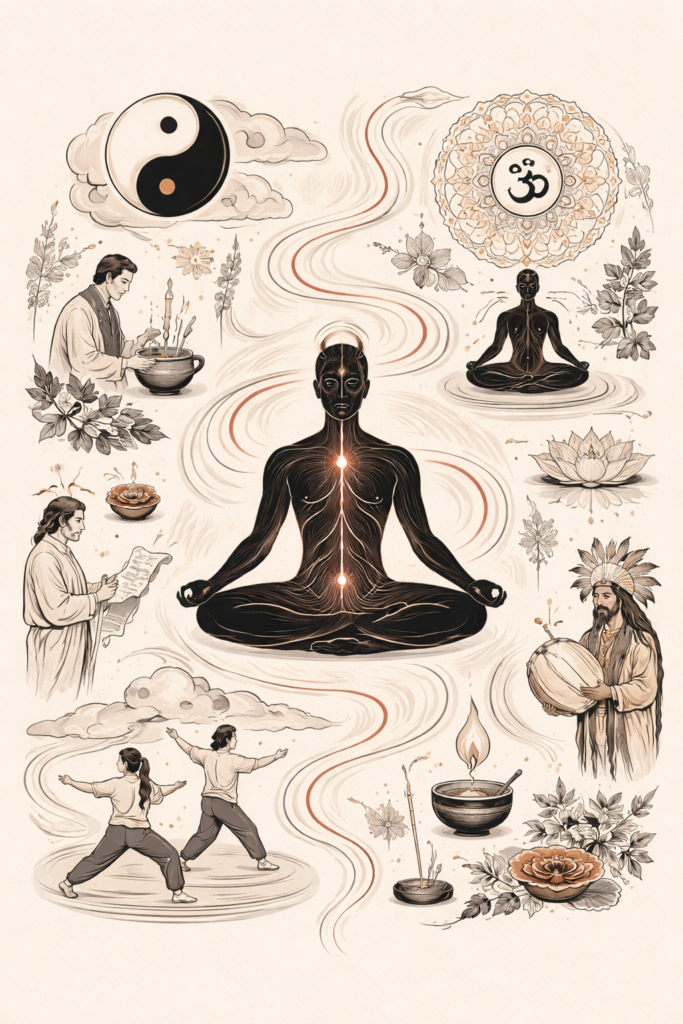
Editorial illustration of vital energy and healing traditions, showing a central meditative figure with flowing lines of breath and vitality surrounded by symbols and practitioners associated with multiple healing systems.

Vital Energy & Healing Traditions: Life Force, Breath, Balance, and the Invisible Dimensions of Health

Vital energy and healing traditions examine health through concepts of life force, breath, circulation, balance, and subtle dimensions of embodiment. Across civilizations, healing has often been understood not only in anatomical or mechanical terms, but through ideas such as qi, prāṇa, pneuma, and wider systems of vitality that connect body, mind, cosmos, ritual, and restoration. This content pillar explores those traditions comparatively and critically, treating them as serious fields of intellectual, cultural, medical, and anthropological inquiry while distinguishing carefully between civilizational significance, living heritage, and modern questions of evidence, safety, and regulation.

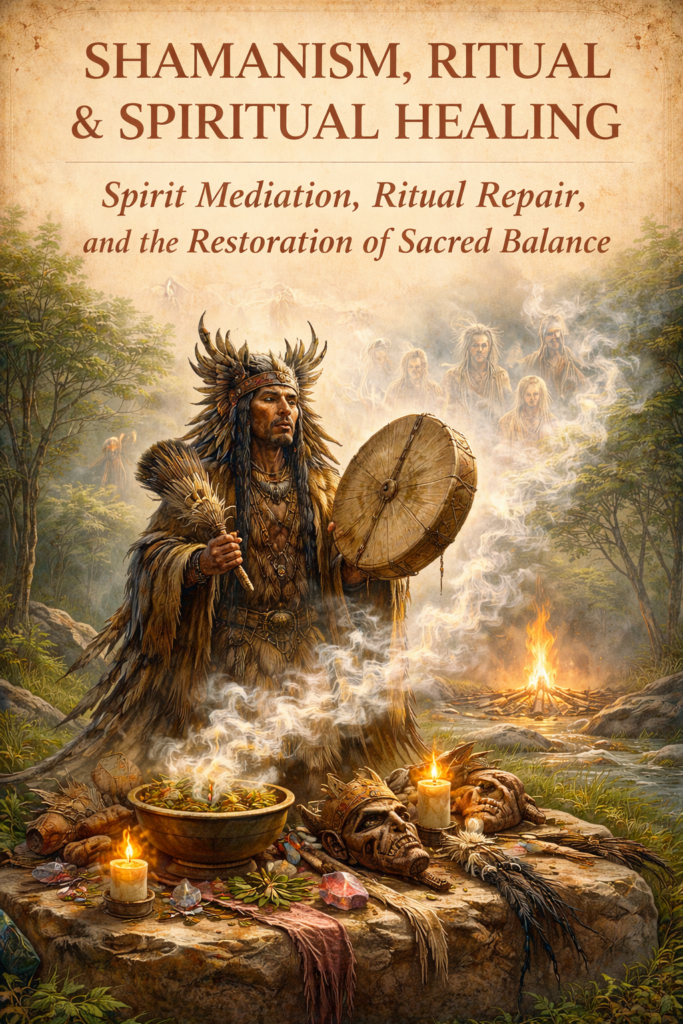
Editorial illustration inspired by ritual and spiritual healing traditions featuring a ritual specialist with drum and feather bundle, smoke, sacred objects, ancestral figures, and a forest ceremonial setting.

Shamanism, Ritual & Spiritual Healing: Spirit Mediation, Ritual Repair, and the Restoration of Sacred Balance

Shamanism, Ritual & Spiritual Healing: Spirit Mediation, Ritual Repair, and the Restoration of Sacred Balance explores a complex field of healing traditions in which illness, disturbance, and restoration are understood through relationships among body, spirit, community, ancestry, ecology, and unseen worlds. From trance, chant, and ritual specialists to purification, soul retrieval, initiation, and communal restoration, this category examines how healing has been practiced as a work of mediation, ceremonial repair, and the reordering of sacred balance.

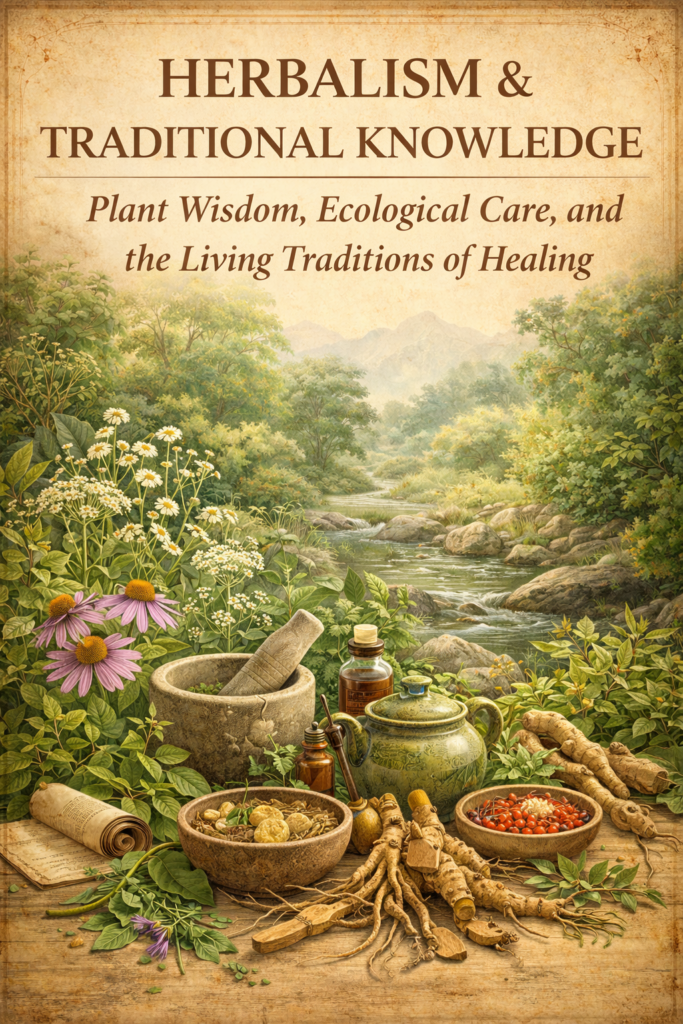
Editorial illustration inspired by herbalism featuring medicinal plants, roots, leaves, vessels, a mortar and pestle, and a natural stream landscape that evokes ecological care and traditional healing knowledge.

Herbalism & Traditional Knowledge: Plant Wisdom, Ecological Care, and the Living Traditions of Healing

Herbalism & Traditional Knowledge: Plant Wisdom, Ecological Care, and the Living Traditions of Healing explores one of the oldest and most enduring forms of healing knowledge, where medicinal plants, ecological familiarity, preparation, transmission, and care converge. From ethnobotany and materia medica to conservation, safety, pharmacology, and Indigenous and local knowledge systems, this category examines how plant-based healing has been cultivated, preserved, and interpreted across generations and living environments.

Scroll to Top