Mythology

Mythology examines the sacred narratives, cosmologies, archetypes, heroic traditions, and symbolic worlds through which cultures have interpreted origins, order, conflict, destiny, and the relationship between human life and the larger cosmos. In the history of ideas, mythology has served not simply as early storytelling, but as a foundational mode of meaning-making through which societies have expressed moral vision, collective memory, metaphysical imagination, and the structure of reality itself.

This category explores myth as a civilizational form that links narrative, ritual, symbolism, and cultural identity across time. It considers how mythic traditions explain the creation of the world, the nature of divine and human power, the role of fate and sacrifice, and the moral tensions embedded in stories of gods, heroes, ancestors, and sacred landscapes.

Mythology plays an important role in human inquiry because it reveals how societies imagine order, transmit values, and confront the enduring questions of suffering, death, transformation, and belonging. By engaging myth seriously, this category deepens understanding of symbolic thought, cultural memory, and the narrative structures through which civilizations have interpreted existence.

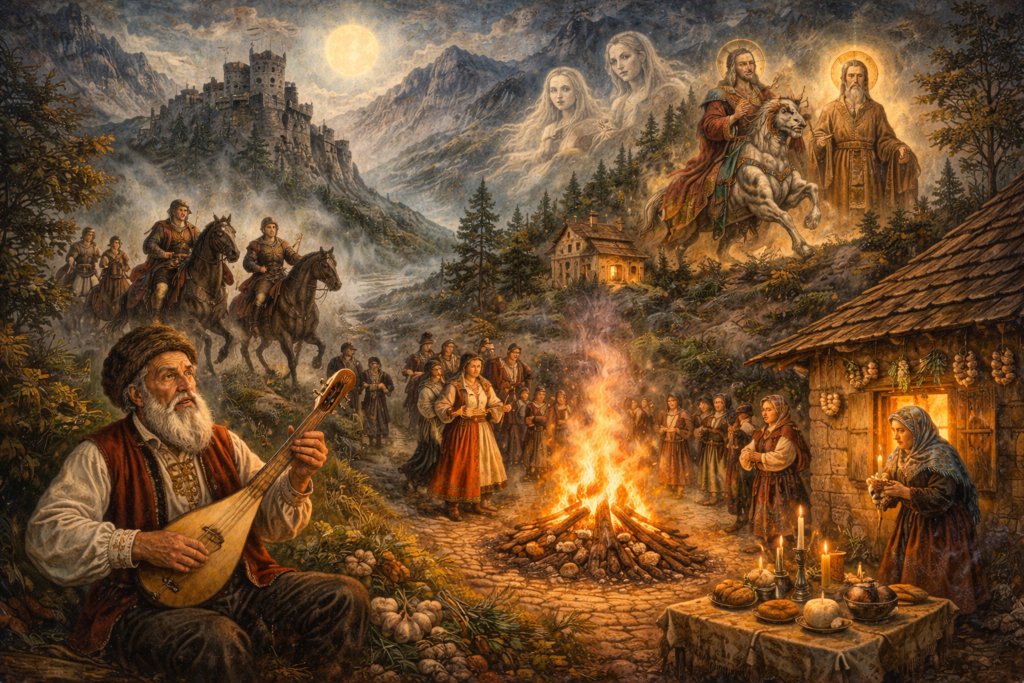
Editorial illustration of South Slavic mythic and folkloric worlds featuring a guslar with a stringed instrument, heroic riders in the Balkan mountains, village ritual around a fire, candlelit household devotion, saintly figures above a mountain monastery, and spectral female spirits in the mist

South Slavic Myth, Epic, and Folklore: Heroic Memory, Sacred Tradition, and the Moral Imagination of the Balkans

South Slavic myth, epic, and folklore preserve one of Europe’s richest narrative worlds: a world of heroic song, sacred mountains, saints, vampires, vila, outlaw memory, women’s lament, seasonal ritual, and the long moral pressure of kinship, empire, and survival. Shaped by pre-Christian Slavic inheritances, Orthodox and Catholic sacred traditions, Ottoman and Muslim frontier worlds, village custom, pastoral life, and oral performance, these traditions reveal how Balkan communities imagined nature, fate, honor, supernatural danger, communal obligation, and the burden of historical memory. This article explores South Slavic folklore in its full civilizational range, from ancient symbolic survivals and guslar epic to household ritual, healing practice, sacred geography, confessional contact zones, and the literary and political afterlives of oral tradition, showing how myth, legend, and song became enduring vehicles of moral imagination across the Balkans.
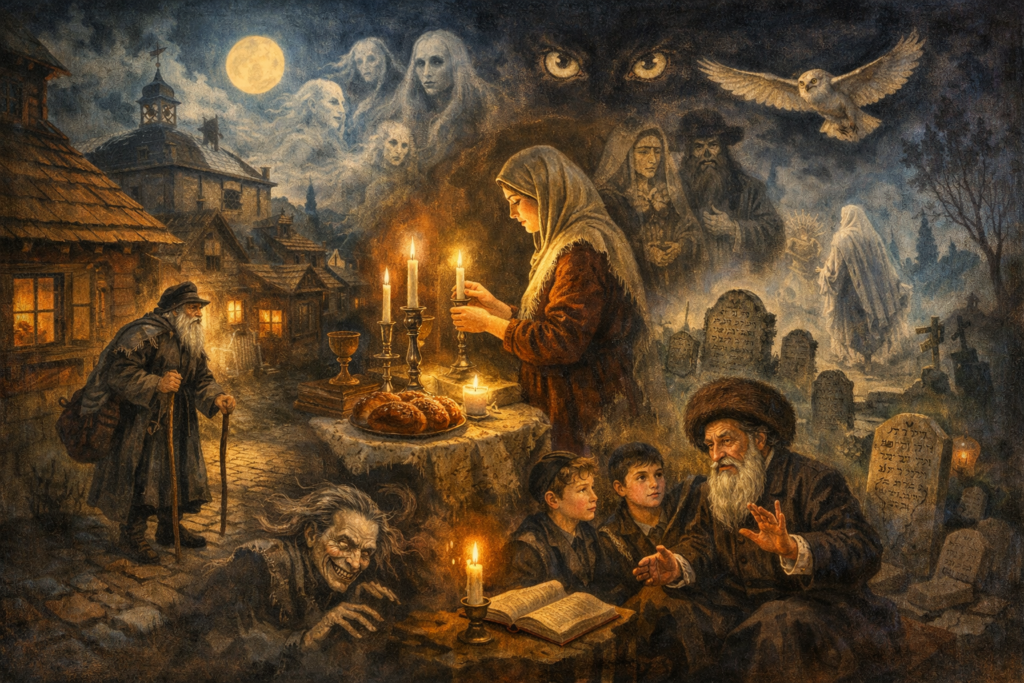
Editorial illustration of Yiddish folkloric and sacred worlds featuring a shtetl at dusk, a wandering holy figure, candlelit domestic ritual, a Hasidic storyteller with children, ghostly spirits, cemetery gravestones, and an atmosphere of exile, wonder, and hidden holiness

Yiddish Legend, Folklore, and Sacred Imagination: Exile, Hidden Holiness, and the Vernacular Life of the Unseen

Yiddish legend, folklore, and sacred imagination preserve one of the most intricate vernacular sacred worlds in Jewish history: a world of dybbuks and demons, hidden righteous figures, miracle-working rebbes, wandering souls, women’s ritual life, comic wisdom, messianic longing, and the moral pressures of diaspora. Shaped by medieval Ashkenazi piety, rabbinic and mystical tradition, Hasidic storytelling, domestic custom, communal memory, and the lived realities of exile, these traditions reveal how Yiddish-speaking communities imagined divine hiddenness, spiritual danger, blessing, suffering, and the unseen dimensions of everyday life. This article explores the field in its full historical range, from premodern Ashkenazi origins and the shtetl world to modern literary transformation, wartime rupture, postwar witness, archival rescue, performance, and continuing Yiddish cultural life, showing how folklore became one of the central ways a people preserved meaning, fear, humor, and sacred endurance across historical change.

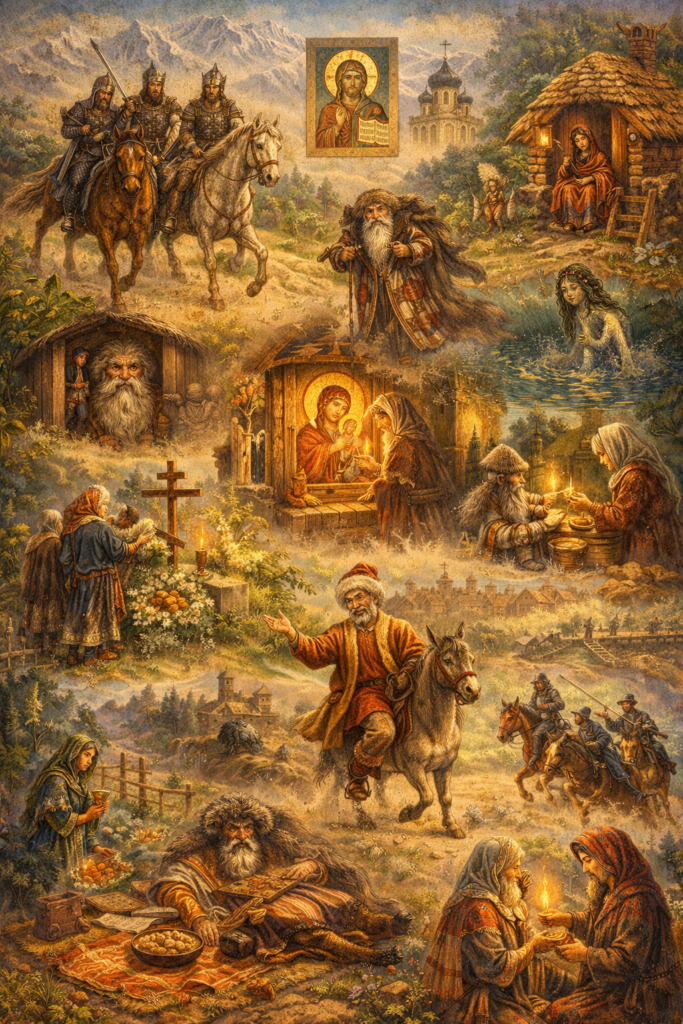
Editorial illustration of Russian mythic and folkloric worlds featuring bogatyr horsemen, a saint icon, a forest elder, a rusalka in the water, a domovoi at a cottage threshold, women in ritual and domestic scenes, a wandering fool on a donkey, and layered village, grave, and wilderness landscapes

Russian Myth, Epic, and Folklore: Nature, Sanctity, Suffering, and Moral Imagination

Russian myth, epic, and folklore preserve one of Europe’s most layered narrative worlds: a world of forests, rivers, saints, spirits, heroes, witches, domestic rites, village memory, and the returning dead, all held within a shared symbolic order. Rather than surviving as a single canonical mythology, these traditions endure through pre-Christian East Slavic belief, heroic oral epic, fairy tale, vernacular demonology, folk Christianity, monastic legend, women’s ritual song, seasonal custom, and later literary and artistic reworkings of folkloric form. Here, nature is never inert, suffering is rarely meaningless, and the boundary between visible and invisible life remains morally charged. This article approaches Russian myth, epic, and folklore as a civilizational archive rather than a loose body of old tales. It traces the interplay of pagan inheritance and Christian transformation; the world of the bogatyrs and the byliny; the supernatural ecology of household and wilderness spirits; the symbolic force of Baba Yaga and other wonder-tale figures; the role of saints, icons, pilgrimage, and holy fools; and the ritual year of Maslenitsa and Ivan Kupala.

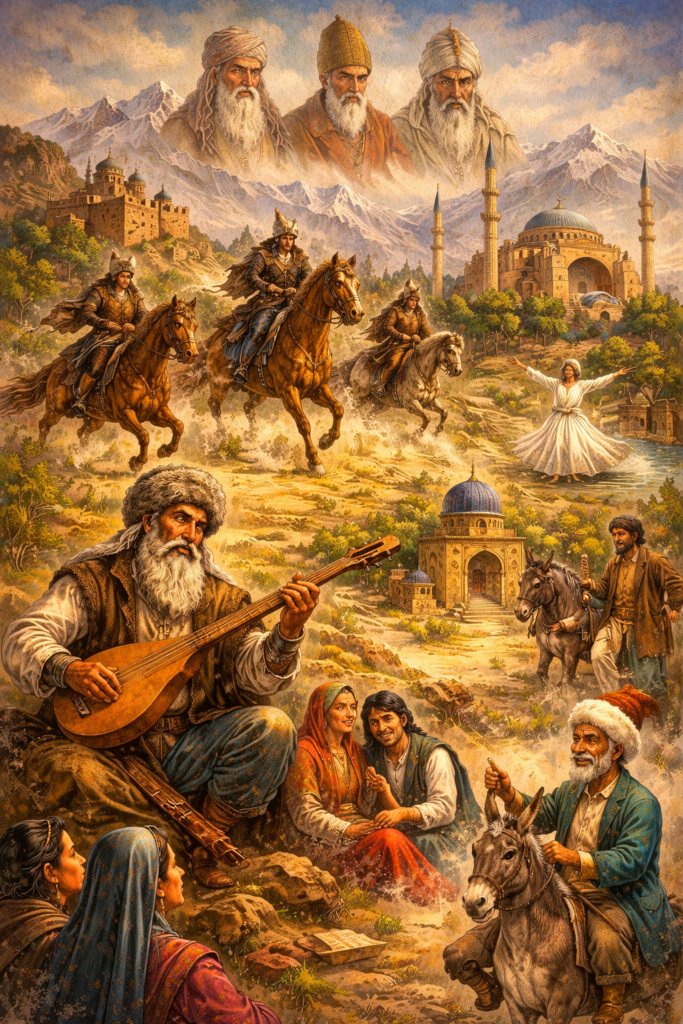
Editorial illustration of Turkic and Ottoman mythic worlds featuring steppe horsemen, an epic bard with a saz, saints and sages above the mountains, Ottoman and Central Asian architecture, whirling devotion, lovers, and Nasreddin Hodja on his donkey in a layered Eurasian landscape

Turkic and Ottoman Myth, Epic, and Folklore

Turkic and Ottoman myth, epic, and folklore preserve one of the great narrative worlds of Eurasia, joining Inner Asian cosmology, heroic memory, sacred charisma, frontier legend, and imperial imagination across centuries of transformation. From wolves, horses, mountains, and ancestral lineages to bardic epics, saint legends, dervish lore, Ottoman founding myths, trickster tales, and regional folk traditions, these story worlds reveal how Turkic-speaking peoples and Ottoman societies understood sovereignty, migration, sanctity, justice, longing, and communal survival. This article explores the field as a layered civilizational archive rather than a single canon, tracing the interplay of steppe inheritance, Islamicate transformation, Anatolian and Ottoman synthesis, oral performance, sacred geography, and popular narrative across a vast transregional world.

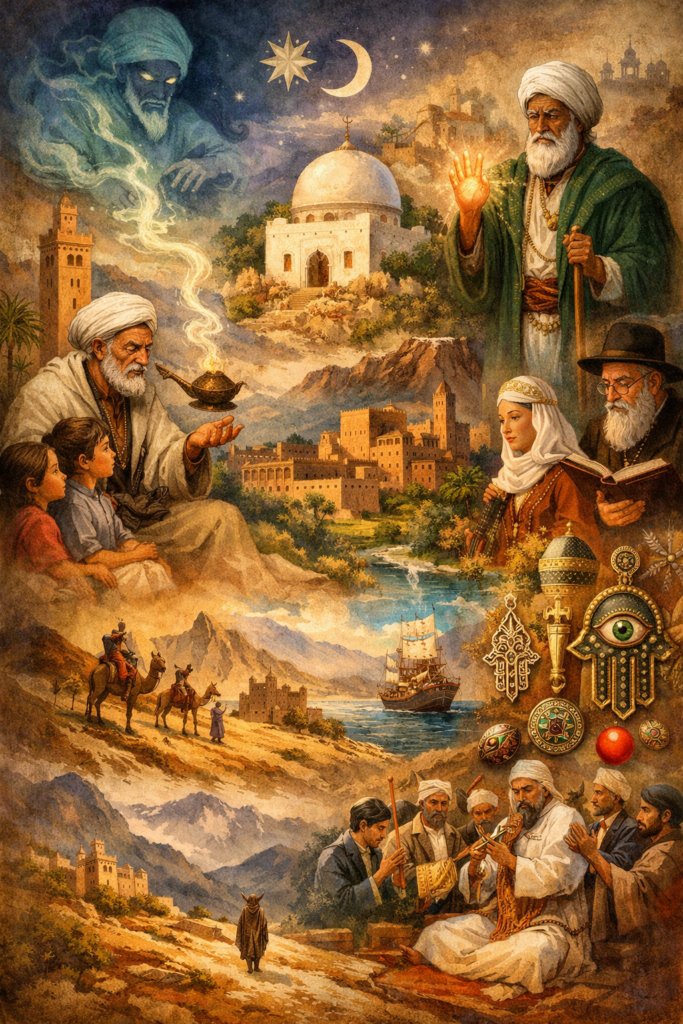
Illustration of Maghrebi and Andalusi sacred imagination featuring a storyteller, saintly figures, shrine architecture, desert and coastal travel, a jinn-like presence, Andalusi palaces, Jewish and Muslim memory, and ritual musicians across North Africa and al-Andalus.

Maghrebi and Andalusi Legend, Folklore, and Sacred Imagination

Maghrebi and Andalusi legend, folklore, and sacred imagination explore the legendary, devotional, and symbolic worlds through which North Africa and al-Andalus imagined sanctity, baraka, exile, memory, spiritual danger, and the hidden life of the world. This tradition is not organized around a single mythological canon, but around layered sacred narratives shaped by Amazigh oral inheritance, Arab and Islamic expansion, Jewish and Muslim folklore, shrine culture, healing ritual, pilgrimage, jinn lore, and the remembered afterlives of al-Andalus. At its core lies a defining question: how do communities preserve blessing, belonging, and civilizational memory through story when worlds are fractured by migration, loss, reform, and historical change? This content pillar explores saints, shrines, marabouts, zawiyas, sacred cities, desert and mountain imaginaries, protective folklore, Gnawa and confraternal ritual traditions, Andalusi and Morisco memory, Sephardi afterlives, and the sacred Mediterranean, showing why Maghrebi and Andalusi sacred imagination remains one of the richest regional traditions of folklore, devotion, and place-based memory.

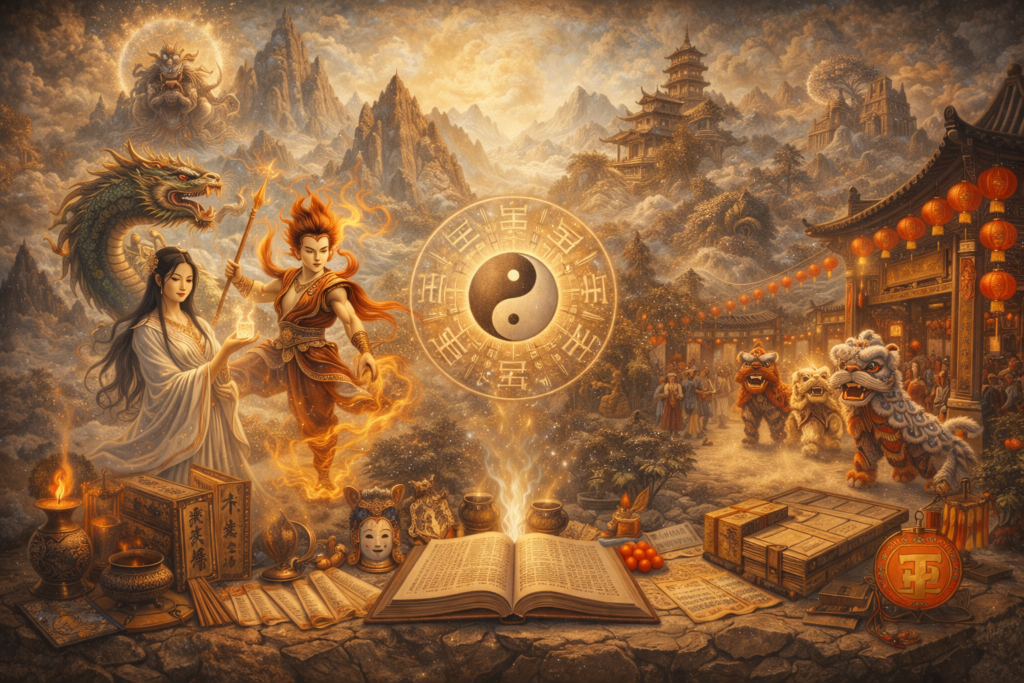
Symbolic Chinese mythic landscape with legendary figures, dragon, sacred mountains, ritual objects, festival lanterns, lion dancers, and cosmological imagery.

Why Chinese Myth, Folklore & Legend Still Matter

Chinese myth, folklore, and legend still matter because they preserve one of the world’s richest symbolic archives for thinking about cosmos, society, landscape, memory, and moral order. This article explores why these traditions remain intellectually, culturally, and socially significant, showing how they survived not through a single canon, but through a distributed field of texts, rituals, festivals, regional traditions, sacred geographies, performances, and modern media reinventions. Far from being relics of a vanished world, they continue to shape how communities remember, inherit, imagine, and reinterpret meaning across generations. In their persistence, adaptability, and symbolic depth, Chinese mythic traditions reveal how old stories remain alive by continuing to speak to questions of order, danger, belonging, transformation, and cultural continuity.

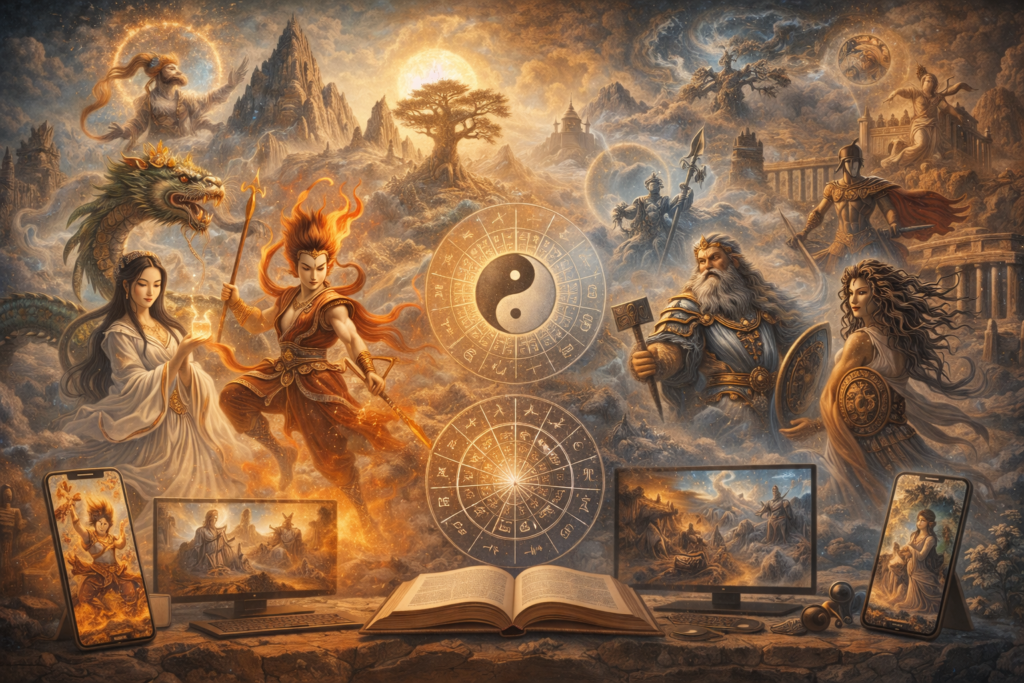
Comparative mythology scene juxtaposing Chinese mythic figures, sacred landscapes, and cosmological symbols with figures and motifs from other world myth traditions.

Chinese Myth in Comparative Perspective

Chinese myth becomes especially illuminating when placed in comparative perspective, but only if comparison avoids forcing it into models shaped by Greece, India, Mesopotamia, or the Norse world. This article explores how Chinese myth differs in formal structure, cosmological imagination, sacred geography, political order, and modes of transmission, showing that it survives less as a single epic canon than as a layered archive carried through classics, ritual, folklore, landscape, performance, and reinvention. By comparing themes such as creation, flood, divine authority, heroism, and mythic place, it argues that Chinese mythology is not an incomplete version of some more familiar pattern, but a distinct civilizational formation whose fragmentary, correlative, and distributed character expands what comparative mythology itself can mean.

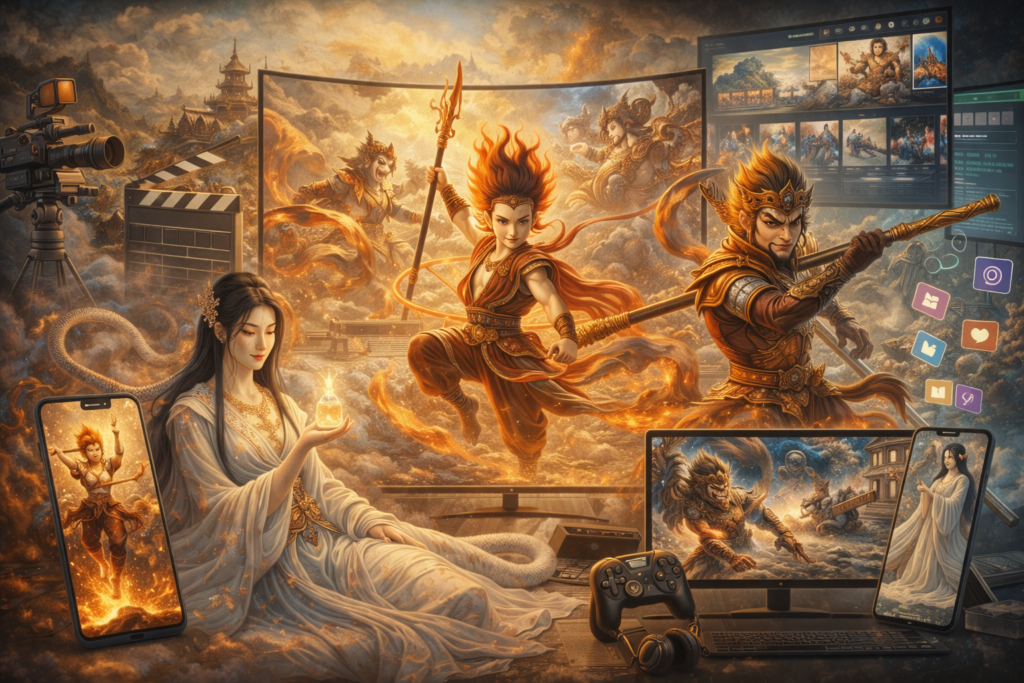
Modern media collage featuring Chinese mythic figures like Nezha, Sun Wukong, and White Snake across screens, gaming devices, and cinematic imagery.

Modern China and the Reinvention of Myth in Film, Television, and Digital Media

Chinese myth survives in modern China not by remaining fixed, but by being reinvented. This article explores how film, television, animation, streaming platforms, and digital media have transformed legendary figures such as Nezha, White Snake, Sun Wukong, and Yang Jian into contemporary icons shaped by spectacle, psychology, serial storytelling, and franchise logic. Rather than treating modern media as a break from tradition, it shows how they extend a much older pattern of adaptation through which myth has always moved across performance, text, image, and audience. In the process, Chinese legend becomes newly visible as a living field of cultural memory, commercial reinvention, national symbolism, and digitally accelerated afterlife.

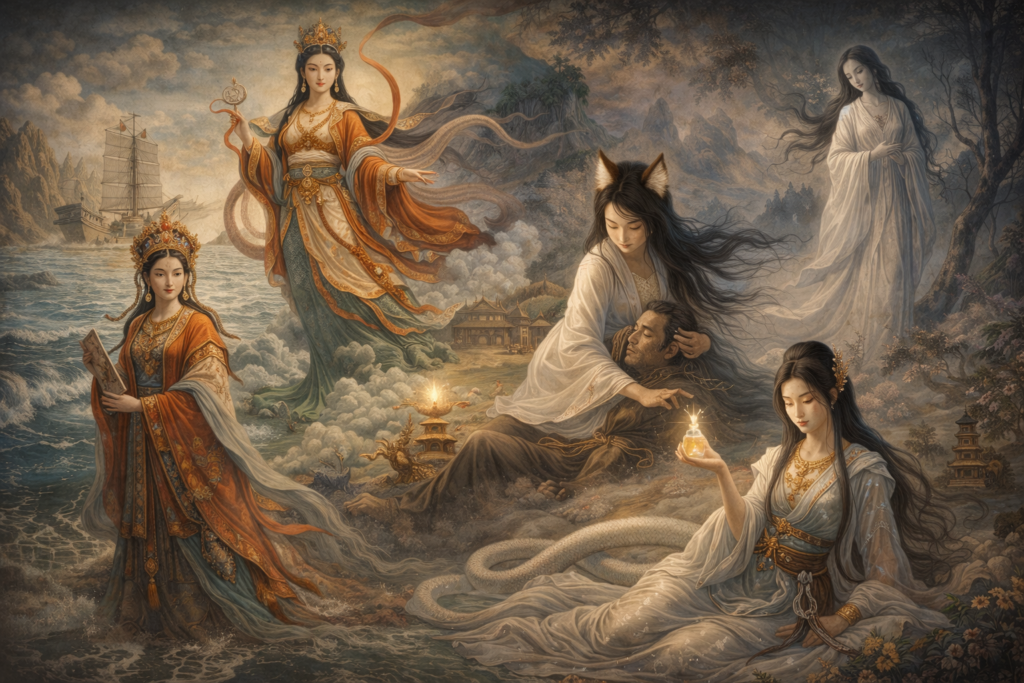
Mythic Chinese scene featuring goddess figures, a fox spirit, a ghostly woman, and White Snake imagery in a symbolic landscape of sacred power, desire, and supernatural presence.

Women, Spirits, and Gendered Power in Chinese Legend

Chinese legend is filled with women whose power exceeds ordinary social boundaries. This article explores how goddesses, fox spirits, ghost-women, supernatural wives, divine mothers, and sea-protectors became central figures in the Chinese mythic imagination, not as marginal curiosities, but as forces through which desire, protection, transgression, virtue, grief, and sovereignty were imagined. Moving across traditions associated with Nüwa, Mazu, White Snake, and female spirit lore, it shows how gendered power in Chinese legend often appears at unstable thresholds between household and wilderness, morality and enchantment, devotion and danger, human and nonhuman worlds. These figures reveal that feminine power in Chinese myth is not singular, but multiple: nurturing, disruptive, erotic, sacred, maternal, haunted, and cosmologically charged.

Scroll to Top