
Last Updated May 29, 2026
Analytical psychology examines the psyche at the level of symbol, conflict, image, dream, projection, complex, archetype, and transformation. Developed by Carl Gustav Jung as a distinct tradition within depth psychology, it seeks to understand the person not only through conscious thought, observable behavior, personality traits, or clinical symptoms, but through dreams, fantasies, complexes, mythic images, symbolic repetition, spiritual crisis, and the long process by which the self becomes more differentiated, more integrated, and more able to hold psychic contradiction.
This article map brings together the major domains through which analytical psychology interprets the symbolic life of the mind. It treats Jungian thought not as a devotional system or a closed doctrine, but as a historically important, internally contested, clinically influential, philosophically ambitious, and culturally complex tradition of depth psychology. Across ego, persona, shadow, anima and animus, complexes, the personal unconscious, the collective unconscious, archetypes, dreams, active imagination, individuation, alchemy, religion, trauma, post-Jungian clinical developments, literary interpretation, myth, and intercultural critique, analytical psychology provides an indispensable language for thinking about the inward life of symbols, conflicts, and transformations.
Main Library
Publications
Article Map
Analytical Psychology
Related Topic
Personality Psychology
Related Topic
Developmental Psychology
Related Topic
Mythology
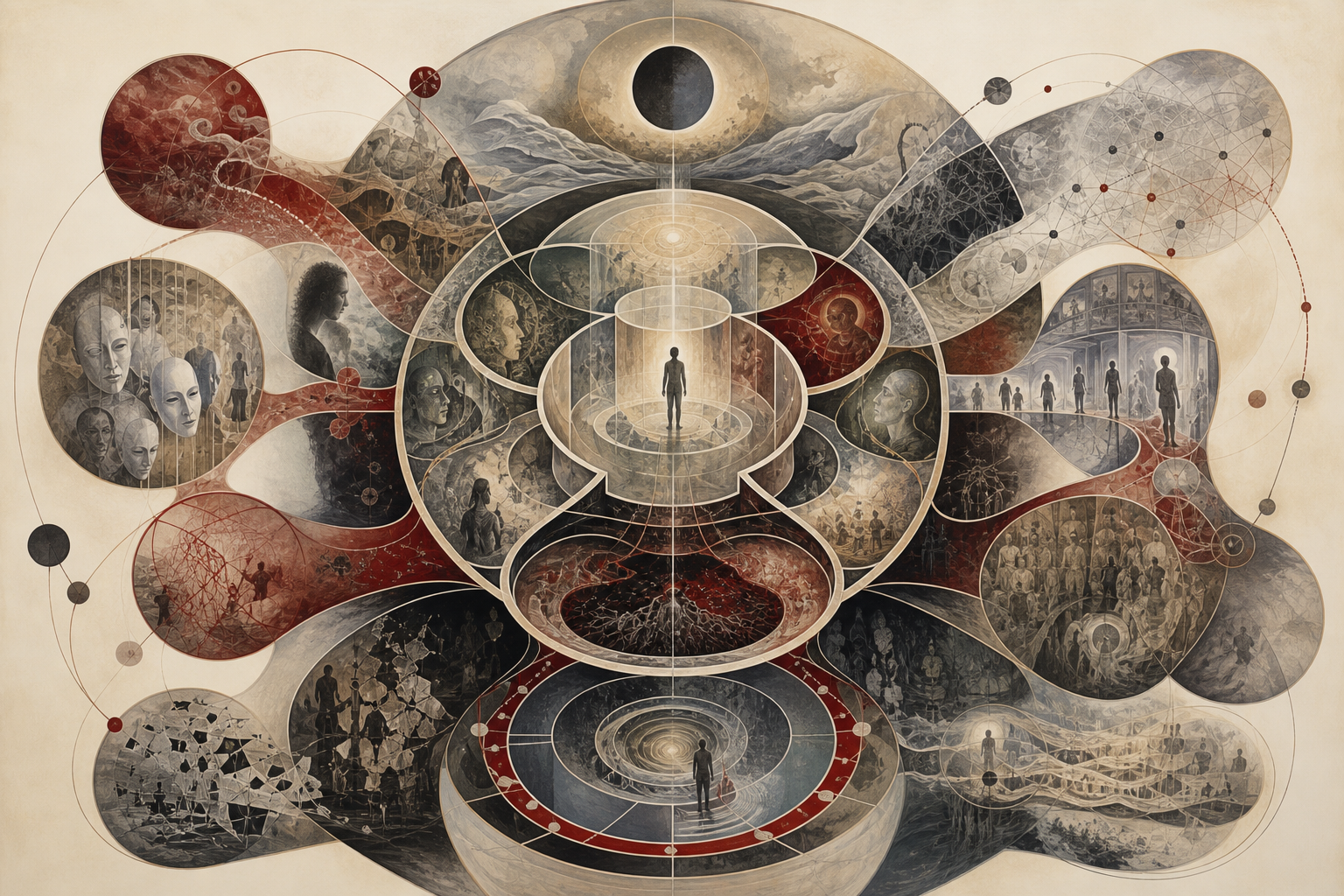
This series also approaches analytical psychology as a field that can be placed in conversation with psychometrics, qualitative interpretation, clinical process research, cultural analysis, symbolic coding, computational simulation, reproducible workflows, and open analytical code. Many of the most important questions in analytical psychology cannot be reduced to narrow measurement, yet they can still be made more explicit through structured models of symbolic access, ego differentiation, affective containment, relational depth, fragmentation pressure, cultural mediation, interpretive openness, and integrative development over time. For that reason, this article map integrates analytical psychology with mathematics, statistics, R, Python, Julia, C++, Fortran, C, Rust, SQL, Go, notebooks, reproducible data practices, and open scientific code where those tools clarify rather than flatten the field.
Analytical psychology therefore appears here not only as a Jungian school of psychotherapy, but also as a symbolic, developmental, clinical, literary, religious, cultural, philosophical, and computationally interpretable tradition. The aim of this series is to preserve the richness of Jungian psychology while remaining honest about evidence, universality, interpretation, cultural critique, and the limits of archetypal claims. Analytical psychology is most valuable when it is treated neither as settled metaphysical truth nor as disposable historical residue, but as a serious interpretive psychology of inward life, symbolic conflict, and psychic transformation.
Complete Code Repository
The Analytical Psychology knowledge series is supported by an open computational repository with article-level folders, reproducible examples, synthetic datasets, documentation, symbolic-process models, psychic-integration simulations, dream-symbol coding scaffolds, depth-psychology workflow examples, and full-stack scientific-computing examples across Python, R, Julia, C++, Fortran, C, Rust, SQL, Go, and notebooks where appropriate.
Analytical Psychology as a Foundational Depth Psychology
Analytical psychology occupies a foundational place within depth psychology because it asks how psychic life exceeds conscious intention. Jung’s tradition treats the ego as only one center of psychic life rather than the whole of the person. Beneath and around conscious identity lie complexes, images, affects, fantasies, dreams, projections, inherited symbolic forms, cultural motifs, and unfinished conflicts that shape how people perceive, desire, suffer, create, and transform.
This foundational role does not mean that analytical psychology replaces psychoanalysis, cognitive psychology, personality psychology, developmental psychology, clinical psychology, neuroscience, anthropology, religious studies, or literary interpretation. Rather, it provides a distinct symbolic and developmental vocabulary for problems those fields often touch from different directions. Cognitive psychology explains information processing. Personality psychology explains enduring individual differences. Developmental psychology explains growth across time. Analytical psychology asks how symbolic life, unconscious conflict, and inward transformation shape the formation of the self.
The tradition matters because it addresses domains of experience that remain psychologically powerful even when they resist simple measurement: dreams, symbolic repetition, mythic identification, spiritual crisis, projection, shadow, inner division, and the search for meaning. Whether or not one accepts every Jungian concept literally, analytical psychology remains a major modern framework for understanding the depth mind.
Analytical Psychology as a Science of Symbol, Conflict, and Transformation
Analytical psychology may be understood as one of the great modern psychologies of symbol, conflict, and transformation. It asks why images return, why dreams dramatize psychic life, why people project disowned material onto others, why myths retain emotional power, why spiritual symbols can reorganize psychic experience, and why the work of becoming whole often requires confrontation with what consciousness rejects.
This makes analytical psychology different from a simple theory of personality labels or dream symbols. The tradition does not merely catalogue archetypes. It asks how psychic life becomes split, how complexes gain autonomy, how symbols mediate conflict, how unconscious material compensates one-sided consciousness, and how the self becomes more integrated through relation to what has been excluded.
Analytical psychology is therefore a systems-level psychology of inward life. The psyche is not treated as flat, transparent, or wholly rational. It is layered, symbolic, conflictual, affectively charged, culturally mediated, and only partly conscious of itself. Its strongest claim is not that every symbol has a fixed meaning, but that symbolic life participates in psychic organization and transformation.
Analytical Psychology as an Interpretive and Computationally Modelable Tradition
Analytical psychology is not a quantitative science in the same way experimental cognition or psychometrics may be. Much of its knowledge is clinical, interpretive, hermeneutic, symbolic, phenomenological, literary, and comparative. Its central materials include dreams, fantasies, myths, images, transference patterns, personal narratives, religious symbols, and affectively charged complexes. These cannot be responsibly treated as simple variables without interpretive loss.
Yet this does not mean the field is immune to analytical discipline. It is possible to model relationships among symbolic access, ego differentiation, affective containment, relational depth, cultural mediation, resistance, fragmentation, and integration. Such models do not prove Jungian theory. They clarify assumptions, identify mechanisms, structure comparisons, and make interpretive claims more explicit.
For that reason, this series treats mathematics, R, Python, SQL, simulation, and reproducible workflows as supporting tools rather than replacements for clinical and symbolic interpretation. Code can help examine possible dynamics. It cannot decide the meaning of a dream, validate an archetype, or replace the analytic encounter. The goal is auditable symbolic reasoning, not computational reduction.
What Analytical Psychology Studies
Analytical psychology studies the symbolic and unconscious dimensions of psychic life. At the structural level, it examines ego, consciousness, persona, shadow, anima and animus, self, personal unconscious, collective unconscious, complexes, and archetypal patterns. At the symbolic level, it studies dreams, images, myths, rituals, alchemy, religion, fantasy, art, and recurring cultural forms. At the developmental level, it studies individuation, midlife transformation, psychic differentiation, spiritual crisis, aging, meaning, and the gradual integration of unconscious material.
At the clinical level, analytical psychology studies complexes, projection, transference, countertransference, active imagination, dream interpretation, trauma, fragmentation, symbolic compensation, and the analytic relationship. At the cultural level, it studies myth, literature, religion, non-Western symbolic systems, appropriation risk, intercultural comparison, and the critique of universal archetypal claims. At the epistemological level, it studies the status of interpretation, evidence, clinical usefulness, symbolic inference, and the boundary between psychology and metaphysics.
Analytical psychology further studies the tension between adaptation and inward truth. A person may function socially while remaining inwardly divided. A persona may succeed externally while concealing shadow, grief, longing, or spiritual hunger. The tradition asks what psychic development requires beyond mere social adjustment.
What This Series Covers
This series brings together the major domains through which analytical psychology interprets the depth mind. It includes Jung’s formation of analytical psychology, the personal unconscious, complexes, the collective unconscious, archetypes, persona, shadow, anima and animus, ego, self, dream interpretation, compensation, active imagination, psychological types, personality theory, individuation, childhood development, midlife meaning, trauma, dissociation, clinical practice, relational Jungian psychotherapy, religion, spiritual crisis, alchemy, literary interpretation, post-Jungian developments, archetypal psychology, Jung’s divergence from Freud, critiques of evidence, cultural universality, non-Western symbolic systems, and epistemology.
These domains differ in method and emphasis, but together they form a coherent intellectual project: the attempt to understand how symbolic and unconscious processes shape suffering, development, creativity, meaning, and selfhood. Analytical psychology is therefore not only a historical Jungian school. It is a way of asking how the psyche gives form to itself through dream, image, conflict, projection, myth, and transformation.
The series also treats analytical psychology as a field that links the individual and the cultural. A dream may be personal, but its images often draw on collective motifs. A complex may be biographical, but it may also take symbolic form. A religious image may be cultural, but it may also carry psychic force. For that reason, the article map is designed not only to introduce Jungian concepts, but to clarify why symbolic depth remains central to human self-understanding.
Mathematics, Computation, and Modeling in Analytical Psychology
Mathematics provides a limited but useful formal language for clarifying relations among symbolic access, ego differentiation, affective containment, relational depth, transformative processing, and fragmentation pressure. It does not convert analytical psychology into a narrow quantitative science. Instead, it makes some assumptions explicit.
A simple recursive form can represent psychic integration as a dynamic process:
A_{t+1} = A_t + \alpha C_t + \beta S_t + \gamma R_t + \delta M_t – \zeta F_t
\]
Interpretation: Psychic integration at the next time point depends on prior integration, conscious reflection, symbolic emergence, relational containment, meaning-making, and the countervailing pressure of fragmentation, repression, inflation, or unresolved complex activation.
where \(A_t\) represents psychic integration at time \(t\), \(C_t\) conscious reflection and ego differentiation, \(S_t\) symbolic emergence through dream, fantasy, and image, \(R_t\) relational containment and analytic process, \(M_t\) meaning-making and interpretive integration, and \(F_t\) fragmentation, repression, inflation, or unresolved complex pressure.
The probability that unconscious material becomes symbolically available rather than defensively blocked can be written as:
Pr(\text{symbolic emergence}) = \frac{1}{1 + e^{-Z_i}}
\]
Interpretation: Symbolic emergence can be modeled as a nonlinear probability shaped by imaginal intensity, affective charge, interpretive openness, symbolic salience, and defensive resistance.
where:
Z_i = \theta_0 + \theta_1 D_i + \theta_2 T_i + \theta_3 I_i + \theta_4 N_i – \theta_5 R_i
\]
Interpretation: Symbolic material becomes more available when dream intensity, complex activation, interpretive openness, and numinous salience are strong, and less available when resistance, repression, or rigid ego defense dominate.
A broader semi-formal model treats Jungian integration as a function of symbolic access, ego differentiation, affective containment, relational depth, transformative processing, cultural mediation, and resistance or fragmentation pressure:
JI = f(SA, ED, AC, RD, TP, CM, RF)
\]
Interpretation: Jungian integration or depth-psychic coherence depends on symbolic access, ego differentiation, affective containment, relational depth, transformative processing, cultural mediation, and resistance or fragmentation pressure.
A simple additive representation is:
JI = \beta_1 SA + \beta_2 ED + \beta_3 AC + \beta_4 RD + \beta_5 TP + \beta_6 CM – \beta_7 RF
\]
Interpretation: Psychic integration increases with symbolic access, reflective differentiation, affective containment, relational depth, transformative processing, and cultural mediation, while resistance, fragmentation, or inflation reduce expected integration.
These formulations do not prove analytical psychology. They clarify one of its central intuitions: integration deepens when symbolic material is encountered, interpreted, contained, and related to conscious life rather than denied, acted out, inflated, or split off.
Computation is especially useful where symbolic and developmental processes become too complex for prose alone. R supports synthetic modeling, regression, visualization, scale development, interpretive coding, and reproducible reports. Python supports simulation, symbolic-process modeling, text analysis, dream-coding scaffolds, network analysis, and data pipelines. SQL supports structured case notes, dream-symbol inventories, coded interpretive categories, longitudinal process records, model outputs, and reproducible provenance. Julia, C++, Fortran, C, Rust, and Go support simulation, command-line tools, symbolic-processing utilities, and reproducible computational infrastructure.
Major Domains of Analytical Psychology
Analytical psychology includes a wide range of major domains, each of which illuminates a different dimension of the depth mind. Complex theory studies emotionally charged clusters of association that shape perception, reaction, fantasy, attachment, and repetition. Dream theory studies how dreams compensate one-sided consciousness, dramatize complexes, and sometimes reveal prospective possibilities for psychic development. Archetypal theory studies recurring symbolic patterns, while also raising difficult questions about universality, culture, evidence, and interpretation.
Persona and shadow theory study social adaptation and disowned selfhood. The persona names the social mask or adaptive identity, while the shadow names rejected, disavowed, feared, or morally difficult aspects of the personality. Individuation studies the lifelong process of differentiation and integration through which the psyche becomes less fragmented and less identified with one-sided conscious positions.
Clinical analytical psychology studies the analytic relationship, transference, countertransference, active imagination, symbolic amplification, trauma, fragmentation, and the long arc of psychic transformation. Cultural and religious analytical psychology studies myth, ritual, literature, alchemy, numinous experience, spiritual crisis, and symbolic systems. Critical analytical psychology studies epistemology, evidence, non-Western critique, gender symbolism, appropriation, universality claims, and the limits of Jungian interpretation.
Why Analytical Psychology Matters
Analytical psychology matters because modern psychology can become too thin if it treats the person only as information processor, trait profile, behavioral organism, diagnostic category, or rational agent. Human beings dream, project, fantasize, identify with images, suffer from symbolic conflict, repeat unresolved patterns, experience spiritual crisis, and seek meaning through stories and symbols. Analytical psychology gives language to these dimensions of psychic life.
The field also matters because it forms one of the strongest bridges between psychology and the humanities. It helps explain why myth, literature, ritual, religious imagery, folklore, and symbolic narratives continue to matter even in secular modernity. People may no longer inhabit traditional cosmologies in the same way, but they still organize meaning through images, narratives, projections, and affectively charged patterns.
Finally, analytical psychology matters because it treats selfhood as difficult, developmental, and incomplete. The person is not identical with the ego. The work of becoming more whole requires confronting shadow, withdrawing projection, tolerating symbolic ambiguity, integrating conflict, and becoming less possessed by unconscious patterns. That makes the tradition morally and existentially serious even where its theoretical claims remain contested.
Analytical Psychology and Human Self-Understanding
Analytical psychology changes how human beings understand themselves because it reveals the limits of conscious self-knowledge. A person may believe they know their motives while being shaped by complexes, projections, fantasies, inherited images, and symbolic identifications. The ego tells one story; the dream, symptom, fantasy, or repetition may tell another.
Yet analytical psychology also complicates simple self-expression. Becoming oneself does not mean indulging every impulse or rejecting all social adaptation. Individuation requires differentiation, discipline, symbolic encounter, moral responsibility, and relation to others. Shadow integration does not mean celebrating destructiveness; it means becoming conscious of what has been denied so it is less likely to be projected or acted out blindly.
For that reason, analytical psychology has philosophical as well as clinical significance. It raises enduring questions about selfhood, symbolism, evil, projection, transformation, spirituality, meaning, cultural inheritance, and the relation between conscious identity and unconscious life. A serious Analytical Psychology article map should therefore not end with archetype lists alone. It should clarify the wider implications of Jungian thought for literature, religion, psychotherapy, culture, and the philosophy of the person.
Analytical Psychology Article Map
The map below organizes the Analytical Psychology knowledge series into conceptual domains, moving from Jung’s formation of analytical psychology toward complexes, dreams, archetypes, persona, shadow, self, active imagination, typology, individuation, trauma, clinical practice, religion, alchemy, post-Jungian developments, cultural critique, and epistemology.
The Analytical Psychology article map is organized to move from foundational definitions and Jung’s formation of the field into the personal unconscious, complexes, affect, repetition, collective unconscious, archetypes, persona, shadow, anima and animus, ego, self, dreams, active imagination, psychological types, personality theory, individuation, development, trauma, clinical practice, religion, alchemy, literature, post-Jungian developments, non-Western symbolic systems, cultural critique, and epistemology. Mathematics, R, Python, Julia, C++, Fortran, C, Rust, SQL, Go, and computational notebooks are integrated where they deepen understanding, especially in areas such as symbolic coding, dream-process modeling, psychic-integration simulation, qualitative coding, cultural comparison, clinical-process scaffolding, and reproducible depth-psychology workflows.
Foundations, History, and Core Architecture
- What Is Analytical Psychology? — An opening article defining analytical psychology as Jung’s depth-psychological tradition of symbol, complex, dream, archetype, individuation, and psychic transformation.
- Carl Jung and the Formation of Analytical Psychology — A historical article on Jung’s break with Freud, the development of analytical psychology, and the emergence of Jung’s distinct theory of the psyche.
- The Personal Unconscious and the Theory of Complexes — An article on the personal unconscious, emotionally charged complexes, association, repetition, and the psychic knots that shape ordinary suffering.
- Complexes, Affect, and Repetition in Analytical Psychology — A focused treatment of complexes as affect-laden structures that organize reaction, projection, relationship, conflict, and recurring psychic patterns.
- Ego, Consciousness, and Psychic Differentiation — An article on the ego as the center of consciousness, the limits of ego identity, and the developmental importance of differentiation.
- The Self in Jungian Thought: Totality, Center, and Symbol — A core article on the self as a larger organizing totality distinct from the ego and central to individuation.
Collective Unconscious, Archetypes, Persona, Shadow, and Gendered Symbolism
- The Collective Unconscious: Meaning, Scope, and Controversy — A major article on Jung’s most famous and contested concept, including universality, symbolic recurrence, inheritance, and critique.
- What Is an Archetype? Pattern, Image, and Psychic Structure — A study of archetypes as recurring symbolic patterns, psychic forms, interpretive categories, and controversial claims about collective structure.
- Persona and Social Adaptation in Analytical Psychology — An article on the social mask, adaptive identity, role performance, conformity, and the risk of over-identification with public selfhood.
- The Shadow and the Psychology of Disowned Selfhood — A treatment of disowned, rejected, feared, morally difficult, or undeveloped aspects of the psyche.
- Anima, Animus, and the Problem of Gendered Symbolism — A critical article on Jung’s gendered symbolic categories, their historical significance, clinical use, and modern limitations.
Dreams, Symbols, Active Imagination, and Types
- Dream Interpretation in Analytical Psychology — An article on dreams as symbolic productions that reveal complexes, compensate conscious one-sidedness, and open interpretive pathways.
- Dreams, Compensation, and the Prospective Function — A focused article on dreams as compensatory and sometimes prospective symbolic processes.
- Myth, Symbol, and the Archetypal Imagination — A study of myth and symbol as forms through which psychic life becomes narratable, affectively organized, and culturally mediated.
- Active Imagination and the Practice of Symbolic Dialogue — An article on Jung’s method of disciplined engagement with inner figures, fantasies, images, and symbolic sequences.
- Psychological Types: Introversion, Extraversion, and the Four Functions — A treatment of Jung’s typology, including introversion, extraversion, thinking, feeling, sensation, and intuition.
- Analytical Psychology and Personality Theory — An article connecting Jungian typology, individuation, complexes, and depth selfhood to broader personality theory.
Individuation, Development, Trauma, and Clinical Practice
- Individuation and the Development of the Depth Self — A core article on individuation as the lifelong process of differentiation, shadow encounter, projection withdrawal, symbolic integration, and self-formation.
- Childhood Development in Jungian and Post-Jungian Thought — A developmental article on how Jungian and post-Jungian writers understand early experience, fantasy, symbol, and emotional formation.
- Midlife, Meaning, and Individuation — An article on midlife as a major symbolic and psychological transition in Jungian thought.
- Trauma, Dissociation, and the Fragmented Psyche — A clinical article on fragmentation, dissociation, psychic suffering, trauma, and symbolic repair.
- Analytical Psychology and Clinical Practice — A treatment of analytic process, transference, countertransference, dream work, active imagination, containment, and transformation.
- Relational and Developmental Jungian Psychotherapy — An article on post-Jungian clinical developments that emphasize relationship, early development, transference, and analytic containment.
Religion, Alchemy, Literature, and Post-Jungian Developments
- Analytical Psychology, Religion, and Spiritual Experience — An article on religion as symbolic container, psychic reality, ritual form, and source of numinous experience.
- Numinous Experience, Spiritual Emergency, and Symbolic Crisis — A focused article on destabilizing and transformative encounters with numinous material.
- Jung, Alchemy, and Symbolic Transformation — A study of Jung’s interpretation of alchemy as a symbolic grammar of transformation, dissolution, conjunction, and integration.
- Analytical Psychology and Literary Interpretation — An article on Jungian approaches to literature, mythic pattern, symbolic narrative, projection, and the image life of texts.
- Post-Jungian Developments in Clinical Analytical Psychology — A treatment of classical, developmental, archetypal, relational, and clinically revised post-Jungian strands.
- Archetypal Psychology After Jung — An article on archetypal psychology, image, mythopoetic imagination, and later symbolic developments after Jung.
Comparative Depth Psychology, Culture, Critique, and Evidence
- Jung, Freud, and the Divergence of Depth Psychologies — A comparative article on Jung’s divergence from Freud around libido, symbol, sexuality, religion, and the unconscious.
- Critiques of Jungian Psychology: Evidence, Culture, and Universality — A critical article on evidential status, interpretive looseness, universality claims, metaphysical ambiguity, and cultural critique.
- Non-Western Symbol Systems and the Limits of Jungian Universality — A cross-cultural article on symbolic comparison, appropriation risk, translation, cultural specificity, and the limits of Jungian master frames.
- Epistemology and Evidence in Analytical Psychology — A methodological article asking what kind of knowledge analytical psychology produces: clinical, hermeneutic, symbolic, empirical, phenomenological, or philosophical.
- Why Analytical Psychology Still Matters — A capstone-style article on the continuing significance of analytical psychology for selfhood, symbol, dream, myth, religion, psychotherapy, and the humanities.
Measurement, Interpretation, and Clinical Practice
One of analytical psychology’s central challenges is that many of its most important materials are interpretive rather than directly measurable. Dreams, images, complexes, projections, numinous experiences, symbolic repetitions, and individuation processes cannot be treated as if they were simple behavioral metrics. Their significance depends on context, affect, narrative, clinical relationship, cultural background, and symbolic resonance.
This matters because analytical psychology can become undisciplined when interpretation is treated as proof. Symbolic richness does not automatically establish explanatory validity. A dream image may be meaningful without proving an archetypal structure. A mythic parallel may be illuminating without being universal. A clinical interpretation may be useful without being final. The field is strongest when it combines symbolic imagination with interpretive humility.
Modern analytical practice should therefore distinguish evidence, interpretation, clinical usefulness, cultural comparison, and metaphysical speculation. Dream work, active imagination, amplification, and symbolic dialogue can be psychologically valuable, but they require careful handling. The analytic relationship, containment, transference, countertransference, and ethical discipline matter because symbolic material can be powerful, destabilizing, and easily overinterpreted.
Analytical Psychology, Technology, and the Modern World
Analytical psychology has renewed relevance in a technological world saturated by images, personas, projections, avatars, archetypal branding, algorithmic mirrors, online identity, fantasy communities, symbolic polarization, and mediated forms of selfhood. Digital life does not eliminate the symbolic psyche. It gives it new channels.
The persona becomes visible in curated profiles and performative identity. Shadow appears in online aggression, projection, scapegoating, and disowned collective affects. Archetypal motifs circulate through films, games, fandoms, memes, mythic branding, hero narratives, and apocalyptic politics. Dreams and fantasies now interact with digital image systems, immersive environments, artificial companions, and algorithmic feedback loops.
A mature analytical psychology of technology must therefore ask how digital systems shape projection, symbolic identification, fantasy, self-fragmentation, and the search for meaning. The danger is not only distraction or misinformation. It is symbolic capture: the absorption of psychic energy into images, myths, and narratives that may intensify unconscious patterns rather than integrate them.
Analytical Psychology, Computation, and Symbolic Simulation
Computation has a limited but useful role in analytical psychology. It cannot determine the meaning of a symbol or replace clinical interpretation, but it can help model dynamic relations among symbolic access, ego differentiation, affective containment, relational depth, cultural mediation, and fragmentation. It can also support qualitative coding, dream motif databases, symbolic network maps, longitudinal process models, and reproducible interpretive workflows.
Symbolic simulation allows researchers to formalize assumptions about psychic processes. A model can test how fragmentation pressure affects integration, how relational containment buffers complex activation, how symbolic access interacts with ego differentiation, or how cultural mediation changes interpretive outcomes. These models do not make analytical psychology a hard science. They make some of its internal logic more explicit.
For that reason, this series treats computation as a supporting discipline of analytical psychology, not as a substitute for clinical, cultural, or symbolic judgment. The strongest form of computational work in this space is not archetype detection or automated dream interpretation. It is auditable symbolic reasoning: structured, transparent, modest, and aware of the limits of formalization.
R Section: Modeling Symbolic Conflict, Integration, and Transformative Development
For analytical readers, R is useful for estimating how symbolic access, ego differentiation, affective containment, relational support, transformative processing, cultural mediation, and fragmentation shape psychic integration. The example below creates a synthetic dataset and models both depth-psychic coherence and the probability of high-transformative analytic environments.
# Synthetic analytical psychology model in R
# Educational example only.

# install.packages(c("tidyverse", "broom", "scales"))
library(tidyverse)
library(broom)
library(scales)

set.seed(2424)

n <- 340

jung_data <- tibble(
  unit_id = 1:n,
  symbolic_access = runif(n, 10, 95),
  ego_differentiation = runif(n, 10, 95),
  affective_containment = runif(n, 10, 95),
  relational_depth = runif(n, 10, 95),
  transformative_processing = runif(n, 10, 95),
  cultural_mediation = runif(n, 10, 95),
  fragmentation_pressure = runif(n, 5, 95)
) %>%
  mutate(
    psychic_integration =
      0.14 * symbolic_access +
      0.14 * ego_differentiation +
      0.13 * affective_containment +
      0.13 * relational_depth +
      0.14 * transformative_processing +
      0.10 * cultural_mediation -
      0.16 * fragmentation_pressure +
      rnorm(n, 0, 6),
    psychic_integration = rescale(psychic_integration, to = c(0, 100)),
    high_transformation = if_else(psychic_integration >= 60, 1, 0)
  )

summary(jung_data)

# Linear model of psychic integration.
lm_fit <- lm(
  psychic_integration ~ symbolic_access + ego_differentiation +
    affective_containment + relational_depth +
    transformative_processing + cultural_mediation +
    fragmentation_pressure,
  data = jung_data
)

summary(lm_fit)
tidy(lm_fit, conf.int = TRUE)

# Logistic model of high-transformation conditions.
logit_fit <- glm(
  high_transformation ~ symbolic_access + ego_differentiation +
    relational_depth + transformative_processing +
    fragmentation_pressure,
  family = binomial(link = "logit"),
  data = jung_data
)

summary(logit_fit)
tidy(logit_fit, conf.int = TRUE, exponentiate = TRUE)

# Interaction model: symbolic access x ego differentiation.
interaction_fit <- lm(
  psychic_integration ~ symbolic_access * ego_differentiation +
    relational_depth + fragmentation_pressure + affective_containment,
  data = jung_data
)

summary(interaction_fit)

# Visualize symbolic access and psychic integration.
ggplot(jung_data, aes(x = symbolic_access, y = psychic_integration)) +
  geom_point(alpha = 0.5) +
  geom_smooth(method = "lm", se = TRUE) +
  labs(
    title = "Symbolic Access and Psychic Integration",
    x = "Symbolic Access",
    y = "Psychic Integration"
  )

# Visualize fragmentation pressure.
ggplot(
  jung_data,
  aes(
    x = fragmentation_pressure,
    y = psychic_integration,
    color = factor(high_transformation)
  )
) +
  geom_point(alpha = 0.7) +
  geom_smooth(method = "loess", se = FALSE) +
  labs(
    title = "Fragmentation Pressure and High-Transformation Outcomes",
    x = "Fragmentation Pressure",
    y = "Psychic Integration",
    color = "High Transformation"
  )

# Identify fragile depth-psychic profiles.
fragile_cases <- jung_data %>%
  filter(
    ego_differentiation < 35,
    relational_depth < 35,
    fragmentation_pressure > 70
  ) %>%
  arrange(desc(psychic_integration))

fragile_cases
This workflow can be extended with clinical process ratings, dream-symbol coding, case-formulation variables, trauma measures, qualitative coding schemes, or interpretive reliability studies.
Python Section: Simulating Analytical-Psychology Dynamics Over Time
Python is especially useful for simulating how symbolic access, ego differentiation, affective containment, relational depth, transformative processing, and fragmentation interact over repeated periods. The example below models psychic integration as a dynamic process.
# Synthetic analytical psychology simulation in Python
# Educational example only.

import numpy as np
import pandas as pd

np.random.seed(2424)

n_people = 230
n_periods = 20

people = pd.DataFrame({
    "person_id": np.arange(1, n_people + 1),
    "symbolic_access": np.random.uniform(0.20, 0.90, n_people),
    "ego_differentiation": np.random.uniform(0.20, 0.90, n_people),
    "affective_containment": np.random.uniform(0.20, 0.90, n_people),
    "relational_depth": np.random.uniform(0.20, 0.90, n_people),
    "transformative_processing": np.random.uniform(0.20, 0.90, n_people),
    "fragmentation_pressure": np.random.uniform(0.10, 0.90, n_people)
})

records = []

for period in range(1, n_periods + 1):
    cultural_mediation = np.random.uniform(0.15, 0.95)

    for index, row in people.iterrows():
        psyche_score = (
            0.15 * row["symbolic_access"] +
            0.14 * row["ego_differentiation"] +
            0.13 * row["affective_containment"] +
            0.13 * row["relational_depth"] +
            0.14 * row["transformative_processing"] +
            0.10 * cultural_mediation -
            0.17 * row["fragmentation_pressure"]
        )

        psyche_score = min(max(psyche_score, 0), 1)

        people.at[index, "ego_differentiation"] = min(
            1,
            max(0, row["ego_differentiation"] + 0.02 * (psyche_score - 0.4))
        )
        people.at[index, "affective_containment"] = min(
            1,
            max(0, row["affective_containment"] + 0.02 * (psyche_score - 0.4))
        )
        people.at[index, "transformative_processing"] = min(
            1,
            max(0, row["transformative_processing"] + 0.02 * (psyche_score - 0.4))
        )
        people.at[index, "fragmentation_pressure"] = min(
            1,
            max(0, row["fragmentation_pressure"] - 0.01 * psyche_score)
        )

        records.append({
            "period": period,
            "person_id": int(row["person_id"]),
            "cultural_mediation": cultural_mediation,
            "psyche_score": psyche_score,
            "symbolic_access": people.at[index, "symbolic_access"],
            "ego_differentiation": people.at[index, "ego_differentiation"],
            "affective_containment": people.at[index, "affective_containment"],
            "relational_depth": people.at[index, "relational_depth"],
            "transformative_processing": people.at[index, "transformative_processing"],
            "fragmentation_pressure": people.at[index, "fragmentation_pressure"]
        })

results = pd.DataFrame(records)

# Period summaries.
period_summary = results.groupby("period")[[
    "cultural_mediation",
    "psyche_score",
    "symbolic_access",
    "ego_differentiation",
    "affective_containment",
    "relational_depth",
    "transformative_processing",
    "fragmentation_pressure"
]].mean()

print(period_summary)

# Top integrative profiles.
person_summary = results.groupby("person_id")[[
    "psyche_score",
    "ego_differentiation",
    "relational_depth",
    "transformative_processing",
    "fragmentation_pressure"
]].mean()

top_people = person_summary.sort_values("psyche_score", ascending=False).head(10)
print(top_people)

# Threshold analysis.
results["high_psychic_integration"] = (results["psyche_score"] >= 0.65).astype(int)
high_rates = results.groupby("period")["high_psychic_integration"].mean()
print(high_rates)

# Export results.
results.to_csv("analytical_psychology_pillar_simulation.csv", index=False)
This simulation can be extended into dream-process models, trauma and symbolic repair scenarios, developmental individuation trajectories, comparative symbolic-interpretation frameworks, or cultural-mediation models.
Interpretive Limits and Analytical Cautions
Analytical psychology is a powerful tradition, but it should not be romanticized. Not every dream image is profound, not every recurring symbol proves an archetype, and not every psychic conflict requires mythic interpretation. The field is most persuasive when it is clinically attentive, symbolically disciplined, culturally aware, and epistemologically modest.
Analysts and readers should therefore be careful not to confuse symbolic richness with explanatory sufficiency, interpretive possibility with interpretive proof, psychological insight with metaphysical certainty, universality claims with adequate comparative cultural analysis, or archetypal language with clinical precision. Analytical psychology can illuminate psychic life, but it can also overreach when symbolic parallels are treated as evidence by themselves.
The tradition is strongest when it is read as a serious, critical, and interpretive psychology of inward life rather than as a closed system immune to scrutiny. It should remain open to dialogue with clinical research, trauma studies, cultural criticism, religious studies, literary theory, developmental psychology, and contemporary psychotherapy.
Analytical Psychology in a Wider Intellectual Context
Analytical psychology belongs not only to psychology, but to the broader history of human thought about symbol, myth, dream, transformation, evil, selfhood, religion, and the unconscious. Philosophers, theologians, poets, ritual traditions, healers, dramatists, mystics, and novelists have long asked why human beings are divided within themselves, why images carry power, why myths endure, and why transformation so often requires descent, suffering, and symbolic death before renewal.
The field changes the imagination of the person. It shows that the psyche is not merely a problem-solving machine or a bundle of traits. It is a symbolic and conflictual field in which conscious identity is only one part of a larger drama. Dreams, projections, fantasies, and symbols are not necessarily irrational debris. They may be forms through which psychic life expresses what the ego cannot yet understand.
For that reason, analytical psychology should be understood as both a psychological and humanistic achievement. It brings together psychotherapy, mythology, religion, literature, personality theory, trauma, culture, and philosophy in a sustained effort to understand inward transformation. It remains indispensable for any serious framework concerned with symbolic life, depth selfhood, spiritual crisis, dream interpretation, mythic imagination, and the difficult work of psychic integration.
Related Reading
- Psychology
- Personality Psychology
- Developmental Psychology
- Social Psychology
- Cognitive Psychology
- Religious Studies
- Mythology
- Literature and Cultural Memory
- Philosophy
- Data Systems & Analytics
Further Reading
- Britannica (2026) Analytic psychology. Available at: https://www.britannica.com/topic/analytic-psychology
- Britannica (2026) Carl Jung. Available at: https://www.britannica.com/biography/Carl-Jung
- International Association for Analytical Psychology (n.d.) About Analytical Psychology. Available at: https://iaap.org/
- Jung, C.G. (1968) The Archetypes and the Collective Unconscious. 2nd edn. Princeton, NJ: Princeton University Press.
- Jung, C.G. (1969) Aion: Researches into the Phenomenology of the Self. 2nd edn. Princeton, NJ: Princeton University Press.
- Jung, C.G. (1969) Psychology and Alchemy. 2nd edn. Princeton, NJ: Princeton University Press.
- Jung, C.G. (1971) Psychological Types. Princeton, NJ: Princeton University Press.
- Samuels, A. (1985) Jung and the Post-Jungians. London: Routledge.
- Shamdasani, S. (2003) Jung and the Making of Modern Psychology: The Dream of a Science. Cambridge: Cambridge University Press.
- Young-Eisendrath, P. and Dawson, T. (eds.) (2008) The Cambridge Companion to Jung. Cambridge: Cambridge University Press. Available at: https://www.cambridge.org/core/books/cambridge-companion-to-jung/DCC16E7952C1749A08BAC3F5C7181EC6
- Journal of Analytical Psychology (n.d.) Journal homepage. Available at: https://onlinelibrary.wiley.com/journal/14685922
References
- Britannica (2026) Analytic psychology. Available at: https://www.britannica.com/topic/analytic-psychology
- Britannica (2026) Carl Jung. Available at: https://www.britannica.com/biography/Carl-Jung
- International Association for Analytical Psychology (n.d.) About Analytical Psychology. Available at: https://iaap.org/
- Jung, C.G. (1968) The Archetypes and the Collective Unconscious. 2nd edn. Princeton, NJ: Princeton University Press.
- Jung, C.G. (1969) Aion: Researches into the Phenomenology of the Self. 2nd edn. Princeton, NJ: Princeton University Press.
- Jung, C.G. (1969) Psychology and Alchemy. 2nd edn. Princeton, NJ: Princeton University Press.
- Jung, C.G. (1971) Psychological Types. Princeton, NJ: Princeton University Press.
- Samuels, A. (1985) Jung and the Post-Jungians. London: Routledge.
- Shamdasani, S. (2003) Jung and the Making of Modern Psychology: The Dream of a Science. Cambridge: Cambridge University Press.
- Young-Eisendrath, P. and Dawson, T. (eds.) (2008) The Cambridge Companion to Jung. Cambridge: Cambridge University Press. Available at: https://www.cambridge.org/core/books/cambridge-companion-to-jung/DCC16E7952C1749A08BAC3F5C7181EC6
- Journal of Analytical Psychology (2025) ‘What sort of a thing is an archetype?’. Available at: https://onlinelibrary.wiley.com/doi/10.1111/1468-5922.13060
- Journal of Analytical Psychology (2025) ‘The process of transformation—The core of analytical psychology?’. Available at: https://onlinelibrary.wiley.com/doi/10.1111/1468-5922.13095