
Last Updated May 3, 2026
Japanese literature preserves one of the world’s most refined archives of poetic memory, seasonal consciousness, impermanence, allusion, and the subtle endurance of feeling. Across waka, monogatari, nikki, zuihitsu, war tale, linked verse, haikai, haiku, Noh, travel writing, folk song, popular prose, modern fiction, modern poetry, drama, and reflective criticism, Japanese literary culture carried forward courtly refinement, longing, restraint, wit, ritual sensitivity, place-memory, and the disciplined art of preserving emotion through forms of extraordinary precision. In this tradition, literature often preserves memory not by exhaustive explanation, but by image, rhythm, suggestion, silence, allusion, arrangement, seasonal reference, and carefully calibrated emotional pressure.
This content pillar approaches Japanese Literature and Poetic Memory not as a narrow canon of famous texts, but as a long civilizational archive of feeling, form, language, performance, place, and cultural continuity. Its canonical spine includes court poetry, imperial anthologies, The Tale of Genji, diaries and miscellanies, medieval war tales, Buddhist-inflected literature, Shinto and shrine-centered sensibility, travel and place-writing, linked verse traditions, Noh and later theatrical forms, Edo-period poetic and prose culture, regional and vernacular forms, women’s writing, and the great modern novelists and essayists who reworked inherited sensibilities under conditions of modernization, empire, war, defeat, urban change, and historical rupture. Around that spine gather aesthetic concepts such as mono no aware, yūgen, mujō, seasonal awareness, poetic allusion, landscape memory, ritual time, literary play, and the persistent Japanese shaping of transience into cultural form.
Current Space
Literature & Cultural Memory
Related Topic
East Asian Traditions
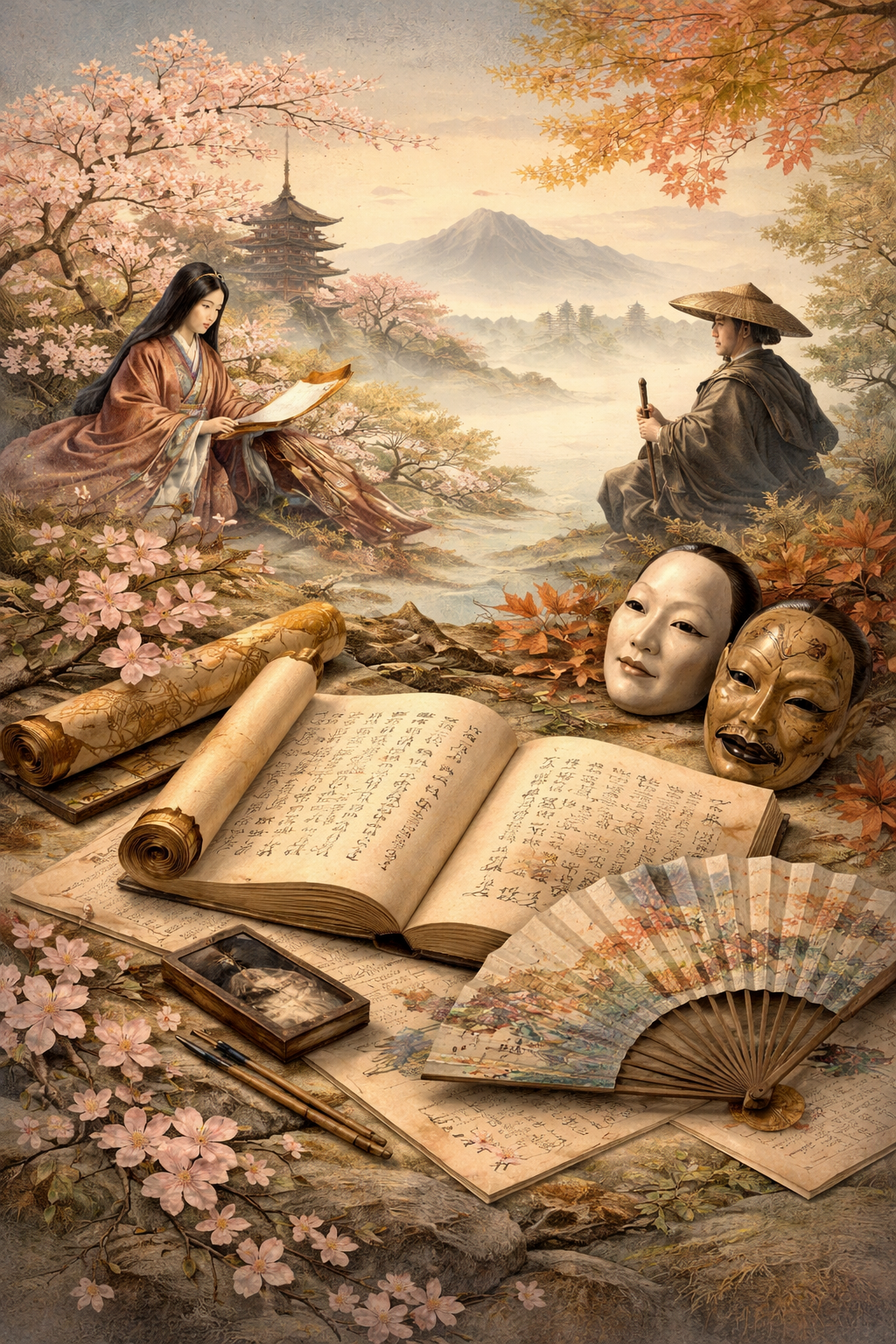
Read in this way, Japanese literature becomes more than literary history. It becomes a record of how a civilization learned to preserve emotion through restraint, atmosphere through precision, and memory through fragile forms that remain open rather than final. It preserves not only courtly and aristocratic worlds, but travel routes, battlefields, temples, shrines, urban pleasures, provincial landscapes, household interiors, ruined capitals, changing seasons, and the emotional textures of waiting, separation, aging, recollection, and loss. Japanese literary memory is often quiet, but it is never slight. Its seriousness lies in the conviction that mood, season, image, gesture, cadence, interval, and verbal arrangement can carry historical and emotional worlds that discursive explanation would flatten.
Japanese Literature and Poetic Memory therefore stands at the intersection of literary history, religious history, performance, aesthetics, court culture, language formation, landscape imagination, manuscript and print transmission, women’s writing, and the history of modern transformation. It asks how literature preserves memory through compression rather than expansion; how poetic form mediates between social order and private feeling; how Buddhism, Shinto, courtliness, warrior memory, urban life, and vernacular practice reshape literary sensibility; how theater, travel, and essay traditions carry memory through voice and performance; how anthology, citation, and commentary transmit literary worlds across centuries; and how modern writers inherit older aesthetic structures while confronting industrialization, empire, war, defeat, urban alienation, and changing forms of selfhood. In this sense, Japanese literature is one of the great traditions through which the world has learned that memory may endure not only through doctrine, epic declaration, or historical record, but through rhythm, mood, season, placement, allusion, and the quiet persistence of poetic form.
Japanese Literature as Poetic Memory
Japanese literature is one of the great poetic-memory systems of world literature because it repeatedly treats mood, season, suggestion, and arrangement as serious forms of remembrance. Its greatest works often preserve worlds not by explaining them fully, but by allowing an image, gesture, season, phrase, or silence to carry what direct statement cannot. A sleeve dampened by tears, a moonlit veranda, an autumn insect, a mountain road, a fading capital, a Noh ghost, a ruined house, a narrow journey, or a snow-lit room may hold an entire memory structure.
This does not make the tradition slight or decorative. On the contrary, Japanese literature is often most serious precisely where it is most compressed. Court poetry turns social relation and emotional intelligence into verbal form. Monogatari preserves courtly worlds through atmosphere and recurrence. War tales transform political collapse into meditation on impermanence. Essays and diaries turn perception itself into literary memory. Bashō’s travel writing and haikai show how brevity can hold route, season, history, and spiritual attention. Noh turns the persistence of the past into voice, mask, movement, and return. Modern fiction brings inherited structures of mood, shame, beauty, estrangement, and uncertainty into the conditions of modern life.
To study Japanese Literature and Poetic Memory is therefore to study how a culture learned to make transience durable without denying transience. Memory survives not because the passing world is frozen, but because literature teaches forms of attention adequate to its passing.
Why This Pillar Matters
Japanese Literature and Poetic Memory matters because few literary traditions have preserved feeling with such formal economy and such enduring subtlety. Again and again, Japanese writers turn to image, season, allusion, silence, pattern, juxtaposition, and emotional restraint in order to preserve what would be damaged by excessive statement. Literature here often becomes the art of carrying atmosphere across time: a misted landscape, a remembered fragrance, a moonlit veranda, the cry of insects, a decaying capital, a journey on a narrow road, the sadness of autumn, the afterimage of war, the distance between lovers, the loneliness of a room. These are not incidental details. They are the means by which cultural memory is made durable.
It also matters because Japanese literature preserves one of the world’s most sustained meditations on impermanence without reducing itself to melancholy alone. Court life, romance, prestige, beauty, houses, capitals, regimes, and literary forms themselves are repeatedly shown as vulnerable to passing away. Yet the tradition does not answer transience with despair alone. It answers with attention. To notice the passing world with adequate care becomes itself a form of memory. This makes Japanese literature indispensable to any serious understanding of how cultures preserve feeling, place, and historical experience through fragile forms rather than monumental declaration.
Just as importantly, Japanese literature matters because it is not only a literature of sadness or fading beauty. It is also a literature of craft, wit, placement, citation, seasonal play, performance, urban liveliness, and the disciplined making of language. Its seriousness lies not in emotional heaviness alone, but in the conviction that arrangement, interval, and allusive intelligence can preserve a civilization’s inner life.
Scope and Method
This pillar is expansive by design, but ordered by a clear poetic center. It includes waka and court anthologies, Heian narrative and diary writing, women’s literary production, war tales, Buddhist- and Shinto-inflected prose and poetry, travel literature, linked verse, haikai, haiku, Noh and related performance traditions, Edo-period prose and poetic culture, regional and vernacular forms, modern fiction, modern poetry, and literary responses to modernization, empire, war, urban life, and historical rupture. It treats Japanese literature not as a single aesthetic essence, but as a field in which courtliness, religious sensibility, warrior memory, vernacular life, urban pleasure, modern alienation, and formal experimentation repeatedly interact.
The method throughout is to read Japanese literature as both art and memory. That means attending to genre, diction, allusion, image-patterning, seasonal reference, atmosphere, silence, script choice, performance context, and transmission history while also asking what these works preserve about historical and emotional life. How does waka preserve social relation through compression? How does court narrative preserve refinement and loss? How do anthology and citation organize continuity? How do Buddhist and Shinto sensibilities reshape literary mood? How do travel writing and poetics bind memory to landscape? How do theater and performance embody cultural recollection? How do popular print culture and urban prose broaden the field of literary memory? How do modern writers inherit older structures of feeling while confronting war, industrialization, empire, urban anonymity, and altered forms of subjectivity?
This pillar also reads the tradition critically. It does not reduce Japan to timeless aesthetic essence, nor does it turn impermanence into a cultural cliché. It asks how elite courtly forms, gendered authorship, Buddhist and Shinto sensibilities, warrior memory, urban print culture, imperial modernity, colonial power, war memory, and postwar literary self-questioning reshape what Japanese poetic memory means across time.
Reading Architecture for a Humanities Pillar
This literature pillar does not require a GitHub repository. Its research infrastructure is textual, bibliographic, philological, performative, historical, and interpretive rather than code-based. The proper scholarly architecture consists of primary texts, reliable translations, critical editions, anthologies, commentaries, performance studies, theater traditions, manuscript and print histories, university press scholarship, museum and archive resources, and carefully ordered reading pathways.
A strong Japanese Literature and Poetic Memory pillar should therefore foreground:
- primary texts in reliable translation, scholarly edition, anthology, or public-domain form where appropriate;
- major textual formations including waka anthologies, The Tale of Genji, The Pillow Book, diary literature, The Tale of the Heike, Hōjōki, Tsurezuregusa, Bashō’s travel writing, Noh plays, Edo prose, and modern fiction;
- major figures including Murasaki Shikibu, Sei Shōnagon, Kamo no Chōmei, Yoshida Kenkō, Zeami, Bashō, Chikamatsu, Saikaku, Sōseki, Tanizaki, Kawabata, Dazai, Enchi, Mishima, Ōe, and others;
- major genre pathways such as waka, monogatari, nikki, zuihitsu, war tale, renga, haikai, haiku, Noh, kabuki and bunraku-related literary culture, Edo prose, modern novel, and modern short fiction;
- transmission systems including imperial anthologies, poetic schools, allusive practice, commentary, recitation, theater lineages, shrine and temple culture, print, education, and modern canon formation;
- critical attention to gender, class, court hierarchy, warrior violence, urban commodification, imperial ideology, colonial memory, war, defeat, censorship, and the danger of turning subtle aesthetics into flattened cultural stereotype.
The Canonical Spine of the Tradition
A strongest-sense account of Japanese Literature and Poetic Memory should be visibly anchored in the formations and figures that most powerfully shaped its literary center. The Heian courtly tradition is foundational: waka anthologies, poetic exchange, diaries, and above all The Tale of Genji establish a world in which refinement, feeling, seasonality, memory, and social nuance are inseparable. Sei Shōnagon, Murasaki Shikibu, and other court writers give Japanese literary memory one of its decisive beginnings. Medieval literature then deepens the archive through war tales such as The Tale of the Heike, Buddhist-inflected reflection on impermanence, and recluse or essay traditions associated with figures such as Kamo no Chōmei and Yoshida Kenkō.
The early modern spine includes linked verse, haikai, Bashō, Noh theory and performance, Edo print culture, urban prose, puppet theater, kabuki-related literary culture, satire, and popular fiction. Bashō stands centrally because he unites travel, seasonal awareness, brevity, allusion, spiritual attention, and landscape memory into one of the most enduring forms of compressed recollection. The modern canon extends the tradition through figures such as Sōseki, Tanizaki, Kawabata, Dazai, Enchi, Mishima, Ōe, and others who confront modernity, war, eros, shame, historical uncertainty, and fractured inwardness without fully severing ties to older aesthetic structures. Around this spine gather anthology traditions, commentary, poetic theory, women’s writing across periods, folk and regional memory, urban prose, and the continuous literary shaping of place, time, atmosphere, and loss.
Foundational Questions
- How did Japanese literature become one of the world’s most subtle archives of feeling and memory?
- How do waka, monogatari, diary, war tale, essay, theater, travel writing, haikai, folk song, popular prose, and modern fiction preserve memory differently?
- Why are impermanence, seasonality, suggestion, allusion, and emotional restraint so central to Japanese literary form?
- How do concepts such as mono no aware, yūgen, and mujō illuminate the structure of Japanese literary memory without becoming clichés?
- How did court culture, Buddhism, Shinto, warrior history, urban life, and vernacular practice shape different literary worlds within Japan?
- What role do anthology, citation, commentary, and poetic schools play in preserving literary continuity?
- How did script worlds such as kanbun and kana shape the development of literary expression?
- How do women’s writing, diaries, intimate prose, and domestic memory preserve social and emotional worlds across periods?
- How did theater, recitation, print, education, and performance help transmit Japanese literary tradition?
- How did modern writers inherit and transform older poetic memory under modernization, empire, war, urbanization, defeat, and historical rupture?
I. Aesthetic Foundations: Impermanence, Attention, and Poetic Form
A strongest-sense treatment of Japanese Literature and Poetic Memory should begin with the aesthetic and philosophical structures that make the tradition distinctive. Japanese literary memory is deeply shaped by attention to impermanence, restraint, suggestion, atmosphere, interval, and the emotional power of what remains partial. To write beautifully is often to write with awareness of passing away. Presence is sharpened by its fragility. Emotion becomes legible not through declaration, but through image, omission, season-word, spacing, allusion, and tonal control.
This aesthetic field includes concepts later named as mono no aware, yūgen, mujō, and related modes of feeling, though these should not be treated as static labels detached from texts. They matter because they help describe a literary world in which beauty is intensified by transience, depth by suggestiveness, and memory by emotional understatement. Yet the deeper thesis of the tradition may be attention itself: a disciplined noticing of relation, season, texture, distance, and disappearance. Japanese literature preserves cultural memory not only by lamenting what passes, but by teaching how to perceive it before it vanishes.
- Impermanence, Attention, and the Aesthetic Foundations of Japanese Literature (planned) — A foundational article on transience, mood, suggestion, and the discipline of noticing.
- Mono no Aware and the Poetics of Fragile Feeling (planned) — A study of emotional responsiveness, passing beauty, courtly narrative, and the risk of oversimplifying the concept.
- Yūgen, Depth, and Suggestive Beauty in Japanese Literary Form (planned) — An article on depth, mystery, restraint, Noh, poetic indirection, and the power of what is not fully shown.
- Mujō and the Literary Imagination of Transience (planned) — A study of impermanence in Buddhist-inflected prose, war tales, poetry, and recollective writing.
- Attention as Cultural Memory in Japanese Literature (planned) — A synthetic article on perception, arrangement, image, silence, and the preservation of fragile worlds.
II. Language, Script Worlds, and the Making of Japanese Literary Expression
Japanese literary history cannot be fully understood without reckoning with language registers and script worlds. Kanbun, Sino-Japanese learning, Chinese literary prestige, kana writing, and vernacular literary expression all shaped how literature developed, who wrote it, and what kinds of feeling it could preserve. Courtly and learned culture moved through complex relations between Chinese-derived forms and increasingly distinct Japanese modes of written expression. This is not merely technical background. It is part of the tradition’s memory structure.
Language choice often carries social, gendered, and aesthetic meaning. The emergence of kana and vernacular prose opened crucial space for court diaries, tale literature, and women’s writing. Kanbun preserved scholarly authority and transregional intellectual prestige. A serious pillar must therefore show that Japanese poetic memory is not simply a matter of themes or moods; it is also a matter of how languages and scripts made different literary worlds possible.
- Kanbun, Kana, and the Making of Japanese Literary Expression (planned) — A study of script, register, prestige, gender, and the formation of literary voice.
- Sino-Japanese Literary Inheritance and Cultural Prestige (planned) — An article on Chinese learning, kanbun practice, classical authority, and Japanese literary formation.
- Vernacular Writing and Courtly Authority (planned) — A study of kana prose, women’s writing, courtly intimacy, and the literary authority of vernacular expression.
- Script, Sensibility, and the Formation of Literary Memory (planned) — A synthetic article on how writing systems helped organize memory, voice, and cultural identity.
III. Anthology, Selection, and the Architecture of Poetic Memory
One of the deepest keys to Japanese literary history is anthology culture. Anthologies are not merely containers of poems; they are part of how the tradition thinks. Selection, sequence, juxtaposition, topic, and categorization organize feeling into canon. Imperial anthologies, later poetic collections, and pedagogical repertoires do not simply preserve literature after the fact. They actively shape what counts as memory, refinement, precedent, and literary authority. A poem survives not just because it was written well, but because it was selected into an arranged field of cultural remembrance.
This makes anthology one of the most distinctive intellectual structures in Japanese literature. Canon formation is inseparable from arrangement. Poetic memory is architectural as much as expressive. A serious project must foreground this rather than treating anthology as background apparatus.
- Imperial Anthologies and the Architecture of Poetic Memory (planned) — A major article on anthologies as structures of selection, sequence, authority, and emotional order.
- Selection, Sequence, and Canon Formation in Japanese Literature (planned) — A study of how arrangement shapes memory and literary inheritance.
- Allusion as Cultural Continuity (planned) — An article on citation, echo, shared poetic memory, and the literary afterlife of earlier works.
- Anthology as a Form of Civilizational Thought (planned) — A synthetic article on anthology as one of Japan’s principal memory technologies.
IV. Court Poetry, Heian Refinement, and the Poetics of Sensibility
The Heian court stands at the beginning of the high canon because it creates one of the world’s great literary civilizations of refinement, allusion, sensitivity, and emotional precision. Waka becomes not only a poetic form but a social language through which intimacy, rank, longing, rivalry, seasonality, and memory are negotiated. Anthologies, poetic exchanges, and courtly conventions together create a literary world in which subtle verbal response is inseparable from cultivated personhood.
This archive matters because it shows literature as social conduct, emotional intelligence, and memory-work at once. Court poetry preserves not only individual feeling, but an entire world of seasonal knowledge, gesture, occasion, and relational delicacy. It also establishes the literary prestige of compression, which remains one of the deepest continuities in Japanese writing.
- Waka and the Social Life of Poetic Memory in Heian Japan (planned) — A foundational article on waka as social exchange, emotional code, and cultural memory.
- Court Poetry and the Formation of Literary Sensibility (planned) — A study of refinement, occasion, rank, intimacy, and cultivated response.
- Seasonality, Allusion, and Emotional Precision in Heian Verse (planned) — An article on seasonal diction, poetic echo, and disciplined feeling.
- Anthology and Refinement in Early Japanese Literary Culture (planned) — A study of how anthologies organized poetic prestige and courtly memory.
V. Genji, Monogatari, and the Memory of Courtly Worlds
The Tale of Genji belongs at the absolute center of this category. It is not simply a court novel, but one of the greatest memory archives in world literature: a subtle record of desire, status, beauty, impermanence, rivalry, ritual, mourning, seasonal passage, and the fragility of cultivated life. Murasaki Shikibu preserves an aristocratic world at once luminous and unstable, making inward nuance and atmospheric recall central to narrative form. The monogatari tradition more broadly preserves the memory of courtly worlds through romance, episode, allusion, and the emotional afterlife of scenes.
This layer matters because it reveals how Japanese narrative can preserve memory through recurrence and atmosphere rather than linear moral declaration. Court life survives not merely as information, but as mood, texture, and the subtle organization of feeling.
- The Tale of Genji and the Memory of Courtly Transience (planned) — A major article on desire, rank, beauty, impermanence, ritual, and the preservation of courtly worlds.
- Murasaki Shikibu and the Narrative of Refined Feeling (planned) — A study of narrative atmosphere, psychological nuance, social observation, and literary authority.
- Monogatari and the Preservation of Courtly Worlds (planned) — An article on tale literature as romance, memory, social form, and emotional archive.
- Love, Rank, and Impermanence in Genji (planned) — A focused study of intimacy, hierarchy, longing, and the fragility of aristocratic life.
VI. Diaries, Essays, and Women’s Writing as Literary Memory
Japanese literary memory is inseparable from diary literature, miscellanies, and women’s writing. Works such as The Pillow Book and later diary traditions preserve the textures of daily life, perception, social judgment, fleeting emotion, and the literary ordering of experience. These genres matter not because they are merely private, but because they convert the minor, the passing, and the atmospheric into forms of cultural permanence.
This archive is essential because it shows that memory may be preserved not only through epic or grand narrative, but through notebooks of sensitivity, fragments of observation, remembered scenes, and lists shaped by taste. A stronger pillar must also insist that women’s writing is not merely an early Heian phenomenon. It is a continuing force within Japanese literary memory across periods, genres, and modernity.
- Sei Shōnagon and the Literature of Perception (planned) — A focused article on wit, lists, judgment, sensory detail, and the literary ordering of attention.
- The Pillow Book and the Memory of Courtly Atmosphere (planned) — A study of observation, taste, social intelligence, courtly scene, and fragmentary memory.
- Diary Literature and the Intimate Archive of Japanese Feeling (planned) — An article on nikki as memory, self-record, travel, longing, and social documentation.
- Women’s Writing and the Preservation of Social and Emotional Worlds (planned) — A major article on women’s authorship, intimacy, court culture, and literary continuity.
- Women’s Writing Beyond Heian (planned) — A study of women writers across medieval, Edo, modern, and contemporary literary history.
- Gender, Intimacy, and Literary Authority in Japanese Tradition (planned) — A critical article on voice, authorship, education, social constraint, and canon formation.
VII. War Tales, Medieval Upheaval, and the Literature of Impermanence
Medieval Japanese literature introduces a different register of memory: one shaped by conflict, decline, warrior rule, religious uncertainty, and the awareness that splendor collapses. The Tale of the Heike stands at the center of this archive, preserving not only military struggle but the pathos of impermanence itself. Political fall becomes a literary meditation on passing glory, broken houses, shifting power, ritualized memory, and the sadness of historical transience.
This layer matters because it widens poetic memory beyond courtly refinement into the memory of historical upheaval. It shows how the Japanese tradition absorbs war into aesthetics without sentimentalizing destruction. Historical loss becomes one more site where impermanence is rendered visible.
- The Tale of the Heike and the Sound of Impermanence (planned) — A major article on war, Buddhist transience, oral performance, fallen houses, and the literary sound of passing glory.
- War Tales and the Literary Memory of Political Collapse (planned) — A study of warrior rule, battle narrative, loyalty, defeat, and historical memory.
- Glory, Ruin, and Historical Transience in Medieval Japanese Literature (planned) — An article on the aesthetic and ethical framing of political collapse.
- The Warrior World and the Poetics of Passing Away (planned) — A study of martial culture, fame, death, ritual memory, and impermanence.
VIII. Buddhist, Shinto, and Ritual Sensibilities in Literary Memory
Buddhism is not merely an external influence on Japanese literature. It is one of its major structuring sensibilities. Literary treatments of impermanence, detachment, suffering, recollection, and the instability of worldly attachment are repeatedly shaped by Buddhist thought, whether directly doctrinal or indirectly atmospheric. Yet a fully serious account must also include Shinto, shrine culture, ritual seasonal life, and the overlap between Buddhist and Shinto sensibilities in the literary imagination. Sacred place in Japanese literature is often plural rather than doctrinally singular.
This matters because Japanese poetic memory is frequently sacred without being narrowly theological. Literary works can carry Buddhist structures of feeling, shrine-centered seasonality, ritual purity, place reverence, and sacred atmosphere through mood, image, ruin, recollection, and recurring seasonal forms. Sacred geography in Japanese literature is therefore not reducible to Buddhism alone.
- Buddhist Sensibility and the Japanese Literary Imagination (planned) — A study of impermanence, detachment, suffering, and Buddhist moods across poetry, prose, and war tale.
- Shinto, Sacred Place, and Literary Memory (planned) — An article on shrine, ritual, purity, seasonal practice, and sacred geography in literary form.
- Buddhist-Shinto Overlap in Japanese Literary Imagination (planned) — A study of syncretic sacred sensibility, ritual place, and literary atmosphere.
- Kamo no Chōmei and the Literature of Retreat (planned) — A focused article on withdrawal, catastrophe, impermanence, and the fragile dwelling.
- Hōjōki and the Memory of Fragile Dwelling (planned) — A close reading of disaster, impermanence, retreat, and the ethics of small shelter.
- Yoshida Kenkō and the Essay of Impermanence (planned) — A study of zuihitsu, fragments, taste, transience, and reflective observation.
- Ritual, Shrine, and Seasonal Sacredness in Japanese Literature (planned) — A synthetic article on ritual time, sacred place, season, and literary memory.
IX. Travel, Place, and the Literary Memory of Landscape
Japanese literature is profoundly place-bound without being merely descriptive. Routes, villages, capitals, mountains, shores, shrines, bridges, rivers, fields, and seasons become literary through repetition, poetic association, and travel recollection. Landscape in the Japanese tradition is not neutral backdrop. It is a vehicle of memory. To move through a place is often to move through layers of prior literature, allusion, and feeling.
This layer is indispensable because it reveals that poetic memory in Japan is often geographic. Literature does not only remember people. It remembers paths, views, seasons, sacred sites, and places already charged by earlier speech.
- Landscape and the Literary Memory of Place in Japan (planned) — A major article on landscape as memory, allusion, sacred geography, and poetic inheritance.
- Travel Writing and the Poetics of Route and Return (planned) — A study of journey, route, departure, return, and the literary shaping of movement.
- Utamakura and the Naming of Emotional Geography (planned) — An article on poetic place-names, allusion, cultural memory, and emotional geography.
- Place, Allusion, and the Repetition of Literary Landscape (planned) — A study of how repeated places accumulate literary resonance across centuries.
X. Renga, Haikai, Bashō, and the Art of Poetic Compression
The poetics of compression reach one of their highest forms in linked verse, haikai, haiku, and Bashō’s travel-poetic practice. Bashō stands near the center of the entire category because he unites travel, seasonal awareness, brevity, allusion, spiritual attention, and landscape memory into an art of extraordinary economy. In him, Japanese literature becomes visibly what this pillar argues it is: an archive of feeling preserved through brevity, rhythm, season, and suggestion.
This archive matters because smallness of form does not mean smallness of significance. A short poem can hold route, history, weather, solitude, literary memory, and spiritual attention all at once. It also preserves wit, play, responsiveness, and collaborative intelligence as part of poetic memory rather than outside it.
- Bashō and the Perfection of Poetic Memory (planned) — A major article on Bashō as a central figure of travel, season, compression, and literary inheritance.
- The Narrow Road to the Deep North and the Literature of Journeying (planned) — A study of travel prose, haikai, place-memory, allusion, and spiritual attention.
- Renga, Haikai, and Collaborative Memory (planned) — An article on linked verse, association, social composition, and collective poetic intelligence.
- Haiku, Compression, and the Ethics of Attention (planned) — A study of brevity, season-word, observation, humility, and the discipline of perception.
- Wit, Play, and Verbal Intelligence in Japanese Poetic Tradition (planned) — An article on humor, play, responsiveness, and literary dexterity.
XI. Noh, Theater, and Performance as Memory
Noh and related performance traditions belong centrally to Japanese poetic memory because they preserve atmosphere, haunting, recurrence, and loss through voice, gesture, mask, music, and stylization. The stage becomes a place where memory returns not as documentary recall, but as embodied recurrence. The dead speak, past passion lingers, and places remain charged by what happened there.
This matters because Japanese literary memory is not purely textual. Performance traditions demonstrate how memory may endure through repetition, ritualized movement, and tonal recurrence. Theater preserves what prose cannot capture alone.
- Noh and the Performance of Memory (planned) — A foundational article on Noh as embodied memory, haunting, recurrence, and stylized feeling.
- Zeami and the Poetics of Yūgen on Stage (planned) — A study of Zeami’s theory, yūgen, performance discipline, and aesthetic depth.
- Ghosts, Return, and Emotional Persistence in Japanese Theater (planned) — An article on the returning dead, unresolved emotion, place-memory, and performance.
- Performance, Voice, and the Embodied Archive of Feeling (planned) — A synthetic article on theater, recitation, music, gesture, and canon transmission.
XII. Edo Urban Culture, Print, Popular Literature, and the Expanding Literary Field
The Edo period must occupy a large place in any serious intellectual account of Japanese literature. Here literary culture expands beyond court and medieval religious or warrior worlds into cities, merchant readerships, pleasure quarters, satirical prose, illustrated books, theatrical publicity, commercial print, and new reading publics. This does not abolish older poetic memory; it reworks it under new social conditions. Urbanity, wit, commerce, theatricality, and everyday life become increasingly central to literature, while inherited aesthetics continue to shape how those worlds are represented.
This layer matters because it shows Japanese literature as adaptive and socially expansive. Poetic memory is not confined to aristocratic refinement alone. It survives and transforms in print culture, comic prose, popular fiction, and urban reading communities. Edo is not a side chapter. It is one of the major restructurings of the literary field.
- Edo Urban Culture and the Expansion of Japanese Literary Life (planned) — A major article on cities, print, pleasure quarters, merchant readerships, and expanding literary publics.
- Print Culture and the Expansion of Literary Publics (planned) — A study of woodblock print, illustrated books, circulation, readership, and literary accessibility.
- Merchant Worlds, Satire, and Urban Prose (planned) — An article on social wit, commercial culture, comic prose, and urban observation.
- The Floating World as Cultural Memory (planned) — A study of ukiyo, pleasure quarters, performance, print, beauty, impermanence, and urban memory.
- Comic Literature and the Poetics of Everyday Life (planned) — An article on humor, ordinary life, satire, and popular literary intelligence.
- How Poetic Memory Survived in Expanding Reading Cultures (planned) — A synthetic article on continuity and transformation under Edo literary expansion.
XIII. Region, Province, Folk Song, and Vernacular Memory
A more complete pillar must move beyond court and capital. Japanese literary memory is not only Kyoto, Edo, and Tokyo. It is also provincial roads, local shrines, northern and southern landscapes, regional song, folk narrative, oral remembrance, and vernacular feeling. To keep the tradition from appearing too polished and top-down, one must account for the ways local worlds preserve memory outside the elite canon while also feeding back into it.
This matters because region and province often preserve forms of attention and continuity that national literary histories smooth over. Folk song, oral memory, and provincial writing help widen the archive from high refinement to lived landscape.
- Provincial Landscapes and Regional Literary Memory in Japan (planned) — A study of local landscapes, provincial writing, regional identity, and memory outside the capital.
- Folk Song, Oral Tradition, and Vernacular Feeling (planned) — An article on song, oral memory, everyday feeling, and non-elite transmission.
- Region, Route, and the Literature of Local Attention (planned) — A study of place-based attention, travel, local memory, and regional literary inheritance.
- Beyond the Capital: Peripheral Memory in Japanese Literature (planned) — A critical article on how provincial and peripheral traditions complicate court-centered literary history.
XIV. Modernity, Empire, War, and the Literary Memory of Rupture
Modernization, industrialization, imperial expansion, war, defeat, occupation, and social upheaval profoundly reconfigured Japanese literary memory. Yet modern literature did not simply sever itself from older forms. It inherited and strained them. Questions of alienation, national destiny, historical guilt, urban dislocation, bodily fragility, and cultural fracture enter literature with new force, but often through sensibilities shaped by much older modes of perception and restraint.
This archive matters because it shows continuity under rupture. Japanese literature remembers modern devastation not only through explicit statement, but through silence, fragmentation, estrangement, and the altered emotional use of inherited forms. A serious pillar must also make room for colonial and imperial memory, not only metropolitan modernity.
- Modernity and the Reorientation of Japanese Literary Memory (planned) — A major article on modernization, language reform, urban change, and the transformation of inherited literary sensibilities.
- War, Defeat, and the Literature of Historical Rupture in Japan (planned) — A study of war memory, defeat, occupation, moral shock, silence, and literary reconstruction.
- Colonial Memory and the Edges of Japanese Literary History (planned) — An article on empire, colonial subjects, language, center-periphery relations, and the limits of national canon.
- Urban Change, Modern Uncertainty, and the Loss of Stable Worlds (planned) — A study of modern city life, alienation, anonymity, class, and shifting subjectivity.
- Historical Upheaval and the Persistence of Poetic Form (planned) — A synthetic article on how older aesthetic structures survive under modern rupture.
XV. Modern Fiction, Women’s Writing, Interiority, and the Poetics of Uncertainty
Modern Japanese fiction deepens interiority, estrangement, erotic ambiguity, memory, shame, bodily vulnerability, and uncertainty in new ways. Sōseki, Tanizaki, Kawabata, Dazai, Enchi, Mishima, Ōe, and others extend the tradition by confronting modern subjectivity, loneliness, aesthetic obsession, guilt, shame, historical consciousness, and fractured belonging. Yet many do so without abandoning the older Japanese literary trust in atmosphere, mood, ellipsis, and emotional indirection.
This layer matters because it reveals the continuity of poetic memory inside the modern novel. Japanese modernity does not erase older forms of feeling. It unsettles and transforms them. It is also here that women’s modern writing becomes essential to the broader story of interiority and literary authority.
- Sōseki and the Modern Problem of Inner Life (planned) — A major article on modern subjectivity, isolation, intellectual unease, and the transformation of literary interiority.
- Tanizaki and the Aesthetics of Desire, Memory, and Artifice (planned) — A study of beauty, erotic ambiguity, tradition, performance, and the instability of aesthetic longing.
- Kawabata and the Fragility of Beauty in Modern Time (planned) — An article on atmosphere, silence, loss, beauty, and the modern afterlife of poetic perception.
- Dazai and the Literature of Shame and Estrangement (planned) — A study of self-exposure, shame, alienation, performance, and postwar literary uncertainty.
- Mishima, Form, Body, and Historical Consciousness (planned) — An article on aesthetic form, body, violence, tradition, and modern historical anxiety.
- Ōe and the Burden of Postwar Moral Memory (planned) — A study of disability, responsibility, war memory, ethics, and postwar literary conscience.
- Women’s Modern Writing and the Recasting of Poetic Memory (planned) — A major article on gender, modernity, authorship, domestic life, body, and literary authority.
XVI. Major Genres Across Japanese Poetic Memory
A comprehensive pillar should also organize the archive by genre. Waka preserves seasonality, relation, and emotional compression. Monogatari preserves courtly worlds through narrative atmosphere. Diary and essay preserve intimate perception. War tale preserves historical impermanence. Buddhist and ritual writing carry contemplative transience and sacred place. Travel writing binds literature to route and landscape. Linked verse and haikai preserve collaborative brevity and associative depth. Theater preserves memory through embodiment. Popular prose and urban print culture widen the archive. Modern fiction extends poetic structures of feeling into new historical conditions.
- Waka and the Architecture of Poetic Memory (planned) — A genre article on waka as compression, social relation, seasonality, and canon memory.
- Monogatari and the Narrative Preservation of Courtly Worlds (planned) — A study of tale literature, atmosphere, romance, courtly hierarchy, and memory.
- Diary and Essay as Intimate Archives of Feeling (planned) — An article on nikki, zuihitsu, perception, self-record, and fragmentary memory.
- War Tale and the Literature of Historical Passing (planned) — A study of gunki monogatari, warrior memory, conflict, and impermanence.
- Travel Writing and the Memory of Landscape (planned) — An article on route, place, season, allusion, and literary geography.
- Theater and the Embodied Persistence of the Past (planned) — A study of Noh, performance, voice, gesture, repetition, and haunting.
- Popular Prose and the Expansion of Literary Memory (planned) — An article on Edo prose, print, satire, urban life, and new publics.
- Modern Fiction and the Continuity of Poetic Sensibility (planned) — A study of modern narrative, interiority, atmosphere, rupture, and inherited aesthetic memory.
XVII. Recurring Themes and Aesthetic Structures
Across these genres, certain structures recur with unusual persistence: season and passage; beauty and decline; longing and distance; courtly decorum and emotional vulnerability; ruin and recollection; travel and return; landscape and allusion; silence and suggestion; atmosphere and memory; refined form and inward instability; melancholy and tenderness; historical rupture and fragile continuity. Just as important are play, wit, careful noticing, and the pleasure of arrangement. These themes help explain why Japanese literature remains so quietly powerful. It preserves not simply events, but tonal worlds through which events are felt and remembered.
- Seasonality and the Poetics of Time in Japanese Literature (planned) — A thematic article on season, ritual time, memory, and poetic structure.
- Longing, Distance, and Emotional Restraint (planned) — A study of separation, withheld feeling, courtly relation, and lyric discipline.
- Ruin, Recollection, and the Beauty of Passing Worlds (planned) — An article on ruins, decline, loss, courtly memory, and historical transience.
- Silence, Suggestion, and the Ethics of Understatement (planned) — A study of restraint, omission, atmosphere, and the refusal of excessive statement.
- Atmosphere as Archive in Japanese Literary Memory (planned) — A major article on mood, setting, image, and the preservation of emotional worlds.
- Melancholy, Tenderness, and the Fragile Endurance of Feeling (planned) — A study of sadness, affection, beauty, and the emotional afterlife of passing things.
- Wit, Play, and the Pleasure of Arrangement (planned) — An article on playfulness, literary intelligence, sequence, and social verbal art.
XVIII. Commentary, Education, Performance, and Canon Formation
Japanese literature became canonical through anthologies, poetic schools, commentary traditions, recitation, court sponsorship, shrine and temple transmission, theater lineages, print culture, and educational curricula. Canon formation here is inseparable from acts of selection, gloss, imitation, and repetition. Literary memory survives not only because great works were written, but because they were quoted, taught, re-performed, and woven into later writing.
This means Japanese poetic memory is also a history of careful preservation. What endures does so through schools of reading, chains of allusion, inherited vocabularies, and the prestige of forms that remain available for reuse. Commentary and education are not external supports. They are part of the literary tradition’s own machinery of continuity.
- Anthology and the Making of the Japanese Canon (planned) — A study of imperial anthologies, selection, sequence, and poetic authority.
- Commentary, Allusion, and the Preservation of Literary Memory (planned) — An article on gloss, interpretation, citation, and inherited literary knowledge.
- Poetic Schools, Transmission, and Cultural Continuity (planned) — A study of poetic lineages, teaching, imitation, authority, and canon maintenance.
- Education, Recitation, and the Social Life of Literary Form (planned) — An article on memorization, pedagogy, recitation, and the social reproduction of literary memory.
- Performance, Repetition, and the Embodied Canon (planned) — A study of theater lineages, repeated performance, voice, gesture, and embodied transmission.
Expanded Article Architecture
The following long-range architecture preserves the full breadth of the category while clarifying its major centers of gravity: aesthetic foundations, language and script formation, anthology as memory system, Heian refinement, narrative and diary memory, medieval impermanence, sacred place, travel and landscape, theatrical embodiment, poetic compression, Edo expansion, regional and vernacular life, modern literary reorientation, and the persistence of poetic memory under rupture.
Aesthetic Foundations
- Impermanence, Attention, and the Aesthetic Foundations of Japanese Literature (planned)
- Mono no Aware and the Poetics of Fragile Feeling (planned)
- Yūgen, Depth, and Suggestive Beauty in Japanese Literary Form (planned)
- Mujō and the Literary Imagination of Transience (planned)
- Attention as Cultural Memory in Japanese Literature (planned)
Language, Script, and Canon
- Kanbun, Kana, and the Making of Japanese Literary Expression (planned)
- Sino-Japanese Literary Inheritance and Cultural Prestige (planned)
- Vernacular Writing and Courtly Authority (planned)
- Script, Sensibility, and the Formation of Literary Memory (planned)
- Imperial Anthologies and the Architecture of Poetic Memory (planned)
- Selection, Sequence, and Canon Formation in Japanese Literature (planned)
- Allusion as Cultural Continuity (planned)
- Anthology as a Form of Civilizational Thought (planned)
Heian Court and Intimate Prose
- Waka and the Social Life of Poetic Memory in Heian Japan (planned)
- Court Poetry and the Formation of Literary Sensibility (planned)
- Seasonality, Allusion, and Emotional Precision in Heian Verse (planned)
- The Tale of Genji and the Memory of Courtly Transience (planned)
- Murasaki Shikibu and the Narrative of Refined Feeling (planned)
- Monogatari and the Preservation of Courtly Worlds (planned)
- Love, Rank, and Impermanence in Genji (planned)
- Sei Shōnagon and the Literature of Perception (planned)
- The Pillow Book and the Memory of Courtly Atmosphere (planned)
- Diary Literature and the Intimate Archive of Japanese Feeling (planned)
- Women’s Writing and the Preservation of Social and Emotional Worlds (planned)
Medieval Impermanence and Sacred Writing
- The Tale of the Heike and the Sound of Impermanence (planned)
- War Tales and the Literary Memory of Political Collapse (planned)
- Glory, Ruin, and Historical Transience in Medieval Japanese Literature (planned)
- The Warrior World and the Poetics of Passing Away (planned)
- Buddhist Sensibility and the Japanese Literary Imagination (planned)
- Shinto, Sacred Place, and Literary Memory (planned)
- Buddhist-Shinto Overlap in Japanese Literary Imagination (planned)
- Kamo no Chōmei and the Literature of Retreat (planned)
- Hōjōki and the Memory of Fragile Dwelling (planned)
- Yoshida Kenkō and the Essay of Impermanence (planned)
- Ritual, Shrine, and Seasonal Sacredness in Japanese Literature (planned)
Landscape, Travel, and Place
- Landscape and the Literary Memory of Place in Japan (planned)
- Travel Writing and the Poetics of Route and Return (planned)
- Utamakura and the Naming of Emotional Geography (planned)
- Place, Allusion, and the Repetition of Literary Landscape (planned)
Poetic Compression and Performance
- Bashō and the Perfection of Poetic Memory (planned)
- The Narrow Road to the Deep North and the Literature of Journeying (planned)
- Renga, Haikai, and Collaborative Memory (planned)
- Haiku, Compression, and the Ethics of Attention (planned)
- Wit, Play, and Verbal Intelligence in Japanese Poetic Tradition (planned)
- Noh and the Performance of Memory (planned)
- Zeami and the Poetics of Yūgen on Stage (planned)
- Ghosts, Return, and Emotional Persistence in Japanese Theater (planned)
- Performance, Voice, and the Embodied Archive of Feeling (planned)
Edo and Expanding Literary Worlds
- Edo Urban Culture and the Expansion of Japanese Literary Life (planned)
- Print Culture and the Expansion of Literary Publics (planned)
- Merchant Worlds, Satire, and Urban Prose (planned)
- The Floating World as Cultural Memory (planned)
- Comic Literature and the Poetics of Everyday Life (planned)
- How Poetic Memory Survived in Expanding Reading Cultures (planned)
Region and Vernacular Memory
- Provincial Landscapes and Regional Literary Memory in Japan (planned)
- Folk Song, Oral Tradition, and Vernacular Feeling (planned)
- Region, Route, and the Literature of Local Attention (planned)
- Beyond the Capital: Peripheral Memory in Japanese Literature (planned)
Modernity, War, and Modern Fiction
- Modernity and the Reorientation of Japanese Literary Memory (planned)
- War, Defeat, and the Literature of Historical Rupture in Japan (planned)
- Colonial Memory and the Edges of Japanese Literary History (planned)
- Urban Change, Modern Uncertainty, and the Loss of Stable Worlds (planned)
- Historical Upheaval and the Persistence of Poetic Form (planned)
- Sōseki and the Modern Problem of Inner Life (planned)
- Tanizaki and the Aesthetics of Desire, Memory, and Artifice (planned)
- Kawabata and the Fragility of Beauty in Modern Time (planned)
- Dazai and the Literature of Shame and Estrangement (planned)
- Mishima, Form, Body, and Historical Consciousness (planned)
- Ōe and the Burden of Postwar Moral Memory (planned)
- Women’s Modern Writing and the Recasting of Poetic Memory (planned)
Genres and Forms
- Waka and the Architecture of Poetic Memory (planned)
- Monogatari and the Narrative Preservation of Courtly Worlds (planned)
- Diary and Essay as Intimate Archives of Feeling (planned)
- War Tale and the Literature of Historical Passing (planned)
- Travel Writing and the Memory of Landscape (planned)
- Theater and the Embodied Persistence of the Past (planned)
- Popular Prose and the Expansion of Literary Memory (planned)
- Modern Fiction and the Continuity of Poetic Sensibility (planned)
Major Themes and Transmission
- Seasonality and the Poetics of Time in Japanese Literature (planned)
- Longing, Distance, and Emotional Restraint (planned)
- Ruin, Recollection, and the Beauty of Passing Worlds (planned)
- Silence, Suggestion, and the Ethics of Understatement (planned)
- Atmosphere as Archive in Japanese Literary Memory (planned)
- Melancholy, Tenderness, and the Fragile Endurance of Feeling (planned)
- Wit, Play, and the Pleasure of Arrangement (planned)
- Anthology and the Making of the Japanese Canon (planned)
- Commentary, Allusion, and the Preservation of Literary Memory (planned)
- Poetic Schools, Transmission, and Cultural Continuity (planned)
- Performance, Repetition, and the Embodied Canon (planned)
Closing Perspective
Japanese Literature and Poetic Memory should be understood as a major archive of impermanence, refinement, seasonality, attention, longing, landscape, literary play, performance, and the subtle endurance of feeling rather than as a narrow sequence of formally delicate texts. Its range extends from Heian court poetry and narrative to diaries, war tales, Buddhist and Shinto-inflected reflection, travel literature, linked verse, Bashō, Noh, Edo print culture, urban prose, regional memory, and the modern novel. Read in the strongest sense, the category shows how literature can preserve not only culture or history, but entire worlds of mood, relation, and perception.
It is therefore central to any serious understanding of Japanese literary history and of the broader possibility that memory may survive through atmosphere, rhythm, allusion, silence, sequence, performance, and attention as fully as through narrative continuity or philosophical statement. Japanese literature reveals how a civilization remembers through season, place, gesture, arrangement, and emotional compression. It also shows, with unusual grace and seriousness, how poetic form can become one of the most enduring shelters of cultural memory.
Related Reading
- Literature & Cultural Memory
- East Asian Traditions
- Chinese Literature and Classical Memory
- Korean Literature and Historical Memory
- Japanese Myth, Folklore, and Legend
- Poetry, Memory, and Imagination
- Religious Studies
- Philosophy
Further Reading
- Shirane, H. (ed.) (2007). Traditional Japanese Literature: An Anthology, Beginnings to 1600. New York: Columbia University Press. https://cup.columbia.edu/book/traditional-japanese-literature/9780231136976/
- Shirane, H. (ed.) (2002). Early Modern Japanese Literature: An Anthology, 1600–1900. New York: Columbia University Press. https://cup.columbia.edu/book/early-modern-japanese-literature/9780231109901/
- Rimer, J. T. and Gessel, V. C. (eds.) (2005). The Columbia Anthology of Modern Japanese Literature: From Restoration to Occupation, 1868–1945. New York: Columbia University Press. https://cup.columbia.edu/book/the-columbia-anthology-of-modern-japanese-literature/9780231138048/
- Rimer, J. T. (ed.) (2011). The Columbia Anthology of Modern Japanese Literature: Abridged Edition. New York: Columbia University Press. https://cup.columbia.edu/book/the-columbia-anthology-of-modern-japanese-literature/9780231157230/
- Carter, S. D. and Shirane, H. (eds.) (2014). The Columbia Anthology of Japanese Essays: Zuihitsu from the Tenth to the Twenty-First Century. New York: Columbia University Press. https://cup.columbia.edu/book/the-columbia-anthology-of-japanese-essays/9780231167710/
- Rimer, J. T., Mori, M. and Poulton, M. C. (eds.) (2014). The Columbia Anthology of Modern Japanese Drama. New York: Columbia University Press. https://cup.columbia.edu/book/the-columbia-anthology-of-modern-japanese-drama/9780231128315/
- Goossen, T. W. (ed.) (1998). The Oxford Book of Japanese Short Stories. Oxford: Oxford University Press. https://global.oup.com/academic/product/the-oxford-book-of-japanese-short-stories-9780199583195
- Tansman, A. (2014). Japanese Literature: A Very Short Introduction. Oxford: Oxford University Press. https://global.oup.com/academic/product/japanese-literature-9780199765256
- Emmerich, M. (2013). The Tale of Genji: Translation, Canonization, and World Literature. New York: Columbia University Press. https://cup.columbia.edu/author-interviews/emmerich-tale-genji/
- Moretti, L. (2020). Pleasure in Profit: Popular Prose in Seventeenth-Century Japan. New York: Columbia University Press. https://cup.columbia.edu/book/pleasure-in-profit/9780231197236/
- Shirane, H. (2012). Japan and the Culture of the Four Seasons: Nature, Literature, and the Arts. New York: Columbia University Press. https://cup.columbia.edu/book/japan-and-the-culture-of-the-four-seasons/9780231152815/
- Shirane, H. (1998). Traces of Dreams: Landscape, Cultural Memory, and the Poetry of Bashō. Stanford: Stanford University Press. https://www.sup.org/books/asian-studies/traces-dreams
References
- Murasaki Shikibu (n.d.). The Tale of Genji. Wikisource. https://en.wikisource.org/wiki/The_Tale_of_Genji
- Murasaki Shikibu (1925–1933). The Tale of Genji. Translated by A. Waley. Wikisource. https://en.wikisource.org/wiki/The_Tale_of_Genji_%28Waley%29
- Shirane, H. (ed.) (2007). Traditional Japanese Literature: An Anthology, Beginnings to 1600. New York: Columbia University Press. https://cup.columbia.edu/book/traditional-japanese-literature/9780231136976/
- Shirane, H. (ed.) (2002). Early Modern Japanese Literature: An Anthology, 1600–1900. New York: Columbia University Press. https://cup.columbia.edu/book/early-modern-japanese-literature/9780231109901/
- Shirane, H. (ed.) (2012). The Tales of the Heike. New York: Columbia University Press. https://cup.columbia.edu/book/the-tales-of-the-heike/9780231138024/
- Sei Shōnagon and others (n.d.). Anthology of Japanese Literature. Wikisource. https://en.wikisource.org/wiki/Anthology_of_Japanese_Literature
- Sei Shōnagon (n.d.). The Pillow Book. In Anthology of Japanese Literature. Wikisource. https://en.wikisource.org/wiki/Anthology_of_Japanese_Literature
- Kamo no Chōmei, Yoshida Kenkō and others (n.d.). Anthology of Japanese Literature. Wikisource. https://en.wikisource.org/wiki/Anthology_of_Japanese_Literature
- Bashō, M. (n.d.). The Narrow Road to the Deep North. Public web edition. https://self.gutenberg.org/wplbn0002118087-the-narrow-road-to-the-deep-north-by-kuniharu-shimizu.aspx
- Watson, B. (trans.) and Shirane, H. (ed.) (2010). The Demon at Agi Bridge and Other Japanese Tales. New York: Columbia University Press. https://cup.columbia.edu/book/the-demon-at-agi-bridge-and-other-japanese-tales/9780231152440/
- Rimer, J. T. and Gessel, V. C. (eds.) (2005). The Columbia Anthology of Modern Japanese Literature: From Restoration to Occupation, 1868–1945. New York: Columbia University Press. https://cup.columbia.edu/book/the-columbia-anthology-of-modern-japanese-literature/9780231138048/
- Rimer, J. T. (ed.) (2011). The Columbia Anthology of Modern Japanese Literature: Abridged Edition. New York: Columbia University Press. https://cup.columbia.edu/book/the-columbia-anthology-of-modern-japanese-literature/9780231157230/
- Goossen, T. W. (ed.) (1998). The Oxford Book of Japanese Short Stories. Oxford: Oxford University Press. https://global.oup.com/academic/product/the-oxford-book-of-japanese-short-stories-9780199583195
- Carter, S. D. and Shirane, H. (eds.) (2014). The Columbia Anthology of Japanese Essays: Zuihitsu from the Tenth to the Twenty-First Century. New York: Columbia University Press. https://cup.columbia.edu/book/the-columbia-anthology-of-japanese-essays/9780231167710/
- Rimer, J. T., Mori, M. and Poulton, M. C. (eds.) (2014). The Columbia Anthology of Modern Japanese Drama. New York: Columbia University Press. https://cup.columbia.edu/book/the-columbia-anthology-of-modern-japanese-drama/9780231128315/
- Columbia University Press (2017). The Winter Sun Shines In: A Life of Masaoka Shiki. New York: Columbia University Press. https://cup.columbia.edu/book/the-winter-sun-shines-in/9780231164887/