
Last Updated May 3, 2026
Latin American literature and magical realism preserve one of the modern world’s most influential archives of myth, memory, marvel, historical repetition, ancestral presence, and the widened possibilities of literary reality. Across Spanish America, Brazil, the Caribbean, Indigenous and Afro-diasporic inheritances, regional storytelling, family saga, oral tradition, sacred narrative, political memory, experimental fiction, and global literary reception, Latin American writers have repeatedly shown that realism need not be limited to the visible, the secular, the measurable, or the conventionally probable. In these traditions, ghosts may inhabit family history, prophecy may shadow daily life, miracles may be narrated without astonishment, and the dead may remain socially present among the living.
This content pillar approaches Latin American Literature and Magical Realism not as a decorative subgenre, but as a major literary system for thinking about reality itself. Its central insight is that myth, memory, sacred presence, supernatural recurrence, dream, omen, curse, miracle, spirit, and ancestral force may appear within recognizable houses, villages, towns, plantations, archives, landscapes, bureaucracies, families, and political orders. The extraordinary does not always break reality apart. More often, it reveals that reality was already layered, haunted, communal, historical, and spiritually dense.
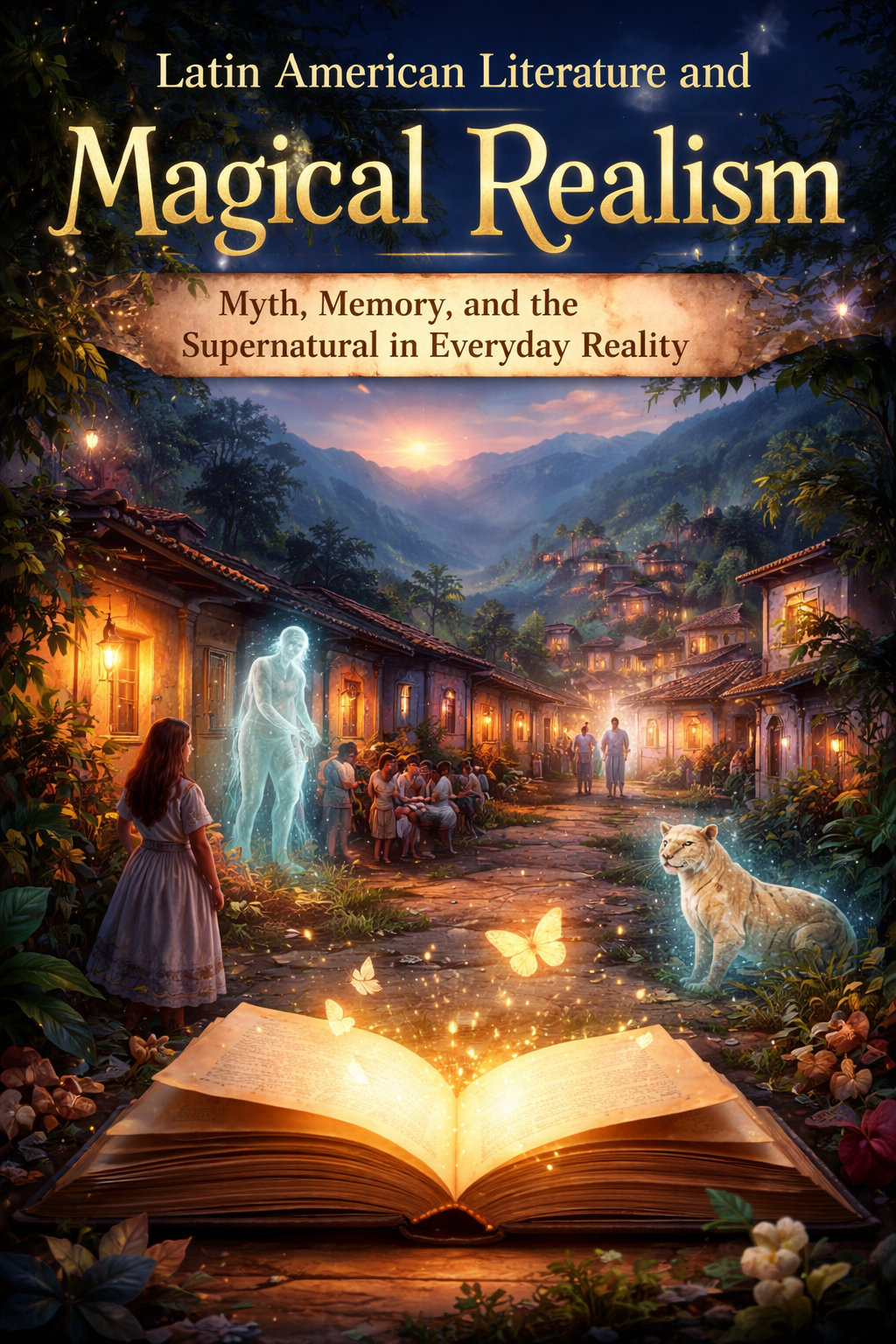
Read in this way, magical realism becomes more than a recognizable literary effect. It becomes a way of understanding the relation between myth and history, memory and daily life, the sacred and the mundane, the ancestral and the modern, the communal and the political. Across Latin American writing, the supernatural may illuminate grief, inheritance, longing, family continuity, communal fear, historical violence, colonial memory, racial and cultural mixture, spiritual survival, and the persistence of worlds that rational modernity cannot fully contain. Magical realism does not abandon the real. It makes the real more spacious, more haunted, more layered, and more alive.
Latin American Literature and Magical Realism therefore stands at the intersection of literary history, myth studies, folklore, oral tradition, postcolonial thought, Indigenous and Afro-diasporic memory, Catholic and syncretic sacred worlds, family narrative, regionalism, modernism, the Latin American Boom, post-Boom fiction, Brazilian and Caribbean traditions, political history, and world literature. It asks how writers place impossibility inside recognizable social life; why ghosts and miracles can feel ordinary; how family, town, landscape, and archive become enchanted structures of memory; how colonial and postcolonial histories alter the meaning of realism; and why this mode became one of Latin America’s most consequential contributions to global literary form.
Latin American Magical Realism as Cultural Memory
Latin American magical realism is one of the great cultural-memory systems of modern literature because it refuses to treat reality as merely empirical surface. Its deepest achievement lies in the way it allows ordinary social worlds to contain myth, spirit, dream, prophecy, ancestral memory, sacred residue, and historical repetition without collapsing into fantasy. The house remains a house, the village remains a village, the bureaucracy remains a bureaucracy, the landscape remains a landscape, but each becomes more charged than conventional realism usually permits.
This is why magical realism matters as more than a style. It is a mode of remembering. It preserves the nearness of the dead, the persistence of myth, the unfinished power of colonial history, the return of family trauma, the authority of oral tradition, the sacred density of place, and the sense that reality contains worlds modern rational systems often exclude. Ghosts are not only supernatural devices. They may be forms of history. Prophecy is not only plot mechanism. It may represent cyclical time, inherited destiny, or the pressure of collective repetition. Miracle is not only wonder. It may reveal a social order in which sacred and ordinary experience remain intertwined.
To study Latin American Literature and Magical Realism is therefore to study how literature widens realism from within. The mode does not flee history. It reveals history as haunted, mythic, repetitive, embodied, communal, and still unfinished.
Why Magical Realism Matters
Magical realism matters because it offers one of literature’s most compelling answers to a central imaginative question: how can the supernatural, mythic, or marvelous exist within ordinary life without dissolving the reality of that life? Latin American literature gave one of the strongest and most enduring responses. In its most powerful forms, magical realism does not transport readers into an invented fantasy world. It leaves them within the everyday world of families, villages, local authorities, domestic routines, political life, weather, illness, birth, mourning, labor, and memory, while allowing mystery, myth, sacred presence, and impossibility to enter that world as if they belonged there.
This makes magical realism especially rich as a mode of cultural memory. It preserves ways of seeing reality in which the dead are not fully absent, the sacred is not wholly separated from the everyday, and history does not move in a purely linear or secular way. The extraordinary may appear quietly, with almost no change in tone, and that quietness is part of the form’s power. The marvelous is not always staged as spectacle. It may arrive as a family inheritance, a lingering presence, an unexplained event, a dream that proves true, a strange recurrence, or a fact accepted by a community without the need for explanation.
It also matters because magical realism changed world literature. It demonstrated that realism could be transformed by myth without becoming escapist; that political history could be narrated through prophecy, repetition, and the marvelous; and that modern fiction could include non-rational, sacred, Indigenous, Afro-diasporic, popular, and communal ways of knowing without treating them as superstition to be overcome. In this sense, magical realism is not anti-realist. It is an argument about the insufficiency of narrow realism.
Scope and Method
This pillar is expansive by design, but ordered by the central problem of the marvelous inside recognizable reality. It includes magical realism, the marvelous real, mythic realism, regional narrative, family saga, village fiction, ghostly realism, folklore-inflected modernism, Latin American Boom fiction, post-Boom transformations, Brazilian and Caribbean variations, Indigenous and Afro-diasporic inheritances, women’s writing, political allegory, historical fiction, and global afterlives of the mode. It treats magical realism not as a single formula, but as a constellation of related narrative practices.
The method throughout is literary and historical. It asks how tone, setting, narrative authority, communal belief, family memory, landscape, religion, myth, politics, and colonial history shape the mode. How does a narrator make impossibility feel ordinary? How do houses and villages become memory systems? How does landscape preserve sacred or historical force? How do ghost, miracle, omen, and prophecy become socially meaningful rather than merely decorative? How do writers distinguish the marvelous real from fantasy? How do Latin American traditions reshape world literature’s assumptions about realism?
This pillar also reads critically. It does not treat magical realism as the only Latin American literary mode, nor does it reduce Latin American writing to enchantment. It asks how the label can sometimes flatten regional differences, exoticize Latin America, or obscure realism, modernism, Indigenous intellectual traditions, Afro-diasporic spiritual worlds, political violence, and urban modernity. A serious reading must preserve the power of magical realism while avoiding the assumption that Latin American reality is inherently “magical” for outside consumption.
Reading Architecture for a Humanities Pillar
This literature pillar does not require a GitHub repository. Its research infrastructure is textual, bibliographic, historical, theoretical, comparative, and interpretive rather than code-based. The appropriate scholarly architecture consists of primary texts, reliable translations, critical editions, university-press scholarship, theory of magical realism, Latin American literary history, Caribbean and Brazilian literary studies, Indigenous and Afro-diasporic cultural studies, folklore and oral-tradition scholarship, and carefully ordered reading pathways.
A strong Latin American Literature and Magical Realism pillar should foreground:
- primary texts by major writers associated with magical realism, the marvelous real, mythic realism, and related modes;
- theoretical foundations from Alejo Carpentier, Angel Flores, Luis Leal, Wendy B. Faris, Lois Parkinson Zamora, Roberto González Echevarría, Stephen M. Hart, and related scholars;
- major writers including Gabriel García Márquez, Juan Rulfo, Alejo Carpentier, Miguel Ángel Asturias, Elena Garro, Isabel Allende, Jorge Amado, João Guimarães Rosa, Clarice Lispector, Jorge Luis Borges, and others whose work complicates the boundaries of the mode;
- major narrative structures including family saga, haunted town, cyclical time, ancestral return, prophetic repetition, village archive, living landscape, and miracle without spectacle;
- historical contexts including coloniality, oral tradition, Indigenous and Afro-diasporic worldviews, Catholic and syncretic sacred worlds, modernization, revolution, dictatorship, archive power, and global publishing;
- critical attention to translation, exoticism, market reception, the Latin American Boom, gender, race, class, region, and the danger of turning magical realism into a simplified brand.
The Canonical Spine of the Tradition
The canonical spine of this pillar begins with the theoretical and literary emergence of the marvelous real and magical realism as ways of widening realism. Alejo Carpentier’s “lo real maravilloso americano” is essential because it frames the marvelous not as imported fantasy but as something arising from the historical, cultural, and spiritual realities of the Americas. Angel Flores and Luis Leal help define early critical debates around magical realism as a literary mode. Later critics such as Zamora, Faris, González Echevarría, and Hart deepen the theoretical and comparative field.
The literary spine includes Gabriel García Márquez’s One Hundred Years of Solitude, one of the central world-literary monuments of the mode; Juan Rulfo’s Pedro Páramo, where the dead, ruined town, silence, and memory become inseparable; Alejo Carpentier’s fiction and essays; Miguel Ángel Asturias’s mythic and political reworking of Indigenous and national memory; Elena Garro’s treatment of time, memory, and uncanny ordinary life; Isabel Allende’s family-historical enchantment; Jorge Amado’s enchanted social worlds; João Guimarães Rosa’s mystical and linguistic landscapes; and other related writers who complicate strict definitions of magical realism.
The tradition is strongest when understood as a constellation rather than a closed canon. Borges is crucial to the broader Latin American transformation of reality, though not simply reducible to magical realism. Clarice Lispector radically remakes inward reality and spiritual intensity, while not fitting a narrow version of the mode. Caribbean writers extend the field through creolization, spirit, history, and plantation memory. Brazilian regional and experimental traditions expand its geography. Women writers reshape magical realism through domestic space, family history, trauma, gendered memory, and intimate enchantment. The pillar therefore treats magical realism as a major center, but not a cage.
Foundational Questions
- How does magical realism place the supernatural within recognizable social reality without becoming conventional fantasy?
- Why are ghosts, prophecy, miracle, dreams, omens, and mythic recurrence often narrated with tonal calm?
- How do family memory, village life, regional landscapes, and oral traditions normalize the marvelous?
- What makes the ordinary world in these texts feel hospitable to the extraordinary?
- How do sacred continuity, ancestral presence, and communal belief reshape what counts as realism?
- How did Latin American writers use magical realism to narrate coloniality, violence, political repetition, and historical trauma?
- How do Indigenous, Afro-diasporic, Catholic, folk, and syncretic worlds shape the mode?
- Why did magical realism become globally influential, and what was lost or simplified in that global circulation?
- How should magical realism be distinguished from fantasy, surrealism, mythic realism, the fantastic, and the marvelous real?
- How do women writers and post-Boom writers transform the mode through family history, domestic memory, gender, intimacy, and trauma?
I. The Marvelous in Everyday Reality
The central achievement of magical realism is its placement of the marvelous within everyday reality. This is the key to the category and the principle that holds the pillar together. The mode depends on a recognizable social world: homes, kitchens, marketplaces, towns, schools, churches, roads, fields, municipal offices, cemeteries, and inherited family spaces. Within such worlds, extraordinary events do not necessarily produce disbelief or dramatic rupture. They are narrated with calmness, accepted with varying degrees of composure, or woven into the fabric of normal life.
This is what distinguishes magical realism from conventional fantasy. The marvelous is not segregated into another realm. It enters ordinary existence and remains there. The resulting effect is not merely decorative. It changes the texture of reality itself. What looks mundane becomes charged with hidden depth. The ordinary world proves capable of holding more than empirical explanation can comfortably contain. This widening of reality is one of Latin American literature’s great gifts to world literature.
- What Magical Realism Is and How It Works (planned) — A foundational article defining the mode through tone, setting, narrative authority, the marvelous, and the recognizable social world.
- The Marvelous in the Ordinary World (planned) — A study of how impossible events enter houses, towns, fields, offices, and family routines without breaking realism.
- Why Magical Realism Is Not Fantasy (planned) — A critical article distinguishing magical realism from fantasy, surrealism, the fantastic, and mythic fiction.
- The Supernatural in Everyday Reality (planned) — An article on ghosts, miracles, omens, curses, and spirits as ordinary social presences.
- How Magical Realism Expands the Meaning of Realism (planned) — A theoretical article on magical realism as widened realism rather than escape from the real.
- Ordinary Settings, Extraordinary Presence, and Narrative Balance (planned) — A craft-focused article on the formal balance between the social ordinary and the marvelous.
II. Myth, Memory, and Ancestral Presence
Magical realism often draws its force from the persistence of myth and memory within present life. Myth in these traditions is not merely an old story quoted for atmosphere. It may survive as structure, inheritance, worldview, pattern, or destiny. It enters the present through names, rituals, symbols, landscapes, family repetitions, sacred presences, and recurring forms of desire, grief, or catastrophe. The past is not gone; it remains active, shaping the emotional and spiritual climate of the present.
Memory functions in a similarly layered way. Family memory, communal memory, historical memory, and ancestral memory often overlap. A house may retain the emotional residue of earlier generations. A town may continue to live under the weight of a founding event, an old wound, a collective silence, or a repeated destiny. Characters may inherit not only property and bloodlines but also unfinished histories, omens, prophecies, curses, and haunting forms of remembrance.
- Myth in the Midst of Everyday Life (planned) — A study of myth not as distant antiquity, but as a living structure inside ordinary social worlds.
- Memory as Living Presence in Latin American Fiction (planned) — An article on houses, towns, archives, names, silence, and inherited memory.
- Ancestral Return and the Persistence of the Dead (planned) — A study of the dead as family, social, historical, and spiritual presences.
- Cyclical Time and Historical Repetition in Magical Realism (planned) — An article on repetition, prophecy, recurrence, and the refusal of purely linear historical time.
- Prophecy, Fate, and Inherited Destiny (planned) — A study of prophecy as family inheritance, political repetition, and narrative architecture.
- The House of Memory in Family and Communal Narrative (planned) — An article on the house as archive, witness, container, and haunted social space.
III. Ghosts, Prophecy, Miracle, and the Uncanny Ordinary
Ghosts, prophecies, miracles, omens, curses, signs, inexplicable returns, and uncanny recurrences are among the most recognizable features of magical realism, but their importance lies in how they are placed. They rarely exist in isolation from the ordinary world. A ghost may appear in a bedroom, a courtyard, or a family conversation. A prophecy may circulate within a household or village rather than descending with epic theatricality. A miracle may occur in a context of domestic or communal routine. The extraordinary is not cut off from everyday social reality; it inhabits it.
This integration allows magical realism to treat the uncanny as intimate rather than remote. The strangeness is often close at hand. It belongs to familiar spaces and repeated customs. This is one reason the mode can feel emotionally dense even when narrated with tonal restraint. The impossible does not abolish the ordinary. It reveals that the ordinary was never as simple as it first appeared.
- Ghosts in the Household: The Dead Among the Living (planned) — A study of ghosts as family memory, historical return, social presence, and unresolved grief.
- Miracle Without Spectacle in Magical Realist Narrative (planned) — An article on miracles narrated calmly rather than theatrically.
- Omens, Signs, and Unexplained Recurrence (planned) — A study of signs, patterns, and repetitions as structures of meaning inside ordinary life.
- Curses, Blessings, and the Social Life of the Supernatural (planned) — An article on supernatural force as communal knowledge, family inheritance, and moral pressure.
- Dreams That Enter the Real World (planned) — A study of dream, prophecy, vision, and porous boundaries between consciousness and social reality.
- The Uncanny Inside Familiar Life (planned) — An article on how magical realism makes familiar settings quietly strange.
IV. Family, Household, and the Enchanted Social World
Family and household life are among the most important settings in Latin American magical realism. Homes store memory. Family names carry repetition. Domestic routines create the surface through which mystery enters. Birth, marriage, illness, inheritance, jealousy, death, and mourning often unfold within spaces already charged by earlier lives and unfinished histories. The household is not merely private background; it is one of the main theaters in which myth and memory remain socially active.
The family saga is especially suited to this mode because it allows generations to overlap, repeat, and haunt one another. Family history can become a vehicle for prophecy, recurrence, silence, and revelation. Ordinary domestic life grows porous. The supernatural may be woven into routine rather than interrupting it. The result is an enchanted social world in which household objects, rooms, habits, names, and kinship ties carry imaginative and historical force.
- Family Saga and the Architecture of Magical Realism (planned) — A study of genealogy, repetition, inheritance, prophecy, and intergenerational haunting.
- Domestic Life and the Entrance of the Marvelous (planned) — An article on kitchens, bedrooms, courtyards, household rituals, and the supernatural inside ordinary space.
- Village Memory and Shared Supernatural Worlds (planned) — A study of communal belief, gossip, legend, public memory, and the local normalization of wonder.
- Everyday Routine and Enchanted Social Space (planned) — An article on how daily routines become charged with myth, sacred presence, and uncanny force.
- Why Houses, Courtyards, and Kitchens Matter in Magical Realist Fiction (planned) — A close look at domestic architecture as narrative memory system.
- Marriage, Birth, Death, and the Supernatural Family Archive (planned) — A study of family rites as thresholds between ordinary life and the marvelous.
V. Village, Town, and Regional Life
Magical realism thrives in villages, provincial towns, and regional worlds where communal memory is dense and where the boundary between public reality and shared legend remains permeable. Such settings provide a scale in which the extraordinary can become socially legible. A town may normalize what outsiders would call impossible. A village may live inside a cycle of belief, repetition, gossip, or inherited knowledge that makes the marvelous feel communal rather than private.
These regional settings are not merely picturesque. They help magical realism achieve one of its core effects: the embedding of wonder in a fully inhabited social order. The town, the village, and the region allow the mode to place the supernatural inside local institutions, habits, rituals, weather, kinship, bureaucracy, politics, and daily routine. The marvelous becomes public and ordinary at once.
- Provincial Towns and the Normality of the Impossible (planned) — A study of towns as socially shared worlds where wonder becomes ordinary.
- Village Memory and the Communal Archive of Wonder (planned) — An article on local memory, oral circulation, public legend, and inherited supernatural knowledge.
- Macondo and the Literary Invention of the Mythic Town (planned) — A focused article on García Márquez’s imagined town as archive, myth, history, and world-literary symbol.
- Comala and the Town of the Dead in Juan Rulfo (planned) — A study of ruined place, ghostly voice, silence, and memory in Pedro Páramo.
- Local Authority, Bureaucracy, and the Marvelous Ordinary (planned) — An article on mayors, officials, church, courts, and bureaucratic realism inside enchanted worlds.
- Region as Mythic Social World in Latin American Fiction (planned) — A study of regional narrative as mythic, political, linguistic, and communal space.
VI. Landscape, Nature, and the Living World
Landscape is not passive scenery in Latin American magical realism. Rivers, forests, mountains, plains, storms, heat, animals, gardens, dust, and vegetation often participate in the imaginative life of the text. Nature may carry memory, reflect spiritual atmosphere, or seem charged with presences older than modern rational order. The land may appear animate, responsive, ominous, excessive, or mysteriously enduring.
This does not necessarily turn landscape into fantasy. Instead, it intensifies the relation between place and meaning. A region may feel alive with inherited force. A natural environment may preserve memory or magnify the uncanny. The living world becomes one of the principal means through which the marvelous enters ordinary reality. Nature, in these traditions, can remember, signify, foretell, and accompany human history without ceasing to be part of recognizable life.
- The Living Landscape in Latin American Magical Realism (planned) — A study of nature as active presence, witness, and memory system.
- Forests, Rivers, and Mountains as Carriers of Memory (planned) — An article on landscape as sacred, historical, ecological, and mythic archive.
- Nature, Weather, and Spiritual Atmosphere (planned) — A study of storms, heat, rain, dust, vegetation, and climate as charged narrative forces.
- Land, Region, and Mythic Environment (planned) — An article on the relation between regional specificity and mythic enlargement.
- The Natural World as Witness and Presence (planned) — A study of landscape as participant in history rather than neutral background.
- Place, Atmosphere, and the Expansion of Reality (planned) — A synthetic article on how place widens realism into sacred and mythic depth.
VII. Oral Tradition, Folklore, and Sacred Continuity
Magical realism is deeply connected to oral tradition, folklore, communal storytelling, inherited beliefs, and sacred continuity. Many of its most powerful effects depend on narrative worlds in which stories circulate before, beside, or beyond formal written authority. Legends, sayings, rituals, local superstitions, sacred presences, saints, spirits, curses, folk explanations, and inherited accounts of the world can all enter literary form. What appears marvelous in print may already have existed as part of a living oral or communal imagination.
This connection gives magical realism much of its tonal authority. The narrative voice often carries the confidence of something already known, already told, already shared. The extraordinary need not be justified because it belongs to the world of the telling. Sacred continuity matters here as well. Religious and syncretic worlds, rituals of remembrance, communal observances, and inherited spiritual assumptions all contribute to a literary atmosphere in which the supernatural can dwell inside everyday reality without seeming alien to it.
- Oral Tradition and the Literary Logic of Magical Realism (planned) — A foundational article on oral authority, communal knowledge, and narrative confidence.
- Folklore, Legend, and Everyday Belief in Latin American Narrative (planned) — A study of popular belief as narrative structure rather than decorative background.
- Sacred Presence in Ordinary Social Worlds (planned) — An article on saints, spirits, miracles, shrines, household devotion, and ritual continuity.
- Communal Storytelling and the Authority of the Marvelous (planned) — A study of how shared telling legitimizes impossible events.
- Inherited Belief and the Narrative Texture of Wonder (planned) — An article on belief systems as part of realism’s widened field.
- Ritual, Custom, and Supernatural Continuity (planned) — A study of rites, festivals, mourning, and sacred habits in magical realist worlds.
VIII. Narrative Tone and the Normality of Wonder
One of magical realism’s most distinctive achievements is tonal. Extraordinary events are often narrated with calmness, restraint, or social normality. The tone does not announce a departure from reality; it absorbs the marvelous into the same narrative fabric as household details, weather, village habits, and local politics. This tonal balance is one of the defining signatures of the mode.
The effect is subtle but profound. By refusing to isolate wonder as spectacle, magical realism changes the reader’s sense of what counts as ordinary. The narrative voice teaches the reader how to inhabit a widened reality. The marvelous becomes credible not because it is explained, but because it is narrated as though it belongs. This belonging is one of the deepest formal principles of the tradition.
- The Tone of Narrative Normality in Magical Realism (planned) — A craft and theory article on calm narration, social composure, and the credible impossible.
- How Writers Narrate the Impossible Without Explanation (planned) — A study of narrative authority, withheld explanation, and readerly adjustment.
- Calm Voice, Extraordinary Event: The Poise of the Marvelous (planned) — An article on tonal restraint as the foundation of wonder.
- Description, Restraint, and the Credibility of Wonder (planned) — A study of sensory detail, social realism, and understated impossibility.
- The Blurred Boundary Between Visible and Invisible Worlds (planned) — An article on perception, ambiguity, and reality’s porous edges.
- Why Magical Realism Feels Both Strange and Familiar (planned) — A synthetic article on the emotional and formal logic of the mode.
IX. History, Politics, Archive, and the Marvelous Real
Magical realism is often most powerful when it transforms historical pressure into narrative form. Colonial conquest, civil war, authoritarian rule, bureaucratic violence, massacre, revolution, land conflict, class hierarchy, and the distortions of official memory all enter Latin American literature through forms that exceed conventional realism. The marvelous does not escape politics. It may expose political reality by making its repetitions, absurdities, silences, and hauntings visible.
This is where the relation between magical realism and archive becomes crucial. The official archive often fails, excludes, distorts, or disciplines memory. Magical realist fiction may answer with family archive, town memory, ghostly testimony, prophetic repetition, or mythic pattern. The marvelous becomes one way of narrating what public records cannot contain.
- History as Haunting in Latin American Magical Realism (planned) — A study of history not as background, but as ghostly and repetitive presence.
- Magical Realism and the Failure of the Official Archive (planned) — An article on archives, silences, erasures, and unofficial memory.
- Political Violence and the Marvelous Real (planned) — A study of how violence, repression, and historical trauma enter magical realist form.
- Bureaucracy, Absurdity, and Enchanted Power (planned) — An article on authority, paperwork, officials, and the strange realism of institutions.
- Revolution, Dictatorship, and Historical Repetition (planned) — A study of cyclical violence, failed promises, and prophetic historical form.
- Myth and Archive in Latin American Narrative (planned) — A theoretical article on myth, law, document, archive, and the novel.
X. Coloniality, Modernity, and the Limits of Rational Realism
Magical realism must be read in relation to coloniality and modernity. Latin American realities were shaped by conquest, forced conversion, racial hierarchy, Indigenous survival, African diasporic presence, plantation economies, extractive systems, republican modernization, and imported rational institutions that never fully displaced older or alternative worlds of meaning. Magical realism often stages this layered reality: modern bureaucracy beside myth, Catholic ritual beside Indigenous or African sacred memory, rational state order beside prophecy and haunting.
The mode therefore challenges the idea that modern realism must be secular, linear, bureaucratic, and disenchanted. It suggests that modernity in the Americas is not the replacement of myth by reason, but the coexistence and conflict of multiple temporalities, authorities, and ways of knowing.
- Coloniality and the Limits of Rational Realism (planned) — A foundational article on magical realism as a challenge to narrow secular modernity.
- The Marvelous Real and the Historical Reality of the Americas (planned) — A study of Carpentier’s theory and the relation between history and wonder.
- Modernity, Myth, and the Layered Social World (planned) — An article on how modern institutions coexist with older sacred and communal structures.
- Conquest, Conversion, and the Haunted Literary Imagination (planned) — A study of colonial violence, religious transformation, and supernatural memory.
- Latin American Modernity and the Refusal of Disenchantment (planned) — An article on why magical realism resists fully secularized realism.
- Multiple Temporalities in Magical Realist Fiction (planned) — A study of cyclical, ancestral, sacred, bureaucratic, and historical time.
XI. Indigenous, Afro-Diasporic, and Syncretic Memory Worlds
A serious magical realism pillar must foreground Indigenous, Afro-diasporic, and syncretic memory worlds without reducing them to atmospheric exoticism. Many Latin American literary works draw on cosmologies, rituals, spiritual presences, oral traditions, sacred landscapes, ancestral relations, and communal forms of knowledge that were marginalized by colonial and modern state systems. These inheritances help explain why the supernatural can appear not as interruption, but as part of ordinary reality.
At the same time, this topic requires care. Indigenous and Afro-diasporic worlds are not raw material for literary enchantment; they are living intellectual, spiritual, and cultural traditions. Magical realism becomes strongest when it preserves their seriousness rather than using them merely as decorative signs of strangeness.
- Indigenous Memory and the Magical Realist Imagination (planned) — A study of Indigenous cosmology, sacred place, oral tradition, and historical survival.
- Afro-Diasporic Sacred Worlds in Latin American Literature (planned) — An article on spirit, ritual, ancestry, syncretism, and Afro-Latin memory.
- Syncretism and the Literary Texture of Sacred Continuity (planned) — A study of Catholic, Indigenous, and African inheritances in narrative form.
- Myth Without Exoticism in Latin American Fiction (planned) — A critical article on how to read mythic and sacred traditions responsibly.
- Ritual, Ancestors, and the Survival of Marginalized Worlds (planned) — An article on ritual memory, social survival, and sacred continuity.
- Magical Realism and the Ethics of Cultural Inheritance (planned) — A study of representation, appropriation, translation, and literary responsibility.
XII. The Boom, Post-Boom, and the Global Expansion of the Mode
The Latin American Boom played a crucial role in making magical realism internationally visible, but the mode both preceded and exceeded the Boom. The Boom helped carry Latin American fiction into global literary consciousness and gave magical realism canonical visibility, yet the tradition cannot be reduced to a single period or publishing phenomenon. It draws on earlier regional, oral, mythic, historical, and experimental traditions, and it continues into later writing through revision, expansion, intimacy, and transformation.
Post-Boom and later writers complicated, deepened, or redirected the mode by moving into family interiors, local histories, intimate memory, domestic enchantment, quieter hauntings, gendered histories, and new relations between the marvelous and the social real. A strong pillar on this subject therefore treats magical realism as both a canonical literary achievement and an evolving imaginative practice.
- Magical Realism Before the Boom (planned) — A historical article on earlier sources, regional traditions, folklore, modernism, and the marvelous real.
- The Boom and the Global Rise of Magical Realism (planned) — A study of publishing, translation, world-literary circulation, and canonical formation.
- Post-Boom Revisions of the Marvelous (planned) — An article on later writers who transform the mode through intimacy, gender, family, and memory.
- How Magical Realism Became a Global Literary Language (planned) — A study of translation, reception, prestige, and international influence.
- The Danger of Turning Magical Realism into a Brand (planned) — A critical article on market simplification, exoticism, and overgeneralization.
- Beyond the Boom: Magical Realism’s Continuing Transformations (planned) — A synthetic article on contemporary extensions and revisions of the mode.
XIII. Major Writers and Literary Traditions
Latin American magical realism is associated with some of the most influential writers of modern literature, but the tradition is broader than a handful of canonical names. Gabriel García Márquez remains central for the scale, narrative ease, and communal density with which the marvelous enters the everyday world. Juan Rulfo offers a quieter but equally powerful version in which the dead, silence, memory, and ruined social life coexist with stark realism. Alejo Carpentier, in a different register, helps articulate the relation between the marvelous and the historical reality of the Americas.
Elena Garro, Isabel Allende, Miguel Ángel Asturias, Jorge Amado, João Guimarães Rosa, and others expand the field in different directions, showing how the supernatural, mythic, sacred, and socially real can be combined with regional specificity and imaginative authority. Borges and Lispector complicate the borders of the category, not because they are simple magical realists, but because their work radically alters the relation between reality, consciousness, metaphysics, language, and literary form.
- Gabriel García Márquez and the Marvelous Everyday (planned) — A major article on García Márquez’s narrative authority, family saga, Macondo, prophecy, and communal memory.
- Juan Rulfo and the Dead Among the Living (planned) — A study of Pedro Páramo, Comala, ghostly voice, silence, and ruined social memory.
- Alejo Carpentier and the Marvelous Real (planned) — An article on Carpentier’s theory, fiction, history, and the reality of wonder in the Americas.
- Elena Garro and Time, Memory, and the Uncanny Ordinary (planned) — A study of time, memory, political unease, and the strange ordinary.
- Isabel Allende and the Supernatural in Family History (planned) — An article on domestic enchantment, gendered memory, family saga, and historical inheritance.
- Miguel Ángel Asturias and Mythic Reality (planned) — A study of myth, Indigenous inheritance, political power, and narrative experiment.
- Jorge Amado and the Enchanted Social World (planned) — An article on Bahia, social life, Afro-Brazilian sacred presence, humor, sensuality, and communal enchantment.
- João Guimarães Rosa and the Mystical Landscape of the Ordinary (planned) — A study of language, backlands, metaphysical landscape, and regional transcendence.
XIV. Brazilian, Caribbean, and Regional Variations
The tradition extends across literary cultures often too quickly separated from one another. Spanish American, Brazilian, Caribbean, and adjacent regional formations all contribute to the broader imaginative world in which magical realism and related modes flourished. Brazilian literature brings distinctive regional, linguistic, Afro-Brazilian, mystical, and experimental energies. Caribbean literature brings plantation memory, creolization, spirit worlds, colonial fragmentation, island geography, and historical haunting. Regional traditions across Latin America show that magical realism does not belong to a single national style or literary moment.
This wider frame matters because magical realism is not one formula exported from one canon. It is a network of narrative possibilities shaped by language, place, history, religion, race, oral tradition, and literary experiment.
- Brazilian Variations on Magical Realist Form (planned) — A study of Brazilian regional, Afro-Brazilian, mystical, and experimental contributions to the field.
- Caribbean Literature, Creolization, and the Haunted Real (planned) — An article on plantation memory, spirit, island history, and creole narrative worlds.
- Regional Traditions and the Expansion of the Mode (planned) — A study of local landscapes, dialect, community, and regional variation.
- Bahia, the Backlands, and the Sacred Social World (planned) — An article on Afro-Brazilian and regional literary environments.
- Plantation Memory and the Supernatural Archive (planned) — A study of Caribbean and Afro-diasporic haunting, labor, land, and memory.
- Why Latin American Magical Realism Is Not One Tradition (planned) — A synthetic article on multiplicity, language, region, race, religion, and history.
XV. Women Writers, Family Memory, and Intimate Enchantment
Women writers have been central to the transformation of magical realism, especially in relation to family memory, domestic space, gendered inheritance, bodily experience, trauma, and intimate forms of enchantment. The household, kitchen, bedroom, family archive, maternal line, and inherited silence often become major sites where the marvelous enters social reality. These spaces are not merely private. They are historically charged fields in which gender, power, memory, and supernatural presence meet.
This layer of the tradition matters because it shifts magical realism away from public myth alone and toward intimate histories. It shows how the marvelous may emerge through domestic labor, women’s memory, illness, reproduction, desire, family violence, secrecy, and care. It also complicates the assumption that magical realism is primarily a Boom-era male canon.
- Women Writers and the Recasting of Magical Realism (planned) — A major article on women’s contributions to domestic, familial, and gendered transformations of the mode.
- Family Memory and the Supernatural Household (planned) — A study of family archive, domestic space, inheritance, and haunting.
- Gender, Trauma, and Intimate Enchantment (planned) — An article on gendered history, violence, body, and the marvelous as memory form.
- Isabel Allende, Elena Garro, and the Rewriting of Historical Memory (planned) — A comparative article on women writers, family history, time, and the uncanny ordinary.
- The Kitchen, the Bedroom, and the Domestic Archive of Wonder (planned) — A study of domestic places as literary thresholds.
- Magical Realism Beyond the Male Boom Canon (planned) — A critical article expanding the category through gender, region, and later writers.
XVI. World-Literary Afterlives of Magical Realism
Magical realism became one of Latin America’s most globally influential literary contributions. It reshaped how writers and readers across the world imagined the relation between realism, myth, history, and belief. Yet global influence also brought simplification. Magical realism was sometimes treated as a shorthand for Latin American exoticism, as if the region itself were inherently magical for outside readers. A serious pillar must therefore study both the power and the risk of global reception.
The world-literary afterlife of magical realism shows how a mode can travel, transform, and be misunderstood. It also reveals why the mode remains powerful: many societies marked by coloniality, trauma, oral tradition, sacred continuity, and competing temporalities have found in magical realism a way to narrate reality more fully than conventional realism allows.
- Why Latin American Magical Realism Changed World Literature (planned) — A major article on global influence, translation, adaptation, and literary prestige.
- Magical Realism and World Literature Beyond Latin America (planned) — A study of how the mode travels into African, South Asian, Caribbean, and global fiction.
- Translation, Reception, and the Global Boom (planned) — An article on publishing, translation, prizes, classrooms, and the international canon.
- The Exoticism Problem in Magical Realism (planned) — A critical article on reader expectation, market branding, and cultural simplification.
- Magical Realism as Postcolonial Narrative Strategy (planned) — A study of why societies marked by coloniality often use widened realism.
- The Future of Magical Realism in Global Fiction (planned) — A synthetic article on contemporary afterlives and new uses of the mode.
XVII. Major Genres and Narrative Forms
A comprehensive pillar should also organize the archive by genre and form. Magical realism appears in novels, short stories, family sagas, village narratives, political allegories, ghost stories, historical fiction, regional fiction, mythic modernism, domestic fiction, Caribbean and Brazilian variations, and postcolonial world literature. Its forms are flexible because the central mechanism is not plot type but narrative relation: the ordinary world is narrated as capable of containing the marvelous.
- The Magical Realist Novel as World-Making Form (planned) — A genre article on the novel’s capacity to hold family, town, history, myth, and supernatural recurrence.
- The Short Story and the Concentrated Marvelous (planned) — A study of shorter forms, uncanny compression, and narrative surprise without fantasy rupture.
- Family Saga as Magical Realist Architecture (planned) — An article on genealogy, repetition, household memory, and inherited destiny.
- Village Narrative and the Communal Supernatural (planned) — A study of towns and villages as social containers for wonder.
- Political Allegory and the Marvelous Real (planned) — An article on dictatorship, revolution, bureaucracy, and political violence in magical realist form.
- Ghost Story, Folklore, and Magical Realism (planned) — A study of overlap and distinction among ghostly fiction, folklore, and magical realism.
XVIII. Recurring Themes and Memory Structures
Across these genres, certain structures recur with unusual force: myth in daily life, ghosts among the living, cyclical time, family repetition, prophetic destiny, living landscape, sacred continuity, historical haunting, village memory, women’s domestic archives, oral authority, bureaucratic absurdity, political recurrence, and the refusal of disenchanted realism. These structures help explain why magical realism remains so powerful. It does not merely add impossible events to realistic settings. It changes the reader’s sense of what reality includes.
- Myth and the Everyday Structure of Reality (planned) — A thematic article on myth as part of ordinary life rather than distant legend.
- Ghosts, Ancestors, and the Social Presence of the Dead (planned) — A study of the dead as family, history, and communal memory.
- Cyclical Time, Repetition, and Historical Fate (planned) — An article on recurrence as family pattern, political history, and narrative form.
- The Living Landscape and Sacred Place (planned) — A study of place, nature, region, and environmental memory.
- Family, Prophecy, and Inherited Catastrophe (planned) — An article on family saga as destiny and historical repetition.
- The Ordinary World as Haunted Archive (planned) — A synthetic article on magical realism as cultural memory system.
Expanded Article Architecture
The following long-range architecture preserves the full breadth of the category while clarifying its major centers of gravity: the marvelous in everyday reality, myth and memory, ghosts and prophecy, family and household, village and regional worlds, living landscape, oral and sacred continuity, narrative tone, political and historical memory, coloniality, Indigenous and Afro-diasporic inheritances, the Boom and post-Boom, major writers, Brazilian and Caribbean variations, women writers, world-literary afterlives, and recurring forms.
Foundations of the Mode
- What Magical Realism Is and How It Works (planned)
- The Marvelous in the Ordinary World (planned)
- Why Magical Realism Is Not Fantasy (planned)
- The Supernatural in Everyday Reality (planned)
- How Magical Realism Expands the Meaning of Realism (planned)
- Ordinary Settings, Extraordinary Presence, and Narrative Balance (planned)
- The Marvelous Real and the Historical Reality of the Americas (planned)
Myth, Memory, and the Return of the Past
- Myth in the Midst of Everyday Life (planned)
- Memory as Living Presence in Latin American Fiction (planned)
- Ancestral Return and the Persistence of the Dead (planned)
- Cyclical Time and Historical Repetition in Magical Realism (planned)
- Prophecy, Fate, and Inherited Destiny (planned)
- The House of Memory in Family and Communal Narrative (planned)
Ghosts, Miracles, and the Uncanny Ordinary
- Ghosts in the Household: The Dead Among the Living (planned)
- Miracle Without Spectacle in Magical Realist Narrative (planned)
- Omens, Signs, and Unexplained Recurrence (planned)
- Curses, Blessings, and the Social Life of the Supernatural (planned)
- Dreams That Enter the Real World (planned)
- The Uncanny Inside Familiar Life (planned)
Family, Household, and Social Worlds
- Family Saga and the Architecture of Magical Realism (planned)
- Domestic Life and the Entrance of the Marvelous (planned)
- Village Memory and Shared Supernatural Worlds (planned)
- Provincial Towns and the Normality of the Impossible (planned)
- Everyday Routine and Enchanted Social Space (planned)
- Why Houses, Courtyards, and Kitchens Matter in Magical Realist Fiction (planned)
- Marriage, Birth, Death, and the Supernatural Family Archive (planned)
Village, Town, Region, and Place
- Macondo and the Literary Invention of the Mythic Town (planned)
- Comala and the Town of the Dead in Juan Rulfo (planned)
- Region as Mythic Social World in Latin American Fiction (planned)
- Local Authority, Bureaucracy, and the Marvelous Ordinary (planned)
- Village Memory and the Communal Archive of Wonder (planned)
- Place, Atmosphere, and the Expansion of Reality (planned)
Landscape, Nature, and Sacred Atmosphere
- The Living Landscape in Latin American Magical Realism (planned)
- Forests, Rivers, and Mountains as Carriers of Memory (planned)
- Nature, Weather, and Spiritual Atmosphere (planned)
- Land, Region, and Mythic Environment (planned)
- The Natural World as Witness and Presence (planned)
- The Living Landscape and Sacred Place (planned)
Oral Tradition, Folklore, and Sacred Continuity
- Oral Tradition and the Literary Logic of Magical Realism (planned)
- Folklore, Legend, and Everyday Belief in Latin American Narrative (planned)
- Sacred Presence in Ordinary Social Worlds (planned)
- Communal Storytelling and the Authority of the Marvelous (planned)
- Inherited Belief and the Narrative Texture of Wonder (planned)
- Ritual, Custom, and Supernatural Continuity (planned)
Form, Tone, and Narrative Method
- The Tone of Narrative Normality in Magical Realism (planned)
- How Writers Narrate the Impossible Without Explanation (planned)
- Calm Voice, Extraordinary Event: The Poise of the Marvelous (planned)
- Description, Restraint, and the Credibility of Wonder (planned)
- The Blurred Boundary Between Visible and Invisible Worlds (planned)
- Why Magical Realism Feels Both Strange and Familiar (planned)
History, Politics, and Archive
- History as Haunting in Latin American Magical Realism (planned)
- Magical Realism and the Failure of the Official Archive (planned)
- Political Violence and the Marvelous Real (planned)
- Bureaucracy, Absurdity, and Enchanted Power (planned)
- Revolution, Dictatorship, and Historical Repetition (planned)
- Myth and Archive in Latin American Narrative (planned)
Coloniality, Modernity, and Sacred Worlds
- Coloniality and the Limits of Rational Realism (planned)
- Modernity, Myth, and the Layered Social World (planned)
- Conquest, Conversion, and the Haunted Literary Imagination (planned)
- Latin American Modernity and the Refusal of Disenchantment (planned)
- Multiple Temporalities in Magical Realist Fiction (planned)
- Indigenous Memory and the Magical Realist Imagination (planned)
- Afro-Diasporic Sacred Worlds in Latin American Literature (planned)
- Syncretism and the Literary Texture of Sacred Continuity (planned)
Major Writers and Deep-Dive Studies
- Gabriel García Márquez and the Marvelous Everyday (planned)
- Juan Rulfo and the Dead Among the Living (planned)
- Alejo Carpentier and the Marvelous Real (planned)
- Elena Garro and Time, Memory, and the Uncanny Ordinary (planned)
- Isabel Allende and the Supernatural in Family History (planned)
- Miguel Ángel Asturias and Mythic Reality (planned)
- Jorge Amado and the Enchanted Social World (planned)
- João Guimarães Rosa and the Mystical Landscape of the Ordinary (planned)
- Borges and the Metaphysical Expansion of Reality (planned)
- Clarice Lispector and the Mysticism of Interior Reality (planned)
The Boom, Post-Boom, and Global Circulation
- Magical Realism Before the Boom (planned)
- The Boom and the Global Rise of Magical Realism (planned)
- Post-Boom Revisions of the Marvelous (planned)
- How Magical Realism Became a Global Literary Language (planned)
- The Danger of Turning Magical Realism into a Brand (planned)
- Beyond the Boom: Magical Realism’s Continuing Transformations (planned)
- Magical Realism and World Literature Beyond Latin America (planned)
- The Exoticism Problem in Magical Realism (planned)
Brazilian, Caribbean, Regional, and Gendered Variations
- Brazilian Variations on Magical Realist Form (planned)
- Caribbean Literature, Creolization, and the Haunted Real (planned)
- Regional Traditions and the Expansion of the Mode (planned)
- Bahia, the Backlands, and the Sacred Social World (planned)
- Plantation Memory and the Supernatural Archive (planned)
- Women Writers and the Recasting of Magical Realism (planned)
- Family Memory and the Supernatural Household (planned)
- Gender, Trauma, and Intimate Enchantment (planned)
- Magical Realism Beyond the Male Boom Canon (planned)
Genres and Recurring Themes
- The Magical Realist Novel as World-Making Form (planned)
- The Short Story and the Concentrated Marvelous (planned)
- Family Saga as Magical Realist Architecture (planned)
- Village Narrative and the Communal Supernatural (planned)
- Political Allegory and the Marvelous Real (planned)
- Ghost Story, Folklore, and Magical Realism (planned)
- Myth and the Everyday Structure of Reality (planned)
- Ghosts, Ancestors, and the Social Presence of the Dead (planned)
- Cyclical Time, Repetition, and Historical Fate (planned)
- The Ordinary World as Haunted Archive (planned)
Closing Perspective
Latin American Literature and Magical Realism remains one of the great literary demonstrations that ordinary reality can hold far more than sober realism usually admits. In these traditions, myth does not vanish before modern life, memory does not remain confined to the past, and the supernatural does not require separation from the everyday world. Instead, the marvelous enters kitchens, courtyards, villages, family lines, regional landscapes, bureaucracies, sacred rituals, political histories, and familiar routines, widening reality from within.
This is what gives the tradition its enduring power. It does not flee the real; it transforms our understanding of the real by revealing its depth, porosity, and imaginative reach. As a knowledge series, this pillar follows that insight across writers, settings, motifs, forms, and historical contexts, showing how Latin American literature made the ordinary world more mythic, more haunted, more sacred, and more alive without ceasing to be recognizably human. In doing so, it reshaped not only the novel, but the very possibilities of literary reality.
Related Reading
- Literature & Cultural Memory
- Mythology
- Poetry, Memory, and Imagination
- Tragedy, Drama, and Collective Memory
- African and Diasporic Literature and Cultural Memory
- Spanish Literature and Cultural Memory
- Comparative Sacred Themes
- Culture, Meaning, and Symbolism
Further Reading
- Zamora, L.P. and Faris, W.B. (eds.) (1995). Magical Realism: Theory, History, Community. Durham, NC: Duke University Press. https://www.dukeupress.edu/magical-realism
- Faris, W.B. (2004). Ordinary Enchantments: Magical Realism and the Remystification of Narrative. Nashville, TN: Vanderbilt University Press. https://www.vanderbiltuniversitypress.com/9780826591777/ordinary-enchantments/
- González Echevarría, R. (1990). Myth and Archive: A Theory of Latin American Narrative. Cambridge: Cambridge University Press. https://www.cambridge.org/core/books/myth-and-archive/82AD26329681E2014787BE9A0DC3FBD8
- González Echevarría, R. (1998). Myth and Archive: A Theory of Latin American Narrative. Durham, NC: Duke University Press. https://www.dukeupress.edu/myth-and-archive
- Williamson, E. (ed.) (1996). The Cambridge History of Latin American Literature. Cambridge: Cambridge University Press. https://www.cambridge.org/core/books/cambridge-history-of-latin-american-literature/7BD96D692CE735A7F0F92C1E91E3310A
- Hart, S.M. and Ouyang, W. (eds.) (2005). A Companion to Magical Realism. Woodbridge: Tamesis.
- Shaw, D.L. (1998). A Companion to Modern Spanish American Fiction. London: Tamesis.
- Williams, R.L. (1998). The Columbia Guide to the Latin American Novel since 1945. New York: Columbia University Press.
- Martin, G. (1989). Journeys Through the Labyrinth: Latin American Fiction in the Twentieth Century. London: Verso.
- Swanson, P. (2010). The Cambridge Companion to Gabriel García Márquez. Cambridge: Cambridge University Press.
- Parkinson Zamora, L. (2006). The Inordinate Eye: New World Baroque and Latin American Fiction. Chicago: University of Chicago Press.
- Slemon, S. (1995). ‘Magic realism as postcolonial discourse’, in Zamora, L.P. and Faris, W.B. (eds.) Magical Realism: Theory, History, Community. Durham, NC: Duke University Press.
References
- Allende, I. (1985). The House of the Spirits. Translated by M. Bogin. New York: Alfred A. Knopf.
- Asturias, M.Á. (1997). Men of Maize. Translated by G. Martin. Pittsburgh, PA: University of Pittsburgh Press.
- Borges, J.L. (1998). Collected Fictions. Translated by A. Hurley. New York: Viking.
- Carpentier, A. (1995). ‘On the marvelous real in America’, in Zamora, L.P. and Faris, W.B. (eds.) Magical Realism: Theory, History, Community. Durham, NC: Duke University Press, pp. 75–88. https://www.dukeupress.edu/magical-realism
- Faris, W.B. (2004). Ordinary Enchantments: Magical Realism and the Remystification of Narrative. Nashville, TN: Vanderbilt University Press. https://www.vanderbiltuniversitypress.com/9780826591777/ordinary-enchantments/
- Flores, A. (1995). ‘Magical realism in Spanish American fiction’, in Zamora, L.P. and Faris, W.B. (eds.) Magical Realism: Theory, History, Community. Durham, NC: Duke University Press, pp. 109–117. https://www.dukeupress.edu/magical-realism
- García Márquez, G. (1970). One Hundred Years of Solitude. Translated by G. Rabassa. New York: Harper & Row.
- Garro, E. (1969). Recollections of Things to Come. Translated by R.L. Scott-Buccleuch. Austin: University of Texas Press.
- González Echevarría, R. (1990). Myth and Archive: A Theory of Latin American Narrative. Cambridge: Cambridge University Press. https://www.cambridge.org/core/books/myth-and-archive/82AD26329681E2014787BE9A0DC3FBD8
- Guimarães Rosa, J. (1963). The Devil to Pay in the Backlands. Translated by J.L. Taylor and H. de Onís. New York: Alfred A. Knopf.
- Leal, L. (1995). ‘Magical realism in Spanish American literature’, in Zamora, L.P. and Faris, W.B. (eds.) Magical Realism: Theory, History, Community. Durham, NC: Duke University Press, pp. 119–124. https://www.dukeupress.edu/magical-realism
- Lispector, C. (1988). The Passion According to G.H.. Translated by R. Fitz and G. Fitz. Minneapolis: University of Minnesota Press.
- Rulfo, J. (1994). Pedro Páramo and El Llano in Flames. Translated by M.S. Peden. New York: Grove Press.
- Williamson, E. (ed.) (1996). The Cambridge History of Latin American Literature. Cambridge: Cambridge University Press. https://www.cambridge.org/core/books/cambridge-history-of-latin-american-literature/7BD96D692CE735A7F0F92C1E91E3310A
- Zamora, L.P. and Faris, W.B. (eds.) (1995). Magical Realism: Theory, History, Community. Durham, NC: Duke University Press. https://www.dukeupress.edu/magical-realism