
Last Updated May 22, 2026
Personality psychology examines the relatively enduring patterns through which human beings think, feel, desire, interpret, and act. It is concerned with the stable and semi-stable structures of individuality that make persons recognizably themselves across time, while also accounting for development, conflict, adaptation, and change. As a field, it addresses one of the central questions of the human sciences: what gives form to a person’s characteristic way of being in the world?
This article map brings together the major domains through which personality psychology interprets enduring individuality. It treats personality not merely as a profile of traits, types, or assessment scores, but as a structured, developing, socially embedded, biologically constrained, motivationally organized, and morally consequential pattern of personhood. Across traits, temperament, motives, goals, values, self-concept, narrative identity, psychometrics, behavior genetics, personality dynamics, maladaptive personality, character, wellbeing, relationships, work, leadership, institutions, culture, and creativity, personality psychology provides an indispensable language for explaining how persons remain recognizably themselves while still changing across time.
Personality psychology also belongs to the contemporary sciences of psychometrics, longitudinal measurement, behavioral genetics, developmental modeling, social-cognitive analysis, clinical structure, intensive repeated measurement, and computational simulation. Many of the most important personality questions now require not only conceptual theory and assessment language, but programmable environments capable of modeling trait structure, factor patterns, personality stability, within-person variability, self-regulation, motivational coherence, maladaptive pressure, life outcomes, health behavior, leadership fit, and personality change over time. The field therefore stands at the intersection of psychological science, measurement theory, clinical interpretation, moral psychology, developmental science, social life, and data systems.
Main Library
Publications
Article Map
Personality Psychology
Related Topic
Developmental Psychology
Related Topic
Social Psychology
Related Topic
Cognitive Psychology
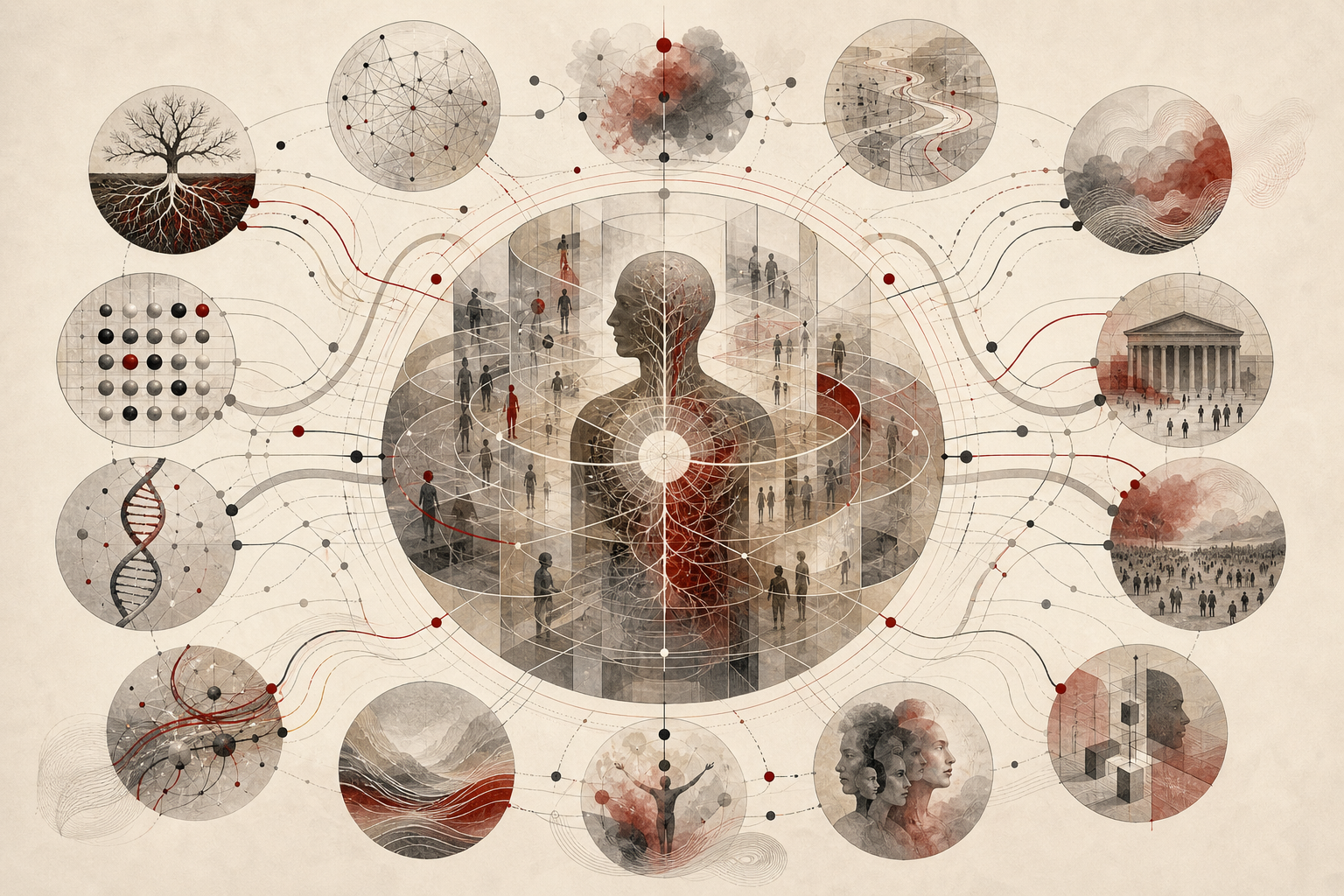
Personality psychology appears here not only as a descriptive science of traits, but also as a developmental, biological, psychometric, motivational, clinical, moral, institutional, cultural, quantitative, and computational field. The aim of this article map is to preserve the conceptual richness of personality psychology while also showing how contemporary personality science increasingly relies on measurement rigor, longitudinal evidence, formal models, statistical inference, dynamic systems, reproducible workflows, and richer theories of selfhood.
The field matters because personality is one of the major ways human life becomes patterned. People are not simply isolated choices, momentary moods, or disconnected behaviors. They carry characteristic dispositions, interpretive styles, motives, self-narratives, vulnerabilities, values, and forms of self-regulation that shape relationships, work, health, leadership, creativity, institutional life, and moral responsibility. Personality psychology therefore provides one of the most consequential frameworks for understanding individuality, character, agency, stability, pathology, and change.
GitHub Repository
This knowledge series is supported by a companion computational repository with article-level folders, reproducible examples, synthetic datasets, documentation, psychometric-analysis workflows, trait-structure examples, personality-stability simulations, maladaptive-pressure models, lifespan-change scaffolding, intensive longitudinal examples, and scientific-computing workflows across Python, R, Julia, C++, Fortran, C, Rust, SQL, Go, and notebooks where appropriate.
Complete Code Repository
This repository supports the Personality Psychology article map with reproducible computational scaffolds for trait structure, psychometrics, personality stability, state variability, maladaptive personality, life outcomes, personality dynamics, and responsible interpretation.
Personality Psychology as a Foundational Science
Personality psychology occupies a foundational place within psychological science because it studies the architecture of individuality. Other fields often isolate particular processes such as memory, perception, emotion, social influence, motivation, or decision making. Personality psychology asks how those processes are organized within whole persons and why some patterns remain recognizably stable across time and circumstance. It examines why one person is habitually conscientious while another is unreliable, why one is emotionally resilient while another is chronically reactive, and why different individuals repeatedly seek novelty, power, intimacy, order, achievement, security, or recognition.
This foundational role does not mean that personality psychology replaces cognitive psychology, social psychology, developmental psychology, clinical psychology, neuroscience, ethics, sociology, or cultural analysis. Rather, it provides an integrating framework through which those fields can be understood at the level of persons. Cognitive processes unfold through characteristic interpretive habits. Social behavior is shaped by enduring dispositions and interpersonal styles. Developmental trajectories give personality its history. Clinical structure reveals when personality becomes rigid, conflicted, unstable, or harmful. Personality psychology therefore bridges description, development, measurement, biography, pathology, and moral seriousness.
Personality psychology also connects psychology to larger questions about character, identity, responsibility, leadership, creativity, institutional life, health, relationships, and social order. It is one of the few psychological fields in which factor structure, life history, selfhood, moral formation, and clinical interpretation can all become part of the same inquiry.
Personality Psychology as a Science of Structure, Continuity, and Change
Personality psychology may be understood as one of the great sciences of structure, continuity, and change. It asks what gives a person their characteristic form across time: their recurring patterns of thought, affect, desire, self-regulation, social interpretation, and action. Yet it also asks how those patterns develop, how they remain stable, how they are expressed differently across situations, and how they can change through maturation, role demands, therapy, crisis, practice, or sustained self-reflection.
This makes personality psychology different from a simple vocabulary of labels. Personality is not merely introverted or extraverted, agreeable or disagreeable, conscientious or impulsive. It includes trait structure, motives, goals, values, self-concept, affective style, identity, habits of interpretation, characteristic adaptations, self-regulation, and the stories through which persons make sense of their lives. It also includes maladaptive structures that shape suffering, conflict, rigidity, dependency, grandiosity, avoidance, instability, and harm.
Personality is therefore a systems-level problem. Persons are stable enough to be recognizable but variable enough to adapt. They are shaped by biology but not reducible to it. They are influenced by situations but not dissolved into them. They are measurable through psychometric methods, but not exhausted by test scores. Personality psychology is strongest when it treats the person as both pattern and history.
Personality Psychology as a Quantitative and Computational Science
Modern personality psychology is deeply quantitative. Personality is not directly observable in the way height or pulse is observable. It must be inferred from patterns: self-reports, informant ratings, repeated behaviors, longitudinal consistency, clinical observation, psychometric structure, and increasingly, intensive repeated measures and digital behavioral data. This makes personality science methodologically sophisticated. It depends on reliability, validity, construct definition, factor analysis, longitudinal modeling, measurement invariance, multi-method assessment, and careful interpretation.
This does not mean that personality psychology becomes a purely statistical field. Rather, it means that serious personality explanation often requires moving across modes of inquiry. A researcher may administer a personality inventory, estimate factor structure, test internal consistency, compare self-report with observer ratings, model life outcomes, examine longitudinal change, track within-person states, store repeated measures in SQL, document assumptions in notebooks, and interpret results through theories of traits, motives, selfhood, development, or maladaptive structure.
For that reason, this series treats mathematics, statistics, psychometrics, computational modeling, longitudinal methods, SQL metadata, reproducible notebooks, and open code repositories as increasingly important parts of personality literacy. Some articles remain primarily conceptual, historical, ethical, or theoretical. Others naturally require factor analysis, scale construction, reliability estimates, simulated trait data, stability models, dynamic state models, or reproducible code. The aim is not to reduce persons to numbers, but to build a Personality Psychology article map that reflects how the field is practiced when it is methodologically serious.
What Personality Psychology Studies
Personality psychology studies enduring patterns of thought, feeling, motivation, interpretation, self-regulation, and behavior. At the trait level, it examines broad and narrow dimensions of individual difference, including extraversion, agreeableness, conscientiousness, neuroticism, openness, honesty-humility, facets, metatraits, and alternative structural models. At the motivational level, it studies goals, values, needs, strivings, achievement, affiliation, power, security, recognition, moral commitment, and the architecture of desire.
At the selfhood level, personality psychology studies self-concept, self-esteem, self-knowledge, identity coherence, narrative identity, agency, self-deception, authenticity, and personal continuity. At the developmental level, it studies temperament, biology, behavior genetics, personality development, lifespan change, personality stability, role transitions, plasticity, and intervention. At the clinical level, it studies maladaptive personality, personality disorders, dimensional diagnosis, identity diffusion, defensive structure, rigidity, fragmentation, and pathology.
Personality psychology further studies the relation between persons and contexts. Traits are not expressed in a vacuum. They appear in situations, roles, relationships, institutions, cultures, and historical contexts. The field therefore studies both stable individual difference and the dynamics through which personality becomes enacted in real life.
What This Article Map Covers
This article map brings together the major domains through which personality psychology interprets patterned personhood. It includes foundational definitions, the history of personality psychology, traits, the lexical hypothesis, the Five-Factor Model, HEXACO, trait hierarchies, temperament, behavior genetics, the person-situation debate, personality dynamics, assessment, psychometrics, personality types, MBTI, motivation, values, self-concept, narrative identity, personal identity, lifespan personality development, personality change, psychodynamic theories, social-cognitive approaches, character, dark traits, maladaptive personality, personality disorders, wellbeing, health, relationships, work, leadership, institutions, political behavior, culture, universality, and creativity.
These domains differ in method, emphasis, and scale, but together they form a coherent intellectual project: the attempt to understand how persons become organized across time. Personality psychology is therefore not only a body of knowledge about individual differences. It is also a way of asking how stable patterns emerge, how they are measured, how they shape life outcomes, how they become ethically consequential, and how they remain open to development and change.
The series also treats personality psychology as a field that links the individual and the institutional. Personality matters for relationships, leadership, work culture, health behavior, resilience, trust, creativity, cooperation, conflict, moral responsibility, and public life. For that reason, the article map is designed not only to introduce personality concepts, but to clarify why personality reasoning remains indispensable for understanding the contemporary world.
Mathematics, Computation, and Modeling in Personality Psychology
Mathematics provides part of the formal language through which personality psychology understands stability, expression, structure, and change. Factor models clarify latent trait structure. Reliability estimates clarify measurement consistency. Longitudinal models clarify rank-order stability and mean-level change. Dynamic models clarify how states vary around traits. Logistic models clarify the conditions under which dispositions are expressed in particular contexts.
A simple recursive form can represent personality organization as stable but revisable over time:
P_{t+1} = P_t + \alpha T_t + \beta M_t + \gamma S_t + \delta R_t – \zeta D_t
\]
Interpretation: Personality organization at the next time point depends on prior personality organization, trait continuity, motivational reinforcement, situational shaping, reflective revision, and disorganizing pressure.
Here, \(P_t\) represents personality organization at time \(t\), \(T_t\) trait continuity and temperament-based stability, \(M_t\) motivational organization, \(S_t\) situational shaping and social-role influence, \(R_t\) reflective revision and self-regulation, and \(D_t\) disorganizing pressure such as stress, conflict, pathology, or instability.
The probability that a characteristic disposition is expressed in a given context can also be modeled as:
Pr(\text{trait expression}) = \frac{1}{1 + e^{-Z_i}}
\]
Interpretation: Trait expression can be modeled as a probability that rises or falls depending on disposition strength, goals, context, identity, and inhibiting costs.
The latent expression score can be represented as:
Z_i = \theta_0 + \theta_1 D_i + \theta_2 G_i + \theta_3 C_i + \theta_4 I_i – \theta_5 K_i
\]
Interpretation: A behavior becomes more likely when disposition, goal relevance, contextual affordance, and identity congruence support it, and less likely when countervailing costs or inhibition are high.
A broader semi-formal model treats personality organization as a function of structure, motive, selfhood, regulation, adaptation, biology, and conflict:
PO = f(TS, MO, SI, SR, AD, BV, CP)
\]
Interpretation: Personality organization depends on trait stability, motivational organization, identity integration, self-regulation, adaptive flexibility, biological constraint, and conflict or pathology.
A simple additive representation is:
PO = \beta_1 TS + \beta_2 MO + \beta_3 SI + \beta_4 SR + \beta_5 AD + \beta_6 BV – \beta_7 CP
\]
Interpretation: Personality organization increases with coherence, self-regulation, adaptive flexibility, and biological stability, while conflict, pathology, or disorganizing pressure reduce expected organization.
A simple state-expression model can clarify the relation between broad traits and momentary states:
S_{it} = \mu_i + \lambda X_t + \epsilon_{it}
\]
Interpretation: A personality state for person \(i\) at time \(t\) can be modeled as that person’s typical level, adjusted by situational conditions and momentary variation.
These formulations do not reduce personality to equations. They clarify central personality insights: enduring individuality is patterned, probabilistic, context-sensitive, developmentally shaped, measurable with caution, and open to gradual revision.
Computation is especially valuable where personality systems become too complex for simple verbal explanation. R supports psychometrics, factor analysis, reliability, regression, structural modeling, longitudinal models, visualization, and reproducible reports. Python supports trait simulation, personality-dynamics modeling, machine learning, text analysis, scale scoring, and data pipelines. Julia supports high-performance simulation and dynamic personality models. SQL supports structured inventory items, repeated assessments, participant metadata, outcome records, model outputs, and reproducible provenance. C++, Fortran, C, Rust, and Go support performance-sensitive simulation, command-line utilities, embedded research tools, and reproducible computational infrastructure.
Used carefully, mathematics and computation clarify personality assumptions rather than replacing human interpretation. They make it possible to ask how traits cluster, how stable patterns are measured, how states vary around dispositions, how role demands shape expression, how maladaptive pressure accumulates, and how personality change can be studied across time.
Major Domains of Personality Psychology
Personality psychology includes a wide range of major domains, each of which illuminates a different dimension of patterned individuality. Trait psychology studies relatively stable dimensions of difference, including broad domains, narrow facets, hierarchical structure, and alternative models such as HEXACO. Psychometrics studies how personality constructs are measured, validated, scored, compared, and interpreted. Temperament and behavior genetics study early individual differences, biological constraint, heritable variation, and gene-environment interplay.
Motivational approaches study goals, needs, values, strivings, desires, and the direction of action. Social-cognitive approaches study expectancies, appraisals, self-efficacy, schemas, goals, self-regulation, and if-then patterns of behavior. Narrative identity approaches study how people organize memory, suffering, aspiration, turning points, purpose, and self-understanding into life stories. Psychodynamic and depth approaches study conflict, defense, attachment, hidden motivation, and the internal structure of character.
Clinical personality research studies maladaptive personality, personality disorders, dimensional diagnosis, identity disturbance, rigidity, fragmentation, and dysfunction. Character and moral-personality research study virtue, honesty, responsibility, manipulation, dark traits, cruelty, integrity, and ethical patterning. Applied personality research studies health, wellbeing, relationships, work, leadership, creativity, political behavior, institutional conduct, and social functioning.
Why Personality Psychology Matters
Personality psychology matters because no serious account of human action can avoid enduring individuality. Institutions are inhabited by personalities. Relationships are shaped by personality. Judgment, responsibility, resilience, trust, ambition, creativity, conflict, and cooperation are filtered through stable dispositions and characteristic ways of interpreting the world. Personality is not destiny, but it is one of the most powerful recurring influences in human life.
The field also matters because it gives psychological precision to questions that everyday language often handles vaguely. People speak of character, temperament, authenticity, ego, ambition, resilience, narcissism, discipline, trustworthiness, and moral seriousness. Personality psychology clarifies which of these concepts can be measured, which are evaluative, which are developmental, which are clinical, and which require richer interpretation.
Finally, personality psychology matters because it links empirical science to ethical and institutional questions. Enduring traits can support reliability, creativity, care, courage, and leadership; they can also support manipulation, cruelty, impulsivity, avoidance, grandiosity, or instability. A mature personality psychology therefore helps explain not only how people differ, but why those differences matter for health, work, relationships, governance, and social life.
Personality Psychology and Human Self-Understanding
Personality psychology changes how human beings understand themselves because it shows that individuality is patterned. People are not merely momentary bundles of choice. They carry recurring dispositions, motives, interpretive habits, vulnerabilities, regulatory styles, and self-narratives that give shape to experience and action across time.
Yet personality psychology also complicates simple self-labeling. A person is not exhausted by a type code, trait score, diagnostic category, or popular assessment label. Traits describe tendencies, not total persons. Types simplify, but they can also flatten. Measurement clarifies, but it can also mislead when treated as complete self-knowledge. The field is strongest when it combines empirical rigor with humility about the depth of persons.
For that reason, personality psychology has philosophical as well as scientific significance. It raises enduring questions about selfhood, agency, character, change, authenticity, moral responsibility, identity, pathology, and the relation between stability and freedom. A serious Personality Psychology article map should therefore not end with trait models alone. It should clarify the wider implications of personality science for self-understanding, ethics, institutions, and human development.
Personality Psychology Article Map
The map below organizes the Personality Psychology knowledge series into conceptual domains, moving from foundational theory and trait structure toward biology, dynamics, measurement, motivation, selfhood, development, clinical structure, morality, social life, institutions, culture, creativity, and contemporary significance. Published articles are linked. Planned extensions remain unlinked and marked as planned.
The Personality Psychology article map is organized to move from foundational definitions and field history into traits, trait structure, temperament, behavior genetics, person-situation interaction, personality dynamics, measurement, typology, motivation, values, selfhood, narrative identity, lifespan development, psychodynamic structure, social-cognitive approaches, moral character, maladaptive personality, health, relationships, institutions, politics, culture, and creativity. Mathematics, R, Python, Julia, C++, Fortran, C, Rust, SQL, Go, and computational notebooks are integrated within the series where they deepen understanding, especially in areas such as factor analysis, scale reliability, latent traits, trait stability, longitudinal change, personality dynamics, maladaptive pressure, health outcomes, leadership fit, and reproducible personality-science workflows.
Foundations, History, and Trait Structure
- What Is Personality Psychology? Traits, Identity, Development, and Measurement — An opening article defining personality psychology as the study of enduring patterns of thought, feeling, motivation, interpretation, identity, development, and behavior.
- The History of Personality Psychology: From Characterology to Personality Science — An article on the movement from characterology, temperament, psychoanalysis, and typology toward modern trait science, psychometrics, and personality research.
- What Is a Trait? Stability, Disposition, and the Logic of Individual Difference — A foundational article on traits as relatively enduring tendencies that organize behavior, affect, cognition, and interpersonal style across situations.
- The Lexical Hypothesis and the Emergence of Trait Structure — A methodological and historical article on how natural language helped shape the scientific discovery of personality dimensions.
- The Five-Factor Model and the Architecture of Personality — A core article on extraversion, agreeableness, conscientiousness, neuroticism, openness, and the Big Five as a dominant modern trait framework.
- Beyond the Big Five: HEXACO, Hierarchies, and Alternative Structural Models — A treatment of honesty-humility, alternative dimensional models, and the continuing scientific debate over personality structure.
- Trait Hierarchies, Facets, and the Architecture of Personality — An article on broad domains, narrow facets, metatraits, hierarchical structure, and different levels of personality description.
Biology, Temperament, and Personality Dynamics
- Temperament, Biology, and the Early Foundations of Personality — An article on early reactivity, regulation, attentional style, emotionality, activity level, and the biological roots of later personality.
- Behavior Genetics and the Biological Basis of Personality — A study of heritability, gene-environment interplay, biological sensitivity, reinforcement systems, and the limits of genetic explanation.
- The Person–Situation Debate and the Problem of Behavioral Consistency — A major article on whether traits predict behavior across situations and how modern personality science reconciles stability with context.
- Personality Dynamics: Traits, States, and Situational Variability — An article on state fluctuations, situational signatures, within-person variability, and the dynamic expression of personality across contexts.
Measurement, Assessment, Types, and Psychometrics
- Measurement in Personality Psychology: Self-Report, Observer Ratings, and Psychometrics — A methodological article on reliability, validity, inventories, informant reports, behavioral indicators, construct validation, and personality assessment.
- Personality Types and Personality Traits: Categorical and Dimensional Models Compared — A comparison of categorical typologies and dimensional trait models, including their uses, limitations, and public appeal.
- The Myers-Briggs Type Indicator: History, Influence, and Scientific Critique — An article situating MBTI within the history and public culture of personality assessment while distinguishing it from the scientific core of personality psychology.
Motivation, Selfhood, Identity, and Development
- Motivation, Goals, and the Architecture of Desire — An article on achievement, power, affiliation, security, novelty, mastery, and the motivational systems that direct personality toward action.
- Values, Strivings, and the Direction of Personality — A treatment of personal values, life goals, strivings, commitments, and the directional structure of individuality.
- Self-Concept, Self-Esteem, and Self-Knowledge — An article on reflexive self-understanding, self-evaluation, self-discrepancy, confidence, authenticity, and self-knowledge.
- Narrative Identity and the Storied Self — A study of how persons organize memory, suffering, purpose, aspiration, turning points, and meaning into life stories.
- Selfhood, Agency, and Personal Identity in Personality Psychology — A philosophical and psychological article on agency, continuity, identity, responsibility, and the person as a structured self.
- Personality Development Across the Lifespan — An article on trait stability, mean-level change, role transitions, maturation, and personality development from childhood through old age.
- Can Personality Change? Stability, Intervention, and Plasticity — A focused treatment of whether personality can change, under what conditions, and how intervention, life experience, and deliberate practice affect personality.
Depth, Social Cognition, Morality, and Clinical Structure
- Psychodynamic Theories of Personality and the Hidden Structure of Character — An article on conflict, defense, attachment, unconscious process, emotional patterning, and the deeper architecture of character.
- Social-Cognitive Approaches to Personality: Goals, Appraisals, and Self-Regulation — A treatment of expectancies, appraisals, self-efficacy, goals, self-regulation, and characteristic ways of interpreting situations.
- Traits, Character, and Moral Evaluation — An article distinguishing descriptive traits from morally thick character concepts such as honesty, discipline, courage, care, and integrity.
- Dark Traits, Virtue, and the Moral Structure of Personality — A study of narcissism, Machiavellianism, psychopathy, cruelty, honesty-humility, virtue, and the moral significance of enduring personality patterns.
- Maladaptive Personality and the Border Between Normal and Clinical Structure — An article on rigid, unstable, harmful, or disorganizing personality patterns and the border between normal-range variation and pathology.
- Personality Disorders and Dimensional Diagnosis — A clinical article on personality disorders, dimensional models, identity disturbance, maladaptive traits, and diagnostic structure.
Health, Relationships, Institutions, Culture, and Creativity
- Personality, Wellbeing, and Mental Health — An article on personality as a predictor of stress, coping, mood, resilience, vulnerability, adaptation, and mental wellbeing.
- Personality and Physical Health Across the Lifespan — A treatment of personality, health behavior, stress exposure, sleep, addiction risk, treatment adherence, and long-run health outcomes.
- Personality, Relationships, and Social Functioning — An article on how traits, motives, attachment patterns, agreeableness, emotional stability, and self-regulation shape relationships and social life.
- Personality, Work, and Leadership — A study of personality in work settings, leadership, role fit, team behavior, reliability, ambition, creativity, and organizational effectiveness.
- Personality and Institutions: Leadership, Bureaucracy, and Social Order — An article on how enduring individuality enters institutional life through leadership style, bureaucratic conduct, trust, judgment, and role performance.
- Personality and Political Behavior — A treatment of personality, ideology, civic participation, authoritarianism, openness, threat sensitivity, trust, and political judgment.
- Personality, Culture, and the Problem of Universality — A cross-cultural article on whether personality dimensions are universal, culturally mediated, linguistically shaped, or historically variable.
- Personality, Creativity, and the Forms of Imagination — A capstone-style article on openness, imagination, divergent thinking, discipline, creative identity, temperament, and the personality structures that support creative life.
Planned Extensions
- Personality Psychology and Intensive Longitudinal Measurement (planned) — An article on experience sampling, daily diaries, repeated states, within-person variability, situational signatures, and the measurement of personality in motion.
- Personality Psychology and Moral Character (planned) — A focused article on the relation between traits, virtues, vices, responsibility, honesty, humility, compassion, courage, and moral formation.
- Personality Psychology and AI-Mediated Assessment (planned) — An article on personality prediction, algorithmic profiling, workplace assessment, digital behavior, privacy, validity, bias, and governance of personality inference.
- Personality Psychology and Life Outcomes (planned) — A study of how personality relates to health, education, work, relationships, wellbeing, civic life, leadership, and long-term adaptation.
- Personality Psychology and Clinical Formulation (planned) — An article on integrating trait models, maladaptive personality, identity structure, defensive style, interpersonal patterning, and dimensional diagnosis.
- Personality Psychology and Culture (planned) — A cross-cultural article on personality description, language, universality, measurement equivalence, local moral worlds, and culturally shaped selfhood.
This structure keeps the article map grounded in personality psychology while reflecting the psychometric, longitudinal, computational, developmental, clinical, ethical, and humanistic depth of contemporary personality science.
Measurement, Psychometrics, and Personality Practice
One of personality psychology’s enduring contributions is its insistence that familiar language about persons must be disciplined by measurement. People constantly make personality judgments in everyday life, but scientific personality psychology asks whether those judgments can be made reliable, valid, comparable, and interpretable. That requires self-report inventories, observer ratings, behavioral evidence, factor analysis, reliability testing, construct validation, longitudinal designs, measurement invariance, and multi-method interpretation.
This matters because personality language can easily become careless. Labels can harden into stereotypes. Type systems can become identity shortcuts. Trait scores can be mistaken for total self-knowledge. Psychometrics does not solve every problem, but it helps personality psychology distinguish stronger constructs from weaker ones, valid instruments from popular ones, and evidence-based interpretation from casual description.
Modern personality practice increasingly depends on reproducible workflows. Studies generate item-level responses, scale scores, reliability estimates, factor loadings, longitudinal measurements, observer reports, clinical indicators, and life-outcome data. A serious Personality Psychology article map should therefore treat measurement, assessment ethics, psychometrics, data provenance, and interpretive caution as central to the study of personality.
Personality Psychology, Technology, and the Modern World
Personality psychology has become increasingly important because modern life is saturated with systems that classify, predict, personalize, and evaluate people. Hiring platforms, leadership assessments, educational tools, wellness apps, recommendation systems, social media profiles, AI companions, dating platforms, and behavioral analytics all make assumptions about personality, preference, identity, or stable behavioral tendency.
The connection between personality and technology is especially visible in digital profiling, algorithmic personalization, personality assessment at work, online identity, self-presentation, recommender systems, and AI-mediated social interaction. These systems can support self-understanding or improve fit, but they can also flatten persons into reductive categories, overclaim predictive power, reproduce bias, or turn personality into a commodity.
A mature personality psychology of technology must therefore ask how assessment systems are built, validated, governed, and interpreted. It must distinguish scientific personality measurement from pop typology, responsible prediction from surveillance, and useful self-knowledge from algorithmic overreach.
Personality Psychology, Computation, and Personality Simulation
Computation has become central to personality psychology because personality systems are patterned, dynamic, and longitudinal. Traits remain stable but are expressed through states. Goals organize behavior but change across roles. Self-regulation buffers stress. Maladaptive pressure can erode integration. Personality changes slowly, but repeated contexts and sustained interventions can shift trajectories over time.
Personality simulation allows researchers to formalize assumptions about trait stability, state variability, situational affordance, goal relevance, identity congruence, and developmental change. A model can test how self-regulation buffers maladaptive pressure, how role demands amplify conscientiousness, how stress increases emotional volatility, or how identity integration changes over time. These models do not replace human interpretation, but they clarify mechanisms and generate hypotheses.
For that reason, this article map treats computation as a supporting discipline of personality psychology, not as a substitute for the person. Models must remain transparent, empirically grounded, ethically responsible, and attentive to context, culture, pathology, and lived complexity. The strongest form of computational personality psychology is therefore not reductive prediction, but auditable reasoning about patterned individuality.
R Section: Modeling Traits, Reliability, and Personality Outcomes
For analytical readers, R is useful for estimating trait scales, reliability, factor-like structure, regression models, longitudinal stability, and relationships between personality and life outcomes. The example below creates a synthetic personality dataset, computes simple scale scores, estimates internal consistency, and models wellbeing as a function of broad trait dimensions. It is not real research data. It is a reproducible scaffold for thinking clearly about personality measurement.
# Synthetic personality psychology model in R
# Educational example only.
# This script simulates personality inventory items, scale scores, reliability,
# and a simple outcome model.

# install.packages(c("tidyverse", "psych", "broom", "scales"))

library(tidyverse)
library(psych)
library(broom)
library(scales)

set.seed(42)

n <- 700

personality_data <- tibble(
  participant_id = 1:n,

  # Simulated latent trait tendencies
  extraversion_latent = rnorm(n, 0, 1),
  agreeableness_latent = rnorm(n, 0, 1),
  conscientiousness_latent = rnorm(n, 0, 1),
  emotional_stability_latent = rnorm(n, 0, 1),
  openness_latent = rnorm(n, 0, 1)
)

# Generate simple item responses from latent traits.
# Values are rescaled to a 1-5 style response range.
make_item <- function(latent_vector) {
  raw <- latent_vector + rnorm(length(latent_vector), 0, 0.65)
  pmin(pmax(round(scales::rescale(raw, to = c(1, 5))), 1), 5)
}

personality_items <- personality_data |>
  mutate(
    E1 = make_item(extraversion_latent),
    E2 = make_item(extraversion_latent),
    E3 = make_item(extraversion_latent),

    A1 = make_item(agreeableness_latent),
    A2 = make_item(agreeableness_latent),
    A3 = make_item(agreeableness_latent),

    C1 = make_item(conscientiousness_latent),
    C2 = make_item(conscientiousness_latent),
    C3 = make_item(conscientiousness_latent),

    ES1 = make_item(emotional_stability_latent),
    ES2 = make_item(emotional_stability_latent),
    ES3 = make_item(emotional_stability_latent),

    O1 = make_item(openness_latent),
    O2 = make_item(openness_latent),
    O3 = make_item(openness_latent)
  ) |>
  mutate(
    extraversion = rowMeans(across(c(E1, E2, E3))),
    agreeableness = rowMeans(across(c(A1, A2, A3))),
    conscientiousness = rowMeans(across(c(C1, C2, C3))),
    emotional_stability = rowMeans(across(c(ES1, ES2, ES3))),
    openness = rowMeans(across(c(O1, O2, O3))),

    wellbeing =
      35 +
      3.5 * extraversion +
      2.8 * agreeableness +
      4.2 * conscientiousness +
      5.0 * emotional_stability +
      1.8 * openness +
      rnorm(n, mean = 0, sd = 6)
  )

# Estimate internal consistency for each simple scale.
alpha_extraversion <- psych::alpha(personality_items |> select(E1, E2, E3))
alpha_agreeableness <- psych::alpha(personality_items |> select(A1, A2, A3))
alpha_conscientiousness <- psych::alpha(personality_items |> select(C1, C2, C3))
alpha_emotional_stability <- psych::alpha(personality_items |> select(ES1, ES2, ES3))
alpha_openness <- psych::alpha(personality_items |> select(O1, O2, O3))

print(alpha_extraversion$total$raw_alpha)
print(alpha_agreeableness$total$raw_alpha)
print(alpha_conscientiousness$total$raw_alpha)
print(alpha_emotional_stability$total$raw_alpha)
print(alpha_openness$total$raw_alpha)

# Model wellbeing from broad personality traits.
wellbeing_model <- lm(
  wellbeing ~ extraversion + agreeableness + conscientiousness +
    emotional_stability + openness,
  data = personality_items
)

wellbeing_summary <- tidy(wellbeing_model, conf.int = TRUE)

print(wellbeing_summary)

# Summarize wellbeing by conscientiousness band.
conscientiousness_summary <- personality_items |>
  mutate(conscientiousness_band = cut(
    conscientiousness,
    breaks = c(1, 2.5, 3.5, 5),
    labels = c("Lower conscientiousness", "Moderate conscientiousness", "Higher conscientiousness"),
    include.lowest = TRUE
  )) |>
  group_by(conscientiousness_band) |>
  summarise(
    mean_wellbeing = mean(wellbeing),
    mean_emotional_stability = mean(emotional_stability),
    .groups = "drop"
  )

print(conscientiousness_summary)

ggplot(conscientiousness_summary, aes(x = conscientiousness_band, y = mean_wellbeing)) +
  geom_col() +
  labs(
    title = "Synthetic Wellbeing by Conscientiousness Band",
    x = "Conscientiousness band",
    y = "Mean wellbeing"
  ) +
  theme_minimal()
This workflow models a basic personality-science intuition: personality claims depend on measurement quality. Trait scores are not self-evident truths. They are constructed from items, scales, reliability assumptions, validity evidence, and interpretive choices. In real research, scale construction requires far more rigorous testing, including factor structure, measurement invariance, construct validity, convergent evidence, discriminant evidence, and ethical interpretation. In an article-map context, the value of the workflow is conceptual clarity: it shows how personality constructs become analyzable without pretending that persons are reducible to scores.
Python Section: Simulating Personality Stability, States, and Change
Python is useful for simulating personality dynamics that unfold across time. Traits can be relatively stable while states fluctuate. Situations can temporarily shift behavior. Stress can increase volatility. Self-regulation can buffer maladaptive pressure. Role demands can gradually reinforce certain patterns. The example below creates a simple personality simulation in which trait-like tendencies shape state expression while life contexts and stress alter momentary behavior.
# Synthetic personality dynamics simulation in Python
# Educational example only.
# This script simulates trait stability, state variability, and gradual change.

import numpy as np
import pandas as pd
import matplotlib.pyplot as plt

np.random.seed(42)

n_people = 120
n_days = 180

# Stable trait-like tendencies.
conscientiousness_trait = np.random.normal(loc=0.0, scale=1.0, size=n_people)
emotional_stability_trait = np.random.normal(loc=0.0, scale=1.0, size=n_people)
openness_trait = np.random.normal(loc=0.0, scale=1.0, size=n_people)

# Person-level self-regulation and stress exposure.
self_regulation = np.random.uniform(0.25, 1.0, size=n_people)
baseline_stress = np.random.uniform(0.00, 1.0, size=n_people)

# Track daily conscientious behavior as a state.
daily_state = np.zeros((n_days, n_people))
trait_change = np.zeros((n_days, n_people))

current_conscientiousness = conscientiousness_trait.copy()
trait_change[0, :] = current_conscientiousness

for day in range(n_days):
    situational_demand = np.random.uniform(0.0, 1.0, size=n_people)

    daily_stress = np.clip(
        0.65 * baseline_stress + 0.35 * np.random.uniform(0.0, 1.0, size=n_people),
        0,
        1
    )

    # State expression is shaped by trait tendency, situation, stress, and self-regulation.
    state_expression = (
        0.70 * current_conscientiousness
        + 0.35 * situational_demand
        + 0.25 * self_regulation
        - 0.30 * daily_stress
        + np.random.normal(0, 0.35, size=n_people)
    )

    daily_state[day, :] = state_expression

    # Repeated situational demand and self-regulation can slowly shift trait-like tendency.
    if day < n_days - 1:
        small_change = (
            0.006 * situational_demand
            + 0.004 * self_regulation
            - 0.005 * daily_stress
            + np.random.normal(0, 0.01, size=n_people)
        )

        current_conscientiousness = current_conscientiousness + small_change
        trait_change[day + 1, :] = current_conscientiousness

daily_summary = pd.DataFrame({
    "day": np.arange(1, n_days + 1),
    "mean_conscientious_state": daily_state.mean(axis=1),
    "state_variability": daily_state.var(axis=1),
    "mean_trait_tendency": trait_change.mean(axis=1)
})

print(daily_summary.head())
print(daily_summary.tail())

plt.figure(figsize=(10, 6))
plt.plot(daily_summary["day"], daily_summary["mean_conscientious_state"])
plt.xlabel("Day")
plt.ylabel("Mean conscientious state")
plt.title("Synthetic Personality State Expression Over Time")
plt.tight_layout()
plt.show()

plt.figure(figsize=(10, 6))
plt.plot(daily_summary["day"], daily_summary["mean_trait_tendency"])
plt.xlabel("Day")
plt.ylabel("Mean trait-like tendency")
plt.title("Synthetic Gradual Personality Change Over Time")
plt.tight_layout()
plt.show()

# Compare final trait-like tendency by self-regulation group.
regulation_group = np.where(
    self_regulation >= np.median(self_regulation),
    "Higher self-regulation",
    "Lower self-regulation"
)

comparison = pd.DataFrame({
    "person": np.arange(n_people),
    "regulation_group": regulation_group,
    "initial_conscientiousness": conscientiousness_trait,
    "final_conscientiousness": trait_change[-1, :]
})

comparison["change"] = comparison["final_conscientiousness"] - comparison["initial_conscientiousness"]

print(
    comparison.groupby("regulation_group")["change"]
    .agg(["mean", "std", "min", "max"])
)
This simulation is intentionally modest. It does not claim that personality change can be explained by a few variables. Its value is that it makes assumptions visible. Traits can be stable without being frozen. States can vary without destroying personality continuity. Situations can shape expression. Repeated roles and self-regulatory practice can alter trajectories gradually. Personality psychology is most convincing when it can hold stability and change together.
Interpretive Limits and Personality Cautions
Personality psychology is powerful because it gives language to enduring individuality. Yet the same strength can become a weakness when personality language becomes too rigid, reductive, or morally careless. A trait score is not a person. A type label is not an identity. A diagnosis is not a total biography. A statistical pattern is not a destiny. A predictive model is not a complete account of agency, responsibility, or change.
Analysts and readers should therefore avoid confusing measurement with self-knowledge, stability with inevitability, personality difference with moral hierarchy, or assessment utility with total validity. Personality psychology can clarify tendencies, but it must remain attentive to context, culture, development, trauma, disability, class, power, role constraint, and the moral danger of labeling people too quickly.
The field is strongest when it combines scientific discipline with interpretive humility. It should not be used to sort people into simplistic categories, justify exclusion, overclaim predictive authority, pathologize difference, or turn human complexity into workplace branding. Its better purpose is explanatory and humane: to understand patterned personhood so that self-understanding, relationships, institutions, clinical care, and public life can become more responsible.
Personality Psychology in a Wider Intellectual Context
Personality psychology belongs not only to psychology, but to the broader history of human thought about character, temperament, selfhood, virtue, vice, identity, agency, and moral life. Philosophers, theologians, physicians, novelists, educators, political theorists, and moralists have long asked why people differ, why some patterns endure, why some persons become trustworthy or destructive, and how character is formed.
The field changes the imagination of the person. It shows that individuality is neither a mystical essence nor a superficial label. It is a structured pattern of dispositions, motives, self-understandings, vulnerabilities, and adaptive styles that emerges through biology, development, culture, and life experience. It also shows that persons can be measured without being exhausted by measurement, and interpreted without being reduced to story alone.
For that reason, personality psychology should be understood as both a scientific and humanistic achievement. It brings together psychometrics, development, biology, clinical theory, moral psychology, narrative identity, social life, institutions, and computational analysis in a sustained effort to understand patterned personhood. It remains indispensable for any serious framework concerned with character, leadership, wellbeing, ethics, institutions, creativity, pathology, and human individuality.
Related Reading
- Psychology
- Cognitive Psychology
- Social Psychology
- Developmental Psychology
- Positive Psychology
- Organizational Psychology
- Institutional Psychology
- Analytical Psychology, Symbolism, and the Depth Mind
- Behavioral Economics
- Moral Psychology
- Systems Thinking
- Data Systems & Analytics
Further Reading
- American Psychological Association (n.d.) Personality. Available at: https://www.apa.org/topics/personality.
- American Psychological Association (n.d.) Personality trait. APA Dictionary of Psychology. Available at: https://dictionary.apa.org/personality-trait.
- American Psychological Association (n.d.) Journal of Personality and Social Psychology. Available at: https://www.apa.org/pubs/journals/psp.
- Bleidorn, W. (2024) ‘Toward a theory of lifespan personality trait development’, Annual Review of Developmental Psychology, 6. Available at: https://www.annualreviews.org/content/journals/10.1146/annurev-devpsych-010923-101709.
- John, O.P., Robins, R.W. and Pervin, L.A. (eds.) (2008) Handbook of Personality: Theory and Research. 3rd edn. New York: Guilford Press.
- McAdams, D.P. (2015) The Art and Science of Personality Development. New York: Guilford Press.
- McCrae, R.R. and Costa, P.T. (2008) ‘The five-factor theory of personality’, in John, O.P., Robins, R.W. and Pervin, L.A. (eds.) Handbook of Personality: Theory and Research. 3rd edn. New York: Guilford Press, pp. 159–181.
- Roberts, B.W. and Yoon, H.J. (2022) ‘Personality psychology’, Annual Review of Psychology, 73, pp. 489–516. Available at: https://www.annualreviews.org/content/journals/10.1146/annurev-psych-020821-114927.
- Society for Personality and Social Psychology (n.d.) About SPSP. Available at: https://spsp.org/about.
References
- American Psychological Association (n.d.) Personality. Available at: https://www.apa.org/topics/personality.
- American Psychological Association (n.d.) Personality trait. APA Dictionary of Psychology. Available at: https://dictionary.apa.org/personality-trait.
- American Psychological Association (n.d.) Journal of Personality and Social Psychology. Available at: https://www.apa.org/pubs/journals/psp.
- Bleidorn, W. (2024) ‘Toward a theory of lifespan personality trait development’, Annual Review of Developmental Psychology, 6. Available at: https://www.annualreviews.org/content/journals/10.1146/annurev-devpsych-010923-101709.
- John, O.P., Robins, R.W. and Pervin, L.A. (eds.) (2008) Handbook of Personality: Theory and Research. 3rd edn. New York: Guilford Press.
- McAdams, D.P. (2015) The Art and Science of Personality Development. New York: Guilford Press.
- McCrae, R.R. and Costa, P.T. (2008) ‘The five-factor theory of personality’, in John, O.P., Robins, R.W. and Pervin, L.A. (eds.) Handbook of Personality: Theory and Research. 3rd edn. New York: Guilford Press, pp. 159–181.
- Roberts, B.W. and Yoon, H.J. (2022) ‘Personality psychology’, Annual Review of Psychology, 73, pp. 489–516. Available at: https://www.annualreviews.org/content/journals/10.1146/annurev-psych-020821-114927.
- Society for Personality and Social Psychology (n.d.) About SPSP. Available at: https://spsp.org/about.