
Last Updated May 4, 2026
Islamic Medicine examines one of the major learned medical traditions in world history through diagnosis, regimen, pharmacology, surgery, hygiene, hospital care, medical ethics, case observation, manuscript culture, translation, commentary, and the organization of healing across Arabic, Persian, Syriac, Jewish, Christian, and wider Islamicate intellectual worlds. As a major category within the Healing Traditions knowledge series, it studies Islamic medicine first through primary medical texts, manuscript traditions, hospitals, clinical literature, pharmacological compendia, surgical works, philosophical sources, and institutional history, and only after that through modern scholarship and comparative medical history.
Islamic medicine is best understood neither as a simple continuation of Greek medicine nor as an isolated civilizational achievement detached from earlier or later worlds. Physicians working in Arabic, Persian, Syriac, Hebrew, and other scholarly languages drew on Greek, late antique, Syriac, Persian, Indian, and local medical materials, but they also reorganized, tested, commented on, expanded, and transmitted them in new ways. The writings of al-Rāzī, Ibn Sīnā, al-Zahrāwī, Ibn al-Nafīs, Ibn al-Bayṭār, and many others reveal a learned medical culture in which care was simultaneously practical, theoretical, ethical, textual, institutional, and intercivilizational.
This category explores translation movements, Galenic inheritance, Arabic medical manuscripts, bīmāristāns, medical ethics, clinical observation, case histories, humoral regimen, pharmacy, materia medica, ophthalmology, surgery, anatomy, cardiopulmonary circulation, public hygiene, hospitals, dispensaries, medical education, al-Andalus, eastern Islamic medical centers, Arabic-Latin translation, and the long transmission of medical knowledge into Europe and other regions. It treats Islamic medicine as a complex historical archive requiring careful study rather than simplified celebration.
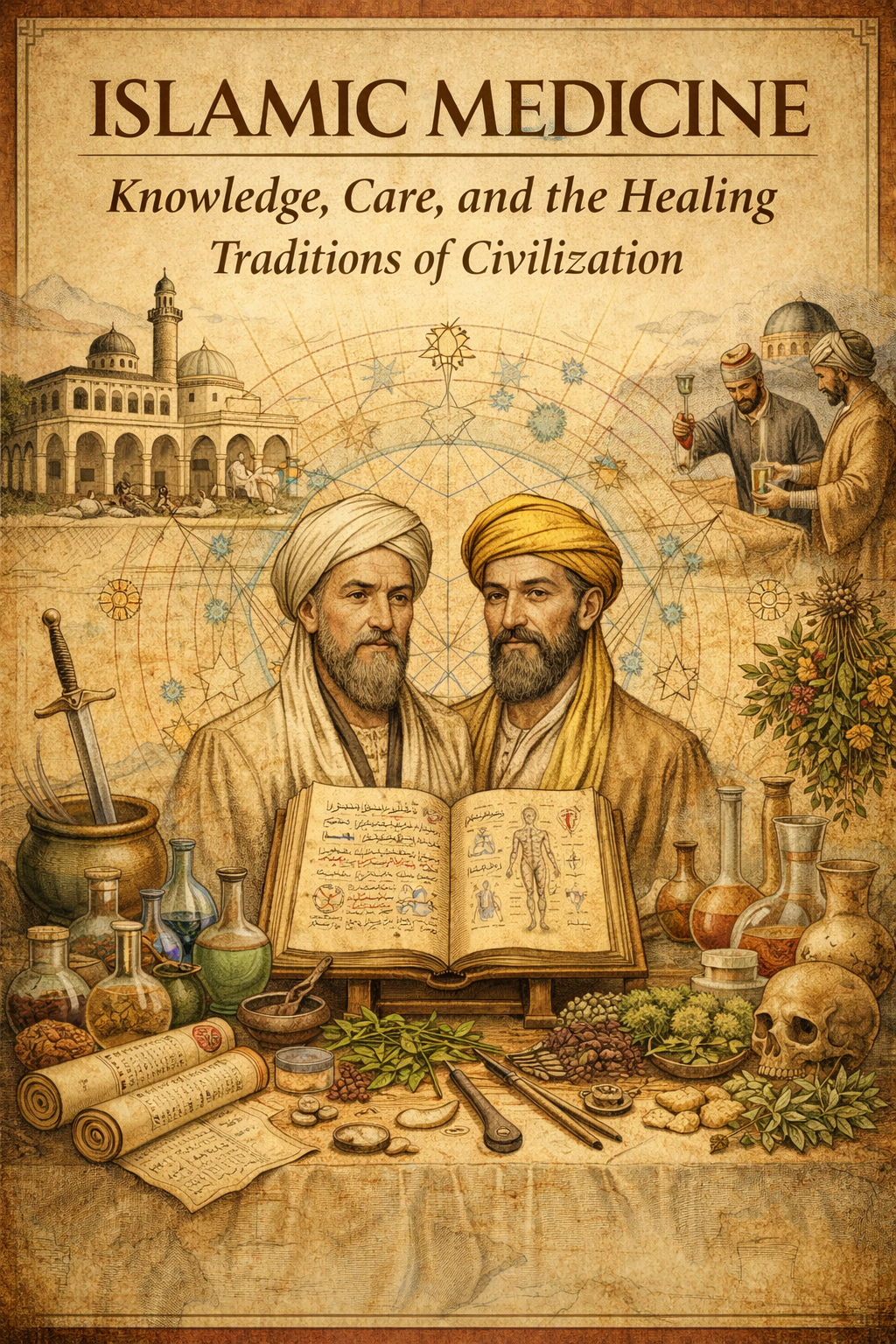
Islamic medicine matters because it preserves a distinctive conception of the physician’s task. Healing was understood not merely as intervention against disease, but as disciplined knowledge ordered toward balance, regimen, prognosis, therapeutics, ethical responsibility, and the organization of care. Clinical observation, case-based reasoning, pharmacological compilation, surgical refinement, ophthalmological specialization, and hospital practice were cultivated within a wider moral and intellectual framework.
This category is especially important within the wider study of healing traditions because it connects Healing Traditions to Greek & Roman Medicine, Ancient Near Eastern and Mediterranean Healing Traditions, Herbalism & Traditional Knowledge, Healing Spaces, Baths & Sacred Environments, Religious Studies, Islamic Mystical Thought, Arabian and Levantine Thought, Persian Thought, Biology, and Ethics & Moral Philosophy. It shows how medical knowledge moves across languages, institutions, philosophical systems, and communities of practice.
The goal of this pillar is not to present Islamic medicine through a triumphalist narrative, nor to reduce it to famous names and isolated discoveries. It is to understand the tradition as a layered medical culture shaped by translation, commentary, observation, hospitals, pharmacology, surgical craft, philosophical reasoning, manuscript circulation, and the practical demands of care. A serious scholarly treatment must attend to both the grandeur and the complexity of its sources, institutions, actors, and historical settings.
Why This Series Matters
Islamic medicine matters because it represents one of the major medical traditions through which ancient, late antique, and medieval knowledge was preserved, reorganized, expanded, and transmitted. It was not merely a bridge between Greek antiquity and Latin Europe. It was a complex medical world in its own right, with physicians, hospitals, pharmacies, manuscripts, formularies, surgical texts, philosophical debates, clinical observations, ethical writings, and institutional systems of care.
The tradition also matters because it shows medicine as an intercivilizational field. Medical learning in the Islamic world drew on Greek, Syriac, Persian, Indian, and local traditions, but it did not simply receive them passively. It translated, compared, classified, criticized, reinterpreted, and extended earlier knowledge. Translation was not mechanical transfer. It was intellectual transformation.
Islamic medicine also widens the meaning of medical history by bringing institutions into view. The bīmāristān was not only a symbol of charitable care; it was an organized setting of treatment, teaching, pharmacy, administration, and clinical practice. Hospitals, dispensaries, libraries, teaching circles, and manuscript workshops made medicine social and institutional as well as textual.
This series therefore matters for anyone studying the history of healing, the history of science, the movement of knowledge across languages, the relationship between medicine and philosophy, and the social organization of care. It shows that medical traditions are built through translation, practice, observation, ethics, infrastructure, and disciplined preservation.
Scope and Orientation
Islamic medicine is best approached as a learned medical tradition rather than a loose collection of remedies or a sequence of biographical sketches about famous physicians. The subject includes translation and commentary, humoral medicine, regimen, pharmacology, surgery, hospital practice, ophthalmology, anatomy, pulse and urine diagnosis, medical ethics, public hygiene, and the institutional settings in which physicians were trained and texts were copied.
The term “Islamic medicine” should also be handled with precision. It does not refer only to medicine practiced by Muslims or to explicitly religious healing. It refers broadly to medical knowledge produced within Islamic civilization and its surrounding intellectual worlds, especially in Arabic and Persian, but also through Syriac, Hebrew, Latin, and other languages. Many contributors to this tradition were Muslim, but Christian, Jewish, and other scholars also participated in the same medical culture.
The tradition is not geographically or temporally uniform. Medicine in Baghdad, Damascus, Cairo, Cordoba, Isfahan, Bukhara, and later Ottoman, Safavid, Mughal, and other contexts did not remain identical. It changed across centuries through courts, hospitals, libraries, scholarly patronage, regional schools, translation movements, manuscript circulation, and practical needs of care.
A scholarly account should therefore resist two distortions. The first is reduction: treating Islamic medicine as a derivative continuation of Greek medicine. The second is romanticization: presenting the tradition as an uncomplicated golden age. Islamic medicine is better understood as a layered historical field: inherited and original, textual and clinical, philosophical and practical, institutional and regional, continuous and contested.
Islamic Medicine as a Learned Medical Tradition
Islamic medicine became a learned tradition because it developed institutions, texts, authorities, methods, and standards of training. Physicians did not only learn recipes. They studied anatomy, physiology, pulse, urine, regimen, pharmacology, surgery, prognosis, ethics, and the philosophical foundations of nature and causation. Medical knowledge was written, copied, commented on, taught, debated, and refined.
This learned character matters because it distinguishes Islamic medicine from a purely local or household healing repertoire. Household remedies and popular practices certainly existed, but the major medical authors worked within a scholarly environment shaped by books, translation, philosophy, pharmacy, case experience, and institutional care. Medicine became part of a wider intellectual order that also included logic, natural philosophy, astronomy, mathematics, theology, and law.
The physician’s authority depended on knowledge, judgment, experience, and moral conduct. A medical text was not merely a list of treatments; it was an instrument for training perception, reasoning, diagnosis, and therapeutic choice. In this sense, Islamic medicine was a discipline of interpretation as well as intervention.
Its learned character also explains its long afterlife. Because medical knowledge was preserved in encyclopedias, compendia, manuscripts, commentaries, and teaching traditions, it could travel into other languages and institutions. Islamic medicine became durable because it was archived, taught, and transmitted.
Translation, Commentary, and Transformation
Translation was one of the major conditions for the development of Islamic medicine. Greek medical works associated with Hippocrates, Galen, Dioscorides, and others entered Arabic through Syriac and Greek translation networks. This process was especially important in Abbasid intellectual culture, where scientific and philosophical materials were collected, translated, studied, and incorporated into new scholarly frameworks.
Translation, however, should not be understood as passive preservation. Translators and scholars had to select terms, clarify concepts, resolve ambiguities, compare manuscripts, comment on difficult passages, and make inherited knowledge usable within new linguistic and intellectual settings. Translation was interpretation. Commentary was transformation.
The medical translation movement also made possible a new kind of synthesis. Once Greek, Syriac, Persian, and other materials were available in Arabic, physicians could compare them, criticize them, expand them, and integrate them into encyclopedic systems. This is one reason Islamic medicine became so rich: it had access to multiple inherited medical worlds and the intellectual tools to reorganize them.
A strong article series should therefore treat translation not as background but as central medical infrastructure. Without translation, there could be no Arabic Galenism, no encyclopedic synthesis on the same scale, and no later Arabic-Latin transmission of medical knowledge into European universities.
Greek, Syriac, Persian, and Indian Legacies
Islamic medicine developed through a wide inheritance. Greek medicine supplied major frameworks of humoral theory, anatomy, regimen, prognosis, and philosophical medicine. Syriac Christian scholars played a crucial role in translation and intellectual transmission. Persian administrative and institutional traditions contributed to the wider setting in which medicine was organized. Indian medical materials also entered some streams of Islamic scientific and medical culture, especially through pharmacological, mathematical, astronomical, and courtly exchange.
This inheritance matters because Islamic medicine was never a sealed system. It was intercultural from the beginning. Its most influential works often represent synthesis: Greek theoretical medicine reorganized in Arabic; Persian and courtly settings of patronage; Syriac translation networks; practical hospital environments; local substances and pharmacological traditions; and later transmission into Hebrew and Latin.
At the same time, inherited knowledge did not remain unchanged. Physicians in the Islamic world developed new encyclopedias, criticized earlier authorities, documented cases, expanded pharmacology, refined surgery, organized hospital care, and produced their own intellectual authorities. Inheritance became a basis for new scholarship.
This makes Islamic medicine an especially important case for studying knowledge circulation. Medical traditions do not belong permanently to one civilization. They move through languages, institutions, courts, libraries, patients, trade routes, and teaching settings.
Manuscripts and the Medical Archive
Islamic medicine is inseparable from manuscript culture. Medical works circulated through copied texts, commentaries, glosses, abridgments, encyclopedias, pharmacological catalogues, surgical manuals, hospital formularies, and case materials. The manuscript was not merely a container of knowledge. It was part of the medical system itself: a technology of preservation, teaching, comparison, and transmission.
This manuscript culture matters because it reveals medicine as cumulative and interpretive. A medical text could be copied, corrected, excerpted, reorganized, taught, and translated. Authority accumulated not only through direct clinical experience but through the written survival of earlier observations, arguments, and remedies.
Manuscripts also complicate the idea of a single stable tradition. Different copies may preserve variations. Texts may be abridged, commented on, or reorganized. A medical work’s influence often depends not only on its author but on the history of its copying, circulation, teaching, and later reception.
A serious pillar should therefore include manuscript history as a major line of inquiry. Islamic medicine survives not only through ideas but through archives, catalogues, libraries, scribes, marginal notes, translations, and the material life of books.
Medicine and Philosophy
Medicine and philosophy were deeply connected in the Islamic intellectual world. Many major physicians were also philosophers or worked in intellectual environments shaped by logic, natural philosophy, metaphysics, ethics, and theories of causation. Medicine required reasoning about nature, body, soul, temperament, causality, evidence, and the relation between universal principles and particular cases.
This connection is especially visible in figures such as al-Rāzī and Ibn Sīnā. Their medical work cannot be fully separated from broader debates about reason, experience, nature, soul, and the structure of knowledge. For Ibn Sīnā especially, medicine belongs within a larger philosophical system of ordered knowledge.
Medicine also provided philosophy with concrete problems. How can hidden causes be inferred from visible signs? What is the relation between body and soul? How should universal theory guide treatment of a particular patient? What role should experience play in correcting inherited authority? These are medical questions and philosophical questions at once.
For this pillar, the medicine-philosophy relationship is central. Islamic medicine was not merely a technical craft. It was part of a learned culture in which healing, logic, ethics, natural philosophy, and observation were mutually connected.
Humoral Balance, Temperament, and Regimen
Islamic medicine inherited and developed humoral frameworks from Greek medicine, especially through Galenic sources. Health was often understood as the proper balance of humors, qualities, temperament, and bodily processes, while disease could result from imbalance, excess, deficiency, corruption, environmental influence, diet, age, season, or improper regimen.
Humoral theory mattered because it gave physicians a structured way to connect the body to diet, climate, habit, age, constitution, and therapeutic intervention. A patient was not treated as an abstract disease-carrier. The physician considered temperament, strength, season, food, environment, and the progression of symptoms.
Regimen was therefore central. Diet, sleep, exercise, bathing, evacuation, emotional moderation, air, climate, and daily habits all belonged to medical reasoning. The physician was responsible not only for treating disease but for advising ordered life.
This humoral and regimental framework connects Islamic medicine strongly to Greek and Roman medicine, but it also developed in new institutional and textual settings. Islamic physicians inherited Galenic medicine, but they also reorganized it through encyclopedias, commentaries, hospital practice, pharmacology, and clinical experience.
Diagnosis, Signs, and Clinical Reasoning
Islamic medicine placed great importance on diagnosis and the interpretation of signs. Pulse, urine, complexion, temperature, pain, appetite, sleep, stool, breathing, swelling, wounds, and the course of symptoms could all become medically meaningful. Diagnosis required observation, questioning, comparison, inference, and judgment.
Pulse and urine diagnosis were especially important within the inherited Galenic tradition. These methods allowed physicians to infer internal bodily conditions through visible or tangible signs. They were not isolated techniques but part of a broader medical semiotics: the body expressed disorder through signs that the trained physician had to interpret.
Clinical reasoning also required matching general knowledge to particular cases. A physician might know the theoretical categories of disease, but the patient’s age, strength, temperament, environment, and disease stage mattered. Medicine therefore required practical judgment rather than mechanical application of theory.
This diagnostic orientation shows Islamic medicine as a disciplined art of reading the body. It also prepares the way for later attention to case histories, observational reports, and the refinement of clinical knowledge through experience.
Case Histories and Medical Experience
Case histories and experience-based medical writing are important because they show Islamic medicine as practiced rather than only theorized. Terms such as tajārib and mujarrabāt are associated with experience, tried remedies, or tested observations, and they reveal a practical dimension of medical literature concerned with what had been seen, attempted, and found useful.
This material matters because it complicates the image of Islamic medicine as purely scholastic. Physicians did not only reproduce inherited authorities. They observed patients, recorded experiences, compared outcomes, and preserved practical lessons. Case-based material gives modern readers access to the encounter between theory and lived illness.
Clinical experience could confirm, refine, or challenge inherited knowledge. It could also preserve unusual cases, successful remedies, failures, therapeutic adjustments, and the physician’s reasoning process. Medical knowledge therefore developed through practice as well as textual authority.
A serious article series should give case histories sustained attention. They are one of the clearest places where the history of medicine becomes the history of patients, symptoms, decisions, uncertainty, and care.
Al-Rāzī and Clinical Intelligence
Al-Rāzī, known in Latin as Rhazes, is one of the major figures in Islamic medicine. He is associated with clinical observation, practical medicine, philosophical controversy, and major medical writings, including the vast al-Ḥāwī. His work shows the physician as compiler, observer, critic, philosopher, and practitioner.
Al-Rāzī is especially important because he represents a strong empirical and clinical tendency within the tradition. His medical writing often preserves observations, comparisons, and practical judgments. He drew on earlier authorities, but he was not merely submissive to them. He could compare inherited knowledge with experience and clinical reasoning.
His importance also lies in the breadth of his intellectual life. Al-Rāzī’s philosophical positions were sometimes controversial, and his medical work belongs within a broader intellectual profile shaped by reason, experiment, ethics, and independent judgment. This makes him a particularly rich figure for studying the relationship between medicine and philosophy.
A dedicated article on al-Rāzī should avoid simple praise and instead examine his method: compilation, observation, criticism, practical medicine, and the tension between inherited authority and clinical judgment.
Ibn Sīnā and the Encyclopedic Ordering of Medicine
Ibn Sīnā, known in Latin as Avicenna, is one of the most influential physicians and philosophers in world history. His al-Qānūn fī al-ṭibb, or Canon of Medicine, became a central organizing text in Islamic medicine and later Latin medical education. Its influence came not only from the information it contained, but from the systematic architecture through which it organized medical knowledge.
Ibn Sīnā’s importance lies in synthesis. He brought together inherited Greek medicine, philosophical reasoning, clinical knowledge, pharmacology, physiology, diagnosis, and therapeutics into a structured encyclopedic form. The Canon helped make medicine teachable, portable, and systematic.
His work also shows how medicine could be integrated into a broader philosophical worldview. The body, soul, nature, causation, knowledge, and healing were not isolated subjects. They belonged to an ordered intellectual system.
A serious treatment of Ibn Sīnā should therefore focus not only on biography or influence, but on the architecture of knowledge. The Canon mattered because it organized medicine into a coherent system that later physicians, translators, teachers, and institutions could use.
The Canon of Medicine and the Architecture of Medical Knowledge
The Canon of Medicine is one of the most important medical encyclopedias in world history. It organizes general principles, simple drugs, diseases of particular organs, systemic diseases, and compound remedies in a structure that made it highly teachable and durable. Its later use in Latin Europe and other settings reflects its extraordinary authority as a medical textbook.
The Canon matters because it shows medical knowledge becoming architectonic. Instead of preserving scattered observations, it builds a system. That system includes theory, diagnosis, therapeutics, pharmacology, regimen, and disease classification. It turns medicine into an organized body of knowledge that can be studied in sequence.
Its influence also raises historical questions. Canonical texts preserve knowledge, but they can also constrain later inquiry when authority hardens. The Canon became powerful because it was systematic, but its systematization also shaped what later physicians considered authoritative.
A dedicated article on the Canon should therefore treat it as both achievement and institution: a book, a curriculum, a medical system, and a vehicle of transmission across languages and centuries.
Al-Zahrāwī and the Surgical Tradition
Al-Zahrāwī, known in Latin as Abulcasis, is central to the history of surgery. His al-Taṣrīf includes important material on surgical procedures, instruments, cautery, obstetrics, dentistry, wound care, and technical intervention. It demonstrates that Islamic medicine was not only theoretical, philosophical, or pharmacological. It included practical craft knowledge and procedural skill.
Surgery matters because it places the physician in direct relation to the wounded or suffering body. Instruments, manual skill, anatomical awareness, risk, pain, and aftercare become central. Al-Zahrāwī’s work is especially important because it preserves surgical tools and procedures in written form, making technical practice part of the medical archive.
This surgical tradition also connects Islamic medicine to earlier and later procedural medicine. It draws from inherited traditions while shaping later Latin surgical knowledge. The movement of al-Taṣrīf into Latin medical worlds gave al-Zahrāwī long influence beyond al-Andalus.
A serious article on al-Zahrāwī should treat surgery as material knowledge: tools, hands, wounds, bodies, risk, training, and the preservation of craft through text and illustration.
Ibn al-Nafīs and Anatomical Revision
Ibn al-Nafīs is especially important for his discussion of pulmonary circulation and his critique of aspects of Galenic anatomy. His work shows that Islamic medicine could revise inherited authority through anatomical reasoning and critical interpretation. He is often discussed in relation to the history of cardiopulmonary circulation.
His significance lies not simply in priority claims, but in the presence of medical critique. Ibn al-Nafīs did not merely transmit Galen. He engaged inherited anatomy critically and proposed corrections where he judged the inherited account inadequate. This makes him a key figure for understanding intellectual independence within the tradition.
Anatomical revision also reveals the limits and possibilities of premodern medical knowledge. Without modern experimental physiology, physicians still reasoned carefully about bodily structures, pathways, and functions. Their conclusions were shaped by available methods, textual inheritance, and philosophical commitments.
A dedicated article should therefore situate Ibn al-Nafīs within the broader history of medical critique, anatomy, circulation, and the reinterpretation of Galenic authority.
Ibn al-Bayṭār and Pharmacological Knowledge
Ibn al-Bayṭār is one of the major figures in the history of pharmacology and materia medica. His work on simple drugs gathered, classified, and transmitted knowledge about plants, minerals, animal substances, therapeutic uses, and medical substances from across a wide geographical world.
Pharmacology was one of the strongest practical branches of Islamic medicine. It connected medicine to botany, trade, agriculture, regional environments, pharmacy, hospitals, markets, and textual compilation. The physician and pharmacist depended not only on theory, but on knowledge of substances, preparation, dosage, combination, and quality.
Ibn al-Bayṭār’s importance also reflects the geographic breadth of Islamic medical culture. Medicinal substances moved across regions through trade, travel, gardens, markets, courtly patronage, and scholarly collection. Materia medica was therefore both scientific and ecological: it depended on plants, landscapes, classification, and material exchange.
A dedicated article on Ibn al-Bayṭār should explore pharmacology as a major knowledge system rather than a secondary branch of medicine. It is one of the places where Islamic medicine became most practical, environmental, and globally connected.
Pharmacy, Materia Medica, and Compound Remedies
Islamic medicine developed sophisticated traditions of pharmacy and materia medica. Physicians and pharmacists worked with simple drugs, compound remedies, syrups, electuaries, ointments, oils, powders, distillates, and other preparations. Pharmacological knowledge required classification, preparation, dosage, storage, substitution, and quality control.
This branch matters because it shows medicine as material practice. A remedy is not merely an idea. It must be sourced, prepared, combined, administered, and monitored. Pharmacy links medical theory to substances, markets, gardens, trade routes, hospitals, and dispensaries.
Compound remedies also reveal combinatory intelligence. Substances could be selected to strengthen, moderate, direct, balance, or counteract one another. Medical preparation required judgment about the patient, disease, temperament, potency, and interaction of ingredients.
A serious pillar should therefore give pharmacy and materia medica sustained attention. Islamic medicine was not only a tradition of theory and texts; it was also a tradition of substances, preparation, practical skill, and organized dispensing.
Bīmāristāns and the Institutional Life of Healing
The bīmāristān is one of the most important institutions in the history of Islamic medicine. Hospitals in the medieval Islamic world could function as places of treatment, teaching, pharmacy, administration, and charitable care. They demonstrate that medicine was not only private practice or book learning. It was organized socially through institutions.
This matters because institutions shape medical knowledge. Hospitals bring patients, physicians, students, remedies, records, routines, and administration into one setting. They create opportunities for observation, teaching, treatment, and comparison. They also reflect social commitments to organized care.
The bīmāristān should not be romanticized as identical to the modern hospital. Its structure, functions, religious and charitable context, staffing, patient population, and medical practices differed from modern institutions. But it remains historically significant as a durable institution of organized healing.
A dedicated article on bīmāristāns should examine hospital space, treatment, teaching, pharmacy, administration, endowments, social welfare, and the relationship between medical knowledge and institutional care.
Hospitals, Dispensaries, and Medical Teaching
Hospitals and dispensaries made Islamic medicine practical and institutional. Care required buildings, staff, medicines, teaching, administration, and routines. Pharmacy and hospital practice were closely related because organized treatment depended on access to prepared remedies and trained personnel.
Medical teaching also took place through texts, apprenticeship, lectures, clinical settings, and scholarly circles. The transmission of medicine depended on both books and embodied instruction. A student had to learn not only what a text said, but how to observe patients, choose treatments, prepare remedies, and practice responsibly.
Hospitals also raise questions of access and social order. Who received care, under what conditions, and through what forms of charity, patronage, or institutional support? These questions prevent the history of Islamic medicine from becoming only the history of elite authors.
A serious treatment should therefore study the social life of medicine: not only what physicians wrote, but where patients were treated, how remedies were supplied, how knowledge was taught, and how institutions organized care.
Hygiene, Environment, and Public Health
Islamic medicine included attention to hygiene, environment, regimen, air, water, food, climate, bathing, and the conditions that sustain or weaken health. This concern belongs partly to inherited humoral medicine and partly to wider religious, civic, and practical cultures of cleanliness, urban life, diet, and bodily discipline.
Environmental thinking mattered because the body was not understood in isolation. Air, water, food, season, housing, exercise, rest, occupation, and climate all shaped bodily balance. Preventive medicine therefore required attention to living conditions.
Hygiene also connected medicine to social practice. Bathing, cleanliness, food safety, waste, water access, and urban organization all affected health. While premodern public health should not be equated with modern epidemiology, it nonetheless reflects an important recognition that health depends on conditions beyond the individual patient.
This section creates a natural bridge to environmental health, public health history, and healing spaces. Islamic medicine should be studied not only through texts and physicians, but also through the conditions of life that physicians sought to regulate.
Ethics and the Figure of the Physician
Medical ethics was central to Islamic medicine. The physician was expected to possess knowledge, discipline, sound judgment, moral responsibility, and concern for the patient’s welfare. Care required more than technical skill. It required proper conduct, trustworthiness, restraint, and ethical use of knowledge.
This ethical dimension matters because medicine creates asymmetry. The patient is vulnerable; the physician has knowledge and authority. That relationship requires moral discipline. A physician who knows remedies but lacks judgment or integrity is dangerous.
Islamic medical ethics also developed in relation to broader religious and philosophical ideas about human responsibility, charity, reason, and the moral use of knowledge. Medicine was a service to life, not merely a career of technical expertise.
A dedicated article on the physician’s ethics should examine conduct, trust, responsibility, patient care, teaching, professional identity, and the moral limits of medical authority.
Al-Andalus, the Eastern Islamic World, and Regional Medical Cultures
Islamic medicine was not confined to one center. Baghdad, Damascus, Cairo, Cordoba, Kairouan, Isfahan, Bukhara, and many other cities contributed to the development and circulation of medical knowledge. Al-Andalus played a particularly important role in the western Islamic world, while eastern Islamic centers developed their own scholarly and institutional traditions.
Regional medical cultures matter because they prevent Islamic medicine from being treated as a single uniform system. Local plants, climates, institutions, courts, languages, scholarly networks, and patient populations shaped medical practice. A text might travel widely, but practice was always situated.
Al-Andalus is especially important because of figures such as al-Zahrāwī and because of the later movement of Arabic medical knowledge into Latin Europe. Eastern centers were equally important for the development of encyclopedic medicine, hospital practice, philosophy, and pharmacology.
A scholarly pillar should therefore include regional diversity. Islamic medicine was a world of many centers, not a single school.
Arabic-Latin Translation and Transmission to Europe
Arabic-Latin translation was one of the major processes through which Islamic medical knowledge entered medieval European education. Works by Ibn Sīnā, al-Rāzī, al-Zahrāwī, and others became part of the Latin medical curriculum. The movement of texts through translation centers helped reshape European medicine for centuries.
This transmission matters because it shows medicine as trans-civilizational. Greek medical knowledge moved into Arabic, was reorganized and expanded, then moved into Latin and other languages. The history of medicine is therefore not a linear story of one civilization replacing another, but a history of repeated translation, commentary, adaptation, and institutional reuse.
Transmission also transformed the materials it carried. A text translated into Latin entered new universities, theological contexts, medical faculties, and intellectual debates. Its meaning changed as its institutional setting changed.
A dedicated article should therefore study Arabic-Latin translation as a medical event, not merely a linguistic one. Translation changed what medicine was, who could study it, and how inherited knowledge was organized.
Historiography and the Problem of Civilization Narratives
Islamic medicine is often presented through simplified civilization narratives. One version treats it as a golden age of scientific brilliance. Another treats it as a mere bridge preserving Greek knowledge for Europe. Both framings are inadequate. The first risks romantic celebration; the second reduces Islamic medicine to a service role in European history.
A better historiography treats Islamic medicine as a complex tradition with its own internal debates, institutions, limitations, achievements, and afterlives. It inherited earlier knowledge, transformed it, generated new authorities, built institutions of care, developed pharmacology and surgery, preserved clinical materials, and transmitted knowledge widely.
This approach also recognizes plurality. Islamic medicine included Muslim, Christian, Jewish, and other actors; Arabic, Persian, Syriac, Hebrew, and Latin contexts; courtly and hospital medicine; elite encyclopedias and practical manuals; eastern and western regional traditions. The field is too complex for one civilizational slogan.
A serious pillar should therefore make historiography visible. How Islamic medicine is narrated matters because those narratives shape whether the tradition is understood as scholarly history, civilizational pride, derivative transmission, or living archive. The strongest approach is precise, comparative, critical, and historically grounded.
Core Themes in This Series
One major theme in this field is translation: the movement of medical knowledge across Greek, Syriac, Arabic, Persian, Hebrew, and Latin scholarly worlds. A second is transformation: inherited materials were reorganized through commentary, encyclopedias, hospitals, pharmacology, and clinical practice. A third is institution: the bīmāristān, pharmacy, library, dispensary, and teaching setting made care organized and durable.
A fourth theme is clinical observation: diagnosis, signs, case histories, experience, and practical judgment shaped medical reasoning. A fifth is pharmacology: materia medica, simple drugs, compound remedies, and pharmacy formed one of the strongest branches of the tradition. A sixth is ethics: the physician’s conduct and responsibility were central to the moral identity of medicine.
Additional themes include philosophy, the relation of medicine to logic and natural knowledge; surgery, especially through al-Zahrāwī; anatomical critique, especially through Ibn al-Nafīs; regional diversity, including al-Andalus and eastern Islamic centers; and historiographical caution, the need to avoid both triumphalist and reductive narratives.
Islamic Medicine Pillar Map
The following article map is designed as a research agenda for the Islamic Medicine pillar, with emphasis on translation, commentary, hospitals, medical ethics, major physicians, clinical observation, pharmacology, surgery, anatomy, regional diversity, transmission, and historiography.
Islamic Medicine is organized to move from foundational questions and intellectual context into translation, manuscripts, major physicians, hospitals, pharmacology, surgery, ethics, regional medical cultures, and transmission across languages. The goal is to treat Islamic medicine as a historically complex learned tradition: textual, clinical, institutional, philosophical, practical, and intercivilizational.
Foundations, Scope, and Historical Method
- What Is Islamic Medicine? (planned)
Introduces Islamic medicine as a learned medical tradition shaped by translation, clinical practice, pharmacology, surgery, ethics, and institutions of care. - Islamic Medicine in the History of Healing (planned)
Situates Islamic medicine within comparative medical history alongside Greek, Persian, Indian, Syriac, Jewish, Christian, and later European traditions. - Islamic Medicine and the Problem of Civilization Narratives (planned)
Examines why the tradition should be studied without reducing it to either golden-age celebration or passive transmission. - Medicine in the Intellectual World of Islamic Civilization (planned)
Studies medicine within the wider scholarly worlds of logic, philosophy, natural science, ethics, libraries, courts, and teaching institutions. - Islamic Medicine as a Multilingual and Multi-Religious Medical Culture (planned)
Explores the participation of Muslim, Christian, Jewish, Syriac, Persian, Arabic, Hebrew, and Latin actors in shared medical worlds. - Healing, Knowledge, and Care in the Islamicate World (planned)
Clarifies the distinction between explicitly religious healing and medicine produced in Islamic civilizational contexts.
Translation, Manuscripts, and Knowledge Transmission
- Translation, Commentary, and the Formation of Islamic Medical Knowledge (planned)
Examines how Greek and late antique medicine entered Arabic through translation, commentary, clarification, and reinterpretation. - Greek, Syriac, Persian, and Indian Legacies in Islamic Medicine (planned)
Studies the inherited medical worlds that shaped Islamic medicine and the ways physicians reorganized them. - The Arabic Medical Manuscript Tradition (planned)
Explores manuscripts as technologies of preservation, correction, commentary, teaching, and medical transmission. - Medical Encyclopedias and the Architecture of Knowledge (planned)
Studies how large medical compendia organized theory, diagnosis, pharmacy, treatment, and clinical reasoning. - Commentary, Abridgment, and Medical Teaching (planned)
Examines how medical texts were adapted for teaching, study, memorization, and practical use. - Arabic-Latin Translation and the Transmission of Medicine to Europe (planned)
Studies how Arabic medical works entered Latin medical education and reshaped European medical curricula.
Major Physicians and Medical Authorities
- Al-Rāzī and the Clinical Intelligence of Islamic Medicine (planned)
Studies al-Rāzī as physician, observer, compiler, critic, and philosopher of practical medical judgment. - Al-Rāzī’s al-Ḥāwī and the Practice of Medical Compilation (planned)
Examines al-Ḥāwī as a vast medical archive of inherited knowledge, experience, and clinical materials. - Ibn Sīnā and the Encyclopedic Ordering of Medicine (planned)
Explores Ibn Sīnā’s role in organizing medicine into a systematic philosophical and clinical architecture. - The Canon of Medicine and the Structure of Medical Knowledge (planned)
Studies the Canon as textbook, system, curriculum, and vehicle of medical transmission. - Al-Zahrāwī and the Surgical Tradition of al-Taṣrīf (planned)
Examines surgery, instruments, cautery, wounds, obstetrics, dentistry, and procedural medical knowledge. - Ibn al-Nafīs and the Revision of Medical Anatomy (planned)
Studies Ibn al-Nafīs through pulmonary circulation, anatomical critique, and the reinterpretation of Galenic authority. - Ibn al-Bayṭār and the Pharmacological Imagination (planned)
Explores materia medica, simple drugs, botanical knowledge, classification, and regional pharmacology. - Other Physicians in the Islamic Medical Tradition (planned)
Introduces additional physicians, translators, pharmacists, ophthalmologists, and compilers who shaped the medical archive.
Clinical Reasoning, Diagnosis, and Medical Practice
- Humoral Balance, Temperament, and Regimen (planned)
Studies the humoral framework, temperament, qualities, balance, diet, season, and the medical management of life. - Diet, Environment, and the Regulation of Health (planned)
Explores food, air, water, climate, sleep, exercise, bathing, and habit as medical concerns. - Pulse, Urine, and the Interpretation of Signs (planned)
Examines diagnostic semiotics and the reading of visible or tangible signs as evidence of internal disorder. - Case Histories and Medical Practice in the Islamic World (planned)
Studies tajārib, mujarrabāt, clinical reports, observation, practical judgment, and experience-based medicine. - Ophthalmology and Specialized Medical Practice (planned)
Examines eye disease, surgical skill, specialized treatises, and the importance of ophthalmology in Islamic medicine. - Women’s Health, Reproduction, and Household Care (planned)
Studies reproductive care, childbirth, gynecology, family medicine, and household healing within Islamic medical contexts. - Mental Disturbance, Soul, and Medical Psychology (planned)
Explores how physicians interpreted mental and emotional disturbance through body, soul, temperament, and regimen.
Pharmacy, Surgery, and Technical Knowledge
- Pharmacy and Materia Medica in Islamic Medicine (planned)
Introduces simple drugs, compound remedies, dispensaries, formularies, and pharmaceutical practice. - Simple Drugs, Compound Remedies, and Medical Preparation (planned)
Studies the classification, preparation, combination, and administration of therapeutic substances. - Plants, Minerals, Trade, and the Geography of Pharmacology (planned)
Connects materia medica to botany, regional environments, trade routes, markets, and ecological knowledge. - Surgery, Instruments, and Technical Intervention (planned)
Examines surgical tools, operative techniques, wound care, cautery, procedural training, and the preservation of craft knowledge. - Wounds, Trauma, and Practical Care (planned)
Studies injury, battlefield wounds, abscesses, fractures, pain, and the technical side of healing. - Medical Instruments and the Material Culture of Healing (planned)
Explores tools, vessels, surgical instruments, pharmacy equipment, manuscripts, and hospital material culture.
Hospitals, Institutions, and Social Organization of Care
- Bīmāristāns and the Institutional Life of Healing (planned)
Studies medieval Islamic hospitals as places of treatment, teaching, pharmacy, administration, and organized care. - Hospitals, Pharmacies, and Organized Care (planned)
Explores the relationship among hospital routines, dispensaries, remedies, staff, patients, and institutional knowledge. - Medical Teaching, Apprenticeship, and the Formation of Physicians (planned)
Examines how physicians learned through texts, teachers, practice, hospitals, and scholarly circles. - Libraries, Courts, and Patronage in Medical Knowledge (planned)
Studies how political patronage, libraries, and scholarly institutions shaped the preservation and production of medicine. - Hygiene, Environment, and Public Health in Islamic Medical Thought (planned)
Explores cleanliness, water, air, bathing, urban life, diet, and the environmental conditions of health. - Care, Charity, and the Social Ethics of Healing (planned)
Examines medicine as a form of social obligation, charitable institution, and ethical service to vulnerable bodies.
Ethics, Philosophy, and Natural Knowledge
- Islamic Medicine and the Ethics of the Physician (planned)
Studies professional conduct, responsibility, moral discipline, patient welfare, and the ethical use of medical knowledge. - Medicine, Philosophy, and Natural Knowledge (planned)
Examines the relation between medicine, logic, natural philosophy, causation, soul, body, and intellectual method. - Reason, Experience, and Authority in Islamic Medicine (planned)
Explores how physicians balanced inherited authority, observation, reasoning, and practical experience. - Body, Soul, and the Philosophical Physician (planned)
Studies medical anthropology, psychology, embodiment, and the relationship between physical and mental life. - Medical Error, Uncertainty, and the Limits of Care (planned)
Examines how physicians confronted uncertainty, failed treatment, incurability, prognosis, and professional humility.
Regions, Transmission, and Comparative Contexts
- Medical Learning in al-Andalus (planned)
Studies the western Islamic medical world, including surgery, translation, courtly learning, and transmission into Latin Europe. - Medical Learning in Baghdad and the Eastern Islamic World (planned)
Explores translation, hospitals, courts, libraries, philosophy, and encyclopedic medicine in eastern centers. - Persian Medical Traditions and the Wider Islamicate World (planned)
Examines Persian-language medicine, courtly medicine, later regional traditions, and the continuation of Islamic medical learning. - Islamic Medicine and Jewish Medical Scholarship (planned)
Studies Jewish physicians writing in Arabic, Hebrew, and other languages within shared medical and philosophical worlds. - Islamic Medicine in Comparative Perspective (planned)
Compares Islamic medicine with Greek and Roman medicine, Ayurveda, Chinese medicine, and later European medical traditions. - Islamic Medicine Between Classical Theory and Modern Historiography (planned)
Concludes the series by examining how Islamic medicine has been narrated, contested, simplified, and reinterpreted in modern scholarship.
This structure keeps the category scholarly, historically grounded, and non-promotional. It presents Islamic medicine as a complex medical tradition shaped by translation, manuscript culture, institutions, clinical reasoning, pharmacology, surgery, ethics, and intercivilizational transmission.
Closing Perspective
Islamic Medicine gives the Healing Traditions knowledge series one of its most important historical and intellectual pillars. It shows how medicine can become a disciplined tradition of translation, commentary, clinical observation, institutional care, pharmacology, surgery, ethical conduct, and philosophical reflection. It also shows how medical knowledge travels: across languages, religions, regions, courts, hospitals, libraries, and universities.
The strongest reason to study this field is that it resists simple categories. Islamic medicine was inherited and original, Greek and Arabic, textual and practical, philosophical and clinical, regional and transregional, institutional and personal. It preserved earlier knowledge while also changing it. It organized care through hospitals and pharmacies while also building vast written archives. It produced famous physicians, but it also depended on translators, scribes, pharmacists, students, patients, and institutions.
As a field of study, Islamic medicine is most valuable when approached with precision. It should not be treated as a civilizational slogan or a decorative historical achievement. It should be studied as a complex body of medical knowledge shaped by specific texts, practices, institutions, and historical conditions. Its significance lies in that complexity.
Related Reading
- Healing Traditions
- Greek & Roman Medicine
- Ancient Near Eastern and Mediterranean Healing Traditions
- Herbalism & Traditional Knowledge
- Healing Spaces, Baths & Sacred Environments
- Diet, Nourishment & Food as Medicine
- Ayurveda and South Asian Healing Traditions
- Chinese Medicine
- African Healing Traditions
- Religious Studies
- Islamic Mystical Thought
- Arabian and Levantine Thought
- Persian Thought
- Ethics & Moral Philosophy
- Biology
Primary Sources and Archives
- Ibn Sīnā, al-Qānūn fī al-ṭibb / The Canon of Medicine: One of the most influential medical encyclopedias in world history and a central organizing text in Islamic and later Latin medical education.
- Al-Rāzī, al-Ḥāwī fī al-ṭibb / The Comprehensive Book on Medicine: A major compendium associated with clinical observation, compilation, practical medicine, and the preservation of medical experience.
- Al-Zahrāwī, al-Taṣrīf: Foundational for the surgical tradition and for the history of medical instruments, operative technique, and procedural medicine.
- Ibn al-Nafīs, anatomical and medical writings: Important for anatomical critique and the history of cardiopulmonary circulation.
- Ibn al-Bayṭār, pharmacological writings: Important for materia medica, botany, pharmacy, and the classification of therapeutic substances.
- National Library of Medicine, Islamic Medical Manuscripts: Bio-Bibliographies: A major resource for physicians, texts, and manuscript history in the Arabic medical tradition. Available at: https://www.nlm.nih.gov/hmd/arabic/bioI.html (Accessed: 4 May 2026).
- National Library of Medicine, Islamic Medical Manuscripts: Catalogue – Encyclopedias: Useful for manuscript descriptions of medical encyclopedias and related texts. Available at: https://www.nlm.nih.gov/hmd/arabic/E8.html (Accessed: 4 May 2026).
Internal Interpretive Traditions
- Galenic and Hippocratic traditions in Arabic: Humoral theory, regimen, anatomy, prognosis, and philosophical medicine as translated, commented on, and reorganized in Arabic medical culture.
- Clinical and hospital traditions: Bīmāristāns, teaching settings, case observation, dispensaries, pharmacy, and organized institutional care.
- Pharmacological traditions: Simple drugs, compound remedies, materia medica, botanical classification, pharmacy, and regional substances.
- Surgical traditions: Al-Zahrāwī, instruments, cautery, wound care, obstetrics, dentistry, and technical intervention.
- Philosophical-medical traditions: Medicine in relation to logic, natural philosophy, ethics, causation, body, soul, and the ordered study of nature.
- Manuscript and commentary traditions: Copying, glossing, abridgment, teaching, translation, and the long material life of medical texts.
- Regional medical traditions: Baghdad, Damascus, Cairo, Cordoba, Isfahan, Bukhara, al-Andalus, and other centers of medical learning and practice.
Modern Scholarship
- Amr, S.S. and Tbakhi, A. Work on Ibn Sīnā and the medical tradition.
- Iskandar, A.Z. Work on Islamic medical manuscripts and bio-bibliography.
- Martini Bonadeo, C. Work on Abū Bakr al-Rāzī.
- Miller, T.S. and Alkhateeb Sheibani, A. Work on the medieval Islamic hospital.
- Millán, C.Á. Work on case histories in medieval Islamic medical literature.
- West, J.B. Work on Ibn al-Nafīs and pulmonary circulation.
- Hasse, D.N. Work on Arabic and Islamic influence on the Latin West.
- Scholarship on Arabic-Latin translation, hospital institutions, pharmacology, surgery, and manuscript transmission.
Further Reading
- Amr, S.S. and Tbakhi, A. (2007) ‘Ibn Sina (Avicenna): The Prince of Physicians’, Annals of Saudi Medicine. Available at: https://pmc.ncbi.nlm.nih.gov/articles/PMC6077049/ (Accessed: 4 May 2026).
- Hasse, D.N. (2008) ‘Influence of Arabic and Islamic Philosophy on the Latin West’, Stanford Encyclopedia of Philosophy. Available at: https://plato.stanford.edu/entries/arabic-islamic-influence/ (Accessed: 4 May 2026).
- Iskandar, A.Z. (n.d.) ‘Islamic Medical Manuscripts: Bio-Bibliographies – I’. National Library of Medicine. Available at: https://www.nlm.nih.gov/hmd/arabic/bioI.html (Accessed: 4 May 2026).
- Iskandar, A.Z. (n.d.) ‘Islamic Medical Manuscripts: Catalogue – Encyclopedias’. National Library of Medicine. Available at: https://www.nlm.nih.gov/hmd/arabic/E8.html (Accessed: 4 May 2026).
- Martini Bonadeo, C. (2025 archive) ‘Abū Bakr al-Rāzī’, Stanford Encyclopedia of Philosophy. Available at: https://plato.stanford.edu/archives/fall2025/entries/abu-bakr-al-razi/ (Accessed: 4 May 2026).
- Miller, T.S. and Alkhateeb Sheibani, A. (2015) The Medieval Islamic Hospital. Cambridge: Cambridge University Press. Available at: https://www.cambridge.org/core/books/medieval-islamic-hospital/6038FE27C86A675A7CA62352EA51972E (Accessed: 4 May 2026).
- Millán, C.Á. (2010) ‘The Case History in Medieval Islamic Medical Literature: Tajārib and Mujarrabāt as Source’, Medical History. Available at: https://pmc.ncbi.nlm.nih.gov/articles/PMC2844281/ (Accessed: 4 May 2026).
- West, J.B. (2008) ‘Ibn al-Nafis, the pulmonary circulation, and the Islamic Golden Age’, Journal of Applied Physiology. Available at: https://pmc.ncbi.nlm.nih.gov/articles/PMC2612469/ (Accessed: 4 May 2026).
References
- Amr, S.S. and Tbakhi, A. (2007) ‘Ibn Sina (Avicenna): The Prince of Physicians’, Annals of Saudi Medicine. Available at: https://pmc.ncbi.nlm.nih.gov/articles/PMC6077049/ (Accessed: 4 May 2026).
- Encyclopaedia Britannica (2026) ‘The Canon of Medicine’. Available at: https://www.britannica.com/topic/The-Canon-of-Medicine (Accessed: 4 May 2026).
- Hasse, D.N. (2008) ‘Influence of Arabic and Islamic Philosophy on the Latin West’, Stanford Encyclopedia of Philosophy. Available at: https://plato.stanford.edu/entries/arabic-islamic-influence/ (Accessed: 4 May 2026).
- Iskandar, A.Z. (n.d.) ‘Islamic Medical Manuscripts: Bio-Bibliographies – I’. National Library of Medicine. Available at: https://www.nlm.nih.gov/hmd/arabic/bioI.html (Accessed: 4 May 2026).
- Iskandar, A.Z. (n.d.) ‘Islamic Medical Manuscripts: Catalogue – Encyclopedias’. National Library of Medicine. Available at: https://www.nlm.nih.gov/hmd/arabic/E8.html (Accessed: 4 May 2026).
- Martini Bonadeo, C. (2025 archive) ‘Abū Bakr al-Rāzī’, Stanford Encyclopedia of Philosophy. Available at: https://plato.stanford.edu/archives/fall2025/entries/abu-bakr-al-razi/ (Accessed: 4 May 2026).
- Miller, T.S. and Alkhateeb Sheibani, A. (2015) The Medieval Islamic Hospital. Cambridge: Cambridge University Press. Available at: https://www.cambridge.org/core/books/medieval-islamic-hospital/6038FE27C86A675A7CA62352EA51972E (Accessed: 4 May 2026).
- Millán, C.Á. (2010) ‘The Case History in Medieval Islamic Medical Literature: Tajārib and Mujarrabāt as Source’, Medical History. Available at: https://pmc.ncbi.nlm.nih.gov/articles/PMC2844281/ (Accessed: 4 May 2026).
- West, J.B. (2008) ‘Ibn al-Nafis, the pulmonary circulation, and the Islamic Golden Age’, Journal of Applied Physiology. Available at: https://pmc.ncbi.nlm.nih.gov/articles/PMC2612469/ (Accessed: 4 May 2026).