
Last Updated June 24, 2026
Geopolitics and global order examine how power, geography, institutions, historical memory, economic systems, military capacity, technological infrastructure, and strategic interests shape the international system. From great power competition to international organizations, from maritime chokepoints to digital infrastructure, from alliance systems to debt regimes, and from colonial legacies to emerging multipolarity, geopolitics studies how states and other actors pursue security, influence, autonomy, and order within a world that remains unequal, contested, and deeply interconnected.
This content pillar treats geopolitics not merely as the study of conflict among powerful states, but as a broad field for understanding how global order is made, maintained, challenged, and transformed. It examines territorial power, military strategy, energy systems, trade routes, international institutions, technological competition, sanctions, development, environmental stress, migration, demographic change, information systems, and the political economy of global hierarchy. It also foregrounds historical injustice, imperial and colonial legacies, unequal sovereignty, selective enforcement, Global South perspectives, nonalignment, dependency, and the different ways communities experience global order depending on their position within systems of power.
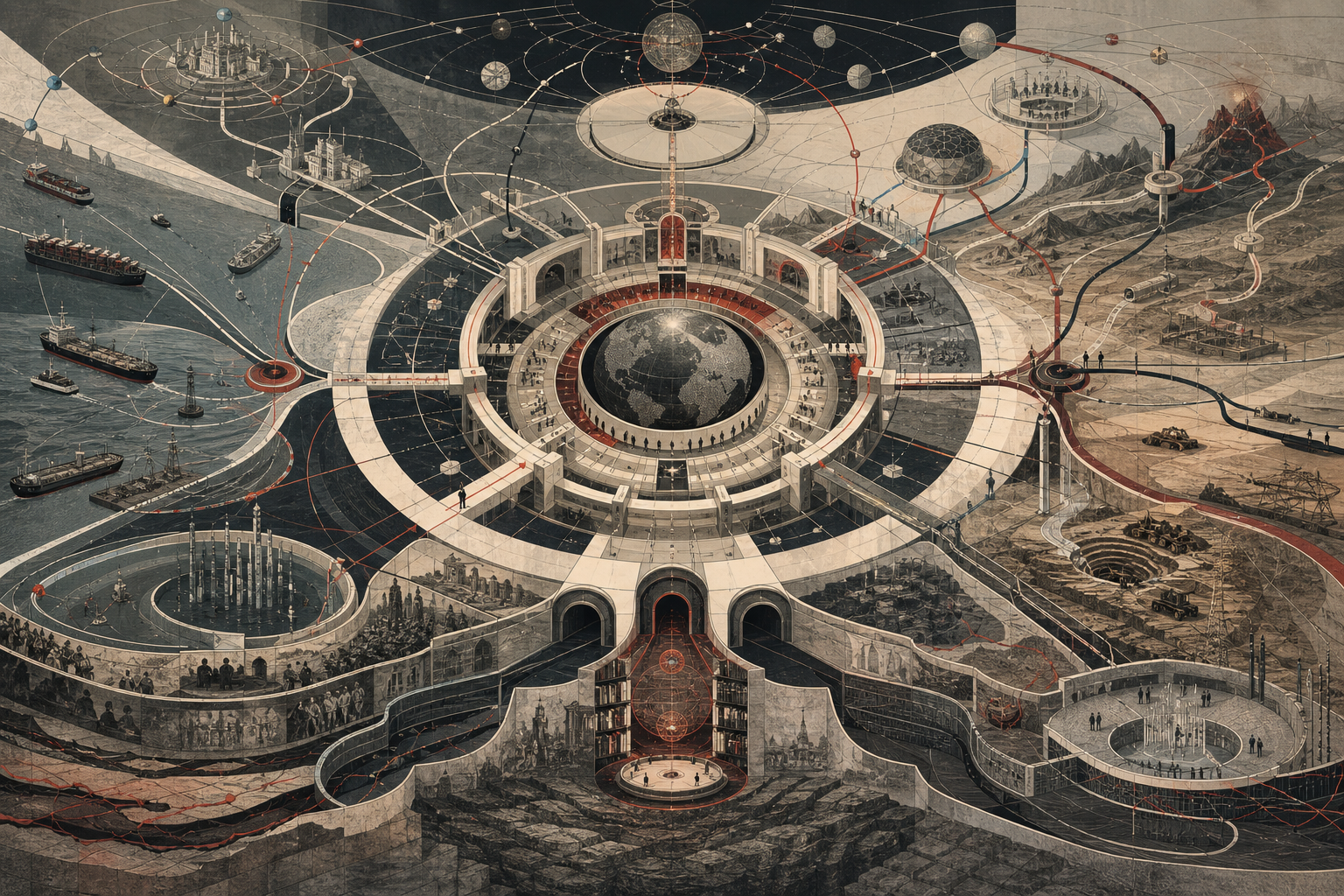
Geopolitics is the study of how geography, power, institutions, resources, technology, and strategic interests interact within the international system. Classical geopolitics emphasized territory, maritime power, land power, military strategy, and geographic constraint. Modern geopolitical analysis expands that field to include economic interdependence, supply chains, energy systems, development finance, sanctions, digital infrastructure, demographic change, climate stress, institutional legitimacy, and the political uses of information.
Global order refers to the structures, institutions, norms, hierarchies, and practices that organize relations among states and other actors. These include alliances, multilateral institutions, international legal frameworks, trade regimes, financial institutions, diplomatic norms, security architectures, development systems, and informal rules of influence. Global order does not eliminate conflict. It shapes how conflict is managed, how cooperation becomes possible, which actors gain voice, which actors are marginalized, and how power is translated into institutional authority.
This series approaches geopolitics and global order as a historically layered and materially grounded field. It treats power not only as military strength, but also as economic leverage, technological capacity, institutional influence, narrative authority, logistical control, monetary power, resource access, and the ability to define what counts as legitimate order. It asks not only how states compete, but also how empires decline, how institutions endure, how peripheral states navigate constraint, how nonaligned movements seek autonomy, and how global crises expose the uneven distribution of vulnerability.
Geopolitics & Global Order Research Repository
The companion repository for this knowledge series supports structured research on regions, actors, alliances, institutions, conflicts, strategic concepts, timelines, source hierarchy, article-roadmap planning, and SQL-backed mapping of geopolitical systems and global-order dynamics.
Geopolitics as a Foundational Field
Geopolitics occupies a central place in the study of world affairs because it explains how power becomes spatial, institutional, economic, military, technological, and historical. It begins with a simple but demanding insight: political order is never abstract. It is shaped by geography, resources, borders, seas, mountains, chokepoints, ports, production systems, populations, infrastructures, institutions, and the strategic calculations of actors seeking security and influence.
Classical geopolitics often focused on territorial control, land power, sea power, imperial competition, and the relationship between geography and state strategy. Those questions remain important, but the contemporary field is broader. Geopolitics now includes energy dependence, semiconductor supply chains, shipping lanes, sanctions networks, financial systems, data infrastructure, cyber operations, climate vulnerability, demographic pressure, and the institutional rules through which global power is organized.
This foundational role makes geopolitics indispensable for understanding global order. It shows why alliances form, why institutions endure or fail, why states compete over corridors and chokepoints, why resource systems become strategic, why technological standards become political, and why international order is always shaped by the interaction between material capability and ideas of legitimacy.
Global Order as Structure, Power, and Institution
Global order refers to the arrangement of power, authority, institutions, norms, and expectations that structure relations among states and other international actors. It includes formal institutions such as the United Nations, World Bank, International Monetary Fund, World Trade Organization, regional organizations, security alliances, and international courts. It also includes informal hierarchies, diplomatic practices, reserve-currency systems, military basing networks, financial dependencies, technological standards, and the strategic assumptions that shape state behavior.
No global order is neutral. Every order privileges certain actors, norms, institutions, and pathways of development while constraining others. The post-1945 order promised sovereign equality, collective security, development, human rights, and multilateral cooperation. Yet it also emerged from a world shaped by empire, Cold War rivalry, racial hierarchy, colonial extraction, unequal development, and the institutional dominance of powerful states. Global order therefore has to be understood as both a stabilizing framework and a contested hierarchy.
This pillar treats global order as a historical structure that changes over time. Orders rise, consolidate, fracture, and transform. The Concert of Europe, imperial orders, the interwar system, the Cold War order, the post-Cold War liberal order, and the emerging debate over multipolarity all show that international systems are not permanent. They are built, defended, challenged, and reorganized through war, diplomacy, economics, ideology, technology, and the struggles of states and peoples seeking autonomy.
Geopolitics as a Research and Source-Based Discipline
Geopolitical analysis requires source discipline. The field is often vulnerable to superficial commentary, ideological simplification, sensational forecasting, and deterministic claims about geography or civilizational conflict. A serious geopolitical method must distinguish between official sources, historical evidence, academic scholarship, institutional data, legal materials, defense documents, economic indicators, think-tank analysis, journalistic reporting, and speculative opinion.
Reliable geopolitical research must therefore track actors, regions, institutions, alliances, conflicts, strategic concepts, treaty frameworks, sanctions regimes, trade corridors, infrastructure systems, demographic patterns, and historical timelines. It must also identify the source hierarchy behind claims. An official treaty, a defense white paper, a UN report, an academic monograph, a World Bank dataset, a think-tank assessment, and a newspaper report do not carry the same evidentiary weight or interpretive function.
This series treats research infrastructure as part of the intellectual discipline of geopolitics. Article roadmaps, SQL-backed actor and region mapping, source registers, timeline tracking, institutional metadata, and citation audits help prevent the field from becoming reactive commentary. They make it possible to build a durable knowledge series grounded in sources, historical context, and structured comparison.
What Geopolitics Studies
Geopolitics studies how power operates across space, institutions, material systems, and historical time. It examines states, empires, alliances, regional orders, international organizations, military systems, trade routes, supply chains, energy networks, resource dependencies, technological infrastructures, demographic pressures, financial systems, and symbolic claims to legitimacy. It asks how actors seek security, influence, autonomy, access, recognition, and strategic advantage.
At the regional level, geopolitics studies Europe, Eurasia, the Middle East, Africa, the Indo-Pacific, the Americas, the Arctic, maritime Asia, and transregional corridors of power. At the institutional level, it studies the United Nations, NATO, the European Union, African Union, ASEAN, BRICS, G7, G20, IMF, World Bank, WTO, regional development banks, and emerging minilateral arrangements. At the material level, it studies energy systems, ports, cables, pipelines, chokepoints, rare earths, food systems, finance, and digital infrastructure.
At the conceptual level, geopolitics studies realism, liberal institutionalism, constructivism, dependency theory, world-systems analysis, nonalignment, deterrence, spheres of influence, balance of power, hegemony, multipolarity, strategic autonomy, securitization, civilizational narratives, and the politics of global hierarchy. It also examines how language itself shapes the field: terms such as “rules-based order,” “great power competition,” “failed state,” “development,” “security,” “terrorism,” and “global governance” often carry political assumptions that must be interpreted critically.
What This Pillar Covers
This pillar begins with foundations: geopolitical strategy, geography and power, great power competition, balance of power, global order, international institutions, sovereignty, and the historical formation of modern world politics. It then moves into the institutional architecture of global governance, including the United Nations system, multilateral diplomacy, international law, development institutions, financial governance, trade regimes, security alliances, and regional organizations.
From there, the pillar expands into major systems of geopolitical power. These include military strategy, deterrence, alliance systems, collective security, energy security, resource competition, economic statecraft, sanctions, trade systems, technological competition, digital infrastructure, cyber power, maritime strategy, supply chains, development finance, climate geopolitics, migration, food security, and demographic change. Each of these domains shows that modern power is not located in one institution or one battlefield. It moves through networks of material dependence, institutional authority, and strategic interpretation.
The pillar also includes critical and historical approaches. Geopolitics cannot be treated credibly without attention to empire, colonialism, racial hierarchy, extraction, dependency, nonalignment, decolonization, Cold War intervention, structural adjustment, debt, border-making, and unequal vulnerability to environmental and economic shocks. The goal is not to replace strategic analysis with moral commentary, but to make strategic analysis historically honest and globally differentiated.
Power in the International System
Power is the central concept in geopolitical analysis, but it should not be reduced to military force alone. Military power matters because it shapes deterrence, coercion, defense, alliance commitments, and the ability to project force. Yet states and institutions also exercise power through finance, trade, technology, law, infrastructure, diplomacy, information, standards, development assistance, sanctions, and control over strategic resources.
Economic power includes the ability to shape markets, currencies, supply chains, debt relationships, investment flows, production networks, and trade rules. Technological power includes leadership in semiconductors, artificial intelligence, telecommunications, cloud infrastructure, satellite systems, cyber capabilities, biotechnology, and energy technologies. Institutional power includes the ability to shape rules, agendas, voting systems, membership criteria, legal interpretations, standards, and development priorities. Narrative power includes the ability to define legitimacy, frame crises, describe threats, and persuade others that a particular order is natural or necessary.
These forms of power interact continuously. A state may use military alliances to protect trade routes, financial power to impose sanctions, technological standards to shape markets, institutions to legitimate preferences, and narratives to define rivals as threats. Geopolitics therefore requires a multidimensional account of power that can explain both direct coercion and the quieter forms of structural influence that shape the choices available to others.
Institutions and Global Governance
International institutions play a crucial role in shaping global order. Organizations such as the United Nations, World Bank, International Monetary Fund, World Trade Organization, regional development banks, NATO, the African Union, European Union, ASEAN, and other bodies provide mechanisms for coordination, negotiation, dispute management, financing, security cooperation, and norm development. These institutions do not eliminate geopolitical competition. They channel, constrain, legitimize, and sometimes intensify it.
Global governance becomes especially important when problems exceed the capacity of any single state. Climate change, pandemics, financial instability, cyber threats, migration, maritime security, food insecurity, arms control, debt distress, humanitarian crises, and technological standards require coordination across borders. Institutions provide forums for negotiation, but they also reflect the inequalities of the system in which they were created. Voting power, agenda control, veto authority, funding dependence, conditional lending, and informal influence can all shape whose interests are prioritized.
For that reason, institutions must be studied as both cooperative mechanisms and sites of power. They may stabilize expectations, reduce uncertainty, and support collective action. They may also reproduce hierarchy, protect dominant interests, or fail to respond adequately to the needs of less powerful states and communities. Global governance is therefore not an alternative to geopolitics. It is one of the principal arenas in which geopolitics operates.
Major Domains of Geopolitics and Global Order
Geopolitics and global order include several major domains. Strategic geography examines territory, seas, chokepoints, borders, corridors, bases, ports, and the spatial organization of power. Military geopolitics examines deterrence, force projection, alliance systems, nuclear strategy, arms control, hybrid warfare, and security competition. Economic geopolitics examines trade, finance, sanctions, debt, industrial policy, supply chains, currency systems, and the distribution of development.
Energy and resource geopolitics examines oil, gas, minerals, rare earths, electricity grids, critical materials, water, food systems, and the strategic politics of scarcity and transition. Technological geopolitics examines digital infrastructure, semiconductors, artificial intelligence, telecommunications, satellites, cyber operations, standards, data governance, and the competition to shape future systems. Environmental geopolitics examines climate change, adaptation, loss and damage, ecological disruption, disasters, migration, Arctic transformation, and the unequal distribution of environmental risk.
Critical geopolitics examines how maps, narratives, institutions, categories, and strategic languages shape political imagination. It asks how certain regions become described as threats, failed states, buffer zones, frontiers, corridors, or spheres of influence. It also asks how colonial histories, racialized assumptions, and imperial maps continue to structure contemporary conflict and policy. A serious pillar must include both material analysis and critique of the narratives through which power explains itself.
Why Geopolitics Matters
Geopolitics matters because global systems shape everyday life. Prices, migration patterns, energy availability, food security, shipping delays, technology access, climate vulnerability, financial stability, public health, infrastructure resilience, and the risk of war are all shaped by geopolitical conditions. Decisions made by states, central banks, international institutions, military alliances, energy producers, technology firms, and development lenders can affect communities far from the centers where those decisions are made.
Geopolitics also matters because unequal power produces unequal exposure to harm. Some states can project force, issue reserve currencies, shape institutional rules, control technology platforms, or absorb economic shocks. Others face debt dependency, climate vulnerability, food import exposure, currency constraints, security threats, or limited institutional voice. Understanding global order requires attention to these differentiated positions.
At its best, geopolitical analysis clarifies the structure of constraint. It helps explain why actors behave as they do, why institutions fail or endure, why crises cascade, why reform is difficult, and why global order can appear stable until it suddenly changes. It does not excuse domination or reduce politics to inevitability. It makes visible the strategic, institutional, historical, and material conditions under which decisions are made.
Geopolitics and Global Self-Understanding
Geopolitics changes how societies understand themselves within the world. It shows that no state exists in isolation. Every political community is embedded in regional systems, trade networks, security arrangements, historical relationships, resource flows, technological dependencies, migration patterns, financial structures, and ecological conditions. Sovereignty matters, but sovereignty is always exercised within a field of constraint.
Global order also shapes moral and political self-understanding. It asks whether security can be separated from justice, whether development can be separated from historical extraction, whether climate policy can be separated from responsibility, whether institutions can be legitimate while power remains unequal, and whether international cooperation can survive when major actors disagree about the rules of order itself.
For that reason, this pillar treats geopolitics as more than strategy. It is also a way of studying dependence, hierarchy, ambition, fear, legitimacy, memory, and responsibility at planetary scale. It asks how the world is organized, who benefits from that organization, who bears its costs, and what kinds of order might be possible under conditions of instability, technological transformation, and ecological stress.
Geopolitics & Global Order Pillar Map
The map below organizes the Geopolitics & Global Order knowledge series into conceptual domains, moving from foundations and first principles toward institutions, regions, strategic competition, economic systems, technology, security, environmental stress, and critical approaches to global hierarchy.
The Geopolitics & Global Order pillar is organized to move from foundations and first principles into geography, power, strategy, institutions, alliances, regions, global governance, economic statecraft, technology competition, energy systems, military power, environmental stress, and the historical critique of global hierarchy. The series treats geopolitics as a material, institutional, historical, and interpretive field. It tracks how actors pursue security and influence, how institutions shape order, how regions are positioned within global systems, how technology and infrastructure become strategic, and how imperial, colonial, and postcolonial histories continue to shape contemporary world politics.
Foundations of Geopolitical Strategy
- Geopolitical Strategy and Great Power Competition (Planned) — A foundational article on rivalry among major powers, strategic positioning, military capacity, alliance networks, economic leverage, and the recurring struggle to shape regional and global order.
- Geography and Power in International Politics (Planned) — An article on territory, borders, maritime routes, chokepoints, land power, sea power, climate, resources, and the geographic constraints that shape strategic possibility.
- Balance of Power, Hegemony, and Multipolarity (Planned) — A conceptual article on how international systems distribute power, how dominant states manage order, and how rising powers challenge existing arrangements.
- Realism, Liberal Institutionalism, and Theories of Global Order (Planned) — A theoretical article comparing major approaches to international relations and their assumptions about power, cooperation, institutions, and conflict.
- Empire, Colonialism, and the Historical Making of Geopolitical Order (Planned) — A critical article on imperial expansion, colonial extraction, racial hierarchy, border-making, and the historical foundations of modern global inequality.
- Nonalignment, Strategic Autonomy, and the Politics of the Global South (Planned) — An article on states and movements that resist alignment with dominant blocs while seeking autonomy within unequal global systems.
International Institutions and Global Governance
- International Organizations and Global Governance (Planned) — An article on how international organizations structure cooperation, conflict management, development, law, economic policy, and global coordination.
- The United Nations System and Multilateral Diplomacy (Planned) — A focused article on the UN system, Security Council, General Assembly, agencies, peacekeeping, development work, and multilateral negotiation.
- International Law and Institutional Authority (Planned) — An article connecting international legal frameworks to institutional legitimacy, compliance, enforcement, and the politics of authority.
- The IMF, World Bank, and the Political Economy of Development (Planned) — A critical article on development finance, conditionality, debt, structural adjustment, institutional voting power, and economic sovereignty.
- The WTO, Trade Governance, and the Rules of Global Commerce (Planned) — An article on trade institutions, dispute settlement, market access, development, industrial policy, and contested economic rules.
- Regional Organizations and the Plural Architecture of Global Order (Planned) — A comparative article on regional institutions such as the African Union, European Union, ASEAN, OAS, Arab League, and other regional frameworks.
Regions and Strategic Systems
- Europe, NATO, and the Security Architecture of the Atlantic Order (Planned) — An article on European security, NATO, transatlantic relations, deterrence, enlargement, and the changing structure of regional defense.
- Eurasia, Land Power, and the Geography of Strategic Depth (Planned) — A regional article on continental power, buffer zones, infrastructure corridors, imperial memory, and strategic depth across Eurasia.
- The Indo-Pacific and the Maritime Geography of Global Power (Planned) — An article on sea lanes, naval power, island chains, alliances, trade routes, and strategic competition across the Indo-Pacific.
- The Middle East, Energy, Security, and the Politics of External Intervention (Planned) — A regional article on energy systems, war, sectarian narratives, colonial borders, security partnerships, and external influence.
- Africa, Sovereignty, Development, and the Geopolitics of Extraction (Planned) — A critical article on resource politics, development finance, regional organizations, security intervention, infrastructure, and postcolonial sovereignty.
- Latin America, Dependency, Sovereignty, and Hemispheric Power (Planned) — An article on intervention, debt, development, commodities, regionalism, social movements, and the politics of autonomy in the Americas.
- The Arctic, Climate Change, and the Opening of Strategic Geography (Planned) — An article on melting ice, shipping routes, resources, Indigenous communities, military activity, and the geopolitics of climate transformation.
Economic and Technological Competition
- Economic Statecraft and Global Trade Systems (Planned) — An article on tariffs, sanctions, export controls, industrial policy, trade agreements, strategic markets, and the use of economic tools for geopolitical ends.
- Sanctions, Financial Power, and the Weaponization of Interdependence (Planned) — A focused article on sanctions regimes, payment systems, reserve currencies, banking networks, and the political power embedded in global finance.
- Technology Competition and Strategic Innovation (Planned) — An article on technological leadership, industrial policy, research ecosystems, standards, intellectual property, and competition over future capabilities.
- Semiconductors, Supply Chains, and the Geopolitics of Production (Planned) — A focused article on chips, advanced manufacturing, export controls, supply-chain concentration, industrial strategy, and technological sovereignty.
- Geopolitics of Digital Infrastructure (Planned) — An article on undersea cables, cloud systems, data centers, satellites, telecommunications, digital platforms, cybersecurity, and information power.
- Artificial Intelligence, Strategic Competition, and Global Governance (Planned) — An article on AI competition, military applications, standards, governance, compute infrastructure, data, and geopolitical risk.
Energy, Resources, and Planetary Pressure
- Energy Security and Resource Geopolitics (Planned) — A foundational article on oil, gas, electricity, minerals, energy dependence, transit routes, price shocks, and the strategic politics of resource access.
- Critical Minerals, Rare Earths, and the Geopolitics of Clean Energy (Planned) — An article on lithium, cobalt, nickel, rare earths, mining, supply chains, environmental justice, and the material foundations of energy transition.
- Food Security, Water Stress, and the Geopolitics of Survival (Planned) — An article on agriculture, grain markets, freshwater, drought, conflict, humanitarian risk, and the political consequences of scarcity.
- Climate Change, Migration, and Security Risk (Planned) — An article on climate stress, displacement, border politics, adaptation, loss and damage, and the security framing of environmental disruption.
- Planetary Boundaries and the Geopolitics of Ecological Constraint (Planned) — A systems article on ecological limits, uneven vulnerability, environmental governance, and the geopolitical implications of planetary instability.
Security and Global Stability
- Alliance Systems and Collective Security (Planned) — An article on alliances, deterrence, security guarantees, collective defense, burden sharing, and the institutionalization of military cooperation.
- Nuclear Deterrence and Strategic Stability (Planned) — A focused article on deterrence theory, arms control, escalation, second-strike capability, proliferation, and the danger of nuclear crisis.
- Conflict Prevention and International Diplomacy (Planned) — An article on mediation, negotiation, peace processes, preventive diplomacy, ceasefires, monitoring, and the difficult work of avoiding escalation.
- Hybrid Warfare, Information Operations, and Political Destabilization (Planned) — An article on cyber operations, disinformation, proxy conflict, sabotage, covert action, and the blurred boundaries of contemporary conflict.
- Peacekeeping, Stabilization, and the Limits of International Intervention (Planned) — A critical article on peace operations, mandates, civilian protection, intervention fatigue, legitimacy, and the politics of external stabilization.
- Arms Control, Disarmament, and the Fragility of Strategic Restraint (Planned) — An article on arms control regimes, verification, trust, compliance, and the breakdown of restraint in periods of rivalry.
Critical Geopolitics and Global Order
- Critical Geopolitics and the Power of Strategic Narratives (Planned) — An article on maps, metaphors, threat construction, regional labels, civilizational claims, and the narrative production of geopolitical reality.
- World-Systems Analysis, Dependency, and Global Hierarchy (Planned) — A critical article on core-periphery relations, unequal exchange, dependency, development, and the long structure of global capitalism.
- Race, Empire, and the Unequal Geography of Global Order (Planned) — An article on racial hierarchy, imperial governance, colonial borders, migration control, extraction, and the unequal distribution of security and vulnerability.
- Human Security, Development, and the Limits of State-Centric Geopolitics (Planned) — An article on people-centered security, poverty, health, food, climate risk, displacement, and the limits of viewing global order only through states.
- The Future of Global Order in an Age of Fragmentation (Planned) — A capstone-style article on multipolarity, institutional crisis, ecological stress, technological rivalry, and possible futures for global governance.
GitHub Research Repository
The Geopolitics & Global Order knowledge series is supported by a companion research repository designed for structured geopolitical research, article planning, actor-region mapping, source tracking, institutional metadata, conflict timelines, alliance records, and strategic-concept documentation. Unlike a computational science repository, this project should remain clean and scholarly: SQL, CSV files, documentation, and lightweight Python utilities are sufficient.
The repository can support durable editorial work by tracking regions, actors, alliances, institutions, conflicts, strategic concepts, planned articles, source hierarchy, and article-roadmap status. It can also help separate stable research infrastructure from reactive commentary. Official documents, institutional reports, treaties, and datasets should generally be linked from authoritative sources rather than republished in full.
Methodological Orientation
This series approaches geopolitics as a material, institutional, historical, and interpretive field. It uses official sources, academic scholarship, institutional documents, datasets, historical studies, think-tank analysis, and high-quality journalism carefully and hierarchically. Different sources answer different kinds of questions. A treaty, a defense strategy, a UN report, a World Bank dataset, a scholarly monograph, a field report, and a newspaper article should not be treated as interchangeable.
The series therefore emphasizes source hierarchy, historical context, regional specificity, and analytical humility. It avoids deterministic claims that geography alone explains political behavior. It also avoids treating global order as a neutral structure detached from empire, colonialism, racial hierarchy, extraction, debt, militarization, and unequal institutional voice. Geopolitics is not only about what powerful actors want. It is also about how less powerful actors navigate constraint, resist domination, seek autonomy, and attempt to reshape global systems.
A serious geopolitical method must therefore hold strategy and justice together. It must analyze military power, economic leverage, technological competition, and institutional design while also asking who is exposed to harm, who is excluded from decision-making, whose histories are erased, and whose futures are constrained by inherited structures of power.
Geopolitics in a Wider Intellectual Context
Geopolitics sits at the intersection of international relations, history, political economy, geography, law, technology, environmental studies, development, ethics, and systems thinking. It is a field of strategy, but also a field of memory. It asks how empires built infrastructures, how borders were drawn, how institutions were created, how resources were extracted, how alliances were formed, and how political communities imagine their place in the world.
In a wider intellectual context, geopolitics helps explain why global problems are so difficult to solve. Climate change, debt, migration, war, supply chains, pandemics, digital governance, and energy transition are not isolated policy areas. They are interconnected systems shaped by power, dependence, institutional capacity, and historical responsibility. Understanding those systems requires more than current-events awareness. It requires a framework for connecting material conditions to political authority.
The study of geopolitics and global order therefore clarifies one of the central questions of the modern age: how can a world of unequal states, competing powers, fragile institutions, technological acceleration, and planetary limits build forms of order that are stable, legitimate, and just enough to endure?
Related Reading
- International Law
- Sustainable Development
- Planetary Boundaries
- Political Philosophy and Justice
- Ethics and Moral Philosophy
- Systems Thinking
- Technology & Systems Intelligence
- Artificial Intelligence Systems
Further Reading
- Agnew, J. (2003) Geopolitics: Re-Visioning World Politics. 2nd edn. London: Routledge. Available at: https://www.routledge.com/Geopolitics-Re-Visioning-World-Politics/Agnew/p/book/9780415310084
- Arrighi, G. (2010) The Long Twentieth Century: Money, Power and the Origins of Our Times. London: Verso. Available at: https://www.versobooks.com/products/1147-the-long-twentieth-century
- Dodds, K. (2019) Geopolitics: A Very Short Introduction. 3rd edn. Oxford: Oxford University Press. Available at: https://global.oup.com/academic/product/geopolitics-a-very-short-introduction-9780198830764
- Keohane, R.O. and Nye, J.S. (2012) Power and Interdependence. 4th edn. Boston: Longman. Available at: https://www.pearson.com/en-us/subject-catalog/p/power-and-interdependence/P200000003900
- Mearsheimer, J.J. (2014) The Tragedy of Great Power Politics. Updated edn. New York: W.W. Norton. Available at: https://wwnorton.com/books/9780393349276
- Ó Tuathail, G. (1996) Critical Geopolitics: The Politics of Writing Global Space. Minneapolis: University of Minnesota Press. Available at: https://www.upress.umn.edu/book-division/books/critical-geopolitics
- Wallerstein, I. (2004) World-Systems Analysis: An Introduction. Durham, NC: Duke University Press. Available at: https://www.dukeupress.edu/world-systems-analysis
- Waltz, K.N. (1979) Theory of International Politics. Reading, MA: Addison-Wesley. Available at: https://www.waveland.com/browse.php?t=384
References
- African Union (n.d.) African Union. Available at: https://au.int/
- Association of Southeast Asian Nations (n.d.) ASEAN. Available at: https://asean.org/
- European Union (n.d.) European Union. Available at: https://european-union.europa.eu/
- International Monetary Fund (n.d.) International Monetary Fund. Available at: https://www.imf.org/en/Home
- NATO (n.d.) North Atlantic Treaty Organization. Available at: https://www.nato.int/
- Organisation for Economic Co-operation and Development (n.d.) OECD. Available at: https://www.oecd.org/
- United Nations (n.d.) United Nations. Available at: https://www.un.org/en/
- United Nations Conference on Trade and Development (n.d.) UNCTAD. Available at: https://unctad.org/
- United Nations Development Programme (n.d.) United Nations Development Programme. Available at: https://www.undp.org/
- World Bank (n.d.) World Bank. Available at: https://www.worldbank.org/
- World Trade Organization (n.d.) World Trade Organization. Available at: https://www.wto.org/