
Last Updated May 4, 2026
Persian thought examines the philosophical, poetic, ethical, mystical, political, historical, and civilizational traditions through which Persian writers and thinkers reflected on wisdom, beauty, justice, kingship, love, transcendence, language, memory, and the meaning of human life. As a major category within the Philosophy knowledge series, this pillar studies Persian thought not as a narrow literary inheritance or a minor branch of Islamicate civilization, but as one of the world’s great traditions of integrated reflection, in which poetry, philosophy, spirituality, ethics, political symbolism, historiography, and civilizational memory are repeatedly brought into relation.
This field follows a long arc in which Persian expression becomes one of the most refined media of moral, aesthetic, and metaphysical inquiry in Iran and across the wider Persianate world. It includes the epic and civilizational memory associated with Ferdowsi, the ethical poise of Saadi, the narrative and symbolic intelligence of Nizami, the mystical pedagogy of Attar, the philosophical and skeptical registers associated with Nasir Khusraw and Omar Khayyam, the lyrical and metaphysical intensity of Hafez, Rumi, and Jami, the philosophical traditions shaped by Avicenna and Suhrawardi, and later syntheses in figures such as Mulla Sadra. Persian thought is not confined to one genre, one doctrine, one institutional setting, or one kind of speech. It is a many-sided search for wisdom in which literature, spirituality, kingship, ethics, metaphysics, memory, and language continually inform one another.
Its distinctive force lies in the way it binds beauty to truth, moral cultivation to literary form, spiritual longing to intellectual rigor, and civilizational memory to philosophical reflection. Persian thought asks how the human being is formed by love, discipline, humility, justice, and insight; how rulers should understand power; how language can gesture toward what exceeds literal speech; how the visible world points beyond itself; how history becomes a vehicle of identity; and how memory, elegance, longing, and illumination can become modes of knowledge.
The goal of this pillar is not to flatten Persian thought into generic “Eastern wisdom,” nor to reduce it to lyric mysticism alone. It is to show why Persian thought remains philosophically indispensable precisely because it sustains a long and subtle argument about kingship, justice, adab, memory, love, illumination, metaphysical order, history, and the education of the soul. It is also to show that Persian thought is not a single doctrine. It is a field of genres, sensibilities, and philosophical lineages shaped by pre-Islamic Iranian memory, Islamicate civilization, courtly culture, Sufism, metaphysics, Shi‘i and philosophical developments, and the wider Persianate ecumene stretching far beyond Iran proper.
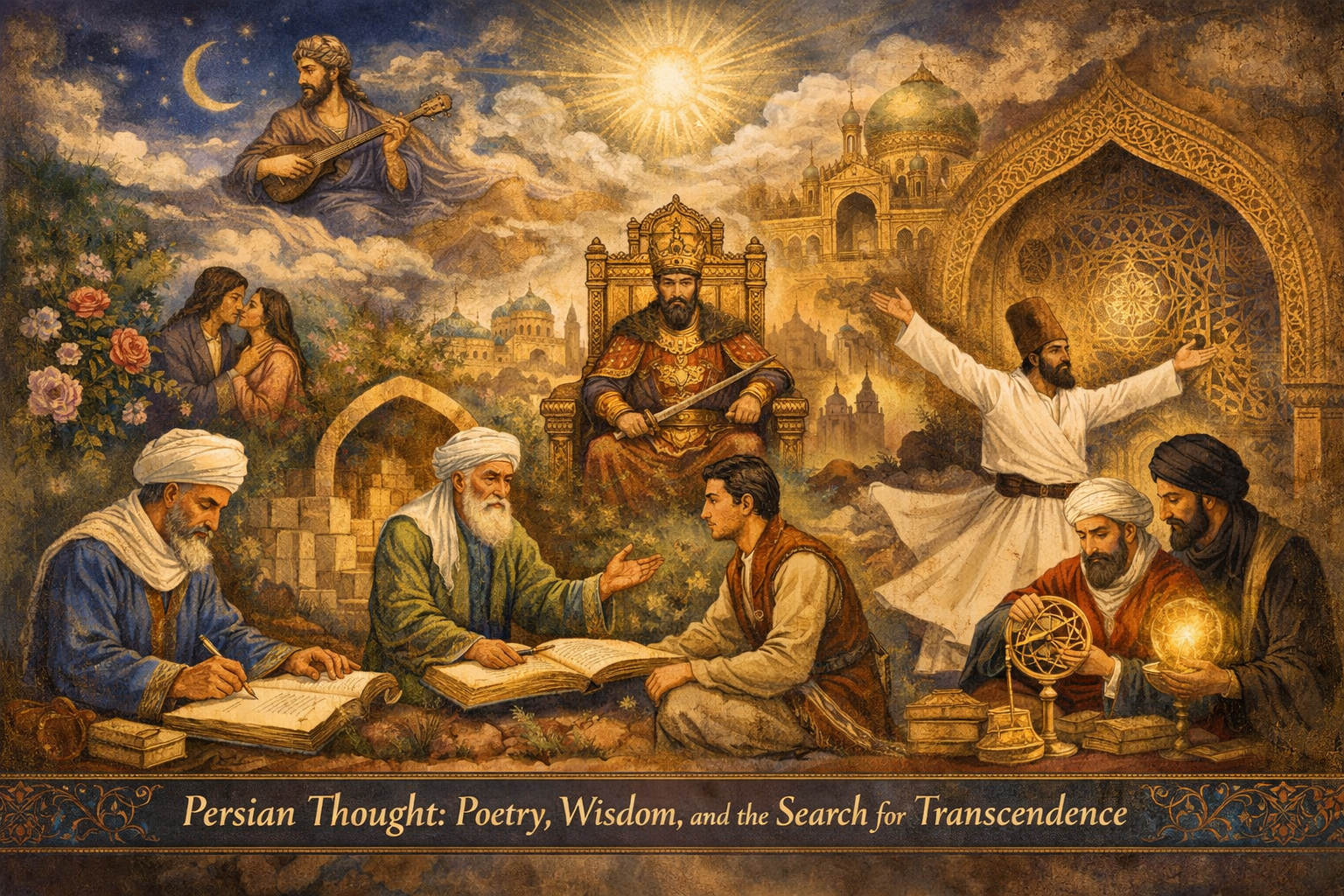
Persian thought is especially important to a broader philosophy architecture because it provides one of the richest traditions for understanding the relation between beauty and wisdom, literature and metaphysics, ethical cultivation and public order, spiritual longing and philosophical discipline, and memory and identity. In this respect, the category links not only to Islamic and Mystical Thought, but also to Ethics and Moral Philosophy, Political Philosophy and Justice, Metaphysics, Greek and Roman Thought, Existential Thought, and Russian Thought. Questions of transcendence, rule, love, form, language, soul, mortality, memory, and civilizational identity become sharper when Persian thought is treated not as ornamental literature, but as a major philosophical world in its own right.
A more comprehensive treatment of Persian thought must also include the philosophical worlds that developed alongside and through Persian literary culture: Avicennan metaphysics, Illuminationist philosophy, Sufi ontology, Shi‘i philosophical theology, Safavid intellectual culture, mirrors-for-princes traditions, Persian historiography, and the Persianate intellectual worlds of Central Asia and South Asia. Persian thought is not exhausted by lyric poetry, even though lyric poetry is one of its greatest achievements. It also includes political reflection, metaphysical system, spiritual pedagogy, historical consciousness, and a long argument about how beauty, wisdom, justice, and transcendence should be held together.
Sources and Textual Foundations
A serious series in Persian thought has to begin with Persian texts themselves. The Shahnameh, Saadi’s Golestan and Bustan, Nizami’s romances, Attar’s mystical narratives, the writings of Nasir Khusraw, the quatrains associated with Omar Khayyam, the ghazals of Hafez, the works of Rumi and Jami, the writings of Suhrawardi, and the later metaphysical tradition associated with Mulla Sadra are not simply monuments to admire from a distance. They are the places where Persian moral imagination, metaphysical reflection, poetic intelligence, and civilizational memory are worked out.
Persian literature served for centuries as one of the central vehicles of Iranian cultural self-understanding, while Persian philosophy developed its own powerful trajectories within the wider Islamicate intellectual world. This means the sources of Persian thought are not confined to philosophical treatises in the narrow sense. A ghazal, epic, moral anecdote, travel narrative, mystical allegory, courtly counsel text, illuminationist treatise, chronicle, or metaphysical commentary can all become a vehicle of thought.
Modern scholarship still matters, but it should illuminate the primary works rather than stand in for them. For literary history and civilizational framing, Iranian studies scholarship is essential because it places Persian literature within the longer development of Iranian identity and the Persianate world. For philosophy, specialist work on Avicenna, Suhrawardi, Mulla Sadra, and later Shi‘i philosophical traditions helps show that Persian thought includes not only poetic and mystical expression but also rigorous metaphysical inquiry.
A research-grade pillar should therefore move repeatedly between primary texts, literary form, metaphysical argument, and historical context. It should not treat poetry as a decorative supplement to philosophy, nor philosophy as a foreign layer imposed on literary culture. Persian thought becomes most intelligible when beauty, argument, spiritual discipline, history, and ethical formation are read together.
Why Persian Thought Matters
Persian thought matters because it offers one of the world’s most integrated traditions of wisdom, joining ethical cultivation, poetic beauty, metaphysical seriousness, civilizational memory, and spiritual longing into a coherent if internally diverse vision of human life. It asks not only what truth is, but how truth should be spoken, sung, remembered, loved, and embodied in the life of the soul.
This matters because Persian thought repeatedly refuses modern separations that treat poetry as merely decorative, spirituality as anti-intellectual, philosophy as bloodless abstraction, or politics as severed from ethics and symbolic order. In the Persian tradition, lyric can become metaphysics, ethics can be transmitted through anecdote and elegance, kingship can be judged through epic memory, and love can become a way of knowing the limits of selfhood and the possibility of transcendence.
Persian thought also matters because it illuminates a civilizational continuity across rupture. Pre-Islamic memory, Islamicate intellectual life, courtly ethics, Sufism, philosophy, historiography, and Persianate expansion are not isolated layers. They are repeatedly brought into relation, making Persian thought one of the clearest examples of how a tradition can remain luminous by transforming without dissolving itself.
Its continuing significance also lies in its refusal to separate inward life from public order. Persian thought asks how rulers should rule, how speakers should speak, how lovers should be transformed, how souls should be educated, how truth can be veiled and unveiled, how memory can preserve a people, and how the human being can move through beauty toward wisdom. Its philosophical power lies precisely in that breadth.
Persian Thought as a Civilizational Tradition
Persian thought is best understood as a civilizational tradition rather than a single school. Its forms of reflection arise at the intersection of pre-Islamic Iranian memory, Islamicate intellectual life, courtly culture, poetic invention, philosophical inquiry, mystical discipline, and historical writing. The revival of Persian literary production in the medieval Islamicate world was closely bound up with the rearticulation of Iranian identity, and Persian became a major literary language far beyond Iran proper, extending across a wider Persianate sphere.
That breadth is part of what gives the tradition its force. Persian thought does not unfold only in treatises or only in verse. It unfolds in epics of kingship, lyric poetry of longing, moral prose, mirrors-for-princes traditions, historical chronicles, metaphysical texts, and mystical teaching. Kingship, beauty, ethical discipline, illumination, longing, memory, and transcendence all become intertwined. It is a tradition of extraordinary tonal range, able to hold together public life and inward life, political symbolism and spiritual poverty, elegance of form and severity of insight.
This broader framing also helps show why Persian thought should not be mistaken for only “Iranian literature” in a narrow national sense. It is Iranian and Persian, but also transregional, shaping and being shaped by intellectual worlds from Anatolia to Central Asia to South Asia. The Persian language became one of the great carriers of culture, philosophy, and refined ethical speech across much of Eurasia.
Persian thought is therefore both rooted and mobile. It preserves Iranian civilizational memory while traveling across courts, Sufi orders, scholarly networks, imperial bureaucracies, poetic circles, and multilingual intellectual worlds. Its identity lies not in closure but in a remarkable capacity to carry philosophical, spiritual, and literary form across historical change.
Pre-Islamic Iranian Memory and Zoroastrian Background
No comprehensive treatment of Persian thought can ignore the pre-Islamic Iranian horizon from which much later Persian expression draws symbolic force. Zoroastrian moral seriousness, cosmic struggle, kingship, truth, justice, and sacred order all remain part of the deeper memory-world of Persian civilization, even where later Persian texts are composed within an Islamic framework. The older Iranian inheritance provides themes of sovereignty, radiance, ethical order, and historical memory that continue to shape Persian imagination.
This matters because Persian thought often remembers more than it states directly. The world of epic, legitimacy, royal glory, and civilizational continuity cannot be fully understood without the older Iranian background against which later Persian literary and political forms took shape. Even where Persian writers are not doctrinally Zoroastrian, they often remain heirs to a civilizational memory structured by pre-Islamic kingship, fate, glory, loss, and renewal.
A serious pillar should therefore include pre-Islamic Iranian memory not as antiquarian background, but as one of the deeper layers through which Persian thought understands identity, justice, and the meaning of historical continuity.
The pre-Islamic layer also helps explain the symbolic density of later Persian writing. Kingship, light, order, fortune, ruin, and moral struggle often carry more weight than their immediate narrative setting suggests. They belong to a long memory of Iran as a moral and historical world.
Truth, Order, and the Moral Structure of the Cosmos
A stronger treatment of Persian thought must also include the older Iranian concern with truth, order, and cosmic struggle. In Zoroastrian moral and cosmological imagination, truth is not merely a proposition. It is an ordering principle of life, world, and ethical action. Falsehood and disorder are not only moral failings but distortions of the structure of reality itself.
This matters because Persian thought repeatedly inherits a vision in which ethics, politics, cosmology, and sacred order are deeply intertwined. Justice is not merely administrative fairness. It is part of the larger right-ordering of life. Kingship, moral struggle, and historical legitimacy all appear against this broader horizon of truth and cosmic responsibility.
This older moral-cosmological background helps explain why later Persian thought so often treats rule, memory, and wisdom as matters of order and disorder rather than merely preference or convention. Power can become beautiful when it serves order, but it becomes monstrous when it violates justice. Speech can reveal truth, but it can also mask corruption. Poetry can illuminate the soul, but it can also expose deception.
The Persian moral imagination therefore often works through contrasts: light and darkness, truth and lie, justice and tyranny, glory and fall, love and ego, presence and absence, beauty and ruin. These contrasts are not merely aesthetic. They carry ethical and metaphysical weight.
Epic Memory, Kingship, and the World of Ferdowsi
Any serious account of Persian thought needs to begin not only with lyric inwardness but with epic memory. The Persian tradition contains a large reflection on rule, destiny, justice, honor, and the rise and fall of civilizations. Through Ferdowsi’s epic inheritance, Persian thought becomes a means of preserving civilizational memory while also testing the moral burden of power and the fragility of worldly greatness. Iranian kingship in this world is never merely administrative. It is symbolic, ethical, and haunted by reversal.
The Shahnameh is therefore not only a literary monument. It is one of the central texts through which Persian civilization narrates itself, judges rulers, remembers origins, and reflects on the unstable relation between power and justice. In epic form, Persian thought asks what kind of greatness can endure, what destroys legitimate rule, and how memory itself becomes a political and moral act.
The result is that epic belongs as much to political philosophy and civilizational thought as to literary history. Ferdowsi preserves a world, but he also tests it. The epic remembers kings and heroes, but it also remembers their limits. It honors glory, but it repeatedly shows how glory can vanish.
Persian epic therefore contributes a philosophy of memory: civilizations survive by remembering, but memory is not flattery. It is judgment. The past becomes an archive of models, warnings, griefs, and moral tests.
Royal Glory, Justice, and the Ethics of Rule
The older Iranian idea of royal glory or radiance helps clarify the political world of Persian thought. Rule is not only a matter of force, administration, or inherited office. It is tied to legitimacy, justice, splendor, and the possibility of losing what once seemed divinely or cosmically sanctioned. Power is therefore morally precarious. Kingship can radiate justice, but it can also become hollow, tyrannical, and self-destroying.
This matters because Persian thought repeatedly judges rulers through symbolic and ethical criteria rather than mere success alone. The great ruler must be more than powerful; he must be just, ordered, measured, and aware of fortune’s instability. The tradition’s political seriousness often lies precisely in its refusal to separate grandeur from moral danger.
For that reason, Persian thought includes a distinctive philosophy of power: one that treats rule as morally charged, aesthetically symbolic, and vulnerable to reversal. Kingship is always shadowed by decline.
The moral imagination of Persian kingship therefore differs from simple celebration of sovereignty. It asks whether power can be worthy of its splendor. It asks whether justice can restrain ambition. It asks whether rulers remember that fortune turns. A ruler without justice may still command, but he no longer radiates legitimate order.
Adab, Ethical Wisdom, and the Education of Character
Persian thought also develops through ethical prose and didactic literature. This is one of its most enduring qualities. Wisdom is not confined to abstraction. It is cultivated through anecdote, parable, moral reflection, refinement, cultivated speech, and elegance of expression. The broader Islamicate category of adab is important here, because it joins literature, etiquette, moral formation, practical judgment, and social intelligence into a single educational world.
What emerges is a conception of wisdom inseparable from style. How a truth is said becomes part of its force. Ethical insight is not treated as a bare proposition but as something embodied in wit, restraint, judgment, timing, and humane presence. Persian thought is especially rich on this point because it assumes that refinement of language can participate in refinement of soul.
This makes Persian ethical literature philosophically serious in a way modern categories often miss. It is not “mere advice literature.” It is a tradition of character formation through form itself.
Adab also bridges private and public life. It teaches how to speak, advise, remember, restrain oneself, recognize hierarchy, criticize folly, endure fortune, and cultivate judgment. It is ethical, literary, political, and pedagogical at once.
Saadi and the Moral Art of Cultivated Speech
Saadi stands near the center of Persian ethical wisdom because his works unite elegance, restraint, wit, and moral seriousness with extraordinary clarity. In the Golestan and Bustan, anecdote, verse, and polished prose become vehicles for judgment, humane reflection, and the education of character. Saadi is not simply instructive. He is morally formative in style.
This matters because Saadi shows that wisdom need not appear as system in order to be philosophically significant. Ethical truth can be carried in tone, proportion, narrative economy, and cultivated speech. His work assumes that moral refinement is inseparable from verbal refinement, and that the disciplined use of language is one means by which the soul is schooled in judgment.
Saadi therefore belongs not only to Persian literature but to the philosophy of ethical life. He offers one of the great traditions of humane intelligence in world letters.
His importance also lies in his ability to hold seriousness and wit together. Saadi’s moral art does not become heavy-handed because it understands that ethical instruction requires proportion. A truth poorly spoken can fail to educate. A truth spoken with elegance can enter memory and shape conduct.
Nizami, Love, Kingship, and the Ethics of Story
A fully comprehensive Persian pillar must include Nizami. He is central not only as a master storyteller but as a thinker whose narrative poems join love, ethics, rulership, symbolic meaning, and the moral testing of character. In Nizami, story becomes a site of philosophical and ethical formation.
This matters because Persian thought is not carried only by lyric and epic. Narrative romance and wisdom-story also play a decisive role. Nizami’s works reveal how Persian thought can test kingship, desire, fidelity, justice, and beauty through dramatic form rather than theoretical exposition. The story becomes a moral and metaphysical instrument.
Nizami therefore enlarges the pillar by showing that Persian thought includes narrative intelligence as one of its major media of reflection. Love and governance are not separate worlds in his work. They illuminate one another.
His narrative art also shows how symbolic form can train ethical perception. A story can reveal the education of desire, the discipline of fidelity, the danger of power, and the relation between beauty and responsibility. Persian thought often thinks through narrative because narrative can hold conflict, transformation, and ambiguity more fully than abstract maxim.
Attar and the Soul’s Journey Through Loss and Annihilation
Farid al-Din Attar is indispensable for a pillar centered on transcendence and the education of the soul. His mystical poetics give Persian thought one of its clearest maps of spiritual journey, annihilation of ego, loss, testing, and the movement from self-attachment toward transformed vision. In Attar, allegory becomes a rigorous pedagogy of the soul.
This matters because Persian thought is not only lyrical longing or metaphysical abstraction. It is also a structured path of transformation. Attar shows how stories of journey, bewilderment, and unmaking can function as ethical and spiritual philosophy. The self does not merely contemplate transcendence; it is broken open by it.
His inclusion is essential because he deepens the pillar’s account of mystical pedagogy, interior transformation, and the disciplined destruction of illusion.
Attar’s importance also lies in his understanding that the soul’s journey is not a smooth ascent. It passes through loss, humiliation, longing, bewilderment, and the failure of self-possession. The path to wisdom requires unlearning as much as learning.
Nasir Khusraw, Wisdom, Travel, and the Search for Truth
Nasir Khusraw is one of the most important remaining figures for a maximally comprehensive Persian pillar. He joins poetry, travel, Ismaili thought, ethical seriousness, and philosophical quest into a distinctive intellectual form. His writings show Persian thought operating across doctrinal reflection, personal transformation, and civilizational observation.
This matters because Persian thought is not only lyric, courtly, or mystical in the familiar sense. It is also argumentative, doctrinal, itinerant, and truth-seeking in a more explicit philosophical and theological register. Nasir Khusraw exemplifies a mode of Persian thought in which wisdom is pursued through travel, reflection, and disciplined commitment rather than purely through aesthetic or symbolic expression.
He therefore belongs centrally to a fully comprehensive account of Persian thought, especially as a bridge between literary form, theological vision, and the ethical seriousness of intellectual search.
His travel writing also matters because movement becomes a form of knowing. The journey is not only geographic. It is intellectual and spiritual. Persian thought often treats travel, exile, pilgrimage, and encounter as ways the self is unsettled and educated.
Omar Khayyam, Time, Fate, and Philosophical Skepticism
Omar Khayyam adds another indispensable register to Persian thought: skepticism, temporality, mortality, and the philosophical ambiguity of worldly existence. Whether read as a poet of wine and ephemerality, a voice of ironic protest, or a thinker of fate and finitude, Khayyam introduces a sharper awareness of time, uncertainty, and the instability of grand explanation.
This matters because Persian thought is not only devotional, ethical, or ecstatic. It also includes questioning, brevity, irony, and the possibility that wisdom begins in the confrontation with limits. Khayyam’s voice disturbs any too-confident synthesis of world and meaning.
His inclusion gives the pillar a fuller tonal range. Persian thought contains not only illumination and longing, but also philosophical reserve, irony, and the intimacy of mortality.
Khayyam’s importance lies partly in the compression of the quatrain form itself. A few lines can hold time, doubt, desire, fate, pleasure, and metaphysical unease. This brevity makes uncertainty memorable. It gives skepticism a lyrical form.
Love, Lyric, and the Metaphysics of Longing
One of the most distinctive features of Persian thought is the way lyric poetry becomes a medium of metaphysical and existential seriousness. In Persian literary culture, the language of longing, poverty, beauty, intoxication, and unattainability is not merely ornamental. Desire becomes a way of knowing the limits of the self and the incompleteness of worldly possession. In this tradition, longing is not opposed to thought. It is one of thought’s deepest forms.
This helps explain why Persian lyric can hold together erotic imagery, moral discipline, mystical ascent, and philosophical ambiguity without collapsing into confusion. Love is not treated only as emotion. It becomes a mode of disclosure, a way of understanding dependence, desire, and the tension between finite human need and a reality beyond mastery. Persian thought is therefore one of the great traditions in which lyric form becomes a vehicle for metaphysical depth.
To take Persian lyric seriously is to recognize that longing is epistemic as well as emotional. The beloved is often less an object than a horizon of transcendence.
This also explains why Persian love poetry resists paraphrase. Its philosophical meaning does not lie only in a doctrine hidden behind imagery. The imagery itself performs longing, absence, nearness, distance, unveiling, and loss. Form becomes part of thought.
Hafez, Symbol, Ambiguity, and the Critique of Spiritual Pretense
Hafez is indispensable because he brings lyric density, irony, symbolic richness, and metaphysical ambiguity into a form of unusual perfection. His poetry is central not only for beauty but for the way it resists flattening. Wine, tavern, beloved, ruin, ecstasy, hypocrisy, and illumination all circulate in a language that refuses literal reduction. Hafez repeatedly discloses the instability of moral and spiritual pretension.
This matters because Persian thought is not only devotional or affirmative. It is also critical. Hafez exposes the distance between outward sanctity and inward truth, between doctrinal posture and actual refinement of soul. His poetry becomes a mode of moral testing as much as of lyrical exaltation.
He therefore occupies a crucial place in the pillar: as a thinker of ambiguity, symbolic excess, spiritual irony, and the limits of literal language in the search for truth.
Hafez also shows that Persian thought often distrusts spiritual performance. The poem can become a tribunal before which public piety, rigid moralism, and claims to purity are exposed as fragile. Ambiguity is not confusion here. It is a discipline against false certainty.
Rumi, Love, Motion, and the Transformation of the Self
Rumi deepens Persian thought by turning love into an ontological, ethical, and spiritual principle. In his work, longing is not merely lack. It is movement, transformation, and the unmaking of the self’s false completeness. Love becomes the force through which the soul is broken open to a reality beyond ego and possession.
This matters because Rumi’s poetry and teaching join beauty, rhythm, intellectual subtlety, and mystical seriousness in a way that transforms the Persian philosophical landscape. Love becomes not sentiment but disciplined openness to transcendence. The self is educated through loss of self-mastery.
Rumi therefore belongs centrally not only to Sufi literature but to Persian thought as a whole. He is one of its greatest thinkers of spiritual motion, relationality, and the transformation of human desire.
His work also shows why Persian thought must be read through sound, rhythm, image, and movement. The form is not accidental. The turning of thought, the repetition of longing, and the movement of language all participate in the transformation the poetry describes.
Jami and the Late Classical Synthesis
A maximally comprehensive Persian pillar should also include Jami, whose work represents a major late classical synthesis of Persian mystical, poetic, and intellectual traditions. Jami matters because he gathers and refines many of the central tendencies of earlier Persian thought—lyric refinement, Sufi metaphysics, moral seriousness, and literary elegance—into a later moment of sustained synthesis.
This matters because Persian thought is not only an ascending sequence that peaks and ends with earlier canonical figures. It also continues through careful synthesis, commentary, and refinement. Jami demonstrates the durability and self-conscious maturity of the Persian literary-mystical tradition.
His inclusion therefore helps complete the historical arc of classical Persian thought, showing not only origin and flowering but later consolidation and transformation.
Jami also matters because later synthesis is itself philosophical. To inherit a tradition well is not only to repeat it. It is to gather, order, refine, and transmit its deepest patterns under new historical conditions.
Sufism, Poverty, and the Path of Love
Mysticism is central to Persian thought, but it should not be confused with anti-intellectualism. In much of the Persian tradition, mystical life transforms intellect rather than abolishing it. Love, poverty, humility, dispossession, and remembrance become ways of exposing the limits of ego, possession, and conceptual pride. Sufism became one of the principal modes of Persian literary expression, and this helps explain why mystical language is so often central to the tradition’s major works.
What makes this strand so powerful is that it joins discipline to beauty and spiritual longing to intellectual seriousness. The path of love is also a path of unmaking the self’s pretensions, of learning dependence, of seeing power as fragile, and of being drawn toward a reality that cannot be possessed by force.
In Persian thought, mystical intensity often sharpens philosophical seriousness rather than replacing it. Poverty becomes epistemic as well as moral: a training in the limits of domination.
Sufi language also gives Persian thought one of its deepest critiques of ego. The self that seeks mastery must be undone before it can know. The lover, the beggar, the wanderer, the ruined one, and the intoxicated one often become figures of knowledge precisely because they no longer stand before reality as owners.
Avicenna and the Philosophical Inheritance of the Persian World
Persian thought also contains a strong philosophical lineage in the narrower sense, and Avicenna stands near the center of that inheritance. Although his philosophical language belongs to the wider Arabic philosophical tradition, his role in the Persian intellectual world is fundamental. He helped shape the metaphysical, logical, psychological, and epistemological architecture inherited by later Persian philosophy.
This matters because Persian thought should never be reduced to poetry alone. It also includes rigorous philosophical traditions concerned with existence, essence, knowledge, soul, causation, and necessity. Avicenna represents one of the great classical inheritances through which Persian thinkers later developed their own metaphysical trajectories.
His inclusion also helps show that Persian thought belongs to a larger Islamicate philosophical ecumene even while retaining distinctive literary, symbolic, and civilizational forms.
Avicenna’s importance is especially visible in later debates. Even thinkers who criticize or transform his inheritance must work in relation to the conceptual architecture he helped establish. Persian metaphysics after Avicenna cannot be understood without him.
Illumination and Philosophical Vision
Persian thought includes one of the most distinctive metaphysical developments in the Islamic world through Illuminationist philosophy. Here vision, light, intuition, and ontological disclosure become central categories for understanding knowledge and being. This is not a rejection of philosophy, but a reorientation of it.
This matters because Illuminationism shows Persian thought at its most integrated: philosophical rigor and symbolic language move closer together rather than farther apart. Knowledge is not only discursive and inferential. It may also be illuminated, disclosed, and ordered through a hierarchy of light and presence.
A comprehensive pillar should therefore treat illumination not as decorative mystical language but as one of Persian thought’s most important philosophical contributions to metaphysics and epistemology.
Illuminationist philosophy also reveals the difficulty of separating poetry, symbol, and argument in Persian intellectual history. Light is image, but it is also ontology. Vision is metaphor, but it is also epistemology. Presence is spiritual language, but it is also a philosophical claim about how knowing occurs.
Suhrawardi, Light, Knowledge, and the Order of Being
Suhrawardi is especially important because he develops a distinctive Illuminationist project that both engages and critiques the dominant Avicennan inheritance, extending reflection across logic, psychology, ontology, cosmology, and epistemology. In his work, light and illumination become central categories for understanding knowledge and being.
This matters because Suhrawardi offers a philosophical world in which metaphysical order is luminous rather than merely abstract. Reality is articulated through degrees of light, and knowledge becomes more than conceptual representation. It is also presence, manifestation, and illumination.
He is therefore indispensable to any serious account of Persian thought, because he shows that Persian metaphysics is not only derivative of earlier philosophy but creatively transformative in its own right.
Suhrawardi also gives Persian thought a particularly powerful bridge between ancient Iranian symbolism and Islamic philosophy. The language of light allows metaphysics, spiritual vision, and Iranian memory to converge without collapsing into a single register.
Mulla Sadra and the Transformation of Persian Metaphysics
Later Persian philosophy continues this line in figures such as Mulla Sadra, whose thought became one of the most significant post-Avicennan developments in Islamic metaphysics. In him, theology, philosophy, and mystical intuition are brought into close relation. Questions of existence, motion, substantial transformation, knowledge, and spiritual realization become part of one ambitious philosophical synthesis.
This matters because Mulla Sadra reveals the full intellectual seriousness of later Persian thought. He shows that the tradition remained philosophically generative well beyond the classical poetic canon. In his work, metaphysics becomes dynamic, existential, and transformative rather than merely classificatory.
A comprehensive pillar therefore needs Mulla Sadra not as a late appendix, but as one of the culminating figures in the Persian search for transcendence through philosophy itself.
Mulla Sadra also matters because he makes existence central. Persian metaphysics here becomes deeply concerned with gradation, movement, transformation, and the journey of being. This places him in conversation not only with Islamic philosophy but with broader questions in metaphysics, ontology, and spiritual anthropology.
Shi‘i Philosophy and the Later Persian Intellectual World
A fully comprehensive account of Persian thought must also make more explicit the importance of Shi‘i intellectual life, especially in Safavid and post-Safavid Iran. Persian philosophy did not develop in a religious vacuum. Questions of authority, esoteric knowledge, theology, spiritual hierarchy, and metaphysical interpretation were shaped by Shi‘i frameworks as well as by broader philosophical traditions.
This matters because later Persian thought is not adequately represented by poetry and metaphysics alone unless the religious-intellectual setting of those developments is also visible. Shi‘i philosophical and theological environments helped sustain later traditions of metaphysical reflection, commentary, and synthesis, including the world in which Mulla Sadra became central.
Its inclusion strengthens the pillar by making clear that Persian thought is not only literary and mystical, but also doctrinally and institutionally embedded in specific forms of religious intellectual life.
Shi‘i philosophy also deepens the relationship between authority and interpretation. Knowledge is not merely a matter of individual speculation. It is connected to chains of transmission, spiritual hierarchy, theological commitment, and the disciplined reading of hidden meaning.
Safavid Intellectual Culture and the Reordering of Persian Thought
A final layer of comprehensiveness requires the Safavid setting to be visible in its own right. Safavid Iran did not simply inherit earlier Persian thought unchanged. It reorganized political, religious, and intellectual life in ways that profoundly shaped later Persian philosophy, theology, and identity. The consolidation of Shi‘i authority, the patronage of scholarship, and the transformation of institutions all matter here.
This matters because Persian thought is not only a sequence of texts but a historically situated intellectual culture. The Safavid world helped define the later environment in which metaphysics, theology, and Persian literary self-understanding developed. To omit that setting is to understate the institutional conditions of later Persian thought.
A fully comprehensive pillar should therefore register Safavid intellectual culture as part of the historical reordering through which later Persian thought became what it was.
The Safavid period also shows that philosophical traditions are shaped by power, patronage, education, religious authority, and institutional life. Metaphysics does not float above history. It is cultivated, preserved, contested, and transmitted through concrete scholarly worlds.
Poetry, Language, and the Limits of Literal Speech
One of the deepest features of Persian thought is its repeated recognition that literal language does not exhaust truth. Symbol, allusion, ambiguity, excess, beauty, and musicality all become ways of saying what cannot be simply paraphrased. Poetry is not the ornamental shell of a hidden doctrine. It is one of the primary modes through which Persian thought approaches realities that exceed conceptual mastery.
This matters because Persian thought often understands language as participatory rather than merely descriptive. A poem may not simply state truth; it may enact orientation toward it. Lyric form can school perception, desire, and humility in ways that literal explanation cannot.
This is one reason Persian thought is so difficult to reduce to slogans. Its truths often appear through resonance rather than direct statement, and through beauty rather than analytic closure.
The limits of literal speech are not failures of philosophy in this tradition. They are part of philosophy’s discipline. When reality exceeds possession, language must become symbolic, musical, indirect, and self-aware. Persian poetry often teaches that truth is not mastered by being named too quickly.
Persian Mirrors for Princes and Political Reflection
Persian thought also develops through mirrors-for-princes literature and broader traditions of political reflection. These texts do not usually resemble modern political theory, yet they are philosophically important because they ask how rulers should govern, how power should be restrained, how order should be maintained, and what kind of ethical intelligence rule requires.
This matters because Persian political thought often joins symbolic kingship to practical judgment. Rule is never merely technical. It is moral, aesthetic, cosmological, and civilizational. The court becomes a place where justice, language, memory, and prudence are all tested.
A serious pillar should therefore include mirrors-for-princes traditions as part of Persian political philosophy, not as secondary etiquette literature. They carry one of the tradition’s most enduring reflections on rule, legitimacy, and the burden of power.
These texts also ask a difficult question: can counsel restrain power? Persian political wisdom often knows that rulers require advice, but also that truth near power is dangerous. The ethics of counsel is therefore one of the tradition’s central political problems.
Courtly Counsel, Bureaucratic Ethics, and the Prudence of Rule
To be fully comprehensive, Persian political thought should also include the more practical ethics of administration, counsel, and bureaucratic life. Persian civilization did not think only in terms of kingship at the symbolic level. It also reflected on the arts of advising rulers, maintaining order, managing institutions, and embodying prudence in public service.
This matters because political wisdom in Persian thought is not exhausted by ideals of justice or epic depictions of fortune. It also includes the lived arts of counsel, statecraft, and administrative morality. The ethical burden of rule is carried not only by kings but by courts, advisors, secretaries, and officials.
This broader view of political ethics makes the pillar more complete by showing how Persian thought joined grandeur to prudence and symbolic sovereignty to practical governance.
Courtly and bureaucratic ethics also bring Persian thought closer to everyday institutional life. They ask how wisdom survives in proximity to ambition, hierarchy, patronage, fear, and unstable favor. The prudent counselor becomes one of the tradition’s recurring moral figures.
Persian Historiography and the Writing of Civilization
A maximally comprehensive account of Persian thought must also give stronger place to historiography. Persian civilization did not preserve itself only through poetry and philosophy. It also narrated itself through chronicles, dynastic histories, court histories, and moralized accounts of rise and decline. History-writing became one of the ways Persian thought reflected on sovereignty, legitimacy, catastrophe, and memory.
This matters because historiography in the Persian world is not merely documentary. It is often interpretive, exemplary, and civilizational. Historical writing can instruct rulers, preserve identity, and judge epochs. It belongs alongside epic as another major mode of collective self-understanding.
Its inclusion helps complete the pillar by showing that Persian thought includes not only lyric inwardness and metaphysical vision, but also explicit historical consciousness and the writing of civilization.
Historiography also gives Persian thought one of its key temporal structures. Empires rise and fall. Rulers are judged by memory. Cities flourish and decline. The chronicle becomes a moral archive, recording not only what happened but what rule, ambition, fortune, and violence reveal.
Persian Thought and the Persianate World
Persian thought cannot be confined to Iran alone. Persian became one of the great literary and intellectual languages of the wider Persianate world, extending into Central Asia, South Asia, Anatolia, and beyond. This means Persian thought must also be understood as a transregional civilizational formation rather than a strictly bounded national tradition.
This matters because it shows the historical reach of Persian literary and philosophical form. Persian ethics, lyric, Sufi symbolism, mirrors-for-princes traditions, and metaphysical vocabularies shaped courts, scholars, poets, and intellectual cultures across a broad geography. The Persianate world is therefore part of the meaning of Persian thought itself.
A comprehensive pillar should make visible this wider sphere, because it reveals Persian as not only a language of Iranian memory but also a major medium of cosmopolitan refinement, intellectual exchange, and civilizational transmission.
The Persianate world also complicates simple ownership narratives. Persian thought is rooted in Iranian memory, but its historical life is transregional. It becomes a language of courtly culture, spiritual teaching, political counsel, lyric art, and philosophical imagination across many peoples and places.
Persianate Thought in South Asia and Beyond
The Persianate world deserves stronger independent treatment because Persian thought did not remain within Iranian political borders. It shaped Mughal courts, South Asian ethical and literary culture, Sufi networks, administrative vocabularies, and transregional conceptions of refinement and sovereignty. Persian was not merely exported; it became one of the principal languages of high culture across a wide world.
This matters because Persian thought was historically mobile. Its forms of ethical instruction, love poetry, kingship, and metaphysical symbolism were not static inheritances but living traditions reinterpreted across regions. To understand Persian thought fully is therefore to understand how it traveled, transformed, and became part of broader Persianate cultural ecologies.
This also strengthens the pillar’s civilizational reach, showing that Persian thought is one of the great transregional traditions of world intellectual history.
South Asia is especially important because Persian there became a language of power, aesthetics, devotion, administration, and literary sophistication. Persianate culture helped shape intellectual worlds that cannot be understood through narrow national categories alone.
Persian Thought and Iranian Identity
Persian thought is deeply bound up with questions of cultural memory and identity. Persian literature played a major role in the revival and elaboration of Iranian identity in the medieval Islamicate period, which means that literary and philosophical production in Persian is not only personal or mystical. It is also civilizational, preserving and reshaping the memory of Iran across changing political, linguistic, and religious orders.
This continuity gives Persian thought unusual durability. It can absorb pre-Islamic memory, Islamicate metaphysics, courtly ethics, philosophical rigor, and lyric intimacy without collapsing into one tone or one doctrine. It remains one of the great traditions in which identity, beauty, and wisdom are elaborated together.
This also means Persian thought is a major case study in how a civilization remembers itself not only through institutions, but through poetic and philosophical form.
Iranian identity in Persian thought is therefore not merely ethnic, political, or linguistic. It is literary, ethical, historical, symbolic, and metaphysical. It is remembered through kings and lovers, ruins and gardens, light and wine, counsel and grief, wisdom and longing.
Core Themes in Persian Thought
One major theme in this field is wisdom. Persian thought repeatedly asks what kind of person is formed by beauty, ethical discipline, humility, and insight.
A second theme is kingship and justice. Epic and political traditions return to the moral burden of rule, the instability of fortune, and the symbolic dimensions of authority.
A third theme is love and longing. Lyric and mystical traditions treat desire, poverty, and unattainability as revealing dimensions of the human relation to transcendence.
A fourth theme is illumination and metaphysical knowledge. Persian philosophy includes strong traditions in which intuition, light, existence, and ontology become central philosophical categories.
A fifth theme is literary form as thought. Poetry, ethical prose, story, philosophy, and historical writing all become vehicles of reflection rather than mere ornament.
A sixth theme is civilizational memory. Persian thought preserves and transforms Iranian identity across changing religious and political formations.
A seventh theme is language and transcendence. Persian writers repeatedly ask how speech can suggest what exceeds literal capture, and how symbol, allusion, and beauty become forms of knowledge.
An eighth theme is political wisdom. Mirrors-for-princes traditions, epic kingship, courtly counsel, and bureaucratic ethics ask how rule should be restrained by justice, prudence, and moral order.
A ninth theme is mystical transformation. Persian Sufi traditions explore poverty, annihilation, love, remembrance, and the unmaking of ego as paths toward deeper knowledge.
A tenth theme is transregional transmission. Persian thought becomes one of the great Persianate languages of refinement, spirituality, governance, and literary imagination across Eurasia.
Finally, this field returns constantly to mortality, soul, discipline, identity, and transcendence. Persian thought endures because it binds civilizational memory to inward transformation and philosophical seriousness to aesthetic beauty.
Expanded Article Architecture
The following structure gathers the Persian Thought pillar into a long-range article architecture. It preserves the planned article sequence from the source draft while adding short descriptions for each article and expanding the map to reflect epic memory, ethical literature, lyric metaphysics, Sufism, Illuminationism, Shi‘i philosophy, political counsel, historiography, Iranian identity, and the wider Persianate world.
Foundations of Persian Thought
- Introduction to Persian Thought (planned)
Introduces Persian thought as a civilizational tradition joining poetry, wisdom, metaphysics, kingship, ethical cultivation, mysticism, and historical memory. - Persian Thought: Poetry, Wisdom, and the Search for Transcendence (planned)
Frames Persian thought around the relation between beauty, truth, love, moral discipline, and the soul’s longing for transcendence. - Persian Thought as a Civilizational Tradition (planned)
Studies Persian thought as a broad intellectual formation shaped by Iran, Islamicate civilization, literary culture, courtly ethics, and the Persianate world.
Pre-Islamic Iranian Memory and Moral-Cosmic Order
- Pre-Islamic Iran, Zoroastrian Memory, and the Moral Order of the World (planned)
Examines pre-Islamic Iranian memory as a source of Persian reflections on truth, justice, kingship, sacred order, and civilizational continuity. - Zoroastrian Truth, Order, and the Moral Structure of the Cosmos (planned)
Studies truth, falsehood, cosmic struggle, ethical order, and sacred responsibility in the older Iranian moral imagination.
Epic Memory, Ferdowsi, and Kingship
- Epic Memory and the World of Ferdowsi (planned)
Introduces Ferdowsi’s epic world as a philosophical archive of kingship, justice, fate, heroism, loss, and Iranian civilizational memory. - Kingship, Glory, and Justice in Persian Imagination (planned)
Studies Persian kingship through glory, legitimacy, moral radiance, justice, fortune, and the instability of rule. - The Shahnameh and the Preservation of Iranian Civilizational Memory (planned)
Examines the Shahnameh as a monumental act of cultural memory, moral judgment, and political imagination. - Royal Glory, Fortune, and the Fragility of Rule (planned)
Studies the moral danger of power and the recurring Persian theme that worldly greatness is always vulnerable to reversal.
Adab, Ethical Formation, and Saadi
- Adab, Ethical Formation, and the Refinement of Character (planned)
Introduces adab as a tradition of cultivated speech, ethical refinement, social intelligence, literary education, and practical wisdom. - Saadi and the Ethics of Cultivated Wisdom (planned)
Studies Saadi as a master of moral intelligence, humane judgment, elegance, restraint, and ethical instruction through literary form. - The Golestan and the Moral Art of Prose (planned)
Examines the Golestan as a work of polished prose, anecdote, wit, political observation, and moral formation. - The Bustan and the Poetics of Ethical Instruction (planned)
Studies the Bustan as a poetic architecture of virtue, justice, generosity, humility, and the education of the soul. - Beauty, Discipline, and the Education of the Soul (planned)
Explores how Persian ethical literature treats beauty, language, style, restraint, and moral discipline as forms of spiritual and intellectual education.
Nizami, Romance, and Narrative Moral Imagination
- Nizami, Love, Kingship, and the Ethics of Story (planned)
Introduces Nizami as a thinker of love, sovereignty, symbolic meaning, ethical testing, and narrative wisdom. - Romance, Sovereignty, and the Moral Imagination in Nizami (planned)
Studies Nizami’s romances as philosophical narratives where desire, rule, fidelity, beauty, and moral transformation are tested through story.
Attar, Spiritual Journey, and Mystical Pedagogy
- Attar and the Soul’s Journey Through Loss and Annihilation (planned)
Studies Attar’s mystical narratives as maps of spiritual journey, ego-loss, longing, bewilderment, and transformed vision. - Mystical Pedagogy and the Logic of Spiritual Journey in Attar (planned)
Examines how Attar uses allegory, parable, quest, and symbolic movement to educate the soul toward detachment and realization.
Nasir Khusraw, Khayyam, and Philosophical Search
- Nasir Khusraw, Wisdom, Travel, and the Search for Truth (planned)
Introduces Nasir Khusraw as a poet, traveler, Ismaili thinker, and seeker of disciplined philosophical and spiritual truth. - Journey, Vision, and Ismaili Intellectual Life in Nasir Khusraw (planned)
Studies travel, doctrine, ethical seriousness, and visionary inquiry in Nasir Khusraw’s Persian intellectual world. - Omar Khayyam, Time, Fate, and Philosophical Skepticism (planned)
Examines Khayyam as a voice of mortality, doubt, fate, brevity, and the philosophical ambiguity of worldly existence. - Mortality, Wine, and the Limits of Certainty in Persian Reflection (planned)
Studies the symbolic language of wine, time, impermanence, and uncertainty in Persian skeptical and existential reflection.
Hafez, Lyric Ambiguity, and the Metaphysics of Longing
- Hafez and the Metaphysics of Longing (planned)
Introduces Hafez as a master of lyric ambiguity, symbolic depth, longing, beauty, and metaphysical tension. - Wine, Ambiguity, and Spiritual Irony in Hafez (planned)
Studies Hafez’s use of wine, tavern, beloved, ruin, and irony to critique spiritual pretense and literal-minded certainty. - Love, Symbol, and the Limits of Literal Language (planned)
Examines Persian lyric as a philosophical form in which symbol, allusion, beauty, and longing disclose what literal speech cannot contain.
Rumi, Jami, and the Sufi Imagination
- Rumi and the Path of Love (planned)
Studies Rumi as a thinker of love, spiritual motion, ego-transformation, longing, and the soul’s movement toward divine reality. - Rumi, Motion, and the Transformation of the Self (planned)
Examines Rumi’s account of love as movement, unmaking, surrender, and the transformation of selfhood. - Jami and the Late Classical Synthesis of Persian Mystical Thought (planned)
Studies Jami as a late classical synthesizer of Persian mystical poetry, Sufi metaphysics, literary refinement, and ethical seriousness. - Poverty, Desire, and the Sufi Imagination in Persian Poetry (planned)
Examines poverty, longing, humility, and desire as philosophical and spiritual themes in Persian Sufi poetics. - Sufism, Humility, and the Unmaking of the Ego (planned)
Studies Sufi poverty, remembrance, love, annihilation, and self-emptying as disciplines of spiritual knowledge.
Avicenna, Post-Avicennan Philosophy, and Illumination
- Avicenna and the Philosophical Inheritance of the Persian World (planned)
Introduces Avicenna as a foundational figure for later Persian metaphysics, logic, psychology, existence, essence, and the philosophy of the soul. - Persian Philosophy After Avicenna (planned)
Studies the later philosophical traditions that inherited, revised, criticized, and transformed Avicennan metaphysics. - Suhrawardi and Illuminationist Philosophy (planned)
Introduces Suhrawardi’s Illuminationist project as a major Persian contribution to metaphysics, epistemology, and symbolic philosophy. - Light, Intuition, and the Persian Metaphysical Imagination (planned)
Examines light, presence, unveiling, intuition, and hierarchy as central concepts in Persian illuminationist thought. - Suhrawardi, Presence, and the Order of Light (planned)
Studies Suhrawardi’s account of reality as ordered through degrees of light and knowledge as presence rather than representation alone.
Mulla Sadra, Shi‘i Philosophy, and Safavid Intellectual Culture
- Mulla Sadra and the Transformation of Persian Philosophy (planned)
Introduces Mulla Sadra as a major figure in later Persian metaphysics, uniting philosophy, theology, mysticism, existence, and transformation. - Existence, Motion, and Transcendent Wisdom in Mulla Sadra (planned)
Studies Mulla Sadra’s account of existence, substantial motion, knowledge, spiritual realization, and transcendent wisdom. - Shi‘i Philosophy and the Later Persian Intellectual World (planned)
Examines the role of Shi‘i theology, authority, esoteric interpretation, and intellectual institutions in later Persian philosophy. - Safavid Intellectual Culture and the Reordering of Persian Thought (planned)
Studies Safavid Iran as a historical setting that reshaped Persian philosophy, theology, religious identity, and institutional scholarship.
Poetry, Language, and Transcendence
- Poetry, Wisdom, and the Search for Transcendence (planned)
Synthesizes Persian poetry as a vehicle of wisdom, longing, beauty, ethical formation, metaphysical intuition, and spiritual transformation. - Poetry, Metaphysics, and the Persian Search for the Real (planned)
Examines how Persian poetry uses symbol, rhythm, ambiguity, and beauty to approach reality beyond literal description.
Political Wisdom, Counsel, and Governance
- Persian Mirrors for Princes and the Ethics of Rule (planned)
Introduces mirrors-for-princes literature as a tradition of political counsel, moral restraint, prudence, and the burden of sovereignty. - Justice, Counsel, and Political Prudence in Persian Courtly Thought (planned)
Studies Persian courtly ethics through advice, justice, discretion, prudence, speech, and the danger of truth near power. - Courtly Counsel, Bureaucratic Ethics, and the Prudence of Rule (planned)
Examines the ethics of administration, bureaucratic life, courtly service, institutional responsibility, and the moral burden of governance.
Historiography, Identity, and Civilizational Memory
- Persian Historiography, Dynastic Memory, and the Writing of Civilization (planned)
Studies Persian historical writing as a mode of civilizational memory, political judgment, dynastic interpretation, and moral instruction. - Persian Literature and the Revival of Iranian Identity (planned)
Examines the role of Persian literature in preserving, renewing, and rearticulating Iranian identity within the medieval Islamicate world. - Persian Thought and Iranian Identity (planned)
Studies how Persian thought binds language, literature, pre-Islamic memory, Islamicate intellectual life, and Iranian self-understanding.
The Persianate World and Transregional Transmission
- Persian Thought and the Persianate World (planned)
Introduces the Persianate world as a transregional sphere of literary, ethical, political, mystical, and philosophical transmission. - Persianate Thought in South Asia and Beyond (planned)
Studies Persianate culture in South Asia and beyond through courts, Sufi networks, administrative language, literary refinement, and intellectual exchange. - Persian Thought Beyond Iran: Language, Empire, and Cultural Transmission (planned)
Examines Persian as a language of empire, scholarship, poetry, statecraft, and cosmopolitan intellectual culture across regions.
Additional Expansion Articles for a Fuller Pillar
- Gardens, Paradise, and the Persian Imagination of Order (planned)
Studies the garden as a Persian symbol of beauty, order, paradise, kingship, poetic space, and the cultivated relation between nature and form. - Ruins, Fortune, and the Persian Philosophy of Impermanence (planned)
Examines ruins and fallen kingdoms as philosophical images of time, mortality, worldly instability, and the judgment of history. - The Beloved in Persian Thought: Beauty, Absence, and Transcendence (planned)
Studies the beloved as a figure of longing, divine nearness, unreachable beauty, self-loss, and metaphysical desire. - Persian Thought and the Philosophy of Friendship (planned)
Explores friendship, companionship, loyalty, spiritual fellowship, and ethical relation in Persian poetry, prose, and Sufi tradition. - Persian Thought and the Ethics of Speech (planned)
Studies truthfulness, counsel, silence, ambiguity, praise, satire, and the moral responsibility of language. - Persian Thought and Comparative Mysticism (planned)
Places Persian mystical thought in dialogue with Islamic, Christian, Jewish, Hindu, Buddhist, and philosophical traditions of inward transformation. - Persian Thought and the Philosophy of Beauty (planned)
Examines beauty as a pathway to knowledge, longing, refinement, metaphysical intuition, and the education of perception. - Persian Thought and the Ethics of Humility (planned)
Studies humility, poverty, dispossession, and the critique of pride across Persian ethical and mystical traditions. - Persian Thought and the Problem of Hypocrisy (planned)
Examines Persian critiques of outward piety, false refinement, courtly flattery, spiritual pretense, and moral self-deception. - Persian Thought and Global Philosophy (planned)
Studies Persian thought as a major world-philosophical tradition in dialogue with Greek, Islamic, Indian, Chinese, Russian, and European thought. - Persian Thought, Modernity, and Cultural Memory (planned)
Examines how Persian thought is reinterpreted under modern conditions of nationalism, reform, translation, exile, and global literary reception. - Why Persian Thought Still Matters (planned)
Concludes the series by explaining why Persian thought remains vital for philosophy, poetry, ethics, metaphysics, mysticism, political reflection, and civilizational memory.
Closing Perspective
Persian thought remains indispensable because it gives philosophy one of its most luminous models of integrated reflection. It refuses to isolate wisdom from beauty, ethics from speech, metaphysics from longing, politics from justice, or civilization from memory. It teaches that poetry can think, that style can form character, that love can disclose the limits of selfhood, that kingship is morally dangerous, that history judges power, and that language often reaches deepest when it knows the limits of literal statement.
This does not mean Persian thought should be reduced to lyric mysticism or treated as an ornamental tradition of beautiful phrases. Its beauty is part of its rigor. Its poetry can be philosophical, its ethics can be literary, its politics can be symbolic, its metaphysics can be luminous, and its memory can be civilizational. To study Persian thought seriously is to study a tradition in which form itself becomes a vehicle of truth.
The strongest reason to study Persian thought is that its questions remain alive. How should beauty educate the soul? How should rulers be judged? What does love reveal about human incompleteness? How can speech gesture toward what cannot be fully said? How does a civilization remember itself across rupture? How can philosophy remain rigorous without becoming dry, and spiritual without becoming vague? These are not only Persian questions. They are enduring philosophical questions, and Persian thought is one of the great traditions through which they can be studied with depth.
Related Reading
- Islamic and Mystical Thought — for metaphysics, Sufism, spiritual discipline, philosophical theology, divine reality, and contemplative transformation.
- Ethics and Moral Philosophy — for virtue, character, moral formation, practical wisdom, dignity, and the good life.
- Political Philosophy and Justice — for kingship, justice, authority, legitimacy, law, public responsibility, and the moral burden of rule.
- Metaphysics — for being, existence, light, causation, motion, ontology, soul, and the structure of reality.
- Greek and Roman Thought — for comparative classical traditions of wisdom, virtue, kingship, rhetoric, metaphysics, and philosophical discipline.
- Existential Thought — for mortality, longing, selfhood, meaning, finitude, anxiety, and the search for an authentic life.
- Russian Thought — for comparative reflection on suffering, faith, beauty, moral responsibility, history, and spiritual seriousness.
- Poetry, Memory, and Imagination — for lyric form, symbolic speech, imagination, beauty, and the role of poetry in civilizational memory.
Further Reading
- Corbin, H. (1998) History of Islamic Philosophy. London: Kegan Paul International. Available at: https://www.routledge.com/History-of-Islamic-Philosophy/Corbin/p/book/9780748604165.
- Dabashi, H. (2012) The World of Persian Literary Humanism. Cambridge, MA: Harvard University Press. Available at: https://www.hup.harvard.edu/books/9780674064285.
- de Bruijn, J.T.P. (1997) Persian Sufi Poetry: An Introduction to the Mystical Use of Classical Persian Poems. Richmond: Curzon Press. Available at: https://www.routledge.com/Persian-Sufi-Poetry-An-Introduction-to-the-Mystical-Use-of-Classical-Persian-Poems/de-Bruijn/p/book/9780700703126.
- Lewisohn, L. (ed.) (1993) The Heritage of Sufism. Oxford: Oneworld. Available at: https://oneworld-publications.com/work/the-heritage-of-sufism/.
- Nasr, S.H. (2006) Islamic Philosophy from Its Origin to the Present: Philosophy in the Land of Prophecy. Albany, NY: State University of New York Press. Available at: https://sunypress.edu/Books/I/Islamic-Philosophy-from-Its-Origin-to-the-Present.
- Schimmel, A. (1975) Mystical Dimensions of Islam. Chapel Hill, NC: University of North Carolina Press. Available at: https://uncpress.org/book/9780807812716/mystical-dimensions-of-islam/.
- Yarshater, E. (ed.) (1988–). Encyclopaedia Iranica. Available at: https://www.iranicaonline.org/.
- Ziai, H. (1990) Knowledge and Illumination: A Study of Suhrawardi’s Hikmat al-Ishraq. Atlanta, GA: Scholars Press.
References
- Adamson, P. (2023) ‘Fakhr al-Dīn al-Rāzī’, Stanford Encyclopedia of Philosophy. Available at: https://plato.stanford.edu/entries/al-din-al-razi/.
- Ashraf, A. (2006) ‘Iranian Identity i. Perspectives’, Encyclopaedia Iranica. Available at: https://www.iranicaonline.org/articles/iranian-identity-i-perspectives/.
- Ashraf, A. (2006) ‘Iranian Identity iii. Medieval Islamic Period’, Encyclopaedia Iranica. Available at: https://www.iranicaonline.org/articles/iranian-identity-iii-medieval-islamic-period/.
- Ashraf, A. (2012) ‘Iranian Identity iv. 19th–20th Centuries’, Encyclopaedia Iranica. Available at: https://www.iranicaonline.org/articles/iranian-identity-iv-19th-20th-centuries/.
- Attar. Selected works, including The Conference of the Birds.
- Avicenna. Selected writings.
- Corbin, H. (1998) History of Islamic Philosophy. London: Kegan Paul International.
- Dabashi, H. (2012) The World of Persian Literary Humanism. Cambridge, MA: Harvard University Press.
- de Bruijn, J.T.P. (1997) Persian Sufi Poetry: An Introduction to the Mystical Use of Classical Persian Poems. Richmond: Curzon Press.
- Ferdowsi. Shahnameh.
- Hafez. Divan.
- Jami. Selected works.
- Lewisohn, L. (ed.) (1993) The Heritage of Sufism. Oxford: Oneworld.
- Marcotte, R. (2007) ‘Suhrawardi’, Stanford Encyclopedia of Philosophy. Available at: https://plato.stanford.edu/entries/suhrawardi/.
- Mulla Sadra. Selected writings.
- Nasir Khusraw. Selected prose and poetry, including the Safarnama.
- Nasr, S.H. (2006) Islamic Philosophy from Its Origin to the Present: Philosophy in the Land of Prophecy. Albany, NY: State University of New York Press.
- Nizami. Selected works from the Khamsa.
- Omar Khayyam. Rubaiyat.
- Rizvi, S. (2009) ‘Mulla Sadra’, Stanford Encyclopedia of Philosophy. Available at: https://plato.stanford.edu/entries/mulla-sadra/.
- Rumi. Selected works, including the Masnavi.
- Saadi. Bustan.
- Saadi. Golestan.
- Schimmel, A. (1975) Mystical Dimensions of Islam. Chapel Hill, NC: University of North Carolina Press.
- Suhrawardi. The Philosophy of Illumination and selected writings.
- Yarshater, E. (1988–). ‘India xiv. Persian Literature’, Encyclopaedia Iranica. Available at: https://www.iranicaonline.org/articles/india-xiv-persian-literature-in-india/.
- Yarshater, E. (1988–). ‘IRAN viii. Persian Literature (1) Pre-Islamic Literature’, Encyclopaedia Iranica. Available at: https://www.iranicaonline.org/articles/iran-viii1-persian-literature-pre-islamic/.
- Yarshater, E. (1988–). ‘IRAN viii. Persian Literature (2) Classical’, Encyclopaedia Iranica. Available at: https://www.iranicaonline.org/articles/iran-viii2-classical-persian-literature/.
- ‘Kingship vi. The Persian Concept of Kingship in the Islamic Period’ (1988–). Encyclopaedia Iranica. Available at: https://www.iranicaonline.org/articles/kingship/kingship-vi-the-persian-concept-of-kingship-in-the-islamic-period/.
- ‘Middle Persian i. Pahlavi Literature’ (1988–). Encyclopaedia Iranica. Available at: https://www.iranicaonline.org/articles/middle-persian/pahlavi-literature/.
- Ziai, H. (1990) Knowledge and Illumination: A Study of Suhrawardi’s Hikmat al-Ishraq. Atlanta, GA: Scholars Press.