
Last Updated May 28, 2026
Arduino projects for sustainable development demonstrate how low-cost embedded systems can support environmental monitoring, renewable energy experimentation, water stewardship, circular resource use, biodiversity protection, and sustainability education aligned with the United Nations Sustainable Development Goals. Sustainable development depends on measurement. Whether the issue is freshwater scarcity, air pollution, energy use, food-system resilience, waste reduction, or biodiversity loss, effective action requires reliable information about how environmental systems are actually functioning. Without measurement, communities, researchers, engineers, educators, and policymakers are forced to rely on incomplete signals, delayed reporting, or assumptions about conditions on the ground.
One of the most important shifts in sustainability technology has been the rise of low-cost environmental sensing. Small embedded devices now make it possible to monitor environmental conditions locally and continuously. Large scientific instruments, laboratory analysis, government monitoring networks, and certified regulatory systems remain essential. But smaller systems can complement them by expanding the reach of environmental observation, supporting education, and making sustainability experimentation more accessible.
One of the most accessible platforms for experimenting with these ideas is Arduino. Arduino boards combine affordable hardware with a beginner-friendly programming environment based on C and C++, making them useful for prototyping distributed sensing systems, automated controls, small robotics projects, renewable energy monitors, environmental telemetry, and classroom-scale sustainability engineering.
Main Library
Publications
Project Map
Arduino SDG Projects
Related Topic
Environmental Monitoring
Related Topic
Infrastructure Systems
Related Topic
Planetary Boundaries
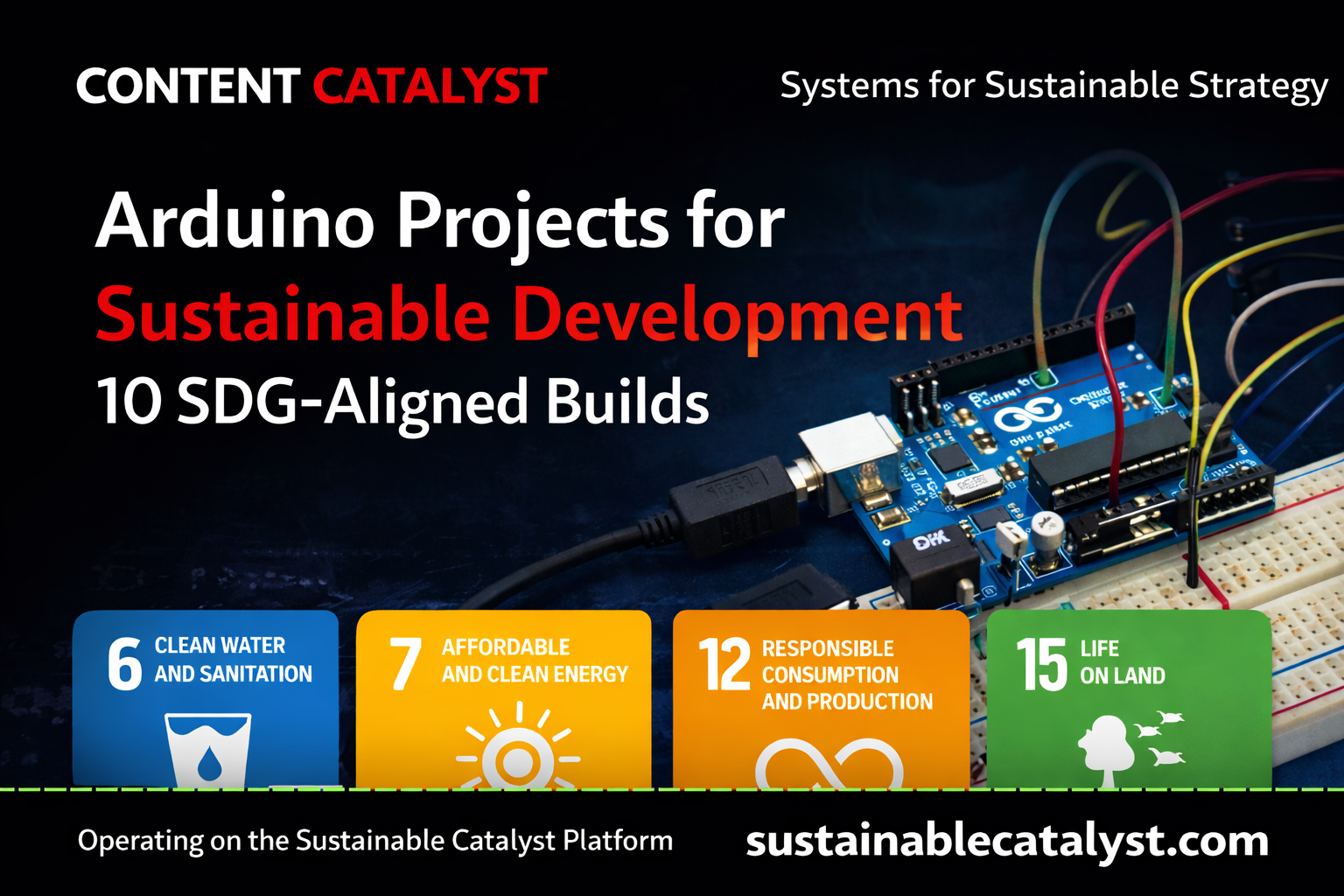
The projects below explore how low-cost electronics can support the goals of the United Nations Sustainable Development Goals. Each project connects to one or more policy objectives, including water conservation, renewable energy, responsible consumption, sustainable cities, climate action, marine protection, and biodiversity monitoring.
These builds are educational prototypes rather than certified environmental instruments. Their value is not that they replace professional monitoring systems, commercial infrastructure, or regulatory equipment. Their value is that they illustrate an important principle: sustainable development ultimately depends on the systems we build to observe, measure, and respond to environmental conditions.
This series also connects to broader knowledge areas across the site, including Environmental Monitoring Systems, Intelligent Infrastructure Systems, Sustainable Development Goals Within Planetary Boundaries, Freshwater Change and Earth System Risk, Climate Change as a Planetary Boundary, Novel Entities and the Problem of Synthetic Overload, and Planetary Boundaries.
Arduino and the Rise of Distributed Environmental Monitoring
Environmental governance increasingly depends on distributed data. From watershed monitoring and air quality sensing to wildlife tracking, compost telemetry, renewable energy systems, and decentralized irrigation control, many sustainability challenges require observations that are local, continuous, and affordable.
Arduino platforms help make that possible. Although they do not replace laboratory-grade instruments or official monitoring networks, they provide an accessible foundation for field experimentation, classroom learning, citizen science, community sensing, and early-stage environmental instrumentation. In that sense, Arduino projects for sustainable development serve not only as educational exercises, but also as prototypes for broader systems of measurement and response.
This is especially important because sustainability is often described in high-level policy language while the work of implementation depends on practical systems. A community cannot manage what it cannot observe. A garden cannot optimize irrigation without feedback. A school cannot teach air-quality variation without a sensor. A wildlife researcher cannot understand movement without telemetry. A circular economy cannot improve material recovery without classification and routing. Low-cost embedded systems make these feedback loops tangible.
How to Use This Series
This article map serves as the central index for a series of Arduino sustainability projects. Each tutorial introduces a practical build, explains its system architecture, provides wiring logic, includes Arduino code, discusses calibration and validation, and connects the project to one or more Sustainable Development Goals.
The projects can be read individually, but they also work together as a small curriculum in applied sustainability engineering. Across the series, several recurring patterns appear:
- Sensing: measuring environmental or infrastructure conditions such as moisture, air quality, water chemistry, location, energy use, temperature, humidity, or system state.
- Control: using measured conditions to trigger pumps, relays, servos, motors, alerts, displays, or status indicators.
- Telemetry: reporting system state through the Serial Monitor, displays, logs, wireless modules, data files, or future dashboards.
- Calibration: comparing sensor readings with known conditions before interpreting results.
- Validation: checking whether readings are plausible, repeatable, and suitable for the intended educational or prototype use.
- Reproducibility: publishing open build materials so the projects can be studied, adapted, audited, and extended.
These are not production systems. They are reference prototypes. Their strongest use is educational, experimental, and conceptual: they show how sustainability problems can be translated into measurable engineering systems.
Projects at a Glance
| Project | Primary SDG | Core Sustainability Theme | Main Technical Pattern |
|---|---|---|---|
| Smart Irrigation Controller | SDG 6 | Freshwater efficiency | Soil sensing and relay control |
| Solar-Powered Arduino Charging System | SDG 7 | Decentralized renewable energy | Solar charging, storage, and voltage monitoring |
| Air Quality Monitoring Station | SDG 11 | Urban environmental monitoring | Particulate sensing and atmospheric telemetry |
| Compost Monitoring System | SDG 12 | Organic waste and nutrient recovery | Temperature, moisture, and ambient monitoring |
| Litter-Collecting Robot | SDG 14 | Pollution prevention | Robotics, proximity sensing, mobility, and gripper actuation |
| Energy Monitoring System | SDG 7 | Energy visibility and efficiency | Current, voltage, power, and energy monitoring |
| Smart Recycling Sorter | SDG 12 | Material recovery and circular systems | Object sensing, material detection, and servo routing |
| Wildlife Tracking Device | SDG 15 | Biodiversity monitoring | GPS logging and low-power field telemetry |
| Water Quality Monitoring Station | SDG 6 | Freshwater quality and water stewardship | pH, temperature, and dissolved-solids sensing |
| Beehive Health Monitoring System | SDG 15 | Pollinator health and ecosystem resilience | Hive temperature, humidity, and weight monitoring |
Arduino Sustainability Project Map
The projects below translate sustainable development challenges into small, measurable embedded-systems prototypes. Each build connects sensors, control logic, calibration, environmental context, and SDG-aligned learning. The table above provides a quick comparison; the project map below gives the series its fuller conceptual structure.
Water, soil, and environmental quality
- Smart Irrigation Controller — A soil-moisture sensing and relay-control project for freshwater efficiency, irrigation feedback, and SDG 6 learning. The project demonstrates how simple environmental feedback can reduce unnecessary watering and make water-use decisions more responsive to local soil conditions.
- Water Quality Monitoring Station — A prototype for measuring pH, temperature, and dissolved-solids signals in freshwater monitoring contexts. The build introduces basic water-sensing principles while emphasizing that educational sensors require calibration and cannot replace certified laboratory analysis.
- Air Quality Monitoring Station — A particulate and atmospheric-sensing project for local air-quality observation and urban environmental awareness. The project illustrates how low-cost sensors can support education and pattern awareness while still requiring caution about calibration, placement, humidity effects, and interpretation.
Energy, waste, and circular systems
- Solar-Powered Arduino Charging System — A small renewable-energy prototype for battery charging, voltage monitoring, and off-grid embedded power. The project helps readers connect solar generation, storage, regulation, and field-device energy budgets.
- Energy Monitoring System — A voltage, current, power, and energy-monitoring project for low-voltage efficiency and energy visibility. The build demonstrates why energy transition depends not only on generation but also on measurement, feedback, load awareness, and system optimization.
- Compost Monitoring System — A temperature and moisture-monitoring project for organic waste, nutrient recovery, and circular resource use. The project shows how biological decomposition can be made more visible through environmental sensing.
- Smart Recycling Sorter — A sensing and servo-routing prototype for material classification, recycling streams, and circular systems education. The project helps readers understand the technical problem of sorting, contamination, classification, and material routing.
Robotics, biodiversity, and field monitoring
- Litter-Collecting Robot — A small environmental robotics prototype using proximity sensing, mobility, and gripper actuation for pollution-prevention learning. The build introduces basic robotics patterns while connecting them to waste, waterways, and material leakage into ecosystems.
- Wildlife Tracking Device — A GPS and low-power telemetry project for biodiversity monitoring, habitat movement, and field-sensing concepts. The project introduces the engineering logic behind movement ecology, conservation telemetry, and low-power environmental deployment.
- Beehive Health Monitoring System — A hive temperature, humidity, and weight-monitoring project for pollinator health and ecological resilience. The project connects embedded sensing to pollinator stewardship, agriculture, and early awareness of colony stress.
Methods, Calibration, and Responsible Use
The central lesson across the series is not that Arduino boards can replace scientific instruments. They cannot. The central lesson is that low-cost embedded systems can help people understand how measurement systems are designed, how environmental signals are collected, how calibration affects interpretation, and how feedback loops can support better decision-making.
That distinction matters. Environmental sensors are never neutral windows into reality. They have operating ranges, drift, sensitivity limits, cross-sensitivities, response times, placement constraints, electrical-noise issues, enclosure requirements, and data-quality limitations. A particulate sensor may be affected by humidity, airflow, and dust accumulation. A soil-moisture sensor may respond differently across soil types. A pH probe requires calibration and maintenance. A load cell must be mechanically mounted with care. A GPS tracker depends on satellite visibility, power management, and logging reliability.
For educational and prototype work, this does not make the projects less valuable. It makes the methodological lesson stronger. Every project should be interpreted through several questions:
- What is the sensor actually measuring? A sensor value is not the same thing as a complete environmental condition.
- What reference condition or calibration standard is being used? Readings are more meaningful when compared with known states or trusted references.
- Where is the device placed? Sensor placement can strongly affect environmental readings.
- How stable is the signal over time? Drift, noise, and environmental interference can change interpretation.
- What decisions should the prototype support? Educational awareness, classroom learning, and trend observation are different from regulatory compliance or safety-critical control.
- What are the consequences of error? A failed classroom display is very different from a failed irrigation controller, water-quality alert, or wildlife-tracking deployment.
Responsible use therefore means being honest about limits. These Arduino builds are appropriate for learning, experimentation, demonstration, prototyping, and community science when interpreted carefully. They should not be presented as certified environmental instruments, professional safety systems, regulatory monitors, medical devices, production infrastructure, or substitutes for expert assessment.
From Prototype to Infrastructure
The projects in this series are intentionally small, but the patterns they demonstrate are infrastructure patterns. A soil moisture controller is a small version of climate-adaptive irrigation. A solar charger is a small version of decentralized energy storage. An air quality monitor is a small version of distributed public-health sensing. A compost monitor is a small version of circular nutrient management. A wildlife tracker is a small version of biodiversity telemetry.
That is why these projects matter as a group. They reveal how sustainability depends on feedback: sensing conditions, interpreting signals, acting carefully, and learning from system response. This feedback logic sits at the center of Intelligent Infrastructure Systems and Environmental Monitoring Systems.
At a planetary scale, the same principle applies. Climate change, freshwater stress, biodiversity loss, land-system transformation, nutrient disruption, atmospheric aerosols, and synthetic overload cannot be governed well if they are poorly measured. Arduino projects do not solve those planetary challenges, but they help make the logic of measurement, feedback, and responsible intervention visible at human scale.
The path from prototype to infrastructure requires much more than wiring and code. It requires robust hardware, field testing, sensor validation, calibration records, metadata, documentation, maintenance plans, power budgets, enclosure design, data governance, uncertainty communication, and clear boundaries around appropriate use. The value of this series is that it introduces those ideas through accessible builds that make sustainability engineering concrete.
Related Site Areas
Environmental sensing and infrastructure
- Environmental Monitoring Systems — The broader systems context for distributed sensing, environmental data collection, field monitoring, calibration, telemetry, and measurement infrastructure.
- Intelligent Infrastructure Systems — The related infrastructure framework for feedback systems, embedded sensing, automation, control logic, adaptive monitoring, and responsive public systems.
Sustainable development and planetary boundaries
- Sustainable Development Goals Within Planetary Boundaries — The broader governance and sustainability framework connecting SDG implementation to ecological limits and planetary-system risk.
- Planetary Boundaries — The wider Earth-system framework for understanding climate change, freshwater change, biosphere integrity, novel entities, land-system change, and biogeochemical disruption.
Water, climate, air quality, and material flows
- Freshwater Change and Earth System Risk — The related planetary-boundary context for water quality monitoring, irrigation control, groundwater stress, and freshwater-system resilience.
- Climate Change as a Planetary Boundary — The climate-system context for renewable energy monitoring, efficiency, solar power, and greenhouse-gas-related sustainability work.
- Atmospheric Aerosol Loading and Regional Planetary Risk — The air-quality and atmospheric-pollution context for particulate monitoring, urban exposure, wildfire smoke, and regional environmental health.
- Novel Entities and the Problem of Synthetic Overload — The material-risk context for plastic pollution, waste sorting, synthetic chemicals, recycling systems, and circular material design.
Nutrients, land systems, and biodiversity
- Biogeochemical Flows: Nitrogen, Phosphorus, and Planetary Destabilization — The nutrient-cycle context for compost monitoring, soil health, organic waste recovery, agriculture, and circular nutrient systems.
- Biosphere Integrity and the Stability of Life Systems — The biodiversity context for wildlife tracking, pollinator monitoring, habitat observation, and ecological resilience.
Further Reading
- Arduino (n.d.) Arduino Documentation. Available at: https://docs.arduino.cc/
- Arduino (n.d.) Arduino Reference. Available at: https://www.arduino.cc/reference/en/
- United Nations (n.d.) The 17 Sustainable Development Goals. Available at: https://sdgs.un.org/goals
- United Nations (n.d.) Sustainable Development Goal 6: Clean Water and Sanitation. Available at: https://sdgs.un.org/goals/goal6
- United Nations (n.d.) Sustainable Development Goal 7: Affordable and Clean Energy. Available at: https://sdgs.un.org/goals/goal7
- United Nations (n.d.) Sustainable Development Goal 11: Sustainable Cities and Communities. Available at: https://sdgs.un.org/goals/goal11
- United Nations (n.d.) Sustainable Development Goal 12: Responsible Consumption and Production. Available at: https://sdgs.un.org/goals/goal12
- United Nations (n.d.) Sustainable Development Goal 14: Life Below Water. Available at: https://sdgs.un.org/goals/goal14
- United Nations (n.d.) Sustainable Development Goal 15: Life on Land. Available at: https://sdgs.un.org/goals/goal15
- Open Source Hardware Association (n.d.) Open Source Hardware Definition. Available at: https://www.oshwa.org/definition/
- U.S. Environmental Protection Agency (n.d.) Air Sensor Toolbox. Available at: https://www.epa.gov/air-sensor-toolbox
- U.S. Geological Survey (n.d.) Water Science School. Available at: https://www.usgs.gov/special-topics/water-science-school
- World Health Organization (2021) WHO Global Air Quality Guidelines. Available at: https://www.who.int/publications/i/item/9789240034228
- World Health Organization (2022) Guidelines for Drinking-water Quality. 4th edn, incorporating the first and second addenda. Available at: https://www.who.int/publications/i/item/9789240045064
References
- Arduino (n.d.) Arduino Documentation. Available at: https://docs.arduino.cc/
- Arduino (n.d.) Arduino Reference. Available at: https://www.arduino.cc/reference/en/
- Food and Agriculture Organization of the United Nations (n.d.) AQUASTAT. Available at: https://www.fao.org/aquastat/en/
- Intergovernmental Science-Policy Platform on Biodiversity and Ecosystem Services (2019) Global Assessment Report on Biodiversity and Ecosystem Services. Available at: https://ipbes.net/global-assessment
- National Oceanic and Atmospheric Administration (2021) NOAA Citizen Science Strategy. Available at: https://sciencecouncil.noaa.gov/wp-content/uploads/2023/03/NOAA_Citizen_Science_Strategy.pdf
- Open Source Hardware Association (n.d.) Open Source Hardware Definition. Available at: https://www.oshwa.org/definition/
- United Nations (n.d.) The 17 Sustainable Development Goals. Available at: https://sdgs.un.org/goals
- United Nations Environment Programme (2021) From Pollution to Solution: A Global Assessment of Marine Litter and Plastic Pollution. Available at: https://www.unep.org/resources/pollution-solution-global-assessment-marine-litter-and-plastic-pollution
- U.S. Environmental Protection Agency (n.d.) Air Sensor Toolbox. Available at: https://www.epa.gov/air-sensor-toolbox
- U.S. Environmental Protection Agency (n.d.) Air Sensor Guidebook. Available at: https://www.epa.gov/air-sensor-toolbox/air-sensor-guidebook
- U.S. Geological Survey (n.d.) Water Science School. Available at: https://www.usgs.gov/special-topics/water-science-school
- World Health Organization (2021) WHO Global Air Quality Guidelines. Available at: https://www.who.int/publications/i/item/9789240034228
- World Health Organization (2022) Guidelines for Drinking-water Quality. 4th edn, incorporating the first and second addenda. Available at: https://www.who.int/publications/i/item/9789240045064