
Last Updated May 3, 2026
Mysticism and Contemplative Traditions examines the religious, philosophical, devotional, ascetic, poetic, psychological, and experiential worlds through which human beings have sought direct transformation of perception, deeper union with ultimate reality, disciplined purification of the self, contemplative insight, sacred presence, interior stillness, awakened awareness, divine intimacy, liberation, illumination, and the reordering of life around what is held to be highest, truest, or most real. As a major category within the Religious Studies knowledge series, it studies these traditions first through their own primary texts, practices, spiritual disciplines, liturgical settings, teacher lineages, and internal interpretive frameworks, and only after that through modern scholarship.
Mystical and contemplative traditions are among the most enduring and difficult forms of religious life to interpret well. They are often reduced either to vague spirituality or to private inward feeling detached from doctrine, ritual, law, ethics, community, and institutional formation. Yet historically they have rarely existed in isolation. They emerge within religious civilizations through scripture, liturgy, monastic discipline, meditative training, metaphysical reflection, spiritual direction, ethical struggle, symbolic language, ritual inheritance, bodily discipline, and inherited methods of transformation. They are not simply emotional intensities. They are disciplined paths.
This category includes contemplative and mystical worlds across multiple civilizational settings: Christian mysticism, Islamic Sufism, Jewish mysticism, Hindu and yogic contemplative traditions, Buddhist meditation lineages, Daoist interior cultivation, contemplative strands within Sikh and other devotional traditions, Indigenous and oral practices of vision, song, healing, and sacred relation where publicly discussable, and comparable paths of inward transformation in other religious worlds. It studies silence, prayer, remembrance, meditation, negation, ecstasy, nonattachment, vision, union, emptiness, illumination, love, deification, annihilation of ego, sacred sound, contemplative embodiment, and the purification of desire not as interchangeable experiences, but as deeply structured religious forms shaped by different metaphysics, languages, practices, and sacred aims.
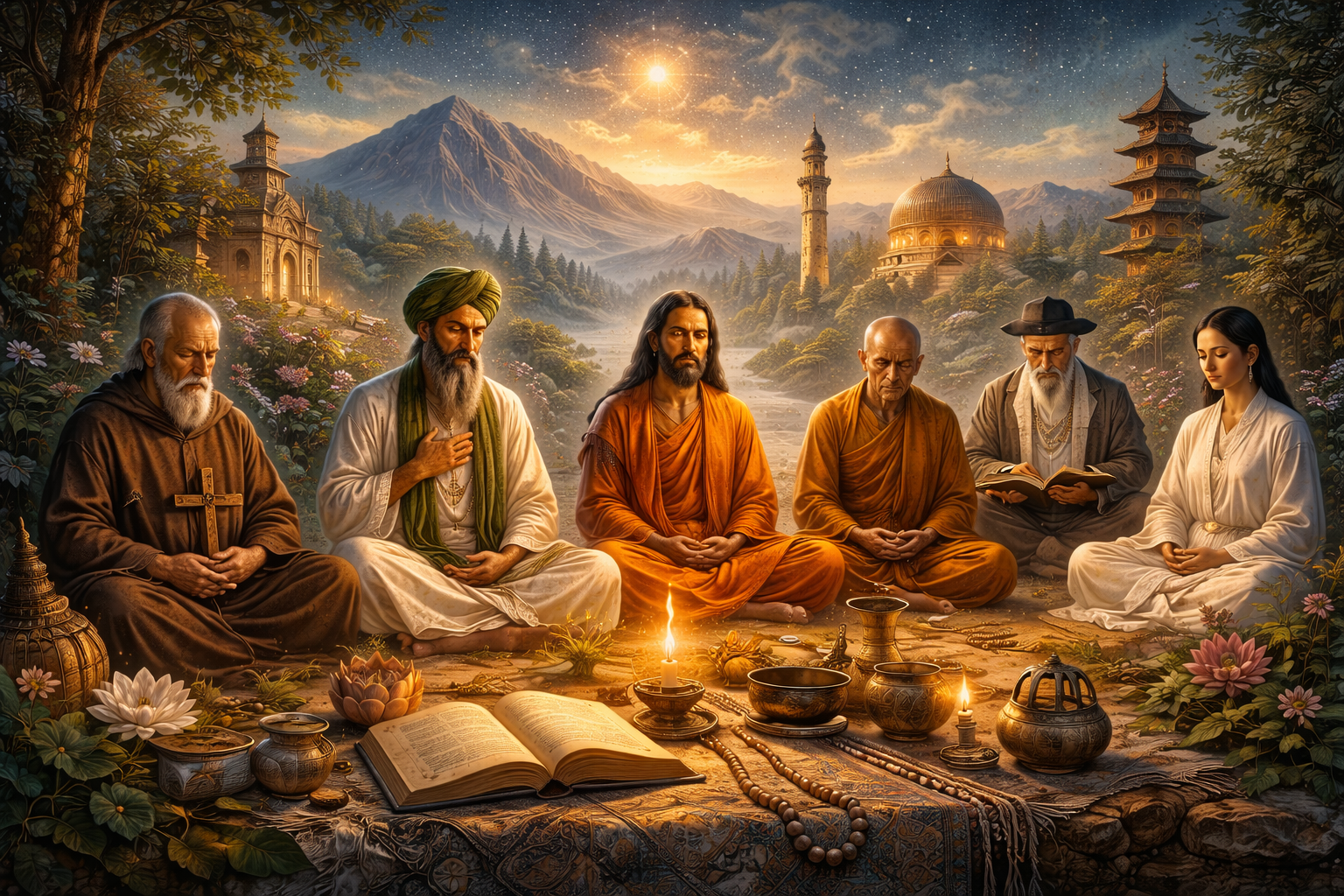
Mysticism and Contemplative Traditions are especially important to the broader architecture of this site because they connect religion to consciousness, ethics, symbolic imagination, selfhood, discipline, embodiment, perception, language, and the limits of ordinary knowledge. In this respect, the category links not only to Foundations of Religion and Comparative Sacred Themes, but also to Philosophy, Psychology, Metaphysics, Mind, Matter, and Consciousness, Healing Traditions, Abrahamic Traditions, South Asian Traditions, East Asian Traditions, and Indigenous and Oral Traditions.
The goal of this pillar is not to dissolve differences into a universal mysticism detached from history. It is to take contemplative and mystical traditions seriously as rigorously formed paths of transformation, each shaped by its own cosmology, doctrine, sacred language, ritual inheritance, metaphysical horizon, ethical discipline, and community of interpretation. Union with God, realization of emptiness, remembrance of Allah, deification in Christ, Kabbalistic repair, yogic liberation, Daoist attunement, Sikh remembrance, and Indigenous vision or healing traditions where publicly shareable are not interchangeable. They may be compared, but not collapsed.
This pillar also recognizes that mystical traditions require ethical seriousness. Interior intensity can be beautiful, but it can also become spiritually dangerous when detached from discernment, humility, accountability, and communal testing. Traditions of contemplation have produced some of the world’s greatest literature, music, philosophy, practices of attention, and grammars of inward transformation. They have also had to confront illusion, pride, self-deception, antinomian claims, charismatic abuse, and the temptation to mistake unusual experience for wisdom. For that reason, this category treats mysticism not as escape from religion, but as one of religion’s most demanding forms of discipline.
Why Mysticism and Contemplative Traditions Matter
Mysticism and contemplative traditions matter because they preserve some of humanity’s deepest reflections on attention, selfhood, desire, transcendence, sacred nearness, and the possibility that perception itself can be transformed. They ask whether ordinary consciousness is clouded, fragmented, egocentric, forgetful, restless, grasping, or spiritually asleep; whether purification, remembrance, meditation, prayer, silence, service, or self-emptying can reveal a deeper order of reality; and whether human beings may come into union, communion, emptiness, stillness, illumination, deification, awakened awareness, or divine intimacy through disciplined practice.
These traditions also matter because they challenge simplistic accounts of religion as merely external belief or social institution. Religious civilizations repeatedly generate interior paths: paths of silence, love, negation, vigilance, repetition, fasting, recollection, chanting, breath, bodily discipline, contemplative attention, and sustained ethical struggle. Yet they are not simply “inner” in a modern individualist sense. They emerge within liturgies, lineages, monasteries, brotherhoods, orders, sanghas, teacher-student relationships, scriptural traditions, metaphysical worlds, and systems of discernment.
At the same time, mystical traditions are not free from danger. They can generate spiritual elitism, antinomian claims, charismatic abuse, psychological confusion, false visions, cultic authority, and the romantic inflation of private feeling. This makes them especially important to study seriously. Their power lies not only in intensity of experience, but in the disciplined traditions that test, shape, interpret, and sometimes restrain experience.
For the broader Sustainable Catalyst architecture, this pillar is strategically important because it connects Religious Studies to Psychology, Philosophy, Healing Traditions, Literature, Metaphysics, and the study of consciousness. Mysticism and contemplation show how traditions think about transformation not as abstract theory alone, but as trained perception, disciplined desire, spiritual memory, and the formation of a different kind of person.
The Problem of Definition
The word “mysticism” is useful but unstable. In modern usage it can refer to direct experience of the divine, union with ultimate reality, ecstatic states, contemplative silence, interior transformation, visionary symbolism, nondual realization, ineffability, or even vague intuition. Such breadth can make the term misleading. Many traditions now called mystical did not define themselves by an equivalent abstract category. They spoke instead of prayer, gnosis, contemplation, union, remembrance, awakening, emptiness, deification, annihilation, illumination, realization, divine love, sacred discipline, or purification of the heart.
For that reason, this pillar uses “Mysticism and Contemplative Traditions” as a comparative framework rather than as a total explanation. It gathers traditions organized around disciplined inward transformation, but it does not assume that all such paths share the same metaphysics, goals, or phenomenology. Union with a personal God is not the same as realization of non-self. Apophatic unknowing is not the same as devotional intoxication. Meditative stillness is not the same as visionary ecstasy. Yogic liberation is not the same as Christian deification. Daoist attunement is not the same as Sufi remembrance.
The modern category also carries intellectual history. Some early comparative approaches treated mysticism as a single universal experience appearing in different religious clothing. Other scholars have argued that mystical experience is always shaped by language, doctrine, expectation, practice, and community. Both positions matter, but this pillar avoids extremes. It does not deny meaningful comparison, but it also refuses to detach experiences from the traditions that form them.
Done well, the category clarifies rather than collapses differences. It allows serious comparison while preserving the internal vocabulary and sacred aims of each tradition. Mysticism is not one universal substance hidden under different names. It is a family of disciplined paths through which religious civilizations seek transformation at the deepest level of self, perception, desire, and relation to ultimate reality.
Experience, Discipline, and Transformation
Mystical and contemplative traditions are often mistaken for collections of unusual experiences. But historically they are far more structured than that. They involve rule, repetition, posture, ethics, diet, liturgical rhythm, scriptural interpretation, teacher-student relations, ritual forms, practices of discernment, and inherited accounts of error and illusion. Experience matters, but it is normally embedded within a larger discipline of transformation.
This is one reason contemplative traditions cannot be reduced to spontaneous spirituality. The aim is rarely raw feeling alone. It is the remaking of perception, will, desire, memory, attention, and conduct. The practitioner is trained to see differently, remember differently, respond differently, and often to become a different kind of person. Experience is not the whole path. It is one moment in an ordered process.
Transformation also gives the category its ethical seriousness. A contemplative path that produces ecstasy without humility, insight without compassion, or intensity without moral responsibility is treated with suspicion in many traditions. Mystical experience must be interpreted by its fruits: patience, mercy, detachment, justice, courage, love, nonviolence, reverence, or disciplined service depending on the tradition.
For comparative religion, this is crucial. The study of mysticism must ask not only what practitioners feel, but what they do, how they are trained, how their communities interpret transformation, how their traditions guard against illusion, and how contemplative practice reshapes ordinary life.
Silence, Attention, and the Reordering of Consciousness
Many contemplative traditions begin from the recognition that ordinary life is noisy, distracted, and spiritually disordered. The mind wanders. Desire fragments attention. Ego defends itself. Speech multiplies without depth. Fear, resentment, and craving narrow perception. In response, traditions of contemplation develop disciplines of silence, stillness, vigilance, recollection, breath, chant, posture, attention, and sacred repetition. Silence is not mere absence. It is often treated as a condition of receptivity.
This matters because contemplation frequently aims not at new information but at new perception. The world is not necessarily replaced; it is seen differently. Attention itself becomes moral and spiritual. To attend rightly may be to remember God, to perceive divine presence, to see interdependence, to recognize emptiness, to overcome illusion, to purify the heart, or to become present to what distraction conceals.
Silence is therefore not always quietism. It may be active receptivity, disciplined listening, purification of speech, liberation from compulsion, or preparation for truthful action. Some traditions enter silence through solitary prayer. Others through monastic rule, meditative posture, breath discipline, communal chanting, retreat, or the repetition of sacred names. The forms differ, but the central insight recurs: attention can be trained.
For this reason, contemplative traditions are deeply relevant to the wider architecture around Psychology, Thinking, Metaphysics, and selfhood. They preserve some of the longest-running human experiments in disciplined attention and the transformation of consciousness.
Apophatic and Cataphatic Paths
One of the most important distinctions in the study of mysticism is between apophatic and cataphatic modes, though the two often overlap. Apophatic paths emphasize negation, silence, darkness, unknowability, and the stripping away of images and concepts. They proceed by un-saying: God or ultimate reality exceeds description. Cataphatic paths, by contrast, emphasize names, images, symbols, beauty, love, praise, sacred form, divine attributes, vision, and affirmative relation.
This distinction matters because mystical traditions do not all aim at the same kind of interior life. Some move toward emptiness and unknowing. Others move toward vision, symbol, intimacy, or devotional fullness. Some cultivate intellectual negation. Others cultivate affective union. Some dismantle conceptual grasping. Others intensify symbolic imagination. The difference is not always absolute, but it helps clarify the diversity of contemplative paths.
In historical terms, this distinction also reveals how metaphysics shapes practice. Traditions centered on divine transcendence may cultivate unknowing; traditions centered on beauty or incarnation may cultivate symbol and presence; traditions centered on emptiness may cultivate deconstruction of conceptual fixation; traditions centered on divine names may cultivate remembrance and repetition. Mystical method is never separate from what is held to be real.
This also helps prevent shallow comparison. Darkness in John of the Cross, emptiness in Buddhist philosophy, fana in Sufi vocabulary, neti neti in South Asian thought, and Daoist non-forcing may all unsettle ordinary egoic grasping, but they arise from distinct religious worlds. Comparison is strongest when it recognizes both resonance and difference.
Love, Union, and Devotional Intimacy
Many mystical traditions are not centered primarily on silence or negation, but on love. The soul longs, remembers, seeks, burns, empties itself, or is drawn toward what exceeds it. In such traditions, prayer becomes intimacy, devotion becomes transformation, and love becomes a mode of knowledge not reducible to discursive reasoning. The language of bride and bridegroom, friend and beloved, lover and absent presence, soul and Lord, or servant and divine mercy often becomes central.
This devotional intensity matters because it shows that contemplation is not always detached stillness. It may also be eros redirected, desire purified, and personality transformed through relation. Here the path is often affective without becoming merely emotional. Love is trained through ritual, scripture, self-denial, chanting, remembrance, ethical refinement, service, and symbolic language.
Love also changes the relation between knowledge and transformation. The mystic does not merely know about the sacred; the mystic is drawn, wounded, humbled, remade, or consumed by relation to it. Christian bridal mysticism, Sufi longing, bhakti devotion, Sikh remembrance, Jewish devotional prayer, and many other traditions show how love can become a disciplined path of perception.
This dimension is especially important because it resists purely intellectual accounts of religion. Mystical love shows that the human being is not transformed by concepts alone. Desire itself must be educated, purified, redirected, and deepened.
Asceticism, Detachment, and Purification
Mystical traditions frequently insist that contemplation requires purification. Desire must be disciplined. Attachment must be loosened. Speech must be restrained. Appetite must be ordered. The body may be trained through fasting, vigil, celibacy, solitude, regulated labor, ritual purity, dietary practice, almsgiving, pilgrimage, or meditative discipline. Asceticism in these traditions is not always world-hatred. Often it is a method of reordering relation to the world.
Detachment matters because contemplation is rarely imagined as compatible with total captivity to greed, vanity, distraction, resentment, violence, pride, or appetite. The self must be thinned, quieted, humbled, watched, purified, or emptied so that something truer may be perceived. Yet traditions vary sharply in how they interpret this process. Some emphasize renunciation of possessions, some renunciation of ego, some renunciation of conceptual grasping, some renunciation of violent action, and some transformation of desire rather than suppression alone.
Asceticism also belongs to communal discipline. Monastic rules, Sufi adab, Buddhist vinaya, Jain vows, yogic restraints, Christian fasting, Daoist regimens, and other practices show that the contemplative body is often formed through inherited patterns rather than private experimentation. The body becomes an archive of discipline.
For comparative study, asceticism provides a key bridge between mysticism, ethics, and embodiment. It shows that the contemplative life is not merely interior. It is inscribed in habit, time, diet, posture, sleep, speech, sexuality, labor, service, and communal rule.
Embodiment, Breath, Posture, and Sacred Practice
Contemplative traditions often begin with the body because attention is embodied. Breath, posture, gesture, fasting, chanting, prostration, walking, sitting, bowing, kneeling, hand position, gaze, diet, sleep, and rhythm can all become spiritual disciplines. The body is not merely a container for inward experience. It is one of the principal sites through which perception, desire, memory, and sacred attention are trained.
This is especially clear in Buddhist meditation, yoga, Daoist inner cultivation, hesychast prayer, Islamic prayer and dhikr, Sikh devotional singing, monastic rules, and many ritual traditions in which repeated bodily action forms consciousness over time. The practitioner does not simply think differently. The practitioner breathes, stands, sits, eats, speaks, and moves differently.
Embodiment also challenges modern attempts to reduce contemplation to mental technique. A practice removed from its ethical, ritual, bodily, and community context may retain some psychological benefit, but it no longer functions in the same religious way. Meditation, prayer, chant, or breathwork are not identical across traditions simply because they involve attention. Their meaning depends on their metaphysical horizon and disciplined setting.
For the wider site, this section creates an important bridge to Healing Traditions, Psychology, and Mind, Matter, and Consciousness. Contemplative traditions are among humanity’s most sustained investigations of embodied attention.
Vision, Ecstasy, and the Problem of Discernment
Many mystical traditions include visions, dreams, auditions, ecstasies, illuminations, raptures, trances, subtle perceptions, or states of extraordinary nearness. Yet serious traditions rarely treat such experiences as self-validating. They develop methods of discernment because experience can mislead. A vision may console, tempt, inflate, confuse, or reveal. Ecstasy may be grace, psychological intensity, symbolic breakthrough, or spiritual danger depending on context.
Discernment therefore belongs at the center of contemplative study. Christian spiritual direction, Sufi guidance, Buddhist teacher-student testing, Jewish interpretive caution, yogic and tantric initiation, Daoist transmission, and Indigenous ceremonial protocol all show that unusual experience must be interpreted by trained communities. The question is not only what was experienced, but what it means, how it affects conduct, whether it produces humility, and whether it aligns with the tradition’s understanding of truth.
This is especially important in modern contexts where mystical experience is often detached from discipline. Without guidance, intense experience can become spiritual inflation, charismatic manipulation, escapism, or psychological harm. Traditions that honor mystical experience often do so precisely because they have ways to test it.
The problem of discernment also deepens the study of authority. Not every teacher is trustworthy; not every claim of illumination is holy; not every rejection of ordinary norms is liberation. A mature pillar must therefore treat mystical intensity with both reverence and caution.
Christian Mysticism
Christian mysticism preserves a long and varied contemplative world shaped by scripture, liturgy, sacrament, monasticism, apophatic theology, bridal mysticism, hesychasm, and the language of deification, union, love, purgation, and unknowing. The Desert Fathers and Mothers, Pseudo-Dionysius, Evagrius, Gregory of Nyssa, Maximus the Confessor, Symeon the New Theologian, Meister Eckhart, Julian of Norwich, Teresa of Ávila, John of the Cross, and others show that the Christian contemplative archive is broad, internally diverse, and theologically dense.
This tradition matters because it binds contemplation to Christological, ecclesial, and sacramental worlds rather than treating mystical experience as private transcendence. Silence, prayer, darkness, purgation, and union are interpreted through grace, incarnation, sin, love, redemption, and transformation in God. Even the most apophatic currents rarely escape the larger Christian metaphysical and liturgical frame.
Christian mysticism also holds together love and discipline. The soul seeks God through prayer, humility, charity, purification, contemplative stillness, and participation in divine life. In Eastern Christian contexts, theosis and hesychasm place contemplation within a larger vision of human transformation by divine grace. In Western contexts, bridal imagery, affective devotion, interior castles, dark nights, and apophatic unknowing give the tradition multiple grammars of transformation.
Christian mysticism therefore belongs centrally in this pillar not as a marginal intensification of doctrine, but as one of the great inward grammars through which Christian civilization interpreted prayer, suffering, love, purification, divine nearness, and the transformation of the human person.
Sufism and Islamic Contemplative Traditions
Sufism and wider Islamic contemplative traditions preserve one of the richest worlds of remembrance, purification, love, annihilation of ego, inward discipline, adab, spiritual companionship, poetic symbolism, and longing for divine nearness. Here the heart is purified, the self is disciplined, remembrance becomes method, and divine unity is approached through ethical refinement, devotion, metaphysical insight, and disciplined practice.
This tradition matters because it shows that Islamic civilization generated not only law, theology, and philosophy, but also a deeply formed interior path. Dhikr, retreat, poetry, music in some contexts, saintly lineages, manuals of purification, and the language of love all reveal a contemplative world at once affective, disciplined, and theologically shaped. Figures such as al-Ghazālī, al-Qushayrī, Rumi, Ibn ‘Arabī, Junayd, Rabia, and many others preserve distinct but related grammars of transformation.
Sufism is not simply Islamic mysticism as vague spirituality. It is shaped by Qur’an, Hadith, prophetic model, adab, remembrance, tawhid, ethical refinement, and often by institutional tariqas. The path of love is inseparable from discipline. The language of annihilation is inseparable from the doctrine of divine unity. The purification of the heart is inseparable from moral conduct.
Sufism also matters because it connects devotion, metaphysics, and civilization. It influenced literature, ethics, pedagogy, art, politics, music, architecture, and popular religion across multiple regions. It is therefore indispensable to any serious comparative treatment of mysticism.
Jewish Mysticism
Jewish mysticism preserves profound traditions of divine nearness, sacred language, creation, emanation, prayer, symbolism, ethical seriousness, and ecstatic or contemplative ascent. From Merkavah and Hekhalot traditions to Kabbalah and later Hasidic spirituality, the Jewish contemplative archive explores the relation between hiddenness and presence, transcendence and immanence, law and inwardness, exile and repair.
This tradition matters because mysticism in Judaism does not replace covenant, Torah, or communal order. Rather, it intensifies them through symbolic interpretation, prayerful concentration, meditative intention, ethical responsibility, and reflection on the structures of divine life and cosmic repair. Language itself often becomes sacred medium: letters, names, numbers, and scriptural depths carry metaphysical significance.
Kabbalah in particular gives Jewish mysticism one of its most powerful symbolic languages: sefirot, emanation, divine attributes, creation, exile, restoration, and tikkun. Hasidism later brings joy, devotion, inwardness, and the sanctification of ordinary life into new forms of communal spirituality. These traditions show that contemplation can unfold through law, story, language, and communal memory rather than through withdrawal alone.
Jewish mysticism therefore broadens this pillar by showing how contemplation may unfold through Torah, prayer, and interpretive depth without dissolving into individualism. It is a major witness to the contemplative possibilities within a strongly textual and communal religious civilization.
South Asian Contemplative Paths
South Asian contemplative traditions include vast worlds of yoga, meditation, renunciation, bhakti, mantra, inward realization, ascetic discipline, sacred sound, and disciplined transformation across Hindu, Jain, Sikh, and related contexts. These traditions ask whether liberation comes through knowledge of the deepest self, loving devotion to the divine, disciplined control of mind and body, moral restraint, nonviolence, grace, or the release of attachment through sustained realization.
This branch matters because it preserves some of the longest and most technically developed traditions of contemplative practice in the world. Yogic discipline, inward realization, ascetic renunciation, devotional absorption, mantra, sacred sound, and subtle body practice all become structured means of transformation. Contemplation here is inseparable from metaphysical questions of self, reality, desire, rebirth, karma, and liberation.
South Asian contemplative traditions also show that mystical life can be philosophical without being merely theoretical. Vedanta, Yoga, Samkhya, Tantra, Jain asceticism, Sikh remembrance, and bhakti devotion all connect insight to practice. The problem is not merely what reality is, but how ignorance, desire, action, and misperception bind the human being.
For this site, this branch should connect strongly to South Asian Traditions, Metaphysics, Psychology, and Healing Traditions. It provides one of the deepest civilizational archives for the study of contemplative discipline and the remaking of selfhood.
Buddhist Meditative Traditions
Buddhist contemplative traditions preserve highly developed paths of mindfulness, concentration, insight, compassion, emptiness, nonattachment, and awakened perception. Across Theravāda, Mahāyāna, Vajrayāna, Chan, Zen, Pure Land, and other lineages, meditation is not merely relaxation or technique. It is ordered around the diagnosis of suffering, the instability of self, the structures of craving, and the transformation of perception through disciplined practice.
This tradition matters because it gives the study of contemplation one of its clearest non-theistic or differently framed models. The aim is not necessarily union with a creator God, but awakening, liberation from ignorance, realization of emptiness, cessation of craving, or compassionate participation in reality rightly perceived. This makes Buddhist traditions indispensable to comparative study because they complicate inherited Western definitions of mysticism.
Buddhist contemplative worlds also reveal the extraordinary diversity of meditative life: monastic discipline, silent sitting, mindfulness, insight, koan practice, visualization, chanting, devotional invocation, philosophical analysis, ritual practice, and compassion training all appear as means of transformation within different traditions.
Buddhist meditation also has a powerful modern afterlife in psychology, wellness, neuroscience, and secular mindfulness. A serious pillar should recognize this influence while also warning against reducing Buddhist contemplative systems to stress reduction. Their traditional aims are ethical, metaphysical, and soteriological, not merely therapeutic.
Daoist and East Asian Contemplative Worlds
Daoist and other East Asian contemplative traditions preserve subtle paths of interior cultivation, alignment, emptiness, ritual discipline, energetic balance, and attunement to deeper processes of reality. Daoist inwardness does not always operate through the same categories as Abrahamic prayer or Buddhist liberation. It often turns toward harmony, receptivity, inner refinement, non-forcing, and alignment with the larger order of the Dao.
These traditions matter because they preserve contemplative life as cosmological attunement rather than only salvation, union, or metaphysical realization in the Western sense. Inner cultivation, breath, stillness, ritual, embodiment, symbolic relation to natural process, and disciplined receptivity all become important. Confucian self-cultivation also belongs nearby, though not always under the same mystical label, because it preserves disciplined inward formation tied to ethics, social order, and moral refinement.
East Asian contemplative traditions also show how practice can move between philosophy, medicine, ritual, aesthetics, martial discipline, poetry, calligraphy, and everyday conduct. The contemplative life is not always a retreat from the world. It may appear as attunement within the world.
These traditions therefore widen the category and prevent it from becoming overly dependent on monotheistic or South Asian models alone. They show that contemplation can be a practice of alignment, subtlety, responsiveness, and non-coercive presence.
Indigenous Vision, Healing, and Sacred Relation
Indigenous and oral traditions include many publicly discussable forms of vision, healing, ceremony, song, fasting, ordeal, dream, and sacred relation that belong in a broad account of contemplation. Yet this area requires special care. Not all Indigenous ceremonial knowledge is public. Some teachings, songs, names, rituals, plants, places, and practices are restricted by protocol, initiation, season, gender, kinship, office, or community permission. A responsible pillar should therefore discuss broad themes without extracting or reproducing protected knowledge.
Where publicly appropriate, Indigenous contemplative and ceremonial worlds show that interior transformation is often inseparable from land, kinship, ancestors, animals, waters, and communal healing. Vision may be relational rather than individualistic. Healing may concern balance among person, community, place, and spirit. Song may carry law and memory. Ceremony may restore right relation rather than produce private mystical experience.
This branch is important because it prevents mysticism from being defined only through textual, monastic, or philosophical traditions. It shows that contemplative transformation may occur through land-based practice, ceremonial endurance, oral transmission, elder guidance, ecological relation, and sacred performance. It also reinforces the ethical principle that comparison must not become appropriation.
For the site architecture, this section should link closely to Indigenous and Oral Traditions, Healing Traditions, Religion and Ecology, and Cultural Anthropology.
Poetry, Symbol, and the Language of the Inner Life
Mystical traditions frequently turn to poetry, paradox, symbol, and metaphor because ordinary descriptive language proves insufficient. Darkness, fire, wine, desert, ocean, mirror, ladder, night, silence, lover, void, cloud, garden, light, fragrance, breath, wound, intoxication, and music all become recurring symbolic languages for transformations that resist simple statement. The result is not decorative excess. It is a serious response to the limits of literal discourse.
This matters because mystical language is never merely private expression. It is often traditioned language, shaped by scripture, liturgy, inherited symbols, and shared schools of interpretation. Poetry can preserve doctrine, metaphysics, and spiritual method in condensed and memorable form. Symbol becomes a mode of transmission.
The difficulty is that mystical symbolism can be easily misread. Wine in Persian poetry, darkness in Christian mysticism, emptiness in Buddhist texts, erotic language in devotional traditions, or alchemical language in Daoist materials may not mean what they appear to mean on a surface reading. The interpreter must learn the symbolic grammar of the tradition.
This branch is especially important for the site because it connects mysticism not only to religion and philosophy, but to literature, art, music, and the shaping of symbolic imagination. Mystical traditions often become some of a civilization’s greatest poetic and artistic achievements precisely because they struggle with what cannot be said directly.
Community, Lineage, and the Problem of Authority
No serious study of mysticism can ignore the problem of authority. Who is permitted to guide? How are visions tested? How are experiences interpreted? What prevents delusion, pride, or abuse? Most contemplative traditions respond to these questions through lineages, directors, masters, manuals, rules, communities, orders, initiation, and systems of discernment. Mysticism without authority often becomes unstable; authority without contemplative depth often becomes hollow.
This matters because the modern tendency to treat mysticism as purely personal can obscure the historical reality that contemplative life is usually trained and supervised. Monasteries, orders, tariqas, yeshivot, sanghas, hermitages, retreat centers, initiatory systems, and teacher-disciple structures all reveal that inner transformation has communal form.
At the same time, these structures can become sites of power abuse or false sanctity. Charismatic teachers, spiritual directors, gurus, elders, masters, or lineage authorities can exploit trust when accountability is weak. A mature pillar must therefore treat authority as both necessary and dangerous: a central tension within contemplative religion itself.
The question of authority also distinguishes serious contemplative traditions from self-invented spiritual consumption. Traditions preserve not only techniques, but tests, warnings, boundaries, and moral expectations. They teach that depth requires humility, and that power without accountability can deform the very path it claims to protect.
Mysticism, Psychology, and the Study of Selfhood
Mystical and contemplative traditions are crucial to the study of selfhood because they often begin from the claim that the ordinary self is misperceiving reality. Whether described as ego, attachment, illusion, sinfulness, forgetfulness, distraction, passion, ignorance, pride, or conceptual grasping, the untransformed self is seen as unreliable. The contemplative path seeks not merely comfort but a remaking of consciousness, desire, memory, and relation.
This makes the category deeply relevant to psychology. It preserves long histories of attention training, emotional discipline, self-observation, moral struggle, and altered perception. Yet contemplative traditions cannot simply be reduced to psychology, because their aims are frequently theological, metaphysical, soteriological, or cosmological rather than merely therapeutic.
Modern psychology can help illuminate some aspects of contemplative practice: attention, affect regulation, habit formation, trauma, dissociation, ego development, embodiment, and altered states. But psychological interpretation must remain cautious. It can clarify, but it can also flatten religious aims into mental health categories. Mysticism is not merely peak experience, stress reduction, or emotional regulation, even when it may affect all three.
For this site, this branch creates especially rich links between Religious Studies, Psychology, Metaphysics, Healing Traditions, and Mind, Matter, and Consciousness. It allows the contemplative traditions to be studied as serious archives of human transformation rather than as exotic experiences or therapeutic tools alone.
Mysticism, Healing, and the Transformation of Suffering
Mystical and contemplative traditions often arise from suffering: grief, longing, guilt, exile, illness, mortality, failure, desire, despair, fear, injustice, or the instability of ordinary life. They do not always remove suffering. Often they reinterpret, endure, purify, or transform it. The dark night, the purification of the heart, the insight into impermanence, the discipline of nonattachment, the remembrance of God, the healing song, or the vow of compassion all represent different ways of relating to suffering.
This makes contemplation closely connected to healing, but not identical with it. Many traditions do not define the goal as feeling better. They seek truth, liberation, holiness, awakening, divine nearness, compassion, surrender, or right relation. Healing may follow, but it is not always the immediate or only aim.
Contemplative traditions also warn that suffering can be misused. Religious language can romanticize pain, silence victims, sanctify abuse, or encourage passivity before injustice. A mature pillar must therefore distinguish between transformative suffering and harmful spiritualization of harm. Discernment is especially important here.
This section connects the pillar to Healing Traditions, Psychology, and Religion and Society. Contemplation can be a path of repair, but only when held within truth, accountability, and care.
Mysticism and Contemplation in Comparative Religion
Mysticism and contemplative traditions are indispensable to comparative religion because they reveal both powerful similarities and irreducible differences across civilizations. Silence, recollection, detachment, discipline, repetition, purified desire, and transformed awareness recur widely. Yet the realities toward which traditions move, the selves they seek to transform, and the ends they imagine remain sharply different. Union with God, realization of emptiness, recovery of primordial nature, deification, annihilation of ego, remembrance, nondual realization, sacred healing, and awakening are not interchangeable goals.
For that reason, comparative study must resist both fragmentation and premature universalism. It must be capable of noticing recurring structures without erasing sacred difference. Mysticism is not one thing appearing everywhere in disguise. It is a family of rigorously formed paths through which religious civilizations confront the limits of language, the instability of selfhood, the transformation of desire, and the possibility of direct relation to what is ultimate.
Comparative study must also ask what is being compared. Are we comparing experiences, practices, doctrines, metaphors, institutions, bodies, training systems, ethical fruits, or metaphysical claims? A meaningful comparison of silence may differ from a comparison of love, breath, vision, or union. Precision matters.
This makes the category central rather than peripheral. Mystical and contemplative traditions widen the study of religion by forcing it to reckon with experience, discipline, consciousness, silence, beauty, authority, symbolic language, and the possibility that the deepest religious truths are not merely asserted, but practiced into view.
Major Questions of Interpretation
This pillar is organized around several major questions. What is mysticism, and why is the term both useful and unstable? How should contemplative traditions be studied when their internal vocabularies differ so sharply? How can union, emptiness, remembrance, deification, illumination, annihilation, sacred healing, and awakening be compared without being collapsed into a single universal experience?
The pillar also asks how experience becomes trustworthy. What role do discipline, ethics, lineage, scripture, teacher guidance, ritual, and community play in shaping contemplative transformation? How do traditions distinguish illumination from delusion, humility from pride, freedom from antinomianism, and spiritual authority from abuse?
Finally, the pillar asks how contemplative traditions reshape the study of the human person. What is the ordinary self? What binds attention? What purifies desire? What does silence reveal? How does disciplined practice transform perception? How should psychology engage traditions whose aims are not merely therapeutic, but theological, metaphysical, or soteriological?
These questions make Mysticism and Contemplative Traditions one of the most important bridge pillars on the site. It connects Religious Studies to Philosophy, Psychology, Healing, Literature, Metaphysics, and the study of consciousness without reducing any one field to another.
Mysticism and Contemplative Traditions Pillar Map
The following article map is designed as a serious research agenda for the Mysticism and Contemplative Traditions pillar, with emphasis on civilizational range, disciplined practice, symbolic language, authority, embodiment, discernment, psychology, and comparative depth.
Mysticism and Contemplative Traditions is organized to move from definition, practice, experience, discipline, silence, love, negation, embodiment, and discernment into major civilizational traditions: Christian mysticism, Islamic Sufism, Jewish mysticism, South Asian contemplative paths, Buddhist meditative traditions, Daoist and East Asian cultivation, and Indigenous vision and healing where publicly discussable. The goal is to keep the category comparative without dissolving distinct metaphysical horizons, sacred aims, and disciplined practices into a vague universal mysticism.
Foundational Frames
- What Are Mysticism and Contemplative Traditions? (planned)
Introduces mysticism and contemplation as disciplined paths of transformation rather than vague spirituality or private feeling. - Mysticism, Meditation, and the Problem of Definition (planned)
Examines why terms such as mysticism, meditation, contemplation, union, awakening, and realization require careful distinction. - Discipline, Experience, and Transformation (planned)
Studies mystical experience within the larger structures of practice, ethics, formation, and community interpretation. - Silence, Attention, and the Reordering of Consciousness (planned)
Explores silence, recollection, attention, stillness, and the training of perception across traditions. - Embodiment, Breath, Posture, and Sacred Practice (planned)
Examines how contemplative traditions train the body through breath, posture, gesture, diet, and repeated practice. - Vision, Ecstasy, and the Problem of Discernment (planned)
Studies visions, ecstasies, dreams, and altered states alongside traditional methods of testing and interpretation.
Christian Mysticism
- The Desert Fathers and Mothers (planned)
Studies early monastic withdrawal, spiritual struggle, silence, asceticism, prayer, and the formation of Christian contemplative discipline. - Apophatic Theology and the Cloud of Unknowing (planned)
Explores divine unknowability, darkness, negation, silence, and the contemplative path beyond images and concepts. - Pseudo-Dionysius and the Mystical Theology of Divine Darkness (planned)
Examines hierarchy, negation, divine transcendence, and the language of unknowing in Christian thought. - Julian of Norwich and the Language of Divine Love (planned)
Studies revelation, suffering, motherhood imagery, divine love, and the assurance that “all shall be well.” - Teresa of Ávila and the Interior Castle (planned)
Explores interior prayer, spiritual architecture, stages of transformation, discernment, and union with God. - John of the Cross and the Dark Night (planned)
Examines purgation, darkness, detachment, spiritual desire, and union through unknowing. - Hesychasm, Prayer, and Deification (planned)
Studies Eastern Christian stillness, the Jesus Prayer, divine energies, and theosis. - Meister Eckhart and the Ground of the Soul (planned)
Explores detachment, divine birth in the soul, apophatic preaching, and the edge of theological language.
Islamic Contemplative Traditions
- What Is Sufism? (planned)
Introduces Sufism as Islamic spiritual discipline rooted in Qur’an, prophetic model, remembrance, adab, and purification of the heart. - Dhikr, Purification, and the Discipline of the Heart (planned)
Studies remembrance, repetition, ethical refinement, vigilance, and the training of the heart. - Rumi and the Poetics of Longing (planned)
Explores love, longing, story, music, and symbolic language in Persian Sufi spirituality. - Ibn ‘Arabī and the Metaphysics of Unity (planned)
Examines divine unity, imagination, being, symbolism, and the metaphysical depth of Islamic mysticism. - Al-Ghazālī and the Inner Sciences of Religion (planned)
Studies moral psychology, purification, knowledge, worship, and the inward life of Islamic practice. - Tariqa, Adab, and Spiritual Companionship (planned)
Explores Sufi orders, guidance, manners, companionship, discipline, and communal formation. - Rabia, Love, and the Sufi Language of Devotion (planned)
Studies divine love, renunciation, sincerity, and the transformation of desire. - Fana, Baqa, and the Annihilation of Ego (planned)
Examines annihilation, subsistence in God, humility, and the limits of selfhood in Sufi thought.
Jewish Mysticism
- Merkavah and Hekhalot Traditions (planned)
Studies ascent, heavenly palaces, throne vision, angelic liturgy, and early Jewish mystical worlds. - Kabbalah (planned)
Introduces Kabbalistic symbolism, sefirot, emanation, creation, divine life, and mystical interpretation. - The Zohar and Sacred Interpretation (planned)
Explores mystical exegesis, symbolic reading, divine presence, and the sacred depth of Torah. - Hasidism and Joyful Inwardness (planned)
Studies devotional joy, prayer, the tzaddik, everyday sanctification, and inward religious renewal. - Tikkun, Exile, and Cosmic Repair (planned)
Examines repair, exile, divine hiddenness, ethical action, and cosmic restoration. - Sacred Letters, Divine Names, and Jewish Contemplative Language (planned)
Studies letters, names, prayer, and the metaphysical power of language in Jewish mysticism.
South Asian Contemplative Traditions
- Yoga and the Discipline of Consciousness (planned)
Introduces yoga as a disciplined transformation of mind, body, attention, and liberation. - Patañjali, Concentration, and the Restraint of Mental Fluctuation (planned)
Studies the Yoga Sūtras, samādhi, discipline, and liberation through mental stilling. - Bhakti and Devotional Absorption (planned)
Explores loving devotion, sacred song, surrender, and divine intimacy in South Asian traditions. - Advaita and the Realization of Ultimate Selfhood (planned)
Examines nondual realization, self, brahman, ignorance, and liberation. - Jain Asceticism and Radical Discipline (planned)
Studies nonviolence, restraint, purification, karma, and ascetic transformation. - Sikh Devotion, Remembrance, and Sacred Song (planned)
Explores remembrance of the divine name, scripture, kirtan, devotion, and communal spiritual life. - Mantra, Sacred Sound, and the Transformation of Attention (planned)
Studies sound, repetition, vibration, memory, and sacred speech as contemplative practice. - Tantra, Initiation, and the Sacred Body (planned)
Examines ritual power, initiation, visualization, mantra, subtle body, and disciplined transformation.
Buddhist Contemplative Traditions
- Meditation in Early Buddhism (planned)
Studies mindfulness, concentration, insight, monastic discipline, and the path beyond suffering. - Impermanence, No-Self, and the Transformation of Perception (planned)
Explores how Buddhist practice reorders perception of self, time, attachment, and reality. - Zen and the Discipline of Immediate Attention (planned)
Examines zazen, koan practice, immediacy, discipline, and awakening in Zen traditions. - Pure Land Devotion and Contemplative Aspiration (planned)
Studies devotion, invocation, faith, aspiration, and the contemplative life of Pure Land traditions. - Vajrayāna, Visualization, and Transformative Practice (planned)
Explores visualization, mantra, deity yoga, ritual, initiation, and transformation in Vajrayāna contexts. - Emptiness, Compassion, and Awakening (planned)
Studies the relation between emptiness, compassion, bodhisattva practice, and liberation. - Mindfulness, Modern Psychology, and the Secularization of Meditation (planned)
Critically examines modern mindfulness, therapeutic adaptation, and the loss or transformation of Buddhist context.
Daoist and East Asian Traditions
- Daoist Inner Cultivation (planned)
Introduces Daoist practices of inward refinement, alignment, breath, stillness, and relation to the Dao. - Stillness, Breath, and Alignment with the Dao (planned)
Studies breath, receptivity, non-forcing, inner quiet, and cosmological attunement. - East Asian Contemplation Beyond Monastic Buddhism (planned)
Explores contemplative forms in Daoist, Confucian, popular, artistic, and embodied traditions. - Self-Cultivation and Interior Formation in East Asia (planned)
Studies moral cultivation, discipline, ritual, attention, and the formation of personhood. - Poetry, Landscape, and Contemplative Perception in East Asia (planned)
Examines landscape, emptiness, perception, art, and contemplative aesthetics.
Indigenous, Oral, and Land-Based Contemplative Worlds
- Vision, Ceremony, and Sacred Relation in Indigenous Traditions (planned)
Studies publicly discussable forms of vision, ceremony, fasting, and relation with strong attention to protocol and non-extraction. - Song, Healing, and the Restoration of Balance (planned)
Explores the role of song, ritual, healing, and relational repair in Indigenous sacred worlds where publicly shareable. - Land, Silence, and Sacred Attention (planned)
Studies land-based attention, ecological relation, place memory, and sacred presence. - Protocol, Restricted Knowledge, and the Ethics of Comparative Mysticism (planned)
Establishes ethical boundaries for studying Indigenous contemplative and ceremonial traditions.
Comparative Themes
- Apophatic and Cataphatic Mysticism (planned)
Compares negation, silence, image, symbol, beauty, and affirmative sacred language. - Love, Union, and the Language of Intimacy (planned)
Studies devotional longing, divine intimacy, spiritual eros, and the transformation of desire. - Asceticism, Detachment, and Purification (planned)
Explores fasting, celibacy, restraint, renunciation, nonattachment, and the discipline of desire. - Poetry, Symbol, and the Limits of Language (planned)
Examines metaphor, paradox, mystical poetry, symbolic grammar, and ineffability. - Authority, Lineage, and Spiritual Discernment (planned)
Studies teachers, directors, lineages, discernment, abuse, accountability, and the testing of experience. - Mysticism, Psychology, and the Study of Selfhood (planned)
Connects contemplative traditions to attention, ego, desire, selfhood, altered states, and transformation. - Embodiment, Breath, and Contemplative Practice (planned)
Compares bodily disciplines across traditions without reducing them to generic technique. - Mysticism, Healing, and the Transformation of Suffering (planned)
Studies suffering, purification, trauma, healing, and spiritual transformation with ethical care. - Why Mysticism and Contemplative Traditions Still Matter (planned)
Concludes the series by connecting contemplation to modern questions of attention, meaning, selfhood, ethics, and sacred transformation.
This structure allows the category to remain comparative while preserving the distinct metaphysical horizons, sacred aims, and disciplined practices of the contemplative traditions it gathers. It also connects the pillar to the wider site architecture by linking Religious Studies to Philosophy, Psychology, Healing Traditions, Metaphysics, Literature, and the study of consciousness.
Closing Perspective
Mysticism and Contemplative Traditions give Religious Studies one of its most demanding and transformative fields. They show that religion is not only doctrine, institution, law, ritual, or community identity. It is also disciplined attention, purified desire, trained perception, sacred silence, symbolic language, inward struggle, and the possibility that the human person may be remade in relation to what is ultimate.
The strongest reason to study this field is that it refuses shallow accounts of both religion and the self. It does not ask only what people believe. It asks how they attend, desire, remember, suffer, pray, sit, breathe, love, renounce, discern, and transform. It asks whether the ordinary self sees clearly, whether desire can be purified, whether silence can disclose truth, whether suffering can become a site of transformation, and whether language can point beyond itself.
For the broader Sustainable Catalyst architecture, this pillar is essential. It strengthens Religious Studies while linking to Philosophy, Psychology, Healing Traditions, Metaphysics, Mind, Matter, and Consciousness, Literature, and Comparative Sacred Themes. Mysticism and contemplative traditions show how sacred life can become a disciplined transformation of consciousness, not as private escape, but as a demanding path of ethical, spiritual, and perceptual reformation.
Related Reading
- Religious Studies
- Foundations of Religion
- Comparative Sacred Themes
- Abrahamic Traditions
- South Asian Traditions
- East Asian Traditions
- Indigenous and Oral Traditions
- Islamic Mystical Thought
- Persian Thought
- Philosophy
- Metaphysics
- Mind, Matter, and Consciousness
- Psychology
- Healing Traditions
- Vital Energy Healing Traditions
- Poetry, Memory, and Imagination
Primary Texts
- Christian traditions: The Cloud of Unknowing; works of Teresa of Ávila; works of John of the Cross; selections from the Philokalia; Pseudo-Dionysius, especially Mystical Theology; Julian of Norwich’s Revelations of Divine Love; writings of Evagrius, Maximus the Confessor, Gregory of Nyssa, Meister Eckhart, and other major Christian contemplative writers.
- Islamic traditions: al-Qushayrī’s Risāla; al-Ghazālī’s Ihyā’ ‘Ulūm al-Dīn; Rumi’s Mathnawī; Ibn ‘Arabī’s major writings; works associated with Junayd, Rabia, Attar, Suhrawardi, Ibn al-‘Arif, and other Sufi and Islamic contemplative authors.
- Jewish traditions: Zohar; Hekhalot and Merkavah materials; Sefer Yetzirah; Kabbalistic commentaries; Hasidic teachings; prayer and devotional texts concerned with divine names, inner intention, and cosmic repair.
- South Asian traditions: Upanishads; Bhagavad Gītā; Yoga Sūtras; bhakti poetry and devotional texts; Advaita, Yoga, Tantra, Sikh devotional, and Jain ascetic materials concerned with liberation, sacred sound, and disciplined transformation.
- Buddhist traditions: early meditation suttas and sutras; major Mahāyāna contemplative texts; Chan and Zen teaching materials; Pure Land devotional materials; Vajrayāna practice texts where publicly accessible and appropriate; Abhidharma and meditation manuals.
- Daoist and East Asian traditions: Dao De Jing; Zhuangzi; Daoist inner cultivation materials; Chan/Zen texts; Confucian self-cultivation texts; contemplative poetry, ritual manuals, and philosophical writings connected to inward formation and attunement.
- Indigenous and oral traditions: community-authorized public materials concerning vision, healing, song, ceremony, and sacred relation, handled with respect for protocol, restricted knowledge, and community sovereignty.
Internal Interpretive Traditions
- Christian mystical traditions: monasticism, hesychasm, apophatic theology, spiritual direction, lectio divina, contemplative prayer, sacramental theology, desert spirituality, bridal mysticism, and traditions of discernment.
- Islamic contemplative traditions: Sufi tariqas, dhikr, adab, purification of the heart, spiritual companionship, Qur’anic contemplation, prophetic model, metaphysics of unity, manuals of self-discipline, and poetic symbolic interpretation.
- Jewish mystical traditions: Merkavah ascent, Kabbalah, Hasidism, sacred names, sefirotic symbolism, kavvanah, Torah interpretation, prayer, and tikkun.
- South Asian contemplative traditions: yoga, Vedanta, bhakti, Tantra, mantra, Jain asceticism, Sikh remembrance, guru lineages, renunciation, sacred sound, and liberation-centered practice.
- Buddhist contemplative traditions: mindfulness, concentration, insight, monastic discipline, Zen, Chan, Pure Land, Vajrayāna, compassion practice, emptiness, visualization, and awakening.
- Daoist and East Asian traditions: inner cultivation, breath practice, non-forcing, stillness, ritual alignment, self-cultivation, and contemplative aesthetics.
- Indigenous contemplative and ceremonial traditions: publicly shareable forms of vision, healing, song, fasting, land relation, and ceremonial knowledge governed by community protocol.
Modern Scholarship
- James, W. The Varieties of Religious Experience.
- Katz, S.T. (ed.) Mysticism and Philosophical Analysis.
- McGinn, B. The Foundations of Mysticism.
- Schimmel, A. Mystical Dimensions of Islam.
- Stace, W.T. Mysticism and Philosophy.
- Underhill, E. Mysticism.
- Hollywood, A. Sensible Ecstasy.
- Forman, R.K.C. Mysticism, Mind, Consciousness.
- Laird, M. Into the Silent Land.
- Idel, M. Kabbalah: New Perspectives.
- Faure, B. Chan Insights and Oversights.
- Sharf, R.H., work on experience, meditation, and the critique of modern Buddhist categories.
- Sells, M.A. Mystical Languages of Unsaying.
- Hadot, P. Philosophy as a Way of Life.
Further Reading
- Faure, B. (1993) Chan Insights and Oversights: An Epistemological Critique of the Chan Tradition. Princeton, NJ: Princeton University Press.
- Forman, R.K.C. (1999) Mysticism, Mind, Consciousness. Albany, NY: State University of New York Press.
- Hadot, P. (1995) Philosophy as a Way of Life: Spiritual Exercises from Socrates to Foucault. Oxford: Blackwell.
- Hollywood, A. (2002) Sensible Ecstasy: Mysticism, Sexual Difference, and the Demands of History. Chicago: University of Chicago Press.
- Idel, M. (1988) Kabbalah: New Perspectives. New Haven: Yale University Press.
- James, W. (2002) The Varieties of Religious Experience. New York: Modern Library.
- Katz, S.T. (ed.) (1978) Mysticism and Philosophical Analysis. New York: Oxford University Press.
- Laird, M. (2006) Into the Silent Land: A Guide to the Christian Practice of Contemplation. Oxford: Oxford University Press.
- McGinn, B. (1991) The Foundations of Mysticism: Origins to the Fifth Century. New York: Crossroad.
- Schimmel, A. (1975) Mystical Dimensions of Islam. Chapel Hill, NC: University of North Carolina Press.
- Sells, M.A. (1994) Mystical Languages of Unsaying. Chicago: University of Chicago Press.
- Sharf, R.H. (1995) ‘Buddhist Modernism and the Rhetoric of Meditative Experience’, Numen, 42(3), pp. 228–283.
- Stace, W.T. (1960) Mysticism and Philosophy. London: Macmillan.
- Underhill, E. (1990) Mysticism: A Study in the Nature and Development of Spiritual Consciousness. Oxford: Oneworld.
References
- Christian Classics Ethereal Library (n.d.) The Cloud of Unknowing. Available at: https://www.ccel.org/c/cloud/ (Accessed: 11 April 2026).
- Chinese Text Project (n.d.) Dao De Jing. Available at: https://ctext.org/dao-de-jing (Accessed: 11 April 2026).
- Chinese Text Project (n.d.) Zhuangzi. Available at: https://ctext.org/zhuangzi (Accessed: 11 April 2026).
- Encyclopaedia Britannica (n.d.) Mysticism. Available at: https://www.britannica.com/topic/mysticism (Accessed: 11 April 2026).
- Faure, B. (1993) Chan Insights and Oversights: An Epistemological Critique of the Chan Tradition. Princeton, NJ: Princeton University Press.
- Forman, R.K.C. (1999) Mysticism, Mind, Consciousness. Albany, NY: State University of New York Press.
- Hadot, P. (1995) Philosophy as a Way of Life: Spiritual Exercises from Socrates to Foucault. Oxford: Blackwell.
- Hollywood, A. (2002) Sensible Ecstasy: Mysticism, Sexual Difference, and the Demands of History. Chicago: University of Chicago Press.
- Idel, M. (1988) Kabbalah: New Perspectives. New Haven: Yale University Press.
- Internet Sacred Text Archive (n.d.) Christian Mysticism. Available at: https://www.sacred-texts.com/chr/ (Accessed: 11 April 2026).
- James, W. (2002) The Varieties of Religious Experience. New York: Modern Library.
- Katz, S.T. (ed.) (1978) Mysticism and Philosophical Analysis. New York: Oxford University Press.
- Laird, M. (2006) Into the Silent Land: A Guide to the Christian Practice of Contemplation. Oxford: Oxford University Press.
- McGinn, B. (1991) The Foundations of Mysticism: Origins to the Fifth Century. New York: Crossroad.
- Schimmel, A. (1975) Mystical Dimensions of Islam. Chapel Hill, NC: University of North Carolina Press.
- Sefaria (n.d.) Introduction to Merkavah. Available at: https://www.sefaria.org/sheets/486151 (Accessed: 11 April 2026).
- Sefaria (n.d.) Zohar. Available at: https://www.sefaria.org/Ohr_Ne%27erav%2C_PART_IV.1 (Accessed: 11 April 2026).
- Sells, M.A. (1994) Mystical Languages of Unsaying. Chicago: University of Chicago Press.
- Sharf, R.H. (1995) ‘Buddhist Modernism and the Rhetoric of Meditative Experience’, Numen, 42(3), pp. 228–283.
- Stanford Encyclopedia of Philosophy (n.d.) Ibn ‘Arabī. Available at: https://plato.stanford.edu/entries/ibn-arabi/ (Accessed: 11 April 2026).
- Stanford Encyclopedia of Philosophy (n.d.) Japanese Zen Buddhist Philosophy. Available at: https://plato.stanford.edu/entries/japanese-zen/ (Accessed: 11 April 2026).
- Stanford Encyclopedia of Philosophy (n.d.) Maimonides. Available at: https://plato.stanford.edu/entries/maimonides/ (Accessed: 11 April 2026).
- Stanford Encyclopedia of Philosophy (n.d.) Mysticism. Available at: https://plato.stanford.edu/entries/mysticism/ (Accessed: 11 April 2026).
- Stanford Encyclopedia of Philosophy (n.d.) Pseudo-Dionysius the Areopagite. Available at: https://plato.stanford.edu/entries/pseudo-dionysius-areopagite/ (Accessed: 11 April 2026).
- Stanford Encyclopedia of Philosophy (n.d.) Religious Experience. Available at: https://plato.stanford.edu/entries/religious-experience/ (Accessed: 11 April 2026).
- Stanford Encyclopedia of Philosophy (n.d.) Yoga. Available at: https://plato.stanford.edu/entries/yoga/ (Accessed: 11 April 2026).
- Stace, W.T. (1960) Mysticism and Philosophy. London: Macmillan.
- Underhill, E. (1990) Mysticism: A Study in the Nature and Development of Spiritual Consciousness. Oxford: Oneworld.