
Last Updated June 7, 2026
Systems modeling examines how formal models are used to understand, simulate, analyze, and responsibly interpret complex systems composed of interacting components. In many real-world domains, outcomes do not emerge from isolated variables but from feedback loops, stock-and-flow structures, network dependencies, nonlinear relationships, time delays, adaptive behavior, scenario pathways, and structural conditions that evolve over time. Systems modeling provides analytical tools for making those patterns explicit, testable, and revisable.
Complex systems appear across economics, governance, infrastructure, sustainability, climate science, technology, public health, organizational life, ecological systems, and public policy. In each of these domains, decision-makers must work with systems whose behavior cannot be reliably understood through linear reasoning or simple causal assumptions alone. Systems modeling addresses this challenge by translating system structure into formal representations that can be simulated, compared, stress-tested, calibrated, and interpreted.
This pillar treats systems modeling as a bridge between conceptual systems thinking and executable analysis. Systems thinking helps analysts recognize feedback, interdependence, delay, emergence, leverage, and unintended consequences. Systems modeling turns those insights into formal structures: stock-and-flow models, system dynamics models, agent-based simulations, network models, discrete-event simulations, scenario models, integrated assessment models, digital twins, and hybrid computational systems. The goal is not perfect prediction. The goal is disciplined explanation, scenario exploration, assumption testing, uncertainty communication, and better reasoning about how systems behave over time.
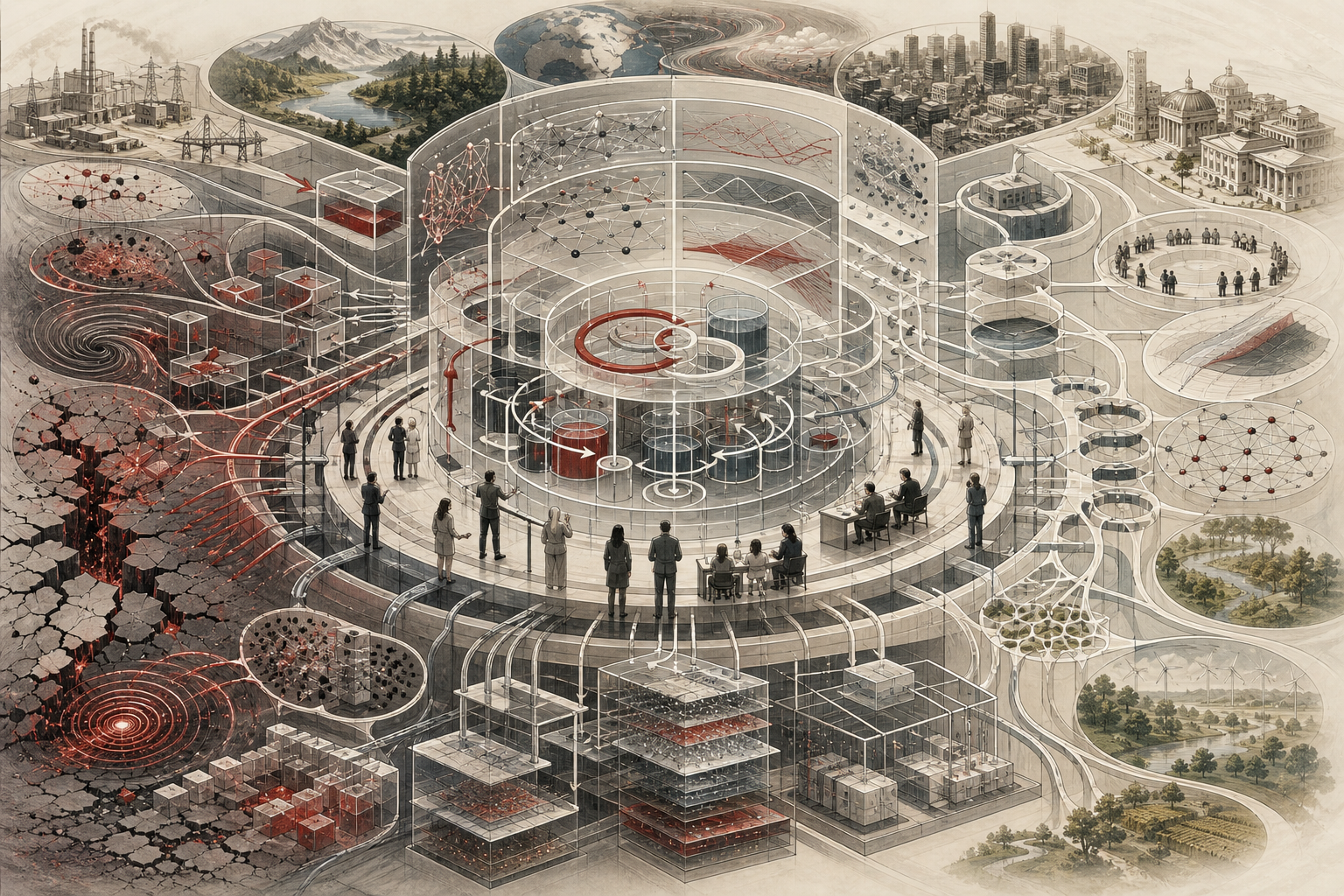
At its core, systems modeling is concerned with how structure generates behavior. It asks how interactions between system components produce outcomes across time, how feedback processes amplify or stabilize change, how delays distort perception, how interventions in one part of a system may generate unintended consequences elsewhere, and how alternative assumptions produce different futures.
Systems modeling is useful precisely because complex systems often resist intuitive reasoning. A policy that appears effective in the short term may worsen the long-term problem. A reinforcing process may produce runaway growth or collapse. A balancing process may stabilize a system only after a long delay. A network may appear resilient until a hidden dependency fails. A system may remain stable for years and then cross a threshold suddenly. Formal modeling gives analysts a way to explore these possibilities before acting as though the system were simple.
Complete Code Repository
This article is supported by a companion code repository with reproducible examples, synthetic datasets, stock-and-flow simulations, feedback-loop models, network shock propagation, scenario analysis, sensitivity workflows, system dynamics examples, SQL schemas, documentation, and scientific-computing examples across Python, R, Julia, SQL, C, C++, Fortran, Rust, Go, and notebooks.
Systems Modeling as Formal Systems Analysis
Systems modeling begins from a central analytical problem: many important outcomes are produced by relationships among components rather than by isolated variables. A public-health outcome may depend on individual behavior, institutional capacity, mobility patterns, communication systems, trust, resource allocation, and time delays. An infrastructure failure may depend on asset condition, network topology, load, maintenance cycles, weather exposure, governance, and emergency response. A sustainability transition may depend on technology adoption, policy incentives, resource constraints, public legitimacy, investment cycles, and ecological feedback.
Systems modeling gives these relationships formal structure. It does not merely describe that “everything is connected.” It asks which things are connected, how strongly, in what direction, through what mechanism, with what delay, and under what conditions. It then uses diagrams, equations, simulations, algorithms, networks, or computational experiments to examine how that structure generates behavior over time.
This makes systems modeling different from ordinary description. Description can identify components and events. Systems modeling represents the relationships that generate patterns. It turns systems thinking into an operational method.
Why Systems Modeling Matters
Many of the most consequential challenges facing contemporary societies are systemic rather than isolated. Climate change, financial instability, biodiversity loss, infrastructure vulnerability, public health crises, supply-chain fragility, governance failure, institutional distrust, and technological disruption all involve interactions that unfold across multiple layers of complexity. These problems cannot be understood adequately through static analysis alone.
Systems modeling matters because it reveals patterns that are difficult to perceive directly. Models can make delayed feedback visible. They can show how small interventions produce large consequences, why obvious fixes fail, how risks propagate through networks, why short-term improvement may produce long-term deterioration, and how apparently separate domains influence one another. Models can help analysts explore not only what is happening, but why a system behaves the way it does.
Used responsibly, systems models do not eliminate uncertainty. They clarify it. They help identify plausible pathways, compare interventions, test assumptions, expose weak points, examine sensitivity, and improve understanding of how complex systems respond to stress or change. A good systems model does not replace judgment; it disciplines judgment.
Scope of This Content Pillar
This pillar is designed as a comprehensive treatment of systems modeling while remaining organized enough to support cumulative learning over time. It does not treat systems modeling as a single method. Instead, it treats it as a family of formal and computational approaches for representing complex systems.
The series moves across several levels at once. At the conceptual level, it examines feedback, stocks, flows, delays, boundaries, emergence, nonlinearity, adaptation, resilience, leverage, scenarios, and uncertainty. At the methodological level, it studies system dynamics, agent-based modeling, network modeling, discrete-event simulation, scenario modeling, hybrid models, integrated assessment models, digital twins, and computational experimentation. At the practical level, it explores how systems models can be implemented through reproducible workflows in R, Python, SQL, and other computational environments.
The goal is not simply to teach modeling techniques. It is to build a durable framework for understanding how formal models help analysts reason about systemic problems. The pillar therefore connects systems thinking, mathematical modeling, scientific computing, decision science, resilience thinking, policy analysis, infrastructure systems, climate modeling, sustainability transitions, and institutional governance.
Because the subject is large, the article map below is intentionally extensive and marked (planned) throughout. It is a long-term architecture for a full knowledge series rather than a list of articles that must already exist.
Relationship to Systems Thinking
Systems modeling is closely related to systems thinking, but the two are not identical.
Systems thinking provides a conceptual orientation. It encourages analysts to view problems in terms of relationships, interdependence, feedback processes, whole-system behavior, delayed effects, leverage points, and unintended consequences. It helps frame the problem.
Systems modeling builds on that orientation by creating formal representations that can be analyzed mathematically, computationally, visually, or through structured simulation. It helps operationalize the analysis.
The distinction matters because systems thinking without modeling can remain too general, while modeling without systems thinking can become technically impressive but conceptually shallow. Systems thinking asks better questions. Systems modeling makes some of those questions testable.
Core Elements of Systems Modeling
1. System Boundaries
Every model defines what is inside the system and what is outside it. Boundaries determine which variables, actors, processes, institutions, delays, and feedbacks are included. Boundary choices are never neutral; they shape what the model can explain.
2. Stocks and Flows
Stocks are accumulations. Flows are rates of change. Together, they represent how systems build up, drain, replenish, degrade, recover, or transform over time. Stocks and flows are central to system dynamics and many sustainability, economic, infrastructure, and ecological models.
3. Feedback Loops
Feedback loops occur when a system’s outputs influence its future inputs or behavior. Reinforcing loops amplify change. Balancing loops counteract change. Feedback helps explain growth, collapse, stabilization, oscillation, and policy resistance.
4. Time Delays
Systems often respond slowly. Delays between action and effect can produce overshoot, oscillation, misinterpretation, and overcorrection. Time delays are especially important in climate systems, infrastructure planning, public health, institutional reform, and resource management.
5. Nonlinearity
In nonlinear systems, causes and effects are not proportional. Small changes may produce large effects under some conditions, while large interventions may produce little effect under others. Nonlinearity is central to tipping points, thresholds, saturation, cascading failure, and resilience loss.
6. Emergence
Emergence occurs when system-level patterns arise from interactions among components. These patterns cannot be understood fully by examining individual parts in isolation. Agent-based models, network models, and complexity science often focus on emergence.
7. Scenarios and Interventions
Systems models allow analysts to explore possible futures under different assumptions, policies, shocks, or interventions. Scenario analysis is not prediction. It is structured learning about plausible pathways and consequences.
8. Calibration, Validation, and Uncertainty
Models must be tested against evidence, expert judgment, sensitivity analysis, and internal consistency. Calibration and validation do not make a model perfect, but they help clarify whether it is useful for its intended purpose.
Major Modeling Paradigms
System Dynamics
System dynamics represents systems through stocks, flows, feedback loops, delays, and nonlinear relationships. It is especially useful for understanding accumulation, policy resistance, long-term consequences, and feedback-driven behavior.
Agent-Based Modeling
Agent-based modeling represents systems as collections of interacting agents. It is useful when system-level outcomes emerge from heterogeneous individual behavior, local rules, adaptation, networks, and interaction.
Network Modeling
Network modeling represents systems through nodes, edges, connectivity, flows, influence, centrality, dependency, and propagation. It is useful for infrastructure systems, supply chains, financial contagion, ecological networks, organizational systems, and information flows.
Discrete-Event Simulation
Discrete-event simulation represents systems as sequences of events that occur over time. It is useful for queues, logistics, service systems, operations, health systems, transportation, and process modeling.
Scenario Modeling
Scenario modeling explores alternative futures based on different assumptions, drivers, policies, uncertainties, or shocks. It is useful for strategic planning, sustainability transitions, climate pathways, infrastructure investment, and governance analysis.
Integrated Assessment Modeling
Integrated assessment models combine multiple systems, often including economy, energy, land, water, climate, and policy. They are used to explore long-term pathways, trade-offs, and scenario assumptions in sustainability and climate research.
Digital Twins and Simulation Platforms
Digital twins connect models to monitored systems, sensor data, infrastructure assets, and operational workflows. They can support simulation, maintenance, planning, and decision support when implemented responsibly.
Systems Modeling in Research and Policy
Systems modeling is widely used in research and policy because it allows analysts to evaluate interventions before they are implemented at scale. Climate models, epidemiological simulations, economic models, infrastructure planning tools, transportation models, energy-system models, integrated assessment models, and digital twins all represent different forms of systems modeling.
These tools allow institutions to test scenarios, compare trade-offs, examine uncertainty, identify possible unintended consequences, and clarify assumptions. Research traditions associated with the MIT System Dynamics Group, the System Dynamics Society, and complexity research centers such as the Santa Fe Institute have been especially important in advancing formal approaches to feedback-based and computational systems analysis.
At the same time, systems modeling requires careful interpretation. Models are simplifications of reality rather than perfect representations of it. Good modeling therefore requires both technical rigor and epistemic humility. This is especially clear in sustainability research and global environmental assessment, where organizations such as the Intergovernmental Panel on Climate Change and the Integrated Assessment Modeling Consortium rely on formal models to compare pathways, assumptions, and policy scenarios.
Mathematical Lens
A general dynamic systems model can be represented as:
\frac{d\mathbf{x}(t)}{dt}=\mathbf{f}\left(\mathbf{x}(t),\mathbf{u}(t),\theta,t\right)
\]
Interpretation: The vector \(\mathbf{x}(t)\) represents system states, \(\mathbf{u}(t)\) represents external inputs or interventions, \(\theta\) represents parameters, and \(\mathbf{f}\) describes how the system changes over time.
A stock-and-flow model can be written in scalar form:
\frac{dS(t)}{dt}=I(t)-O(t)
\]
Interpretation: The stock \(S(t)\) changes according to inflow \(I(t)\) and outflow \(O(t)\). This structure appears in population, resource, capital, inventory, carbon, water, and infrastructure models.
Reinforcing feedback can be represented as:
I(t)=rS(t)
\]
Interpretation: When inflow increases with the current stock, growth can reinforce itself. This structure appears in compounding growth, diffusion, adoption, contagion, and runaway dynamics.
Balancing feedback can be represented as:
O(t)=k\left(S(t)-S^*\right)
\]
Interpretation: When outflow or corrective action depends on the gap between the current state and a target \(S^*\), the system may adjust toward equilibrium.
A coupled two-stock system can be represented as:
\frac{dS_1}{dt}=f_1(S_1,S_2), \qquad \frac{dS_2}{dt}=f_2(S_1,S_2)
\]
Interpretation: Each stock affects the other. Coupling allows models to represent interdependence, feedback, competition, cooperation, contagion, resource sharing, and cascading effects.
A network shock model can be written as:
\mathbf{x}_{t+1}=A\mathbf{x}_t+\mathbf{s}_t
\]
Interpretation: The matrix \(A\) represents structural connections among system components, while \(\mathbf{s}_t\) represents an external shock. This structure helps model propagation and recovery in interconnected systems.
These formulas do not exhaust systems modeling. They show why formal representation matters: once feedback, coupling, delay, nonlinearity, uncertainty, and network structure are introduced, intuition alone becomes unreliable.
Systems Modeling and Judgment
Systems modeling gives analysts powerful tools, but it does not remove the need for judgment. Every model depends on boundary choices, assumptions, data quality, time scales, parameter values, causal structure, feedback design, and interpretation. A model can be mathematically consistent while leaving out a crucial institution, behavior, constraint, or feedback loop. A simulation can generate compelling outputs while depending on fragile assumptions. A diagram can make relationships visible while oversimplifying power, uncertainty, or history.
For this reason, systems modeling must be joined to model assessment. What is the purpose of the model? What is inside the boundary, and what has been excluded? Which variables are stocks, flows, agents, nodes, or events? What evidence supports the relationships? Are feedbacks modeled correctly? Are delays and nonlinearities represented? Are parameters calibrated? Are results sensitive to assumptions? Are uncertainties communicated honestly? Is the model being used for explanation, exploration, decision support, or prediction?
A serious systems modeling practice does not treat the model as reality. It treats the model as a disciplined representation that can be challenged, revised, compared, and used to think more clearly.
Systems Modeling Article Series
The Systems Modeling pillar is organized to move from foundations and conceptual distinctions toward modeling paradigms, analytical methods, mathematical foundations, complex system behavior, applied modeling domains, advanced platforms, responsible interpretation, and case studies. Planned articles are shown in their intended final order but are left unlinked until publication.
Part I. Foundations of Systems Modeling
- What Is Systems Modeling? — An opening article defining systems modeling as formal representation of complex systems.
- Systems Thinking vs Systems Modeling — A distinction between conceptual systems reasoning and executable formal models.
- Why Complex Systems Require Models — A foundational article on why intuition struggles with feedback, delay, and interdependence.
- The History of Systems Modeling — A historical article on systems science, cybernetics, system dynamics, complexity science, and computational modeling.
- Core Principles of Systems Modeling — A concise framework for boundaries, stocks, flows, feedback, scenarios, uncertainty, and interpretation.
Part II. Modeling Paradigms
- System Dynamics Modeling — A major article on stocks, flows, feedback loops, delays, and long-term behavior.
- Agent-Based Modeling — A treatment of interacting agents, local rules, heterogeneity, adaptation, and emergence.
- Network Models — An article on nodes, edges, flows, dependency, centrality, contagion, and network vulnerability.
- Discrete Event Simulation — A workflow article on queues, operations, service systems, event timing, and process simulation.
- Hybrid Modeling Approaches — A study of models that combine system dynamics, agents, networks, events, and data-driven components.
Part III. Analytical Methods
- Scenario Modeling and Simulation — A practical article on exploring alternative futures and interventions.
- Sensitivity Analysis in Systems Models — A workflow article on identifying influential assumptions and fragile parameters.
- Calibration and Validation of Models — A critical article on aligning models with evidence and evaluating credibility.
- Uncertainty and Model Interpretation — An article on uncertainty, confidence, ambiguity, robustness, and responsible communication.
- Model Comparison and Ensemble Reasoning — A study of comparing model structures, assumptions, and outputs.
- Stress Testing and Robustness Analysis — A practical article on testing models under shocks and extreme conditions.
Part IV. Mathematical Foundations of Complex Systems
- Mathematics of Complex Systems — A bridge to differential equations, probability, networks, nonlinear systems, and simulation.
- Modeling Feedback Loops — A focused article on reinforcing and balancing loops in formal systems models.
- Leverage Points in Complex Systems — A modeling-oriented article on structural intervention and system change.
- Stocks, Flows, and Accumulation — A foundation for modeling dynamic accumulation across domains.
- Delay, Oscillation, and Policy Resistance — A treatment of why systems often respond slowly or counterintuitively.
- Nonlinearity, Thresholds, and Regime Change — A study of disproportionate response, tipping dynamics, and state shifts.
Part V. Complex System Behavior
- Resilience and Adaptive Systems — A study of recovery, adaptation, persistence, and transformation under disturbance.
- Panarchy and Multi-Scale Systems Modeling — An article on cross-scale dynamics, adaptive cycles, and nested systems.
- Critical Transitions and Tipping Points in Complex Systems — A treatment of sudden qualitative change after slow pressure.
- Early Warning Signals of System Collapse — A modeling article on variance, autocorrelation, slowing recovery, and fragility.
- Phase Transitions in Complex Systems — A bridge between statistical physics, complexity science, and systems behavior.
- Cascading Failure and Contagion — A network-oriented article on propagation, dependency, and systemic risk.
Part VI. Applied Systems Modeling
- Economic Systems Modeling — A study of interdependence, growth, instability, input-output structure, and policy scenarios.
- Environmental Systems Modeling — An article on ecosystems, resource flows, pollution, climate stress, and monitoring.
- Urban Systems Modeling — A treatment of mobility, housing, land use, infrastructure, and social systems.
- Infrastructure Systems Modeling — A study of connected assets, load, degradation, maintenance, risk, and resilience.
- Public Policy Modeling — An article on policy design, trade-offs, unintended consequences, and institutional learning.
- Organizational Systems Modeling — A treatment of teams, incentives, bottlenecks, coordination, and institutional dynamics.
- Health Systems Modeling — A study of public health, service capacity, epidemics, resource allocation, and care systems.
Part VII. Advanced Modeling Platforms
- Integrated Assessment Models — A major article on energy, economy, land, water, climate, and policy pathway models.
- AI and Machine Learning in Systems Modeling — A critical article on data-driven modeling, hybrid models, prediction, and interpretability.
- Digital Twins and Simulation Platforms — A study of monitored assets, live data, simulation environments, and governance risks.
- Geospatial Systems Modeling — An article on spatial data, regional systems, environmental exposure, and infrastructure geography.
- Participatory Modeling and Stakeholder Systems — A treatment of model-building with communities, institutions, and affected groups.
Part VIII. Responsible Systems Modeling
- Model Assumptions and Boundary Judgment — A critical article on what models include, exclude, simplify, and make invisible.
- When Systems Models Clarify and When They Distort — A cautionary article on false precision, abstraction risk, and model misuse.
- Ethics, Power, and Systems Modeling — A study of who defines the model, whose data count, and whose futures are represented.
- Communicating Model Results Responsibly — A practical article on uncertainty, caveats, visualizations, and public interpretation.
- Future Directions in Systems Modeling — A capstone article on hybrid systems, AI-assisted models, digital twins, open modeling, and public accountability.
Part IX. Applied Case Studies
- Case Study: Stock-and-Flow Modeling of Resource Depletion — A worked example of accumulation, regeneration, extraction, and threshold risk.
- Case Study: Shock Propagation in Infrastructure Networks — A worked example of network dependency, failure, and recovery.
- Case Study: Scenario Modeling for Public Policy — A worked example comparing intervention pathways under uncertainty.
- Case Study: Agent-Based Modeling of Adoption and Diffusion — A worked example of local rules producing system-level patterns.
- Case Study: Resilience Modeling Under Climate Stress — A worked example of disturbance, recovery, adaptation, and threshold behavior.
- Case Study: Integrated Assessment and Sustainability Pathways — A worked example of linked systems, policy scenarios, and long-horizon interpretation.
R Workflow: Interacting Stocks with Feedback
The R workflow below simulates two interacting stocks with reinforcing and balancing dynamics. It demonstrates how structure generates behavior over time and how a compact formal model can reveal patterns that are hard to reason about intuitively.
# Systems Modeling:
# Simulating interacting stocks with feedback in R.
# Educational example only.

library(tidyverse)

time <- 1:140

stock_a <- numeric(length(time))
stock_b <- numeric(length(time))

stock_a[1] <- 20
stock_b[1] <- 10

growth_a_rate <- 0.06
growth_b_rate <- 0.04
b_to_a_pressure <- 0.02
a_to_b_support <- 0.04
b_balancing_rate <- 0.03
target_b <- 45

for (t in 2:length(time)) {
  reinforcing_a <- growth_a_rate * stock_a[t - 1]
  pressure_from_b <- -b_to_a_pressure * stock_b[t - 1]

  reinforcing_b <- growth_b_rate * stock_b[t - 1]
  support_from_a <- a_to_b_support * stock_a[t - 1]
  balancing_b <- b_balancing_rate * max(stock_b[t - 1] - target_b, 0)

  stock_a[t] <- stock_a[t - 1] + reinforcing_a + pressure_from_b
  stock_b[t] <- stock_b[t - 1] + reinforcing_b + support_from_a - balancing_b
}

results <- tibble(
  time = time,
  stock_a = stock_a,
  stock_b = stock_b
)

summary_results <- results |>
  summarise(
    final_stock_a = last(stock_a),
    final_stock_b = last(stock_b),
    max_stock_a = max(stock_a),
    max_stock_b = max(stock_b),
    time_of_max_stock_b = time[which.max(stock_b)]
  )

print(summary_results)

ggplot(results, aes(x = time)) +
  geom_line(aes(y = stock_a, color = "Stock A"), linewidth = 1) +
  geom_line(aes(y = stock_b, color = "Stock B"), linewidth = 1) +
  labs(
    title = "Interacting Stocks with Feedback",
    x = "Time",
    y = "State",
    color = "Series"
  ) +
  theme_minimal(base_size = 12)

dir.create("outputs", showWarnings = FALSE, recursive = TRUE)

write_csv(results, "outputs/r_interacting_stocks_feedback.csv")
write_csv(summary_results, "outputs/r_interacting_stocks_summary.csv")
This workflow shows why systems modeling is useful: the model is simple, but the behavior is generated by interaction. The system cannot be understood fully by looking at either stock alone.
Python Workflow: Shock Propagation in an Interconnected System
The Python workflow below simulates shock propagation in a small interconnected system. It shows how network structure and coupling can determine whether a disturbance remains localized or spreads through the system.
# Systems Modeling:
# Shock propagation in an interconnected system.
# Educational example only.

from __future__ import annotations

import numpy as np
import pandas as pd


def simulate_network_shock(
    influence_matrix: np.ndarray,
    initial_state: np.ndarray,
    shock_time: int,
    shock_vector: np.ndarray,
    recovery_rate: float,
    steps: int
) -> pd.DataFrame:
    """
    Simulate shock propagation and recovery in an interconnected system.

    influence_matrix:
        Weighted structural links among components.
    initial_state:
        Initial condition of each system component.
    shock_vector:
        One-time disturbance applied at shock_time.
    recovery_rate:
        Pull back toward baseline after disturbance.
    """
    baseline = initial_state.copy()
    state = initial_state.copy()

    rows = []

    for t in range(steps):
        shock = shock_vector if t == shock_time else np.zeros_like(state)

        interaction_effect = influence_matrix @ (state - baseline)
        recovery_effect = -recovery_rate * (state - baseline)

        state = state + interaction_effect + recovery_effect + shock

        rows.append({
            "time": t,
            "infrastructure": state[0],
            "energy": state[1],
            "water": state[2],
            "health": state[3],
            "governance": state[4]
        })

    return pd.DataFrame(rows)


def main() -> None:
    influence_matrix = np.array([
        [0.00, 0.05, 0.04, 0.02, 0.03],
        [0.06, 0.00, 0.03, 0.02, 0.04],
        [0.05, 0.04, 0.00, 0.03, 0.03],
        [0.03, 0.03, 0.04, 0.00, 0.05],
        [0.04, 0.05, 0.03, 0.04, 0.00]
    ])

    initial_state = np.array([100.0, 100.0, 100.0, 100.0, 100.0])

    shock_vector = np.array([-20.0, -8.0, -5.0, 0.0, -3.0])

    results = simulate_network_shock(
        influence_matrix=influence_matrix,
        initial_state=initial_state,
        shock_time=20,
        shock_vector=shock_vector,
        recovery_rate=0.08,
        steps=100
    )

    summary = pd.DataFrame({
        "component": ["infrastructure", "energy", "water", "health", "governance"],
        "minimum_state": [
            results["infrastructure"].min(),
            results["energy"].min(),
            results["water"].min(),
            results["health"].min(),
            results["governance"].min()
        ],
        "final_state": [
            results["infrastructure"].iloc[-1],
            results["energy"].iloc[-1],
            results["water"].iloc[-1],
            results["health"].iloc[-1],
            results["governance"].iloc[-1]
        ]
    })

    print(summary)

    results.to_csv("systems_modeling_network_shock_results.csv", index=False)
    summary.to_csv("systems_modeling_network_shock_summary.csv", index=False)


if __name__ == "__main__":
    main()
This workflow reinforces a central lesson of systems modeling: structure matters. The same shock can produce different outcomes depending on network coupling, recovery strength, time delay, redundancy, and feedback.
Interpretive Limits and Responsible Use
Systems modeling is powerful, but models can mislead when used without judgment. A model can make a weak assumption look precise. A simulation can create the appearance of prediction when it is really an exploration of assumptions. A diagram can hide power, history, inequality, or institutional context. A scenario can be mistaken for a forecast. A digital twin can imply operational control over systems that remain socially and politically contested.
Models are simplifications. Their value depends on whether the simplification is appropriate for the question being asked. Analysts should be explicit about model purpose, boundary choices, assumptions, uncertainty, data quality, calibration, validation, and limitations. They should distinguish exploratory models from predictive models, conceptual models from operational models, and decision-support models from claims about reality.
Responsible systems modeling therefore requires technical rigor and epistemic humility. A model should help people think more clearly, not replace judgment, conceal uncertainty, or make contested decisions appear automatic.
Related Reading
- Systems Thinking
- Resilience Thinking
- Decision Science
- Mathematical Modeling
- Scientific Computing for Systems Modeling
- Differential Equations for Systems Modeling
- Probability for Systems Modeling
- Statistics for Systems Modeling
Further Reading
- Arthur, W.B. (2009) The Nature of Technology: What It Is and How It Evolves. New York: Free Press.
- Bertalanffy, L. von (1968) General System Theory: Foundations, Development, Applications. New York: George Braziller.
- Forrester, J.W. (1961) Industrial Dynamics. Cambridge, MA: MIT Press.
- Holland, J.H. (1995) Hidden Order: How Adaptation Builds Complexity. Reading, MA: Addison-Wesley.
- Meadows, D.H. (2008) Thinking in Systems: A Primer. White River Junction, VT: Chelsea Green Publishing.
- Mitchell, M. (2009) Complexity: A Guided Tour. Oxford: Oxford University Press.
- Sterman, J.D. (2000) Business Dynamics: Systems Thinking and Modeling for a Complex World. Boston: McGraw-Hill.
- System Dynamics Society, What is System Dynamics?
- MIT System Dynamics Group
- Santa Fe Institute
- Calvin, K. et al. (2019) ‘GCAM v5.1: representing the linkages between energy, water, land, climate, and economic systems’. Geoscientific Model Development, 12, pp. 677–698.
- Integrated Assessment Modeling Consortium
- Intergovernmental Panel on Climate Change
References
- Arthur, W.B. (2009) The Nature of Technology: What It Is and How It Evolves. New York: Free Press.
- Bertalanffy, L. von (1968) General System Theory: Foundations, Development, Applications. New York: George Braziller.
- Calvin, K. et al. (2019) ‘GCAM v5.1: representing the linkages between energy, water, land, climate, and economic systems’. Geoscientific Model Development, 12, pp. 677–698.
- Forrester, J.W. (1961) Industrial Dynamics. Cambridge, MA: MIT Press.
- Holland, J.H. (1995) Hidden Order: How Adaptation Builds Complexity. Reading, MA: Addison-Wesley.
- Meadows, D.H. (2008) Thinking in Systems: A Primer. White River Junction, VT: Chelsea Green Publishing.
- Mitchell, M. (2009) Complexity: A Guided Tour. Oxford: Oxford University Press.
- Sterman, J.D. (2000) Business Dynamics: Systems Thinking and Modeling for a Complex World. Boston: McGraw-Hill.
- System Dynamics Society (n.d.) What is System Dynamics?.