
Last Updated May 5, 2026
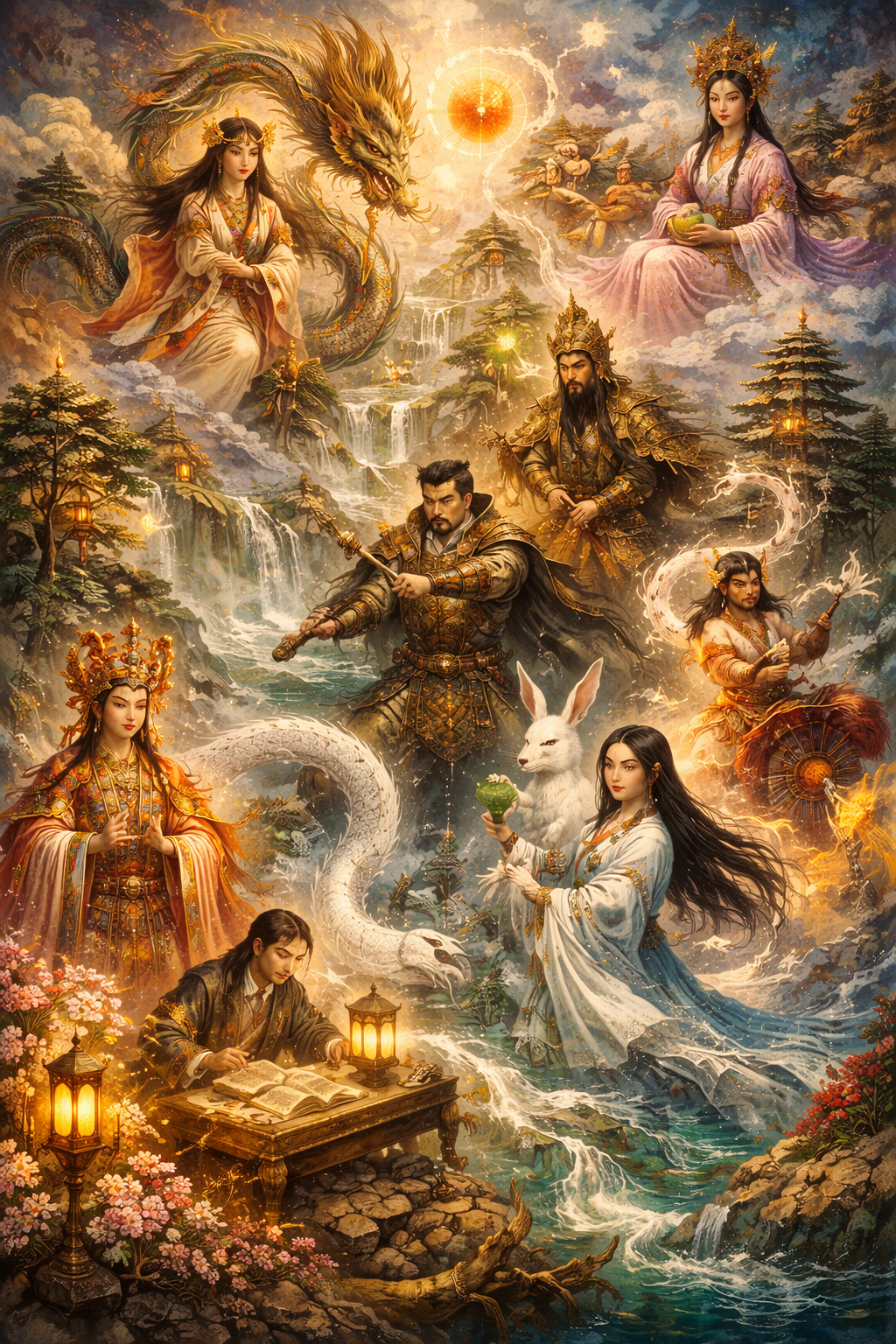
Chinese myth, folklore, and legend constitute a vast field of cultural and historical inquiry in which cosmogony, dynastic memory, ritual tradition, sacred geography, oral performance, supernatural narrative, religious imagination, political ancestry, local cults, festival practice, and literary reinvention converge. Unlike mythic traditions preserved in the form of a single canonical epic, the Chinese mythic archive survives in dispersed and layered form across early classical texts, historical compilations, religious writings, temple networks, calendrical observances, vernacular storytelling, regional performance, visual culture, oral tradition, and modern media. The result is not a closed mythological canon, but an evolving symbolic world extending across millennia.
The earliest materials appear in fragmentary and distributed textual form. Works such as the Shanhaijing, the Chu ci, the Huainanzi, transmitted classics, dynastic histories, and later collections of anomaly literature preserve cosmogonic images, flood narratives, celestial myths, sacred mountains, strange beings, culture heroes, legendary rulers, divine mothers, dragons, immortals, underworld officials, ritual geographies, and supernatural beings. Serious scholarship therefore approaches Chinese mythology not as a single internally unified system, but as a field reconstructed from textual witnesses, ritual traditions, symbolic structures, local practices, visual cultures, and long continuities of cultural memory.
Any research-grade treatment must also attend to religion. Chinese mythic traditions developed in close relation to early cosmological thought, ancestor reverence, sacrificial ritual, Daoist symbolism, Buddhist adaptation, temple culture, household rites, pilgrimage, and the wider field often described as Chinese popular religion. Myth in this context is not merely imaginative ornament. It is embedded in sacred landscapes, seasonal observance, temple practice, moral order, political legitimacy, household ritual, local protection, and the symbolic relation between heaven, earth, ancestors, spirits, rulers, and communities.
Chinese folklore and legend extend this field beyond classical mythology narrowly understood. Folk religion, local deity cults, tales of ghosts and fox spirits, legends of immortals, dragon lore, pilgrimage traditions, sea-goddess devotion, festival narratives, oral epics, vernacular fiction, opera, shadow puppetry, and regional storytelling traditions all belong to the broader archive. Many of these traditions remain active forms of living heritage rather than historical survivals, preserved through ritual, performance, seasonal practice, craft, temple networks, visual media, and intergenerational transmission.
This pillar therefore treats Chinese myth, folklore, and legend as a layered cultural system rather than as a simple catalogue of gods, monsters, heroes, and marvels. It follows how mythic memory moves among text, landscape, ritual, image, performance, festival, and popular devotion; how legendary antiquity shapes political imagination; how supernatural beings carry moral, cosmological, ecological, and social meanings; and how modern film, television, animation, fantasy, games, and digital storytelling continue to rework inherited mythic worlds.
Why This Field Matters
Chinese myth, folklore, and legend matter because they preserve one of the world’s richest and longest-running symbolic traditions. They carry accounts of world-ordering, divine ancestry, flood control, sacred mountains, dragon power, immortal realms, ghosts, fox spirits, festival time, local gods, moral retribution, cosmic bureaucracy, ritual obligation, and the relation between heaven, earth, ancestors, rulers, households, and communities. These stories are not merely imaginative entertainments. They are cultural memory in narrative form.
The field also matters because it challenges narrow models of mythology. Chinese myth does not appear primarily as a single fixed epic, sacred book, or systematic pantheon. It survives across many media and institutions: classical texts, cosmological treatises, dynastic histories, ritual manuals, local temples, visual arts, anomaly tales, vernacular novels, drama, oral performance, festival practice, and modern screen culture. The scholar or reader must therefore approach it as a distributed archive rather than a unified canon.
This distributed quality makes the tradition especially important for the study of mythology as cultural memory. Chinese mythic materials often move between elite and popular forms, textual and ritual forms, religious and literary forms, historical and supernatural forms. A figure may appear in an early text, become part of temple worship, enter drama or fiction, circulate in visual art, and then reappear in modern animation or film. Myth survives because it is repeatedly re-embedded in new cultural settings.
The field also matters because many of these traditions remain socially alive. Mazu devotion, festival cycles, shadow puppetry, solar-term observances, ghost beliefs, dragon imagery, opera traditions, and regional epics are not simply museum objects. They continue to shape ritual practice, heritage discourse, local identity, ecological time, family memory, and popular imagination. Chinese myth, folklore, and legend therefore illuminate how ancient symbolic forms can remain active in modern cultural life.
The Problem of the Archive
A research-grade account must begin with the archive itself. Chinese mythology survives in a form unlike the mythological corpora familiar from some other traditions. There is no single Chinese equivalent to Homer’s epics, Hesiod’s Theogony, the Mahabharata, or the Popol Vuh that gathers the mythic world into one dominant literary structure. Instead, early Chinese mythic materials are dispersed across texts whose main purposes may be geographical, ritual, philosophical, historical, poetic, cosmological, political, or religious.
This means that Chinese mythology must often be reconstructed by reading across sources. The Shanhaijing preserves mythic geography, strange beings, sacred mountains, and marvel traditions. The Chu ci preserves a southern poetic imagination rich in celestial travel, divine encounter, and symbolic landscape. The Huainanzi orders mythic motifs within Han philosophical cosmology. Dynastic histories preserve ritual and political memory. Later anomaly literature preserves ghosts, marvels, transformations, and supernatural events. Vernacular fiction and opera then rework inherited figures for new audiences.
The archive is therefore layered, not linear. Mythic materials may appear in fragmentary form, be moralized by later commentators, be reorganized within ritual systems, or be transformed by literary imagination. A story that seems ancient in theme may be late in textual form; a figure preserved in popular religion may have multiple textual and regional histories; a familiar legend may have been shaped by centuries of retelling. Caution is not a barrier to interpretation. It is part of responsible interpretation.
This archival problem also makes Chinese mythology intellectually rewarding. It asks readers to think about how myth survives when no single text controls it. The tradition’s coherence lies not in one canonical system, but in recurring symbolic patterns: cosmic order, water control, sacred mountains, heavenly mandate, ancestral authority, transformation, immortality, moral retribution, seasonal recurrence, local protection, and the porous boundary between visible and invisible worlds.
Myth Without a Single Canon
Chinese mythology is best understood as a plural and evolving mythic field rather than a closed canon. Its figures and motifs move through many social worlds: court ritual, literati writing, Daoist religion, Buddhist narrative, popular temples, local festivals, family practices, entertainment, opera, painting, woodblock print, and modern media. This mobility explains why Chinese myth can appear simultaneously ancient, regional, religious, literary, popular, and contemporary.
The absence of one canon does not mean the absence of structure. Instead, structure emerges through repetition and transformation. Creation and repair myths return in different forms. Flood control becomes a foundation of political memory. Sacred mountains organize geography into cosmology. Dragons link water, weather, imperial symbolism, and auspicious power. Immortals connect Daoist cultivation, longevity, popular religion, and visual art. Ghosts and underworld judges give moral and bureaucratic shape to death. Festivals turn celestial or legendary narratives into recurrent social practice.
Chinese mythic tradition therefore requires a method attentive to circulation. A figure such as Nüwa, Yu the Great, the Queen Mother of the West, Mazu, Sun Wukong, Nezha, Chang’e, or the Dragon Kings may belong to more than one domain at once. Each figure may be textual, ritual, visual, local, national, popular, literary, and modern in different ways. Myth persists through these migrations.
For this reason, Chinese myth, folklore, and legend should not be reduced to a list of “gods” or “creatures.” It is a cultural system for thinking order, danger, transformation, kinship, sovereignty, morality, fertility, death, weather, travel, and the relation between human communities and unseen powers.
Cosmogony, Chaos, and World-Order
Chinese myth includes multiple accounts of origins, differentiation, repair, and ordering rather than a single canonical creation narrative. Figures such as Pangu and Nüwa belong to broader reflections on chaos, separation, destruction, repair, and renewal. Origin stories often concern the movement from undifferentiated or damaged condition toward intelligible order: heaven and earth separated, the human world repaired, cosmic pillars restored, waters controlled, seasons regulated, and civilization made possible.
This emphasis on ordering is crucial. Chinese cosmogonic imagination is often less concerned with creation from nothing than with differentiation, harmonization, repair, and alignment. The world becomes livable when relations are ordered: heaven and earth, waters and land, rulers and people, ancestors and descendants, seasons and agriculture, ritual and political authority, visible world and spirit world. Myth gives symbolic form to these relations.
Nüwa’s repair of the cosmos, Pangu’s separation of heaven and earth, and other cosmogonic motifs therefore carry more than narrative interest. They help express a worldview in which civilization depends on restoration, balance, and the maintenance of cosmic relation. Myths of origin often become myths of repair because the world is imagined as vulnerable to disorder and dependent on acts of renewal.
This makes Chinese cosmogony especially important for comparative mythology. It complicates models that treat creation myth as a single foundational event. In Chinese traditions, the world’s order may be repeatedly established, threatened, repaired, ritualized, and symbolically renewed.
Flood, Repair, and Culture Heroes
Flood narratives, the taming of waters, and the labor of founding culture heroes are central to Chinese legendary history. Yu the Great in particular stands at the threshold between myth, political memory, and the symbolic foundations of rulership. His flood-control narrative links natural catastrophe, technical labor, public service, moral endurance, and the emergence of political order.
The flood tradition matters because water in Chinese myth is both life-giving and dangerous. Rivers, rain, floods, seas, wells, and dragon-controlled waters carry ecological, agricultural, political, and cosmological significance. To control water is not merely to solve an environmental problem; it is to make civilization possible. Flood control becomes a mythic image of governance itself.
Culture heroes such as Fuxi, Shennong, the Yellow Emperor, Yao, Shun, and Yu belong to this larger field of civilizational memory. They are not simply legendary individuals. They embody the origins of writing, agriculture, medicine, rulership, ritual order, moral authority, and social organization. Through them, myth becomes a way of remembering civilization as a moral, technical, and political achievement.
The culture hero tradition also shows how myth and history interpenetrate. Legendary antiquity becomes political imagination. It offers models of sage rule, moral succession, public labor, and cosmic legitimacy. Whether read as myth, legend, political memory, or symbolic historiography, these figures helped shape later ideas of order and authority.
Sacred Geography and Mythic Landscape
Mountains, rivers, seas, caves, celestial regions, paradisal realms, and frontier zones form a core part of the Chinese mythic imagination. The Shanhaijing is especially important for showing geography as a charged symbolic field inhabited by deities, monsters, wonders, medicinal substances, sacred mountains, strange peoples, and civilizational boundaries. Mythic geography is not merely a map of places. It is a map of relation between human society and cosmic strangeness.
Sacred mountains occupy a particularly powerful position. Kunlun, paradisal mountains, Daoist grotto-heavens, pilgrimage mountains, and local sacred peaks all reveal how landscape becomes spiritually and mythically organized. Mountains may serve as residences of deities, sites of immortality, axes between realms, places of revelation, or thresholds between ordinary and extraordinary worlds.
Water geographies are equally important. Rivers, seas, dragon palaces, island paradises, floodplains, and coastal shrines connect myth to ecology, travel, danger, agriculture, and maritime devotion. Dragons, sea goddesses, flood heroes, and river deities reveal that Chinese mythic geography is also environmental memory. It preserves how communities understood dependence on water, weather, seasonal cycles, and landscape power.
Sacred geography also complicates the boundary between text and practice. Mythic places may be described in ancient texts, represented in art, visited in pilgrimage, invoked in ritual, and reimagined in fiction. Landscape becomes a medium through which myth is read, walked, painted, worshipped, and remembered.
Heaven, Rulership, and Legendary Antiquity
Narratives of sage-kings, divine ancestry, legendary emperors, and morally charged antiquity connect myth to legitimacy, ritual authority, and the political imagination of order. Chinese mythic tradition often places rulership within a cosmic and moral frame: heaven, earth, ancestors, ritual, virtue, and public order are not separate domains but mutually implicated structures.
The Yellow Emperor, Yao, Shun, Yu, and other figures of legendary antiquity served as symbolic anchors for later political memory. They offered images of order before disorder, virtue before decline, and civilization before fragmentation. The past became a moral resource, not merely a chronological record. Mythic antiquity helped later thinkers imagine what rightful rule should look like.
The relation between heaven and rulership is especially important. The Mandate of Heaven and related ideas shaped the symbolic field in which dynastic legitimacy, moral conduct, ritual performance, and political failure could be interpreted. Myth and legend helped make rulership accountable to cosmic order, even when that accountability was mediated through political ideology.
This does not mean that myth simply legitimated power. It could also judge power. Stories of sage rule, flood control, abdication, cosmic disorder, and dynastic change preserved standards by which rulers could be measured. Mythic memory therefore helped imagine both political authority and political critique.
Daoism, Immortality, and the Supernatural
Daoist traditions preserved, transformed, and reorganized large portions of the Chinese mythic archive. Immortals, paradisal mountains, celestial bureaucracies, talismans, longevity symbolism, ritual journeys, divine registers, alchemical imagination, and complex pantheons became central to later religious and artistic representation. Daoism gave many mythic figures new cosmological, ritual, and salvific meanings.
Immortality is one of the most important themes in this domain. The Queen Mother of the West, peaches of immortality, island paradises, mountain realms, transcendent beings, and longevity symbols all reveal a mythic imagination concerned with the transformation of the body, the extension of life, and access to realms beyond ordinary mortality. These motifs entered poetry, painting, ritual, decorative art, fiction, and popular religion.
Daoist mythic worlds are also bureaucratic and cosmic. Heavens, officials, registers, temples, stars, mountains, and ritual specialists form an ordered sacred administration. This differs from many mythologies in which divine order is imagined primarily through family genealogies or heroic epics. In Daoist and popular religious contexts, the cosmos may be imagined through offices, ranks, petitions, documents, and ritual communication.
This makes Daoist myth indispensable to the study of Chinese folklore and legend. It links supernatural narrative to practice: ritual action, healing, exorcism, longevity, pilgrimage, temple worship, and visual culture. Myth becomes not only story, but religious technology.
Buddhism, Underworlds, and Vernacular Moral Worlds
Chinese folklore and legend also developed through Buddhist narrative, miracle tales, underworld imagery, karmic storytelling, pilgrimage accounts, and the recirculation of transregional motifs into local Chinese forms. Buddhism did not simply add foreign stories to an existing archive. It reshaped ideas of death, moral causation, rebirth, salvation, compassion, hell, merit, and the afterlife within Chinese narrative worlds.
The underworld is especially important as a site where Buddhist, Daoist, bureaucratic, and popular religious imaginations converge. Underworld judges, registers, punishments, courts, messengers, and moral accounting reveal a world in which death is governed through forms familiar from earthly administration. The afterlife becomes bureaucratic, moral, and narratively vivid.
Ghost stories and karmic tales often carry ethical functions. They explain injustice, unresolved obligation, improper burial, family duty, betrayal, greed, violence, or neglected ritual. The supernatural is not merely frightening; it is morally structured. Ghosts return because something remains unsettled. Underworld courts judge because moral consequence extends beyond visible life.
This Buddhist and vernacular moral world became a major source for drama, storytelling, temple culture, prints, fiction, and popular teaching. It helped make the invisible order of moral consequence narratable and socially present.
Popular Religion, Local Cults, and Living Ritual
Folk religion, temple networks, mother goddesses, city gods, protective deities, sea cults, local heroes, village rituals, household offerings, pilgrimage, and calendrical observance preserve some of the most socially embedded forms of Chinese mythic consciousness. In these contexts, myth is not only something read or retold. It is enacted, offered to, visited, petitioned, celebrated, feared, and maintained.
Mazu belief is especially important for understanding the relation between local devotion, maritime danger, sacred geography, and living tradition. Her cult links coastal communities, sailors, migrants, temples, oral legend, ritual procession, and transregional networks of devotion. She shows how a local figure can become a major religious and mythic presence across regions and diasporas.
Local cults often preserve historical memory in mythic form. A deified official, healer, warrior, mother, martyr, protector, or local benefactor may become part of a community’s sacred landscape. Temple festivals keep such memory alive through ritual, processions, offerings, theater, music, and public gathering. Myth here functions as social memory anchored in place.
Popular religion also reveals the practical dimension of myth. Communities seek protection from disease, storm, drought, misfortune, ghosts, demons, and social disorder. Mythic beings are not merely symbols; they are addressed as powers within a moral and ritual universe. This living dimension is essential to the field.
Ghosts, Fox Spirits, Dragons, and Strange Beings
Chinese supernatural culture includes a vast taxonomy of nonhuman presences: dragons associated with water, power, weather, and beneficence; fox spirits linked to transformation, ambiguity, seduction, cultivation, and social boundary-crossing; ghosts shaped by grievance, improper death, unfinished obligation, or moral disturbance; and innumerable strange creatures preserved in classical and vernacular sources.
Dragons occupy a particularly distinctive position. Unlike many Western dragon traditions, Chinese dragons are often associated with rain, rivers, seas, imperial power, fertility, cosmic vitality, and auspicious force. They are not reducible to monsters. They are water powers, weather beings, symbols of authority, and mediators between visible and invisible realms.
Fox spirits reveal a different kind of supernatural logic. They often occupy zones of ambiguity: human and animal, seduction and wisdom, danger and cultivation, deception and transformation. Their stories explore gender, desire, social anxiety, spiritual power, and the instability of appearances. The fox is a figure through which transformation becomes ethically and socially complex.
Ghosts and anomaly tales preserve the moral pressure of the unresolved. The dead return because obligations remain unsettled. Strange events reveal hidden moral or cosmic order. Supernatural tales therefore function as more than entertainment. They are narrative tools for thinking justice, desire, death, transformation, and the porous boundary between worlds.
Festival Calendar and Seasonal Myth
Chinese myth and folklore are deeply embedded in calendar time. Spring Festival, Lantern Festival, Qingming, Dragon Boat Festival, Qixi, Mid-Autumn Festival, Ghost Festival, and the Twenty-Four Solar Terms all show how mythic and folkloric memory becomes cyclical. Stories are not merely told once; they return with the year.
Festival time is one of the strongest forms of cultural memory because it ties narrative to practice. Food, offerings, processions, family gatherings, ancestor rites, seasonal markers, symbolic decorations, dragon boats, moon viewing, lanterns, and local performances all make myth socially repeatable. The calendar becomes an archive of practice.
Celestial legends such as Chang’e and Hou Yi or the Cowherd and Weaver Girl show how astronomical observation, seasonal ritual, romance, separation, longing, and festival life can merge. Myth becomes a way of humanizing the sky, while the sky gives myth recurrent visibility. The heavens are not abstract; they are calendrical, emotional, and ritualized.
The Twenty-Four Solar Terms are especially important because they reveal the relation between cosmology, agriculture, observation, and social practice. Seasonal knowledge becomes cultural inheritance. Mythic time is therefore not only sacred or legendary; it is ecological and practical.
Performance, Visual Culture, and Transmission
Myths and legends endure not only through texts but through opera, storytelling, shadow puppetry, festival performance, popular illustration, painting, print, ceramics, sculpture, temple murals, decorative art, and modern visual media. Performance and image are essential to Chinese mythic transmission because they make stories visible, embodied, repeatable, and accessible across levels of literacy.
Opera and vernacular fiction played especially important roles in expanding mythic worlds. Figures such as Nezha, Sun Wukong, White Snake, the Eight Immortals, and many others became culturally durable through repeated performance and narrative reinvention. The stage and printed page allowed myth to move beyond early textual witnesses into popular imagination.
Shadow puppetry reveals the importance of visual performance as living heritage. It joins craft, music, storytelling, local style, ritual context, and communal entertainment. Like opera, it preserves stories by making them performable. Myth survives because it can be staged, sung, seen, and remembered collectively.
Visual culture also stabilizes mythic iconography. Dragons, phoenixes, qilin, immortals, mountains, moon goddesses, underworld judges, guardian figures, and auspicious symbols become recognizable across media. Image becomes another archive of mythic memory.
Regional Plurality and Non-Han Traditions
A research-grade synthesis must resist false uniformity. “Chinese” mythic culture includes major Han traditions but cannot be reduced to them. Tibetan, Qiang, Mongolian, Manchu, Miao, Yi, Zhuang, coastal, frontier, Daoist, Buddhist, vernacular, and local traditions intersect in ways that complicate any single civilizational narrative. The archive is plural, regionally differentiated, and historically dynamic.
The Gesar epic tradition is especially important because it reveals the multiethnic and transregional dimensions of mythic narrative worlds within China. It belongs to Tibetan and Inner Asian epic culture and cannot simply be folded into a narrow Han-centered mythology. Its inclusion expands the field toward oral epic, heroic narrative, bardic performance, and living intangible heritage.
Regional traditions also preserve local landscapes, deities, origin stories, ritual specialists, healing practices, and performance forms that may not appear prominently in elite textual archives. These traditions are not peripheral to mythology. They show how mythic memory lives in local worlds.
To study Chinese myth responsibly is therefore to recognize plurality without dissolving coherence. The field includes shared symbolic patterns, but those patterns are always refracted through region, ethnicity, language, religious practice, ecology, and historical circumstance.
Literary Reinvention and Modern Afterlives
Chinese myth did not remain ancient. It was reworked in vernacular fiction, drama, late-imperial print culture, nationalist reinterpretation, modern fantasy, animation, cinema, television, games, comics, and contemporary digital storytelling. The mythic archive remains culturally productive because inherited stories continue to be remade for new historical needs and media forms.
Journey to the West and Investiture of the Gods are especially important examples of literary reinvention. They gather religious, mythic, legendary, comic, heroic, and supernatural materials into expansive narrative worlds that later media continue to adapt. Sun Wukong and Nezha, in particular, have become modern mythic figures whose meanings shift across literature, opera, film, animation, and popular culture.
Modern reinterpretation can nationalize, commercialize, secularize, politicize, globalize, or psychologically deepen inherited myths. A dragon may become a cultural emblem; Nezha may become a figure of rebellious youth; Mazu may become heritage and living devotion; White Snake may become romance, gendered transgression, or spiritual cultivation; Chang’e may move between festival legend, space-age symbolism, and popular fantasy.
These afterlives matter because they show mythology as a living system. Myth does not survive by remaining unchanged. It survives by becoming available for new acts of meaning.
Major Questions of Interpretation
This pillar is organized around several major questions. How should Chinese mythology be studied when its archive is dispersed across classical texts, ritual traditions, local cults, religious writings, vernacular fiction, visual culture, and performance? What does it mean to study myth without a single canonical epic? How do cosmogony, flood control, sacred geography, dragons, immortals, ghosts, fox spirits, and legendary rulers preserve different kinds of cultural memory?
The pillar also asks how Daoism, Buddhism, popular religion, ancestor reverence, temple practice, and festival life reshape mythic tradition. How do myths move between elite texts and local ritual? How do regional and non-Han traditions complicate the category of “Chinese mythology”? How do modern film, television, animation, digital media, and global popular culture transform inherited figures? And why do Chinese myth, folklore, and legend remain powerful for understanding religion, ecology, political imagination, cultural memory, and the relation between visible and invisible worlds?
These questions keep the category from becoming a simple catalogue of stories. They open Chinese myth, folklore, and legend as a field of textual, ritual, religious, historical, regional, performative, visual, and comparative inquiry. The tradition is not only a collection of wonders. It is one of the great symbolic archives through which Chinese cultural worlds have imagined order, danger, transformation, memory, and renewal.
Expanded Article Architecture
The following structure gathers the pillar into a long-range architecture suitable for a major mythology knowledge series. It is designed to support foundational source studies, mythic geography, legendary antiquity, religious and ritual traditions, supernatural beings, festival culture, performance transmission, regional plurality, gendered spiritual power, and modern afterlives. Linked entries below are available or intended as part of the live series architecture.
Foundations and Source Problems
- What Is Chinese Myth, Folklore & Legend? — Introduces the field as a layered archive of myth, folklore, religion, ritual practice, literary memory, and living cultural transmission.
- The Problem of Sources in Chinese Mythology — Explains why Chinese myth must be reconstructed across fragmentary, classical, religious, regional, and performative sources.
- From Classical Text to Folkloric Archive: How Chinese Myth Survived — Traces how mythic materials moved from early textual witnesses into ritual, folklore, performance, and later cultural memory.
- Chinese Mythology Without a Single Canon — Planned article on how the absence of one dominant epic shaped Chinese mythology as a distributed and adaptive archive.
- Text, Ritual, Temple, and Story in Chinese Mythic Memory — Planned article on how textual preservation, temple practice, ritual, and oral narrative keep myth socially active.
- How to Read Chinese Myth Across Genres and Periods — Planned methodological guide for reading poetry, geography, history, religious narrative, folklore, drama, and visual culture together.
Classical Texts and Early Mythic Witnesses
- Reading the Shanhaijing: Mythic Geography, Strange Beings, and Sacred Space — Studies the Shanhaijing as a foundational archive of sacred geography, strange beings, divine traces, and mythic landscapes.
- Mythic Allusion and Cosmology in the Chu ci — Reads the Chu ci as a poetic source for divine encounter, celestial travel, ritual longing, and mythic allusion.
- The Huainanzi and the Philosophical Ordering of Myth — Examines how the Huainanzi absorbs mythic materials into cosmology, rulership, and philosophical order.
- Reading the Soushen Ji: Anomaly, Wonder, and the Medieval Supernatural — Explores the Soushen ji as a medieval archive of ghosts, marvels, transformation, divine response, and anomaly literature.
- The Shijing and Early Poetic Memory in Chinese Legend — Planned article on how early poetic materials preserve ancestral, celestial, ritual, and legendary motifs.
- Dynastic Histories and the Political Preservation of Myth — Planned article on how official histories preserved legendary rulers, ritual authority, and political antiquity.
Cosmogony, Chaos, and World-Ordering
- Chaos, Cosmos, and the Origins of the World in Chinese Myth — Studies Chinese cosmogony through chaos, differentiation, world-repair, flood, qi, yin-yang, and the making of a habitable world.
- Pangu and the Separation of Heaven and Earth — Interprets Pangu as a later but powerful image of cosmic separation, vertical order, and body-world transformation.
- Nüwa: Creation, Repair, and the Human World — Explores Nüwa as creator, sky-mender, protector of the vulnerable, and figure of world-saving female agency.
- Cosmic Repair and the Mythic Logic of Renewal — Planned article on repair, restoration, and renewal as central alternatives to creation-from-nothing models.
- Heaven, Earth, and the Ordering of Realms in Chinese Myth — Planned article on how heaven, earth, underworlds, mountains, waters, and celestial zones become ordered realms.
- Creation, Differentiation, and Repair in Comparative Perspective — Planned comparative article placing Chinese cosmogony beside other world-origin traditions without flattening its distinctiveness.
Culture Heroes and Legendary Antiquity
- Fuxi and the Myth of Cultural Order — Presents Fuxi as culture hero of trigrams, symbolic intelligibility, kinship order, technique, and the patterned human world.
- Shennong and the Invention of Agriculture, Medicine, and Rule — Reads Shennong as founder of agriculture, plant knowledge, food security, medicine, and the material basis of civilization.
- The Yellow Emperor and the Mythic Politics of Chinese Origins — Interprets Huangdi as the figure through whom myth turns toward sovereignty, warfare, territory, ancestry, and ritual centrality.
- Yao, Shun, and the Sage-Kings in Legendary History — Examines sage kingship, moral succession, abdication, virtue, and the political imagination of exemplary antiquity.
- Yu the Great, Flood Control, and the Birth of Political Order — Studies Yu’s flood-control myth as a foundation for labor, governance, territorial order, and dynastic memory.
- Culture Heroes and the Mythic Invention of Civilization — Planned article synthesizing how Fuxi, Shennong, Huangdi, Yao, Shun, and Yu encode the origins of civilization.
- Sage Kings, Moral Antiquity, and the Politics of Memory — Planned article on how legendary antiquity became a moral standard for later reflections on rule.
Heaven, Mandate, and Political Myth
- Heaven, Mandate, and the Mythic Imagination of Rule — Explores Heaven, legitimacy, dynastic change, moral authority, and the symbolic accountability of rulers.
- Ritual Authority and the Political Theology of Heaven — Planned article on sacrifice, ritual order, royal authority, and the relation between political power and sacred sanction.
- Dynastic Change and the Mythic Memory of Legitimacy — Planned article on how myths of rise and fall framed political transition and moral judgment.
- Legendary Rulers and the Moral Imagination of Governance — Planned article on rulers as ethical models, warnings, and symbolic anchors for political order.
- Political Order, Cosmic Disorder, and Mythic Judgment — Planned article on how floods, droughts, omens, and disasters became signs of political and cosmic imbalance.
- Myth, Historiography, and the Making of Ancient Authority — Planned article on how histories constructed ancient authority through genealogy, ritual, narrative, and moral sequence.
Sacred Geography and Mythic Landscape
- Kunlun, Paradise Mountains, and the Sacred Geography of the West — Studies Kunlun and western sacred geography as sites of divine presence, paradise imagery, and mythic distance.
- The Queen Mother of the West and the Imagery of Immortality — Explores Xiwangmu through immortality, paradise, ritual imagination, gendered power, and visual culture.
- Sacred Mountains and the Vertical Imagination of Chinese Myth — Planned article on mountains as axes of ascent, immortality, pilgrimage, revelation, and spiritual geography.
- Rivers, Seas, and Water Worlds in Chinese Mythic Geography — Planned article on rivers, seas, dragon palaces, floodplains, maritime devotion, and the mythic ecology of water.
- Caves, Grotto-Heavens, and Hidden Realms — Planned article on Daoist hidden worlds, sacred caves, retreat, revelation, and alternative geographies of transcendence.
- Mythic Landscape from the Shanhaijing to Daoist Sacred Geography — Planned article tracing the evolution of sacred landscape from early mythic geography to later religious mapping.
Dragons, Auspicious Beings, and Symbolic Creatures
- Dragons in Chinese Myth, Water Cosmology, and Imperial Symbolism — Interprets dragons as water powers, weather beings, imperial symbols, and figures of cosmic vitality.
- Phoenix, Qilin, and the World of Auspicious Beings — Explores auspicious creatures as visual, moral, political, and cosmological signs of harmony.
- Animals, Omens, and Symbolic Creatures in Chinese Folk Imagination — Studies animal symbolism, omens, hybrid beings, and the folk interpretation of signs.
- Dragon Kings, Rain, and the Ritual Ecology of Water — Planned article on Dragon Kings, rainmaking, water governance, drought, flood, and ritual relationships with weather.
- Monsters, Marvels, and the Boundary of the Human World — Planned article on strange beings as markers of danger, difference, borderlands, and unstable categories.
- Auspicious Beings and the Visual Culture of Blessing — Planned article on how symbolic creatures circulate through art, architecture, textiles, ritual, and household imagery.
Daoism, Immortality, and Religious Imagination
- Daoism, Immortality, and the Supernatural Imagination — Introduces Daoist mythic worlds through immortals, sacred mountains, celestial bureaucracies, talismans, and transformation.
- The Eight Immortals and the Popular Religious Imagination — Explores the Eight Immortals as figures of popular devotion, performance, iconography, and everyday religious imagination.
- Daoist Pantheons and the Celestial Bureaucracy — Planned article on divine offices, registers, cosmic administration, and the bureaucratic imagination of sacred order.
- Talismans, Registers, and the Ritual Technologies of Myth — Planned article on Daoist ritual media, written power, protective practice, and the technical side of mythic religion.
- Longevity, Alchemy, and the Mythic Transformation of the Body — Planned article on immortality, alchemical imagination, bodily cultivation, and the mythic desire to transform mortality.
- Immortal Realms in Poetry, Painting, and Popular Religion — Planned article on how immortal worlds move through literature, landscape painting, religious practice, and popular visual culture.
Buddhism, Underworlds, and Moral Narrative
- Buddhism, Daoism, and the Recasting of Chinese Mythic Worlds — Studies how Buddhist and Daoist traditions reshaped Chinese mythic beings, underworlds, salvation, and moral causality.
- Underworlds, Judges, and the Bureaucracy of the Afterlife — Explores afterlife courts, judges, punishments, registers, and bureaucratic moral imagination.
- Buddhist Miracle Tales and the Moral Imagination of Karma — Planned article on miracle stories, karmic causality, merit, rebirth, and narrative evidence of moral consequence.
- Hell, Judgment, and Popular Images of the Afterlife — Planned article on Buddhist-Daoist underworld imagery, punishment, salvation, and popular moral teaching.
- Guanyin, Compassion, and the Recasting of Sacred Presence — Planned article on Guanyin’s transformation in Chinese religious life, gendered compassion, miracle tales, and devotional practice.
- Pilgrimage, Salvation, and the Narrative Worlds of Chinese Buddhism — Planned article on sacred journeys, merit, temples, pilgrimage sites, and Buddhist narrative geography.
Ghosts, Fox Spirits, and Strange Tales
- Ghosts, Revenants, and the Moral Logic of the Unsettled Dead — Interprets ghost stories as narratives of unresolved obligation, injustice, improper burial, memory, and moral return.
- Fox Spirits, Transformation, and Ambiguity in Chinese Folklore — Studies fox spirits as figures of transformation, seduction, cultivation, danger, wisdom, and social ambiguity.
- Strange Tales and the Rise of Supernatural Literature — Traces the literary development of strange tales from anomaly accounts into more elaborate supernatural fiction.
- Revenants, Improper Burial, and Unfinished Obligation — Planned article on how the dead return when ritual, memory, justice, or kinship duties remain unresolved.
- Transformation Tales and the Instability of Appearance — Planned article on metamorphosis, disguise, animal-human boundaries, and the unreliability of visible form.
- Zhiguai, Chuanqi, and the Literary Life of the Strange — Planned article on major genres of supernatural prose and their role in preserving wonder, fear, and moral disturbance.
Celestial Legends, Romance, and Festival Worlds
- Chang’e, Hou Yi, and the Mythic Imagination of the Moon — Reads the moon legend through immortality, exile, archery, longing, festival time, and celestial memory.
- The Cowherd and the Weaver Girl: Stars, Separation, and Festival — Studies star lore, romantic separation, Qixi, weaving, labor, and the emotional calendar of the heavens.
- The White Snake Tradition and the Legend of Love, Transgression, and Cultivation — Explores White Snake as a story of love, spiritual cultivation, gendered power, transgression, and religious authority.
- Moon, Stars, Lovers, and the Poetics of Celestial Separation — Planned article on how celestial legends transform astronomy into longing, distance, reunion, and festival memory.
- Festival Romance and the Mythic Calendar of Feeling — Planned article on how seasonal festivals organize emotion, memory, family, love, and ritual recurrence.
- Love, Transformation, and Gendered Power in Chinese Legend — Planned article on romances involving spirits, serpents, foxes, goddesses, mortals, and the social risks of desire.
Heroic Legend, Vernacular Fiction, and Divine Warfare
- Nezha, Rebellion, and Divine Warfare in Chinese Legend — Interprets Nezha through divine warfare, family conflict, rebirth, rebellion, and popular religious imagination.
- Sun Wukong and the Mythic Afterlives of Journey to the West — Studies the Monkey King as trickster, rebel, pilgrim, disciple, and globalized mythic figure.
- Investiture of the Gods and the Mythologizing of Dynastic Change — Examines divine warfare, dynastic transition, cosmic politics, and the transformation of history into mythic epic.
- Rebellion, Trickster Power, and the Popular Hero in Chinese Legend — Planned article on rebellious heroes, comic power, disorder, charisma, and popular resistance within mythic narrative.
- Divine Warfare and the Mythic Imagination of Dynastic Change — Planned article on battles among gods, demons, rulers, and cosmic forces as symbolic accounts of political transition.
- Vernacular Fiction as a Myth-Making Machine — Planned article on how novels, print culture, drama, and popular storytelling created durable mythic worlds.
Popular Religion, Sea-Goddess Traditions, and Local Cults
- Mazu and the Sea-Goddess Traditions of Coastal China — Studies Mazu through maritime danger, coastal devotion, temple networks, migration, protection, and living ritual.
- City Gods, Local Protectors, and the Sacred Administration of Place — Planned article on protective deities, local temples, moral jurisdiction, and the sacred governance of communities.
- Temple Networks and the Social Life of Deity Cults — Planned article on how temples, pilgrimages, processions, and associations sustain deity traditions across regions.
- Household Ritual and the Mythic Life of Ancestors — Planned article on ancestor reverence, domestic ritual, family memory, and the mythic structure of kinship.
- Sea, Storm, Migration, and Mazu’s Transregional Afterlife — Planned article on how maritime devotion travels through migration, diaspora, ports, and coastal ritual networks.
- Local Heroes, Deification, and Community Memory — Planned article on how officials, healers, martyrs, protectors, and regional figures become local gods.
Festival, Calendar, and Seasonal Practice
- Spring Festival, New Year Cosmology, and Folk Belief — Explores New Year as renewal, family gathering, protective practice, symbolic reversal, and cosmological resetting.
- The Dragon Boat Festival, Ritual Memory, and Legendary Origins — Studies Dragon Boat traditions through Qu Yuan, water rites, protection, communal memory, and ritual competition.
- The Twenty-Four Solar Terms and the Mythic Calendar of Seasonal Life — Connects seasonal observation, agricultural timing, ecological knowledge, and the cultural ordering of time.
- Temple Festivals, Popular Religion, and the Social Life of Legend — Examines festivals as public ritual, performance, local devotion, communal identity, and mythic reenactment.
- Qingming, Ancestors, and the Ritual Memory of the Dead — Planned article on tomb-sweeping, ancestor care, seasonal remembrance, family continuity, and ritual obligation.
- Mid-Autumn Festival and the Moonlit Imagination of Reunion — Planned article on moon imagery, Chang’e, family reunion, harvest, longing, and seasonal memory.
- Ghost Festival and the Ritual Care of Unsettled Spirits — Planned article on hungry ghosts, offerings, underworld belief, compassion, fear, and ritual responsibility toward the dead.
Performance, Opera, Visual Culture, and Transmission
- Chinese Shadow Puppetry and the Performance of Legend — Studies shadow puppetry as craft, storytelling, visual performance, local style, and living mythic transmission.
- Opera, Vernacular Fiction, and the Transmission of Myth — Explores how opera and fiction carried mythic figures into performance, emotion, and popular memory.
- Myth in Painting, Print, and Decorative Art — Examines images of dragons, immortals, goddesses, auspicious beings, and supernatural worlds across visual media.
- Temple Murals and the Visual Ordering of Mythic Worlds — Planned article on murals as public theology, mythic education, ritual backdrop, and visual cosmology.
- Woodblock Print and the Popular Circulation of Legend — Planned article on print culture, household images, deity prints, story circulation, and affordable mythic visuality.
- Performance, Costume, Gesture, and the Embodiment of Myth — Planned article on how bodies, costumes, music, and gesture make myth performative and memorable.
Regional, Ethnic, and Plural Narrative Worlds
- The Gesar Epic and the Plural Narrative Worlds of China — Places the Gesar epic within Tibetan, Inner Asian, oral, heroic, and multiethnic narrative worlds.
- Qiang, Tibetan, and Other Regional Mythic Traditions — Introduces regional and ethnic mythic traditions that complicate a single Han-centered narrative of Chinese mythology.
- Regional Mythic Worlds and the Limits of a Single Chinese Canon — Planned article on regional diversity, local sacred landscapes, and the methodological limits of nationalized mythology.
- Minority Epics, Ritual Specialists, and Oral Transmission — Planned article on oral epics, shamans, ritual experts, bardic memory, and the transmission of non-Han traditions.
- Frontier Landscapes and the Plurality of Sacred Geography — Planned article on mountains, borderlands, rivers, steppe, and frontier spaces as plural sacred environments.
- Ethnic Diversity and the Comparative Study of Chinese Mythic Culture — Planned article on how comparative and minority perspectives deepen the study of Chinese mythic worlds.
Gender, Spirits, and Social Power
- Women, Spirits, and Gendered Power in Chinese Legend — Examines goddesses, spirit women, ghost women, serpent women, fox women, and the gendered politics of supernatural power.
- Divine Mothers, Spirit Women, and the Authority of Protection — Planned article on maternal power, protection, healing, local devotion, and gendered forms of sacred authority.
- Serpent Women, Fox Women, and the Ambiguity of Transformation — Planned article on transformation, desire, danger, intelligence, cultivation, and social anxiety around female spirits.
- Goddesses, Immortals, and Gendered Images of Power — Planned article on female divine figures, immortality, sovereignty, beauty, wisdom, and spiritual authority.
- Romance, Transgression, and Female Agency in Chinese Legend — Planned article on love stories, forbidden unions, spiritual cultivation, gendered vulnerability, and resistance.
- Gendered Fear and Desire in Supernatural Tales — Planned article on how ghost, fox, serpent, and spirit stories encode fear, longing, social constraint, and hidden agency.
Modern Reinvention and Comparative Afterlives
- Modern China and the Reinvention of Myth in Film, Television, and Digital Media — Studies how mythic figures are reworked in modern screen culture, animation, games, nationalism, and global media.
- Chinese Myth in Comparative Perspective — Places Chinese myth alongside other world mythologies while preserving its distinct archive, genres, and source problems.
- Why Chinese Myth, Folklore & Legend Still Matter — Synthesizes the continuing importance of Chinese myth for cultural memory, religion, ecology, politics, and modern storytelling.
- Animation, Fantasy, and the Contemporary Reworking of Mythic Figures — Planned article on Nezha, Sun Wukong, dragons, goddesses, and mythic worlds in contemporary popular media.
- Myth, Heritage, and Cultural Memory in Modern China — Planned article on how myth becomes heritage, identity, public culture, education, tourism, and national memory.
- Chinese Myth in Global Popular Culture — Planned article on translation, adaptation, diaspora storytelling, games, comics, animation, and global mythic circulation.
Closing Perspective
Chinese myth, folklore, and legend reveal one of the great long-duration symbolic archives in world culture. They preserve cosmogony, flood control, sacred mountains, legendary rulers, dragons, immortals, ghosts, fox spirits, local gods, celestial romances, festival narratives, ritual geographies, and vernacular transformations across an extraordinary range of texts, practices, and media. Their power lies not in a single system but in a layered continuity of retelling.
This is what makes the category so important within mythology. Chinese mythic culture shows how mythology can survive without one controlling epic, how sacred geography can organize memory, how political legitimacy can be narrated through legendary antiquity, how religion and folklore can interpenetrate, and how local ritual can keep myth socially alive. It also shows how modern culture continues to reinvent inherited figures without exhausting their older meanings.
The strongest reason to study this field is that it clarifies mythology as a living relation among text, ritual, image, landscape, season, performance, and community. Chinese myth, folklore, and legend do not belong only to the ancient past. They remain a dynamic archive through which cultural worlds imagine order, transformation, danger, protection, ancestry, morality, and the unseen forces that bind human life to heaven, earth, and memory.
Related Reading
- Mythology
- Japanese Myth, Folklore & Legend
- East Asian Traditions
- Comparative Sacred Themes
- Religion and Society
- Religion and Ecology
- Culture, Meaning, and Symbolism
- Environment, Place, and Ecological Knowledge
Primary Sources
- Chinese Text Project (n.d.) Shanhaijing 山海經 / Classic of Mountains and Seas. Foundational primary source for early Chinese mythic geography, strange beings, sacred mountains, marvel traditions, and boundary zones. Available at: https://ctext.org/shan-hai-jing
- Chinese Text Project (n.d.) Chu ci 楚辭 / Songs of Chu. Essential for early mythic imagination, cosmological allusion, celestial imagery, ritual longing, and the symbolic world of southern tradition. Available at: https://ctext.org/chu-ci
- Chinese Text Project (n.d.) Huainanzi 淮南子. Crucial for cosmogony, cosmology, rulership, and the philosophical ordering of mythic motifs in early Han thought. Available at: https://ctext.org/huainanzi
- Chinese Text Project (n.d.) Soushen ji 搜神記 / In Search of the Supernatural. Key source for medieval anomaly literature, ghosts, marvel tales, transformation, and zhiguai narrative. Available at: https://ctext.org/wiki.pl?if=en&res=839038
- Chinese Text Project (n.d.) Shiji: Wudi benji 史記:五帝本紀 / Annals of the Five Emperors. Major source for legendary antiquity, Huangdi, Yao, Shun, political ancestry, and historiographical myth-making. Available at: https://ctext.org/shiji/wu-di-ben-ji/ens
- Chinese Text Project (n.d.) Han Shu: Jiaosi zhi 漢書:郊祀志 / Treatise on Suburban Sacrifices. Important for ritual cosmology, sacrifice, and the political theology of sacred order. Available at: https://ctext.org/han-shu/jiao-si-zhi/ens
- Chinese Text Project (n.d.) Shijing 詩經 / Book of Odes. Important for early poetic witnesses to legendary, ancestral, ritual, and celestial motifs. Available at: https://ctext.org/book-of-poetry
- Chinese Text Project (n.d.) Taiping guangji 太平廣記. Large medieval compilation preserving ghosts, marvels, religious tales, strange beings, and transmitted supernatural narratives. Available at: https://ctext.org/taiping-guangji
- Chinese Text Project (n.d.) Liaozhai zhiyi 聊齋志異. Major later collection of strange tales, fox spirits, ghosts, transformation stories, and literary supernatural imagination. Available at: https://ctext.org/liao-zhai-zhi-yi
Further Reading
- Birrell, A. (1993) Chinese Mythology: An Introduction. Baltimore: Johns Hopkins University Press. Available at: https://archive.org/details/chinesemythology0000birr
- Yang, L. and An, D. (with Turner, J.A.) (2005) Handbook of Chinese Mythology. Oxford: Oxford University Press. Available at: https://archive.org/details/handbookofchines0000yang
- Campany, R.F. (1996) Strange Writing: Anomaly Accounts in Early Medieval China. Albany: State University of New York Press.
- Poo, M.-C. (1998) In Search of Personal Welfare: A View of Ancient Chinese Religion. Albany: State University of New York Press.
- Chinese Text Project (n.d.) “Introduction.” Useful for understanding the platform as a digital research environment for ancient Chinese texts and locating primary sources used in the study of mythology and folklore. Available at: https://ctext.org/introduction/ens
- The Metropolitan Museum of Art (2011) “Daoism and Daoist Art.” Strong institutional introduction to Daoist pantheons, immortal realms, ritual media, and visual transmission of religious-mythic worlds. Available at: https://www.metmuseum.org/essays/daoism-and-daoist-art
- The Metropolitan Museum of Art (2004) “Nature in Chinese Culture.” Helpful for the cosmological and symbolic relation between nature, order, and Chinese thought. Available at: https://www.metmuseum.org/essays/nature-in-chinese-culture
- The Metropolitan Museum of Art (2010) “Longevity in Chinese Art.” Useful for immortality symbolism, auspicious imagery, and the diffusion of religious motifs into visual culture. Available at: https://www.metmuseum.org/essays/longevity-in-chinese-art
- International Dunhuang Programme (n.d.) “Chang-E, or The Archer and the Moon Goddess.” Institutional guide to one of the major celestial legends and its festival afterlives. Available at: https://idp.bl.uk/discover/learning/chinese-astronomy/articles/astrology-and-myth/chang-e-or-the-archer-and-the-moon-goddess/
- International Dunhuang Programme (n.d.) “The Herd Boy and the Weaver Girl.” Helpful for star lore, festival tradition, and transmission of celestial romance narrative. Available at: https://idp.bl.uk/discover/learning/chinese-astronomy/articles/astrology-and-myth/the-herd-boy-and-the-weaver-girl/
- UNESCO Intangible Cultural Heritage (n.d.) “China.” Essential for tracing living traditions connected to festival, epic, performance, storytelling, and ritual life. Available at: https://ich.unesco.org/en/state/china-CN?info=elements-on-the-lists
- UNESCO Intangible Cultural Heritage (2009) “Mazu belief and customs.” Important for oral tradition, local devotion, sacred geography, and sea-goddess worship. Available at: https://ich.unesco.org/en/RL/mazu-belief-and-customs-00227
- UNESCO Intangible Cultural Heritage (2011) “Chinese shadow puppetry.” Useful for understanding performance transmission and the role of narrative theater in preserving legend. Available at: https://ich.unesco.org/en/RL/chinese-shadow-puppetry-00421
- UNESCO Intangible Cultural Heritage (2016) “The Twenty-Four Solar Terms, knowledge in China of time and practices developed through observation of the sun’s annual motion.” Valuable for linking cosmology, seasonality, ritual time, and social practice. Available at: https://ich.unesco.org/en/RL/the-twenty-four-solar-terms-knowledge-in-china-of-time-and-practices-developed-through-observation-of-the-sun-s-annual-motion-00647
- UNESCO Intangible Cultural Heritage (2009) “Gesar epic tradition.” Important for the plural and multiethnic dimensions of mythic narrative worlds within China. Available at: https://ich.unesco.org/en/RL/gesar-epic-tradition-00204
References
- Birrell, A. (1993) Chinese Mythology: An Introduction. Baltimore: Johns Hopkins University Press. Available at: https://archive.org/details/chinesemythology0000birr
- Campany, R.F. (1996) Strange Writing: Anomaly Accounts in Early Medieval China. Albany: State University of New York Press.
- Chinese Text Project (n.d.) “Introduction.” Available at: https://ctext.org/introduction/ens
- Chinese Text Project (n.d.) Chu ci. Available at: https://ctext.org/chu-ci
- Chinese Text Project (n.d.) Han Shu: Jiaosi zhi. Available at: https://ctext.org/han-shu/jiao-si-zhi/ens
- Chinese Text Project (n.d.) Huainanzi. Available at: https://ctext.org/huainanzi
- Chinese Text Project (n.d.) Liaozhai zhiyi. Available at: https://ctext.org/liao-zhai-zhi-yi
- Chinese Text Project (n.d.) Shanhaijing. Available at: https://ctext.org/shan-hai-jing
- Chinese Text Project (n.d.) Shijing. Available at: https://ctext.org/book-of-poetry
- Chinese Text Project (n.d.) Shiji: Wudi benji. Available at: https://ctext.org/shiji/wu-di-ben-ji/ens
- Chinese Text Project (n.d.) Soushen ji. Available at: https://ctext.org/wiki.pl?if=en&res=839038
- Chinese Text Project (n.d.) Taiping guangji. Available at: https://ctext.org/taiping-guangji
- International Dunhuang Programme (n.d.) “Chang-E, or The Archer and the Moon Goddess.” Available at: https://idp.bl.uk/discover/learning/chinese-astronomy/articles/astrology-and-myth/chang-e-or-the-archer-and-the-moon-goddess/
- International Dunhuang Programme (n.d.) “The Herd Boy and the Weaver Girl.” Available at: https://idp.bl.uk/discover/learning/chinese-astronomy/articles/astrology-and-myth/the-herd-boy-and-the-weaver-girl/
- Metropolitan Museum of Art (2004) “Nature in Chinese Culture.” Available at: https://www.metmuseum.org/essays/nature-in-chinese-culture
- Metropolitan Museum of Art (2010) “Longevity in Chinese Art.” Available at: https://www.metmuseum.org/essays/longevity-in-chinese-art
- Metropolitan Museum of Art (2011) “Daoism and Daoist Art.” Available at: https://www.metmuseum.org/essays/daoism-and-daoist-art
- Poo, M.-C. (1998) In Search of Personal Welfare: A View of Ancient Chinese Religion. Albany: State University of New York Press.
- UNESCO Intangible Cultural Heritage (n.d.) “China.” Available at: https://ich.unesco.org/en/state/china-CN?info=elements-on-the-lists
- UNESCO Intangible Cultural Heritage (2009) “Gesar epic tradition.” Available at: https://ich.unesco.org/en/RL/gesar-epic-tradition-00204
- UNESCO Intangible Cultural Heritage (2009) “Mazu belief and customs.” Available at: https://ich.unesco.org/en/RL/mazu-belief-and-customs-00227
- UNESCO Intangible Cultural Heritage (2011) “Chinese shadow puppetry.” Available at: https://ich.unesco.org/en/RL/chinese-shadow-puppetry-00421
- UNESCO Intangible Cultural Heritage (2016) “The Twenty-Four Solar Terms, knowledge in China of time and practices developed through observation of the sun’s annual motion.” Available at: https://ich.unesco.org/en/RL/the-twenty-four-solar-terms-knowledge-in-china-of-time-and-practices-developed-through-observation-of-the-sun-s-annual-motion-00647
- Yang, L. and An, D. (with Turner, J.A.) (2005) Handbook of Chinese Mythology. Oxford: Oxford University Press. Available at: https://archive.org/details/handbookofchines0000yang