Metaphysics

Metaphysics examines the fundamental structure of reality, including questions of being, substance, causation, time, change, mind, matter, freedom, identity, and the conditions under which anything can be said to exist at all. In the history of ideas, metaphysical inquiry has shaped some of the deepest reflections in philosophy, religion, science, and cosmology by asking what the world is, how it holds together, and what kinds of things are ultimately real.

This category explores the nature of existence and order, including debates over essence and appearance, permanence and becoming, necessity and contingency, material and immaterial reality, consciousness and causation, and the status of the self within the larger structure of the cosmos. It considers how metaphysical thought has developed across civilizations through classical philosophy, religious speculation, scientific transformation, and modern critiques of inherited ontologies.

Metaphysics plays an important role in comparative inquiry because it addresses the deepest assumptions that underlie ethical systems, political theories, scientific worldviews, and religious understandings of reality. By engaging these questions seriously, this category deepens understanding of how human beings have interpreted existence, order, identity, and the ultimate nature of the world.

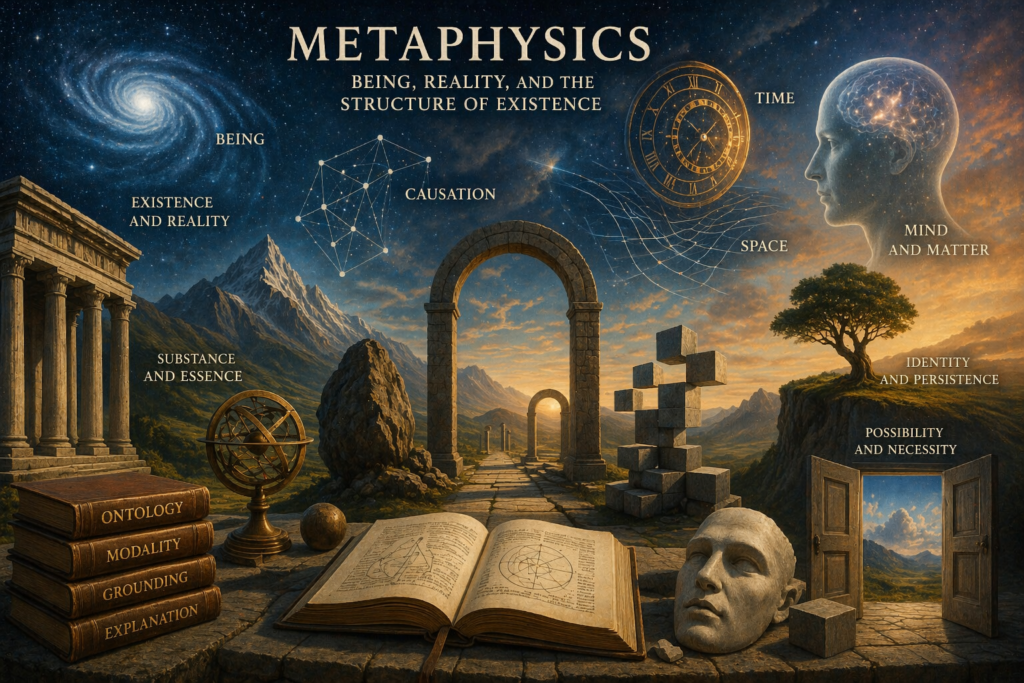
Surreal editorial image representing metaphysics through cosmic space, ancient architecture, books, geometric forms, a human head, and symbolic scenes of being, causation, time, possibility, and reality

Metaphysics: Being, Reality, and the Structure of Existence

Metaphysics examines the most fundamental questions about reality, being, existence, identity, change, causation, possibility, time, space, mind, matter, and the basic structure of what there is. This field is not speculative excess detached from the world, but a disciplined inquiry into the deepest conditions of intelligibility: what kinds of things exist, what it means for something to be real, how things persist or change, what causes and grounds phenomena, and how reality is structured at its most basic level. At its core lies a defining philosophical question: what is the world ultimately made of, and how does what exists hang together? This content pillar explores ontology, substance, essence, identity, persistence, modality, grounding, time, space, mind, personhood, realism, and metaphysical explanation, showing why metaphysics remains indispensable wherever inquiry presupposes some account of what exists and how reality is ordered.
Abstract metaphysical image of a central human figure surrounded by layered translucent faces, luminous pathways, and interconnected patterns representing selfhood, memory, continuity, and personal identity

Selfhood and Personal Identity: Personhood, Persistence, and the Question of Who We Are

Selfhood and personal identity form one of the central constellations of metaphysics. The problem is not merely whether persons exist, but what kind of beings persons are, what makes someone the same person over time, how selfhood relates to consciousness and embodiment, and whether identity is grounded in memory, psychology, bodily continuity, narrative, agency, or some deeper structure of persistence. To ask about personal identity is to ask what it means to remain oneself through change, what survives across time, and what, if anything, makes a human life count as the life of one continuing subject. This content pillar explores those questions across classical, early modern, and contemporary philosophy, while also connecting metaphysical debates to ethics, law, medicine, cognitive science, trauma, aging, social recognition, and the lived conditions under which a life remains intelligibly one’s own.

Abstract metaphysical image of a human figure standing between two diverging luminous paths, with radiant and mechanical cosmic structures symbolizing freedom, agency, and determinism

Freedom, Agency, and Determinism: Free Will, Action, and Responsibility in a Causally Ordered World

Freedom, agency, and determinism form one of the central constellations of metaphysics. The problem is not merely whether human beings act, choose, and deliberate, but whether those acts, choices, and deliberations can be genuinely free in a world shaped by causal order, natural law, character, history, and circumstance. To ask whether we are free is to ask whether agency is real, whether responsibility is justified, whether persons are authors of what they do in any meaningful sense, and whether action can be more than the unfolding of forces whose deeper sources lie beyond conscious control. This content pillar explores those questions across classical, medieval, modern, and contemporary philosophy, while also connecting metaphysical debates to action theory, law, politics, psychology, neuroscience, coercion, social structure, and the conditions under which human beings can meaningfully be held answerable for what they do.

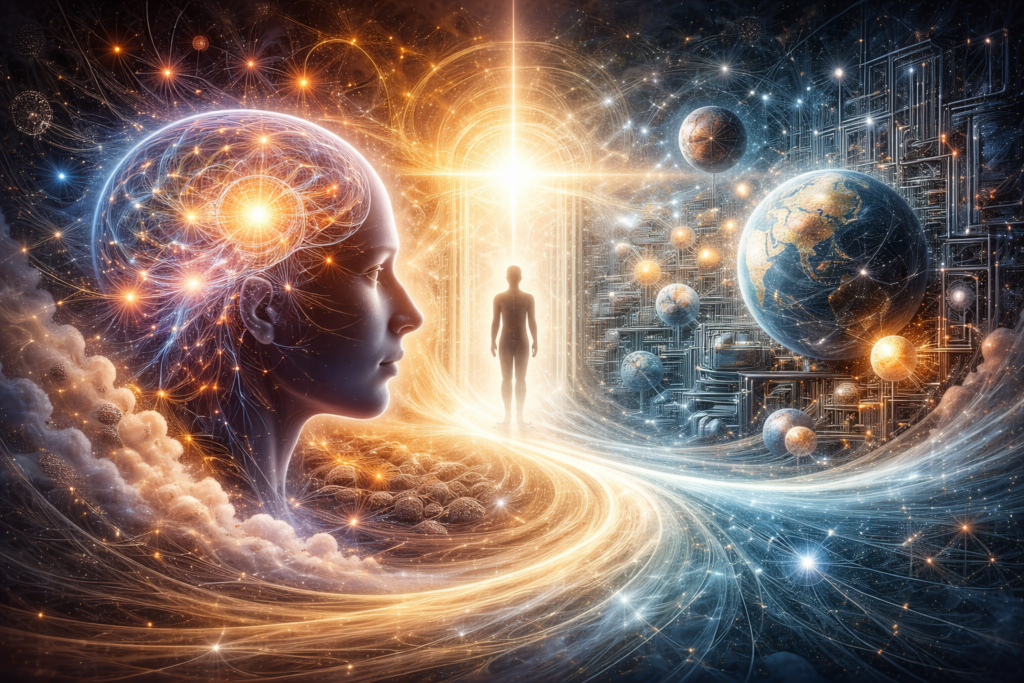
Abstract metaphysical image showing a luminous human profile, radiant neural patterns, a central human figure, and a technological cosmic landscape representing mind, matter, and consciousness

Mind, Matter, and Consciousness: Mental Life, Physical Reality, and the Problem of Experience

Mind, matter, and consciousness form one of the most enduring and difficult constellations in metaphysics. The problem is not simply whether minds exist, but how mental life relates to physical reality, whether consciousness can be explained in material terms, how thought is possible in a world of matter, and whether subjective experience discloses a dimension of reality that resists reduction to physical description. At its core lies a defining philosophical question: how does subjective life fit into the structure of reality? This content pillar explores dualism, materialism, physicalism, idealism, consciousness, qualia, intentionality, mental representation, mental causation, embodiment, personal identity, cognitive science, and artificial intelligence, showing why the relation between mind and world remains one of the deepest fault lines in metaphysics.

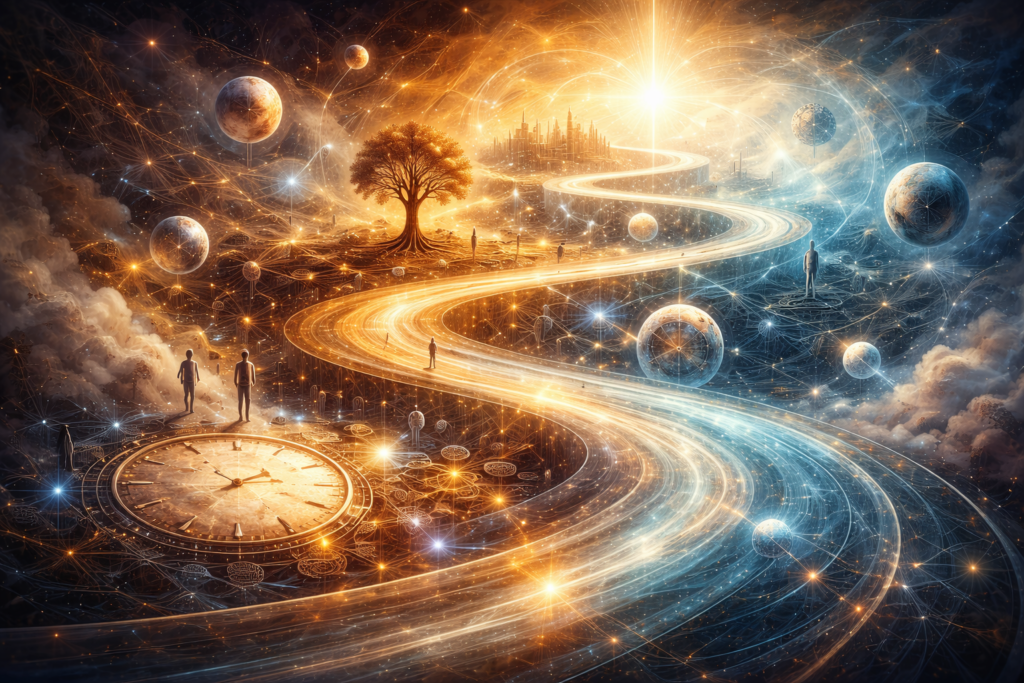
Abstract cosmic landscape with a flowing luminous path, celestial spheres, human figures, and radiant structures representing time, change, and causation

Time, Change, and Causation: Temporality, Becoming, and the Order of Events

Time, change, and causation form one of the central constellations of metaphysics. Time concerns succession, duration, persistence, and the ordering of past, present, and future. Change concerns alteration, motion, development, and transformation. Causation concerns the relations through which events, processes, states, and actions bring about further events, processes, states, and actions. Taken together, these concepts shape some of the deepest philosophical questions about reality: whether the world genuinely unfolds, whether becoming is real, whether the present is metaphysically privileged, whether causes must precede their effects, and how explanation is possible in a changing world. This content pillar explores those questions across classical, medieval, modern, and contemporary philosophy, while also connecting metaphysical debates to physics, agency, law, history, and systems thinking.

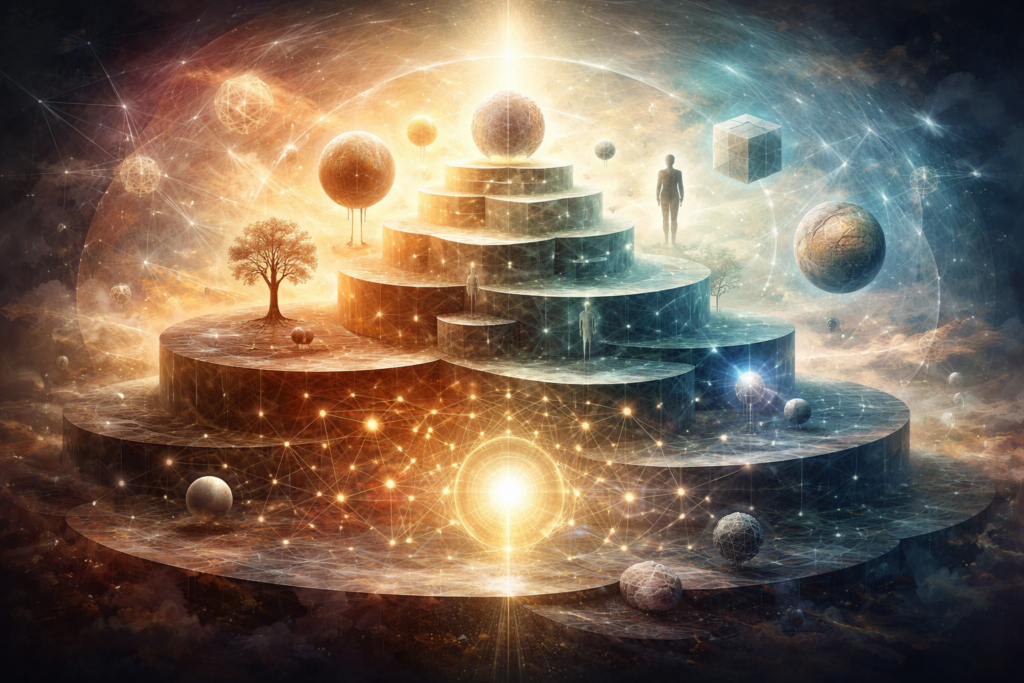
Abstract metaphysical landscape with layered circular platforms, glowing spheres, geometric forms, and human silhouettes representing being, categories, and the structure of reality

Ontology: Being, Existence, and the Structure of Reality

Ontology is the branch of metaphysics concerned with being, existence, and the most general structure of reality. It asks what there is, what kinds of things exist, how those things are organized into categories, whether some entities are more fundamental than others, and how relations of dependence, composition, identity, and modality shape any serious account of the real. From Aristotle’s investigations into substance and category to contemporary debates over grounding, mereology, abstract objects, possible worlds, and social ontology, the history of ontology is the history of philosophy’s attempt to clarify what reality contains and how reality is structured. This content pillar explores ontology historically, systematically, and critically, providing a foundation for future work on being, essence, universals, particulars, truthmakers, fundamentality, and the layered architecture of the world.

Scroll to Top