
Last Updated May 4, 2026
Islamic and mystical thought examines the intellectual and spiritual traditions through which Muslim thinkers reflected on revelation, wisdom, law, ethics, metaphysics, love, selfhood, healing, creation, and the soul’s relation to God. As a major category within the Philosophy knowledge series, this pillar studies Islamic and mystical thought not as a marginal spiritual appendix to theology or law, but as one of the world’s great traditions of integrated intellectual and inward life, in which revelation, jurisprudence, theology, philosophy, ethics, spirituality, poetry, disciplined self-transformation, and the sciences of body and cosmos continually meet.
This field includes the Qur’anic and prophetic foundations of Islamic spirituality, the emergence of jurisprudence, theology, philosophy, mathematics, natural philosophy, and medicine, the development of Sufism as a path of remembrance, purification, companionship, and self-discipline, and the major syntheses offered by thinkers such as al-Ghazali, Suhrawardi, Ibn ʿArabi, and later metaphysical writers. It also includes the Persian mystical tradition, where figures such as Rumi and Attar gave lyric and narrative form to longing, annihilation, discipline, and union, as well as the broader institutional and doctrinal worlds in which Sunni and Shiʿi spiritual-intellectual traditions developed.
Its enduring power lies in the way it treats knowledge as more than information and religion as more than outward observance. It asks what it means to know God, how the self is transformed through discipline and remembrance, how the heart is purified of illusion, how revelation and reason are to be understood together, how law and inwardness belong to one another, how imagination mediates spiritual truth, how outward religion and inward realization can be reconciled, how the visible world gestures toward deeper realities, and how the study of number, nature, and the human body can belong within a wider search for order and wisdom.
The goal of this pillar is not to flatten Islamic thought into either legal formalism or generalized mysticism. It is to show why Islamic and mystical thought remains philosophically indispensable precisely because it sustains a long and subtle argument about revelation, prophecy, law, ethics, reason, theology, metaphysics, remembrance, love, spiritual authority, mathematics, natural order, medicine, and the education of the soul.
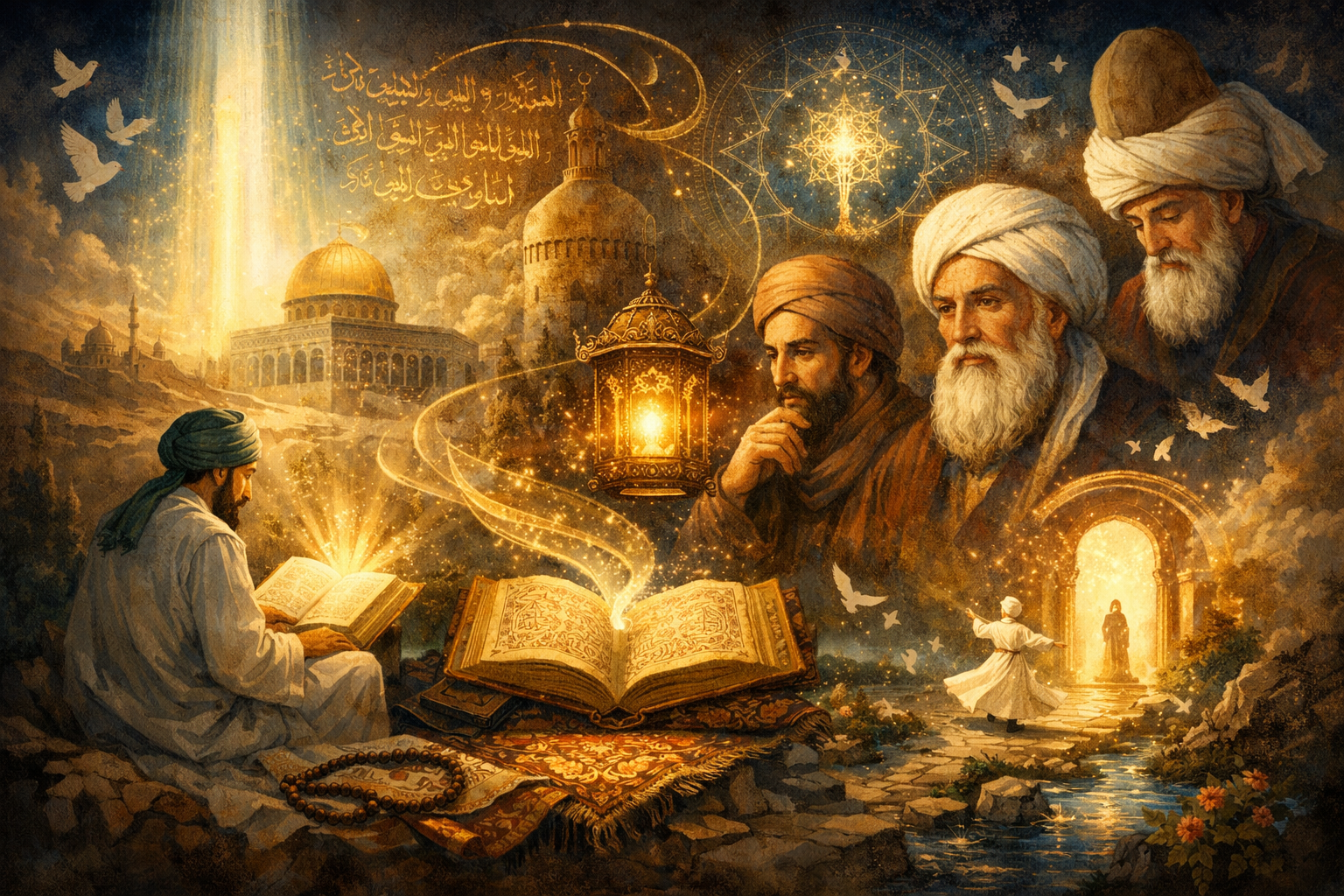
Islamic and mystical thought is especially important to a broader philosophy architecture because it provides one of the richest traditions for understanding revelation, wisdom, self-discipline, metaphysical order, love, inward transformation, and the relation between law and spiritual realization. In this respect, the category links not only to Persian Thought, but also to Ethics and Moral Philosophy, Metaphysics, Existential Thought, Greek and Roman Thought, and Political Philosophy and Justice. Questions of soul, discipline, revelation, imagination, divine reality, the purification of perception, and the intelligibility of creation become sharper when Islamic and mystical thought is treated not as vague spirituality, but as a major philosophical and religious world in its own right.
A fuller treatment must also make visible the intellectual worlds that developed around revelation: Qur’anic interpretation, Hadith, jurisprudence, kalam, falsafa, ethical formation, Sufi manuals, Persian mystical poetry, Shiʿi and Ismaʿili esoteric traditions, illuminationist metaphysics, natural philosophy, mathematics, medicine, and regional institutions of spiritual transmission. Islamic and mystical thought is therefore not one school, one temperament, or one vocabulary. It is a field of schools, methods, sensibilities, lineages, institutions, regions, and historical ecologies shaped by Qur’anic revelation, prophetic example, tafsir, taʾwil, kalam, falsafa, jurisprudence, adab, Sufi discipline, illuminationist metaphysics, Shiʿi esotericism, and the wider Persianate and Islamicate worlds.
Sources and Textual Foundations
A serious series in Islamic and mystical thought begins with the Qur’an and the Hadith, since Islamic spirituality and metaphysics emerge from within the revealed world of Islam rather than outside it. From there, the tradition unfolds through jurisprudence, theology, philosophy, ethics, manuals of spiritual discipline, hagiography, mystical poetry, metaphysical speculation, institutional lineages, and regional worlds of practice.
A cornerstone series should therefore be built from primary texts such as the Qur’an, selections from Hadith, al-Ghazali’s major works, al-Qushayri’s Risala, al-Hujwiri’s Kashf al-Mahjub, Suhrawardi’s illuminationist writings, Ibn ʿArabi’s major works, Ibn ʿAtaʾ Allah’s aphorisms, Jami’s writings, selections from Mulla Sadra where relevant, and key Persian Sufi works including Rumi and Attar. It should also move through the doctrinal and institutional archives of Sunni, Shiʿi, and Ismaʿili traditions, as well as the literature of Sufi orders, shrine cultures, and regional pedagogies.
Modern scholarship remains indispensable, but it should clarify and deepen the primary materials rather than replace them. For broad framing, specialist Islamic studies resources on Sufism, Islamic philosophy, Islamic metaphysics, theology, natural philosophy, and medicine are stronger than generic reference works because they show how mysticism, theology, philosophy, pedagogy, law, and the sciences continually overlap. A fully comprehensive pillar must therefore move repeatedly between revelation, doctrine, law, metaphysics, poetry, ritual, spiritual practice, mathematics, natural order, healing, institutional transmission, and historical region.
Why Islamic and Mystical Thought Matters
Islamic and mystical thought matters because it offers one of the world’s most integrated traditions of revelation, reason, law, ethics, inward discipline, metaphysical aspiration, and ordered knowledge. It asks not only what truth is, but how truth is received, enacted, remembered, contemplated, and lived. In this tradition, the deepest knowledge is not detached from the transformation of the knower.
This matters because Islamic intellectual life repeatedly refuses the modern separation between religious form and spiritual depth, or between philosophical rigor and inward realization. Revelation is not simply a source of doctrines. It becomes the ground of ethics, jurisprudence, metaphysics, contemplation, symbolic interpretation, spiritual pedagogy, and reflection on the structure of creation. The relation between outward religion and inward realization is one of the field’s enduring questions.
Islamic and mystical thought also matters because it preserves a many-sided vision of the human being. The self is legal and ethical, rational and imaginative, social and inward, disciplined and desiring, embodied and contemplative. It must be formed through worship, remembrance, study, companionship, struggle, humility, healing, and refinement of perception. Few traditions sustain so rich a vocabulary for the education of the soul.
Revelation, Wisdom, and the Formation of an Intellectual World
Islamic thought unfolds from revelation, but it does not remain at the level of bare scriptural citation. From early on, Muslim intellectual life generated rich traditions of jurisprudence, theology, philosophy, ethics, spirituality, and the sciences. Mysticism in the Islamic context has long been intertwined with hikmah, a term that can carry the meanings of wisdom and philosophy at once. That older unity matters because it reminds us that the separation between philosophy and spirituality is often far sharper in modern classifications than it was in the Islamic intellectual world itself.
This is one reason Islamic and mystical thought has such depth. It is not just a set of devotional attitudes, and it is not just a school of rational speculation. It is an intellectual world in which revelation becomes the source of law, ethics, contemplation, symbolic exegesis, metaphysical reflection, and inquiry into the order of nature and the human being. Many of its central questions arise from within that world: how God should be known, how the soul should be purified, what sort of causality operates in the world, how human action relates to divine power, and how outward religion and inward realization belong together.
The Qur’an and the Prophetic Model
A fully comprehensive pillar must make explicit the centrality of the Qur’an and the Prophetic model. The Qur’an is not merely the starting text of Islam. It is the linguistic, theological, ethical, and contemplative ground from which much later Islamic and mystical thought emerges. Its language of signs, remembrance, mercy, accountability, nearness, light, wisdom, and the heart shapes later metaphysical and spiritual reflection in decisive ways.
The Prophetic model matters just as deeply. The Sunnah establishes not only legal precedent but a lived form of ethical and spiritual exemplarity. The Prophet’s speech, conduct, worship, forbearance, humility, and relation to God become central to Islamic conceptions of character, discipline, and realization. Mystical life in Islam is therefore not a departure from Prophetic form but, at its best, an inward intensification of it.
This dual foundation helps explain why Islamic mystical thought cannot be reduced to generalized spirituality. It remains rooted in revelation and Prophetic embodiment.
Tafsir, Taʾwil, and the Layers of Meaning
A fully comprehensive pillar should foreground Qur’anic interpretation. Islamic and mystical thought does not simply quote revelation; it interprets it. Tafsir, symbolic exegesis, inward interpretation, and taʾwil all become major sites where theology, spirituality, language, and metaphysics meet. The revealed text is read as law, guidance, sign, symbol, and ontological disclosure.
This matters because mystical thought in Islam is inseparable from hermeneutics. The relation between outward and inward meaning is one of the deepest organizing tensions in the tradition. Symbolic exegesis does not abolish literal meaning; it seeks to disclose deeper layers within a revealed order already held to be true.
This makes scriptural interpretation a central part of Islamic mystical thought rather than a secondary scholarly exercise.
Law, Ethics, and the Shaping of the Muslim Self
Islamic thought has always treated law as more than external regulation. At its strongest, jurisprudence is part of the shaping of the self, the ordering of communal life, and the embodiment of submission to God. Ritual obligations, dietary rules, financial ethics, social duties, and norms of conduct all contribute to a world in which ethical and spiritual formation occur through disciplined practice.
This matters because mystical inwardness is not opposed to form in the Islamic tradition. The self is trained through prayer, fasting, recitation, charity, restraint, and etiquette. Law becomes one of the means through which habit, intention, and attention are disciplined. Islamic mystical thought often assumes this formative structure even when it turns more explicitly toward the purification of the heart.
For that reason, a serious pillar cannot isolate spirituality from legal and ethical life. Islamic thought forms the human being through both.
Kalam, Falsafa, and the Question of Reason
A comprehensive account of Islamic and mystical thought must include the major rational traditions through which Muslim thinkers debated God, causality, creation, human action, prophecy, and the nature of knowledge. Kalam and falsafa represent different but overlapping efforts to think rigorously within or alongside the revealed world of Islam. They matter because mystical thought develops not in the absence of such debate, but in an intellectual world already alive with theological and philosophical dispute.
This matters because Islamic mysticism cannot be adequately understood if philosophy and theology are treated as separate realms with no bearing on spiritual life. The debates over reason, causality, metaphysical order, and the intelligibility of nature helped define the larger intellectual environment in which figures such as al-Ghazali, Suhrawardi, and Ibn ʿArabi wrote. Mystical thought often responds to, transforms, or reorders these rational traditions rather than abandoning them.
A serious pillar should therefore make visible the broader intellectual ecology of Islamic thought: revelation, jurisprudence, kalam, falsafa, and Sufism as interrelated rather than sealed domains.
Muʿtazila, Ashʿarism, and Maturidism
To be fully comprehensive, the pillar must also make the major theological schools more visible. Muʿtazila, Ashʿarism, and Maturidism are not marginal technical traditions. They shape the central debates over divine justice, reason, human action, causality, moral responsibility, and the relation between revelation and rational inquiry. These schools define much of the theological terrain on which later spiritual and philosophical reflection unfolds.
This matters because Islamic mystical thought emerges within, beside, and sometimes against these theological worlds. Questions about free will, divine power, moral value, and the intelligibility of revelation are not merely scholastic background. They condition the larger atmosphere in which the soul’s journey is imagined.
Theological schools therefore belong integrally to a comprehensive pillar rather than as optional background.
Al-Kindi, Al-Farabi, and Avicenna
A maximally comprehensive pillar should also name the major philosophers who shaped the rational tradition inherited by later Islamic mystical thought. Al-Kindi, al-Farabi, and Avicenna are crucial because they develop the philosophical vocabularies of intellect, causality, emanation, soul, being, prophecy, and human perfection that later thinkers confront, transform, or absorb.
This matters because al-Ghazali, Suhrawardi, and later mystical philosophers do not emerge in a vacuum. They write in relation to an already rich philosophical world. Avicenna in particular becomes a decisive point of departure for later metaphysics, natural philosophy, medicine, illuminationism, and debates over knowledge and reality.
Including these figures helps complete the pillar’s account of the wider intellectual ecology of Islamic thought and prevents mysticism from appearing disconnected from philosophy.
Early Asceticism and the Rise of Sufism
Before later metaphysical syntheses, Islamic mystical life emerged through early asceticism, renunciation, vigilance over the self, fear of God, hope, love, and the disciplined refusal of worldly excess. Early Muslim piety cultivated inward seriousness through fasting, night prayer, repentance, moral accountability, and careful scrutiny of the self. These practices formed the spiritual atmosphere from which later Sufism developed.
This matters because Sufism did not appear first as system. It began as a lived effort to deepen sincerity, detachment, remembrance, and purification. The later elaboration of mystical doctrines and orders should not obscure the formative seriousness of early ascetic Islam.
Including this background helps prevent the pillar from becoming too weighted toward later speculation. Islamic mystical thought begins in practice, discipline, and moral self-scrutiny.
Hasan al-Basri, Rabiʿa, Junayd, and al-Hallaj
A fully comprehensive pillar should explicitly include the foundational figures of early Sufism. Hasan al-Basri, Rabiʿa al-ʿAdawiyya, Junayd, and al-Hallaj represent major moments in the evolution of Islamic mystical language and practice: ascetic seriousness, divine love, sobriety and disciplined realization, and ecstatic utterance pushed to its extreme.
This matters because these figures help define the path before later grand syntheses. Rabiʿa deepens the language of love; Junayd becomes central to sober and disciplined mystical discourse; al-Hallaj reveals the danger and intensity of ecstatic expression. Together they give Islamic mystical thought some of its most enduring tones: fear, love, sobriety, annihilation, and dangerous nearness.
Without them, the pillar remains too weighted toward later systematizers.
The Rise of Sufism as a Path of Transformation
Sufism is the name most commonly given to the mystical interpretation and practice of Islam, but that brief definition only gestures toward its range. It includes doctrines, practices, pedagogies, disciplines of remembrance, theories of the self, saintly lineages, shrine cultures, and moral programs of purification. At its center lies the conviction that religion is not exhausted by outward conformity. The self must be transformed. Desire must be disciplined. The heart must be polished. Knowledge must become lived realization.
That is why Sufism belongs near the center of a pillar like this. It turns Islamic thought inward without severing it from the larger religious tradition. The path is not merely contemplative. It is ethical, ritual, and pedagogical. It requires companionship, discipline, adab, and practice. In many historical settings, Sufi thought also shaped education, social life, and institutional cultures, showing that mysticism was never simply private ecstasy detached from communal life.
Adab, Discipline, and the Education of the Heart
A fully comprehensive account of Islamic and mystical thought must foreground adab, because the path is not only about abstract doctrine or extraordinary states. It is about comportment, refinement, humility, companionship, speech, etiquette, and receptivity. Adab educates the heart through form.
This matters because inward realization in the Islamic tradition is often inseparable from trained conduct. The way one speaks, sits, remembers, listens, serves, and receives correction all become part of the discipline of the soul. Spiritual realization is therefore not merely inward experience. It is also a schooling in form, relation, and ethical beauty.
This emphasis helps explain why Islamic mystical traditions so often join beauty, order, reverence, and humility. The soul is refined through adab as much as through speculation.
Al-Qushayri, Al-Hujwiri, and the Codification of the Path
A maximally comprehensive pillar should include al-Qushayri and al-Hujwiri, because Islamic mystical thought is not shaped only by saints and metaphysicians but also by those who codified, clarified, defended, and transmitted Sufi terminology, practice, and doctrine. Their writings help stabilize the path without reducing it to formula.
This matters because Sufism becomes historically durable not only through inspiration but through teaching, exposition, and disciplined transmission. Manuals and expository works make mystical language legible, socially grounded, and pedagogically usable.
These figures therefore help complete the institutional and textual history of the tradition.
Al-Ghazali and the Reordering of Knowledge
Al-Ghazali stands near the center of Islamic and mystical thought because he moved across jurisprudence, theology, philosophy, and spirituality with unusual authority. He does not fit neatly into one category, and part of his importance lies in the way he reordered the relationship among them. In him, the question is never just what can be argued, but what kind of knowledge saves, transforms, and rightly orders the soul.
His significance is often flattened into the claim that he was simply anti-philosophical, but that misses the scale of his achievement. He confronted Aristotelian philosophy, theological debate, and spiritual crisis while also reworking philosophy and Sufism into a new Sunni synthesis. His project was not anti-intellectual withdrawal. It was a reordering of knowledge around truth, discipline, salvation, and the purification of the self.
Al-Ghazali therefore belongs at the center of the pillar as one of the great figures through whom Islamic thought rethinks the hierarchy of knowledge, the danger of sterile intellection, and the necessity of spiritual realization.
Illumination and the Metaphysics of Light
Islamic mystical philosophy is not confined to practical spirituality. It also develops major metaphysical visions. Suhrawardi is central here because he founded the Illuminationist tradition, offering an original critique of dominant Avicennan Peripateticism while elaborating a philosophical language of light, intuition, and presence. His project ranges across logic, psychology, ontology, cosmology, and epistemology, but what gives it its distinctive force is the way intellectual vision becomes inseparable from illumination.
This gives Islamic and mystical thought a different philosophical texture than a purely rationalist history would suggest. Knowledge is not simply conceptual adequation. Light becomes an ontological and epistemic principle at once. The world is read not only through syllogism but through degrees of disclosure, proximity, radiance, and unveiling. In that sense, illuminationist thought intensifies rather than abandons philosophy.
Suhrawardi and Illuminationist Philosophy
Suhrawardi is indispensable because he shows that Islamic mystical thought can be philosophically rigorous without surrendering symbolic and intuitive depth. His work is not vague spirituality in philosophical dress. It is a serious metaphysical alternative in which presence, light, and gradation of being become architectonic principles.
This matters because Suhrawardi helps bridge revelation, philosophy, and inward disclosure. He reorients metaphysics toward luminous presence while preserving conceptual sophistication. In him, Islamic thought develops one of its most original syntheses of speculative and illuminative knowledge.
His inclusion is therefore essential to a maximally comprehensive pillar.
Ibn ʿArabi and the Unity of Being
Ibn ʿArabi belongs near the summit of this tradition. His work is difficult to classify by modern academic boundaries because it is metaphysical, symbolic, Qur’anic, mystical, and philosophical all at once. That difficulty is part of his significance. In him, Islamic mystical thought reaches a level of ambition that makes narrow distinctions between speculative theology, philosophical inquiry, and spiritual realization increasingly hard to maintain.
His importance lies in the vastness of his synthesis. The cosmos, the divine names, prophecy, imagination, human perfection, revelation, and spiritual realization all become parts of a single vision. In Ibn ʿArabi, mystical thought reaches a level of metaphysical seriousness that makes it impossible to dismiss Sufism as merely emotional or anti-intellectual. The path of realization becomes at once a path of ontology, cosmology, scriptural interpretation, and self-knowledge.
Imagination, Symbol, and Human Perfection
A fully comprehensive pillar should make explicit the role of imagination, symbolism, and the ideal of the perfected human being. Islamic mystical thought often treats imagination not as illusion but as an intermediate and revelatory faculty through which realities can become perceptible in symbolic form. Vision, dream, metaphor, and the imaginal world all become important here.
This matters because Islamic mystical thought is not content with literalism on one side or abstraction on the other. Symbolic disclosure mediates between visible and invisible realities. Human perfection, likewise, is not moral achievement alone but a mode of receptivity to divine names, prophetic inheritance, and ontological realization.
These themes are especially important in later metaphysical Sufism and should stand clearly inside the pillar rather than remaining implied.
Later Metaphysics and the Post-Classical Expansion of the Tradition
A fully comprehensive pillar should not end its deepest intellectual density with al-Ghazali, Suhrawardi, and Ibn ʿArabi alone. Later Islamic philosophy and mysticism extended, contested, and reworked these earlier syntheses. Fakhr al-Din al-Razi intensified philosophical theology and sharpened the intellectual environment in which post-Avicennan debates unfolded. Later, Mulla Sadra produced one of the most ambitious syntheses in Islamic philosophy, drawing on Avicennan, Illuminationist, Ibn ʿArabi-influenced, and Shiʿi metaphysical traditions in a system that gave renewed force to questions of existence, knowledge, soul, motion, and transformation.
These later developments matter because they show that Islamic and mystical thought did not culminate and then decline. It remained generative, internally argumentative, and philosophically ambitious well beyond the classical core. A strongest-sense pillar should therefore make visible a post-classical and early modern arc: from Avicennan inheritance to Illuminationism, from Ibn ʿArabi’s metaphysical vastness to later commentators and synthesizers, and from Sunni theological worlds into Persian and Shiʿi philosophical expansion.
Without this later layer, the pillar risks appearing top-heavy around a few canonical high points rather than showing the continuing vitality of the tradition.
Persian Mystical Poetry and the Language of Love
Persian literature gives Islamic and mystical thought one of its most compelling languages. In the Persian tradition, Sufism became a principal form of literary expression, and the ghazal became one of its favored media. That matters because longing, intoxication, beauty, poverty, and love are not ornamental themes laid over a prior doctrine. They are among the most powerful ways the tradition thinks.
Rumi is central here, but he is best understood not as a generic poet of love detached from Islam. His writings remain deeply embedded in Qur’anic and Sufi worlds of meaning. Attar deepens this poetic-mystical landscape through visionary narrative and saintly biography, while works such as Tadhkirat al-Awliya preserve lineages of sanctity, discipline, and transformation. Later figures such as Jami help demonstrate the ongoing sophistication of Persian mystical synthesis rather than allowing the tradition to end with a small set of favorites.
Together these writers show how poetry and hagiography become media of metaphysical and ethical seriousness.
Rumi and the Language of Spiritual Transformation
Rumi is indispensable because he gives Islamic mystical thought one of its greatest poetic and pedagogical forms. In his work, longing, rupture, discipline, movement, music, and love all become vehicles for the transformation of the self. He does not merely describe spiritual change. He performs it in language.
This matters because Rumi reveals how deeply Islamic and mystical thought can join beauty to discipline and ecstasy to moral education. His poetry is saturated with Qur’anic resonance, Sufi psychology, and metaphysical seriousness. To read him well is to see that love in this tradition is not sentiment but a force of spiritual reordering.
He therefore belongs centrally to any fully comprehensive pillar.
Attar and the Poetics of the Sufi Path
Attar is equally indispensable because he gives Islamic and mystical thought one of its clearest languages of journey, annihilation, testing, and the soul’s passage beyond illusion. His narratives and hagiographic writings reveal that mystical transformation is not merely lyrical yearning but a severe pedagogy of loss, discipline, bewilderment, and unmaking.
This matters because Attar helps complete the pillar’s account of the Sufi path. He brings together allegory, sanctity, memory, pedagogy, and metaphysical aspiration in a form at once poetic and exacting. The path is not only love; it is also trial, subtraction, and the dismantling of egoic certainty.
Saintly Authority, Masters, and Silsila
A fully comprehensive treatment of Islamic mystical thought must include the transmission of spiritual authority through masters, lineages, and chains of initiation. The role of the shaykh, the importance of companionship, the idea of saintly authority, and the continuity of transmission through silsila are central to the lived structure of Sufism.
This matters because Islamic mysticism is not merely a set of ideas. It is also an inherited practice-world shaped by discipline, correction, relational authority, ritual, and memory. Saints and masters are not simply charismatic figures. They become pedagogical and spiritual nodes through which forms of life are transmitted.
This dimension helps anchor mystical thought in institutions, lineages, and lived communities rather than in disembodied abstraction.
Major Sufi Orders and the Historical Transmission of Mysticism
A maximally comprehensive pillar should make visible the major Sufi orders through which mystical life became historically durable and socially expansive. Traditions such as the Qadiriyya, Naqshbandiyya, Chishtiyya, Shadhiliyya, Mevleviyya, and others carry distinctive forms of remembrance, pedagogy, etiquette, authority, and institutional life.
This matters because Sufism is not only a textual and conceptual tradition. It is also an organized historical world of lodges, lineages, travel, ritual, and teaching. The great orders help show how Islamic mystical thought moved across regions and became embedded in different societies.
Without this dimension, the pillar risks becoming overly abstract. Orders and institutions make mystical transmission historically legible.
Regional Ecologies of Islamic and Mystical Thought
A fully comprehensive pillar must make explicit that Islamic and mystical thought did not unfold in one undifferentiated religious space. It developed through distinct but interconnected regional ecologies, each with its own institutions, vocabularies, pedagogies, and spiritual emphases. Iraq was central to early asceticism, kalam, jurisprudence, and formative Sufi discourse. Khurasan became one of the great homelands of Persian Sufism, saintly hagiography, and the poetic language of longing and annihilation. Persia and the eastern Islamicate world sustained major metaphysical and illuminationist traditions, including the afterlives of Avicennan philosophy, Suhrawardi’s Illuminationism, and later Sadrian philosophy.
Anatolia became one of the great zones of Sufi institutional transmission, especially through Ottoman and Mevlevi lineages. North Africa and al-Andalus sustained powerful traditions of jurisprudence, sainthood, metaphysical commentary, and devotional practice. South Asia became one of the richest worlds of Chishti, Qadiri, Suhrawardi, and Naqshbandi expansion, where shrine life, ethics, poetry, pedagogy, and social hospitality gave Islamic mysticism immense public presence.
This regional differentiation matters because it prevents the tradition from collapsing into a single abstract narrative. The inward life of Islam was never only one thing. It was juristic and ascetic in some settings, poetic and metaphysical in others, shrine-centered and pedagogical in others, and in many cases all of these at once.
Shiʿi Spirituality, Imamate, and Esoteric Knowledge
A maximally comprehensive pillar should also make visible the importance of Shiʿi spirituality and esoteric knowledge. Islamic mystical and metaphysical thought did not develop only through Sunni Sufi lineages. Shiʿi traditions of authority, Imamate, inward meaning, esoteric hermeneutics, devotion, and spiritual knowledge also shape the wider field.
This matters because questions of authority, hidden meaning, and inward knowledge take distinct forms in Shiʿi intellectual and devotional life. The Imam is not only a political or juridical figure but also, in many strands of Shiʿi thought, a bearer of inward truth and spiritual authority. These traditions help widen the pillar beyond the most familiar Sunni-centered narratives and clarify the diversity of Islamic spiritual thought.
Including this strand makes the pillar more complete and less reductive.
Shiʿi and Ismaʿili Esoteric Worlds
A maximally comprehensive account must deepen Shiʿi spirituality beyond a brief section on Imamate and esoteric knowledge. Twelver Shiʿi traditions of authority, devotion, metaphysics, and commentary created distinctive modes of spiritual thought in which the Imam could function not only as a political and juridical figure but also as a locus of inward truth, spiritual mediation, and hermeneutic depth. Ismaʿili traditions likewise developed rich intellectual worlds of taʾwil, hierarchy, esoteric interpretation, cosmological vision, and spiritual pedagogy.
Shiʿi and Ismaʿili materials matter because they widen the category beyond a Sunni-Sufi center and reveal how authority, hidden meaning, and spiritual knowledge took different but equally serious forms across the Islamic world. These traditions belong structurally inside the pillar, not as optional supplements at the edge of the story.
Law Schools, Juristic Worlds, and Sufi Formation
A fullest account should sharpen the relation between Sunni legal schools and spiritual life. Islamic mysticism did not simply hover above jurisprudence. In many of its most historically durable forms, it was embedded within Hanafi, Maliki, Shafiʿi, and Hanbali legal worlds. Ritual practice, purification, prayer, fasting, discipline, commercial ethics, companionship, and social comportment all gave law a formative and pedagogical function.
Sufi life was frequently cultivated within juristic orthodoxy rather than in opposition to it. The path of inward realization often assumed the formative world of the law rather than rejecting it. This is one reason why Islamic mystical thought is best understood not as a rebellion against form, but as a deepening of it.
The Nafs, the Heart, and the Journey of Self-Transformation
A fully comprehensive pillar should foreground the anthropology of the self. Islamic and mystical thought returns constantly to the nafs, the heart, intention, remembrance, heedlessness, sincerity, humility, and the purification of perception. The central drama is not merely doctrinal assent but transformation of the inner life.
This matters because the soul’s journey is not abstract. It concerns desire, anger, forgetfulness, pride, illusion, repentance, refinement, and receptivity to divine reality. The discipline of the heart is one of the central sites where Islamic ethics, spirituality, and anthropology converge.
To include this explicitly is to show that Islamic mystical thought is also a profound tradition of moral psychology.
Lived Practice, Ritual, and the Social Worlds of the Path
A comprehensive pillar should expand the lived-practice layer. Islamic and mystical thought is not only a history of texts and metaphysical doctrines. It is also a history of dhikr, samaʿ, retreat, litanies, adab, companionship, lodge life, shrine visitation, charitable hospitality, ritual discipline, and pedagogies of correction. These practices matter because they make mystical thought socially and historically legible.
Without them, the tradition risks appearing as disembodied inwardness. In reality, the path was cultivated through repeated acts of remembrance, embodied etiquette, collective ritual, and forms of disciplined presence that joined the soul’s education to communal life.
Women, Saints, Transmitters, and Devotional Presence
A final pass toward fuller comprehensiveness must strengthen the place of women across the tradition. Rabiʿa is indispensable, but a single iconic figure is not enough. Women belonged to the worlds of transmission, remembrance, patronage, ethical instruction, saintly reputation, household piety, and literary memory. In a tradition so concerned with companionship, adab, sanctity, and the purification of the self, women cannot remain only a symbolic exception.
A fuller pillar therefore integrates women more structurally: in early ascetic piety, in hagiography, in shrine cultures, in devotional transmission, in pedagogies of recollection, and in later literary and regional expressions of Islamic spirituality. Women belong inside the history of the path, not outside it.
Mathematics, Order, and the Intelligibility of Creation
A fully comprehensive pillar on Islamic and mystical thought should include the place of mathematics within the wider Islamic intellectual world. Mathematics was not always treated as a merely technical discipline detached from questions of truth, harmony, order, and intelligibility. In the classical classification of the sciences, mathematical disciplines could function as ways of grasping structure, proportion, and the intelligible order of creation. Number, measure, geometry, and formal relation helped sustain broader philosophical reflection on cosmic order, demonstrative certainty, and the disciplined training of the mind.
This matters because Islamic intellectual life did not isolate spiritual inquiry from rigorous forms of rational order. The mathematical sciences belonged to a world in which logic, astronomy, metaphysics, and natural philosophy were often understood as mutually illuminating. Even where mathematics was not itself mystical, it contributed to a broader intellectual culture in which the world could be read as ordered, knowable, and structured according to intelligible principles.
Including mathematics also helps correct modern habits of compartmentalization. In the medieval Islamicate world, the hierarchy and classification of the sciences often placed mathematics alongside physics and medicine as part of a comprehensive map of knowledge. To include it here is not to blur disciplinary boundaries carelessly, but to reflect the older conviction that truth could be pursued through multiple, ordered forms of inquiry.
Science, Nature, and the Philosophical Study of the Cosmos
A fully comprehensive treatment should make explicit the role of science and natural philosophy within Islamic thought. The study of nature in the medieval Arabic-speaking world did not belong to a single intellectual camp. Natural philosophy was pursued both within kalam and within falsafa, with theologians and philosophers often approaching questions of body, motion, time, causation, continuity, atomism, and divine agency in strikingly different ways. Islamic and mystical thought therefore developed in an intellectual environment already alive with serious debate over how the natural world should be understood.
This matters because cosmology, astronomy, optics, physics, and the philosophical study of nature helped shape the larger questions to which theological and mystical traditions responded. The structure of the heavens, the intelligibility of motion, the nature of causation, and the relation between divine power and natural regularity were not marginal curiosities. They were among the major ways Muslim intellectuals thought about creation, order, contingency, and the place of the human knower in the cosmos.
A strongest-sense pillar should therefore present science not as something external to Islamic intellectual life, but as one of the fields through which Muslim thinkers investigated the created world and its intelligibility.
Medicine, Healing, and the Care of Body and Soul
Medicine is one of the clearest missing layers in a pillar of this scale. Islamic thought did not treat healing as an isolated craft severed from philosophy, ethics, psychology, and spiritual anthropology. Avicenna himself stands as the most obvious reminder: he was not only a philosopher but also the preeminent physician of the Islamic world, and his work helped integrate philosophical, scientific, and medical inquiry into a single rationally ordered system. In this world, medicine belonged to the broader pursuit of knowledge about the human being, the body, causation, regimen, temperament, and the conditions of flourishing.
This matters because Islamic and mystical thought repeatedly returns to the relation between body and soul, inward discipline and outward regimen, moral psychology and embodied life. Medical reasoning helped supply conceptual tools for thinking about balance, temperament, habit, perception, and the management of bodily and psychic states. Medicine belongs naturally inside this pillar rather than as an afterthought.
A fullest-sense account should therefore include medicine as part of the larger architecture of Islamic wisdom. Healing concerns not only pathology and cure, but also care, discipline, ethics, and the conditions under which the human being can live well, know rightly, and remain receptive to truth.
Islamic and Mystical Thought in the Persianate World
Islamic and mystical thought expands through the Persianate world, where Persian literature, Sufi institutions, metaphysical vocabulary, and poetic forms gave Islamic spirituality one of its richest civilizational languages. Persia did not merely receive Islamic mystical thought; it profoundly shaped its expression, affective texture, and literary transmission.
This matters because some of the most influential languages of Islamic mysticism—love, intoxication, poverty, annihilation, longing, companionship, and the soul’s journey—reached their most refined literary form in Persianate settings. The Persianate world therefore belongs not at the periphery but near the center of a comprehensive Islamic and mystical pillar.
This also creates a natural bridge to the separate Persian Thought pillar while preserving the distinctively Islamic framing of this category.
South Asia and the Expansion of Islamic Mystical Thought
A fully comprehensive pillar should register the major regional expansions of Islamic mystical thought, especially in South Asia. There, Sufi orders, Persianate literary culture, shrine devotion, ethical instruction, and forms of spiritual pedagogy became major forces in social and religious life. The Chishtiyya in particular shaped powerful idioms of devotion, hospitality, love, moral presence, and spiritual democratization.
This matters because Islamic mystical thought is not confined to an Arab or Iranian heartland. It becomes a transregional tradition whose institutions, languages, and pedagogies are adapted and deepened across different worlds. South Asia is one of the clearest examples of that expansion, and later thinkers such as Shah Wali Allah help show that this was not only a shrine or poetic culture but also a world of sustained intellectual renewal.
Including this dimension strengthens the pillar’s historical and civilizational completeness.
Core Themes in Islamic and Mystical Thought
One major theme in this field is revelation. Islamic and mystical thought begins from the revealed world of Islam and continually returns to the Qur’an as a source of law, symbolism, metaphysics, and inward guidance.
A second theme is wisdom. The tradition repeatedly treats hikmah as a meeting point of philosophy, spiritual intelligence, and the disciplined search for truth.
A third theme is purification of the self. Sufism places extraordinary emphasis on the discipline of the heart, remembrance of God, companionship, humility, and the transformation of desire.
A fourth theme is illumination and metaphysical disclosure. Thinkers such as Suhrawardi and Ibn ʿArabi make light, unveiling, imagination, and divine presence central to philosophical reflection.
A fifth theme is the language of love. In Persian and wider Sufi traditions, longing, beauty, and poverty become ways of speaking about transcendence, dependence, and the soul’s journey.
A sixth theme is law and inward realization. Islamic and mystical thought repeatedly asks how outward religion and inward transformation belong together.
A seventh theme is authority and transmission. Spiritual masters, saintly lineages, Sufi orders, and inherited forms of discipline give mystical thought institutional depth and historical continuity.
An eighth theme is interpretation. Qur’anic hermeneutics, symbolic reading, and inward meaning remain central to the relation between revelation and realization.
A ninth theme is region. Iraq, Khurasan, Persia, Anatolia, North Africa, and South Asia each give the inward life of Islam different forms without severing it from the larger tradition.
A tenth theme is the intelligibility of creation. Mathematics, natural philosophy, cosmology, and medicine reveal that Islamic thought also investigated number, order, body, and world as part of a wider search for wisdom.
Finally, this field returns constantly to the relation between outward religion and inward realization. Islamic and mystical thought endures because it holds together law, ethics, reason, revelation, beauty, memory, institution, science, healing, and transformation rather than surrendering any one of them too quickly.
Expanded Article Architecture
The following structure gathers the Islamic and Mystical Thought pillar into a long-range article architecture. It preserves the planned article sequence from the source draft while adding short descriptions for each planned article.
Foundations of Islamic and Mystical Thought
- Introduction to Islamic and Mystical Thought (planned)
Introduces Islamic and mystical thought as an integrated tradition of revelation, wisdom, law, ethics, metaphysics, spiritual discipline, and inward transformation. - Islamic and Mystical Thought: Revelation, Wisdom, Law, and the Journey of the Soul (planned)
Frames the pillar around the soul’s journey through revelation, worship, knowledge, law, remembrance, love, and transformation. - Revelation, Wisdom, and the Formation of an Intellectual World (planned)
Studies how Qur’anic revelation generated traditions of jurisprudence, theology, philosophy, spirituality, ethics, and the sciences. - The Qur’an and the Roots of Islamic Spirituality (planned)
Examines Qur’anic language of mercy, nearness, remembrance, accountability, signs, light, and the heart as foundations of Islamic spirituality. - The Prophetic Model and the Ethics of Embodied Revelation (planned)
Studies the Prophet’s example as a lived model of worship, humility, mercy, discipline, ethical conduct, and spiritual realization. - Tafsir, Taʾwil, and the Layers of Meaning in Islamic Thought (planned)
Explores Qur’anic interpretation, outward and inward meaning, symbolic exegesis, and the relation between text, law, and spiritual insight.
Law, Theology, and Philosophy
- Law, Worship, and the Formation of the Muslim Self (planned)
Studies how ritual obligations, legal discipline, intention, worship, and communal practice shape the moral and spiritual self. - Kalam, Falsafa, and the Question of Reason in Islam (planned)
Examines the major rational traditions through which Muslim thinkers debated God, causality, prophecy, knowledge, and creation. - Muʿtazila, Ashʿarism, and Maturidism in Islamic Theology (planned)
Introduces major theological schools and their debates over reason, divine justice, moral value, free will, causality, and revelation. - Al-Kindi, Al-Farabi, and the Philosophical Inheritance of Islam (planned)
Studies early Islamic philosophers who shaped the traditions of intellect, prophecy, metaphysics, political philosophy, and rational inquiry. - Avicenna and the Metaphysical Architecture of Islamic Philosophy (planned)
Examines Avicenna’s influence on existence, essence, soul, knowledge, causality, medicine, natural philosophy, and later metaphysical traditions.
Early Asceticism and Foundational Sufi Figures
- Early Asceticism and the Moral Origins of Sufism (planned)
Studies early Muslim asceticism through repentance, vigilance, fear of God, hope, renunciation, sincerity, and moral self-scrutiny. - Hasan al-Basri and the Seriousness of Early Islamic Piety (planned)
Examines Hasan al-Basri as a figure of early ascetic seriousness, moral accountability, spiritual vigilance, and devotional intensity. - Rabiʿa al-ʿAdawiyya and the Language of Divine Love (planned)
Studies Rabiʿa as a foundational figure in the language of divine love, sincerity, worship, poverty, and inward devotion. - Junayd and the Sobriety of the Sufi Path (planned)
Examines Junayd’s sober Sufism, disciplined realization, spiritual speech, annihilation, subsistence, and the ethics of mystical restraint. - Al-Hallaj and the Danger of Ecstatic Speech (planned)
Studies al-Hallaj as a figure of ecstatic utterance, nearness, controversy, martyrdom, and the risks of mystical language.
Sufism as a Path of Transformation
- The Rise of Sufism as a Path of Transformation (planned)
Introduces Sufism as a disciplined path of remembrance, purification, companionship, self-knowledge, love, and spiritual realization. - Remembrance, Purification, and the Discipline of the Heart (planned)
Studies dhikr, sincerity, repentance, vigilance, humility, and the purification of the heart as central practices of the path. - Adab, Companionship, and the Education of the Soul (planned)
Examines adab as spiritual etiquette, relational discipline, humility, speech, listening, service, and receptivity to correction. - Al-Qushayri and the Doctrinal Language of Sufism (planned)
Studies al-Qushayri’s role in clarifying Sufi terminology, defending the path, and making mystical discourse pedagogically stable. - Al-Hujwiri and the Early Codification of the Path (planned)
Examines al-Hujwiri’s contribution to the transmission, explanation, and institutional grounding of Sufi concepts and practice.
Al-Ghazali and the Reordering of Knowledge
- Al-Ghazali and the Reordering of Knowledge (planned)
Introduces al-Ghazali as a major figure linking jurisprudence, theology, philosophy, spiritual crisis, purification, and the hierarchy of knowledge. - The Incoherence of the Philosophers and the Critique of Falsafa (planned)
Studies al-Ghazali’s critique of philosophical claims about causality, metaphysics, creation, divine knowledge, and demonstrative certainty. - The Revival of the Religious Sciences and the Formation of the Self (planned)
Examines al-Ghazali’s reconstruction of religious knowledge through worship, ethics, intention, inward discipline, and purification of the heart.
Illumination, Ibn ʿArabi, and Later Metaphysics
- Suhrawardi and the Metaphysics of Light (planned)
Introduces Suhrawardi’s Illuminationist philosophy as a major metaphysical vision centered on light, presence, knowledge, and being. - Illumination, Presence, and Intuitive Knowledge (planned)
Studies illumination as a mode of knowing in which presence, disclosure, intuition, and hierarchy supplement discursive reasoning. - Ibn ʿArabi and the Unity of Being (planned)
Examines Ibn ʿArabi’s vast metaphysical synthesis of divine names, cosmos, imagination, prophecy, revelation, and spiritual realization. - Imagination, Divine Names, and Human Perfection (planned)
Studies the imaginal faculty, symbolism, divine names, and the perfected human being in Islamic mystical metaphysics. - Fakhr al-Din al-Razi and the Intensification of Philosophical Theology (planned)
Examines al-Razi’s role in sharpening post-Avicennan philosophical theology, kalam, metaphysics, and debates over reason and revelation. - Mulla Sadra and the Later Metaphysical Expansion of Islamic Philosophy (planned)
Studies Mulla Sadra’s synthesis of Avicennan philosophy, Illuminationism, Ibn ʿArabi-influenced metaphysics, Shiʿi thought, existence, and motion.
Persian Mystical Poetry and the Language of Love
- Rumi and the Language of Spiritual Transformation (planned)
Studies Rumi’s poetry as a language of love, longing, rupture, remembrance, moral education, and the transformation of the self. - Attar and the Poetics of the Sufi Path (planned)
Examines Attar’s narratives and hagiographic writings as pedagogies of journey, annihilation, testing, loss, and spiritual realization. - Love, Poverty, and the Mystical Imagination (planned)
Studies love, poverty, longing, humility, and imagination as central modes of Sufi thought and Persian mystical expression.
Authority, Orders, and Transmission
- Saints, Masters, and the Transmission of Spiritual Authority (planned)
Examines saintly authority, shaykhs, companionship, spiritual correction, and the transmission of disciplined forms of life. - Silsila, Initiation, and the Inheritance of the Path (planned)
Studies chains of initiation, lineage, authorization, memory, and continuity as structures of Sufi transmission. - Qadiriyya, Naqshbandiyya, Chishtiyya, Shadhiliyya, and the Historical Expansion of Sufism (planned)
Introduces major Sufi orders and their distinctive forms of remembrance, pedagogy, institutional life, and regional expansion. - The Regional Ecologies of Islamic Mysticism: Iraq, Khurasan, Persia, Anatolia, North Africa, and South Asia (planned)
Studies how Islamic mysticism developed through distinct regional worlds with different institutions, languages, practices, and intellectual emphases.
Shiʿi, Ismaʿili, Juristic, and Institutional Worlds
- Shiʿi Spirituality, Imamate, and Esoteric Knowledge (planned)
Examines Shiʿi traditions of authority, Imamate, inward meaning, devotion, esoteric knowledge, and spiritual interpretation. - Ismaʿili Esotericism and the Architecture of Taʾwil (planned)
Studies Ismaʿili approaches to symbolic interpretation, hierarchy, cosmology, authority, and inward meaning. - Law Schools and the Formation of the Sufi Self (planned)
Examines how Hanafi, Maliki, Shafiʿi, and Hanbali legal worlds shaped ritual practice, discipline, ethics, and Sufi formation. - Dhikr, Samaʿ, Retreat, and the Ritual Worlds of Sufism (planned)
Studies embodied practices of remembrance, audition, retreat, litanies, and collective ritual as forms of spiritual pedagogy. - Women, Sanctity, and the Transmission of the Inward Life in Islam (planned)
Examines women as saints, transmitters, patrons, teachers, devotional presences, and participants in the history of spiritual formation. - Zawiya, Khanqah, Tekke: Institutions of Mystical Transmission (planned)
Studies lodges, shrine complexes, teaching circles, manuscript cultures, and institutions that preserved and transmitted mystical life.
Later Persianate, Ottoman, South Asian, and Maghrebi Worlds
- Jami and the Later Persian Synthesis of Poetry and Metaphysics (planned)
Studies Jami as a later figure of Persian mystical synthesis, literary refinement, Sufi metaphysics, and philosophical-poetic transmission. - Shah Wali Allah and the Renewal of Islamic Intellectual Life in South Asia (planned)
Examines Shah Wali Allah as a figure of intellectual renewal, Hadith, law, Sufism, reform, and South Asian Islamic thought. - Ottoman Sufism and the Institutional Life of Mysticism (planned)
Studies Ottoman Sufi orders, tekkes, pedagogy, poetry, public devotion, and the institutional transmission of mystical life. - Maghrebi and Andalusi Sainthood, Metaphysics, and Devotional Order (planned)
Examines North African and Andalusi traditions of sainthood, jurisprudence, metaphysical commentary, devotion, and spiritual authority.
Law, Ethics, Selfhood, and Moral Psychology
- Law, Ethics, and the Inward Life in Islam (planned)
Studies the relation between outward legal form, ethical discipline, worship, intention, sincerity, and inward realization. - The Nafs, the Heart, and the Journey of Self-Transformation (planned)
Examines the lower self, the heart, intention, remembrance, heedlessness, sincerity, purification, and Islamic moral psychology.
Mathematics, Science, Nature, and Medicine
- Mathematics, Order, and the Intelligibility of Creation in Islamic Thought (planned)
Studies mathematics as a discipline of number, measure, proportion, order, demonstrative certainty, and the intelligibility of creation. - Number, Measure, and the Classification of the Sciences in the Islamicate World (planned)
Examines how mathematical sciences were situated within broader classifications of knowledge, philosophy, nature, medicine, and metaphysics. - Natural Philosophy in Kalam and Falsafa (planned)
Studies how theologians and philosophers approached nature, body, motion, time, causation, atomism, continuity, and divine agency. - Causation, Motion, and the Study of Nature in Islamic Philosophy (planned)
Examines debates over causation, motion, natural regularity, contingency, and the intelligibility of the created world. - Avicenna’s Natural Philosophy and the Structure of the Physical World (planned)
Studies Avicenna’s account of body, motion, continuity, physics, cosmology, and the philosophical structure of nature. - Science, Cosmology, and the Philosophical Study of Creation in Islam (planned)
Examines astronomy, cosmology, optics, nature, order, and the study of creation within Islamic intellectual life. - Medicine, Healing, and the Care of Body and Soul in Islamic Thought (planned)
Studies medicine as a bridge between body, soul, regimen, ethics, temperament, healing, philosophy, and spiritual anthropology. - Avicenna as Philosopher and Physician (planned)
Examines Avicenna’s dual role in metaphysics and medicine, and the relation between philosophical anthropology and medical knowledge. - Medical Ethics, Temperament, and Human Flourishing in the Islamicate Tradition (planned)
Studies medical ethics, temperament, balance, regimen, habit, care, and the conditions of human flourishing.
Persianate and South Asian Transmission
- Islamic and Mystical Thought in the Persianate World (planned)
Studies the Persianate world as a major language of Islamic mystical poetry, metaphysics, Sufi institutions, and spiritual imagination. - South Asia and the Expansion of Islamic Mystical Thought (planned)
Examines South Asian Sufi orders, Persianate culture, shrine devotion, hospitality, poetry, pedagogy, and intellectual renewal. - Reason, Revelation, and the Journey of the Soul (planned)
Synthesizes the pillar’s central relation between rational inquiry, revealed guidance, spiritual discipline, and transformation of the self. - Why Islamic and Mystical Thought Still Matters (planned)
Concludes the series by explaining why Islamic and mystical thought remains vital for philosophy, theology, ethics, spirituality, science, medicine, and the study of the soul.
Closing Perspective
Islamic and mystical thought remains indispensable because it gives philosophy and religious studies one of the world’s richest models of integrated knowing. It does not separate revelation from reason, law from inwardness, ethics from spiritual discipline, metaphysics from worship, poetry from transformation, or the study of nature from the intelligibility of creation. Its deepest claim is that knowledge changes the knower, and that the soul must be educated if truth is to be received rightly.
This does not mean the tradition is simple or uniform. It contains jurists, theologians, philosophers, Sufis, poets, physicians, mathematicians, commentators, saints, metaphysicians, reformers, and institutional transmitters. It contains Sunni, Shiʿi, Ismaʿili, Persianate, Ottoman, Maghrebi, Andalusi, South Asian, and other regional expressions. It contains sober discipline and ecstatic utterance, law and love, hierarchy and humility, commentary and poetry, natural philosophy and metaphysical disclosure.
The strongest reason to study Islamic and mystical thought is that its questions remain alive. How should revelation be understood? How does law form the self? How can reason and inward realization belong together? What is the heart? What is knowledge if it does not transform the knower? How can poetry disclose spiritual truth? How does the study of creation belong to wisdom? These are not only Islamic questions. They are enduring human questions, and Islamic and mystical thought is one of the great traditions through which they can be studied with depth.
Related Reading
- Persian Thought — for Persian mystical poetry, Illuminationism, Sufi literature, kingship, memory, and the Persianate world.
- Ethics and Moral Philosophy — for virtue, moral formation, practical wisdom, discipline, dignity, and the good life.
- Existential Thought — for mortality, selfhood, meaning, freedom, inward struggle, and the question of how to live.
- Greek and Roman Thought — for comparative traditions of philosophy, metaphysics, ethics, virtue, and the intellectual inheritance received by Islamic philosophy.
- Metaphysics — for being, existence, causation, light, motion, soul, ontology, and the structure of reality.
- Political Philosophy and Justice — for authority, law, legitimacy, justice, public order, and the ethical dimensions of rule.
- Religion and Law — for the relation between revealed law, social order, discipline, obligation, and religious life.
- Mysticism and Contemplative Traditions — for comparative study of inward transformation, contemplation, devotion, and spiritual practice.
Primary Sources and Archives
- Al-Ghazali (n.d.) The Incoherence of the Philosophers.
- Al-Ghazali (n.d.) The Revival of the Religious Sciences.
- Al-Hujwiri (n.d.) Kashf al-Mahjub.
- Al-Qushayri (n.d.) Al-Risala al-Qushayriyya.
- Al-Suhrawardi (n.d.) The Philosophy of Illumination and selected writings.
- Attar (n.d.) Tadhkirat al-Awliya and selected poetic works.
- Ibn ʿArabi (n.d.) Selected writings, including Fusus al-Hikam and al-Futuhat al-Makkiyya.
- Ibn ʿAtaʾ Allah (n.d.) Al-Hikam.
- Jami (n.d.) Selected mystical and poetic writings.
- Mulla Sadra (n.d.) Selected writings.
- Rumi (n.d.) Selected works, including the Masnavi.
- The Qur’an (n.d.).
- Selected Hadith collections (n.d.).
Further Reading
- Adamson, P. and Taylor, R.C. (eds.) (2005) The Cambridge Companion to Arabic Philosophy. Cambridge: Cambridge University Press. Available at: https://www.cambridge.org/core/books/cambridge-companion-to-arabic-philosophy/BB1B390ECB024E88FC807FF471EE80EB.
- Bertolacci, A. (2012) ‘Arabic and Islamic Metaphysics’, Stanford Encyclopedia of Philosophy. Available at: https://plato.stanford.edu/entries/arabic-islamic-metaphysics/.
- Chittick, W.C. (1989) The Sufi Path of Knowledge: Ibn al-ʿArabi’s Metaphysics of Imagination. Albany, NY: State University of New York Press.
- Ernst, C.W. (1997) The Shambhala Guide to Sufism. Boston, MA: Shambhala.
- Griffel, F. (2009) Al-Ghazali’s Philosophical Theology. Oxford: Oxford University Press. Available at: https://global.oup.com/academic/product/al-ghazalis-philosophical-theology-9780195331622.
- Gutas, D. (2016) ‘Ibn Sina [Avicenna]’, Stanford Encyclopedia of Philosophy. Available at: https://plato.stanford.edu/entries/ibn-sina/.
- Haq, S.N. (2010) ‘Islamic Philosophy and Science’, in Robinson, C.F. (ed.) The New Cambridge History of Islam. Cambridge: Cambridge University Press. Available at: https://www.cambridge.org/core/books/new-cambridge-history-of-islam/islamic-philosophy-and-science/55E87D49276B62312A5FF94955F52DC6.
- Knysh, A. (2017) Sufism: A New History of Islamic Mysticism. Princeton, NJ: Princeton University Press. Available at: https://www.jstor.org/stable/j.ctvc77j8m.
- McGinnis, J. (2006) ‘Arabic and Islamic Natural Philosophy and Natural Science’, Stanford Encyclopedia of Philosophy. Available at: https://plato.stanford.edu/entries/arabic-islamic-natural/.
- McGinnis, J. (2016) ‘Ibn Sina’s Natural Philosophy’, Stanford Encyclopedia of Philosophy. Available at: https://plato.stanford.edu/entries/ibn-sina-natural/.
- McGinnis, J. (2023) ‘Arabic and Islamic Philosophy of Religion’, Stanford Encyclopedia of Philosophy. Available at: https://plato.stanford.edu/entries/arabic-islamic-religion/.
- Nasr, S.H. (2006) Islamic Philosophy from Its Origin to the Present: Philosophy in the Land of Prophecy. Albany, NY: State University of New York Press.
- Pormann, P.E. (ed.) (2011) Islamic Medical and Scientific Tradition. London: Routledge. Available at: https://www.routledge.com/Islamic-Medical-and-Scientific-Tradition/Pormann/p/book/9780415479530.
- Rizvi, S.H. (2009) Mulla Sadra and Metaphysics: Modulation of Being. London: Routledge. Available at: https://www.routledge.com/Mulla-Sadra-and-Metaphysics-Modulation-of-Being/Rizvi/p/book/9780415849005.
- Schimmel, A. (1975) Mystical Dimensions of Islam. Chapel Hill, NC: University of North Carolina Press. Available at: https://uncpress.org/book/9780807812717/mystical-dimensions-of-islam/.
- Ziai, H. (1990) Knowledge and Illumination: A Study of Suhrawardi’s Hikmat al-Ishraq. Atlanta, GA: Scholars Press.
References
- Adamson, P. and Taylor, R.C. (eds.) (2005) The Cambridge Companion to Arabic Philosophy. Cambridge: Cambridge University Press. Available at: https://www.cambridge.org/core/books/cambridge-companion-to-arabic-philosophy/BB1B390ECB024E88FC807FF471EE80EB.
- Al-Ghazali (n.d.) The Incoherence of the Philosophers.
- Al-Ghazali (n.d.) The Revival of the Religious Sciences.
- Al-Hujwiri (n.d.) Kashf al-Mahjub.
- Al-Qushayri (n.d.) Al-Risala al-Qushayriyya.
- Al-Suhrawardi (n.d.) The Philosophy of Illumination and selected writings.
- Attar (n.d.) Tadhkirat al-Awliya and selected poetic works.
- Bertolacci, A. (2012) ‘Arabic and Islamic Metaphysics’, Stanford Encyclopedia of Philosophy. Available at: https://plato.stanford.edu/entries/arabic-islamic-metaphysics/.
- Chittick, W.C. (1989) The Sufi Path of Knowledge: Ibn al-ʿArabi’s Metaphysics of Imagination. Albany, NY: State University of New York Press.
- Ernst, C.W. (1997) The Shambhala Guide to Sufism. Boston, MA: Shambhala.
- Griffel, F. (2009) Al-Ghazali’s Philosophical Theology. Oxford: Oxford University Press. Available at: https://global.oup.com/academic/product/al-ghazalis-philosophical-theology-9780195331622.
- Gutas, D. (2016) ‘Ibn Sina [Avicenna]’, Stanford Encyclopedia of Philosophy. Available at: https://plato.stanford.edu/entries/ibn-sina/.
- Haq, S.N. (2010) ‘Islamic Philosophy and Science’, in Robinson, C.F. (ed.) The New Cambridge History of Islam. Cambridge: Cambridge University Press. Available at: https://www.cambridge.org/core/books/new-cambridge-history-of-islam/islamic-philosophy-and-science/55E87D49276B62312A5FF94955F52DC6.
- Ibn ʿArabi (n.d.) Selected writings.
- Ibn ʿAtaʾ Allah (n.d.) Al-Hikam.
- Jami (n.d.) Selected works.
- Knysh, A. (2017) Sufism: A New History of Islamic Mysticism. Princeton, NJ: Princeton University Press. Available at: https://www.jstor.org/stable/j.ctvc77j8m.
- McGinnis, J. (2006) ‘Arabic and Islamic Natural Philosophy and Natural Science’, Stanford Encyclopedia of Philosophy. Available at: https://plato.stanford.edu/entries/arabic-islamic-natural/.
- McGinnis, J. (2016) ‘Ibn Sina’s Natural Philosophy’, Stanford Encyclopedia of Philosophy. Available at: https://plato.stanford.edu/entries/ibn-sina-natural/.
- McGinnis, J. (2023) ‘Arabic and Islamic Philosophy of Religion’, Stanford Encyclopedia of Philosophy. Available at: https://plato.stanford.edu/entries/arabic-islamic-religion/.
- Mulla Sadra (n.d.) Selected writings.
- Nasr, S.H. (2006) Islamic Philosophy from Its Origin to the Present: Philosophy in the Land of Prophecy. Albany, NY: State University of New York Press.
- Pormann, P.E. (ed.) (2011) Islamic Medical and Scientific Tradition. London: Routledge. Available at: https://www.routledge.com/Islamic-Medical-and-Scientific-Tradition/Pormann/p/book/9780415479530.
- Rizvi, S.H. (2009) Mulla Sadra and Metaphysics: Modulation of Being. London: Routledge. Available at: https://www.routledge.com/Mulla-Sadra-and-Metaphysics-Modulation-of-Being/Rizvi/p/book/9780415849005.
- Rumi (n.d.) Selected works, including the Masnavi.
- Schimmel, A. (1975) Mystical Dimensions of Islam. Chapel Hill, NC: University of North Carolina Press. Available at: https://uncpress.org/book/9780807812717/mystical-dimensions-of-islam/.
- The Qur’an (n.d.).
- Ziai, H. (1990) Knowledge and Illumination: A Study of Suhrawardi’s Hikmat al-Ishraq. Atlanta, GA: Scholars Press.