
Last Updated May 4, 2026
Shamanism, Ritual & Spiritual Healing examines the ritual, ceremonial, ecological, embodied, and social forms of healing through which human communities have interpreted illness, vulnerability, affliction, protection, spirit relation, ancestry, altered states, and the restoration of balance. As a major category within the Healing Traditions knowledge series, it studies ritual and spiritual healing first through specific living traditions, ethnographic context, ritual specialists, ceremonial practice, oral transmission, ecological relation, community participation, and local authority, and only after that through comparative theory, anthropology of religion, psychology, heritage policy, and modern interpretation.
This field requires conceptual caution. “Shamanism” is a useful comparative term in some scholarly contexts, but it is also a contested category because it can collapse highly specific ritual traditions into a single generalized type. In narrower historical usage, the term is associated especially with Siberian and Inner Asian ritual specialists. In broader comparative usage, it has been extended to many forms of spirit mediation, trance healing, ecstatic practice, divination, soul retrieval, ritual diagnosis, and ceremonial repair. A rigorous approach must therefore preserve both the heuristic value of comparison and the limits of the term itself.
This category explores ritual specialists, trance, ecstasy, possession, spirit communication, divination, ancestral relation, unseen causation, drumming, chant, dance, smoke, purification, offerings, masks, costumes, sacred implements, soul loss, symbolic extraction, initiation, vocation, affliction, community healing, ecological relation, heritage recognition, colonial anthropology, cultural preservation, and the politics of representing living ritual worlds. It treats ritual and spiritual healing as a plural field of mediation rather than as a single religion, doctrine, or universal spiritual technology.
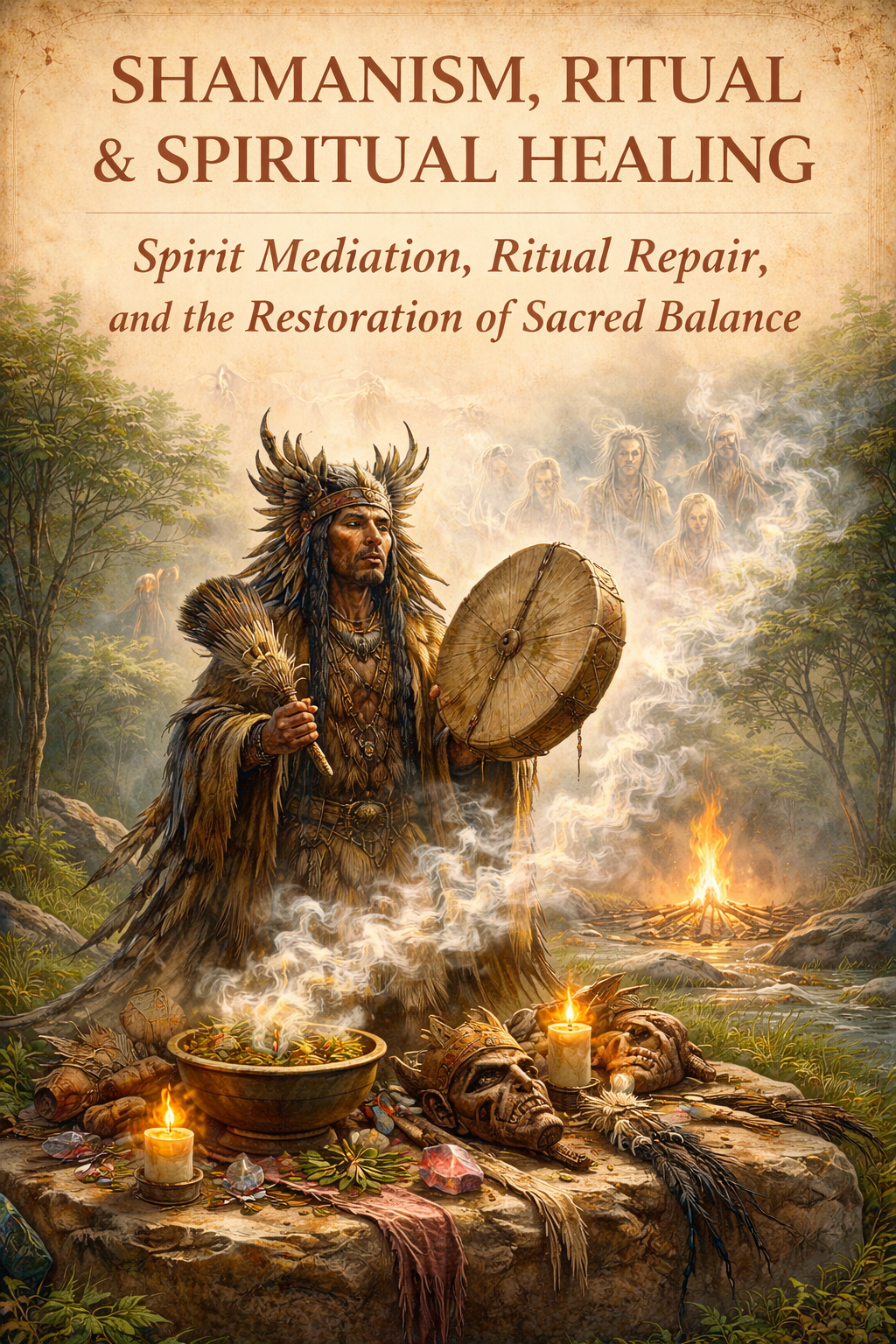
Shamanism, ritual, and spiritual healing constitute a demanding field of comparative inquiry because illness, vulnerability, disorder, and restoration are often understood through relationships among body, spirit, community, ecology, ancestry, and unseen dimensions of existence. Healing in such contexts is rarely confined to physical intervention alone. It may involve diagnosis of hidden causes, negotiation with spirits or ancestors, recovery of lost vitality, purification, protection, initiation, symbolic repair, or the restoration of balance within a wider social and cosmological order.
This category is especially important within the wider study of healing traditions because it connects Healing Traditions to African Healing Traditions, Indigenous and Oral Traditions, Religion and Ecology, Healing Spaces, Baths & Sacred Environments, Herbalism & Traditional Knowledge, Environment, Place, and Ecological Knowledge, Cultural Anthropology, Psychology, and Comparative Sacred Themes. It shows that healing can be embodied, performative, symbolic, ecological, social, and spiritual at once.
The goal of this pillar is not to romanticize ritual healing, universalize “shamanism,” or treat diverse Indigenous and local traditions as interchangeable examples of one global spiritual type. It is to study ritual healing as a historically specific and comparative field: grounded in particular communities, formed through initiation and practice, expressed through ceremony, contested through scholarship, and transformed by colonialism, modern states, heritage regimes, tourism, public health, and contemporary religious change.
Why This Series Matters
Shamanism, ritual, and spiritual healing matter because they preserve alternative conceptions of illness, vulnerability, care, and restoration. In many ritual worlds, suffering is not interpreted only as malfunction within the physical body. It may be understood as spirit intrusion, ancestral rupture, soul loss, ritual disorder, taboo violation, ecological imbalance, moral breach, or severed relation among persons, land, and invisible agencies.
Such frameworks cannot be translated directly into biomedical vocabulary, nor should they be dismissed as irrational survivals. They are historically durable systems of meaning and practice that have shaped how communities respond to crisis, illness, danger, grief, misfortune, and social disorder. In these settings, healing may involve ceremony, trance, music, purification, ritual diagnosis, symbolic extraction, offerings, sacred objects, or collective participation.
The field also matters because it challenges narrow definitions of medicine. Ritual healing is not only “religion” in a separate sphere from health. It often functions as diagnosis, therapy, social repair, moral interpretation, ecological relation, and community reintegration. The ritual specialist may not simply treat symptoms but mediate between worlds, identify hidden causes, protect the vulnerable, and restore relations that have been damaged.
A serious series must therefore hold two commitments together. It must preserve respect for the internal coherence of ritual healing traditions, while also avoiding romantic generalization, outsider spectacle, and claims that erase local specificity. The field is strongest when comparative insight remains grounded in particular histories, communities, languages, ceremonies, and authorities.
Scope and Orientation
Shamanism, ritual, and spiritual healing are best approached as a comparative field of mediated healing practices rather than as a single coherent religion. The subject includes trance, ecstatic states, drumming, chant, invocation, spirit communication, possession, divination, soul retrieval, purification, ritual diagnosis, communal restoration, and ceremonial forms through which healing is linked to cosmology, ancestry, land, and social continuity.
Such breadth is necessary because the traditions brought under this heading are regionally diverse and historically distinct. Some center on spirit travel; others on possession, divination, trance diagnosis, ritual song, ancestral mediation, sacred plants, healing dances, protective objects, or community ceremony. Some are embedded in Indigenous cosmologies; others have been reshaped by Buddhism, Christianity, Islam, state heritage systems, tourism, or modern revival movements.
The field requires methodological caution. “Shamanism” can be useful when it identifies recurrent patterns of ritual mediation, altered states, healing authority, and communication with unseen worlds. It becomes misleading when it turns highly specific traditions into a universal spiritual archetype or when it uses one regional model to explain all ritual healing.
For that reason, this category should be written as a plural field. Its purpose is not to define the essence of shamanism, but to study ritual healing as a set of historically situated practices through which communities interpret suffering, negotiate danger, restore relation, and preserve ceremonial knowledge.
The Problem of “Shamanism” as a Comparative Category
One of the first scholarly questions in this field is whether “shamanism” should be used as a broad comparative category at all. The term has a narrower historical association with Siberian and Inner Asian ritual specialists, but it has been extended widely in anthropology, religious studies, popular spirituality, psychology, and heritage discourse. This broader usage can illuminate recurring patterns, but it can also flatten difference.
The risk is typological overreach. If every ritual specialist, healer, medium, diviner, visionary, or ecstatic practitioner is called a shaman, then the term loses precision and may impose an outsider framework on local traditions. It may also reproduce colonial patterns in which Indigenous and local practices are grouped into a generalized “primitive” or “archaic” spirituality.
At the same time, comparison is not useless. Some traditions do share recurrent features: altered states, mediation with spirits, healing work, ritual journeying, sacred sound, initiation through affliction, and social authority grounded in the ability to manage uncertain or unseen forces. Comparative scholarship can study these patterns without pretending they are identical everywhere.
A strong pillar should therefore use the term cautiously. “Shamanism” may be treated as a heuristic category, not as a universal essence. Each article should ask where the term fits, where it distorts, and what local names, concepts, and traditions should be foregrounded instead.
Ritual Specialists and the Work of Mediation
What gives this field coherence is not one doctrine, but a recurrent concern with mediation. In many ritual healing traditions, specialists diagnose unseen disturbance, negotiate with spirits or other-than-human forces, guide ceremonies, protect communities, recover lost vitality, or restore broken relations. Their authority depends on the ability to operate across boundaries: visible and invisible, living and dead, body and spirit, person and community, human and other-than-human.
The ritual specialist may be called, initiated, trained, possessed, apprenticed, inherited, or recognized through illness and recovery. Authority is rarely only personal charisma. It is often formed through discipline, taboo, apprenticeship, suffering, ritual instruction, and community recognition. In many settings, the specialist must undergo transformation before becoming able to transform others.
Mediation also means risk. The specialist works with dangerous forces, ambiguous signs, uncertain causes, and vulnerable people. Ritual authority can protect, but it can also be contested. Communities may debate whether a healer is legitimate, whether a diagnosis is correct, whether a ceremony succeeded, or whether power has been misused.
This makes ritual healing a social institution as much as a spiritual practice. The healer’s work is not private spirituality alone. It is a publicly recognized role in the management of illness, uncertainty, danger, and repair.
Illness, Spirit Communication, and Unseen Causation
In many ritual healing worlds, illness is understood through unseen causation. Suffering may be linked to spirits, ancestors, violated taboos, lost soul, sorcery, broken relations, ecological disturbance, failed ritual obligations, or improper contact with dangerous powers. This does not necessarily exclude physical causes. Rather, causation may be layered.
A person may have bodily symptoms, but the ritual question may be why those symptoms appeared, what relation has been disturbed, and what kind of repair is needed. The healer may therefore diagnose meaning as well as condition. The problem is not only what hurts, but what the affliction signifies within a larger moral, spiritual, or relational field.
Spirit communication may take many forms: trance speech, possession, dreams, divination, songs, visions, sacred objects, bodily signs, or ritual performance. Such communication is not random within its own tradition. It is structured by cosmology, training, ceremony, and recognized interpretive codes.
A scholarly account should not collapse unseen causation into metaphor, nor should it treat it as empirically equivalent to biomedical causation. It should study unseen causation as part of a coherent ritual system for interpreting vulnerability, danger, responsibility, and restoration.
Trance, Ecstasy, and Altered States
Trance, ecstasy, possession, visionary experience, and altered states often play central roles in ritual healing. These states may be induced through drumming, chant, dance, fasting, isolation, sensory intensity, repetitive movement, plant substances, sleep deprivation, disciplined breathing, or other ceremonial methods. They are not incidental effects. In many traditions, altered states are the means through which the specialist enters relation with unseen powers or accesses diagnostic knowledge.
The meaning of altered states differs across traditions. In one context, trance may enable spirit travel. In another, possession may allow a spirit to speak through the body. In another, visionary experience may reveal a diagnosis, a lost soul, a dangerous force, or the correct ritual action. These differences matter.
Altered states are also socially regulated. The ritual specialist must learn how to enter, sustain, interpret, and return from such states. Community recognition matters because a trance state must be intelligible to others. The experience becomes authoritative only within a shared ritual world.
For comparative study, trance and ecstasy show that healing can involve disciplined transformations of consciousness. Yet these states should be interpreted through specific traditions rather than reduced to generic psychology or romanticized spirituality.
Drumming, Chant, and the Sonic Architecture of Healing
Sound is one of the central media of ritual healing. Drumming, chant, song, bells, rattles, breath, invocation, and rhythmic repetition can structure ceremonial time, induce altered states, summon spirits, mark transitions, protect participants, and coordinate collective attention. Sound is not merely atmosphere. It is often part of the therapeutic mechanism.
In many traditions, rhythm helps move participants into a different ritual state. It may guide trance, support possession, stabilize ceremony, or create a shared field of attention. Chant and invocation can name powers, speak requests, narrate myths, call ancestors, or transform ordinary speech into ritual action.
Sonic healing is also communal. Participants may sing, respond, drum, dance, or listen together. The patient’s affliction becomes surrounded by a structured sound world in which others participate in restoration. Healing is therefore not simply done to the patient; it may be enacted through a collective sonic environment.
A dedicated article on sound should treat music and rhythm as ritual technologies. They are disciplined forms through which healing, mediation, memory, and community presence become perceptible.
Performance, Objects, Masks, Costumes, and Sacred Media
Ritual healing is often embodied and performative. Masks, costumes, drums, feathers, staffs, rattles, smoke, offerings, sacred bundles, plants, stones, carved objects, painted bodies, and ritual spaces are not decorative additions to healing. They are media through which mediation becomes visible, tactile, audible, and socially recognizable.
Costume and mask may transform the healer’s social identity, signal relation to spirits, or make unseen forces perceptible. Sacred implements may focus power, protect participants, diagnose disorder, or enact symbolic extraction. Smoke, water, fire, blood, oil, plants, and sound may carry cleansing, protection, or communication.
Performance also matters because healing often needs witnesses. A ritual must be seen, heard, felt, and recognized by the patient and community. The ceremony creates a public form through which disorder is named and repair is enacted.
A scholarly approach should therefore treat ritual objects and performance as central evidence. They are not secondary illustrations of belief. They are part of the practice through which healing becomes effective and socially meaningful.
Soul Loss, Retrieval, and the Restoration of Vitality
Soul loss is a recurrent theme in many ritual healing traditions, though it must be interpreted within specific local frameworks. A person may be understood as weakened, fragmented, frightened, displaced, or spiritually diminished because some vital aspect has been lost, captured, wandered away, or become disconnected from the body and community. Healing then involves retrieval, return, reintegration, or restoration of vitality.
Soul retrieval should not be treated as a universal doctrine. The concept varies widely. Some traditions speak of multiple souls, spirit doubles, vital essence, breath, shadow, name, memory, or relational presence. The important comparative point is that vitality may be understood as something that can be disrupted, lost, endangered, or restored through ritual action.
This theme is especially important for thinking about trauma, grief, fright, illness, and dislocation in comparative perspective. Ritual healing may provide a way of interpreting forms of suffering that seem to involve not only the body but the person’s presence in the world.
A dedicated article should study soul loss through local concepts rather than imposing a generic spiritual vocabulary. The scholarly task is to understand how different traditions conceptualize personhood, vitality, fragmentation, and return.
Purification, Protection, and Ritual Repair
Ritual healing often involves purification and protection. Washing, smoke, breath, fire, herbs, offerings, sweeping, binding, untying, symbolic extraction, confession, abstinence, taboo, or spatial separation may be used to remove danger, cleanse pollution, protect the vulnerable, or reset relations. These practices address affliction as something that can cling, contaminate, invade, confuse, or remain unresolved.
Protection is not only defensive. It can be preventive, marking a person, house, child, field, animal, or community as guarded against visible or invisible harm. Amulets, sacred words, ritual objects, substances, or ceremonies may create boundaries against danger.
Ritual repair may also address social relations. A ceremony can restore a broken obligation, reconcile a family, acknowledge ancestors, reestablish moral order, or bring the afflicted person back into recognized community life.
This theme links ritual healing to broader questions of ethics and social repair. Healing is not always a matter of removing a symptom. It may involve cleansing a relation, protecting a threshold, or repairing the symbolic order within which a person lives.
Ancestors, Spirits, and the Social World of Illness
Ancestors and spirits often play central roles in ritual healing traditions. They may protect, warn, call, punish, guide, afflict, test, or communicate. Their presence makes illness social in a wider-than-human sense. The patient is not alone with a symptom; the affliction may involve relations with the dead, the land, spirits, animals, deities, or other unseen agencies.
These relations are not the same everywhere. Ancestors may be kin-based in one tradition, territorial in another, heroic in another, or tied to lineage authority, ritual obligation, or healing vocation. Spirits may be dangerous, protective, ambivalent, wild, ancestral, ecological, or divine depending on the tradition.
Illness may therefore become a social message. A recurring affliction may indicate neglected obligations, improper behavior, spiritual calling, unresolved grief, ritual impurity, or dangerous contact. The healer interprets these relations and identifies the appropriate form of repair.
A strong pillar should treat ancestors and spirits with ethnographic specificity. Their importance lies not in fitting a universal typology, but in showing how different communities imagine the social life of illness beyond the human individual.
Initiation, Calling, and the Formation of Healing Authority
Many ritual healing traditions distinguish specialists through initiation, calling, apprenticeship, inheritance, illness, dreams, possession, or marked vocation. A healer may be chosen by spirits, trained by elders, called through recurring illness, initiated through ordeal, or taught through long discipline. Authority is therefore formed, not merely claimed.
Initiation often transforms the person. The future healer may undergo isolation, taboo, fasting, instruction, symbolic death and rebirth, apprenticeship, or ceremonial recognition. The process marks the person as capable of mediating between ordinary and extraordinary domains.
Training also includes practical knowledge: songs, chants, myths, plant uses, ritual sequences, diagnosis, spirit names, objects, offerings, taboos, and ethical responsibilities. The healer’s knowledge is embodied and relational, not only doctrinal.
This theme matters because it prevents ritual healing from being reduced to spontaneous spirituality. Many ritual specialists are formed through demanding disciplines of practice, memory, body, taboo, and community accountability.
Affliction as Vocation
In many traditions, affliction may become vocation. A person who suffers unusual illness, visions, dreams, possession, mental disturbance, social withdrawal, or repeated misfortune may be interpreted not only as sick, but as called. The path to becoming a healer may begin with crisis.
This pattern is significant because it reverses ordinary assumptions about illness. Suffering may become evidence of relation to spirits, ancestors, or other powers. The afflicted person may need initiation rather than simple cure. Healing the healer becomes the condition for the healer’s future ability to heal others.
Affliction as vocation also reveals the social dimension of interpretation. A crisis becomes a calling only within a community that recognizes the signs and provides a path of training, initiation, and authority. Without that interpretive world, the same experience might be classified differently.
A careful article should treat this theme with nuance. It should not romanticize suffering or collapse serious mental distress into spiritual election. It should examine how particular communities interpret extraordinary affliction and how ritual systems transform vulnerability into social role.
Community Healing and the Collective Life of Ritual
Ritual healing is often collective rather than private. The patient may be the focus, but family, neighbors, singers, drummers, elders, initiates, witnesses, and ritual assistants may all participate. The ceremony creates a social field in which suffering is named, contained, interpreted, and addressed.
This collective dimension matters because illness may affect the community as well as the individual. A person’s affliction can generate fear, suspicion, grief, conflict, or uncertainty. Ritual healing can reorganize those social emotions by giving them form, sequence, explanation, and action.
Community participation also gives healing legitimacy. The ceremony is witnessed. The diagnosis is heard. The offerings are made. The patient is reintegrated. The group recognizes that something has been done. This social recognition can be central to the meaning of cure.
A dedicated article on community healing should examine ritual as social repair. The ceremony may heal by acting on relationships, not only bodies.
Ecology, Land, and Other-Than-Human Relations
Many ritual healing traditions are deeply ecological. Spirits may be associated with mountains, rivers, forests, animals, winds, fields, stones, plants, or ancestral territories. Healing knowledge may include acute attention to nature, seasonal patterns, animal behavior, sacred places, and the moral obligations that govern relations with land and other-than-human beings.
This ecological dimension matters because affliction may be interpreted as relational disturbance with place. A person, family, or community may be out of alignment with land, animals, waters, spirits, or sacred obligations. Healing may therefore involve offerings, prohibitions, environmental respect, pilgrimage, ritual movement, or restoration of right relation with place.
Ritual healing also preserves environmental knowledge. Songs, myths, ceremonies, taboos, and initiations may encode information about animals, plants, seasons, territories, and ecological responsibilities. This knowledge is not always separable from cosmology.
For the wider study of healing traditions, this theme is essential. It shows that spiritual healing may also be ecological healing, and that care can involve relationships beyond the human community.
Specific Living Traditions and Heritage Documentation
Specific living traditions must anchor this category. UNESCO’s documentation of Mongolian shamanism, Jeju ritual practice, and the Traditional Knowledge of the Jaguar Shamans of Yuruparí is valuable because it grounds the field in concrete ceremonial worlds rather than abstract typology. These examples show that ritual healing is performed through music, dance, costume, sacred objects, ecological knowledge, initiation, community relation, and ceremonial authority.
Such documentation also reveals the limits of generalization. Mongolian shamanism, Jeju ritual practice, and Yuruparí traditions do not represent one universal form. They belong to different histories, languages, landscapes, cosmologies, and political contexts. Their comparison is useful only when difference remains visible.
Heritage documentation can help preserve and recognize living traditions, but it also reshapes them. Once a practice enters heritage discourse, it may be translated for state institutions, tourism, education, and global audiences. This can protect traditions, but it can also freeze, simplify, or stage them in new ways.
A serious pillar should therefore use heritage sources carefully. They are important windows into living traditions, but they should not replace community authority, local scholarship, or ethnographic specificity.
Mongolian Shamanism and Ritual Technologies of Healing
Mongolian shamanism is one of the most important traditions for understanding the historical and comparative use of the term “shamanism.” It involves ritual specialists who communicate with spirits, enter trance, use costumes and drums, and perform ceremonies connected with healing, protection, and relation to the unseen world.
The importance of Mongolian shamanism lies partly in its ritual technologies. Costume, drum, movement, voice, invocation, and sacred objects help mark the specialist’s transformation and relation to spirits. These are not theatrical accessories. They are ritual instruments through which mediation is enacted.
Mongolian traditions also show how shamanic practice is historically dynamic. It has been affected by Buddhism, socialism, repression, revival, nationalism, heritage recognition, and contemporary spiritual movements. Ritual healing does not exist outside history.
A dedicated article should therefore examine Mongolian shamanism through both ritual form and historical change: trance, costume, drum, spirit relation, healing, repression, revival, and the modern politics of cultural identity.
Jeju Ritual Practice and the Healing Power of Ceremony
Jeju ritual practice offers an important example of ceremonial healing and communal protection in a specific Korean island context. The Jeju Chilmeoridang Yeongdeunggut is associated with village shamans, seasonal ritual, protection, abundance, sea-related livelihood, and relations with deities and community life.
This tradition matters because it shows ritual healing and ritual protection as collective events tied to place, livelihood, season, and community continuity. Ceremony may seek not only individual cure but protection, fertility, abundance, safe passage, and balanced relation with local powers.
Jeju ritual practice also demonstrates the importance of gender, performance, music, dance, offering, and ritual memory in the transmission of healing and protective traditions. The ceremony is not an abstract belief system; it is an embodied communal practice.
A dedicated article should treat Jeju ritual practice as a specific tradition rather than an example of generic shamanism. Its meaning depends on island ecology, local deities, maritime life, women ritual specialists, village identity, and Korean cultural history.
The Jaguar Shamans of Yuruparí and Cosmological Care
The Traditional Knowledge of the Jaguar Shamans of Yuruparí offers an important South American example in which healing, initiation, ecological knowledge, ritual transmission, and cosmology are deeply connected. It demonstrates that ritual healing may be inseparable from the maintenance of community continuity, environmental knowledge, and sacred narratives.
This tradition is especially important because it links care to cosmological responsibility. Healing knowledge is not only used to treat individuals; it belongs to a wider system of initiation, sacred territory, ecological relation, and the reproduction of social order. The healer’s work helps maintain a world.
The Yuruparí example also shows why local specificity matters. Jaguar shamanism should not be folded into a generic global “shamanic” model. It has its own cosmology, ritual forms, forms of transmission, ecological knowledge, and community authority.
A dedicated article should therefore study Yuruparí traditions through cosmological care: healing as part of the ongoing maintenance of relation among humans, land, spirits, animals, ancestors, and sacred knowledge.
Comparative Anthropology and Critical Historiography
The study of shamanism and ritual healing is inseparable from the history of anthropology. Earlier scholarship often produced typologies that compared ritual specialists across distant cultures, sometimes with insight and sometimes with serious distortion. Colonial anthropology, missionary writing, psychoanalytic interpretation, evolutionary theory, and popular spirituality all shaped how “shamanism” has been imagined.
Critical historiography is therefore essential. Scholars must ask who is naming a practice, who benefits from the category, what local terms are being displaced, and how comparison may reproduce older hierarchies. The field’s vocabulary is never neutral.
At the same time, rejecting comparison entirely would also be limiting. Ritual healing traditions across regions do share recurrent concerns: mediation, trance, spirit relation, altered states, ceremonial diagnosis, healing authority, and social repair. The challenge is to compare without erasing difference.
A serious pillar should make this tension visible. The field is strongest when it treats comparison as a disciplined method requiring humility, local grounding, and constant attention to the history of representation.
Modernity, Heritage, Tourism, and Cultural Preservation
Ritual and spiritual healing traditions continue to change under modern conditions. States may recognize them as intangible cultural heritage. Communities may preserve, revive, teach, or adapt them. Tourism may stage or commodify them. Religious movements may reinterpret them. Public-health systems may coexist uneasily with them. These transformations are part of the field, not external to it.
Heritage recognition can provide visibility, legitimacy, and preservation support. It can also reshape ritual practice by turning living ceremonies into performances for outsiders, documents for institutions, or symbols of national identity. A practice preserved as heritage may be protected and transformed at the same time.
Tourism and spiritual markets raise additional concerns. Ritual healing can be appropriated, simplified, commercialized, or detached from community authority. Sacred practices may be repackaged as personal wellness techniques for outsiders with little attention to history, consent, or accountability.
A scholarly treatment should therefore study modernity as a field of negotiation. Ritual traditions are not simply disappearing or surviving unchanged. They are being regulated, represented, marketed, revived, contested, and reinterpreted.
Ethics, Representation, and Appropriation
Ethics is central to the study of ritual and spiritual healing. Many traditions involve sacred knowledge, restricted practices, community-specific authority, and forms of transmission that are not meant for public extraction. Scholars, writers, tourists, practitioners, and spiritual consumers must therefore ask what can be described, who has permission to teach it, and what forms of representation may cause harm.
Appropriation is a major concern. Ritual elements may be borrowed without consent, sold commercially, detached from their cosmological setting, or generalized as “shamanic practice” for global wellness markets. Such borrowing can erase the communities that preserved the traditions and transform living ritual knowledge into consumable spectacle.
Representation also matters. Descriptions of ritual healing can exoticize, pathologize, romanticize, or trivialize. A serious article must avoid turning practitioners into mystical figures outside history. Ritual specialists are social actors within particular communities, shaped by training, authority, responsibility, and historical change.
A rigorous pillar should therefore include ethical restraint. Not all knowledge should be extracted; not all practices should be generalized; not all ceremonies should be translated for outsider consumption. Scholarly seriousness requires respect for boundaries.
Core Themes in This Series
One major theme in this field is mediation: the ritual specialist’s work between visible and invisible domains, human and other-than-human forces, patient and community, illness and meaning. A second is altered state: trance, ecstasy, possession, vision, and ritual consciousness as disciplined means of healing or diagnosis. A third is unseen causation: the interpretation of illness through spirits, ancestors, soul loss, taboo, ecological disorder, or broken relation.
A fourth theme is performance: healing enacted through sound, movement, costume, mask, smoke, offering, speech, rhythm, sacred objects, and collective participation. A fifth is initiation: healing authority formed through calling, affliction, apprenticeship, taboo, and ritual transformation. A sixth is community: healing as social repair and collective recognition rather than private treatment alone.
Additional themes include ecology, the relation of ritual healing to land, animals, plants, waters, and other-than-human beings; heritage, the preservation and transformation of living traditions through modern institutions; historiography, the contested history of the term “shamanism”; and ethics, the need to avoid appropriation, generalization, and extractive representation.
Shamanism, Ritual & Spiritual Healing Pillar Map
The following article map is designed as a research agenda for the Shamanism, Ritual & Spiritual Healing pillar, with emphasis on conceptual caution, ritual specialists, trance, unseen causation, ceremonial performance, soul retrieval, initiation, community healing, ecology, specific living traditions, heritage politics, and the ethics of representation.
Shamanism, Ritual & Spiritual Healing is organized to move from foundational questions into mediation, trance, spirit relation, ritual performance, healing authority, community repair, ecological relation, specific living traditions, critical historiography, modern heritage politics, and ethical representation. The goal is to treat ritual healing as a plural and historically grounded field of care: embodied, ceremonial, social, ecological, spiritual, and interpretive.
Foundations, Scope, and Method
- What Is Shamanism, Ritual & Spiritual Healing? (planned)
Introduces ritual and spiritual healing as a comparative field involving mediation, ceremony, altered states, unseen causation, and restoration. - The Problem of “Shamanism” as a Comparative Category (planned)
Examines the usefulness and limits of “shamanism” as a term, including its Siberian roots, comparative expansion, and scholarly controversy. - How to Study Ritual Healing Without Generalizing It (planned)
Establishes a careful method grounded in local terms, ethnographic specificity, historical context, and community authority. - Ritual Healing in Comparative Perspective (planned)
Compares ritual healing across regions while preserving difference, avoiding typological overreach, and foregrounding local traditions. - Medicine, Religion, and the Ritual Interpretation of Illness (planned)
Studies ritual healing as a field where medical, religious, ecological, social, and symbolic forms of care overlap. - Mediation, Ecstasy, and the Repair of Sacred Worlds (planned)
Explores the central role of mediation in restoring relation among body, spirit, community, land, and unseen forces.
Ritual Specialists, Authority, and Vocation
- Ritual Specialists, Trance, and the Work of Mediation (planned)
Studies healers, shamans, mediums, diviners, and ritual experts as mediators between visible and invisible domains. - Initiation, Calling, and the Formation of Healing Authority (planned)
Examines how ritual specialists are formed through initiation, inheritance, apprenticeship, illness, dreams, or spirit calling. - Affliction as Vocation in Ritual Traditions (planned)
Explores how illness, crisis, possession, or unusual experience may be interpreted as a call to healing work. - Taboo, Discipline, and the Cost of Ritual Authority (planned)
Studies fasting, prohibition, abstinence, bodily discipline, and social restriction as forms of specialist formation. - Apprenticeship, Memory, and the Transmission of Ceremonial Knowledge (planned)
Examines how songs, myths, techniques, objects, prayers, and diagnostic practices are learned and preserved. - Ethics, Responsibility, and the Dangers of Ritual Power (planned)
Studies trust, misuse, accountability, secrecy, diagnosis, accusation, and the ethical risks of ritual authority.
Illness, Spirit Relation, and Unseen Causation
- Healing, Spirit Communication, and Unseen Causation (planned)
Explores illness interpreted through spirits, ancestors, taboo, sorcery, ecological disruption, soul loss, or broken relation. - Ancestors, Spirits, and the Social World of Illness (planned)
Studies how illness may involve relations with the dead, spirits, deities, animals, places, or other-than-human presences. - Soul Retrieval, Loss, and the Restoration of Vitality (planned)
Examines traditions in which vitality, soul, presence, or relational integrity can be lost, endangered, and ritually restored. - Possession, Mediumship, and the Speaking Body (planned)
Studies possession and mediumship as ritual forms through which spirits speak, diagnose, heal, or claim authority. - Dreams, Visions, and Diagnostic Knowledge (planned)
Explores dreams and visions as sources of diagnosis, instruction, calling, warning, and ritual direction. - Taboo Violation, Moral Disorder, and the Meaning of Affliction (planned)
Examines how illness may be interpreted through broken obligations, ritual danger, moral breach, or disrupted order.
Trance, Performance, and Sacred Media
- Trance, Ecstasy, and Altered States in Ritual Practice (planned)
Studies altered states as disciplined means of mediation, diagnosis, spirit communication, and ceremonial transformation. - Drumming, Chant, and the Sonic Architecture of Healing (planned)
Explores rhythm, song, voice, invocation, repetition, and sound as ritual technologies of healing. - Dance, Movement, and the Embodied Field of Ceremony (planned)
Examines bodily movement, gesture, exhaustion, rhythm, and performance as part of therapeutic action. - Masks, Costumes, and Sacred Implements in Ritual Healing (planned)
Studies ritual objects, dress, masks, drums, staffs, bundles, smoke, and sacred tools as media of mediation. - Smoke, Fire, Water, Breath, and the Sensory Life of Ritual Healing (planned)
Explores the sensory materials through which purification, protection, and transformation are enacted. - Symbolic Extraction, Cleansing, and the Performance of Cure (planned)
Studies rituals that remove, draw out, cleanse, contain, or transform illness through symbolic and embodied action.
Protection, Repair, and Community Healing
- Purification, Protection, and Ritual Repair (planned)
Examines cleansing, protection, offerings, symbolic repair, and the restoration of relation after danger or disorder. - Community Healing and the Collective Life of Ritual (planned)
Studies ritual healing as a collective process involving witnesses, family, singers, drummers, elders, and community recognition. - Ritual Healing and Social Repair (planned)
Explores reconciliation, confession, reintegration, moral repair, and the social dimensions of cure. - Protection Against Misfortune, Danger, and Spiritual Harm (planned)
Studies protective rites, amulets, boundaries, taboos, prayers, and ceremonies that guard people and communities. - Grief, Death, Mourning, and the Ritual Care of Loss (planned)
Examines ritual healing around death, mourning, ancestral transition, grief, and the restoration of continuity. - Healing as Restoration of Balance (planned)
Studies healing as the reestablishment of relational, moral, ecological, social, and cosmological order.
Ecology, Land, and Other-Than-Human Worlds
- Ecology, Land, and Other-Than-Human Relations in Ritual Healing (planned)
Explores healing traditions in which land, animals, plants, waters, mountains, winds, and spirits form part of the therapeutic field. - Animals, Spirit Helpers, and More-Than-Human Mediation (planned)
Studies animal spirits, helpers, familiars, guardians, and symbolic relations in ritual healing traditions. - Sacred Places, Pilgrimage, and the Geography of Ritual Cure (planned)
Examines mountains, rivers, groves, shrines, caves, houses, and ceremonial spaces as active healing environments. - Plants, Smoke, Offerings, and Ecological Ritual Materials (planned)
Connects ritual healing to plants, resins, smoke, food, offerings, and ecological substances used in ceremony. - Ritual Healing and Traditional Ecological Knowledge (planned)
Studies how ceremonies preserve knowledge of animals, seasons, territories, plants, weather, and ecological obligations. - Environmental Disruption and Ritual Worlds Under Pressure (planned)
Examines how land loss, climate change, extraction, displacement, and biodiversity decline affect ritual healing traditions.
Specific Living Traditions and Case Studies
- Mongolian Shamanism and the Ritual Technologies of Healing (planned)
Studies trance, costume, drum, spirit relation, healing, repression, revival, and the modern cultural politics of Mongolian shamanism. - Jeju Ritual Practice and the Healing Power of Ceremony (planned)
Examines Jeju Chilmeoridang Yeongdeunggut through village ritual, protection, abundance, sea-related life, and community continuity. - The Jaguar Shamans of Yuruparí and Cosmological Care (planned)
Studies healing, initiation, ecological knowledge, sacred territory, and cosmological responsibility in Yuruparí traditions. - Mentawai Shamans, Taboos, and Ritual Discipline (planned)
Explores initiation, costly prohibitions, bodily discipline, authority, and social recognition among Mentawai shamans. - Siberian and Inner Asian Shamanic Traditions (planned)
Examines the regional contexts most closely associated with the historical use of the term “shaman.” - Ritual Healing Traditions in Comparative Case Study (planned)
Compares specific traditions without reducing them to one universal model of shamanism.
Historiography, Heritage, and Modern Transformation
- Shamanic Healing and the Anthropology of Performance (planned)
Studies ritual healing through performance theory, embodiment, sound, spectacle, social recognition, and ceremonial efficacy. - Colonial Anthropology and the Invention of Shamanic Universals (planned)
Examines how colonial scholarship, missionary accounts, and early anthropology shaped generalized ideas of shamanism. - Shamanism, Heritage, and the Politics of Cultural Preservation (planned)
Studies how heritage regimes recognize, preserve, transform, and sometimes stage living ritual traditions. - Tourism, Revival, and the Commodification of Ritual Healing (planned)
Explores how spiritual markets, tourism, and modern revival movements reshape ritual authority and practice. - Spiritual Healing Between Ritual Tradition and Modernity (planned)
Examines how ritual healing adapts in relation to states, clinics, public health, nationalism, diaspora, and global spirituality. - Representation, Appropriation, and the Ethics of Ritual Knowledge (planned)
Concludes the series by addressing consent, sacred knowledge, outsider interpretation, commercialization, and community authority.
This structure keeps the category scholarly, specific, and non-promotional. It presents ritual and spiritual healing as a historically complex field shaped by mediation, trance, spirit relation, ceremonial performance, community restoration, ecological knowledge, heritage politics, and the ethics of representation.
Closing Perspective
Shamanism, Ritual & Spiritual Healing gives the Healing Traditions knowledge series one of its most important comparative frameworks. It shows that healing has often involved more than the treatment of bodily symptoms. Across many ritual worlds, care may involve mediation with spirits, recovery of vitality, purification, protection, community participation, ancestral relation, ecological responsibility, and repair of the symbolic order.
The strongest reason to study this field is that it widens the meaning of healing without erasing difference. Ritual healing asks how suffering is interpreted, how unseen danger is diagnosed, how communities participate in restoration, how altered states become disciplined knowledge, how sacred objects and sound function therapeutically, and how ritual specialists are formed through calling, initiation, and social recognition.
As a field of study, ritual and spiritual healing is most valuable when approached with caution and specificity. It should not be reduced to a universal spiritual archetype, a wellness technique, or a romantic image of Indigenous wisdom. It should be studied as a plural body of practices shaped by local traditions, histories, cosmologies, communities, ecological relations, and ethical boundaries.
Related Reading
- Healing Traditions
- African Healing Traditions
- Herbalism & Traditional Knowledge
- Indigenous and Oral Traditions
- Religion and Ecology
- Healing Spaces, Baths & Sacred Environments
- Vital Energy Healing Traditions
- Environment, Place, and Ecological Knowledge
- Cultural Anthropology
- Comparative Sacred Themes
- Psychology
Primary Sources and Archives
Comparative and Theoretical Foundations
- Encyclopaedia Britannica, “Shamanism”: Useful for a concise comparative baseline definition centered on trance, ecstatic experience, healing, and mediation. Available at: https://www.britannica.com/topic/shamanism (Accessed: 4 May 2026).
- Singh, M. (2018), “The cultural evolution of shamanism”: Major contemporary theoretical account of shamanism as a recurrent cultural complex. Available at: https://www.cambridge.org/core/journals/behavioral-and-brain-sciences/article/cultural-evolution-of-shamanism/6942421013C692541D1D460503F9FA42 (Accessed: 4 May 2026).
- Singh, M. (2018), “Why is there shamanism?”: Important response essay clarifying the theory and engaging alternative accounts. Available at: https://www.cambridge.org/core/journals/behavioral-and-brain-sciences/article/why-is-there-shamanism-developing-the-cultural-evolutionary-theory-and-addressing-alternative-accounts/1A03C78D7A8E6A07F7924A266231E6E3 (Accessed: 4 May 2026).
- Oxford Academic, “Shamanism”: Useful for emphasizing the contested history of the category in the study of ritual and religious experience. Available at: https://academic.oup.com/edited-volume/38633/chapter-abstract/335312370 (Accessed: 4 May 2026).
Specific Living Traditions and Heritage Documentation
- UNESCO, “Mongolian shamanism”: Useful for a living heritage example in which shamans enter trances to communicate with deities and spirits and perform healing-related rites using masks, music, dance, and ritual artefacts. Available at: https://www.unesco.org/archives/multimedia/document-2188 (Accessed: 4 May 2026).
- UNESCO, “Jeju Chilmeoridang Yeongdeunggut”: Useful for a specific Korean ritual tradition involving village shamans, protection, abundance, and cosmological relation. Available at: https://ich.unesco.org/en/RL/jeju-chilmeoridang-yeongdeunggut-00187 (Accessed: 4 May 2026).
- UNESCO, “Traditional Knowledge of the Jaguar Shamans of Yuruparí”: Useful for a South American example linking healing, initiation, ecological knowledge, and ritual transmission. Available at: https://www.unesco.org/archives/multimedia/document-2186 (Accessed: 4 May 2026).
- UNESCO, “Intangible Cultural Heritage Domains”: Useful for showing how shamanistic rites often combine music, dance, prayers, sacred items, ritual practices, and knowledge of nature in one complex expression. Available at: https://ich.unesco.org/doc/src/01857-EN.pdf (Accessed: 4 May 2026).
Embodiment, Social Function, and Discipline
- Watson-Jones, R.E. and Legare, C.H. (2018), “The social functions of shamanism”: Useful for group cohesion and social function arguments in the comparative literature. Available at: https://www.cambridge.org/core/journals/behavioral-and-brain-sciences/article/social-functions-of-shamanism/76D4EAA61BA5B8506A83F72DC5B2977E (Accessed: 4 May 2026).
- Singh, M. et al. (2020), “Why do religious leaders observe costly prohibitions? Examining taboos on Mentawai shamans”: Useful for initiation, taboo, bodily discipline, and ritual authority. Available at: https://www.cambridge.org/core/journals/evolutionary-human-sciences/article/why-do-religious-leaders-observe-costly-prohibitions-examining-taboos-on-mentawai-shamans/FD678BD50E458532A78F15111F7ED84C (Accessed: 4 May 2026).
Internal Interpretive Traditions
- Ritual specialist traditions: Healers, shamans, mediums, diviners, possession specialists, ceremonial leaders, and ritual experts whose authority is formed through initiation, calling, inheritance, apprenticeship, or affliction.
- Trance and altered-state traditions: Practices involving drumming, chant, dance, fasting, vision, possession, ecstasy, journeying, or disciplined transformations of consciousness.
- Spirit and ancestral traditions: Healing systems organized around relations with ancestors, spirits, deities, animals, places, or other-than-human powers.
- Ritual performance traditions: Ceremonies involving sound, movement, costume, mask, sacred objects, smoke, water, fire, offerings, and symbolic repair.
- Community restoration traditions: Healing practices that address social rupture, grief, danger, misfortune, moral disorder, and the reintegration of afflicted persons.
- Ecological ritual traditions: Ceremonial systems that connect healing to land, plants, animals, waters, seasons, sacred places, and other-than-human relations.
- Heritage and revival traditions: Living ritual worlds reshaped by cultural preservation, state recognition, tourism, revival movements, religious change, and global circulation.
Modern Scholarship
- Singh, M. Work on the cultural evolution of shamanism and comparative theory.
- Watson-Jones, R.E. and Legare, C.H. Work on social functions and group cohesion in ritual healing.
- Research on Mentawai shamans and costly prohibitions, useful for initiation, taboo, bodily discipline, and ritual authority.
- UNESCO documentation of Mongolian shamanism, Jeju ritual practice, and the Traditional Knowledge of the Jaguar Shamans of Yuruparí.
- Oxford and comparative religious-studies scholarship on the contested history of “shamanism” as a category.
- Anthropological work on ritual performance, possession, trance, sacred objects, spirit mediation, healing, and social repair.
- Scholarship on heritage politics, cultural preservation, appropriation, tourism, and the ethics of representing living ritual traditions.
Further Reading
- Encyclopaedia Britannica (2026) ‘Shamanism’. Available at: https://www.britannica.com/topic/shamanism (Accessed: 4 May 2026).
- Oxford Academic (n.d.) ‘Shamanism’. Available at: https://academic.oup.com/edited-volume/38633/chapter-abstract/335312370 (Accessed: 4 May 2026).
- Singh, M. (2018) ‘The cultural evolution of shamanism’, Behavioral and Brain Sciences. Available at: https://www.cambridge.org/core/journals/behavioral-and-brain-sciences/article/cultural-evolution-of-shamanism/6942421013C692541D1D460503F9FA42 (Accessed: 4 May 2026).
- Singh, M. (2018) ‘Why is there shamanism? Developing the cultural evolutionary theory and addressing alternative accounts’, Behavioral and Brain Sciences. Available at: https://www.cambridge.org/core/journals/behavioral-and-brain-sciences/article/why-is-there-shamanism-developing-the-cultural-evolutionary-theory-and-addressing-alternative-accounts/1A03C78D7A8E6A07F7924A266231E6E3 (Accessed: 4 May 2026).
- Singh, M. et al. (2020) ‘Why do religious leaders observe costly prohibitions? Examining taboos on Mentawai shamans’, Evolutionary Human Sciences. Available at: https://www.cambridge.org/core/journals/evolutionary-human-sciences/article/why-do-religious-leaders-observe-costly-prohibitions-examining-taboos-on-mentawai-shamans/FD678BD50E458532A78F15111F7ED84C (Accessed: 4 May 2026).
- UNESCO (2009) ‘Jeju Chilmeoridang Yeongdeunggut’. Available at: https://ich.unesco.org/en/RL/jeju-chilmeoridang-yeongdeunggut-00187 (Accessed: 4 May 2026).
- UNESCO (2011) ‘Traditional Knowledge of the Jaguar Shamans of Yuruparí’. Available at: https://www.unesco.org/archives/multimedia/document-2186 (Accessed: 4 May 2026).
- UNESCO (2014) ‘Mongolian shamanism’. Available at: https://www.unesco.org/archives/multimedia/document-2188 (Accessed: 4 May 2026).
- Watson-Jones, R.E. and Legare, C.H. (2018) ‘The social functions of shamanism’, Behavioral and Brain Sciences. Available at: https://www.cambridge.org/core/journals/behavioral-and-brain-sciences/article/social-functions-of-shamanism/76D4EAA61BA5B8506A83F72DC5B2977E (Accessed: 4 May 2026).
References
- Encyclopaedia Britannica (2026) ‘Shamanism’. Available at: https://www.britannica.com/topic/shamanism (Accessed: 4 May 2026).
- Oxford Academic (n.d.) ‘Shamanism’. Available at: https://academic.oup.com/edited-volume/38633/chapter-abstract/335312370 (Accessed: 4 May 2026).
- Singh, M. (2018) ‘The cultural evolution of shamanism’, Behavioral and Brain Sciences. Available at: https://www.cambridge.org/core/journals/behavioral-and-brain-sciences/article/cultural-evolution-of-shamanism/6942421013C692541D1D460503F9FA42 (Accessed: 4 May 2026).
- Singh, M. (2018) ‘Why is there shamanism? Developing the cultural evolutionary theory and addressing alternative accounts’, Behavioral and Brain Sciences. Available at: https://www.cambridge.org/core/journals/behavioral-and-brain-sciences/article/why-is-there-shamanism-developing-the-cultural-evolutionary-theory-and-addressing-alternative-accounts/1A03C78D7A8E6A07F7924A266231E6E3 (Accessed: 4 May 2026).
- Singh, M. et al. (2020) ‘Why do religious leaders observe costly prohibitions? Examining taboos on Mentawai shamans’, Evolutionary Human Sciences. Available at: https://www.cambridge.org/core/journals/evolutionary-human-sciences/article/why-do-religious-leaders-observe-costly-prohibitions-examining-taboos-on-mentawai-shamans/FD678BD50E458532A78F15111F7ED84C (Accessed: 4 May 2026).
- UNESCO (2009) ‘Jeju Chilmeoridang Yeongdeunggut’. Available at: https://ich.unesco.org/en/RL/jeju-chilmeoridang-yeongdeunggut-00187 (Accessed: 4 May 2026).
- UNESCO (2011) ‘Traditional Knowledge of the Jaguar Shamans of Yuruparí’. Available at: https://www.unesco.org/archives/multimedia/document-2186 (Accessed: 4 May 2026).
- UNESCO (2014) ‘Mongolian shamanism’. Available at: https://www.unesco.org/archives/multimedia/document-2188 (Accessed: 4 May 2026).
- UNESCO (n.d.) Intangible Cultural Heritage Domains. Available at: https://ich.unesco.org/doc/src/01857-EN.pdf (Accessed: 4 May 2026).
- Watson-Jones, R.E. and Legare, C.H. (2018) ‘The social functions of shamanism’, Behavioral and Brain Sciences. Available at: https://www.cambridge.org/core/journals/behavioral-and-brain-sciences/article/social-functions-of-shamanism/76D4EAA61BA5B8506A83F72DC5B2977E (Accessed: 4 May 2026).