
Last Updated May 3, 2026
Dante, Epic, and Medieval Memory explores one of the great civilizational constellations in literary history: the poetic, moral, theological, political, and cosmological traditions through which the medieval world imagined justice, exile, salvation, sacred history, moral order, and the destiny of the human soul. Medieval literature did not merely ornament inherited belief or preserve inherited stories. It gave symbolic, narrative, and visionary form to the structure of reality itself. Through epic, allegory, visionary writing, courtly lyric, theological poetry, pilgrimage narrative, saints’ lives, moral exemplarity, devotional prose, commentary, and manuscript culture, medieval literature helped order memory into a world in which history, judgment, love, sin, grace, and transcendence could be narrated within a single intelligible cosmos.
Dante stands at the center of this field because his work gathers these traditions into an extraordinary synthesis. In The Divine Comedy, the epic inheritance of antiquity, the scriptural imagination of Latin Christendom, the discipline of scholastic reasoning, the moral psychology of Augustine, the civic violence of the medieval commune, the pathos of exile, the authority of commentary, and the emerging prestige of the vernacular are drawn into one total architecture of meaning. Dante is not simply a medieval poet of immense scope. He is one of the great poets of synthesis in world literature, a writer who transforms inherited memory into a poetic universe in which every figure, place, voice, punishment, prayer, longing, and light participates in an ordered vision of the whole.
Current Space
Literature & Cultural Memory
Related Topic
Classical Literature
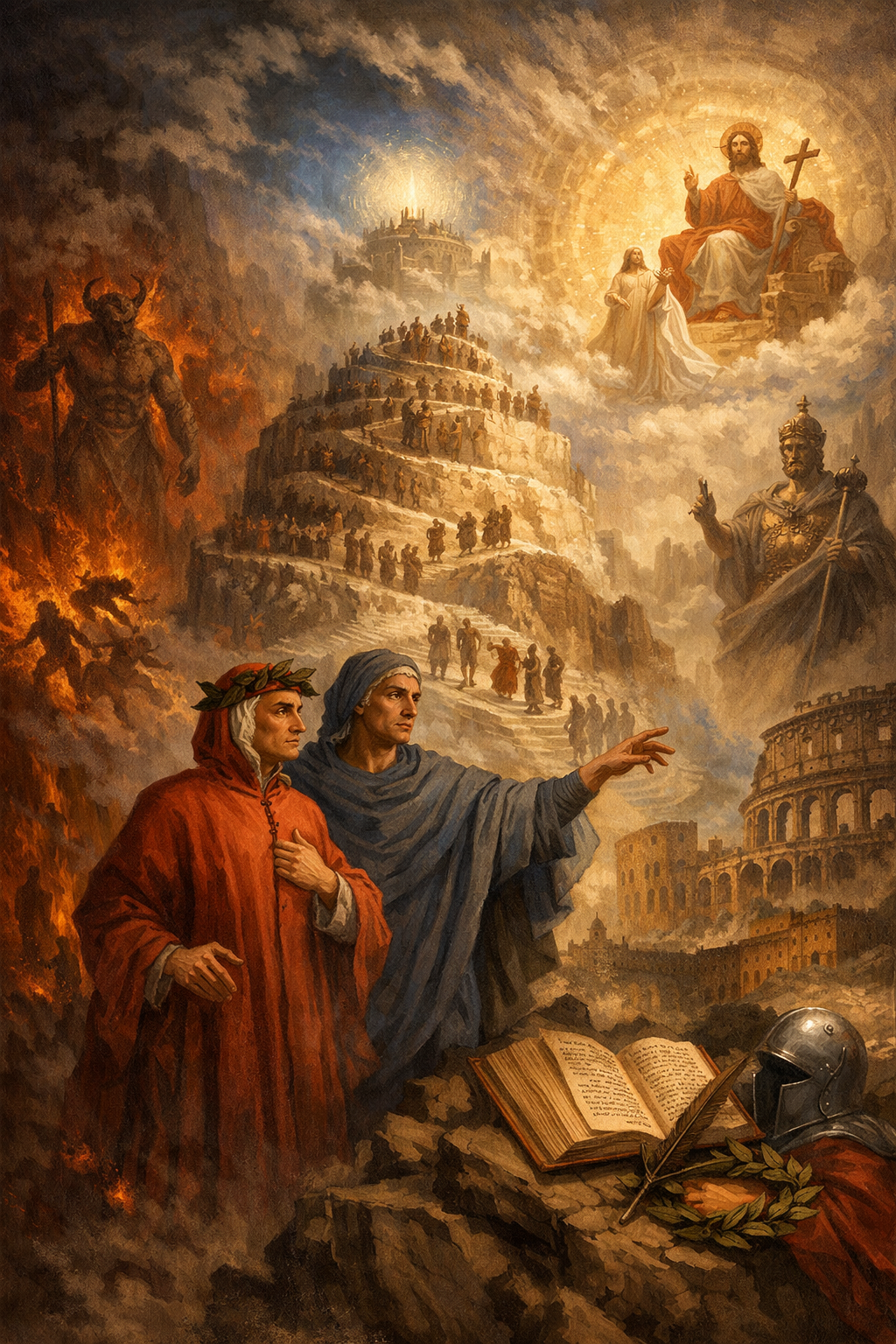
This category approaches Dante not in isolation, but within the wider structures of medieval literary memory. It examines the transformation of epic under Christian conditions; the place of Virgilian inheritance and classical prestige; the relation between theology, philosophy, rhetoric, and poetic form; the importance of courtly love, allegory, pilgrimage, dream vision, and devotional language; the imaginative force of Hell, Purgatory, and Paradise as literary spaces; the role of exile, empire, papacy, faction, and providence in shaping medieval political consciousness; and the habits of citation, gloss, exemplarity, and commentary through which medieval culture remembered its authorities. It also explores how memory in this tradition is not simply recollection, but arrangement: persons, texts, empires, virtues, sins, cities, sacred events, and destinies placed into symbolic relation.
Dante, Epic, and Medieval Memory is essential for understanding literature as a medium of total form. It studies how poetry can preserve a civilization’s moral map, carry forward theological and historical memory, bind imaginative vision to ultimate questions of order and destiny, and make the invisible structure of reality narratable. By placing Dante within the larger field of medieval literary consciousness, this category illuminates one of the decisive moments in literary history: the moment when poetry became not only beautiful speech, but a total language of judgment, exile, desire, history, and transcendence.
Why This Field Matters
This field matters because medieval literature preserves a world in which poetry remains answerable to the ultimate structure of things. Sin, virtue, judgment, grace, exile, beatitude, damnation, order, corruption, providence, and sacred history are not merely abstract doctrines. They are narratable realities. Literature becomes a way of making visible the invisible architecture of a civilization: the relation between earthly life and eternal destiny, political disorder and sacred order, human desire and divine love, historical conflict and transcendent meaning.
Dante matters within this field because he creates one of the most complete literary worlds ever composed. He takes inherited materials from epic, theology, philosophy, lyric, scripture, civic history, scholastic reasoning, and personal loss, and orders them into a poetic cosmos in which moral truth is spatial, temporal, historical, and eschatological at once. This is not simply a masterpiece within a tradition. It is one of the great acts by which a tradition understands itself.
The pillar also matters because Dante’s project reveals what literature can do when it refuses to separate beauty from judgment, memory from order, exile from political consciousness, or desire from ultimate destiny. Dante does not write from a world in which poetry is merely expressive. He writes from a world in which poetry can become the language through which reality is interpreted. That makes this pillar central not only to medieval studies, but to the broader study of literature as cultural memory.
Dante and Total Synthesis
Dante stands at the center of medieval literary memory because he is a poet of total synthesis. In him, the classical and Christian worlds do not merely coexist; they are brought into ordered relation. The prestige of Virgil, the authority of Rome, the legacy of epic, the discipline of scholastic thought, the inwardness of lyric desire, the violence of Florentine faction, and the eschatological imagination of Latin Christendom all converge. The result is not a collage of influences, but a higher unity in which inherited materials are transformed and ranked within a new poetic whole.
This synthetic power is essential to the pillar. Dante is not only important because he wrote about Hell, Purgatory, and Paradise, or because he is a canonical medieval poet. He is important because he demonstrates what poetry can do when it becomes the medium through which theology, history, philosophy, politics, rhetoric, cosmology, and personal destiny are all simultaneously thinkable. He is therefore not merely central to medieval literature, but to the history of literature as a civilizational art.
Dante’s synthesis is also disciplined. Classical authority is honored but bounded. Political history is made urgent but judged. Lyric desire is preserved but purified. Vernacular language is elevated but made answerable to ultimate meaning. The poem’s grandeur comes from this ordering power: it refuses fragmentation by placing every inheritance within a total vision of reality.
Memory as Architecture
One of the most defining features of medieval literary memory is that it is architectural. Memory is arranged, ranked, placed, ordered, and traversed. Persons, sins, virtues, exempla, cities, empires, sacred events, authorities, and destinies do not appear as disconnected fragments. They are positioned within symbolic structures that render moral and spiritual meaning visible. The literary imagination preserves not only stories, but the ordered relation among stories.
Dante offers the supreme expression of this architectural impulse. Hell is structured punishment, Purgatory structured purification, Paradise structured illumination. The poem remembers by placing. It arranges inherited history into circles, terraces, spheres, encounters, lights, and songs. Medieval literary memory thus becomes more than recollection. It becomes moral cartography: a mapping of existence in which poetry serves as the architecture of remembrance.
This architectural quality is one reason Dante remains so powerful. The reader does not simply receive a sequence of episodes. The reader moves through an ordered moral universe. The poem teaches by placement, proportion, distance, ascent, descent, repetition, and contrast. Dante’s art lies not only in individual scenes, but in the total arrangement that gives those scenes their final meaning.
Time, History, and Eternity
Medieval literary memory is not only spatially ordered; it is temporally stratified. Biblical time, Roman time, civic time, personal time, liturgical time, eschatological time, and eternity all intersect within the medieval imagination. Dante’s poem is one of the most remarkable literary structures ever built from these layered temporalities. Ancient history, scripture, Florentine politics, the pilgrim’s biographical present, the time of judgment, and the timelessness of divine vision all coexist.
This temporal density matters because medieval literature does not understand history as a flat sequence of events. History is read within providence. The past remains active in the present; the present is judged in light of eternity; earthly time is meaningful because it is placed within sacred time. Dante’s memory is therefore not antiquarian. It is temporal ordering at the highest scale, a way of seeing how lives, cities, empires, and souls stand within an overarching drama whose end is already known to God, even if not yet fully visible to human beings.
The Comedy is therefore a poem of time as much as space. Its journey occurs over a liturgical span; its historical references reach backward into antiquity and scripture; its political anger belongs to Dante’s own fractured civic life; and its final destination lies beyond temporal sequence altogether. This convergence of temporal orders gives the poem its immense density.
Epic Inheritance from Virgil to Dante
Dante’s relation to epic is one of inheritance, rivalry, transformation, and fulfillment. He receives from antiquity not only narrative scale and poetic ambition, but the prestige of Rome, the authority of Virgil, and the idea that poetry may bear the destiny of a people. Yet he does not simply continue classical epic. He reorders it under Christian conditions. The heroic journey becomes the journey of the soul. Imperial destiny is judged within providential history. Pagan wisdom is honored, employed, and finally bounded. Virgil becomes both guide and limit: indispensable, noble, and ultimately surpassed.
This transformation is central to the category. Dante stands within epic memory, but also changes what epic can be. Instead of narrating wars, wanderings, and foundations alone, he makes ultimate judgment, purgation, and beatitude the matter of epic scale. In doing so, he turns heroic form into a literary vehicle capable of bearing theology, metaphysics, salvation history, and the final order of things.
Virgil’s role reveals Dante’s generosity and severity at once. The ancient poet is revered, loved, and trusted. Yet he cannot enter Paradise. Classical wisdom can guide the pilgrim through reason and poetic inheritance, but it cannot complete the journey into grace. That tension is one of Dante’s deepest acts of literary memory: he preserves the classical past while making visible its limit.
Hell, Purgatory, Paradise, and Literary Space
One of the great achievements of medieval literary imagination is the transformation of the afterlife into literary space. The invisible becomes traversable. Eternity becomes narratable. Punishment, purification, illumination, blessedness, and divine order become places, movements, encounters, and modes of sight. This is one of the bold premises of visionary literature, and in Dante it reaches unsurpassed formal power.
Hell, Purgatory, and Paradise are not simply settings. They are structures of meaning. Each gives poetic form to a mode of justice and a condition of the soul. Hell fixes disordered desire in eternal consequence. Purgatory orders suffering toward transformation. Paradise renders truth as increasing light, harmony, and participation in divine love. Medieval literary memory reaches one of its highest forms here because the cosmos itself becomes legible through poetic journey.
The three realms also teach different modes of reading. Inferno often forces recognition through grotesque fixation and moral consequence. Purgatorio teaches through process, repentance, humility, and disciplined hope. Paradiso requires the reader to follow poetry toward the limits of language, sight, and intellect. The total poem therefore becomes a pedagogy of perception.
Encounter, Voice, and Judgment
The Comedy is also a vast theater of encounter. Dante remembers by meeting. The pilgrim comes face to face with the damned, the penitent, the blessed, the exemplary, the disgraced, the intimate, the legendary, the political, and the prophetic. These encounters are not incidental episodes; they are the principal dramatic form through which judgment becomes humanly intelligible. Memory is voiced through recognition, confession, rebuke, lament, instruction, and praise.
Voice is therefore central to medieval literary memory. The damned speak under the pressure of fixation, self-justification, and unending consequence. The penitent speak through humility, hope, and incompletion. The blessed speak through clarity, joy, and transformed understanding. Virgil instructs with classical reason; Beatrice with chastening illumination; the saints with authority transfigured by vision. Dante’s world is not merely architectonic but polyphonic, a world in which the ordering of voices is itself part of the ordering of truth.
This is why the poem remains dramatically alive. Dante’s universe is not an abstract chart. It is populated by speakers whose voices carry history, desire, pride, grief, repentance, joy, and self-deception. Judgment becomes memorable because it is embodied in encounter.
Exile, City, and Political Order
Exile is one of the deepest interpretive keys of Dante’s poetry and of this category more broadly. It is personal, civic, and spiritual at once. Dante’s expulsion from Florence shapes his political vision, his moral severity, his understanding of faction and corruption, and his longing for a just order beyond the violence of the city. Exile becomes not only a biographical wound but a literary principle: a way of seeing earthly belonging as unstable, civic life as morally compromised, and true order as inseparable from displacement.
This also ties the pillar to the wider field of medieval political consciousness. City, empire, papacy, commune, justice, law, corruption, providence, and the common good all matter here. Dante’s poem is not merely visionary; it is political in the strongest sense. It judges rulers, offices, factions, and historical actors according to a moral order that transcends earthly power. Medieval memory thus includes not only saints and sinners, but cities and institutions, broken systems and imagined restorations.
Dante’s political imagination is severe because it measures earthly institutions against transcendent order. Florence is not simply a home lost to exile. It becomes a sign of civic disorder, factional failure, and corrupted common life. Dante’s poetry turns personal displacement into a vantage point from which earthly power can be judged.
Vernacular Authority and Poetic Language
Dante is also one of the great makers of vernacular authority. His importance lies not only in what he says, but in the language in which he says it. By claiming the vernacular as a vehicle adequate to theology, history, philosophy, and epic magnitude, Dante transforms the relation between literary prestige and living speech. The highest subjects no longer belong exclusively to Latin. Poetic authority is relocated into the language of a people.
This matters profoundly for literary memory. The vernacular is not merely a practical medium; it is a civilizational claim. It makes new forms of readership, identity, and inheritance possible. The category therefore treats Dante as central not only to medieval poetry but to the history of vernacular literary authority in Europe. He demonstrates that literary greatness can emerge not by abandoning inherited learning, but by transfiguring it in a new linguistic register.
Dante’s vernacular project is especially important because it does not oppose learned culture. Instead, it brings learned culture into a language capable of becoming public, poetic, philosophical, and enduring. The Comedy is one of the decisive works through which vernacular European literature became capable of total ambition.
Love, Desire, and the Order of the Soul
Love is one of the governing principles of this field. Medieval literature inherits from courtly lyric and philosophical reflection a rich vocabulary of desire, longing, beauty, and inward movement. In Dante, that inheritance is radicalized and reordered. Love becomes not only erotic or lyric impulse, but moral principle, cosmological force, spiritual pedagogy, and the deepest law of the universe. Misordered love produces sin; purified love enables ascent; fulfilled love becomes participation in divine reality.
This is why Dante cannot be separated from the traditions of courtly love and theological desire. The Comedy is, among other things, a poem of moral psychology. It maps the will. Pride, lust, despair, anger, repentance, longing, and beatitude are not merely emotional states; they are orientations of the soul toward or away from the good. A complete pillar on Dante and medieval memory must therefore treat desire as one of the principal structures through which literature renders inner life intelligible.
Dante’s deepest transformation of love is that it becomes cosmological. The poem begins with disorientation and ends with the love that moves the sun and the other stars. That arc turns desire into the central grammar of reality.
Beatrice, Mary, and the Feminine Economy of Grace
The medieval world imagined mediation not only through hierarchy and doctrine but through figures of sanctified and transformative relation. In Dante, Beatrice is at once beloved, guide, rebuke, illumination, and instrument of ascent. She gathers courtly lyric inheritance into a theological economy of grace. Love becomes educative, purifying, and elevating through her presence. She is not simply an object of devotion, but a figure through whom poetic memory, salvation, and understanding become intertwined.
Beyond Beatrice, Marian devotion and the wider feminine structure of intercession are central to medieval literary consciousness. Mary is mercy within order, intimacy within transcendence, and one of the supreme figures by which medieval literature imagines mediation between human frailty and divine justice. A strongest-sense account of Dante and medieval memory must therefore include not only love and desire in general, but the gendered and devotional forms through which grace, intercession, and elevation become thinkable.
This does not mean these figures should be flattened into symbols alone. They are literary, theological, affective, and devotional presences. They make possible a structure in which judgment is not separated from mercy, and ascent is not achieved by solitary intellect alone.
Allegory, Figuration, and Layered Meaning
Medieval literary consciousness is deeply shaped by layered meaning. Persons, journeys, events, and texts may carry literal, moral, allegorical, and anagogical significance at once. History is not flat. Scripture, politics, pilgrimage, and poetic narrative can all be read figurally, as part of a world in which visible events disclose invisible truths. This habit of interpretation is central to medieval memory and indispensable to Dante.
The Comedy is therefore not only a story but a structure of meanings. Its landscapes are moral states, its movements spiritual stages, its encounters acts of remembrance and judgment, its figures both historical persons and exemplary positions within the order of things. A strong pillar on Dante and medieval memory must foreground this layered mode of reading because it is one of the principal ways medieval literature preserves reality as simultaneously historical and symbolic.
Allegory in this field is not a code that reduces poetry to abstract meaning. It is a disciplined expansion of meaning. It allows historical persons, poetic episodes, scriptural echoes, and moral states to exist simultaneously without canceling one another.
Pilgrimage, Ascent, and the Journey of the Soul
Movement is one of the defining literary structures of the medieval imagination. The soul journeys, wanders, falls, ascends, repents, returns. Pilgrimage is not only physical travel but moral and spiritual trajectory. This dynamic sense of life as wayfaring links epic, conversion narrative, visionary literature, and sacred history. The traveler moves through landscapes that are also moral states, and the journey becomes the form by which truth is learned.
Dante perfects this structure by making the pilgrim’s path identical with the ordering of the cosmos. Descent, ascent, illumination, and final vision all unfold as stages of transformation. Suffering itself becomes pedagogical in this movement, especially in Purgatory, where pain is not merely retributive but formative. Medieval literary memory is thus not only a repository of meanings, but a path through them.
The journey structure also allows Dante to stage learning. The pilgrim does not begin with understanding. He is instructed, corrected, chastened, moved, overwhelmed, and gradually prepared for vision. Poetry becomes pedagogy through movement.
Medieval Cosmology, Providence, and Sacred History
Medieval literature inhabits a cosmos that is ordered, ranked, meaningful, and permeated by sacred history. The heavens, the celestial spheres, the angelic orders, providence, salvation history, sacred time, sin, virtue, empire, and final judgment all belong to a world that is imaginatively coherent. Cosmology is not decorative background. It is the condition under which literature can narrate reality as total form.
Dante gives this cosmology one of its most complete poetic expressions. Yet the wider category includes many forms of writing shaped by the same imaginative order: visionary texts, theological poetry, moral allegories, saints’ lives, eschatological narratives, and historical writing read within divine providence. Medieval memory is inseparable from a providential reading of history in which cities, rulers, empires, and souls are all made legible within a sacred drama larger than themselves.
This cosmological framework is essential to the Comedy’s final power. Paradise is difficult because Dante is trying to render a reality beyond normal poetic representation. Light, harmony, motion, intellect, and love all become ways of approaching what language cannot fully contain.
Commentary, Manuscript, and the Making of Authority
Medieval literary memory survives not only in composition but in transmission. Manuscript culture, gloss, commentary, copying, teaching, illumination, and reception are all part of the field. Dante does not simply write a poem; he becomes the center of one of the great commentary traditions in literary history. Authority is made not only by poetic brilliance, but by the sustained labor of reading, annotating, preserving, and teaching.
This matters because medieval literature is a culture of inherited authorities in active relation. Texts are cited, ranked, transformed, and glossed. Virgil, Scripture, Aristotle, Augustine, Boethius, Aquinas, and many others remain present through acts of recollection and interpretation. A strongest-sense pillar must therefore include the mediated life of the text: how literary memory is copied, commented upon, and carried forward through institutions of reading as well as acts of composition.
The life of Dante’s poem after Dante is part of the poem’s meaning within cultural memory. Commentators, scribes, illuminators, teachers, translators, and scholars extend the Comedy into a long history of interpretation. Dante becomes a tradition, not only an author.
The Wider Field of Medieval Literary Memory
This category must extend beyond Dante himself. Dante is central, but he stands within a broader world of medieval literary memory that includes epic inheritance, visionary literature, courtly lyric, theological verse, dream vision, romance, saints’ lives, pilgrimage writing, political-theological prose, sermons, exempla, and apocalyptic imagination. Medieval Europe preserves itself through multiple literary forms, each contributing to a larger symbolic and moral order.
To place Dante in this wider field is not to diminish his singularity, but to illuminate it. He gathers into synthesis traditions that precede him and transforms those that follow. A serious pillar must therefore move in two directions at once: toward Dante as culmination, and toward the medieval literary world as the vast inheritance he receives, rearranges, and transfigures.
This wider field also prevents Dante from becoming isolated as a solitary monument. His greatness becomes clearer when seen as the reordering of an immense inheritance: classical epic, Christian vision, scholastic reason, vernacular lyric, political theology, manuscript commentary, devotional tradition, and symbolic reading.
Major Questions of Interpretation
This pillar is organized around several large interpretive questions. How does medieval literature preserve memory through symbolic and moral architecture rather than simple recollection? In what sense does Dante transform epic rather than merely inherit it? How do Hell, Purgatory, and Paradise function as literary spaces of justice, desire, and pedagogy? What role do exile, civic conflict, empire, corruption, and providence play in shaping poetic vision? How does vernacular authority alter the history of literary prestige? In what ways do allegory, figuration, and layered meaning allow medieval literature to render history as spiritually intelligible? How do encounter, voice, and commentary shape literary memory? And why does Dante remain one of the greatest poets of civilizational totality in world literature?
These questions keep the category from becoming contextual summary. They open it as a field of literary, theological, political, rhetorical, and historical inquiry. Dante, Epic, and Medieval Memory is not only about one poet or one poem. It is about the conditions under which literature can become a total map of existence.
Expanded Article Architecture
The following structure gathers the pillar into a long-range architecture suitable for a major literature and cultural memory knowledge series on Dante, epic inheritance, medieval theology, vernacular authority, symbolic form, and the transmission of medieval memory. It is designed to support foundational essays, Dante-focused deep dives, genre-level synthesis, theological and political studies, and wider medieval literary contexts. All entries below should be treated as planned unless already completed elsewhere on the site.
Foundations of the Field
- Dante, Epic, and the Moral Memory of the Middle Ages (planned)
- Why Dante Matters in World Literature (planned)
- Medieval Literature as Civilizational Form (planned)
- Poetry, Judgment, and the Ordering of Reality (planned)
- Memory, Symbol, and the Medieval Literary Imagination (planned)
- Why Medieval Literature Still Matters (planned)
Dante and Total Synthesis
- Dante as Poet of Total Synthesis (planned)
- The Divine Comedy and the Unity of Medieval Thought (planned)
- History, Theology, Politics, and Poetry in Dante (planned)
- How Dante Reorders Inherited Tradition (planned)
- Dante and the Architecture of Moral Meaning (planned)
- The Comedy as a Total Literary World (planned)
Time, Memory, and Sacred History
- Biblical Time, Roman Time, and Florentine Time in Dante (planned)
- Eternity and Narrative in the Comedy (planned)
- Providential History in Medieval Literature (planned)
- How Dante Orders Time (planned)
- Memory, History, and Eschatology (planned)
- The Temporal Layers of Medieval Consciousness (planned)
Epic Inheritance
- From Virgil to Dante: The Transformation of Epic (planned)
- Rome, Empire, and the Prestige of the Classical Past (planned)
- Virgil as Guide, Master, and Limit (planned)
- Why Dante Needed Epic (planned)
- The Christianization of Heroic Form (planned)
- Epic Destiny and the Journey of the Soul (planned)
Vision, Eschatology, and Literary Space
- Hell as Moral Geography in Dante (planned)
- Purgatory and the Literature of Transformation (planned)
- Paradise and the Poetics of Light (planned)
- The Afterlife as Literary Space (planned)
- Eschatology and the Medieval Imagination (planned)
- How Dante Makes Eternity Narratable (planned)
Encounter, Voice, and Judgment
- The Poetry of Encounter in the Divine Comedy (planned)
- Recognition, Confession, and Rebuke in Dante (planned)
- The Voices of the Damned, the Penitent, and the Blessed (planned)
- Speech, Silence, and Moral Condition (planned)
- The Rhetoric of Judgment in Medieval Poetry (planned)
- How Dante Turns Memory into Dialogue (planned)
Exile, Politics, and Historical Order
- Exile as Literary Principle in Dante (planned)
- Florence, Faction, and the Moral Vision of the Comedy (planned)
- Empire, Papacy, and Political Order in Medieval Literature (planned)
- Corruption, Justice, and the Judgment of History (planned)
- The City and the Broken Common Good (planned)
- Dante’s Political Theology of Order (planned)
Language, Authority, and the Vernacular
- Dante and the Rise of Vernacular Authority (planned)
- Latin Prestige and Vernacular Power in Medieval Europe (planned)
- Why the Comedy Matters for the History of Language (planned)
- Poetic Authority Beyond Latin (planned)
- The Vernacular as Civilizational Claim (planned)
- Dante, Language, and Literary Permanence (planned)
Love, Desire, and Moral Psychology
- Courtly Love and Dante’s Poetic Inheritance (planned)
- Beatrice and the Transformation of Desire (planned)
- Love as Moral and Cosmological Force (planned)
- Misordered Love and the Structure of Sin (planned)
- Augustine, the Will, and Dante’s Inner Cartography (planned)
- From Lyric Desire to Divine Ascent (planned)
- The Love That Moves the Sun and Other Stars (planned)
Grace, Mediation, and the Feminine
- Beatrice as Guide, Judge, and Mediator (planned)
- Marian Devotion in Dante’s Poetic Universe (planned)
- Grace, Intercession, and the Ascent of the Soul (planned)
- The Feminine Economy of Salvation in Medieval Literature (planned)
- Love, Vision, and Blessed Mediation (planned)
- From Courtly Lady to Heavenly Guide (planned)
Allegory, Figuration, and Medieval Reading
- Allegory and the Medieval Habit of Meaning (planned)
- Literal, Moral, Allegorical, and Anagogical Senses (planned)
- Figural History in Dante and Medieval Literature (planned)
- How Medieval Texts Mean More Than One Thing (planned)
- Symbolic Geography and the Reading of Reality (planned)
- Dante and the Discipline of Interpretation (planned)
Pilgrimage, Journey, and Pedagogy
- Pilgrimage as Literary Form in the Middle Ages (planned)
- The Journey of the Soul from Error to Vision (planned)
- Wayfaring, Wandering, and Sacred Movement (planned)
- Descent and Ascent in Medieval Narrative (planned)
- Suffering as Pedagogy in Purgatory (planned)
- Conversion as Journey in Dante (planned)
- The Pilgrim and the Ordered Cosmos (planned)
Commentary, Manuscript, and Reception
- Dante and the Commentary Tradition (planned)
- How Manuscript Culture Preserved Medieval Memory (planned)
- Gloss, Annotation, and the Life of the Text (planned)
- Authority Through Reading: Medieval Commentary as Cultural Form (planned)
- Teaching Dante in the Middle Ages and Beyond (planned)
- Illumination, Transmission, and the Visual Life of the Comedy (planned)
The Wider Medieval Field
- Visionary Literature Before Dante (planned)
- Dream Vision and Medieval Moral Imagination (planned)
- Saints’ Lives, Exemplarity, and Sacred Memory (planned)
- Romance, Courtly Lyric, and Moral Refinement (planned)
- Theological Poetry in Medieval Europe (planned)
- Apocalyptic Writing and the End of History (planned)
- Boethius, Consolation, and the Medieval Imagination (planned)
- Augustine, Aquinas, and the Intellectual Structure of Dante’s World (planned)
Major Authors and Deep-Dive Studies
- Dante Alighieri and the Total Architecture of the Comedy (planned)
- Virgil and the Epic Memory of Rome (planned)
- Augustine, Interiority, and Sacred History (planned)
- Thomas Aquinas and the Scholastic Order of Reality (planned)
- Bernard of Clairvaux and the Language of Spiritual Ascent (planned)
- Boethius and Consolation in the Medieval Imagination (planned)
- Guido Cavalcanti and the Limits of Love (planned)
- The Dream Vision Tradition and Medieval Desire (planned)
Closing Perspective
Dante, Epic, and Medieval Memory reveals one of the great moments in literary history when poetry became capable of bearing an entire civilization’s moral, theological, political, rhetorical, and cosmological imagination. It preserves a world in which memory is ordered, desire judged, history symbolized, exile spiritualized, suffering interpreted, and ultimate reality rendered narratable through form. Dante stands at the center of that world not only because he mastered inherited traditions, but because he transformed them into a total poetic architecture whose density and scope still remain almost unmatched.
This is what makes the category so important within Literature & Cultural Memory. It does not simply revisit medieval texts as artifacts of a distant era. It studies how literature can become a total language of history, judgment, longing, commentary, and transcendence; how epic can be remade as the journey of the soul; and how poetic vision can preserve the moral map of a civilization. As a long-range knowledge series, this pillar is meant to follow those structures across Dante and the wider medieval field, showing how one of the great literary worlds of Europe continues to shape the history of memory, authority, and form.
Related Reading
- Literature & Cultural Memory
- Classical Literature and Civilizational Memory
- Poetry, Memory, and Imagination
- Tragedy, Drama, and Collective Memory
- Religious Studies
- Foundations of Religion
- Ethics and Moral Philosophy
- Metaphysics
Further Reading
- Auerbach, E. (1961). Dante: Poet of the Secular World. Translated by R. Manheim. Chicago: University of Chicago Press. https://press.uchicago.edu/ucp/books/book/chicago/D/bo3630032.html
- Barański, Z.G. and Pertile, L. (eds.) (2015). Dante in Context. Cambridge: Cambridge University Press. https://www.cambridge.org/core/books/dante-in-context/4EAC06DB42E93F3D4D84BE5B5C6F6D0D
- Barolini, T. (1992). The Undivine Comedy: Detheologizing Dante. Princeton, NJ: Princeton University Press. https://www.jstor.org/stable/j.ctt7rvnj
- Barolini, T. (2006). Dante and the Origins of Italian Literary Culture. New York: Fordham University Press. https://www.fordhampress.com/9780823227037/dante-and-the-origins-of-italian-literary-culture/
- Gragnolati, M., Lombardi, E. and Southerden, F. (eds.) (2021). The Oxford Handbook of Dante. Oxford: Oxford University Press. https://global.oup.com/academic/product/the-oxford-handbook-of-dante-9780198820741
- Jacoff, R. (ed.) (2007). The Cambridge Companion to Dante. 2nd edn. Cambridge: Cambridge University Press. https://www.cambridge.org/core/books/cambridge-companion-to-dante/536FA1DDCBF7192689B83912919BCB11
- Pertile, L. and Barański, Z.G. (eds.) (2018). The Cambridge Companion to Dante’s Commedia. Cambridge: Cambridge University Press. https://www.cambridge.org/core/books/cambridge-companion-to-dantes-commedia/072AFC5493B3385573A7FD267ACD15E0
- Freccero, J. (1986). Dante: The Poetics of Conversion. Cambridge, MA: Harvard University Press. https://www.hup.harvard.edu/books/9780674192263
- Hollander, R. (1969). Allegory in Dante’s Commedia. Princeton, NJ: Princeton University Press.
- Botterill, S. (2005). Dante and the Mystical Tradition: Bernard of Clairvaux in the Commedia. Cambridge: Cambridge University Press.
- Digital Dante (n.d.). Digital Dante. Columbia University. https://digitaldante.columbia.edu/
- Princeton University (n.d.). The Princeton Dante Project. Princeton University. https://dante.princeton.edu/
- University of Virginia (n.d.). The World of Dante. University of Virginia Institute for Advanced Technology in the Humanities. https://worldofdante.iath.virginia.edu/
References
- Alighieri, D. (2008). The Divine Comedy. Translated by C.H. Sisson. Oxford: Oxford University Press. https://global.oup.com/academic/product/the-divine-comedy-9780199535644
- Alighieri, D. (n.d.). The Divine Comedy. Digital Dante, Columbia University. https://digitaldante.columbia.edu/dante/divine-comedy/
- Alighieri, D. (n.d.). La Divina Commedia. Princeton Dante Project. https://dante.princeton.edu/dante/pdp/commedia.html
- Alighieri, D. (1996). De vulgari eloquentia. Translated by S. Botterill. Cambridge: Cambridge University Press. https://www.cambridge.org/core/books/dante-de-vulgari-eloquentia/5305D635BB0FA9923484679B525D6F0D
- Alighieri, D. (2008). Vita Nuova. Edited and translated by M. Musa. Oxford: Oxford University Press. https://global.oup.com/academic/product/vita-nuova-9780199540655
- Auerbach, E. (1961). Dante: Poet of the Secular World. Translated by R. Manheim. Chicago: University of Chicago Press. https://press.uchicago.edu/ucp/books/book/chicago/D/bo3630032.html
- Barański, Z.G. and Pertile, L. (eds.) (2015). Dante in Context. Cambridge: Cambridge University Press. https://www.cambridge.org/core/books/dante-in-context/4EAC06DB42E93F3D4D84BE5B5C6F6D0D
- Barolini, T. (1992). The Undivine Comedy: Detheologizing Dante. Princeton, NJ: Princeton University Press. https://www.jstor.org/stable/j.ctt7rvnj
- Barolini, T. (2006). Dante and the Origins of Italian Literary Culture. New York: Fordham University Press. https://www.fordhampress.com/9780823227037/dante-and-the-origins-of-italian-literary-culture/
- Botterill, S. (2005). Dante and the Mystical Tradition: Bernard of Clairvaux in the Commedia. Cambridge: Cambridge University Press.
- Freccero, J. (1986). Dante: The Poetics of Conversion. Cambridge, MA: Harvard University Press. https://www.hup.harvard.edu/books/9780674192263
- Gragnolati, M., Lombardi, E. and Southerden, F. (eds.) (2021). The Oxford Handbook of Dante. Oxford: Oxford University Press. https://global.oup.com/academic/product/the-oxford-handbook-of-dante-9780198820741
- Hollander, R. (1969). Allegory in Dante’s Commedia. Princeton, NJ: Princeton University Press.
- Jacoff, R. (ed.) (2007). The Cambridge Companion to Dante. 2nd edn. Cambridge: Cambridge University Press. https://www.cambridge.org/core/books/cambridge-companion-to-dante/536FA1DDCBF7192689B83912919BCB11
- Pertile, L. and Barański, Z.G. (eds.) (2018). The Cambridge Companion to Dante’s Commedia. Cambridge: Cambridge University Press. https://www.cambridge.org/core/books/cambridge-companion-to-dantes-commedia/072AFC5493B3385573A7FD267ACD15E0
- Singleton, C.S. (1977). An Essay on the Vita Nuova. Cambridge, MA: Harvard University Press.
- Virgil (2008). The Aeneid. Translated by F. Ahl. Oxford: Oxford University Press. https://global.oup.com/academic/product/the-aeneid-9780199231959
- Digital Dante (n.d.). Commento Baroliniano. Columbia University. https://digitaldante.columbia.edu/commento-baroliniano/
- Princeton University (n.d.). Dante Bibliographies Online. Princeton Dante Project. https://dante.princeton.edu/pdp/da_b.htm
- University of Virginia (n.d.). The World of Dante. University of Virginia Institute for Advanced Technology in the Humanities. https://worldofdante.iath.virginia.edu/