
Last Updated May 28, 2026
Design thinking is an interdisciplinary methodology for human-centered inquiry, problem framing, creative experimentation, prototyping, testing, implementation, and responsible revision under uncertainty. In its strongest form, design thinking is not a lightweight workshop ritual, a euphemism for brainstorming, or a generic vocabulary of innovation. It is a disciplined way of moving from lived experience to insight, from insight to reframing, from reframing to experimental possibility, and from experimentation to tested, implemented, and continuously revised systems of action.
This article map brings together the major domains through which design thinking interprets complex problem solving. It treats design not merely as aesthetics, product development, or creativity, but as a structured mode of inquiry that links human experience, evidence, interpretation, systems awareness, prototyping, organizational learning, service design, public-sector innovation, sustainability, behavioral design, participation, strategy, ethics, and responsible implementation. Across research, framing, ideation, experimentation, validation, implementation, scaling, and stewardship, design thinking provides an indispensable language for working responsibly when problems are ambiguous, contested, evolving, and embedded in institutions.
Main Library
Publications
Article Map
Design Thinking
Related Topic
Knowledge Architecture
Related Topic
Systems Thinking
Related Topic
Data Systems & Analytics
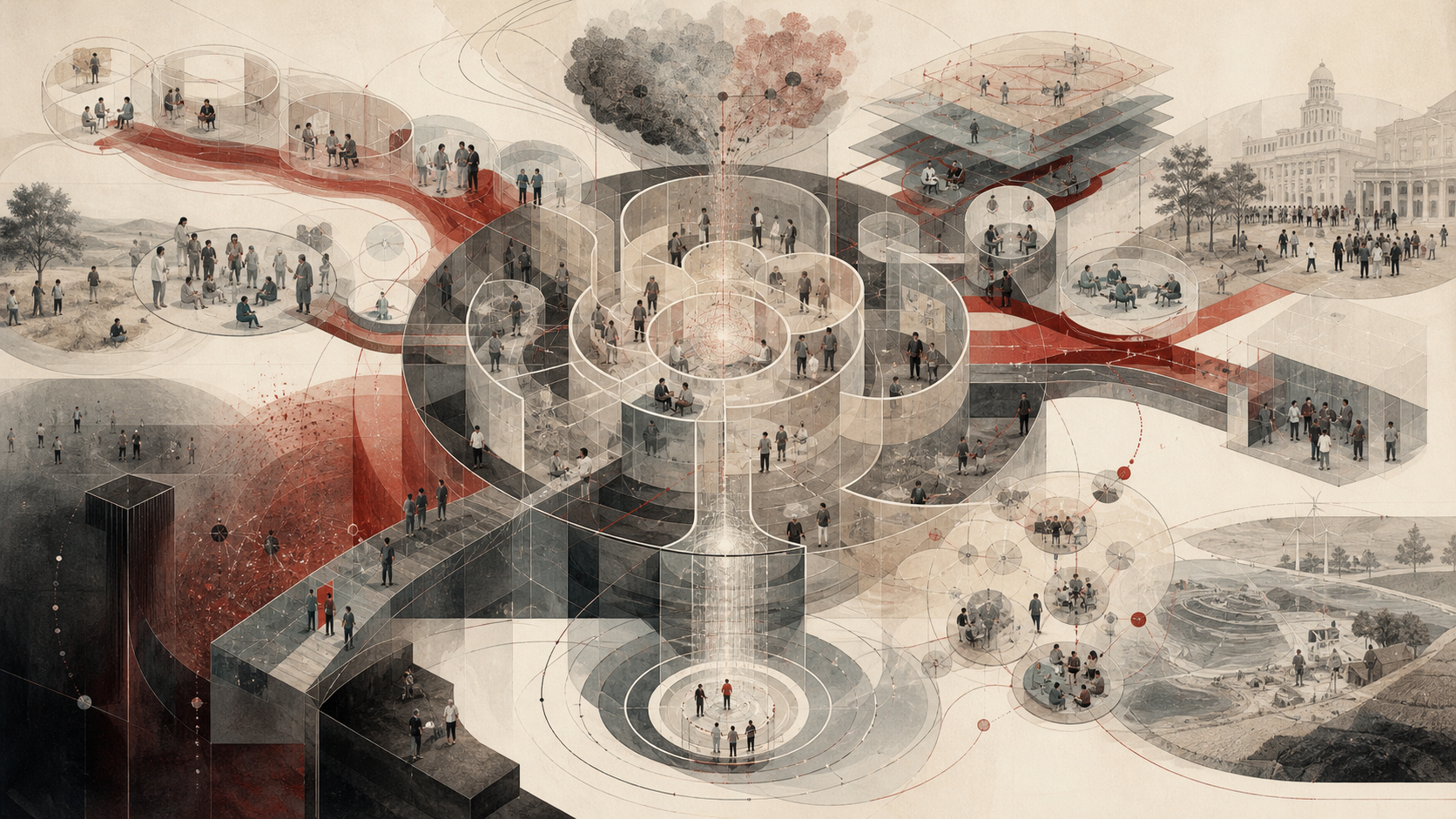
This series also approaches design thinking as a field that increasingly benefits from research systems, stakeholder data, design repositories, prioritization models, uncertainty analysis, service blueprints, behavior-change models, qualitative coding, impact evaluation, systems mapping, reproducible workflows, and open analytical code. Many of the most important design questions now require not only empathy and creativity, but programmable environments capable of modeling design value, uncertainty, portfolio trade-offs, testing evidence, implementation risk, service complexity, adoption barriers, stakeholder burden, equity impacts, and downstream system effects.
Design thinking therefore appears here not only as a method for innovation, but as a practical theory of responsible learning. It explains how teams discover what problem they are actually facing, how they translate human evidence into insight, how they reframe assumptions, how they generate alternatives, how they test ideas against reality, and how they revise solutions before institutional commitment becomes too costly. The aim of this series is to preserve the constructive power of design thinking while avoiding shallow process diagrams. Design thinking is strongest when it remains human-centered, systems-aware, evidence-seeking, ethically serious, and willing to learn from contradiction.
GitHub Repository
The Design Thinking knowledge series is supported by an open computational repository with article-level folders, reproducible examples, synthetic datasets, documentation, design-value models, uncertainty analysis workflows, stakeholder-research scaffolds, service-design schemas, implementation-risk examples, and full-stack scientific-computing examples across Python, R, Julia, C++, Fortran, C, Rust, SQL, Go, and notebooks where appropriate.
Design Thinking Code Repository
The repository supports the Design Thinking article map with reproducible companion materials for human-centered research, insight synthesis, prototyping, testing, implementation, evaluation, AI-assisted research, public value, institutional design, and future design-readiness modeling.
Design Thinking as a Foundational Methodology
Design thinking occupies a foundational place within contemporary problem-solving practice because it explains how teams can learn under uncertainty before committing to premature solutions. Many problems arrive already framed by institutions, departments, technologies, incentives, or inherited assumptions. Design thinking slows that rush to solution by asking what people actually experience, what problem is really being solved, whose needs are visible or invisible, which assumptions are untested, and what must be learned before action hardens into implementation.
This foundational role does not mean that design thinking replaces strategy, systems thinking, engineering, policy analysis, behavioral science, evaluation, organizational psychology, sustainability science, or implementation research. Rather, it provides a bridge across them. Systems thinking helps identify feedback loops and structural causes. Behavioral science explains adoption and action. Strategy clarifies direction and trade-offs. Evaluation examines outcomes. Design thinking contributes a disciplined method for translating lived experience, ambiguity, and experimentation into more responsible intervention.
The field matters because many contemporary challenges are not stable, technical puzzles. They are human, social, institutional, and interpretive. A service may fail not because the technology is weak, but because the user journey is fragmented. A public program may underperform because it was designed around administrative convenience rather than lived need. A sustainability intervention may fail because it ignores behavior, trust, access, or hidden burden. Design thinking helps expose these gaps before solutions scale.
Design Thinking as Inquiry, Framing, and Experimentation
Design thinking may be understood as one of the great practical disciplines of inquiry, framing, and experimentation. It asks how teams move from observation to insight, from insight to problem reframing, from reframing to possibility generation, and from possibility generation to prototypes that can be tested against reality. Its central discipline is not creativity alone. It is learning through disciplined contact with human experience and evidence.
This makes design thinking different from simple idea generation. Brainstorming can produce ideas, but design thinking asks whether the right problem has been framed, whether the team has interpreted evidence well, whether the prototype tests the right assumption, whether users behave as expected, whether implementation burdens have been understood, and whether the proposed solution creates new harm elsewhere in the system.
Design thinking is therefore iterative in a serious sense. Iteration is not repetition for its own sake. It is cumulative revision under evidence. A team learns something, changes the frame, builds a representation, tests it, encounters friction, and updates its understanding. The method is strongest when each loop improves not only the solution, but the team’s grasp of the problem itself.
Design Thinking as a Quantitative and Computational Practice
Design thinking is often described through qualitative research, observation, workshops, journey maps, prototypes, and stakeholder conversations. Those remain central. Yet modern design work increasingly involves quantitative and computational practice as well. Teams compare design pathways, estimate risk, model uncertainty, analyze adoption, examine service data, evaluate usability, track implementation burden, structure research repositories, and monitor outcomes over time.
This does not mean that design thinking becomes a purely technical or optimization-driven field. Rather, it means that serious design work often requires multiple forms of evidence. A team may conduct interviews, synthesize qualitative themes, build personas, map journeys, score opportunity areas, model feasibility, simulate adoption uncertainty, store research notes in SQL, document assumptions in notebooks, and evaluate prototype performance through structured metrics.
For that reason, this series treats mathematics, statistics, computational modeling, R, Python, SQL metadata, reproducible notebooks, and open code repositories as increasingly useful parts of design-thinking literacy. Some articles remain primarily conceptual, interpretive, participatory, or ethical. Others naturally require design-value models, Monte Carlo uncertainty analysis, prioritization workflows, journey-data schemas, service blueprints, implementation-risk scoring, or reproducible code. The aim is not to reduce design to metrics, but to make design reasoning more explicit, auditable, and disciplined.
What Design Thinking Studies and Does
Design thinking studies and organizes the movement from lived experience to responsible intervention. At the research level, it examines human experience, stakeholder needs, observed behavior, context, pain points, barriers, motivations, constraints, and unmet needs. At the interpretive level, it studies how observations become insights, how patterns are synthesized, how tensions are named, and how problem frames become more generative.
At the creative level, design thinking studies ideation, divergence, convergence, analogy, sketching, storyboarding, concept generation, and possibility expansion. At the experimental level, it studies prototypes, tests, assumptions, feedback, validation, usability, desirability, feasibility, viability, and evidence. At the implementation level, it studies scaling, adoption, institutional fit, service delivery, operational burden, stakeholder alignment, and unintended consequences.
Design thinking further studies the ethics of intervention. Human-centeredness can become superficial if it ignores power, exclusion, representation, accessibility, cultural difference, ecological limits, or institutional incentives. A mature design-thinking practice therefore asks not only whether a solution works, but for whom, at what cost, under whose authority, with what burden, and with what downstream effects.
What This Pillar Covers
This pillar brings together the major domains through which design thinking interprets human-centered problem solving. It includes the foundations of design thinking, human-centered problem solving, problem framing, empathy research, stakeholder research, contextual inquiry, insight generation, ideation, prototyping, testing, validation, implementation, scaling, systems thinking, service design, co-design, participatory design, behavioral design, strategy, public policy, sustainability, organizational innovation, ethics, power, inclusion, evaluation, and the future of responsible design.
These domains differ in method and emphasis, but together they form a coherent intellectual project: the attempt to design better interventions by learning more responsibly from human experience, evidence, and systems. Design thinking is therefore not only a process sequence. It is a way of asking how problems are framed, how evidence is interpreted, how ideas are tested, and how solutions become accountable to the realities they enter.
The series also treats design thinking as a field that links creativity and responsibility. Innovation without evidence can become theater. Evidence without imagination can become administrative inertia. Implementation without ethics can create harm. Design thinking is most useful when it holds these tensions together: empathy and rigor, creativity and constraint, experimentation and accountability, systems awareness and human experience.
Mathematics, Computation, and Modeling in Design Thinking
Mathematics provides part of the formal language through which design thinking can clarify trade-offs, uncertainty, learning value, risk, feasibility, stakeholder burden, and implementation quality. These models do not replace design judgment. They make some of its implicit choices visible.
A simple model of candidate design value can be written as:
V_i = w_h H_i + w_f F_i + w_l L_i – w_r R_i
\]
Interpretation: Candidate design value depends on human-centered relevance, feasibility, learning value, and unresolved risk, weighted by the priorities of the team, institution, or public context.
where \(V_i\) represents the value of design pathway \(i\), \(H_i\) human-centered relevance, \(F_i\) feasibility, \(L_i\) learning value, \(R_i\) residual risk, and \(w_h, w_f, w_l, w_r\) decision weights.
The iterative logic of design can be modeled dynamically:
Q_{t+1} = Q_t + \alpha I_t + \beta U_t – \gamma C_t
\]
Interpretation: Solution quality improves when each iteration produces insight gain and usability improvement faster than new friction, complexity, or coordination cost is introduced.
where \(Q_t\) is solution quality, \(I_t\) insight gain, \(U_t\) usability improvement, \(C_t\) new friction or complexity, and \(\alpha, \beta, \gamma\) are sensitivity parameters.
A design portfolio perspective can represent expected portfolio value:
E(P) = \sum_{i=1}^{n} p_i V_i
\]
Interpretation: Expected design portfolio value depends on the probability that each pathway produces durable downstream value and the value of the pathway if it succeeds.
A broader semi-formal model treats responsible design quality as a function of human relevance, interpretive rigor, system fit, evidence strength, implementation feasibility, equity impact, and residual risk:
DQ = f(HR, IR, SF, ES, IF, EI, RR)
\]
Interpretation: Design quality depends on human relevance, interpretive rigor, system fit, evidence strength, implementation feasibility, equity impact, and residual risk.
A simple additive representation is:
DQ = \beta_1 HR + \beta_2 IR + \beta_3 SF + \beta_4 ES + \beta_5 IF + \beta_6 EI – \beta_7 RR
\]
Interpretation: Responsible design quality rises when research, interpretation, system fit, evidence, feasibility, and equity improve, and declines when unresolved risk remains high.
These formulations do not reduce design thinking to formulas. They clarify a central design insight: the strongest pathway is not always the most creative, feasible, popular, or measurable in isolation. It is the pathway that best balances human relevance, evidence, implementation, learning, and responsible risk under uncertainty.
Computation is especially valuable where design pathways become complex. R supports prioritization models, survey analysis, experimental comparison, journey-data summaries, evaluation workflows, visualization, and reproducible reporting. Python supports Monte Carlo simulation, uncertainty analysis, design portfolio models, stakeholder clustering, journey analytics, prototype-test data, and decision-support tools. SQL supports structured research notes, personas, journey steps, prototype tests, service blueprints, stakeholder records, decision logs, and reproducible provenance. Julia, C++, Fortran, C, Rust, and Go support simulation, command-line tools, high-performance analysis, and reproducible computational infrastructure.
Major Domains of Design Thinking
Design thinking includes a wide range of major domains, each of which illuminates a different stage or dimension of responsible problem solving. Human-centered research studies lived experience, stakeholder needs, context, observation, interviews, and the difference between what institutions assume and what people actually encounter. Problem framing studies how the definition of a challenge shapes what becomes visible, solvable, and strategically meaningful.
Insight generation studies how raw observations become explanatory claims about needs, tensions, contradictions, constraints, and opportunity. Ideation studies divergence, creativity, structured possibility generation, and the disciplined avoidance of premature convergence. Prototyping studies how ideas become tangible enough to encounter evidence. Testing and validation study whether assumptions survive contact with use, friction, constraint, and feedback.
Implementation and scaling study what happens when ideas leave the prototype stage and enter organizations, services, platforms, policy systems, or communities. Service design studies multi-touchpoint experience and backstage coordination. Participatory design studies how stakeholders become collaborators rather than research subjects. Design ethics studies representation, burden, power, consent, inclusion, accessibility, and downstream consequences.
Why Design Thinking Matters
Design thinking matters because many failures are failures of framing. Teams often build solutions before understanding the problem, optimize around institutional convenience rather than lived need, or treat symptoms as root causes. Design thinking helps delay premature certainty long enough for better questions to emerge.
The field also matters because implementation often fails when human experience is treated as secondary. A policy can be formally sound and practically unusable. A product can be technically sophisticated and emotionally alienating. A service can be efficient for providers and exhausting for users. A sustainability intervention can be rational but socially impossible. Design thinking helps reveal such misalignments.
Finally, design thinking matters because responsible innovation requires humility. Real problems answer back. Users resist, reinterpret, improvise, and reveal hidden constraints. Institutions introduce friction. Systems produce unintended consequences. The strongest design thinking does not pretend to know everything in advance. It builds a method for learning before, during, and after intervention.
Design Thinking and Human Self-Understanding
Design thinking changes how human beings understand problem solving because it shows that solutions are shaped by the way problems are perceived. People and institutions often believe they are solving objective problems, when they are actually acting within frames inherited from structure, language, habit, authority, or convenience. Design thinking makes framing visible.
The field also changes how teams understand expertise. Expertise remains important, but it must be placed in conversation with lived experience. Users, patients, students, citizens, workers, caregivers, residents, and frontline staff often know forms of reality that official systems miss. Design thinking does not romanticize experience as automatically correct. It treats experience as evidence that must be interpreted carefully.
For that reason, design thinking has philosophical as well as practical significance. It raises enduring questions about empathy, interpretation, creativity, agency, participation, power, responsibility, experimentation, and the ethics of intervention. A serious Design Thinking pillar should therefore not end with process stages alone. It should clarify the wider implications of design thinking for institutions, systems, sustainability, public life, and humane problem solving.
Design Thinking Article Map
The map below organizes the Design Thinking knowledge series into conceptual domains, moving from foundations and human-centered research toward framing, ideation, prototyping, testing, implementation, systems, sustainability, public policy, service design, participation, behavior, strategy, ethics, data systems, AI-assisted research, complex institutions, social impact, public value, and future directions. The links below are mapped from the confirmed article list in the attached CSV.
Foundations and Core Method
- What Is Design Thinking? — Defines design thinking as a human-centered, iterative, interdisciplinary method for inquiry and intervention under uncertainty.
- Human-Centered Problem Solving — Examines why design must begin from lived experience rather than institutional convenience, technical abstraction, or inherited assumptions alone.
- Problem Framing in Design Thinking — Studies how the definition of a challenge shapes what becomes visible, actionable, and thinkable.
- Iteration and Experimentation in Design Thinking — Explains how design thinking learns through repeated cycles of testing, contradiction, revision, and evidence.
Research, Interpretation, and Framing
- Empathy and Stakeholder Research in Design Thinking — Treats empathy as disciplined stakeholder research rather than vague sympathy or generic user-centered language.
- Insight Generation in Design Thinking — Explores how raw observations become explanatory claims about need, tension, contradiction, and opportunity.
- Ideation and Creative Problem Solving in Design Thinking — Studies divergence, structured creativity, possibility expansion, and disciplined protection against premature convergence.
- Design Research Methods: Contextual Inquiry and Synthesis — Covers field observation, interview design, affinity mapping, theme development, and evidence synthesis.
Experimentation, Validation, and Delivery
- Prototyping in Design Thinking — Examines the experimental core of design thinking, where ideas become tangible enough to encounter evidence.
- Testing and Validation in Design Thinking — Studies how design claims are exposed to real interaction, friction, contradiction, and observed use.
- Implementation and Scaling in Design Thinking — Explores how validated ideas move from promising pilots into organizational, institutional, or public reality.
- Design Evaluation, Learning, and Outcome Measurement — Examines how prototypes, pilots, adoption, outcomes, burden, and unintended consequences can be evaluated.
Systems, Sustainability, Public Policy, and Organizations
- Design Thinking and Systems Thinking — Bridges lived experience with feedback, structure, interdependence, and complex systems analysis.
- Design Thinking for Sustainability — Connects design thinking to ecological limits, circular design, resilience, sustainable behavior, and environmental responsibility.
- Design Thinking in Public Policy — Examines people-centered public services, policy pilots, administrative burden, public value, and institutional redesign.
- Design Thinking and Organizational Innovation — Studies internal transformation, strategy, service redesign, organizational learning, and institutional adaptation.
Participation, Services, Behavior, Strategy, and Ethics
- Co-Design and Participatory Design — Examines methods where stakeholders become collaborators in framing, interpretation, prototyping, and solution development.
- Service Design in Design Thinking — Treats service blueprints, frontstage and backstage coordination, multi-touchpoint experience, and service-system redesign.
- Design Thinking and Behavioral Design — Bridges design thinking, behavior change, choice architecture, habit formation, and applied behavioral science.
- Design Thinking and Strategy — Explores how framing, experimentation, and design-led inquiry influence long-range direction, uncertainty, and strategic choice.
- Ethics, Power, and Inclusion in Design Thinking — Examines representation, exclusion, hidden burdens, asymmetry, consent, accessibility, and the politics of design decisions.
Advanced Design Practice and Future Directions
- Design Thinking, Data Systems, and AI-Assisted Research — Covers research repositories, AI-assisted synthesis, traceability, data systems, and the risks of automating interpretation.
- Design Thinking for Complex Institutions — Treats institutional incentives, bureaucracy, governance, trust, implementation burden, legitimacy, and public accountability.
- Design Thinking for Social Impact and Public Value — Examines equity, public goods, community benefit, social innovation, accountability, and durable value creation.
- The Future of Design Thinking — Serves as the capstone article on design thinking’s future across AI, sustainability, public systems, participation, behavioral science, and responsible innovation.
Methods, Measurement, and Design Practice
One of design thinking’s central challenges is methodological discipline. The field uses interviews, observation, contextual inquiry, stakeholder mapping, journey mapping, personas, empathy maps, affinity clustering, prototypes, usability tests, pilot studies, service blueprints, co-design workshops, and implementation feedback. These tools are useful only when they are tied to clear questions and evidence.
This matters because design thinking can become performative. A team can run workshops, create sticky-note walls, produce personas, and build prototypes while avoiding the hard work of interpretation, power analysis, operational constraint, or evaluation. Methods do not guarantee learning. They must be used with rigor, humility, and traceability.
Modern design practice increasingly depends on research systems. Teams need to preserve evidence, document assumptions, compare competing interpretations, track decisions, record prototype tests, and understand how insights changed over time. A serious Design Thinking pillar should therefore treat research operations, measurement, documentation, and ethics as part of the method itself.
Design Thinking, Technology, and the Modern World
Design thinking has become increasingly important because modern technologies are often deployed before their social, behavioral, and institutional consequences are understood. AI systems, digital platforms, public-service portals, health technologies, educational tools, climate dashboards, automation systems, and decision-support platforms all reshape human experience. Design thinking offers a way to study those effects before they harden into infrastructure.
Technology can support design thinking when it helps teams collect evidence, prototype quickly, simulate scenarios, analyze feedback, improve accessibility, and test alternatives. It can also weaken design thinking when it replaces lived inquiry with synthetic assumptions, automates interpretation without accountability, or treats users as data points rather than participants in meaning-making.
A mature design-thinking approach to technology must therefore ask not only whether a system is usable, but whether it is legitimate, trustworthy, inclusive, accessible, accountable, and aligned with human and ecological flourishing. The future of design thinking will increasingly depend on whether it can remain human-centered in environments shaped by automation, AI, platform logic, and data-intensive institutions.
Computation and Design-Strategy Simulation
Computation has become valuable for design thinking because design choices are uncertain, multidimensional, and consequential. A prototype may score high on desirability but low on feasibility. A public intervention may be equitable in intention but burdensome in practice. A service redesign may improve one touchpoint while worsening another. A digital tool may be efficient but untrusted. These trade-offs require structured reasoning.
Design-strategy simulation allows teams to formalize assumptions about pathways, risks, uncertainties, and priorities. A model can compare design alternatives under different weightings, estimate sensitivity to uncertain evidence, test implementation scenarios, or evaluate whether a pathway remains robust when feasibility, user value, or risk estimates shift. These models do not replace judgment, but they make design judgment more visible.
For that reason, this pillar treats computation as a supporting discipline of design thinking, not as a substitute for human-centered inquiry. Models must remain transparent, ethically grounded, and connected to evidence. The strongest form of computational design thinking is not automated decision-making, but auditable design reasoning under uncertainty.
R Section: Comparing Design Pathways Across Innovation Priorities
The R workflow below evaluates a small portfolio of design pathways across human relevance, feasibility, learning value, and residual risk. It then compares how rankings shift under different strategic priorities, helping teams see what they are actually optimizing when they choose among design directions.
# Advanced R workflow for design thinking pathway comparison.
# Educational example only.

# install.packages(c("tidyverse", "scales"))
library(tidyverse)
library(scales)

pathways <- tibble(
  pathway = c(
    "Service Redesign Pathway",
    "Digital Platform Pathway",
    "Workflow Coordination Pathway",
    "Community Partnership Pathway"
  ),
  human_relevance = c(8.8, 7.9, 8.2, 8.6),
  feasibility     = c(7.4, 8.3, 7.8, 7.1),
  learning_value  = c(8.1, 7.7, 8.4, 8.5),
  residual_risk   = c(4.0, 4.3, 3.8, 4.2)
)

score_pathways <- function(data, wh, wf, wl, wr) {
  data %>%
    mutate(
      design_value = wh * human_relevance +
        wf * feasibility +
        wl * learning_value -
        wr * residual_risk
    ) %>%
    arrange(desc(design_value))
}

scenarios <- tribble(
  ~scenario,              ~wh,  ~wf,  ~wl,  ~wr,
  "Balanced",             0.35, 0.25, 0.25, 0.15,
  "Human-first",          0.50, 0.20, 0.20, 0.10,
  "Feasibility-first",    0.20, 0.50, 0.20, 0.10,
  "Learning-first",       0.20, 0.20, 0.45, 0.15,
  "Risk-sensitive",       0.25, 0.20, 0.20, 0.35
)

scenario_results <- scenarios %>%
  rowwise() %>%
  do(
    score_pathways(
      pathways,
      wh = .$wh,
      wf = .$wf,
      wl = .$wl,
      wr = .$wr
    ) %>%
      mutate(scenario = .$scenario)
  ) %>%
  ungroup()

ranked_results <- scenario_results %>%
  group_by(scenario) %>%
  arrange(desc(design_value), .by_group = TRUE) %>%
  mutate(rank = row_number()) %>%
  ungroup()

print(ranked_results)

ggplot(ranked_results, aes(x = pathway, y = design_value, group = scenario)) +
  geom_point(size = 3) +
  geom_line(aes(color = scenario), linewidth = 1) +
  coord_flip() +
  labs(
    title = "Design Pathway Value Across Innovation Priority Scenarios",
    x = "Design Pathway",
    y = "Weighted Design Value"
  ) +
  theme_minimal(base_size = 12)

top_rank_summary <- ranked_results %>%
  filter(rank == 1) %>%
  count(pathway, name = "times_ranked_first") %>%
  arrange(desc(times_ranked_first))

print(top_rank_summary)

write_csv(ranked_results, "design_thinking_pathway_comparison.csv")
This workflow can be extended with stakeholder-weighted priorities, equity scoring, implementation burden, cost bands, uncertainty estimates, accessibility indicators, sustainability criteria, and prototype-test evidence.
Python Section: Uncertainty Analysis for Design Strategy Choices
The Python workflow below extends the same logic with Monte Carlo simulation. Instead of assuming that each design pathway’s scores are known with certainty, it models uncertainty across human relevance, feasibility, learning value, and residual risk. This helps estimate which pathways remain strongest when the evidence is still incomplete and the design team is still learning.
# Advanced Python workflow for design strategy uncertainty.
# Educational example only.

import numpy as np
import pandas as pd
import matplotlib.pyplot as plt

pathways = pd.DataFrame({
    "pathway": [
        "Service Redesign Pathway",
        "Digital Platform Pathway",
        "Workflow Coordination Pathway",
        "Community Partnership Pathway"
    ],
    "human_relevance": [8.8, 7.9, 8.2, 8.6],
    "feasibility":     [7.4, 8.3, 7.8, 7.1],
    "learning_value":  [8.1, 7.7, 8.4, 8.5],
    "residual_risk":   [4.0, 4.3, 3.8, 4.2]
})

weights = {
    "human_relevance": 0.35,
    "feasibility": 0.25,
    "learning_value": 0.25,
    "residual_risk": 0.15
}

def compute_design_value(df, weights_dict):
    result = df.copy()
    result["design_value"] = (
        weights_dict["human_relevance"] * result["human_relevance"] +
        weights_dict["feasibility"]     * result["feasibility"] +
        weights_dict["learning_value"]  * result["learning_value"] -
        weights_dict["residual_risk"]   * result["residual_risk"]
    )
    return result.sort_values("design_value", ascending=False)

baseline_results = compute_design_value(pathways, weights)
print("Baseline design pathway ranking:")
print(baseline_results[["pathway", "design_value"]])

np.random.seed(42)
n_simulations = 5000
simulation_winners = []

for _ in range(n_simulations):
    simulated = pathways.copy()

    for col in ["human_relevance", "feasibility", "learning_value", "residual_risk"]:
        simulated[col] = np.random.normal(
            loc=pathways[col],
            scale=0.6
        )
        simulated[col] = simulated[col].clip(1, 10)

    simulated_results = compute_design_value(simulated, weights)
    winner = simulated_results.iloc[0]["pathway"]
    simulation_winners.append(winner)

winner_summary = (
    pd.Series(simulation_winners)
    .value_counts(normalize=True)
    .rename("probability_ranked_first")
    .reset_index()
)

winner_summary.columns = ["pathway", "probability_ranked_first"]
winner_summary["probability_ranked_first"] *= 100

print("\nProbability each pathway ranks first:")
print(winner_summary)

plt.figure(figsize=(10, 6))
plt.bar(winner_summary["pathway"], winner_summary["probability_ranked_first"])
plt.xticks(rotation=20, ha="right")
plt.ylabel("Probability of Ranking First (%)")
plt.title("Robustness of Design Strategy Choices Under Uncertainty")
plt.tight_layout()
plt.show()

winner_summary.to_csv("design_thinking_strategy_uncertainty_results.csv", index=False)
This workflow can be extended into multi-stakeholder prioritization, service-redesign evidence, desirability-feasibility-viability scoring, risk registers, prototype performance, implementation readiness, and sustainability impact analysis.
Interpretive Limits and Ethical Cautions
Design thinking is powerful, but it should not be treated as a universal solution for every problem. Some problems require law, politics, infrastructure, redistribution, technical engineering, organizational accountability, or long-term governance more than workshops, prototypes, or user interviews. Design thinking becomes weak when it mistakes method for mandate.
Analysts and practitioners should therefore be careful not to confuse empathy with justice, participation with power-sharing, prototype success with implementation readiness, usability with public value, innovation with improvement, or stakeholder research with democratic legitimacy. Human-centered design can still reproduce exclusion if the wrong people are included, if power is ignored, or if hidden burdens remain invisible.
The field is strongest when it combines creativity with accountability. It should help teams learn from people without extracting from them, test ideas without manipulating users, and implement solutions without ignoring downstream consequences. Design thinking should make intervention more responsible, not merely more polished.
Design Thinking in a Wider Intellectual Context
Design thinking belongs not only to business innovation or product development, but to the broader history of human thought about inquiry, craft, engineering, public problem solving, practical reasoning, systems, and responsible intervention. Philosophers, architects, engineers, educators, planners, designers, and reformers have long asked how human beings move from situation to action when certainty is unavailable.
The field changes the imagination of problem solving. It shows that many problems are not simply waiting to be solved. They must first be interpreted, framed, tested, and understood in relation to lived experience. This gives design thinking its intellectual seriousness: it is not only a way of making things, but a way of learning what should be made, changed, protected, or left alone.
For that reason, design thinking should be understood as both a practical and ethical achievement. It brings together human-centered research, creativity, experimentation, systems awareness, implementation, and responsibility in a sustained effort to improve how organizations and communities learn under uncertainty. It remains indispensable for any serious framework concerned with innovation, sustainability, public value, service systems, technology, and humane institutional change.
Related Reading
- Problem Solving
- Systems Thinking
- Knowledge Architecture
- Data Systems & Analytics
- Behavioral Psychology
- Organizational Psychology
- Institutions & Governance
- Stewardship & Ethics
Further Reading
- Brown, T. (2008) ‘Design thinking’, Harvard Business Review. Available at: https://hbr.org/2008/06/design-thinking.
- Buchanan, R. (1992) ‘Wicked problems in design thinking’, Design Issues, 8(2), pp. 5–21. Available at: https://www.jstor.org/stable/1511637.
- Design Council (n.d.) Systemic Design Framework. Available at: https://www.designcouncil.org.uk/our-resources/systemic-design-framework/.
- Design Justice Network (n.d.) Design Justice Network Principles. Available at: https://designjustice.org/read-the-principles.
- IDEO.org (2015) The Field Guide to Human-Centered Design. Available at: https://www.designkit.org/resources/1.html.
- Liedtka, J. and Ogilvie, T. (2011) Designing for Growth: A Design Thinking Tool Kit for Managers. New York: Columbia University Press. Available at: https://cup.columbia.edu/book/designing-for-growth/9780231527965/.
- Norman, D.A. (2013) The Design of Everyday Things. Rev. and expanded edn. New York: Basic Books. Available at: https://jnd.org/the-design-of-everyday-things-revised-and-expanded-edition/.
- Simon, H.A. (1996) The Sciences of the Artificial. 3rd edn. Cambridge, MA: MIT Press. Available at: https://mitpress.mit.edu/9780262691918/the-sciences-of-the-artificial/.
- Stanford d.school (n.d.) Design Thinking Bootleg. Available at: https://dschool.stanford.edu/resources/design-thinking-bootleg.
References
- Brown, T. (2008) ‘Design thinking’, Harvard Business Review. Available at: https://hbr.org/2008/06/design-thinking.
- Buchanan, R. (1992) ‘Wicked problems in design thinking’, Design Issues, 8(2), pp. 5–21. Available at: https://www.jstor.org/stable/1511637.
- Design Council (n.d.) Systemic Design Framework. Available at: https://www.designcouncil.org.uk/our-resources/systemic-design-framework/.
- Design Justice Network (n.d.) Design Justice Network Principles. Available at: https://designjustice.org/read-the-principles.
- IDEO.org (2015) The Field Guide to Human-Centered Design. Available at: https://www.designkit.org/resources/1.html.
- Liedtka, J. and Ogilvie, T. (2011) Designing for Growth: A Design Thinking Tool Kit for Managers. New York: Columbia University Press. Available at: https://cup.columbia.edu/book/designing-for-growth/9780231527965/.
- Norman, D.A. (2013) The Design of Everyday Things. Rev. and expanded edn. New York: Basic Books. Available at: https://jnd.org/the-design-of-everyday-things-revised-and-expanded-edition/.
- Simon, H.A. (1996) The Sciences of the Artificial. 3rd edn. Cambridge, MA: MIT Press. Available at: https://mitpress.mit.edu/9780262691918/the-sciences-of-the-artificial/.
- Stanford d.school (n.d.) About the d.school. Available at: https://dschool.stanford.edu/.
- Stanford d.school (n.d.) Design Thinking Bootleg. Available at: https://dschool.stanford.edu/resources/design-thinking-bootleg.