
Last Updated June 29, 2026
Storytelling is one of the fundamental ways human beings organize experience, preserve memory, interpret change, transmit values, negotiate identity, and imagine meaning across time. It belongs not only to literature, drama, film, and popular culture, but also to religion, ritual, law, politics, philosophy, education, psychology, institutional life, oral tradition, collective memory, and public reasoning. Stories do not merely entertain. They order action, assign significance, connect event to consequence, and make human experience intelligible through sequence, conflict, transformation, and interpretation.
This content pillar brings together the major domains through which storytelling can be understood as a formal, cultural, psychological, ethical, and symbolic system. It treats story not as a simple communication technique, but as one of the central frameworks through which individuals and communities make sense of origins, crises, obligations, identities, losses, conflicts, futures, and transformations. Across classical poetics, rhetoric, oral tradition, folklore, mythology, narratology, hermeneutics, psychology, media studies, religious narrative, political narrative, memoir, film, and digital culture, storytelling provides a durable architecture for meaning.
Storytelling also belongs to the contemporary study of narrative systems, story structure, character transformation, cultural memory, narrative identity, persuasive communication, public myth, symbolic interpretation, adaptation, media environments, and computational text analysis. Many storytelling questions now require not only literary interpretation, but structured methods capable of mapping narrative arcs, character roles, conflicts, motifs, turning points, rhetorical moves, audience effects, ethical risks, and cross-media transformation. The field therefore stands at the intersection of poetics, rhetoric, mythology, psychology, philosophy, media history, anthropology, religious studies, cultural memory, strategic communication, and narrative-systems modeling.
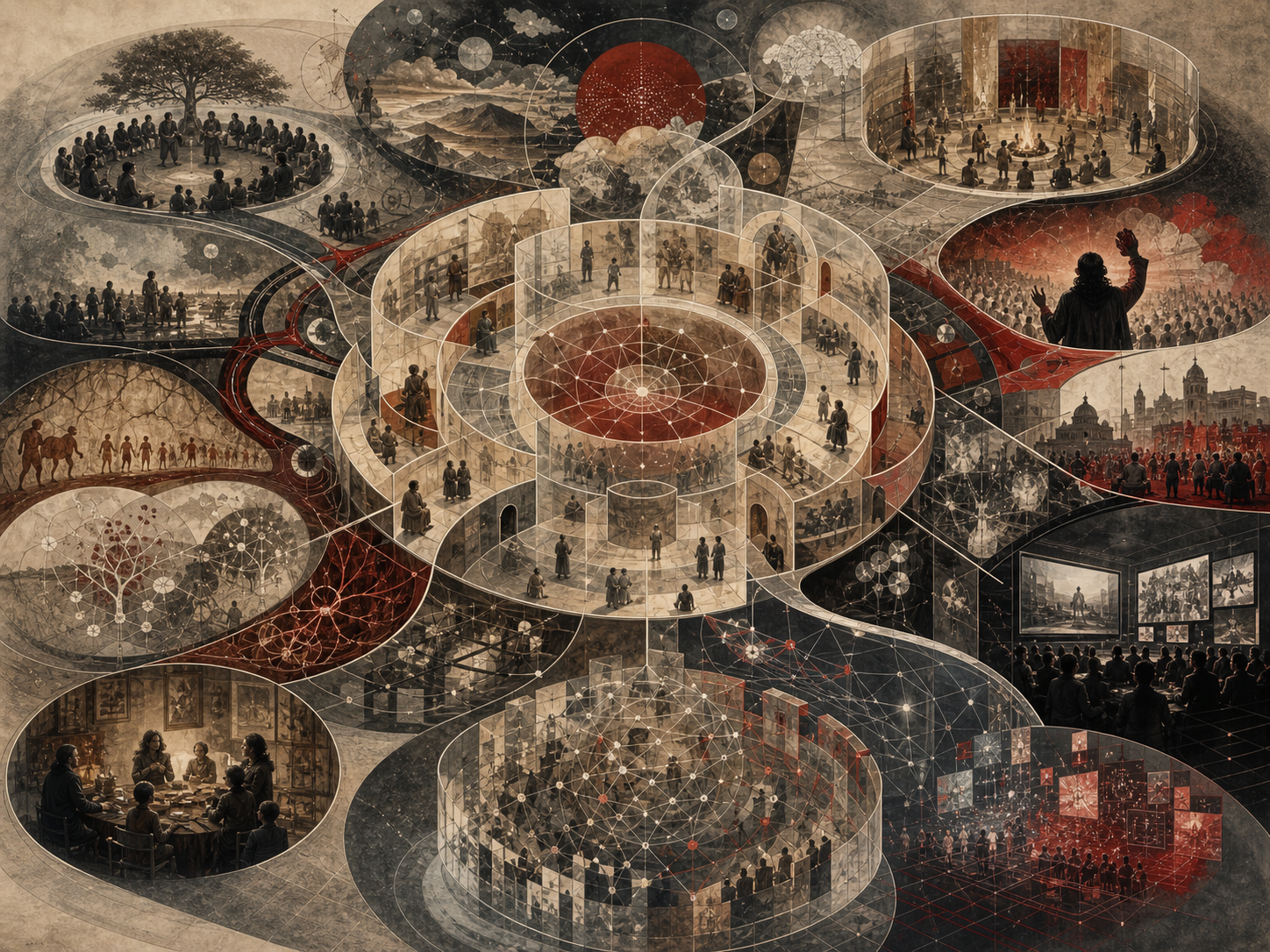
Storytelling appears here not merely as craft advice or plot mechanics, but as a deep human system for arranging experience into meaning. Stories give shape to beginnings and endings, crises and recoveries, exile and return, guilt and repair, suffering and recognition, conflict and transformation. They help people understand what has happened, what matters, who they are, what has been lost, what may be restored, and what future might still be possible.
The study of storytelling therefore extends far beyond advice about plot structure. It includes classical poetics, rhetoric, oral tradition, folklore, mythology, narratology, hermeneutics, psychology, performance, media history, religious imagination, political narrative, and collective memory. Aristotle remains foundational because he treated plot as the central principle of poetic action and asked why some arrangements of events produce stronger intellectual and emotional effects than others. Later thinkers approached story from other directions: Vladimir Propp examined recurrent folktale functions; Paul Ricoeur explored how narrative configures time and shapes identity; oral-tradition scholarship emphasized performance, memory, and communal transmission; comparative mythologists such as Joseph Campbell investigated recurrent symbolic patterns across cultures.
Campbell remains important within this larger field because he articulated one of the most influential modern frameworks for mythic storytelling. In The Hero with a Thousand Faces, he proposed that many myths and hero tales exhibit a recurrent movement of departure, ordeal, transformation, and return. Yet storytelling cannot be reduced to the monomyth. Stories may be tragic rather than redemptive, cyclical rather than progressive, communal rather than individual, fragmentary rather than unified, ritualized rather than psychologically interior, or deliberately resistant to closure. Campbell’s framework is most valuable when understood as one comparative model among others rather than as a universal narrative law.
Storytelling also demands critical scrutiny. Universal patterns can illuminate broad similarities, but they can also flatten cultural difference, genre variation, gendered experience, Indigenous traditions, non-Western narrative forms, oral performance, historical specificity, and political struggle. Maureen Murdock’s heroine’s journey remains one of the most influential interventions in this debate because it challenges inherited assumptions about transformation, wholeness, descent, and integration. More broadly, feminist, postcolonial, folkloric, oral-tradition, religious, and culturally specific perspectives all underscore that stories live in many forms and serve many different ends.
GitHub Repository
The companion repository supports this Storytelling knowledge series with reusable narrative templates, story-structure schemas, character-arc models, plot and conflict metadata, theme and motif examples, rhetorical-framework workflows, narrative-tension analysis, oral-tradition documentation templates, SQL schemas, and reproducible tools for studying how stories organize meaning, memory, identity, conflict, persuasion, cultural transmission, and transformation over time.
Complete Code Repository
This repository provides the computational companion material for the Storytelling series, including structured article folders, narrative-systems models, story metadata, reusable templates, documentation, and reproducible narrative-analysis examples.
Storytelling as a Foundational Discipline
Storytelling occupies a foundational place within human thought because it gives temporal shape to experience. Human beings do not encounter life as isolated facts alone. They remember, anticipate, interpret, justify, regret, confess, celebrate, mourn, warn, teach, persuade, and hope through sequences of meaning. Story makes events intelligible by connecting them through cause, motive, conflict, consequence, recognition, and transformation.
This foundational role does not mean that storytelling replaces history, philosophy, theology, psychology, politics, law, anthropology, communication, or literary study. Rather, it runs through them. Historical writing organizes events into meaningful relation. Religious traditions preserve sacred narrative, prophetic memory, ritual sequence, and moral orientation. Law depends on narrative accounts of action, responsibility, harm, evidence, and judgment. Politics depends on public stories of identity, crisis, enemy, obligation, legitimacy, and future. Psychology depends on the stories people tell about self, trauma, development, purpose, and repair.
The field matters because stories shape perception before argument begins. A story defines what counts as a problem, who counts as a hero or victim, what conflict matters, what sacrifice is meaningful, what future is desirable, and what action appears justified. To study storytelling is therefore to study one of the deepest structures of human meaning-making.
Storytelling as the Architecture of Meaning Over Time
Storytelling may be understood as the architecture of meaning over time. It does not simply arrange events. It gives events relation, direction, emphasis, and consequence. A story asks what happened first, what changed, what was desired, what was resisted, what was lost, what was recognized, what was transformed, and what remained unresolved.
This makes storytelling different from information delivery. Information can describe facts. Story connects facts through movement. A timeline can record sequence. Story gives sequence significance. A report can explain conditions. Story asks how people experience those conditions, how choices unfold, and how meaning emerges from action and consequence.
The architecture metaphor also clarifies why storytelling is not only emotional. Stories can move audiences, but they do so through structure. Plot, tension, reversal, recognition, repetition, threshold, delay, point of view, pacing, image, voice, silence, and resolution all shape how meaning appears. Strong storytelling is therefore both formal and symbolic. It concerns the arrangement of narrative parts and the deeper cultural, moral, psychological, or spiritual work those arrangements perform.
Storytelling as a Quantitative and Computational Practice
Storytelling is often studied through close reading, interpretation, performance analysis, genre study, and cultural history. These methods remain essential. Yet serious narrative work can also benefit from structured and computational practice. Story systems can be mapped through metadata, narrative arcs, motif patterns, character roles, conflict types, turning points, rhetorical moves, media forms, themes, and audience responses.
This does not mean that storytelling becomes reducible to data. A narrative arc graph cannot replace interpretation. A motif count cannot explain symbolic depth. A character map cannot determine ethical meaning. Computation is useful when it makes structures visible: where tension rises, where reversals occur, how motifs recur, how characters transform, how narrative roles are distributed, how stories travel across media, and how repeated patterns appear across a corpus.
For that reason, this series treats SQL schemas, Python workflows, R analysis, narrative metadata, story-structure templates, motif libraries, character-arc models, and open repositories as useful parts of narrative literacy. Some articles remain primarily philosophical, literary, mythological, religious, oral-traditional, or interpretive. Others naturally benefit from narrative-arc modeling, character networks, motif tracking, rhetoric mapping, story metadata, and reproducible documentation. The aim is not to mechanize storytelling, but to make narrative structure more visible, inspectable, and teachable.
What Storytelling Studies
Storytelling studies how events become meaningful through arrangement. At the formal level, it examines plot, action, sequence, pacing, reversal, recognition, conflict, climax, resolution, voice, perspective, and narrative coherence. At the symbolic level, it examines myth, ritual, archetype, sacrifice, exile, return, initiation, taboo, memory, identity, and transformation.
At the cultural level, storytelling studies oral tradition, folklore, epic, legend, scripture, performance, communal memory, historical narrative, political myth, and public identity. At the psychological level, it studies narrative identity, trauma, aspiration, moral development, self-interpretation, and the shaping of experience through life story. At the rhetorical level, it studies persuasion, public speech, institutional narrative, moral framing, and the use of story to authorize action.
Storytelling further studies the gap between structure and formula. A narrative pattern may clarify meaning, but it can become formulaic when applied mechanically. The hero’s journey may illuminate many mythic structures, but it can distort stories that do not follow heroic, individual, redemptive, or masculine-coded arcs. A strong storytelling field must therefore study patterns without becoming captive to them.
What This Pillar Covers
This pillar brings together the major domains through which storytelling can be understood. It includes classical poetics, rhetoric, plot, action, narrative coherence, myth, ritual, oral tradition, folklore, folktale morphology, narratology, narrative time, narrative identity, Joseph Campbell, the monomyth, the hero’s journey, Maureen Murdock, the heroine’s journey, alternative story structures, tragedy, cyclical narrative, non-heroic story forms, religion, politics, public life, film, visual media, adaptation, digital storytelling, ethics of representation, comparative storytelling, and narrative systems.
These domains differ in method and emphasis, but together they form a coherent intellectual project: the study of how stories organize meaning, memory, identity, conflict, and transformation across cultures and media. Storytelling is therefore not only an art. It is a framework of human understanding.
The series also treats storytelling as a bridge between symbolic interpretation and strategic communication. Stories can reveal, heal, teach, mobilize, persuade, manipulate, exclude, or preserve. They can carry sacred memory or political myth, personal identity or public propaganda, communal wisdom or cultural distortion. A serious storytelling framework must therefore hold craft, interpretation, culture, and ethics together.
Mathematics, Computation, and Modeling in Storytelling
Mathematics and computation provide useful ways to represent narrative structures without reducing them to formulas. A story can be modeled as an ordered sequence of narrative events:
S = (e_1, e_2, \ldots, e_n)
\]
Interpretation: A story can be represented as a sequence of events. The order of events matters because meaning emerges through relation, delay, reversal, recognition, and consequence.
where \(S\) is a story and each \(e_i\) is a narrative event.
A narrative arc can be represented as changing tension over time:
T = f(t)
\]
Interpretation: Narrative tension changes over time. Stories often move through rising tension, reversal, crisis, recognition, resolution, or unresolved aftermath.
where \(T\) is tension and \(t\) is narrative time.
A character transformation can be represented as change in a character state:
C_{t+1} = C_t + \Delta E_t + \Delta R_t + \Delta A_t
\]
Interpretation: A character changes through events, relationships, and actions. Transformation is not merely internal feeling; it emerges through narrative pressure and response.
where \(C_t\) is character state, \(E_t\) is event pressure, \(R_t\) is relational influence, and \(A_t\) is action.
A motif system can be represented as a set of recurring symbolic elements:
M = \{m_1, m_2, \ldots, m_k\}
\]
Interpretation: Motifs recur across a story or tradition. Their meaning depends not only on frequency, but on placement, variation, context, and symbolic relation.
A narrative network can be represented as:
G = (V,E)
\]
Interpretation: A story world can be modeled as a network of characters, places, conflicts, objects, institutions, and symbolic relationships.
where \(V\) is a set of narrative nodes and \(E\) is a set of relationships among them.
A broader model of storytelling capacity can be represented as:
NS = f(P, C, T, R, M, V, E, I)
\]
Interpretation: Narrative strength depends on plot, character, tension, reversal, motif, voice, ethical stakes, and interpretive depth.
These formulations do not reduce storytelling to mathematics. They clarify a central point: stories are structured systems. They unfold through sequence, relation, transformation, recurrence, and interpretation.
Computation is especially valuable when narrative systems become large. Python can support motif tracking, character-network mapping, narrative metadata analysis, rhetorical move classification, and story-structure comparison. R can support narrative tension visualization, theme distribution summaries, genre comparison, and corpus-level descriptive analysis. SQL can store stories, events, characters, conflicts, motifs, turning points, themes, rhetorical moves, media forms, and ethical cautions. These tools make narrative systems easier to study, but they do not replace close reading, cultural interpretation, or ethical judgment.
Major Domains of Storytelling
Storytelling includes a wide range of major domains, each of which illuminates a different aspect of narrative meaning. Poetics studies how stories are made: plot, action, unity, reversal, recognition, conflict, and catharsis. Rhetoric studies how stories persuade, move, instruct, justify, or frame public action. Folklore studies tale types, functions, motifs, oral transmission, communal memory, and recurring narrative forms.
Mythological interpretation studies stories as carriers of cosmology, ritual, initiation, taboo, sacrifice, exile, renewal, and symbolic order. Hermeneutics studies how narrative shapes interpretation, time, memory, identity, and self-understanding. Psychology studies how stories organize emotion, aspiration, trauma, development, and narrative identity. Oral-tradition studies treat storytelling as performance, embodiment, variation, repetition, and communal transmission rather than fixed text alone.
Media and adaptation studies examine how stories change across oral performance, manuscript, print, theater, film, television, games, digital platforms, and interactive forms. Critical approaches examine exclusions, distortions, cultural flattening, gendered patterns, colonial narratives, political myth, and the ethical risks of representation. Together, these domains show why storytelling is not one method, but a field of human meaning-making.
Why Storytelling Matters
Storytelling matters because human beings understand themselves and their worlds through narrative form. People remember by arranging events. They interpret suffering by placing it in relation to cause, consequence, loss, or transformation. They imagine futures by telling stories about what could happen. They build identities by narrating where they have come from, what they have endured, what they value, and what kind of person or community they hope to become.
Stories also matter because they shape public life. Nations tell origin stories. Institutions tell legitimacy stories. Religions tell sacred histories. Political movements tell stories of injustice, crisis, liberation, decline, renewal, or betrayal. Families tell stories of ancestry, migration, sacrifice, and memory. Organizations tell stories about purpose, change, failure, and success. These stories shape belonging, obligation, moral judgment, and collective action.
Finally, storytelling matters because it can both reveal and distort. Stories can humanize the ignored, preserve the vulnerable, challenge power, and transmit wisdom. They can also erase victims, justify domination, simplify history, manipulate emotion, and turn complex realities into convenient myths. A serious study of storytelling must therefore ask not only how stories work, but what work they are doing.
Storytelling and Human Self-Understanding
Storytelling changes how human beings understand the self. A person is not only a bundle of traits, memories, or decisions. People often experience themselves as characters in an unfolding life story: someone shaped by beginnings, wounds, relationships, choices, losses, thresholds, failures, hopes, and possible futures. Narrative identity gives continuity to a life that would otherwise appear as disconnected episodes.
This does not mean that all life can be neatly narrated. Some experiences resist narrative. Trauma can fragment memory. Grief can break sequence. Historical injustice can silence entire communities. The demand for a coherent story can itself become oppressive when people are forced to turn pain into meaning before they are ready. Storytelling is powerful precisely because it can both integrate and distort experience.
For that reason, storytelling has philosophical as well as practical significance. It raises enduring questions about time, memory, agency, identity, suffering, moral responsibility, interpretation, culture, and hope. A serious Storytelling pillar should therefore not end with plot structure alone. It should clarify how narrative becomes one of the ways human beings encounter meaning.
Storytelling Pillar Map
The map below organizes the Storytelling knowledge series into conceptual domains, moving from foundations and classical poetics toward oral tradition, folklore, mythology, narratology, identity, religion, politics, media, critique, ethics, and narrative systems. Expansion articles are placed inside the sections where they belong once the pillar is complete.
The Storytelling pillar is organized to move from foundational definitions and cultural significance into poetics, rhetoric, plot, oral tradition, folklore, myth, ritual, narratology, narrative time, narrative identity, Joseph Campbell, the monomyth, the hero’s journey, Maureen Murdock, the heroine’s journey, alternative story structures, tragedy, cyclical narrative, religion, politics, public life, media adaptation, ethics of representation, comparative storytelling, narrative systems, and the future of story in digital and institutional environments. SQL, Python, R, and computational notebooks are integrated where they deepen understanding, especially in areas such as narrative metadata, character arcs, motif tracking, story-network mapping, rhetorical moves, narrative tension, and reusable storytelling frameworks.
Foundations: Story, Meaning, Culture, and Human Understanding
- What Is Storytelling? — An opening article defining storytelling as a human system for organizing experience, meaning, identity, and memory across time.
- Why Storytelling Matters in Human Culture — A foundational article on story as memory, teaching, identity, moral imagination, and cultural transmission.
- Storytelling as a Content Framework — A bridge article on how story structures help organize complex ideas, evidence, tension, and transformation.
- The History of Storytelling from Oral Tradition to Modern Media — A historical article on story across speech, ritual, epic, manuscript, print, theater, film, television, games, and digital media.
- Story as a Mode of Human Understanding — An article on why narrative is central to memory, expectation, causality, and meaning-making.
- Storytelling and the Architecture of Meaning Over Time — A conceptual article on sequence, causality, conflict, transformation, and interpretation.
Poetics, Rhetoric, Plot, and Narrative Form
- Aristotle and the Earliest Theory of Plot — An article on Poetics, mimesis, action, unity, reversal, recognition, and the enduring theory of plot.
- Rhetoric, Persuasion, and the Public Life of Story — A treatment of how stories persuade, justify, instruct, and organize public speech.
- Plot, Action, and Narrative Coherence — A major article on why the arrangement of events creates meaning, inevitability, tension, and effect.
- Conflict, Tension, and the Logic of Narrative Movement — An article on how desire, obstacle, pressure, delay, and escalation move stories forward.
- Reversal, Recognition, and Transformation — A study of narrative turning points, discovery, reversal, self-knowledge, and altered action.
- Voice, Perspective, and Point of View — An article on how narration, focalization, voice, and perspective shape what a story means.
- Beginnings, Endings, and Narrative Closure — A study of narrative openings, closure, ambiguity, circularity, and unresolved endings.
Oral Tradition, Folklore, Performance, and Collective Memory
- Oral Tradition, Performance, and Collective Memory — A major article on storytelling as embodied, communal, variable, and transmitted through performance.
- Folktale Structure and Vladimir Propp’s Morphology — An article on recurring folktale functions, roles, sequences, and the structural analysis of tale form.
- Myths, Legends, Folktales, and Epics — A comparative article distinguishing major traditional story forms and their cultural functions.
- Storytelling as Intangible Cultural Heritage — An article on UNESCO, oral traditions, chants, prayers, proverbs, epic songs, and cultural continuity.
- Performance, Memory, and Variation in Oral Storytelling — A study of how oral stories change while preserving recognizable forms.
- Proverb, Song, Chant, and Ritual Speech — An article on non-novelistic narrative forms and the role of repeated speech in cultural memory.
Myth, Ritual, Symbol, and Sacred Narrative
- Myth, Ritual, and the Symbolic Work of Story — A major article on cosmology, initiation, taboo, sacrifice, exile, return, sacred order, and symbolic interpretation.
- Joseph Campbell and the Comparative Study of Myth — An article on Campbell’s comparative method, influence, strengths, and limits.
- The Monomyth: What Campbell Actually Argued — A focused article on departure, initiation, return, and the interpretive scope of the monomyth.
- The Hero’s Journey: Departure, Initiation, and Return — A major article on the hero’s movement through threshold, ordeal, transformation, and return.
- Thresholds, Trials, and Transformative Ordeals — A study of liminality, testing, symbolic death, ordeal, descent, revelation, and change.
- The Four Functions of Myth and the Cultural Work of Story — An article on Campbell’s account of myth’s metaphysical, cosmological, sociological, and pedagogical functions.
- Sacred History and Revelatory Narrative — An article on scripture, prophecy, covenant, revelation, sacred time, and narrative authority.
- Creation, Flood, Exile, and Return as Narrative Patterns — A comparative article on recurring sacred and mythic structures across traditions.
Narratology, Time, Identity, and the Story of the Self
- Narratology and the Grammar of Story — An article on story, discourse, sequence, duration, focalization, narration, and modern narrative theory.
- Paul Ricoeur and Narrative Time — A philosophical article on narrative, temporality, interpretation, memory, and the configuration of time.
- Narrative Identity and the Story of the Self — A major article on how people understand themselves through life-story, memory, aspiration, conflict, and interpretation.
- Memory, Trauma, and Fragmented Narrative — An article on stories that break, repeat, fragment, or resist integration after harm.
- Autobiography, Memoir, and Life-Writing — A study of how people narrate life, selfhood, identity, memory, and witness.
- Moral Agency and the Stories We Tell About Ourselves — An article on responsibility, guilt, repair, transformation, and narrative self-interpretation.
Gender, Critique, Alternative Structures, and the Limits of Universal Models
- Maureen Murdock and the Heroine’s Journey — An article on descent, fragmentation, healing, integration, and critique of heroic universalism.
- Gender, Critique, and the Limits of Universal Story Models — A critical article on gendered assumptions, universal patterns, exclusion, and narrative authority.
- Alternative Story Structures Beyond the Monomyth — A major article on stories that are cyclical, communal, tragic, episodic, fragmentary, ritualized, or non-heroic.
- Tragedy, Cyclical Story, and Non-Heroic Narrative — A treatment of narrative structures that resist redemptive return or heroic resolution.
- Postcolonial Storytelling and the Politics of Narrative Form — An article on imperial narrative, counter-memory, voice, resistance, and cultural specificity.
- Indigenous Storytelling, Place, and Relational Memory — A respectful article on place, kinship, land, relational knowledge, and the limits of extractive interpretation.
- When Narrative Framework Becomes Formula — A critical article on the reduction of story to mechanical beats, templates, and commercial structure.
Storytelling in Religion, Politics, Institutions, and Public Life
- Storytelling in Religion, Politics, and Public Life — A major article on sacred narrative, political myth, public rhetoric, institutional identity, and collective meaning.
- Origin Stories, Legitimacy, and Institutional Memory — An article on how institutions narrate beginnings, purpose, authority, reform, and continuity.
- National Narratives and the Politics of Memory — A critical article on origin myths, collective identity, historical trauma, public memory, and exclusion.
- Law, Evidence, and Narrative Responsibility — A study of how legal systems depend on competing stories of action, motive, harm, and accountability.
- Organizational Storytelling, Purpose, and Change — An article on how organizations use story to explain purpose, failure, transformation, and institutional direction.
- Public Narrative and Social Change — A treatment of how movements narrate injustice, agency, solidarity, urgency, and collective action.
Media, Adaptation, Film, Popular Narrative, and Digital Story Worlds
- Storytelling Across Oral, Literary, and Visual Media — An article on how stories change as they move through speech, writing, theater, film, television, and visual culture.
- The Hero’s Journey in Film and Popular Narrative — A study of Campbell’s influence on cinema, popular storytelling, and commercial narrative form.
- Adaptation and the Migration of Stories Across Media — An article on what stories gain, lose, and transform across books, films, theater, games, and digital platforms.
- Serial Storytelling, Television, and Long-Form Narrative — A treatment of episodic structure, season arcs, character evolution, repetition, and delayed resolution.
- Games, Interactivity, and Branching Narrative — An article on player agency, branching structure, procedural narrative, worldbuilding, and interactive consequence.
- Digital Storytelling and Platform Culture — A study of narrative under algorithms, feeds, short-form media, participatory culture, and platform incentives.
Ethics, Representation, Comparative Storytelling, and Narrative Systems
- Storytelling and the Ethics of Representation — A critical article on voice, harm, appropriation, stereotype, witness, consent, and responsibility.
- Storytelling in Comparative Perspective — A major article on comparing traditions without flattening cultural difference or imposing universal formulas.
- Narrative Systems and Story Structure Modeling — A methodological article on story metadata, character arcs, motifs, conflict structures, and narrative networks.
- Rhetorical Moves and the Ethics of Persuasive Story — An article on emotional appeal, framing, manipulation, public reasoning, and audience autonomy.
- Narrative Risk and the Misuse of Story — A study of propaganda, mythic simplification, scapegoating, narratives of hidden power, institutional distortion, and the struggle over evidence and public trust.
- Why Storytelling Still Matters — A capstone-style article on story as memory, meaning, culture, identity, public life, and human orientation in a fragmented age.
This structure keeps the pillar grounded in storytelling while making room for full expansion across poetics, rhetoric, oral tradition, folklore, mythology, narratology, psychology, religion, politics, media, critique, ethics, and narrative systems.
Methods, Measurement, and Narrative Practice
One of storytelling’s central challenges is that narrative power is not located in one element alone. Plot without character can become mechanical. Character without structure can become static. Symbol without action can become abstract. Emotion without form can become sentimental. A story works through the relation among event, desire, obstacle, voice, sequence, image, tension, recognition, and meaning.
Storytelling therefore uses multiple methods. Poetics studies plot, unity, reversal, recognition, and action. Rhetoric studies persuasion, audience, public speech, and framing. Folklore studies recurring functions, tale-types, motifs, and oral transmission. Mythological interpretation studies symbolic transformation, ritual, initiation, and sacred meaning. Narratology studies discourse, time, point of view, and narrative levels. Hermeneutics studies interpretation, memory, and identity. Media studies examine adaptation, platform, form, and technological mediation.
Modern narrative practice should combine interpretation with structure. Close reading reveals texture, ambiguity, symbolism, and voice. Structural mapping reveals sequence, tension, recurrence, transformation, and role. Ethical analysis reveals representation, power, exclusion, and harm. Computational workflows can support these methods by making narrative metadata visible, but the judgment remains interpretive.
Storytelling, Media, and the Modern World
Storytelling has become increasingly important because modern media environments produce stories constantly. News feeds, streaming platforms, podcasts, games, social media, documentaries, political campaigns, institutional messaging, brand narratives, religious media, educational platforms, and AI-generated content all shape how people understand events. The challenge is not whether stories exist, but whether people can interpret them critically.
Media can strengthen storytelling when it expands access, preserves cultural memory, supports marginalized voices, and allows new narrative forms. It can weaken storytelling when it rewards speed, simplification, outrage, stereotype, spectacle, or emotional manipulation. A platform environment can turn story into fragmented attention rather than sustained meaning.
A mature approach to storytelling in the modern world must therefore ask how media shape narrative form. What happens when stories are optimized for engagement? What happens when complex histories become short clips? What happens when public identity is shaped by algorithmic repetition? What happens when AI systems generate plausible story without lived memory, accountability, or cultural context? These are narrative questions as much as technological ones.
Storytelling, Computation, and Narrative Systems
Computation has become valuable for storytelling because narrative systems can become large, distributed, and difficult to track manually. A story world may contain many characters, conflicts, locations, symbols, motifs, episodes, media adaptations, and audience interpretations. A cultural tradition may preserve many versions of a tale. A public narrative may spread across speeches, articles, videos, slogans, rituals, and institutions.
Narrative systems modeling allows analysts to represent stories as structured data. Characters can be linked to relationships, motives, conflicts, transformations, and turning points. Motifs can be tracked across stories. Narrative arcs can be compared across episodes. Rhetorical moves can be identified in public speech. Ethical risks can be documented when representation becomes distorted, extractive, manipulative, or exclusionary.
For that reason, this pillar treats computation as a supporting discipline of storytelling, not as a substitute for interpretation. The strongest form of computational storytelling analysis is auditable narrative structure: clear metadata, explicit categories, visible assumptions, reproducible workflows, and careful interpretation of culture, meaning, and ethics.
R Section: Modeling Narrative Tension and Story Metadata
The R workflow below models a simple narrative arc using synthetic data. It tracks tension, transformation, conflict intensity, and resolution pressure across story stages. It is not intended to explain any single work. It demonstrates how narrative movement can be represented for teaching, comparison, and editorial analysis.
# Storytelling: Modeling Narrative Tension and Story Metadata in R
# Educational example only.

library(tidyverse)

story_arc <- tibble(
  stage = c(
    "Ordinary World",
    "Inciting Event",
    "Threshold",
    "Trials",
    "Crisis",
    "Recognition",
    "Transformation",
    "Return or Aftermath"
  ),
  sequence_order = 1:8,
  tension = c(0.20, 0.42, 0.55, 0.68, 0.92, 0.78, 0.62, 0.38),
  conflict_intensity = c(0.18, 0.46, 0.58, 0.72, 0.95, 0.70, 0.50, 0.30),
  transformation_pressure = c(0.10, 0.28, 0.48, 0.62, 0.88, 0.92, 0.80, 0.55),
  resolution_pressure = c(0.05, 0.10, 0.18, 0.25, 0.42, 0.68, 0.82, 0.90)
)

print(story_arc)

arc_long <- story_arc |>
  pivot_longer(
    cols = c(
      tension,
      conflict_intensity,
      transformation_pressure,
      resolution_pressure
    ),
    names_to = "dimension",
    values_to = "value"
  )

ggplot(arc_long, aes(x = sequence_order, y = value, group = dimension)) +
  geom_line(aes(linetype = dimension)) +
  geom_point() +
  scale_x_continuous(
    breaks = story_arc$sequence_order,
    labels = story_arc$stage
  ) +
  labs(
    title = "Synthetic Narrative Arc",
    x = "Narrative stage",
    y = "Intensity",
    linetype = "Narrative dimension"
  ) +
  theme_minimal(base_size = 12) +
  theme(axis.text.x = element_text(angle = 35, hjust = 1))

peak_moments <- arc_long |>
  group_by(dimension) |>
  slice_max(value, n = 1, with_ties = FALSE) |>
  ungroup()

print(peak_moments)

dir.create("outputs", showWarnings = FALSE, recursive = TRUE)

write_csv(story_arc, "outputs/story_arc.csv")
write_csv(arc_long, "outputs/story_arc_long.csv")
write_csv(peak_moments, "outputs/story_arc_peak_moments.csv")
This workflow illustrates a basic narrative principle: story movement is not flat. Tension, conflict, transformation, and resolution can rise and fall at different rates. The shape of those changes contributes to how a story feels and what kind of meaning it produces.
Python Section: Mapping Narrative Structure, Motifs, and Character Arcs
The Python workflow below models a small story structure with events, characters, motifs, and relationships. It demonstrates how narrative systems can be represented as structured data while preserving the need for interpretation.
# Storytelling: Narrative Structure, Motifs, and Character Arcs in Python
# Educational example only.

from __future__ import annotations

import pandas as pd
import networkx as nx


events = pd.DataFrame({
    "event_id": [
        "e1", "e2", "e3", "e4", "e5", "e6", "e7", "e8"
    ],
    "stage": [
        "Ordinary World",
        "Inciting Event",
        "Threshold",
        "Trials",
        "Crisis",
        "Recognition",
        "Transformation",
        "Return or Aftermath"
    ],
    "sequence_order": list(range(1, 9)),
    "tension": [0.20, 0.42, 0.55, 0.68, 0.92, 0.78, 0.62, 0.38],
    "transformation_pressure": [0.10, 0.28, 0.48, 0.62, 0.88, 0.92, 0.80, 0.55]
})

characters = pd.DataFrame({
    "character": ["Protagonist", "Guide", "Opponent", "Community"],
    "initial_state": [0.25, 0.70, 0.80, 0.40],
    "final_state": [0.82, 0.76, 0.35, 0.64],
    "role": ["central_actor", "mentor_or_witness", "source_of_conflict", "social_world"]
})

motifs = pd.DataFrame({
    "motif": ["Threshold", "Fire", "Broken Vessel", "Return", "Hidden Name"],
    "symbolic_function": [
        "transition",
        "trial_and_illumination",
        "fragmentation_and_repair",
        "reintegration",
        "identity_and_recognition"
    ],
    "frequency": [3, 4, 2, 2, 1]
})

relationships = pd.DataFrame({
    "source": [
        "Protagonist",
        "Guide",
        "Opponent",
        "Community",
        "Protagonist",
        "Protagonist"
    ],
    "target": [
        "Guide",
        "Protagonist",
        "Protagonist",
        "Protagonist",
        "Community",
        "Opponent"
    ],
    "relationship": [
        "receives_guidance",
        "offers_witness",
        "creates_conflict",
        "sets_norms",
        "returns_to",
        "confronts"
    ]
})


def character_transformation_score(row: pd.Series) -> float:
    """Calculate change between initial and final character state."""
    return row["final_state"] - row["initial_state"]


characters["transformation_score"] = characters.apply(
    character_transformation_score,
    axis=1
)

print("Narrative events:")
print(events)

print("\nCharacter transformations:")
print(characters)

print("\nMotif summary:")
print(motifs.sort_values("frequency", ascending=False))

graph = nx.DiGraph()

for _, row in characters.iterrows():
    graph.add_node(row["character"], role=row["role"])

for _, row in relationships.iterrows():
    graph.add_edge(row["source"], row["target"], relationship=row["relationship"])

centrality = nx.degree_centrality(graph)

network_metrics = pd.DataFrame({
    "character": list(graph.nodes()),
    "role": [graph.nodes[node]["role"] for node in graph.nodes()],
    "in_degree": [graph.in_degree(node) for node in graph.nodes()],
    "out_degree": [graph.out_degree(node) for node in graph.nodes()],
    "degree_centrality": [centrality[node] for node in graph.nodes()]
}).sort_values("degree_centrality", ascending=False)

print("\nCharacter network metrics:")
print(network_metrics)

events.to_csv("story_events.csv", index=False)
characters.to_csv("character_arcs.csv", index=False)
motifs.to_csv("motif_inventory.csv", index=False)
relationships.to_csv("character_relationships.csv", index=False)
network_metrics.to_csv("character_network_metrics.csv", index=False)
This workflow reinforces a central storytelling distinction. Narrative analysis can represent events, motifs, and relationships structurally, but the meaning of those structures depends on interpretation. A motif’s significance is not its count alone. A character’s transformation is not a number alone. The model supports reading; it does not replace it.
Interpretive Limits and Storytelling Cautions
Storytelling is powerful, but it can be misused. A story can clarify experience, but it can also distort it. A narrative framework can reveal recurring patterns, but it can also flatten cultural difference. A mythic pattern can illuminate transformation, but it can also impose heroic structure where tragedy, survival, descent, communal memory, or unresolved grief would be more accurate.
Analysts and practitioners should therefore avoid confusing narrative power with truth. A compelling story is not automatically reliable. A coherent story is not automatically just. A popular story is not automatically humane. Stories can produce recognition, but they can also produce scapegoating, propaganda, stereotype, exclusion, and false inevitability.
The field is strongest when it combines formal insight with ethical humility. It should study plot, structure, motif, and transformation without treating any one pattern as universal. It should honor oral, religious, folkloric, literary, visual, and digital traditions without collapsing them into one model. Storytelling should help people understand meaning, not force meaning where complexity, silence, grief, or difference must remain.
Storytelling in a Wider Intellectual Context
Storytelling belongs not only to literature or entertainment, but to the broader history of human thought about time, memory, identity, morality, culture, and imagination. Societies have always preserved themselves through stories of origin, law, covenant, migration, catastrophe, heroism, betrayal, divine encounter, exile, return, reform, and renewal. Individuals have always made sense of life through remembered scenes, family stories, formative wounds, aspirations, and accounts of change.
The field changes the imagination of communication. It shows that communication is not only the transfer of information. It is the arrangement of meaning. A story tells people where they are, what has happened, what matters, what is at stake, who is involved, what has changed, and what might come next.
For that reason, storytelling should be understood as both an art and an intellectual infrastructure. It brings together poetics, rhetoric, myth, psychology, religion, politics, media, ethics, and cultural memory. It remains indispensable for any serious framework concerned with human understanding, public meaning, institutional legitimacy, moral imagination, and the future of shared life.
Primary Sources
- Aristotle, Poetics. Foundational account of plot, action, mimesis, reversal, and recognition. Available at: https://classics.mit.edu/Aristotle/poetics.mb.txt
- Aristotle, Rhetoric. Important for understanding narrative arrangement, persuasion, and the relation between story and public speech. Available at: https://classics.mit.edu/Aristotle/rhetoric.3.iii.html
- Campbell, Joseph, The Hero with a Thousand Faces. Foundational modern statement of the monomyth and the hero’s journey. Available at: https://archive.org/details/herowiththousand0000jose
- Propp, Vladimir, Morphology of the Folktale. Foundational structural analysis of folktale functions. Available at: https://archive.org/details/morphologyoffolk00prop
- Joseph Campbell Foundation, “Joseph Campbell and the Hero’s Journey.” Useful overview of Campbell’s own formulation and its interpretive scope. Available at: https://www.jcf.org/learn/joseph-campbell-heros-journey
- Joseph Campbell Foundation, “Joseph Campbell’s Four Functions of Myth.” Useful for understanding Campbell’s broader conception of what myth does culturally and psychologically. Available at: https://www.jcf.org/learn/joseph-campbell-four-functions-of-myth
- Maureen Murdock, “The Heroine’s Journey.” A major response to Campbell that articulates an alternative narrative arc of descent, fragmentation, and integration. Available at: https://maureenmurdock.com/articles/articles-the-heroines-journey/
- UNESCO, “Oral traditions and expressions.” Useful for understanding storytelling as living intangible heritage, including myths, legends, epic songs, prayers, chants, and performances. Available at: https://ich.unesco.org/en/oral-traditions-and-expressions-00053
Related Reading
- Content Frameworks
- Strategic Ideation
- Knowledge Architecture
- Story, Myth, and Meaning
- Beauty, Aesthetics, and Meaning
- Symbolism, Style, and Cultural Meaning
- Moral Psychology
- Analytical Psychology
- Religious Studies
- Literature & Cultural Memory
Further Reading
- Aristotle’s Poetics and Rhetoric. Essential for grounding storytelling in classical thought about plot, arrangement, action, and persuasion.
- Joseph Campbell’s The Hero with a Thousand Faces. Essential as a primary comparative text rather than a simplified popular summary.
- Joseph Campbell Foundation materials on the hero’s journey and the functions of myth. Useful for Campbell’s broader theory of mythic storytelling.
- Encyclopaedia Britannica, “Narratology.” Helpful for a concise overview of modern theoretical approaches to narrative.
- Stanford Encyclopedia of Philosophy, “Paul Ricoeur.” Useful for narrative time, interpretation, and the philosophical dimensions of storytelling.
- UNESCO oral-heritage resources. Valuable for understanding storytelling as lived cultural transmission rather than only as literary form.
- Maureen Murdock’s writings on the heroine’s journey. Important for critique, revision, and the limits of universal narrative models.
References
- Aristotle (n.d.) Poetics. Available at: https://classics.mit.edu/Aristotle/poetics.mb.txt
- Aristotle (n.d.) Rhetoric. Available at: https://classics.mit.edu/Aristotle/rhetoric.3.iii.html
- Campbell, J. (2008) The Hero with a Thousand Faces. 3rd edn. Novato, CA: New World Library.
- Encyclopaedia Britannica (n.d.) ‘Narratology’. Available at: https://www.britannica.com/art/narratology
- Joseph Campbell Foundation (n.d.) ‘Joseph Campbell and the Hero’s Journey’. Available at: https://www.jcf.org/learn/joseph-campbell-heros-journey
- Joseph Campbell Foundation (n.d.) ‘Joseph Campbell’s Four Functions of Myth’. Available at: https://www.jcf.org/learn/joseph-campbell-four-functions-of-myth
- Murdock, M. (n.d.) ‘The Heroine’s Journey’. Available at: https://maureenmurdock.com/articles/articles-the-heroines-journey/
- Pellauer, D. (2002; substantive revision 2025) ‘Paul Ricoeur’. Stanford Encyclopedia of Philosophy. Available at: https://plato.stanford.edu/entries/ricoeur/
- Propp, V. (1968) Morphology of the Folktale. 2nd edn. Austin: University of Texas Press. Available at: https://archive.org/details/morphologyoffolk00prop
- UNESCO (n.d.) ‘Oral traditions and expressions’. Available at: https://ich.unesco.org/en/oral-traditions-and-expressions-00053