
Last Updated May 4, 2026
Pan-African and Black political thought form one of the central constellations of political philosophy, organized around the historical experiences of slavery, colonialism, racial hierarchy, diaspora, empire, dispossession, religious self-definition, and the struggle for liberation. This field is not a single doctrine. It is a broad, internally diverse body of reflection asking how freedom, equality, community, sovereignty, democracy, dignity, and justice must be rethought in a world shaped by anti-Blackness, colonial domination, racial capitalism, and the violent denial of Black humanity.
At its core lies a defining political question: what would it mean to think political freedom after slavery and empire? Pan-African and Black political thought asks whether concepts such as liberty, equality, citizenship, personhood, law, sovereignty, democracy, and rights can be understood apart from the historical structures that excluded Black people from their protection. It asks whether inclusion into existing institutions is sufficient, or whether the institutions themselves must be transformed because they were shaped through racial domination from the beginning.
Pan-African and Black political thought emerged from concrete historical conditions rather than from abstract speculation alone. The transatlantic slave trade, plantation slavery, colonial conquest, segregation, imperial rule, exclusionary citizenship, and racial violence generated not only suffering but also rich traditions of resistance, memory, organization, faith, culture, and theory. Across Africa, the Caribbean, the United States, Latin America, and Europe, Black thinkers, organizers, writers, workers, religious leaders, artists, and revolutionaries developed political frameworks for emancipation, self-determination, dignity, solidarity, and collective survival.
These traditions include abolitionism, Black nationalism, Pan-Africanism, Garveyism, Negritude, anti-colonial humanism, Black Islam, the Nation of Islam, Ahmadiyya-linked African American Islamic revival, Black Marxism, Black feminism, Africana philosophy, Black radicalism, and contemporary critiques of racial capitalism, state violence, environmental racism, migration regimes, carcerality, and structural exclusion. Taken together, they form one of the most important bodies of political thought in the modern world.
Current Space
Political Philosophy & Justice
Related Topic
Socialism & Socialist Thought
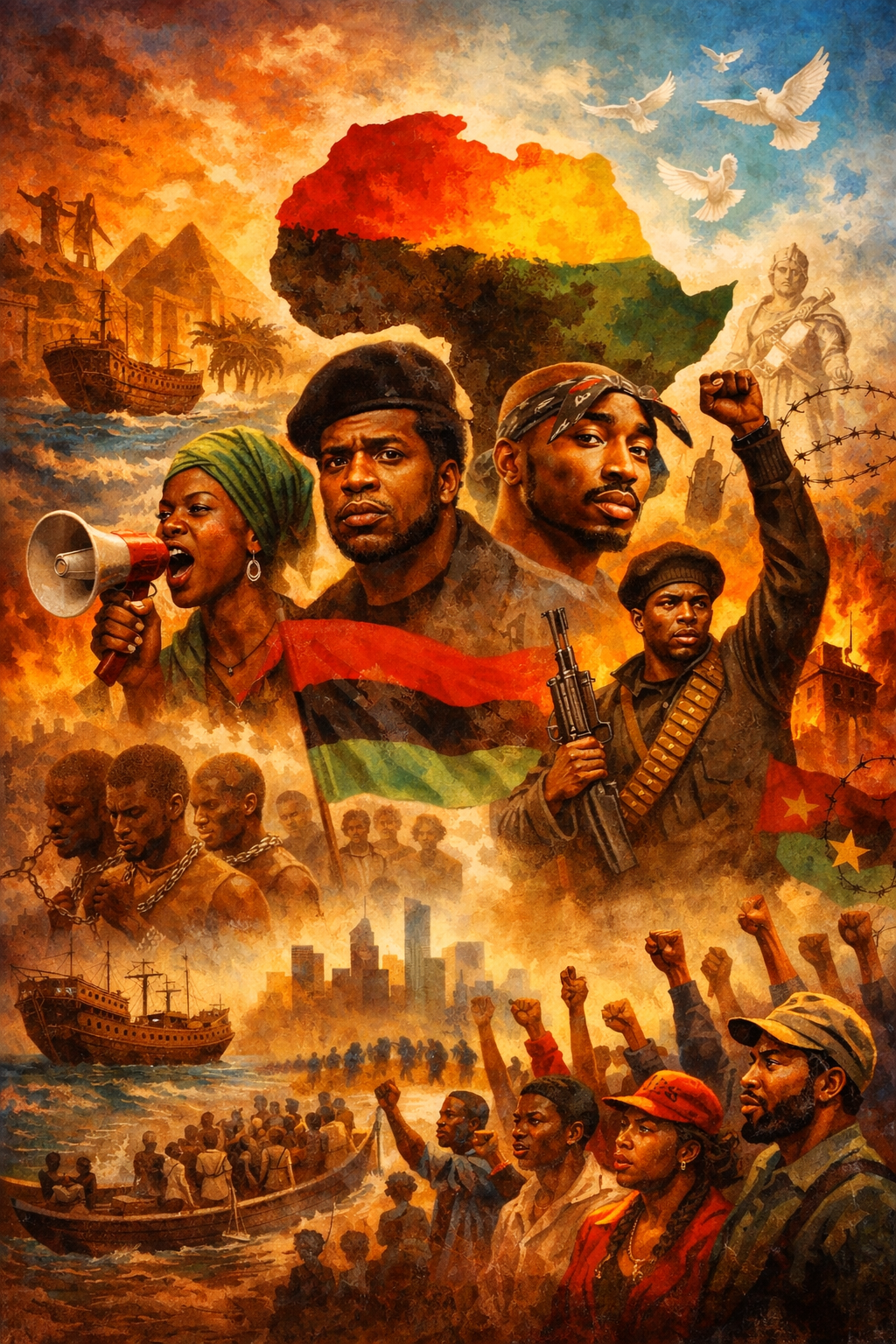
The significance of the subject extends far beyond the history of ideas. Pan-African and Black political thought have shaped debates about citizenship, rights, democracy, colonialism, imperialism, sovereignty, reparations, racial justice, policing, labor, class, migration, culture, religion, identity, and the political meaning of diaspora. They have also challenged the terms on which modern political philosophy has often been written. Black political thought repeatedly asks whether concepts such as liberty, equality, personhood, law, sovereignty, democracy, and the social contract can be understood apart from the histories of enslavement, conquest, segregation, racial capitalism, and exclusion through which modernity itself was built.
The internal diversity of the field becomes clear quickly. Some traditions emphasize return, unity, and collective destiny across the African diaspora. Others emphasize local struggle, anti-colonial state formation, or the specificity of national histories. Some focus on race and anti-Blackness; others insist that race must be understood together with class, gender, labor, land, empire, ecology, religion, and migration. Some defend nationalism, separatism, or autonomous institutions; others defend socialism, internationalism, feminism, abolition democracy, religious reconstruction, or radical democratic transformation.
What unites the field is not a single program but a shared confrontation with the fact that modern political order has been inseparable from racial domination, and that genuine freedom requires more than inclusion into unjust structures. Pan-African and Black political thought therefore belongs at the center of Political Philosophy and Justice, not at its margins. It asks political philosophy to become historically honest about the worlds that produced its most celebrated concepts and about the people excluded from those concepts in practice.
This article pillar is part of the broader Political Philosophy and Justice knowledge series. It moves from slavery, abolition, and nineteenth-century Black political struggle through Pan-Africanism, anti-colonial thought, Negritude, Black Islam, Ahmadiyya-linked African American Islamic revival, the Nation of Islam, Black radicalism, Black Marxism, Black feminist thought, Africana philosophy, and contemporary debates over reparations, policing, migration, citizenship, environmental racism, global anti-Blackness, and decolonial justice. It is designed to provide both conceptual orientation and a rigorous article architecture for future essays on liberation, race, empire, diaspora, religion, and political transformation.
Why Pan-African and Black Political Thought Matter
Pan-African and Black political thought matter because they compel political philosophy to reckon with histories that cannot be treated as peripheral to modernity. The modern state, modern capitalism, modern empire, and modern ideas of citizenship and personhood were all shaped through slavery, colonialism, extraction, racial classification, and racial rule. Black political thought therefore does not merely add neglected voices to an otherwise complete canon. It forces a revision of the canon’s assumptions by showing that race, empire, and dispossession are not secondary topics but foundational dimensions of the political world.
These traditions matter because they ask what freedom means under conditions of domination that are not exhausted by formal legal exclusion alone. A people may be nominally free yet remain subject to racial terror, economic dispossession, colonial subordination, labor extraction, surveillance, exclusionary borders, cultural erasure, religious denigration, or the denial of collective self-determination. Black political thought therefore often treats freedom as material, historical, relational, spiritual, and collective rather than merely formal or juridical. The question is not only whether rights are recognized, but whether people possess the power, dignity, memory, security, and institutional standing required to live as free human beings.
The field also matters because it bridges Africa and the diaspora. Pan-Africanism, in particular, insists that the histories of Africa, the Caribbean, the Americas, and Black life in Europe cannot be understood in isolation. Slavery, colonialism, migration, exile, nationalism, religious reconstruction, and liberation struggle produced a transnational political condition in which racial domination and Black resistance crossed borders and reconfigured the meaning of community itself. This transnational dimension makes Pan-African and Black political thought indispensable to any serious account of empire, global justice, and political belonging.
The field also challenges narrow accounts of political agency. Black political thought has been made not only in formal treatises but also in speeches, sermons, autobiographies, newspapers, songs, poetry, religious movements, revolutionary programs, community institutions, abolitionist networks, labor organizing, liberation movements, prison writings, cultural production, and collective memory. It expands the archive of political theory by showing that political thought is produced wherever people analyze domination, organize resistance, imagine freedom, and build institutions of survival.
What This Article Pillar Covers
This article pillar is designed as a comprehensive foundation for the study of Pan-African and Black political thought within political philosophy and justice. It combines historical depth, conceptual analysis, and contemporary debate while connecting Black political thought to slavery, abolition, anti-colonialism, labor, empire, sovereignty, feminism, race theory, diaspora studies, Black radicalism, Africana philosophy, Black Islamic movements, religious-political self-definition, and decolonial critique.
It begins with the violent formation of the Black Atlantic and the political world created by slavery, colonial conquest, racial law, forced migration, and dispossession. It then moves through abolitionist politics, nineteenth-century struggles over freedom and citizenship, Pan-African congresses, Garveyism, Negritude, anti-colonial thought, Black nationalism, Black internationalism, Black Islamic revival, the Moorish Science Temple, Ahmadiyya missionary networks, the Nation of Islam, civil rights, Black Power, Black Marxism, Black feminism, prison abolition, reparations, and contemporary struggles over racial capitalism, state violence, migration, environmental racism, and global anti-Blackness.
The article pillar is organized around several recurring tensions. The first is the tension between formal emancipation and substantive freedom. The second is the tension between national liberation and diasporic solidarity. The third is the tension between integration and autonomous institution-building. The fourth is the tension between race-specific analysis and broader accounts of class, gender, empire, ecology, religion, and labor. The fifth is the tension between liberal rights frameworks and deeper structural transformation. The sixth is the tension between memory and futurity: how to honor the dead, confront historical violence, and build new political horizons.
A research-grade treatment of this field must avoid two mistakes. It must not reduce Black political thought to a single ideological tradition, as though Pan-Africanism, Black nationalism, Black Islam, Black Marxism, Black feminism, abolitionism, and Africana philosophy were interchangeable. But it also must not isolate these traditions from one another, because they repeatedly overlap through shared histories of racial domination, diaspora, resistance, religious experimentation, and world-making.
Freedom, Humanity, and the Afterlife of Slavery
One of the field’s central concerns is the struggle over Black humanity itself. Enslavement, racial classification, colonial anthropology, segregation, and anti-Black violence all worked to deny the full personhood of Black peoples. Black political thought therefore often begins from a struggle to assert humanity against systems that rendered Black life exploitable, disposable, or politically subordinate. This makes emancipation more than a formal legal change. It becomes a question of world-making after racial domination.
The afterlife of slavery is not simply a metaphor for memory. It refers to the persistence of institutional patterns, economic structures, legal practices, cultural representations, and forms of vulnerability that outlast the formal abolition of slavery. Emancipation ended legal ownership of persons, but it did not automatically end racial capitalism, land dispossession, debt peonage, labor coercion, lynching, segregation, colonial exploitation, state violence, or the unequal distribution of life chances. Black political thought asks what freedom requires when domination mutates rather than disappears.
This makes the concept of freedom unusually dense. Freedom may mean escape from enslavement, citizenship, voting rights, land, education, bodily security, self-defense, political representation, cultural dignity, economic independence, spiritual liberation, reproductive autonomy, collective memory, or sovereignty. Different thinkers emphasize different dimensions, but the field as a whole insists that freedom cannot be reduced to formal legal status alone.
The struggle over humanity also changes the meaning of political philosophy itself. If political philosophy asks what persons are owed, Black political thought asks why some human beings were excluded from the category of “person” in the first place and how that exclusion was justified by law, religion, science, economics, culture, and political theory. It therefore forces a deeper inquiry into the foundations of modern personhood, citizenship, and rights.
Diaspora, Solidarity, and Pan-Africanism
Pan-Africanism links Africans and people of African descent through histories of displacement, struggle, and shared political aspiration. While Pan-African traditions differ greatly, they often insist that slavery, colonialism, and racial hierarchy created a transnational political condition requiring solidarity across borders. Pan-African thought has therefore included cultural, political, economic, religious, and spiritual dimensions, ranging from diasporic identity and congress politics to anti-colonial organizing, Black internationalism, reparations, and demands for continental and global unity.
Diaspora is not merely dispersal. It is a political condition shaped by forced movement, memory, kinship, rupture, survival, and reconstruction. The African diaspora was created through violence, yet it also generated new forms of political community, religion, music, language, resistance, and identity. Pan-African and Black political thought ask how a people fragmented by slavery and empire can imagine solidarity without erasing difference.
Pan-Africanism has taken many forms. Some versions emphasize return to Africa or the building of independent Black institutions. Others emphasize continental liberation, anti-colonial unity, or the political federation of African states. Others emphasize cultural reclamation, diasporic consciousness, economic cooperation, religious renewal, or human-rights politics. What unites these versions is the claim that Black struggle is not merely local. It belongs to a global history of racial domination and collective resistance.
This transnational dimension makes Pan-Africanism especially important for global justice. It challenges nation-bound accounts of citizenship and political belonging by asking how historical violence creates obligations across borders. It also reveals that modern political life has always been global, even when political theory pretended otherwise. Slavery, empire, capitalism, religious hierarchy, and racial hierarchy were transnational systems; Black solidarity became transnational in response.
Nation, Sovereignty, and Liberation
Black political thought has long wrestled with nationalism, separatism, self-determination, and the meaning of sovereign political community. For some thinkers, Black liberation requires autonomous institutions, national self-rule, territorial sovereignty, or independent political power. For others, nationalism must be held in tension with socialism, feminism, diaspora, internationalism, religion, or democratic pluralism. Anti-colonial thought in Africa and the Caribbean added further complexity by linking national liberation to decolonization, development, language, land, and the unfinished work of postcolonial statehood.
Nationalism can function as a politics of dignity and self-defense. When Black peoples are excluded from citizenship, exploited by empire, or denied collective power, national consciousness can become a way to reject dependency and assert political agency. It can support schools, economic institutions, cultural renewal, religious institutions, armed resistance, diplomatic struggle, and claims to self-determination. It can also challenge assimilationist politics that require oppressed peoples to seek recognition from institutions built against them.
Yet nationalism also raises difficult questions. Who belongs to the nation? How are gender, class, religion, ethnicity, and diaspora treated within nationalist frameworks? Can nationalism become authoritarian, patriarchal, exclusionary, or insufficiently attentive to internal differences? Can postcolonial sovereignty produce liberation if economic dependency and imperial pressure remain intact? Black political thought has repeatedly debated these questions because liberation cannot be reduced to flag independence or formal statehood alone.
Sovereignty is therefore both necessary and incomplete. Anti-colonial movements fought for national sovereignty because colonial rule denied self-determination. But postcolonial Black political thought also asks what forms of sovereignty are possible in a world shaped by debt, military intervention, resource extraction, unequal trade, multinational corporations, and global governance systems that constrain newly independent states. The problem of liberation therefore extends beyond independence into the institutional conditions of real self-rule.
Race, Empire, and Colonial Modernity
Another major concern is the relation between race and empire. Black political thought repeatedly shows that race is not only a matter of prejudice or identity, but a political technology bound up with slavery, labor extraction, colonial governance, segregation, policing, and global hierarchy. This makes race central to the critique of modernity itself. Rather than asking simply how race fits into liberal institutions, many Black thinkers ask how those institutions were constituted through racial domination from the start.
Colonial modernity depended on classification. Peoples were ranked, governed, studied, exploited, and disciplined through racial categories presented as natural, scientific, civilizational, or administrative. Blackness was constructed within this world not only as identity but as a political position marked by dispossession, forced labor, exclusion, surveillance, and vulnerability. Black political thought analyzes how these categories were made and how they continue to shape institutions.
Empire also shaped the geography of political thought. Theories of rights, law, sovereignty, progress, civilization, and humanity were often developed in metropoles that benefited from colonial extraction. Black political thought asks whether political concepts can be purified of that history or whether the history must transform how the concepts are understood. This is why Black critique often becomes a critique of modernity itself.
The field also refuses to treat colonialism as a finished past. Colonial forms persist in borders, debt, resource extraction, military power, development regimes, racialized migration control, land dispossession, environmental harm, and cultural hierarchy. To study race and empire in Black political thought is therefore to study the unfinished structure of the modern world.
Labor, Class, and Racial Capitalism
Black political thought has developed powerful analyses of labor, class, and political economy. In some strands, race and class are inseparable because Black labor was constitutive of capitalist development through slavery, plantation economies, colonial extraction, racialized wage hierarchies, domestic service, prison labor, and precarious work. Black Marxism, anti-colonial socialism, and later critiques of racial capitalism have insisted that neither class nor race can be understood adequately in isolation from the other.
Racial capitalism names the argument that capitalism did not simply become racial by accident. It developed historically through racial differentiation, slavery, colonialism, dispossession, and labor hierarchy. Black labor was central to the creation of wealth, yet Black people were excluded from the full protection of property, citizenship, wages, and social standing. This history complicates any political philosophy that treats capitalism as a neutral system of exchange among formally free individuals.
Class analysis remains essential, but Black political thought challenges versions of class theory that treat race as secondary. Racial domination shapes labor markets, housing, incarceration, schooling, health, migration, policing, environmental exposure, and wealth accumulation. At the same time, race is not reducible to class. Anti-Blackness operates through cultural, legal, symbolic, spatial, and bodily forms of domination that cannot be fully explained by wage relations alone.
This is why Black radical traditions often combine critiques of capitalism, empire, state violence, and racial hierarchy. The plantation, the colony, the prison, the ghetto, the border, the workplace, and the debt regime can all become sites of political analysis. Black political thought asks how freedom can be secured when labor, race, and capital are historically intertwined.
Culture, Consciousness, and Political Identity
Movements such as Negritude, Afrocentrism, Black Power, Black Islam, and other currents of cultural and political affirmation treated culture not as an ornamental domain but as a site of liberation. Language, history, memory, religion, art, music, education, and collective self-understanding became crucial to resisting colonial assimilation and racial denigration. Black political thought therefore often links liberation to consciousness, dignity, historical recovery, and the rejection of imposed standards of value.
Culture matters politically because domination works through meaning as well as force. Colonial and racial systems attempted to define Blackness as inferior, primitive, dependent, criminal, irrational, or outside history. Cultural affirmation responded by reclaiming African history, diasporic creativity, spiritual traditions, aesthetic forms, religious autonomy, and intellectual authority. This was not merely symbolic. It was a struggle over who could name the world and who could appear as a subject of history.
Negritude, for example, challenged colonial assimilation by affirming Black identity and cultural value, while also raising debates about essentialism, gender, class, and the relation between culture and political economy. Black Power linked culture to self-defense, community control, education, and institutional autonomy. Black Islamic movements linked religious discipline, self-naming, moral reform, and critique of white supremacy to the reconstruction of Black political identity. Africana philosophy and Black existentialism deepened the field by asking how Black being, freedom, embodiment, alienation, and recognition are shaped under conditions of racialized modernity.
Political identity in this tradition is therefore both inherited and made. It is shaped by violence, but it is not exhausted by victimization. Black political thought repeatedly turns imposed identity into a site of resistance, solidarity, memory, creativity, and world-building.
Black Islam, the Nation of Islam, and Ahmadiyya Connections
Black Islamic movements belong within Pan-African and Black political thought because they helped reshape the political meaning of identity, discipline, self-respect, community formation, anti-racist critique, and historical recovery among African Americans. These movements cannot be reduced to theology alone. They functioned as institutions of moral reconstruction, political education, cultural reorientation, economic self-help, and resistance to the racial order of the United States.
The Nation of Islam is especially important because it joined religious language to Black nationalism, self-discipline, racial pride, economic independence, critique of white supremacy, and the rejection of inherited slave names. Emerging in Detroit in the early twentieth century through Wallace D. Fard and developed under Elijah Muhammad, the Nation of Islam became one of the most influential Black religious-political movements of the twentieth century. Its significance for political philosophy lies not only in its theology, which differs sharply from mainstream Sunni Islam and from Ahmadiyya Islam, but in its role as a movement of Black self-definition, separatist critique, communal institution-building, and political refusal.
Malcolm X makes this history unavoidable. His rise within the Nation of Islam, later break with the movement, embrace of Sunni Islam after the hajj, and turn toward international human rights politics reveal the movement’s complex place within Black political thought. Malcolm’s trajectory connects Black nationalism, Islamic identity, anti-colonial internationalism, critique of U.S. racial violence, and the global politics of liberation. Any serious article architecture on Pan-African and Black political thought should therefore treat the Nation of Islam not as an isolated religious organization, but as part of the wider history of Black political modernity.
The Ahmadiyya movement should also be included, but with precision. Ahmadiyya missionaries from colonial India were among the earliest organized Muslim presences in the United States, especially in Chicago and Detroit during the 1920s. Their publications and missionary work reached African American audiences through anti-racist messaging, Pan-Islamic vocabulary, and appeals to Islam as a religion connected to dignity, discipline, ancestral recovery, and liberation. This does not mean that the Nation of Islam was simply an Ahmadiyya offshoot. The relationship is better understood as part of a shared historical environment in which Islam, Black nationalism, Pan-Africanism, anti-Christian critique, immigrant Muslim networks, and African American religious experimentation interacted.
This distinction matters. The Nation of Islam developed a distinctive theology and political program that mainstream Sunni Muslims and Ahmadi Muslims generally did not share. But Ahmadiyya missionary activity helped create an earlier Black Islamic intellectual and institutional context in which Islam could be understood by African Americans as a language of racial dignity, anti-colonial identification, moral discipline, and spiritual-political renewal. The connection is therefore historical, rhetorical, and contextual rather than straightforwardly organizational.
This section also belongs here because Black Islam complicates secular readings of Black political thought. Black religious-political movements were not simply private faith communities. They built newspapers, schools, businesses, mosques, discipline systems, prison ministries, speaking circuits, and alternative institutions of community formation. They also contested the racial meaning of Christianity in the Americas, the memory of Africa, the politics of naming, and the relationship between spiritual identity and political freedom. In that sense, Black Islam belongs alongside Pan-Africanism, Black nationalism, Black Power, and Black internationalism as one of the major frameworks through which Black communities theorized liberation.
Gender and Black Feminist Thought
No adequate account of Black political thought can treat race as separable from gender, reproduction, care, and family regulation. Black feminist thought has transformed the field by showing how patriarchy, racialization, labor exploitation, and state violence intersect. It has also challenged masculinist assumptions within nationalist, socialist, religious, and even liberal traditions, insisting that liberation must include the political experiences of Black women and forms of life long treated as secondary.
Black feminist thought reveals that political domination often operates through the body, household, workplace, prison, clinic, school, welfare office, and family structure. The regulation of Black women’s labor, reproduction, motherhood, respectability, and public voice has been central to racial domination. Freedom therefore cannot be defined only through male citizenship, formal rights, national sovereignty, religious authority, or class struggle.
Intersectionality became one of the most important conceptual contributions of Black feminist thought because it showed that race, gender, class, labor, family structure, and other structures of power do not operate separately and then merely add together. They produce distinct forms of experience, vulnerability, resistance, and political knowledge. Black women’s political thought therefore does not simply supplement existing theories; it changes the terms of analysis.
Black feminism also expands the field’s understanding of care, love, community, survival, and coalition. It asks how movements reproduce hierarchy internally and how liberation politics can avoid sacrificing some members of the community for the symbolic unity of the whole. It insists that freedom must be measured by those most exposed to overlapping systems of domination.
Reparations, Justice, and the Contemporary State
Contemporary Black political thought continues to confront the institutional afterlives of slavery and colonialism in policing, incarceration, border regimes, economic inequality, land dispossession, health disparities, environmental racism, democratic exclusion, educational inequality, and public memory. This has renewed debates over reparations, abolition democracy, citizenship, redistribution, restitution, memorialization, and the transformation of state institutions. The field therefore remains urgently contemporary, not merely historical.
Reparations are not only about compensation, though compensation may matter. They raise deeper questions about historical responsibility, institutional repair, stolen labor, stolen land, racial wealth gaps, colonial extraction, state violence, public truth, and the conditions of justice after mass harm. Reparations debates ask whether political communities can be legitimate if they inherit the benefits of injustice while refusing repair.
Abolitionist politics similarly challenges narrow reform. It asks whether institutions such as prisons, policing, and punitive surveillance can be made just, or whether they reproduce structures of racial domination that require deeper transformation. Abolition democracy, in this sense, is not merely the removal of harmful institutions. It is the building of life-supporting institutions: housing, health, education, care, employment, safety, and democratic community power.
The contemporary state remains central because it is both a site of protection and a site of violence. Black political thought asks how state institutions can be transformed when they have historically organized surveillance, dispossession, punishment, and exclusion. It also asks how freedom can be built through community institutions, religious institutions, public goods, international solidarity, and democratic power beyond the state alone.
Historical Formation: Slavery, Colonialism, Diaspora, and Resistance
A serious account of Pan-African and Black political thought begins with the violent making of the modern Black Atlantic. The transatlantic slave trade, plantation slavery, colonial conquest, and racial law did not simply create populations marked as Black. They generated a vast political world of captivity, dispossession, labor extraction, exile, and resistance. From maroon communities and slave revolts to abolitionist networks and diasporic newspapers, Black political thought grew out of practical struggle as much as formal theory. The demand for freedom was never purely abstract. It was anchored in the lived refusal of enslavement and racial domination.
The nineteenth and early twentieth centuries transformed these struggles into wider intellectual and organizational traditions. Abolitionism became linked to citizenship, education, emigration debates, labor, religion, and institutional self-determination. Pan-African congresses, diasporic networks, Garveyism, Black Islamic revival, and later anti-colonial organizing connected the condition of Black people across the Americas, the Caribbean, Europe, Africa, and the wider Muslim world. This period made clear that slavery and colonialism were not separate histories but related structures of racial rule shaping a shared political condition.
The twentieth century deepened and diversified the field. Anti-colonial thinkers linked liberation to national sovereignty, culture, socialism, and postcolonial reconstruction. Negritude, Black existentialism, Black Islam, and Africana philosophy challenged colonial categories of humanity and reason. Black radical traditions in the United States, the Caribbean, and Africa confronted segregation, empire, policing, labor exploitation, religious hierarchy, and capitalist domination. Black feminist thinkers reconstructed the field by exposing the limits of race-only and class-only frameworks.
Contemporary debates over reparations, abolition, migration, environmental justice, religious freedom, and global anti-Blackness show that Pan-African and Black political thought remain living traditions shaped by unfinished struggles. The field is historical, but it is not past. It continues to interpret the present through the long memory of slavery, empire, resistance, religious reconstruction, and world-making.
Pan-African and Black Political Thought Within Political Philosophy and Justice
Within political philosophy, Pan-African and Black political thought occupy a foundational but historically marginalized position. They are foundational because they address sovereignty, personhood, citizenship, labor, rights, violence, law, democracy, legitimacy, religion, culture, and freedom at the deepest level. They were marginalized because canonical political philosophy often treated slavery, race, empire, colonial rule, and Black religious-political life as secondary or accidental to modern political development. Black political thought corrects that distortion by showing that the modern political order cannot be understood without them.
This field also serves as a site where multiple traditions meet and collide. Liberal integrationism, Black nationalism, Pan-Africanism, Black Islam, socialism, Black Marxism, anti-colonial humanism, feminism, Africana existentialism, decolonial critique, and abolitionist politics all share overlapping concerns while diverging sharply on strategy, institutional form, class analysis, nationalism, religion, gender, and the role of the state. Some seek inclusion into a more just democratic order. Others argue that the political order itself was built through racial domination and must be transformed at a structural level. Still others insist that diaspora, empire, religious identity, and coloniality require transnational rather than purely national solutions.
For that reason, this article pillar treats Pan-African and Black political thought not as a supplement to European political theory but as a field of political argument in its own right about liberation, sovereignty, race, labor, community, religion, gender, and the terms of justice after slavery and empire. To study this field seriously is to study one of the most powerful traditions of modern political critique and one of the clearest intellectual challenges to any philosophy that imagines freedom without history or justice without decolonization.
Political philosophy is changed by this encounter. Concepts such as liberty, equality, citizenship, sovereignty, rights, democracy, property, religious freedom, and the social contract appear differently when read from the standpoint of those denied personhood, excluded from citizenship, exploited as labor, governed as colonial subjects, and compelled to reconstruct spiritual and cultural identity under domination. Pan-African and Black political thought therefore does not merely ask for recognition inside the canon. It asks political philosophy to reconsider what the canon has been unable or unwilling to see.
Core Themes in Pan-African and Black Political Thought
One major theme is freedom after slavery. The field asks what freedom means when formal emancipation is followed by racial terror, labor exploitation, segregation, colonial rule, incarceration, and structural exclusion.
A second theme is humanity and personhood. Black political thought challenges the historical denial of Black humanity and asks how political concepts must change when personhood itself has been contested.
A third theme is diaspora. Pan-African and Black political thought examine how forced displacement, migration, exile, and memory create political communities across borders.
A fourth theme is sovereignty and self-determination. These traditions ask how Black peoples and formerly colonized communities can secure political agency, institutional autonomy, and collective power.
A fifth theme is racial capitalism. Black radical traditions analyze how race, labor, class, slavery, colonialism, and capitalist development are historically intertwined.
A sixth theme is culture and consciousness. Political liberation is linked to history, memory, art, language, religion, education, and the recovery of dignity against racial denigration.
A seventh theme is Black religious-political self-definition. Black Islamic movements, the Nation of Islam, Ahmadiyya-linked missionary networks, and related traditions show how religion can become a language of dignity, discipline, anti-racist critique, institutional formation, and political refusal.
An eighth theme is gender and intersectionality. Black feminist thought shows that race cannot be separated from gender, reproduction, care, labor, and state violence.
A ninth theme is abolition and institutional transformation. The field asks whether prisons, policing, borders, and punitive institutions can be reformed or must be fundamentally transformed.
A tenth theme is reparative justice. Black political thought asks what repair is owed for slavery, colonialism, dispossession, racial terror, stolen labor, and ongoing institutional harm.
An eleventh theme is global anti-Blackness and decolonial justice. The field asks how racial domination operates across nations, empires, borders, religious geographies, and global systems, and how liberation must be imagined beyond the nation-state alone.
Expanded Article Architecture
The following structure gathers the article pillar into a long-range architecture suitable for a major political philosophy knowledge series. It preserves the planned article architecture from the source draft while adding a dedicated Black Islam cluster covering the Nation of Islam, Ahmadiyya connections, the Moorish Science Temple, Malcolm X, Warith Deen Mohammed, and debates over Islamic legitimacy in African American political life.
Foundations, Slavery, and Nineteenth-Century Black Political Modernity
- What Is Pan-African and Black Political Thought? (planned)
Introduces the field as a tradition of political reflection shaped by slavery, colonialism, diaspora, racial hierarchy, liberation struggle, and the demand for justice after empire. - Slavery, Empire, and the Political Making of the Black Atlantic (planned)
Studies how the slave trade, plantation slavery, colonial rule, and forced migration created the political world of the Black Atlantic. - Abolitionism and the First Traditions of Black Political Modernity (planned)
Examines abolitionism as a political tradition linking emancipation, citizenship, education, labor, moral critique, and institutional self-determination. - Frederick Douglass and the Meaning of Freedom (planned)
Explores Douglass’s political thought on slavery, citizenship, constitutionalism, self-making, and the moral force of freedom. - Sojourner Truth, Gender, and the Politics of Human Equality (planned)
Studies Truth’s challenge to racial and gender hierarchy and her role in expanding the political meaning of equality. - Martin Delany, Emigration, and Black Nationalism (planned)
Explores Delany’s arguments about emigration, self-determination, Black nationality, and the limits of inclusion.
Du Bois, Garvey, and Pan-African Formation
- W.E.B. Du Bois and the Problem of the Color Line (planned)
Studies Du Bois’s account of race, global modernity, democracy, capitalism, empire, and the color line. - Du Bois, Double Consciousness, and Democratic Reconstruction (planned)
Examines double consciousness, Black subjectivity, democratic promise, and the unfinished struggle for reconstruction. - Marcus Garvey and the Politics of Black National Destiny (planned)
Explores Garveyism, race pride, economic independence, mass organizing, return, and diasporic nationalism. - Pan-African Congresses and the Global Politics of Black Solidarity (planned)
Studies Pan-African congress politics as an international effort to connect diaspora, anti-colonialism, rights, and self-determination. - Pan-Africanism: Unity, Diaspora, and the Idea of a Global Black Politics (planned)
Introduces Pan-Africanism as a transnational political tradition linking Africa and the diaspora through solidarity and liberation. - Race, Citizenship, and Exclusion in the Atlantic World (planned)
Examines how race structured citizenship, rights, belonging, law, labor, and personhood across the Atlantic world. - Black Internationalism and Anti-Imperial Struggle (planned)
Examines Black internationalist thought as a response to empire, capitalism, colonialism, and global racial hierarchy.
Black Islam, the Nation of Islam, and Religious-Political Self-Definition
- Black Islam and the African American Search for Liberation (planned)
Introduces Black Islamic movements as religious-political traditions of dignity, discipline, self-definition, anti-racist critique, and communal institution-building. - The Ahmadiyya Movement and the Early Black Islamic Revival in America (planned)
Studies Ahmadiyya missionary work in Chicago, Detroit, and other U.S. contexts as an early institutional expression of Islam that reached African American audiences through anti-racist, Pan-Islamic, and liberation-oriented rhetoric. - Ahmadiyya, Pan-Islamism, and African American Religious Modernity (planned)
Examines how Ahmadiyya publications and missionary networks connected Islam to racial dignity, ancestral memory, anti-colonial consciousness, and African American religious experimentation. - The Moorish Science Temple and the Religious Politics of Black National Identity (planned)
Explores Noble Drew Ali, Moorish identity, Islamicate symbolism, nationality, self-naming, and the early twentieth-century religious reconstruction of Black political identity. - The Nation of Islam and the Politics of Black Self-Definition (planned)
Studies the Nation of Islam as a religious-political movement organized around Black nationalism, discipline, economic self-help, separatist critique, and the rejection of white supremacist social order. - Wallace Fard Muhammad, Elijah Muhammad, and the Making of the Nation of Islam (planned)
Examines the origins of the Nation of Islam in Detroit, the role of Wallace Fard Muhammad, Elijah Muhammad’s leadership, and the formation of a distinctive Black nationalist religious theology. - Elijah Muhammad, Economic Self-Reliance, and the Black Muslim Program (planned)
Studies Elijah Muhammad’s emphasis on economic independence, discipline, moral reform, community institutions, and the political meaning of separation. - Malcolm X, the Nation of Islam, and the Turn Toward Global Human Rights (planned)
Examines Malcolm X’s movement from Nation of Islam minister to Sunni Muslim internationalist, connecting Black nationalism, anti-colonial solidarity, human rights, and global liberation politics. - Warith Deen Mohammed and the Transition Toward Sunni Islam (planned)
Studies the post-1975 transformation of much of the Nation of Islam under Warith Deen Mohammed toward Sunni Islam, pluralism, and a different model of African American Muslim identity. - Louis Farrakhan, the Reconstituted Nation of Islam, and Black Nationalist Continuity (planned)
Examines the reconstitution of the Nation of Islam under Louis Farrakhan, including continuity with Elijah Muhammad’s teachings, mass mobilization, institutional power, and public controversy. - Black Muslim Movements, Orthodoxy, and the Debate Over Islamic Legitimacy (planned)
Explores debates among the Nation of Islam, Sunni Muslims, Ahmadi Muslims, and other Muslim communities over theology, race, authority, orthodoxy, and the meaning of Islam in African American political life.
Negritude, Anti-Colonial Humanism, and African Liberation Thought
- Negritude and the Politics of Cultural Reclamation (planned)
Studies Negritude as a movement of cultural affirmation, anti-colonial critique, and reclamation of Black identity. - Aimé Césaire, Colonialism, and the Return of Human Dignity (planned)
Examines Césaire’s critique of colonial civilization, dehumanization, and the moral bankruptcy of empire. - Léopold Sédar Senghor, Culture, and Political Identity (planned)
Studies Senghor’s thought on culture, African identity, Negritude, humanism, and postcolonial political formation. - Frantz Fanon and the Violence of Colonial Rule (planned)
Explores Fanon’s analysis of colonial violence, dehumanization, race, psychic injury, and revolutionary struggle. - Fanon, Liberation, and the New Humanism (planned)
Examines Fanon’s vision of liberation as the creation of a new political humanity beyond colonial domination. - Kwame Nkrumah and the Politics of African Unity (planned)
Studies Nkrumah’s vision of Pan-African unity, anti-imperialism, socialism, development, and continental sovereignty. - Julius Nyerere, Ujamaa, and Postcolonial Political Community (planned)
Examines Nyerere’s theory of African socialism, village community, moral economy, and postcolonial development. - Amílcar Cabral and the Political Uses of Culture (planned)
Studies Cabral’s account of culture, class, anti-colonial struggle, national liberation, and revolutionary organization. - Patrice Lumumba and the Crisis of Postcolonial Sovereignty (planned)
Examines Lumumba’s political significance in relation to sovereignty, resource control, imperial intervention, and postcolonial statehood.
Black Power, Civil Rights, and Revolutionary Community Politics
- Black Power and the Transformation of Democratic Struggle (planned)
Studies Black Power as a shift from civil rights inclusion toward self-determination, community control, and radical critique. - Malcolm X, Black Internationalism, and Human Rights (planned)
Examines Malcolm X’s transformation of Black struggle from a civil-rights question into a global human-rights and anti-imperial struggle. - Martin Luther King Jr., Democracy, and the Moral Critique of America (planned)
Studies King’s political thought on democracy, nonviolence, poverty, racism, militarism, and moral reconstruction. - The Black Panther Party and Revolutionary Community Defense (planned)
Examines the Panthers’ programs of self-defense, community survival, socialist politics, and state repression. - Huey P. Newton, Revolutionary Intercommunalism, and Black Political Power (planned)
Studies Newton’s theory of revolutionary intercommunalism, community control, capitalism, empire, and Black liberation. - Fred Hampton, Rainbow Coalition Politics, and Revolutionary Solidarity (planned)
Explores Hampton’s coalition politics, class analysis, anti-racism, socialist organizing, and revolutionary solidarity. - Assata Shakur, Black Liberation, Exile, and Revolutionary Resistance (planned)
Studies Shakur’s political significance in relation to state violence, imprisonment, exile, liberation, and revolutionary memory.
Black Marxism, Racial Capitalism, and Radical Political Economy
- Black Marxism and the Critique of Racial Capitalism (planned)
Introduces Black Marxism as a tradition analyzing capitalism, slavery, empire, racial hierarchy, and Black radical resistance. - C.L.R. James, Revolution, and the Black Atlantic (planned)
Studies James’s thought on revolution, Haiti, Marxism, anti-colonialism, democracy, and the Black Atlantic. - Cedric Robinson and the Theory of Racial Capitalism (planned)
Examines Robinson’s account of racial capitalism and the Black radical tradition. - Stokely Carmichael, Anti-Imperialism, and Black Self-Determination (planned)
Studies Carmichael’s thought on Black Power, anti-imperialism, self-determination, and global liberation.
Africana Philosophy, Black Existentialism, and Political Identity
- Africana Philosophy and the Politics of Diaspora (planned)
Introduces Africana philosophy as a field of thought shaped by diaspora, colonialism, race, personhood, and liberation. - Black Existentialism and the Problem of Freedom (planned)
Studies Black existential thought on freedom, embodiment, alienation, absurdity, and the struggle for self-making under racial domination. - Afrocentrism, Identity, and Political Self-Definition (planned)
Examines Afrocentrism as a project of historical recovery, cultural self-definition, and resistance to Eurocentric knowledge systems. - Race, Ontology, and the Critical Philosophy of Black Being (planned)
Explores philosophical debates over Black being, racialization, embodiment, social death, recognition, and political existence.
Black Feminist Thought, Gender, and Intersectional Politics
- Black Feminist Thought and the Reconstruction of Political Theory (planned)
Studies Black feminism as a transformation of political theory through race, gender, class, labor, care, and institutional critique. - Angela Davis, Abolition, and the Carceral State (planned)
Examines Davis’s political thought on prisons, abolition, capitalism, race, gender, and freedom. - bell hooks, Love, Power, and Radical Social Critique (planned)
Studies hooks’s work on love, domination, patriarchy, class, race, education, and emancipatory political practice. - Patricia Hill Collins and the Politics of Intersectionality (planned)
Explores Collins’s account of Black feminist epistemology, controlling images, intersectionality, and political knowledge.
Abolition, Reparations, Ecology, and Diasporic Belonging
- Police, Prisons, and the Politics of Abolition (planned)
Studies abolitionist critiques of policing, prisons, surveillance, punishment, and racialized state violence. - Reparations, Restitution, and Historical Justice (planned)
Examines reparations as a demand for repair after slavery, colonialism, stolen labor, dispossession, and institutional harm. - The Uhuru Movement, Reparations, and African Internationalism (planned)
Studies the Uhuru Movement’s reparations politics, African internationalism, self-determination, and critique of colonial power. - Environmental Racism and Ecological Justice in Black Political Thought (planned)
Explores environmental racism, pollution, land, health, climate vulnerability, and ecological repair. - Migration, Borders, and the Politics of Diasporic Belonging (planned)
Examines migration, border regimes, refugees, citizenship, diaspora, and racialized mobility.
Pan-Africanism, the Diaspora, Culture, and Contemporary Black Political Thought
- Africa, the Caribbean, and the Politics of Regional Federation (planned)
Explores regional federation as a response to fragmentation, colonial borders, dependency, and the search for collective power. - Black Political Thought in Latin America and the Afro-Diasporic South (planned)
Studies Black political traditions across Latin America, the Caribbean, and the Afro-diasporic South. - Tupac Shakur, Political Memory, Black Radical Lineage, and Cultural Power (planned)
Examines Tupac Shakur as a cultural figure situated within Black radical memory, urban inequality, carcerality, and political inheritance. - Pan-Africanism After Decolonization (planned)
Studies the challenges facing Pan-African politics after formal independence, including sovereignty, development, debt, and state formation. - Black Political Thought in the Age of Global Anti-Blackness (planned)
Studies anti-Blackness as a global structure shaped by policing, borders, migration, labor, media, health, and state power. - Why Pan-African and Black Political Thought Still Matter (planned)
Concludes the series by explaining why this field remains indispensable to debates over freedom, democracy, justice, race, empire, and global political order.
Closing Perspective
Pan-African and Black political thought remain indispensable because the histories that produced them remain unfinished. Slavery, colonialism, racial capitalism, segregation, land dispossession, extraction, policing, incarceration, migration control, religious denigration, and cultural erasure continue to shape political life in transformed forms. A society may proclaim equality while reproducing racial vulnerability through housing, labor, healthcare, education, environmental exposure, debt, borders, state violence, and unequal recognition. Black political thought keeps asking whether such a society can honestly call itself free.
This is what makes the field so important within political philosophy. It joins historical memory to normative critique. It asks whether concepts such as freedom, equality, rights, citizenship, sovereignty, democracy, religious liberty, and human dignity can be adequate if they ignore the people excluded from them. It also expands the meaning of political theory by treating speeches, songs, sermons, religious movements, prison writings, autobiographies, cultural memory, and collective struggle as sites of serious political thought.
The strongest reason to study Pan-African and Black political thought is that it trains political judgment where modernity’s contradictions become most visible. It teaches that freedom without history becomes abstraction, justice without repair becomes evasion, and equality without structural transformation becomes performance. It also teaches that liberation is not only resistance to domination. It is the work of building memory, institutions, solidarities, cultures, religious vocabularies, and futures in which denied humanity is restored as political power.
Related Reading
- Political Philosophy and Justice — for authority, legitimacy, rights, democracy, law, justice, and the moral foundations of collective life.
- Socialism and Socialist Thought — for class, labor, capitalism, racial capitalism, socialist critique, and democratic economic transformation.
- Liberation, Anti-Colonial, and Decolonial Thought — for anti-imperial critique, decolonization, coloniality, sovereignty, and liberation movements.
- Liberalism and Its Traditions — for rights, citizenship, equality, law, public reason, and the liberal frameworks Black political thought often critiques and revises.
- Ethics and Moral Philosophy — for moral obligation, dignity, responsibility, justice, repair, and the good life.
- Global Governance — for sovereignty, human rights, international institutions, migration, development, and global justice.
- Institutions and Governance — for state power, legitimacy, accountability, governance systems, and institutional design.
- Abrahamic Traditions — for comparative study of Islam, Christianity, Judaism, revelation, law, prophecy, and sacred history.
Further Reading
- Césaire, A. (2000) Discourse on Colonialism. Translated by J. Pinkham. New York: Monthly Review Press. Available at: https://monthlyreview.org/product/discourse-on-colonialism/.
- Curtis, E.E. (2002) Islam in Black America: Identity, Liberation, and Difference in African-American Islamic Thought. Albany: State University of New York Press.
- Curtis, E.E. (2006) Black Muslim Religion in the Nation of Islam, 1960–1975. Chapel Hill: University of North Carolina Press.
- Davis, A.Y. (2003) Are Prisons Obsolete? New York: Seven Stories Press. Available at: https://www.sevenstories.com/books/1274-are-prisons-obsolete.
- Du Bois, W.E.B. (1903) The Souls of Black Folk. Chicago: A.C. McClurg & Co. Available at: https://www.gutenberg.org/ebooks/408.
- Fanon, F. (2004) The Wretched of the Earth. Translated by R. Philcox. New York: Grove Press. Available at: https://groveatlantic.com/book/the-wretched-of-the-earth/.
- Garvey, M. (2016) Selected Writings and Speeches of Marcus Garvey. New York: Dover Publications. Available at: https://store.doverpublications.com/products/9780486806646.
- Gordon, L.R. (2008) An Introduction to Africana Philosophy. Cambridge: Cambridge University Press. Available at: https://www.cambridge.org/core/books/introduction-to-africana-philosophy/6F3BF4B4E9D31B3D93A6D3B3171C96B6.
- hooks, b. (2000) Where We Stand: Class Matters. New York: Routledge. Available at: https://www.routledge.com/Where-We-Stand-Class-Matters/hooks/p/book/9780415929132.
- Malcolm X and Haley, A. (1965) The Autobiography of Malcolm X. New York: Grove Press. Available at: https://groveatlantic.com/book/the-autobiography-of-malcolm-x/.
- Newton, H.P. (1973) Revolutionary Suicide. New York: Harcourt Brace Jovanovich. Available at: https://www.penguinrandomhouse.com/books/666229/revolutionary-suicide-by-huey-p-newton/.
- Nkrumah, K. (1963) Africa Must Unite. London: Heinemann. Available at: https://abibookstore.com/products/africa-must-unite.
- Robinson, C.J. (2000) Black Marxism: The Making of the Black Radical Tradition. 2nd edn. Chapel Hill: University of North Carolina Press. Available at: https://uncpress.org/book/9780807848294/black-marxism/.
- Shakur, A. (1987) Assata: An Autobiography. Chicago: Lawrence Hill Books. Available at: https://www.haymarketbooks.org/books/1858-assata.
References
- Alcoff, L.M. (2021) ‘Critical Philosophy of Race’, in Zalta, E.N. and Nodelman, U. (eds.) The Stanford Encyclopedia of Philosophy. Available at: https://plato.stanford.edu/entries/critical-phil-race/.
- Britannica (2026) ‘Elijah Muhammad’, Encyclopaedia Britannica. Available at: https://www.britannica.com/biography/Elijah-Muhammad.
- Britannica (2026) ‘Malcolm X’, Encyclopaedia Britannica. Available at: https://www.britannica.com/biography/Malcolm-X.
- Britannica (2026) ‘Nation of Islam’, Encyclopaedia Britannica. Available at: https://www.britannica.com/topic/Nation-of-Islam.
- Britannica (2026) ‘Negritude’, Encyclopaedia Britannica. Available at: https://www.britannica.com/art/Negritude.
- Britannica (2026) ‘Pan-Africanism’, Encyclopaedia Britannica. Available at: https://www.britannica.com/topic/Pan-Africanism.
- Drabinski, J.E. (2019) ‘Frantz Fanon’, in Zalta, E.N. and Nodelman, U. (eds.) The Stanford Encyclopedia of Philosophy. Available at: https://plato.stanford.edu/entries/frantz-fanon/.
- Gines, K.T. (2019) ‘Africana Philosophy’, in Zalta, E.N. and Nodelman, U. (eds.) The Stanford Encyclopedia of Philosophy. Available at: https://plato.stanford.edu/archives/win2019/entries/africana/.
- Taylor, P.C. (2021) ‘Contemporary Africana Philosophy’, in Zalta, E.N. and Nodelman, U. (eds.) The Stanford Encyclopedia of Philosophy. Available at: https://plato.stanford.edu/entries/africana-contemporary/.
- Uhuru Solidarity Movement (2026) Official website. Available at: https://www.uhurusolidarity.org/.
- Videon, H.F. (2024) ‘Sunrise in the Heartland: The Ahmadiyya Movement and African American Islamic Revival’, University of Montana ScholarWorks. Available at: https://scholarworks.umt.edu/gsrc/2024/332/5/.
- Wiley (2024) ‘State of the Field: The History of African Political Thought’, History Compass. Available at: https://onlinelibrary.wiley.com/doi/10.1111/1468-229X.13406.
- Wiredu, K. and others (n.d.) ‘History of African Philosophy’, Internet Encyclopedia of Philosophy. Available at: https://iep.utm.edu/history-of-african-philosophy/.
- Zack, N. (2008) ‘Race’, in Zalta, E.N. and Nodelman, U. (eds.) The Stanford Encyclopedia of Philosophy. Available at: https://plato.stanford.edu/entries/race/.