
Last Updated May 4, 2026
Maghrebi and Andalusi Thought explores the philosophical, legal, theological, mystical, literary, scientific, political, and historical traditions through which thinkers in North Africa and al-Andalus reflected on reason, revelation, law, ethics, memory, society, sovereignty, and the fate of civilization. As a major category within the Philosophy knowledge series, this pillar studies the western Islamic intellectual world not as a peripheral extension of eastern Islamic philosophy, but as a major civilizational field shaped by Amazigh, Arab, Islamic, Jewish, African, Mediterranean, and Iberian inheritances.
This field includes the formation of Mālikī jurisprudence, uṣūl al-fiqh, maqāṣid reasoning, hadith scholarship, Qurʾanic exegesis, kalām, falsafa, Sufi discipline, saintly authority, adab, poetry, medicine, astronomy, logic, mathematics, historiography, Jewish-Arabic thought, Amazigh statecraft, dynastic political theory, manuscript transmission, and the memory of al-Andalus. It examines a western Islamic tradition in which law, metaphysics, revelation, spiritual formation, political order, urban refinement, scientific inquiry, and historical memory repeatedly intersect.
The series proceeds from a central methodological claim: Maghrebi and Andalusi thought cannot be reduced to a few famous philosophers, a nostalgic memory of convivencia, or a regional appendix to either European or Middle Eastern intellectual history. Its deepest arguments often appear in legal manuals, fatwas, commentaries, poetic anthologies, Sufi writings, chronicles, urban histories, medical and scientific works, Jewish-Arabic philosophical texts, dynastic memory, and reflections on conquest, exile, decline, and civilizational loss. The field therefore requires a broad understanding of philosophy, one capable of reading jurisprudence, theology, mysticism, literature, history, and social explanation as mutually connected forms of thought.
The goal of this pillar is not to romanticize al-Andalus, flatten North Africa into Andalusi memory, or treat the western Islamic world only through its later loss. It is to show why Maghrebi and Andalusi thought remains philosophically indispensable precisely because it joins reason, revelation, law, metaphysics, urban culture, spiritual discipline, scientific order, Amazigh and Arab statecraft, Jewish-Muslim intellectual exchange, Mediterranean circulation, Saharan connection, and the moral problem of civilizational endurance into one of the great intellectual archives of the Islamic west.
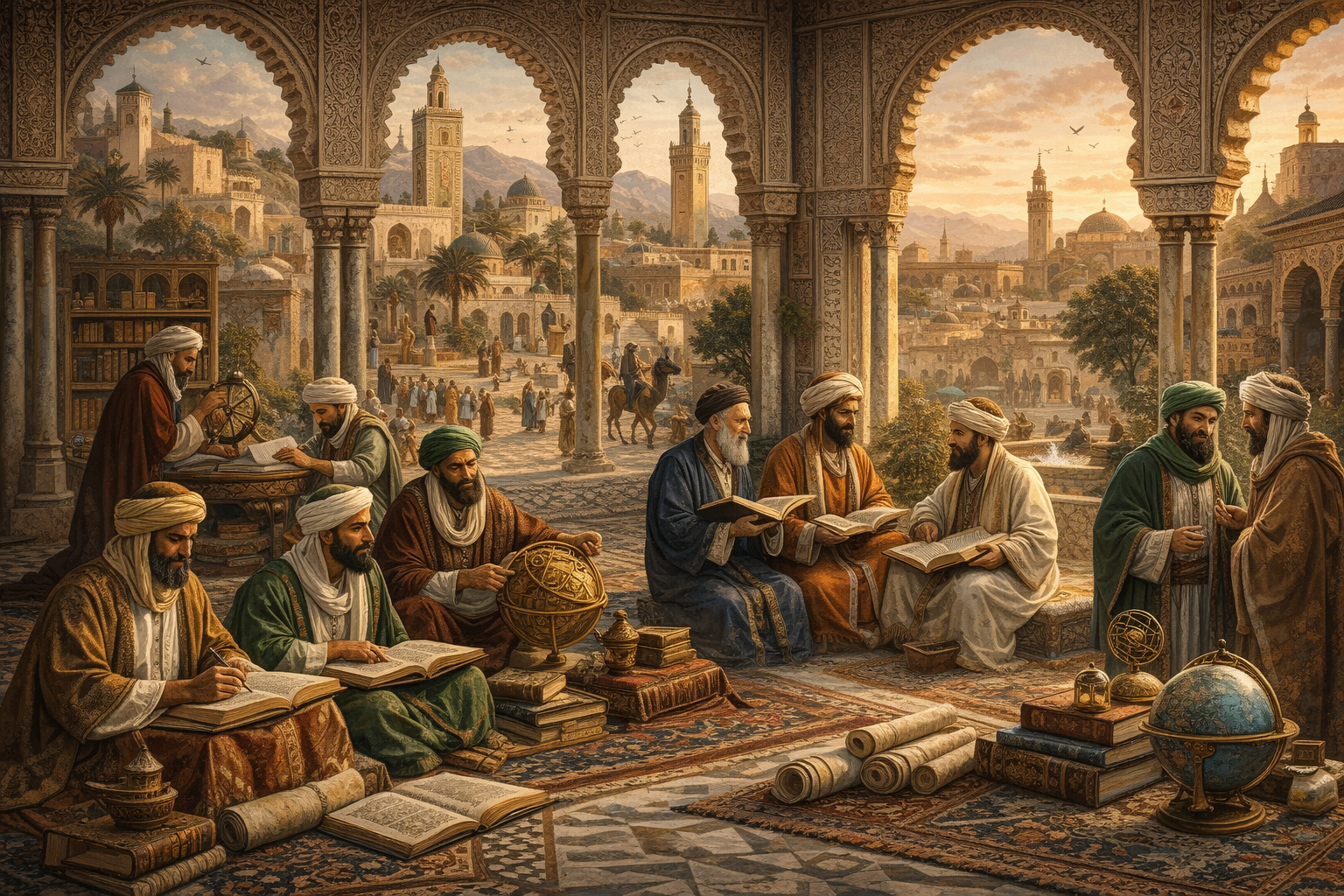
Maghrebi and Andalusi thought is especially important to a broader philosophy architecture because it restores the western Islamic world to its proper place as a major center of reflection on law, ethics, metaphysics, society, science, and civilization. In this respect, the category links not only to Arabian and Levantine Thought, Persian Thought, and Islamic and Mystical Thought, but also to Ethics and Moral Philosophy, Political Philosophy and Justice, Religion and Law, Religion and Society, and Classical Literature and Civilizational Memory. Questions of reason and revelation, legal authority, Sufi inwardness, political legitimacy, urban refinement, Jewish-Arabic exchange, Amazigh statecraft, conquest memory, exile, and civilizational loss become sharper when Maghrebi and Andalusi thought is treated as a major intellectual world in its own right.
It is important to recognize that “Maghrebi and Andalusi” is not merely a geographical label. It names an interconnected intellectual zone extending across Morocco, Algeria, Tunisia, Libya, al-Andalus, and their wider Mediterranean and Saharan relations. Scholars, jurists, theologians, philosophers, poets, physicians, mystics, historians, administrators, grammarians, and teachers moved across cities, courts, mosques, madrasas, ribāṭs, libraries, caravan routes, and ports linking Kairouan, Fez, Marrakesh, Tlemcen, Tunis, Ceuta, Cordoba, Seville, Granada, the Mediterranean, sub-Saharan Africa, and the wider Islamic world. The result is not a single unified doctrine but a dense field of reflection on law, metaphysics, polity, moral cultivation, scientific order, and the terms of communal life in a region shaped by exchange, conquest, displacement, plurality, and political transformation.
Why This Series Matters
Maghrebi and Andalusi thought deserves serious study for several reasons. First, it preserves one of the major intellectual traditions of the Islamic world, yet is too often treated as secondary to eastern centers. Second, it shows how philosophy, jurisprudence, theology, mysticism, literary culture, scientific inquiry, and historical reflection developed together rather than in isolation. Third, it provides indispensable materials for understanding how western Islamic societies thought about law, sovereignty, revelation, metaphysics, urban life, social cohesion, and the moral discipline of the self.
This field is also central for understanding the relation between reason and revelation in Islamic intellectual history. The legacies of Ibn Ḥazm, Ibn Bājja, Ibn Ṭufayl, Ibn Rushd, Ibn al-ʿArabī, al-Shāṭibī, Ibn Khaldūn, Maimonides, and many others show that the western Islamic world was not merely a transmitter of inherited problems. It was a place where the problems themselves were reworked: demonstration and revelation, law and welfare, philosophy and prophecy, urban refinement and civilizational decline, mystical realization and public authority, literary cultivation and political memory.
The field also illuminates North Africa and al-Andalus as interconnected worlds of exchange rather than as isolated regions. The western Islamic intellectual world was held together by travel, teaching, manuscript circulation, legal networks, Sufi lineages, urban patronage, pilgrimage, commerce, dynastic movement, Saharan routes, Mediterranean ports, and post-Andalusi migration. Its intellectual life cannot be understood through modern national borders alone.
Finally, this pillar broadens philosophy itself by showing that some of the deepest reflection on society, ethics, knowledge, and civilization occurs not only in abstract metaphysics but in legal theory, Sufi discipline, adab, historiography, commentary traditions, political memory, and public reasoning about communal order. Maghrebi and Andalusi thought therefore belongs at the level of civilizational interpretation, not as a marginal supplement to Middle Eastern or European thought.
The Civilizational Frame of Maghrebi and Andalusi Thought
The phrase “Maghrebi and Andalusi thought” is useful because it names a field broader than formal philosophy alone and deeper than national intellectual histories. It points to a western Islamic world formed across North Africa and Islamic Iberia among scholars, jurists, theologians, philosophers, poets, mystics, physicians, historians, administrators, and military-political founders whose work moved across courts, cities, mosques, madrasas, markets, ribāṭs, caravan corridors, and devotional lineages. This is not a claim of uniformity. It is a claim that these worlds participated in overlapping concerns with law, divine order, communal discipline, political legitimacy, metaphysics, historical memory, and the cultivation of learned life.
At its deepest level, this field includes the western development of Islamic jurisprudence, theology, and devotional practice, but it also reflects older Amazigh, Mediterranean, late antique, Jewish, African, and Iberian inheritances refracted through Islamic forms. Kairouan, Fez, Marrakesh, Tlemcen, Tunis, Ceuta, Cordoba, Seville, Granada, and other centers became sites where knowledge was transmitted, contested, localized, and re-exported. These cities were linked not only to one another but to Cairo, the Mashriq, the Sahara, the western Mediterranean, Sicily, and sub-Saharan Africa.
Over time, these worlds were reshaped by dynastic change, conquest and reconquest, migration, religious contestation, scholastic consolidation, Sufi institutional growth, Jewish-Muslim intellectual exchange, manuscript circulation, and the rise and decline of urban centers. The result was not one stable canon but a layered intellectual field in which legal authority, philosophical inquiry, theological debate, mystical refinement, literary elegance, political foundation, and historical consciousness repeatedly converged.
Maghrebi and Andalusi thought is therefore best understood as a western Islamic zone of dense historical mediation rather than as one school or doctrine. It is a civilizational field in which law, metaphysics, poetry, medicine, science, Sufism, history, and statecraft are not separable compartments, but interlocking forms of reflection on order, truth, and communal life.
Plurality, Layering, and Intellectual Formation
No complete account of Maghrebi and Andalusi thought can proceed as though these traditions belonged to one homogeneous worldview. The field is internally plural. Kairouan differs from Cordoba; Fez differs from Seville; Marrakesh differs from Granada; Almoravid, Almohad, Marinid, Hafsid, Zayyanid, Nasrid, and post-Andalusi diasporic contexts all generated distinct emphases. Mālikī jurists do not speak in the same register as philosophers. Theologians differ from more scripturalist and more philosophical orientations. Sufi writers differ from court literati. Jewish philosophers and poets participate in the same world while addressing overlapping but distinct theological, legal, and communal questions.
Amazigh dynasties and social formations do not merely provide political background; they shape the very structures through which western Islamic thought is organized. The Almoravid, Almohad, Marinid, Hafsid, Zayyanid, and Nasrid worlds each created different relations among law, theology, dynastic legitimacy, urban scholarship, military authority, and learned patronage. The category must therefore treat dynastic context as intellectual context rather than as political scenery.
This layered condition is especially important for avoiding reduction. To describe Maghrebi and Andalusi thought only as jurisprudence misses metaphysics, adab, science, historiography, scriptural interpretation, and mysticism. To describe it only as philosophy misses the legal and devotional structures that organized learned authority. To describe it only as convivencia misses power, hierarchy, conflict, conquest, legal differentiation, and the hard political conditions within which exchange took place. To describe it only through famous philosophers misses jurists, historians, theologians, poets, military founders, and Sufi masters who shaped the region’s moral and intellectual life no less profoundly.
The field is therefore best understood as a complex ecology of thought. Mālikī law, legal theory, kalām, falsafa, Sufism, literary culture, Jewish-Arabic reflection, Amazigh and Arab political formations, dynastic change, frontier politics, urban scholarship, and historical consciousness all participate in a shared but internally varied western Islamic intellectual world.
Major Lines of Inquiry
One major line of inquiry is reason, revelation, and the hierarchy of knowledge. The region’s thinkers repeatedly confront the relation between philosophical demonstration, scriptural truth, juristic method, theological argument, and mystical insight. This problem becomes especially important in Ibn Rushd’s defense of demonstration, Ibn Ḥazm’s polemical textualism, and the wider debates over the authority of reason within revealed civilization.
A second line is law, authority, and communal order. Mālikī jurisprudence, uṣūl al-fiqh, fatwa culture, judicial practice, market oversight, public morality, and the relation between custom and norm all shape reflection on legitimacy and social order. Law is not merely technical in this tradition. It is one of the principal languages through which moral and political life is organized.
A third line is metaphysics, cosmology, and divine order. Philosophers, theologians, and mystics address being, causality, creation, soul, intellect, providence, imagination, and the structure of reality through different but overlapping conceptual languages. These debates connect the region to Greek, Islamic, Jewish, and Latin Christian intellectual worlds.
A fourth line is mysticism, discipline, and the transformation of the self. Sufi traditions in the Maghreb and al-Andalus preserve major reflections on remembrance, discipline, sainthood, inward purification, intention, virtue, divine proximity, and the authority of spiritually realized persons.
A fifth line is politics, sovereignty, and dynastic legitimacy. Courts, caliphates, emirates, dynasties, jurists, administrators, conquerors, and frontier actors generated sustained reflection on the relation between religious norm, military power, public order, urban governance, and social cohesion.
A sixth line is history, decline, and the fate of civilization. The western Islamic world produced profound reflections on rise and decline, urban refinement, tribal solidarity, luxury, taxation, state formation, and the moral fragility of civilizations.
A seventh line is language, eloquence, and literary cultivation. Adab, poetry, prose style, commentary, rhetoric, and literary criticism shape a major tradition of reflection on eloquence, refinement, self-cultivation, memory, love, exile, and the social authority of learning.
An eighth line is plurality, exchange, and intellectual coexistence. Jewish, Muslim, and at times Christian intellectual actors participated in overlapping worlds of translation, commentary, law, poetry, science, and philosophical debate, even under unequal legal and political conditions.
A ninth line is exile, migration, and the memory of al-Andalus. Conquest, displacement, forced movement, and North African resettlement shaped enduring reflections on belonging, rupture, civilizational loss, and continuity after historical fracture.
A tenth line is science, medicine, and the order of nature. Astronomy, medicine, logic, mathematics, natural philosophy, botany, and the classification of knowledge all contributed to conceptions of body, intellect, causality, rational method, and disciplined inquiry.
Finally, the field returns constantly to frontier, crossing, and foundation. The passage into Iberia, the making of Muslim rule, the memory of Tāriq b. Ziyād, and the later interpretation of conquest and loss are indispensable to the western Islamic imagination.
Early Mālikī Foundations: Sahnūn, Ibn Abī Zayd, and the Western Legal School
One of the most decisive foundations of Maghrebi and Andalusi thought is the development of Mālikī legal culture. Figures such as Sahnūn and Ibn Abī Zayd al-Qayrawānī helped define the western Islamic legal tradition not simply by transmitting doctrine but by stabilizing methods of interpretation, pedagogy, authority, and communal normativity. Legal interpretation, juristic authority, fatwa traditions, judicial practice, governance, market regulation, public morality, and the relation between custom and revealed norm all became sites of serious intellectual reflection.
In this world, law is not merely technical. It is one of the principal media through which ethical and political thought takes shape. Mālikī legal culture helped organize the relation between revelation and communal life, between scholarly authority and public conduct, between judicial procedure and moral order. The western Islamic world is therefore one of the most important regions for studying how jurisprudence becomes a civilizational form of thought.
Kairouan is especially important in this respect. It became an early center of legal and scholarly consolidation, helping root Mālikī jurisprudence in North African soil. From there, legal culture became one of the great connective tissues linking the Maghreb and al-Andalus.
A serious pillar must therefore begin with law not because law exhausts the tradition, but because it provides one of its deepest institutional and conceptual foundations. Maghrebi and Andalusi philosophy, Sufism, politics, and historiography develop in relation to a world in which legal authority is already central.
Legal Theory, Maqāṣid, and the Higher Purposes of Normativity
A strongest-sense account must also include western Islamic contributions to legal theory, including reflection on legal reasoning, public welfare, juristic disagreement, and the higher purposes of the law. Thinkers such as al-Bājī and al-Shāṭibī make clear that Maghrebi and Andalusi thought does not merely apply inherited norms; it theorizes the moral architecture of law itself.
This matters because legal thought in the western Islamic world repeatedly asks how textual command, communal welfare, practical judgment, and moral purpose are related. Law is not only a matter of rules. It is a disciplined inquiry into how revealed normativity orders life, protects fundamental goods, and preserves communal conditions for human flourishing.
Maqāṣid reasoning becomes especially important because it directs attention to the purposes of law: the preservation of religion, life, intellect, lineage, property, and related goods. Such reflection gives Islamic legal thought a philosophical depth that cannot be reduced to procedural formalism. It asks why legal obligations exist and how law relates to human welfare.
This part of the tradition belongs naturally in conversation with ethics, political philosophy, religion and law, and social theory. It shows that legal reasoning in the western Islamic world was not only doctrinal; it was also moral, purposive, and civilizational.
Hadith, Tafsīr, and Scriptural Sciences
The western Islamic world also cultivated hadith scholarship and Qurʾanic exegesis as serious forms of intellectual life. Scriptural sciences shape authority, legal reasoning, doctrinal argument, pedagogy, and public piety. Scholars such as Ibn ʿAbd al-Barr demonstrate how hadith, legal commentary, theology, and education intertwine in the formation of western Islamic learned culture.
A fullest account of Maghrebi and Andalusi thought must therefore include not only law and philosophy but the sciences of transmission and interpretation through which revelation itself becomes intelligible. Scriptural scholarship is not background to thought. It is one of the forms thought takes, because it determines how divine speech, prophetic practice, communal memory, and legal authority are received.
Hadith and tafsīr also shape the relation between continuity and interpretation. A scholar does not merely innovate freely; he enters chains of transmission, inherited commentarial practice, and interpretive communities. The authority of knowledge depends on memory, discipline, teacherly relation, and fidelity to transmitted sources.
This makes scriptural sciences central to the intellectual architecture of the region. They help explain why reason, law, theology, and mysticism operate within a world already structured by revelation, transmission, and interpretive responsibility.
Kalām, Theology, and the Defense of Divine Order
The western Islamic world also produced important traditions of kalām in relation to divine attributes, causality, prophecy, revelation, and the boundaries of orthodoxy. Theology in this setting is not only doctrinal defense. It is a mode of reflection on epistemology, divine order, moral obligation, and the intelligibility of the world.
This theological world includes both systematic argument and polemical struggle over the legitimacy of different modes of knowing. It asks how revelation can be defended, how divine unity should be understood, how causality should be interpreted, what role reason should play in doctrine, and how communal belief should be protected from distortion.
Theology also intersects with law and philosophy. Jurists require doctrinal frameworks, philosophers confront theological objections, mystics reinterpret divine names and attributes, and political authorities seek religious legitimacy. Kalām is therefore not a narrow specialist discipline but part of the broader architecture through which western Islamic societies understood truth and order.
A strong pillar should therefore treat theology as one of the major intellectual forms of Maghrebi and Andalusi thought. Without kalām, the relation among law, metaphysics, revelation, and authority remains incomplete.
Ibn Ḥazm and the Drama of Polemical Reason
A strongest account must give direct place to Ibn Ḥazm, whose work stands at the intersection of legal theory, theology, ethics, comparative religion, and literary style. He represents one of the region’s sharpest examples of how doctrinal commitment, logical severity, polemical energy, and textual argument combine in a single intellectual figure. Whether treated through jurisprudence, theology, ethics, or religious comparison, he is indispensable to the western Islamic tradition.
Ibn Ḥazm matters because he dramatizes the force and danger of polemical reason. His writing can be severe, exacting, and uncompromising. It shows the intellectual intensity of a world in which truth is not merely explored but defended, argued, and fought over. His importance lies not only in his doctrinal positions, but in the style of reasoning he embodies.
He also makes visible the plurality of the western Islamic intellectual world. His thought does not fit neatly into every dominant Mālikī pattern, yet it belongs unmistakably to the region’s broader argumentative life. He shows that Maghrebi and Andalusi thought was not a single consensus but a field of disagreement.
A pillar on this tradition should treat Ibn Ḥazm as a major thinker of law, theology, language, argument, and religious difference. He belongs near the center of the series because he shows the philosophical drama of commitment under conditions of contestation.
Falsafa and the Philosophical Tradition
Maghrebi and Andalusi thought includes major engagements with Aristotle, late antique metaphysical inheritances, logic, cosmology, psychology, natural philosophy, and philosophical commentary. Thinkers such as Ibn Bājja, Ibn Ṭufayl, and Ibn Rushd become central interlocutors in debates over the scope of reason, the interpretation of scripture, the nature of demonstration, and the relation between philosophy and prophetic religion.
Falsafa in the western Islamic world matters because it turns reason into a disciplined path of inquiry within a revealed civilization. It asks what can be known by demonstration, how the intellect reaches truth, how the soul is perfected, how political society enables or obstructs contemplation, and how philosophical truth relates to religious language.
This philosophical tradition also becomes crucial for Latin Christian and Jewish intellectual history. The translation and reception of Andalusi philosophy helped shape medieval European scholastic debates, but the tradition should not be valued only for its European afterlife. It must be understood first in its own western Islamic context.
A strong pillar should therefore frame falsafa not as a foreign element within Islamic civilization, but as one of the region’s major modes of disciplined inquiry into reality, knowledge, ethics, and order.
Ibn Bājja, Ibn Ṭufayl, and the Solitary Intellect
The western Islamic philosophical tradition repeatedly returns to the question of whether the human being can attain truth in a corrupt, imperfect, or incomplete political order. Ibn Bājja and Ibn Ṭufayl treat solitude, contemplation, intellectual perfection, and the relation between the philosopher and society in ways that make the region central to political philosophy, philosophical anthropology, and the philosophy of education.
This matters because the solitary intellect is not merely an abstract problem. It asks what happens when a person’s highest intellectual possibilities cannot be easily reconciled with the surrounding social order. Can truth be achieved alone? Does society form or obstruct the philosopher? What is the relation between natural human development and revealed guidance? How does philosophical education unfold?
Ibn Ṭufayl’s philosophical narrative makes this problem especially vivid by dramatizing human self-discovery through story. It shows that narrative can become philosophy, and that philosophical anthropology can be explored through imaginative form rather than treatise alone.
Ibn Bājja and Ibn Ṭufayl therefore belong near the center of the pillar because they show the western Islamic world thinking deeply about solitude, society, intellect, perfection, and the possibility of human fulfillment.
Ibn Rushd and the Defense of Demonstration
Ibn Rushd stands at the center of Maghrebi and Andalusi philosophy not only as a commentator on Aristotle but as a thinker of the relation between law, demonstration, revelation, and political order. His work crystallizes one of the most important questions in the region’s intellectual history: how different levels of truth, discourse, and authority can coexist within one revealed civilization.
His defense of demonstration matters because it treats philosophy as a disciplined and legitimate path of inquiry rather than as a threat to religion. He argues that properly understood revelation and properly practiced demonstration cannot ultimately be enemies, though they address different audiences and use different modes of expression. This makes his work central to debates over reason and revelation not only in Islamic philosophy, but in Jewish and Latin Christian intellectual history as well.
Ibn Rushd’s commentarial project is also philosophically significant. Commentary is not passive repetition; it is a method of interpretation, clarification, reconstruction, and argument. Through commentary, Ibn Rushd enters a conversation across Greek, Arabic, Islamic, Jewish, and later Latin worlds.
A serious pillar should therefore treat Ibn Rushd as both a western Islamic thinker and a world-philosophical figure. His importance lies in the defense of disciplined reason within a civilization structured by revelation and law.
Jewish-Arabic and Judeo-Andalusi Intellectual Life
Jewish thinkers, poets, jurists, and philosophers in al-Andalus and the Maghreb belong fully within the intellectual history of the western Islamic world. Their work participates in the same legal, philosophical, literary, and theological environment while also developing distinct reflections on revelation, law, language, commentary, and communal continuity. A fullest treatment must therefore include figures such as Maimonides within a wider Judeo-Arabic and Andalusi intellectual ecology rather than as isolated exceptions.
This matters because Jewish-Arabic intellectual life shows that the region’s philosophical and literary culture was shared without being identical. Muslim and Jewish thinkers often wrote in Arabic, engaged similar philosophical materials, participated in overlapping urban cultures, and developed sophisticated legal and theological traditions. Yet they did so from distinct communal locations and religious commitments.
Poetry, biblical interpretation, philosophy, medicine, legal thought, and grammar all belong to this shared environment. Jewish intellectual life in al-Andalus and the Maghreb is therefore not simply a minority supplement to Islamic intellectual history. It is one of the ways the western Islamic world becomes intelligible as a plural learned ecology.
A serious pillar should handle this plurality carefully. It should neither romanticize coexistence nor reduce it to oppression. It should study the actual conditions under which intellectual exchange, hierarchy, legal differentiation, patronage, creativity, and vulnerability coexisted.
Sufism, Ethical Self-Formation, and Saintly Authority
A fullest account must include the region’s Sufi traditions as serious forms of thought, not only as devotional currents. Sufi masters, manuals, saints’ lineages, and ethical disciplines preserve sustained reflection on the purification of the self, remembrance, moral struggle, spiritual states, divine proximity, and the relation between inward transformation and public religious life. In North Africa especially, saintly authority becomes a major category of social and political thought.
This matters because Sufism gives Maghrebi and Andalusi thought one of its strongest accounts of ethical formation. The self is not merely a rational agent or legal subject; it is a being needing discipline, purification, intention, remembrance, and transformation. Knowledge is not only acquired; it must be lived.
Sufi traditions also shape social authority. Saints, lodges, lineages, and devotional communities become part of the moral geography of North Africa and al-Andalus. They can mediate social life, challenge formal authority, reinforce communal piety, and preserve memory.
A serious pillar should therefore treat Sufism as part of the intellectual core of the region. It belongs in conversation with law, theology, metaphysics, ethics, politics, and literature, not as a separate spiritual aside.
Ibn al-ʿArabī and the Metaphysics of the Western Mystical World
A strongest-sense treatment must include the western Islamic contribution to metaphysical Sufism, especially through Ibn al-ʿArabī and related traditions. Here ontology, divine names, imagination, prophecy, sainthood, and the inner structure of reality are brought into relation with spiritual experience, scriptural interpretation, and moral transformation. This is one of the region’s great contributions to metaphysics and religious philosophy.
Ibn al-ʿArabī matters because he shows that mystical thought can be philosophically rigorous without becoming merely scholastic. His work explores the relation between divine reality and created multiplicity, the function of imagination, the meanings of prophecy and sainthood, and the spiritual interpretation of existence. He belongs not only to Islamic mysticism but to metaphysics, hermeneutics, and the philosophy of religion.
This mystical metaphysics also complicates simple divisions between philosophy and spirituality. It is not falsafa in the Aristotelian sense, but it is deeply philosophical in its attention to being, knowledge, language, symbol, and divine manifestation.
A pillar on Maghrebi and Andalusi thought should therefore give Ibn al-ʿArabī a major place while also keeping him connected to the wider western Islamic mystical world from which he emerged and into which his legacy was transmitted.
Adab, Poetry, and Literary Ethics
Maghrebi and Andalusi thought is also carried by literature. Poetry, belles-lettres, anthologies, courtly prose, mirrors for princes, epistles, and literary criticism preserve reflections on love, refinement, loss, discipline, rhetoric, memory, exile, and the social meaning of learning. Adab in this tradition is not merely ornament. It is a form of ethical cultivation, rhetorical formation, and philosophical world-making.
This matters because literary culture shaped how learned persons were formed. Eloquence, memory, taste, wit, quotation, moral instruction, and social refinement all belonged to the cultivation of the self. Poetry was not only aesthetic expression; it was a medium of ethical imagination and social authority.
Andalusi literature especially preserves a powerful vocabulary of place, longing, refinement, pleasure, loss, exile, and civilizational memory. The literary imagination becomes one of the major ways al-Andalus is later remembered and mourned.
A serious pillar should therefore treat adab and poetry not as secondary decoration but as central forms of thought. They show how the western Islamic world reflected on beauty, self-cultivation, social distinction, love, impermanence, and historical memory.
Science, Medicine, and the Classification of Knowledge
The western Islamic world also participated in scientific and medical inquiry, including astronomy, medicine, mathematics, logic, botany, natural philosophy, and the classification of knowledge. These traditions matter philosophically because they shape conceptions of causality, body, environment, rational demonstration, observation, and the relation between inherited authority and disciplined inquiry.
Medicine is especially important because it connects body, ethics, environment, regimen, and practical care. Astronomy and mathematics connect cosmology, timekeeping, calculation, and rational order. Logic connects philosophy, theology, law, and pedagogy. Botanical and medical traditions connect observation with inherited textual knowledge.
This scientific dimension also helps correct overly literary or legal accounts of the region. Maghrebi and Andalusi thought includes disciplined reflection on the natural world, the human body, the intellect, the cosmos, and the organization of knowledge.
A fullest account should therefore treat science not as an aside, but as part of the region’s broader concern with order, method, truth, and the intelligibility of creation.
Historiography, Civilizational Theory, and Social Explanation
One of the most distinctive features of Maghrebi thought is the development of historical and sociological reflection on state formation, collective solidarity, dynasty, nomadism, urban life, taxation, labor, decline, and the cyclical or contingent nature of power. Ibn Khaldūn is central here, but not solitary. He emerges from a broader western Islamic world deeply concerned with the explanatory logic of history and the fragility of civilizational order.
This matters because the region produced one of the great traditions of social explanation. History is not treated merely as chronicle. It becomes a field for studying causality, political cohesion, economic pressure, moral decline, institutional formation, and the relation between nomadic and urban life.
Ibn Khaldūn’s analysis of ʿaṣabiyya, dynasty, taxation, luxury, and decline belongs not only to Islamic historiography but to world social thought. It asks why civilizations rise and fall, how states form, why power becomes fragile, and how moral and material conditions interact.
A serious pillar should therefore treat historiography as philosophy. Maghrebi and Andalusi thought is one of the places where historical writing becomes a disciplined inquiry into the conditions of civilization itself.
Dynastic Worlds and Distinct Intellectual Formations
A strongest version of the category must distinguish among the different political-intellectual ecologies of the western Islamic world. Almoravid rigor, Almohad theological-political reform, Marinid scholarly patronage, Hafsid urban intellectual life, Zayyanid regional courtly culture, and Nasrid Granada’s late refinement and vulnerability each shaped thought differently. Dynasties here are not merely political chronology. They are frameworks of knowledge, authority, and style.
The Almoravids shaped the relation between law, military power, reform, and western Islamic expansion. The Almohads introduced an especially powerful theological-political project of reform and authority. The Marinids, Hafsids, and Zayyanids preserved and reshaped scholarly, urban, and courtly cultures in North Africa. The Nasrid world of Granada carried late Andalusi refinement under conditions of vulnerability.
This dynastic differentiation matters because thought occurs inside institutions, courts, patronage systems, urban environments, and political pressures. The same legal or theological concept may function differently under different regimes.
A comprehensive pillar should therefore treat dynastic worlds as intellectual formations. They shape what is taught, sponsored, suppressed, remembered, translated, or defended.
Amazigh Participation and Western Islamic Statecraft
Amazigh societies and dynasties were not passive background to Maghrebi intellectual history. They were active participants in the formation of legal, political, theological, and military worlds across North Africa and al-Andalus. Any fullest treatment must therefore account for Amazigh political agency, dynastic state-building, and the ways western Islamic thought was structured through Amazigh as well as Arab historical formations.
This matters because the western Islamic world was not simply Arab-Islamic civilization transplanted westward. It was formed through Amazigh participation, adaptation, leadership, and statecraft. The Almoravid and Almohad movements especially demonstrate the profound role of Amazigh formations in shaping law, theology, sovereignty, and imperial ambition.
Amazigh participation also helps clarify the memory of Tāriq b. Ziyād and the founding of al-Andalus. The crossing into Iberia is not only an Islamic expansion narrative; it is also part of a wider history of Amazigh agency in the making of the Islamic west.
A serious pillar should therefore avoid erasing Amazigh history behind Arabic language or later Andalusi nostalgia. Maghrebi and Andalusi thought is structurally Amazigh, Arab, Islamic, Mediterranean, and African at once.
Post-Andalusi Memory, Diaspora, and North African Continuity
The fall of Muslim rule in Iberia and the migrations that followed did not end Andalusi thought. They transformed it. North African cities preserved and reworked Andalusi legal, literary, musical, scholarly, and intellectual legacies, while memory of al-Andalus became a powerful site of reflection on loss, refinement, legitimacy, exile, and the afterlife of civilization. Displacement itself becomes an intellectual condition.
This matters because al-Andalus survives as memory, archive, style, lineage, and lament. Its afterlife continues in North African urban culture, manuscript traditions, music, literary memory, family genealogies, and civilizational imagination. The end of Muslim rule in Iberia did not erase the intellectual world of al-Andalus; it relocated and transformed it.
Post-Andalusi memory also raises philosophical questions about loss. How does a civilization remember a world it no longer possesses? How does exile shape identity? How does nostalgia preserve refinement while risking distortion? How does memory become both mourning and continuity?
A strongest pillar should therefore treat post-Andalusi memory as an intellectual tradition in its own right. Civilizational loss becomes one of the major thought-forms of the Islamic west.
Frontier, Conquest, and the Founding of Western Islamic Order
A strongest-sense account of Maghrebi and Andalusi thought should make room for the frontier, the crossing, and the founding moment. The western Islamic world was not formed only in settled legal schools, refined urban adab, or later scholastic consolidation. It was also formed through movement, military organization, conquest, negotiation, and the remaking of political space across North Africa and Iberia. The frontier in this context is not merely a military line. It is a civilizational threshold in which law, sovereignty, settlement, memory, and moral order are repeatedly redefined.
This matters because western Islamic thought does not emerge only from the classroom, the court, or the library. It also emerges from the practical and symbolic work of creating a new order in lands marked by older Roman, Visigothic, Amazigh, Arab, Mediterranean, and Iberian inheritances. A fullest account should therefore include the politics of crossing, rule, military legitimacy, and the relation between conquest and norm as part of the region’s intellectual architecture rather than as pre-intellectual background.
Conquest also raises ethical and historical questions. How is political foundation remembered? How does a community interpret military expansion as sacred mission, political necessity, historical destiny, or later nostalgia? How are founding acts transformed into memory?
A serious pillar should therefore approach conquest with care: neither romanticizing violence nor ignoring its constitutive role in the formation of political and intellectual worlds. The question is not only what happened, but how the event became intelligible to later memory.
Tāriq b. Ziyād: Crossing, Founding, and the Memory of al-Andalus
Tāriq b. Ziyād belongs directly inside the strongest version of this pillar. He matters not only as a military commander associated with the entry into Iberia, but as a figure of founding memory in the western Islamic world. In later reflection, he stands at the intersection of crossing, frontier courage, Amazigh participation, political opening, and the creation of a new civilizational space. The strait itself, Jabal Ṭāriq, preserves that memory geographically as well as historically.
A serious treatment should not reduce him to legend or battlefield drama. It should instead ask what it means for a civilizational tradition to remember its beginning through a crossing, a campaign, and the transformation of political geography. In that sense, Tāriq belongs not only to conquest history but to the philosophy of foundation, sovereignty, and western Islamic memory.
His significance also lies in the relation between individual memory and collective formation. The figure of Tāriq condenses larger historical processes: Arab and Amazigh expansion, Iberian transformation, Islamic governance, frontier statecraft, and the later imagination of al-Andalus as a world opened by decisive movement.
Within the pillar, Tāriq should therefore be treated as a figure of political memory rather than merely a biographical topic. He helps illuminate how places, names, crossings, and beginnings become civilizational symbols.
Ṣalāḥ al-Dīn, Comparative Memory, and the Political Imagination of Liberation
Ṣalāḥ al-Dīn should be included carefully and comparatively. He is not Maghrebi or Andalusi in the direct regional sense, and he should not be folded into the category as though he were. But he belongs in a strongest-sense expansion pass as a comparative and memorial figure through whom later Islamic political imagination, including western Islamic memory, reflected on righteous sovereignty, jihad, sacred protection, liberation, and moral kingship.
Within this pillar, Saladin is best framed not as a western Islamic founder but as a comparative figure in the afterlife of Islamic political virtue. He helps illuminate how Maghrebi and Andalusi readers and later memory cultures situated their own histories of loss, reconquest, sovereignty, and hope within broader Islamic models of heroic restoration, legitimate rule, and the recovery of sacred geography.
This comparative frame matters because the western Islamic world developed its own memories of loss and recovery. Saladin provides a wider Islamic model of restoration that can be placed beside Andalusi memories of conquest, decline, and longing. The comparison should clarify difference rather than collapse regions.
A careful article on this topic would therefore ask how models of righteous sovereignty circulate across Islamic memory, and how regional traditions interpret their own histories through broader symbols of liberation and sacred protection.
Córdoba: Caliphal Power and Intellectual Metropolitan Life
A strongest-sense account of Maghrebi and Andalusi thought should treat Córdoba not merely as one important city among others, but as one of the great intellectual metropolises of the medieval world. Córdoba was not only a political capital. It was a city in which sovereignty, jurisprudence, literary culture, theological argument, urban refinement, educational accumulation, and civilizational prestige were concentrated at extraordinary scale. In the western Islamic world, Córdoba became one of the principal places where law, language, philosophy, architecture, and imperial imagination were gathered into a single metropolitan order.
This matters because Córdoba gave the western Islamic world a visible and durable center of gravity. It became a site through which scholars, jurists, litterateurs, physicians, administrators, and political actors could imagine al-Andalus not as a frontier province alone, but as a mature and self-confident civilizational center. A maximally unfolded treatment therefore has to ask not only what thinkers wrote in Córdoba, but what Córdoba itself meant as a city of accumulation, prestige, rivalry, and metropolitan authority.
Córdoba should also be treated as the political-theological center of the Andalusi Umayyad experiment. The city mattered because it housed a dynasty that did not simply govern Iberian territory, but presented itself as the bearer of a western caliphal order. Madīnat al-Zahrāʾ materializes this ambition especially clearly. Córdoba therefore belongs not only to urban history, but to the philosophy of sovereignty, legitimacy, dynastic self-representation, and the making of a rival universal order in the Islamic west.
A fullest account should also foreground Córdoba as a city of books, scholars, commentary, and archival accumulation. The city’s intellectual prestige depended not only on famous individual thinkers but on dense cultures of manuscript collection, copying, teaching, commentary, and urban scholarly reproduction. Córdoba was also a city of adab, rhetoric, etiquette, literary ambition, and courtly refinement, where the Andalusi ideal of cultivated civilization could be imagined, embodied, and later mourned.
Finally, Córdoba should be treated as an interreligious intellectual world. Muslim and Jewish intellectual life overlapped within a shared Andalusi environment of philosophy, law, philology, medicine, and literary culture, even under unequal political conditions. To unfold Córdoba properly is to treat it as a city in which multiple learned communities participated in the same metropolitan ecology of argument, commentary, and refinement.
Spain, Iberia, and the Andalusi Civilizational World
A fuller treatment of Spain should move beyond using al-Andalus mainly as the setting for a few major philosophers. Iberia in this pillar should appear as a historically thick and changing civilizational field in which Muslim rule, Christian polities, Jewish intellectual life, urban cultures, military frontiers, translation zones, and later memories of loss all shaped one another over centuries.
This matters because Spain in the context of Maghrebi and Andalusi thought should not be reduced to modern nationalist geography, nor should it be treated only as the land later lost. It must be understood as Iberia under layered conditions: Visigothic inheritance, Muslim rule, caliphal centralization, taifa fragmentation, Christian advance, Jewish-Muslim-Arabic intellectual coexistence and tension, and eventual displacement and diasporic afterlife. A strongest pillar therefore treats Iberia as one of the main laboratories in which western Islamic civilization thought through pluralism, sovereignty, conquest, memory, and decline.
Al-Andalus should also be treated as more than Córdoba. Córdoba may have been the metropolitan summit, but Seville carried major courtly and literary energy, Toledo became a pivotal site in later political and translation history, and Granada emerged as the last great Muslim polity in Iberia and one of the most powerful symbolic sites of endurance, refinement, and historical vulnerability. This gives Spain internal structure instead of leaving it as a generalized Andalusi atmosphere.
A stronger Spain treatment should also make more of taifa fragmentation. After caliphal collapse, Andalusi intellectual life did not disappear. It reorganized under fragmented polities, new patronage structures, unstable sovereignties, and intensified military pressure. Al-Andalus after Córdoba is not merely decline; it is reconfiguration under fractured sovereignty.
The pillar should also deal explicitly with Christian advance and the changing political map of Iberia. This is not only military chronology. It is part of the intellectual history of the region, because it conditions jurisprudence, political realism, memory, exile, and later philosophies of civilizational fragility. Spain remains central not only because Muslim rule once existed there, but because later North African and wider Islamic memory repeatedly returned to al-Andalus as a figure of brilliance, loss, displacement, and civilizational mourning.
Cities, Networks, and the Transmission of Knowledge
No serious treatment of Maghrebi and Andalusi thought is complete without the institutions and infrastructures through which knowledge moved. Study circles, ijāza networks, commentary traditions, manuscript culture, libraries, biographical dictionaries, teaching lineages, juristic consultation, court patronage, and devotional chains all shaped the life of ideas. Intellectual history in the western Islamic world was not only a matter of individual genius. It was built through institutions of transmission.
Kairouan matters as an early center of legal and scholarly consolidation. Fez matters as a long-lived urban and scholastic node where law, theology, and later Andalusi memory converge. Marrakesh matters as a dynastic and political center where reform, sovereignty, and learned patronage meet. Cordoba matters as a philosophical and literary center of extraordinary density. Seville matters as a courtly and political city in which adab, administration, and literary brilliance flourish. Granada matters as a late Andalusi center of refinement, vulnerability, historical memory, and exile-consciousness. Tlemcen and Tunis matter as durable Maghrebi centers of legal, historical, and literary continuity.
Transmission also extends beyond the region itself. The movement of texts, scholars, commentaries, and translations into the wider Mediterranean made Maghrebi and Andalusi thought part of Jewish, Latin Christian, and later global intellectual history. This afterlife matters not because it validates the tradition externally, but because it demonstrates its centrality within the circulation of philosophy, law, science, and literature across civilizations.
A serious pillar should therefore treat intellectual networks as philosophical infrastructure. Ideas endure when institutions, cities, manuscripts, teachers, patrons, and readers sustain them across generations.
Maritime, Saharan, and Mediterranean Circulations
A full version of the pillar should make circulation more expansive. The western Islamic world was shaped not only by inland urban scholarship but by Mediterranean sea routes, Saharan crossings, diplomatic exchange, pilgrimage, trade, manuscript mobility, and North African connections with sub-Saharan Africa. These channels of movement gave Maghrebi and Andalusi thought a wider civilizational ecology than city-centered narratives alone can capture.
This matters because the region’s intellectual life was sustained by ships as well as caravans, ports as well as mosques, and transregional exchange as well as local teaching circles. Manuscripts, scholars, jurists, physicians, pilgrims, merchants, and Sufi lineages moved through overlapping geographies that linked North Africa to Iberia, the Mashriq, the Sahara, Sicily, the Mediterranean, and West Africa.
These circulations complicate the idea of a closed western Islamic world. The region was distinctive, but not isolated. It was formed through exchange: eastern learning localized in the west, Andalusi refinement carried into North Africa, Maghrebi scholarship transmitted across the Mediterranean and Sahara, and Jewish-Arabic and Latin Christian translations expanding the afterlife of western Islamic philosophy.
A fullest account should therefore present mobility itself as one of the conditions of thought. The western Islamic intellectual world is a world of routes, crossings, libraries, ports, caravans, and displaced memories as much as of individual thinkers.
Law, Theology, Philosophy, and Mysticism
No serious treatment of Maghrebi and Andalusi thought can isolate philosophy from its neighboring disciplines. In this region, legal reasoning, kalām, falsafa, and Sufi reflection develop in relation to one another, sometimes as allies, sometimes as rivals, and often as overlapping forms of inquiry into truth, obligation, and the structure of the human good.
Law asks how life should be ordered, how authority is constituted, and how normativity is applied in the world. Theology asks how revelation, prophecy, divine power, and doctrinal truth are to be understood. Philosophy asks what can be known through reason, logic, and demonstration. Mysticism asks how truth is lived, purified, interiorized, and spiritually realized. The western Islamic world is one of the most important places where these questions meet intensely, and where no one of them can be understood fully without the others.
This is also why the region matters for comparative philosophy. It reveals that metaphysics and jurisprudence, contemplation and administration, inward discipline and civilizational theory, are not separate compartments but mutually shaping modes of thought. In Maghrebi and Andalusi traditions, intellectual life is at once legal, theological, philosophical, ethical, literary, and spiritual.
This disciplinary interdependence is one of the pillar’s key claims. The western Islamic world should not be divided into isolated silos of law, philosophy, mysticism, and literature. It should be read as an integrated but contested intellectual field.
Literature, History, and the Thought of Civilization
Maghrebi and Andalusi thought repeatedly returns to the problem of civilization: how it is formed, refined, corrupted, remembered, and lost. Literature and historiography are two of the chief media through which this question is pursued. Poets and litterateurs reflect on urbanity, elegance, love, exile, memory, refinement, and the fragility of cultivated life. Historians and political thinkers reflect on power, solidarity, conquest, taxation, dynastic exhaustion, and institutional breakdown.
This concern with civilization is one of the defining features of the western Islamic intellectual world. It binds courtly refinement to political instability, urban culture to frontier power, and memory of lost order to critique of present decay. Nowhere is this clearer than in reflections on al-Andalus, whose remembered brilliance and catastrophic loss became a durable lens through which later writers considered history, identity, and the vulnerability of all human achievement.
In this sense, Maghrebi and Andalusi thought is not only concerned with abstract metaphysics or legal detail. It is equally concerned with the moral and historical conditions under which civilization becomes possible. That is one reason the category belongs so centrally within philosophy rather than merely literary history or regional studies.
Civilization here is not a triumphalist concept. It is fragile, contingent, and morally dangerous. It can refine, but also soften. It can cultivate knowledge, but also produce luxury and decline. It can build cities, but also leave ruins. Maghrebi and Andalusi thought is one of the major traditions for thinking that ambivalence.
Ethics, Politics, and the Problem of Order
The ethical and political dimensions of Maghrebi and Andalusi thought are inseparable from questions of order. What makes authority legitimate? How should the ruler relate to the jurist, the philosopher, the scholar, the saint, the city, and the tribe? What kind of discipline is required for self-rule, household order, urban stability, or civilizational endurance? How are revelation, reason, and power held together without corruption? These questions recur across legal theory, mirrors for princes, Sufi ethics, philosophical commentary, and historical writing.
This field is also marked by tension between norm and contingency. Juristic and theological traditions seek stable order under divine law, while historical and political reflection repeatedly confronts the instability of dynastic life, conquest, faction, luxury, fiscal pressure, and decline. The region’s thinkers therefore inhabit a world where ideal order and historical fragility are constantly placed in relation. That tension is one of the great philosophical contributions of the tradition.
Ethics here is never merely private. It is tied to learning, authority, language, piety, household order, public conduct, and the survival of institutions. Politics is never merely administrative. It is moral, historical, and civilizational.
That is why Maghrebi and Andalusi thought remains indispensable for understanding how law, metaphysics, spirituality, and social order were thought together in the western Islamic world.
Manuscripts, Commentary, and the Material Life of Thought
A strongest-sense version of the pillar should foreground the material life of knowledge. Commentary traditions, manuscript transmission, scholastic abridgement, copying, marginalia, library formation, and urban scholarly accumulation are central to the western Islamic world. Philosophical, legal, and theological life did not endure by abstraction alone. It endured through pedagogical repetition, manuscript circulation, and archival survival.
This matters because Maghrebi and Andalusi thought was not only produced by great names. It was reproduced through textual labor. Copyists, teachers, students, librarians, commentators, abridgers, glossators, and transmitters all helped preserve and transform the tradition. The intellectual world exists not only in ideas but in the practices by which ideas are carried.
Commentary deserves especially careful treatment. It is often misunderstood as mere repetition, but in many scholastic traditions commentary is a form of disciplined reasoning. It clarifies, disputes, reconciles, condenses, expands, and teaches. It is one of the ways tradition remains alive.
A fully comprehensive pillar should therefore include manuscript culture as one of the conditions of civilizational continuity. Without the material life of books, the intellectual life of the region cannot be understood.
Gender, Household, and Social Order
A fully comprehensive account should not leave household and gendered moral life at the margins. Although the surviving record is uneven and often male-dominated, Maghrebi and Andalusi thought repeatedly addresses family order, marriage, inheritance, modesty, domestic authority, and the moral regulation of everyday life. These are not peripheral topics. They are among the places where law, ethics, theology, and social power become concrete.
Women also appear in the region’s intellectual world through literary representation, patronage, transmission, social memory, household authority, and the legal structuring of family relations. A strongest treatment of the tradition must therefore ask not only what women were permitted to do within legal and social frameworks, but how household order, embodiment, inheritance, and gendered virtue were themselves theorized as part of the moral architecture of society.
This topic also reveals the limits of treating intellectual history only through elite male authors. Social order is reproduced in households, schools, kin networks, marriages, inheritance practices, and everyday norms. Law and ethics become real through these structures.
A serious pillar should therefore integrate gender and household life structurally. The moral world of Maghrebi and Andalusi thought includes public law, philosophical reason, and civilizational theory, but it also includes the ordering of family, intimacy, inheritance, education, and social reproduction.
Expanded Article Architecture
The following structure gathers the Maghrebi and Andalusi Thought pillar into a long-range article architecture. It preserves the planned article list from the source draft while adding short descriptions under every planned article.
Foundations of Maghrebi and Andalusi Thought
- What Is Maghrebi and Andalusi Thought? (planned)
Introduces Maghrebi and Andalusi thought as a western Islamic intellectual field shaped by law, theology, philosophy, Sufism, literature, science, Jewish-Arabic exchange, Amazigh statecraft, and civilizational memory. - The Western Islamic World as an Intellectual Civilization (planned)
Frames the Maghreb and al-Andalus as a major intellectual civilization rather than a peripheral extension of eastern Islamic or European thought. - Kairouan, Fez, Marrakesh, Cordoba, Seville, Granada, Tlemcen, and Tunis as Intellectual Worlds (planned)
Studies the major cities of the western Islamic world as distinct yet connected centers of law, philosophy, Sufism, literature, science, historiography, and manuscript transmission.
Law, Jurisprudence, and Scriptural Authority
- Maliki Jurisprudence and the Formation of Maghrebi Legal Reason (planned)
Examines Mālikī jurisprudence as a foundational structure of western Islamic legal, ethical, social, and political reasoning. - Sahnūn, Ibn Abī Zayd, and the Foundations of Western Islamic Legal Authority (planned)
Studies Sahnūn and Ibn Abī Zayd al-Qayrawānī as major figures in the formation of legal authority, pedagogy, and communal normativity in the Islamic west. - Law, Custom, and Authority in North African and Andalusi Islam (planned)
Explores the relation between revealed law, custom, juristic interpretation, social practice, and political authority in North Africa and al-Andalus. - Uṣūl al-Fiqh, Maqāṣid, and Legal Reasoning in the Western Islamic World (planned)
Studies legal theory, juristic method, public welfare, maqāṣid reasoning, and the philosophical structure of normativity. - Al-Bājī, al-Shāṭibī, and the Moral Architecture of Law (planned)
Examines al-Bājī and al-Shāṭibī as major thinkers of legal reasoning, disagreement, welfare, and the higher purposes of law. - Hadith, Tafsīr, and Scriptural Scholarship in the Maghreb and al-Andalus (planned)
Studies hadith, Qurʾanic exegesis, transmission, interpretive authority, and the sciences through which revelation became intellectually and legally active. - Ibn ʿAbd al-Barr and the Unity of Tradition, Law, and Learning (planned)
Examines Ibn ʿAbd al-Barr as a scholar whose work joins hadith, law, pedagogy, memory, and western Islamic learned authority.
Theology, Polemic, Philosophy, and Demonstration
- Ashʿari Theology and the Defense of Divine Order in the West (planned)
Studies Ashʿari theological currents in the western Islamic world through divine attributes, causality, prophecy, orthodoxy, and doctrinal defense. - Reason and Revelation in Maghrebi and Andalusi Theology (planned)
Examines how theologians, philosophers, jurists, and mystics negotiated the relation between reason, revelation, interpretation, and religious authority. - Ibn Ḥazm and the Drama of Law, Theology, and Religious Polemic (planned)
Studies Ibn Ḥazm’s legal theory, theology, ethics, comparative religion, polemical style, and disciplined textual argument. - Falsafa in al-Andalus and the Western Islamic Philosophical Tradition (planned)
Introduces Andalusi falsafa through Aristotle, logic, metaphysics, psychology, cosmology, political philosophy, and the relation between philosophy and revelation. - Ibn Bājja and the Solitary Intellect in Andalusi Philosophy (planned)
Examines Ibn Bājja’s account of intellectual perfection, solitude, philosophical life, and the tension between the thinker and imperfect political society. - Ibn Ṭufayl, Philosophy, and the Narrative of Human Self-Discovery (planned)
Studies Ibn Ṭufayl’s philosophical narrative as an inquiry into natural reason, human development, solitude, revelation, and self-discovery. - Ibn Rushd and the Philosophical Defense of Demonstration (planned)
Examines Ibn Rushd’s defense of demonstration, philosophical interpretation, law, revelation, and the legitimacy of rational inquiry within Islam.
Jewish-Arabic Thought, Sufism, Literature, and Science
- Jewish-Arabic Philosophy in al-Andalus and the Maghreb (planned)
Studies Jewish-Arabic intellectual life as part of the western Islamic learned ecology of philosophy, law, poetry, medicine, and commentary. - Maimonides Between Andalusi Reason and Jewish Law (planned)
Examines Maimonides in relation to Andalusi philosophy, Jewish law, Arabic intellectual culture, theology, and the problem of reason and revelation. - Poetry, Biblical Interpretation, and Jewish Intellectual Life in the Western Islamic World (planned)
Studies Jewish poetry, exegesis, legal thought, language, and literary culture within the wider Andalusi and Maghrebi intellectual environment. - Sufism, Ethical Discipline, and the Transformation of the Self in the Maghreb (planned)
Examines Sufi discipline, remembrance, purification, moral struggle, sainthood, and inward transformation as serious forms of ethical thought. - Ibn al-ʿArabī and the Metaphysics of the Western Islamic Mystical World (planned)
Studies Ibn al-ʿArabī through ontology, divine names, imagination, prophecy, sainthood, hermeneutics, and mystical metaphysics. - Sainthood, Baraka, and Spiritual Authority in North African Thought (planned)
Examines saintly authority, baraka, social mediation, devotional geography, Sufi lineages, and the moral power of spiritual charisma. - Adab, Poetry, and the Ethics of Cultivated Life in al-Andalus (planned)
Studies adab, rhetoric, poetry, refinement, literary taste, memory, and ethical cultivation in Andalusi intellectual culture. - Love, Exile, and Memory in Andalusi Literary Thought (planned)
Examines love poetry, exile consciousness, longing, place, refinement, and the literary memory of lost Andalusi worlds. - Science, Medicine, and the Classification of Knowledge in the Western Islamic World (planned)
Studies astronomy, medicine, mathematics, logic, botany, natural philosophy, and the classification of knowledge as part of western Islamic intellectual life.
Politics, Dynasties, Amazigh Statecraft, and Foundation
- Courts, Dynasties, and the Problem of Political Legitimacy in the Maghreb (planned)
Examines courts and dynasties as intellectual formations in which sovereignty, patronage, law, theology, military power, and legitimacy are contested. - Almoravid, Almohad, Marinid, Hafsid, Zayyanid, and Nasrid Worlds of Knowledge (planned)
Studies major western Islamic dynastic worlds as distinct political-intellectual ecologies shaping law, theology, literature, scholarship, and historical memory. - Amazigh State Formation and Intellectual Life in the Western Islamic World (planned)
Examines Amazigh agency, dynastic power, state formation, legal culture, theology, and the structuring role of Amazigh societies in western Islamic thought. - Ibn Tūmart, Reform, and Theological-Political Power in the Almohad World (planned)
Studies Ibn Tūmart and Almohad reform through theology, authority, political legitimacy, religious discipline, and the fusion of doctrine and power. - Empire, Conquest, and the Moral Order of Society in North African History (planned)
Examines conquest, empire, public order, law, social cohesion, and moral legitimacy in North African political history. - Frontier, Conquest, and the Founding of Western Islamic Order (planned)
Studies frontier formation, conquest, settlement, sovereignty, legal normativity, and the founding memory of western Islamic political order. - Tāriq b. Ziyād and the Political Memory of Crossing into al-Andalus (planned)
Examines Tāriq b. Ziyād as a figure of crossing, Amazigh participation, political foundation, and the memory of al-Andalus. - Cebelitārık, Founding Memory, and the Geography of Western Islamic Expansion (planned)
Studies Gibraltar/Jabal Ṭāriq as a geographic and symbolic site of crossing, foundation, expansion, and western Islamic memory. - Conquest, Legitimacy, and the Making of Muslim Rule in Iberia (planned)
Examines how conquest, settlement, law, legitimacy, and inherited Iberian structures shaped the formation of Muslim rule in al-Andalus.
Córdoba and the Andalusi Metropolitan World
- Córdoba as the Intellectual Capital of al-Andalus (planned)
Studies Córdoba as a major intellectual metropolis where law, philosophy, literature, science, theology, power, and urban refinement converged. - The Umayyad Caliphate of Córdoba and the Politics of Legitimacy (planned)
Examines the Andalusi Umayyad caliphate through sovereignty, dynastic representation, caliphal authority, and western Islamic political theology. - Madīnat al-Zahrāʾ and the Architecture of Western Caliphal Power (planned)
Studies Madīnat al-Zahrāʾ as a material expression of sovereignty, courtly prestige, architectural authority, and caliphal self-representation. - Libraries, Scholars, and Book Culture in Córdoba (planned)
Examines Córdoba’s manuscript culture, libraries, scholars, copying, teaching, commentary, and urban scholarly accumulation. - Córdoba, Adab, and the Ethics of Urban Refinement (planned)
Studies Córdoba’s literary and courtly culture through adab, eloquence, etiquette, refinement, urban distinction, and cultivated life. - Jewish-Arabic Intellectual Life in Córdoba (planned)
Examines Córdoba as a shared metropolitan ecology for Muslim and Jewish philosophy, law, philology, medicine, poetry, and commentary.
Civilizational Theory, Andalusi Loss, and Mediterranean Transmission
- Ibn Khaldūn and the Social Philosophy of Civilization (planned)
Studies Ibn Khaldūn’s theory of civilization, solidarity, dynasty, taxation, urban life, nomadism, labor, decline, and historical causality. - Urban Life, Nomadism, Taxation, and Historical Change in Maghrebi Thought (planned)
Examines the social and political conditions of civilizational change through urbanization, tribal solidarity, taxation, luxury, and state formation. - Ibn al-Khaṭīb, al-Maqqarī, and the Memory of Andalusi Civilization (planned)
Studies Andalusi memory through historians and literary figures who preserved, interpreted, and mourned the civilization of al-Andalus. - The Fall of al-Andalus and the Philosophy of Civilizational Loss (planned)
Examines the fall of Muslim Iberia as a philosophical problem of memory, decline, displacement, exile, and the fragility of civilization. - Andalusi Exile, Migration, and North African Continuity (planned)
Studies post-Andalusi migration into North Africa and the preservation of Andalusi law, literature, music, memory, and urban culture. - Transmission, Translation, and the Mediterranean Afterlife of Andalusi Thought (planned)
Examines the movement of Andalusi philosophy, science, medicine, and Jewish-Arabic thought into Latin Christian, Jewish, and broader Mediterranean intellectual worlds. - Mediterranean and Saharan Networks in Maghrebi Intellectual Life (planned)
Studies sea routes, caravan routes, pilgrimage, trade, manuscript mobility, and transregional networks linking the Maghreb to Iberia, the Sahara, Africa, and the Mediterranean.
Iberia, Taifa Worlds, Granada, and Comparative Islamic Memory
- Iberia as a Western Islamic Civilizational World (planned)
Frames Iberia as a layered civilizational space shaped by Muslim rule, Christian polities, Jewish intellectual life, urban culture, frontier politics, and memory. - Taifa Politics and the Reorganization of Andalusi Thought (planned)
Examines taifa fragmentation as a reorganization of patronage, sovereignty, literature, political prudence, and intellectual life after caliphal collapse. - Toledo, Seville, Granada, and the Changing Geography of al-Andalus (planned)
Studies major Andalusi centers beyond Córdoba and how their changing roles shaped translation, court culture, law, literature, and late Andalusi memory. - Reconquest, Political Fragmentation, and the Thought of Loss in Iberia (planned)
Examines Christian advance, political fragmentation, jurisprudence, exile, historical realism, and the emergence of Andalusi loss as a philosophical problem. - Spain in the Afterlife of Andalusi Memory (planned)
Studies Spain/Iberia as a mnemonic landscape of brilliance, loss, exile, nostalgia, and civilizational mourning in later Maghrebi and Islamic memory. - Saladin in Comparative Islamic Memory: Liberation, Sovereignty, and Moral Kingship (planned)
Places Saladin in comparative Islamic memory as a figure of righteous sovereignty, liberation, sacred protection, and moral kingship. - Jihad, Restoration, and the Political Imagination of Civilizational Recovery (planned)
Examines political restoration, sacred geography, jihad, recovery, loss, and the moral imagination of civilizational renewal across Islamic memory.
Manuscripts, Commentary, Social Worlds, and Continuing Significance
- Manuscripts, Libraries, and the Material Transmission of Western Islamic Thought (planned)
Studies manuscript copying, libraries, marginalia, book circulation, scholarly accumulation, and the material conditions of intellectual continuity. - Commentary, Gloss, and Scholarly Reproduction in the Maghreb and al-Andalus (planned)
Examines commentary, gloss, abridgement, pedagogy, and scholastic reproduction as creative forms of intellectual preservation and argument. - Amazigh, Arab, African, and Mediterranean Layers in Maghrebi Intellectual Life (planned)
Studies the layered ethnic, linguistic, geographic, and cultural formations that shaped Maghrebi thought across North Africa and the Mediterranean. - Women, Household Norms, and Gendered Moral Worlds in Maghrebi and Andalusi Writing (planned)
Examines family order, marriage, inheritance, domestic authority, women’s representation, social memory, and gendered moral life in western Islamic thought. - Why Maghrebi and Andalusi Thought Still Matters (planned)
Concludes the series by explaining why Maghrebi and Andalusi thought remains vital for philosophy, Islamic studies, legal theory, theology, Mediterranean history, literary studies, and civilizational memory.
The Wider Significance of the Series
This series treats Maghrebi and Andalusi thought as a major archive whose significance extends far beyond regional intellectual history. It helps explain how communities reflected on revelation, law, sovereignty, urban life, spiritual discipline, historical decline, the memory of founding, and the preservation of civilizational order. It also contributes to comparative work in philosophy, Islamic studies, legal theory, theology, intellectual history, literary history, Jewish studies, Mediterranean studies, and African intellectual history by presenting a field in which jurisprudence, metaphysics, adab, mysticism, science, Jewish-Arabic exchange, and social thought all meet.
More broadly, the series argues that Maghrebi and Andalusi thought is indispensable for understanding the western Islamic world as a zone of serious and sustained reflection rather than as a peripheral recipient of eastern ideas. It reveals how thinkers in North Africa and al-Andalus engaged law and metaphysics, reason and revelation, poetry and governance, spirituality and civilizational history. It shows how thought develops not only in philosophical treatises but in courts, schools, legal opinions, chronicles, poems, devotional lineages, manuscripts, and memories of loss.
The strongest reason to study this field is that its questions remain alive. How should reason and revelation be related? What makes law morally authoritative? How does a civilization preserve memory after political loss? How does urban refinement become both achievement and vulnerability? How do manuscript traditions sustain intellectual life? How do plural communities share intellectual worlds without erasing difference or inequality? These are not only Maghrebi and Andalusi questions. They are enduring questions of philosophy, history, religion, law, and collective life.
Related Reading
- Arabian and Levantine Thought — for wider Arabic-Islamic traditions of philosophy, theology, law, literature, public reason, and political memory.
- Persian Thought — for Persianate literary, philosophical, mystical, and courtly worlds that shaped Islamic intellectual history across regions.
- Islamic and Mystical Thought — for Sufism, metaphysics, divine names, spiritual discipline, saintly authority, and inward transformation.
- Ottoman and Turkish Thought — for comparison with another major Islamic imperial and post-imperial intellectual world.
- Religion and Law — for jurisprudence, legal theory, sacred normativity, public welfare, and the relation between revelation and legal order.
- Political Philosophy and Justice — for sovereignty, legitimacy, order, rule, law, public authority, and political memory.
- Classical Literature and Civilizational Memory — for epic, adab, literary refinement, memory, loss, and the long life of civilizational imagination.
Primary Sources and Archives
- TDV İslâm Ansiklopedisi (n.d.) TÂRIK b. ZİYÂD. Available at: https://islamansiklopedisi.org.tr/tarik-b-ziyad (Accessed: 12 April 2026).
- TDV İslâm Ansiklopedisi (n.d.) İBN HAZM. Available at: https://islamansiklopedisi.org.tr/ibn-hazm (Accessed: 12 April 2026).
- TDV İslâm Ansiklopedisi (n.d.) İBN RÜŞD. Available at: https://islamansiklopedisi.org.tr/ibn-rusd–torun (Accessed: 12 April 2026).
- TDV İslâm Ansiklopedisi (n.d.) İBN HALDÛN. Available at: https://islamansiklopedisi.org.tr/ibn-haldun (Accessed: 12 April 2026).
- TDV İslâm Ansiklopedisi (n.d.) SELÂHADDÎN-i EYYÛBÎ. Available at: https://islamansiklopedisi.org.tr/selahaddin-i-eyyubi (Accessed: 12 April 2026).
- Gallica (n.d.) La Mokaddima, ou “Prolégomènes historiques”, d’Ibn Khaldoun. Available at: https://gallica.bnf.fr/ark:/12148/btv1b10031982j.image (Accessed: 12 April 2026).
- WorldCat (n.d.) The Reconciliation of the Fundamentals of Islamic Law / al-Muwafaqat fi Usul al-Shari’a. Available at: https://search.worldcat.org/title/The-reconciliation-of-the-fundamentals-of-Islamic-law/oclc/738344704 (Accessed: 12 April 2026).
- WorldCat (n.d.) Bidayat al-mujtahid wa nihayat al-muqtasid. Available at: https://search.worldcat.org/title/667699947 (Accessed: 12 April 2026).
- WorldCat (n.d.) Kitab al-Fasl fi al-Milal wa-al-Ahwa wa-al-Nihal. Available at: https://search.worldcat.org/title/60291694 (Accessed: 12 April 2026).
Further Reading
- Abun-Nasr, J.M. (1987) A History of the Maghrib in the Islamic Period. Cambridge: Cambridge University Press.
- Ben Ahmed, F. (2021) ‘Ibn Rushd [Averroes]’, Stanford Encyclopedia of Philosophy. Available at: https://plato.stanford.edu/entries/ibn-rushd/ (Accessed: 12 April 2026).
- Casewit, Y. (2017) The Mystics of al-Andalus: Ibn Barrajān and Islamic Thought in the Twelfth Century. Cambridge: Cambridge University Press.
- Cornell, V.J. (1998) Realm of the Saint: Power and Authority in Moroccan Sufism. Austin, TX: University of Texas Press.
- Fakhry, M. (2004) A History of Islamic Philosophy. 3rd edn. New York: Columbia University Press.
- Gutas, D. (2012) Arabic Thought and Culture. London: Routledge.
- Leaman, O. and Nasr, S.H. (eds.) (1996) History of Islamic Philosophy. London: Routledge.
- Mahdi, M. (1957) Ibn Khaldūn’s Philosophy of History. London: Allen & Unwin.
- Masud, M.K. (1995) Shatibi’s Philosophy of Islamic Law. Islamabad: Islamic Research Institute.
- McGinnis, J. (2023) ‘Arabic and Islamic Philosophy of Religion’, Stanford Encyclopedia of Philosophy. Available at: https://plato.stanford.edu/entries/arabic-islamic-religion/ (Accessed: 12 April 2026).
- Menocal, M.R. (2002) The Ornament of the World. Boston: Little, Brown.
- Montada, J.P. (2018) ‘Ibn Rushd’s Natural Philosophy’, Stanford Encyclopedia of Philosophy. Available at: https://plato.stanford.edu/entries/ibn-rushd-natural/ (Accessed: 12 April 2026).
- Stroumsa, S. (2019) Andalus and Sefarad: On Philosophy and Its History in Islamic Spain. Princeton, NJ: Princeton University Press.
References
- Abun-Nasr, J.M. (1987) A History of the Maghrib in the Islamic Period. Cambridge: Cambridge University Press.
- Ben Ahmed, F. (2021) ‘Ibn Rushd [Averroes]’, Stanford Encyclopedia of Philosophy. Available at: https://plato.stanford.edu/entries/ibn-rushd/ (Accessed: 12 April 2026).
- Casewit, Y. (2017) The Mystics of al-Andalus: Ibn Barrajān and Islamic Thought in the Twelfth Century. Cambridge: Cambridge University Press.
- Cornell, V.J. (1998) Realm of the Saint: Power and Authority in Moroccan Sufism. Austin, TX: University of Texas Press.
- Fakhry, M. (2004) A History of Islamic Philosophy. 3rd edn. New York: Columbia University Press.
- Gallica (n.d.) La Mokaddima, ou “Prolégomènes historiques”, d’Ibn Khaldoun. Available at: https://gallica.bnf.fr/ark:/12148/btv1b10031982j.image (Accessed: 12 April 2026).
- Gutas, D. (2012) Arabic Thought and Culture. London: Routledge.
- Leaman, O. and Nasr, S.H. (eds.) (1996) History of Islamic Philosophy. London: Routledge.
- Mahdi, M. (1957) Ibn Khaldūn’s Philosophy of History. London: Allen & Unwin.
- Masud, M.K. (1995) Shatibi’s Philosophy of Islamic Law. Islamabad: Islamic Research Institute.
- McGinnis, J. (2023) ‘Arabic and Islamic Philosophy of Religion’, Stanford Encyclopedia of Philosophy. Available at: https://plato.stanford.edu/entries/arabic-islamic-religion/ (Accessed: 12 April 2026).
- Menocal, M.R. (2002) The Ornament of the World. Boston: Little, Brown.
- Montada, J.P. (2018) ‘Ibn Rushd’s Natural Philosophy’, Stanford Encyclopedia of Philosophy. Available at: https://plato.stanford.edu/entries/ibn-rushd-natural/ (Accessed: 12 April 2026).
- Stroumsa, S. (2019) Andalus and Sefarad: On Philosophy and Its History in Islamic Spain. Princeton, NJ: Princeton University Press.
- TDV İslâm Ansiklopedisi (n.d.) İBN HALDÛN. Available at: https://islamansiklopedisi.org.tr/ibn-haldun (Accessed: 12 April 2026).
- TDV İslâm Ansiklopedisi (n.d.) İBN HAZM. Available at: https://islamansiklopedisi.org.tr/ibn-hazm (Accessed: 12 April 2026).
- TDV İslâm Ansiklopedisi (n.d.) İBN RÜŞD. Available at: https://islamansiklopedisi.org.tr/ibn-rusd–torun (Accessed: 12 April 2026).
- TDV İslâm Ansiklopedisi (n.d.) SELÂHADDÎN-i EYYÛBÎ. Available at: https://islamansiklopedisi.org.tr/selahaddin-i-eyyubi (Accessed: 12 April 2026).
- TDV İslâm Ansiklopedisi (n.d.) TÂRIK b. ZİYÂD. Available at: https://islamansiklopedisi.org.tr/tarik-b-ziyad (Accessed: 12 April 2026).
- WorldCat (n.d.) Bidayat al-mujtahid wa nihayat al-muqtasid. Available at: https://search.worldcat.org/title/667699947 (Accessed: 12 April 2026).
- WorldCat (n.d.) Kitab al-Fasl fi al-Milal wa-al-Ahwa wa-al-Nihal. Available at: https://search.worldcat.org/title/60291694 (Accessed: 12 April 2026).
- WorldCat (n.d.) The Reconciliation of the Fundamentals of Islamic Law / al-Muwafaqat fi Usul al-Shari’a. Available at: https://search.worldcat.org/title/The-reconciliation-of-the-fundamentals-of-Islamic-law/oclc/738344704 (Accessed: 12 April 2026).