
Last Updated May 3, 2026
South Asian literature preserves one of the world’s richest and most enduring civilizational archives of sacred memory, philosophical reflection, devotional song, epic imagination, and multilingual literary continuity. Across epic, scripture-adjacent narrative, devotional poetry, philosophical verse, classical drama, courtly literature, saintly song, vernacular retelling, mystical lyric, oral performance, and modern writing shaped by colonialism and partition, the literary cultures of South Asia have carried forward gods, kingdoms, teachers, pilgrims, lovers, saints, landscapes, ethical worlds, and contested inheritances across extraordinary spans of time. In this region, literature has rarely functioned as mere aesthetic artifact. It has served instead as a medium of transmission through which ritual imagination, moral argument, theological reflection, philosophical inquiry, emotional intensity, sacred geography, dynastic memory, and social critique remain culturally alive.
This content pillar approaches South Asian Literature and Sacred Memory not as a narrow canon of isolated masterpieces, but as a vast multilingual memory system extending across Sanskrit, Pali, Prakrit, Tamil, Persian, Urdu, Bengali, Hindi, Punjabi, Marathi, Gujarati, Kannada, Telugu, Malayalam, Sindhi, Kashmiri, and many other literary worlds. Its canonical spine includes the Ramayana and Mahabharata traditions, classical Sanskrit kavya and drama, Buddhist and Jain literary inheritances, Tamil classical and devotional traditions, bhakti poetry, Sufi poetry, Persianate and Urdu literatures, vernacular narrative retellings, sacred geography, oral performance, and modern literary responses to colonialism, nationalism, partition, and post-imperial transformation. Sacred memory remains the governing frame because South Asian literary culture repeatedly made literature one of the principal means by which civilizational meaning was preserved, performed, debated, and renewed.
Current Space
Literature & Cultural Memory
Related Topic
South Asian Traditions
Related Topic
Persian Poetry and Cultural Memory
Related Topic
Indus Region Myth, Folklore & Sacred Narrative
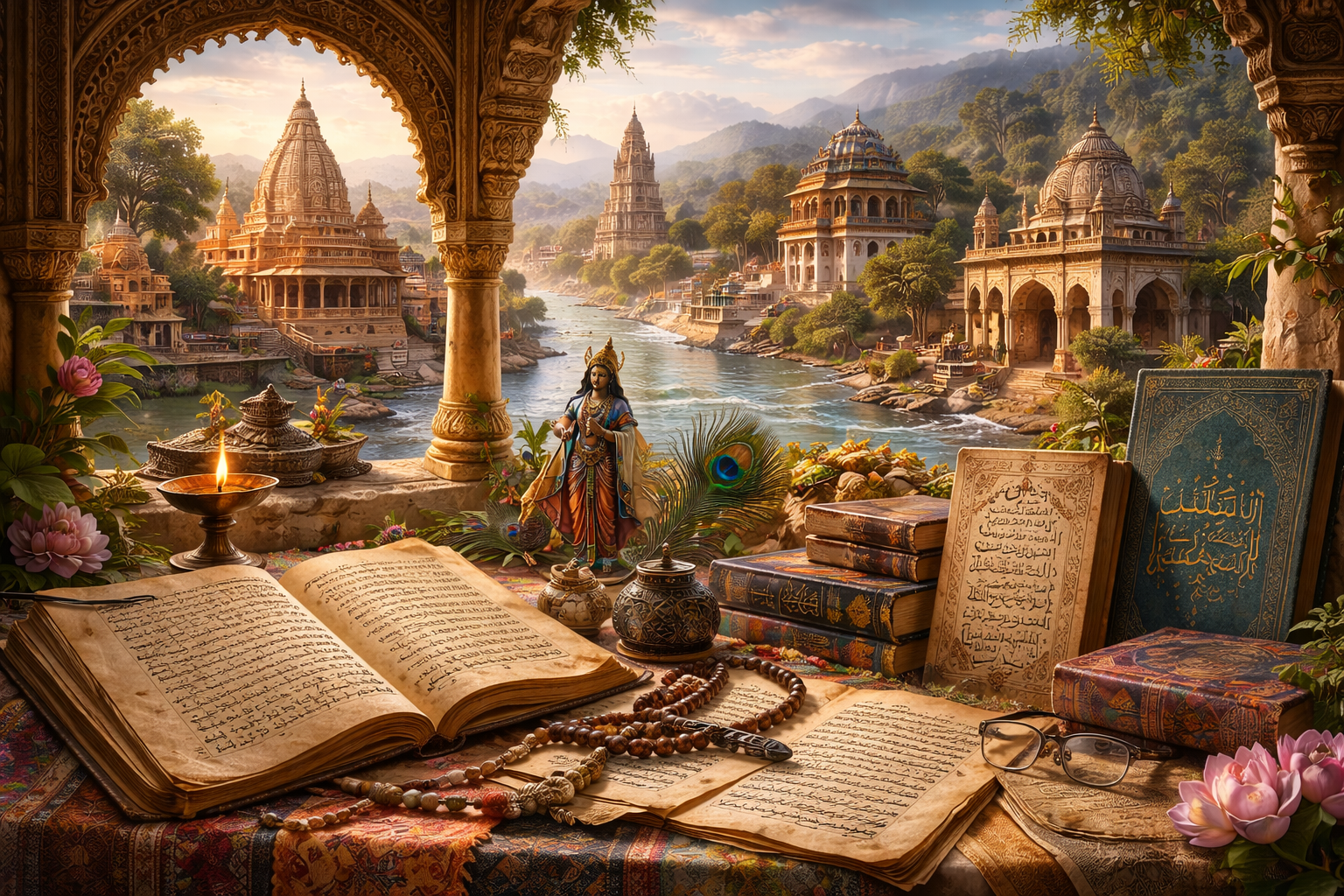
Read in this way, South Asian literature becomes more than literary history. It becomes an archive of continuity through reinterpretation. It records not only inherited worlds, but the ongoing labor of retelling them: epics re-performed in village and court, philosophical ideas made lyrical, devotional longing made vernacular, local landscapes bound to sacred story, Persian and Indic literary worlds intertwined, and inherited authority repeatedly tested by poets, saints, reformers, performers, and modern writers. South Asian literature preserves memory not through static repetition but through living adaptation. It allows gods and heroes, teachers and rebels, cities and pilgrimage routes, lovers and mystics to return in forms at once familiar and transformed.
South Asian Literature and Sacred Memory therefore stands at the intersection of literary history, religious history, philosophical inquiry, performance studies, manuscript culture, political history, language history, and the study of cultural transmission. It asks how literature becomes sacred inheritance; how vernacular forms expand, democratize, or contest elite traditions; how memory moves across temple, monastery, court, shrine, village, school, manuscript, song, theater, and print culture; and how literary traditions survive conquest, translation, sectarian change, colonialism, nationalism, and partition without losing their symbolic force. In this sense, the category is not only about texts. It is about literature as one of the deepest media through which South Asia has remembered, interpreted, contested, and reimagined itself.
South Asian Literature as Sacred Memory
South Asian literature is one of the great sacred-memory systems of world literature because it repeatedly turns story, song, dialogue, drama, commentary, and performance into vehicles of civilizational continuity. Its literary worlds preserve gods and heroes, renouncers and householders, kings and poets, saints and skeptics, teachers and disciples, lovers and rebels, rivers and forests, shrines and cities, courts and monasteries, villages and empires. It is not a single tradition. It is a layered archive of traditions that developed through many languages, religions, sects, castes, regions, and performance communities.
The strength of this archive lies in its capacity for renewal. The Ramayana and Mahabharata are not simply inherited epics; they are ongoing narrative worlds. Bhakti poems are not simply devotional texts; they are sung, remembered, performed, and recontextualized. Buddhist and Jain narratives preserve renunciant ethics through story. Tamil literature binds landscape, love, war, temple, and devotion into deep regional memory. Persianate and Urdu traditions bring courtly refinement, Sufi longing, ghazal ambiguity, shrine culture, and Indo-Persian cosmopolitanism into the South Asian field. Modern literature inherits all of this while responding to colonialism, reform, nationalism, language politics, migration, and partition.
To study South Asian Literature and Sacred Memory is therefore to study how sacred worlds remain open. Memory in this archive is not frozen. It is commented upon, sung, translated, localized, contested, dramatized, printed, politicized, and restored.
Why This Pillar Matters
South Asian Literature and Sacred Memory matters because few literary traditions have carried such a vast and internally plural archive of civilizational meaning. Here literature has long functioned as scripture-adjacent narrative, devotional utterance, philosophical argument, dramatic performance, political instruction, ethical reflection, regional memory, and social critique at once. It preserves not one sacred world but many: Vedic and epic inheritances, Buddhist and Jain moral universes, temple-centered devotional traditions, Sufi mystical worlds, courtly Persianate culture, vernacular rearticulations of scriptural memory, and modern literary responses to colonial dislocation and national rupture.
This pillar also matters because South Asian literature shows with unusual clarity how sacred memory can remain culturally open. Epics are retold in different languages and for different communities. Saints sing divine love in local idioms. Philosophical concepts become lyric and narrative. Persianate and Indic forms merge, compete, translate, and transform one another. Political orders are legitimized, critiqued, and reimagined through literary form. Literary memory in South Asia is therefore not only preservative. It is generative. It continuously remakes inherited meaning in response to changing communities, regions, empires, and crises.
The pillar is also essential because it resists the simplification of South Asian literature into a single religious, national, or linguistic category. South Asian literary history is multilingual, multi-religious, regionally dense, and internally contested. It includes Sanskritic, Tamil, Buddhist, Jain, Islamic, Persianate, Urdu, bhakti, Sufi, Dalit, feminist, regional, oral, and modern secular inheritances. Its authority comes not from homogeneity, but from the depth and continuity of its plural memory.
Scope and Method
This pillar is expansive by design. It includes Sanskrit epic, kavya, and drama; Pali and Prakrit literary cultures; Buddhist and Jain narrative worlds; Tamil classical and devotional traditions; bhakti literature across multiple vernaculars; Persianate and Urdu courtly and mystical literature; Sufi and saintly poetry; oral epics and performative storytelling; pilgrimage and place-based literature; and modern literary work shaped by empire, reform, nationalism, migration, and partition. It includes both elite and vernacular traditions, written and oral forms, courtly and popular repertoires, because South Asian literary memory has always moved across those boundaries rather than remaining confined within them.
The method throughout is to read South Asian literature as both aesthetic creation and civilizational transmission. That means attending to genre, language, performance context, theological world, region, historical setting, and material transmission, while also asking what these works did for the communities that preserved them. How did epic narrate cosmic and political order? How did bhakti vernacularize access to the sacred? How did Buddhist and Jain literary cultures preserve renunciant ethics and narrative pedagogy? How did Persian and Urdu literary worlds reshape memory under new courts, shrines, and forms of refinement? How did oral performance keep literary worlds socially alive beyond the manuscript? How did print modernity, colonial education, nationalism, and partition reframe older inheritances without erasing them?
The pillar also reads South Asian literature with attention to hierarchy and contestation. Sacred memory can be liberating, but it can also be used to authorize social order. Vernacular devotion may challenge caste, gender, ritual exclusivity, and scholastic authority, but it may also be reabsorbed into institutions. Epic may preserve ethical grandeur while also requiring critical reading around gender, caste, violence, kingship, and political appropriation. Modern literary memory must therefore be read not as simple continuity, but as continuity under pressure.
Reading Architecture for a Humanities Pillar
This literature pillar does not require a GitHub repository. Its research infrastructure is textual, bibliographic, philological, performative, historical, and interpretive rather than code-based. The appropriate scholarly architecture consists of primary texts, reliable translations, critical editions, manuscript histories, performance studies, commentary traditions, scholarly companions, university press scholarship, regional literary histories, and carefully ordered reading pathways.
The central research practices for this pillar are close reading, historical contextualization, genre analysis, translation comparison, performance analysis, reception history, commentary study, manuscript and print history, and critical attention to language politics. The most important materials are not scripts or datasets, but epics, poems, plays, oral-performance records, bhakti songs, Sufi lyrics, commentaries, anthologies, manuscripts, printed editions, scholarly monographs, and historical studies.
A strong South Asian Literature and Sacred Memory pillar should therefore foreground:
- primary texts in reliable translation, bilingual edition, or scholarly edition;
- major epic and sacred narrative traditions such as the Ramayana, Mahabharata, Bhagavad Gita, Puranic narratives, Jataka stories, Jain narratives, and regional retellings;
- major literary languages and worlds including Sanskrit, Pali, Prakrit, Tamil, Persian, Urdu, Bengali, Hindi, Punjabi, Marathi, Gujarati, Kannada, Telugu, Malayalam, Sindhi, and Kashmiri;
- major devotional figures and traditions including Andal, the Alvars, the Nayanmars, Kabir, Mirabai, Tulsidas, Surdas, Tukaram, Basava, Akka Mahadevi, Namdev, Lalleshwari, Bulleh Shah, and other bhakti and Sufi voices;
- transmission through commentary, recitation, oral performance, temple practice, shrine culture, manuscript copying, pilgrimage, festival, music, theater, print, and modern media;
- critical attention to caste, gender, sectarian boundaries, colonialism, nationalism, partition, language politics, and the contested uses of sacred memory.
The Canonical Spine of the Tradition
A strongest-sense account of South Asian Literature and Sacred Memory should be visibly anchored in the major formations that define its high canonical and civilizational center. The epic spine belongs above all to the Ramayana and Mahabharata traditions, whose narrative and ethical worlds have shaped South Asian imagination across languages and centuries. Sanskrit literature more broadly remains central through the kavya tradition, dramatic literature, aesthetic theory, and figures such as Kalidasa, Bhavabhuti, Bana, Bharavi, Magha, and other classical masters.
Buddhist and Jain literary traditions provide equally important archives of renunciant, ethical, philosophical, and narrative memory. Tamil literature must stand near the center as both an ancient classical world and a major devotional and sacred tradition. Bhakti poetry across languages—through figures such as Andal, Mirabai, Kabir, Tulsidas, Surdas, Tukaram, Basava, Akka Mahadevi, Namdev, Lalleshwari, and many others—forms one of the most powerful vernacular transformations of sacred memory anywhere in the world.
The Persianate and Urdu worlds also belong centrally within the category, not as external additions but as major South Asian literary formations. Amir Khusrau, later Urdu ghazal traditions, South Asian Sufi poetry, qawwali culture, marsiya, masnavi, and Indo-Persian court literature reshape sacred and emotional memory through multilingual, courtly, and mystical registers. Modern figures shaped by colonialism, nationalism, reform, and partition extend the archive into new historical conditions without severing it from older sacred and literary forms. Around this canonical spine gather the wider worlds of oral epics, regional retellings, temple literatures, saintly biographies, pilgrimage texts, commentarial traditions, manuscript cultures, and print afterlives through which South Asian literary memory remained socially alive.
Foundational Questions
- How did South Asian literary traditions preserve sacred memory across multiple religions, languages, regions, and historical eras?
- What distinguishes epic, devotional poetry, philosophical verse, classical drama, courtly literature, oral performance, and modern fiction as different forms of civilizational memory?
- How did the Ramayana and Mahabharata traditions become so foundational and so adaptable across South Asia?
- How did bhakti and Sufi traditions reshape sacred literature by vernacularizing access to devotion, memory, and transcendence?
- How did Buddhist and Jain literary cultures contribute to the region’s broader archive of ethical and narrative continuity?
- How did Persian, Urdu, Sanskrit, Tamil, Bengali, Hindi, Punjabi, Marathi, and other literary worlds intersect rather than remain fully separate?
- How did sacred geography, pilgrimage, temple culture, shrine culture, and storytelling traditions tie literary memory to place?
- How did commentary, manuscript transmission, oral performance, and print culture help preserve and reinterpret inherited texts?
- How did colonialism, nationalism, language politics, and partition reframe older literary memories without extinguishing them?
- How should sacred literary memory be read critically in relation to caste, gender, class, religious difference, political appropriation, and social exclusion?
I. Epic Foundations and the Civilizational Memory of Story
The strongest version of this category begins with epic. The Ramayana and Mahabharata are not simply ancient literary monuments; they are among the deepest and most generative memory systems in South Asian civilization. They preserve kingship, dharma, kinship, exile, loyalty, war, grief, sacrifice, divine intervention, and the moral ambiguity of action at civilizational scale. They are also inexhaustibly retold. Their force lies not only in textual authority but in their openness to reinterpretation across region, sect, language, theater, recitation, ritual, and performance.
The epic archive matters because it preserves both continuity and argument. The Ramayana can be royal ethic, devotional path, domestic ideal, regional narrative, political symbol, or object of feminist, Dalit, tribal, and subaltern critique. The Mahabharata can be cosmic war, philosophical encyclopedia, dynastic tragedy, meditation on dharma, or archive of ethical impossibility. These epics remain central because they do not close meaning. They sustain it through repetition and reinterpretation.
- The Ramayana and the Sacred Memory of Exile, Kingship, and Return (planned) — A foundational article on Rama, Sita, exile, dharma, kingship, devotion, forest, return, and the ethical complexity of epic memory.
- The Mahabharata and the Civilizational Memory of War, Dharma, and Catastrophe (planned) — A major article on dynastic conflict, cosmic war, dharma under crisis, grief, kinship, and the catastrophe of righteous violence.
- Epic as Sacred and Social Memory in South Asia (planned) — A synthetic article on why epic remains one of the region’s deepest media of continuity, argument, performance, and identity.
- Ramayana Traditions Across Languages and Regions (planned) — A study of how the Ramayana changes across Sanskrit, Tamil, Hindi, Bengali, Southeast Asian, Jain, Buddhist, folk, and modern retellings.
- Mahabharata Retellings and the Ethics of Reinterpretation (planned) — An article on regional, caste, gendered, oral, dramatic, and modern reinterpretations of Mahabharata memory.
- The Bhagavad Gita and the Compression of Epic Philosophy (planned) — A reading of action, duty, devotion, knowledge, renunciation, and divine revelation within the battlefield frame.
- Draupadi, Sita, and the Gendered Memory of Epic Suffering (planned) — A critical article on women’s suffering, dignity, voice, ordeal, and later feminist reinterpretations.
- Epic Performance and the Continuing Life of Story (planned) — A study of how recitation, theater, festival, village performance, television, and ritual enactment keep epic memory socially alive.
II. Sanskrit Literature, Kavya, and Classical Aesthetic Worlds
Sanskrit literary culture occupies a central place in South Asian memory as a language of epic grandeur, dramatic refinement, philosophical articulation, royal culture, and aesthetic theory. The kavya tradition gives literature a high classical polish in which ornament, rasa, suggestion, courtly intelligence, and emotional stylization become vehicles for preserving civilizational ideals. Kalidasa stands near the summit of this tradition, but he belongs to a larger world of dramatic, poetic, and reflective writing in which nature, love, kingship, longing, and cosmological order are given formally exquisite expression.
This classical Sanskrit archive matters because it shapes both elite literary ideals and later vernacular aspirations. It also provides the conceptual language of aesthetics through rasa, dhvani, alamkara, and related traditions that help explain how South Asian literary cultures understood feeling, suggestion, beauty, performance, and refined reception.
- Kalidasa and the Classical Imagination of South Asia (planned) — A major article on Kalidasa’s poetry and drama as a summit of Sanskrit literary refinement, emotional depth, nature imagery, and courtly imagination.
- Kavya and the Refinement of Literary Feeling (planned) — A study of ornament, rasa, style, courtly polish, poetic convention, and the classical formation of literary beauty.
- Classical Sanskrit Drama and the Staging of Civilizational Order (planned) — An article on drama, courtly worlds, love, recognition, kingship, performance, and aesthetic experience.
- Rasa and the Aesthetic Theory of Emotional Worlds (planned) — A study of rasa theory as a major South Asian framework for literary feeling, performance, and shared emotional experience.
- Nature, Desire, and Kingship in Sanskrit Literary Culture (planned) — An article on seasonal imagery, royal power, erotic refinement, and cosmological order in Sanskrit poetry.
- Bhavabhuti and the Tragic Tenderness of Sanskrit Drama (planned) — A focused article on emotional intensity, Rama traditions, and dramatic memory in later Sanskrit literature.
- Classical Sanskrit Aesthetics and the Theory of Suggestion (planned) — An article on dhvani, poetic resonance, and the intellectual refinement of literary meaning.
III. Buddhist, Jain, and Renunciant Literary Worlds
South Asian sacred memory cannot be understood without the literary worlds shaped by Buddhism and Jainism. Pali, Prakrit, Sanskrit, and related literary traditions preserve renunciant ethics, narrative pedagogy, cosmological imagination, monastic instruction, philosophical debate, and alternative visions of kingship, violence, selfhood, and liberation. Jataka narratives, Buddhist verses, Jain stories, monastic poetry, and philosophical compositions widen the archive beyond Brahmanical and epic frameworks without existing outside the region’s broader civilizational conversation.
These traditions matter because they show South Asian literature as a plural sacred field. They preserve compassion, nonviolence, discipline, detachment, karmic continuity, and the drama of renunciation as literary and civilizational memory. They also circulate through story, sermon, recitation, commentary, pilgrimage, manuscript, and adaptation across centuries of transmission.
- Buddhist Narrative and the Ethics of Sacred Story in South Asia (planned) — A study of Buddhist stories as moral pedagogy, karmic memory, renunciant instruction, and narrative compassion.
- The Jataka Tradition and the Literary Memory of Moral Becoming (planned) — An article on previous-birth stories, ethical formation, narrative repetition, and the pedagogy of becoming.
- Pali Literature and the Preservation of Monastic Worlds (planned) — A study of Pali texts, monastic discipline, devotional verse, women’s voices, and the memory of early Buddhist communities.
- Jain Literary Culture and the Imagination of Nonviolence (planned) — An article on Jain narrative, ethics, cosmology, nonviolence, asceticism, and literary instruction.
- Renunciation, Karma, and Liberation in South Asian Literary Memory (planned) — A synthetic article on renunciation as one of the major literary alternatives to household, court, and epic worlds.
- The Therigatha and the Poetic Memory of Early Buddhist Women (planned) — A focused article on women’s renunciant voices, spiritual achievement, and early Buddhist poetic memory.
- Compassion, Detachment, and Narrative Pedagogy in Buddhist and Jain Literature (planned) — A comparative article on moral story, affect, discipline, and liberation.
IV. Tamil Classical and Devotional Memory
Tamil literature must stand at the center of any serious account of South Asian literary memory. The Sangam corpus preserves one of the great ancient literary worlds of place, emotion, warfare, kingship, ethics, and landscape-coded feeling. Later Tamil devotional traditions, especially Shaiva and Vaishnava bhakti, turn the literary archive toward temple-centered sacred worlds, divine intimacy, embodied longing, and regional sanctity. Tamil literary culture therefore bridges classical antiquity, devotional interiority, and living sacred geography with unusual power.
This tradition matters because it is both deeply rooted and civilizationally expansive. It preserves local landscapes and emotional codes while participating in wider religious and literary worlds. It also shows that sacred memory in South Asia is not reducible to Sanskritic forms alone. Tamil literature is ancient, autonomous, devotional, philosophical, and enduring in its own right.
- Sangam Literature and the Poetics of Landscape, Love, and War (planned) — A foundational article on akam and puram, landscape poetics, love, heroism, grief, kingship, and ancient Tamil memory.
- Tamil Classical Memory and the Regional Foundations of Civilizational Literature (planned) — A study of Tamil literary antiquity as a major classical world in its own right.
- The Alvars and the Vernacular Sacred in South India (planned) — An article on Vaishnava devotion, Tamil hymns, divine intimacy, temple culture, and sacred place.
- The Nayanmars and the Devotional Imagination of Shaiva Tamil Literature (planned) — A study of Shaiva bhakti, saints, hymns, embodied devotion, and sacred geography.
- Temple, Hymn, and Sacred Place in Tamil Literary Memory (planned) — An article on how Tamil devotional literature binds place, deity, shrine, community, and song.
- Andal and the Poetics of Devotional Longing (planned) — A focused article on feminine devotional voice, love, bridal mysticism, and Tamil Vaishnava memory.
- Landscape Codes and Emotional Worlds in Classical Tamil Poetry (planned) — A study of how ecology, emotion, and social life are organized through Tamil landscape poetics.
V. Bhakti Poetry and the Vernacular Sacred
Bhakti poetry is one of the most transformative developments in South Asian literary history because it makes devotion immediate, affective, and linguistically intimate. Through the vernacularization of sacred longing, bhakti poets reshaped access to the divine, often challenging caste hierarchy, ritual exclusivity, scholastic authority, and literary elitism even while drawing on older inherited worlds. Mirabai, Kabir, Tulsidas, Surdas, Tukaram, Namdev, Basava, Akka Mahadevi, Andal, Lalleshwari, and many others create a South Asian archive in which love, surrender, protest, grief, joy, interiority, and social critique become inseparable.
Bhakti matters because it turns memory into song and repetition into intimacy. It allows inherited sacred worlds to enter local language, local music, local performance, and emotionally immediate experience. It is one of the principal ways sacred memory remains socially alive beyond formal institutions alone.
- Bhakti and the Vernacularization of Sacred Memory (planned) — A foundational article on how devotion moved into regional languages, song, performance, and communal memory.
- Mirabai and the Poetics of Divine Longing (planned) — A study of feminine devotional voice, Krishna longing, refusal of social constraint, and the emotional power of bhakti song.
- Kabir and the Language of Radical Devotional Critique (planned) — An article on anti-ritual critique, caste challenge, religious boundary-crossing, and the sharp poetics of spiritual directness.
- Tulsidas and the Sacred Retelling of the Ramayana (planned) — A study of the Ramcharitmanas, vernacular epic authority, devotion, and the reconfiguration of Rama memory.
- Surdas and the Devotional Imagination of Krishna (planned) — An article on Krishna bhakti, poetic reconstruction, song tradition, divine childhood, and emotional intimacy.
- Tukaram and the Moral Voice of Marathi Bhakti (planned) — A study of devotion, social critique, humility, public voice, and the Varkari devotional world.
- Basava and the Poetics of Spiritual and Social Dissent (planned) — An article on vachana poetry, anti-caste critique, direct speech, and the religious imagination of social transformation.
- Akka Mahadevi and the Fierce Body of Devotional Renunciation (planned) — A focused article on gender, body, renunciation, longing, and Kannada bhakti.
- Saint, Song, and Community in Bhakti Literature (planned) — A synthetic article on how bhakti poetry creates communities of memory through repetition, singing, and shared devotion.
VI. Sufi, Persianate, and Urdu Literary Worlds
South Asian literary memory is also profoundly shaped by Persianate and Urdu literary cultures, especially in courts, shrines, and multilingual urban settings. Amir Khusrau stands near the beginning of a major South Asian synthesis in which Persian, Hindavi, music, devotion, and courtly intelligence intersect. Later Urdu ghazal and masnavi traditions, along with South Asian Sufi poetry, create literary worlds of longing, mystical indirection, refinement, grief, beauty, and emotional ambiguity that belong centrally to the region’s sacred and cultural memory.
This archive matters because it shows South Asian literature not as a sealed Indic world but as a profoundly interconnected literary civilization. Persian and Urdu forms become South Asian not by losing their cosmopolitanism, but by entering local memory, sacred spaces, music, speech, and emotional worlds. Sufi writing, meanwhile, offers a mode of sacred remembrance in which love, annihilation, longing, music, shrine culture, and devotional attachment become literary form.
- Amir Khusrau and the Multilingual Imagination of South Asia (planned) — A major article on Persian, Hindavi, music, courtly culture, Sufism, and literary synthesis.
- Persianate Literary Culture in South Asian Courts and Shrines (planned) — A study of Indo-Persian poetry, courtly patronage, ethical refinement, shrine culture, and multilingual literary prestige.
- Urdu Ghazal and the Sacred Aesthetics of Longing (planned) — An article on desire, grief, beloved, mystical ambiguity, urbanity, and the formation of Urdu lyric memory.
- Sufi Poetry and Shrine-Centered Memory in South Asia (planned) — A study of qawwali, saintly devotion, shrine communities, and poetic remembrance.
- Love, Music, and Mystical Indirection in Indo-Persian Literary Worlds (planned) — An article on music, metaphor, beloved, annihilation, and the layered language of Sufi longing.
- Bulleh Shah and the Punjabi Sufi Lyric (planned) — A focused article on spiritual critique, vernacular voice, love, identity, and Punjabi sacred memory.
- Karbala, Marsiya, and the Poetics of South Asian Muslim Memory (planned) — An article on martyrdom, lament, ritual performance, Urdu literary form, and Shi‘i devotional memory.
- Ghalib, Urdu Modernity, and the Late Mughal Imagination (planned) — A study of Urdu lyric ambiguity, historical collapse, self-consciousness, and the transformation of Indo-Persian memory.
VII. Vernacular Retellings, Local Languages, and Sacred Adaptation
One of the defining features of South Asian literary memory is retelling. Sacred and epic narratives move across languages, regions, castes, courts, and performance traditions, creating a literary world where translation is often transformation. Vernacular retellings do not merely reproduce authoritative stories; they relocate them, reinterpret them, and embed them within new moral, political, devotional, and regional worlds. Bengali, Hindi, Marathi, Tamil, Kannada, Telugu, Malayalam, Punjabi, Gujarati, Sindhi, Kashmiri, and many other traditions participate in this ongoing process.
This makes South Asian literature one of the world’s great archives of adaptive continuity. Memory remains durable because it remains retellable. Sacred story is not weakened by plurality; it is often strengthened by being locally inhabited.
- Vernacular Retelling as a Form of Sacred Continuity (planned) — A foundational article on translation, adaptation, localization, and the renewal of inherited authority.
- Regional Ramayanas and the Plural Life of Epic Memory (planned) — A study of how Rama traditions differ across language, region, religion, caste, gender, and performance context.
- Translation, Adaptation, and Literary Authority in South Asia (planned) — An article on how authority changes when sacred story moves between languages and communities.
- How Local Language Reshapes Sacred Story (planned) — A study of vernacular creativity, regional identity, theological variation, and literary transformation.
- Bengali Literary Memory and the Sacred Vernacular (planned) — An article on Bengali devotional, narrative, and modern literary worlds as sacred and cultural memory.
- Marathi, Kannada, and Telugu Devotional Worlds (planned) — A comparative article on regional bhakti, saint poetry, and sacred language formation.
- Punjabi and Sindhi Sacred Poetics Across Sufi and Bhakti Worlds (planned) — A study of regional lyric, devotional crossing, shrine culture, and oral transmission.
VIII. Courtly Literature, Kingship, and Political Imagination
South Asian literature also preserves courts, dynasties, political ideals, and the aesthetics of rule. Royal praise, courtly narrative, political reflection, and literary representations of sovereignty appear across Sanskrit, Persian, regional, and mixed literary worlds. Literature helps imagine kingship, preserve dynastic legitimacy, refine elite conduct, and narrate the moral burdens of power. Yet it can also complicate and critique those same orders through irony, moral ambiguity, devotional counter-authority, and social memory from below.
This courtly archive matters because sacred memory in South Asia was never wholly separate from political imagination. Gods and kings, order and justice, ritual authority and worldly rule repeatedly intersect in literary form. Courtly literature therefore belongs beside devotional and epic literature, not beneath it.
- Kingship and Literary Memory in South Asian Courtly Worlds (planned) — A major article on royal authority, praise, dharma, sovereignty, courtly aesthetics, and dynastic memory.
- Praise, Sovereignty, and Political Aesthetics Across South Asian Literatures (planned) — A study of court poetry across Sanskrit, Persian, and regional traditions.
- Court, Temple, and Empire in Literary Imagination (planned) — An article on how political authority intersects with ritual, patronage, sacred place, and literary prestige.
- Devotional and Vernacular Challenges to Elite Political Order (planned) — A study of how bhakti, Sufi, and vernacular voices contest courtly, caste, and scholastic authority.
- Indo-Persian Courts and the Literary Culture of Rule (planned) — An article on Persianate style, political ethics, chronicle, praise, and courtly memory in South Asia.
- Royal Patronage, Manuscript Culture, and Literary Authority (planned) — A study of how courts preserved, commissioned, translated, and reordered literary inheritance.
IX. Performance, Recitation, and Oral Transmission
South Asian literary memory did not live on the page alone. It has been preserved through recitation, storytelling, temple performance, dramatic enactment, village epic, devotional song, public reading, pilgrimage performance, and oral instruction. The continued life of the Ramayana, the singing of bhajans and qawwalis, the embodied transmission of saintly songs, and the region’s many dramatic and narrative traditions all demonstrate that sacred literature in South Asia is inseparable from performance.
This layer is crucial because it reveals literature as a socially lived medium. A text survives not merely by being copied, but by being voiced, heard, enacted, sung, and remembered in community. Performance also changes interpretation: it can localize epic, intensify devotion, contest hierarchy, preserve minority memory, and make sacred narrative visible in public space.
- Recitation and the Social Life of Sacred Literature in South Asia (planned) — A foundational article on oral transmission, public reading, memorization, and voiced sacred memory.
- Epic Performance and the Continuing Life of Story (planned) — A study of Ramayana and Mahabharata performance across theater, festival, village epic, television, and ritual enactment.
- Bhajan, Kirtan, and Devotional Song as Literary Memory (planned) — An article on devotional song as literature, community practice, repetition, and sacred feeling.
- Qawwali and the Sound of Sufi Remembrance (planned) — A study of Sufi musical performance, shrine culture, longing, repetition, and collective memory.
- Drama, Festival, and Ritual Reenactment in Literary Tradition (planned) — An article on how dramatic form turns sacred story into embodied public memory.
- Oral Epics and Regional Worlds of Performance (planned) — A study of regional oral epic traditions, local heroes, community memory, and the reshaping of classical narrative.
X. Sacred Geography, Pilgrimage, and Place-Memory
South Asian literature is deeply place-bound without being narrowly local. Rivers, mountains, forests, cities, shrines, temples, pilgrimage circuits, monasteries, and sacred regions are woven into literary memory with extraordinary density. Ayodhya, Varanasi, Kurukshetra, Vrindavan, Kashi, Madurai, Pandharpur, Ajmer, Bodh Gaya, Amritsar, Nizamuddin, Puri, Rameswaram, and countless other sacred geographies persist not only through religious practice but through song, narrative, commentary, and pilgrimage literature.
This means sacred memory in South Asia is often geographic as much as textual. Literature preserves where meaning happens. It ties memory to land, route, shrine, temple, river, forest, and repeated movement. It also reveals how sacred geography can become contested, politicized, and reinterpreted across communities.
- Sacred Geography and the Literary Mapping of South Asia (planned) — A major article on how texts, songs, and stories map rivers, cities, temples, shrines, forests, and pilgrimage routes.
- Pilgrimage, Narrative, and the Memory of Blessed Place (planned) — A study of pilgrimage literature, route memory, devotional movement, and sacred geography.
- Temple, River, and Region in Devotional Literature (planned) — An article on how place becomes sacred through hymn, story, ritual, and repeated performance.
- How Literary Traditions Make Sacred Landscapes Endure (planned) — A synthetic article on place-memory, ritual repetition, and the literary preservation of geography.
- Forest, City, and Battlefield in Epic Geography (planned) — A study of how epic spaces organize exile, war, revelation, and ethical crisis.
- Shrine, Song, and Sufi Place-Memory in South Asia (planned) — An article on shrine-centered literary memory, qawwali, saintly lineages, and devotional geography.
XI. Colonialism, Nationalism, Partition, and Modern Literary Reorientation
South Asian literary memory was profoundly reconfigured under colonial rule, print capitalism, reform movements, nationalism, and partition. Colonial education altered the canon. Print fixed and recirculated texts in new ways. Reform movements reinterpreted older sacred and literary inheritances. Nationalism selectively elevated some traditions while marginalizing others. Partition introduced one of the most devastating new experiences of displacement and collective fracture in the region’s modern history.
Yet modern South Asian literature did not abandon sacred memory. It reworked it. Writers engaged older epics, devotional inheritances, Persianate forms, regional memory, and oral traditions under new political conditions. The modern archive matters because it shows continuity under pressure and reinterpretation under rupture. It also makes clear that sacred memory can be a source of resistance, mourning, nationalism, exclusion, repair, and ethical critique.
- Colonialism and the Reordering of South Asian Literary Memory (planned) — A major article on colonial education, translation, canon formation, missionary encounter, Orientalism, and literary reclassification.
- Print Modernity and the New Life of Sacred Texts (planned) — A study of print culture, cheap editions, reform movements, public readerships, and the stabilization of once-fluid traditions.
- Nationalism, Literary Canon, and the Politics of Inheritance (planned) — An article on how modern nation-making selected, elevated, and contested older literary memories.
- Partition and the Literature of Rupture, Memory, and Loss (planned) — A study of displacement, violence, border, grief, testimony, Urdu/Hindi literary fracture, and post-Partition memory.
- Modern Writers and the Reuse of Epic and Devotional Worlds (planned) — An article on how modern literature reactivates epics, saints, myths, and sacred symbols under new political conditions.
- Tagore and the Literary Reimagining of Civilization, Nation, and Humanity (planned) — A focused article on Rabindranath Tagore’s role in modern South Asian literary and philosophical memory.
- Dalit Literature and the Critique of Sacred Social Order (planned) — A necessary article on caste, counter-memory, testimony, and the ethical challenge to inherited literary authority.
- Feminist Rewritings of Epic and Sacred Memory (planned) — A study of women writers, epic retellings, devotional reinterpretation, and gendered critique.
XII. Major Genres Across South Asian Literary Memory
A comprehensive pillar should also organize the archive by genre. Epic preserves dynastic, sacred, and ethical memory at civilizational scale. Kavya refines emotional, courtly, and aesthetic worlds. Drama stages public and sacred feeling. Devotional lyric transforms longing into communal utterance. Philosophical verse condenses metaphysical inquiry into memorable form. Saintly poetry links devotion to biography and community. Narrative retelling renews inherited stories. Travel and pilgrimage writing map sacred worlds. Oral performance keeps literature socially alive beyond textual enclosure. Modern fiction, memoir, and poetry transform older memory under conditions of colonialism, nationalism, migration, and partition.
- Epic as Sacred and Civilizational Memory in South Asia (planned) — A genre article on epic scale, dharma, divine action, kingship, war, exile, and retellability.
- Kavya and the Classical Refinement of Feeling (planned) — A study of aesthetic polish, rasa, ornament, suggestion, and courtly form.
- Devotional Lyric and the Language of Divine Intimacy (planned) — An article on bhakti, Sufi lyric, song, longing, surrender, and vernacular sacred experience.
- Philosophical Verse and the Compression of Thought (planned) — A study of how metaphysical and ethical inquiry become memorable through poetic and dialogic form.
- Retelling, Translation, and the Renewal of Authority (planned) — An article on translation as transformation, vernacularization, and the renewal of sacred story.
- Performance as Literary Preservation (planned) — A study of recitation, song, dramatic enactment, oral epic, festival, and embodied transmission.
- Saintly Biography and Devotional Community (planned) — An article on hagiography, memory of saints, lineage, shrine, and community formation.
- Partition Literature as Modern Sacred and Ethical Memory (planned) — A study of testimony, mourning, displacement, violence, and literary repair after rupture.
XIII. Recurring Themes and Symbolic Structures
Across these genres, certain themes and structures recur with extraordinary persistence: exile and return, war and dharma, divine love and human longing, kingship and cosmic order, renunciation and household duty, guru and disciple, saint and seeker, river and pilgrimage path, sacred city and forest retreat, devotion and social protest, memory and retelling, rupture and continuity. These recurring forms are among the chief reasons South Asian literature remains so durable. They make sacred memory endlessly transmissible without making it static.
These themes must also be read critically. Dharma may preserve ethical seriousness while also becoming a site of conflict. Devotion may challenge hierarchy while also being institutionalized. Sacred geography may deepen belonging while also becoming politically contested. Epic may preserve moral grandeur while also carrying violence, gendered suffering, and caste-coded social order. South Asian literary memory is powerful because it contains these tensions rather than resolving them too easily.
- Exile, Return, and the Moral Geography of South Asian Narrative (planned) — A thematic article on forest, city, homeland, banishment, pilgrimage, and the return to order.
- Dharma, Conflict, and Ethical Ambiguity in Literary Memory (planned) — A study of duty, action, moral uncertainty, violence, and competing obligations.
- Divine Love, Human Longing, and the Language of Devotion (planned) — An article on bhakti, Sufi love, longing, surrender, and the sacred transformation of emotion.
- Saint, Teacher, and Disciple in Sacred Literary Worlds (planned) — A study of spiritual authority, lineage, instruction, memory, and devotion.
- Sacred City, Forest, and River in South Asian Imagination (planned) — An article on geography, pilgrimage, ecology, ritual, and literary place-memory.
- Retelling, Repetition, and the Open Form of Civilizational Memory (planned) — A study of why South Asian sacred memory remains durable through adaptation rather than fixed repetition.
- Caste, Devotion, and the Literary Critique of Social Hierarchy (planned) — A critical article on anti-caste voices, bhakti, Dalit literature, and the contested ethics of sacred inheritance.
- Partition, Trauma, and the Broken Geography of Memory (planned) — A modern thematic article on border, loss, migration, violence, and literary witness.
XIV. Commentary, Manuscript Transmission, Print, and Canon Formation
South Asian literary memory became durable through systems of transmission: commentary, memorization, manuscript copying, scholastic debate, temple and monastic recitation, saintly lineages, performance, translation, and later print circulation. Canon formation in South Asia is inseparable from commentary because inherited texts were rarely left uninterpreted. They were glossed, debated, regionalized, theologized, dramatized, contested, and retold. Print modernity later stabilized some versions while unsettling others, altering how literary authority appeared without abolishing older practices of living transmission.
This means the canon is not merely a list of revered texts. It is a history of preservation, pedagogy, regional variation, sectarian reading, social conflict, and repeated cultural reuse. A text becomes canonical not only because it is old, but because communities continue to interpret, perform, quote, revise, and argue with it.
- Commentary and the Living Interpretation of South Asian Texts (planned) — A major article on gloss, exegesis, scholastic debate, sectarian interpretation, and inherited reading practices.
- Manuscript Culture and the Material Life of Sacred Literature (planned) — A study of copying, palm-leaf manuscripts, codices, scribal labor, libraries, preservation, and textual variation.
- Memorization, Recitation, and the Social Life of the Canon (planned) — An article on embodied transmission, oral authority, teaching, and communal memory.
- Print, Region, and the Reordering of Literary Authority (planned) — A study of print capitalism, cheap editions, public readership, reformist canon-making, and modern textual stabilization.
- Why South Asian Sacred Memory Remains Open to Reinterpretation (planned) — A synthetic article on retelling, commentary, performance, vernacularization, and the plural life of inherited texts.
- Translation and the Politics of Sacred Literary Authority (planned) — An article on how translation changes access, interpretation, hierarchy, and canon formation.
Expanded Article Architecture
The following long-range architecture preserves the full breadth of the category while clarifying its major centers of gravity: epic, classical aesthetics, renunciant traditions, Tamil literary memory, bhakti, Sufi and Persianate worlds, vernacular retelling, sacred geography, performance, manuscript and print transmission, colonial modernity, partition, and modern critique.
Epic and Foundational Narratives
- The Ramayana and the Sacred Memory of Exile, Kingship, and Return (planned)
- The Mahabharata and the Civilizational Memory of War, Dharma, and Catastrophe (planned)
- Epic as Sacred and Social Memory in South Asia (planned)
- Ramayana Traditions Across Languages and Regions (planned)
- Mahabharata Retellings and the Ethics of Reinterpretation (planned)
- The Bhagavad Gita and the Compression of Epic Philosophy (planned)
- Draupadi, Sita, and the Gendered Memory of Epic Suffering (planned)
- Epic Performance and the Continuing Life of Story (planned)
Sanskrit Classical Worlds
- Kalidasa and the Classical Imagination of South Asia (planned)
- Kavya and the Refinement of Literary Feeling (planned)
- Classical Sanskrit Drama and the Staging of Civilizational Order (planned)
- Rasa and the Aesthetic Theory of Emotional Worlds (planned)
- Nature, Desire, and Kingship in Sanskrit Literary Culture (planned)
- Bhavabhuti and the Tragic Tenderness of Sanskrit Drama (planned)
- Classical Sanskrit Aesthetics and the Theory of Suggestion (planned)
Buddhist and Jain Literatures
- Buddhist Narrative and the Ethics of Sacred Story in South Asia (planned)
- The Jataka Tradition and the Literary Memory of Moral Becoming (planned)
- Pali Literature and the Preservation of Monastic Worlds (planned)
- Jain Literary Culture and the Imagination of Nonviolence (planned)
- Renunciation, Karma, and Liberation in South Asian Literary Memory (planned)
- The Therigatha and the Poetic Memory of Early Buddhist Women (planned)
- Compassion, Detachment, and Narrative Pedagogy in Buddhist and Jain Literature (planned)
Tamil Classical and Devotional Memory
- Sangam Literature and the Poetics of Landscape, Love, and War (planned)
- Tamil Classical Memory and the Regional Foundations of Civilizational Literature (planned)
- The Alvars and the Vernacular Sacred in South India (planned)
- The Nayanmars and the Devotional Imagination of Shaiva Tamil Literature (planned)
- Temple, Hymn, and Sacred Place in Tamil Literary Memory (planned)
- Andal and the Poetics of Devotional Longing (planned)
- Landscape Codes and Emotional Worlds in Classical Tamil Poetry (planned)
Bhakti and Vernacular Devotion
- Bhakti and the Vernacularization of Sacred Memory (planned)
- Mirabai and the Poetics of Divine Longing (planned)
- Kabir and the Language of Radical Devotional Critique (planned)
- Tulsidas and the Sacred Retelling of the Ramayana (planned)
- Surdas and the Devotional Imagination of Krishna (planned)
- Tukaram and the Moral Voice of Marathi Bhakti (planned)
- Basava and the Poetics of Spiritual and Social Dissent (planned)
- Akka Mahadevi and the Fierce Body of Devotional Renunciation (planned)
- Saint, Song, and Community in Bhakti Literature (planned)
Sufi, Persianate, and Urdu Worlds
- Amir Khusrau and the Multilingual Imagination of South Asia (planned)
- Persianate Literary Culture in South Asian Courts and Shrines (planned)
- Urdu Ghazal and the Sacred Aesthetics of Longing (planned)
- Sufi Poetry and Shrine-Centered Memory in South Asia (planned)
- Love, Music, and Mystical Indirection in Indo-Persian Literary Worlds (planned)
- Bulleh Shah and the Punjabi Sufi Lyric (planned)
- Karbala, Marsiya, and the Poetics of South Asian Muslim Memory (planned)
- Ghalib, Urdu Modernity, and the Late Mughal Imagination (planned)
Retelling and Regional Adaptation
- Vernacular Retelling as a Form of Sacred Continuity (planned)
- Regional Ramayanas and the Plural Life of Epic Memory (planned)
- Translation, Adaptation, and Literary Authority in South Asia (planned)
- How Local Language Reshapes Sacred Story (planned)
- Bengali Literary Memory and the Sacred Vernacular (planned)
- Marathi, Kannada, and Telugu Devotional Worlds (planned)
- Punjabi and Sindhi Sacred Poetics Across Sufi and Bhakti Worlds (planned)
Courtly and Political Literary Worlds
- Kingship and Literary Memory in South Asian Courtly Worlds (planned)
- Praise, Sovereignty, and Political Aesthetics Across South Asian Literatures (planned)
- Court, Temple, and Empire in Literary Imagination (planned)
- Devotional and Vernacular Challenges to Elite Political Order (planned)
- Indo-Persian Courts and the Literary Culture of Rule (planned)
- Royal Patronage, Manuscript Culture, and Literary Authority (planned)
Performance, Place, and Transmission
- Recitation and the Social Life of Sacred Literature in South Asia (planned)
- Epic Performance and the Continuing Life of Story (planned)
- Bhajan, Kirtan, and Devotional Song as Literary Memory (planned)
- Qawwali and the Sound of Sufi Remembrance (planned)
- Drama, Festival, and Ritual Reenactment in Literary Tradition (planned)
- Oral Epics and Regional Worlds of Performance (planned)
- Sacred Geography and the Literary Mapping of South Asia (planned)
- Pilgrimage, Narrative, and the Memory of Blessed Place (planned)
- Temple, River, and Region in Devotional Literature (planned)
- Shrine, Song, and Sufi Place-Memory in South Asia (planned)
Colonialism, Modernity, and Partition
- Colonialism and the Reordering of South Asian Literary Memory (planned)
- Print Modernity and the New Life of Sacred Texts (planned)
- Nationalism, Literary Canon, and the Politics of Inheritance (planned)
- Partition and the Literature of Rupture, Memory, and Loss (planned)
- Modern Writers and the Reuse of Epic and Devotional Worlds (planned)
- Tagore and the Literary Reimagining of Civilization, Nation, and Humanity (planned)
- Dalit Literature and the Critique of Sacred Social Order (planned)
- Feminist Rewritings of Epic and Sacred Memory (planned)
Genres and Forms
- Epic as Sacred and Civilizational Memory in South Asia (planned)
- Kavya and the Classical Refinement of Feeling (planned)
- Devotional Lyric and the Language of Divine Intimacy (planned)
- Philosophical Verse and the Compression of Thought (planned)
- Retelling, Translation, and the Renewal of Authority (planned)
- Performance as Literary Preservation (planned)
- Saintly Biography and Devotional Community (planned)
- Partition Literature as Modern Sacred and Ethical Memory (planned)
Major Themes
- Exile, Return, and the Moral Geography of South Asian Narrative (planned)
- Dharma, Conflict, and Ethical Ambiguity in Literary Memory (planned)
- Divine Love, Human Longing, and the Language of Devotion (planned)
- Saint, Teacher, and Disciple in Sacred Literary Worlds (planned)
- Sacred City, Forest, and River in South Asian Imagination (planned)
- Retelling, Repetition, and the Open Form of Civilizational Memory (planned)
- Caste, Devotion, and the Literary Critique of Social Hierarchy (planned)
- Partition, Trauma, and the Broken Geography of Memory (planned)
Closing Perspective
South Asian Literature and Sacred Memory should be understood as a major archive of epic continuity, devotional intensity, philosophical reflection, vernacular transformation, oral performance, and post-imial endurance rather than as a narrow set of disconnected religious or linguistic traditions. Its range extends from Sanskrit epic and classical aesthetics to Buddhist and Jain narrative, Tamil literary worlds, bhakti devotion, Sufi and Persianate poetry, oral performance, sacred geography, manuscript culture, print modernity, and the literatures of colonialism and partition. Read in the strongest sense, the category shows how literature can preserve not only sacred story or aesthetic pleasure, but entire civilizational worlds of meaning.
It is therefore central to any serious understanding of South Asia as a literary and spiritual civilization. South Asian literature reveals how memory can remain open through retelling, how sacred worlds can survive through adaptation, how language can carry place, ritual, philosophy, longing, and protest across centuries, and how literary traditions can hold together plurality without ceasing to be continuous. It also shows, with unusual power, how literature can become one of the deepest homes of civilizational inheritance.
Related Reading
- Literature & Cultural Memory
- Religious Studies
- Persian Poetry and Cultural Memory
- Arabic Literature and Adab
- Islamic & Mystical Thought
- Ayurveda and South Asian Healing Traditions
- Indus Region Thought
Further Reading
- Clay Sanskrit Library (n.d.). Ramayana II: Ayodhya. Translated by Sheldon I. Pollock. New York: NYU Press / Clay Sanskrit Library. https://claysanskritlibrary.org/volumes/ramayana-ii-ayodhya/
- Dimock, E. C. Jr and Levertov, D. (1981). In Praise of Krishna: Songs from the Bengali. Chicago: University of Chicago Press. https://press.uchicago.edu/ucp/books/book/chicago/I/bo3633241.html
- Hawley, J. S. (1988). “Author and Authority in the Bhakti Poetry of North India.” The Journal of Asian Studies, 47(2), pp. 269–290. https://www.cambridge.org/core/journals/journal-of-asian-studies/article/author-and-authority-in-the-bhakti-poetry-of-north-india/1DB65AC5FAB1FA3A5D7474CD1FEDFEC1
- Hiltebeitel, A. (1999). Rethinking India’s Oral and Classical Epics: Draupadi among Rajputs, Muslims, and Dalits. Chicago: University of Chicago Press. https://press.uchicago.edu/ucp/books/book/chicago/R/bo3633036.html
- Hyder, S. A. (2008). Reliving Karbala: Martyrdom in South Asian Memory. Oxford: Oxford University Press. https://academic.oup.com/book/27257
- McGregor, R. S. (ed.) (1992). Devotional Literature in South Asia: Current Research, 1985–1988. Cambridge: Cambridge University Press. https://www.cambridge.org/us/universitypress/subjects/literature/asian-literature/devotional-literature-south-asia-current-research-19851988?format=HB&isbn=9780521413114
- Murty Classical Library of India (n.d.). Murty Classical Library of India. Cambridge, MA: Harvard University Press. https://www.hup.harvard.edu/series/murty-classical-library-of-india
- Murty Classical Library of India (n.d.). Sur’s Ocean: Poems from the Early Tradition. Cambridge, MA: Harvard University Press. https://www.murtylibrary.com/books/surs-ocean
- Murty Classical Library of India (n.d.). Therigatha: Poems of the First Buddhist Women. Cambridge, MA: Harvard University Press. https://www.murtylibrary.com/books/therigatha-poems-of-the-first-buddhist-women
- Orsini, F. (2021). “The Multilingual Local: Worlding Literature in India.” In The Cambridge History of World Literature. Cambridge: Cambridge University Press. https://www.cambridge.org/core/books/cambridge-history-of-world-literature/multilingual-local-worlding-literature-in-india/FB42381DF334D93C70693723CEE749EE
- Oxford University Press (n.d.). The Oxford Handbook of Tantric Studies. Oxford: Oxford University Press. https://global.oup.com/academic/product/the-oxford-handbook-of-tantric-studies-9780197549919
- Tagore, R. (2019). The Cambridge Companion to Rabindranath Tagore. Cambridge: Cambridge University Press. https://www.cambridge.org/core/books/cambridge-companion-to-rabindranath-tagore/B761FD38C14F92959B4CD8B60E3BBB41
References
- Bhavabhuti (2007). Rama’s Last Act. Translated by Sheldon I. Pollock. New York: NYU Press / Clay Sanskrit Library. https://nyupress.org/9780814767337/ramas-last-act/
- Bulleh Shah (2022). Sufi Lyrics. Translated by Christopher Shackle. Cambridge, MA: Murty Classical Library of India / Harvard University Press. https://www.murtylibrary.com/books/sufi-lyrics
- Clay Sanskrit Library (n.d.). Ramayana II: Ayodhya. Translated by Sheldon I. Pollock. New York: NYU Press / Clay Sanskrit Library. https://claysanskritlibrary.org/volumes/ramayana-ii-ayodhya/
- Dimock, E. C. Jr and Levertov, D. (1981). In Praise of Krishna: Songs from the Bengali. Chicago: University of Chicago Press. https://press.uchicago.edu/ucp/books/book/chicago/I/bo3633241.html
- Hawley, J. S. (1988). “Author and Authority in the Bhakti Poetry of North India.” The Journal of Asian Studies, 47(2), pp. 269–290. https://www.cambridge.org/core/journals/journal-of-asian-studies/article/author-and-authority-in-the-bhakti-poetry-of-north-india/1DB65AC5FAB1FA3A5D7474CD1FEDFEC1
- Hiltebeitel, A. (1999). Rethinking India’s Oral and Classical Epics: Draupadi among Rajputs, Muslims, and Dalits. Chicago: University of Chicago Press. https://press.uchicago.edu/ucp/books/book/chicago/R/bo3633036.html
- Hyder, S. A. (2008). Reliving Karbala: Martyrdom in South Asian Memory. Oxford: Oxford University Press. https://academic.oup.com/book/27257
- McGregor, R. S. (ed.) (1992). Devotional Literature in South Asia: Current Research, 1985–1988. Cambridge: Cambridge University Press. https://www.cambridge.org/us/universitypress/subjects/literature/asian-literature/devotional-literature-south-asia-current-research-19851988?format=HB&isbn=9780521413114
- Murty Classical Library of India (n.d.). Murty Classical Library of India. Cambridge, MA: Harvard University Press. https://www.hup.harvard.edu/series/murty-classical-library-of-india
- Murty Classical Library of India (n.d.). Sur’s Ocean: Poems from the Early Tradition. Cambridge, MA: Harvard University Press. https://www.murtylibrary.com/books/surs-ocean
- Murty Classical Library of India (n.d.). Ten Indian Classics. Cambridge, MA: Harvard University Press. https://www.murtylibrary.com/books/ten-indian-classics
- Murty Classical Library of India (n.d.). Therigatha: Poems of the First Buddhist Women. Cambridge, MA: Harvard University Press. https://www.murtylibrary.com/books/therigatha-poems-of-the-first-buddhist-women
- Orsini, F. (2021). “The Multilingual Local: Worlding Literature in India.” In The Cambridge History of World Literature. Cambridge: Cambridge University Press. https://www.cambridge.org/core/books/cambridge-history-of-world-literature/multilingual-local-worlding-literature-in-india/FB42381DF334D93C70693723CEE749EE
- Oxford University Press (n.d.). The Oxford Handbook of Tantric Studies. Oxford: Oxford University Press. https://global.oup.com/academic/product/the-oxford-handbook-of-tantric-studies-9780197549919
- Tagore, R. (2019). The Cambridge Companion to Rabindranath Tagore. Cambridge: Cambridge University Press. https://www.cambridge.org/core/books/cambridge-companion-to-rabindranath-tagore/B761FD38C14F92959B4CD8B60E3BBB41
- Valmiki (2005). Ramayana, Book Two: Ayodhya. Translated by Sheldon I. Pollock. New York: NYU Press / Clay Sanskrit Library. https://nyupress.org/9780814767160/ramayana-book-two/
- Valmiki (2006). Ramayana, Book Three: The Forest. Translated by Sheldon I. Pollock. New York: NYU Press / Clay Sanskrit Library. https://nyupress.org/9780814767221/ramayana-book-three/