
Last Updated May 4, 2026
Greek and Roman thought examines the classical traditions of ancient philosophy that shaped enduring ideas about reason, virtue, civic order, flourishing, law, rhetoric, metaphysics, mathematics, nature, and the discipline of the self. As a major category within the Philosophy knowledge series, this pillar studies the intellectual traditions of the ancient Mediterranean not as a closed canon or a merely antiquarian inheritance, but as one of the deepest and most formative sources of philosophical reflection on human life, political order, truth, reality, education, and the pursuit of wisdom.
This field explores the major thinkers, schools, texts, and civic worlds of ancient Greek and Roman philosophy, from the early Greek natural philosophers and mathematicians to the moral revolution associated with Socrates, the systematic syntheses of Plato and Aristotle, the Hellenistic schools, and the Roman reception and transformation of Greek philosophy. It asks how reason should guide life, how character should be formed, what justice requires, how political order should be understood, what the soul is, how truth differs from opinion, what the cosmos is like, what mathematics reveals about order, and what it means to live well under conditions of mortality, instability, civic obligation, and historical decline.
The study of Greek and Roman thought occupies a central place in philosophy because it brought into sustained relation a set of questions that remain fundamental: What is the good life? What is virtue? What is justice? What is the soul? What is knowledge? What is nature? What is the relation between law and reason? What kind of order should govern both the self and the city? In this sense, classical thought is not merely a prelude to later philosophy. It remains philosophically alive because it continues to shape the vocabulary, problems, disciplines, and aspirations of ethical, political, metaphysical, mathematical, rhetorical, and civilizational reflection.
A serious treatment of Greek and Roman thought must also be historically honest. Classical philosophy produced some of the most powerful accounts of virtue, reason, civic life, and human flourishing in world intellectual history, yet it developed within societies marked by slavery, patriarchy, restricted citizenship, empire, household hierarchy, and unequal political standing. To study the tradition well is neither to romanticize antiquity nor to dismiss it. It is to understand how its deepest insights and its deepest limits belong to the same historical field.
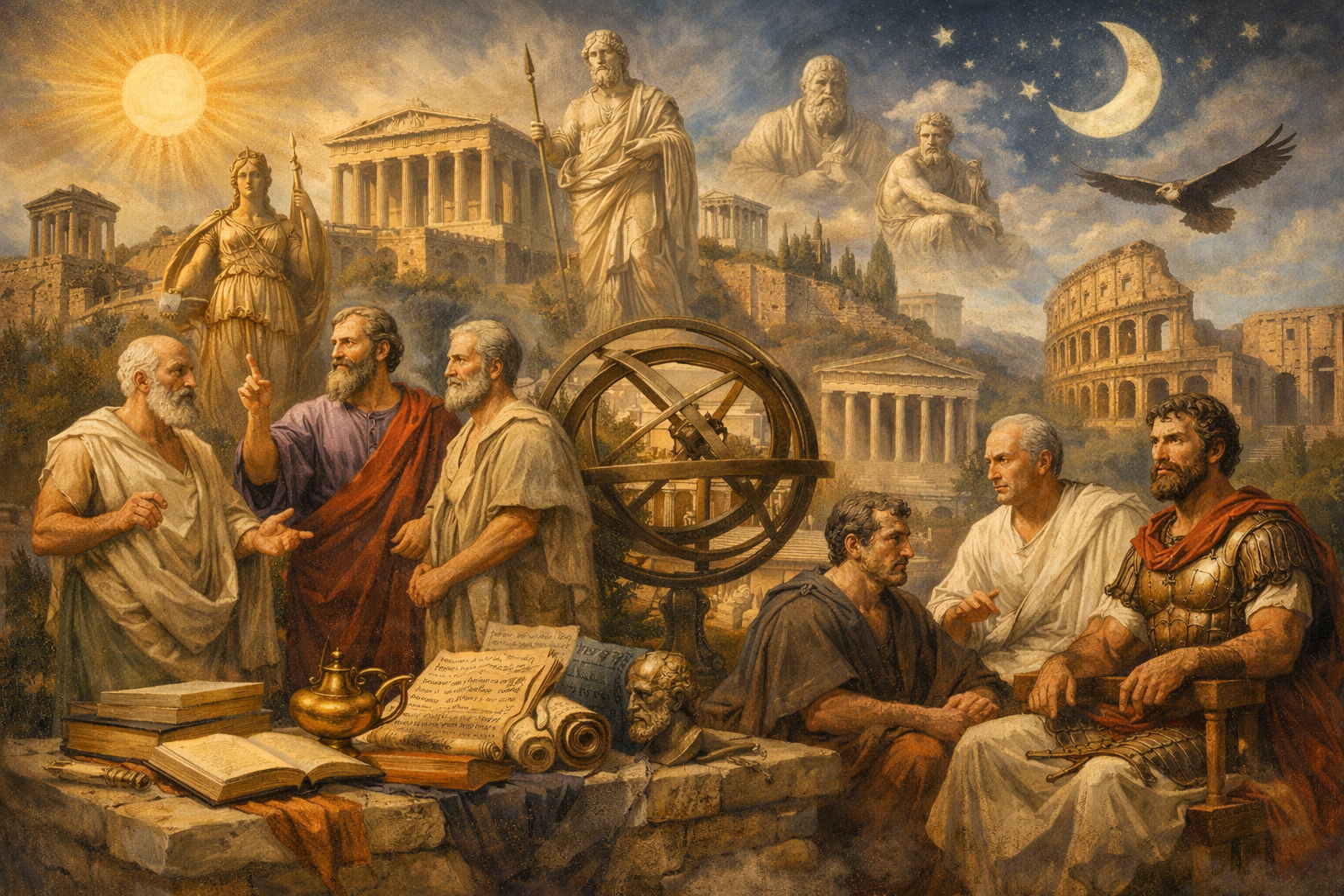
Greek and Roman thought provides one of the deepest classical foundations for later inquiries in ethics, political philosophy, metaphysics, rhetoric, science, existential reflection, theology, law, education, and the governance of the self. In this respect, the category connects not only to Ethics and Moral Philosophy and Political Philosophy and Justice, but also to Metaphysics, Existential Thought, Chinese Thought, Persian Thought, and Islamic and Mystical Thought. Without this classical layer, many later traditions can still be read, but they cannot be fully situated within the longer argument about reason, virtue, civic life, nature, law, mathematics, and the shape of human excellence that ancient philosophy helped establish.
A more complete understanding of Greek and Roman thought also requires attention to mathematics, natural philosophy, rhetoric, religion, law, social hierarchy, drama, medicine, education, and the long afterlife of classical traditions. Ancient philosophy did not treat number, ratio, geometry, harmony, astronomy, and cosmological order as merely technical matters external to wisdom. In many classical traditions, mathematics was inseparable from metaphysics, education, music, and the intelligibility of the cosmos itself. Likewise, rhetoric, tragedy, civic religion, slavery, gender hierarchy, citizenship, empire, and household order formed part of the world to which philosophy responded.
The goal of this pillar is not to romanticize antiquity or flatten Greek and Roman philosophy into a single civilizational story. It is to show why these traditions remain philosophically indispensable precisely because they connect rational inquiry with ethical formation, political judgment, metaphysical order, mathematical intelligibility, rhetorical power, and the care of the soul. Ancient philosophy continues to matter not because its answers are final, but because its questions remain alive and because its conception of philosophy as a way of life still offers one of the richest models of serious intellectual discipline.
Why Greek and Roman Thought Matters
Greek and Roman thought matters because it established many of the central questions and distinctions that continue to animate philosophy. Early Greek thinkers asked about the origin and order of the cosmos, the nature of change, the structure of reality, the possibility of rational explanation, and the relation between appearance and truth. With Socrates, the philosophical center of gravity shifted toward ethics, self-examination, virtue, justice, and the question of how one ought to live. Plato and Aristotle then gave classical form to discussions of metaphysics, epistemology, politics, ethics, rhetoric, logic, education, and the soul, creating a conceptual architecture that later traditions could inherit, transform, or contest.
This perspective matters because classical philosophy was not organized as a narrow academic specialization. It was a way of seeking wisdom about the world and one’s place within it. Philosophy could concern natural order, moral character, civic life, friendship, education, contemplation, law, happiness, rhetoric, medicine, mathematics, and the discipline of desire. The ancient schools treated thought not merely as theory, but as an orientation toward life, combining metaphysical reflection with ethical formation, civic judgment, and, in many cases, spiritual discipline.
Greek and Roman thought also matters because it offers a conception of philosophy in which ethics, politics, metaphysics, mathematics, rhetoric, and the cultivation of the self remain deeply connected. The classical world did not always separate questions of virtue from questions of citizenship, or questions of reason from questions of flourishing, or questions of cosmic order from questions of moral discipline. As a result, ancient philosophy remains especially powerful for any project concerned with character, public life, moral seriousness, education, and the long civilizational history of wisdom.
Within a broader philosophy architecture, Greek and Roman thought provides both origin and continuity. It gives later discussions of ethics, justice, existential struggle, mystical aspiration, rhetoric, education, political order, and civilizational memory a classical foundation. It also provides a field of critique, since its ideals of rationality and freedom were historically entangled with hierarchy, exclusion, slavery, empire, and restricted citizenship. The tradition matters not because it is innocent, but because it is foundational, powerful, internally diverse, and still philosophically unfinished.
The Scope of Classical Philosophy
Greek and Roman thought is not reducible to a single set of doctrines. It encompasses cosmology, natural philosophy, ethics, political philosophy, rhetoric, logic, metaphysics, mathematics, education, psychology, medicine, law, civic order, household order, and spiritual discipline. Ancient philosophy asks what the world is, what a human being is, how reason should function, how desire should be governed, how a city should be ordered, what law is for, what makes a life worth living, and what forms of excellence are worthy of cultivation.
This breadth is one reason classical philosophy remains alive. It did not isolate questions of truth from questions of conduct, or questions of politics from questions of moral formation, or questions of mathematics from questions of order and intelligibility. A person’s relation to nature, to the city, to the soul, to law, to speech, to body, to education, and to mortality could all be treated within a single philosophical horizon. That unity does not make classical thought simple. It makes it unusually ambitious.
A research-grade treatment of Greek and Roman thought must therefore include cosmological beginnings, mathematical inquiry, Socratic moral criticism, Platonic and Aristotelian synthesis, Hellenistic schools, Roman reception, social hierarchy, civic religion, tragedy, rhetoric, medicine, and the long afterlife of ancient philosophy in late antiquity, Christianity, Islam, and medieval thought. It must also recognize that ancient philosophy was not merely a premodern precursor to modern disciplines. It was a sophisticated intellectual world in its own right, with competing schools, technical arguments, distinct educational ideals, and divergent visions of truth, freedom, civic order, and the human good.
Major Intellectual Lineages
The study of Greek and Roman thought draws on several major intellectual lineages. One foundational lineage begins with the early Greek philosophers and mathematicians, who turned inquiry toward the origin, structure, and intelligibility of the world. Their questions about substance, change, plurality, number, order, and explanation established philosophy as a disciplined attempt to understand reality through reason rather than myth alone.
A second lineage centers on Socrates and the ethical turn. Socrates redirected philosophical attention toward the examined life, moral reasoning, virtue, justice, and the condition of the soul. In the Socratic tradition, philosophy became not only an inquiry into what exists, but also an inquiry into how one should live, what justice requires, and whether unexamined convention can withstand rational scrutiny.
A third lineage is the great classical synthesis associated with Plato and Aristotle. Plato developed a powerful philosophical vision linking metaphysics, knowledge, politics, education, eros, justice, and the ascent of the soul toward truth. Aristotle, by contrast, offered a more differentiated and systematic account of logic, causation, virtue, politics, rhetoric, biology, mathematics, and the natural world. Together, they established models of philosophy that remained decisive for centuries and continue to define much of the philosophical canon.
A fourth lineage emerges in Hellenistic and Roman philosophy, where schools such as Stoicism, Epicureanism, Skepticism, Cynicism, and later Neoplatonism asked how one might live well in a world marked by uncertainty, imperial scale, and political instability. These schools often treated philosophy not only as argument but as therapy, exercise, discipline, and preparation for endurance under difficult conditions.
A fifth lineage lies in Roman philosophical transmission and transformation. Roman thinkers did not merely preserve Greek philosophy; they adapted it to questions of law, rhetoric, public duty, imperial life, friendship, civic obligation, and moral endurance. Cicero, Seneca, Epictetus, Marcus Aurelius, Lucretius, and others translated Greek schools into forms shaped by Roman political and moral experience.
A sixth lineage concerns the long afterlife of classical thought. Greek and Roman philosophy did not end with antiquity. It was reinterpreted in late antique Neoplatonism, early Christian theology, Islamic philosophy, medieval scholasticism, Renaissance humanism, early modern political thought, and modern ethical reflection. The classical tradition therefore belongs not only to the ancient world, but to a wider history of transmission, commentary, appropriation, contestation, and transformation.
Myth, Reason, and the Birth of Philosophy
Greek philosophy is often described as the movement from myth to reason, but that formula must be handled carefully. Ancient thought did not simply abandon mythic imagination for rational explanation. Rather, philosophy emerged within a world already structured by epic, tragedy, cult, civic ritual, genealogy, poetry, and inherited accounts of divine order. What changed was the development of argument, conceptual distinction, and explanatory inquiry as distinct forms of intellectual authority.
This matters because philosophy in the Greek world was never wholly detached from the poetic, civic, and religious worlds around it. Plato can criticize poets while still writing dramatically charged dialogues. Tragedy can stage questions of justice, fate, guilt, and civic disorder that philosophy later reworks in a more analytic register. Greek thought therefore begins not in a clean break from myth, but in a complex reordering of authority among story, ritual, argument, and reason.
The birth of philosophy should therefore be understood as a transformation in how questions were asked and justified. Instead of receiving the cosmos only through inherited sacred narrative, early philosophers asked for principles, explanations, causes, elements, structures, and rational accounts. Yet the old imaginative and religious worlds did not disappear. They remained part of the background against which philosophy defined itself.
A serious treatment of Greek and Roman thought must therefore hold together both the rise of rational inquiry and the cultural worlds from which it emerged. Philosophy did not simply replace myth. It defined itself against, alongside, and through it.
The Greek Foundation: From Cosmos to Ethics
The earliest Greek philosophers were concerned with nature, origin, and order. They asked what the world is made of, how change is possible, whether reality is one or many, and what kind of intelligibility underlies the flux of experience. These questions may appear distant from later ethical thought, but they are important because they established philosophy as a practice of rational explanation and conceptual inquiry.
The pre-Socratic world was not unified. Some thinkers emphasized permanence, others flux; some sought a single underlying principle, others a plurality of elements or forces. Thales, Anaximander, Anaximenes, Heraclitus, Parmenides, Empedocles, Anaxagoras, Leucippus, and Democritus did not share a single doctrine. Yet across their differences, ancient Greek philosophy began to ask whether the world is ordered in ways the mind can understand and whether explanation can proceed by argument rather than inherited story alone.
The Greek foundation of philosophy therefore includes both cosmological inquiry and the gradual emergence of more explicitly ethical and political reflection. It seeks to understand the world, but it also opens the question of what kind of beings human persons are within that world and what forms of life reason can vindicate. This movement from cosmos to ethics is not a rejection of nature. It is the recognition that human life itself belongs within a larger order of explanation, judgment, and form.
Mathematics, Nature, and the Order of the Cosmos
Greek philosophy cannot be fully understood without mathematics. Number, ratio, geometry, harmony, astronomy, and proof were not treated as isolated technical pursuits, but as windows into the intelligibility of reality itself. Pythagorean thought, Platonic education, Euclidean geometry, mathematical astronomy, and later cosmological traditions all gave mathematics a privileged place because mathematical order seemed to reveal something fundamental about the structure of the world.
This matters because classical thought often connected mathematics to ethics, politics, music, and metaphysics. A world shaped by proportion and order suggested that the soul, the city, and the cosmos might all be judged by standards of measure, balance, and intelligibility. Geometry and astronomy therefore belonged to a larger vision in which philosophical reason sought not only argument, but form, order, and disciplined relation between mind and world.
Mathematics also shaped ancient education. In Platonic contexts especially, mathematical training could function as preparation for dialectic because it moved the mind away from sensory immediacy toward intelligible structure. This did not make mathematics identical with philosophy, but it made mathematical reasoning one of the most important disciplines through which philosophy learned to think rigorously about order, proof, abstraction, and necessity.
A comprehensive treatment of Greek and Roman thought must therefore include mathematics not as a side note, but as one of the core civilizational achievements of antiquity. The philosophical meaning of number, the authority of proof, the relation between mathematical order and cosmic order, and the place of mathematics in education all belong within the classical search for wisdom.
Socrates and the Moral Turn
With Socrates, philosophy took a more decisively ethical, dialogical, and critical form. Questions of virtue, justice, courage, piety, friendship, law, and the examined life came to the fore. Philosophy became inseparable from the demand that one justify one’s beliefs, scrutinize one’s habits, and care for the soul. Socratic inquiry did not abandon truth or metaphysics; rather, it bound them more closely to the problem of human conduct and self-knowledge.
Socrates matters because he exemplifies philosophy as a form of living interrogation. He challenges convention without replacing it with dogma, exposing the instability of moral confidence unsupported by reason. In this way, the Socratic turn became foundational not only to ethics but to philosophy’s self-understanding as an activity of examination, refutation, and moral seriousness.
The Socratic legacy continued through multiple traditions. Plato transformed it into a grand metaphysical and political project. Cynics radicalized its challenge to convention. Stoics absorbed its emphasis on moral seriousness and self-command. Later moral philosophy continued to inherit the Socratic conviction that the unexamined life is deficient not merely intellectually, but ethically.
The examined life became one of the defining aspirations of ancient philosophy because Socrates made philosophy answerable to the soul as well as to argument. Philosophy was not only a body of teachings. It was a test of life.
Plato, Aristotle, and the Classical Synthesis
Plato and Aristotle remain central because they developed two of the most influential and enduring visions of philosophical order. Plato’s thought joins metaphysical ascent, dialectical inquiry, moral education, eros, and political reflection into a unified vision in which truth, justice, beauty, and the good are deeply interrelated. His dialogues ask how knowledge differs from opinion, how the soul should be ordered, how education shapes character, and how political life might reflect deeper standards of justice.
Aristotle offers a different kind of synthesis. His philosophy is more empirical, classificatory, and architectonic, yet no less ambitious. He treats ethics as a practical inquiry into flourishing, virtue, habit, friendship, and prudence; politics as the study of life in the polis; logic as a discipline of valid reasoning; rhetoric as an art of persuasion bound to judgment; natural philosophy as the study of motion, change, and living beings; and metaphysics as the inquiry into being, substance, and causation. Aristotle’s account of ethics remains foundational because it links virtue to habituation, rational activity, and the fulfillment of human capacities within a social and political order.
Together, Plato and Aristotle define much of the classical horizon. They establish philosophy as a search for truth, but also as an inquiry into the proper order of the soul, the city, education, speech, nature, and the forms of life consistent with human excellence. Much of later philosophy can be read as a development, rejection, modification, or retrieval of the problems they formulated.
Their importance also lies in their differences. Plato often moves upward toward intelligible order, dialectic, and the form of the good. Aristotle often begins from the plurality of beings, practices, causes, and forms of explanation. The tension between these two orientations became one of the most productive forces in later intellectual history.
Hellenistic and Roman Philosophy
After the classical period, Greek and Roman philosophy took on new forms under altered historical conditions. Hellenistic schools such as Stoicism, Epicureanism, Skepticism, and Cynicism asked how one might achieve freedom from disturbance, self-command, and rational steadiness in a world no longer centered on the autonomous city-state. Under conditions of political fragmentation, imperial expansion, and insecurity, philosophy increasingly turned toward questions of inner order, discipline, and endurance.
Stoicism is especially important because it joined ethics, logic, and physics into an interlocking philosophical system. It presents virtue as necessary and sufficient for happiness while also developing a cosmology in which rational order structures the universe. Stoicism’s long afterlife owes much to its union of moral rigor, civic seriousness, and practical discipline under conditions of uncertainty and constraint.
Epicureanism offered a different but equally sophisticated vision. It linked atomistic materialism to an ethics of tranquility, friendship, and the measured pursuit of pleasure understood as freedom from disturbance. Skeptical traditions stressed the suspension of judgment and the tranquility that might follow from resisting dogmatic certainty. Cynicism pursued radical freedom through the rejection of convention, luxury, and false status. Neoplatonism later reconfigured Platonic themes into a more overtly metaphysical and spiritual architecture centered on emanation, ascent, and the hierarchy of reality.
Roman philosophy absorbed and transformed these traditions. Cicero transmitted and reworked Greek philosophical debates for Roman public life. Seneca, Epictetus, and Marcus Aurelius made Stoicism central to questions of inner discipline, public role, and moral endurance. Lucretius rendered Epicurean philosophy into one of the great poetic-philosophical works of antiquity. Roman thought did not merely repeat Greek ideas; it translated them into a civic and imperial register in which law, duty, public office, friendship, mortality, and the fragility of worldly power became philosophically salient.
Virtue, Reason, and the Ordering of Life
One of the deepest unifying themes across Greek and Roman thought is the conviction that philosophy concerns the ordering of life through reason. Whether in Socratic self-examination, Platonic ascent, Aristotelian flourishing, Stoic self-command, Epicurean tranquility, Cynic austerity, or skeptical discipline, ancient philosophy repeatedly asks how human beings should govern desire, cultivate judgment, and align life with truth, nature, justice, or peace of soul.
Virtue is central to this vision because moral excellence is not treated as accidental or secondary. It is treated as a condition of living well. In different schools, virtue may be connected to harmony of soul, practical wisdom, freedom from destructive passion, civic excellence, friendship, just action, rational fulfillment, or inner freedom. Yet across these variations, virtue remains one of the principal ways ancient thought links ethics to anthropology: it asks what kind of being a human person is and what kind of excellence such a being should seek.
Reason, likewise, is not merely instrumental. It is both a cognitive and a moral power, capable of ordering conduct, evaluating ends, disciplining desire, and situating persons within a wider structure of nature, city, or cosmos. This is why Greek and Roman thought continues to matter. It offers not just doctrines, but a vision of philosophy as formative discipline: a practice of becoming more lucid, more self-governing, more answerable to standards higher than appetite or convention, and more capable of enduring the instability of worldly life.
Civic Order, Law, and the Political World
Greek and Roman thought also matters because it treats philosophy as inseparable from political life. Plato and Aristotle ask what justice requires of the city and what sort of regime supports human flourishing. Roman thought translates philosophical reflection into a world of law, office, empire, citizenship, and civic duty. Across these traditions, the city is not merely the setting of philosophy but one of its major objects.
This matters because classical thought repeatedly joins questions of virtue to questions of citizenship. The formation of character cannot be wholly detached from education, law, public institutions, and the common world shared with others. Ancient political thought therefore remains foundational for later reflection on republicanism, civic virtue, law, mixed constitution, public speech, public office, and the moral standing of political life.
Roman thought adds an important juridical and civic dimension. The Roman world made law, duty, citizenship, office, and public responsibility central to philosophical reflection. Cicero’s engagement with natural law and republican duty, Seneca’s reflections on moral discipline within elite public life, and Marcus Aurelius’s meditations on rule and mortality show philosophy adapting to the burdens of civic and imperial responsibility.
Even where ancient philosophy turns inward, it rarely abandons the political world altogether. Stoic endurance, Roman duty, Platonic justice, and Aristotelian citizenship all presuppose that human beings live not merely as private individuals but as members of moral and political communities.
Religion, Tragedy, and the Moral Imagination
Greek and Roman thought cannot be understood through reason alone if reason is imagined as detached from religion, ritual, poetry, and tragedy. Ancient philosophy emerged alongside civic cult, sacrificial order, mythic inheritance, tragic drama, and religious imagination. Even where philosophy criticized conventional religion, it did so from within a world saturated by sacred forms, ancestral memory, and public ritual.
Tragedy is especially important because it explores questions that philosophy never fully leaves behind: fate, guilt, hubris, necessity, suffering, conflicting duties, civic breakdown, and the limits of human control. Greek tragedy often confronts the moral remainder left behind when no clean resolution is possible. In that sense, tragedy and philosophy are not opposites but neighboring forms of reflection on justice, fragility, and the human condition.
Religion likewise belongs to the intellectual landscape of classical thought. Philosophers could criticize mythic accounts of the gods, reinterpret divine order, propose more rational forms of theology, or connect cosmic reason with moral discipline. Stoicism, Platonism, Neoplatonism, and later Christian and Islamic receptions of Greek philosophy all demonstrate that ancient philosophy remained deeply entangled with questions of divinity, order, ritual, and transcendence.
A comprehensive pillar must therefore include religion and tragedy as part of classical thought’s larger moral imagination. Philosophy did not simply displace these forms. It inherited, contested, and reworked them.
Women, Slavery, and the Limits of Classical Freedom
No comprehensive treatment of Greek and Roman thought can ignore the social hierarchies that structured the classical world. Philosophical reflection on virtue, citizenship, freedom, law, and rational order took place within societies marked by slavery, patriarchy, exclusion from citizenship, household hierarchy, and sharp distinctions between those considered fit for public life and those denied full standing within it.
This matters because classical philosophy is not only a history of wisdom; it is also a history of limitation. Ancient accounts of freedom could coexist with slavery. Civic participation could be praised while women, foreigners, enslaved persons, and laboring populations remained excluded from the political community. Hierarchy could be naturalized even where reason and virtue were treated as universal in aspiration. These tensions do not cancel the value of Greek and Roman thought, but they do require philosophical honesty.
A serious pillar should therefore study not only what classical thinkers illuminate, but what they obscure, justify, or fail to confront. Greek and Roman thought remains alive not because it is beyond criticism, but because it remains open to rereading, retrieval, and moral challenge. The tradition’s ideals of reason, freedom, virtue, law, and civic order must be studied alongside the social exclusions that shaped their historical expression.
Mortality, Fragility, and Endurance
Ancient philosophy often confronts instability, loss, political decline, exile, illness, death, and the limits of human control with unusual clarity. Hellenistic and Roman thought, especially, turns repeatedly to mortality, fortune, suffering, impermanence, and the vulnerability of human plans to forces beyond command. Yet this confrontation does not typically collapse into despair. It becomes an occasion for philosophical discipline.
This matters because Greek and Roman thought does not offer wisdom only under ideal conditions. It asks what becomes of philosophy under pressure: when cities decline, when power corrupts, when life is brief, when loved ones die, when public duty conflicts with inward freedom, or when certainty proves impossible. Ancient philosophy remains powerful because it does not treat these as peripheral problems. They are central to what it means to live rationally.
Stoicism, Epicureanism, Skepticism, Cynicism, and later Neoplatonic traditions each offer different disciplines of endurance. Some emphasize rational assent and inner freedom. Some emphasize friendship and tranquility. Some emphasize suspension of judgment. Some reject convention. Some seek ascent beyond the unstable world. These are not identical answers, but they share the conviction that philosophy must address vulnerability, not merely abstraction.
That is one reason classical thought continues to speak across eras. It offers not the elimination of fragility, but forms of lucidity, endurance, restraint, and moral steadiness within it.
Late Antiquity and the Afterlife of Classical Thought
Greek and Roman thought did not end with the Roman Empire. In late antiquity, classical philosophy was transformed through Neoplatonism, theological controversy, commentary traditions, educational institutions, and new forms of spiritual and metaphysical synthesis. Plotinus, Porphyry, Iamblichus, Proclus, and later thinkers gave Platonic metaphysics a renewed life that would shape both Christian and Islamic philosophy.
This matters because the classical world became foundational not only to “Western philosophy” in a narrow sense, but to much wider intellectual histories. Greek philosophy was translated, commented upon, disputed, and integrated into early Christian theology, Islamic falsafa and kalam, Jewish philosophy, and medieval scholastic reasoning. Roman law and rhetoric likewise exerted a long civilizational influence beyond the immediate ancient world.
The afterlife of classical thought is not merely a story of preservation. It is a story of transformation. Plato and Aristotle were not simply repeated; they were reinterpreted through new religious, linguistic, political, and metaphysical contexts. Stoic, Epicurean, skeptical, and Neoplatonic themes were likewise adapted, resisted, or absorbed into later philosophical worlds.
A fully comprehensive pillar must therefore treat Greek and Roman thought not only as an ancient inheritance but as a living archive transmitted across languages, religions, and civilizations. Classical thought matters partly because it survived by being transformed.
Core Themes in Greek and Roman Thought
One major theme in this field is virtue. Greek and Roman philosophy repeatedly asks what moral excellence consists in and how character is formed through habit, discipline, judgment, and rational self-ordering.
A second theme is the good life. Ancient philosophy is centrally concerned with flourishing, happiness, tranquility, contemplation, friendship, and the forms of life that make human existence worthy and coherent.
A third theme is reason and knowledge. Classical thought treats reason not only as a tool of argument, but as a means of discovering truth, ordering the soul, and orienting life toward what is genuinely good.
A fourth theme is justice and political order. Greek and Roman thinkers ask how the city should be governed, what citizens owe one another, and how law, authority, rhetoric, and virtue relate to public life.
A fifth theme is nature and cosmos. From the pre-Socratics to the Stoics and Epicureans, ancient philosophy seeks to understand the larger order of reality and humanity’s place within it.
A sixth theme is mathematics and proportion. Number, harmony, proof, and formal order play a major role in classical thought’s conception of intelligibility, education, music, and cosmic structure.
A seventh theme is self-mastery. Greek and Roman traditions repeatedly return to the problem of desire, passion, discipline, and inner freedom, asking how the self can be governed in accordance with reason.
An eighth theme is rhetoric and persuasion. Classical philosophy repeatedly confronts the power of speech, the education of citizens, the instability of opinion, and the danger that persuasive language can serve truth or domination.
A ninth theme is mortality and endurance. Ancient philosophy often confronts instability, loss, political decline, exile, and the limits of human control, yet does so in ways that seek clarity rather than despair.
Finally, this field raises persistent questions of hierarchy, exclusion, and critique. Classical thought helped define ideals of freedom and civic order, yet did so within societies marked by slavery, patriarchy, and restricted citizenship. That tension is part of the tradition itself and must remain visible in any serious treatment.
Expanded Article Architecture
The following structure gathers the Greek and Roman Thought pillar into a long-range article architecture. It preserves the planned article sequence from the source draft while adding short descriptions for each article and grouping them into a clearer publication map.
Foundations of Greek and Roman Thought
- What Is Greek and Roman Thought? (planned)
Introduces the classical philosophical traditions of Greece and Rome as a field of inquiry into reason, virtue, nature, law, rhetoric, civic life, and wisdom. - Myth, Reason, and the Birth of Philosophy (planned)
Examines philosophy’s emergence within a world shaped by myth, epic, ritual, tragedy, and the rise of rational explanation.
Early Greek Natural Philosophy and First Principles
- The Pre-Socratics and the Birth of Rational Inquiry (planned)
Studies early Greek philosophers who sought rational accounts of nature, change, order, being, and the structure of reality. - Thales, Anaximander, and the Search for First Principles (planned)
Examines the earliest Ionian attempts to identify underlying principles of nature and explain the cosmos without relying only on inherited myth. - Anaximenes, Air, and the Logic of Natural Explanation (planned)
Studies Anaximenes’ account of air as a basic principle and the early philosophical search for natural mechanisms of change. - Heraclitus, Flux, and the Order of Change (planned)
Explores Heraclitus’ vision of reality as dynamic, ordered through tension, conflict, logos, and perpetual transformation. - Parmenides, Being, and the Denial of Becoming (planned)
Studies Parmenides’ radical challenge to change, plurality, and non-being, and his influence on later metaphysics. - Pluralism, Atomism, and the Multiplicity of Nature (planned)
Examines philosophical responses to Parmenides through pluralist and atomist accounts of elements, forces, bodies, and change. - Democritus and the Metaphysics of Atomism (planned)
Studies Democritus’ atomism as a major ancient account of matter, void, motion, perception, and natural explanation. - Nature, Cosmos, and the Search for Intelligibility (planned)
Synthesizes early Greek natural philosophy around the question of whether the world is rationally ordered and knowable.
Mathematics, Harmony, and Cosmic Order
- Pythagoreanism, Number, and Cosmic Order (planned)
Examines Pythagorean thought on number, harmony, music, cosmology, discipline, and the mathematical structure of reality. - Mathematics and the Philosophical Imagination in Ancient Greece (planned)
Studies how mathematical reasoning shaped Greek metaphysics, education, proof, cosmology, and ideals of intellectual discipline. - Geometry, Proof, and the Order of Reason (planned)
Explores geometry as a model of rigorous knowledge, formal demonstration, abstraction, and rational order. - Number, Ratio, and Harmonic Structure in Greek Thought (planned)
Studies ratio, proportion, harmony, music, and measure as philosophical concepts connecting mathematics, ethics, and cosmology. - Astronomy, Cosmos, and Classical Rationality (planned)
Examines ancient astronomy as a philosophical discipline concerned with order, motion, observation, and cosmic intelligibility. - Mathematics, Harmony, and Philosophical Order (planned)
Synthesizes the role of mathematical structure in classical visions of education, reality, music, proportion, and reason.
Sophists, Rhetoric, Language, and Method
- The Sophists, Persuasion, and the Politics of Speech (planned)
Studies the Sophists as teachers of rhetoric, civic skill, argument, relativism, and the political power of language. - Rhetoric, Education, and Civic Power in the Greek World (planned)
Examines rhetoric as a civic art bound to education, persuasion, public judgment, and political influence. - Language, Dialectic, and Philosophical Method (planned)
Studies how classical philosophy developed methods of questioning, definition, refutation, argument, and dialectical inquiry.
Socrates and the Ethical Turn
- Socrates and the Examined Life (planned)
Introduces Socrates as a defining figure of moral inquiry, self-examination, civic challenge, and the care of the soul. - Socratic Dialogue, Irony, and Moral Interrogation (planned)
Studies Socratic method through questioning, irony, refutation, and the destabilization of unexamined moral confidence. - Virtue, Knowledge, and the Care of the Soul (planned)
Examines the Socratic connection between virtue, knowledge, self-knowledge, moral formation, and the health of the soul.
Plato and the Architecture of Truth, Soul, and City
- Plato on Truth, Justice, and the Order of the Soul (planned)
Studies Plato’s account of justice as order in both the soul and the city, grounded in philosophical knowledge of the good. - Plato’s Theory of Forms and the Ascent to Reality (planned)
Examines Plato’s metaphysics of forms, appearance, knowledge, participation, and the ascent from opinion to truth. - Plato on Education, Rule, and the Just City (planned)
Studies Platonic political philosophy through education, guardianship, philosophical rule, civic order, and the formation of character. - Plato on Love, Beauty, and Philosophical Desire (planned)
Explores eros, beauty, desire, and the movement of the soul toward wisdom, truth, and higher forms of love.
Aristotle and the Classical Synthesis
- Aristotle on Virtue, Flourishing, and Practical Wisdom (planned)
Studies Aristotle’s ethics through virtue, habituation, practical wisdom, friendship, happiness, and human flourishing. - Aristotle on Logic, Demonstration, and Scientific Knowledge (planned)
Examines Aristotle’s development of logic, demonstration, classification, and systematic inquiry into knowledge. - Aristotle on Nature, Causation, and Change (planned)
Studies Aristotle’s natural philosophy through motion, potentiality, actuality, four causes, form, matter, and living beings. - Aristotle on Politics, Citizenship, and Constitutional Order (planned)
Examines Aristotle’s political thought through citizenship, regimes, law, education, virtue, and the polis as a site of human flourishing. - Aristotle on Friendship, Character, and the Human Good (planned)
Studies friendship as a moral and political relation central to virtue, character formation, and the good life.
Greek Civic Life, Justice, and Political Order
- The Polis, Citizenship, and Ancient Political Life (planned)
Introduces the polis as the civic context in which Greek philosophy developed ideas of citizenship, virtue, law, and public life. - Justice, Law, and Civic Order in the Greek City (planned)
Examines how Greek thought connected law, justice, civic education, public speech, and the ordering of the city. - Ancient Ethics and the Search for Happiness (planned)
Studies eudaimonia, virtue, pleasure, friendship, contemplation, and competing ancient accounts of the good life.
Religion, Tragedy, and Classical Moral Imagination
- Tragedy, Fate, and Moral Knowledge in Greek Thought (planned)
Examines tragedy as a philosophical resource for thinking about fate, guilt, suffering, conflict, and the limits of human control. - Religion, Ritual, and the Philosophical Life in Antiquity (planned)
Studies the relation between ancient philosophy, civic religion, ritual practice, divine order, and moral formation. - Philosophy and Civic Religion in the Classical World (planned)
Examines how philosophers criticized, reinterpreted, or participated in civic religious worlds shaped by ritual, myth, and public order.
Stoicism, Epicureanism, Skepticism, and Cynicism
- Stoicism: Virtue, Nature, and Inner Freedom (planned)
Introduces Stoicism as a philosophical system linking virtue, rational nature, inner freedom, discipline, and moral endurance. - Stoic Physics, Logic, and Moral Discipline (planned)
Studies Stoicism’s integration of cosmology, logic, ethics, fate, providence, and rational self-command. - Epicureanism: Pleasure, Tranquility, and the Limits of Desire (planned)
Examines Epicurean ethics through pleasure, tranquility, friendship, simplicity, fear of death, and the measured life. - Epicurus, Atomism, and the Ethics of Peace (planned)
Studies Epicurus’ atomistic natural philosophy and its connection to freedom from fear, superstition, and disturbance. - Skepticism and the Discipline of Uncertainty (planned)
Introduces ancient skepticism as a discipline of inquiry, suspension of judgment, and resistance to dogmatic certainty. - Pyrrhonism and the Ethics of Suspension (planned)
Examines Pyrrhonian skepticism through epochē, tranquility, appearances, and the refusal of fixed metaphysical claims. - Academic Skepticism and the Limits of Certainty (planned)
Studies skepticism within the Platonic Academy and its critique of dogmatic knowledge claims. - Cynicism, Freedom, and the Rejection of Convention (planned)
Examines Cynic philosophy as a radical challenge to wealth, status, convention, luxury, and false social need. - Hellenistic Philosophy and the Search for Stability in an Unstable World (planned)
Synthesizes Hellenistic schools as responses to political instability, mortality, uncertainty, and the search for inner order.
Roman Reception, Law, Office, and Civic Duty
- Cicero and the Roman Transmission of Greek Philosophy (planned)
Studies Cicero’s role in translating, adapting, and transmitting Greek philosophy into Roman civic, rhetorical, and legal life. - Roman Republicanism, Office, and Civic Duty (planned)
Examines Roman thought on public office, duty, republican virtue, civic obligation, and the moral burdens of political life. - Roman Law, Natural Law, and Jurisprudential Reason (planned)
Studies Roman legal thought and its contribution to natural law, jurisprudence, legal reason, and later political philosophy. - Law, Duty, and Civic Order in Roman Thought (planned)
Explores how Roman philosophy connected law, moral duty, citizenship, social order, and public responsibility. - Empire, Citizenship, and Universal Order in Roman Philosophy (planned)
Examines Roman reflections on empire, universal reason, cosmopolitanism, citizenship, and the expansion of political order.
Roman Moral Philosophy and the Discipline of the Self
- Seneca and the Ethics of Self-Command (planned)
Studies Seneca’s moral philosophy through anger, wealth, mortality, self-discipline, public life, and inner freedom. - Epictetus and Freedom Under Constraint (planned)
Examines Epictetus’ philosophy of freedom, control, discipline, assent, slavery, and moral autonomy under external constraint. - Marcus Aurelius and Philosophy in Public Life (planned)
Studies Marcus Aurelius as a philosopher-ruler reflecting on duty, mortality, discipline, cosmic order, and public responsibility. - Lucretius, Nature, and the Poetics of Philosophy (planned)
Examines Lucretius’ poetic presentation of Epicurean atomism, nature, mortality, fear, and philosophical liberation. - Friendship, Education, and the Formation of Character (planned)
Studies ancient accounts of friendship and education as practices central to moral formation and human flourishing. - Self-Mastery, Passion, and the Government of Desire (planned)
Examines classical accounts of desire, passion, self-control, discipline, and the rational ordering of the self. - Mortality, Fortune, and Endurance in Ancient Philosophy (planned)
Studies ancient reflections on death, fortune, loss, impermanence, and the philosophical cultivation of endurance.
Medicine, Body, Household, and Social Limits
- Ancient Medicine, Nature, and the Body (planned)
Examines ancient medicine as a field connecting nature, body, health, balance, observation, and philosophical anthropology. - Women, Citizenship, and Exclusion in Classical Thought (planned)
Studies the exclusion of women from full civic standing and how gender shaped classical theories of citizenship, virtue, and public life. - Slavery, Hierarchy, and the Limits of Ancient Freedom (planned)
Examines slavery and social hierarchy as central historical contradictions within classical accounts of freedom and civic order. - Greek and Roman Philosophy and the Problem of Human Equality (planned)
Studies the tension between universal claims about reason or nature and the unequal social realities of ancient life. - Household, Gender, and Social Order in Antiquity (planned)
Examines household management, gender hierarchy, kinship, labor, and domestic order as philosophical and political concerns.
Late Antiquity, Neoplatonism, and Classical Transmission
- Neoplatonism and the Late Antique Transformation of Classical Thought (planned)
Introduces Neoplatonism as a major late antique transformation of Platonic metaphysics, spirituality, and philosophical ascent. - Plotinus and the Metaphysics of Emanation (planned)
Studies Plotinus’ account of the One, intellect, soul, emanation, return, and the hierarchy of reality. - The Afterlife of Greek Philosophy in Late Antiquity (planned)
Examines how Greek philosophy continued through commentary, schools, theological debate, and late antique intellectual culture. - Greek Thought in Early Christian Theology (planned)
Studies how early Christian thinkers used, transformed, and contested Greek philosophical concepts in theology. - Greek and Roman Philosophy in Islamic Reception (planned)
Examines the reception, translation, and transformation of Greek philosophy in Islamic intellectual traditions. - The Classical Legacy and the Making of Medieval Philosophy (planned)
Studies how Greek and Roman thought shaped medieval scholastic, theological, metaphysical, and ethical traditions. - Greek and Roman Thought and the Foundations of Western Philosophy (planned)
Examines the long influence of classical thought on later philosophy, education, law, rhetoric, science, and political theory. - Classical Wisdom in an Age of Complexity (planned)
Reflects on how ancient traditions of virtue, self-command, civic judgment, and philosophical discipline speak to complex modern conditions. - Why Greek and Roman Thought Still Matters (planned)
Concludes the series by explaining why classical philosophy remains vital for ethics, politics, metaphysics, education, rhetoric, and the search for wisdom.
Closing Perspective
Greek and Roman thought remains indispensable because it gives philosophy one of its deepest models of intellectual seriousness. It joins inquiry into nature with inquiry into the soul, reason with virtue, mathematics with order, rhetoric with civic judgment, law with public responsibility, and mortality with the discipline of life. It understands philosophy not simply as the production of arguments, but as the formation of persons capable of judgment, restraint, courage, friendship, civic responsibility, and contemplation.
This does not mean the classical tradition should be treated as morally complete. It must be studied critically, especially where ancient accounts of freedom and civic excellence coexisted with slavery, patriarchy, exclusion, and empire. But serious criticism requires serious study. The value of Greek and Roman thought lies not in removing it from history, but in seeing how its insights and limits continue to shape the questions later traditions inherit.
The strongest reason to study Greek and Roman thought is that its questions remain alive. What is the good life? What is justice? How should desire be governed? What is nature? What is truth? What kind of education forms judgment? What do citizens owe one another? How should one live under mortality, uncertainty, and political instability? These are not ancient questions only. They are enduring philosophical questions, and the classical world remains one of the most powerful places to begin asking them.
Related Reading
- Ethics and Moral Philosophy — for virtue, duty, moral reasoning, character, practical wisdom, and the good life.
- Political Philosophy and Justice — for authority, law, citizenship, justice, civic order, liberty, and the common good.
- Metaphysics — for being, substance, causation, change, form, reality, and the structure of existence.
- Existential Thought — for mortality, freedom, anxiety, meaning, finitude, and the problem of how to live.
- Chinese Thought — for comparative traditions of virtue, order, harmony, moral cultivation, and political life.
- Russian Thought — for later philosophical engagements with suffering, moral responsibility, history, and spiritual seriousness.
- Persian Thought — for comparative reflection on wisdom, kingship, ethics, metaphysics, poetry, and civilizational memory.
- Islamic and Mystical Thought — for the later reception and transformation of Greek philosophy through metaphysics, theology, mysticism, and spiritual discipline.
Further Reading
- Annas, J. (1993) The Morality of Happiness. New York: Oxford University Press. Available at: https://global.oup.com/academic/product/the-morality-of-happiness-9780195096521.
- Hadot, P. (1995) Philosophy as a Way of Life. Oxford: Blackwell. Available at: https://www.wiley.com/en-us/Philosophy+as+a+Way+of+Life%3A+Spiritual+Exercises+from+Socrates+to+Foucault-p-9780631180333.
- Long, A.A. (2006) From Epicurus to Epictetus: Studies in Hellenistic and Roman Philosophy. Oxford: Oxford University Press. Available at: https://global.oup.com/academic/product/from-epicurus-to-epictetus-9780199279126.
- Nightingale, A.W. (2004) Spectacles of Truth in Classical Greek Philosophy. Cambridge: Cambridge University Press. Available at: https://www.cambridge.org/core/books/spectacles-of-truth-in-classical-greek-philosophy/6E5B9A7C5E5D9E278671B4B90C12C7D8.
- Sellars, J. (2006) Stoicism. Berkeley: University of California Press. Available at: https://www.ucpress.edu/book/9780520249088/stoicism.
- Shields, C. (2007) Ancient Philosophy: A Contemporary Introduction. London: Routledge. Available at: https://www.routledge.com/Ancient-Philosophy-A-Contemporary-Introduction/Shields/p/book/9780415233987.
- Vlastos, G. (1991) Socrates, Ironist and Moral Philosopher. Cambridge: Cambridge University Press. Available at: https://www.cambridge.org/core/books/socrates-ironist-and-moral-philosopher/5E23F560E782F45698B04707989B710E.
- Waterfield, R. (2023) The Making of Greek Philosophy. Oxford: Oxford University Press. Available at: https://global.oup.com/academic/product/the-making-of-greek-philosophy-9780197564750.
References
- Britannica (n.d.) Greek philosophy. Available at: https://www.britannica.com/topic/Greek-philosophy.
- Britannica (n.d.) Western philosophy: Ancient Greek and Roman philosophy. Available at: https://www.britannica.com/topic/Western-philosophy/Ancient-Greek-and-Roman-philosophy.
- Britannica (n.d.) Greek philosophy: Hellenistic and Roman philosophy. Available at: https://www.britannica.com/topic/Greek-philosophy/Hellenistic-and-Roman-philosophy.
- Durand, M. (2023) ‘Stoicism’, in Zalta, E.N. and Nodelman, U. (eds.) The Stanford Encyclopedia of Philosophy. Available at: https://plato.stanford.edu/entries/stoicism/.
- Internet Encyclopedia of Philosophy (n.d.) Ancient Greek Philosophy. Available at: https://iep.utm.edu/ancient-greek-philosophy/.
- Internet Encyclopedia of Philosophy (n.d.) Stoicism. Available at: https://iep.utm.edu/stoicism/.
- Konstan, D. (2005) ‘Epicurus’, in Zalta, E.N. and Nodelman, U. (eds.) The Stanford Encyclopedia of Philosophy. Available at: https://plato.stanford.edu/entries/epicurus/.
- Lane, M. (2010) ‘Ancient Political Philosophy’, in Zalta, E.N. and Nodelman, U. (eds.) The Stanford Encyclopedia of Philosophy. Available at: https://plato.stanford.edu/entries/ancient-political/.
- Parry, R. (2004) ‘Ancient Ethical Theory’, in Zalta, E.N. and Nodelman, U. (eds.) The Stanford Encyclopedia of Philosophy. Available at: https://plato.stanford.edu/entries/ethics-ancient/.
- Woolf, R. (2022) ‘Cicero’, in Zalta, E.N. and Nodelman, U. (eds.) The Stanford Encyclopedia of Philosophy. Available at: https://plato.stanford.edu/entries/cicero/.