
Last Updated May 3, 2026
Poetry, Memory, and Imagination explores one of humanity’s oldest and most enduring arts: the patterned making of language through which experience is preserved, intensified, and carried across generations. Long before poetry became a literary object on the page, it lived in voice, breath, chant, repetition, ceremony, and song. It preserved names, losses, prayers, victories, lineages, laws, landscapes, divine presences, communal wounds, moral ideals, and visions of the sacred by binding memory to rhythm and form. Poetry is therefore not simply one genre among others. It is one of the oldest technologies of human remembrance and one of the most concentrated ways civilizations remember themselves.
What poetry remembers, however, is not identical with what history records. Poetry often preserves another order of truth: emotional truth, ritual truth, symbolic truth, visionary truth, communal truth, and the felt atmosphere of lived experience. It does not merely state what happened. It gives shape to what remains after events: the wound, the praise, the prayer, the image that does not fade, the sound by which a people continues to know itself, the cadence in which grief or devotion becomes bearable. For this reason poetry has frequently stood near the center of cultural memory, preserving what communities fear to lose and imagining meanings that prose alone cannot fully contain.
Current Space
Literature & Cultural Memory
Related Topic
Classical Literature
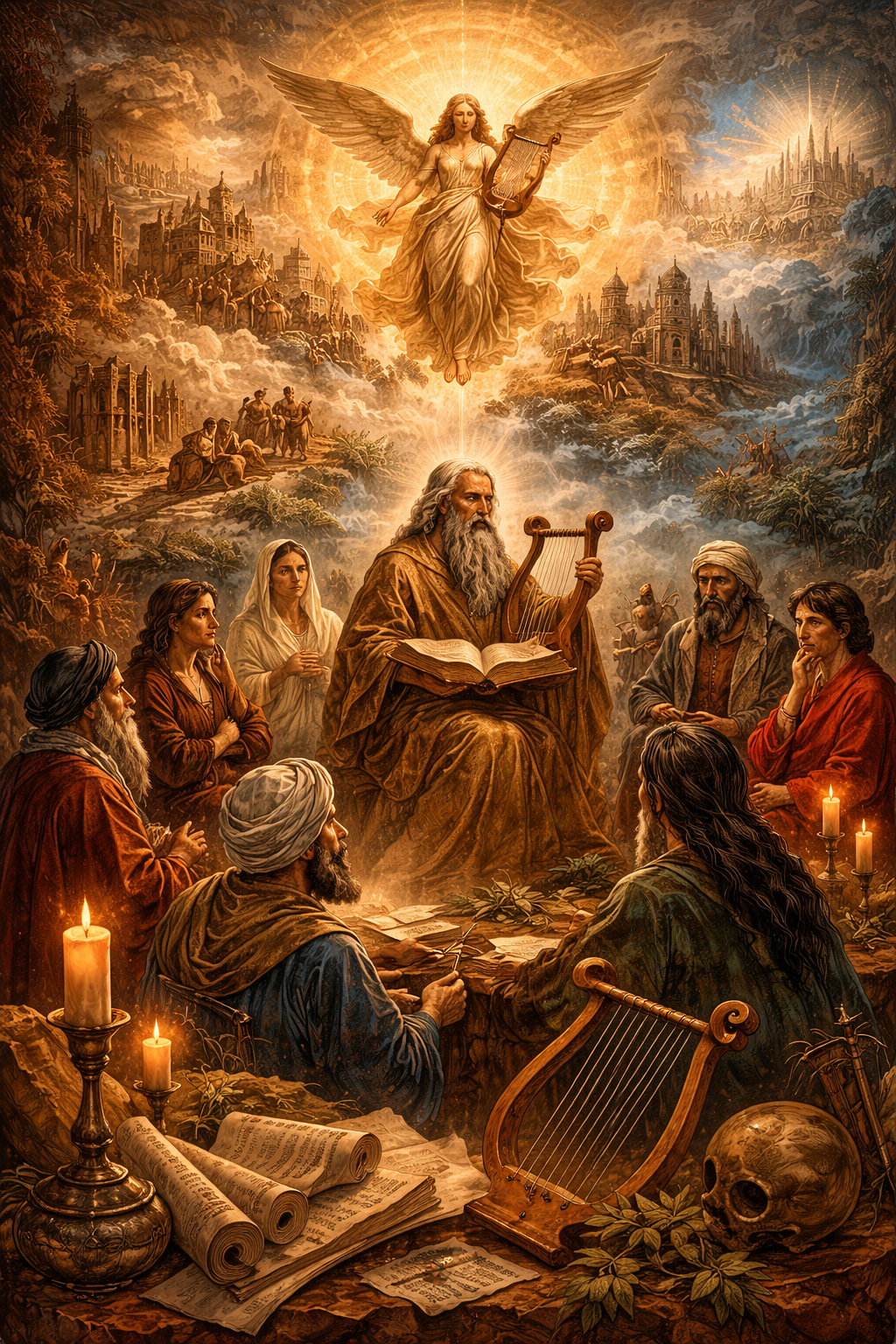
This category examines lyric, epic, elegy, devotional verse, oral poetry, praise poetry, love poetry, mystical poetry, political poetry, prophetic poetry, and experimental poetics across traditions. It studies how poetic form supports remembrance through meter, refrain, cadence, allusion, image, breath, silence, and symbolic compression, and how poetry becomes a site where memory and imagination are not opposites but mutually sustaining forces. Poetry recalls the lost, names the absent, preserves the sacred, gives voice to resistance, transforms suffering into utterance, and creates verbal forms through which individuals and communities continue to think and feel beyond rupture.
Poetry, Memory, and Imagination is therefore a study of one of literature’s deepest and most durable powers. It brings poetic traditions into relation with ritual, performance, music, language, mourning, desire, prophecy, law, cosmology, translation, canon formation, memorization, and artistic renewal. By treating poetry as both cultural archive and imaginative reworlding, this category clarifies how verse preserves continuity while opening new possibilities of feeling, perception, and collective life. Poetry is not only remembered language. It is one of the oldest and strongest ways human beings make memory audible.
Why This Field Matters
This field matters because poetry preserves what is most difficult to keep. It can hold the dead in speech, carry a people’s losses through rhythm, preserve devotion in repeated form, keep praise alive beyond the moment of praise, bind law to memory, and transform fleeting perception into something transmissible. Other forms of writing may document, explain, classify, or narrate. Poetry remembers by sounding, by returning, by condensing, by shaping experience into forms that can be spoken again.
For that reason poetry often stands at the center of civilizational memory. Communities remember through song, prayer, lament, praise, chant, anthem, invocation, epic narration, and prophetic utterance. Families remember through elegy. Religions remember through liturgical verse. Nations remember through resistance poetry and commemorative speech. Poetry matters not because it is decorative, but because it gives survival a form and absence a voice.
The field also matters because poetry refuses the reduction of memory to information. It preserves not only events, but tonalities of experience: dread, reverence, longing, grief, astonishment, gratitude, shame, devotion, and hope. A poem may remember a world by preserving the pressure of a single image, the return of a refrain, the music of a line, or the silence after a broken phrase. Poetry is therefore one of the most concentrated forms of historical feeling.
In a culture increasingly dominated by speed, summary, utility, and disposable language, poetry also preserves the seriousness of attention. It teaches that language can be slowed, weighed, repeated, memorized, and entrusted with what ordinary speech cannot carry alone. Poetry remains indispensable because it protects language from becoming merely functional. It restores density, resonance, and presence to human remembrance.
Poetry as a Technology of Remembrance
Poetry is one of the oldest technologies of remembrance because it binds memory to pattern. Repetition, meter, refrain, formula, parallelism, alliteration, image, lineation, and cadence make language memorable in ways that prose often does not. A poem can be carried in the mind, in the mouth, in communal recitation, and across generations. Its form is part of its mnemonic life.
This mnemonic power is not merely practical. It is imaginative and social. To remember through poetry is to remember rhythmically, symbolically, and often communally. The remembered thing becomes more than information; it becomes presence, recurrence, atmosphere, and return. Poetry is thus not simply a storehouse of content. It is a patterned method by which memory survives rupture.
The term “technology” matters here because poetic form performs work. Meter organizes utterance. Refrain returns feeling. Parallelism stabilizes memory. Formula preserves narrative sequence. Rhyme binds words into expectation. Lineation gives language spatial and rhythmic shape. These devices are not decorative additions to meaning. They are part of how meaning is stored, repeated, and made durable.
Poetry also remembers by making memory participatory. A repeated line invites the hearer to anticipate, join, recite, sing, or answer. The poem becomes a shared form rather than a private object. In this sense, poetry’s memory is not held only by manuscripts or books. It is held by bodies, voices, gatherings, ceremonies, schools, religious communities, families, movements, and traditions of repetition.
Before Writing: Oral Memory and Civilizational Transmission
Poetry’s history reaches back before stable textual archives. In many cultures it preserved genealogy, myth, law, praise, cosmology, instruction, and sacred speech through oral formula and communal performance. Before writing, or alongside it, verse made memory durable because pattern could be repeated, shared, and embodied. This pre-literate and para-literate force remains crucial to understanding poetry’s civilizational role.
The oral dimension also reminds us that poetry is not secondary to culture but foundational to it. Communities often learned who they were through repeated lines, stories, invocations, and sung forms. In such settings, poetry was not a luxury or specialized art. It was one of the primary ways a people carried knowledge forward.
Oral poetry also complicates modern assumptions about authorship. In many traditions, the poem belongs not only to an individual maker but to a chain of performance, memory, adaptation, and communal preservation. Formula, variation, improvisation, and repetition allow poems to remain stable enough to survive while flexible enough to answer new occasions. Memory in oral poetry is therefore both conservative and creative.
This is one reason epic, ballad, chant, praise poetry, lament, and ritual song remain central to the field. They show poetry as an archive before the archive: a living system of transmission in which the past is carried by those who speak, sing, hear, and repeat.
Voice, Breath, Body, and Recitation
Before poetry is text, it is voice. It is breath, cadence, utterance, cry, invocation, recitation, and listening. Across traditions, poetry begins in the body and often remains tied to performance even after it becomes written literature. Oral verse survives through vocal authority, embodied rhythm, and communal repetition. The line is remembered because it can be spoken; the poem endures because it can be heard again.
This bodily dimension extends beyond voice alone. Pulse, gesture, chant, communal swaying, ritual movement, lamentation, and performative stance all shape how poetry is remembered and felt. A poem is often not merely read but inhabited. A strongest-sense account of poetry and memory must therefore begin not only on the page but in the mouth, ear, breath, and gathered body.
Breath is especially important because it connects poetic form to human finitude. A line is not only a visual unit; it is often a unit of utterance, a measure of air, pressure, pause, and release. Enjambment, caesura, stanza, chant, and refrain all shape the relation between language and the breathing body. Poetry remembers through forms that the body can repeat.
Recitation also creates community. To hear a poem spoken is to encounter language as event, not only as inscription. The speaker lends body to the poem; the listeners lend memory to its continuation. Poetry survives because it can become a shared occasion of voice.
Ritual, Sacred Speech, and Ceremonial Form
Poetry is frequently bound to ritual. It appears at funerals, weddings, commemorations, pilgrimages, liturgies, coronations, initiations, feasts, protests, and other threshold moments where ordinary language proves insufficient. In these settings poetry is not simply expressive language; it is a patterned act through which a community marks what matters most. Lament, blessing, invocation, praise, prayer, curse, oath, and hymn all show poetry functioning as ceremonial memory.
This ritual dimension helps explain poetry’s durability. It survives not only because it is beautiful, but because it is needed where a society must speak with more than ordinary language. Poetry often stands close to law, sanctity, mourning, and social cohesion because its patterned form gives gravity to utterance. In many traditions, poetry is among the chief modes by which the sacred becomes audible.
Sacred speech often relies on poetic pattern because religious memory must be repeatable, communal, and charged with authority. Psalms, hymns, chants, mantras, devotional lyrics, mystical songs, and liturgical responses make memory participatory. They do not simply convey doctrine. They train feeling, posture, attention, and communal belonging.
Poetry also appears where communities confront thresholds: death, birth, marriage, oath, war, exile, harvest, pilgrimage, public mourning, national crisis. At such moments, language must do more than communicate. It must gather, bind, console, command, praise, or sanctify. Poetry gives ceremony its durable voice.
Sound, Meter, Repetition, and the Memory of Form
Poetry remembers through sound. Rhyme, meter, cadence, refrain, assonance, consonance, alliteration, and rhythmic return are not ornamental extras. They are among poetry’s oldest mnemonic powers. Sound organizes feeling and makes recurrence possible. It allows lines to lodge in memory, to be carried in speech, and to survive beyond the circumstances of first utterance.
Meter and form also discipline memory. They turn grief, praise, devotion, protest, or celebration into recognizable structures. A stanza becomes a vessel. A refrain makes loss bearable by repeating it. Formal recurrence gives shape to emotional recurrence. Poetry’s memory is therefore not only thematic; it is sonic and structural.
Sound matters because it allows meaning to be felt before it is fully interpreted. The ear recognizes pressure, return, expectation, emphasis, and rupture. A poem’s music can preserve the emotional logic of an experience even when the literal context has faded. This is why a line may survive in memory as cadence before it survives as paraphrase.
Form also allows memory to endure constraint. The discipline of meter, stanza, rhyme, or refrain can hold overwhelming feeling without dissolving into formlessness. Poetry often gives grief, devotion, anger, or longing a structure strong enough to carry what ordinary speech cannot sustain.
Language Consciousness and the Pressure of the Line
Poetry is also one of the arts through which language becomes most conscious of itself. Words in poetry are tested for pressure, resonance, density, ambiguity, silence, and symbolic charge. Poetry is where language is tightened, broken open, heightened, and made to bear more than ordinary discursive use requires. It is often the form language takes under maximum pressure.
This matters because poetic memory is inseparable from verbal self-awareness. A line may endure not only because of what it says, but because of how it sounds, where it breaks, what it withholds, and how it reorders perception. Poetry preserves memory through intensified language: language made strange, memorable, exact, and resonant enough to survive.
The line is one of poetry’s central instruments of thought. It can suspend meaning, accelerate it, interrupt it, intensify it, or force the reader to hold multiple possibilities at once. Line breaks turn language into event. They make the reader feel sequence, hesitation, emphasis, and surprise. A line can become memorable because it concentrates perception into a shape the mind can return to.
Poetry also protects ambiguity as a form of truth. Where ordinary language may seek closure, poetry can preserve tension: grief and praise, presence and absence, faith and doubt, memory and invention, intimacy and distance. The pressure of the line allows complex experiences to remain complex without becoming vague.
Memory, History, and Poetry’s Orders of Truth
Poetry does not preserve the past in the same way history does. It often records another order of truth: emotional truth, symbolic truth, ritual truth, visionary truth, metaphysical truth, communal truth. A poem may preserve what it felt like to lose, to praise, to fear, to worship, to remember, to survive. In this sense poetic memory is not a lesser history. It is a different mode of knowing.
This distinction matters because poetry often carries what official history cannot hold well: sacred presence, moral atmosphere, collective wound, ancestral continuity, fleeting perception, inward contradiction, and the language of the absent. Poetry becomes the place where communities remember not only what occurred, but what it meant to endure it.
History often seeks sequence, evidence, explanation, and causation. Poetry may preserve intensity, atmosphere, recurrence, and symbolic relation. The two are not enemies, but they answer different needs. A battlefield may be recorded by historians through dates, forces, causes, and consequences. Poetry may preserve the cry, the name, the broken object, the silence afterward, the grief that becomes communal memory.
For this reason, poetry is especially important where memory is contested, wounded, suppressed, or sacred. It can carry forms of truth that do not fit easily into archive, chronology, or official record. It is often where the interior and communal meanings of history remain audible.
Lyric, Epic, Elegy, and the Modes of Poetic Memory
Poetic memory takes many forms. Lyric condenses inward experience and fleeting intensity into concentrated speech. Epic preserves collective origins, journeys, wars, laws, heroes, and cosmological orders. Elegy remembers the dead, the vanished bond, the ruined world. Devotional verse preserves prayer and sacred relation. Praise poetry keeps rulers, ancestors, beloveds, gods, or communal ideals alive in speech. Political poetry remembers injustice and sustains resistance. Mystical poetry remembers what exceeds ordinary language by stretching language toward vision.
A serious content pillar must distinguish among these modes because each remembers differently. Lyric gathers feeling. Epic orders communal memory. Elegy gives loss a durable voice. Devotional poetry binds memory to worship. Political verse preserves injury and protest. Experimental poetry may fracture inherited form to register damaged inheritance or altered perception. Poetry is not one mode of remembering, but many.
Epic and lyric are especially useful contrasts. Epic extends memory outward into collective scale: origins, wars, migrations, founding acts, ancestral figures, and civilizational orders. Lyric intensifies memory inward: the moment, the voice, the beloved, the wound, the perception, the prayer. Elegy mediates between them, making private loss available to communal recognition and communal grief available to individual utterance.
These forms often overlap. An elegy may become political. A lyric may carry sacred memory. An epic may contain moments of intimate grief. A protest poem may become liturgical in its repetition. The field therefore studies poetic mode not as fixed classification, but as a set of memory functions through which verse carries different kinds of human inheritance.
Praise, Love, Devotion, and Prophecy
Poetry has long preserved what cultures wish to honor. Praise poetry elevates rulers, ancestors, beloveds, landscapes, gods, saints, and communal virtues. Love poetry remembers the beloved not only as person but as figure of desire, beauty, intimacy, and imaginative transformation. Devotional poetry remembers the divine through invocation, adoration, yearning, and submission. Prophetic poetry speaks in another register: warning, calling, rebuking, envisioning, binding memory to judgment and future possibility.
In all these modes, poetry does not simply describe what is valued or feared; it helps constitute value and orientation through language. It preserves ideals, desires, and warnings in forms made to endure. The remembered ideal may be intimate, sacred, or collective, but poetry gives it recurrence and authority.
Praise poetry is especially important because it shows poetry as a maker of social value. To praise is to preserve a name, a virtue, a lineage, a victory, a beauty, or a divine attribute in heightened speech. Yet praise can also be politically dangerous, because it may glorify power, sanctify hierarchy, or convert violence into honor. A scholarly account of poetry must therefore read praise as both memory and judgment.
Prophetic poetry introduces another form of memory: memory turned toward accountability. It remembers covenant, law, injustice, betrayal, and divine or moral demand. It speaks not only of what has been, but of what must be faced. In prophetic verse, poetry becomes a voice that refuses forgetfulness.
Poetry, Absence, and the Language of Loss
One of poetry’s deepest functions is to speak to and from absence. The dead, the exiled, the beloved, the vanished homeland, the ruined city, the inaccessible divine, the unrealized future, the lost childhood, the broken community all become poetic presences precisely because they are absent. Poetry is one of the arts most intimately bound to what cannot be restored except in language.
This relation to absence helps explain poetry’s central place in mourning and remembrance. Poems do not abolish loss. They shape it into something that can be carried. A line may become the last durable form of relation to what is gone. In this sense poetry often stands nearest to the human need to continue speaking where reality no longer answers.
Elegy is the most explicit form of this work, but absence runs through many poetic traditions. Exile poetry remembers a lost homeland; love poetry remembers distance or separation; mystical poetry addresses the hidden divine; political poetry speaks for the disappeared; war poetry names the dead; diaspora poetry preserves broken continuity; devotional poetry speaks toward a presence that may be felt as both intimate and inaccessible.
Poetry gives absence form without pretending to overcome it. Its power lies in that restraint. It allows the absent to remain absent while still being addressed, mourned, praised, remembered, and carried forward.
Time, Place, and the Imaginative Ordering of Memory
Poetry does not only remember content; it remakes time. Lyric can suspend the moment into intensity. Epic can stretch memory across generations. Elegy can turn the present toward the irrecoverable past. Prophetic verse can speak as though the future were already audible. Refrain creates recurrence; chant creates cyclical time; fragment can register historical interruption. Poetry is one of literature’s most powerful instruments for shaping temporal experience.
Poetry is also deeply tied to place. Homeland, city, battlefield, river, mountain, shrine, grave-site, desert, sea, and remembered house often become mnemonic anchors through verse. Place in poetry is rarely mere setting. It is remembered ground, sacred landscape, lost territory, site of grief, or image of belonging. Poetry helps preserve how a place is felt, mourned, praised, or imagined.
Poetic time is often layered rather than linear. A poem can make childhood, ancestry, myth, grief, ritual, and historical crisis present in the same utterance. It can allow the past to return without becoming mere repetition. It can hold an instant open until it becomes symbolic. It can make a future demand audible in the present.
Poetic place works similarly. A landscape in poetry may be physical, sacred, political, remembered, imagined, or lost. A river may carry history; a mountain may hold revelation; a house may preserve childhood; a city may embody ruin or longing; a grave may become a site where private mourning and public memory meet. Poetry makes place resonant by binding geography to feeling, history, and symbolic form.
Imagination, Image, and the Remaking of Memory
Imagination in poetry is not merely escape from memory. It is one of the principal means by which memory is transformed into something livable, transmissible, and newly thinkable. Poetry remembers by making images, symbols, metaphors, scenes, and verbal intensities that reorder experience. It does not simply store the past; it remakes it into form.
This is why memory and imagination in poetry are mutually sustaining rather than opposed. Memory gives poetry its pressure; imagination gives memory shape. The poem does not choose between fidelity and invention. It creates an image through which remembered experience can survive and acquire new meaning.
The image is one of poetry’s most powerful memory devices. A single image can condense an entire history of grief, devotion, violence, desire, or belonging. The broken wall, the returning bird, the river crossing, the empty room, the burning city, the night sea, the mother’s hand, the unmarked grave—such images become carriers of memory because they allow experience to be seen again.
Imagination also permits memory to exceed repetition. It does not merely preserve what was; it opens what the remembered past may mean now. In this sense poetry is both archive and reworlding. It holds inheritance while allowing inheritance to become newly perceptible.
Silence, Fragment, and the Unsayable
Poetry is not made only of words. It is also made of pause, caesura, break, gap, omission, suspension, and silence. Some experiences are remembered not through full statement but through what language approaches and cannot entirely hold. Silence in poetry is not merely the failure of speech. It is one of poetry’s materials.
This becomes especially important where memory is damaged, grief is excessive, or language is morally strained. Fragment, ellipsis, and broken sequence can preserve the shape of what cannot be directly said. Poetry often remembers by marking the limit of utterance as carefully as utterance itself.
The fragment has particular force in modern and post-traumatic poetic traditions. It can register broken inheritance, interrupted speech, damaged archive, exile, censorship, catastrophe, or historical violence. Fragmented form may be the most truthful way to preserve an experience that cannot be made whole without falsification.
Silence also has ethical significance. Some things should not be easily spoken; some losses resist closure; some sacred realities are diminished by overstatement. Poetry honors these limits by allowing pause, blankness, and restraint to carry meaning. The unsayable becomes present not through explanation, but through formal attention to the boundary of speech.
Music, Translation, and the Survival of Poetry
Poetry has always lived close to music. Song, chant, hymn, recitative, oral performance, and lyric composition remind us that poetry’s relation to sound is not incidental. Music intensifies poetry’s mnemonic and affective power, while poetry gives language musical order. Across traditions, the boundary between poem and song is often historically porous.
Translation introduces another dimension of survival. Poetry is among the most difficult forms to move across languages because so much of its memory resides in sound, rhythm, idiom, and form. Yet poetry also survives through translation, often becoming newly legible across civilizational boundaries. A serious pillar on poetry must therefore attend to both the fragility and resilience of poetic transmission.
Music can preserve poetry where text does not. A line sung in ritual, protest, lullaby, hymn, or communal gathering may endure because melody carries it. Song gives memory a second body. It allows language to travel through emotion, repetition, and collective participation.
Translation, by contrast, reveals poetry’s vulnerability. Sound, pun, meter, idiom, cultural reference, and sacred resonance may shift or disappear. Yet translation also renews poetry by allowing it to enter new languages, communities, and historical moments. The translated poem is both survival and transformation: it remembers the original while becoming a new event of language.
Canon, Anthology, and the Institutions of Remembrance
Poetry survives not only because poems are written, but because they are selected, memorized, recited, copied, anthologized, taught, sung, quoted, and ritualized. Canon formation, anthology culture, liturgical use, schooling, and recitation practices all shape what remains present in cultural memory. The archive is never neutral. Communities remember through institutions as well as through form.
This means that poetic inheritance depends on more than individual genius. It also depends on transmission. Which poems are repeated to children, sung in worship, recited in public, preserved in anthologies, and cited in moments of grief or celebration? Poetry enters cultural memory not only through composition, but through practices of preservation and return.
Anthologies are especially important because they arrange memory. They make some poems representative, some poets central, some traditions visible, and others marginal. Schooling teaches poems as inheritance; liturgy preserves them as devotion; national commemoration turns them into public memory; protest movements recover them as living speech. Every act of selection is also an act of cultural judgment.
A serious account of poetry must therefore ask not only what poems mean, but how they survive. Memory depends on institutions, technologies, pedagogy, performance, translation, and repetition. Poetry’s endurance is made through both form and social practice.
Modernity, Rupture, and Experimental Poetics
Modern and contemporary poetry often inherit memory through fracture rather than continuity. Fragment, collage, silence, disrupted syntax, broken lineation, visual experimentation, disjunctive sequence, documentary montage, and hybrid form can become ways of registering damaged inheritance, historical violence, urban alienation, technological change, migration, or new perceptual conditions. Experimental poetics do not simply abandon memory; they often respond to forms of history that older forms can no longer fully contain.
This means that poetic innovation remains part of the field rather than an exception to it. Poetry continues to preserve and remake memory even when it no longer sounds like prayer, lament, epic, or song. The archive does not end with tradition; it evolves through formal risk.
Modernity often breaks inherited forms of continuity: religious certainty, rural rhythm, communal recitation, oral transmission, empire, nation, language, and historical confidence. Poetry responds by changing its forms. Free verse, fragmentation, typography, sequence, documentary poetics, and experimental syntax become ways of registering altered consciousness. The broken form may become a truthful memory of a broken world.
Experimental poetry also expands who may speak and how. It can challenge official language, resist inherited hierarchy, expose violence hidden in conventional forms, and create new structures for memory after displacement, oppression, or catastrophe. Innovation becomes memory work when inherited forms no longer suffice.
Poetry and World Literature
Poetry is central to world literature because it is one of the oldest and most concentrated forms through which civilizations preserve voice, law, myth, grief, praise, cosmology, devotion, protest, desire, and communal identity. Long before the modern novel, communities remembered themselves through poetic form. Even after prose became dominant in many traditions, poetry remained one of the principal places where language could carry the highest pressure of emotion, ritual, and symbolic meaning.
Its contribution to world literature lies partly in concentration. A few lines may preserve an entire moral atmosphere. A refrain may outlast an empire. An elegy may become a culture’s most enduring speech to its dead. An anthem may help make a people audible to itself. Poetry shows that literary inheritance is not measured only by scale. It is often preserved most powerfully in what is brief, patterned, repeatable, and unforgettable.
Poetry also travels through world literature in distinctive ways. It moves through translation, recitation, song, quotation, adaptation, religious practice, school memory, performance, and diaspora. A poem may become global not because it loses its local specificity, but because its form allows particular experience to become resonant across languages and histories.
For this reason, poetry is one of the best ways to study literature as cultural memory at a world scale. It reveals how civilizations preserve their sacred speech, mourn their dead, praise their heroes, resist domination, remember place, and imagine futures beyond historical injury.
Major Questions of Interpretation
This pillar is organized around several major questions. How does poetry preserve memory differently from prose or history? Why are sound, rhythm, refrain, and form so central to remembrance? How do lyric, epic, elegy, praise, devotion, prophecy, political verse, and experimental poetics carry different kinds of inheritance? In what ways do ritual, performance, music, and embodiment sustain poetry’s communal force?
The pillar also asks how imagination remakes memory without betraying it. What happens to poetry when it is translated? How do silence and fragment preserve what cannot be fully spoken? How do anthologies, canons, schools, liturgies, and public ceremonies decide which poems remain culturally present? Why does poetry remain one of the most durable forms by which the absent continue to speak?
These questions keep the category from becoming a broad appreciation of poetry in general. They open it as a field of formal, emotional, ritual, civilizational, and linguistic inquiry. Poetry, Memory, and Imagination is not simply about poems as beautiful texts. It is about poetry as one of the deepest mediums through which human beings remember.
Expanded Article Architecture
The following structure gathers the pillar into a long-range architecture suitable for a major literature and cultural memory knowledge series. It is designed to support formal analysis, oral and ritual traditions, genre-level synthesis, world-poetry traditions, translation studies, modern experimental poetics, and the relation between poetic form and civilizational memory. All entries below should be treated as planned unless already completed elsewhere on the site.
Foundations of the Field
- Poetry, Memory, and the Human Need to Remember (planned)
- Why Poetry Matters in World Literature (planned)
- Poetry as Cultural Archive and Imaginative Renewal (planned)
- What Poetry Preserves That History Cannot (planned)
- Form, Voice, and the Durability of Feeling (planned)
- Why Communities Remember in Verse (planned)
- Poetry as One of Humanity’s Oldest Memory Systems (planned)
- Poetic Language and the Survival of Experience (planned)
Poetry as Remembrance
- Poetry as a Technology of Remembrance (planned)
- How Pattern Makes Memory Endure (planned)
- Refrain, Repetition, and the Return of Feeling (planned)
- Brevity, Concentration, and the Power of the Line (planned)
- The Line as a Unit of Memory (planned)
- The Archive of Voice in Poetic Form (planned)
- Meter, Formula, and the Architecture of Recall (planned)
- Poetry and the Difference Between Memory and Information (planned)
Before Writing: Oral and Embodied Transmission
- Poetry Before the Page (planned)
- Oral Poetry and Civilizational Memory (planned)
- Genealogy, Law, and Myth in Oral Verse (planned)
- Voice, Breath, and the Body of the Poem (planned)
- Recitation Cultures and the Survival of Poetry (planned)
- How the Mouth Remembers What the Archive Cannot (planned)
- Formula, Improvisation, and Oral Poetic Authority (planned)
- Performance and the Living Transmission of Verse (planned)
Ritual, Sacred Speech, and Ceremony
- Poetry as Ritual Form (planned)
- Sacred Speech and the Authority of Verse (planned)
- Prayer, Blessing, and Liturgical Memory (planned)
- Lamentation and the Ceremonial Poem (planned)
- Poetry at Funerals, Feasts, and Threshold Moments (planned)
- Why Cultures Need Poetic Ceremony (planned)
- Hymn, Chant, and the Communal Body of Memory (planned)
- Oath, Curse, Invocation, and the Power of Patterned Speech (planned)
Sound, Meter, and Poetic Form
- How Sound Carries Memory (planned)
- Meter as Mnemonic Structure (planned)
- Rhyme, Cadence, and Poetic Survival (planned)
- Alliteration, Assonance, and Sonic Memory (planned)
- The Musical Life of the Line (planned)
- Form as Emotional Discipline (planned)
- Refrain and the Architecture of Return (planned)
- Stanza, Pattern, and the Vessel of Feeling (planned)
Modes of Poetic Memory
- Lyric and the Memory of Interior Life (planned)
- Epic and the Memory of Peoples (planned)
- Elegy and the Speech of Loss (planned)
- Praise Poetry and the Preservation of Value (planned)
- Devotional Verse and Sacred Memory (planned)
- Political Poetry and the Memory of Resistance (planned)
- Mystical Poetry and the Language of the Beyond (planned)
- Love Poetry and the Remembered Beloved (planned)
- Prophetic Poetry and the Voice of Judgment (planned)
- Satirical Poetry and the Memory of Moral Exposure (planned)
Poetry, Language, and Imagination
- Poetry as Language Under Pressure (planned)
- Memory and Imagination in Poetic Form (planned)
- Metaphor as a Way of Remembering (planned)
- Image, Symbol, and the Condensation of Experience (planned)
- How Poetry Remakes the Past (planned)
- Poetic Imagination as Reworlding (planned)
- The Image as Archive in Poetic Memory (planned)
- Ambiguity, Resonance, and the Survival of Meaning (planned)
Absence, Silence, and the Unsayable
- The Dead in Poetry (planned)
- Exile, Distance, and the Poem of Return (planned)
- Poetry and the Lost Homeland (planned)
- The Beloved, the Vanished, and the Unreachable (planned)
- Silence as Poetic Material (planned)
- Fragment and the Memory of Rupture (planned)
- How Poetry Speaks at the Limit of Saying (planned)
- Poetry After Catastrophe and the Ethics of Restraint (planned)
- Elegy, Absence, and the Refusal of Closure (planned)
Time, Place, and Poetic Memory
- Lyric Time and the Suspended Moment (planned)
- Epic Time and the Memory of Generations (planned)
- Elegiac Time and the Work of Looking Back (planned)
- Prophetic Time and the Future in Verse (planned)
- Poetry and the Memory of Place (planned)
- Landscape, Homeland, and the Sacred Geography of the Poem (planned)
- River, Mountain, Desert, Sea: Poetic Landscapes of Memory (planned)
- The House, the Grave, and the City as Poetic Memory Sites (planned)
Music, Translation, and Transmission
- Poetry and Music Across Traditions (planned)
- Song, Lyric, and the Remembered Voice (planned)
- How Poetry Survives in Musical Form (planned)
- Translation and the Fragility of Poetic Memory (planned)
- What Is Lost and Found in Translating Poetry (planned)
- The Afterlife of Poems Across Languages (planned)
- Poetry, Diaspora, and the Translation of Belonging (planned)
- World Poetry and the Problem of Untranslatable Form (planned)
Canon, Anthology, and Institutional Memory
- Anthologies and the Transmission of Poetic Memory (planned)
- How Canons Preserve and Limit Poetry (planned)
- Poetry in Schooling, Recitation, and Childhood Memory (planned)
- Scripture, Liturgy, and the Institutional Life of Verse (planned)
- Memorization and the Cultural Survival of the Poem (planned)
- Who Decides What a Civilization Remembers in Poetry? (planned)
- The Public Poem: Anthem, Memorial, Protest, and Ceremony (planned)
- Recovery, Revision, and the Reopening of Poetic Canons (planned)
Modern and Experimental Poetics
- Fragment and Memory in Modern Poetry (planned)
- Experimental Poetics and Broken Inheritance (planned)
- Collage, Sequence, and Modern Forms of Remembrance (planned)
- Silence, Ellipsis, and the Limits of Saying (planned)
- Poetry After Historical Rupture (planned)
- Innovation as Memory Work (planned)
- Free Verse and the Reordering of Poetic Authority (planned)
- Documentary Poetics and the Archive of Witness (planned)
- Visual Poetry, Page Space, and the Memory of Form (planned)
Poets and Traditions
- Epic Poets and the Preservation of Civilizational Memory (planned)
- Lyric Traditions and the Archive of Intimacy (planned)
- Elegists and the Language of Collective Mourning (planned)
- Mystical Poets and the Memory of the Divine (planned)
- Poetry of Protest and Historical Witness (planned)
- Anthologies, Canons, and the Transmission of Poetic Memory (planned)
- Homer and the Epic Memory of the Ancient World (planned)
- The Psalms and the Poetic Memory of Prayer (planned)
- Sappho and the Lyric Survival of Desire (planned)
- Rumi, Mystical Love, and the Poetics of Divine Longing (planned)
- Emily Dickinson and the Interior Architecture of the Line (planned)
- W.B. Yeats and the Poetic Making of Cultural Memory (planned)
- T.S. Eliot and the Fragmented Memory of Modernity (planned)
- Seamus Heaney and the Buried Memory of Language and Land (planned)
Closing Perspective
Poetry, Memory, and Imagination reveals one of literature’s deepest capacities: the ability to preserve what must not be lost by shaping it into sound, image, rhythm, silence, and return. Poetry remembers in ways other forms cannot. It keeps grief in the line, praise in the refrain, prayer in the chant, homeland in the image, absence in the pause, and communal identity in the repeated voice. It does not merely carry content from one generation to the next; it carries the felt life of inheritance.
This is what makes poetry so central to Literature & Cultural Memory. It is one of the primary arts through which human beings continue to speak to the dead, to the absent, to the beloved, to the divine, and to one another across time. As a long-range knowledge series, this pillar is meant to follow poetry through its many forms and functions, showing how verse becomes archive, ritual, lament, praise, prophecy, protest, song, and imaginative renewal all at once.
The strongest reason to study poetry as cultural memory is that poetry shows how language survives when ordinary statement is not enough. It gives form to what would otherwise vanish: a cry, a blessing, a name, a cadence, a place, a loss, a vow, a vision. In that sense, poetry is not only remembered language. It is one of the most enduring ways a civilization remembers itself.
Related Reading
- Literature & Cultural Memory
- Classical Literature and Civilizational Memory
- Dante, Epic, and Medieval Memory
- Tragedy, Drama, and Collective Memory
- British Literature and Cultural Memory
- Transcendentalism and American Moral Imagination
- Religious Studies
- Ritual, Symbol, and Sacred Practice
Further Reading
- Attridge, D. (1995) Poetic Rhythm: An Introduction. Cambridge: Cambridge University Press. https://www.cambridge.org/gb/universitypress/subjects/literature/literary-theory/poetic-rhythm-introduction
- Culler, J. (2015) Theory of the Lyric. Cambridge, MA: Harvard University Press.
- Finnegan, R. (2012) Oral Poetry: Its Nature, Significance and Social Context. Cambridge: Cambridge University Press.
- Fussell, P. (1979) Poetic Meter and Poetic Form, rev. edn. New York: Random House.
- Grossman, A. (1992) The Sighted Singer: Two Works on Poetry for Readers and Writers. Baltimore, MD: Johns Hopkins University Press.
- McHale, B. and Hollander, J. (eds.) (2003) The Princeton Encyclopedia of Poetry and Poetics, 4th edn. Princeton, NJ: Princeton University Press.
- Ong, W.J. (2012) Orality and Literacy: The Technologizing of the Word, 30th anniversary edn. London: Routledge. https://www.routledge.com/Orality-and-Literacy-30th-Anniversary-Edition/Ong/p/book/9780415538381
- Ramazani, J. (1994) Poetry of Mourning: The Modern Elegy from Hardy to Heaney. Chicago: University of Chicago Press. https://press.uchicago.edu/ucp/books/book/chicago/P/bo3683910.html
- Ramazani, J. (2009) A Transnational Poetics. Chicago: University of Chicago Press. https://press.uchicago.edu/ucp/books/book/chicago/T/bo6637372.html
- Grethlein, J. and Rengakos, A. (eds.) (2025) ‘Social memory and epic composition’, in The World of Homer. Cambridge: Cambridge University Press. https://www.cambridge.org/core/books/world-of-homer/social-memory-and-epic-composition/449ECDA923FC30CFBC76DC7F8F866782
- Rubin, D.C. (1995) Memory in Oral Traditions: The Cognitive Psychology of Epic, Ballads, and Counting-out Rhymes. New York: Oxford University Press.
- Samatar, S. (2024) The Practice, the Horizon, and the Chain: Philosophy and the Poetic Imagination. New York: Columbia University Press.
- Wolosky, S. (2001) The Art of Poetry: How to Read a Poem. Oxford: Oxford University Press.
- Assmann, J. (2011) Cultural Memory and Early Civilization: Writing, Remembrance, and Political Imagination. Cambridge: Cambridge University Press.
- Fried, M. (2018) ‘Form’, in What Is Poetry? Cambridge: Cambridge University Press. https://www.cambridge.org/core/books/what-is-poetry/form/41D91A4523528DF7746AA504AEEB6702
References
- Attridge, D. (1995) Poetic Rhythm: An Introduction. Cambridge: Cambridge University Press. https://www.cambridge.org/gb/universitypress/subjects/literature/literary-theory/poetic-rhythm-introduction
- Culler, J. (2015) Theory of the Lyric. Cambridge, MA: Harvard University Press.
- Finnegan, R. (2012) Oral Poetry: Its Nature, Significance and Social Context. Cambridge: Cambridge University Press.
- Grethlein, J. and Rengakos, A. (eds.) (2025) ‘Social memory and epic composition’, in The World of Homer. Cambridge: Cambridge University Press. https://www.cambridge.org/core/books/world-of-homer/social-memory-and-epic-composition/449ECDA923FC30CFBC76DC7F8F866782
- Grossman, A. (1992) The Sighted Singer: Two Works on Poetry for Readers and Writers. Baltimore, MD: Johns Hopkins University Press.
- Homer (1996) The Iliad. Translated by R. Fagles. New York: Penguin Books.
- Homer (1997) The Odyssey. Translated by R. Fagles. New York: Penguin Books.
- Ong, W.J. (2012) Orality and Literacy: The Technologizing of the Word, 30th anniversary edn. London: Routledge. https://www.routledge.com/Orality-and-Literacy-30th-Anniversary-Edition/Ong/p/book/9780415538381
- Ramazani, J. (1994) Poetry of Mourning: The Modern Elegy from Hardy to Heaney. Chicago: University of Chicago Press. https://press.uchicago.edu/ucp/books/book/chicago/P/bo3683910.html
- Ramazani, J. (2009) A Transnational Poetics. Chicago: University of Chicago Press. https://press.uchicago.edu/ucp/books/book/chicago/T/bo6637372.html
- Rubin, D.C. (1995) Memory in Oral Traditions: The Cognitive Psychology of Epic, Ballads, and Counting-out Rhymes. New York: Oxford University Press.
- The Holy Bible (2007) The New Oxford Annotated Bible with the Apocrypha, 3rd edn. Edited by M.D. Coogan. Oxford: Oxford University Press.
- Wolosky, S. (2001) The Art of Poetry: How to Read a Poem. Oxford: Oxford University Press.
- World Poetry Books (n.d.) Poetry in Translation. New York: Columbia University Press. https://cup.columbia.edu/series/world-poetry-books
- Assmann, J. (2011) Cultural Memory and Early Civilization: Writing, Remembrance, and Political Imagination. Cambridge: Cambridge University Press.
- Fried, M. (2018) ‘Form’, in What Is Poetry? Cambridge: Cambridge University Press. https://www.cambridge.org/core/books/what-is-poetry/form/41D91A4523528DF7746AA504AEEB6702
- Rubin, D.C. and Mullen, P.B. (1993) ‘Oral traditions as collective memories: implications for a general theory of individual and collective memory’, in Memory in Mind and Culture. Cambridge: Cambridge University Press. https://www.cambridge.org/core/books/memory-in-mind-and-culture/oral-traditions-as-collective-memories-implications-for-a-general-theory-of-individual-and-collective-memory/B1BEBDC26AC9AAF96A5E28C4E12E31A6