
Last Updated June 1, 2026
Complex systems do not behave like simple machines. Their outcomes emerge from interaction, adaptation, feedback, constraint, memory, and change over time. A crowd forms patterns no single person designed. A city evolves through millions of decisions about housing, work, transport, land, money, infrastructure, and belonging. An ecosystem reorganizes through species interaction, disturbance, succession, climate, and nutrient flows. A market shifts through expectations, incentives, information, institutions, and imitation. A digital platform changes as users, algorithms, advertisers, rules, and social norms adapt to one another.
Emergence, Adaptation, and Complexity examines one of the central insights of systems thinking: the behavior of the whole cannot always be predicted by analyzing isolated parts. Complex systems generate patterns, surprises, thresholds, cascades, learning, lock-in, and transformation because their elements interact dynamically. They are not random, but they are not fully controllable. They require a different kind of intelligence: one that studies relationships, feedback, adaptation, path dependence, resilience, and unintended consequences.
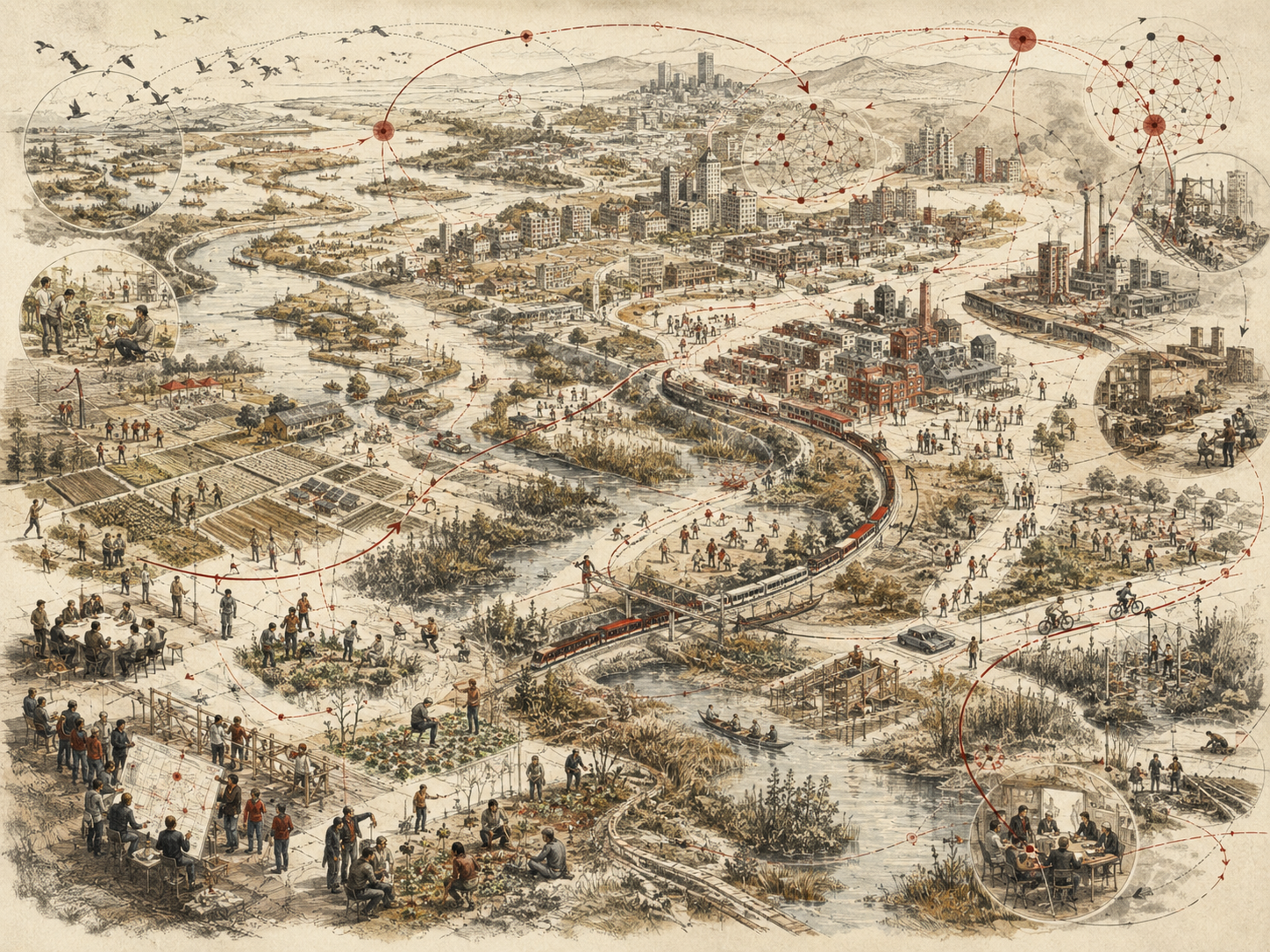
This article explains emergence, adaptation, and complexity as foundations for systems thinking. It examines how local interactions produce large-scale patterns, why adaptive agents change system behavior, why complexity creates surprise, and why intervention requires humility. It connects complexity science to ecosystems, cities, markets, organizations, public institutions, digital platforms, infrastructure, climate risk, social change, and artificial intelligence. It also asks ethical questions: who defines the system, who bears the consequences of emergent harm, when adaptation becomes exploitation, and how institutions can govern complex systems without pretending to control them completely.
Why Emergence and Complexity Matter
Emergence and complexity matter because many of the most important systems in the world do not behave as simple chains of cause and effect. Public health, climate, cities, ecosystems, organizations, markets, democracies, infrastructure networks, supply chains, digital platforms, and social movements all involve many interacting parts. Their behavior depends not only on what the parts are, but on how they relate, adapt, and respond over time.
Simple systems can often be understood by decomposition. A machine can be taken apart, examined, repaired, and reassembled. Many engineered systems are designed to behave predictably under specified conditions. Complex systems are different. Their parts may be understandable, but the whole can still surprise us because interaction produces new properties. Traffic jams can form without a crash. Markets can panic without one central command. Rumors can spread through networks faster than correction. Ecosystems can shift suddenly after gradual stress. Institutions can behave irrationally even when individuals inside them are trying to act rationally.
Emergence challenges the assumption that system behavior can be explained by isolated parts. Adaptation challenges the assumption that systems remain fixed after intervention. Complexity challenges the assumption that control is simply a matter of better prediction. In complex systems, interventions change incentives, behavior, information, and relationships. The system responds.
| Simple-system assumption | Complex-system reality | Systems-thinking implication |
|---|---|---|
| The whole is the sum of the parts. | Interaction produces emergent behavior. | Study relationships, feedback, and patterns, not parts alone. |
| Cause and effect are proportional. | Small changes can produce large effects near thresholds. | Monitor nonlinear dynamics, delays, and tipping conditions. |
| Intervention changes only the target. | Adaptive agents respond to intervention. | Anticipate behavioral, institutional, and market adaptation. |
| Prediction is enough for control. | Complex systems generate uncertainty and surprise. | Build learning, resilience, feedback, and adaptive governance. |
| Efficiency always improves performance. | Over-optimization can reduce resilience. | Preserve redundancy, diversity, modularity, and recovery capacity. |
| Policy can be evaluated by intended effect. | Unintended consequences emerge through system response. | Evaluate second-order effects, distributional outcomes, and feedback loops. |
Complexity does not mean everything is unknowable. It means knowledge must be more humble, dynamic, and relational. We can identify patterns, model scenarios, monitor signals, test interventions, learn from feedback, and design institutions that adapt responsibly. But we should not expect complex systems to behave like passive objects.
Systems thinking helps us work with complexity without surrendering to it. It teaches us to look for feedback loops, local rules, adaptive behavior, network structure, thresholds, path dependence, memory, diversity, and resilience. It asks not only what caused a problem, but what pattern keeps reproducing it.
What Emergence Means
Emergence occurs when interactions among parts produce patterns or properties that are not obvious from the parts alone. The emergent pattern is real, but it is not located in one component. It arises through relationship. A flock of birds forms coordinated motion without one bird commanding the whole. A neighborhood develops culture through repeated interaction among residents, institutions, histories, businesses, public spaces, and routines. A market price emerges from distributed buying, selling, expectations, scarcity, information, and regulation. A traffic jam emerges from many drivers responding locally to speed, spacing, signals, and road conditions.
Emergence is not magic. It is structured interaction. Local rules, constraints, incentives, information flows, and feedback loops generate larger-scale patterns. The challenge is that these patterns can be difficult to predict in detail, especially when many agents adapt to one another. Emergence is one reason why systems thinking focuses on structure rather than isolated events.
\text{Emergent Pattern} = f(\text{Agents}, \text{Interactions}, \text{Rules}, \text{Feedback}, \text{Environment})
\]
Interpretation: Emergent patterns arise from agents interacting under rules, feedback, constraints, and environmental conditions.
Emergent behavior can be beneficial, harmful, or ambiguous. Cooperation can emerge from trust and repeated interaction. Innovation can emerge from diverse networks and experimentation. Informal care systems can emerge where formal institutions fail. But segregation can emerge from small preferences interacting through housing markets. Misinformation can emerge from platform incentives and social sharing. Financial bubbles can emerge from imitation, leverage, optimism, and fear. Bureaucratic failure can emerge from rules that make sense locally but produce harmful system behavior collectively.
Emergence also means responsibility cannot always be assigned to a single actor. This does not mean no one is responsible. It means responsibility may be distributed across rules, incentives, institutions, platforms, markets, histories, and governance decisions. A complex system can produce harm even when many participants are following local rules. The ethical question becomes: who designed the rules, who benefits from the pattern, who is harmed by it, and who has the power to change it?
Emergence asks us to look beyond blame at the level of individual behavior without losing accountability for system design.
Adaptation and Learning Agents
Complex systems often contain adaptive agents. An adaptive agent changes behavior in response to experience, incentives, information, constraints, or the behavior of others. People adapt. Organizations adapt. Firms adapt. Governments adapt. Species adapt. Algorithms adapt. Social movements adapt. Pathogens adapt. Cities adapt. Infrastructure systems adapt through management and use, even when physical assets change slowly.
Adaptation makes systems dynamic. A policy does not simply act on a fixed population. People respond to it. A regulation changes incentives. Firms find workarounds. Households adjust decisions. Agencies reinterpret rules. Platforms modify algorithms. Users change behavior. Opponents mobilize. Beneficiaries organize. The intervention becomes part of the system’s environment, and the system adapts.
This is why complex systems often show policy resistance. An intervention may produce short-term change, but agents adapt in ways that reduce, redirect, or reverse the intended effect. Road expansion can induce more driving. Testing requirements can produce teaching to the test. Performance metrics can produce gaming. Subsidies can change market behavior. Automated moderation can change user tactics. Antibiotic use can select for resistant bacteria. Adaptation is not an exception. It is normal system behavior.
A_{t+1} = A_t + \Delta(\text{Information}, \text{Incentives}, \text{Experience}, \text{Constraints})
\]
Interpretation: Adaptive agents change behavior over time as information, incentives, experience, and constraints change.
Adaptation can also strengthen systems. Communities learn from disaster. Ecosystems reorganize after disturbance. Organizations improve through feedback. Cities adjust land use and infrastructure. Public institutions revise policy. Social movements build strategy. Complex systems are not only fragile; they can learn, evolve, and regenerate when feedback is preserved and adaptive capacity is strong.
The systems question is not whether adaptation will occur. It is what kind of adaptation the system encourages. Does it reward cooperation or extraction? Learning or denial? Resilience or fragility? Inclusion or exclusion? Long-term stewardship or short-term advantage? The adaptive behavior of agents reflects the structure of the system around them.
Complexity as System Behavior
Complexity describes systems in which many interacting elements produce behavior that is difficult to reduce to one cause, one actor, or one linear pathway. Complexity often includes feedback loops, nonlinear effects, adaptation, distributed control, path dependence, thresholds, heterogeneity, and multiple scales of interaction. A complex system may be understandable in patterns even when exact prediction is impossible.
Complexity is not the same as complication. A complicated system may have many parts, but if the parts are stable and relationships are well specified, the system may remain predictable. A jet engine is complicated. A city is complex. A tax code is complicated, but taxpayer, institutional, political, and market responses to it can create complexity. A software system may be complicated, but a platform with millions of users adapting to algorithmic incentives is complex.
| Complicated system | Complex system |
|---|---|
| Many parts, but relationships are relatively stable. | Many interacting parts whose relationships change over time. |
| Can often be decomposed and reassembled. | Behavior depends on interaction and context. |
| Failure can often be traced to specific components. | Failure can emerge from normal interactions among parts. |
| Expert control may be sufficient under known conditions. | Adaptive governance and feedback learning are often necessary. |
| Prediction can be precise when conditions are known. | Prediction may be probabilistic, scenario-based, or pattern-based. |
Complexity matters because interventions in complex systems often produce second-order effects. A policy aimed at one variable can affect incentives, trust, distribution, adaptation, and future behavior. A technology introduced to solve one problem can create new dependencies. A management system designed for efficiency can reduce resilience. A metric intended to improve accountability can narrow attention and produce gaming. A local solution can create system-wide burden elsewhere.
Complexity does not excuse inaction. It demands better action: experimentation, monitoring, participatory design, scenario analysis, redundancy, modularity, transparency, and institutional learning. Complex systems should not be governed as if they are simple machines. They should be governed as living patterns of relationship, feedback, and adaptation.
Local Rules and Global Patterns
Many complex systems generate global patterns from local rules. Individual birds follow simple movement relationships with nearby birds, and flocking emerges. Drivers respond to spacing, speed, signals, and perceived travel time, and traffic waves emerge. Households make housing decisions based on price, safety, schools, identity, and commute, and segregation or sprawl can emerge. Platform users respond to attention, status, outrage, and recommendation systems, and information cascades emerge.
Local rules matter because they are often leverage points. A city can change parking rules, zoning rules, street design, transit priority, or housing protections. A platform can change ranking rules, moderation rules, friction, incentives, or transparency. An organization can change promotion rules, workload rules, meeting norms, documentation systems, or feedback channels. Small local rules can change large-scale patterns if they alter repeated interactions.
\text{Global Pattern}_{t} = \sum_{i=1}^{n} \text{Local Interaction}_{i,t}
\]
Interpretation: System-level patterns can emerge from many local interactions repeated over time, even when no single actor controls the whole.
However, local rules are not neutral. They are embedded in power and history. Housing choices occur within zoning, lending, income inequality, discrimination, school boundaries, and transport systems. Platform behavior occurs within algorithmic incentives, business models, moderation policy, and social identity. Organizational behavior occurs within authority, workload, reward systems, norms, and fear. Local interaction is shaped by system structure.
Systems thinking asks how local rules produce global outcomes. It also asks who has the authority to change those rules and who bears the consequences when they remain unchanged. Emergence can make harm seem natural or inevitable when it is actually produced by repeated local rules that can be redesigned.
Nonlinearity, Thresholds, and Surprise
Complex systems are often nonlinear. In a linear system, a small input produces a small output and a large input produces a large output in proportion. In a nonlinear system, small changes can sometimes produce large effects, while large interventions may produce little visible change until thresholds are crossed. This is why complex systems surprise us.
Nonlinearity appears in ecosystems, climate systems, public health, social movements, financial markets, organizations, digital platforms, and infrastructure networks. A small rumor can cascade if network conditions are right. A small delay in disease response can produce large case growth. A gradual increase in nutrient pollution can suddenly shift a lake into algal dominance. A small infrastructure failure can cascade through dependent systems. A minor change in platform ranking can alter attention, incentives, and public discourse.
\Delta Y \not\propto \Delta X
\]
Interpretation: In nonlinear systems, changes in output are not necessarily proportional to changes in input.
Thresholds are especially important. A system may absorb disturbance for a long time, then reorganize quickly after crossing a critical boundary. Thresholds can involve ecological capacity, public trust, infrastructure load, social legitimacy, financial risk, disease transmission, or organizational burnout. A system can appear stable while resilience declines beneath the surface.
Surprise does not mean there were no warning signs. Complex systems often show signals: rising variance, longer recovery time, repeated near misses, increasing fragility, loss of diversity, growing synchronization, or declining trust. But those signals are easy to ignore if institutions are optimized for short-term performance, political comfort, or narrow metrics.
Systems thinking helps by asking where nonlinearity may be present, what thresholds may matter, what early warnings are visible, and what system memory is being ignored.
Self-Organization and Order without Central Control
Self-organization occurs when order emerges without a central controller directing every part. Markets, ecosystems, neighborhoods, internet communities, informal care networks, traffic flows, social movements, scientific communities, and organizational cultures can all self-organize. They develop patterns through interaction, feedback, norms, constraints, and adaptation.
Self-organization can produce resilience. Communities may organize mutual aid when formal institutions fail. Ecosystems may regenerate after disturbance through succession. Workers may develop informal knowledge-sharing systems to keep organizations functioning. Local communities may create norms that manage shared resources. Distributed intelligence can be powerful because knowledge is not concentrated in one authority.
Self-organization can also produce harm. Informal exclusion can emerge without written rules. Misinformation networks can organize rapidly. Market speculation can amplify bubbles. Workplace cultures can normalize burnout. Online harassment can become coordinated through loose signals. Segregation can emerge from local preferences and unequal constraints. Order without central control is not automatically good.
\text{Self-Organization} = \text{Interaction} + \text{Feedback} + \text{Local Rules} + \text{Adaptation}
\]
Interpretation: Self-organization arises when interacting agents adapt to feedback and local rules, producing system-level order without complete central direction.
Governance of self-organizing systems requires balance. Too much control can suppress local intelligence, adaptation, and resilience. Too little governance can allow exploitation, exclusion, cascade risk, or harm. The challenge is to design boundaries, rules, feedback, rights, and accountability that support beneficial self-organization while limiting destructive patterns.
Systems thinking does not romanticize decentralization. It asks what kind of self-organization is emerging, who benefits, who is excluded, what harms are amplified, and what governance conditions would improve the pattern.
Path Dependence, Lock-In, and Historical Memory
Path dependence means that where a system can go next depends on where it has been. Early choices, accidents, power arrangements, infrastructure, norms, investments, and institutional routines can shape future possibilities. Once a pattern becomes established, it can become difficult to change even if better alternatives exist.
Lock-in occurs when a system becomes committed to a pathway through infrastructure, habits, standards, sunk costs, expectations, institutions, or political power. Car-dependent urban development locks in road networks, parking, zoning, commuting patterns, fuel demand, and household costs. Fossil fuel systems lock in extraction, pipelines, refineries, vehicles, finance, labor markets, and political influence. Organizational routines lock in ways of working. Digital platforms lock in user networks, data, developer ecosystems, and business models.
Historical memory matters because complex systems carry the past into the present. A city’s segregation patterns are not only current preferences; they reflect past policy, lending, zoning, violence, infrastructure, and exclusion. Public distrust is not only misinformation; it may reflect institutional harm. Environmental exposure is not only geography; it reflects land-use decisions and political power. Path dependence prevents systems analysis from becoming ahistorical.
S_{t+1} = f(S_t, H_t, I_t, R_t)
\]
Interpretation: The future state of a system depends on its current state, history, institutions, and reinforcing structures.
Path dependence does not mean change is impossible. It means change must address the structures that reproduce the path. A system locked into car dependence needs more than driver education. It needs land-use reform, transit, street redesign, parking reform, housing near jobs, and public finance changes. A system locked into institutional distrust needs more than communication. It needs repair, reliability, accountability, and power-sharing.
Systems thinking treats memory as a causal force. The past is not background. It is part of the system.
Co-Evolution and Changing Environments
Co-evolution occurs when systems change in response to one another. Predators and prey co-evolve. Technologies and users co-evolve. Laws and markets co-evolve. Platforms and user behavior co-evolve. Pathogens and immune systems co-evolve. Cities and transport systems co-evolve. Organizations and workers co-evolve. Public institutions and public trust co-evolve.
Co-evolution means that no system develops in isolation. The environment changes, and the system adapts. The system changes, and the environment responds. A policy changes market incentives; firms adapt; regulators respond; political coalitions shift. A platform changes its algorithm; users change posting strategies; advertisers respond; moderators adjust; public discourse changes. A climate hazard increases; infrastructure adapts; settlement patterns shift; insurance systems change; public finance responds.
Co-evolution is one reason complex systems cannot be governed only by static plans. The plan changes the system. The system changes the conditions under which the plan operates. Governance must therefore be adaptive, monitored, and able to revise assumptions.
Co-evolution can produce arms races. Cybersecurity systems and attackers adapt to each other. Antibiotics and bacteria interact through selection. Platform moderators and malicious actors develop countermeasures. Regulators and regulated industries adjust strategically. In these systems, one-time solutions often fail because the system learns around them.
But co-evolution can also produce mutual improvement. Public institutions can learn with communities. Energy systems can evolve with cleaner technology and better governance. Cities can adapt land use and transit together. Ecosystems can recover when human management supports regenerative feedback. The question is whether co-evolution is producing resilience, exploitation, fragility, or transformation.
Complexity in Social and Institutional Systems
Social and institutional systems are complex because they involve meaning, power, incentives, identity, norms, rules, trust, conflict, learning, and history. Unlike physical systems, social systems interpret interventions. People respond not only to material conditions but to legitimacy, fairness, memory, and belief. Institutions do not merely process inputs; they shape categories, incentives, authority, and attention.
Organizations often produce emergent behavior. A company may say it values innovation while its incentives punish risk. A public agency may value service while its forms, rules, and staffing create burden. A university may value learning while its metrics encourage credential competition. A hospital may value care while overload produces burnout. These contradictions are system patterns, not simply individual hypocrisy.
Institutional complexity also appears through fragmentation. Different departments optimize different metrics. One agency reduces cost while another absorbs harm. A policy succeeds on paper while increasing administrative burden. A regulation reduces one risk while creating loopholes elsewhere. A metric improves while the underlying mission declines. Complex institutions can fail through normal compliance with local rules.
| Institutional complexity pattern | How it emerges | Systems implication |
|---|---|---|
| Metric gaming | People adapt to measured targets rather than underlying purpose. | Measure systems carefully and preserve qualitative feedback. |
| Administrative burden | Rules intended for accountability accumulate into access barriers. | Design for user experience, equity, and burden reduction. |
| Silo optimization | Departments improve local metrics while shifting cost elsewhere. | Use shared goals and cross-system accountability. |
| Institutional amnesia | Turnover, poor documentation, and political cycles erase learning. | Preserve memory through records, evaluation, and public accountability. |
| Trust collapse | Repeated harm or opacity reduces cooperation and feedback. | Repair trust through reliability, transparency, and power-sharing. |
Systems thinking helps social institutions move beyond blame. It asks how rules, incentives, authority, information flows, and histories produce recurring behavior. It also asks who has power to change the system and who is forced to adapt to its failures.
Complexity in Technology and AI Systems
Technology systems become complex when they interact with users, institutions, markets, data, incentives, infrastructure, and governance. A technology is not only an artifact. It becomes part of a sociotechnical system. Artificial intelligence systems are especially complex because they learn from data, shape behavior, influence decisions, and operate within institutional incentives.
AI systems can produce emergent behavior at multiple levels. A model may generate outputs that were not explicitly programmed. A recommendation system may shift user behavior. A platform may optimize engagement and amplify polarizing content. A workplace AI tool may change labor expectations, surveillance, productivity metrics, and worker autonomy. A public-sector algorithm may reshape access to benefits, policing, healthcare, or education. The technology interacts with the system into which it is introduced.
Complexity in AI systems comes from feedback. Users change behavior in response to the system. The system collects new data from changed behavior. The model or platform adapts. Institutions make decisions based on outputs. Those decisions change future data. Bias, error, exclusion, and feedback loops can become embedded unless governance is active and accountable.
\text{AI System Behavior} = f(\text{Model}, \text{Data}, \text{Users}, \text{Institution}, \text{Feedback}, \text{Incentives})
\]
Interpretation: AI system behavior depends not only on the model, but also on data, users, institutional context, feedback loops, and incentives.
Complexity also challenges simplistic ideas of technological neutrality. A model may be mathematically sophisticated but socially narrow. A system may optimize a measurable target while ignoring dignity, rights, access, or long-term effects. A platform may claim to connect people while designing incentives that reward outrage. AI governance therefore needs systems thinking: monitoring feedback, distributional effects, institutional incentives, failure modes, user adaptation, and accountability.
AI and technology systems should be evaluated not only by accuracy, speed, or efficiency, but by the emergent patterns they create. What behavior do they reward? What information do they amplify? What burdens do they shift? What dependencies do they create? Who can contest the output? Who is harmed when the system fails?
Governing Complex Systems
Governing complex systems requires a shift from command-and-control certainty to adaptive stewardship. This does not mean abandoning authority or accountability. It means recognizing that complex systems respond, learn, surprise, and evolve. Governance must therefore include monitoring, feedback, experimentation, transparency, participation, memory, and the ability to revise course.
Complex systems cannot be governed well through prediction alone. Forecasts matter, but they are incomplete. Scenario analysis, stress testing, early warning signals, local knowledge, redundancy, and iterative evaluation are also needed. A resilient governance system does not assume it will always be right. It builds capacity to detect when it is wrong and correct before harm deepens.
Governance also needs modularity and diversity. Highly centralized systems can act decisively, but they can also fail catastrophically if one authority misreads the system. Highly decentralized systems can adapt locally, but they can also produce fragmentation, inequality, or coordination failure. Good governance often combines local adaptation with shared standards, rights, data, funding, and accountability.
| Governance principle | Why it matters in complex systems | Practical expression |
|---|---|---|
| Feedback | Complex systems change and generate unintended effects. | Monitoring, public reporting, evaluation, early warning indicators. |
| Adaptation | Static plans become obsolete as systems respond. | Review triggers, flexible rules, learning cycles, scenario planning. |
| Participation | Local knowledge reveals barriers and harms invisible to central planners. | Community authority, co-design, deliberation, participatory budgeting. |
| Redundancy | Efficiency alone can create fragility. | Backup capacity, multiple suppliers, distributed systems, reserves. |
| Transparency | Trust and contestability are necessary when outcomes are uncertain. | Explainable decisions, open assumptions, audit trails, appeal mechanisms. |
| Memory | Systems repeat mistakes when learning is not preserved. | Documentation, postmortems, institutional archives, public accountability. |
Governance of complex systems is not passive. It requires strong public capacity. Weak institutions often respond to complexity by outsourcing, denying, simplifying, or shifting burden. Strong institutions build learning systems, listen across boundaries, and protect those most exposed to emergent harm.
The goal is not perfect control. It is responsible navigation.
Ethics: Power, Responsibility, and Emergent Harm
Complexity has ethical stakes because emergent harm can be difficult to assign, easy to deny, and hard to repair. When a system produces harm through distributed interaction, powerful actors may claim no one intended the outcome. But lack of intent does not erase responsibility. If a system repeatedly produces displacement, exclusion, pollution, misinformation, overload, or inequality, the pattern itself demands accountability.
Complexity can be misused as an excuse. Institutions may say problems are too complicated to solve. Companies may blame users for harms produced by platform incentives. Governments may blame individuals for outcomes produced by policy design. Organizations may blame workers for burnout produced by workload systems. Systems thinking should not become a language for avoiding responsibility. It should make responsibility more structural and precise.
Ethical complexity asks:
- Who defines the system boundary?
- Who benefits from the emergent pattern?
- Who is harmed by it?
- Who has the power to change rules, incentives, data, infrastructure, or governance?
- Whose knowledge is included in diagnosing the system?
- What harms are treated as externalities?
- What feedback is ignored because it comes from marginalized groups?
- When does adaptation become exploitation?
- What forms of repair are owed when harm emerges from system design?
- How can governance remain accountable under uncertainty?
Emergent harm often falls unevenly. Pollution, displacement, surveillance, algorithmic error, administrative burden, climate exposure, infrastructure failure, and public-health risk often affect communities with less power first. Complexity analysis must therefore include justice. A system is not well understood if its distribution of harm is hidden.
Ethical systems thinking combines humility and responsibility. Humility recognizes uncertainty, adaptation, and unintended consequences. Responsibility asks institutions to monitor, learn, repair, and redesign systems when patterns of harm become visible.
Examples Across Complex Systems
Emergence, adaptation, and complexity appear across natural, social, technological, institutional, and economic systems. The examples below show how local interaction can create large-scale patterns.
Traffic flow
Traffic waves can emerge from small changes in speed and spacing even without a crash. Drivers respond locally, but the system produces congestion patterns at the network level.
Ecosystem succession
After disturbance, species interactions, soil conditions, climate, seed dispersal, and competition can reorganize an ecosystem into a new pattern over time.
Financial bubbles
Expectation, imitation, leverage, media attention, and rising prices can reinforce one another until the system becomes fragile and reverses sharply.
Public trust
Trust can grow through repeated reliability, but it can also collapse through repeated harm, opacity, burden, or exclusion, changing how people respond to institutions.
Digital platforms
Platform behavior emerges from users, algorithms, advertisers, moderation systems, incentives, and social networks interacting at scale.
Organizational culture
Culture is not only stated values. It emerges from repeated decisions, rewards, punishments, stories, routines, leadership behavior, and informal norms.
Urban segregation
Spatial inequality can emerge from housing markets, zoning, income, discrimination, school boundaries, lending, public investment, and historical exclusion.
Social movements
Movements can emerge through networks, shared grievance, moral language, organizing infrastructure, triggering events, and adaptive strategy.
Across these examples, the key point is not that systems are chaotic. It is that patterns emerge from interaction, and those patterns can be studied, influenced, governed, and redesigned.
Mathematics, Computation, and Modeling
Emergence, adaptation, and complexity can be explored through agent-based models, cellular automata, network models, nonlinear dynamics, sensitivity analysis, threshold models, feedback simulations, and scenario analysis. These models do not capture all the richness of real systems, but they help make interaction visible.
A simple agent interaction model can be represented as:
x_{i,t+1} = f(x_{i,t}, N_{i,t}, R_t, E_t)
\]
Interpretation: Agent \(i\)’s future state depends on its current state, neighboring agents, system rules, and environmental conditions.
An adaptation rule can be represented as:
b_{i,t+1} = b_{i,t} + \alpha(F_{i,t} – b_{i,t})
\]
Interpretation: Agent behavior \(b_i\) adapts toward feedback \(F_i\) at learning rate \(\alpha\).
A simple complexity index can be represented conceptually as:
CI = w_dD + w_hH + w_fF + w_nN + w_aA
\]
Interpretation: A complexity index can combine diversity, heterogeneity, feedback density, network interdependence, and adaptation.
Network cascade risk can be represented as:
R_c = f(C, K, B, M)
\]
Interpretation: Cascade risk depends on connectivity \(C\), node capacity \(K\), buffers \(B\), and modularity \(M\).
Emergent pattern strength can be measured through variance, clustering, synchronization, concentration, or inequality, depending on the system being studied.
| Modeling approach | Complexity question | Example output |
|---|---|---|
| Agent-based modeling | How do local rules produce global patterns? | Clustering, segregation, adoption, congestion, cooperation, or cascade patterns. |
| Network analysis | Where are dependencies, bottlenecks, and cascade risks? | Centrality, modularity, redundancy, bridge nodes, and failure pathways. |
| Nonlinear dynamics | Where might small changes produce large effects? | Thresholds, tipping points, attractors, and regime-shift indicators. |
| Scenario analysis | How do interventions perform under uncertainty? | Baseline, stress, adaptation, governance, and transformation pathways. |
| Sensitivity analysis | Which assumptions drive system behavior? | Parameter influence, robustness checks, and uncertainty ranges. |
| Feedback simulation | What loops reinforce or stabilize the system? | Behavior-over-time graphs, loop dominance, and leverage diagnostics. |
Complexity models should be used carefully. They can clarify possible patterns, but they can also create false confidence. A model is not the system. It is a disciplined simplification. Good complexity modeling makes assumptions visible, tests sensitivity, includes uncertainty, and remains open to feedback from people living inside the system being modeled.
Python Workflow: Emergence, Adaptation, and Agent Interaction Scenarios
The Python workflow below turns emergence and adaptation into a small reproducible agent-interaction model. It compares four scenarios: weak interaction baseline, strong local conformity, high-noise adaptation, and guided resilient adaptation. It also includes one-at-a-time sensitivity analysis for the guided resilient adaptation scenario. The script uses only the Python standard library, writes CSV outputs relative to the article folder, and is designed as a clear starting point for companion repository work.
# emergence_adaptation_complexity_workflow.py
# Dependency-light workflow for emergence, adaptation, and complexity diagnostics:
# adaptive agents, local interaction, clustering, synchronization, diversity,
# shock response, institutional guidance, path dependence, and scenario comparison.
# Writes outputs relative to the article root.

from __future__ import annotations

from dataclasses import dataclass, replace
from pathlib import Path
import csv
import random
from statistics import mean, pstdev

ARTICLE_ROOT = Path(__file__).resolve().parents[1]
TABLES = ARTICLE_ROOT / "outputs" / "tables"


@dataclass
class ComplexityScenario:
    name: str
    agents: int
    local_interaction_strength: float
    adaptation_rate: float
    institutional_guidance: float
    diversity_floor: float
    noise_level: float
    memory_weight: float
    network_bridge_strength: float
    shock_period: int
    shock_strength: float
    recovery_support: float
    governance_learning: float
    exploitation_pressure: float
    equity_capacity: float


def clamp(value: float, low: float = 0.0, high: float = 1.0) -> float:
    return max(low, min(high, value))


def initialize_agents(count: int, seed: int) -> list[float]:
    rng = random.Random(seed)
    return [rng.random() for _ in range(count)]


def neighborhood_mean(values: list[float], index: int, radius: int = 2) -> float:
    count = len(values)
    neighbors = [values[(index + offset) % count] for offset in range(-radius, radius + 1) if offset != 0]
    return mean(neighbors)


def bridge_mean(values: list[float], index: int) -> float:
    count = len(values)
    bridge_positions = [(index + count // 3) % count, (index + 2 * count // 3) % count]
    return mean(values[position] for position in bridge_positions)


def clustering_index(values: list[float]) -> float:
    if len(values) < 2:
        return 0.0
    distances = [abs(values[i] - values[(i + 1) % len(values)]) for i in range(len(values))]
    return clamp(1.0 - mean(distances))


def diversity_index(values: list[float]) -> float:
    if len(values) < 2:
        return 0.0
    return clamp(pstdev(values) * 3.0)


def synchronization_index(values: list[float]) -> float:
    return clamp(1.0 - diversity_index(values))


def polarization_index(values: list[float]) -> float:
    low = sum(1 for value in values if value < 0.33)
    high = sum(1 for value in values if value > 0.67)
    middle = len(values) - low - high
    return clamp((low + high - middle * 0.35) / max(1, len(values)))


def complexity_index(clustering: float, diversity: float, synchronization: float, polarization: float) -> float:
    balance = clamp(1.0 - abs(synchronization - 0.55) * 2.0)
    return clamp(0.30 * clustering + 0.30 * diversity + 0.25 * balance + 0.15 * (1.0 - polarization))


def run_scenario(scenario: ComplexityScenario, periods: int = 72, seed: int = 42) -> list[dict[str, object]]:
    rng = random.Random(seed)
    states = initialize_agents(scenario.agents, seed)
    previous_states = list(states)
    institutional_signal = scenario.institutional_guidance
    trust_stock = 0.45 + scenario.governance_learning * 0.25 + scenario.equity_capacity * 0.10
    learning_stock = 0.35 + scenario.governance_learning * 0.35
    resilience_stock = 0.40 + scenario.recovery_support * 0.30 + scenario.diversity_floor * 0.20
    rows: list[dict[str, object]] = []

    for period in range(periods + 1):
        cluster = clustering_index(states)
        diversity = diversity_index(states)
        sync = synchronization_index(states)
        polarization = polarization_index(states)
        complexity = complexity_index(cluster, diversity, sync, polarization)
        system_mean = mean(states)
        variance = pstdev(states) if len(states) > 1 else 0.0
        minimum_state = min(states)
        maximum_state = max(states)

        fragility_index = clamp(
            sync * 0.26
            + polarization * 0.22
            + scenario.exploitation_pressure * 0.18
            + max(0.0, 0.50 - diversity) * 0.16
            + max(0.0, 0.45 - trust_stock) * 0.12
            - resilience_stock * 0.18
            - scenario.equity_capacity * 0.10
        )

        adaptive_capacity_index = clamp(
            learning_stock * 0.30
            + resilience_stock * 0.24
            + diversity * 0.18
            + trust_stock * 0.16
            + scenario.network_bridge_strength * 0.10
            + scenario.equity_capacity * 0.10
            - polarization * 0.14
            - scenario.exploitation_pressure * 0.10
        )

        rows.append({
            "period": period,
            "scenario": scenario.name,
            "system_mean": round(system_mean, 4),
            "system_variance": round(variance, 4),
            "minimum_agent_state": round(minimum_state, 4),
            "maximum_agent_state": round(maximum_state, 4),
            "clustering_index": round(cluster, 4),
            "diversity_index": round(diversity, 4),
            "synchronization_index": round(sync, 4),
            "polarization_index": round(polarization, 4),
            "complexity_index": round(complexity, 4),
            "trust_stock": round(trust_stock, 4),
            "learning_stock": round(learning_stock, 4),
            "resilience_stock": round(resilience_stock, 4),
            "fragility_index": round(fragility_index, 4),
            "adaptive_capacity_index": round(adaptive_capacity_index, 4),
        })

        shock = scenario.shock_strength if period == scenario.shock_period else 0.0
        updated_states: list[float] = []

        for index, current in enumerate(states):
            local_signal = neighborhood_mean(states, index)
            bridge_signal = bridge_mean(states, index)
            memory_signal = previous_states[index]
            adaptive_signal = (
                scenario.local_interaction_strength * local_signal
                + scenario.network_bridge_strength * bridge_signal
                + scenario.memory_weight * memory_signal
                + (1.0 - min(1.0, scenario.local_interaction_strength + scenario.network_bridge_strength + scenario.memory_weight))
                * institutional_signal
            )

            exploitation_pull = scenario.exploitation_pressure * (current - 0.5) * 0.08
            random_noise = rng.uniform(-scenario.noise_level, scenario.noise_level)
            recovery_push = scenario.recovery_support * trust_stock * (institutional_signal - current) * 0.035
            diversity_injection = rng.random() * scenario.diversity_floor

            new_value = (
                current
                + scenario.adaptation_rate * (adaptive_signal - current)
                + recovery_push
                + exploitation_pull
                + random_noise
                - shock
            )

            if scenario.diversity_floor > 0:
                new_value = new_value * (1.0 - scenario.diversity_floor) + diversity_injection

            updated_states.append(clamp(new_value))

        previous_states = states
        states = updated_states

        feedback_quality = clamp(
            complexity * 0.30
            + diversity * 0.20
            + scenario.governance_learning * 0.20
            + scenario.equity_capacity * 0.16
            - fragility_index * 0.18
        )

        learning_stock = clamp(
            learning_stock
            + feedback_quality * 0.035
            + scenario.governance_learning * 0.020
            - polarization * 0.025
            - scenario.exploitation_pressure * 0.015
        )

        trust_stock = clamp(
            trust_stock
            + scenario.equity_capacity * 0.018
            + scenario.recovery_support * 0.014
            + feedback_quality * 0.018
            - polarization * 0.025
            - fragility_index * 0.020
        )

        resilience_stock = clamp(
            resilience_stock
            + scenario.recovery_support * 0.020
            + diversity * 0.012
            + learning_stock * 0.010
            - shock * 0.15
            - fragility_index * 0.018
        )

    return rows


def summarize(rows: list[dict[str, object]]) -> list[dict[str, object]]:
    output: list[dict[str, object]] = []
    for scenario_name in sorted({row["scenario"] for row in rows}):
        subset = [row for row in rows if row["scenario"] == scenario_name]
        final = subset[-1]
        average_complexity = mean(float(row["complexity_index"]) for row in subset)
        peak_complexity = max(float(row["complexity_index"]) for row in subset)
        average_fragility = mean(float(row["fragility_index"]) for row in subset)
        average_adaptive_capacity = mean(float(row["adaptive_capacity_index"]) for row in subset)
        final_sync = float(final["synchronization_index"])
        final_diversity = float(final["diversity_index"])
        final_polarization = float(final["polarization_index"])

        if final_sync >= 0.88:
            diagnostic = "over-synchronized pattern with reduced adaptive diversity"
        elif final_polarization >= 0.65:
            diagnostic = "polarized emergent pattern with elevated fragility"
        elif average_fragility >= 0.60:
            diagnostic = "fragility is high relative to learning and recovery capacity"
        elif final_diversity >= 0.85:
            diagnostic = "high variation with weak coherence"
        elif average_complexity >= 0.50 and average_adaptive_capacity >= 0.50:
            diagnostic = "adaptive complex pattern with learning capacity"
        else:
            diagnostic = "weak or unstable complexity pattern"

        output.append({
            "scenario": scenario_name,
            "final_complexity_index": final["complexity_index"],
            "peak_complexity_index": round(peak_complexity, 4),
            "average_complexity_index": round(average_complexity, 4),
            "final_clustering_index": final["clustering_index"],
            "final_diversity_index": final["diversity_index"],
            "final_synchronization_index": final["synchronization_index"],
            "final_polarization_index": final["polarization_index"],
            "final_fragility_index": final["fragility_index"],
            "final_adaptive_capacity_index": final["adaptive_capacity_index"],
            "average_fragility_index": round(average_fragility, 4),
            "average_adaptive_capacity_index": round(average_adaptive_capacity, 4),
            "diagnostic": diagnostic,
        })

    return output


def one_at_a_time(base: ComplexityScenario, delta: float = 0.10) -> list[dict[str, object]]:
    base_score = float(run_scenario(base)[-1]["adaptive_capacity_index"])
    parameters = [
        "local_interaction_strength",
        "adaptation_rate",
        "institutional_guidance",
        "diversity_floor",
        "noise_level",
        "memory_weight",
        "network_bridge_strength",
        "shock_strength",
        "recovery_support",
        "governance_learning",
        "exploitation_pressure",
        "equity_capacity",
    ]

    rows: list[dict[str, object]] = []
    for parameter in parameters:
        for direction in (-1, 1):
            current = getattr(base, parameter)
            revised_value = max(0.0, min(1.0, current + direction * delta))
            revised = replace(base, name=f"{base.name} {parameter} {direction * delta:+.2f}", **{parameter: revised_value})
            revised_score = float(run_scenario(revised)[-1]["adaptive_capacity_index"])
            rows.append({
                "parameter": parameter,
                "delta": direction * delta,
                "base_value": current,
                "revised_value": revised_value,
                "base_final_adaptive_capacity_index": round(base_score, 4),
                "revised_final_adaptive_capacity_index": round(revised_score, 4),
                "score_change": round(revised_score - base_score, 4),
                "absolute_score_change": round(abs(revised_score - base_score), 4),
            })

    return sorted(rows, key=lambda row: float(row["absolute_score_change"]), reverse=True)


def validate(rows: list[dict[str, object]]) -> list[str]:
    errors: list[str] = []
    bounded_fields = [
        "system_mean",
        "minimum_agent_state",
        "maximum_agent_state",
        "clustering_index",
        "diversity_index",
        "synchronization_index",
        "polarization_index",
        "complexity_index",
        "trust_stock",
        "learning_stock",
        "resilience_stock",
        "fragility_index",
        "adaptive_capacity_index",
    ]

    for row in rows:
        for field in bounded_fields:
            value = float(row[field])
            if value < -0.001 or value > 1.001:
                errors.append(f"{field} outside 0-1 range in {row['scenario']} period {row['period']}.")

    return errors


def write_csv(path: Path, rows: list[dict[str, object]]) -> None:
    path.parent.mkdir(parents=True, exist_ok=True)
    if not rows:
        raise ValueError(f"No rows to write: {path}")
    with path.open("w", newline="", encoding="utf-8") as handle:
        writer = csv.DictWriter(handle, fieldnames=list(rows[0].keys()))
        writer.writeheader()
        writer.writerows(rows)


def main() -> None:
    scenarios = [
        ComplexityScenario("Weak interaction baseline", 120, 0.20, 0.12, 0.55, 0.04, 0.035, 0.22, 0.10, 999, 0.00, 0.24, 0.28, 0.24, 0.30),
        ComplexityScenario("Strong local conformity", 120, 0.82, 0.28, 0.55, 0.01, 0.015, 0.30, 0.04, 999, 0.00, 0.22, 0.24, 0.40, 0.24),
        ComplexityScenario("High-noise adaptation", 120, 0.55, 0.22, 0.58, 0.10, 0.070, 0.26, 0.18, 32, 0.12, 0.46, 0.50, 0.30, 0.42),
        ComplexityScenario("Guided resilient adaptation", 120, 0.46, 0.18, 0.62, 0.08, 0.022, 0.30, 0.28, 32, 0.06, 0.82, 0.82, 0.16, 0.84),
    ]

    rows: list[dict[str, object]] = []
    for index, scenario in enumerate(scenarios):
        rows.extend(run_scenario(scenario, seed=42 + index))

    validation_errors = validate(rows)
    if validation_errors:
        raise ValueError("Validation failed:
" + "
".join(validation_errors))

    write_csv(TABLES / "emergence_adaptation_complexity_timeseries.csv", rows)
    write_csv(TABLES / "emergence_adaptation_complexity_summary.csv", summarize(rows))
    write_csv(TABLES / "emergence_adaptation_complexity_sensitivity_analysis.csv", one_at_a_time(scenarios[-1]))

    validation_path = TABLES / "validation_report.txt"
    validation_path.parent.mkdir(parents=True, exist_ok=True)
    validation_path.write_text(
        "Validation passed.
Bounded agent states, complexity indicators, and scenario outputs completed.
",
        encoding="utf-8",
    )

    print("Emergence, adaptation, and complexity workflow complete.")
    print(TABLES / "emergence_adaptation_complexity_timeseries.csv")


if __name__ == "__main__":
    main()
The workflow is intentionally simple enough to inspect. It shows how local interaction, adaptation rate, institutional guidance, diversity floor, noise, memory, network bridges, shock response, recovery support, governance learning, exploitation pressure, and equity capacity interact over time. It also shows why complexity should not be reduced to disorder: too much synchronization can become fragile, too much volatility can weaken coherence, and adaptive systems often need enough diversity, trust, and learning capacity to respond without collapsing into chaos or conformity. The model is synthetic and illustrative; it supports disciplined inquiry rather than replacing field observation, institutional analysis, community knowledge, or ethical judgment.
R Workflow: Complexity Indicators, Adaptation Tables, and Pattern Visualization
The R workflow reads the Python-generated time-series and sensitivity outputs, creates complexity-system summaries, and exports base R plots for complexity, clustering, diversity, synchronization, polarization, fragility, and adaptive capacity. It uses only base R so it remains portable across simple local environments.
# emergence_adaptation_complexity_diagnostics.R
# Base R workflow for complexity indicators, adaptive capacity, and pattern visualization.

args <- commandArgs(trailingOnly = FALSE)
file_arg <- grep("^--file=", args, value = TRUE)

if (length(file_arg) > 0) {
  script_path <- normalizePath(sub("^--file=", "", file_arg[1]), mustWork = TRUE)
  article_root <- normalizePath(file.path(dirname(script_path), ".."), mustWork = TRUE)
} else {
  article_root <- getwd()
}

setwd(article_root)

tables_dir <- file.path(article_root, "outputs", "tables")
figures_dir <- file.path(article_root, "outputs", "figures")

if (!dir.exists(tables_dir)) {
  dir.create(tables_dir, recursive = TRUE)
}

if (!dir.exists(figures_dir)) {
  dir.create(figures_dir, recursive = TRUE)
}

timeseries_path <- file.path(tables_dir, "emergence_adaptation_complexity_timeseries.csv")
sensitivity_path <- file.path(tables_dir, "emergence_adaptation_complexity_sensitivity_analysis.csv")

if (!file.exists(timeseries_path)) {
  stop(paste("Missing", timeseries_path, "Run the Python workflow first."))
}

data <- read.csv(timeseries_path, stringsAsFactors = FALSE)

last_by_scenario <- do.call(
  rbind,
  lapply(split(data, data$scenario), function(df) df[nrow(df), ])
)

avg_complexity <- aggregate(complexity_index ~ scenario, data = data, FUN = mean)
peak_complexity <- aggregate(complexity_index ~ scenario, data = data, FUN = max)
avg_fragility <- aggregate(fragility_index ~ scenario, data = data, FUN = mean)
avg_adaptive <- aggregate(adaptive_capacity_index ~ scenario, data = data, FUN = mean)
avg_diversity <- aggregate(diversity_index ~ scenario, data = data, FUN = mean)
avg_sync <- aggregate(synchronization_index ~ scenario, data = data, FUN = mean)

names(avg_complexity)[2] <- "average_complexity_index"
names(peak_complexity)[2] <- "peak_complexity_index"
names(avg_fragility)[2] <- "average_fragility_index"
names(avg_adaptive)[2] <- "average_adaptive_capacity_index"
names(avg_diversity)[2] <- "average_diversity_index"
names(avg_sync)[2] <- "average_synchronization_index"

final_fields <- last_by_scenario[, c(
  "scenario",
  "complexity_index",
  "clustering_index",
  "diversity_index",
  "synchronization_index",
  "polarization_index",
  "fragility_index",
  "adaptive_capacity_index"
)]

names(final_fields) <- c(
  "scenario",
  "final_complexity_index",
  "final_clustering_index",
  "final_diversity_index",
  "final_synchronization_index",
  "final_polarization_index",
  "final_fragility_index",
  "final_adaptive_capacity_index"
)

summary_table <- Reduce(
  function(x, y) merge(x, y, by = "scenario"),
  list(avg_complexity, peak_complexity, avg_fragility, avg_adaptive, avg_diversity, avg_sync, final_fields)
)

summary_table$diagnostic <- ifelse(
  summary_table$final_synchronization_index >= 0.88,
  "over-synchronized pattern with reduced adaptive diversity",
  ifelse(
    summary_table$final_polarization_index >= 0.65,
    "polarized emergent pattern with elevated fragility",
    ifelse(
      summary_table$average_fragility_index >= 0.60,
      "fragility is high relative to learning and recovery capacity",
      ifelse(
        summary_table$final_diversity_index >= 0.85,
        "high variation with weak coherence",
        ifelse(
          summary_table$average_complexity_index >= 0.50 &
            summary_table$average_adaptive_capacity_index >= 0.50,
          "adaptive complex pattern with learning capacity",
          "weak or unstable complexity pattern"
        )
      )
    )
  )
)

summary_table <- summary_table[order(summary_table$final_adaptive_capacity_index, decreasing = TRUE), ]

write.csv(
  summary_table,
  file.path(tables_dir, "emergence_adaptation_complexity_r_summary.csv"),
  row.names = FALSE
)

if (file.exists(sensitivity_path)) {
  sensitivity <- read.csv(sensitivity_path, stringsAsFactors = FALSE)
  sensitivity_ranked <- sensitivity[order(sensitivity$absolute_score_change, decreasing = TRUE), ]
  write.csv(
    sensitivity_ranked,
    file.path(tables_dir, "emergence_adaptation_complexity_sensitivity_ranked_r.csv"),
    row.names = FALSE
  )
}

plot_metric <- function(metric, label, file_name) {
  png(file.path(figures_dir, file_name), width = 1200, height = 700)
  scenarios <- unique(data$scenario)
  plot(
    NA,
    xlim = range(data$period),
    ylim = range(data[[metric]], na.rm = TRUE),
    xlab = "Period",
    ylab = label,
    main = paste(label, "by Complexity Scenario")
  )
  for (scenario_name in scenarios) {
    subset_data <- data[data$scenario == scenario_name, ]
    lines(subset_data$period, subset_data[[metric]], lwd = 2)
  }
  legend("topright", legend = scenarios, lwd = 2, cex = 0.75, bty = "n")
  grid()
  dev.off()
}

plot_metric("complexity_index", "Complexity index", "complexity_index_trajectories.png")
plot_metric("clustering_index", "Clustering index", "clustering_index_trajectories.png")
plot_metric("diversity_index", "Diversity index", "diversity_index_trajectories.png")
plot_metric("synchronization_index", "Synchronization index", "synchronization_index_trajectories.png")
plot_metric("polarization_index", "Polarization index", "polarization_index_trajectories.png")
plot_metric("fragility_index", "Fragility index", "fragility_index_trajectories.png")
plot_metric("adaptive_capacity_index", "Adaptive capacity index", "adaptive_capacity_trajectories.png")

png(file.path(figures_dir, "final_adaptive_capacity_scores.png"), width = 1200, height = 700)
barplot(
  summary_table$final_adaptive_capacity_index,
  names.arg = summary_table$scenario,
  las = 2,
  ylab = "Final adaptive capacity index",
  main = "Final Adaptive Capacity by Complexity Scenario"
)
grid()
dev.off()

print(summary_table)
This workflow supports the article’s central methodological claim: complex systems should be evaluated through patterns over time, not static parts alone. The R outputs help readers compare weak interaction, local conformity, high-noise adaptation, and guided resilient adaptation as different emergent system behaviors.
GitHub Repository
The companion repository for this article should help readers model emergence, adaptation, complexity, agent interaction, self-organization, diversity, clustering, synchronization, shock response, and resilience using synthetic datasets and reproducible workflows.
Complete Code Repository
Companion repository for the article, including emergence simulations, adaptive-agent models, complexity indicators, clustering and synchronization diagnostics, shock-response scenarios, polarization and fragility measures, Python and R workflow scripts, synthetic datasets, documentation assets, and multi-language scaffolds for systems analysis.
articles/emergence-adaptation-and-complexity/
├── python/
│   ├── emergence_adaptation_complexity_workflow.py
│   ├── adaptive_agent_scenarios.py
│   ├── clustering_synchronization_diagnostics.py
│   ├── shock_response_model.py
│   ├── polarization_fragility_model.py
│   ├── complexity_sensitivity_analysis.py
│   ├── network_emergence_indicators.py
│   ├── validation_checks.py
│   └── run_all_complexity_workflows.py
├── r/
│   ├── emergence_adaptation_complexity_diagnostics.R
│   ├── complexity_indicator_visualization.R
│   ├── pattern_summary_tables.R
│   ├── adaptation_scenario_plots.R
│   ├── shock_response_summary.R
│   ├── polarization_fragility_tables.R
│   └── run_all_complexity_workflows.R
├── julia/
│   ├── nonlinear_adaptive_agent_dynamics.jl
│   ├── emergence_sensitivity_model.jl
│   └── synchronization_thresholds.jl
├── sql/
│   ├── schema_agent_states.sql
│   ├── schema_interaction_rules.sql
│   ├── schema_complexity_indicators.sql
│   ├── schema_adaptation_scenarios.sql
│   ├── schema_shock_events.sql
│   ├── schema_pattern_diagnostics.sql
│   ├── schema_polarization_fragility.sql
│   ├── schema_model_runs.sql
│   └── schema_outputs.sql
├── rust/
│   └── complexity_scenario_validator.rs
├── go/
│   └── adaptive_agent_scenario_runner.go
├── cpp/
│   ├── efficient_agent_interaction_scan.cpp
│   └── synchronization_threshold_solver.cpp
├── fortran/
│   └── recurrence_adaptive_system_model.f90
├── c/
│   └── low_level_emergence_kernel.c
├── docs/
│   ├── modeling_principles.md
│   ├── article_notes.md
│   ├── emergence_adaptation_complexity_framework.md
│   ├── agent_based_modeling_notes.md
│   ├── complexity_indicator_guide.md
│   ├── python_workflow.md
│   ├── r_workflow.md
│   ├── diagnostic_questions.md
│   ├── ethics_and_emergent_harm.md
│   ├── assumptions_and_limitations.md
│   └── responsible_use.md
├── data/
│   ├── synthetic_agent_states.csv
│   ├── synthetic_interaction_rules.csv
│   ├── synthetic_complexity_indicators.csv
│   ├── synthetic_adaptation_scenarios.csv
│   ├── synthetic_shock_events.csv
│   ├── synthetic_pattern_diagnostics.csv
│   ├── synthetic_polarization_fragility.csv
│   ├── synthetic_model_runs.csv
│   └── synthetic_outputs.csv
├── outputs/
│   ├── README.md
│   ├── figures/
│   └── tables/
└── notebooks/
    ├── python_emergence_adaptation_walkthrough.ipynb
    └── r_complexity_diagnostics_visualization_placeholder.ipynb
This repository structure supports the article’s central argument: emergence and adaptation should be analyzed dynamically, with attention to agents, interaction rules, feedback, diversity, synchronization, clustering, shock response, path dependence, polarization, fragility, and governance learning. The python/ folder supports dependency-light simulation and diagnostics. The r/ folder supports visualization and interpretive summaries. The julia folder supports nonlinear adaptive dynamics. The sql folder defines schemas for complexity-system data. The lower-level language folders provide scaffolds for agent-interaction scanning, synchronization threshold solving, recurrence modeling, and low-level emergence simulation.
A Practical Method for Complexity Systems Diagnosis
Complexity systems diagnosis requires moving from isolated causes to patterns of interaction, adaptation, and emergence. The method below can support analysis of cities, organizations, ecosystems, markets, public institutions, infrastructure, platforms, and AI systems.
1. Define the system and scale
Clarify whether the system is an organization, network, ecosystem, platform, community, city, market, infrastructure system, or policy environment.
2. Identify agents and relationships
Map the actors, components, nodes, institutions, species, users, or organizations, and identify how they interact.
3. Identify local rules
Ask what incentives, norms, constraints, algorithms, policies, routines, or habits shape repeated behavior.
4. Trace feedback loops
Identify reinforcing and balancing loops that amplify, stabilize, redirect, or delay system behavior.
5. Look for emergent patterns
Identify clustering, synchronization, segregation, cascades, cooperation, congestion, bubbles, lock-in, or cultural patterns.
6. Analyze adaptation
Ask how agents learn, imitate, resist, optimize, exploit, cooperate, or change strategy in response to the system.
7. Examine thresholds and nonlinear effects
Identify where small changes could produce large effects, where resilience may be weakening, and where regime shifts may occur.
8. Study path dependence
Ask how infrastructure, history, norms, sunk costs, power, standards, and memory shape current possibilities.
9. Compare scenarios
Model different rules, incentives, feedback structures, shocks, adaptation rates, and governance responses.
10. Build adaptive governance
Create feedback channels, monitoring, participation, memory, review triggers, and accountability for emergent harm.
This method treats complexity as an observable pattern of interaction, adaptation, history, and response. It asks not only what parts exist, but what system behavior those parts keep producing together.
Common Pitfalls
Complexity thinking can fail when it becomes vague, mystical, or detached from responsibility. Several patterns are especially common.
- Using complexity as an excuse: complexity should not become a reason to avoid action, accountability, or repair.
- Confusing complexity with complication: many parts do not automatically make a system complex; adaptation, feedback, and interaction matter.
- Ignoring power: emergent patterns are shaped by rules, incentives, history, ownership, authority, and unequal capacity to adapt.
- Assuming self-organization is always good: decentralized patterns can produce cooperation, but they can also produce exclusion, misinformation, segregation, or exploitation.
- Over-trusting models: complexity models are useful simplifications, not replacements for observation, judgment, community knowledge, or accountability.
- Missing adaptation: interventions often fail when people, firms, agencies, platforms, or organisms adapt around them.
- Ignoring history: path dependence means current behavior may be shaped by past infrastructure, policy, trauma, standards, and exclusion.
- Optimizing away resilience: systems designed only for efficiency can lose redundancy, diversity, modularity, and recovery capacity.
The deeper mistake is treating complexity as a decorative concept rather than a discipline for understanding interaction, adaptation, uncertainty, responsibility, and system redesign.
Why Complexity Requires Systems Thinking
Complexity requires systems thinking because complex systems cannot be understood by isolating parts alone. Their behavior emerges from relationships. Agents adapt. Feedback loops shift dominance. Local rules produce global patterns. Small changes can produce large effects near thresholds. History shapes current possibilities. Governance changes the system it tries to govern.
Systems thinking gives complexity a practical language. It helps us ask what interactions matter, what patterns are emerging, what feedback loops reinforce them, what rules shape local behavior, what thresholds may be near, what histories constrain change, and what forms of governance can learn responsibly. It turns complexity from a vague statement that “everything is connected” into a disciplined method for analysis and intervention.
Emergence reminds us that the whole can behave differently from the parts. Adaptation reminds us that systems respond to intervention. Complexity reminds us that control is limited and learning is essential. Together, these concepts challenge simplistic management, narrow metrics, and overconfident prediction. But they do not demand resignation. They demand better design.
A responsible approach to complexity preserves humility without abandoning responsibility. It builds feedback, listens across boundaries, protects diversity, monitors emerging harm, supports resilience, and creates institutions capable of learning. Complex systems cannot be commanded into justice, sustainability, or resilience. But they can be shaped through better rules, better relationships, better feedback, and deeper accountability.
Related Articles
- Urban Systems: Congestion, Housing, and Infrastructure
- Networks, Dependencies, and Cascade Risk
- Systems Thinking in AI and Technology
- Platforms, Feedback Loops, and Digital Systems
- Intelligent Infrastructure as a System
- Complex Adaptive Systems and Social Change
- Resilience, Thresholds, and Regime Shifts
- Feedback Loops in Systems Thinking
Further Reading
- Mitchell, Melanie. Complexity: A Guided Tour. Oxford University Press.
- Holland, John H. Complexity: A Very Short Introduction. Oxford University Press.
- Holland, John H. Hidden Order: How Adaptation Builds Complexity. Addison-Wesley.
- Waldrop, M. Mitchell. Complexity: The Emerging Science at the Edge of Order and Chaos. Simon & Schuster.
- Miller, John H. and Page, Scott E. Complex Adaptive Systems: An Introduction to Computational Models of Social Life. Princeton University Press.
- Page, Scott E. Diversity and Complexity. Princeton University Press.
- Arthur, W. Brian. Complexity and the Economy. Oxford University Press.
- Ostrom, Elinor. Governing the Commons: The Evolution of Institutions for Collective Action. Cambridge University Press.
- Meadows, Donella H. Thinking in Systems: A Primer. Chelsea Green Publishing.
- Sterman, John D. Business Dynamics: Systems Thinking and Modeling for a Complex World. Irwin/McGraw-Hill.
References
- Arthur, W.B. (2015) Complexity and the Economy. Oxford: Oxford University Press. Available at: https://global.oup.com/academic/product/complexity-and-the-economy-9780199334292
- Holland, J.H. (1995) Hidden Order: How Adaptation Builds Complexity. Reading, MA: Addison-Wesley.
- Holland, J.H. (2014) Complexity: A Very Short Introduction. Oxford: Oxford University Press. Available at: https://global.oup.com/academic/product/complexity-a-very-short-introduction-9780199662548
- Meadows, D.H. (2008) Thinking in Systems: A Primer. White River Junction, VT: Chelsea Green Publishing. Available at: https://www.chelseagreen.com/product/thinking-in-systems/
- Miller, J.H. and Page, S.E. (2007) Complex Adaptive Systems: An Introduction to Computational Models of Social Life. Princeton, NJ: Princeton University Press. Available at: https://press.princeton.edu/books/paperback/9780691127026/complex-adaptive-systems
- Mitchell, M. (2009) Complexity: A Guided Tour. Oxford: Oxford University Press. Available at: https://global.oup.com/academic/product/complexity-9780195124415
- Ostrom, E. (1990) Governing the Commons: The Evolution of Institutions for Collective Action. Cambridge: Cambridge University Press.
- Page, S.E. (2010) Diversity and Complexity. Princeton, NJ: Princeton University Press. Available at: https://press.princeton.edu/books/paperback/9780691137674/diversity-and-complexity
- Sterman, J.D. (2000) Business Dynamics: Systems Thinking and Modeling for a Complex World. Boston: Irwin/McGraw-Hill.
- Waldrop, M.M. (1992) Complexity: The Emerging Science at the Edge of Order and Chaos. New York: Simon & Schuster.