
Last Updated May 3, 2026
Intelligent infrastructure systems integrate sensing, embedded computing, edge intelligence, communication networks, data platforms, analytics, automated control, and governance into physical infrastructure in order to improve reliability, efficiency, resilience, adaptive capacity, and public accountability. Rather than treating infrastructure as a set of static assets that are inspected periodically and managed reactively, intelligent infrastructure treats roads, grids, water networks, buildings, transport systems, emergency networks, environmental assets, and public services as dynamically monitored cyber-physical systems that can generate operational insight, support predictive maintenance, detect disruption, and coordinate response under uncertainty.
Infrastructure has always depended on information. What distinguishes intelligent infrastructure is not simply the use of digital tools, but the systematic integration of real-time measurement, networked communication, data governance, analytical modeling, and decision support into the operation of essential systems. It is not just “smart” infrastructure in a promotional or consumer-technological sense. It is infrastructure whose performance increasingly depends on the quality of its sensing, telemetry, coordination, modeling, control architecture, cybersecurity, institutional governance, and resilience planning.
Current Space
Technology & Systems Intelligence
Related Topic
Data Systems & Analytics
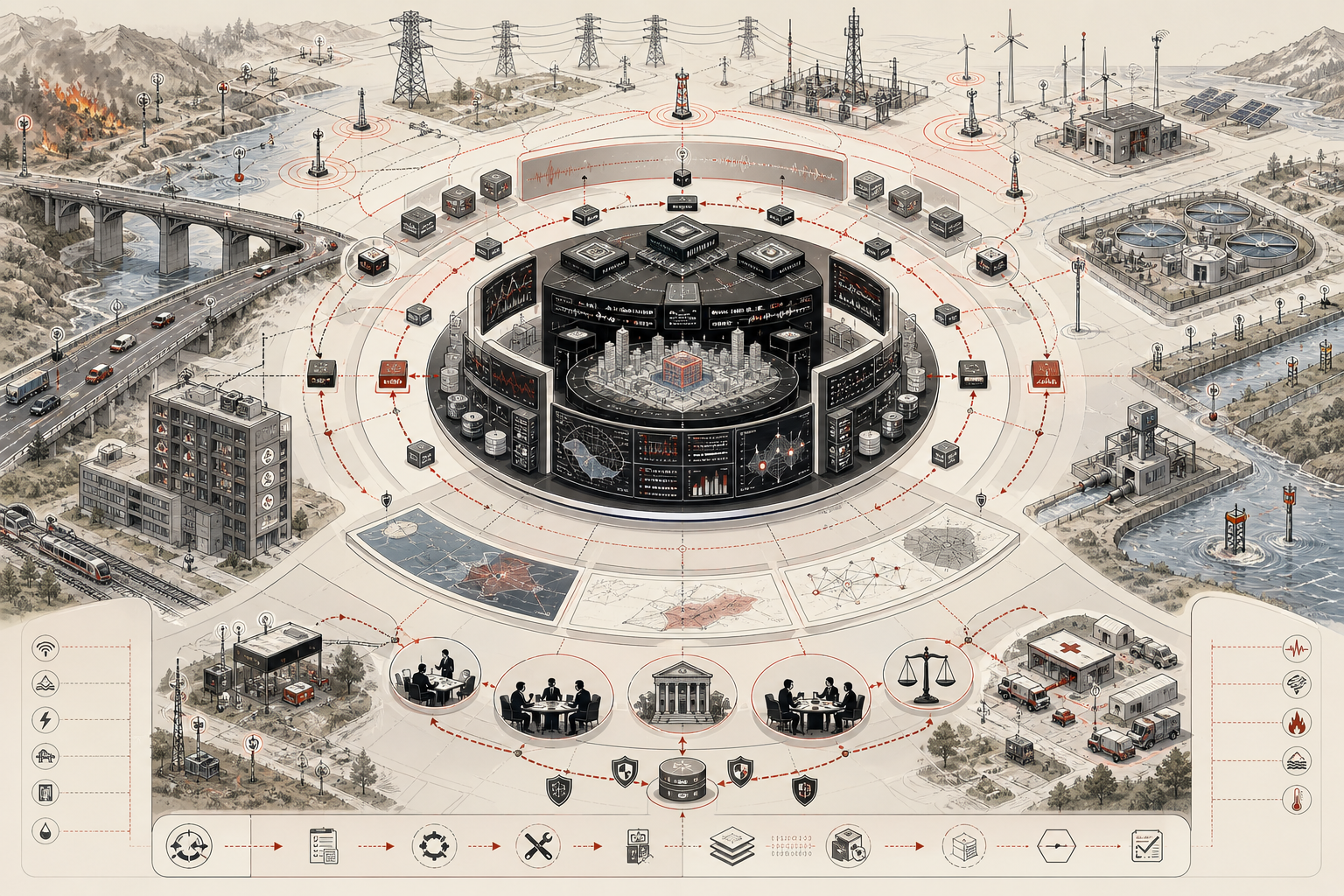
This matters because contemporary societies rely on increasingly interdependent systems. Electricity powers communications networks; communications networks support transport coordination; transport systems underpin supply chains; water systems depend on digital monitoring and energy-intensive treatment; emergency management depends on data flows spanning multiple institutions. As interdependence increases, failures can propagate across sectors. Intelligent infrastructure therefore promises not only efficiency gains, but also better visibility into system conditions, faster anomaly detection, improved asset stewardship, stronger remote monitoring, better disaster response, and greater resilience when confronted with climate risk, cyber threats, maintenance backlogs, infrastructure aging, and operational uncertainty.
Yet intelligent infrastructure also introduces new challenges. Digital dependence expands attack surfaces. Automated decision systems can obscure accountability. Data asymmetries can concentrate power in platform vendors or private operators. Legacy assets often resist easy integration. LPWAN and LoRaWAN deployments can extend monitoring into remote environments, but they also require careful design around payload size, duty cycle, gateway coverage, device identity, battery life, encryption, and operational governance. For that reason, intelligent infrastructure should be understood not merely as a technological upgrade, but as a governance problem, a systems engineering problem, a public-interest problem, and a resilience problem. The central question is not whether infrastructure can be made more digital, but how it can be made more observable, trustworthy, resilient, interoperable, maintainable, secure, and institutionally accountable.
Complete Code Repository
The companion repository for this knowledge series contains SQL schemas, infrastructure telemetry datasets, Python analytics workflows, R reliability reports, Embedded C firmware examples, TinyML anomaly-detection scaffolds, PYNQ edge-acceleration workflows, HDL/Verilog streaming signal modules, LPWAN and LoRaWAN telemetry simulations, MQTT gateway examples, Go event-stream services, Rust telemetry validators, Julia resilience simulations, TypeScript dashboard scaffolds, calibration manifests, asset metadata, observability examples, and governance documentation for intelligent infrastructure systems.
What Are Intelligent Infrastructure Systems?
Intelligent infrastructure systems are infrastructure networks that incorporate digital sensing, embedded computing, communications technologies, data platforms, modeling tools, local inference, edge analytics, and automated or semi-automated control processes in order to monitor conditions and manage operations dynamically. These systems extend traditional infrastructure management by making physical assets more measurable, connected, adaptive, and accountable over time.
In practical terms, intelligent infrastructure typically includes several interrelated components:
- sensing and measurement through distributed sensors, meters, cameras, vibration monitors, satellite data, drones, diagnostic devices, and field instruments
- embedded computing through microcontrollers, firmware, real-time operating systems, device drivers, and low-power field nodes
- edge intelligence through gateways, TinyML inference, PYNQ/FPGA acceleration, local anomaly detection, buffering, and offline-first decision logic
- communication and connectivity through fiber, Ethernet, cellular, Wi-Fi, LoRaWAN, LPWAN, satellite, MQTT, OPC UA, Modbus, CAN, RS-485, and hybrid networks
- data storage and integration through operational databases, time-series stores, PostGIS, TimescaleDB, cloud platforms, data lakes, digital twins, and interoperability layers
- analytics and decision support through anomaly detection, forecasting, optimization, simulation, digital twins, statistical modeling, and machine-learning systems
- control and intervention through alerts, maintenance scheduling, dispatch, adaptive routing, demand response, emergency coordination, and automated actuation
- governance and accountability through metadata, telemetry contracts, calibration records, audit logs, security controls, standards, public oversight, and institutional decision rights
Seen in this way, intelligent infrastructure is not reducible to a single technology. It is a systems architecture that links measurement to interpretation and interpretation to action. A water utility that only installs sensors is not yet operating as intelligent infrastructure if it lacks a robust data governance model, reliable analytics pipeline, secure telemetry system, and decision process capable of translating signals into timely operational changes. Likewise, a transport network may collect large quantities of data while still failing to improve public outcomes if that data is fragmented, low quality, poorly governed, or disconnected from operational decisions.
The concept is therefore best understood in sociotechnical terms. Infrastructure intelligence emerges not simply from devices, but from the organizational and institutional capacity to interpret signals, coordinate decisions, govern trade-offs, and maintain reliability across complex physical systems.
Why Intelligent Infrastructure Matters
Modern infrastructure systems face mounting pressures: aging assets, tighter budgets, higher service expectations, climate volatility, cyber risk, disaster exposure, maintenance backlogs, supply-chain disruptions, energy transition pressures, and growing interdependence between sectors. Under these conditions, traditional inspection-based and reactive models of infrastructure management become increasingly inadequate. Periodic manual observation often fails to detect slow deterioration, emerging bottlenecks, hidden leaks, remote faults, cascading dependencies, or rapidly changing disaster conditions early enough to prevent disruption.
Intelligent infrastructure addresses this problem by improving observability. Continuous or near-real-time data allows operators to move from delayed awareness to earlier detection. This shift can support predictive maintenance, reduce downtime, extend asset life, improve resource allocation, guide emergency response, and support long-term resilience planning. In energy systems, intelligent grid architectures can improve balancing, load management, fault detection, and distributed energy coordination. In transportation, dynamic control systems can improve traffic flow, incident management, public transit coordination, and multimodal planning. In water systems, network monitoring can detect leaks, pressure anomalies, contamination risks, pump failures, flooding risk, and inefficiencies that would otherwise remain hidden.
Equally important, intelligent infrastructure helps make infrastructure legible at scale. Large, distributed systems are often difficult to govern because their internal states remain partially invisible. Better monitoring and integration do not eliminate uncertainty, but they can reduce informational blind spots, allowing infrastructure institutions to allocate attention more effectively and distinguish local incidents from system-level patterns. This is why intelligent infrastructure has become central to smart grids, water utilities, disaster relief, critical infrastructure resilience, environmental monitoring, remote asset management, industrial operations, transportation systems, and climate adaptation planning.
Still, intelligence should not be confused with autonomy alone. A highly automated system may still be poorly governed, brittle, insecure, inequitable, or strategically myopic. The public value of intelligent infrastructure depends on whether its digital architecture improves stewardship, accountability, transparency, and long-run system resilience rather than simply increasing operational complexity.
System Architecture and Functional Layers
The architecture of intelligent infrastructure can be analyzed as a layered system in which physical assets, data flows, computational processes, communication networks, and decision mechanisms interact over time.
Physical Asset Layer
The physical layer includes infrastructure assets such as substations, pipes, pumps, bridges, roads, rail lines, traffic signals, buildings, dams, culverts, shelters, towers, solar arrays, batteries, transformers, treatment plants, meters, and field equipment. These assets exist in material environments shaped by weather, hydrology, climate, human use, maintenance history, and institutional capacity.
Sensing and Measurement Layer
The sensing layer captures physical signals from infrastructure assets and surrounding environments. These may include flow rates, temperature, vibration, structural strain, voltage, current, pressure, occupancy, emissions, acoustic signatures, water levels, air quality, soil moisture, rainfall, or equipment status. The design of this layer determines what the system can observe, how frequently it can observe it, and with what degree of accuracy, latency, power demand, and spatial coverage.
Embedded and Edge Layer
The embedded and edge layer includes microcontrollers, data loggers, gateways, edge servers, RTOS-based devices, TinyML inference modules, PYNQ/FPGA accelerators, and local buffering systems. This layer matters because infrastructure often operates in remote, harsh, low-bandwidth, or safety-relevant contexts where sending every signal to the cloud is inefficient or impossible. Local processing can filter noise, detect anomalies, compress telemetry, trigger alerts, and maintain basic function during network disruption.
Communication Layer
The communication layer transmits data between field devices, gateways, control centers, data platforms, emergency managers, and operational interfaces. Infrastructure communications may involve fiber networks, Ethernet, industrial control networks, cellular systems, satellite links, LoRaWAN, other LPWAN technologies, MQTT, OPC UA, Modbus, CAN, RS-485, Wi-Fi, BLE, or hybrid architectures. Reliability, latency, cybersecurity, interoperability, power consumption, terrain, and disaster survivability all become critical here.
Data Layer
The data layer stores, structures, and integrates infrastructure data. This includes real-time telemetry, historical operational records, maintenance logs, geospatial data, inspection records, remote sensing data, work orders, weather data, market signals, and emergency events. Without strong data architecture, intelligent infrastructure becomes fragmented: devices generate signals, but institutions cannot reliably turn those signals into cumulative operational knowledge.
Analytics and Modeling Layer
The analytics layer transforms data into operationally meaningful insight. It may include dashboards, statistical monitoring, anomaly detection, predictive maintenance, optimization models, geospatial risk modeling, simulation, forecasting, machine learning, and digital twins. The quality of this layer depends not only on model sophistication, but on governance of assumptions, calibration, uncertainty, data quality, and model validity in real operating environments.
Control and Decision Layer
The control layer links analytical outputs to intervention. In some systems, this means automated actuation. In others, it means human-in-the-loop decision support, prioritization, maintenance scheduling, emergency dispatch, adaptive routing, demand response, or public warning. This is where infrastructure intelligence becomes operational rather than merely descriptive. It is also where accountability concerns become most acute, especially when automated systems affect public safety, service access, pricing, emergency response, or resource allocation.
Together these layers form a recursive feedback architecture: infrastructure generates signals; systems interpret those signals; operators or control systems intervene; those interventions alter subsequent system conditions. Understanding intelligent infrastructure therefore requires understanding not only each layer individually, but also the quality of the feedback loops that connect them.
Cyber-Physical Integration and Feedback
Intelligent infrastructure systems are a major class of cyber-physical systems, in which computational and communicative processes are deeply coupled with physical assets and environments. In cyber-physical infrastructure, the digital system does not merely record what happens in the physical system after the fact. It helps shape operations in real time through measurement, prediction, coordination, and control.
This coupling creates new capabilities but also new forms of dependence. When digital systems mediate the operation of transport, water, power, emergency response, buildings, or urban management systems, software reliability, communication integrity, firmware integrity, and data validity become part of infrastructure reliability itself. A sensor failure, timing mismatch, interface bug, model drift, weak encryption practice, or cyber intrusion can become operationally significant because digital errors may propagate into physical consequences.
Feedback is central here. Traditional infrastructure often relied on delayed or low-frequency feedback, such as periodic reports, scheduled inspections, or after-action assessments. Intelligent infrastructure increases the speed, granularity, and potential responsiveness of feedback loops. But faster feedback is not always better. Rapid control responses can amplify instability if signals are noisy, if optimization targets are poorly specified, if automated systems lack safeguards, or if local conditions are misrepresented by incomplete data.
For this reason, intelligent infrastructure should be analyzed in relation to system observability, controllability, delay structures, failure modes, communication reliability, and coordination mechanisms. Its success depends less on raw data volume than on whether feedback loops are interpretable, trustworthy, secure, and aligned with public and operational goals.
LPWAN, LoRa, and LoRaWAN for Remote Infrastructure Monitoring
Low-power wide-area networking is central to intelligent infrastructure because many infrastructure assets are geographically distributed, power constrained, difficult to access, or located outside reliable broadband coverage. Pump stations, culverts, flood gauges, rural transformers, water tanks, bridges, environmental stations, drainage infrastructure, field shelters, agricultural systems, and remote emergency assets often require telemetry systems that can operate for long periods on batteries or solar power.
LPWAN refers to a class of network architectures designed for long-range, low-power, low-data-rate communication. It is useful where devices send small telemetry payloads rather than continuous high-bandwidth streams. LPWAN is not ideal for video, high-frequency control, or large data transfers, but it can be extremely useful for status updates, environmental readings, alerts, equipment health, water levels, pressure values, battery state, and disaster-response beacons.
LoRa is the physical-layer radio modulation technology associated with long-range, low-power communication. LoRaWAN is the network protocol and system architecture built around LoRa-based devices, gateways, network servers, application servers, device identity, security, and message routing. In practical infrastructure terms, LoRa describes how radio signals travel; LoRaWAN describes how devices participate in a managed network.
LoRaWAN is especially relevant for intelligent infrastructure because it supports:
- long-range field telemetry for assets spread across rural, peri-urban, industrial, agricultural, or watershed environments
- low-power operation for battery or solar-powered devices deployed for months or years
- small payload monitoring for readings such as water level, valve status, vibration summary, pressure, temperature, battery voltage, or signal quality
- gateway-based collection where many devices communicate through one or more strategically placed gateways
- disaster-resilient deployment where field nodes may continue sending small messages when ordinary connectivity is degraded
- remote monitoring for hard-to-reach assets that cannot justify cellular subscriptions or wired connectivity
A practical LoRaWAN infrastructure architecture usually includes:
- end devices — battery-powered or solar-powered sensor nodes attached to assets or environmental sites
- gateways — devices that receive LoRa radio messages and forward packets through IP networks
- network server — the layer that manages device sessions, message routing, deduplication, and network behavior
- application server — the layer that receives decoded payloads and connects data to dashboards, databases, alerts, or analytics workflows
- infrastructure data platform — the institutional system that stores telemetry with asset metadata, geospatial location, calibration records, quality flags, and maintenance context
LoRaWAN design requires engineering trade-offs. Long range and low power come with payload constraints, duty-cycle limits, latency variability, and limited suitability for continuous control. It is often best for monitoring and alerting rather than closed-loop real-time control. For critical infrastructure, LoRaWAN should be combined with redundancy, local fail-safe logic, event buffering, secure device provisioning, message validation, and clear operational procedures.
In intelligent infrastructure, LPWAN and LoRaWAN should be treated not as standalone technologies, but as part of a larger architecture of remote observability. They are most powerful when connected to reliable device metadata, geospatial asset registries, telemetry contracts, quality checks, edge analytics, and response workflows.
Disaster Relief, Early Warning, and Remote Monitoring
Disaster relief and emergency management are among the strongest use cases for intelligent infrastructure. Disasters expose the limits of static infrastructure management because conditions can change rapidly, communications can degrade, assets can fail simultaneously, and institutions may need to coordinate across jurisdictions under uncertainty.
Intelligent infrastructure can support disaster relief in several ways:
- early warning — flood gauges, rainfall sensors, landslide monitors, wildfire sensors, heat sensors, storm-surge gauges, and air-quality monitors can detect emerging risk before full-scale impact.
- remote situational awareness — LPWAN, satellite, cellular, mesh, and edge gateways can transmit field conditions from locations that are difficult or unsafe to inspect manually.
- asset status monitoring — generators, pumps, shelters, bridges, roads, substations, and water facilities can report operational state, battery levels, faults, and local environmental conditions.
- edge-based resilience — local devices can buffer data, trigger alerts, or maintain basic monitoring when cloud connectivity is unavailable.
- logistics coordination — infrastructure telemetry can support dispatch, routing, resource allocation, and prioritization of repair crews or relief supplies.
- post-event assessment — sensor records, satellite imagery, drone surveys, inspection logs, and geospatial data can support damage assessment, recovery planning, and accountability.
Remote monitoring is especially important where disaster conditions prevent immediate site access. Flooded roads, wildfire zones, storms, damaged bridges, contaminated water systems, landslides, and power outages all limit human inspection. Field-deployed sensors and edge gateways can provide partial but valuable visibility when manual observation is delayed.
However, disaster intelligence must be designed carefully. Warning systems fail if alerts do not reach people, if institutions lack response capacity, if data is not trusted, if false alarms undermine credibility, or if vulnerable communities are not represented in the monitoring design. The intelligence of disaster infrastructure therefore depends on the full chain from detection to communication to response.
Mathematical Lens
Intelligent infrastructure systems require mathematics because reliability, risk, latency, power consumption, communication range, maintenance probability, and resilience must be measured rather than merely asserted.
A = \frac{MTBF}{MTBF + MTTR}
\]
L_{\text{total}} = L_{\text{sense}} + L_{\text{edge}} + L_{\text{network}} + L_{\text{platform}} + L_{\text{response}}
\]
E_{\text{daily}} = N_s E_s + N_t E_t + E_{\text{sleep}}
\]
B = P_{tx} + G_{tx} + G_{rx} – L_{path} – L_{misc}
\]
R = H \times E \times V
\]
S_t = \alpha x_t + (1-\alpha)S_{t-1}
\]
| Symbol | Meaning | Infrastructure interpretation |
|---|---|---|
| \(A\) | Availability | The share of time an asset or service is operational. |
| \(MTBF\) | Mean time between failures | A reliability measure for assets, devices, or systems. |
| \(MTTR\) | Mean time to repair | A measure of how quickly disruptions can be restored. |
| \(L_{\text{total}}\) | Total response latency | Time from physical event to operational response. |
| \(E_{\text{daily}}\) | Daily energy use | Energy budget for remote infrastructure monitoring nodes. |
| \(B\) | Link budget | A simplified measure of communication viability. |
| \(R\) | Risk | Interaction of hazard, exposure, and vulnerability. |
The mathematical lesson is practical. Intelligent infrastructure does not become resilient because it has sensors. It becomes more resilient when sensing, communication, modeling, maintenance, and response capacity improve system behavior under stress.
Core Domains of Intelligent Infrastructure
Intelligent infrastructure systems span multiple sectors, each with distinctive operational requirements, communication needs, risk profiles, and governance constraints.
Energy Infrastructure
Smart energy systems integrate digital monitoring, advanced metering, distributed control, demand-response capabilities, grid sensors, substation monitoring, fault detection, and renewable-energy coordination into generation, transmission, distribution, and storage systems. As electricity systems incorporate more distributed energy resources and variable renewables, intelligent coordination becomes essential for balancing, reliability, and resilience.
Transportation Infrastructure
Intelligent transportation systems use sensors, communications networks, signal control systems, vehicle data, traffic analytics, cameras, incident detection, and geospatial models to improve mobility, safety, congestion management, emergency routing, and multimodal coordination. These systems increasingly support dynamic operations rather than static traffic engineering alone.
Water Infrastructure
Intelligent water infrastructure includes network sensing, leak detection, pressure monitoring, pump monitoring, flood detection, treatment optimization, quality surveillance, valve status, stormwater monitoring, and digital asset management. In a context of aging pipes, climate variability, water stress, and contamination risk, better system visibility can materially improve reliability and stewardship.
Buildings and Facilities
Intelligent buildings and facilities integrate occupancy sensing, energy monitoring, HVAC analytics, indoor air-quality sensors, access systems, maintenance data, equipment monitoring, and demand-response coordination. The goal is not merely automation, but healthier, safer, more efficient, more resilient building operations.
Urban and Civic Infrastructure
Urban infrastructure systems increasingly incorporate sensor networks, integrated operations centers, geospatial platforms, emergency communication systems, and digital service coordination. Used well, these systems can improve service delivery, situational awareness, and urban resilience. Used poorly, they risk producing fragmented dashboards without robust public accountability or meaningful operational integration.
Environmental Monitoring Infrastructure
Environmental monitoring infrastructure tracks air quality, hydrological conditions, ecological stress, wildfire risk, emissions, climate indicators, and exposure conditions using sensor networks, remote sensing, embedded devices, LPWAN, edge analytics, and integrated data systems. These systems are especially important where infrastructure management and environmental risk interact directly.
Disaster Detection and Early Warning
Early warning infrastructure combines monitoring systems, LPWAN and cellular communication, remote sensing, predictive models, emergency coordination protocols, sirens, alerts, field devices, and public communication. Here the intelligence of infrastructure depends not only on technical detection but also on the credibility, reach, and timeliness of institutional response mechanisms.
Remote and Rural Infrastructure
Remote infrastructure includes rural utilities, roads, culverts, water tanks, agricultural infrastructure, microgrids, remote clinics, communication towers, field shelters, and environmental stations. LPWAN, LoRaWAN, satellite backhaul, solar nodes, offline-first data logging, and low-power firmware are especially important in these contexts.
Across these domains, the same basic principle holds: intelligence arises when distributed data, operational models, and decision processes are integrated into an infrastructure system that can observe, learn, adapt, and intervene with greater precision and accountability.
Intelligent Infrastructure Systems Pillar Map
The roadmap below organizes the Intelligent Infrastructure Systems knowledge series into conceptual domains. Existing and planned articles are listed with descriptions so the pillar can function as both a public index and a long-range technical architecture for the series.
Foundations of Infrastructure Intelligence
- Digital Infrastructure Systems — Explains the data, communication, software, cloud, edge, and governance layers that support digitally coordinated infrastructure.
- Cyber-Physical Infrastructure Systems — Examines how sensing, computation, communication, and physical infrastructure interact through feedback loops and control processes.
- Infrastructure Monitoring and Sensor Integration — Covers how sensors, meters, diagnostic devices, and field instruments are integrated into infrastructure assets and operational workflows.
- Infrastructure Data Platforms and Analytics — Explains how telemetry, maintenance records, geospatial data, inspections, and operational streams become structured infrastructure intelligence.
- Infrastructure Telemetry Systems (Planned) — Will introduce device telemetry, payload design, quality flags, timestamping, buffering, ingestion, metadata, and monitoring contracts for infrastructure systems.
- Infrastructure Observability and Operational Intelligence (Planned) — Will study logs, metrics, traces, alerts, dashboards, device health, service indicators, and operational awareness across distributed infrastructure.
- Infrastructure Interoperability and System Integration (Planned) — Will examine APIs, OPC UA, MQTT, Modbus, data standards, middleware, semantic models, and cross-vendor integration.
Embedded, Edge, LPWAN, and Remote Monitoring
- Embedded Sensors for Intelligent Infrastructure (Planned) — Will demonstrate microcontrollers, firmware, calibration constants, interrupt handling, low-power sensor loops, and infrastructure device design.
- Edge Computing for Infrastructure Monitoring (Planned) — Will examine gateways, local analytics, buffering, offline-first operation, anomaly detection, and cloud-edge coordination for infrastructure systems.
- LPWAN and LoRaWAN for Remote Infrastructure Monitoring (Planned) — Will explore LPWAN architecture, LoRa modulation, LoRaWAN device classes, gateways, network servers, payload design, battery life, coverage, security, and field deployment trade-offs.
- MQTT Telemetry for Infrastructure Systems (Planned) — Will cover publish/subscribe messaging, topic design, gateway events, retained messages, QoS patterns, and telemetry ingestion.
- OPC UA and Industrial Infrastructure Interoperability (Planned) — Will study machine-to-machine and machine-to-enterprise data exchange, industrial asset models, semantic interoperability, and secure operations.
- Remote Monitoring for Rural and Hard-to-Reach Infrastructure (Planned) — Will examine solar nodes, satellite backhaul, LoRaWAN gateways, offline buffering, rugged deployment, and maintenance planning.
- Low-Power Infrastructure Device Design (Planned) — Will cover duty cycling, sleep states, battery sizing, event-triggered telemetry, solar charging, and energy-aware firmware.
TinyML, PYNQ, HDL, and Hardware-Aware Infrastructure AI
- TinyML for Predictive Maintenance (Planned) — Will demonstrate on-device inference for vibration anomalies, pump faults, equipment stress, acoustic signals, and low-power infrastructure monitoring.
- PYNQ for Edge Infrastructure Analytics (Planned) — Will introduce Python-controlled FPGA acceleration for sensor windows, vibration features, signal-processing pipelines, and local inference support.
- HDL for Streaming Infrastructure Signals (Planned) — Will demonstrate Verilog or VHDL modules for threshold detection, moving averages, finite-state alert controllers, and deterministic signal pathways.
- Embedded C for Infrastructure Firmware (Planned) — Will cover watchdog loops, fail-safe states, rolling thresholds, local alert logic, sensor polling, and firmware patterns for infrastructure assets.
- Edge AI Benchmarking for Infrastructure Systems (Planned) — Will compare latency, energy, memory, accuracy, model size, communication cost, and operational risk across edge inference approaches.
- Hardware-Software Co-Design for Intelligent Infrastructure (Planned) — Will examine when to use firmware, edge Linux, TinyML, FPGA acceleration, cloud analytics, or human-in-the-loop decision support.
Simulation, Digital Twins, and Lifecycle Intelligence
- Digital Twins and Infrastructure Simulation — Explains how infrastructure models, telemetry, simulation, and scenario analysis can support planning and operations.
- Asset Management and Predictive Maintenance Systems — Covers maintenance data, failure prediction, inspection scheduling, asset risk, and lifecycle stewardship.
- Infrastructure Failure Modeling and Reliability Analysis (Planned) — Will study availability, MTBF, MTTR, failure curves, degradation models, and repair prioritization.
- Network Flow Models for Infrastructure Resilience (Planned) — Will examine graph models, bottlenecks, redundancy, flow disruption, interdependencies, and recovery pathways.
- Scenario Analysis for Infrastructure Planning (Planned) — Will connect uncertainty, climate risk, demand growth, investment planning, and robust decision-making.
- Infrastructure Lifecycle Data and Long-Term Stewardship (Planned) — Will study asset histories, inspection records, telemetry, maintenance logs, capital planning, and institutional memory.
Energy, Water, and Resource Infrastructure
- Smart Energy Grids and Digital Power Systems — Explains grid sensors, smart meters, distributed energy coordination, fault detection, demand response, and digital power-system operations.
- Intelligent Water Infrastructure Systems — Covers leak detection, pressure monitoring, pump telemetry, water quality, treatment optimization, and watershed-linked infrastructure management.
- Infrastructure for Renewable Energy Systems — Examines the infrastructure needed to integrate solar, wind, storage, microgrids, distributed resources, and grid flexibility.
- Monitoring Energy Infrastructure Performance — Studies telemetry, performance indicators, equipment health, fault detection, and operational analytics for energy systems.
- Microgrids and Remote Energy Monitoring (Planned) — Will examine distributed energy resources, storage, islanding, load monitoring, LPWAN telemetry, and resilience for remote communities or facilities.
- Smart Pump Stations and Water Utility Telemetry (Planned) — Will study pumps, pressure, flow, vibration, water quality, energy use, and predictive maintenance for water infrastructure.
- Stormwater Infrastructure Monitoring Systems (Planned) — Will cover rainfall sensors, flow meters, culvert monitoring, flood thresholds, green infrastructure, and urban drainage analytics.
Urban, Mobility, and Civic Infrastructure
- Smart City Infrastructure Systems — Examines urban sensor networks, integrated operations, civic platforms, public accountability, and the limits of dashboard-driven urbanism.
- Intelligent Transportation Networks — Covers traffic sensors, signal coordination, incident detection, transit data, routing, and multimodal mobility systems.
- Urban Sensor Networks and Infrastructure Monitoring — Studies distributed urban sensing for air quality, heat, traffic, water, lighting, safety, and public services.
- Infrastructure Systems for Urban Resilience — Explains how infrastructure monitoring, redundancy, adaptation, emergency planning, and public systems support urban resilience.
- Smart Buildings and Facility Intelligence (Planned) — Will study HVAC monitoring, energy analytics, occupancy, indoor air quality, maintenance alerts, and building-level resilience.
- Public Transit Monitoring and Service Reliability (Planned) — Will examine vehicle telemetry, headway reliability, passenger information, disruption management, and equity in service monitoring.
- Geospatial Infrastructure Risk Mapping (Planned) — Will use PostGIS, spatial joins, asset registries, hazard layers, exposure, and vulnerability analysis to map infrastructure risk.
Environmental, Climate, and Disaster Monitoring Infrastructure
- Infrastructure for Environmental Monitoring Systems — Explains how field sensors, telemetry, data platforms, and observation networks support environmental monitoring.
- Climate Monitoring Infrastructure — Covers long-term observation systems, climate variables, remote sensing, weather stations, and institutional climate data systems.
- Flood and Disaster Early Warning Infrastructure — Studies gauges, rainfall sensors, flood models, alerts, emergency communication, and decision pathways for early warning.
- Infrastructure Systems for Climate Adaptation — Connects monitoring, risk assessment, adaptation planning, investment prioritization, and resilience governance.
- LPWAN Disaster Monitoring Networks (Planned) — Will examine low-power field nodes, LoRaWAN gateways, flood and wildfire sensors, emergency beacons, and degraded-connectivity operation.
- Remote Sensing for Infrastructure Damage Assessment (Planned) — Will study satellite imagery, drones, geospatial change detection, flood extent, wildfire damage, landslide risk, and post-event recovery assessment.
- Emergency Communications and Infrastructure Telemetry (Planned) — Will examine redundant communication paths, satellite links, radio, cellular fallback, mesh networks, LPWAN, and field coordination.
- Disaster Relief Logistics and Infrastructure Data Systems (Planned) — Will connect asset status, road access, shelter capacity, supply routing, geospatial data, and emergency operations centers.
Governance, Security, and Public Accountability
- Infrastructure Governance and Policy Systems — Explains how institutions, policies, standards, procurement, coordination, and public accountability shape infrastructure systems.
- Infrastructure Security and Cyber Resilience — Covers cyber risk, segmentation, incident response, secure device management, supply-chain risk, and recovery for connected infrastructure.
- Infrastructure Risk Management Systems — Studies risk registers, exposure, vulnerability, indicators, scenario planning, monitoring, and mitigation prioritization.
- Telemetry Governance for Public Infrastructure (Planned) — Will examine data ownership, access, retention, privacy, metadata, audit logs, quality rules, and public legitimacy.
- Secure Device Lifecycle Management for Infrastructure (Planned) — Will study provisioning, firmware signing, secure boot, OTA updates, rollback, device identity, and long-lived field deployments.
- Infrastructure Data Contracts and Operational Accountability (Planned) — Will define telemetry contracts, schema expectations, quality thresholds, ownership, escalation paths, and auditability.
- Vendor Lock-In and Public Infrastructure Platforms (Planned) — Will examine procurement, interoperability, proprietary platforms, open standards, data portability, and institutional dependency.
Capstone and Long-Horizon Synthesis
- The Future of Intelligent Infrastructure — Synthesizes sensing, edge computing, AI, digital twins, infrastructure governance, resilience, and public accountability.
- Intelligent Infrastructure as Public Knowledge Infrastructure (Planned) — Will frame infrastructure intelligence as a public-capacity problem involving observation, legitimacy, stewardship, and accountable decision-making.
- Infrastructure Intelligence Under Climate Volatility (Planned) — Will examine how monitoring, modeling, adaptation, disaster response, and governance must evolve under more unstable environmental conditions.
GitHub Code Repository
The Intelligent Infrastructure Systems knowledge series is supported by a companion code repository designed for practical, reproducible, multi-language infrastructure workflows. This repository should bridge field sensing, embedded firmware, LPWAN and LoRaWAN telemetry, edge analytics, data systems, predictive maintenance, geospatial risk modeling, observability, digital twins, disaster monitoring, and governance documentation.
Recommended repository structure:
intelligent-infrastructure-systems-code/
├── README.md
├── LICENSE
├── data/
│   ├── raw/
│   ├── processed/
│   ├── synthetic/
│   └── geospatial/
├── sql/
│   ├── infrastructure_schema.sql
│   ├── seed_data.sql
│   ├── telemetry_quality_checks.sql
│   ├── maintenance_event_views.sql
│   └── resilience_indicator_views.sql
├── embedded_c/
│   ├── low_power_infrastructure_sensor.c
│   ├── vibration_threshold_monitor.c
│   └── watchdog_fail_safe_loop.c
├── tinyml/
│   ├── vibration_anomaly_tinyml_stub.cpp
│   ├── pump_fault_detection_stub.cpp
│   ├── model_metadata.json
│   └── README.md
├── hdl/
│   ├── streaming_threshold_detector.v
│   ├── moving_average_filter.v
│   └── finite_state_alert_controller.v
├── pynq/
│   ├── pynq_vibration_feature_acceleration.py
│   └── pynq_sensor_window_pipeline.py
├── python/
│   ├── telemetry_ingestion_pipeline.py
│   ├── infrastructure_anomaly_detection.py
│   ├── lpwan_lorawan_payload_decoder.py
│   ├── geospatial_asset_risk_model.py
│   ├── disaster_monitoring_event_pipeline.py
│   ├── digital_twin_simulation.py
│   └── maintenance_forecast.py
├── r/
│   ├── infrastructure_reliability_report.R
│   ├── resilience_indicator_trends.R
│   └── uncertainty_communication_report.R
├── julia/
│   ├── network_flow_resilience_model.jl
│   └── infrastructure_failure_simulation.jl
├── rust/
│   └── telemetry_schema_validator/
├── go/
│   └── edge_gateway_event_stream/
├── typescript/
│   └── infrastructure_dashboard_scaffold/
├── metadata/
│   ├── telemetry_contract.yml
│   ├── asset_metadata.yml
│   ├── calibration_manifest.yml
│   ├── lorawan_device_registry.yml
│   └── governance_manifest.yml
├── notebooks/
├── docs/
│   ├── governance_notes.md
│   ├── lpwan_lorawan_design_notes.md
│   ├── disaster_relief_monitoring_notes.md
│   ├── reproducibility_guide.md
│   └── cybersecurity_notes.md
└── outputs/
    ├── tables/
    ├── figures/
    └── reports/
The repository should support several practical workflows:
- SQL: infrastructure assets, sensors, telemetry, maintenance events, disaster events, quality flags, and resilience indicators.
- Embedded C: low-power sensor loops, vibration thresholds, watchdogs, local alerts, fail-safe behavior, and power-aware infrastructure device logic.
- TinyML: on-device inference for predictive maintenance, vibration anomalies, pump faults, acoustic signatures, and remote field events.
- PYNQ: hardware-aware edge acceleration for vibration windows, streaming features, signal preprocessing, and low-latency infrastructure analytics.
- HDL/Verilog: streaming threshold detection, moving averages, finite-state alert controllers, and deterministic signal-processing modules.
- Python: telemetry ingestion, LoRaWAN payload decoding, anomaly detection, geospatial risk modeling, disaster monitoring, digital twins, and maintenance forecasting.
- R: infrastructure reliability reporting, resilience trends, uncertainty communication, and report-ready figures.
- Julia: network-flow resilience modeling, infrastructure failure simulation, and numerical scenario analysis.
- Rust: safe telemetry schema validation and command-line quality-control tooling.
- Go: edge gateway event streaming, MQTT-style services, and lightweight infrastructure telemetry APIs.
- TypeScript: dashboard scaffolding and browser-based decision-support interfaces.
SQL Workflow: Infrastructure Asset and Telemetry Registry
SQL provides the durable structure for intelligent infrastructure. It defines assets, sensors, telemetry, maintenance events, disaster events, alerts, and quality checks.
Suggested filename:
sql/infrastructure_schema.sql-- Infrastructure Asset and Telemetry Registry
-- ------------------------------------------
-- This schema supports intelligent infrastructure examples:
-- assets, sensors, telemetry, maintenance, disaster events,
-- alerts, and resilience indicators.
CREATE TABLE IF NOT EXISTS infrastructure_assets (
asset_id TEXT PRIMARY KEY,
asset_type TEXT NOT NULL,
sector TEXT NOT NULL,
location_name TEXT NOT NULL,
latitude REAL,
longitude REAL,
installed_at TEXT,
criticality_score REAL NOT NULL,
active INTEGER NOT NULL CHECK (active IN (0, 1))
);
CREATE TABLE IF NOT EXISTS infrastructure_sensors (
sensor_id TEXT PRIMARY KEY,
asset_id TEXT NOT NULL,
sensor_type TEXT NOT NULL,
unit TEXT NOT NULL,
communication_mode TEXT NOT NULL,
sampling_interval_seconds INTEGER NOT NULL,
FOREIGN KEY (asset_id) REFERENCES infrastructure_assets(asset_id)
);
CREATE TABLE IF NOT EXISTS telemetry_readings (
reading_id INTEGER PRIMARY KEY AUTOINCREMENT,
sensor_id TEXT NOT NULL,
observed_at TEXT NOT NULL,
observed_value REAL NOT NULL,
battery_voltage REAL,
signal_quality REAL,
payload_bytes INTEGER,
transmitted INTEGER NOT NULL CHECK (transmitted IN (0, 1)),
quality_flag TEXT NOT NULL,
FOREIGN KEY (sensor_id) REFERENCES infrastructure_sensors(sensor_id)
);
CREATE TABLE IF NOT EXISTS maintenance_events (
maintenance_id INTEGER PRIMARY KEY AUTOINCREMENT,
asset_id TEXT NOT NULL,
event_time TEXT NOT NULL,
maintenance_type TEXT NOT NULL,
severity TEXT NOT NULL,
notes TEXT,
FOREIGN KEY (asset_id) REFERENCES infrastructure_assets(asset_id)
);
CREATE TABLE IF NOT EXISTS disaster_events (
disaster_event_id INTEGER PRIMARY KEY AUTOINCREMENT,
event_time TEXT NOT NULL,
event_type TEXT NOT NULL,
affected_sector TEXT NOT NULL,
severity TEXT NOT NULL,
latitude REAL,
longitude REAL,
notes TEXT
);
CREATE TABLE IF NOT EXISTS infrastructure_alerts (
alert_id INTEGER PRIMARY KEY AUTOINCREMENT,
sensor_id TEXT NOT NULL,
observed_at TEXT NOT NULL,
alert_type TEXT NOT NULL,
severity TEXT NOT NULL,
observed_value REAL NOT NULL,
threshold_value REAL NOT NULL,
handled_locally INTEGER NOT NULL CHECK (handled_locally IN (0, 1)),
FOREIGN KEY (sensor_id) REFERENCES infrastructure_sensors(sensor_id)
);This schema supports infrastructure intelligence because assets, telemetry, maintenance, disasters, and alerts must be connected. A sensor reading matters more when it is tied to a physical asset, location, sector, criticality score, communication mode, and response workflow.
Embedded C Workflow: Low-Power Infrastructure Sensor Monitor
Embedded C is essential for device-level monitoring because infrastructure field nodes often require direct control over memory, timing, power states, sensor reads, watchdog behavior, and communication.
Suggested filename:
embedded_c/low_power_infrastructure_sensor.c/*
* Low-Power Infrastructure Sensor Monitor
* ---------------------------------------
*
* Firmware-style example:
* - read an infrastructure sensor value
* - apply calibration
* - maintain a rolling average
* - detect local anomalies
* - trigger a local alert
*
* This can be adapted to pumps, pipes, bridges, substations,
* culverts, tanks, shelters, or remote monitoring nodes.
*/
#include <stdio.h>
#include <stdbool.h>
#define WINDOW_SIZE 12
#define ANOMALY_THRESHOLD 8.0f
#define SCALE_FACTOR 1.01f
#define OFFSET_VALUE -0.15f
static float samples[WINDOW_SIZE];
static int sample_index = 0;
static bool buffer_full = false;
float read_raw_sensor_value(void) {
/*
* Replace with ADC, I2C, SPI, UART, Modbus, or other field sensor read.
*/
static float synthetic_value = 40.0f;
synthetic_value += 0.55f;
return synthetic_value;
}
float apply_calibration(float raw_value) {
return (SCALE_FACTOR * raw_value) + OFFSET_VALUE;
}
void add_sample(float value) {
samples[sample_index] = value;
sample_index++;
if (sample_index >= WINDOW_SIZE) {
sample_index = 0;
buffer_full = true;
}
}
float rolling_average(void) {
int count = buffer_full ? WINDOW_SIZE : sample_index;
if (count == 0) {
return 0.0f;
}
float total = 0.0f;
for (int i = 0; i < count; i++) {
total += samples[i];
}
return total / count;
}
bool is_anomaly(float current_value, float average_value) {
float difference = current_value - average_value;
if (difference < 0.0f) {
difference = -difference;
}
return difference > ANOMALY_THRESHOLD;
}
void trigger_local_alert(float value, float average) {
/*
* Replace with real action:
* - send LoRaWAN uplink
* - publish MQTT event through gateway
* - write to flash
* - increase sampling frequency
* - set fail-safe state
*/
printf("INFRASTRUCTURE ALERT: value=%0.2f rolling_average=%0.2f\n", value, average);
}
int main(void) {
for (int cycle = 0; cycle < 40; cycle++) {
float raw_value = read_raw_sensor_value();
float calibrated_value = apply_calibration(raw_value);
float average = rolling_average();
if (buffer_full && is_anomaly(calibrated_value, average)) {
trigger_local_alert(calibrated_value, average);
}
add_sample(calibrated_value);
/*
* In real firmware, enter low-power sleep here until the next
* timer interrupt, sensor event, or scheduled transmission.
*/
}
return 0;
}This workflow supports remote infrastructure monitoring because the device can detect local abnormalities even before a cloud platform or control center receives the data.
TinyML Workflow: Predictive Maintenance Inference
TinyML supports compact machine-learning inference on microcontrollers and constrained devices. In intelligent infrastructure, TinyML can support vibration anomaly detection, pump fault detection, acoustic monitoring, equipment stress classification, and event-triggered telemetry.
Suggested filename:
tinyml/vibration_anomaly_tinyml_stub.cpp/*
* Vibration Anomaly TinyML Stub
* -----------------------------
*
* Educational scaffold for predictive maintenance inference.
* Replace this scoring function with a quantized TinyML model in production.
*/
#include <stdint.h>
#include <stdio.h>
typedef struct {
float mean_value;
float standard_deviation;
float peak_to_peak;
float signal_energy;
float crest_factor;
float recent_change_rate;
} VibrationFeatureVector;
float run_vibration_anomaly_stub(VibrationFeatureVector features) {
float score = 0.0f;
score += 0.20f * features.standard_deviation;
score += 0.20f * features.peak_to_peak;
score += 0.25f * features.signal_energy;
score += 0.20f * features.crest_factor;
score += 0.15f * features.recent_change_rate;
return score;
}
int main(void) {
VibrationFeatureVector features = {
.mean_value = 0.05f,
.standard_deviation = 0.31f,
.peak_to_peak = 1.42f,
.signal_energy = 0.82f,
.crest_factor = 0.56f,
.recent_change_rate = 0.22f
};
float anomaly_score = run_vibration_anomaly_stub(features);
printf("Vibration anomaly score: %0.3f\n", anomaly_score);
return 0;
}TinyML is especially useful when the system needs to reduce bandwidth, preserve battery, protect operational data, or detect faults locally before failures propagate.
PYNQ Workflow: Edge Acceleration for Infrastructure Signals
PYNQ supports Python-controlled FPGA workflows. In intelligent infrastructure, PYNQ can prototype hardware acceleration for vibration windows, water-flow signals, electrical waveforms, image preprocessing, and edge feature extraction.
Suggested filename:
pynq/pynq_vibration_feature_acceleration.py"""
PYNQ Vibration Feature Acceleration
-----------------------------------
Educational PYNQ-style workflow for edge infrastructure analytics.
Runs in software simulation mode while showing where FPGA overlay logic
would be used on supported hardware.
"""
from __future__ import annotations
import numpy as np
def simulate_vibration_window(window_size: int = 256) -> np.ndarray:
"""Create a synthetic infrastructure vibration signal."""
time = np.linspace(0, 1, window_size)
base = np.sin(2 * np.pi * 12 * time)
disturbance = 0.35 * np.sin(2 * np.pi * 35 * time)
noise = 0.10 * np.random.randn(window_size)
return (base + disturbance + noise).astype(np.float32)
def extract_vibration_features(signal: np.ndarray) -> dict:
"""Compute features that could be accelerated in programmable logic."""
return {
"mean": float(np.mean(signal)),
"std": float(np.std(signal)),
"energy": float(np.sum(signal ** 2)),
"peak_to_peak": float(np.max(signal) - np.min(signal)),
"rms": float(np.sqrt(np.mean(signal ** 2))),
}
def pynq_overlay_placeholder(signal: np.ndarray) -> dict:
"""
Placeholder for PYNQ hardware acceleration.
On supported PYNQ hardware:
- load FPGA overlay
- allocate input/output buffers
- stream signal windows to accelerator IP
- retrieve feature outputs
"""
return extract_vibration_features(signal)
def main() -> None:
signal = simulate_vibration_window()
features = pynq_overlay_placeholder(signal)
print("PYNQ infrastructure edge acceleration workflow complete.")
print(features)
if __name__ == "__main__":
main()PYNQ belongs in this pillar because some infrastructure workloads require low-latency, parallel, deterministic, or energy-aware computation closer to the asset.
HDL Workflow: Streaming Infrastructure Threshold Detector
HDL belongs in intelligent infrastructure when monitoring requires deterministic hardware logic. FPGA-based modules can support streaming filters, threshold detectors, counters, finite-state alert controllers, and low-latency safety pathways.
Suggested filename:
hdl/streaming_threshold_detector.v/*
* Streaming Infrastructure Threshold Detector
* -------------------------------------------
*
* Educational Verilog module for deterministic infrastructure monitoring.
* Raises alert_out when a streaming sensor value exceeds a configured threshold.
*/
module streaming_threshold_detector #(
parameter DATA_WIDTH = 16
)(
input wire clk,
input wire reset_n,
input wire valid_in,
input wire [DATA_WIDTH-1:0] sensor_value,
input wire [DATA_WIDTH-1:0] threshold_value,
output reg alert_out
);
always @(posedge clk or negedge reset_n) begin
if (!reset_n) begin
alert_out <= 1'b0;
end else begin
if (valid_in && sensor_value > threshold_value) begin
alert_out <= 1'b1;
end else begin
alert_out <= 1'b0;
end
end
end
endmoduleThis module is simple, but it expresses a critical infrastructure pattern: compare a streaming signal with an operational threshold and produce a deterministic alert signal for downstream control or response.
Python Workflow: Infrastructure Telemetry Quality Pipeline
Python is the primary workflow language for telemetry ingestion, LoRaWAN payload decoding, anomaly detection, geospatial risk modeling, disaster monitoring, digital twins, and predictive maintenance.
Suggested filename:
python/telemetry_ingestion_pipeline.py"""
Infrastructure Telemetry Quality Pipeline
-----------------------------------------
This workflow creates synthetic infrastructure telemetry, validates records,
calculates quality indicators, and exports SQLite/CSV outputs.
"""
from __future__ import annotations
import sqlite3
from pathlib import Path
import pandas as pd
PROJECT_ROOT = Path(__file__).resolve().parents[1]
DATA_DIR = PROJECT_ROOT / "data" / "processed"
OUTPUT_DIR = PROJECT_ROOT / "outputs" / "tables"
DATABASE_PATH = PROJECT_ROOT / "outputs" / "intelligent_infrastructure.sqlite"
DATA_DIR.mkdir(parents=True, exist_ok=True)
OUTPUT_DIR.mkdir(parents=True, exist_ok=True)
DATABASE_PATH.parent.mkdir(parents=True, exist_ok=True)
def create_synthetic_telemetry() -> pd.DataFrame:
"""Create synthetic telemetry records from infrastructure assets."""
return pd.DataFrame(
[
{"asset_id": "PUMP-001", "sector": "water", "sensor_type": "vibration", "observed_value": 0.81, "battery_voltage": 3.71, "signal_quality": 0.93, "communication_mode": "lorawan", "observed_at": "2026-04-01T10:00:00"},
{"asset_id": "PUMP-001", "sector": "water", "sensor_type": "vibration", "observed_value": 1.42, "battery_voltage": 3.68, "signal_quality": 0.87, "communication_mode": "lorawan", "observed_at": "2026-04-01T10:05:00"},
{"asset_id": "BRIDGE-001", "sector": "transportation", "sensor_type": "strain", "observed_value": 12.5, "battery_voltage": 3.82, "signal_quality": 0.91, "communication_mode": "cellular", "observed_at": "2026-04-01T10:00:00"},
{"asset_id": "SUBSTATION-001", "sector": "energy", "sensor_type": "temperature", "observed_value": 41.2, "battery_voltage": 4.02, "signal_quality": 0.96, "communication_mode": "ethernet", "observed_at": "2026-04-01T10:00:00"},
{"asset_id": "FLOOD-GAUGE-001", "sector": "disaster_monitoring", "sensor_type": "water_level", "observed_value": None, "battery_voltage": 3.45, "signal_quality": 0.74, "communication_mode": "lpwan", "observed_at": "2026-04-01T10:00:00"},
]
)
def calculate_quality_report(df: pd.DataFrame) -> pd.DataFrame:
"""Calculate infrastructure telemetry quality indicators."""
valid_records = (
df["observed_value"].notna()
& (df["battery_voltage"] >= 3.3)
& (df["signal_quality"] >= 0.80)
)
return pd.DataFrame(
[
{
"record_count": len(df),
"missing_observed_values": int(df["observed_value"].isna().sum()),
"mean_battery_voltage": float(df["battery_voltage"].mean()),
"mean_signal_quality": float(df["signal_quality"].mean()),
"valid_records": int(valid_records.sum()),
"valid_record_rate": float(valid_records.mean()),
}
]
)
def main() -> None:
telemetry = create_synthetic_telemetry()
telemetry["observed_at"] = pd.to_datetime(telemetry["observed_at"])
quality_report = calculate_quality_report(telemetry)
telemetry_path = DATA_DIR / "infrastructure_telemetry.csv"
report_path = OUTPUT_DIR / "infrastructure_telemetry_quality_report.csv"
telemetry.to_csv(telemetry_path, index=False)
quality_report.to_csv(report_path, index=False)
with sqlite3.connect(DATABASE_PATH) as connection:
telemetry.to_sql("infrastructure_telemetry", connection, if_exists="replace", index=False)
quality_report.to_sql("infrastructure_telemetry_quality_report", connection, if_exists="replace", index=False)
print("Infrastructure Telemetry Quality Pipeline complete.")
print(quality_report)
if __name__ == "__main__":
main()This workflow supports the core claim of the pillar: infrastructure intelligence depends on trustworthy telemetry, not merely connected devices.
R Workflow: Infrastructure Reliability and Resilience Report
R is useful for reliability summaries, resilience trend reporting, uncertainty communication, and publication-ready infrastructure analytics.
Suggested filename:
r/infrastructure_reliability_report.R# Infrastructure Reliability and Resilience Report
# ------------------------------------------------
#
# Reads processed infrastructure telemetry and produces sector-level summaries.
library(readr)
library(dplyr)
library(ggplot2)
project_root <- normalizePath(file.path(dirname(sys.frame(1)$ofile), ".."))
input_path <- file.path(project_root, "data", "processed", "infrastructure_telemetry.csv")
output_tables_dir <- file.path(project_root, "outputs", "tables")
output_figures_dir <- file.path(project_root, "outputs", "figures")
dir.create(output_tables_dir, recursive = TRUE, showWarnings = FALSE)
dir.create(output_figures_dir, recursive = TRUE, showWarnings = FALSE)
telemetry <- read_csv(input_path, show_col_types = FALSE)
sector_summary <- telemetry |>
mutate(
valid_record = !is.na(observed_value) &
battery_voltage >= 3.3 &
signal_quality >= 0.80
) |>
group_by(sector, communication_mode) |>
summarise(
records = n(),
missing_values = sum(is.na(observed_value)),
valid_record_rate = mean(valid_record),
mean_battery_voltage = mean(battery_voltage, na.rm = TRUE),
mean_signal_quality = mean(signal_quality, na.rm = TRUE),
.groups = "drop"
)
write_csv(
sector_summary,
file.path(output_tables_dir, "infrastructure_reliability_sector_summary.csv")
)
quality_plot <- ggplot(sector_summary, aes(x = sector, y = valid_record_rate)) +
geom_col() +
labs(
title = "Valid Telemetry Record Rate by Infrastructure Sector",
x = "Infrastructure sector",
y = "Valid record rate"
) +
theme_minimal()
ggsave(
filename = file.path(output_figures_dir, "valid_record_rate_by_sector.png"),
plot = quality_plot,
width = 8,
height = 5,
dpi = 300
)
print(sector_summary)This workflow helps communicate where infrastructure telemetry is reliable, where it is weak, and where field monitoring or communications may need improvement.
Governance, Security, and Institutional Capacity
Because intelligent infrastructure links public assets with digital systems, governance becomes inseparable from technical design. Questions of interoperability, procurement, standards, data stewardship, accountability, vendor dependence, public legitimacy, and security are not downstream issues to be addressed after deployment. They are constitutive design concerns.
First, intelligent infrastructure depends on institutional coordination. Infrastructure systems typically span multiple owners, operators, regulators, local authorities, contractors, emergency responders, and technology vendors. Without clear governance arrangements, data remains siloed, responsibilities blur, and interoperability becomes difficult to sustain over time. This is especially acute in urban contexts where transport, utilities, emergency response, and environmental management may be governed by separate bodies with different mandates and digital maturity levels.
Second, security and trustworthiness are central. As infrastructure assets become more connected, cyber risk becomes part of infrastructure risk. Operators must consider authentication, segmentation, secure boot, firmware integrity, incident response, patching, device identity, supply-chain vulnerabilities, encryption, key management, and secure update processes. Yet security alone is not enough. Trustworthiness also includes data quality, model transparency, auditability, continuity of operations, calibration history, and institutional capacity to understand what automated systems are doing.
Third, governance shapes the public purpose of infrastructure intelligence. A technically sophisticated system can still fail in public terms if it weakens accountability, excludes communities, obscures trade-offs, or channels decision-making into opaque proprietary platforms. Public infrastructure requires governance frameworks capable of aligning digital capability with long-term public value rather than short-term technical novelty.
Resilience, Risk, and Adaptation
One of the strongest arguments for intelligent infrastructure lies in resilience. Infrastructure systems operate in environments characterized by uncertainty, interdependence, and increasing exposure to extreme events. Climate shocks, cyber incidents, supply-chain disruptions, cascading outages, public-health emergencies, and chronic underinvestment all test the ability of infrastructure institutions to absorb disturbance, adapt operations, and recover without unacceptable social harm.
Intelligent infrastructure can improve resilience in several ways. Better sensing can detect weak signals earlier. Integrated data platforms can improve situational awareness during crises. Predictive models can support contingency planning and maintenance prioritization. Distributed control architectures can reduce single points of failure. LPWAN and LoRaWAN can support low-power remote monitoring where conventional connectivity is unavailable or degraded. Scenario analysis and digital twins can support preparedness by revealing bottlenecks and dependencies before disruption occurs.
But resilience is not achieved by digitalization alone. A highly instrumented system can still be brittle if it is over-optimized for efficiency, overly centralized, poorly governed, or unable to operate under degraded conditions. Intelligent infrastructure must therefore balance optimization with redundancy, efficiency with slack, automation with recoverability, and real-time response with human accountability.
Future Directions
The future of intelligent infrastructure will likely be shaped by several converging developments: cheaper sensing, wider edge computing deployment, stronger LPWAN and satellite integration, more capable remote monitoring, improved geospatial analytics, richer digital twin environments, better predictive maintenance, more compact TinyML models, hardware acceleration at the edge, stronger observability, and increasing integration between infrastructure operations and climate adaptation planning.
At the same time, the strategic frontier is likely to shift from instrumentation alone to trustworthiness and coordination. The most important future question may not be how many devices can be connected, but whether infrastructure institutions can build systems that remain interpretable, secure, interoperable, and governable across decades. This includes avoiding lock-in to brittle vendor ecosystems, designing for degraded operations, and ensuring that decision-support systems can be audited and challenged where public stakes are high.
In that sense, intelligent infrastructure should be understood as part of a broader transformation in how societies govern complexity. The move from static infrastructure to adaptive infrastructure parallels a move from episodic administration to continuous situational awareness. Whether this transformation improves public outcomes depends on whether infrastructure intelligence is embedded in strong institutions, robust standards, public accountability, and long-run resilience thinking.
Methodological Orientation
This pillar uses a systems-based, hardware-aware, and governance-centered approach to intelligent infrastructure. It treats field sensing, embedded firmware, LPWAN and LoRaWAN telemetry, edge analytics, TinyML, PYNQ, HDL, SQL, Python, R, digital twins, geospatial risk modeling, observability, cybersecurity, and institutional governance as connected components of a single infrastructure lifecycle.
The methodological stance is practical but critical. Embedded C examples are treated as device-level reasoning patterns. TinyML examples are treated as constrained local inference systems. PYNQ and HDL examples are treated as hardware-aware pathways for deterministic and accelerated edge processing. SQL, Python, and R connect device telemetry to structured data, analytics, and reporting. Go, Rust, Julia, and TypeScript support gateway services, validation, simulation, and decision interfaces. Governance documentation connects technical systems to accountability, security, and public purpose.
This pillar is intended to help readers understand how intelligent infrastructure systems are built, how infrastructure telemetry becomes evidence, how remote monitoring and disaster response depend on communication architecture, and how public infrastructure can become more observable, resilient, and accountable.
How This Series Connects Across the Site
Intelligent Infrastructure Systems connects directly to Embedded and Edge Systems, because infrastructure intelligence depends on sensors, firmware, microcontrollers, gateways, edge analytics, TinyML, PYNQ, HDL, and local telemetry. It connects to Data Systems & Analytics, because infrastructure telemetry must be validated, structured, stored, modeled, visualized, and governed. It connects to Environmental Monitoring Systems, because infrastructure resilience increasingly depends on climate, hydrological, air-quality, ecological, and hazard observation.
It also connects to Artificial Intelligence Systems, where predictive maintenance, anomaly detection, optimization, and model governance become central; to Risk & Resilience, where infrastructure monitoring supports early warning and adaptation; to Energy Systems, where grids, microgrids, and distributed energy resources require intelligent coordination; and to Institutions & Governance, where public accountability, procurement, standards, data stewardship, and legitimacy shape infrastructure outcomes.
Across the wider site, this pillar provides the infrastructure layer where sensing, data, computation, governance, and public systems converge.
Related Reading
- Embedded and Edge Systems
- Data Systems & Analytics
- Environmental Monitoring Systems
- Artificial Intelligence Systems
- Risk & Resilience
- Energy Systems
- Systems Thinking
- Institutions & Governance
Further Reading
- LoRa Alliance (n.d.) LoRaWAN for Developers. Available at: https://lora-alliance.org/lorawan-for-developers/
- MQTT.org (n.d.) MQTT: The Standard for IoT Messaging. Available at: https://mqtt.org/
- OPC Foundation (n.d.) OPC Unified Architecture. Available at: https://opcfoundation.org/about/opc-technologies/opc-ua/
- Zephyr Project (n.d.) About the Zephyr Project. Available at: https://www.zephyrproject.org/learn-about/
- PYNQ Project (n.d.) PYNQ Documentation. Available at: https://pynq.readthedocs.io/
- TensorFlow (n.d.) TensorFlow Lite for Microcontrollers. Available at: https://www.tensorflow.org/lite/microcontrollers
- NIST (2017) Framework for Cyber-Physical Systems: Volume 1, Overview. Available at: https://www.nist.gov/publications/framework-cyber-physical-systems-volume-1-overview
- OECD (n.d.) Infrastructure Governance. Available at: https://www.oecd.org/en/topics/infrastructure-governance.html
References
- LoRa Alliance (n.d.) LoRaWAN for Developers. Available at: https://lora-alliance.org/lorawan-for-developers/
- MQTT.org (n.d.) MQTT: The Standard for IoT Messaging. Available at: https://mqtt.org/
- OASIS Open (n.d.) Message Queuing Telemetry Transport Technical Committee. Available at: https://www.oasis-open.org/committees/tc_home.php?wg_abbrev=mqtt
- OPC Foundation (n.d.) OPC Unified Architecture. Available at: https://opcfoundation.org/about/opc-technologies/opc-ua/
- Zephyr Project (n.d.) About the Zephyr Project. Available at: https://www.zephyrproject.org/learn-about/
- PYNQ Project (n.d.) PYNQ Documentation. Available at: https://pynq.readthedocs.io/
- TensorFlow (n.d.) TensorFlow Lite for Microcontrollers. Available at: https://www.tensorflow.org/lite/microcontrollers
- Griffor, E., Greer, C., Wollman, D. and Burns, M. (2017) Framework for Cyber-Physical Systems: Volume 1, Overview. Gaithersburg, MD: National Institute of Standards and Technology. Available at: https://www.nist.gov/publications/framework-cyber-physical-systems-volume-1-overview
- Organisation for Economic Co-operation and Development (OECD) (n.d.) Infrastructure Governance. Available at: https://www.oecd.org/en/topics/infrastructure-governance.html
Return to the Sustainable Systems index.