
Last Updated May 3, 2026
Greek and Roman mythology constitute one of the foundational mythic archives of the ancient Mediterranean, preserving a vast narrative world in which cosmogony, divine genealogy, heroic action, ritual order, sacred geography, poetic performance, political memory, tragic reflection, and imperial imagination converge. The archive is not contained in a single canonical scripture. Instead, it survives across epic, hymn, tragedy, lyric, mythography, antiquarian prose, cult practice, visual art, temple space, civic ritual, philosophical interpretation, and later literary reinvention. Greek myth and Roman myth are therefore best understood not as isolated bodies of fabulous tales, but as overlapping and historically layered systems of narrative, symbolism, religious imagination, political memory, and cultural transmission.
The Greek tradition is anchored in primary texts such as Homer’s Iliad and Odyssey, Hesiod’s Theogony and Works and Days, the Homeric Hymns, the tragedies of Aeschylus, Sophocles, and Euripides, Apollodorus’ Library, and Pausanias’ Description of Greece. Together these works preserve accounts of creation, divine succession, Olympian power, heroic lineages, sacred places, etiological myths, local cult traditions, tragic reinterpretations, and the changing afterlives of divine and heroic figures. Roman mythology, while deeply indebted to Greek mythic forms, developed its own symbolic and political logic through Italic religion, foundation legends, civic ritual, Augustan literary culture, calendrical memory, and imperial adaptation. Texts such as Virgil’s Aeneid and Ovid’s Metamorphoses and Fasti are central to understanding how myth was recast within Roman historical consciousness, political imagination, and the tragedy of imperial destiny.
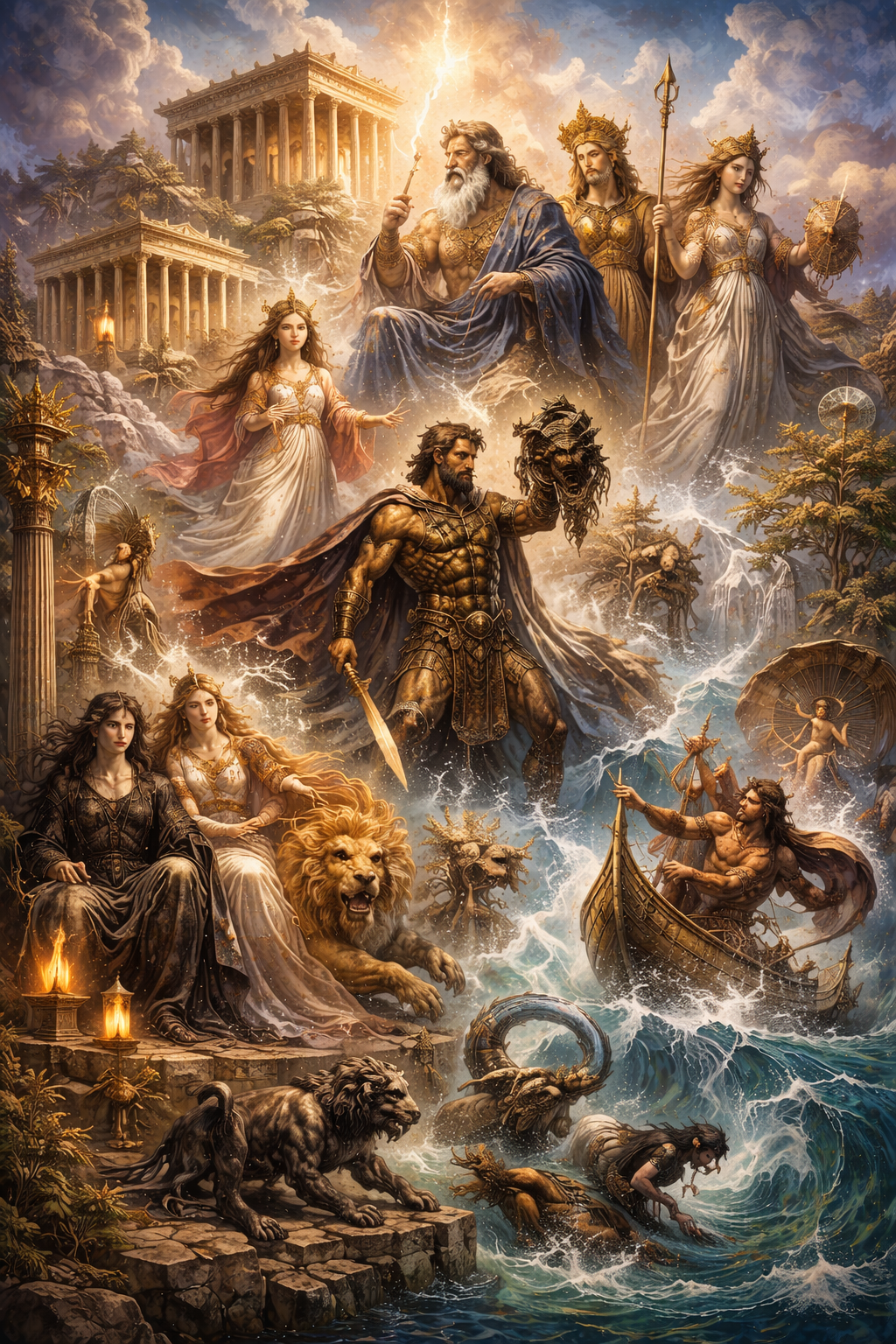
Serious study of Greek and Roman mythology requires attention to religion. These myths were not simply literary ornaments or fictional narratives detached from practice. They were embedded in sacrifice, sanctuary, festival, pilgrimage, civic identity, household devotion, dramatic performance, funerary imagery, and the visual life of temples, pottery, sculpture, coins, mosaics, reliefs, sarcophagi, and public monuments. The mythic archive is therefore inseparable from ancient Mediterranean ritual worlds and from the symbolic relation between gods, mortals, landscapes, cities, and empires.
Greek and Roman mythology also belong to the study of transmission. Myths were sung, staged, painted, sculpted, inscribed, performed, catalogued, translated, moralized, politicized, allegorized, and reinvented. They moved from oral-poetic tradition into literary codification, from local cult into Panhellenic prestige, from Greek mythic forms into Roman civic memory, and from antiquity into medieval reception, Renaissance revival, modern scholarship, museum culture, psychoanalytic theory, political symbolism, film, television, games, and contemporary popular culture. The field therefore illuminates not only the ancient world, but also the extraordinary durability of mythic forms across time.
This pillar treats Greek and Roman mythology as a layered cultural system rather than a fixed list of gods, heroes, and monsters. It asks how cosmogony becomes divine order, how epic turns heroic action into civilizational memory, how tragedy subjects inherited myth to moral and political pressure, how Roman writers transform Greek materials into foundation story and imperial destiny, how sacred geography preserves local cult and civic identity, and how visual culture gives myth a durable material life.
Why This Field Matters
Greek and Roman mythology matter because they preserve one of the most influential symbolic archives in world cultural history. These myths carry accounts of divine order, cosmic violence, heroic glory, mortal suffering, sacred place, civic identity, kinship catastrophe, metamorphosis, sacrifice, underworld descent, foundation, imperial destiny, and the unstable boundary between human and divine life. They shaped ancient literature, ritual, art, politics, philosophy, drama, education, and public memory, and their afterlives continue to shape modern imagination.
The field also matters because it reveals mythology as a dynamic system rather than a static inheritance. The gods of epic differ from the gods of cult, tragedy, hymn, mythography, visual art, and Roman political poetry. Zeus in Hesiod, Zeus in Homer, Zeus in tragedy, Jupiter in Roman state religion, and Jupiter in Augustan poetry are related but not identical forms of divine meaning. Myth changes when it enters a new genre, city, sanctuary, ritual, political order, or medium.
Greek mythology is especially important because it offers one of the richest surviving archives for studying the relation between myth, religion, poetry, performance, and civic life. The myths of Olympus, Troy, Thebes, Argos, Crete, Delphi, Eleusis, Athens, and the underworld are not only stories. They are ways of thinking divine power, human vulnerability, law, violence, mourning, marriage, burial, fate, glory, and memory.
Roman mythology adds another indispensable dimension: the transformation of myth into civic origin, historical destiny, ritual calendar, and imperial self-understanding. Roman poets and antiquarians did not merely borrow Greek myth. They translated and reorganized it within Roman concerns: foundation, pietas, ancestry, conquest, loss, state ritual, and the moral burden of empire. The result is not imitation but transformation.
The Problem of the Archive
A research-grade account must begin with the archive itself. Greek and Roman mythology does not survive in a single sacred scripture or official mythological code. It survives across multiple genres and media: oral epic, written epic, theogony, hymn, tragedy, lyric poetry, local cult, historiography, mythographic compilation, antiquarian prose, philosophical interpretation, vase painting, sculpture, temple decoration, relief, mosaic, sarcophagus, calendar poetry, and later reception. Each form preserves myth differently.
Homeric epic gives myth narrative breadth, heroic intensity, and divine presence in war and wandering. Hesiod gives myth genealogical and cosmological order. The Homeric Hymns connect divine identity to cultic and poetic celebration. Tragedy subjects inherited myths to moral, civic, familial, and theological pressure. Apollodorus gathers genealogies and narrative variants into mythographic structure. Pausanias preserves local sacred geography and cult memory. Virgil and Ovid reshape myth under Roman literary, political, and imperial conditions.
The archive is therefore layered and plural. A myth may have multiple versions, local variations, visual forms, ritual contexts, tragic reinterpretations, and Roman transformations. There is no single “original” form to which all later versions can be reduced. Responsible interpretation asks not only what a myth says, but where it appears, who preserves it, how it is performed, which community claims it, what ritual or artistic context supports it, and how later authors rework it.
This archival complexity makes the field unusually rich. Greek and Roman mythology allow readers to study how myth changes as it moves across time, genre, language, city, empire, image, and institution. Myth survives not by remaining fixed, but by being continually reactivated.
Greek and Roman Myth: Distinction Without Separation
Greek myth and Roman myth overlap extensively, but they are not identical. Roman authors inherited, translated, adapted, moralized, politicized, and monumentalized Greek materials within specifically Roman religious and civic frameworks. Jupiter is not simply Zeus under another name; Venus is not simply Aphrodite in Latin dress; Mars is not merely Ares transferred into a new language. Roman religion, civic practice, family memory, state ritual, and political ideology reshaped inherited divine figures.
This distinction matters because Roman myth often places older mythic materials inside a historical and civic frame. Greek myths of gods and heroes become linked to Roman ancestry, foundation, ritual calendar, moral exemplarity, imperial destiny, and public memory. Aeneas is not only a Trojan survivor. He becomes the bearer of Roman origin, piety, loss, and future empire. Romulus and Remus become figures of fraternal violence and civic foundation. Ovid’s calendar myths embed divine and legendary memory in Roman sacred time.
At the same time, Greek materials remained powerful within Roman imagination. Roman literature is full of Greek gods, Greek heroes, Greek artistic models, and Greek narrative structures. The point is not to separate Greek and Roman mythology into sealed traditions, but to understand transformation. Roman myth is a reception, translation, and reorganization of mythic inheritance under new civic and imperial conditions.
This pillar therefore treats Greek and Roman mythology as an interconnected field: continuous enough to study together, different enough to require careful distinction.
Cosmogony and Divine Succession
Greek myth begins not with a single creation account but with layered narratives of emergence, conflict, generation, and succession. Hesiod’s Theogony is the principal ancient source for this structure. Chaos, Gaia, Uranus, Cronus, the Titans, Zeus, and the Olympian order form a sequence in which cosmic authority emerges through birth, violence, overthrow, and consolidation.
Divine succession is central because it imagines order as historically and violently achieved. Uranus is overthrown by Cronus; Cronus is overthrown by Zeus; the Titans are defeated; Zeus consolidates rule through power, alliance, distribution of honors, and suppression of rival forces. Cosmic order is not innocent. It is secured through conflict and political imagination.
This cosmogonic world also establishes recurring structures in Greek myth: generational violence, anxiety over succession, the instability of power, the danger of prophecy, the relation between divine rule and justice, and the ambiguous place of human beings within a world governed by gods who themselves emerged through conflict. Mythic order is stable only because disorder has been overcome, and even then only provisionally.
Roman mythology inherits Greek divine genealogies but often places cosmic and divine materials within different frameworks: civic cult, antiquarian explanation, literary transformation, and imperial symbolism. Ovid’s Metamorphoses, for example, opens with cosmic ordering but quickly moves into a world of change, desire, punishment, violence, and unstable form. Roman myth often remembers cosmogony through transformation rather than through a single theology of order.
Epic Gods and Heroic Worlds
Homeric epic provides not a systematic theology but a powerful narrative world in which gods intervene in war, travel, kinship, deception, rage, protection, and return. In the Iliad, divine action is inseparable from heroic violence and mortal fragility. The gods favor, deceive, wound, rescue, quarrel, and watch while human beings confront glory and death. In the Odyssey, divine agency shapes wandering, hospitality, disguise, homecoming, recognition, and the restoration of household order.
Epic heroes occupy a dangerous space between mortality and fame. Achilles must choose between long life and imperishable glory. Odysseus survives through cunning, endurance, speech, and recognition. Hector represents civic duty and family vulnerability. Helen becomes both person and symbolic cause, the figure through whom desire, beauty, blame, and catastrophe converge. Epic myth preserves these figures not as simple moral examples, but as complex forms of heroic value under pressure.
The epic gods are equally complex. They are powerful but not morally simple; anthropomorphic but not merely human; invested in honor, rivalry, affection, and cosmic status. Homeric divine life reveals a mythic world in which human events are never wholly human and divine conflicts are never wholly separate from mortal suffering.
Epic therefore gives Greek myth one of its deepest memory structures. The Trojan War becomes more than a war story. It becomes a vast archive of mortality, honor, wrath, grief, endurance, return, and the unstable relation between gods and men.
Hymn, Cult, and Divine Persona
The Homeric Hymns illuminate the powers, epiphanies, and cultic significance of major deities such as Demeter, Apollo, Hermes, and Aphrodite. They help bridge literary myth and ritual practice by presenting gods not only as characters in stories, but as beings approached through praise, invocation, festival, sanctuary, and cult memory.
Hymns are crucial because they define divine persona through narrative and worship. The Homeric Hymn to Demeter links divine grief, the abduction of Persephone, agricultural fertility, seasonal recurrence, and the Eleusinian mythic complex. The Homeric Hymn to Apollo connects divine birth, sacred place, music, prophecy, and sanctuary. The Homeric Hymn to Hermes presents a god of theft, mediation, boundary-crossing, and invention. The Homeric Hymn to Aphrodite reveals the power and danger of erotic divinity.
These hymns show that a god is not only a name in a pantheon. A deity is a field of powers, stories, places, rituals, epiphanies, symbols, and relationships. Myth and cult interact because stories help define why a god is honored and what kind of power that god embodies.
Hymnic poetry also reminds us that myth is performative. It praises, invokes, remembers, and establishes relation. It is not only about gods. It is speech directed toward gods.
Tragedy and the Moral Reimagining of Myth
Greek tragedy reworks inherited myth into a space of moral conflict, familial violence, civic reflection, and theological ambiguity. In Aeschylus, Sophocles, and Euripides, myth becomes a medium for thinking about justice, suffering, pollution, vengeance, burial, kingship, kinship, gender, speech, divine silence, and the unstable relation between divine order and civic authority.
Tragedy does not merely retell myth. It subjects mythic material to formal, ethical, and political pressure. The old stories of Thebes, Troy, Argos, and heroic households are placed before a civic audience and made to bear questions that no simple narrative summary can resolve. What is justice after bloodshed? What does law owe to the dead? When does obedience become moral failure? How does a house inherit guilt? What happens when knowledge arrives too late?
On the tragic stage, myth becomes self-interrogating. The audience often knows the story, but tragedy makes the known story newly urgent by staging recognition, delay, irony, lament, and irreversible action. Myth is transformed from inherited narrative into public inquiry.
This makes tragedy central to Greek and Roman mythology as cultural memory. It is one of the primary ways myth was made morally and politically alive for ancient audiences and later traditions.
The Theban Cycle and Tragic Civic Memory
The myths of Oedipus, Jocasta, Eteocles, Polynices, Antigone, and Creon are indispensable for understanding how Greek myth stages the collision between household and polis, curse and inheritance, law and piety, knowledge and blindness, authority and moral limit. The Theban archive is not only a body of stories about dynastic catastrophe. It is one of the great ancient laboratories for thinking about sovereignty, civic order, intergenerational guilt, and the cost of rule.
Sophocles occupies a central place in this tradition because his Theban plays intensify the relation between heroic inheritance and ethical self-recognition. Oedipus Tyrannus turns kingship, knowledge, pollution, and identity into catastrophe. Oedipus at Colonus transforms exile and suffering into sacred afterlife. Antigone stages the conflict between burial obligation, divine custom, family loyalty, gendered speech, sovereign command, and civic law.
Antigone is especially important because it shows that the law of the city cannot easily contain all forms of justice. Burial, kinship, piety, and the dead make claims that exceed the decree of the ruler. The play does not simply celebrate disobedience; it exposes the tragic collision between public order and obligations older than the state.
The Theban cycle therefore makes myth into civic memory. It asks how a city remembers its violence, how a household transmits guilt, and how political authority fails when it cannot hear the claims of kinship, death, and sacred custom.
Heroes, Monsters, and Liminal Beings
Greek and Roman mythology are filled with heroes, monsters, hybrids, and beings who occupy unstable boundaries. Herakles, Perseus, Theseus, Jason, Medea, Medusa, the Minotaur, centaurs, satyrs, sirens, nymphs, cyclopes, sphinxes, and many others reveal the role of myth in negotiating danger, violence, desire, transformation, and the unstable edges of civilization.
Heroes are rarely simple models of virtue. Herakles embodies strength, excess, labor, suffering, violence, and eventual divine elevation. Perseus slays Medusa, but the Gorgon herself becomes a powerful figure of fear, beauty, monstrosity, and later visual fascination. Theseus becomes a civic hero of Athens, but his myths are also filled with abandonment, violence, and political construction. Jason’s expedition produces heroic glory and catastrophic betrayal through Medea.
Monsters and hybrids are equally important because they mark boundaries. The Minotaur stands at the intersection of royal failure, animality, enclosure, and sacrificial violence. Centaurs and satyrs test the boundary between culture and wildness. Sirens and sphinxes transform knowledge, desire, song, and death into danger. Medusa turns looking itself into peril.
These figures show that mythic imagination is often most powerful at the edges: human and animal, civilized and wild, male and female, mortal and divine, beautiful and monstrous, foreign and familiar, lawful and excessive.
Underworld, Fate, and the Limits of Knowledge
The underworld is one of the major symbolic spaces of Greek and Roman myth. Hades, Persephone, Hermes as guide, Orpheus, Odysseus, Aeneas, shades of the dead, judges, punishments, and fields of afterlife memory all make death narratable without making it simple. Underworld journeys reveal what lies beyond ordinary life, but they also reveal the limits of retrieval, knowledge, and human control.
Orpheus descends for Eurydice but cannot fully recover her. Odysseus seeks knowledge from the dead but must return to mortal struggle. Aeneas descends into the underworld and receives a vision of Roman destiny, but the vision is burdened by loss, violence, and future history. Underworld myth therefore links memory, prophecy, grief, and destiny.
Fate and oracles belong to this same field of limitation. Greek myth repeatedly stages the danger of knowing and not knowing. Oedipus fulfills the prophecy he seeks to avoid. Achilles knows the cost of glory. Agamemnon acts under impossible pressure. Human beings receive signs, prophecies, warnings, and riddles, but knowledge often arrives too late or remains too partial to prevent catastrophe.
These myths preserve one of the ancient Mediterranean’s deepest forms of tragic wisdom: human beings act within orders they cannot fully comprehend, yet their actions still matter.
Sacred Geography, Sanctuary, and Festival
Greek and Roman myth is attached to places: Delphi, Olympia, Eleusis, Athens, Thebes, Argos, Crete, Troy, Epidaurus, Delos, Carthage, Rome, and countless local sanctuaries. Geography is not background but a carrier of ritual memory, civic identity, divine presence, and local authority. Myth explains why a place matters; ritual keeps that meaning socially active.
Delphi concentrates Apollo, prophecy, purification, political consultation, and sacred authority. Eleusis links Demeter and Persephone to mystery cult, agriculture, death, and hope. Olympia binds Zeus to athletic festival and Panhellenic prestige. Epidaurus preserves the sacred geography of healing through Asklepios. Athens uses myth to construct civic identity around Athena, Theseus, autochthony, and democratic self-understanding.
Roman sacred geography adds another layer: the Palatine, the Forum, the Capitoline, the Tiber, Carthage, Lavinium, Alba Longa, and the route from Troy to Italy become mythic-historical spaces. Roman myth maps destiny onto geography.
Sacred geography reminds us that myth is local as well as literary. Places remember through temples, offerings, festivals, monuments, processions, stories, and repeated visitation. Myth lives where it is walked, worshipped, displayed, and performed.
Mythography, Travel, and Local Tradition
Mythographers and antiquarian writers are indispensable because they preserve genealogies, variants, and local traditions that complicate any overly unified view of mythology. Apollodorus’ Library gathers divine genealogies, heroic cycles, and narrative summaries into a major mythographic compendium. Pausanias’ Description of Greece preserves sanctuaries, monuments, local cults, images, sacred places, and regional versions of myth.
These sources show that myth was not one uniform body of stories known in the same way everywhere. Local communities preserved their own genealogies, cult foundations, heroic tombs, sacred objects, divine epiphanies, and place-based traditions. A mythic figure might be Panhellenic in prestige and local in ritual life at the same time.
Travel writing is especially important because it connects myth to material remains and sacred topography. Pausanias does not simply summarize stories. He moves through places where myth was embedded in statue, temple, tomb, altar, landscape, and civic memory. His work reveals mythology as a geography of remembered presence.
Mythography and travel prose therefore preserve the multiplicity of the archive. They remind readers that Greek and Roman mythology is not only a poetic tradition, but a network of local memories and sacred claims.
Roman Adaptation and Civic Myth
Roman mythology transforms myth into foundation story, ritual calendar, civic identity, and imperial memory. Virgil and Ovid are especially important for understanding how Rome reinterpreted myth within a civic and historical framework. Roman myth often asks how a people understands its origin, destiny, institutions, gods, losses, and obligations.
The Aeneid is central because it turns Trojan survival into Roman future. Aeneas carries gods, father, son, memory, and duty from the ruins of Troy toward Italy. His mission is not private fulfillment but historical burden. The poem transforms myth into imperial genealogy while repeatedly exposing the suffering that destiny requires.
Romulus and Remus reveal another Roman structure: foundation through fraternal violence. Rome’s origin is not pure harmony but conflict, boundary, blood, and sovereignty. Roman myth often remembers order as achieved through rupture.
Ovid’s Fasti adds the ritual calendar as a mythic archive. Roman sacred time becomes filled with stories explaining festivals, rites, names, divine honors, and civic memory. Myth is not only in epic; it is in the calendar, the public year, and the ritual repetition of the city.
Dido, Carthage, and the Tragedy of Imperial Destiny
The figure of Dido stands at the intersection of myth, epic, politics, gender, exile, and empire. In Virgil’s Aeneid, her story is never merely a romantic episode. It is a tragic confrontation between competing historical futures, between hospitality and abandonment, between sovereign city-foundation and imperial vocation, and between personal fidelity and the violent demands of destiny.
Dido is herself a founder. She builds Carthage after exile, betrayal, and displacement. Her city is not a passive setting for Aeneas’ journey but an alternative future: a powerful political order with its own dignity, memory, and destiny. Aeneas’ departure therefore enacts more than personal loss. It stages the sacrifice of one possible world to another.
The tragedy of Dido reveals the cost of Roman historical imagination. The poem presents Aeneas’ mission as necessary, yet it forces readers to witness the human devastation produced by that necessity. Empire is founded through suffering, abandonment, and unresolved grief. Dido’s curse also projects the personal wound into future Roman-Carthaginian conflict, linking intimate tragedy to historical violence.
For this reason, Dido belongs at the center of Roman mythic study. She exposes the moral ambiguity of destiny and the human cost hidden inside foundation narratives.
Metamorphosis, Etiology, and Poetic Transformation
Ovid’s mythic world is one of change, instability, desire, punishment, violence, and narrative recursion. The Metamorphoses preserves hundreds of myths through the organizing principle of transformation. Bodies become trees, birds, rivers, stars, stones, flowers, constellations, and voices. Form is unstable; identity is vulnerable; violence often leaves a new shape behind.
Metamorphosis is not merely a device for wonder. It is a way of thinking what remains after crisis. Daphne becomes laurel; Philomela becomes bird; Narcissus becomes flower; Arachne becomes spider; Phaethon’s sisters become trees; countless violated, grieving, punished, or escaping figures survive as transformed signs. Ovidian myth remembers through altered form.
Etiological narrative explains why something is the way it is: a festival, name, flower, constellation, ritual, city, custom, or landscape. Myth becomes explanation, but also poetic transformation. The world is full of stories because objects, places, and customs carry traces of divine and human action.
Roman myth therefore often survives through poetic change. It does not simply preserve inherited Greek materials; it turns them into a literature of instability, memory, violence, and form.
Visual and Material Transmission
Greek and Roman myths circulated not only in texts but in vase painting, sculpture, relief, temple ornament, sarcophagi, mosaics, frescoes, coins, gemstones, and Roman copies of earlier Greek works. Visual culture is indispensable to the archive because it preserves scenes, emphases, variants, and interpretive possibilities not always recoverable from texts alone.
Greek vase painting often gives myth a vivid narrative life: gods, heroes, weddings, battles, monsters, pursuits, punishments, sacrifices, and transformations appear in visual sequence or concentrated emblem. Temple sculpture places myth in public sacred architecture. Funerary art uses myth to think death, memory, and afterlife. Roman domestic and imperial art adapts myth into status, taste, moral allegory, and cultural inheritance.
Roman copies of Greek statues are especially important because they preserve the afterlife of Greek mythic art under Roman conditions of collecting, taste, display, and cultural prestige. A Greek mythic figure in a Roman villa, bath, or public space no longer means exactly what it meant in a Greek sanctuary or civic context. Meaning shifts with setting.
Visual transmission also shapes modern reception. Many people encounter Greek and Roman mythology first through museum objects: Medusa heads, heroic sculptures, painted vases, sarcophagi, temple fragments, mosaics, and marble gods. The material archive continues to frame the mythic imagination.
Reception and Afterlives
Greek and Roman mythology did not end in antiquity. It entered medieval allegory, Renaissance art, early modern drama, neoclassical political imagery, Romantic poetry, opera, museum culture, psychoanalysis, anthropology, comparative mythology, fantasy literature, film, television, comics, games, and digital culture. Its afterlife is one of the longest and most influential in world literature.
Reception matters because every period remakes classical myth for its own needs. Renaissance artists turn gods and heroes into visual systems of beauty, power, and humanist learning. Early modern dramatists use myth and tragedy to think sovereignty, desire, gender, violence, and fate. Modern writers use figures such as Prometheus, Orpheus, Antigone, Medusa, Narcissus, and Medea to rethink rebellion, art, law, trauma, gender, selfhood, and power.
Modern scholarship has also transformed the field. Philology, archaeology, anthropology, ritual theory, structuralism, feminism, postcolonial criticism, reception studies, and performance studies have all changed how Greek and Roman myth is read. The archive remains alive because its meanings are contested.
These afterlives are not secondary. They are part of the cultural history of myth. Greek and Roman mythology became foundational not because it stayed unchanged, but because it proved endlessly available for reinterpretation.
Major Questions of Interpretation
This pillar is organized around several major questions. How should Greek and Roman mythology be studied when its archive includes epic, theogony, hymn, tragedy, mythography, cult practice, visual art, sanctuary space, Roman poetry, and later reception? How do Greek and Roman myth overlap, and where must they be distinguished? How do divine succession, heroic glory, tragic knowledge, sacred geography, and Roman foundation myth preserve different kinds of cultural memory?
The pillar also asks how tragedy transforms inherited myth into public ethical inquiry. What happens when the stories of Thebes, Troy, Argos, and heroic households are staged before a civic audience? How do burial, law, kinship, sovereignty, vengeance, and pollution become mythic and political questions? How do Roman writers such as Virgil and Ovid reshape Greek myth into a literature of origin, empire, calendar, and transformation?
These questions keep the category from becoming a simple catalogue of gods and heroes. They open Greek and Roman mythology as a field of literary, religious, civic, artistic, political, tragic, and comparative inquiry. The tradition is not only a collection of ancient stories. It is one of the great symbolic archives through which Mediterranean cultures imagined order, violence, desire, justice, mortality, foundation, and memory.
Expanded Article Architecture
The following structure gathers the pillar into a long-range architecture suitable for a major mythology knowledge series. It is designed to support foundational source studies, divine genealogy, epic worlds, tragic reinterpretation, sacred geography, heroes and monsters, Roman adaptation, visual culture, and modern afterlives. All entries below should be treated as planned unless already completed elsewhere on the site.
Foundations and Source Problems
- What Is Greek & Roman Mythology? (planned)
- The Problem of Sources in Greek and Roman Myth (planned)
- Greek and Roman Mythology Without a Single Canon (planned)
- Text, Cult, Image, and Performance in Classical Mythic Memory (planned)
- How to Read Greek and Roman Myth Across Genres and Periods (planned)
- Myth, Religion, Literature, and Cultural Memory in the Ancient Mediterranean (planned)
Primary Texts and Mythic Archives
- Homer, Hesiod, and the Earliest Literary Archive of Myth (planned)
- The Homeric Hymns and the Ritual Life of the Gods (planned)
- Apollodorus, Pausanias, and the Work of Mythographic Preservation (planned)
- Virgil, Ovid, and the Roman Recasting of Myth (planned)
- Epic, Hymn, Tragedy, and Mythography as Different Memory Systems (planned)
- Local Cult, Sacred Place, and the Mythic Archive Beyond Literature (planned)
Cosmogony and Divine Succession
- Chaos, Gaia, and the Earliest Orders of the Cosmos (planned)
- Uranus, Cronus, and the Violence of Divine Succession (planned)
- Zeus and the Consolidation of Cosmic Rule (planned)
- The Titanomachy and the Political Imagination of Divine Order (planned)
- Divine Genealogy and the Mythic Structure of Power (planned)
- Cosmic Violence and the Birth of Order in Hesiod (planned)
Prometheus, Pandora, and Mortal Trouble
- Prometheus, Fire, and the Ambivalence of Human Advancement (planned)
- Pandora, Gender, and the Origins of Mortal Trouble (planned)
- Sacrifice, Deception, and the Human Condition in Hesiod (planned)
- The Ages of Man and the Moral Memory of Decline (planned)
- Technology, Punishment, and Ambiguous Progress in Greek Myth (planned)
- Human Vulnerability and Divine Power in Early Greek Myth (planned)
The Olympian Gods and Divine Persona
- The Olympian Gods and the Structure of the Pantheon (planned)
- Hera, Marriage, and Divine Queenship (planned)
- Athena, Intelligence, War, and Civic Order (planned)
- Apollo, Prophecy, Music, and Purification (planned)
- Artemis, Wilderness, and Liminal Femininity (planned)
- Demeter, Persephone, and the Mythic Logic of Seasonality (planned)
- Aphrodite, Desire, and the Politics of Erotic Power (planned)
- Hermes, Mediation, Theft, and Boundary Crossing (planned)
- Dionysus, Ecstasy, and the Instability of Social Order (planned)
- Hades, the Underworld, and the Geography of the Dead (planned)
Epic Worlds and Heroic Memory
- The Trojan War as Mythic Archive (planned)
- Achilles, Mortality, and Heroic Glory (planned)
- Odysseus, Return, and the Ethics of Cunning (planned)
- Helen, Desire, and the Catastrophe of Beauty (planned)
- Hector, Family, and the Civic Tragedy of Troy (planned)
- Priam, Mourning, and the Humanization of the Enemy (planned)
- Hospitality, Recognition, and the Moral World of the Odyssey (planned)
- Epic Memory and the Making of Heroic Value (planned)
Greek Tragedy and Mythic Reinterpretation
- Greek Tragedy and the Moral Reimagining of Myth (planned)
- Aeschylus, Sophocles, and Euripides as Mythic Interpreters (planned)
- Sophocles, Tragedy, and the Theban Mythic Imagination (planned)
- Antigone, Burial, Law, and Moral Defiance (planned)
- Tragedy as Public Memory in the Greek Polis (planned)
- Myth on Stage: Fate, Law, Kinship, and Civic Order (planned)
- Pollution, Vengeance, and Justice in Greek Tragic Myth (planned)
- Recognition, Reversal, and the Too-Late Knowledge of Tragedy (planned)
The Theban and Argive Cycles
- Orestes, Clytemnestra, and the Violence of Kinship (planned)
- Oedipus, Knowledge, and the Catastrophe of Self-Recognition (planned)
- The Theban Cycle: Curse, Kingship, and Civic Ruin (planned)
- Eteocles, Polynices, and the War of Brothers (planned)
- Creon, Sovereignty, and the Failure of Civic Listening (planned)
- The House of Atreus and the Inheritance of Blood Guilt (planned)
- The Oresteia and the Passage from Vengeance to Law (planned)
- Electra, Mourning, and the Memory of Murdered Fathers (planned)
Heroes, Monsters, and Liminal Beings
- Herakles and the Heroic Logic of Excess (planned)
- Perseus, Medusa, and the Imagination of Monstrous Otherness (planned)
- Theseus, Athens, and the Politics of Heroic Identity (planned)
- Jason, Medea, and the Tragedy of Expedition (planned)
- Monsters, Hybrids, and the Liminal Imagination of Greek Myth (planned)
- The Gorgon, the Minotaur, and the Politics of Fear (planned)
- Centaurs, Satyrs, and the Boundary Between Nature and Culture (planned)
- Nymphs, Rivers, and Sacred Landscapes (planned)
- Orpheus, Music, and the Limits of Retrieval (planned)
Fate, Oracles, Underworlds, and Mystery
- Fate, Oracles, and the Limits of Human Knowledge (planned)
- Delphi, Apollo, and the Ambiguity of Prophecy (planned)
- Mystery Cults, Initiation, and the Mythic Imagination of Salvation (planned)
- Eleusis, Demeter, Persephone, and Sacred Hope (planned)
- Underworld Journeys from Odysseus to Aeneas (planned)
- Hades, Persephone, Hermes, and the Pathways of the Dead (planned)
- Orpheus, Eurydice, and the Tragedy of Looking Back (planned)
Sacred Geography, Sanctuary, and Local Memory
- Delphi, Eleusis, Olympia, and the Sacred Geography of Greece (planned)
- Pausanias and the Local Memory of Sanctuaries (planned)
- Athens, Thebes, Argos, Troy, and the Mythic City (planned)
- Sanctuary, Pilgrimage, and the Geography of Divine Presence (planned)
- Healing Cults, Asklepios, and Sacred Landscape at Epidaurus (planned)
- Local Cult and the Multiplicity of Greek Myth (planned)
Roman Foundation, Civic Myth, and Empire
- Aeneas, Troy, and the Roman Politics of Origin (planned)
- Dido, Carthage, and the Tragedy of Aeneas’ Destiny (planned)
- Romulus, Remus, and the Myth of Fraternal Foundation (planned)
- Virgil’s Aeneid and the Mythic Imagination of Empire (planned)
- Roman Foundation Myth and the Violence of Civic Beginning (planned)
- Pietas, Duty, and the Burden of Historical Destiny (planned)
- Troy, Italy, and the Mythic Geography of Roman Memory (planned)
Ovid, Calendar, and Roman Transformation
- Ovid’s Metamorphoses and the Poetics of Mythic Change (planned)
- Ovid’s Fasti and the Calendar of Roman Sacred Time (planned)
- Metamorphosis, Violence, and the Survival of Form (planned)
- Etiological Myth and the Explanation of Ritual Memory (planned)
- Desire, Punishment, and Transformation in Ovidian Myth (planned)
- Roman Myth as Literary Recomposition (planned)
Adaptation, Translation, and Power
- Greek Gods in Roman Dress: Adaptation, Translation, and Power (planned)
- Jupiter and Zeus: Continuity and Difference in Divine Rule (planned)
- Venus and Aphrodite: Desire, Genealogy, and Roman Origin (planned)
- Mars and Ares: War, Fatherhood, and Civic Memory (planned)
- Roman Religion and the Reframing of Greek Mythic Figures (planned)
- Translation as Mythic Transformation in the Ancient Mediterranean (planned)
Visual and Material Culture
- Myth in Greek Vase Painting and Architectural Sculpture (planned)
- Roman Copies, Imperial Taste, and the Afterlife of Greek Mythic Art (planned)
- Medusa, Theseus, and the Museum Afterlives of Myth (planned)
- Temple Sculpture and the Public Life of Mythic Images (planned)
- Sarcophagi, Mosaics, and Mythic Memory in Roman Visual Culture (planned)
- Coins, Reliefs, and the Political Iconography of Myth (planned)
- How Museums Shape the Modern Imagination of Classical Myth (planned)
Reception, Comparison, and Modern Afterlives
- Greek & Roman Myth in Comparative Perspective (planned)
- Why Greek & Roman Mythology Still Matter (planned)
- Classical Myth in Renaissance Art and Humanist Memory (planned)
- Prometheus, Antigone, Medusa, and Modern Political Imagination (planned)
- Greek and Roman Myth in Film, Television, Games, and Popular Culture (planned)
- Classical Myth, Psychoanalysis, and Modern Theories of the Self (planned)
- Feminist and Postcolonial Reinterpretations of Classical Myth (planned)
- The Long Afterlife of Olympus in World Literature (planned)
Closing Perspective
Greek and Roman mythology reveal one of the great long-duration symbolic archives of world culture. They preserve cosmic succession, Olympian power, heroic glory, mortal suffering, tragic knowledge, sacred geography, ritual memory, monsters, metamorphosis, foundation, empire, and afterlife across an extraordinary range of texts, images, practices, and later reinterpretations. Their power lies not in a single fixed canon, but in a layered continuity of retelling.
This is what makes the category so important within Mythology. Greek and Roman mythic culture shows how mythology can be literary and ritual, local and Panhellenic, Greek and Roman, tragic and political, visual and performative, ancient and continually modern. It also shows why mythology must be studied through genre, place, practice, image, and reception, not only through story summary.
The strongest reason to study this field is that Greek and Roman mythology clarifies how deeply myth can shape cultural memory. These traditions do not belong only to the ancient past. They continue to organize how later cultures imagine power, beauty, violence, fate, rebellion, law, desire, empire, grief, and the fragile boundary between human life and the forces that exceed it.
Related Reading
- Mythology
- Classical Literature and Civilizational Memory
- Tragedy, Drama, and Collective Memory
- Dante, Epic, and Medieval Memory
- Egyptian Mythology
- Mesopotamian Mythology
- Poetry, Memory, and Imagination
- Ethics and Moral Philosophy
Primary Sources
Greek Epic and Theogonic Sources
- Homer, Iliad. Foundational for divine intervention, heroic conflict, and the mythic world of Troy. Available via Scaife Viewer: https://scaife.perseus.org/library/urn:cts:greekLit:tlg0012.tlg001.perseus-eng3/
- Homer, Odyssey. Essential for wandering, return, divine mediation, and the mythic geography of travel. Available via Scaife Viewer: https://scaife.perseus.org/library/urn:cts:greekLit:tlg0012.tlg002.perseus-eng3/
- Hesiod, Theogony. The principal ancient source for cosmogony, divine genealogy, and succession myth. Available via Scaife Viewer: https://scaife.perseus.org/library/urn:cts:greekLit:tlg0020.tlg001/
- Hesiod, Works and Days. Important for Prometheus, Pandora, the Ages of Man, justice, and the moral economy of mortal life. Available via Scaife Viewer: https://scaife.perseus.org/library/urn:cts:greekLit:tlg0020.tlg002.perseus-eng2/
Greek Tragedy and the Theban Archive
- Aeschylus, Seven Against Thebes. Essential for the political and familial crisis of the Theban cycle. Available via Scaife Viewer/Perseus: https://scaife.perseus.org/
- Sophocles, Oedipus Tyrannus. Foundational for fate, knowledge, kingship, pollution, and tragic self-recognition. Available via Scaife Viewer/Perseus: https://scaife.perseus.org/
- Sophocles, Oedipus at Colonus. Important for exile, sacred place, death, and the transformation of heroic suffering. Available via Scaife Viewer/Perseus: https://scaife.perseus.org/
- Sophocles, Antigone. Indispensable for burial, law, kinship, civic authority, divine custom, and moral defiance. Available via Scaife Viewer/Perseus: https://scaife.perseus.org/
- Euripides, Phoenician Women. Important for later tragic reworking of the Theban conflict and dynastic catastrophe. Available via Scaife Viewer/Perseus: https://scaife.perseus.org/
Hymns, Cult, and Divine Persona
- Homeric Hymn to Demeter. Crucial for Demeter, Persephone, agricultural sacrality, and the Eleusinian mythic complex. Available via Scaife Viewer: https://scaife.perseus.org/library/urn:cts:greekLit:tlg0013.tlg002.perseus-eng2/
- Homeric Hymn to Aphrodite. Important for divine desire, seduction, and mortal-divine encounter. Available via Scaife Viewer: https://scaife.perseus.org/library/urn:cts:greekLit:tlg0013.tlg005.perseus-eng2/
- Homeric Hymns collection. Useful as a broader archive of cultic-poetic presentations of the gods. Available via Scaife ATLAS: https://atlas.perseus.tufts.edu/library/urn:cts:greekLit:tlg0013/
Mythography, Geography, and Local Tradition
- Apollodorus, Library. A major mythographic compendium of genealogies, heroic cycles, and narrative variants. Available via Scaife Viewer: https://scaife.perseus.org/library/urn:cts:greekLit:tlg0548.tlg001/
- Apollodorus, Epitome. Important for heroic cycles, especially Trojan and post-Trojan material. Available via Scaife Viewer: https://scaife.perseus.org/library/urn:cts:greekLit:tlg0548.tlg002/
- Pausanias, Description of Greece. Indispensable for local cult traditions, sacred topography, monuments, and place-based mythic memory. Available via Scaife Viewer: https://scaife.perseus.org/library/urn:cts:greekLit:tlg0525/
Roman Poetic and Antiquarian Sources
- Virgil, Aeneid. Foundational for Roman mythic origins, Trojan inheritance, imperial destiny, and the tragedy of Dido. Available via Scaife Viewer: https://scaife.perseus.org/library/urn:cts:latinLit:phi0690.phi003.perseus-eng2/
- Ovid, Metamorphoses. Essential for mythic transformation, Roman literary synthesis, and the poetics of change. Available via Scaife Viewer: https://scaife.perseus.org/library/urn:cts:latinLit:phi0959.phi006/
- Ovid, Fasti. Important for Roman festival, calendrical ritual, and the embedding of myth in civic sacred time. Available via Scaife Viewer: https://scaife.perseus.org/library/urn:cts:latinLit:phi0959.phi007/
Research Platforms and Text Environments
- Scaife Viewer. A reading environment for pre-modern texts in original languages and translation, and the principal current interface for updated Perseus Greek and Latin materials: https://scaife.perseus.org/
- Perseus Digital Library. Broad access point for Greek and Latin texts and related resources: https://www.perseus.tufts.edu/hopper/
- Theoi Greek Mythology. Useful reference environment for classical mythic personae, genealogies, and ancient source collation: https://www.theoi.com/
Further Reading
- The Metropolitan Museum of Art (2003) ‘Greek Gods and Religious Practices’. Useful for the relation between the Olympian gods, cult, and material religion. https://www.metmuseum.org/essays/greek-gods-and-religious-practices
- The Metropolitan Museum of Art (2003) ‘Greek Art in the Archaic Period’. Helpful for how myth entered visual representation in early Greek art. https://www.metmuseum.org/essays/greek-art-in-the-archaic-period
- The Metropolitan Museum of Art (2008) ‘The Art of Classical Greece (ca. 480–323 B.C.)’. Useful for mythic imagery in classical artistic production. https://www.metmuseum.org/essays/the-art-of-classical-greece-ca-480-323-b-c
- The Metropolitan Museum of Art (2007) ‘Art of the Hellenistic Age and the Hellenistic Tradition’. Valuable for later transformations in divine and heroic representation. https://www.metmuseum.org/essays/art-of-the-hellenistic-age-and-the-hellenistic-tradition
- The Metropolitan Museum of Art (2017) ‘Medusa in Ancient Greek Art’. Helpful for tracing myth across literature, visual culture, and later reception. https://www.metmuseum.org/essays/medusa-in-ancient-greek-art
- The Metropolitan Museum of Art (2009) ‘Theseus, Hero of Athens’. Useful for the civic and political framing of heroic myth. https://www.metmuseum.org/essays/theseus-hero-of-athens
- The Metropolitan Museum of Art (2002) ‘Roman Copies of Greek Statues’. Important for understanding how Roman collecting and copying preserve Greek mythic imagery. https://www.metmuseum.org/essays/roman-copies-of-greek-statues
- UNESCO World Heritage Centre (n.d.) ‘Sanctuary of Asklepios at Epidaurus’. Useful for sacred landscape, healing cult, and the ongoing interpretive life of ancient sanctuary space. https://whc.unesco.org/en/list/491/
- Burkert, W. (1985) Greek Religion. Cambridge, MA: Harvard University Press.
- Graf, F. (1993) Greek Mythology: An Introduction. Baltimore, MD: Johns Hopkins University Press.
- Gantz, T. (1993) Early Greek Myth: A Guide to Literary and Artistic Sources. Baltimore, MD: Johns Hopkins University Press.
- Dowden, K. (1992) The Uses of Greek Mythology. London: Routledge.
- Hard, R. (2004) The Routledge Handbook of Greek Mythology. London: Routledge.
- Feeney, D. (1998) Literature and Religion at Rome: Cultures, Contexts, and Beliefs. Cambridge: Cambridge University Press.
- Galinsky, K. (1969) Aeneas, Sicily, and Rome. Princeton, NJ: Princeton University Press.
References
- Aeschylus (n.d.) Seven Against Thebes. Available via Scaife Viewer/Perseus. https://scaife.perseus.org/
- Apollodorus (n.d.) Library. Scaife Viewer. Available at: https://scaife.perseus.org/library/urn:cts:greekLit:tlg0548.tlg001/
- Apollodorus (n.d.) Epitome. Scaife Viewer. Available at: https://scaife.perseus.org/library/urn:cts:greekLit:tlg0548.tlg002/
- Burkert, W. (1985) Greek Religion. Cambridge, MA: Harvard University Press.
- Dowden, K. (1992) The Uses of Greek Mythology. London: Routledge.
- Euripides (n.d.) Phoenician Women. Available via Scaife Viewer/Perseus. https://scaife.perseus.org/
- Feeney, D. (1998) Literature and Religion at Rome: Cultures, Contexts, and Beliefs. Cambridge: Cambridge University Press.
- Galinsky, K. (1969) Aeneas, Sicily, and Rome. Princeton, NJ: Princeton University Press.
- Gantz, T. (1993) Early Greek Myth: A Guide to Literary and Artistic Sources. Baltimore, MD: Johns Hopkins University Press.
- Graf, F. (1993) Greek Mythology: An Introduction. Baltimore, MD: Johns Hopkins University Press.
- Hard, R. (2004) The Routledge Handbook of Greek Mythology. London: Routledge.
- Hesiod (n.d.) Theogony. Scaife Viewer. Available at: https://scaife.perseus.org/library/urn:cts:greekLit:tlg0020.tlg001/
- Hesiod (n.d.) Works and Days. Scaife Viewer. Available at: https://scaife.perseus.org/library/urn:cts:greekLit:tlg0020.tlg002.perseus-eng2/
- Homer (n.d.) Iliad. Scaife Viewer. Available at: https://scaife.perseus.org/library/urn:cts:greekLit:tlg0012.tlg001.perseus-eng3/
- Homer (n.d.) Odyssey. Scaife Viewer. Available at: https://scaife.perseus.org/library/urn:cts:greekLit:tlg0012.tlg002.perseus-eng3/
- Homeric Hymn to Aphrodite (n.d.). Scaife Viewer. Available at: https://scaife.perseus.org/library/urn:cts:greekLit:tlg0013.tlg005.perseus-eng2/
- Homeric Hymn to Demeter (n.d.). Scaife Viewer. Available at: https://scaife.perseus.org/library/urn:cts:greekLit:tlg0013.tlg002.perseus-eng2/
- Metropolitan Museum of Art (2002) ‘Roman Copies of Greek Statues’. Available at: https://www.metmuseum.org/essays/roman-copies-of-greek-statues
- Metropolitan Museum of Art (2003) ‘Greek Art in the Archaic Period’. Available at: https://www.metmuseum.org/essays/greek-art-in-the-archaic-period
- Metropolitan Museum of Art (2003) ‘Greek Gods and Religious Practices’. Available at: https://www.metmuseum.org/essays/greek-gods-and-religious-practices
- Metropolitan Museum of Art (2007) ‘Art of the Hellenistic Age and the Hellenistic Tradition’. Available at: https://www.metmuseum.org/essays/art-of-the-hellenistic-age-and-the-hellenistic-tradition
- Metropolitan Museum of Art (2008) ‘The Art of Classical Greece (ca. 480–323 B.C.)’. Available at: https://www.metmuseum.org/essays/the-art-of-classical-greece-ca-480-323-b-c
- Metropolitan Museum of Art (2009) ‘Theseus, Hero of Athens’. Available at: https://www.metmuseum.org/essays/theseus-hero-of-athens
- Metropolitan Museum of Art (2017) ‘Medusa in Ancient Greek Art’. Available at: https://www.metmuseum.org/essays/medusa-in-ancient-greek-art
- Ovid (n.d.) Fasti. Scaife Viewer. Available at: https://scaife.perseus.org/library/urn:cts:latinLit:phi0959.phi007/
- Ovid (n.d.) Metamorphoses. Scaife Viewer. Available at: https://scaife.perseus.org/library/urn:cts:latinLit:phi0959.phi006/
- Pausanias (n.d.) Description of Greece. Scaife Viewer. Available at: https://scaife.perseus.org/library/urn:cts:greekLit:tlg0525/
- Perseus Digital Library (2022) ‘Perseus Digital Library’. Available at: https://www.perseus.tufts.edu/hopper/
- Scaife Viewer (2026) ‘Scaife Viewer’. Available at: https://scaife.perseus.org/
- Sophocles (n.d.) Antigone. Available via Scaife Viewer/Perseus. https://scaife.perseus.org/
- Sophocles (n.d.) Oedipus at Colonus. Available via Scaife Viewer/Perseus. https://scaife.perseus.org/
- Sophocles (n.d.) Oedipus Tyrannus. Available via Scaife Viewer/Perseus. https://scaife.perseus.org/
- Theoi Greek Mythology (2026) ‘Theoi Greek Mythology’. Available at: https://www.theoi.com/
- UNESCO World Heritage Centre (n.d.) ‘Sanctuary of Asklepios at Epidaurus’. Available at: https://whc.unesco.org/en/list/491/
- Virgil (n.d.) Aeneid. Scaife Viewer. Available at: https://scaife.perseus.org/library/urn:cts:latinLit:phi0690.phi003.perseus-eng2/