
Last Updated May 3, 2026
Religion and Law examines the relationship between sacred authority, moral obligation, legal reasoning, ritual discipline, communal order, political legitimacy, and institutional power across religious civilizations. As a major category within the Religious Studies knowledge series, it studies how traditions have linked divine command, covenant, scripture, commentary, jurisprudence, conscience, custom, sovereignty, punishment, mercy, purity, family, property, community, and public authority to wider visions of justice and moral order.
In the history of ideas, religious traditions have shaped foundational conceptions of justice, duty, legitimacy, sovereignty, covenant, punishment, interpretation, family order, legal identity, moral responsibility, and the relationship between ultimate truth and human institutions. Law in these traditions is rarely only procedural regulation. It often claims to mediate between sacred order and everyday conduct, binding metaphysical truth to communal life. Religious legality is therefore not simply a list of rules. It is one of the ways civilizations organize moral reality.
This category approaches religion and law not as a minor subfield of theology or legal history, but as one of the major sites through which civilizations have organized public authority, moral discipline, institutional continuity, family life, ritual practice, social hierarchy, reform, and historical memory. Religious law asks not only what human beings should do, but by what authority norms are given, who may interpret them, how they are applied across time, what distinguishes sacred obligation from state enforcement, and how legal traditions respond to pluralism, colonialism, modernity, reform, and political power.
Current Space
Religious Studies
Related Topic
Foundations of Religion
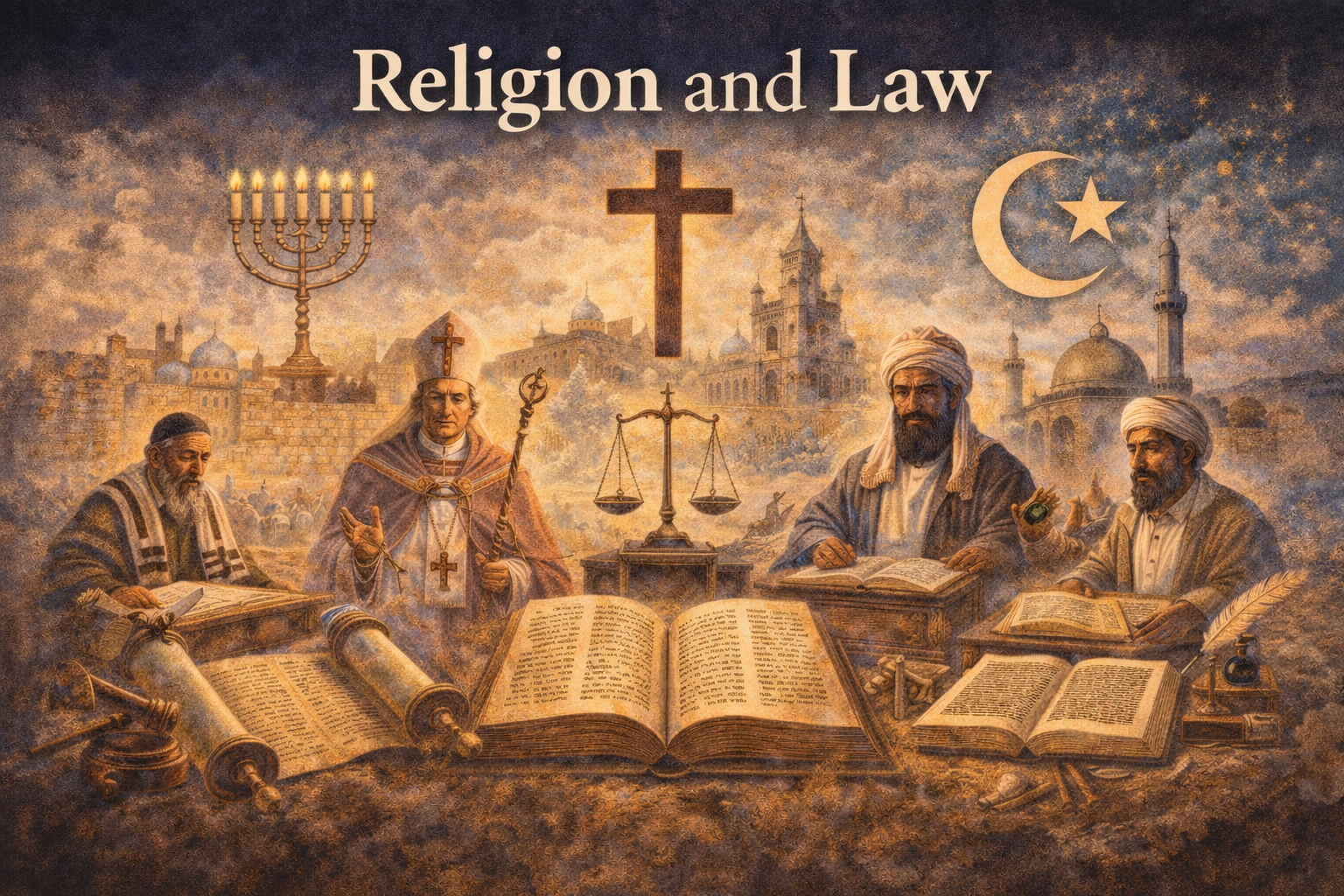
Religion and Law explores scriptural law, jurisprudence, canon law, halakhah, Sharia and fiqh, dharma, Buddhist monastic discipline, Indigenous sacred normativity, customary governance, religious courts, legal commentary, ritual obligation, family law, purity regimes, political theology, colonial codification, legal pluralism, and the role of sacred legality in organizing communal and political life. It considers how traditions define lawful conduct, authorize interpreters, mediate between text and circumstance, distinguish moral norm from coercive enforcement, and negotiate tensions between sacred obligation, state power, custom, reform, and historical change.
The category is central to comparative inquiry because it shows that religious worlds have never been limited to private belief. They have often structured institutions, courts, education, marriage, inheritance, discipline, sovereignty, conflict, minority governance, public morality, and the ordinary rhythms of daily conduct. To study religion without law is often to miss how sacred worlds become socially organized. To study law without religion is often to miss how norms acquire moral depth, historical memory, and claims to ultimate legitimacy.
This pillar gives special attention to the Abrahamic legal traditions because Judaism, Christianity, and Islam each develop sophisticated legal worlds around revelation, interpretation, authority, and communal discipline. But the field cannot stop there. Dharma traditions, Buddhist monastic law, Jain vows, Sikh discipline, Indigenous legal orders, customary religious normativity, and modern plural legal regimes all reveal that sacred law exceeds any single family of traditions. The goal is not to flatten these legal worlds into one model, but to understand how civilizations bind truth to order, obligation to community, and sacred authority to historical life.
Why Religion and Law Matters
Religion and Law matters because the two together form one of the deepest archives of civilizational order. They reveal how societies have linked transcendent truth to human conduct, institutional life, and political legitimacy. In many historical settings, religious law did not occupy a narrow sphere of ritual observance. It structured education, marriage, inheritance, punishment, commerce, purity, public morality, leadership, charity, minority identity, and communal authority. Sacred normativity has often been one of the main ways religious worlds became durable.
The field also matters because religious legal traditions preserve an unusually rich record of interpretive reasoning. Sacred law is rarely self-applying. It must be read, glossed, debated, contextualized, extended, limited, institutionalized, and applied. That makes Religion and Law a central field for understanding how civilizations negotiate permanence and change, text and circumstance, divine authority and human judgment, tradition and reform.
Law also shows that religion is not merely inward belief. A tradition’s deepest assumptions about the human person often appear in its legal and normative practices: Who may marry? Who inherits? Who may teach? Who may judge? What counts as testimony? What is purity? What is harm? What is mercy? What is punishment for? What is owed to the poor, the stranger, the debtor, the prisoner, the widow, the orphan, the convert, the outsider, or the enemy?
At the same time, Religion and Law must be studied critically. Sacred law can preserve justice, moral discipline, communal continuity, and protection for vulnerable groups. It can also sanctify hierarchy, gender inequality, coercion, exclusion, violence, caste, patriarchy, and state power. A serious pillar must therefore treat religious law neither as timeless wisdom beyond critique nor as mere oppression. It is a field in which sacred meaning, institutional power, moral aspiration, and historical conflict meet.
Sacred Authority, Legal Order, and the Problem of Jurisdiction
One of the deepest questions in this field concerns jurisdiction: who has the right to command, interpret, judge, and enforce? Religious legal traditions often claim that ultimate authority does not arise solely from human agreement, state sovereignty, or political convenience. It may derive from revelation, covenant, divine command, sacred tradition, cosmic order, ancestral law, prophetic example, monastic rule, or inherited jurisprudence. Yet such authority must still be exercised by human interpreters, judges, rulers, elders, priests, jurists, monks, bishops, rabbis, scholars, councils, or communities.
The relation between sacred source and human jurisdiction is therefore one of the field’s central tensions. A law may be understood as divine, but its application is historical. A text may be sacred, but its meaning is interpreted. A community may claim divine guidance, but its institutions are humanly administered. The problem of jurisdiction asks how ultimate normativity enters history without becoming indistinguishable from contested human power.
This question is not abstract. It affects courts, clerical office, communal autonomy, imperial administration, minority governance, colonial codification, constitutional law, religious freedom, family law, educational authority, and the relation between religious and state institutions. In many societies, the boundary between sacred and civil jurisdiction has been one of the central struggles of political life.
Religion and Law matters philosophically because it stages a recurrent problem: how can human institutions claim to mediate more-than-human authority while remaining accountable, interpretable, reformable, and limited? The answer differs across traditions, but the problem recurs wherever law is tied to sacred order.
Law as Moral Order, Not Merely Code
Religious law is often misread as a static set of rules. In reality, many traditions understand law as a moral order shaping life as a whole. Sacred law may regulate prayer and purity, but also family, contract, testimony, inheritance, punishment, food, sexuality, leadership, education, land, ritual time, and relations between persons and communities. It is often a way of inhabiting a moral world rather than merely obeying isolated commands.
This gives religious legality a broader significance than modern positive law alone. It forms subjects, structures habits, defines obligations, and gives communal life an intelligible shape. In many traditions, law is pedagogical. It trains desire, disciplines conduct, forms memory, marks sacred time, and teaches a community how to live before God, ancestors, cosmic order, or inherited sacred authority.
That does not mean religious law is always coercive. Some norms are aspirational, ritual, communal, ethical, penitential, or interpretive rather than directly enforceable by courts. Others become juridical, institutional, or politically backed. One of the major tasks of this pillar is therefore to distinguish between law as moral formation, law as ritual discipline, law as communal expectation, law as court-administered norm, and law as state-enforced command.
To study Religion and Law seriously is to study how moral worlds become lived and organized through normativity. The legal tradition is not merely a technical archive. It is a civilizational grammar for duty, order, responsibility, identity, and judgment.
Text, Commentary, and the Authority to Interpret
In almost every major tradition, law is inseparable from interpretation. Scripture alone rarely settles legal life. Text must be glossed, harmonized, extended, qualified, contextualized, and applied. Commentary traditions, jurisprudential schools, legal canons, responsa, judicial reasoning, councils, monastic rules, interpretive institutions, and community precedents all become essential to how religious law actually functions. The law lives not only in foundational text but in the accumulated labor of reading.
This makes hermeneutics one of the core problems of the category. The real question is often not simply what the text says, but who may say what it means, by what methods, in what circumstances, and with what institutional authority. Religious legal traditions are therefore among the most sophisticated archives of interpretive reasoning in human history.
Commentary also allows traditions to negotiate change without simply abandoning continuity. A legal tradition can preserve fidelity by distinguishing cases, developing analogies, recognizing exceptions, weighing principles, interpreting precedent, or identifying higher purposes. At the same time, commentary can also preserve hierarchy, resist reform, or disguise social power as textual necessity. Interpretation is never innocent of authority.
For this reason, Religion and Law is inseparable from Foundations of Religion. Sacred text, ritual practice, institutional authority, and interpretive communities are not separate layers. They form the living architecture through which religious legality persists.
Judaism, Christianity, and Islam as Abrahamic Legal Traditions
Among the most important comparative constellations in the study of Religion and Law are the three Abrahamic traditions. Judaism, Christianity, and Islam each understand revelation, divine command, moral obligation, and communal normativity as fundamental, yet each develops its legal world differently. All three emerge from scriptural monotheism and treat sacred text as a source of normativity, but none is governed by scripture alone. Each tradition develops interpretive authorities, institutions, commentarial practices, legal reasoning, and forms of communal discipline that mediate between revelation and lived life.
Judaism preserves a covenantal legal world in which Torah and rabbinic interpretation shape halakhic life across ritual, ethics, family, commerce, time, and communal order. Christianity inherits Jewish scripture and legal categories but reworks the role of law through questions of covenant, grace, ecclesial authority, sacramental discipline, canon law, natural law, and moral theology. Islam emerges later in a late antique religious-legal environment already shaped by Jewish and Christian traditions, yet develops its own comprehensive jurisprudential architecture through the Qur’an, Prophetic practice, hadith, legal theory, and juristic schools.
Studied together, these traditions show both genealogical proximity and profound divergence in how sacred law becomes historical order. They share concern for revelation, interpretation, moral conduct, community, and accountability before God. Yet they differ sharply in their understandings of covenant, church, ummah, commandment, grace, divine law, human jurisprudence, legal authority, and the relation between sacred law and political power.
This comparison belongs at the center of the pillar because it connects directly to Abrahamic Traditions. Abrahamic religion is not only prophecy, scripture, prayer, and theology. It is also law, legal imagination, community order, discipline, and the institutionalization of sacred normativity.
Halakhah, Canon Law, and Sharia: Structures of Sacred Normativity
A strong comparative account of Abrahamic law must move beyond broad labels and examine how each tradition structures sacred normativity. Halakhah is not simply “Jewish law” in a generic sense. It is a covenantal, interpretive, and practical way of life shaped by Torah, rabbinic debate, responsa, precedent, communal discipline, liturgical time, and the ordering of daily conduct. It governs sacred time, food, marriage, commerce, prayer, testimony, inheritance, purity, and countless other areas by weaving legal reasoning into a comprehensive moral-ritual world.
Canon law is likewise more than church administration. In Christian history it becomes a major institutional and juridical structure through which ecclesiastical authority governs clerical conduct, sacraments, marriage, discipline, office, adjudication, and the relation between church and political power. It develops alongside wider Christian legal reflection on natural law, moral theology, the relation between old and new law, and the distinction or overlap between ecclesial and civil jurisdictions.
Sharia, in turn, names divine normativity in Islam, while fiqh represents the human jurisprudential effort to understand and apply it. Through Qur’an, Sunna, hadith, usul al-fiqh, analogy, consensus, juristic debate, legal maxims, and legal schools, Islamic law develops one of the world’s most elaborate traditions of sacred jurisprudence. The distinction between divine guidance and human legal understanding is crucial because it prevents Sharia from being reduced to any single code, court, state policy, or modern political slogan.
Bringing halakhah, canon law, and Sharia into direct comparison reveals three distinct structures of sacred normativity: each scriptural, each interpretive, each institutional, and each shaped by a different relation among revelation, community, legal authority, and historical governance. The comparison is powerful precisely because the traditions are not identical.
Shared Genealogies, Divergent Legal Worlds, and the Comparative Study of Abrahamic Law
The value of Abrahamic comparison lies in tracing both kinship and divergence. All three traditions link law to revelation, all develop learned interpreters, all regulate communal boundaries and embodied life, and all preserve some relation between sacred text and legal commentary. Yet the legal worlds they build are not interchangeable. Judaism maintains a powerful continuity between covenant, commandment, and communal legal life through halakhic interpretation. Christianity repeatedly debates whether and how the law of Israel is fulfilled, transformed, moralized, ecclesialized, or superseded. Islam recognizes earlier revelation while presenting the Qur’anic dispensation as culminating and corrective, and develops a jurisprudence in which divine norm and human legal reasoning remain sharply distinguished yet inseparable in practice.
This comparison also illuminates a wider historical entanglement. Christianity arises from Jewish scriptural and legal worlds even as it redefines its relation to them. Islam emerges in a late antique environment where Jewish and Christian legal-religious discourse is already historically present. Across late antiquity, the medieval Mediterranean, and later imperial contexts, Jewish, Christian, and Muslim communities lived within overlapping regimes of debate, coexistence, legal pluralism, borrowing, contrast, and polemic.
Comparative Abrahamic law is therefore not merely a taxonomy of three religions. It is a history of related yet divergent legal civilizations, each defining itself partly through proximity to the others. The traditions share a deep concern for divine command and moral accountability, but they organize authority through different institutional forms.
This is why the Abrahamic legal archive remains so important for modern debates over religious freedom, secularism, personal law, minority rights, family law, human rights, and the relation between sacred obligation and public authority. The old questions have not disappeared. They have been reconfigured under modern legal orders.
Jurisprudence, Casuistry, and Reasoning Across Cases
Religious legal systems are rarely reducible to fixed commandments alone. They also develop methods of reasoning: analogy, precedent, distinction, balancing, exception, intention, purpose, case analysis, layered commentary, and institutional judgment. Casuistry in the strongest sense is not moral evasion. It is one of the principal ways traditions negotiate the difficulty of applying general norms to concrete life.
This jurisprudential dimension is essential because it reveals religious law as intellectually dynamic. The tradition does not merely repeat inherited commands; it reasons through them. Legal thought becomes a site where universality and circumstance are held in tension, and where tradition shows its capacity to respond to complexity without relinquishing its own sources of legitimacy.
In Jewish law, responsa literature reveals communities asking legal authorities how inherited norms apply to new situations. In canon law, ecclesiastical courts and legal collections develop procedural and institutional reasoning. In Islamic jurisprudence, usul al-fiqh, qiyas, ijma‘, juristic disagreement, and legal maxims provide sophisticated tools for reasoning from sacred sources to lived cases. In Buddhist monastic law, interpretive application of discipline to communal life becomes a continuing institutional task. In Indigenous legal orders, reasoning may be embedded in story, precedent, territory, kinship, and elder interpretation rather than codified statute.
Jurisprudence therefore shows that religious law is not simply law because it commands. It is law because it interprets, reasons, applies, transmits, disputes, and preserves authority across time.
Ritual, Purity, Discipline, and the Governance of Life
Religious law often extends beyond courts and punishments into ritual and bodily discipline. Rules concerning purity, food, fasting, prayer, monastic practice, sexual conduct, calendrical order, dress, mourning, sacrifice, almsgiving, pilgrimage, and sacred time show that law may govern forms of life as much as disputes between persons. Such norms often organize the conditions under which a community understands itself as properly ordered before the sacred.
This matters because modern legal consciousness sometimes assumes that law is only coercive regulation backed by force. Religious traditions show a broader spectrum, in which normativity may be internalized, communally enforced, ritually embodied, or spiritually aspirational. The governance of life is wider than the governance of litigation.
Purity laws are especially important because they reveal how sacred order becomes bodily and material. Food, blood, water, death, sexuality, illness, childbirth, dress, space, and time may all become sites where religion orders human life. These practices can create meaning, discipline, identity, and continuity. They can also generate exclusion, stigma, hierarchy, or unequal burdens. A serious pillar must hold both dimensions.
Ritual law therefore belongs at the center of Religion and Law. It shows that legality in religious worlds often concerns not only what may be done, but how life is to be patterned, remembered, embodied, and sanctified.
Family, Gender, and the Regulation of Embodied Order
Among the most consequential domains of religious law are marriage, divorce, inheritance, kinship, sexuality, reproduction, adoption, legitimacy, household authority, and gendered obligation. Family law is frequently one of the main places where sacred normativity shapes everyday life, and one of the most contested sites where reform, custom, authority, and state intervention meet. Religious legal traditions often preserve their deepest assumptions about personhood, lineage, duty, and moral order through these domains.
This is why the study of Religion and Law cannot remain at the level of abstract theory alone. Sacred legality enters the body, the household, and the generational transmission of property, identity, and obligation. The legal ordering of intimate life is one of the main ways religion becomes institutionally and historically durable.
It is also one of the main places where religious law must be examined ethically. Gender hierarchy, unequal divorce rights, inheritance inequality, restrictions on sexuality, exclusion from authority, and control over bodies have often been justified through sacred legal language. At the same time, religious legal traditions have also preserved duties of care, protection, maintenance, kinship responsibility, and moral seriousness around intimate life. The field requires both critique and close understanding.
Modern disputes over personal law, marriage recognition, women’s rights, religious courts, and state regulation of family life are therefore not peripheral. They are among the central contemporary sites where sacred normativity, human dignity, and political authority collide.
Punishment, Mercy, and Divine Justice
Religious legal traditions often think about punishment differently from purely secular penal systems. Punishment may be understood as retribution, deterrence, purification, restoration, discipline, repentance, divine justice, communal protection, or moral correction. Yet religious law also repeatedly links justice to mercy, forgiveness, repentance, atonement, restitution, and moral transformation. The tension between punishment and mercy is one of the deepest legal-theological questions in the field.
This tension is visible across traditions. Biblical law, rabbinic interpretation, Christian penitential systems, canon law, Islamic criminal and civil jurisprudence, Buddhist monastic discipline, Hindu dharma literature, Jain vows, and Indigenous restorative practices all contain different ways of thinking about wrongdoing and repair. The question is not simply what penalty is imposed, but what kind of moral world punishment presupposes.
Religious punishment can be dangerous when it becomes cruelty sanctified by sacred language, public humiliation, coercion, exclusion, or theocratic violence. Yet traditions of mercy, repentance, restitution, and restraint also show that sacred law can limit vengeance and reframe justice around repair. A mature treatment must avoid both romanticization and caricature.
The study of punishment also reveals the difference between divine judgment and human enforcement. Many traditions recognize that ultimate judgment belongs to God, while human institutions remain limited, fallible, and accountable. That distinction is often crucial for preventing religious law from becoming absolute political domination.
Courts, Clergy, Jurists, and Institutions of Normativity
Law does not function without institutions. Religious courts, rabbinic authorities, juristic schools, episcopal structures, monastic orders, councils, temple-centered legal authority, Brahmanical interpreters, elders, tribal councils, customary authorities, and communal tribunals all demonstrate that sacred normativity is organized through offices, procedures, and recognized interpretive roles. Legal authority is therefore never merely textual. It is institutional.
This institutional layer matters because it shapes who may judge, teach, bind, absolve, interpret, exclude, initiate, or reconcile. It also shapes continuity itself. Traditions endure through schools, archives, courts, commentaries, lineages, administrative structures, and forms of recognized expertise. Institutions are among the main ways sacred law becomes durable in history.
Institutions also create vulnerability. Legal authority can be captured by elites, centralized by states, professionalized beyond community access, gendered in exclusionary ways, or used to suppress dissent. Religious courts and clerical authority may protect communal autonomy in one context and reinforce hierarchy in another. The institutional life of normativity must therefore be studied with both respect and critique.
This section connects Religion and Law directly to Institutions & Governance. Sacred normativity becomes historically powerful when it is organized through institutions that can teach, adjudicate, preserve, enforce, and reform law.
Religion, Law, and Political Sovereignty
Religion and law often become most charged where they encounter sovereignty. Is ultimate authority vested in the state, in the ruler, in the sacred community, in divine command, in ancestral law, or in some negotiated arrangement among these? Religious legal traditions have often legitimized kingship, limited rulers, structured communal autonomy, or competed with political power for jurisdiction over persons and conduct.
This makes the field central to political philosophy as well as Religious Studies. The problem is not only whether religion influences law, but how competing claims to order coexist or collide. Religious law may underwrite political legitimacy, resist political domination, or survive within plural legal regimes that refuse to grant it full sovereignty. The relation between sacred and political order is one of the category’s deepest comparative questions.
Political sovereignty also changes religious law. When sacred normativity is administered by a state, it may become codified, bureaucratized, enforced, and politicized in ways different from community-based jurisprudence. When a secular state restricts religious law to private domains, it may preserve religious freedom in some respects while reshaping the tradition’s public authority. When colonial states codify religious law, they often freeze, simplify, or transform interpretive systems into administrative categories.
Religion and Law therefore belongs alongside Global Governance, Institutions & Governance, and Political Philosophy and Justice. It reveals that sovereignty is never merely administrative; it is also moral, symbolic, and often sacredly contested.
Pluralism, Conflict, and Overlapping Legal Orders
Religious legality often exists within plural legal worlds. Sacred law may coexist with imperial administration, royal decree, customary normativity, colonial jurisprudence, constitutional law, secular courts, tribal governance, minority law, international human rights discourse, or modern administrative states. Such plurality generates conflict over marriage, inheritance, education, minority governance, conversion, blasphemy, land, religious dress, sacred sites, conscience, and communal jurisdiction.
This pluralism matters because it reveals that law is never only a system of norms. It is also a field of competing institutions, claims, and scales of legitimacy. Comparative study of Religion and Law is strengthened when it treats legal conflict not as an accident, but as one of the normal conditions under which sacred normativity persists in history.
Legal pluralism can protect minority communities, preserve religious autonomy, and allow traditions to maintain internal norms. It can also produce inequality, especially when personal law regimes restrict rights within families or communities. The challenge is not simply whether pluralism is good or bad, but how authority, consent, equality, community continuity, and individual dignity are negotiated.
This field becomes especially urgent in modern societies where religious communities live under secular constitutional orders while maintaining their own moral and legal traditions. The question is not whether sacred law still matters. It is how sacred normativity should be recognized, limited, protected, or transformed within plural political orders.
Reform, Codification, and Historical Change
Religious legal traditions are often imagined as resistant to change, yet many have historically adapted through commentary, precedent, codification, reform, selective revival, judicial discretion, legal maxims, institutional adjustment, and interpretive innovation. New political orders, imperial pressures, social transformation, technological change, migration, economic life, and moral controversy all require traditions to decide how continuity is to be preserved under altered conditions.
This historical dynamism is central to the category. The real question is not whether sacred law changes, but how change is legitimized, contested, denied, or disguised. Some traditions emphasize continuity through commentary; others through codification, reform, renewal, custom, communal authority, or institutional adjustment. The history of Religion and Law is therefore also a history of how permanence and adaptation are negotiated.
Reform can be liberating when it addresses injustice, expands dignity, corrects abusive practice, or restores neglected moral principles. It can also be destructive when it is imposed by colonial powers, hostile states, or political movements seeking control over religious communities. Codification can clarify law, but it can also harden what was once interpretive and flexible. Revival can restore moral seriousness, but it can also romanticize the past or weaponize identity.
Religion and Law therefore requires historical nuance. Traditions do not simply move from sacred rigidity to secular progress. They undergo layered transformations shaped by internal debate, external pressure, political power, community need, and shifting moral imagination.
Colonialism, Secularization, and the Reordering of Sacred Law
Modernity does not simply abolish religious law. It often reorders it. Secular states may privatize some domains, absorb others, regulate religious courts, or reframe sacred normativity as personal law, minority law, moral heritage, religious freedom, or cultural exception. Colonial and postcolonial regimes have also profoundly altered the institutional life of religious legality, sometimes codifying what was once more interpretive and flexible, sometimes fragmenting older legal worlds.
Colonial law is especially important because empires often classified, translated, administered, and codified religious traditions for purposes of rule. Hindu law, Anglo-Muhammadan law, customary law, tribal law, and personal status law were often reshaped by administrative needs rather than by internal religious development alone. Colonial states did not merely observe sacred law. They frequently remade it.
Secularization also changes religious law by redefining its public status. In some contexts, religious law becomes a matter of private conscience. In others, it remains embedded in family law or minority governance. In still others, it becomes a marker of political identity, anti-colonial resistance, or religious nationalism. Modernity therefore creates new forms of sacred law rather than simply eliminating old ones.
This makes modernity one of the key historical pressures in the field. Religion and law after secularization are not merely remnants of a premodern past. They are reconfigured forms of authority still negotiating family life, public morality, institutional recognition, political legitimacy, and the boundaries of conscience.
Major Traditions in Comparative Perspective
This category must be broad enough to hold together distinct but comparable traditions: biblical and covenantal law; rabbinic halakhah; Christian canon law and natural-law reflection; Islamic law and jurisprudence; dharma and legal-ritual order in South Asia; Buddhist monastic codes and legal reasoning; Jain vows and ascetic normativity; Sikh discipline and communal order; Indigenous forms of sacred normativity and customary governance; and modern forms of religious personal law, minority law, and hybrid legal pluralism.
The point of comparison is not to flatten these traditions into a single model. It is to illuminate how different civilizations have linked legality to ultimate meaning. Comparison becomes serious only when it preserves difference while asking structurally similar questions about obligation, interpretation, legitimacy, authority, moral formation, and communal order.
For example, dharma traditions do not map neatly onto Abrahamic divine-command frameworks. Buddhist monastic discipline does not function like state law. Indigenous sacred law may be carried through story, territory, kinship, ceremony, and oral authority rather than text or court. Canon law differs from halakhah, and Sharia differs from both. These differences are the point. They reveal the many ways sacred normativity can be structured.
A broad comparative pillar also prevents Abrahamic law from becoming the implicit standard for all religious law. The field must be capacious enough to include scripture, custom, commentary, discipline, oral law, monastic rule, sacred kingship, ritual purity, family law, and public authority without forcing them into one legal template.
Law, Conscience, and Human Dignity
Religion and Law also raises urgent questions about conscience and human dignity. When does sacred law protect conscience, and when does it burden it? When does communal law preserve identity, and when does it constrain individuals within inherited structures they may not freely choose? How should religious freedom, gender equality, minority protection, family autonomy, children’s rights, and community continuity be balanced?
These questions are especially difficult because religious law often speaks in registers that modern liberal law cannot easily translate. Sacred obligation may not feel optional to believers. Community continuity may be experienced as a moral inheritance rather than a voluntary association. At the same time, modern states cannot ignore coercion, discrimination, abuse, or unequal treatment when justified through religious authority.
The field therefore requires a careful moral vocabulary. It should neither dismiss sacred law as irrational nor allow religious authority to become immune from critique. It must ask how legal systems can protect religious freedom while also protecting persons from harm. It must examine how traditions themselves have generated internal resources for mercy, equity, dignity, reform, and restraint.
This section links Religion and Law to Ethics & Moral Philosophy, Political Philosophy and Justice, and Religion and Society. The question of law is never only institutional. It is also human: what kind of life does law make possible, and for whom?
Major Questions of Interpretation
This pillar is organized around several major questions. How do religious traditions connect ultimate truth to legal obligation? Who has the authority to interpret sacred normativity, and by what methods? What distinguishes moral discipline, ritual norm, communal expectation, and coercive legal enforcement? How do sacred and state legal orders overlap, compete, or coexist? How do traditions negotiate continuity and change?
The pillar also asks how Judaism, Christianity, and Islam share genealogies of revelation and interpretation while building distinct legal worlds. How do halakhah, canon law, and Sharia differ as structures of sacred normativity? How do commentary, reform, codification, and pluralism reshape legal traditions across time? How do colonial and secular states transform sacred law by recognizing, limiting, codifying, or privatizing it?
Finally, the pillar asks how law becomes embodied. How do legal traditions regulate family, gender, purity, diet, inheritance, ritual time, punishment, conversion, minority status, and communal boundaries? How do religious legal systems preserve moral worlds, and how do they become sites of injustice or reform?
These questions keep the category from becoming either abstract theology or technical legal history. They open Religion and Law as a field of comparative civilizational inquiry in which text, commentary, institution, morality, politics, body, family, and historical change remain inseparable.
Religion and Law Pillar Map
The following article map is designed as a serious research agenda for the Religion and Law pillar, with emphasis on sacred normativity, interpretive authority, Abrahamic legal comparison, jurisprudence, embodied life, political sovereignty, plural legal orders, colonial transformation, and comparative traditions beyond the Abrahamic frame.
Religion and Law is organized to move from foundational questions of sacred normativity, authority, interpretation, jurisdiction, and moral order into Abrahamic legal traditions, halakhah, canon law, Sharia and fiqh, non-Abrahamic legal worlds, ritual discipline, family and gender, institutions, sovereignty, legal pluralism, colonial codification, modern secular states, and contemporary questions of conscience and human dignity. The goal is to treat sacred law as a civilizational structure: textual, interpretive, embodied, institutional, political, and historically dynamic.
Foundations of the Field
- Religion and Law: Sacred Normativity and the Architecture of Civilization (planned)
Introduces the field by showing how religious traditions bind ultimate meaning to legal order, communal discipline, and institutional life. - Why Sacred Law Matters in Comparative Thought (planned)
Explains why sacred legal traditions remain central to the study of civilization, morality, authority, and social continuity. - Law, Obligation, and the Moral Ordering of Community (planned)
Studies law as a system of moral formation rather than merely procedural regulation. - Divine Command, Human Judgment, and Legal Authority (planned)
Examines the tension between divine source, human interpretation, and institutional judgment. - Religious Worlds Beyond Private Belief (planned)
Shows how religion becomes social order through norms, institutions, family, courts, ritual, and public authority. - How Civilizations Bind Truth to Order (planned)
Explores the civilizational problem of translating metaphysical or sacred truth into public and communal order.
Authority, Interpretation, and Jurisdiction
- Who May Interpret Sacred Law? (planned)
Studies rabbis, jurists, canonists, priests, monks, elders, councils, teachers, and institutions of recognized legal authority. - Jurisdiction and the Problem of Religious Authority (planned)
Examines who has the right to command, judge, teach, and enforce within sacred legal worlds. - Commentary, Hermeneutics, and Legal Continuity (planned)
Explores how commentary traditions preserve continuity while adapting law across time. - Text and Circumstance in Religious Jurisprudence (planned)
Studies how legal traditions apply sacred sources to changing cases and historical conditions. - Clergy, Jurists, and the Institutional Life of Normativity (planned)
Examines the offices, schools, courts, and interpretive communities through which sacred law becomes durable. - Why Interpretation Is Central to Sacred Law (planned)
Shows why religious legal traditions are never reducible to scripture alone.
Abrahamic Legal Genealogies
- Judaism, Christianity, and Islam as Abrahamic Legal Traditions (planned)
Compares the legal worlds of the three Abrahamic traditions through revelation, command, interpretation, and community. - Revelation, Covenant, and Sacred Normativity in the Abrahamic Religions (planned)
Studies how divine address becomes legal and moral obligation in Judaism, Christianity, and Islam. - From Biblical Law to Rabbinic, Christian, and Islamic Legal Worlds (planned)
Traces legal development from biblical sources into rabbinic, ecclesial, and Islamic jurisprudential forms. - Shared Scriptural Monotheism and Divergent Legal Development (planned)
Explains how traditions sharing scriptural monotheism developed distinct legal institutions and interpretive structures. - Law, Community, and Authority Across the Abrahamic Traditions (planned)
Compares synagogue, church, ummah, rabbinic authority, ecclesial authority, and juristic authority. - Why Abrahamic Comparison Matters in Religious Legal History (planned)
Shows why proximity and divergence must both be preserved in the comparative study of Abrahamic law.
Halakhah, Canon Law, and Sharia
- Halakhah as Covenantal Way of Life (planned)
Studies halakhah as a comprehensive Jewish structure of covenant, commandment, interpretation, and daily practice. - Canon Law and the Juridical Life of the Church (planned)
Examines canon law as the institutional ordering of ecclesial authority, sacraments, discipline, office, and adjudication. - Sharia and Fiqh in Islamic Jurisprudence (planned)
Explains the distinction between divine normativity and human jurisprudential understanding in Islamic law. - Torah, Canon, Qur’an, and the Architecture of Sacred Normativity (planned)
Compares how sacred texts become legal and moral sources across Abrahamic traditions. - Rabbis, Canonists, and Ulema as Interpreting Authorities (planned)
Studies the learned classes and institutions that mediate sacred law. - Comparing Halakhah, Canon Law, and Sharia (planned)
Develops a careful comparative framework for three distinct Abrahamic structures of legal normativity.
Modes of Religious Legality
- Divine Command and Revealed Law (planned)
Examines how divine command becomes moral, ritual, and legal obligation. - Covenantal Normativity and Communal Obligation (planned)
Studies covenant as a legal-theological structure binding community, memory, and obligation. - Casuistry, Precedent, and Reasoning Across Cases (planned)
Explores analogy, exception, precedent, distinction, and practical reasoning in religious law. - Ritual Law and the Governance of Sacred Time (planned)
Studies law governing calendars, festivals, Sabbath, fasting, pilgrimage, prayer, and ritual sequence. - Natural Law and Moral Universality (planned)
Examines Christian and comparative natural-law traditions and their claims about reason, nature, and universal moral order. - Custom, Commentary, and Sacred Sanction (planned)
Studies the relation between inherited custom, community practice, textual interpretation, and sacred legitimacy.
Law, Life, and Moral Order
- Law as Lived Moral World (planned)
Explores how religious law forms daily conduct, habit, identity, and moral subjecthood. - Purity, Discipline, and Everyday Sacred Normativity (planned)
Studies food, dress, bodily discipline, purity, ritual order, and the sanctification of ordinary life. - Family, Kinship, and the Legal Ordering of Intimacy (planned)
Examines marriage, divorce, inheritance, lineage, household authority, and family law. - Gender, Body, and the Reach of Religious Law (planned)
Critically studies how sacred law regulates gendered bodies, roles, authority, sexuality, and social participation. - Property, Inheritance, and Communal Continuity (planned)
Explores property, inheritance, endowments, charity, and the legal transmission of communal life. - How Religious Law Shapes Daily Conduct (planned)
Shows how legal norms become habits, rhythms, disciplines, and embodied religious identity.
Punishment, Mercy, and Legal Theology
- Punishment, Mercy, and Divine Justice (planned)
Studies the relation between penalty, repentance, mercy, deterrence, purification, and divine judgment. - Repentance, Atonement, and Legal Repair (planned)
Explores how traditions repair wrongdoing through repentance, restitution, confession, penance, or reconciliation. - Blasphemy, Heresy, and Boundary Maintenance (planned)
Examines the legal regulation of sacred speech, doctrinal boundaries, and communal identity. - Crime, Sin, and the Limits of Human Judgment (planned)
Distinguishes wrongdoing as legal violation, moral failure, ritual impurity, or sin before God. - Mercy, Equity, and Discretion in Sacred Law (planned)
Studies how legal traditions create room for compassion, exception, equity, and contextual judgment.
Religion and Political Order
- Religion, Sovereignty, and Political Legitimacy (planned)
Studies how sacred law supports, limits, challenges, or legitimizes political authority. - Law Between Temple, Throne, and Community (planned)
Explores the relation among religious institutions, rulers, and communal legal autonomy. - Religious Courts and the Administration of Justice (planned)
Examines rabbinic courts, ecclesiastical courts, Islamic courts, monastic adjudication, and customary tribunals. - Royal Law, Sacred Sanction, and Institutional Power (planned)
Studies kingship, sacred legitimacy, and the legal ordering of political authority. - When Sacred and Political Orders Collide (planned)
Explores conflict between religious obligation, state law, conscience, and political sovereignty. - Why Religious Law Matters to Political Philosophy (planned)
Connects sacred normativity to legitimacy, authority, justice, pluralism, and institutional power.
Pluralism, Conflict, and Historical Change
- Overlapping Legal Orders in Religious History (planned)
Studies how sacred law coexists with imperial, customary, colonial, secular, and constitutional law. - Colonialism, Codification, and the Transformation of Sacred Law (planned)
Examines how colonial states classified, codified, and reshaped religious legal traditions. - Secular States and the Reordering of Religious Jurisdiction (planned)
Studies how modern states regulate, privatize, recognize, or limit religious law. - Minority Law, Personal Law, and Legal Pluralism (planned)
Explores personal status systems, minority rights, communal autonomy, and the risks of unequal protection. - Reform, Revival, and the Politics of Normative Change (planned)
Studies how religious legal traditions change, resist change, or authorize reform. - How Sacred Law Survives Modernity (planned)
Examines religious law as a transformed modern presence rather than a premodern residue.
Major Traditions Beyond the Abrahamic Frame
- Dharma and Legal-Ritual Order in South Asia (planned)
Studies dharma as duty, social order, ritual obligation, legal imagination, and moral structure. - Buddhist Monastic Law and the Discipline of Community (planned)
Examines vinaya, monastic regulation, discipline, confession, and communal continuity. - Jain Vows, Nonviolence, and Legal-Moral Discipline (planned)
Studies vows, restraint, nonviolence, karma, and moral discipline as forms of sacred normativity. - Sikh Discipline, Community, and Sacred Order (planned)
Explores Sikh communal discipline, Khalsa identity, service, equality, and religious authority. - Indigenous Sacred Normativity and Customary Governance (planned)
Studies oral law, land-based obligation, kinship, ceremony, elders, and customary legal authority. - Ritual Obligation and Juridical Order Beyond the West (planned)
Examines non-Western legal-religious structures without forcing them into modern state-law categories. - Comparative Sacred Law Across Civilizations (planned)
Develops a wide comparative method for studying sacred legality across traditions. - Why Religious Legality Exceeds Any Single Family of Traditions (planned)
Shows why Religion and Law must move beyond Abrahamic categories while still studying them deeply.
Key Themes and Problem Areas
- Law, Conscience, and Moral Responsibility (planned)
Studies the relation between sacred obligation, individual conscience, obedience, dissent, and moral accountability. - Marriage, Divorce, and the Sacred Regulation of Family (planned)
Explores one of the most enduring and contested domains of religious law. - Conversion, Membership, and Legal Identity (planned)
Studies entry, exit, belonging, apostasy, communal status, and legal identity. - Religious Freedom, Human Rights, and Sacred Law (planned)
Examines modern conflicts and compatibilities among religious law, conscience, dignity, and rights frameworks. - Gender Equality and the Reform of Sacred Law (planned)
Studies feminist, internal reformist, and rights-based critiques of gendered legal systems. - Interpretive Authority in Times of Crisis (planned)
Examines how legal traditions respond to war, migration, pandemic, political rupture, technological change, and moral emergency.
This structure allows the Religion and Law pillar to remain comparative, historically serious, and institutionally grounded. It gives special attention to Abrahamic legal traditions while also opening the field to dharma, Buddhist monastic law, Jain vows, Sikh discipline, Indigenous legal orders, customary governance, colonial codification, modern legal pluralism, human dignity, and the enduring problem of sacred authority in public life.
Closing Perspective
Religion and Law reveals one of the deepest ways civilizations organize moral life: by binding ultimate meaning to norms, institutions, and acts of interpretation. It preserves traditions in which legality is never only procedural and religion is never only private. Sacred authority, commentary, communal discipline, political legitimacy, bodily order, family structure, and historical adaptation all converge here in a field where law becomes one of the major expressions of a civilization’s understanding of justice and order.
This is what makes the category so important within Religious Studies. Religion and Law does not merely document rules. It studies how traditions transform text into order, obligation into community, interpretation into institutional life, and sacred normativity into durable social worlds. It also studies how those worlds are challenged by reformers, colonized peoples, women, minorities, secular states, courts, dissidents, and modern rights frameworks.
As a long-range knowledge series, this pillar is meant to follow those processes across major traditions and historical transformations, with special attention to the Abrahamic legal traditions and their shared genealogies, divergent forms, and enduring influence on the moral and institutional architecture of civilization. The field matters because law is one of the places where religion becomes concrete: in households, courts, rituals, calendars, schools, bodies, property, punishment, mercy, sovereignty, and conscience.
Related Reading
- Religious Studies
- Foundations of Religion
- Abrahamic Traditions
- South Asian Traditions
- Indigenous and Oral Traditions
- Comparative Sacred Themes
- Religion and Society
- Religion and Ecology
- Institutions & Governance
- Global Governance
- Political Philosophy and Justice
- Ethics & Moral Philosophy
- Liberalism and Its Traditions
- Socialism and Socialist Thought
- Liberation Theology
Primary Texts and Legal Corpora
- Jewish traditions: Torah, Tanakh, Mishnah, Talmud, Midrash, halakhic codes, responsa literature, rabbinic commentaries, communal legal records, and modern halakhic interpretation.
- Christian traditions: Hebrew Bible and New Testament, church councils, patristic legal and moral writings, canon law collections, penitential literature, natural-law texts, moral theology, Catholic canon law, Orthodox canonical traditions, Protestant church orders, and ecclesiastical court materials.
- Islamic traditions: Qur’an, Hadith, sīrah, tafsir, fiqh, usul al-fiqh, legal maxims, juristic school literature, fatwa collections, court records, works on maqasid, and modern discussions of Sharia, legal reform, and state law.
- South Asian traditions: Dharmaśāstra, Manusmriti, Yājñavalkya Smṛti, Buddhist Vinaya, Jain vows and disciplinary texts, Sikh codes of discipline, royal edicts, commentary traditions, and colonial/postcolonial personal-law materials.
- Indigenous and oral traditions: community-authorized oral law, customary governance, treaty materials, land-based law, elder interpretation, public teachings, legal traditions tied to kinship and territory, and Indigenous rights documents.
- Modern legal and rights materials: constitutional provisions, religious freedom cases, personal law statutes, minority law frameworks, international human rights documents, and legal pluralism scholarship.
Internal Interpretive Traditions
- Halakhic traditions: rabbinic debate, responsa, codes, local custom, precedent, communal authority, legal reasoning, and modern Jewish legal interpretation.
- Christian legal traditions: canon law, councils, papal authority, episcopal governance, natural law, moral theology, sacramental discipline, ecclesiastical courts, Protestant church orders, and Orthodox canonical traditions.
- Islamic legal traditions: madhhabs, usul al-fiqh, qiyas, ijma‘, ijtihad, taqlid, fatwa, qadi courts, legal maxims, maqasid al-sharia, and contemporary Islamic legal reform.
- Dharma and South Asian legal traditions: dharma literature, commentary, ritual law, caste and social order, kingship, household duty, monastic law, vows, and modern personal law.
- Buddhist and Jain normative traditions: vinaya, monastic discipline, confession, vows, nonviolence, ascetic law, lay obligations, and communal continuity.
- Indigenous legal traditions: oral law, land-based obligation, kinship responsibility, elders, ceremonial protocol, treaty memory, customary governance, and sovereignty.
- Modern religious legal interpretation: religious freedom discourse, feminist legal reform, minority law, secular courts, rights-based critique, legal pluralism, and constitutional negotiation.
Modern Scholarship
- Witte, J., Jr. and Domingo, R. (eds.) The Oxford Handbook of Christianity and Law.
- Broyde, M.J. and Novak, D. (eds.) The Oxford Handbook of Jewish Law.
- Emon, A.M. and Ahmed, R. (eds.) The Oxford Handbook of Islamic Law.
- Hayes, C. (ed.) The Cambridge Companion to Judaism and Law.
- Hallaq, W.B. Sharī‘a: Theory, Practice, Transformations.
- Cover, R.M. “Nomos and Narrative.”
- Berman, H.J. Law and Revolution: The Formation of the Western Legal Tradition.
- Tierney, B. The Idea of Natural Rights.
- Levinson, B.M. Legal Revision and Religious Renewal in Ancient Israel.
- Davis, D.R. The Spirit of Hindu Law.
- Lariviere, R.W., work on Dharmaśāstra and Hindu law.
- Schonthal, B., work on Buddhism, law, and constitutionalism.
- Glenn, H.P. Legal Traditions of the World.
- Menski, W. Comparative Law in a Global Context.
Further Reading
- Berman, H.J. (1983) Law and Revolution: The Formation of the Western Legal Tradition. Cambridge, MA: Harvard University Press.
- Broyde, M.J. and Novak, D. (eds.) (2024) The Oxford Handbook of Jewish Law. Oxford: Oxford University Press. https://academic.oup.com/edited-volume/55830
- Calder, N., Hooker, M.B. and Hallaq, W.B. (eds.) (1997) Classical and Contemporary Islamic Jurisprudence. Cambridge: Cambridge University Press.
- Cover, R.M. (1983) ‘Nomos and Narrative’, Harvard Law Review, 97(1), pp. 4–68.
- Davis, D.R. (2010) The Spirit of Hindu Law. Cambridge: Cambridge University Press.
- Emon, A.M. and Ahmed, R. (eds.) (2018) The Oxford Handbook of Islamic Law. Oxford: Oxford University Press. https://academic.oup.com/edited-volume/28121
- Glenn, H.P. (2014) Legal Traditions of the World: Sustainable Diversity in Law. 5th edn. Oxford: Oxford University Press.
- Griffel, F. (ed.) (2020) The Oxford Handbook of Islamic Theology. Oxford: Oxford University Press. https://academic.oup.com/edited-volume/34345
- Hallaq, W.B. (2009) Sharī‘a: Theory, Practice, Transformations. Cambridge: Cambridge University Press. https://www.cambridge.org/core/books/sharia/0071DAB556EC8200DEA1A61D8D4B5A8D
- Hayes, C. (ed.) (2017) The Cambridge Companion to Judaism and Law. Cambridge: Cambridge University Press. https://www.cambridge.org/core/books/cambridge-companion-to-judaism-and-law/E2123054471EF9450BD7B50A5508D118
- Levinson, B.M. (2008) Legal Revision and Religious Renewal in Ancient Israel. Cambridge: Cambridge University Press.
- Menski, W. (2006) Comparative Law in a Global Context: The Legal Systems of Asia and Africa. 2nd edn. Cambridge: Cambridge University Press.
- Schonthal, B. (2016) Buddhism, Politics and the Limits of Law: The Pyrrhic Constitutionalism of Sri Lanka. Cambridge: Cambridge University Press.
- Tierney, B. (1997) The Idea of Natural Rights: Studies on Natural Rights, Natural Law and Church Law, 1150–1625. Atlanta, GA: Scholars Press.
- Witte, J., Jr. and Domingo, R. (eds.) (2023) The Oxford Handbook of Christianity and Law. Oxford: Oxford University Press. https://academic.oup.com/edited-volume/55205
References
- Berman, H.J. (1983) Law and Revolution: The Formation of the Western Legal Tradition. Cambridge, MA: Harvard University Press.
- Broyde, M.J. (2025) Jewish Law and International Law. Oxford: Oxford University Press. https://global.oup.com/academic/product/jewish-law-and-international-law-9780197805244
- Broyde, M.J. and Novak, D. (eds.) (2024) The Oxford Handbook of Jewish Law. Oxford: Oxford University Press. https://academic.oup.com/edited-volume/55830
- Broyde, M.J. and Novak, D. (eds.) (2024) ‘Editors’ Introduction’, in The Oxford Handbook of Jewish Law. Oxford: Oxford University Press. https://academic.oup.com/edited-volume/55830/chapter/537189406
- Calder, N., Hooker, M.B. and Hallaq, W.B. (eds.) (1997) Classical and Contemporary Islamic Jurisprudence. Cambridge: Cambridge University Press.
- Cover, R.M. (1983) ‘Nomos and Narrative’, Harvard Law Review, 97(1), pp. 4–68.
- Davis, D.R. (2010) The Spirit of Hindu Law. Cambridge: Cambridge University Press.
- Emon, A.M. and Ahmed, R. (eds.) (2018) The Oxford Handbook of Islamic Law. Oxford: Oxford University Press. https://academic.oup.com/edited-volume/28121
- Emon, A.M. and Ahmed, R. (eds.) (2018) The Oxford Handbook of Islamic Law. Oxford: Oxford University Press. https://global.oup.com/academic/product/the-oxford-handbook-of-islamic-law-9780199679027
- Glenn, H.P. (2014) Legal Traditions of the World: Sustainable Diversity in Law. 5th edn. Oxford: Oxford University Press.
- Griffel, F. (ed.) (2020) ‘Introduction’, in The Oxford Handbook of Islamic Theology. Oxford: Oxford University Press. https://academic.oup.com/edited-volume/34345/chapter/291393875
- Griffel, F. (ed.) (2020) The Oxford Handbook of Islamic Theology. Oxford: Oxford University Press. https://academic.oup.com/edited-volume/34345
- Hallaq, W.B. (2009) Sharī‘a: Theory, Practice, Transformations. Cambridge: Cambridge University Press. https://www.cambridge.org/core/books/sharia/0071DAB556EC8200DEA1A61D8D4B5A8D
- Hayes, C. (2017) ‘Introduction: Can We Even Speak of “Judaism and Law”?’, in Hayes, C. (ed.) The Cambridge Companion to Judaism and Law. Cambridge: Cambridge University Press. https://www.cambridge.org/core/books/cambridge-companion-to-judaism-and-law/introduction-can-we-even-speak-of-judaism-and-law/02D5D617410377045A6B74F3C760A9E7
- Hayes, C. (ed.) (2017) The Cambridge Companion to Judaism and Law. Cambridge: Cambridge University Press. https://www.cambridge.org/core/books/cambridge-companion-to-judaism-and-law/E2123054471EF9450BD7B50A5508D118
- Hussain, S.A. (2018) ‘Anglo-Muhammadan Law’, in Emon, A.M. and Ahmed, R. (eds.) The Oxford Handbook of Islamic Law. Oxford: Oxford University Press. https://academic.oup.com/edited-volume/28121/chapter/212297953
- Levinson, B.M. (2008) Legal Revision and Religious Renewal in Ancient Israel. Cambridge: Cambridge University Press.
- Menski, W. (2006) Comparative Law in a Global Context: The Legal Systems of Asia and Africa. 2nd edn. Cambridge: Cambridge University Press.
- Rudavsky, T.M. (ed.) (2008) ‘Law’, in The Oxford Handbook of the Study of Religion. Oxford: Oxford University Press. https://academic.oup.com/edited-volume/27966/chapter/211582709
- Schonthal, B. (2016) Buddhism, Politics and the Limits of Law: The Pyrrhic Constitutionalism of Sri Lanka. Cambridge: Cambridge University Press.
- Syed, M. (2018) ‘Ijmāʿ’, in Emon, A.M. and Ahmed, R. (eds.) The Oxford Handbook of Islamic Law. Oxford: Oxford University Press. https://academic.oup.com/edited-volume/28121/chapter/212289574
- Tierney, B. (1997) The Idea of Natural Rights: Studies on Natural Rights, Natural Law and Church Law, 1150–1625. Atlanta, GA: Scholars Press.
- Witte, J., Jr. and Domingo, R. (eds.) (2023) ‘Preface and Acknowledgments’, in The Oxford Handbook of Christianity and Law. Oxford: Oxford University Press. https://academic.oup.com/edited-volume/55205/chapter/426542150
- Witte, J., Jr. and Domingo, R. (eds.) (2023) The Oxford Handbook of Christianity and Law. Oxford: Oxford University Press. https://academic.oup.com/edited-volume/55205