
Last Updated May 3, 2026
Chinese literature preserves one of the world’s deepest archives of classical memory, moral cultivation, historical judgment, poetic discipline, and civilizational continuity. Across poetry, history, philosophical prose, regulated verse, fu, lyric song, memorial writing, rhapsody, anecdotal literature, drama, fiction, commentary, essay, family instruction, women’s writing, literary criticism, manuscript culture, and print transmission, Chinese literary culture carried forward moral order, dynastic remembrance, ritual form, political judgment, cultivated feeling, and the continuity of civilization across more than two millennia. In this tradition, literature has rarely been only aesthetic expression. It has also served as moral discipline, historical record, elite training, political remonstrance, philosophical reflection, family memory, and cultural inheritance.
This content pillar approaches Chinese Literature and Classical Memory not as a narrow list of canonical texts, but as a vast civilizational archive of cultivation, continuity, and historical self-understanding. Its canonical spine includes the Classic of Poetry, early philosophical writing, historical prose, Han and Six Dynasties literature, Tang poetry, Song lyric and prose, literati culture, regulated verse, travel and exile writing, Yuan drama, Ming-Qing fiction, women’s literary culture, commentary traditions, and modern literary responses to dynastic collapse, reform, revolution, war, and cultural transformation. Around that spine gather Confucian learning, Daoist sensibility, Buddhist influence, examination culture, calligraphy, painting-poetry relations, family and clan memory, manuscript and print transmission, regional literary worlds, and the long discipline of returning to inherited forms without merely repeating them.
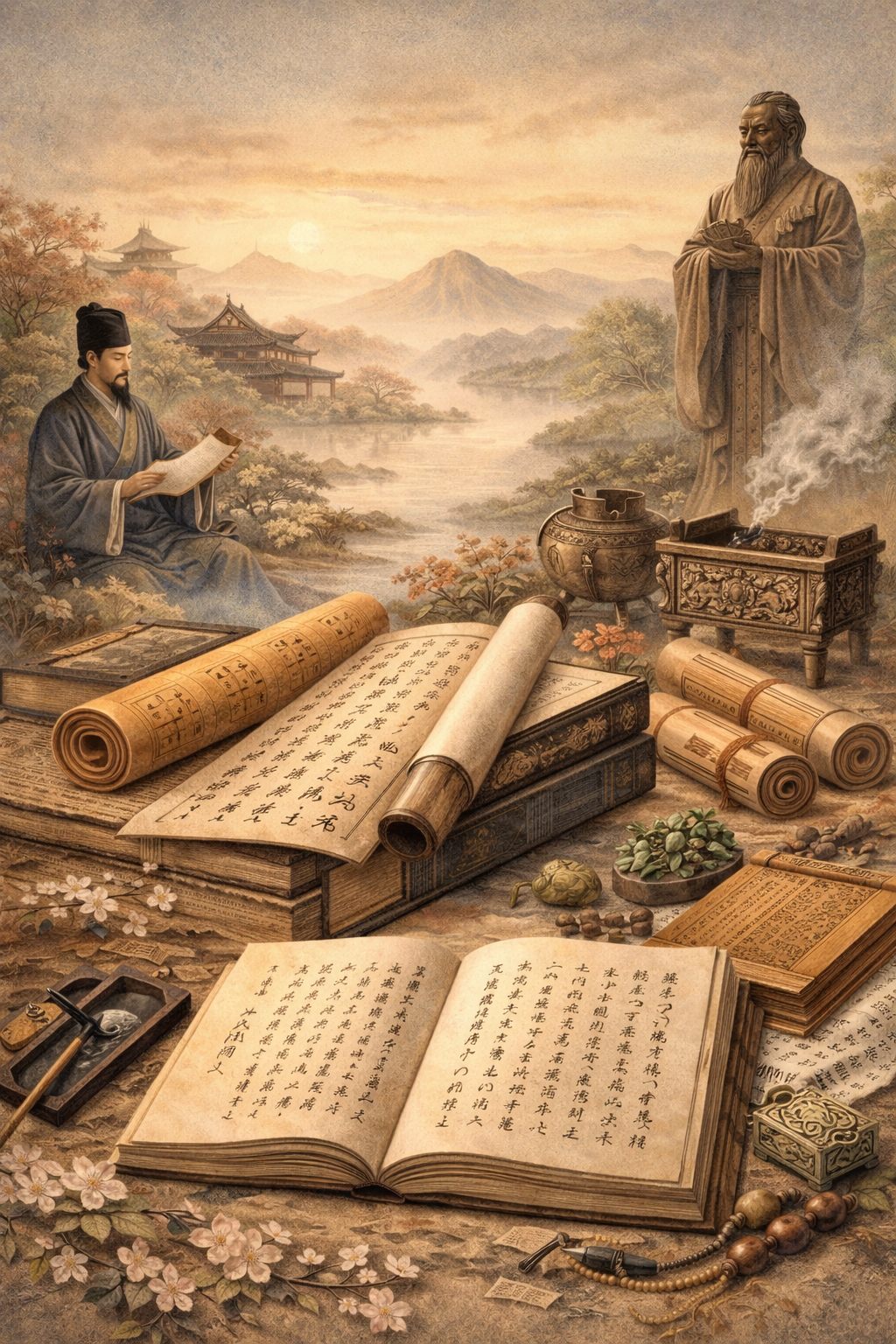
Read in this way, Chinese literature becomes more than literary history. It becomes a record of how a civilization preserved judgment, beauty, loyalty, grief, ritual order, refinement, withdrawal, exile, service, family obligation, and the memory of loss through language. It carries the voices of ministers and recluses, emperors and exiles, historians and poets, moralists and wanderers, scholars and dramatists, women writers and family poets, all working within forms that link personal feeling to civilizational continuity. Chinese literary memory is not static repetition. It is continuity through commentary, imitation, reformulation, revision, disciplined return, and renewal. The past remains active because literary culture continually returns to it, reorganizes it, argues with it, and speaks through it.
Chinese Literature and Classical Memory therefore stands at the intersection of literary history, philosophy, education, statecraft, historiography, family order, religion, artistic cultivation, and material transmission. It asks how literature preserves moral order without becoming rigid dogma; how poetic feeling survives within highly disciplined forms; how dynastic transition reshapes literary memory; how exile, ruin, remonstrance, and political disappointment become engines of literary power; how commentary, examination culture, anthology, manuscript, and print sustain continuity; how classical Chinese preserves elite identity across time; how vernacular writing expands the archive; and how a civilization’s long memory can remain living rather than merely archival. In this sense, Chinese literature is one of the great traditions through which the world can study literature as cultural inheritance, moral form, historical judgment, and disciplined transformation.
Chinese Literature as Classical Memory
Chinese literature is one of the great classical-memory systems of world literature because it binds writing to moral order, statecraft, historical judgment, education, family continuity, philosophical reflection, and cultivated feeling. The Chinese literary archive does not preserve beauty apart from civilization. It repeatedly asks how beauty, order, feeling, judgment, and memory may belong together. Poetry teaches emotional measure. Historical writing remembers the past through ethical evaluation. Philosophical prose shapes moral vocabulary. Memorial writing and remonstrance connect literary form to public duty. Commentary turns inheritance into argument. Fiction and drama broaden the archive into vernacular voice, social worlds, family decline, and moral ambiguity.
The tradition is powerful because continuity is never merely passive. Chinese literary memory survives by returning to the past through disciplined transformation. Later writers imitate earlier forms, but they also redirect them. Commentators preserve inherited texts, but they also debate them. Dynastic histories order the past, but they also judge it. Tang and Song poets inherit earlier traditions, but they make exile, friendship, landscape, and office newly intense. Ming and Qing fiction expands the archive, but remains deeply saturated with older moral, historical, and symbolic forms. Modern writers may reject classical authority, but they continue to write in its shadow.
To study Chinese Literature and Classical Memory is therefore to study how a civilization made literature one of its deepest technologies of continuity: not mechanical preservation, but reflective, disciplined, interpretive endurance.
Why This Pillar Matters
Chinese Literature and Classical Memory matters because few literary traditions have so thoroughly linked literary expression to education, moral judgment, statecraft, family order, and civilizational continuity. In the Chinese world, literature was not merely one cultural activity among others. It was a principal medium through which the educated class learned to feel, judge, remember, write, govern, remonstrate, mourn, withdraw, and return. Poetry taught emotional measure and cultivated responsiveness. Historical writing preserved political memory through narrative judgment. Philosophical prose shaped ethical and political language. Commentary linked present reading to inherited authority. Literature became one of the main ways civilization taught itself what it had been and what it ought to remain.
It also matters because Chinese literary culture demonstrates how continuity can coexist with change. Dynasties fall, regions shift, foreign influences enter, religious and philosophical balances change, script practices evolve, and literary forms expand, yet the tradition repeatedly reorganizes inherited materials without severing itself from them. Chinese literature preserves not only memory, but methods of memory: commentary, anthology, imitation, canonization, examination, citation, calligraphic practice, local gazetteer, collected works, family archive, and return. That gives it unusual durability. It remains one of the world’s strongest examples of literature as long-duration civilizational form.
Just as importantly, Chinese literature matters because language itself becomes an instrument of continuity. Classical Chinese preserves compression, prestige, allusive range, and historical reach; vernacular writing broadens accessibility, narrative energy, social voice, performance, and fictional worldmaking. The relation between these two realms is one of the central structural stories of Chinese literary history.
Scope and Method
This pillar is expansive by design, but ordered by a classical center. It includes canonical poetry, historical writing, philosophical prose, fu, regulated verse, ci lyric, literati essay, memorial and state prose, commentary traditions, drama, fiction, family and place writing, women’s literary culture, manuscript and print transmission, and modern literary transformations of classical inheritance. It includes both elite and broader literary worlds, not because they are the same, but because Chinese literary memory continuously moved between canonical and popular forms.
The method throughout is to read Chinese literature as both art and classical memory. That means attending to form, diction, allusion, parallelism, genre, historical setting, philosophical background, institutional context, and material transmission while also asking what these works preserve about moral order, dynastic remembrance, cultivated feeling, loyalty, loss, family continuity, and civilizational endurance. How does poetry preserve emotion without abandoning discipline? How does historiography narrate the past as moral inquiry rather than mere record? How do commentary and canon formation stabilize or redirect memory? How do office-holding and remonstrance shape prose and poetic voice? How do exile and dynastic transition intensify literary expression? How do fiction and drama widen the archive without abandoning the classical field of reference? How does continuity survive through disciplined transformation?
This pillar also reads the tradition critically. It does not treat classical continuity as simple harmony. The archive contains hierarchy, exclusion, gendered constraint, elite gatekeeping, bureaucratic pressure, imperial violence, dynastic collapse, and literary forms of loyal dissent. A serious reading must preserve the beauty and coherence of Chinese classical memory while also asking who was authorized to speak, whose memory became canonical, and how later writers widened or contested inherited forms.
Reading Architecture for a Humanities Pillar
This literature pillar does not require a GitHub repository. Its research infrastructure is textual, bibliographic, philological, historical, artistic, and interpretive rather than code-based. The appropriate scholarly architecture consists of primary texts, reliable translations, critical editions, classical commentaries, anthologies, dynastic histories, literary histories, manuscript and print studies, university press scholarship, museum and library resources, and carefully ordered reading pathways.
A strong Chinese Literature and Classical Memory pillar should therefore foreground:
- primary texts in reliable translation, bilingual edition, scholarly edition, or digitized classical source where appropriate;
- major textual formations including the Classic of Poetry, early philosophical prose, Shiji, Han fu, Six Dynasties poetry and criticism, Tang poetry, Song ci, literati prose, Yuan drama, Ming-Qing fiction, and modern Chinese literature;
- major authors and figures including Confucius, Mencius, Zhuangzi, Sima Qian, Tao Yuanming, Li Bai, Du Fu, Wang Wei, Bai Juyi, Han Yu, Liu Zongyuan, Ouyang Xiu, Su Shi, Li Qingzhao, Guan Hanqing, Luo Guanzhong, Shi Nai’an, Wu Cheng’en, Cao Xueqin, Lu Xun, Eileen Chang, and others;
- major genre pathways such as canonical poetry, historiography, philosophical prose, fu, regulated verse, ci, memorial prose, essay, commentary, drama, vernacular fiction, women’s writing, and modern prose;
- institutional systems including examination culture, commentary, anthology, manuscript copying, woodblock print, collected works, family archives, local gazetteers, calligraphy, painting, academies, and literati networks;
- critical attention to bureaucracy, gender, class, family hierarchy, imperial power, frontier writing, regional inequality, colonial pressure, language reform, and modern ruptures in classical authority.
The Canonical Spine of the Tradition
A strongest-sense account of Chinese Literature and Classical Memory should be visibly anchored in the major formations and figures that define its civilizational center. The early classics, especially the Classic of Poetry, establish a foundational relation between poetic feeling, political order, ritual form, and cultivated memory. Early philosophical prose and historical writing give Chinese literature a moral and intellectual architecture inseparable from later literary life. Sima Qian’s historiographical model makes narrative remembrance a form of moral judgment. Han and Six Dynasties writers expand the field through fu, rhapsodic prose, lyric development, literary criticism, and emerging aesthetic self-consciousness.
Tang poetry forms one of the absolute high points of world literature through figures such as Li Bai, Du Fu, Wang Wei, Bai Juyi, and many others, who turn poetry into an unmatched archive of landscape, friendship, exile, service, grief, historical awareness, and cultivated feeling. Song literature extends this archive through literati prose, ci lyric, painting-poetry culture, and the refined synthesis of learning, self-cultivation, and public service. Su Shi, Ouyang Xiu, Li Qingzhao, and many others help define literature as both personal and civilizational refinement.
Around this core stand the persistent themes of loyalty and withdrawal, the memory of exile, the relation between state service and moral integrity, and the late imperial broadening of literary memory through drama and fiction. Yuan drama, Ming and Qing novels, and modern writers do not displace the classical center; they expand the forms in which Chinese cultural memory can endure. The strength of the category lies in preserving this hierarchy while showing its full breadth.
Foundational Questions
- How did Chinese literature become one of the world’s strongest archives of classical and civilizational memory?
- How are poetry, history, prose, commentary, and fiction differently involved in preserving moral order and cultural continuity?
- What role did Confucian learning, Daoist sensibility, and Buddhist transformation play in shaping Chinese literary form?
- How did classical Chinese function as a civilizational medium across dynasties, and what changed when vernacular writing expanded?
- How did historiography preserve dynastic memory as moral judgment?
- Why do exile, loyalty, remonstrance, withdrawal, ruin, and longing recur so powerfully across Chinese literary history?
- How did examination culture, commentary, anthology, and canon formation sustain literary continuity?
- How did literati culture bind literature to calligraphy, painting, administration, friendship, and self-cultivation?
- How did drama, vernacular fiction, and print culture expand literary memory beyond elite classical forms?
- How did women’s writing, family archives, and regional literary cultures complicate the elite canon?
- How did modern Chinese writers inherit, reject, mourn, and transform classical memory under historical rupture?
I. Classical Foundations: Canon, Memory, and the Literary Order of Civilization
A strongest-sense treatment of Chinese Literature and Classical Memory begins with the recognition that literary culture in China is inseparable from canon. The classics do not merely precede later literature; they form the conditions under which later literature becomes intelligible. Canonical texts shape education, self-cultivation, bureaucratic life, political thought, ritual memory, and the relation between language and legitimacy. Chinese literature emerges from a world in which the remembered word is part of the ordering of civilization itself.
This matters because classical memory in China is not only thematic. It is institutional and pedagogical. Texts survive through commentary, recitation, schooling, official examination, anthology, collected works, and the transmission of moral vocabulary. The literary archive is thus also an archive of civilizational continuity.
- Canon, Memory, and the Literary Order of Chinese Civilization (planned) — A foundational article on how canonical texts shaped education, moral vocabulary, political legitimacy, and literary inheritance.
- The Classics and the Formation of Literary Authority (planned) — A study of how early classics became sources of form, judgment, quotation, pedagogy, and cultural authority.
- Education, Cultivation, and Civilizational Continuity in Chinese Literature (planned) — An article on literature as training in moral perception, style, memory, and public life.
- Why Literary Memory in China Is Also Institutional Memory (planned) — A synthetic article on canon, schools, exams, commentary, official culture, and transmission.
II. Classical Chinese, Vernacular Writing, and the Civilizational Life of Literary Language
One of the deepest structural features of Chinese literary history is the centrality of language itself. Classical Chinese was not merely a tool of communication. It was a civilizational medium: concise, allusive, prestigious, and socially formative. Its endurance across dynasties helped preserve continuity of elite identity, commentary practice, moral vocabulary, and literary style. To write in classical Chinese was to enter a long field of remembered form.
Yet Chinese literature is also transformed by the growth of vernacular writing. Vernacular writing does not simply replace the classical medium. It widens narrative range, social voice, performative energy, fictional worldmaking, and literary accessibility. The relation between classical and vernacular forms is one of the great tensions of Chinese literary history.
- Classical Chinese and the Civilizational Life of Literary Language (planned) — A study of classical Chinese as medium of compression, authority, allusion, elite identity, and continuity.
- Literary Chinese, Vernacular Writing, and Cultural Continuity (planned) — An article on the relation between classical prestige and vernacular expansion.
- Concise Form, Prestige, and the Ethics of Literary Language in China (planned) — A study of density, parallelism, citation, restraint, and linguistic discipline.
- When Vernacular Writing Recast the Chinese Literary Archive (planned) — An article on drama, fiction, popular narrative, social voice, and the broadening of literary memory.
III. Confucian Learning, Daoist Sensibility, and Buddhist Transformation
Chinese literary history is shaped by a dynamic interaction among Confucian moral-political order, Daoist modes of withdrawal and natural attunement, and Buddhist reflections on emptiness, suffering, transience, illusion, compassion, and release. These traditions do not remain isolated. They enter literary form through tone, image, moral orientation, rhetorical pattern, and philosophical depth. Confucian learning gives literature its relation to cultivation, office, ritual, hierarchy, and ethical order. Daoist sensibility deepens freedom, wandering, distance from power, and a more oblique relation to language. Buddhist influence intensifies reflection on suffering, impermanence, illusion, detachment, and contemplative perception.
This interplay matters because Chinese literature is never simply one thing: not only official, not only reclusive, not only worldly, not only transcendent. Its richness lies in the way these traditions contest, combine, and inflect one another within literary form.
- Confucian Learning and the Moral Uses of Literature in China (planned) — A study of literature as cultivation, ritual memory, office, education, and ethical formation.
- Daoist Sensibility and the Literature of Wandering, Distance, and Natural Form (planned) — An article on freedom, reclusion, spontaneity, indirectness, and the literary imagination of withdrawal.
- Buddhist Transformation and the Literary Imagination of Impermanence (planned) — A study of impermanence, illusion, detachment, suffering, and Buddhist inflection in poetry and prose.
- The Three Teachings and the Formation of Chinese Literary Memory (planned) — A synthetic article on Confucian, Daoist, and Buddhist patterns within the literary archive.
IV. The Classic of Poetry and the Early Formation of Poetic Memory
The Classic of Poetry stands near the absolute foundation of Chinese literary memory. It establishes poetry as a medium through which feeling, ritual, governance, social order, and moral interpretation become linked. The poems preserve agricultural life, courtly ceremonies, longing, complaint, praise, marriage, labor, and political significance, but they do so through forms that later tradition repeatedly treats as morally and culturally exemplary. Poetry becomes not simply expressive, but civilizational.
This archive matters because it gives Chinese literary culture one of its earliest and strongest convictions: that poetry can preserve the emotional life of a people while remaining within an ordered framework of interpretation and use.
- The Classic of Poetry and the Origins of Chinese Poetic Memory (planned) — A foundational article on the Shijing as poetic, ritual, social, and civilizational memory.
- Feeling, Ritual, and Political Reading in the Shijing (planned) — A study of how early poems became objects of moral, ritual, and political interpretation.
- Why Early Chinese Poetry Became Civilizational Memory (planned) — An article on poetry as emotion, order, pedagogy, and inherited cultural form.
- Poetry, Order, and Moral Interpretation in Classical China (planned) — A broader article on the moral uses of poetic reading in the classical tradition.
V. Historiography, Moral Judgment, and Dynastic Memory
Chinese literature cannot be understood without historiography. Historical writing in China is not merely a repository of facts; it is a moral form. Dynasties are remembered through narrative structure, exemplary character, political causation, ritual order, and judgment. Historiography preserves the rise and fall of states, the conduct of rulers and ministers, the fortunes of households, and the ethical consequences of disorder, all within forms that bind memory to instruction.
This matters because Chinese historical prose makes remembrance itself a discipline. The past is narrated not simply to preserve it, but to evaluate it. That gives Chinese classical memory unusual coherence and weight.
- Historiography as Moral Memory in Chinese Civilization (planned) — A foundational article on historical writing as ethical judgment, dynastic record, and civilizational memory.
- Sima Qian and the Historian as Custodian of Memory (planned) — A focused article on the Shiji, biography, judgment, suffering, and historiographical authority.
- Dynastic History and the Narrative of Political Judgment (planned) — A study of rise and fall, ruler and minister, mandate, disorder, and moral causation.
- History, Example, and the Ethics of Political Remembrance (planned) — An article on exemplarity, warning, precedent, and the political uses of historical memory.
VI. Han, Six Dynasties, and the Expansion of Literary Form
The Han and Six Dynasties periods expand the literary field through fu, rhapsodic prose, lyric development, literary criticism, and a growing self-consciousness about style, emotion, and aesthetic distinction. This is a crucial stage in the history of Chinese literary memory because it shows the archive becoming more differentiated and formally reflective. Literature begins to theorize itself more explicitly while remaining linked to state, learning, and memory.
This archive matters because it broadens the classical field without breaking it. It introduces new textures of elegance, lament, landscape, personal voice, aesthetic evaluation, and cultivated selfhood that later dynasties refine further.
- Han Literature and the Expansion of Civilizational Form (planned) — A study of Han prose, court literature, historiography, cosmology, and expanding literary scale.
- Fu and the Rhapsodic Imagination in Chinese Literary History (planned) — An article on descriptive abundance, rhetorical display, courtly space, and formal expansion.
- Six Dynasties Poetry and the Formation of Literary Self-Consciousness (planned) — A study of lyric development, style, personal voice, and early aesthetic reflection.
- Tao Yuanming and the Literature of Reclusion, Field, and Return (planned) — A focused article on withdrawal, rural life, moral simplicity, wine, and poetic self-fashioning.
- Style, Elegance, and Early Aesthetic Reflection in China (planned) — An article on literary criticism, taste, distinction, and the emergence of aesthetic self-awareness.
VII. Tang Poetry and the High Canon of Literary Memory
Tang poetry belongs among the supreme achievements of world literature. It gives Chinese literary memory one of its most concentrated and enduring forms through regulated verse, landscape poetry, friendship poems, exile poems, frontier verse, reflections on history, and meditations on time and loss. Li Bai, Du Fu, Wang Wei, Bai Juyi, and many others preserve vastly different modes of feeling and judgment while remaining within an extraordinarily disciplined formal world.
This archive matters because Tang poetry demonstrates how strict form can intensify rather than limit emotional and historical depth. It becomes one of the clearest examples anywhere of literature as both cultivated art and civilizational memory.
- Tang Poetry and the High Canon of Chinese Literary Memory (planned) — A major article on Tang poetry as one of the central achievements of world literary form and memory.
- Li Bai and the Freedom of Vision in Chinese Poetry (planned) — A study of spontaneity, wine, friendship, cosmic imagination, and poetic freedom.
- Du Fu and the Ethics of History, Suffering, and Witness (planned) — An article on war, displacement, service, family, moral burden, and poetic witness.
- Wang Wei and the Poetics of Landscape, Quiet, and Buddhist Inflection (planned) — A study of landscape, silence, contemplative presence, and Buddhist resonance.
- Bai Juyi and the Moral Clarity of Literati Poetry (planned) — An article on clarity, social concern, public feeling, and poetic accessibility.
- Regulated Verse and the Discipline of Feeling (planned) — A study of form, tonal pattern, parallelism, compression, and emotional control.
- Frontier Poetry, Exile, and the Edges of Empire (planned) — An article on borders, military life, distance, longing, and imperial imagination.
VIII. Song Literati Culture, Ci Lyric, and the Ethics of Cultivation
The Song period deepens the relation between literature, self-cultivation, office, painting, calligraphy, friendship, and philosophical reflection. Literati culture becomes one of the most distinctive civilizational formations in Chinese history, and literature is central to it. Prose, lyric, essay, inscription, and reflection are joined to cultivated sociability, bureaucratic service, private retreat, and a heightened consciousness of style and learning. Ci lyric gives Chinese literature another great mode of compressed feeling, often more intimate, musical, and atmospheric than earlier regulated verse.
This matters because Song literature shows Chinese memory not only in dynastic and political terms, but as a form of cultivated life. It preserves a world in which literature, painting, ethics, conversation, scholarship, friendship, and self-fashioning belong together.
- Song Literati Culture and the Ethics of Literary Cultivation (planned) — A major article on literature as self-cultivation, public service, social identity, and refined life.
- Ci Lyric and the Music of Refined Feeling (planned) — A study of lyric song, intimacy, musicality, gendered voice, and emotional atmosphere.
- Su Shi and the Breadth of Song Literary Imagination (planned) — An article on poetry, prose, exile, friendship, painting, Buddhism, Daoism, and resilient cultivation.
- Li Qingzhao and the Lyric Memory of Loss and Refinement (planned) — A focused article on memory, gender, displacement, intimacy, and the power of ci lyric.
- Ouyang Xiu, Prose, and the Culture of Learned Elegance (planned) — A study of prose style, historical consciousness, friendship, antiquarianism, and literati refinement.
IX. Poetry, Painting, Calligraphy, and the Unified Aesthetic World of the Literati
A serious civilizational pillar on Chinese literature must foreground the integration of the literati arts. Poetry, painting, and calligraphy do not belong to separate cultural compartments. They form a unified aesthetic world in which self-cultivation, social identity, landscape perception, inscription, and literary memory reinforce one another. A poem may be written on a painting; a painting may embody poetic vision; calligraphy may itself become moral-aesthetic presence; and gardens or pavilions may serve as spatial extensions of literary feeling.
This matters because Chinese literary culture is not merely verbal. It is spatial, visual, embodied, and performative in elite practice. The literary archive includes inscription, brushwork, cultivated viewing, architectural setting, and the shaping of environment into memory.
- Poetry, Painting, and Calligraphy as a Unified Aesthetic World (planned) — A major article on the interrelation of literary, visual, and calligraphic cultivation.
- Inscription and the Visual Life of Literary Form in China (planned) — A study of poems on paintings, stele, objects, architecture, and the material presence of writing.
- Gardens, Pavilions, and the Spatial Memory of Literati Culture (planned) — An article on built environments as extensions of literary feeling and cultivated memory.
- Self-Cultivation and the Interwoven Arts of the Chinese Literati (planned) — A study of how poetry, brushwork, painting, friendship, and moral refinement form one cultural world.
X. The Scholar-Official, Remonstrance, and the Moral Burden of Writing
One of the most distinctive features of Chinese literature as a civilizational project is its deep relation to bureaucracy, office, and moral service. The scholar-official ideal binds literary cultivation to statecraft. Writing is not only private expression; it is memorial, remonstrance, policy argument, official judgment, and ethical intervention. The educated writer serves, advises, criticizes, records, and sometimes fails with dignity. The literary life is therefore inseparable from the burdens of office and the danger of speaking truth within power.
This matters because Chinese literature is not simply a literature of detached contemplation. It is also a literature of administration, loyal criticism, bureaucratic pressure, and public responsibility. The pen is implicated in governance. That is one of the defining structures of the tradition.
- The Scholar-Official and the Literary Imagination in China (planned) — A foundational article on the writer as official, moral agent, adviser, critic, and cultivated servant.
- Memorial Prose, Remonstrance, and the Ethics of Service (planned) — A study of official prose, loyal criticism, moral courage, and writing within power.
- Bureaucracy, Office, and the Moral Burden of Writing (planned) — An article on administrative life, constraint, obligation, and the literary forms of public service.
- Writing Within Power: Literature and Statecraft in Imperial China (planned) — A synthetic article on statecraft, moral speech, style, and political judgment.
XI. Exile, Loyalty, Withdrawal, and the Literature of Political Feeling
One of the deepest recurrent structures in Chinese literary history is the relation between service and withdrawal, loyalty and disillusion, office and exile. The state is never absent from literary memory, but neither is the possibility of distance from it. Exile intensifies literary reflection; loyalty deepens pathos; withdrawal opens literary attention to landscape, solitude, and philosophical freedom. This tension between participation and refusal is one of the tradition’s most enduring moral and emotional engines.
This matters because Chinese literature preserves political feeling without reducing itself to propaganda or private escape. Exile, dismissal, loyal remonstrance, dynastic transition, and righteous defeat become some of its most powerful literary conditions.
- Exile and the Deepening of Literary Memory in China (planned) — A study of banishment, travel, loss, poetic reflection, and the intensification of memory under displacement.
- Loyalty, Withdrawal, and the Ethics of Service (planned) — An article on office, reclusion, conscience, and the difficult balance between public duty and inward freedom.
- Loyal Dissent in Chinese Literary History (planned) — A study of remonstrance, criticism, moral risk, and the writer’s duty to speak within power.
- Righteous Failure and the Literature of Political Conscience (planned) — An article on defeat, disappointment, loyal suffering, and ethical memory.
- Dynastic Transition and the Ethics of Memory (planned) — A study of loyalty after collapse, historical legitimacy, mourning, and literary response to regime change.
- Retreat, Landscape, and Moral Freedom in Chinese Writing (planned) — An article on reclusion, mountains, rivers, fields, distance, and cultivated withdrawal.
XII. Examination Culture, Commentary, and Canon Formation
Chinese literary continuity cannot be understood apart from examination culture, commentary traditions, and the long institutional life of the canon. The examination system made literary style, textual memory, and classical command part of public life and state formation. Commentary stabilized texts, redirected their meanings, argued with inherited authority, and connected successive generations to the same civilizational archive. Canon formation here is not merely retrospective admiration. It is one of the working mechanisms through which Chinese literary memory remained active.
This matters because Chinese literature endured not only through genius, but through repeated acts of pedagogical and interpretive transmission. The archive survived because it was studied, glossed, tested, memorized, socially rewarded, and repeatedly reread. Commentary in China is not secondary labor. It is a central intellectual method of renewal.
- Examination Culture and the Institutional Life of Chinese Literature (planned) — A major article on how examination culture made literary memory part of public office and elite reproduction.
- Commentary as Interpretation, Argument, and Renewal (planned) — A study of commentary as a form of preservation, debate, reinterpretation, and intellectual continuity.
- Canon Formation and Literary Authority in Imperial China (planned) — An article on selection, pedagogy, anthologies, orthodoxy, commentary, and classical prestige.
- Education, Memorization, and the Social Reproduction of Literary Culture (planned) — A study of schooling, recitation, copying, examination, and the embodied life of literary memory.
XIII. Drama, Fiction, and the Expansion of Literary Memory
A fully comprehensive pillar must include the expansion of literary memory through drama and fiction. Yuan drama, Ming and Qing fiction, and vernacular prose do not merely sit outside the classical center. They broaden the forms through which Chinese civilization remembers itself. Historical fiction, romance, social satire, sacred-comic quest, domestic tragedy, and dramatic performance preserve moral conflict, dynastic memory, popular speech, family structure, social worlds, and vernacular imagination that elite prose and poetry alone cannot contain.
This layer matters because it prevents Chinese literary history from appearing too exclusively elite. The literary archive expands through popular narrative, theatricality, print, and prose worlds that still remain in conversation with classical values and structures. The great novels deserve especially strong weight because they are among the principal vehicles through which late imperial China remembered power, disorder, pilgrimage, family decline, and moral ambiguity.
- Yuan Drama and the Performance of Historical and Emotional Memory (planned) — A study of theater, performance, injustice, emotion, and the expansion of literary memory beyond elite forms.
- Romance of the Three Kingdoms and Dynastic Memory (planned) — An article on war, loyalty, strategy, legitimacy, dynastic decline, and historical imagination.
- Water Margin and the Moral Imagination of Disorder (planned) — A study of banditry, justice, rebellion, fraternity, violence, and social disorder.
- Journey to the West and the Sacred-Comic Archive (planned) — An article on pilgrimage, transformation, Buddhist-Daoist imagination, humor, and spiritual testing.
- Dream of the Red Chamber and the Memory of Family, Beauty, and Decline (planned) — A major article on family collapse, women’s culture, desire, memory, illusion, and late imperial refinement.
- Drama, Fiction, and the Broadening of Civilizational Remembrance (planned) — A synthetic article on how vernacular forms expanded the Chinese literary archive.
XIV. Women’s Writing, Family Order, and the Domestic Archive of Memory
A serious civilizational account must foreground women’s literary culture. Chinese literary memory is not preserved only through officials, historians, and canonical male poets. It also survives through women’s poetry, domestic writing, family correspondence, elite women’s literary networks, courtesan literature, widow writing, inscriptions, teaching texts, and gendered forms of memory rooted in household life, kinship, and inward cultivation. The domestic archive is one of the important though often underemphasized carriers of continuity.
This matters because family order is not merely an abstract ethical category in Chinese civilization. It is lived, remembered, and written. Women’s literary culture helps preserve family feeling, sorrow, education, ritual obligation, grief, friendship, self-cultivation, and the textures of domestic continuity across dynasties and historical change.
- Women’s Poetry and Literary Memory in China (planned) — A major article on women poets, domestic writing, literary networks, gendered authorship, and cultural memory.
- Gender, Family, and Authorship in Late Imperial Literary Culture (planned) — A study of women’s education, family order, literary visibility, constraint, and authorship.
- The Domestic Archive and the Preservation of Cultural Memory (planned) — An article on household writing, correspondence, family poetry, mourning, and kinship memory.
- Women Writers and the Recasting of Tradition in Modern China (planned) — A study of gender, modernity, language reform, fiction, public voice, and the transformation of inherited forms.
XV. Family Order, Region, and the Memory of Place
Chinese classical memory is not only dynastic and canonical. It is also familial, local, and regional. Clan memory, ancestral consciousness, local gazetteers, family ethics, regional schools, and attachments to native place all shape literary continuity. Place in Chinese literature is not only scenic. It is social, genealogical, moral, and historical. Home districts, mountains, rivers, pavilions, tombs, gardens, academies, and family sites become coordinates of remembrance.
This matters because the endurance of Chinese literary culture depends partly on the way large civilizational memory and local place-memory reinforce one another. Literature remembers the empire, but it also remembers the household, the district, the region, and the landscape of return. A fuller project must also acknowledge distinct literary zones, such as Jiangnan and frontier regions, whose sensibilities inflect the larger archive.
- Family Order and the Ethics of Memory in Chinese Literature (planned) — A study of ancestral memory, kinship, filial obligation, mourning, and literary continuity.
- Region, Native Place, and Literary Identity (planned) — An article on native-place attachment, local identity, regional style, and literary belonging.
- Jiangnan and the Formation of a Chinese Literary Region (planned) — A focused article on Jiangnan as literary region, aesthetic world, economic center, and memory field.
- Frontier Writing and the Edge of Civilizational Memory (planned) — A study of borders, empire, travel, difference, military life, and the literary imagination of the frontier.
- Landscape, Locality, and the Geography of Chinese Remembrance (planned) — An article on mountains, rivers, pavilions, gardens, and place-based memory.
- Clan, Home, and Cultural Continuity in Literary Form (planned) — A study of genealogy, family collection, household transmission, and local memory.
XVI. Manuscript, Print, Anthology, and the Transmission of Continuity
Chinese literature survived through material systems of transmission: manuscripts, bamboo and silk texts, handwritten copies, woodblock print, editions, anthologies, libraries, schools, collected works, local gazetteers, family archives, and commercial book culture. Print culture in particular transformed the scale and durability of literary memory, making canonical and non-canonical texts more widely available while also stabilizing certain forms of authority. Anthology likewise functions as a major organizing structure: it selects, sequences, preserves, and teaches memory as a usable archive.
This matters because classical continuity is never only abstract. It depends on technologies and institutions of preservation. Literary memory remains alive because it can be recopied, reprinted, excerpted, taught, glossed, and re-entered.
- Manuscript Culture and the Material Life of Chinese Literature (planned) — A study of early textual materials, copying, archives, manuscript variation, and material transmission.
- Woodblock Print and the Expansion of Literary Continuity (planned) — An article on print, circulation, editions, accessibility, canon, and late imperial book culture.
- Anthology as a Technology of Classical Memory (planned) — A study of selection, ordering, excerpting, pedagogy, and the creation of usable literary inheritance.
- Editions, Collections, and the Preservation of Civilizational Form (planned) — An article on collected works, textual stabilization, commentary, and literary survival.
XVII. Late Imperial Crisis, Modern Transformation, and the Recasting of Classical Memory
Chinese literature also preserves the memory of rupture. Late imperial crisis, reform, revolution, war, and modern transformation force writers to revisit the classical archive under new conditions of uncertainty. Classical memory does not disappear. It is contested, compressed, secularized, mourned, politicized, and reinterpreted. Modern Chinese literary culture remains legible partly because of the classical structures it inherits even when it seeks to escape them.
This matters because the Chinese literary tradition endures not only through continuity, but through its capacity to renew itself after fracture. A fully serious account must therefore show how classical memory survives modern transformation without assuming that the older order remains intact. It should distinguish the late Qing reform moment, May Fourth rupture, Republican modernism, revolutionary and post-1949 literary transformation, and wider Sinophone continuities rather than collapsing them into one broad modern category.
- Late Qing Reform and the Strain on Classical Form (planned) — A study of reform, translation, crisis, political prose, journalism, and the pressure placed on inherited forms.
- May Fourth and the Break with Classical Authority (planned) — An article on vernacular reform, anti-traditional critique, literary modernization, and the revaluation of classical memory.
- Lu Xun and the Modern Literature of Cultural Diagnosis (planned) — A focused article on satire, moral shock, vernacular prose, national critique, and literary modernity.
- Republican Modernism and Literary Self-Reinvention (planned) — A study of urban writing, experimentation, translation, gender, language, and modern sensibility.
- Revolutionary and Post-1949 Literary Transformation (planned) — An article on ideology, realism, revolutionary culture, censorship, memory, and literary reorientation.
- Sinophone and Diasporic Afterlives of Chinese Literary Tradition (planned) — A study of Taiwan, Hong Kong, diaspora, multilingual modernity, and transregional Chinese literary memory.
- How Classical Memory Survived Historical Transformation in China (planned) — A synthetic article on continuity, rupture, recovery, and reinterpretation across modernity.
XVIII. Major Genres Across Chinese Classical Memory
A comprehensive pillar should also organize the archive by genre. Canonical poetry preserves feeling within order. Historiography preserves the past through judgment. Philosophical prose shapes the moral vocabulary of civilization. Fu expands descriptive and rhetorical imagination. Regulated verse refines emotional and formal discipline. Ci lyric compresses intimacy and atmosphere. Essay and memorial prose preserve literati thought and statecraft. Drama and fiction widen the archive into performance, narrative, social worlds, and vernacular life. Commentary preserves continuity through interpretive return.
- Poetry as Civilizational Memory in China (planned) — A genre article on poetry as emotional discipline, moral form, and long-duration cultural memory.
- Historiography and the Ethics of Dynastic Remembrance (planned) — A study of history as narrative judgment, political memory, and moral archive.
- Philosophical Prose and the Literary Formation of Moral Order (planned) — An article on early thought, style, argument, parable, and ethical language.
- Regulated Verse and the Discipline of Classical Feeling (planned) — A study of form, balance, tonal structure, and the compression of emotion.
- Ci Lyric and the Music of Refined Intimacy (planned) — An article on song lyric, private feeling, gendered voice, and emotional atmosphere.
- Drama and Fiction in the Broad Archive of Chinese Memory (planned) — A study of vernacular narrative, theater, social worldmaking, and popular memory.
- Commentary as a Literary Genre of Continuity (planned) — An article on commentary as preservation, interpretation, argument, and renewal.
XIX. Recurring Themes and Civilizational Structures
Across these genres, certain structures recur with unusual persistence: order and disorder; loyalty and withdrawal; dynastic rise and decline; exile and remembrance; grief and cultivated restraint; service and moral compromise; remonstrance and righteous defeat; landscape and native place; family continuity; ritual and feeling; beauty and impermanence; history and judgment; civilization and ruin. These themes help explain why Chinese literature remains so enduring. It preserves not only events and doctrines, but the patterned emotional and ethical worlds through which a civilization understood itself.
- Order, Ruin, and the Literary Imagination of Dynastic Change (planned) — A thematic article on historical transition, disorder, collapse, and literary remembrance.
- Loyalty, Withdrawal, and the Ethics of Service in Chinese Literature (planned) — A study of office, exile, reclusion, loyalty, and moral tension.
- Exile, Native Place, and the Memory of Return (planned) — An article on displacement, longing, local attachment, and the poetics of return.
- Family, Ritual, and the Preservation of Cultural Continuity (planned) — A study of kinship, ancestry, filial memory, domestic writing, and ritual order.
- Beauty, Discipline, and the Forms of Cultivated Feeling (planned) — An article on emotional restraint, aesthetic discipline, style, and moral refinement.
- History, Judgment, and the Burden of Remembrance (planned) — A study of memory as ethical responsibility across historiography, poetry, and prose.
- Continuity Through Transformation in Chinese Literary History (planned) — A synthetic article on how Chinese literature preserves inheritance through change rather than stasis.
Expanded Article Architecture
The following long-range architecture preserves the full breadth of the category while clarifying its major centers of gravity: canon and classics, literary language, philosophy, historiography, Tang and Song high culture, literati arts, bureaucracy and remonstrance, political feeling through exile and loyalty, commentary and examination, drama and fiction, women’s writing, family and place, transmission technologies, and differentiated modern transformation.
Canon and Foundations
- Canon, Memory, and the Literary Order of Chinese Civilization (planned)
- The Classics and the Formation of Literary Authority (planned)
- Education, Cultivation, and Civilizational Continuity in Chinese Literature (planned)
- The Classic of Poetry and the Origins of Chinese Poetic Memory (planned)
- Feeling, Ritual, and Political Reading in the Shijing (planned)
Language and Textuality
- Classical Chinese and the Civilizational Life of Literary Language (planned)
- Literary Chinese, Vernacular Writing, and Cultural Continuity (planned)
- Concise Form, Prestige, and the Ethics of Literary Language in China (planned)
- When Vernacular Writing Recast the Chinese Literary Archive (planned)
Philosophy and Literary Formation
- Confucian Learning and the Moral Uses of Literature in China (planned)
- Daoist Sensibility and the Literature of Wandering, Distance, and Natural Form (planned)
- Buddhist Transformation and the Literary Imagination of Impermanence (planned)
- The Three Teachings and the Formation of Chinese Literary Memory (planned)
History and Moral Judgment
- Historiography as Moral Memory in Chinese Civilization (planned)
- Sima Qian and the Historian as Custodian of Memory (planned)
- Dynastic History and the Narrative of Political Judgment (planned)
- History, Example, and the Ethics of Political Remembrance (planned)
Han and Six Dynasties Literary Expansion
- Han Literature and the Expansion of Civilizational Form (planned)
- Fu and the Rhapsodic Imagination in Chinese Literary History (planned)
- Six Dynasties Poetry and the Formation of Literary Self-Consciousness (planned)
- Tao Yuanming and the Literature of Reclusion, Field, and Return (planned)
- Style, Elegance, and Early Aesthetic Reflection in China (planned)
Tang Poetic High Culture
- Tang Poetry and the High Canon of Chinese Literary Memory (planned)
- Li Bai and the Freedom of Vision in Chinese Poetry (planned)
- Du Fu and the Ethics of History, Suffering, and Witness (planned)
- Wang Wei and the Poetics of Landscape, Quiet, and Buddhist Inflection (planned)
- Bai Juyi and the Moral Clarity of Literati Poetry (planned)
- Regulated Verse and the Discipline of Feeling (planned)
- Frontier Poetry, Exile, and the Edges of Empire (planned)
Song Literati and Integrated Arts
- Song Literati Culture and the Ethics of Literary Cultivation (planned)
- Ci Lyric and the Music of Refined Feeling (planned)
- Su Shi and the Breadth of Song Literary Imagination (planned)
- Li Qingzhao and the Lyric Memory of Loss and Refinement (planned)
- Ouyang Xiu, Prose, and the Culture of Learned Elegance (planned)
- Poetry, Painting, and Calligraphy as a Unified Aesthetic World (planned)
- Gardens, Pavilions, and the Spatial Memory of Literati Culture (planned)
Statecraft, Remonstrance, and Political Feeling
- The Scholar-Official and the Literary Imagination in China (planned)
- Memorial Prose, Remonstrance, and the Ethics of Service (planned)
- Bureaucracy, Office, and the Moral Burden of Writing (planned)
- Writing Within Power: Literature and Statecraft in Imperial China (planned)
- Exile and the Deepening of Literary Memory in China (planned)
- Loyalty, Withdrawal, and the Ethics of Service (planned)
- Loyal Dissent in Chinese Literary History (planned)
- Righteous Failure and the Literature of Political Conscience (planned)
- Dynastic Transition and the Ethics of Memory (planned)
- Retreat, Landscape, and Moral Freedom in Chinese Writing (planned)
Canon Formation and Institutions
- Examination Culture and the Institutional Life of Chinese Literature (planned)
- Commentary as Interpretation, Argument, and Renewal (planned)
- Canon Formation and Literary Authority in Imperial China (planned)
- Education, Memorization, and the Social Reproduction of Literary Culture (planned)
- Anthology as a Technology of Classical Memory (planned)
Drama, Fiction, and Literary Expansion
- Yuan Drama and the Performance of Historical and Emotional Memory (planned)
- Romance of the Three Kingdoms and Dynastic Memory (planned)
- Water Margin and the Moral Imagination of Disorder (planned)
- Journey to the West and the Sacred-Comic Archive (planned)
- Dream of the Red Chamber and the Memory of Family, Beauty, and Decline (planned)
- Drama, Fiction, and the Broadening of Civilizational Remembrance (planned)
Women, Family, Region, and Local Continuity
- Women’s Poetry and Literary Memory in China (planned)
- Gender, Family, and Authorship in Late Imperial Literary Culture (planned)
- The Domestic Archive and the Preservation of Cultural Memory (planned)
- Women Writers and the Recasting of Tradition in Modern China (planned)
- Family Order and the Ethics of Memory in Chinese Literature (planned)
- Region, Native Place, and Literary Identity (planned)
- Jiangnan and the Formation of a Chinese Literary Region (planned)
- Frontier Writing and the Edge of Civilizational Memory (planned)
- Landscape, Locality, and the Geography of Chinese Remembrance (planned)
- Clan, Home, and Cultural Continuity in Literary Form (planned)
Transmission Technologies
- Manuscript Culture and the Material Life of Chinese Literature (planned)
- Woodblock Print and the Expansion of Literary Continuity (planned)
- Anthology as a Technology of Classical Memory (planned)
- Editions, Collections, and the Preservation of Civilizational Form (planned)
Late Imperial and Modern Transformation
- Late Qing Reform and the Strain on Classical Form (planned)
- May Fourth and the Break with Classical Authority (planned)
- Lu Xun and the Modern Literature of Cultural Diagnosis (planned)
- Republican Modernism and Literary Self-Reinvention (planned)
- Revolutionary and Post-1949 Literary Transformation (planned)
- Sinophone and Diasporic Afterlives of Chinese Literary Tradition (planned)
- How Classical Memory Survived Historical Transformation in China (planned)
Genres and Forms
- Poetry as Civilizational Memory in China (planned)
- Historiography and the Ethics of Dynastic Remembrance (planned)
- Philosophical Prose and the Literary Formation of Moral Order (planned)
- Regulated Verse and the Discipline of Classical Feeling (planned)
- Ci Lyric and the Music of Refined Intimacy (planned)
- Drama and Fiction in the Broad Archive of Chinese Memory (planned)
- Commentary as a Literary Genre of Continuity (planned)
Major Themes
- Order, Ruin, and the Literary Imagination of Dynastic Change (planned)
- Loyalty, Withdrawal, and the Ethics of Service in Chinese Literature (planned)
- Exile, Native Place, and the Memory of Return (planned)
- Family, Ritual, and the Preservation of Cultural Continuity (planned)
- Beauty, Discipline, and the Forms of Cultivated Feeling (planned)
- History, Judgment, and the Burden of Remembrance (planned)
- Continuity Through Transformation in Chinese Literary History (planned)
Closing Perspective
Chinese Literature and Classical Memory should be understood as a major archive of moral order, dynastic remembrance, cultivated feeling, philosophical reflection, literary language, family continuity, and civilizational endurance rather than as a narrow sequence of canonical texts. Its range extends from the classics and historiography to Tang poetry, Song literati culture, commentary, examination traditions, the integrated arts of the literati, drama, fiction, women’s writing, family and regional memory, print culture, and modern literary transformation. Read in the strongest sense, the category shows how literature can preserve not only beauty and feeling, but the long continuity of a civilization’s patterns of judgment and form.
It is therefore central to any serious understanding of literature as inheritance, discipline, argument, and renewal. Chinese literary culture reveals how poetry, prose, history, commentary, fiction, and literary language together sustain a civilizational memory that remains morally charged, aesthetically refined, and historically responsive. It also shows, with unusual power, how literature can endure as one of the longest and most sophisticated shelters of classical memory in the world precisely because it survives through disciplined transformation rather than static repetition.
Related Reading
- Literature & Cultural Memory
- Chinese Thought
- East Asian Traditions
- Japanese Literature and Poetic Memory
- Korean Literature and Historical Memory
- Chinese Myth, Folklore, and Legend
- Philosophy
- Religious Studies
Further Reading
- Chang, K. and Owen, S. (eds.) (2010). The Cambridge History of Chinese Literature. Cambridge: Cambridge University Press. https://www.cambridge.org/core/books/cambridge-history-of-chinese-literature/8DB5364B81E5C1DF90F752BB825E5C04
- Mair, V. H. (ed.) (2000). The Columbia History of Chinese Literature. New York: Columbia University Press. https://cup.columbia.edu/book/the-columbia-history-of-chinese-literature/9780231109840/
- Mair, V. H. (ed.) (2000). The Shorter Columbia Anthology of Traditional Chinese Literature. New York: Columbia University Press. https://cup.columbia.edu/book/the-shorter-columbia-anthology-of-traditional-chinese-literature/9780231505628/
- Owen, S. (1996). An Anthology of Chinese Literature: Beginnings to 1911. New York: W. W. Norton.
- Owen, S. (1992). Readings in Chinese Literary Thought. Cambridge, MA: Harvard University Asia Center.
- Cai, Z. (ed.) (2008). How to Read Chinese Poetry: A Guided Anthology. New York: Columbia University Press. https://cup.columbia.edu/book/how-to-read-chinese-poetry/9780231139410/
- Cai, Z. (ed.) (2018). How to Read Chinese Prose in Chinese: A Course in Classical Chinese. New York: Columbia University Press. https://cup.columbia.edu/book/how-to-read-chinese-prose-in-chinese/9780231185370/
- Idema, W. and Haft, L. (1997). A Guide to Chinese Literature. Ann Arbor: Center for Chinese Studies, University of Michigan.
- Idema, W. and Grant, B. (2004). The Red Brush: Writing Women of Imperial China. Cambridge, MA: Harvard University Asia Center.
- Idema, W. and Grant, B. (eds.) (2010). The Columbia Anthology of Yuan Drama. New York: Columbia University Press. https://cup.columbia.edu/book/the-columbia-anthology-of-yuan-drama/9780231122665/
- Bender, M. and Mair, V. H. (eds.) (2011). The Columbia Anthology of Chinese Folk and Popular Literature. New York: Columbia University Press. https://cup.columbia.edu/book/the-columbia-anthology-of-chinese-folk-and-popular-literature/9780231153126/
- Wang, D. D. W. (ed.) (2007; rev. edn. 2023). The Columbia Anthology of Modern Chinese Literature. New York: Columbia University Press. https://cup.columbia.edu/book/the-columbia-anthology-of-modern-chinese-literature/9780231138413/
- Lee, L. O.-f. et al. (eds.) (2013). The Columbia Companion to Modern Chinese Literature. New York: Columbia University Press. https://cup.columbia.edu/book/the-columbia-companion-to-modern-chinese-literature/9780231170093/
- Chen, X. (ed.) (2014). The Columbia Anthology of Modern Chinese Drama. New York: Columbia University Press. https://cup.columbia.edu/book/the-columbia-anthology-of-modern-chinese-drama/9780231145701/
References
- Shijing [Classic of Poetry] (n.d.). Chinese Text Project. https://ctext.org/book-of-poetry
- Analects (n.d.). Chinese Text Project. https://ctext.org/analects
- Mengzi [Mencius] (n.d.). Chinese Text Project. https://ctext.org/mengzi
- Zhuangzi (n.d.). Chinese Text Project. https://ctext.org/zhuangzi
- Sima Qian (n.d.). Shiji [Records of the Grand Historian]. Chinese Text Project. https://ctext.org/shiji
- Sima Qian (n.d.). “Preface by Grand Historian Tai” [Taishigong zixu]. In Shiji. Chinese Text Project. https://ctext.org/shiji/tai-shi-gong-zi-xu
- Watson, B. (trans.) (1993). Records of the Grand Historian: Han Dynasty II. New York: Columbia University Press. Listed at Chinese Text Project resources. https://ctext.org/resource.pl?author=4&if=en
- Cai, Z. (ed.) (2008). How to Read Chinese Poetry: A Guided Anthology. New York: Columbia University Press. https://cup.columbia.edu/book/how-to-read-chinese-poetry/9780231139410/
- Mair, V. H. (ed.) (2000). The Shorter Columbia Anthology of Traditional Chinese Literature. New York: Columbia University Press. https://cup.columbia.edu/book/the-shorter-columbia-anthology-of-traditional-chinese-literature/9780231505628/
- Idema, W. and Grant, B. (eds.) (2010). The Columbia Anthology of Yuan Drama. New York: Columbia University Press. https://cup.columbia.edu/book/the-columbia-anthology-of-yuan-drama/9780231122665/
- Luo Guanzhong (n.d.). Sanguo yanyi [Romance of the Three Kingdoms]. Chinese Text Project reference index / dictionary mention. https://ctext.org/dictionary.pl?chapter=106581&if=gb&sid=9810&trid=2255098
- Shi Nai’an (n.d.). Shuihu zhuan [Water Margin]. Chinese Text Project reference index / dictionary mention. https://ctext.org/dictionary.pl?chapter=106581&if=gb&sid=9810&trid=2255098
- Wu Cheng’en (n.d.). Xiyou ji [Journey to the West]. Chinese Text Project reference index / dictionary mention. https://ctext.org/dictionary.pl?chapter=106581&if=gb&sid=9810&trid=2255098
- Cao Xueqin (n.d.). Honglou meng [Dream of the Red Chamber]. Chinese Text Project reference index / dictionary mention. https://ctext.org/dictionary.pl?chapter=106581&if=gb&sid=9810&trid=2255098
- Bender, M. and Mair, V. H. (eds.) (2011). The Columbia Anthology of Chinese Folk and Popular Literature. New York: Columbia University Press. https://cup.columbia.edu/book/the-columbia-anthology-of-chinese-folk-and-popular-literature/9780231153126/
- Wang, D. D. W. (ed.) (2023). The Columbia Anthology of Modern Chinese Literature. New York: Columbia University Press. https://cup.columbia.edu/book/the-columbia-anthology-of-modern-chinese-literature/9780231138413/
- Lee, L. O.-f. et al. (eds.) (2013). The Columbia Companion to Modern Chinese Literature. New York: Columbia University Press. https://cup.columbia.edu/book/the-columbia-companion-to-modern-chinese-literature/9780231170093/
- Chen, X. (ed.) (2014). The Columbia Anthology of Modern Chinese Drama. New York: Columbia University Press. https://cup.columbia.edu/book/the-columbia-anthology-of-modern-chinese-drama/9780231145701/