
Last Updated June 1, 2026
Artificial intelligence and digital technology are not merely tools. They are sociotechnical systems: networks of models, data, users, institutions, platforms, incentives, infrastructure, labor, governance, markets, and feedback loops. A model does not operate in isolation. It is trained on data created by people and institutions, deployed inside organizational workflows, interpreted through human judgment, shaped by business incentives, constrained by infrastructure, and judged by social consequences. Technology becomes powerful because it enters systems of decision-making, attention, work, communication, surveillance, access, risk, and public trust.
Systems Thinking in AI and Technology examines artificial intelligence and digital systems through feedback, adaptation, incentives, data flows, governance, infrastructure, institutional behavior, and unintended consequences. It asks why AI failures are rarely just technical failures, why algorithmic systems can amplify bias, why automation can shift rather than remove labor, why platforms create feedback loops, why governance must examine incentives and power, and why responsible technology requires more than accuracy, efficiency, or innovation rhetoric. AI systems must be understood as part of the world they reshape.
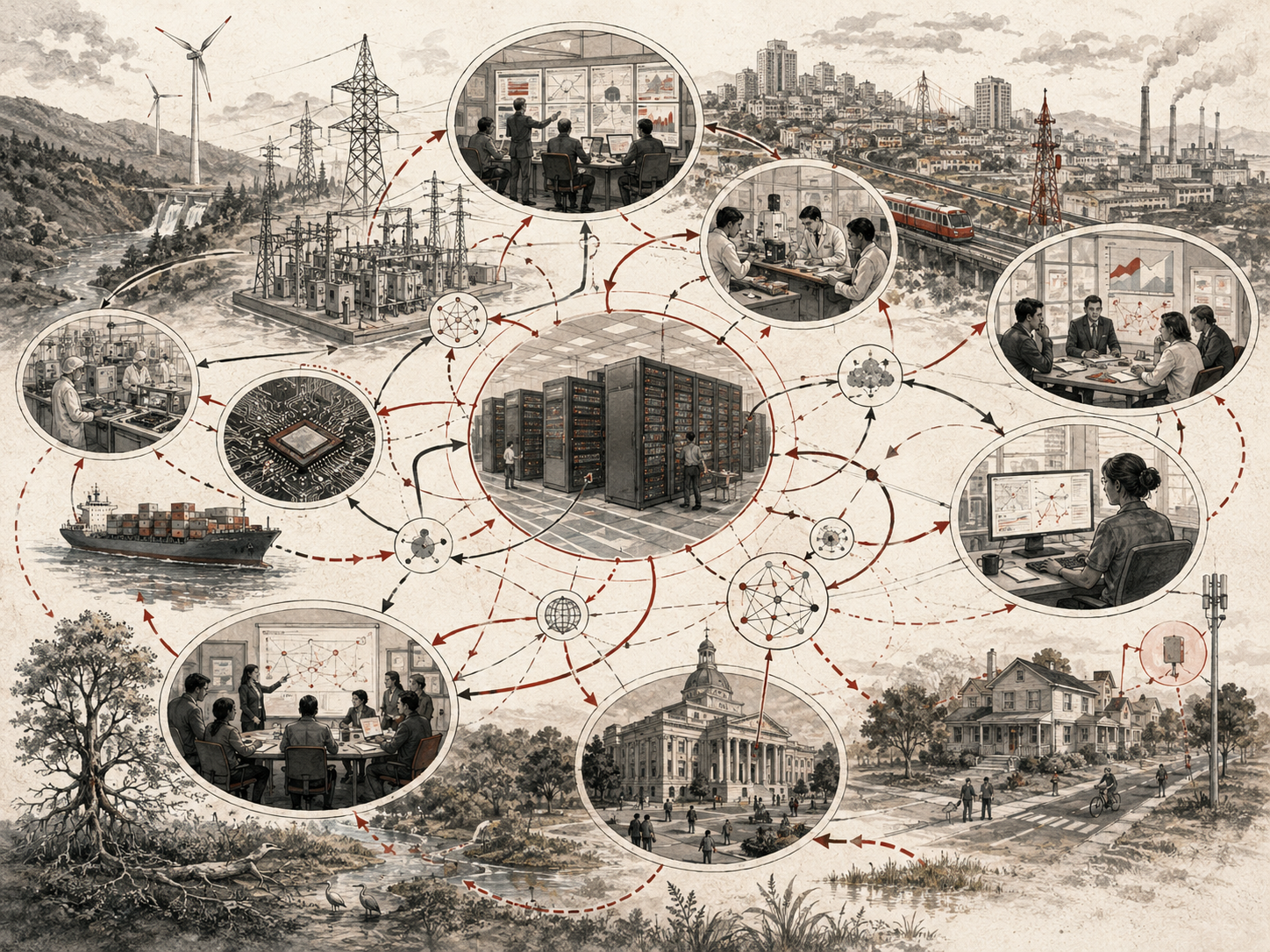
This article explains AI and technology through systems thinking. It examines sociotechnical systems, data pipelines, feedback loops, platform incentives, automation, human judgment, institutional adoption, model drift, algorithmic bias, infrastructure dependency, labor, governance, accountability, public trust, and emergent harm. It shows why responsible AI cannot be reduced to better models alone. The question is not only whether a system works technically, but how it changes behavior, who benefits, who is harmed, what incentives it strengthens, what dependencies it creates, and whether institutions can monitor, contest, repair, and redesign it over time.
Why Systems Thinking Matters for AI and Technology
Systems thinking matters for AI and technology because technological effects do not come from technical artifacts alone. A model, platform, sensor, app, database, robot, or decision-support tool becomes consequential when it is embedded in workflows, institutions, markets, rules, incentives, infrastructure, and human interpretation. Technology changes what people see, what organizations measure, what decisions are automated, what behaviors are rewarded, what labor becomes invisible, and what risks are shifted elsewhere.
A narrow view of AI asks whether a model is accurate, fast, scalable, or innovative. A systems view asks a wider set of questions. What data trained the model? Who produced that data? What histories are encoded in it? What is the model allowed to decide or recommend? Who can challenge the output? What incentives surround deployment? What feedback loops will the system create? What happens when users adapt? What happens when the world changes? Who bears the consequences of error? What happens when many institutions deploy similar systems at once?
AI failures are often systems failures. A model may be statistically strong but deployed in the wrong context. A tool may improve one metric while increasing administrative burden. A recommendation system may optimize engagement while degrading public discourse. A fraud-detection system may reduce losses while wrongly excluding vulnerable people. A hiring tool may reproduce labor-market inequality. A policing technology may amplify surveillance in already over-policed communities. An automation system may remove human discretion where judgment and accountability are needed.
| Narrow technology question | Systems-thinking question | Why it matters |
|---|---|---|
| Is the model accurate? | Accurate for whom, under what conditions, and with what consequences? | Aggregate performance can hide group-level harm and contextual failure. |
| Can the process be automated? | What judgment, rights, labor, accountability, and appeal are being redesigned? | Automation changes power and responsibility, not only efficiency. |
| Does the platform increase engagement? | What behaviors and social patterns does engagement optimization reward? | Attention metrics can amplify misinformation, outrage, addiction, or polarization. |
| Can the system scale? | What risks scale with it? | Bias, dependence, error, surveillance, and cascade risk can scale too. |
| Does the tool reduce cost? | Whose cost is reduced, and whose burden increases? | Technology can shift work onto users, workers, communities, or public systems. |
| Is the technology innovative? | Does it improve public value, dignity, resilience, accountability, and justice? | Novelty is not the same as social benefit. |
Systems thinking is not anti-technology. It makes technology more serious. It asks technology to account for the systems it enters and transforms. It recognizes that technical design is also institutional design, social design, economic design, and ethical design. Responsible AI requires more than model improvement. It requires better feedback, governance, documentation, monitoring, contestability, public accountability, and institutional capacity.
The most important question is not “What can AI do?” It is “What system will this AI become part of, and what pattern will it help produce?”
AI as a Sociotechnical System
AI is a sociotechnical system because it combines technical components with social institutions and human practices. The technical side includes models, data, software, compute infrastructure, interfaces, sensors, optimization methods, deployment pipelines, and monitoring tools. The social side includes users, workers, organizations, laws, norms, incentives, procurement processes, business models, public expectations, and power relations. The system emerges from both.
A model does not decide in a vacuum. It is selected, trained, tuned, deployed, interpreted, trusted, ignored, challenged, audited, updated, or misused by people and institutions. Its outputs become part of workflows. Those workflows may affect hiring, lending, education, healthcare, policing, logistics, content moderation, public benefits, infrastructure management, advertising, insurance, or research. The AI system is therefore not the model alone. It is the model plus the surrounding arrangement of data, rules, decisions, and consequences.
\text{AI System} = \text{Model} + \text{Data} + \text{Infrastructure} + \text{Workflow} + \text{Institution} + \text{Governance}
\]
Interpretation: An AI system includes technical artifacts and the social, institutional, and governance structures through which those artifacts operate.
Sociotechnical thinking helps explain why the same technology can have different effects in different contexts. A decision-support tool may help an expert team when used transparently, with training, review, and appeal. The same tool may harm people when used as an unquestioned authority inside a punitive bureaucracy. A predictive model may support maintenance planning when uncertainty is visible and human expertise remains engaged. The same kind of model may produce injustice when used to rank people without explanation or recourse.
AI systems also reorganize responsibility. When a human decision-maker follows a model recommendation, who is responsible for the decision? The developer? The vendor? The institution? The operator? The manager who set the policy? The dataset? The regulator? Systems thinking does not dissolve responsibility. It maps it. It asks where authority sits, who can override, who can audit, who can appeal, who can repair, and who benefits from ambiguity.
Understanding AI as sociotechnical prevents two common errors: treating technology as neutral and treating social harm as merely a technical bug. Many AI problems are not defects in the model alone. They arise from how institutions define goals, collect data, measure success, distribute authority, and respond to feedback.
Data Flows and Model Boundaries
AI systems depend on data flows. Data is collected, cleaned, labeled, transformed, stored, modeled, evaluated, deployed, monitored, and reused. Each step embeds assumptions. What counts as data? Who is represented? Who is missing? What categories are used? What historical patterns are treated as signal? What outcomes are measured? What errors are tolerated? What context is lost when lived experience becomes a variable?
Data is not raw reality. It is produced through systems. Police data reflects policing patterns. Health data reflects healthcare access. Employment data reflects labor-market discrimination and institutional decisions. Education data reflects school funding, testing regimes, language access, and unequal opportunity. Platform data reflects design choices and user behavior under incentives. Administrative data reflects bureaucratic categories. If those systems are unequal, data can encode inequality even when the model is mathematically sophisticated.
\text{Model Output} = f(\text{Training Data}, \text{Features}, \text{Objective}, \text{Context}, \text{Deployment})
\]
Interpretation: Model behavior depends on data, feature choices, optimization objectives, context, and deployment conditions, not algorithmic form alone.
Boundaries matter. A model can only learn from what it is given and what it is designed to optimize. If a model predicts hospital readmission using cost as a proxy for need, it may reproduce unequal access to care. If a hiring model learns from past hiring outcomes, it may reproduce prior exclusion. If a predictive policing model learns from arrest data, it may reinforce surveillance patterns. If a platform model optimizes engagement, it may ignore public value, psychological harm, or civic trust.
Data flows also create feedback. Once a model is deployed, it may change the data that future models see. A risk model can increase scrutiny of some groups, producing more recorded incidents and reinforcing the model’s belief that those groups are high-risk. A recommendation system can push users toward certain content, then learn from the behavior it helped create. An automated screening system can deny opportunities, reducing future evidence of ability. Feedback can turn biased prediction into self-reinforcing structure.
Systems thinking asks where data comes from, what it leaves out, what system produced it, what feedback loops it enters, and whether the model boundary matches the real-world decision boundary. A model can be internally consistent and externally harmful if its boundaries are wrong.
Feedback Loops in AI Systems
Feedback loops are central to AI systems. A model produces outputs. People or institutions act on those outputs. Those actions change behavior, opportunities, data, incentives, or measurement. Future models then learn from the changed system. This loop can improve performance when feedback is accurate, accountable, and carefully monitored. It can also amplify harm when feedback is biased, incomplete, punitive, or self-reinforcing.
Recommendation systems are a clear example. A platform recommends content. Users click, watch, share, or react. The system interprets these behaviors as signals. It recommends more similar content. Creators adapt to the recommendation logic. Advertisers respond to engagement. Users’ attention patterns change. The system then learns from behavior it helped produce. This is not a passive measurement system. It is an active feedback system.
Decision systems also create feedback. A credit model denies loans to certain applicants. Denial reduces access to capital. Reduced access affects future financial records. Those records reinforce the model’s view of risk. A hiring model screens candidates based on past patterns. Excluded candidates lose opportunities to gain experience. Future data then reflects the exclusion. A school analytics tool labels students at risk. If support follows, the label may help. If stigma follows, the label may harm.
\text{Prediction}_t \rightarrow \text{Decision}_t \rightarrow \text{Behavior}_{t+1} \rightarrow \text{Data}_{t+1} \rightarrow \text{Prediction}_{t+1}
\]
Interpretation: AI systems can create feedback loops when predictions shape decisions, decisions change behavior, and changed behavior becomes future data.
| Feedback loop | How it works | Risk |
|---|---|---|
| Recommendation loop | Recommended content changes user behavior, which trains future recommendations. | Amplification of outrage, misinformation, addiction, or narrow exposure. |
| Surveillance loop | Prediction directs scrutiny, scrutiny creates more records, records reinforce prediction. | Self-confirming risk scores and unequal enforcement. |
| Automation loop | Automated decisions reduce human review, reducing opportunities to detect system error. | Error becomes normalized and hard to contest. |
| Metric optimization loop | Users and institutions adapt to measured targets. | Gaming, Goodhart’s law, and mission drift. |
| Data exclusion loop | Excluded groups generate less visible data, reducing future system quality for them. | Persistent invisibility and unequal performance. |
Responsible AI must monitor feedback loops after deployment. Pre-deployment evaluation is not enough because the system changes once it enters the world. Feedback governance should include drift detection, group-level outcome monitoring, appeal mechanisms, human review, incident reporting, independent audits, community feedback, and authority to pause or redesign systems when harmful loops appear.
AI systems are not only predictive. They are performative. They help create the reality they later claim to measure.
Automation, Human Judgment, and Workflow Design
Automation changes work, authority, responsibility, and attention. It does not simply remove tasks. It redesigns workflows. Some tasks become faster. Some become hidden. Some move to users. Some move to lower-paid workers. Some become monitoring work. Some become exception handling. Some forms of judgment disappear from view. Some decisions become harder to challenge because “the system” appears to have decided.
Human-in-the-loop systems are often presented as a safeguard, but the phrase can be misleading. A human reviewer may lack time, authority, training, context, or institutional support to challenge an automated recommendation. If the interface nudges acceptance, if management rewards throughput, or if liability is ambiguous, human oversight can become symbolic. Real oversight requires power, time, explanation, recourse, and accountability.
Automation bias occurs when people over-trust automated outputs. Deskilling can occur when people stop practicing judgment because the system handles routine cases. Alert fatigue can occur when systems generate too many warnings. Responsibility gaps occur when humans are nominally accountable but not practically empowered. These are workflow design problems, not merely user errors.
\text{Effective Oversight} = f(\text{Authority}, \text{Time}, \text{Context}, \text{Explanation}, \text{Accountability})
\]
Interpretation: Human oversight is meaningful only when people have the authority, time, context, explanation, and accountability needed to act.
Automation can be valuable when it reduces drudgery, improves safety, expands access, detects patterns, supports experts, or handles routine tasks while preserving human judgment where values, rights, context, and uncertainty matter. It becomes dangerous when it replaces judgment with opaque ranking, accelerates harmful decisions, hides burden, or removes meaningful appeal.
Workflow design should ask where automation belongs, where human judgment is essential, where uncertainty should be communicated, where exceptions should be escalated, where users need explanation, and where affected people need recourse. The question is not whether a human is somewhere in the process. The question is whether the system preserves accountable judgment.
Algorithmic Bias and Structural Inequality
Algorithmic bias is often discussed as if it were a technical defect inside a model. Sometimes it is. But many forms of algorithmic bias arise from structural inequality. If historical data reflects exclusion, surveillance, underinvestment, discrimination, or unequal access, models trained on that data may reproduce those patterns. If the objective function reflects institutional priorities rather than human wellbeing, the system may optimize the wrong outcome. If evaluation focuses on aggregate accuracy, group-level harm can remain hidden.
Bias can enter AI systems through data collection, labels, features, model design, deployment context, user interpretation, feedback loops, and institutional use. A model may perform worse for groups underrepresented in training data. It may use proxies for protected characteristics. It may treat unequal historical outcomes as neutral ground truth. It may be deployed in settings where affected people cannot contest errors. It may produce disparate impact even without explicit discriminatory intent.
Systems thinking shifts bias analysis from model-only fairness to structural diagnosis. It asks what social system produced the data, whose outcomes are being predicted, whose interests define success, what harms are possible, what appeal exists, what feedback loops will emerge, and whether the system should be used at all.
\text{Algorithmic Harm} = f(\text{Data Bias}, \text{Objective}, \text{Deployment}, \text{Power}, \text{Feedback})
\]
Interpretation: Algorithmic harm emerges from biased data, optimization goals, deployment context, power relations, and feedback loops.
Fairness metrics can help, but they are not enough. Technical fairness may reduce some disparities while leaving unjust systems intact. A more balanced model can still be deployed for harmful purposes. A risk score can be calibrated and still support punitive surveillance. A content moderation system can improve precision and still silence marginalized speech if context is ignored. A hiring tool can reduce one form of bias while reinforcing credential inequality.
AI ethics therefore requires asking whether the system should exist, not only whether it can be improved. Some contexts demand refusal, limitation, public oversight, or non-automated alternatives. Systems thinking supports this judgment by examining purpose, power, harm, contestability, and structural consequences.
Platforms, Incentives, and Attention Systems
Digital platforms are systems of attention, incentives, data, moderation, advertising, ranking, recommendation, user behavior, creator behavior, and institutional governance. They do not merely host content. They shape visibility. They decide what rises, what disappears, what spreads, what is monetized, what is recommended, what is moderated, and what becomes culturally salient.
Platform systems often optimize measurable engagement. Engagement can be useful, but it is not the same as public value. Content that provokes outrage, fear, identity conflict, or compulsive attention can perform well under engagement metrics. Creators adapt to platform incentives. Users adapt to reward systems. Advertisers follow attention. The platform learns from the behavior it helped create. Over time, the system may amplify the very patterns it claims merely to observe.
Platforms also create power through dependency. Creators depend on algorithmic visibility. Small businesses depend on ranking, search, advertising, and payment systems. News organizations depend on distribution. Users depend on platform identity, social connection, and information access. Public institutions may depend on private platforms for communication. These dependencies give platform governance public significance.
\text{Platform Outcome} = f(\text{Ranking}, \text{Incentives}, \text{User Behavior}, \text{Moderation}, \text{Business Model})
\]
Interpretation: Platform outcomes emerge from ranking systems, incentive design, user adaptation, moderation practices, and business models.
Systems thinking asks what behaviors a platform rewards, what harms it externalizes, what dependencies it creates, what content it amplifies, what labor it hides, and what rights users have. It also asks how public governance can address platform power without suppressing legitimate expression, organizing, dissent, creativity, or access to information.
Platforms should be evaluated as public-impact systems, even when privately owned. Their design choices shape civic life, mental health, labor markets, culture, commerce, public knowledge, and political conflict. Systems thinking helps move beyond blaming individual users and toward analyzing the incentive architecture that shapes collective behavior.
Model Drift, Adaptation, and System Change
AI systems operate in changing environments. Model drift occurs when the relationship between input data and real-world outcomes changes over time. A model trained on past behavior may degrade when user behavior, markets, policies, climate conditions, disease patterns, fraud tactics, language, institutions, or technology change. Drift is not an edge case. It is normal in dynamic systems.
There are different kinds of drift. Data drift occurs when input distributions change. Concept drift occurs when the relationship between inputs and outputs changes. Label drift occurs when outcome definitions or measurement practices change. Behavioral drift occurs when people adapt to the system. Institutional drift occurs when workflows, policies, or incentives change. Social drift occurs when norms, language, or expectations change.
Adaptation can be adversarial or ordinary. Fraudsters adapt to detection models. Students adapt to assessment systems. Applicants adapt to hiring filters. Creators adapt to platform algorithms. Agencies adapt to metrics. Users adapt to recommendation systems. The system changes because people learn how it works or believe they know how it works.
\text{Risk}_{t+1} = f(\text{Model}_t, \text{Environment}_{t+1}, \text{User Adaptation}_{t+1})
\]
Interpretation: Future system risk depends on the model, the changing environment, and how users or institutions adapt to the system.
Responsible AI governance must include post-deployment monitoring. This means tracking performance over time, evaluating group-level outcomes, testing for drift, reviewing incidents, updating documentation, and preserving the ability to pause or retire systems. A model that was acceptable at deployment may become unacceptable after the system changes.
Systems thinking treats AI deployment as the beginning of a lifecycle, not the end of a project. A deployed model becomes part of a living system. It must be monitored like one.
Infrastructure Dependency and Technology Risk
AI and digital systems depend on infrastructure: data centers, cloud providers, chips, electricity, cooling, networks, software libraries, APIs, security systems, labor, supply chains, minerals, finance, standards, and regulation. These dependencies are often hidden behind seamless interfaces. But technological systems are material systems. They require energy, water, land, hardware, maintenance, and people.
Infrastructure dependency creates risk. A cloud outage can disrupt businesses, public agencies, healthcare systems, schools, payment systems, and communications. A software vulnerability can propagate through thousands of dependent systems. A chip supply disruption can affect AI deployment, vehicles, medical devices, telecommunications, and industrial systems. A cyberattack can disable critical services. A power failure can halt digital systems that appear weightless.
AI systems also have environmental and resource consequences. Training and deployment require compute, electricity, cooling, hardware, and supply chains. The environmental cost depends on model size, inference demand, energy sources, data center location, water use, hardware lifecycle, and system purpose. A systems view asks whether AI use is proportionate to public value and whether benefits justify material costs.
\text{Technology Resilience} = f(\text{Compute}, \text{Power}, \text{Network}, \text{Security}, \text{Supply Chain}, \text{Governance})
\]
Interpretation: Technology resilience depends on physical infrastructure, cybersecurity, supply chains, and governance, not software performance alone.
Technology risk is therefore network risk. It involves concentration, dependency, redundancy, cybersecurity, environmental load, vendor lock-in, maintenance capacity, interoperability, and public oversight. A society that embeds AI into essential systems must ask what happens if the AI system fails, if the vendor disappears, if the cloud provider goes down, if the model drifts, if data pipelines break, or if affected people cannot appeal.
Systems thinking turns digital infrastructure from background assumption into an explicit object of governance.
Governance, Accountability, and Contestability
AI governance is the set of rules, institutions, practices, rights, responsibilities, audits, monitoring systems, and accountability mechanisms that shape how AI is designed, deployed, evaluated, challenged, and repaired. Governance is not a document alone. It is a functioning system. It must have authority, resources, expertise, independence, transparency, and consequences.
Accountability means someone can be held responsible for decisions and harms. In AI systems, accountability can become diffuse. Vendors blame users. Institutions blame software. Operators blame policy. Managers blame data. Developers blame deployment context. Regulators lack visibility. Affected people face automated decisions without meaningful explanation. Systems thinking maps accountability so it cannot disappear into technical complexity.
Contestability is the ability to question, appeal, correct, or refuse system outputs. It is essential where AI affects rights, opportunities, services, safety, dignity, or public power. Contestability requires notice, explanation, access, human review, documentation, evidence, timelines, and remedies. A system without contestability can turn error into authority.
\text{AI Accountability} = \text{Transparency} + \text{Responsibility} + \text{Contestability} + \text{Remedy}
\]
Interpretation: AI accountability requires transparency, assigned responsibility, the ability to contest decisions, and meaningful remedy when harm occurs.
| Governance function | Systems role | Failure if absent |
|---|---|---|
| Documentation | Preserves assumptions, data sources, limitations, and intended use. | Systems are reused beyond safe boundaries. |
| Audit | Tests performance, fairness, security, and institutional impact. | Harms remain hidden until they scale. |
| Monitoring | Detects drift, incidents, feedback effects, and group-level harm. | Deployment becomes unmanaged experimentation. |
| Contestability | Allows affected people to challenge outputs and correct errors. | Automated error becomes administrative reality. |
| Public accountability | Connects AI deployment to democratic oversight and rights. | Private or opaque systems exercise public power without scrutiny. |
| Sunset and pause authority | Allows systems to be stopped when harm exceeds benefit. | Bad systems persist because institutions lack exit mechanisms. |
AI governance must also be proportionate. Not every AI system requires the same controls. A text summarization tool used internally has different stakes than an automated system affecting housing, parole, healthcare, immigration, employment, education, or public benefits. Systems thinking helps classify risk by context, consequence, power, reversibility, vulnerability, and scale.
Governance should not be treated as friction against innovation. It is part of responsible technological capacity. A technology system that cannot be governed should not be treated as mature simply because it can be deployed.
Labor, Power, and Invisible Work
AI systems often hide labor. Data must be collected, cleaned, labeled, moderated, verified, annotated, maintained, secured, and interpreted. Models may rely on content moderation workers, data labelers, prompt evaluators, infrastructure technicians, warehouse workers, call-center workers, clinicians, teachers, caseworkers, and users who correct system errors. Automation frequently depends on human labor that is made less visible, less valued, or more precarious.
AI can also redistribute power at work. It can intensify monitoring, standardize performance metrics, automate scheduling, rank workers, evaluate productivity, shape hiring, and reduce discretion. In some contexts, AI can support workers by reducing drudgery, improving safety, and expanding access to information. In others, it can deskill, surveil, discipline, speed up, or displace labor. The difference depends on governance, ownership, bargaining power, transparency, and worker participation.
Systems thinking asks who controls the technology, who is subject to it, who benefits from productivity gains, who absorbs risk, and who has the power to contest decisions. It also asks whether affected workers are involved in design and deployment. Technology imposed on workers without voice often misses operational knowledge and creates resistance, harm, or failure.
Invisible work also appears in public systems. When automated systems are confusing, users must spend time navigating forms, correcting errors, appealing decisions, or contacting support. This shifts administrative burden onto households, especially those with fewer resources. A system that looks efficient to an institution may be costly to the people forced to use it.
AI labor ethics therefore includes workers who build systems, workers managed by systems, users burdened by systems, and communities affected by systems. A serious AI systems analysis must make these labor relationships visible.
Resilience and Responsible Technology Design
Responsible technology design requires resilience. A resilient AI or technology system can detect error, absorb disruption, preserve human accountability, protect vulnerable users, recover from failure, and learn from incidents. It does not assume perfect prediction. It assumes uncertainty, drift, adaptation, misuse, and changing conditions.
Resilience requires redundancy, monitoring, transparency, fallback modes, human expertise, incident response, security, data quality checks, governance review, and meaningful user support. In high-stakes settings, a system should fail safely. It should not deny care, benefits, employment, housing, or rights without explanation and remedy. It should not make essential services dependent on opaque automation with no backup.
Responsible design also requires purpose limitation. Not every process should be automated. Not every prediction should be used. Not every dataset should be collected. Not every efficiency gain is worth the social cost. Systems thinking supports restraint by asking whether a technological intervention improves the whole system or merely shifts burden, accelerates harm, or legitimizes existing injustice.
| Resilience principle | AI and technology application | Why it matters |
|---|---|---|
| Redundancy | Human fallback, alternative workflows, backup infrastructure. | Prevents automation failure from becoming service failure. |
| Monitoring | Drift detection, incident reporting, group-level outcome review. | Detects harm after deployment. |
| Modularity | Limits dependency on one model, vendor, platform, or data pipeline. | Reduces cascade risk and lock-in. |
| Contestability | Appeal, correction, explanation, and human review. | Protects people from opaque error. |
| Transparency | Documentation, public reporting, model cards, data sheets, audit trails. | Supports accountability and learning. |
| Participation | Worker, user, community, and domain-expert involvement. | Improves design and legitimacy. |
Resilient technology is not the same as frictionless technology. Some friction is protective. Review, consent, appeal, rate limits, documentation, and deliberation can slow harmful automation. In systems affecting rights, safety, and dignity, speed is not always the highest value.
Responsible technology design should strengthen human and institutional capacity rather than replace it with brittle automation.
Ethics: Dignity, Power, and Emergent Harm
AI and technology ethics are systems ethics because technological harm often emerges from interaction rather than isolated intent. A platform may amplify harmful content because of incentive design. A model may reproduce inequality because of historical data. An automated system may deny services because of workflow rules. A surveillance tool may expand because institutions reward risk avoidance. A labor platform may produce precarity because flexibility is designed for one side of the market more than the other.
Dignity matters because people should not be reduced to scores, predictions, behavioral traces, or optimization targets. AI systems often classify, rank, recommend, infer, and decide. These activities can be useful, but they can also diminish agency if people cannot understand, challenge, or escape them. A person affected by an AI system should not be treated as a data point without voice.
Power matters because AI systems are usually deployed by institutions with resources: corporations, governments, universities, hospitals, insurers, platforms, employers, banks, or security agencies. Affected people may have less power to refuse, inspect, or contest the system. Ethics therefore requires attention to asymmetry. Consent is weak when participation is required for work, housing, education, healthcare, public benefits, or social life.
Ethical AI systems thinking asks:
- Who defines the purpose of the system?
- Who provides the data, knowingly or unknowingly?
- Who is classified, ranked, predicted, or acted upon?
- Who benefits from automation?
- Who bears the burden of error?
- Who can appeal, correct, or refuse?
- What feedback loops could amplify harm?
- What labor is hidden?
- What dependencies or lock-ins are created?
- What public accountability exists when private technology exercises public power?
Emergent harm requires responsibility even when no single actor intended the outcome. If a system repeatedly produces exclusion, surveillance, manipulation, misinformation, labor exploitation, or administrative burden, the pattern demands redesign. Ethical technology is not only about avoiding bad intent. It is about building systems that can see, prevent, repair, and learn from harm.
Examples Across AI and Technology Systems
Systems thinking applies across many AI and technology contexts. The examples below show how technical tools become consequential through feedback, incentives, institutions, infrastructure, and human adaptation.
Recommendation systems
Recommendation systems shape attention by learning from user behavior that the system itself helps create. Without governance, engagement optimization can amplify harmful or low-quality content.
Predictive policing
Prediction can direct more surveillance toward already-policed areas, creating more recorded incidents and reinforcing the model’s future predictions.
Hiring algorithms
Hiring tools trained on past employment patterns can reproduce exclusion unless data, objectives, evaluation, and institutional use are redesigned.
Healthcare decision support
Clinical AI can support diagnosis and triage, but it must account for data quality, access inequality, workflow pressure, uncertainty, and patient rights.
Public-benefit automation
Automated eligibility systems can reduce administrative cost while increasing wrongful denial, burden, opacity, and appeal difficulty for vulnerable households.
Generative AI at work
Generative tools can support drafting, coding, research, and analysis, but they also reshape skill, accountability, authorship, review, labor expectations, and knowledge quality.
Smart infrastructure
Sensors and AI can improve maintenance and resilience, but they create dependencies on data quality, cybersecurity, energy, vendors, governance, and public trust.
Content moderation
Moderation systems combine automated detection, human labor, policy, cultural context, appeals, platform incentives, and political conflict.
Across these examples, the key question is not whether AI can perform a task. It is how the task changes when AI becomes part of a larger system of power, behavior, data, and consequence.
Mathematics, Computation, and Modeling
AI and technology systems can be modeled through feedback simulations, fairness diagnostics, drift detection, causal diagrams, dependency networks, risk scoring, scenario analysis, agent-based models, human-in-the-loop workflow models, and governance indicators. These models should not create false certainty. Their purpose is to make assumptions, feedback loops, disparities, dependencies, and governance gaps visible.
A model prediction can be represented as:
\hat{y} = f(X; \theta)
\]
Interpretation: A model produces prediction \(\hat{y}\) from input features \(X\) using learned parameters \(\theta\).
A feedback loop between prediction and future data can be represented as:
X_{t+1} = g(X_t, \hat{y}_t, D_t, A_t)
\]
Interpretation: Future data \(X_{t+1}\) can be shaped by current data, model predictions, institutional decisions \(D_t\), and user adaptation \(A_t\).
A basic group disparity measure can be represented as:
\Delta_g = \left| Error_g – Error_{ref} \right|
\]
Interpretation: Group disparity can be measured as the difference between error for group \(g\) and a reference group, though no single metric captures all fairness concerns.
A drift score can be represented conceptually as:
Drift_t = distance(P(X_t), P(X_{train}))
\]
Interpretation: Drift measures how much current input data differs from the training distribution.
An AI governance readiness index can be represented as:
GAI = w_dD + w_mM + w_aA + w_cC + w_rR
\]
Interpretation: Governance readiness can combine documentation, monitoring, audit, contestability, and remedy using transparent weights.
| Modeling task | Systems question | Example output |
|---|---|---|
| Feedback simulation | How do model outputs shape future data? | Self-reinforcement, drift, amplification, or correction trajectories. |
| Fairness diagnostics | Who experiences higher error, denial, burden, or surveillance? | Group-level error, access, false positive, and false negative tables. |
| Drift monitoring | Is the deployment environment changing? | Distribution shifts, performance decline, and update triggers. |
| Workflow modeling | Where does automation change judgment, burden, or authority? | Human review load, appeal pathways, escalation points, and bottlenecks. |
| Dependency mapping | What infrastructure, vendors, data systems, and labor does the technology depend on? | Dependency matrix, lock-in risk, and failure pathways. |
| Governance scoring | Does the institution have capacity to monitor and repair the system? | Documentation, audit, contestability, remedy, and incident-response indicators. |
AI systems modeling should include technical performance and institutional context. A model with high accuracy but weak contestability, high drift, severe group disparity, and no incident response is not a responsible system. Systems thinking brings these dimensions into the same analytical frame.
Python Workflow: AI System Feedback, Bias, Drift, and Governance Scenarios
The Python workflow for this article models AI systems through synthetic data, group-level error, feedback amplification, drift, automation burden, and governance controls. It uses only the Python standard library so it can run without external dependencies. The workflow compares four scenarios: unmanaged automation, biased feedback loop, monitored deployment, and accountable human-centered governance. It exports time-series tables, risk summaries, and validation reports.
# ai_technology_systems_model.py
# Dependency-light professional workflow for AI and technology systems analysis.
# Purpose: model feedback loops, group-level harm, drift, automation burden, and governance readiness.
# Uses only Python standard library.

from dataclasses import dataclass
import csv
import math
import os
import random
from statistics import mean

OUTPUT_TABLES = "outputs/tables"

@dataclass
class AIScenario:
    name: str
    periods: int
    base_accuracy: float
    group_gap: float
    feedback_strength: float
    drift_rate: float
    automation_level: float
    human_review_capacity: float
    appeal_access: float
    monitoring_strength: float
    remedy_strength: float
    vulnerability_weight: float

def ensure_outputs() -> None:
    os.makedirs(OUTPUT_TABLES, exist_ok=True)

def clamp(value: float, low: float = 0.0, high: float = 100.0) -> float:
    return max(low, min(high, value))

def run_scenario(scenario: AIScenario, seed: int = 42) -> list[dict]:
    rng = random.Random(seed)

    drift = 0.0
    feedback_bias = scenario.group_gap
    documentation_quality = 45.0 + scenario.monitoring_strength * 25.0
    rows = []

    for period in range(scenario.periods + 1):
        drift = clamp(drift + scenario.drift_rate * (1.0 - scenario.monitoring_strength * 0.35), 0.0, 100.0)

        # Feedback bias grows when automated decisions shape future data without monitoring or remedy.
        feedback_bias = clamp(
            feedback_bias
            + scenario.feedback_strength * scenario.automation_level * 2.0
            - scenario.monitoring_strength * 0.70
            - scenario.remedy_strength * 0.55,
            0.0,
            100.0
        )

        base_error = clamp(100.0 - scenario.base_accuracy + drift * 0.18)
        group_a_error = clamp(base_error)
        group_b_error = clamp(base_error + feedback_bias * 0.35 + scenario.vulnerability_weight * 0.10)

        false_positive_gap = clamp(group_b_error - group_a_error)
        false_negative_gap = clamp(feedback_bias * 0.25 + drift * 0.08)

        automation_burden = clamp(
            scenario.automation_level * 55.0
            - scenario.human_review_capacity * 18.0
            - scenario.appeal_access * 16.0
            + drift * 0.10
        )

        human_review_backlog = clamp(
            scenario.automation_level * 45.0
            + group_b_error * 0.25
            - scenario.human_review_capacity * 38.0
        )

        contestability_index = clamp(
            scenario.appeal_access * 45.0
            + scenario.human_review_capacity * 30.0
            + scenario.remedy_strength * 25.0
            - automation_burden * 0.20
        )

        governance_readiness = clamp(
            documentation_quality * 0.22
            + scenario.monitoring_strength * 28.0
            + scenario.remedy_strength * 24.0
            + scenario.appeal_access * 18.0
            + scenario.human_review_capacity * 12.0
        )

        ai_system_risk = clamp(
            group_b_error * 0.24
            + false_positive_gap * 0.20
            + false_negative_gap * 0.16
            + drift * 0.16
            + automation_burden * 0.14
            + human_review_backlog * 0.10
            - governance_readiness * 0.20
        )

        public_trust = clamp(
            78.0
            - ai_system_risk * 0.45
            - automation_burden * 0.18
            + contestability_index * 0.20
            + scenario.remedy_strength * 8.0
        )

        rows.append({
            "period": period,
            "scenario": scenario.name,
            "drift_index": round(drift, 3),
            "feedback_bias_index": round(feedback_bias, 3),
            "group_a_error": round(group_a_error, 3),
            "group_b_error": round(group_b_error, 3),
            "false_positive_gap": round(false_positive_gap, 3),
            "false_negative_gap": round(false_negative_gap, 3),
            "automation_burden": round(automation_burden, 3),
            "human_review_backlog": round(human_review_backlog, 3),
            "contestability_index": round(contestability_index, 3),
            "governance_readiness": round(governance_readiness, 3),
            "ai_system_risk": round(ai_system_risk, 3),
            "public_trust": round(public_trust, 3)
        })

    return rows

def write_csv(path: str, rows: list[dict]) -> None:
    if not rows:
        return
    with open(path, "w", newline="", encoding="utf-8") as handle:
        writer = csv.DictWriter(handle, fieldnames=list(rows[0].keys()))
        writer.writeheader()
        writer.writerows(rows)

def summarize(rows: list[dict]) -> list[dict]:
    scenarios = sorted(set(row["scenario"] for row in rows))
    summary = []

    for scenario_name in scenarios:
        subset = [row for row in rows if row["scenario"] == scenario_name]
        final = subset[-1]
        average_risk = mean(row["ai_system_risk"] for row in subset)
        max_gap = max(row["false_positive_gap"] for row in subset)
        max_backlog = max(row["human_review_backlog"] for row in subset)
        min_trust = min(row["public_trust"] for row in subset)

        summary.append({
            "scenario": scenario_name,
            "final_ai_system_risk": final["ai_system_risk"],
            "average_ai_system_risk": round(average_risk, 3),
            "maximum_false_positive_gap": round(max_gap, 3),
            "maximum_human_review_backlog": round(max_backlog, 3),
            "minimum_public_trust": round(min_trust, 3),
            "final_governance_readiness": final["governance_readiness"],
            "final_contestability_index": final["contestability_index"],
            "diagnostic": (
                "high-risk AI system" if average_risk >= 45 or max_gap >= 25 else
                "moderate risk requiring stronger governance" if average_risk >= 28 or max_backlog >= 35 else
                "comparatively accountable AI pathway"
            )
        })

    return summary

def validate(rows: list[dict]) -> list[str]:
    errors = []
    bounded_fields = [
        "drift_index",
        "feedback_bias_index",
        "group_a_error",
        "group_b_error",
        "false_positive_gap",
        "false_negative_gap",
        "automation_burden",
        "human_review_backlog",
        "contestability_index",
        "governance_readiness",
        "ai_system_risk",
        "public_trust"
    ]

    for row in rows:
        for field in bounded_fields:
            if row[field] < -0.001 or row[field] > 100.001:
                errors.append(f"{field} outside 0-100 range in {row['scenario']} period {row['period']}.")

    return errors

def main() -> None:
    ensure_outputs()

    scenarios = [
        AIScenario(
            name="Unmanaged automation",
            periods=36,
            base_accuracy=82.0,
            group_gap=18.0,
            feedback_strength=0.62,
            drift_rate=2.2,
            automation_level=0.86,
            human_review_capacity=0.20,
            appeal_access=0.15,
            monitoring_strength=0.10,
            remedy_strength=0.08,
            vulnerability_weight=55.0
        ),
        AIScenario(
            name="Biased feedback loop",
            periods=36,
            base_accuracy=84.0,
            group_gap=24.0,
            feedback_strength=0.78,
            drift_rate=1.8,
            automation_level=0.78,
            human_review_capacity=0.28,
            appeal_access=0.18,
            monitoring_strength=0.18,
            remedy_strength=0.12,
            vulnerability_weight=62.0
        ),
        AIScenario(
            name="Monitored deployment",
            periods=36,
            base_accuracy=85.0,
            group_gap=14.0,
            feedback_strength=0.34,
            drift_rate=1.4,
            automation_level=0.58,
            human_review_capacity=0.58,
            appeal_access=0.52,
            monitoring_strength=0.68,
            remedy_strength=0.48,
            vulnerability_weight=42.0
        ),
        AIScenario(
            name="Accountable human-centered governance",
            periods=36,
            base_accuracy=86.0,
            group_gap=10.0,
            feedback_strength=0.22,
            drift_rate=1.1,
            automation_level=0.42,
            human_review_capacity=0.78,
            appeal_access=0.82,
            monitoring_strength=0.84,
            remedy_strength=0.78,
            vulnerability_weight=34.0
        )
    ]

    all_rows = []
    for index, scenario in enumerate(scenarios):
        all_rows.extend(run_scenario(scenario, seed=42 + index))

    validation_errors = validate(all_rows)
    if validation_errors:
        raise ValueError("Validation failed:\n" + "\n".join(validation_errors))

    summary_rows = summarize(all_rows)

    write_csv(os.path.join(OUTPUT_TABLES, "ai_technology_systems_timeseries.csv"), all_rows)
    write_csv(os.path.join(OUTPUT_TABLES, "ai_technology_systems_summary.csv"), summary_rows)

    with open(os.path.join(OUTPUT_TABLES, "validation_report.txt"), "w", encoding="utf-8") as handle:
        handle.write("Validation passed.\n")
        handle.write("Bounded indicators, fairness gaps, drift, governance readiness, and risk outputs completed.\n")

    print("\nAI and technology systems scenario summary:")
    for row in summary_rows:
        print(
            f"{row['scenario']}: avg risk={row['average_ai_system_risk']}, "
            f"max FP gap={row['maximum_false_positive_gap']}, "
            f"diagnostic={row['diagnostic']}"
        )

if __name__ == "__main__":
    main()
This workflow shows how AI risk can grow through feedback, drift, group-level disparity, automation burden, and weak governance. It also shows how monitoring, appeal access, human review capacity, and remedy can reduce risk. The purpose is not to simulate any real system directly, but to provide a reusable structure for thinking about AI as a dynamic sociotechnical system.
A fuller repository version can add optional pandas and matplotlib workflows for richer dashboards, Excel workbooks, group-level risk analysis, drift plots, fairness tables, and scenario comparisons while preserving this standard-library script as the default smoke-tested workflow.
R Workflow: AI System Indicators, Risk Tables, and Governance Visualization
The R workflow for this article uses base R so it can run without additional package dependencies. It reads the Python-generated AI systems outputs, creates scenario summaries, exports diagnostic tables, and produces plots for drift, feedback bias, group error gaps, automation burden, governance readiness, system risk, and public trust.
# ai_technology_systems_diagnostics.R
# Base R AI systems workflow.
# Purpose: summarize AI feedback, drift, fairness, automation burden, and governance scenarios.

tables_dir <- "outputs/tables"
figures_dir <- "outputs/figures"

if (!dir.exists(figures_dir)) {
  dir.create(figures_dir, recursive = TRUE)
}

timeseries_path <- file.path(tables_dir, "ai_technology_systems_timeseries.csv")
summary_path <- file.path(tables_dir, "ai_technology_systems_summary.csv")

if (!file.exists(timeseries_path)) {
  stop("Missing ai_technology_systems_timeseries.csv. Run the Python workflow first.")
}

ai <- read.csv(timeseries_path, stringsAsFactors = FALSE)

last_by_scenario <- do.call(
  rbind,
  lapply(split(ai, ai$scenario), function(df) df[nrow(df), ])
)

avg_risk <- aggregate(ai_system_risk ~ scenario, data = ai, FUN = mean)
max_gap <- aggregate(false_positive_gap ~ scenario, data = ai, FUN = max)
max_backlog <- aggregate(human_review_backlog ~ scenario, data = ai, FUN = max)
min_trust <- aggregate(public_trust ~ scenario, data = ai, FUN = min)

names(avg_risk)[2] <- "average_ai_system_risk"
names(max_gap)[2] <- "maximum_false_positive_gap"
names(max_backlog)[2] <- "maximum_human_review_backlog"
names(min_trust)[2] <- "minimum_public_trust"

diagnostics <- Reduce(
  function(x, y) merge(x, y, by = "scenario"),
  list(avg_risk, max_gap, max_backlog, min_trust)
)

diagnostics$diagnostic <- ifelse(
  diagnostics$average_ai_system_risk >= 45 |
    diagnostics$maximum_false_positive_gap >= 25,
  "high-risk AI system",
  ifelse(
    diagnostics$average_ai_system_risk >= 28 |
      diagnostics$maximum_human_review_backlog >= 35,
    "moderate risk requiring stronger governance",
    "comparatively accountable AI pathway"
  )
)

write.csv(diagnostics, summary_path, row.names = FALSE)
print(diagnostics)

plot_metric <- function(metric, y_label, title, output_name) {
  png(file.path(figures_dir, output_name), width = 1200, height = 700)
  scenarios <- unique(ai$scenario)
  plot(
    NA,
    xlim = range(ai$period),
    ylim = range(ai[[metric]], na.rm = TRUE),
    xlab = "Period",
    ylab = y_label,
    main = title
  )
  for (scenario_name in scenarios) {
    subset_data <- ai[ai$scenario == scenario_name, ]
    lines(subset_data$period, subset_data[[metric]], lwd = 2)
  }
  legend("topleft", legend = scenarios, lwd = 2, cex = 0.8, bty = "n")
  grid()
  dev.off()
}

plot_metric(
  metric = "drift_index",
  y_label = "Drift index",
  title = "Model Drift by AI Governance Scenario",
  output_name = "ai_drift_trajectories.png"
)

plot_metric(
  metric = "feedback_bias_index",
  y_label = "Feedback bias index",
  title = "AI Feedback Bias by Scenario",
  output_name = "ai_feedback_bias_trajectories.png"
)

plot_metric(
  metric = "false_positive_gap",
  y_label = "False positive gap",
  title = "Group-Level False Positive Gap by Scenario",
  output_name = "ai_false_positive_gap_trajectories.png"
)

plot_metric(
  metric = "automation_burden",
  y_label = "Automation burden",
  title = "Automation Burden by Scenario",
  output_name = "ai_automation_burden_trajectories.png"
)

plot_metric(
  metric = "governance_readiness",
  y_label = "Governance readiness",
  title = "AI Governance Readiness by Scenario",
  output_name = "ai_governance_readiness_trajectories.png"
)

plot_metric(
  metric = "ai_system_risk",
  y_label = "AI system risk",
  title = "AI System Risk by Scenario",
  output_name = "ai_system_risk_trajectories.png"
)

plot_metric(
  metric = "public_trust",
  y_label = "Public trust",
  title = "Public Trust by AI Governance Scenario",
  output_name = "ai_public_trust_trajectories.png"
)

final_table <- last_by_scenario[, c(
  "scenario",
  "drift_index",
  "feedback_bias_index",
  "group_a_error",
  "group_b_error",
  "false_positive_gap",
  "automation_burden",
  "contestability_index",
  "governance_readiness",
  "ai_system_risk",
  "public_trust"
)]

write.csv(
  final_table,
  file.path(tables_dir, "ai_technology_final_diagnostics.csv"),
  row.names = FALSE
)

print(final_table)
This R workflow helps interpret AI risk as behavior over time rather than a one-time model score. It shows how drift, feedback bias, group disparity, automation burden, governance readiness, and public trust change across scenarios. The default version is portable and dependency-light, supporting reproducible analysis without requiring additional packages.
A fuller version can add package-based dashboards, fairness visualizations, uncertainty analysis, drift alerts, and governance scorecards through an optional advanced analysis environment. The base R workflow remains the stable reproducible layer.
GitHub Repository
The companion repository for this article should help readers model AI and technology systems through feedback loops, group-level error, drift, automation burden, governance readiness, contestability, infrastructure dependency, public trust, and responsible technology design using synthetic datasets and reproducible workflows.
Complete Code RepositoryCompanion repository for the article, including AI systems simulations, feedback-loop models, fairness and drift diagnostics, automation-burden scenarios, governance-readiness indicators, Python and R workflow scripts, synthetic datasets, documentation assets, and multi-language scaffolds for systems analysis.
articles/systems-thinking-in-ai-and-technology/
├── python/
│   ├── ai_technology_systems_model.py
│   ├── feedback_loop_scenarios.py
│   ├── fairness_drift_diagnostics.py
│   ├── automation_burden_model.py
│   ├── governance_readiness_index.py
│   ├── technology_dependency_mapping.py
│   └── export_ai_system_outputs.py
├── r/
│   ├── ai_technology_systems_diagnostics.R
│   ├── drift_visualization.R
│   ├── fairness_gap_tables.R
│   ├── governance_readiness_plots.R
│   ├── automation_burden_summary.R
│   └── export_ai_system_tables.R
├── julia/
│   ├── nonlinear_ai_feedback_dynamics.jl
│   ├── drift_sensitivity_model.jl
│   └── governance_thresholds.jl
├── sql/
│   ├── schema_model_runs.sql
│   ├── schema_group_outcomes.sql
│   ├── schema_drift_indicators.sql
│   ├── schema_feedback_events.sql
│   ├── schema_human_review.sql
│   ├── schema_governance_controls.sql
│   ├── schema_incidents.sql
│   └── schema_outputs.sql
├── rust/
│   └── ai_system_scenario_validator.rs
├── go/
│   └── ai_system_scenario_runner.go
├── cpp/
│   ├── efficient_drift_scan.cpp
│   └── fairness_gap_solver.cpp
├── fortran/
│   └── recurrence_ai_feedback_model.f90
├── c/
│   └── low_level_ai_feedback_kernel.c
├── docs/
│   ├── modeling_principles.md
│   ├── article_notes.md
│   ├── ai_systems_framework.md
│   ├── feedback_and_drift_guide.md
│   ├── governance_readiness_notes.md
│   ├── python_workflow.md
│   ├── r_workflow.md
│   ├── diagnostic_questions.md
│   ├── ethics_and_responsible_ai.md
│   ├── assumptions_and_limitations.md
│   └── responsible_use.md
├── data/
│   ├── synthetic_model_runs.csv
│   ├── synthetic_group_outcomes.csv
│   ├── synthetic_drift_indicators.csv
│   ├── synthetic_feedback_events.csv
│   ├── synthetic_human_review.csv
│   ├── synthetic_governance_controls.csv
│   ├── synthetic_incidents.csv
│   └── synthetic_outputs.csv
├── outputs/
│   ├── README.md
│   ├── figures/
│   └── tables/
└── notebooks/
    ├── python_ai_systems_walkthrough.ipynb
    └── r_ai_systems_diagnostics_visualization_placeholder.ipynb
This repository structure supports the article’s central argument: AI and technology systems must be analyzed through feedback, drift, fairness, automation burden, infrastructure dependency, governance readiness, contestability, labor, and public trust. The python/ folder supports dependency-light simulation and diagnostics. The r/ folder supports visualization and interpretive summaries. The julia folder supports nonlinear AI feedback dynamics. The sql folder defines schemas for AI systems data. The lower-level language folders provide scaffolds for drift scanning, fairness-gap solving, recurrence modeling, and low-level feedback simulation.
A Practical Method for AI and Technology Systems Diagnosis
AI and technology systems diagnosis requires moving from model-centered evaluation to sociotechnical analysis. The method below can support responsible AI review, technology governance, platform analysis, digital transformation, public-sector automation, infrastructure intelligence, and institutional risk assessment.
1. Define the system boundary
Clarify whether the system includes a model, workflow, platform, data pipeline, vendor, users, institution, infrastructure, legal process, or public service.
2. Identify the decision or influence pathway
Map what the technology predicts, recommends, ranks, generates, moderates, automates, or enables, and how that output affects real decisions.
3. Trace data origins and exclusions
Ask what system produced the data, who is represented, who is missing, what categories are used, and what histories are encoded.
4. Map feedback loops
Identify how outputs change behavior, decisions, future data, institutional incentives, and user adaptation.
5. Evaluate group-level outcomes
Measure error, denial, burden, surveillance, access, and benefit across affected groups rather than relying on aggregate performance.
6. Analyze workflow and authority
Ask who can accept, reject, override, appeal, audit, pause, or repair the system and whether they have real authority.
7. Assess infrastructure and vendor dependencies
Map cloud, compute, data, software, security, energy, supply-chain, vendor, and labor dependencies.
8. Test drift and adaptation
Monitor changing data distributions, behavior shifts, adversarial adaptation, institutional changes, and performance decline.
9. Evaluate governance readiness
Review documentation, audit, monitoring, contestability, incident response, remedy, accountability, and sunset authority.
10. Decide whether to deploy, limit, redesign, or refuse
Use the systems diagnosis to determine whether the technology improves the whole system or whether it should be paused, constrained, redesigned, or rejected.
Common Pitfalls
AI and technology analysis can fail when tools are treated as isolated artifacts rather than sociotechnical systems. Several patterns are especially common.
- Model accuracy as the whole evaluation: aggregate accuracy can hide group-level harm, weak contestability, drift, and institutional misuse.
- Assuming automation removes human judgment: automation redistributes judgment, authority, burden, and responsibility rather than eliminating them.
- Treating data as neutral: data is produced by social, institutional, historical, and technical systems.
- Ignoring feedback loops: AI systems can shape the future data and behavior they later claim to measure.
- Using human oversight as decoration: human review is meaningful only when reviewers have time, authority, context, and accountability.
- Separating ethics from infrastructure: compute, energy, labor, vendors, cybersecurity, and environmental costs are part of responsible technology analysis.
- Confusing innovation with public value: a system can be technically novel while socially harmful or institutionally brittle.
- Deploying without exit mechanisms: systems need pause, sunset, appeal, and repair pathways before harm scales.
The deeper mistake is treating AI as a tool that acts on the world from outside, rather than as a system that becomes part of the world and changes the conditions it measures.
Why AI and Technology Require Systems Thinking
AI and technology require systems thinking because their consequences emerge from interaction. Models interact with data, users, institutions, incentives, infrastructure, labor, governance, and public trust. Platforms interact with attention, advertising, creators, algorithms, moderation, and social behavior. Automation interacts with workflows, accountability, expertise, and administrative burden. Digital infrastructure interacts with energy, water, hardware, vendors, cybersecurity, and supply chains.
A model can be technically impressive and socially dangerous. A platform can be efficient and democratically corrosive. An automated system can reduce institutional workload while increasing human burden. A decision tool can improve average performance while harming a vulnerable group. A smart infrastructure system can improve monitoring while increasing dependency and surveillance. Systems thinking makes these trade-offs visible.
The core question is not whether AI is good or bad in general. It is what system a particular technology enters, what feedback loops it creates, what incentives it strengthens, what dependencies it introduces, what harms it may amplify, and whether affected people have voice, contestability, and remedy. Responsible technology cannot be judged by capability alone. It must be judged by its system effects.
Systems thinking supports a more mature technological imagination. It allows AI and digital tools to be used where they genuinely support learning, access, safety, sustainability, creativity, resilience, and public value. It also supports restraint where automation would deepen inequality, obscure responsibility, or scale harm. Technology should strengthen human and institutional capacity, not replace accountability with opacity. AI becomes responsible only when the systems around it are responsible too.
Related Articles
- What Is Systems Thinking?
- Emergence, Adaptation, and Complexity
- Networks, Dependencies, and Cascade Risk
- Systems Thinking in Governance and Public Institutions
- Public Health as a System
- Urban Systems: Congestion, Housing, and Infrastructure
- Platforms, Feedback Loops, and Digital Systems
- Intelligent Infrastructure as a System
Further Reading
- Barocas, Solon, Hardt, Moritz and Narayanan, Arvind. Fairness and Machine Learning.
- Benjamin, Ruha. Race After Technology: Abolitionist Tools for the New Jim Code. Polity.
- Eubanks, Virginia. Automating Inequality: How High-Tech Tools Profile, Police, and Punish the Poor. St. Martin’s Press.
- Noble, Safiya Umoja. Algorithms of Oppression: How Search Engines Reinforce Racism. NYU Press.
- O’Neil, Cathy. Weapons of Math Destruction. Crown.
- Pasquale, Frank. The Black Box Society. Harvard University Press.
- Selbst, Andrew D. et al. “Fairness and Abstraction in Sociotechnical Systems.” Proceedings of the Conference on Fairness, Accountability, and Transparency.
- Raji, Inioluwa Deborah et al. “Closing the AI Accountability Gap.” Proceedings of the 2020 Conference on Fairness, Accountability, and Transparency.
- Mitchell, Margaret et al. “Model Cards for Model Reporting.” Proceedings of the Conference on Fairness, Accountability, and Transparency.
- Meadows, Donella H. Thinking in Systems: A Primer. Chelsea Green Publishing.
References
- Barocas, S., Hardt, M. and Narayanan, A. (2019) Fairness and Machine Learning: Limitations and Opportunities. Available at: https://fairmlbook.org/
- Benjamin, R. (2019) Race After Technology: Abolitionist Tools for the New Jim Code. Cambridge: Polity.
- Eubanks, V. (2018) Automating Inequality: How High-Tech Tools Profile, Police, and Punish the Poor. New York: St. Martin’s Press.
- Meadows, D.H. (2008) Thinking in Systems: A Primer. White River Junction, VT: Chelsea Green Publishing. Available at: https://www.chelseagreen.com/product/thinking-in-systems/
- Mitchell, M. et al. (2019) “Model Cards for Model Reporting.” Proceedings of the Conference on Fairness, Accountability, and Transparency, pp. 220–229. Available at: https://doi.org/10.1145/3287560.3287596
- Noble, S.U. (2018) Algorithms of Oppression: How Search Engines Reinforce Racism. New York: NYU Press.
- O’Neil, C. (2016) Weapons of Math Destruction: How Big Data Increases Inequality and Threatens Democracy. New York: Crown.
- Pasquale, F. (2015) The Black Box Society: The Secret Algorithms That Control Money and Information. Cambridge, MA: Harvard University Press.
- Raji, I.D. et al. (2020) “Closing the AI Accountability Gap: Defining an End-to-End Framework for Internal Algorithmic Auditing.” Proceedings of the 2020 Conference on Fairness, Accountability, and Transparency, pp. 33–44. Available at: https://doi.org/10.1145/3351095.3372873
- Selbst, A.D. et al. (2019) “Fairness and Abstraction in Sociotechnical Systems.” Proceedings of the Conference on Fairness, Accountability, and Transparency, pp. 59–68. Available at: https://doi.org/10.1145/3287560.3287598