
Last Updated May 3, 2026
Yiddish Literature and Cultural Memory explores one of the most important literary traditions of the Jewish diaspora as a medium of communal memory, linguistic survival, religious inheritance, humor, suffering, everyday life, and modern transformation. For centuries, Yiddish served not only as a vernacular language, but also as a vessel through which Ashkenazi Jewish communities narrated family life, sacred learning, labor, migration, political struggle, urban change, theater, journalism, domestic intimacy, religious ambivalence, and the fragility of belonging. Yiddish literature therefore preserves a deeply textured archive of cultural continuity shaped by ordinary life, textual inheritance, modern upheaval, and historical catastrophe.
This category approaches Yiddish literature not simply as writing produced in a historically significant Jewish language, but as a world-making vernacular tradition. Yiddish is not incidental to the archive it carries. It holds a particular social intimacy: the tones of household speech, study, argument, prayer, irony, tenderness, complaint, satire, gossip, song, rebuke, and lament. Through Yiddish, whole communities remembered themselves in the language of daily life rather than solely in the language of sacred authority. That vernacular force gives the tradition much of its singular power. It allows literature to preserve not only doctrines, events, and institutions, but the moral weather and emotional grain of a civilization.
Current Space
Literature & Cultural Memory
Current Topic
Yiddish Literature
At the same time, Yiddish literature emerges within a deeply textual culture already shaped by commentary, interpretation, law, scriptural memory, liturgical cadence, and habits of argument. It lives in relation to Hebrew and Aramaic, to surrounding majority languages, to multilingual Jewish life, and to the layered hierarchy of sacred, learned, and everyday speech. It is therefore not simply vernacular writing beside religious tradition. It is vernacular writing formed under the pressure of inherited textual worlds, legal obligation, communal expectation, social vulnerability, and the moral seriousness of a people long accustomed to living through language, study, and transmission.
Yiddish literature also belongs to one of the great histories of modern rupture. It developed across Eastern Europe, migrated into global cities, entered mass print culture, transformed through theater and journalism, absorbed socialism, secularization, nationalism, modernism, and migration, and then faced the catastrophic destruction of many of the communities in which Yiddish had flourished as a living everyday language. Its afterlife is therefore inseparable from translation, archival recovery, performance revival, postvernacular memory, and the ethics of reading after loss. Yet the tradition must not be reduced to disappearance. Its power lies in the fact that it preserves a world as lived: comic, argumentative, devout, skeptical, poor, learned, ambitious, wounded, theatrical, intimate, and alive.
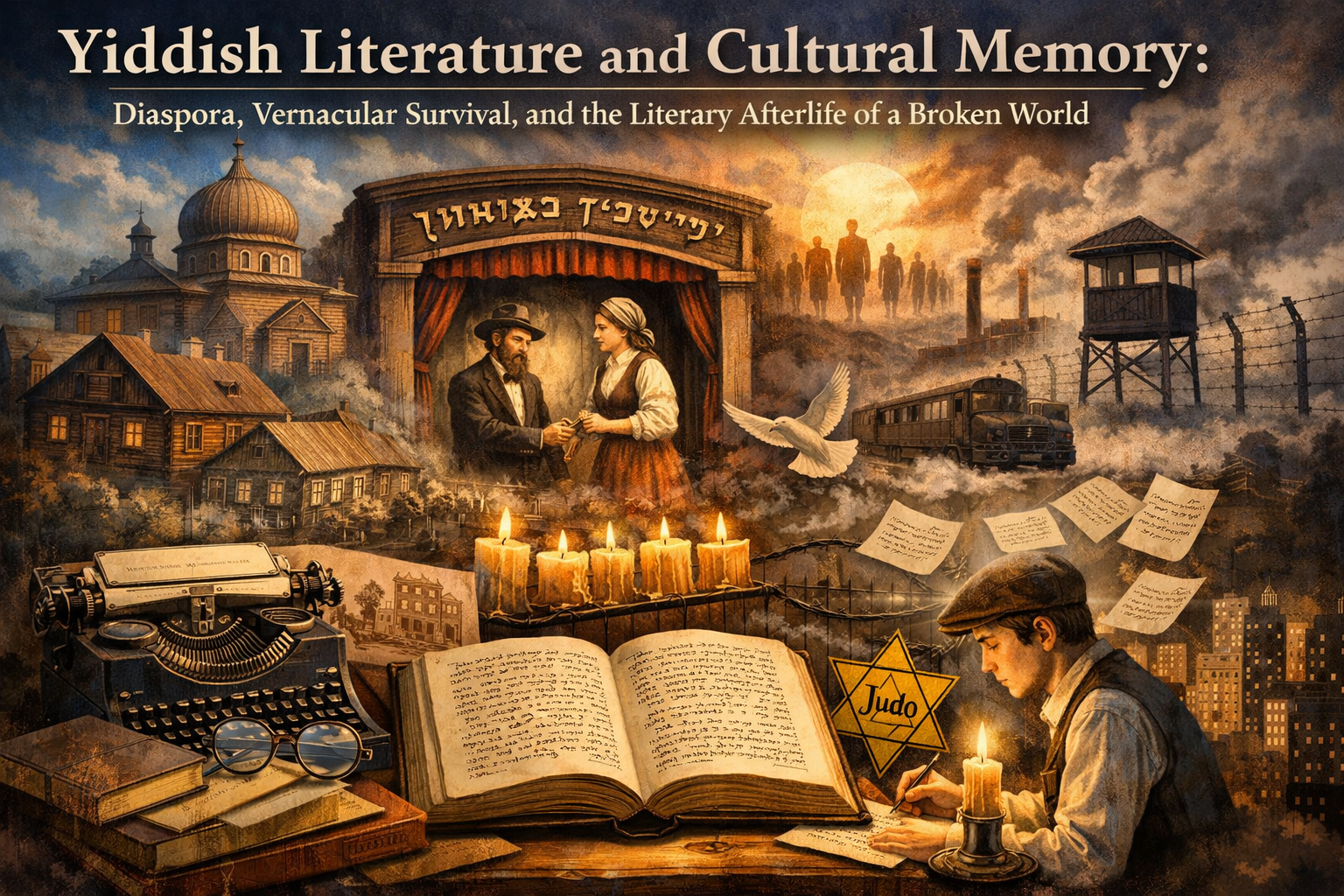
This category examines Yiddish storytelling, poetry, theater, memoir, journalism, satire, folklore, children’s literature, modernist experimentation, Holocaust writing, post-catastrophic remembrance, and postvernacular revival. It considers how Yiddish literary culture emerged from the interaction of rabbinic tradition, vernacular speech, communal institutions, print culture, migration, secularization, socialism, multilingual exchange, gendered domestic transmission, and the pressures of modernity. It also explores how Yiddish literature became one of the great literary languages of memory in the modern world, particularly in relation to shtetl life, urban transformation, displacement, the Holocaust, and the afterlives of destroyed communities.
By studying Yiddish literature in relation to diaspora, translation, theater, religious tradition, domestic life, political upheaval, law, education, humor, migration, and memorial reconstruction, this category shows how literature can preserve a world even after that world has been violently broken. It also shows how vernacular language can carry civilizational depth without state power, imperial reach, or institutional dominance. Yiddish literature is one of the great witnesses to the fact that cultural memory may survive through voice, argument, intimacy, performance, translation, and the stubborn durability of ordinary speech.
Why This Field Matters
Yiddish literature matters because it preserves one of the richest vernacular archives of diasporic civilization in the modern world. It remembers not only persecution and loss, but the density of ordinary life: domestic speech, communal ritual, economic struggle, study, laughter, embarrassment, longing, argument, aspiration, and survival. In it, a people speaks to itself in a language at once portable and intimate, historically burdened and extraordinarily alive.
This gives Yiddish literature unusual importance within cultural memory. It is a literature formed under conditions of dispersion, vulnerability, and repeated upheaval, yet it is never reducible to victimhood alone. It preserves humor as well as grief, irony as well as prayer, political urgency as well as domestic tenderness. It keeps alive the tonal complexity of a civilization that understood itself not only through sacred text and legal tradition, but through the vernacular life of speech, story, performance, and print.
The field also matters because Yiddish literature challenges narrow assumptions about literary greatness. It was not a literature of empire, court culture, or sovereign national prestige. It was a literature of dispersed communities, multilingual negotiation, precarious belonging, and cultural survival under pressure. Its power comes from another source: the density of vernacular life. It shows that literary civilization can flourish through jokes, letters, newspapers, folktales, theater, domestic speech, political argument, devotional memory, and ordinary stories as much as through monumental forms.
Yiddish literature is also indispensable because it preserves the life of worlds that were partly destroyed. Reading it today requires historical care. The tradition should not be romanticized into nostalgia, flattened into tragedy, or treated as a museum of vanished life. It should be read as a dynamic literary field whose works carried modernity, religious tension, social critique, desire, political struggle, and formal innovation long before they became objects of post-catastrophic recovery.
Yiddish as World-Making Vernacular
Yiddish is not merely the medium in which this literature happens to be written. It is one of the conditions that make the literature what it is. As a vernacular language formed in diaspora, carrying Germanic, Hebrew-Aramaic, Slavic, Romance, and other layers, Yiddish embodies historical movement and cultural mixture within its very structure. It is a language of intimacy, improvisation, portability, and internal memory. Through it, Ashkenazi Jewish life could be rendered not only in official or sacred terms, but in the language of the kitchen, the street, the marketplace, the schoolroom, the joke, the quarrel, the lullaby, and the lament.
This is why Yiddish literature preserves a social world with such unusual vividness. The language itself carries tonal registers of affection, sarcasm, dispute, tenderness, moral complaint, satire, reverence, resignation, and verbal agility. A strongest account of the tradition must therefore treat Yiddish not as background but as archive: a living linguistic form in which a dispersed people remembered itself.
Yiddish also carries the tension between proximity and displacement. It is a home language for communities often denied secure political home. It is local and portable at once: spoken in towns, neighborhoods, households, workshops, study houses, theaters, immigrant districts, and newspapers across shifting geographies. Its power lies in this paradox. It can feel deeply rooted while also bearing the marks of movement, instability, and contact with other languages.
The world-making force of Yiddish becomes especially visible in literature because literary language can preserve tone. Translation can carry plot and theme, but the original language holds rhythm, register, social nuance, and inherited intimacy. For this reason, Yiddish literature asks readers to attend not only to what is remembered, but to the linguistic texture through which memory becomes emotionally and culturally intelligible.
Textual Culture, Sacred Learning, and the Vernacular Archive
Yiddish literature develops within a civilization already shaped by sacred textuality. Study, commentary, legal argument, biblical memory, liturgical cadence, interpretive dispute, and the prestige of textual learning all form part of the background from which Yiddish literary culture emerges. The vernacular does not replace this textual world. It lives beside it, beneath it, against it, and through it.
This relation matters because Yiddish literature often carries the habits of a people formed by study. Even when it becomes comic, secular, rebellious, or modernist, it remains marked by traditions of quotation, argument, interpretation, moral questioning, and linguistic self-consciousness. The vernacular archive is therefore not anti-textual. It is deeply informed by a civilization of texts, but turns that inheritance toward everyday speech, narrative, performance, and modern literary form.
The relation between sacred learning and vernacular literature is especially important because it complicates the boundary between high and popular culture. Yiddish writing may draw on biblical figures, rabbinic turns of argument, liturgical echoes, folktale structures, ethical instruction, and communal law while addressing readers in the idiom of everyday life. The result is not a simple descent from sacred to secular. It is a layered movement between authority and intimacy.
This layered textuality also gives Yiddish literature much of its intellectual depth. Characters argue, misinterpret, cite, joke, rebuke, and remember in a world where language itself carries obligation. Yiddish literary memory is therefore not only narrative memory. It is interpretive memory: a memory of how a people reads, disputes, transmits, and lives under the pressure of inherited words.
Multilingual Jewish Life and the Hierarchy of Languages
Yiddish literary memory is shaped by multilingual life. Yiddish exists in relation to Hebrew, Aramaic, and the majority languages of the surrounding societies in which Jews lived. These languages do not coexist neutrally. They often carry different forms of authority, sanctity, prestige, power, intimacy, and risk. Hebrew may signify sacred inheritance or national aspiration; Yiddish everyday life and communal proximity; dominant state languages bureaucracy, ambition, assimilation, education, coercion, or political pressure.
This linguistic layering deepens the literary field. Code-switching, tonal shifts, borrowings, translation, and linguistic hierarchy all shape how Yiddish literature imagines identity and belonging. A strongest-sense account of the category must therefore treat language not only as medium but as social order, cultural tension, and memory structure.
The hierarchy of languages can also mark gender, education, piety, class, and aspiration. Sacred learning may be associated with Hebrew and Aramaic; domestic storytelling and everyday conversation with Yiddish; state advancement or assimilation with Russian, Polish, German, English, Spanish, or other surrounding languages. Literature captures the emotional consequences of these hierarchies: pride, shame, ambition, estrangement, reverence, rebellion, and longing.
Yiddish literature is therefore unusually attentive to the politics of speech. Who speaks which language, to whom, under what conditions, and with what authority becomes part of the literary meaning. Language is never merely communicative. It is a map of belonging, memory, hierarchy, and change.
Diaspora as Everyday Condition
Yiddish literature is inseparable from diaspora, but diaspora here must be understood not only as large-scale displacement or exile. It is also an everyday condition: life across towns, cities, empires, and shifting borders; communities bound by text, law, custom, memory, and language despite political instability and geographic dispersion. The literature carries the practical and emotional intelligence of this condition—its vulnerability, adaptability, portability, humor, caution, and alertness to unstable belonging.
This makes Yiddish one of the great literatures of distributed life. It remembers how people dwell without sovereignty, how they improvise continuity without territorial certainty, and how communal forms endure across movement, pressure, and precarity. Diaspora is not merely the historical setting of Yiddish literature. It is one of its principal structures of feeling and thought.
Diaspora also shapes literary form. Stories often unfold within unstable economies, shifting political authorities, uncertain futures, and networks of letters, news, migration, and rumor. The imagination is local and translocal at the same time. A small town may be connected to Odessa, Warsaw, Vilna, New York, Buenos Aires, Palestine, or Moscow through family, politics, print, money, migration, and memory.
This distributed structure gives Yiddish literature its remarkable elasticity. It can preserve the smallest details of local life while remaining aware of vast historical pressure. It can be intensely domestic and global in the same breath. Its diaspora consciousness is not an abstraction. It is a way of feeling history through ordinary life.
Shtetl, Household, Market, and Study House
One of the most powerful achievements of Yiddish literature is its preservation of everyday Jewish life in extraordinary social detail. The shtetl, the town, the tenement, the market, the household, the workshop, and the study house all become memory-bearing spaces. Here literature records courtship, marriage, poverty, piety, gossip, aspiration, family pressure, generational tension, economic worry, and the minute negotiations through which ordinary life is sustained.
This attention to everyday worlds gives the tradition much of its civilizational depth. It remembers not only public events or theological abstractions, but how people actually lived: how they spoke, worried, joked, worked, disciplined children, interpreted texts, endured humiliation, and made room for tenderness. The archive survives through the life of the ordinary.
The shtetl in particular must be treated carefully. It is not only a nostalgic image or sentimental symbol. In Yiddish literature it can appear as a dense social world: poor, comic, oppressive, affectionate, learned, superstitious, ethically serious, hierarchical, absurd, resilient, and vulnerable. Its literary power comes from complexity, not from idealization. The shtetl may preserve intimacy and communal continuity, but it may also produce surveillance, poverty, narrowness, and conflict.
The household, market, and study house form a social triangle. The household preserves language, family memory, gendered labor, childhood, and emotional inheritance. The market reveals economic vulnerability, exchange, bargaining, humiliation, and survival. The study house carries textual authority, male learning, argument, and religious aspiration. Yiddish literature moves among these spaces to remember a whole social world.
Humor, Irony, and the Moral Life of Survival
Yiddish literature cannot be understood through grief alone. It is one of the great literatures of humor, irony, satire, exaggeration, absurdity, and conversational wit. These are not secondary tonal ornaments. They are among the tradition’s deepest moral resources. Humor in Yiddish often preserves dignity under pressure, turns suffering into verbal intelligence, exposes hypocrisy, punctures pretension, and keeps communal life from collapsing into solemnity or despair.
This tonal range is essential to cultural memory. A people does not remember itself only through lament. It also remembers through laughter, self-critique, comic embarrassment, argument, and verbal agility. The moral seriousness of Yiddish literature is inseparable from its comic powers. It teaches that wit may be a mode of endurance, and that irony can preserve truth where direct statement becomes too rigid or too painful.
Yiddish humor often works by refusing false dignity. It recognizes human frailty, social absurdity, religious inconsistency, poverty, ambition, vanity, and misfortune without surrendering to contempt. Its laughter can be sharp, but it is rarely simple. It may criticize a community while remaining bound to it. It may mock suffering’s circumstances while refusing to mock the sufferer. It may turn helplessness into verbal agency.
This makes humor a major structure of Yiddish cultural memory. Laughter holds together grief and intelligence. It allows literature to speak from vulnerability without becoming mute before it.
Law, Obligation, and Communal Judgment
Jewish communal life was structured not only by feeling, custom, and family, but by obligation, norm, interpretation, and judgment. Yiddish literature frequently records the everyday pressure of moral and communal expectation: what is permitted, what is shameful, what is dutiful, what is transgressive, what is owed to parents, to neighbors, to the dead, to tradition, and to God. This relation to law and obligation is one of the ways the tradition carries ethical seriousness into daily life.
Yet the literature rarely preserves this world passively. It questions, satirizes, negotiates, resists, softens, and sometimes mourns the very norms it inherits. Yiddish writing thus becomes one of the places where communal law and individual desire encounter one another in lived, literary form.
Law in this archive is not only formal code. It is social atmosphere. It enters marriage, food, mourning, debt, education, gender roles, reputation, charity, dispute, and speech. It shapes what a character fears, what a family expects, and how a community judges. At the same time, law may be experienced as protection, burden, wisdom, pressure, discipline, or constraint depending on the situation and the speaker.
This complexity gives Yiddish literature its ethical density. It understands that communities are sustained by obligation, but also that obligation can wound. It understands that inherited norms preserve memory, but also that modern life forces those norms into crisis. The result is a literature of negotiation rather than simple obedience or simple rebellion.
Sacred Inheritance, Secular Modernity, and Religious Ambivalence
Yiddish literature stands at a crucial threshold between sacred inheritance and secular transformation. It emerges from worlds shaped by rabbinic learning, communal law, religious discipline, biblical language, and liturgical memory, yet becomes one of the principal literary arenas in which those inherited worlds encounter modernity. Secularization, enlightenment, socialism, nationalism, urbanization, migration, and new forms of individuality all pass through Yiddish literary culture with particular intensity.
This gives the tradition one of its central dramas. The movement from study house to newspaper, from sacred commentary to secular fiction, from communal authority to personal ambition, from inherited law to modern desire does not abolish the past. It reorders it. Yiddish literature becomes one of the chief places where Jewish modernity thinks itself through tension rather than simple rupture. It is often a literature not of settled belief or settled unbelief, but of religious ambivalence, attachment without full submission, longing without certainty, critique from within, and unresolved spiritual remainder.
Modern Yiddish writing often stages characters who cannot simply remain inside inherited worlds, yet cannot fully abandon them without loss. The sacred past may be mocked, mourned, criticized, desired, remembered, or transformed into literature. Secular writers may retain biblical rhythms, rabbinic habits of dispute, liturgical echoes, and ethical seriousness even when they no longer accept traditional authority.
This religious ambivalence is one of the tradition’s great strengths. It makes Yiddish literature a major archive of transition: not the clean replacement of religion by modernity, but the complicated survival of sacred memory inside secular forms.
Print Culture, Journalism, and Public Debate
Yiddish modernity is inseparable from print. Newspapers, journals, serialized fiction, essays, feuilletons, literary circles, pamphlets, reviews, advice columns, theater notices, polemics, and public debates created a vibrant world in which language circulated quickly and widely across dispersed communities. Yiddish literature was not only a matter of books preserved for posterity. It was also a living print culture of argument, immediacy, commentary, ideological conflict, and communal self-interpretation.
This print ecology matters because it shows Yiddish as a language of modern public life as well as inherited memory. Journalism, criticism, and serial publication gave the literature a social dynamism that matched the unsettled conditions of migration, urbanization, and political change. The archive is therefore not only literary in the narrow sense; it is also periodical, polemical, and public.
Print transformed Yiddish readership. It connected towns and cities, old worlds and new worlds, immigrants and relatives, radicals and traditionalists, workers and writers, theater audiences and political movements. It accelerated debate over religion, socialism, Zionism, Bundism, assimilation, education, gender, labor, and language itself. The newspaper became a kind of portable community, allowing dispersed readers to inhabit a shared field of argument.
Serial fiction is especially important because it embedded literature in ordinary rhythms of reading. Stories unfolded through time, alongside news, advertisements, letters, and public controversies. This gave Yiddish literature a living social immediacy. It was not only memory after the fact; it was memory being made in public.
Theater, Song, and the Voiced Archive
Yiddish literary culture is not exclusively textual. It lives in voice, song, theater, recitation, storytelling, comic performance, and public speech. The Yiddish stage became one of the great vehicles for transmitting memory, moral conflict, humor, melodrama, music, and social critique to wide audiences. Song and performance carried the language across generations and through migration in forms that were emotionally immediate and communally shared.
This voiced archive is central to the tradition’s endurance. Literature here does not remain trapped on the page. It enters the ear, the body, the stage, the public square, and the domestic gathering. A strongest-sense pillar must therefore treat performance not as supplementary, but as one of the principal modes through which Yiddish memory moved and survived.
Theater made Yiddish modernity visible and audible. It staged family conflict, generational change, romantic desire, poverty, aspiration, assimilation, religious tension, political hope, and comic survival. It offered collective experience to immigrant audiences negotiating unfamiliar cities and changed social worlds. It also helped standardize, popularize, and transform literary language through performance.
Song and oral performance carried another kind of memory. They preserved lullabies, labor feeling, devotional tones, comic turns, mourning, festive life, and political solidarity. Through voice, Yiddish culture could survive even when books were lost, archives damaged, or communities scattered. Performance is therefore one of the tradition’s major technologies of memory.
Women, Family, Childhood, and Domestic Transmission
Yiddish literature preserves not only public communal worlds but domestic and gendered interiors. Family life, motherhood, daughterhood, marriage, labor, desire, confinement, generational conflict, and emotional endurance all shape the archive. Women’s voices, women’s labor, and women’s memory belong at the center of this category because the household is one of the main places where Yiddish culture was lived, transmitted, and contested.
Childhood and education matter here as well. Cultural memory is carried through lullabies, stories, domestic speech, schooling, religious instruction, family conflict, and generational expectation. Yiddish literature repeatedly returns to the problem of transmission: what the child inherits, what the child resists, what the parent fears losing, and what a damaged world can still pass on. The family is therefore not only a setting, but one of the tradition’s great memory machines.
Women’s roles in Yiddish cultural memory cannot be reduced to domestic preservation alone. Women appear as writers, readers, performers, workers, radicals, mothers, daughters, lovers, translators, educators, and witnesses. Their writing and representation reveal the tensions between communal obligation and personal desire, religious expectation and modern ambition, family loyalty and self-making.
The domestic archive also complicates public history. Major transformations—migration, poverty, secularization, political radicalism, assimilation, and catastrophe—enter the family before they become abstractions. They appear in changed speech, changed marriage expectations, children leaving home, altered religious practice, new forms of education, and the emotional strain of survival.
Love, Desire, and Intimate Rebellion
Yiddish literature is also a literature of longing, erotic tension, bodily desire, romantic disappointment, and intimate rebellion. Love in this tradition does not appear apart from social form; it is often entangled with arranged marriage, class pressure, family obligation, communal surveillance, gendered expectation, poverty, religious norm, and the clash between inherited authority and individual yearning.
This dimension matters because it restores the full human scale of the archive. Yiddish literature is not only communal, historical, or doctrinal. It is also sensual, emotionally volatile, private, and intimate. It preserves the drama of persons who desire more than the worlds available to them, or differently from what those worlds allow.
Intimate rebellion may appear quietly: in a daughter’s education, a lover’s refusal, a marriage choice, a secret longing, a comic complaint, a refusal of shame, or a movement toward secular life. It may also appear dramatically, as rupture with family, tradition, town, or religious expectation. These intimate conflicts show how historical change enters the body and the household.
Love in Yiddish literature is rarely isolated from memory. Desire often carries the burden of language, custom, class, gender, and migration. To love differently may be to imagine a different future; to be denied love may be to feel the pressure of an entire social world.
Labor, Socialism, and Political Imagination
Yiddish literature is deeply entangled with the political upheavals of modern Jewish life. Labor movements, Bundism, socialism, anti-tsarist struggle, class conflict, revolutionary hope, trade unionism, immigrant organizing, and debates over nationalism and assimilation all enter the literary field. The tradition therefore preserves not only inherited communal life but the pressures of modern political imagination: what kind of collective future might be possible, and in what language it might be named.
This political dimension matters because Yiddish is not only a language of memory but also of struggle. It became a medium for workers, radicals, secular intellectuals, and politically engaged writers trying to articulate justice under conditions of vulnerability and upheaval. Political literature in Yiddish carries the moral seriousness of a people imagining survival beyond inherited forms.
Yiddish political culture also reveals the diversity of Jewish modernity. Some writers and activists imagined liberation through socialism; others through Jewish cultural autonomy, Zionism, religious renewal, liberal emancipation, or assimilation. Yiddish became a language in which these competing futures could be argued from within the community rather than imposed from outside it.
Labor is especially important because it connects politics to ordinary life. Sweatshops, workshops, strikes, poverty, immigrant labor, gendered work, and class aspiration all shaped modern Yiddish writing. Political imagination was not only ideological. It emerged from the body at work and the need to make a dignified life under precarious conditions.
Migration, City Life, and Global Yiddish Modernity
Yiddish literature does not remain confined to Eastern European towns. It moves through Warsaw, Vilna, Odessa, New York, Buenos Aires, Montreal, London, Berlin, Moscow, Tel Aviv, and other centers of diasporic transformation, reshaping itself under migration, labor, urban density, linguistic transition, and modern mass culture. The city becomes a new stage for memory: crowded, unstable, commercial, multilingual, politically charged, and generative.
This global circulation is essential to the category. Yiddish modernity is not a single regional story but a diasporic network of literary reinvention. Migration changes the language’s audiences, institutions, themes, and tonal registers. The move from shtetl to metropolis is not merely a change of setting; it is one of the tradition’s great psychological and literary transformations, altering consciousness itself under the pressure of speed, anonymity, labor, and secular modernity.
New York Yiddish culture, for example, was not simply an extension of Eastern Europe. It became its own literary world, shaped by immigration, labor politics, theater, newspapers, tenement life, English pressure, American aspiration, and the memory of what had been left behind. Similar transformations occurred in other Yiddish centers, each producing different forms of modernity.
Migration also changes memory. The old world becomes recollected from distance, sometimes with affection, sometimes with bitterness, sometimes with comic exaggeration, sometimes with grief. The new world becomes both opportunity and loss. Yiddish literature is one of the great archives of what happens when language crosses oceans.
Modernism, Fracture, and the Form of Historical Change
Yiddish modernity is not only a change of subject matter. It is also a change of form. Modernist experimentation in Yiddish registers urban shock, estrangement, interior fracture, altered temporality, symbolic density, linguistic pressure, and the breakdown of inherited narrative assurances. Fragmentation, compression, dislocation, and formal daring become ways of recording what it feels like to live through historical acceleration and civilizational instability.
This matters because Yiddish literature does not simply describe transformation; it absorbs it into its forms. Modernism in this tradition is one of the principal ways literature registers the psychic, linguistic, and historical pressure of modern life. Form itself becomes a bearer of memory under changed conditions.
Yiddish modernism also complicates assumptions about literary modernity as a primarily metropolitan or major-language phenomenon. Writers working in Yiddish engaged avant-garde experiment, urban fragmentation, political crisis, psychological interiority, and historical rupture while writing from a language marked by diaspora and vulnerability. This gives Yiddish modernism a distinctive intensity: it is formally experimental and civilizationally anxious at once.
The modernist Yiddish text often feels pulled between worlds: sacred past and secular future, folk memory and avant-garde form, communal language and individual estrangement, local speech and international literary experiment. That tension is one of its defining strengths.
Regional Variation and the Many Worlds of Yiddish
Yiddish literature is not fully captured by a single unified image. It develops across different regional, political, and cultural worlds: Lithuanian, Polish, Galician, Russian, Ukrainian, Romanian, American, Argentine, Soviet, Israeli, and other contexts each shape the language’s tonal, ideological, and literary possibilities in distinctive ways. The traditions of Warsaw are not identical to those of Vilna; the New York Yiddish press is not simply an extension of the Eastern European shtetl; postwar and émigré formations rearrange memory again.
A strongest-sense pillar must therefore recognize that Yiddish literary culture is plural within itself. Its unity lies not in sameness, but in a family of related worlds bound by language, inheritance, argument, and historical pressure. Regional variation deepens rather than weakens the category.
These regional differences affect genre, politics, dialect, readership, style, and institutional life. One center may emphasize theater and journalism; another modernist poetry; another scholarly preservation; another socialist culture; another postwar remembrance. The many worlds of Yiddish show that the language was not a single enclosed folk medium, but a modern literary system with multiple publics.
Regional attention also resists nostalgia. It prevents “Yiddish culture” from becoming a simplified image. Instead, it restores complexity: competing cities, movements, dialects, political programs, religious orientations, aesthetic experiments, and afterlives.
The Holocaust, Destruction, and Post-Catastrophic Memory
The destruction of Eastern European Jewish life in the Holocaust is inescapable in any serious account of Yiddish literature. It shattered the demographic and cultural worlds in which Yiddish had flourished as an everyday literary language. After genocide, Yiddish writing becomes one of the great archives of irrecoverable civilizational loss: a literature of witness, survival, mourning, remnant memory, and the struggle to speak after annihilation.
Yet the category must resist reducing the tradition to posthumous sorrow alone. Yiddish literature matters not only because a world was destroyed, but because that world had already created a vast and complex literary civilization. Post-catastrophic writing therefore bears a double burden: to remember what was annihilated and to preserve the vitality, wit, learning, conflict, and ordinary life that existed before destruction as more than a lost prelude. It also forces literature itself to change: voice, genre, witness, silence, diction, and the possibility of narrative are all altered under the pressure of catastrophe.
Writing in Yiddish after the Holocaust carries a particular historical charge because the language itself becomes bound to the destroyed world. To write, read, translate, or preserve Yiddish after catastrophe is not merely to use a language. It is to carry memory under damaged conditions. The language becomes witness, remnant, archive, and act of defiance.
At the same time, post-catastrophic memory must remain attentive to life before destruction. The dead should not be remembered only as victims. Yiddish literature preserves them as speakers, workers, children, lovers, skeptics, believers, performers, readers, fools, sages, radicals, and ordinary human beings. That is one of its deepest ethical tasks.
Translation, Recovery, and the Postvernacular Afterlife
Much of Yiddish literature now survives through translation, scholarship, anthology, archival preservation, performance revival, digital libraries, academic programs, and acts of cultural recovery. This does not mean the tradition has ended; it means its afterlife has become one of the principal conditions of its present intelligibility. Readers often encounter Yiddish now through mediation, reconstruction, and institutional memory rather than through everyday vernacular use.
This makes recovery itself part of the literary story. Translation is not merely technical transfer. It is a form of preservation under damaged conditions. Archives, performers, scholars, editors, teachers, and translators become agents in the continued life of the tradition. The afterlife of Yiddish literature is therefore not secondary to cultural memory. It is one of its most urgent contemporary forms, especially in a postvernacular world where memory often survives through acts of deliberate revival rather than ordinary continuity.
Translation raises difficult questions. What happens to humor, idiom, register, religious echo, and social intimacy when Yiddish enters English or another language? What can be carried, and what must be explained? Does translation preserve the tradition, transform it, or both? These questions are not obstacles to reading. They are part of the ethical and aesthetic life of the field.
The postvernacular afterlife of Yiddish also includes music, theater, festivals, academic study, digital archives, family memory, and renewed language learning. These forms may not restore the lost everyday world, but they can keep the archive active. Recovery becomes a way of honoring both rupture and continuity.
Yiddish Literature and World Literature
Yiddish literature matters to world literature because it is one of the great vernacular literatures of diaspora, tonal complexity, and cultural endurance. It preserves a civilization without sovereignty, a social world sustained through language, law, memory, performance, and portability rather than state power alone. Few literary traditions carry together so vividly humor and grief, prayer and satire, domestic realism and historical catastrophe, political urgency and communal tenderness.
Its world-literary significance lies not only in historical tragedy, but in literary force. Yiddish writing shows how a language can carry the weight of ordinary life, radical transformation, and civilizational mourning all at once. It expands what world literature means by demonstrating that some of the most important literary archives are built not from imperial scale, but from dispersed survival, verbal intensity, and collective memory under pressure.
Yiddish literature also complicates the relation between major and minor languages. A language may be politically vulnerable and literarily immense. It may lack state power while sustaining a vast imaginative world. It may be pushed toward disappearance while leaving behind works of global significance. This gives Yiddish a special place in comparative literary study.
To read Yiddish literature as world literature is therefore to revise the scale by which literary importance is measured. The tradition’s greatness lies not in domination, but in density; not in territorial sovereignty, but in memory; not in official prestige, but in the voices of a dispersed people speaking themselves into endurance.
Major Questions of Interpretation
This pillar is organized around several major questions. How does Yiddish function not merely as medium but as world-making vernacular? In what ways does vernacular literature remain shaped by sacred textual culture, multilingual life, and legal-ethical inheritance? How do shtetl life, urban modernity, family memory, sacred ambivalence, political struggle, theater, humor, journalism, migration, and gendered transmission all enter the archive?
The pillar also asks what changes when Yiddish becomes a modern language of journalism, mass readership, political argument, migration, and experimentation. How does the Holocaust transform the tradition without exhausting its meaning? What does it mean for Yiddish literature to survive now through translation, recovery, performance, scholarship, and postvernacular remembrance? How should readers preserve the vitality of the tradition without reducing it either to nostalgia or to loss?
These questions keep the category from becoming either nostalgia or elegy alone. They open Yiddish literature as a field of linguistic, social, religious, domestic, political, performative, and civilizational inquiry. Yiddish Literature and Cultural Memory is not only about a lost world. It is about a literary tradition that preserved a world in all its conflict, vitality, comedy, desire, learning, and sorrow.
Expanded Article Architecture
The following structure gathers the pillar into a long-range architecture suitable for a major literature and cultural memory knowledge series. It is designed to support foundational essays, language studies, author studies, genre-level synthesis, theater and performance history, religious and secular transformations, political movements, Holocaust memory, translation, and postvernacular recovery. All entries below should be treated as planned unless already completed elsewhere on the site.
Foundations of the Field
- Yiddish Literature and the Cultural Memory of Diaspora (planned)
- Why Yiddish Matters in World Literature (planned)
- Vernacular Language and Civilizational Memory (planned)
- What Yiddish Literature Preserved (planned)
- Humor, Grief, and the Moral Density of a Language (planned)
- Why a Broken World Still Speaks in Yiddish (planned)
- Yiddish Literature Beyond Nostalgia and Loss (planned)
- How a Vernacular Became a Civilization’s Archive (planned)
Language, Text, and Diasporic Vernacularity
- Yiddish as a World-Making Vernacular (planned)
- Yiddish, Hebrew, and the Hierarchy of Jewish Languages (planned)
- Textual Culture and the Vernacular Archive (planned)
- Portable Language and the Memory of Community (planned)
- How Yiddish Held a Civilization Together (planned)
- Speech, Intimacy, and the Social Life of the Vernacular (planned)
- Germanic, Hebrew-Aramaic, and Slavic Layers in Yiddish Memory (planned)
- Code-Switching, Translation, and Multilingual Jewish Life (planned)
Everyday Life and the Archive of the Ordinary
- The Shtetl as Literary World (planned)
- Household, Market, and Study House in Yiddish Writing (planned)
- Poverty, Family, and Ordinary Survival (planned)
- Marriage, Gossip, Ambition, and Communal Pressure (planned)
- The Texture of Daily Life in Yiddish Fiction (planned)
- Why the Ordinary Matters in Cultural Memory (planned)
- Tenement, Workshop, and Street as Yiddish Memory Spaces (planned)
- Children, Elders, and the Transmission of Ordinary Worlds (planned)
Humor, Irony, and Argument
- Humor as a Form of Yiddish Survival (planned)
- Satire, Wit, and Moral Intelligence (planned)
- Why Yiddish Comedy Is Never Only Comic (planned)
- Irony and the Ethics of Self-Critique (planned)
- Argument as Cultural Style in Yiddish Literature (planned)
- Laughter in the Shadow of Vulnerability (planned)
- Comic Speech and the Preservation of Dignity (planned)
- Complaint, Exaggeration, and the Verbal Art of Endurance (planned)
Tradition, Law, and Secular Change
- Rabbinic Tradition and the Rise of Yiddish Literature (planned)
- Law, Obligation, and Everyday Jewish Life (planned)
- From Study House to Print Culture (planned)
- Secularization and the Modern Jewish Imagination (planned)
- Religious Ambivalence in Yiddish Writing (planned)
- The Sacred Past Inside Secular Literature (planned)
- Hasidic Memory and Yiddish Storytelling (planned)
- Enlightenment, Haskalah, and the Vernacular Question (planned)
Print, Journalism, and Public Culture
- Newspapers and the Making of Modern Yiddish Publics (planned)
- Serial Fiction and the Social Life of Reading (planned)
- Journalism, Polemic, and Communal Self-Interpretation (planned)
- Urban Readerships and the Expansion of Yiddish Print (planned)
- How Print Changed the Yiddish Literary Field (planned)
- Periodicals, Debate, and Modern Jewish Public Culture (planned)
- The Forward and the Public Life of Immigrant Yiddish (planned)
- Feuilletons, Advice Columns, and the Everyday Voice of Print (planned)
Theater, Song, and Performance
- The Yiddish Stage as Cultural Memory (planned)
- Song, Performance, and the Voiced Archive (planned)
- Storytelling Beyond the Page (planned)
- Comedy, Melodrama, and Public Feeling in Yiddish Theater (planned)
- How Performance Preserved Diasporic Life (planned)
- Voice, Audience, and the Survival of Yiddish Culture (planned)
- Yiddish Theater in New York and the Immigrant Public (planned)
- Music, Lament, and the Emotional Archive of Yiddish Memory (planned)
Women, Family, Childhood, and Desire
- Women’s Voices in Yiddish Literature (planned)
- Domestic Memory and the Jewish Family Archive (planned)
- Childhood, Schooling, and Generational Transmission (planned)
- Motherhood, Daughterhood, and Generational Change (planned)
- Love, Desire, and Intimate Rebellion (planned)
- Why the Home Matters in Yiddish Memory (planned)
- Marriage, Gender, and Communal Expectation in Yiddish Fiction (planned)
- Women Writers and the Reordering of Yiddish Modernity (planned)
Politics, Labor, and the Modern Future
- Yiddish Literature and Socialist Imagination (planned)
- Bundism, Labor, and Political Community (planned)
- Revolution, Radicalism, and Modern Jewish Writing (planned)
- Nationalism, Assimilation, and Competing Futures (planned)
- Political Upheaval in the Yiddish Literary Archive (planned)
- How Literature Imagined Justice in a Precarious World (planned)
- Sweatshop, Union, and Immigrant Labor in Yiddish Writing (planned)
- Yiddish Radicalism and the Language of Collective Hope (planned)
Migration, City, and Global Yiddish Modernity
- From Eastern Europe to New York: Yiddish in Migration (planned)
- Urban Transformation and the New Jewish City (planned)
- Yiddish Literature in America and Beyond (planned)
- Tenement Life, Mobility, and Modernity (planned)
- Modernist Experiment and Historical Rupture (planned)
- How Migration Changed the Language of Memory (planned)
- Buenos Aires, Montreal, London, and the Global Yiddish Network (planned)
- Immigrant Speech and the Literary Reinvention of Home (planned)
Regional Worlds and Literary Difference
- Vilna, Warsaw, Galicia, and the Regional Worlds of Yiddish (planned)
- Eastern European Variations in Yiddish Literary Culture (planned)
- American Yiddish as a Different Modernity (planned)
- Language, Politics, and Regional Tone (planned)
- The Many Geographies of Yiddish Memory (planned)
- Plurality Within a Vernacular Civilization (planned)
- Soviet Yiddish and the Politics of Culture (planned)
- Yiddish in Israel and the Struggle Over Language Memory (planned)
Modernism, Fracture, and Literary Experiment
- Yiddish Modernism and the Form of Historical Fracture (planned)
- Urban Shock and Avant-Garde Yiddish Writing (planned)
- Fragment, Dislocation, and the Modern Jewish Imagination (planned)
- Symbolism, Expressionism, and Yiddish Literary Experiment (planned)
- Modernist Poetry and the Pressure of Civilizational Change (planned)
- How Yiddish Modernism Rewrote Vernacular Memory (planned)
- Celia Dropkin and the Intensities of Yiddish Modernism (planned)
- David Bergelson and the Strange New World of Yiddish Prose (planned)
Holocaust, Rupture, and Post-Catastrophic Writing
- The Destruction of Yiddish-Speaking Worlds (planned)
- Holocaust Writing in Yiddish (planned)
- Witness, Mourning, and the Archive After Annihilation (planned)
- Writing After Civilizational Rupture (planned)
- Poetics of Silence, Ruin, and Survival (planned)
- Why Yiddish Literature Cannot Be Reduced to Loss (planned)
- Avrom Sutzkever and Poetry After Catastrophe (planned)
- Memory, Testimony, and the Ethics of Post-Holocaust Yiddish (planned)
Translation, Recovery, and Afterlife
- Translation and the Survival of Yiddish Literature (planned)
- Archives, Anthologies, and Cultural Recovery (planned)
- Postvernacular Yiddish and the Memory of Language (planned)
- Revival, Scholarship, and Literary Afterlife (planned)
- How Destroyed Worlds Continue to Be Read (planned)
- The Future of Yiddish Memory (planned)
- Digital Libraries and the Recovery of Yiddish Print Culture (planned)
- Performance Revival and the Living Afterlife of Yiddish (planned)
Major Writers and Deep-Dive Studies
- Mendele Mocher Sforim and the Birth of Modern Yiddish Literature (planned)
- Sholem Aleichem and the Comic Archive of Everyday Life (planned)
- I.L. Peretz and the Moral Intelligence of Modern Yiddish Writing (planned)
- S. An-sky and the Folkloric Memory of the Jewish People (planned)
- Der Nister and the Mystical-Modernist Imagination (planned)
- Celia Dropkin and the Intensities of Yiddish Modernism (planned)
- David Bergelson and the Modernist Prose of Dislocation (planned)
- Anna Margolin and the Urban Interior of Yiddish Poetry (planned)
- Avrom Sutzkever and Poetry After Catastrophe (planned)
- Isaac Bashevis Singer and the Afterlife of a Destroyed World (planned)
Closing Perspective
Yiddish Literature and Cultural Memory reveals one of the great achievements of diasporic literary civilization: the ability to preserve a people’s inward life, social world, humor, sacred inheritance, political struggle, everyday intimacy, and historical grief through the intimate force of a vernacular language. It remembers not only catastrophe, but daily existence; not only rupture, but continuity; not only prayer and lament, but wit, argument, study, desire, and contradiction. In Yiddish, literature becomes one of the primary ways a dispersed world speaks itself into durability.
This is what makes the category so important within Literature & Cultural Memory. Yiddish literature does not simply document a broken past. It carries a civilization’s ordinary life, modern transformation, and post-catastrophic memory in forms that continue to demand reading, translation, performance, and recovery. As a long-range knowledge series, this pillar is meant to follow those forms across language, genre, migration, politics, destruction, and afterlife, showing how one of the modern world’s great literatures of vulnerability and endurance continues to preserve what violence could not entirely erase.
The deepest reason to study Yiddish literature today is not only to remember what was lost. It is to encounter a vernacular civilization in motion: arguing, laughing, mourning, loving, performing, translating, printing, migrating, and remaking itself under pressure. Yiddish literature endures because it refuses silence. It keeps alive the voices of a world that history tried to break, and it reminds readers that cultural memory can survive not only in monuments, but in jokes, songs, stories, newspapers, family speech, and the stubborn afterlife of language.
Related Reading
- Literature & Cultural Memory
- Abrahamic Traditions
- Foundations of Religion
- Religion and Society
- Yiddish Legend, Folklore, and Sacred Imagination
- Poetry, Memory, and Imagination
- African and Diasporic Literature and Cultural Memory
- Religion and Law
Further Reading
- Estraikh, G. and Krutikov, M. (eds.) (2025) The Oxford Handbook of Yiddish Literature. Oxford: Oxford University Press. https://academic.oup.com/edited-volume/61883
- Roskies, D.G. (1995) A Bridge of Longing: The Lost Art of Yiddish Storytelling. Cambridge, MA: Harvard University Press. https://www.hup.harvard.edu/books/9780674081406
- Shandler, J. (2020) Yiddish: Biography of a Language. Oxford: Oxford University Press. https://global.oup.com/academic/product/yiddish-9780190651961
- Katz, D. (2004) Words on Fire: The Unfinished Story of Yiddish. New York: Basic Books.
- Howe, I. and Greenberg, E. (eds.) (1976) A Treasury of Yiddish Stories. New York: Viking. https://shop.yiddishbookcenter.org/products/o-star-too-beautiful-a-treasury-of-yiddish-stories-edited-by-joachim-neugroschel
- Glinter, E. (ed.) (2016) Have I Got a Story for You: More Than a Century of Fiction from The Forward. New York: W.W. Norton. https://shop.yiddishbookcenter.org/products/have-i-got-a-story-for-you-more-than-a-century-of-fiction-from-the-forward-edited-by-ezra-glinter
- Quint, A. (2019) The Rise of the Modern Yiddish Theater. Bloomington, IN: Indiana University Press. https://iupress.org/9780253038616/the-rise-of-the-modern-yiddish-theater/
- Veidlinger, J. (2000) The Moscow State Yiddish Theater: Jewish Culture on the Soviet Stage. Bloomington, IN: Indiana University Press. https://iupress.org/9780253218926/the-moscow-state-yiddish-theater/
- Caplan, M. (2018) Yiddish Writers in Weimar Berlin. Bloomington, IN: Indiana University Press. https://iupress.org/9780253051981/yiddish-writers-in-weimar-berlin/
- Rojanski, R. (2020) Yiddish in Israel: A History. Bloomington, IN: Indiana University Press. https://iupress.org/9780253045140/yiddish-in-israel/
- Murav, H. (2019) David Bergelson’s Strange New World: Untimeliness and Futurity. Bloomington, IN: Indiana University Press. https://iupress.org/9780253036919/david-bergelsons-strange-new-world/
- Roskies, D.G. (1999) The Jewish Search for a Usable Past. Bloomington, IN: Indiana University Press. https://iupress.org/9780253335050/the-jewish-search-for-a-usable-past/
- Yiddish Book Center (n.d.) 1000 Essential Yiddish Books. Amherst, MA: Yiddish Book Center. https://www.yiddishbookcenter.org/collections/digital-yiddish-library/1000-essential-yiddish-books
- YIVO Institute for Jewish Research (n.d.) The YIVO Encyclopedia of Jews in Eastern Europe. New York: YIVO Institute for Jewish Research. https://yivoencyclopedia.org/
- YIVO Institute for Jewish Research (n.d.) Digital Collections. New York: YIVO Institute for Jewish Research. https://archives.cjh.org/repositories/7
References
- Estraikh, G. and Krutikov, M. (eds.) (2025) The Oxford Handbook of Yiddish Literature. Oxford: Oxford University Press. https://academic.oup.com/edited-volume/61883
- Shandler, J. (2020) Yiddish: Biography of a Language. Oxford: Oxford University Press. https://global.oup.com/academic/product/yiddish-9780190651961
- Roskies, D.G. (1995) A Bridge of Longing: The Lost Art of Yiddish Storytelling. Cambridge, MA: Harvard University Press. https://www.hup.harvard.edu/books/9780674081406
- Katz, D. (2004) Words on Fire: The Unfinished Story of Yiddish. New York: Basic Books.
- Howe, I. and Greenberg, E. (eds.) (1976) A Treasury of Yiddish Stories. New York: Viking. https://shop.yiddishbookcenter.org/products/o-star-too-beautiful-a-treasury-of-yiddish-stories-edited-by-joachim-neugroschel
- Glinter, E. (ed.) (2016) Have I Got a Story for You: More Than a Century of Fiction from The Forward. New York: W.W. Norton. https://shop.yiddishbookcenter.org/products/have-i-got-a-story-for-you-more-than-a-century-of-fiction-from-the-forward-edited-by-ezra-glinter
- Yiddish Book Center (n.d.) Have I Got a Story for You: Reading Resources. Amherst, MA: Yiddish Book Center. https://www.yiddishbookcenter.org/language-literature-culture/great-jewish-book-club/about-book-club/have-i-got-story-you-reading
- Quint, A. (2019) The Rise of the Modern Yiddish Theater. Bloomington, IN: Indiana University Press. https://iupress.org/9780253038616/the-rise-of-the-modern-yiddish-theater/
- Veidlinger, J. (2000) The Moscow State Yiddish Theater: Jewish Culture on the Soviet Stage. Bloomington, IN: Indiana University Press. https://iupress.org/9780253218926/the-moscow-state-yiddish-theater/
- Caplan, M. (2018) Yiddish Writers in Weimar Berlin. Bloomington, IN: Indiana University Press. https://iupress.org/9780253051981/yiddish-writers-in-weimar-berlin/
- Murav, H. (2019) David Bergelson’s Strange New World: Untimeliness and Futurity. Bloomington, IN: Indiana University Press. https://iupress.org/9780253036919/david-bergelsons-strange-new-world/
- Rojanski, R. (2020) Yiddish in Israel: A History. Bloomington, IN: Indiana University Press. https://iupress.org/9780253045140/yiddish-in-israel/
- Yiddish Book Center (n.d.) 1000 Essential Yiddish Books. Amherst, MA: Yiddish Book Center. https://www.yiddishbookcenter.org/collections/digital-yiddish-library/1000-essential-yiddish-books
- Yiddish Book Center (n.d.) Yiddish Children’s Literature. Amherst, MA: Yiddish Book Center. https://www.yiddishbookcenter.org/collections/yiddish-book-centers-noah-cotsen-library-yiddish-childrens-literature
- Roskies, D.G. (1999) The Jewish Search for a Usable Past. Bloomington, IN: Indiana University Press. https://iupress.org/9780253335050/the-jewish-search-for-a-usable-past/
- YIVO Institute for Jewish Research (n.d.) The YIVO Encyclopedia of Jews in Eastern Europe. New York: YIVO Institute for Jewish Research. https://yivoencyclopedia.org/
- YIVO Institute for Jewish Research (n.d.) Digital Collections. New York: YIVO Institute for Jewish Research. https://archives.cjh.org/repositories/7