
Last Updated May 12, 2026
Embedded and edge systems examine how computation is integrated directly into physical devices, sensors, machines, infrastructure, and environments in order to observe real-world conditions, process signals locally, coordinate action, and support reliable decision-making close to the source of data generation. These systems operate where the digital and physical worlds meet: inside microcontrollers, sensor nodes, field instruments, gateways, industrial controllers, robotics platforms, edge AI devices, FPGA accelerators, and distributed monitoring networks.
Modern computing no longer resides only in servers, laptops, cloud platforms, and centralized data centers. It is increasingly distributed throughout the physical world. Microcontrollers regulate appliances and industrial equipment. Sensor nodes monitor temperature, vibration, moisture, pressure, air quality, energy consumption, water flow, movement, and ecological conditions. Embedded processors coordinate medical devices, vehicles, control systems, communications hardware, environmental stations, and infrastructure assets. Edge platforms make it possible to process and interpret data locally rather than transmitting every signal to distant infrastructure for analysis.
Main Library
Publications
Article Map
Embedded & Edge Systems
Related Topic
Data Systems & Analytics
Related Topic
Artificial Intelligence Systems
Related Topic
Environmental Monitoring
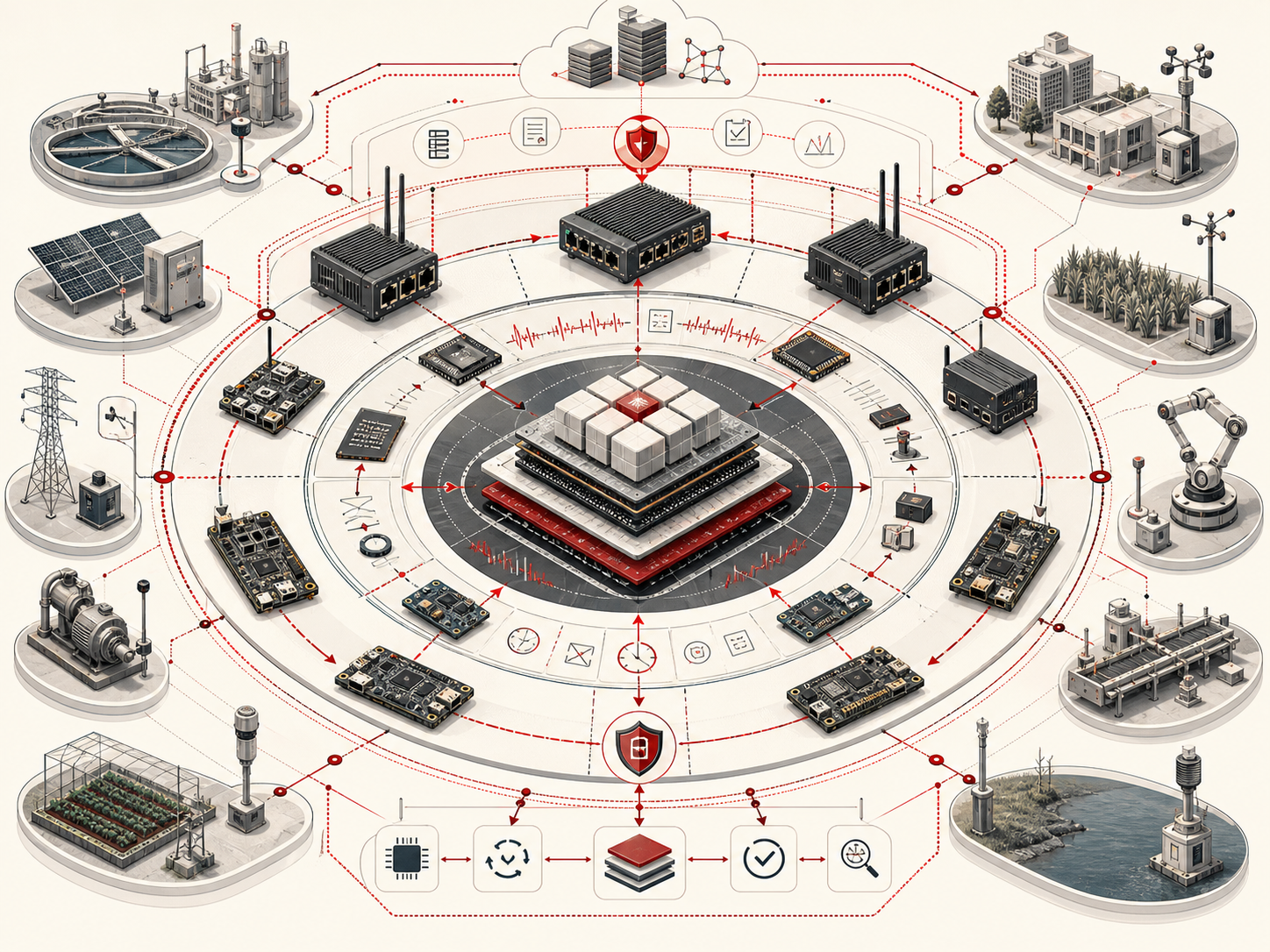
Embedded and edge systems sit at the intersection of hardware engineering, software systems, networking, sensing, control, data systems, distributed intelligence, and cyber-physical infrastructure. They connect computation to material environments: buildings, roads, farms, factories, ecosystems, energy systems, utilities, vehicles, robots, laboratories, health devices, and public infrastructure. Their design is shaped by constraints that differ sharply from traditional enterprise software. Engineers must often work within strict limits on memory, compute capacity, energy consumption, bandwidth, heat, timing, reliability, security, maintainability, and physical durability, while still ensuring predictable performance under real-world operating conditions.
As intelligent infrastructure expands, embedded and edge systems are becoming strategically important. They support environmental monitoring, industrial automation, robotics, logistics, health technology, autonomous platforms, smart buildings, distributed energy systems, precision agriculture, field science, and resilient public infrastructure. Understanding how these systems are designed, constrained, deployed, secured, and governed is essential for anyone studying technological systems that must operate reliably outside the data center.
Complete Code Repository
The companion repository for this knowledge series contains SQL schemas, synthetic sensor datasets, Python and R analytics workflows, Embedded C firmware examples, TinyML inference scaffolds, PYNQ edge-acceleration workflows, MQTT-style event simulation, anomaly detection routines, reproducible notebooks, governance documentation, device metadata, calibration tables, and code patterns for building reliable embedded and edge systems.
What Are Embedded and Edge Systems?
Embedded and edge systems refer to computing architectures designed to operate within devices, instruments, machines, sensor networks, and physical environments rather than solely within centralized computing infrastructure. They translate physical signals into digital information, convert digital decisions into physical action, and increasingly support local intelligence under real-world constraints.
These systems typically involve combinations of:
- microcontrollers, microprocessors, digital signal processors, and system-on-chip architectures
- sensors, actuators, analog-to-digital converters, and data-acquisition subsystems
- firmware, hardware abstraction layers, device drivers, and low-level control logic
- real-time operating systems and deterministic execution models
- local signal processing, feature extraction, filtering, and compression
- wireless, wired, fieldbus, serial, and industrial communication interfaces
- edge gateways, local servers, FPGA boards, and hardware-accelerated compute layers
- on-device or near-device analytics, anomaly detection, and machine-learning inference
- secure boot, device identity, lifecycle management, remote updates, and field observability
Embedded systems primarily concern the integration of computing into dedicated devices built to perform specific functions. Edge computing extends this model by introducing local or near-local processing layers that reduce dependence on remote cloud resources. The distinction is not absolute, but it is analytically useful. Embedded systems emphasize device-level sensing, control, timing, and dedicated functionality. Edge systems emphasize distributed processing near the source of data, often across networks of devices, gateways, accelerators, and local compute nodes.
Together, embedded and edge systems form the operational substrate of cyber-physical infrastructure. They are how computation leaves the screen and becomes part of material systems.
Why This Field Matters
Embedded and edge systems matter because modern institutions increasingly depend on distributed sensing, local computation, and machine-mediated response. Environmental monitoring requires field sensors and data loggers. Smart infrastructure depends on embedded controllers, gateways, and operational telemetry. Energy systems rely on meters, grid sensors, control loops, and fault-detection logic. Health devices depend on reliable measurement, low-power operation, privacy-sensitive processing, and safety-aware design. Industrial systems require deterministic control, vibration monitoring, predictive maintenance, and secure device management.
The field also matters because many sustainability, resilience, and public-interest technologies depend on observation. Climate, biodiversity, water quality, energy demand, soil conditions, air pollution, infrastructure stress, transportation flow, and equipment degradation all require measurement. But measurement does not happen abstractly. It happens through devices, sensors, protocols, firmware, calibration routines, telemetry pipelines, storage systems, and analytical workflows. Embedded and edge systems are often the first layer of evidence.
Poorly designed systems can produce unreliable data, drain energy, fail in the field, expose sensitive information, create insecure infrastructure, or automate decisions without appropriate oversight. Well-designed systems can reduce latency, conserve bandwidth, improve resilience, protect privacy, enable local autonomy, support scientific monitoring, and make distributed infrastructure more observable and accountable.
The Embedded-to-Edge System Lifecycle
The lifecycle of an embedded and edge system describes how a physical event becomes a digital signal, how that signal becomes data, how data becomes local inference or action, and how system behavior is monitored over time.
- Physical observation — a sensor detects temperature, vibration, pressure, light, chemical concentration, motion, current, voltage, moisture, acoustic signals, or another environmental condition.
- Signal conditioning — analog signals are filtered, amplified, stabilized, digitized, sampled, or calibrated before analysis.
- Firmware execution — device-level software reads sensors, applies timing logic, handles interrupts, manages power states, and controls communication.
- Local processing — raw signals are filtered, summarized, compressed, transformed, or converted into features.
- Edge inference — TinyML, signal-processing models, anomaly detection, rule-based logic, or hardware-accelerated workflows classify events or detect patterns locally.
- Control or response — the system actuates a device, triggers an alert, changes sampling rate, opens a valve, modifies a control signal, or sends a message to a gateway.
- Telemetry transmission — device records are transmitted through serial, LoRaWAN, Wi-Fi, Bluetooth, cellular, Ethernet, MQTT, OPC UA, CAN, Modbus, or other protocols.
- Gateway aggregation — local nodes aggregate events, manage buffering, synchronize clocks, validate payloads, and coordinate communication with cloud or institutional systems.
- Storage and analysis — telemetry enters databases, time-series stores, lakehouses, dashboards, notebooks, or operational analytics systems.
- Monitoring and lifecycle governance — firmware versions, device health, calibration status, battery condition, drift, security posture, and update history are tracked over time.
This lifecycle is important because many failures in edge intelligence begin before analytics. A noisy sensor, drifting calibration curve, unstable power supply, blocking loop, memory leak, dropped packet, insecure update process, or undocumented firmware change can undermine the entire system.
Mathematical Lens
Embedded and edge systems require mathematics because real-world devices must manage sampling, energy, latency, uncertainty, signal quality, and resource constraints. These calculations are not abstract additions to the field; they are part of engineering judgment.
f_s \geq 2f_{\max}
\]
E = P \times t
\]
L_{\text{total}} = L_{\text{sense}} + L_{\text{compute}} + L_{\text{network}} + L_{\text{actuate}}
\]
SNR = 10\log_{10}\left(\frac{P_{\text{signal}}}{P_{\text{noise}}}\right)
\]
M_{\text{model}} + M_{\text{runtime}} + M_{\text{buffer}} \leq M_{\text{available}}
\]
| Symbol | Meaning | Embedded or edge interpretation |
|---|---|---|
| \(f_s\) | Sampling frequency | How often a device reads a sensor or signal. |
| \(f_{\max}\) | Highest signal frequency of interest | The fastest meaningful variation the system must preserve. |
| \(E\) | Energy consumption | Total energy used by sensing, computation, communication, and idle states. |
| \(L_{\text{total}}\) | Total latency | Time between physical event detection and system response. |
| \(SNR\) | Signal-to-noise ratio | A measure of whether the signal is reliable enough for inference or control. |
| \(M_{\text{available}}\) | Available memory | The memory budget that constrains firmware, buffers, and TinyML models. |
The mathematical lesson is practical. Embedded intelligence is not simply a smaller version of cloud intelligence. It is intelligence under physical, electrical, computational, temporal, and environmental constraints.
Embedded Computing Systems
Embedded computing refers to specialized processors and software integrated into physical devices designed to perform dedicated tasks with high reliability and predictable behavior. Unlike general-purpose computers, embedded systems are usually optimized for clearly defined functions such as sensing, control, signal processing, regulation, actuation, or communication.
Common embedded platforms include:
- microcontrollers for low-power sensing and control
- system-on-chip devices for integrated processing and connectivity
- digital signal processors for timing-sensitive or signal-heavy applications
- embedded Linux boards for gateway, robotics, and edge-compute applications
- FPGA and programmable logic platforms for hardware-accelerated sensing and inference
- industrial controllers and automotive-grade platforms for harsh operating environments
Because embedded systems interact directly with physical processes, their software must be engineered for reliability, determinism, and robustness. In many domains, failure is not merely inconvenient; it can compromise safety, degrade infrastructure performance, damage equipment, waste energy, or produce material harm. Embedded design therefore requires close integration between hardware architecture, firmware logic, sensing interfaces, power management, communication protocols, calibration routines, and environmental operating conditions.
Embedded systems are often invisible to end users, yet they are everywhere: in appliances, vehicles, meters, medical devices, industrial equipment, agricultural systems, laboratory instruments, environmental monitors, energy systems, robotics platforms, and public infrastructure.
Edge Computing Architectures
Edge computing extends embedded architecture by shifting data processing, analytics, and decision support closer to where data is generated. Rather than sending every measurement or event to a centralized server, edge systems allow devices or nearby compute nodes to process information locally. This can reduce latency, lower bandwidth use, improve privacy, increase resilience under intermittent connectivity, and support faster responses to changing conditions.
Edge architectures often enable devices and local nodes to:
- collect and preprocess sensor streams
- filter noisy or redundant data before transmission
- perform local analytics or anomaly detection
- run lightweight machine-learning inference near the source
- aggregate device data through gateways and local servers
- trigger immediate control responses
- continue operating even when cloud connectivity is degraded or unavailable
In practice, edge computing spans a spectrum. At one end are highly constrained devices performing minimal filtering. At the other are capable gateways, industrial edge servers, FPGA platforms, or AI accelerators that aggregate data from multiple devices and support coordination across distributed systems. What unifies these architectures is not one single hardware form but the principle that computation should occur as close as practicable to the physical source of information when latency, efficiency, privacy, resilience, or autonomy make that advantageous.
TinyML, PYNQ, and Local Intelligence
TinyML and PYNQ represent two complementary approaches to local intelligence.
TinyML brings machine-learning inference onto highly constrained microcontrollers. The goal is not to train large models locally, but to deploy compact models that can classify, detect, or estimate patterns from sensor data within severe memory, compute, and power limits. TinyML is useful for wake-word detection, vibration anomaly detection, gesture classification, environmental event detection, predictive maintenance, and low-power field monitoring.
PYNQ brings Python-based access to programmable logic platforms such as Xilinx Zynq devices. It allows developers to combine Python workflows with hardware acceleration through FPGA overlays. This is valuable when edge systems require faster signal processing, parallel computation, low-latency pipelines, or hardware-aware analytics. PYNQ is especially useful as a teaching and prototyping bridge between software analytics and hardware acceleration.
Together, TinyML and PYNQ show that edge intelligence is not a single architecture. It can mean ultra-low-power inference on a microcontroller, local analytics on a gateway, FPGA-accelerated processing on a PYNQ board, or hybrid coordination across devices, edge nodes, and cloud systems.
Design Constraints and Engineering Trade-Offs
Embedded and edge systems are defined as much by their constraints as by their capabilities. Designers must regularly balance competing requirements, including:
- limited memory, storage, and compute capacity
- strict energy budgets and battery constraints
- real-time deadlines and deterministic response requirements
- sensor noise, calibration drift, and measurement uncertainty
- harsh environmental conditions such as heat, vibration, dust, moisture, corrosion, or electromagnetic interference
- intermittent network availability and unreliable field connectivity
- security requirements across long device lifecycles
- maintenance difficulty once devices are deployed in the field
- model compression, quantization, and memory limits for TinyML inference
- hardware/software co-design trade-offs for FPGA and accelerator workflows
These trade-offs shape architectural decisions at every layer. A system designed for remote environmental monitoring may prioritize energy efficiency and duty-cycled sensing. An industrial control system may prioritize determinism and fault tolerance. A smart camera platform may prioritize local inference, compressed transmission, and privacy-preserving processing. A PYNQ-based edge prototype may prioritize hardware acceleration and experimental flexibility. In each case, the engineering problem is not simply to add more intelligence, but to allocate intelligence under constraints.
Core Domains of Embedded and Edge Systems
Embedded and edge systems encompass several major technical domains:
- microcontroller architectures and embedded processors
- firmware design, hardware abstraction, and device control
- real-time operating systems and deterministic scheduling
- sensor interfaces, data acquisition, and instrumentation
- low-power computing and energy-efficient design
- wireless communication and device networking
- distributed edge platforms and local data processing
- edge analytics and on-device machine-learning inference
- TinyML, model quantization, and embedded inference runtimes
- FPGA acceleration, PYNQ workflows, and hardware/software co-design
- cyber-physical systems and control integration
- security, trust, and lifecycle management for connected devices
- device metadata, telemetry governance, calibration, and field observability
These domains collectively explain how computation becomes materially embedded in environments and infrastructures. They also show why embedded and edge systems should not be treated as narrow hardware topics alone. They are systems topics: concerned with sensing, timing, coordination, intelligence, reliability, governance, and action in the physical world.
Embedded and Edge Systems Article Map
The roadmap below organizes the Embedded and Edge Systems knowledge series into conceptual domains. Published articles from the attached CSV are linked directly. Future articles are unlinked and marked as planned so the page can function as both a public index and a long-range technical architecture for the series.
Embedded Computing Foundations
- Embedded Systems Architecture: Components, Design, and Real-Time Constraints — Explains how processors, memory, firmware, timing, peripherals, power states, security boundaries, and physical interfaces combine into dedicated computing systems.
- Microcontrollers and System-on-Chip Design for Embedded Systems — Introduces MCU and SoC architectures, integrated peripherals, memory constraints, timers, DMA, interrupts, communication buses, and hardware-aware software design.
- Real-Time Operating Systems in Embedded Computing — Explains deterministic scheduling, tasks, priorities, deadlines, interrupt handling, latency, stack discipline, and the role of RTOS design in timing-sensitive systems.
- Firmware, Hardware Abstraction, and Device Control in Embedded Systems — Covers firmware architecture, device drivers, hardware abstraction layers, register access, state machines, interrupts, and reliable control of sensors and actuators.
- Low-Power Embedded System Design for Embedded and Edge Devices — Examines sleep modes, duty cycling, battery budgets, wake sources, energy-aware sensing, radio costs, and strategies for long-lived field devices.
- Reliability and Fault Tolerance in Embedded Devices — Studies watchdogs, fault detection, redundancy, safe states, environmental stress, hardware degradation, diagnostics, and recovery patterns for deployed devices.
- Interrupts, Timers, DMA, and Deterministic Firmware (Planned) — Will explain interrupt-driven design, timer peripherals, capture/compare units, DMA transfers, ISR discipline, jitter control, and deterministic firmware patterns.
- Embedded Memory Management and Resource Constraints (Planned) — Will examine stacks, heaps, static allocation, fragmentation, buffers, firmware-update partitions, retained state, model footprints, and safe resource budgeting.
- Embedded Linux for Edge Gateways (Planned) — Will introduce Linux-based edge devices, device trees, services, local storage, networking, containers, observability, and gateway orchestration patterns.
- Hardware Bring-Up, Board Support Packages, and Debug Interfaces (Planned) — Will cover board bring-up, BSPs, clocks, GPIO, UART consoles, SWD/JTAG, boot diagnostics, peripheral validation, and manufacturing test readiness.
Sensor Networks, Instrumentation, and Data Acquisition
- Environmental Sensor Networks for Embedded and Edge Systems — Explains how distributed sensors observe temperature, humidity, air quality, water quality, soil moisture, biodiversity signals, infrastructure conditions, and ecological dynamics.
- Data Acquisition and Embedded Sensor Interfaces for Embedded Systems — Covers analog and digital sensing, ADCs, sampling, anti-aliasing, filtering, calibration, I²C, SPI, UART, and conversion of physical signals into usable data.
- Distributed Monitoring Systems for Embedded and Edge Environments — Examines device networks that collect, aggregate, validate, transmit, and analyze data across spatially distributed infrastructure, field sites, and environments.
- Internet of Things Sensor Architectures — Studies IoT device layers, communication protocols, gateways, telemetry formats, device identity, cloud coordination, and operational sensor networks.
- Calibration, Noise, and Measurement Integrity in Sensor Systems — Explains calibration curves, measurement error, noise filtering, drift, uncertainty, signal-to-noise ratio, and the data-quality foundations of trustworthy sensing.
- Sensor Fusion and Multi-Modal Edge Observation (Planned) — Will examine how accelerometers, cameras, environmental sensors, acoustic signals, GPS, and other streams can be combined to improve reliability and reduce ambiguity.
- Time Synchronization and Event Ordering in Sensor Networks (Planned) — Will study clock drift, timestamps, NTP, PTP, GPS time, event ordering, latency, and the importance of temporal integrity in distributed sensing.
- Field Data Logging and Offline-First Telemetry (Planned) — Will cover local buffering, file formats, flash wear, retry logic, intermittent connectivity, store-and-forward patterns, and reliable data capture in remote deployments.
- Sensor Metadata, Calibration Records, and Measurement Lineage (Planned) — Will examine how device metadata, calibration events, sensor provenance, measurement conditions, and uncertainty records support trustworthy analysis.
Edge Computing, Gateways, and Distributed Analytics
- Edge Computing Architectures for Embedded and Real-Time Systems — Explains device-edge-cloud layering, local processing, latency reduction, resilience, bandwidth management, runtime coordination, and distributed analytical design.
- Edge Analytics and Local Data Processing for Embedded Systems — Covers local filtering, aggregation, anomaly detection, compression, feature extraction, rule logic, buffering, and decision support close to the data source.
- Edge AI and On-Device Machine Learning for Embedded Systems — Introduces local inference, model optimization, quantization, memory limits, latency constraints, deployment evidence, and the difference between cloud AI and edge intelligence.
- Gateways, Aggregation Layers, and Distributed Edge Infrastructure — Examines edge gateways, protocol translation, buffering, aggregation, local storage, device coordination, and hybrid infrastructure patterns.
- Cloud-Edge Coordination and Hybrid Architectures — Explains how cloud platforms, edge nodes, and devices coordinate model updates, telemetry, alerts, control logic, long-term storage, and lifecycle management.
- MQTT, OPC UA, CAN, Modbus, and Edge Communication Protocols (Planned) — Will compare communication protocols used in IoT, industrial systems, vehicles, field devices, energy systems, and distributed monitoring networks.
- Edge Observability and Device Fleet Monitoring (Planned) — Will cover logs, metrics, heartbeats, battery state, firmware versions, device health, telemetry quality, alerting, rollout status, and field reliability dashboards.
- Local-First Analytics for Resilient Infrastructure (Planned) — Will study how edge systems continue operating during cloud outages, network disruption, degraded connectivity, emergency response, or isolated field conditions.
- Edge Storage, Time-Series Databases, and Telemetry Pipelines (Planned) — Will examine local databases, time-series retention, compression, synchronization, data quality checks, and handoff from edge nodes to institutional systems.
TinyML, Embedded AI, PYNQ, and Hardware-Aware Intelligence
- TinyML and Machine Learning on Microcontrollers (Planned) — Will introduce ultra-low-power inference, feature extraction, model compression, quantization, TensorFlow Lite Micro, CMSIS-NN, and MCU deployment constraints.
- Model Quantization and Embedded Inference Optimization (Planned) — Will explain integer quantization, activation buffers, memory footprints, latency, energy, accuracy trade-offs, and deployment testing for constrained devices.
- Embedded C for Sensor Inference and Anomaly Detection (Planned) — Will demonstrate firmware-level feature extraction, threshold models, rolling statistics, watchdog-friendly loops, and safe local alert generation.
- PYNQ for Edge Analytics and FPGA Acceleration (Planned) — Will introduce Python-controlled FPGA workflows, overlays, DMA buffers, hardware acceleration, and edge analytics on programmable logic.
- Edge AI Benchmarking: Latency, Energy, Memory, and Accuracy (Planned) — Will study how edge AI systems are evaluated across the performance and reliability metrics that matter in deployed physical environments.
- Federated and Distributed Learning at the Edge (Planned) — Will examine model updates, privacy-preserving learning, heterogeneous devices, communication constraints, drift, evaluation, and governance of distributed learning systems.
- Accelerators, NPUs, DSPs, and Heterogeneous Edge Compute (Planned) — Will compare domain-specific compute resources for signal processing, inference, encryption, compression, and low-latency local analytics.
Cyber-Physical Systems, Robotics, and Control
- Cyber-Physical Systems and Hardware Integration — Explains how computation, sensing, actuation, feedback, timing, and physical processes combine into integrated cyber-physical systems.
- Embedded Control Systems for Real-Time Physical Regulation — Covers feedback loops, discrete-time control, PID behavior, estimator residuals, safety filtering, actuator limits, supervision, timing budgets, and real-time physical regulation.
- Autonomous Systems and Edge Intelligence — Examines local perception, decision logic, autonomy, navigation, resilience, safety constraints, and the role of edge intelligence in autonomous systems.
- Robotics, Actuation, and Physical Feedback Loops — Studies robotics control, motors, actuators, sensors, feedback loops, force, motion, timing, and embodied computation.
- PID Control and Embedded Feedback Systems (Planned) — Will explain proportional-integral-derivative control, tuning, error dynamics, anti-windup, stability, and implementation in microcontroller firmware.
- Digital Twins and Edge-Connected Physical Systems (Planned) — Will examine how device telemetry, simulation, infrastructure models, and operational histories combine to represent physical systems over time.
- Safety-Critical Embedded Systems (Planned) — Will introduce hazard analysis, fail-safe behavior, deterministic control, redundancy, certification concerns, watchdog logic, and risk-aware embedded design.
- Motor Control, Power Electronics, and Real-Time Actuation (Planned) — Will examine PWM, H-bridges, motor drivers, current sensing, control timing, actuator saturation, thermal limits, and fault containment.
Security, Trust, Governance, and Lifecycle Management
- Security in Embedded and Edge Systems Architecture — Covers device identity, secure boot, trusted execution, firmware integrity, attack surfaces, debug control, and defensive design for connected devices.
- Privacy and Local Data Processing at the Edge — Explains how local processing can reduce unnecessary data transfer while still requiring governance, minimization, consent, access control, and auditability.
- Device Lifecycle Management and Over-the-Air Updating — Examines provisioning, firmware versions, update mechanisms, rollback strategies, staged rollout, fleet management, maintenance, and long-lived device governance.
- Standards, Interoperability, and Governance in Edge Infrastructure — Studies interoperability, protocol standards, vendor ecosystems, open interfaces, governance frameworks, and responsible coordination across edge infrastructure.
- Secure Boot, Device Identity, and Firmware Integrity (Planned) — Will explain hardware roots of trust, signed firmware, attestation, boot chains, debug restrictions, and verification of deployed device software.
- Edge Data Governance and Telemetry Stewardship (Planned) — Will examine ownership, retention, access control, metadata, calibration records, lineage, quality flags, and accountability for device-generated data.
- Over-the-Air Updates, Rollbacks, and Field Reliability (Planned) — Will study safe update strategies, staged rollout, rollback, compatibility checks, update evidence, firmware testing, and remote recovery.
- Supply Chain, Component Risk, and Long-Lived Embedded Infrastructure (Planned) — Will examine component availability, firmware dependencies, vendor lock-in, security patching, lifecycle risk, and maintainability for deployed systems.
Applied Embedded and Edge Systems Across Sustainable Infrastructure
- Embedded Systems for Environmental Monitoring (Planned) — Will connect sensor design, field deployment, calibration, telemetry, low-power operation, and edge analytics to environmental observation systems.
- Edge Systems for Energy, Water, and Infrastructure Monitoring (Planned) — Will examine distributed sensing and local analytics for utilities, smart grids, water systems, building systems, transportation assets, and infrastructure resilience.
- Precision Agriculture and Field Sensor Networks (Planned) — Will study soil sensing, moisture monitoring, crop-condition data, local inference, wireless networks, rugged devices, and field-ready edge design.
- Embedded Health Devices and Privacy-Preserving Edge Analytics (Planned) — Will examine wearables, medical-adjacent devices, sensitive sensor data, local inference, safety, privacy, and clinical reliability constraints.
- Industrial Edge Systems and Predictive Maintenance (Planned) — Will cover vibration sensing, equipment monitoring, anomaly detection, maintenance alerts, local analytics, reliability engineering, and industrial governance.
- Remote Field Science, Open Hardware, and Reproducible Instrumentation (Planned) — Will examine field instruments, open-source hardware, calibration practices, reproducible data capture, and the research infrastructure of distributed sensing.
GitHub Code Repository
The Embedded and Edge Systems knowledge series is supported by a companion code repository designed for practical, reusable, multi-language examples. This repository should be more hardware-aware than a typical analytics repository. It includes SQL for telemetry structure, Python and R for analysis, Embedded C for firmware-style monitoring, TinyML for on-device inference, PYNQ for hardware-accelerated edge analytics, and documentation for governance, calibration, security, and reproducibility.
Recommended repository structure:
embedded-edge-systems-code/
├── README.md
├── LICENSE
├── data/
│   ├── raw/
│   ├── processed/
│   └── synthetic/
├── sql/
│   ├── schema.sql
│   ├── seed_data.sql
│   ├── telemetry_quality_checks.sql
│   └── edge_metric_views.sql
├── embedded_c/
│   ├── low_power_sensor_anomaly_monitor.c
│   └── README.md
├── tinyml/
│   ├── tinyml_inference_stub.cpp
│   ├── model_metadata.json
│   └── README.md
├── pynq/
│   ├── pynq_edge_acceleration_workflow.py
│   └── README.md
├── python/
│   ├── edge_telemetry_quality_pipeline.py
│   ├── sensor_feature_engineering.py
│   └── gateway_event_simulation.py
├── r/
│   ├── sensor_reliability_field_report.R
│   └── edge_device_performance_summary.R
├── notebooks/
│   ├── edge_telemetry_quality_pipeline.ipynb
│   └── sensor_reliability_report.ipynb
├── metadata/
│   ├── device_registry.yml
│   ├── telemetry_contract.yml
│   └── calibration_manifest.yml
├── docs/
│   ├── governance_notes.md
│   ├── reproducibility_guide.md
│   ├── edge_security_notes.md
│   └── hardware_assumptions.md
└── outputs/
    ├── tables/
    ├── figures/
    └── reports/
The repository should support several practical workflows:
- SQL: device registry, telemetry schema, calibration records, sensor readings, alert logs, and quality checks.
- Embedded C: low-power sensor polling, rolling statistics, anomaly detection, and alert generation.
- TinyML: model metadata, quantized inference scaffolds, and microcontroller deployment patterns.
- PYNQ: Python-controlled edge acceleration, buffer preparation, simulated FPGA overlay use, and hardware-aware signal workflows.
- Python: telemetry ingestion, validation, feature engineering, SQLite export, and reproducible edge analytics.
- R: sensor reliability analysis, field-performance reporting, trend summaries, and report-ready figures.
- YAML: device metadata, telemetry contracts, calibration manifests, lineage notes, and governance assumptions.
SQL Workflow: Sensor Telemetry and Device Registry
SQL provides the durable structure for embedded and edge telemetry. It defines device identity, deployment metadata, calibration records, sensor readings, local alerts, and quality checks.
Suggested filename:
sql/schema.sql-- Sensor Telemetry and Device Registry
-- ------------------------------------
-- This schema supports embedded and edge systems examples:
-- device registry, deployments, telemetry readings, calibration,
-- edge alerts, and quality checks.
CREATE TABLE IF NOT EXISTS devices (
device_id TEXT PRIMARY KEY,
device_type TEXT NOT NULL,
hardware_platform TEXT NOT NULL,
firmware_version TEXT NOT NULL,
deployment_region TEXT NOT NULL,
installed_at TEXT NOT NULL,
active INTEGER NOT NULL CHECK (active IN (0, 1))
);
CREATE TABLE IF NOT EXISTS sensors (
sensor_id TEXT PRIMARY KEY,
device_id TEXT NOT NULL,
sensor_type TEXT NOT NULL,
unit TEXT NOT NULL,
sampling_interval_seconds INTEGER NOT NULL,
FOREIGN KEY (device_id) REFERENCES devices(device_id)
);
CREATE TABLE IF NOT EXISTS telemetry_readings (
reading_id INTEGER PRIMARY KEY AUTOINCREMENT,
sensor_id TEXT NOT NULL,
observed_at TEXT NOT NULL,
observed_value REAL NOT NULL,
battery_voltage REAL,
signal_quality REAL,
local_inference_score REAL,
transmitted INTEGER NOT NULL CHECK (transmitted IN (0, 1)),
FOREIGN KEY (sensor_id) REFERENCES sensors(sensor_id)
);
CREATE TABLE IF NOT EXISTS edge_alerts (
alert_id INTEGER PRIMARY KEY AUTOINCREMENT,
sensor_id TEXT NOT NULL,
observed_at TEXT NOT NULL,
alert_type TEXT NOT NULL,
severity TEXT NOT NULL,
observed_value REAL NOT NULL,
threshold_value REAL NOT NULL,
handled_locally INTEGER NOT NULL CHECK (handled_locally IN (0, 1)),
FOREIGN KEY (sensor_id) REFERENCES sensors(sensor_id)
);This SQL layer supports the broader pillar because embedded systems do not end at the device. Field data needs durable structure, quality checks, lineage, device metadata, calibration history, and monitoring records.
Embedded C Workflow: Low-Power Sensor Anomaly Monitor
Embedded C remains central to device-level computing because microcontrollers require direct control over memory, timing, interrupts, peripherals, and power states. The example below demonstrates a simplified rolling-average anomaly detector suitable for adaptation into firmware.
Suggested filename:
embedded_c/low_power_sensor_anomaly_monitor.c/*
* Low-Power Sensor Anomaly Monitor
* --------------------------------
*
* This simplified Embedded C example demonstrates firmware-style logic:
* - sample a sensor value
* - maintain a rolling average
* - detect values that exceed a threshold
* - trigger a local alert without requiring cloud connectivity
*
* Hardware-specific ADC, sleep, and communication functions are represented
* as placeholders so the structure can be adapted to Arduino, STM32,
* ESP32, RP2040, or other microcontroller platforms.
*/
#include <stdio.h>
#include <stdbool.h>
#define WINDOW_SIZE 8
#define ANOMALY_THRESHOLD 12.0f
static float samples[WINDOW_SIZE];
static int sample_index = 0;
static bool buffer_full = false;
float read_sensor_value(void) {
/*
* Replace this placeholder with a real ADC or sensor driver read.
* Example hardware sources:
* - analogRead() on Arduino-style boards
* - HAL_ADC_GetValue() on STM32
* - I2C/SPI driver read for digital sensors
*/
static float synthetic_value = 25.0f;
synthetic_value += 0.7f;
return synthetic_value;
}
float rolling_average(void) {
int count = buffer_full ? WINDOW_SIZE : sample_index;
if (count == 0) {
return 0.0f;
}
float total = 0.0f;
for (int i = 0; i < count; i++) {
total += samples[i];
}
return total / count;
}
void add_sample(float value) {
samples[sample_index] = value;
sample_index++;
if (sample_index >= WINDOW_SIZE) {
sample_index = 0;
buffer_full = true;
}
}
bool is_anomaly(float current_value, float average_value) {
float difference = current_value - average_value;
if (difference < 0.0f) {
difference = -difference;
}
return difference > ANOMALY_THRESHOLD;
}
void trigger_local_alert(float value, float average) {
/*
* Replace with local action:
* - set GPIO pin
* - send MQTT event through gateway
* - write to flash log
* - change sampling cadence
* - enter safe state
*/
printf("ALERT: value=%0.2f rolling_average=%0.2f\n", value, average);
}
int main(void) {
for (int cycle = 0; cycle < 20; cycle++) {
float value = read_sensor_value();
float average = rolling_average();
if (buffer_full && is_anomaly(value, average)) {
trigger_local_alert(value, average);
}
add_sample(value);
/*
* In real firmware, enter low-power sleep here until the next
* timer interrupt or sensor event.
*/
}
return 0;
}The purpose of this example is not to replace hardware-specific firmware. It shows the logic pattern: local sensing, stateful computation, threshold-based inference, and immediate response.
TinyML Workflow: On-Device Inference Pipeline
TinyML places compact machine-learning models on microcontrollers and other constrained devices. The workflow usually includes data collection, feature extraction, model training in Python, quantization, conversion, embedded deployment, local inference, and field monitoring.
Suggested filename:
tinyml/tinyml_inference_stub.cpp/*
* TinyML Inference Stub
* ---------------------
*
* This scaffold shows the shape of a TensorFlow Lite Micro-style inference
* workflow. It is intentionally presented as a portable educational stub.
*
* In a production project, this file would include:
* - a quantized model array
* - TensorFlow Lite Micro headers
* - tensor arena allocation
* - input feature preparation
* - interpreter invocation
* - output classification or anomaly score handling
*/
#include <stdint.h>
#include <stdio.h>
#define FEATURE_COUNT 6
typedef struct {
float mean_value;
float standard_deviation;
float minimum_value;
float maximum_value;
float signal_energy;
float zero_crossing_rate;
} SensorFeatureVector;
float run_tinyml_inference_stub(SensorFeatureVector features) {
/*
* Replace this educational scoring function with a quantized TinyML model.
* The placeholder score is useful for testing firmware integration before
* the full model runtime is added.
*/
float score = 0.0f;
score += 0.25f * features.mean_value;
score += 0.20f * features.standard_deviation;
score += 0.15f * features.signal_energy;
score += 0.10f * features.zero_crossing_rate;
return score;
}
int main(void) {
SensorFeatureVector features = {
.mean_value = 0.62f,
.standard_deviation = 0.18f,
.minimum_value = 0.10f,
.maximum_value = 0.95f,
.signal_energy = 0.74f,
.zero_crossing_rate = 0.08f
};
float inference_score = run_tinyml_inference_stub(features);
printf("TinyML inference score: %0.3f\n", inference_score);
return 0;
}TinyML is most useful when sending raw data to the cloud is too slow, too expensive, too energy-intensive, too privacy-sensitive, or too fragile under intermittent connectivity.
PYNQ Workflow: Edge Acceleration and Hardware-Aware Analytics
PYNQ provides a Python interface to programmable logic on supported FPGA platforms. It is useful for teaching and prototyping because it allows Python workflows to coordinate hardware overlays, buffers, and accelerated computations.
Suggested filename:
pynq/pynq_edge_acceleration_workflow.py"""
PYNQ Edge Acceleration Workflow
-------------------------------
This educational workflow shows the structure of a PYNQ-style edge analytics
pipeline. It can run in simulation mode on a normal machine, while indicating
where PYNQ overlay and buffer logic would be used on supported hardware.
"""
from __future__ import annotations
import numpy as np
def simulate_sensor_window(window_size: int = 128) -> np.ndarray:
"""Create a synthetic sensor signal window."""
time = np.linspace(0, 1, window_size)
signal = np.sin(2 * np.pi * 8 * time) + 0.15 * np.random.randn(window_size)
return signal.astype(np.float32)
def software_feature_extraction(signal: np.ndarray) -> dict:
"""Compute features that could be accelerated in programmable logic."""
return {
"mean": float(np.mean(signal)),
"std": float(np.std(signal)),
"energy": float(np.sum(signal ** 2)),
"peak_to_peak": float(np.max(signal) - np.min(signal)),
}
def pynq_overlay_placeholder(signal: np.ndarray) -> dict:
"""
Placeholder for PYNQ hardware acceleration.
On supported PYNQ hardware, this is where you would:
- load an Overlay
- allocate input/output buffers
- send data to an accelerator IP block
- retrieve accelerated feature outputs
"""
return software_feature_extraction(signal)
def main() -> None:
signal = simulate_sensor_window()
features = pynq_overlay_placeholder(signal)
print("PYNQ-style edge acceleration workflow complete.")
print(features)
if __name__ == "__main__":
main()PYNQ belongs in this pillar because edge systems increasingly require hardware-aware analytics. Some workloads are too latency-sensitive, parallel, or energy-constrained for ordinary software-only processing.
Python Workflow: Edge Telemetry Quality Pipeline
Python is the primary workflow language for telemetry ingestion, validation, feature engineering, and reproducible edge analytics. The example below generates synthetic telemetry, validates key fields, calculates quality metrics, and writes structured outputs.
Suggested filename:
python/edge_telemetry_quality_pipeline.py"""
Edge Telemetry Quality Pipeline
-------------------------------
This workflow demonstrates how device-generated telemetry can be validated
before entering analytical systems.
"""
from __future__ import annotations
import sqlite3
from pathlib import Path
import pandas as pd
PROJECT_ROOT = Path(__file__).resolve().parents[1]
DATA_DIR = PROJECT_ROOT / "data" / "processed"
OUTPUT_DIR = PROJECT_ROOT / "outputs" / "tables"
DATABASE_PATH = PROJECT_ROOT / "outputs" / "embedded_edge_systems.sqlite"
DATA_DIR.mkdir(parents=True, exist_ok=True)
OUTPUT_DIR.mkdir(parents=True, exist_ok=True)
DATABASE_PATH.parent.mkdir(parents=True, exist_ok=True)
def create_synthetic_telemetry() -> pd.DataFrame:
"""Create synthetic telemetry records from edge devices."""
return pd.DataFrame(
[
{"device_id": "EDGE-001", "sensor_type": "temperature", "observed_value": 21.4, "battery_voltage": 3.91, "signal_quality": 0.98, "observed_at": "2026-04-01T10:00:00"},
{"device_id": "EDGE-001", "sensor_type": "temperature", "observed_value": 21.7, "battery_voltage": 3.90, "signal_quality": 0.97, "observed_at": "2026-04-01T10:05:00"},
{"device_id": "EDGE-002", "sensor_type": "vibration", "observed_value": 0.81, "battery_voltage": 3.70, "signal_quality": 0.91, "observed_at": "2026-04-01T10:00:00"},
{"device_id": "EDGE-002", "sensor_type": "vibration", "observed_value": 1.42, "battery_voltage": 3.68, "signal_quality": 0.84, "observed_at": "2026-04-01T10:05:00"},
{"device_id": "EDGE-003", "sensor_type": "moisture", "observed_value": None, "battery_voltage": 3.50, "signal_quality": 0.76, "observed_at": "2026-04-01T10:00:00"},
]
)
def calculate_quality_report(df: pd.DataFrame) -> pd.DataFrame:
"""Calculate simple telemetry quality indicators."""
report = {
"record_count": len(df),
"missing_observed_values": int(df["observed_value"].isna().sum()),
"mean_battery_voltage": float(df["battery_voltage"].mean()),
"mean_signal_quality": float(df["signal_quality"].mean()),
"transmission_ready_records": int(
df["observed_value"].notna()
& (df["battery_voltage"] >= 3.3)
& (df["signal_quality"] >= 0.80)
).sum(),
}
return pd.DataFrame([report])
def main() -> None:
telemetry = create_synthetic_telemetry()
telemetry["observed_at"] = pd.to_datetime(telemetry["observed_at"])
quality_report = calculate_quality_report(telemetry)
telemetry_path = DATA_DIR / "edge_telemetry.csv"
report_path = OUTPUT_DIR / "edge_telemetry_quality_report.csv"
telemetry.to_csv(telemetry_path, index=False)
quality_report.to_csv(report_path, index=False)
with sqlite3.connect(DATABASE_PATH) as connection:
telemetry.to_sql("edge_telemetry", connection, if_exists="replace", index=False)
quality_report.to_sql("edge_telemetry_quality_report", connection, if_exists="replace", index=False)
print("Edge Telemetry Quality Pipeline complete.")
print(quality_report)
if __name__ == "__main__":
main()This workflow connects embedded systems to data systems. A field device may collect the signal, but institutional knowledge depends on whether telemetry is validated, structured, stored, and documented.
R Workflow: Sensor Reliability and Field Performance Report
R is useful for statistical summaries, field-performance reporting, trend analysis, and publication-oriented visualization. The R workflow below reads telemetry output from the Python pipeline and produces reliability summaries.
Suggested filename:
r/sensor_reliability_field_report.R# Sensor Reliability and Field Performance Report
# -----------------------------------------------
#
# This workflow summarizes edge telemetry by device and sensor type.
library(readr)
library(dplyr)
library(ggplot2)
project_root <- normalizePath(file.path(dirname(sys.frame(1)$ofile), ".."))
input_path <- file.path(project_root, "data", "processed", "edge_telemetry.csv")
output_tables_dir <- file.path(project_root, "outputs", "tables")
output_figures_dir <- file.path(project_root, "outputs", "figures")
dir.create(output_tables_dir, recursive = TRUE, showWarnings = FALSE)
dir.create(output_figures_dir, recursive = TRUE, showWarnings = FALSE)
telemetry <- read_csv(input_path, show_col_types = FALSE)
device_summary <- telemetry |>
group_by(device_id, sensor_type) |>
summarise(
records = n(),
missing_values = sum(is.na(observed_value)),
mean_observed_value = mean(observed_value, na.rm = TRUE),
mean_battery_voltage = mean(battery_voltage, na.rm = TRUE),
mean_signal_quality = mean(signal_quality, na.rm = TRUE),
.groups = "drop"
)
write_csv(
device_summary,
file.path(output_tables_dir, "sensor_reliability_field_summary.csv")
)
battery_plot <- ggplot(device_summary, aes(x = device_id, y = mean_battery_voltage)) +
geom_col() +
labs(
title = "Mean Battery Voltage by Edge Device",
x = "Device ID",
y = "Mean battery voltage"
) +
theme_minimal()
ggsave(
filename = file.path(output_figures_dir, "mean_battery_voltage_by_device.png"),
plot = battery_plot,
width = 8,
height = 5,
dpi = 300
)
print(device_summary)This workflow supports field reliability analysis: which devices are healthy, which sensors are missing values, which units have weak signal quality, and where maintenance or calibration may be needed.
Applications of Embedded and Edge Systems
Embedded and edge systems support a wide range of real-world applications:
- environmental monitoring and climate sensing
- smart buildings and intelligent infrastructure
- industrial automation and manufacturing systems
- agricultural sensing and precision agriculture
- autonomous mobility and transportation systems
- medical instrumentation and health monitoring
- energy systems, utility monitoring, and grid intelligence
- distributed sensor networks and IoT platforms
- robotics, remote inspection, and field operations
- predictive maintenance and industrial edge analytics
- field science, ecological observation, and remote research instrumentation
These applications differ in scale and complexity, but they share a common principle: meaningful computation must occur in direct relation to the physical environment. The system must sense, interpret, decide, and often act under real constraints, with limited time and imperfect information.
Security, Reliability, and Governance Challenges
As embedded and edge systems become more capable and more connected, they also become more exposed to operational and governance challenges. Security is difficult because devices may be deployed for long periods in physically accessible or remote environments, operate with constrained update mechanisms, and depend on heterogeneous hardware and software stacks. Reliability is difficult because real-world systems must withstand noise, degradation, intermittent power, environmental stress, and network disruption.
Key challenges include:
- secure boot, trusted execution, and device identity
- firmware integrity and protection against unauthorized modification
- privacy protection when edge devices process sensitive data streams
- maintaining software over long-lived deployed devices
- interoperability across vendors, protocols, and standards
- verifying reliability in safety-critical and mission-critical environments
- ensuring local autonomy does not produce opaque or poorly governed outcomes
- tracking calibration, drift, battery degradation, and device health over time
These concerns make embedded and edge systems an important governance topic as well as a technical one. As intelligence moves into infrastructure, questions of trust, auditability, resilience, maintainability, and accountability move with it.
Future Directions
Embedded and edge systems are evolving rapidly as advances in semiconductors, connectivity, software tooling, compact AI accelerators, and hardware/software co-design increase what can be done locally within devices and near-device infrastructure. More systems are now capable of combining low-power sensing with local inference, real-time event detection, adaptive decision logic, and distributed monitoring.
Several trends will shape the next phase of the field:
- greater deployment of AI inference directly on embedded and edge devices
- expansion of TinyML for low-power sensor intelligence
- increased use of FPGA and accelerator platforms for edge analytics
- stronger coordination between devices, gateways, local servers, and cloud platforms
- more privacy-preserving local processing of sensitive sensor data
- improved resilience through local autonomy during network interruption
- greater importance of hardware-rooted trust and secure lifecycle management
- more rigorous governance for device telemetry, calibration, model updates, and field reliability
The future of embedded and edge computing will not be defined only by smaller models or faster devices. It will be defined by whether distributed intelligence can remain reliable, secure, interpretable, maintainable, energy-aware, and accountable when deployed in the physical world.
Methodological Orientation
This pillar uses a systems-based and hardware-aware approach. It treats embedded firmware, sensor design, telemetry, edge analytics, TinyML, PYNQ acceleration, control systems, security, and governance as connected components of a single cyber-physical lifecycle. It avoids presenting edge intelligence as a magical extension of cloud AI. Instead, it emphasizes signals, timing, power, memory, calibration, latency, reliability, field maintenance, and accountable deployment.
The methodological stance is practical but critical. Embedded C examples are treated as patterns for low-level reasoning, not as universal firmware. TinyML examples are treated as constrained inference systems, not miniature cloud models. PYNQ workflows are treated as hardware-aware prototypes, not generic Python scripts. SQL, Python, and R are used to connect device telemetry to data quality, reproducibility, and field reliability analysis.
This pillar therefore supports both technical learning and institutional reasoning. It is intended to help readers understand how embedded and edge systems are built, how local intelligence operates under constraints, how field telemetry becomes evidence, and how cyber-physical systems can be made more reliable and accountable.
How This Series Connects Across the Site
Embedded and Edge Systems connects directly to Data Systems & Analytics, because device telemetry must be validated, structured, stored, analyzed, and governed. It connects to Artificial Intelligence Systems, because TinyML, edge AI, model compression, inference monitoring, and distributed learning are increasingly important parts of intelligent infrastructure. It connects to Environmental Monitoring Systems, because ecological, climate, water, and air-quality observation depend on field sensors, calibration, telemetry, and edge processing.
It also connects to Risk & Resilience, where monitoring, anomaly detection, local autonomy, and early warning systems help institutions respond to stress before failure occurs; to Energy Systems, where meters, grid sensors, distributed devices, and control systems shape operational intelligence; and to Institutions & Governance, where connected infrastructure raises questions of security, privacy, accountability, maintenance, and public trust.
Across the wider site, this pillar provides the device and infrastructure layer beneath observation. Data-driven systems require measurement, but measurement requires instruments. Embedded and Edge Systems explains how those instruments sense, compute, communicate, and act.
Related Reading
- Data Systems & Analytics
- Artificial Intelligence Systems
- Environmental Monitoring Systems
- Energy Systems
- Risk & Resilience
- Institutions & Governance
- Systems Thinking
- Data Systems and Analytics
- Edge AI and Distributed Intelligence
Further Reading
- Arm (n.d.) CMSIS-NN Documentation. Available at: https://arm-software.github.io/CMSIS-NN/latest/
- Edge Impulse (n.d.) Edge Impulse Documentation. Available at: https://docs.edgeimpulse.com/
- FreeRTOS (n.d.) FreeRTOS Documentation. Available at: https://www.freertos.org/Documentation/RTOS_book.html
- Lee, E. A. and Seshia, S. A. (2017) Introduction to Embedded Systems: A Cyber-Physical Systems Approach. Available at: https://ptolemy.berkeley.edu/books/leeseshia/
- PYNQ Project (n.d.) PYNQ Documentation. Available at: https://pynq.readthedocs.io/
- TensorFlow (n.d.) TensorFlow Lite for Microcontrollers. Available at: https://www.tensorflow.org/lite/microcontrollers
- Zephyr Project (n.d.) Zephyr Project Documentation. Available at: https://docs.zephyrproject.org/
References
- Arm (n.d.) CMSIS-NN Documentation. Available at: https://arm-software.github.io/CMSIS-NN/latest/
- Edge Impulse (n.d.) Edge Impulse Documentation. Available at: https://docs.edgeimpulse.com/
- FreeRTOS (n.d.) FreeRTOS Documentation. Available at: https://www.freertos.org/Documentation/RTOS_book.html
- Hennessy, J. L. and Patterson, D. A. (2019) Computer Architecture: A Quantitative Approach. 6th edn. Cambridge, MA: Morgan Kaufmann.
- Lee, E. A. and Seshia, S. A. (2017) Introduction to Embedded Systems: A Cyber-Physical Systems Approach. Available at: https://ptolemy.berkeley.edu/books/leeseshia/
- PYNQ Project (n.d.) PYNQ Documentation. Available at: https://pynq.readthedocs.io/
- Rajkumar, R., Lee, I., Sha, L. and Stankovic, J. (2010) ‘Cyber-physical systems: the next computing revolution’, Design Automation Conference.
- Shi, W. and Dustdar, S. (2016) ‘The promise of edge computing’, Computer, 49(5), pp. 78–81.
- TensorFlow (n.d.) TensorFlow Lite for Microcontrollers. Available at: https://www.tensorflow.org/lite/microcontrollers
- Wolf, W. (2012) Computers as Components: Principles of Embedded Computing System Design. 3rd edn. Burlington, MA: Morgan Kaufmann.
- Zephyr Project (n.d.) Zephyr Project Documentation. Available at: https://docs.zephyrproject.org/
Return to the Sustainable Systems index.