
Last Updated May 4, 2026
Enlightenment, Modernity, and Postmodern Thought examines how philosophers and critical traditions have understood reason, freedom, subjectivity, history, truth, science, power, language, identity, and the changing conditions of human life from the early modern period to the contemporary world. As a major category within the Philosophy knowledge series, this pillar studies modern thought not as a single doctrine or a simple march of progress, but as a long, conflict-ridden intellectual field in which the modern world attempted to understand, justify, criticize, and repeatedly revise itself.
This field explores the rise of modern philosophy through rationalism, empiricism, the Scientific Revolution, Enlightenment public reason, secular critique, liberal political theory, moral autonomy, and the hope that reason could emancipate human beings from arbitrary authority. It also follows the crises that modernity produced or intensified: alienation, nihilism, ideology, disenchantment, domination, bureaucratic rationality, colonial violence, slavery, racial hierarchy, gender exclusion, and the instability of meaning in modern life.
The category therefore includes rationalism and empiricism, Enlightenment political theory, German idealism, romantic and anti-rational critique, Marxism, pragmatism, phenomenology, existentialism, feminism, psychoanalysis, hermeneutics, critical theory, analytic philosophy, structuralism, post-structuralism, and postmodern philosophy. It also takes seriously the deeper genealogies of modern thought: Hellenistic and Alexandrian scholarship, Latin and Roman institutional inheritances, Arabic-Islamic philosophy and science, and the often-buried Afro-Islamic presence within Atlantic slavery and early America.
The goal of this pillar is not to celebrate modernity uncritically or dismiss it through postmodern suspicion alone. It is to show why Enlightenment, modernity, and postmodern thought remain philosophically indispensable precisely because they gather modernity’s promises and failures into one interpretive field. Here the ideals of reason, critique, rights, autonomy, science, emancipation, and progress appear alongside domination, empire, slavery, exclusion, fragmentation, and the crisis of meaning. To study this field is to study how the modern world came to think as it does, why its ideals remain powerful, and why its deepest assumptions remain contested.
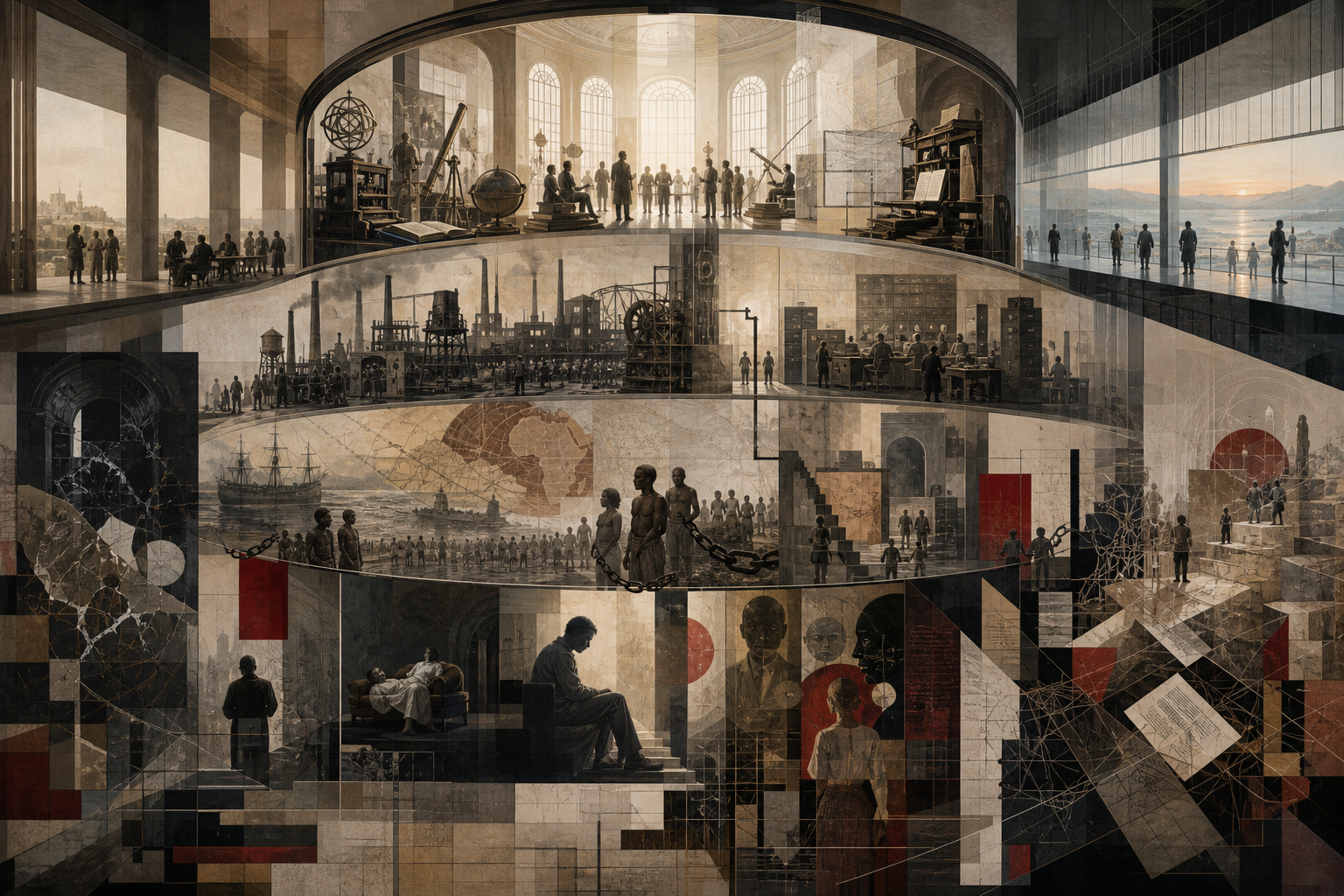
Enlightenment, modernity, and postmodern thought is especially important to a broader philosophy architecture because it gathers the making of the modern world and the arguments against it within a single frame. In this respect, the category connects not only to Political Philosophy and Justice, Ethics and Moral Philosophy, and Metaphysics, but also to Existential Thought, Arabian and Levantine Thought, Maghrebi and Andalusi Thought, Liberalism and Its Traditions, Socialism and Socialist Thought, and Liberation, Anti-Colonial, and Decolonial Thought. Questions of reason, freedom, history, subjectivity, law, emancipation, domination, critique, and meaning become sharper when modernity is treated as both an achievement and a crisis.
This pillar approaches Enlightenment, modernity, and postmodern thought not as a single chronological sequence but as a layered intellectual field. The modern world inherited older philosophical, scientific, institutional, religious, and textual traditions; reorganized them through method, science, statecraft, rights, and public reason; and then found itself increasingly troubled by the exclusions and contradictions within its own claims. Modernity promised emancipation, but also produced new forms of domination. It promised rational clarity, but also generated skepticism about reason’s complicity with power. It promised universal humanity, but often organized the world through empire, slavery, racial hierarchy, gender exclusion, and colonial violence.
Why This Series Matters
Enlightenment, modernity, and postmodern thought deserve to be treated together because the modern philosophical world is intelligible only when its confidence and its crises are studied in one frame. The Enlightenment gave modern thought some of its decisive commitments: reason, critique, scientific inquiry, moral autonomy, public debate, natural rights, secular argument, and the possibility of progress. Later traditions inherited those ambitions, radicalized them, revised them, or turned sharply against them. The result is not a neat chronology of schools, but a long struggle over how freedom, truth, social order, and historical change should be understood.
This matters because many of the defining categories of contemporary life were shaped here: subjectivity, rights, autonomy, public reason, ideology, alienation, authenticity, structure, discourse, difference, genealogy, critique, and suspicion of totalizing truth. The modern world still thinks through these categories even when it rejects them. This series therefore helps clarify not only what modern philosophy said, but why its arguments still frame contemporary disputes over politics, science, morality, identity, religion, culture, technology, and power.
It also matters because standard accounts remain too narrow. They often move from Greece to Europe to modernity with little attention to Hellenistic scholarly infrastructures, Latin-Christian institutional worlds, Arabic-Islamic philosophical transmission, colonial violence, slavery, or the presence of enslaved African Muslims within Atlantic modernity. A stronger pillar therefore treats modern thought as historically layered, globally entangled, and morally conflicted from the start.
The series matters most because modernity remains unfinished. Its ideals have not disappeared: reason, liberty, equality, dignity, rights, education, public debate, and scientific inquiry still matter. But those ideals now exist under pressure from the histories they helped obscure: empire, extraction, racial hierarchy, gendered exclusion, technocratic domination, ecological crisis, and the fragmentation of meaning. This pillar studies that tension without resolving it too quickly.
The Intellectual Frame of Enlightenment, Modernity, and Postmodern Thought
This category is best understood not as a single school but as a large and internally conflictual field stretching from early modern epistemology to the postmodern critique of universality, progress, and stable meaning. It begins with the effort to secure knowledge and order through reason and method, expands into ambitious accounts of freedom, morality, and history, and then becomes increasingly troubled by domination, fragmentation, and the limits of rational self-grounding.
At its broadest level, the category includes several overlapping projects: the search for certainty in rationalism and empiricism; the Scientific Revolution’s reorganization of nature and method; the Enlightenment effort to free thought from dogma and arbitrary authority; the Kantian and post-Kantian reorganization of reason, subjectivity, and autonomy; the nineteenth-century struggles over history, labor, and alienation; the twentieth-century turn toward experience, interpretation, critique, language, and power; and the postmodern suspicion that modernity’s grand narratives had concealed violence, exclusion, and instability all along.
This makes the field both cumulative and self-subverting. Each generation inherits the modern project while also exposing its blind spots. Enlightenment, modernity, and postmodern thought therefore form one of philosophy’s deepest archives of self-critique.
The field is also structurally interdisciplinary. It cannot be confined to metaphysics, ethics, political theory, epistemology, or aesthetics alone. Modernity reorganized all of these domains at once. Knowledge became methodical and scientific; politics became rights-bearing and revolutionary; morality became increasingly tied to autonomy; the self became inward, historical, social, and unstable; language became a philosophical problem; and critique became one of modernity’s defining habits.
Early Modern Philosophy and the Search for Certainty
Early modern philosophy gives this pillar one of its central starting points: the search for certainty under conditions of intellectual upheaval. Rationalism and empiricism emerge as competing but related attempts to understand how knowledge is possible when inherited authorities no longer command unquestioned confidence. Descartes, Spinoza, Leibniz, Locke, Berkeley, and Hume all belong to this effort, though they do not agree on where certainty, evidence, substance, causality, or the self should be located.
This search for certainty matters because it reorganizes the relation between mind, world, God, nature, and method. Philosophy becomes increasingly concerned with the subject who knows, the conditions under which knowledge can be justified, and the limits of human understanding. In this sense, modern philosophy is not merely a new set of doctrines. It is a new problem-space in which the knower becomes philosophically central.
Rationalism and empiricism also prepare the way for Enlightenment public reason. If knowledge must be justified by reason, evidence, method, and experience rather than inherited authority alone, then philosophy becomes part of a broader cultural movement of critique. The early modern search for certainty therefore becomes one of the foundations of modern intellectual life.
Yet the same search also generates instability. Hume’s skepticism exposes the limits of reason, causality, selfhood, and induction. Kant’s critical philosophy then emerges as a response to this crisis, attempting to explain the conditions of possible experience and the limits of metaphysical speculation. The modern project begins, then, not in simple confidence but in a deep anxiety over knowledge, certainty, and the boundaries of reason.
The Scientific Revolution and the Remaking of Nature
A strong account of Enlightenment, modernity, and postmodern thought must give the Scientific Revolution an architectonic place. Modern philosophy did not arise only from abstract debates about knowledge. It also emerged from a transformation in how nature itself was conceived. The Scientific Revolution radically altered the conditions of later modern thought through quantitative reasoning, experiment, new cosmologies, and increasingly mechanistic conceptions of nature. Nature became something to be measured, modeled, and methodically investigated rather than simply inherited through authority.
The philosophical significance of this shift lies in its reorganization of explanation itself. Copernican displacement, Galilean mathematization, Keplerian law, Newtonian synthesis, experimental practice, and the mechanical world picture all changed the relation between metaphysics and physics, theology and natural inquiry, speculation and method. The Enlightenment’s confidence in reason, progress, and public knowledge would be unintelligible without this deeper reordering of nature and inquiry.
For that reason, the Scientific Revolution should not be treated merely as background to Enlightenment thought. It is one of the conditions under which modern reason acquires its new authority, its new confidence, and eventually its new vulnerabilities. Once nature is reconceived as law-governed, measurable, and theoretically intelligible, philosophy must also reconsider causality, subjectivity, certainty, and the place of the human knower in a newly disenchanted world.
This transformation also carries a double legacy. On one hand, it made modern science, public knowledge, engineering, medicine, and technological power possible. On the other hand, it helped produce a world in which nature could be imagined as object, mechanism, resource, and material for mastery. Later critiques of modernity would return repeatedly to this ambiguity: the same rationality that explains nature can also objectify it.
Enlightenment, Public Reason, and Critique
The Enlightenment is often associated with confidence in reason, but its deeper importance lies in the public practice of critique. Enlightenment thought challenged dogma, arbitrary authority, religious intolerance, inherited hierarchy, censorship, superstition, and unexamined custom. It sought to make reason public: something that could be argued, criticized, tested, and shared beyond closed authority.
This is why figures such as Kant, Voltaire, Diderot, Montesquieu, Rousseau, Hume, and Wollstonecraft matter within a single field, even when their commitments differ sharply. Enlightenment thought is not one doctrine. It is a culture of inquiry organized around the claim that human beings can and should examine the conditions under which they are governed, educated, judged, and made subject to authority.
Public reason also transforms political life. The legitimacy of power can no longer rest simply on divine right, inherited rank, or force. Authority must increasingly justify itself in terms of rights, law, consent, utility, freedom, public welfare, or rational legitimacy. This shift does not eliminate domination, but it changes the terms on which domination must be defended and criticized.
The Enlightenment remains powerful because it made critique one of modernity’s central habits. Yet it also remains vulnerable because its claims to universality often failed to include those excluded by gender, race, class, empire, religion, and colonial hierarchy. The Enlightenment therefore must be studied as both an emancipatory project and a historically limited one.
Modern Freedom and Its Inner Argument
A strong account should explicitly center John Locke, Jean-Jacques Rousseau, Mary Wollstonecraft, and John Stuart Mill. Locke is foundational not only for empiricism but for natural rights, toleration, consent, property, and the political architecture of modern liberal order. Rousseau is indispensable for showing how modernity criticizes itself from within through arguments about inequality, authenticity, education, civic freedom, and the corruption of social life. Wollstonecraft is essential because she exposes the gendered limits of Enlightenment universality and insists that reason, education, and freedom cannot remain male monopolies. Mill then becomes central to modern liberty, individuality, utilitarian reform, and the defense of women’s equality.
These figures matter together because they show that modern freedom was never one settled doctrine. It was always an argument over who counted as fully rational, what education was for, whether society cultivated or deformed the self, how property should be justified, whether liberty required individual independence or civic participation, and how freedom could be protected without collapsing into domination, custom, or exclusion.
Modern freedom therefore has an inner conflict. It includes liberal rights, moral autonomy, civic participation, individual self-development, equality before law, freedom of thought, and critique of domination. But it also includes unresolved questions: what happens when property rights conflict with equality, when formal rights coexist with social subordination, when freedom is defined by those already empowered, or when the promise of universality excludes women, colonized peoples, enslaved persons, workers, and racialized communities?
This is why modern freedom must be read as a contested project rather than a stable inheritance. Enlightenment freedom is one of modernity’s greatest achievements, but its own categories made possible the critique of its exclusions.
German Worlds, Modernity, and Self-Formation
A strong account of Enlightenment, modernity, and postmodern thought must give German thought an architectonic role. German philosophy is not merely one national branch of modern philosophy. It is one of the principal sites in which the modern project became philosophically self-conscious, historically expansive, and internally critical. The German world gathers together late Enlightenment reason, aesthetic theory, Bildung, romantic inwardness, idealist system-building, the critique of alienation, the problem of history, and later reflections on nihilism, technology, domination, and fractured subjectivity.
This matters because many of the category’s deepest questions receive especially concentrated treatment in German thought: whether reason can ground freedom, whether history has intelligible direction, whether the self is formed through education or rupture, whether art discloses truth better than system, whether modern life deforms inwardness, and whether modernity culminates in emancipation or spiritual exhaustion.
Kant reorganizes reason by asking what reason can know, what it ought to do, and what it may hope. Fichte, Schelling, and Hegel expand the modern subject into history, freedom, nature, spirit, and system. German Romanticism pushes against rational closure by emphasizing art, irony, fragment, imagination, and inwardness. Marx transforms German philosophical inheritance into a critique of labor, class, ideology, and capitalist society. Nietzsche then radicalizes the crisis of modern value by confronting nihilism, genealogy, and the collapse of inherited moral authority.
German thought therefore serves not merely as one strand within modernity, but as one of the major theaters in which modernity reflects on its own ambitions and limits.
Goethe, Faust, and Modern Striving
Goethe should be treated as a central figure in this pillar, not merely as a literary celebrity adjacent to philosophy. He stands at the intersection of Enlightenment, romanticism, Bildung, aesthetic self-cultivation, science, and the moral drama of becoming. Goethe matters because he shows that the modern self cannot be understood through rational system alone. Formation also occurs through experience, striving, art, error, desire, discipline, and the long unfinished work of becoming human.
He occupies a uniquely revealing position in the history of modernity. He belongs neither simply to rationalist confidence nor to anti-rational revolt. Instead, he shows how modernity’s deepest tensions can be lived through the expanding self: science and poetry, measure and longing, discipline and desire, form and development. In that sense, Goethe is not a decorative literary addition to the story of modern philosophy; he is one of the key figures through whom modernity becomes intelligible as a lived and developmental process.
Faust deserves explicit and sustained treatment because it is one of the great philosophical-literary texts of modernity. It condenses the modern will to knowledge, mastery, transformation, experience, and transcendence into one drama of striving. The Faustian figure is not just a scholar who wants more knowledge. He is an image of the modern subject that refuses limit, seeks intensity, bargains with power, and discovers that expansion itself may become morally catastrophic.
Faust gives modernity one of its most enduring self-images. It brings together science, desire, ambition, world-making, destruction, redemption, and restlessness. A strong pillar should therefore treat it as a key text for the philosophy of modern striving, the moral cost of progress, and the instability of a subject that seeks total expansion without secure measure.
Industrial Capitalism and the Social Crisis of Modernity
Modern thought cannot be understood without industrial capitalism, bureaucracy, urbanization, wage labor, class formation, and the reorganization of social life. The nineteenth century turns modern freedom into a social problem. Formal liberty may coexist with economic dependence; legal equality may coexist with class exploitation; technological progress may coexist with alienation; and scientific rationality may coexist with bureaucratic control.
This transformation matters because modernity becomes material. It is no longer only a philosophical problem of reason or rights. It becomes a world of factories, cities, labor discipline, property relations, public administration, mass politics, markets, and technological acceleration. The modern subject is increasingly shaped by systems larger than the self.
This is where modern philosophy must confront social structure. If individuals are not merely rational agents but workers, consumers, citizens, subjects, patients, pupils, bureaucratic cases, and members of classes, then freedom itself must be rethought. The social world is not just a setting for freedom. It shapes the horizon of what freedom can mean.
The crisis of modernity is therefore not simply spiritual or intellectual. It is institutional and economic. Modernity creates new capacities and new forms of dependency at the same time. This tension prepares the way for Marxism, sociology, critical theory, existentialism, and later critiques of technocratic society.
Marxism, Alienation, and Ideology
Marxism belongs near the center of this pillar because it gives modernity one of its most powerful internal critiques. Marx inherits Enlightenment critique, German philosophy, political economy, and revolutionary politics, then redirects them toward labor, class, production, alienation, ideology, and the historical structure of capitalism. Modern freedom, in this account, cannot be understood apart from the economic relations that organize life.
Alienation becomes one of the decisive concepts of modern social thought. Human beings are estranged from their labor, from the products they make, from one another, from their own capacities, and from the social world they collectively produce. This critique changes the meaning of philosophy. Thought must no longer only interpret consciousness; it must examine the material conditions that shape consciousness.
Ideology deepens this critique by asking how social domination becomes naturalized. Modern power does not always announce itself as power. It can appear as common sense, market necessity, legal neutrality, moral order, or historical inevitability. Marxism therefore gives modern thought one of its most important methods for unmasking domination beneath apparently rational forms.
At the same time, Marxism becomes one of modernity’s most contested legacies. It inspires movements for emancipation, labor rights, and social transformation, but also raises questions about revolution, state power, historical necessity, ideology, and the dangers of totalizing political visions. It belongs in this pillar both as critique and as problem.
Phenomenology, Existentialism, and Lived Experience
The twentieth century brings a major turn toward lived experience, embodiment, intentionality, anxiety, freedom, and the structures of meaning as they are encountered from within. Phenomenology begins by seeking a rigorous description of experience and consciousness, but it quickly becomes central to broader debates about the lifeworld, embodiment, temporality, intersubjectivity, and worldhood.
This turn matters because it resists both abstract rationalism and reductive scientism. It asks how the world is given to consciousness, how meaning appears, how the body is not merely an object but a lived condition, and how human beings inhabit a shared world before they theorize it. Husserl, Heidegger, Merleau-Ponty, Sartre, and Beauvoir all belong to this transformation, though their projects differ sharply.
Existentialism extends the problem of lived experience into freedom, anxiety, responsibility, absurdity, authenticity, oppression, and the burden of selfhood. It asks what it means to exist as a finite, embodied, situated being under conditions that cannot be resolved by system alone. This makes existential thought one of modernity’s most intense self-examinations.
Phenomenology and existentialism also connect modernity to crisis. They arise in a world shaped by war, technological society, bureaucracy, mass politics, and the collapse of older certainties. Their central concern is not only what can be known, but what it means to live, act, choose, suffer, and become responsible in a world that no longer offers simple foundations.
Freud, Psychoanalysis, and the Decentered Subject
Freud belongs in this pillar because psychoanalysis profoundly disrupts the modern image of the rational subject. Enlightenment modernity often imagined the human being as capable of rational self-knowledge, moral autonomy, and conscious self-rule. Freud unsettles that picture by showing that desire, repression, fantasy, unconscious conflict, sexuality, memory, and repetition shape the self beneath conscious intention.
This matters because modern subjectivity becomes divided. The person is no longer transparent to themselves. Reason does not simply govern desire; it may rationalize what it does not understand. Moral life is not merely a matter of conscious principle; it is entangled with unconscious attachments, defensive structures, guilt, shame, and psychic conflict.
Psychoanalysis also changes the meaning of culture. Civilization itself becomes a source of repression, discipline, discomfort, and psychic compromise. The modern subject is formed through prohibitions and renunciations that make social life possible while also generating suffering. Modernity’s promise of rational self-mastery becomes psychologically unstable.
Freud therefore belongs not only to psychology but to philosophy, cultural criticism, and modern self-understanding. He helps explain why the modern subject cannot be reduced to rational agency, public identity, or social function. The self is fractured, symbolic, historical, desiring, and partly unknown to itself.
Feminism and the Gendered Limits of Modern Universality
Feminist philosophy is structurally central to this pillar because it exposes the gendered limits of modern universality. Enlightenment thought often spoke in the language of reason, rights, freedom, and humanity while excluding women from full political, educational, legal, and intellectual recognition. Mary Wollstonecraft makes this contradiction explicit by insisting that reason and education cannot be male privileges if Enlightenment universality is to be taken seriously.
This critique continues through Harriet Taylor Mill, John Stuart Mill, Simone de Beauvoir, and later feminist traditions that examine how freedom, subjectivity, embodiment, labor, sexuality, law, and social expectation are gendered. Feminism shows that modern freedom cannot be understood only through abstract rights. It must be examined through education, marriage, property, work, bodily autonomy, social role, recognition, and the structures that make some lives appear secondary or dependent.
Feminist critique does not merely add women to an existing modern canon. It changes the canon’s questions. Who is the subject of reason? Who counts as autonomous? What forms of dependency are naturalized? How does socialization shape desire and selfhood? How are bodies governed? How does public reason exclude those it claims to represent?
In this sense, feminism is one of modernity’s most powerful forms of self-critique. It uses the ideals of reason, equality, and freedom to expose the partiality of the world that claimed those ideals.
Critical Theory and the Dialectic of Enlightenment
Critical theory deepens the critique of modernity by asking how reason itself becomes entangled with domination. The Frankfurt School inherits Marx, Weber, Freud, Hegel, and modern social theory, then turns them toward mass culture, bureaucracy, fascism, capitalism, instrumental reason, and the failures of Enlightenment progress. The central question is not whether reason matters, but what happens when reason becomes reduced to calculation, administration, and control.
This is the meaning of the dialectic of Enlightenment: the same rationality that promised emancipation can become a tool of domination when stripped of ethical, historical, and reflective limits. Enlightenment does not simply defeat myth; it can become mythic in its own confidence. Scientific and bureaucratic rationality can produce knowledge while also reorganizing human beings as objects of management.
Critical theory therefore belongs at the center of modern self-critique. It asks why societies that possess advanced science, culture, and administrative capacity can still produce barbarism, conformity, commodification, and mass deception. It refuses the idea that progress is automatic.
At the same time, critical theory does not simply abandon Enlightenment. Its critique remains animated by the possibility of emancipation. It seeks a reason capable of reflecting on its own complicity, resisting domination, and recovering the unfinished promise of freedom without repeating modernity’s illusions.
Language, Structure, and the Linguistic Turn
The twentieth century also transforms philosophy through the linguistic turn. Analytic philosophy, structuralism, hermeneutics, and later post-structuralism all make language central, though in very different ways. Philosophy increasingly asks whether problems of knowledge, meaning, mind, and reality are inseparable from the forms of language through which they are articulated.
Analytic philosophy turns toward logic, meaning, reference, ordinary language, and conceptual clarity. Structuralism turns toward systems of relation, signification, and underlying structures that shape meaning beyond individual intention. Hermeneutics turns toward interpretation, historical understanding, and the situated nature of meaning. These traditions differ, but they share a major modern insight: language is not a neutral container for thought. It shapes what can be thought, said, interpreted, and recognized.
This matters because the modern subject is further displaced. Meaning is no longer simply the product of sovereign consciousness. It is structured by language, history, systems, practices, institutions, and interpretive horizons. The self speaks through forms it did not invent.
The linguistic turn therefore prepares the way for post-structuralist and postmodern critique. Once language is understood as unstable, historically situated, and structured by difference, the claims of universal reason, transparent meaning, and stable identity become increasingly difficult to sustain without qualification.
Post-Structuralism and Postmodern Critique
Post-structuralism and postmodern philosophy intensify modernity’s self-critique by questioning stable meaning, sovereign subjectivity, totalizing history, and universal narratives of progress. Foucault, Derrida, Lyotard, Baudrillard, and related thinkers do not all share one doctrine, but they collectively transform the philosophical landscape by making power, discourse, difference, genealogy, simulation, and fragmentation central.
Foucault examines the relation between knowledge and power, showing how modern institutions produce subjects through discipline, classification, surveillance, medicine, sexuality, punishment, and expertise. Derrida questions the stability of meaning and exposes the internal tensions of philosophical language. Lyotard famously describes postmodernism through suspicion toward metanarratives. Baudrillard analyzes simulation, media, signs, and the destabilization of the real in contemporary culture.
These critiques matter because they reveal the fragility of modern self-certainty. Modernity claimed to speak for reason, humanity, progress, science, and emancipation, but postmodern critique asks whose reason, whose humanity, whose progress, whose knowledge, and under what conditions of power.
Yet postmodern critique is not simply destructive. At its best, it teaches interpretive caution. It makes visible hidden exclusions, unstable foundations, and the danger of totalizing explanation. Its weakness appears when suspicion becomes so total that critique loses the ability to defend truth, justice, or responsibility. This tension is why postmodern thought must be studied carefully rather than either celebrated or dismissed.
Hellenistic, Latin, and Arabic-Islamic Genealogies of Modern Thought
A strong account of Enlightenment, modernity, and postmodern thought should reject the flattened story in which modern philosophy simply awakens out of Europe by itself. Modern thought emerged through layered inheritances. Hellenistic scholarship, late antique textual culture, Roman and Latin institutional worlds, Christian scholastic traditions, Arabic-Islamic philosophy and science, and later early modern transformations all belong to its deeper genealogy. The point is not to erase European agency, but to refuse the fiction that Europe thought itself into modernity alone.
This matters because the intellectual prehistory of modernity is Mediterranean, transregional, and multilingual rather than purely national or civilizationally self-enclosed. A stronger pillar therefore presents modernity as historically assembled from several interacting streams rather than as a pure civilizational self-creation. What is at stake here is not symbolic inclusiveness, but explanatory adequacy: the modern world becomes more intelligible when its genealogies are understood as layered, translated, and contested.
Hellenistic and Alexandrian scholarship preserved, organized, and transformed older bodies of knowledge. Latin Christendom created institutional and scholastic structures through which law, theology, university life, and philosophical argument developed. Arabic-Islamic philosophy and science transmitted, transformed, and expanded Greek, Persian, Indian, and Islamic intellectual materials in ways that later shaped Latin Europe. Avicenna and Averroes, in particular, became decisive for medieval and early modern debates over metaphysics, intellect, soul, causality, and the relation between philosophy and theology.
The modern world therefore inherits not one clean origin but a deep archive of translation, commentary, transmission, appropriation, and argument. Modernity is not less European because of this; it is more historically intelligible.
Colonial Modernity, Race, and the Dark Side of Universality
Colonialism, race, and empire must be structurally central rather than merely corrective. Enlightenment universality often presented itself as neutral, rational, and humanly general, but modernity unfolded through empire, racial hierarchy, extraction, and slavery. The modern subject was frequently imagined as universal while being historically coded through exclusion.
This matters because modernity’s highest ideals cannot be understood apart from the violence, hierarchy, and selective recognition through which they were historically organized. The critique of modern universality becomes far more powerful when its colonial and racial underside is fully named. Modernity should therefore be read not only as a history of emancipation, but also as a history of uneven recognition, domination, and world-ordering violence.
Colonial modernity reveals that reason can be used both to criticize domination and to organize it. Scientific classification, legal categories, economic theory, missionary discourse, administrative bureaucracy, racial anthropology, and imperial cartography all participated in the making of the modern world. Modern knowledge was not innocent of power.
This does not mean that Enlightenment ideals are worthless. It means they must be judged historically. The language of rights, equality, and emancipation remains powerful precisely because it can be turned against the exclusions of the world that produced it. Colonial critique therefore does not simply destroy modernity; it exposes the difference between modernity’s ideals and its historical arrangements.
Islam in Atlantic Modernity
A less whitewashed account of Enlightenment modernity should include Islam not only as a contributor to the prehistory of European knowledge, but as a lived presence inside Atlantic slavery and early America. Slaveholding America encountered Islam directly through enslaved African Muslims whose religious, linguistic, and intellectual traditions were forcibly drawn into the Atlantic world.
This matters because it changes the moral and intellectual geography of modernity. Islam in early America was not only something discussed by elites as an external religion. It was also embodied by enslaved people whose literacy, devotional life, and memory survived under conditions of domination. Arabic autobiographies, letters, prayers, and documentary traces reveal an Afro-Islamic archive inside the very world often narrated as a purely Christian or secular Atlantic modernity.
Omar ibn Said is especially important because his Arabic autobiography makes visible a literate Muslim intellectual presence within American slavery. His life and writings reveal that early American modernity contained forms of knowledge, memory, faith, and language that dominant narratives often suppressed or ignored. The archive is not merely biographical. It is philosophical because it forces a reconsideration of reason, religion, slavery, literacy, memory, and human dignity inside the modern Atlantic world.
This dimension belongs in the pillar because modernity cannot be understood only through European philosophers speaking about liberty while enslaved Muslims and other enslaved peoples appear only as objects of political contradiction. They were also bearers of memory, language, law, devotion, and intellectual life.
Afro-Islamic Perspectives and the Critique of Enlightenment Whiteness
An academically credible Afro-Islamic perspective does not require overstating direct doctrinal influence on every major European philosopher. It requires showing that modernity’s standard self-story is too narrow. West African Muslim societies possessed literate traditions, Qur’anic schooling, manuscript cultures, and legal-religious learning before and during the Atlantic slave trade. The problem is not that Islam was absent from modernity, but that the archive of modernity was racialized and selectively remembered.
This expands the pillar in a way that is both historically grounded and intellectually differentiating. It allows the category to argue that Enlightenment and modernity must be read through translation, slavery, empire, repression, and buried intellectual continuities, not through a clean white European narrative of secular self-creation.
The phrase “Enlightenment whiteness” should be handled carefully. It does not mean that reason, science, rights, or public critique are inherently white. It means that the institutional memory of modernity often centered European subjects while marginalizing or erasing African, Islamic, Indigenous, Asian, and colonial intellectual presences. The critique concerns historical framing, archive formation, and selective recognition.
An Afro-Islamic perspective therefore adds both moral force and scholarly precision. It asks who was allowed to appear as a thinker, whose literacy counted, whose religious life was preserved, whose archives were recognized, and how slavery shaped the conditions under which modern universality was proclaimed.
Progress, Crisis, and the Afterlife of Modernity
The belief in progress is one of the great engines of modern thought, but it is also one of its most vulnerable assumptions. The Enlightenment associated modern change with improvement, while later critical traditions exposed the risks, exclusions, and disasters concealed by that confidence. World wars, colonial violence, environmental degradation, racial domination, technological acceleration, mass bureaucracy, and ideological catastrophe all make modern progress appear morally and historically unstable.
This matters because postmodern and critical traditions do not simply negate modernity. They inherit its problems after its certainties have weakened. The afterlife of modernity is therefore not a clean break but a condition in which the language of autonomy, critique, progress, science, equality, and emancipation continues to operate under suspicion.
Modernity’s afterlife is visible everywhere: in debates over democracy, secularism, technology, rights, identity, scientific authority, historical memory, artificial intelligence, colonial repair, environmental crisis, and the status of truth in public life. The modern project is not over; it has become contested from within.
The strongest reason to study this field is that contemporary thought still lives inside modernity’s unresolved inheritance. We continue to depend on reason while distrusting rationalization, to need rights while seeing their exclusions, to value science while fearing technocracy, to seek emancipation while confronting domination, and to use critique while worrying that critique itself can become corrosive. This unresolved tension is the real subject of the pillar.
Core Themes in This Series
One major theme in this field is reason. Enlightenment and modern philosophy repeatedly ask what reason can know, how it should govern, where its limits appear, and how reason becomes distorted when reduced to instrument, system, or domination.
A second theme is freedom. From political rights to moral autonomy to existential responsibility, modern thought continually redefines what it means to be free.
A third theme is subjectivity. The modern self appears as rational, historical, divided, embodied, social, linguistic, gendered, racialized, colonized, unconscious, and unstable depending on the tradition in view.
A fourth theme is history. Modernity repeatedly seeks to explain historical development, progress, crisis, contradiction, revolution, decline, and the possibility of emancipation through historical change.
A fifth theme is critique. Enlightenment critique attacks dogma; Marxist critique attacks ideology; feminist critique attacks false universality; critical theory attacks domination; post-structural critique attacks the hidden operations of discourse and power.
A sixth theme is science and nature. The Scientific Revolution gives modern reason new authority while also reorganizing nature as measurable, law-governed, and increasingly available to technological mastery.
A seventh theme is meaning. Modern and postmodern thought are deeply concerned with whether the world remains intelligible, whether value can be justified, and whether language can stabilize truth.
An eighth theme is genealogy. Modernity is repeatedly re-read through Hellenistic, Latin, Arabic-Islamic, colonial, Atlantic, Afro-Islamic, and enslaved intellectual histories that complicate self-contained European narratives.
Finally, this field returns constantly to modernity’s double character: it is a project of emancipation and a field of fracture at the same time. That tension is what gives the category its enduring philosophical force.
Expanded Article Architecture
The following structure gathers the Enlightenment, Modernity, and Postmodern Thought pillar into a long-range article architecture. It preserves the planned article list from the source draft while adding short descriptions for every planned article.
Foundations of the Field
- What Is Enlightenment, Modernity, and Postmodern Thought? (planned)
Introduces the field as a long intellectual struggle over reason, freedom, subjectivity, history, science, critique, power, and the crises of the modern world.
Early Modern Certainty, Rationalism, and Empiricism
- Rationalism, Empiricism, and the Search for Certainty (planned)
Studies early modern efforts to secure knowledge through reason, method, experience, evidence, and the critique of inherited authority. - Hobbes, Security, and the Artificial State (planned)
Examines Hobbes’s account of fear, security, sovereignty, contract, and the modern state as an artificial solution to disorder. - Locke, Toleration, and the Architecture of Liberal Modernity (planned)
Studies Locke’s role in modern liberal thought through rights, property, consent, toleration, empiricism, and political legitimacy. - Spinoza, Freedom of Thought, and Radical Enlightenment (planned)
Examines Spinoza’s defense of free thought, critique of superstition, biblical interpretation, political liberty, and rational freedom. - Leibniz and the Rational Order of the World (planned)
Studies Leibniz’s metaphysics of reason, harmony, possibility, substance, divine order, and the intelligibility of reality. - Hume, Skepticism, and the Limits of Reason (planned)
Examines Hume’s skepticism about causality, induction, selfhood, religion, morality, and the limits of rational certainty.
Science, Nature, and Method
- The Scientific Revolution and the Remaking of Nature (planned)
Explores how modern science transformed nature into a law-governed, measurable, experimental, and mathematically intelligible order. - Experiment, Quantification, and the Mechanical World Picture (planned)
Studies experiment, measurement, mechanistic explanation, and the philosophical consequences of treating nature through method and model.
Enlightenment Public Reason and Political Critique
- The Enlightenment and the Idea of Public Reason (planned)
Examines Enlightenment public reason as a culture of critique, debate, publication, education, and resistance to arbitrary authority. - The Enlightenment and the Critique of Dogma (planned)
Studies Enlightenment attacks on superstition, intolerance, censorship, inherited authority, and unexamined tradition. - Montesquieu, Law, and the Moderation of Power (planned)
Examines Montesquieu’s analysis of law, political forms, separation of powers, climate, custom, and the dangers of despotism. - Voltaire, Toleration, and the Public Intellectual (planned)
Studies Voltaire as a critic of fanaticism, religious persecution, censorship, and arbitrary injustice. - Diderot and the Encyclopedic Ambition of Enlightenment Reason (planned)
Explores the Encyclopédie as a project of public knowledge, classification, secular learning, and intellectual democratization. - Rousseau, Inequality, and the Crisis of Civilization (planned)
Studies Rousseau’s critique of inequality, social corruption, authenticity, education, civic freedom, and the ambiguity of progress. - The French Revolution and the Historical Fate of Enlightenment Politics (planned)
Examines the French Revolution as the dramatic political test of Enlightenment ideals, rights, sovereignty, terror, and historical rupture.
Kant, Autonomy, Gender, and Modern Ethics
- Kant and the Critique of Reason (planned)
Introduces Kant’s critical philosophy through reason, experience, autonomy, moral law, judgment, and the limits of metaphysics. - Autonomy, Morality, and the Burden of Enlightenment Freedom (planned)
Studies autonomy as a modern moral ideal and examines the responsibility, dignity, and burden attached to rational self-legislation. - Wollstonecraft and the Gendered Limits of Enlightenment Universalism (planned)
Examines Wollstonecraft’s critique of male-centered reason, education, gender hierarchy, and false universalism. - Bentham, Mill, and the Utilitarian Reconstruction of Modern Ethics (planned)
Studies utilitarianism through pleasure, pain, reform, law, public welfare, social calculation, and the ethics of consequences. - Harriet Taylor Mill, J.S. Mill, and the Politics of Equality (planned)
Examines liberty, individuality, women’s equality, marriage, education, and the social conditions of modern freedom.
German Worlds, Romanticism, and Idealism
- German Worlds, Modernity, and the Problem of Self-Formation (planned)
Studies German thought as a major theater of Bildung, inwardness, idealism, history, freedom, and modern self-formation. - Goethe between Enlightenment and Romanticism (planned)
Examines Goethe as a thinker of Bildung, aesthetic formation, science, discipline, desire, and the lived development of the modern self. - Faust and the Tragedy of Modern Striving (planned)
Studies Faust as a philosophical drama of knowledge, ambition, power, desire, mastery, destruction, and the moral cost of progress. - German Idealism and the Historical Life of Spirit (planned)
Introduces German idealism through reason, freedom, subjectivity, history, spirit, system, and the philosophical meaning of modernity. - Fichte, Schelling, and Hegel after Kant (planned)
Examines post-Kantian philosophy through selfhood, nature, freedom, absolute idealism, history, and the development of spirit. - German Romanticism, Art, Irony, and the Fragment (planned)
Studies Romanticism as a critique of system through art, irony, fragment, imagination, longing, and the incompleteness of modern selfhood.
Capitalism, Marxism, and Social Critique
- Industrial Capitalism, Bureaucracy, and the Social Crisis of Modernity (planned)
Examines factories, wage labor, urbanization, bureaucracy, markets, class formation, and the social crisis of modern freedom. - Marxism and the Critique of Capitalist Modernity (planned)
Introduces Marxism as a critique of capitalism, labor exploitation, class domination, ideology, alienation, and historical transformation. - Alienation, Labor, and Ideology in Modern Social Thought (planned)
Studies alienation and ideology as key concepts for understanding how modern social structures shape consciousness and life.
Pragmatism, Phenomenology, and Lived Experience
- Pragmatism, Experiment, and Democratic Intelligence (planned)
Examines pragmatism through inquiry, experience, fallibilism, education, public problem-solving, and democratic intelligence. - Phenomenology and the Recovery of Lived Experience (planned)
Studies phenomenology as a return to experience, intentionality, perception, consciousness, and the structures of meaning. - Intentionality, Embodiment, and the Lifeworld (planned)
Examines phenomenological accounts of embodied perception, worldhood, intersubjectivity, and the lived horizon of experience.
Existential Crisis, Psychoanalysis, and the Modern Self
- Kierkegaard, Faith, and the Revolt against System (planned)
Studies Kierkegaard’s critique of system through inwardness, anxiety, despair, faith, subjectivity, and becoming a self. - Nietzsche and the Crisis of Truth, Morality, and Modern Value (planned)
Examines Nietzsche’s critique of morality, nihilism, ressentiment, genealogy, truth, and the revaluation of values. - Freud and the Decentering of the Rational Subject (planned)
Studies Freud’s disruption of rational self-mastery through the unconscious, desire, repression, sexuality, and psychic conflict. - Existentialism, Anxiety, and the Problem of Meaning (planned)
Examines existentialism through anxiety, freedom, absurdity, finitude, responsibility, and the search for meaning under uncertainty. - Freedom, Responsibility, and the Crisis of the Self (planned)
Studies modern freedom as a burden of selfhood, action, choice, moral responsibility, and identity without final guarantees. - Beauvoir, Gender, and the Critique of Modern Freedom (planned)
Examines Beauvoir’s critique of abstract freedom through gender, embodiment, oppression, ambiguity, and relational liberation. - Arendt, Totalitarianism, and the Crisis of the Political (planned)
Studies Arendt’s analysis of totalitarianism, mass society, ideology, action, plurality, judgment, and the fragility of political freedom. - Hermann Hesse, Modernist Inwardness, and the Divided Self (planned)
Examines Hesse as a literary-philosophical witness to divided subjectivity, spiritual hunger, bourgeois alienation, and the search for integration.
Critical Theory, Hermeneutics, and the Linguistic Turn
- Critical Theory and the Dialectic of Enlightenment (planned)
Studies the Frankfurt School’s critique of instrumental reason, domination, mass culture, fascism, capitalism, and failed progress. - Reason, Domination, and the Critique of Modern Society (planned)
Examines how reason can become administrative, instrumental, and complicit with domination when severed from ethical reflection. - Hermeneutics and the Problem of Historical Understanding (planned)
Studies interpretation, tradition, historical consciousness, language, meaning, and the situated character of understanding. - Analytic Philosophy, Logic, and the Linguistic Turn in Modern Thought (planned)
Examines logic, language, meaning, reference, ordinary speech, and conceptual analysis as central to twentieth-century philosophy.
Structuralism, Post-Structuralism, and Postmodernism
- Structuralism and the Turn to System (planned)
Introduces structuralism as a method for understanding meaning through systems, relations, signs, language, and underlying structures. - Language, Structure, and the End of the Sovereign Subject (planned)
Studies how structuralist and post-structuralist thought challenge the idea of the self as fully autonomous source of meaning. - Post-Structuralism, Power, and the Instability of Meaning (planned)
Examines post-structuralism through difference, discourse, power, instability, genealogy, and critique of fixed meaning. - Foucault, Derrida, and the Genealogies of Modernity (planned)
Studies Foucault and Derrida as major figures in the critique of power, discourse, discipline, writing, difference, and modern rationality. - Postmodernism and the Crisis of Metanarratives (planned)
Examines postmodern skepticism toward totalizing histories, universal foundations, progress narratives, and stable meaning. - Lyotard, Baudrillard, and the Fragmentation of the Contemporary World (planned)
Studies Lyotard and Baudrillard through metanarratives, simulation, media, signs, fragmentation, and the instability of the real.
Deep Genealogies of Modern Thought
- Alexandria, Hellenistic Scholarship, and the Deep Prehistory of Modern Knowledge (planned)
Examines Alexandrian and Hellenistic scholarship as part of the deep archive of classification, textual preservation, mathematics, science, and learned inquiry. - Latin Christendom, Roman Order, and the Institutional Roots of Modernity (planned)
Studies Roman law, Latin institutions, Christian scholasticism, universities, and administrative order as part of modernity’s deeper formation. - Arabic-Islamic Philosophy and the Making of European Modern Thought (planned)
Examines Arabic-Islamic philosophy, science, translation, commentary, and transmission as crucial to the formation of Latin and European intellectual life. - Avicenna, Averroes, and the Latin Transformation of Philosophy (planned)
Studies Avicenna and Averroes as decisive figures in medieval and early modern debates over metaphysics, intellect, soul, reason, and theology.
Colonial Modernity, Race, Slavery, and Afro-Islamic Archives
- Modernity, Colonialism, and the Dark Side of Universality (planned)
Examines how Enlightenment universality was historically entangled with empire, slavery, racial hierarchy, extraction, and selective recognition. - Islam in Early America: Enslaved Muslims and the Buried Archive of Atlantic Modernity (planned)
Studies enslaved African Muslims in early America as bearers of literacy, memory, religion, language, and intellectual life within Atlantic slavery. - Omar ibn Said, Arabic Literacy, and the Intellectual Life of the Enslaved (planned)
Examines Omar ibn Said’s Arabic writings as evidence of an Afro-Islamic intellectual archive inside American slavery. - Afro-Islamic Atlantic Worlds and the Critique of Whitewashed Enlightenment Narratives (planned)
Studies West African Muslim learning, slavery, archive formation, and the racialized exclusion of Afro-Islamic intellectual life from standard modernity narratives. - Slavery, Religion, and the Suppressed Plurality of Early American Modernity (planned)
Examines early American modernity as religiously and intellectually plural, shaped by Christianity, Islam, African memory, slavery, and forced displacement.
Modernity’s Afterlife
- Progress, Crisis, and the Afterlife of Modernity (planned)
Studies progress as both modernity’s central promise and one of its most unstable assumptions under war, empire, technology, and ecological crisis. - Why the Enlightenment Still Matters (planned)
Defends the continued importance of Enlightenment critique, rights, public reason, science, education, and anti-dogmatic inquiry while acknowledging their limits. - Why Modernity Still Remains Unfinished (planned)
Examines modernity as an unresolved historical project whose ideals of freedom, equality, reason, and progress remain incomplete and contested. - Why Postmodern Critique Still Matters (planned)
Explains why postmodern critique remains valuable for exposing power, exclusion, unstable meaning, and false universality, while noting the risks of total suspicion.
Closing Perspective
Enlightenment, modernity, and postmodern thought remains indispensable because it gives philosophy one of its most important archives of self-understanding and self-critique. It shows how the modern world came to trust reason, science, public debate, rights, autonomy, and progress; how those ideals transformed politics, knowledge, morality, and subjectivity; and how the same modern world generated new forms of domination, exclusion, alienation, and crisis.
This does not mean modernity should be either celebrated or dismissed. Its history is too complex for either response. Enlightenment critique remains necessary wherever dogma, arbitrary authority, superstition, censorship, and domination persist. Modern rights and public reason remain indispensable. Scientific inquiry remains one of humanity’s most powerful forms of shared knowledge. Yet modernity’s exclusions, colonial violence, racial hierarchy, gendered limits, technocratic rationality, and ecological consequences cannot be treated as secondary accidents.
The strongest reason to study this field is that contemporary life still inhabits its unresolved tensions. We remain modern enough to need reason, rights, science, and critique, and postmodern enough to distrust universal claims that conceal power. We inherit Enlightenment hope, modern crisis, and postmodern suspicion at once. This pillar therefore studies not a closed period, but an ongoing condition: the unfinished struggle to understand freedom, truth, power, history, and human life after modernity has become both inheritance and problem.
Related Reading
- Ethics and Moral Philosophy — for autonomy, duty, virtue, dignity, moral formation, responsibility, and the good life.
- Political Philosophy and Justice — for rights, sovereignty, democracy, equality, domination, legitimacy, revolution, and public reason.
- Metaphysics — for reason, subjectivity, causality, being, identity, freedom, and the structure of reality.
- Existential Thought — for freedom, anxiety, alienation, selfhood, meaning, and responsibility under modern conditions.
- Arabian and Levantine Thought — for Arabic-Islamic intellectual histories, philosophy, theology, translation, and transregional modern genealogies.
- Maghrebi and Andalusi Thought — for Averroes, Andalusi philosophy, Islamic scholarship, and Mediterranean intellectual transmission.
- Liberalism and Its Traditions — for liberty, rights, consent, toleration, individuality, property, and constitutional modernity.
- Socialism and Socialist Thought — for labor, class, exploitation, equality, solidarity, capitalism, and social transformation.
Primary Sources and Archives
- Descartes, R. (1641) Meditations on First Philosophy. Available at: https://www.gutenberg.org/ebooks/23306.
- Hobbes, T. (1651) Leviathan. Available at: https://archive.org/details/hobbessleviathan00hobbuoft.
- Locke, J. (1689) Two Treatises of Government. Available at: https://www.gutenberg.org/ebooks/7370.
- Locke, J. (1689) A Letter Concerning Toleration. Available at: https://historyofeconomicthought.mcmaster.ca/locke/toleration.pdf.
- Spinoza, B. (1670) Theological-Political Treatise. Available at: https://archive.org/details/theologico-polit00spinuoft.
- Hume, D. (1739–1740) A Treatise of Human Nature. Available at: https://www.gutenberg.org/ebooks/4705.
- Montesquieu (1748) The Spirit of the Laws. Available at: https://oll.libertyfund.org/titles/montesquieu-complete-works-vol-1-the-spirit-of-laws.
- Rousseau, J.-J. (1755) Discourse on the Origin and Foundations of Inequality among Men. Available at: https://www.gutenberg.org/ebooks/11136.
- Rousseau, J.-J. (1762) The Social Contract. Available at: https://www.gutenberg.org/ebooks/46333.
- Voltaire (1763) Treatise on Tolerance. Available at: https://archive.org/details/treatiseontolera1763volt.
- Diderot, D. and d’Alembert, J. le R. (eds.) (1751–1772) Encyclopédie. Available at: https://encyclopedie.uchicago.edu/.
- United States (1776) Declaration of Independence. Available at: https://www.archives.gov/founding-docs/declaration-transcript.
- France (1789) Declaration of the Rights of Man and of the Citizen. Available at: https://avalon.law.yale.edu/18th_century/rightsof.asp.
- Kant, I. (1781/1787) Critique of Pure Reason. Available at: https://www.gutenberg.org/files/59023/59023-h/59023-h.htm.
- Kant, I. (1784) An Answer to the Question: What Is Enlightenment?. Available at: https://en.wikisource.org/wiki/What_is_Enlightenment%3F.
- Wollstonecraft, M. (1792) A Vindication of the Rights of Woman. Available at: https://www.gutenberg.org/ebooks/3420.
- Goethe, J.W. von (1808; 1832) Faust. Available at: https://www.gutenberg.org/ebooks/14591.
- Hegel, G.W.F. (1807) Phenomenology of Spirit. Available at: https://www.gutenberg.org/ebooks/author/40736.
- Marx, K. and Engels, F. (1848) Manifesto of the Communist Party. Available at: https://www.marxists.org/archive/marx/works/1848/communist-manifesto/.
- Mill, J.S. (1859) On Liberty. Available at: https://www.gutenberg.org/ebooks/34901.
- Mill, J.S. (1869) The Subjection of Women. Available at: https://www.gutenberg.org/ebooks/27083.
- Marx, K. (1867) Capital, Vol. 1. Available at: https://www.marxists.org/archive/marx/works/1867-c1/.
- Nietzsche, F. (1887) On the Genealogy of Morality. Available at: https://www.gutenberg.org/ebooks/52319.
- Husserl, E. (1913) Ideas Pertaining to a Pure Phenomenology. Available at: https://archive.org/details/ideasperta00huss.
- Heidegger, M. (1927) Being and Time. Available at: https://archive.org/details/beingtime0000heidegger.
- Hesse, H. (1927) Steppenwolf. Available at: https://archive.org/details/steppenwolf0000herm.
- Omar ibn Said (1831) Autobiography. Available at: https://www.loc.gov/collections/omar-ibn-said-collection/about-this-collection/.
- Freud, S. (1930) Civilization and Its Discontents. Available at: https://archive.org/details/freud-civilization-and-its-discontents.
- Horkheimer, M. and Adorno, T.W. (1947) Dialectic of Enlightenment. Available at: https://archive.org/details/dialecticofenlig0000ador.
- Beauvoir, S. de (1949) The Second Sex. Available at: https://archive.org/details/sexxxxxxxx0000beau.
- Arendt, H. (1951) The Origins of Totalitarianism. Available at: https://archive.org/details/originsoftotalit0000aren.
- Foucault, M. (1975) Discipline and Punish. Available at: https://archive.org/details/disciplinepunish0000fouc.
- Lyotard, J.-F. (1979) The Postmodern Condition. Available at: https://archive.org/details/postmoderncondit0000lyot.
- Hesse, H. (1943) The Glass Bead Game. Available at: https://archive.org/details/glassbeadgame0000hess.
Further Reading
- Bertolacci, A. (2012) ‘Arabic and Islamic Metaphysics’, Stanford Encyclopedia of Philosophy. Available at: https://plato.stanford.edu/entries/arabic-islamic-metaphysics/.
- Bristow, W. (2010) ‘Enlightenment’, Stanford Encyclopedia of Philosophy. Available at: https://plato.stanford.edu/entries/enlightenment/.
- Britannica (n.d.) ‘Library of Alexandria’. Available at: https://www.britannica.com/topic/Library-of-Alexandria.
- Britannica (n.d.) ‘Scientific Revolution’. Available at: https://www.britannica.com/science/Scientific-Revolution.
- Britannica (n.d.) ‘French Revolution’. Available at: https://www.britannica.com/event/French-Revolution.
- Celikates, R. (2023) ‘Critical Theory’, Stanford Encyclopedia of Philosophy. Available at: https://plato.stanford.edu/entries/critical-theory/.
- Duignan, B. (2005) ‘Postmodernism’, Stanford Encyclopedia of Philosophy. Available at: https://plato.stanford.edu/entries/postmodernism/.
- Gratton, P. (2018) ‘Jean-François Lyotard’, Stanford Encyclopedia of Philosophy. Available at: https://plato.stanford.edu/entries/lyotard/.
- Guyer, P. (2015) ‘Idealism’, Stanford Encyclopedia of Philosophy. Available at: https://plato.stanford.edu/entries/idealism/.
- Hasse, D.N. (2008) ‘Influence of Arabic and Islamic Philosophy on the Latin West’, Stanford Encyclopedia of Philosophy. Available at: https://plato.stanford.edu/entries/arabic-islamic-influence/.
- Library of Congress (2019) ‘New Online: Rare 19th Century Autobiography in Arabic by Enslaved American’. Available at: https://blogs.loc.gov/international-collections/2019/01/new-online-rare-autobiography-in-arabic-by-enslaved-american/.
- Library of Congress (n.d.) ‘Islam in America’. Available at: https://www.loc.gov/loc/lcib/0202/islam-symp.html.
- National Museum of African American History and Culture (n.d.) ‘African Muslims in Early America’. Available at: https://nmaahc.si.edu/explore/stories/african-muslims-early-america.
- Redding, P. (2020) ‘Georg Wilhelm Friedrich Hegel’, Stanford Encyclopedia of Philosophy. Available at: https://plato.stanford.edu/entries/hegel/.
- Rohlf, M. (2022) ‘Immanuel Kant’, Stanford Encyclopedia of Philosophy. Available at: https://plato.stanford.edu/entries/kant/.
- Tam, A. (2011) ‘Progress’, Stanford Encyclopedia of Philosophy. Available at: https://plato.stanford.edu/entries/progress/.
- Williford, M. (2023) ‘Mary Wollstonecraft’, Stanford Encyclopedia of Philosophy. Available at: https://plato.stanford.edu/entries/wollstonecraft/.
References
- Bertolacci, A. (2012) ‘Arabic and Islamic Metaphysics’, Stanford Encyclopedia of Philosophy. Available at: https://plato.stanford.edu/entries/arabic-islamic-metaphysics/.
- Bristow, W. (2010) ‘Enlightenment’, Stanford Encyclopedia of Philosophy. Available at: https://plato.stanford.edu/entries/enlightenment/.
- Britannica (n.d.) ‘French Revolution’. Available at: https://www.britannica.com/event/French-Revolution.
- Britannica (n.d.) ‘Library of Alexandria’. Available at: https://www.britannica.com/topic/Library-of-Alexandria.
- Britannica (n.d.) ‘Scientific Revolution’. Available at: https://www.britannica.com/science/Scientific-Revolution.
- Celikates, R. (2023) ‘Critical Theory’, Stanford Encyclopedia of Philosophy. Available at: https://plato.stanford.edu/entries/critical-theory/.
- Duignan, B. (2005) ‘Postmodernism’, Stanford Encyclopedia of Philosophy. Available at: https://plato.stanford.edu/entries/postmodernism/.
- Gratton, P. (2018) ‘Jean-François Lyotard’, Stanford Encyclopedia of Philosophy. Available at: https://plato.stanford.edu/entries/lyotard/.
- Guyer, P. (2015) ‘Idealism’, Stanford Encyclopedia of Philosophy. Available at: https://plato.stanford.edu/entries/idealism/.
- Hasse, D.N. (2008) ‘Influence of Arabic and Islamic Philosophy on the Latin West’, Stanford Encyclopedia of Philosophy. Available at: https://plato.stanford.edu/entries/arabic-islamic-influence/.
- Library of Congress (2019) ‘New Online: Rare 19th Century Autobiography in Arabic by Enslaved American’. Available at: https://blogs.loc.gov/international-collections/2019/01/new-online-rare-autobiography-in-arabic-by-enslaved-american/.
- Library of Congress (n.d.) ‘Islam in America’. Available at: https://www.loc.gov/loc/lcib/0202/islam-symp.html.
- National Museum of African American History and Culture (n.d.) ‘African Muslims in Early America’. Available at: https://nmaahc.si.edu/explore/stories/african-muslims-early-america.
- Redding, P. (2020) ‘Georg Wilhelm Friedrich Hegel’, Stanford Encyclopedia of Philosophy. Available at: https://plato.stanford.edu/entries/hegel/.
- Rohlf, M. (2022) ‘Immanuel Kant’, Stanford Encyclopedia of Philosophy. Available at: https://plato.stanford.edu/entries/kant/.
- Tam, A. (2011) ‘Progress’, Stanford Encyclopedia of Philosophy. Available at: https://plato.stanford.edu/entries/progress/.
- Williford, M. (2023) ‘Mary Wollstonecraft’, Stanford Encyclopedia of Philosophy. Available at: https://plato.stanford.edu/entries/wollstonecraft/.