
Last Updated May 4, 2026
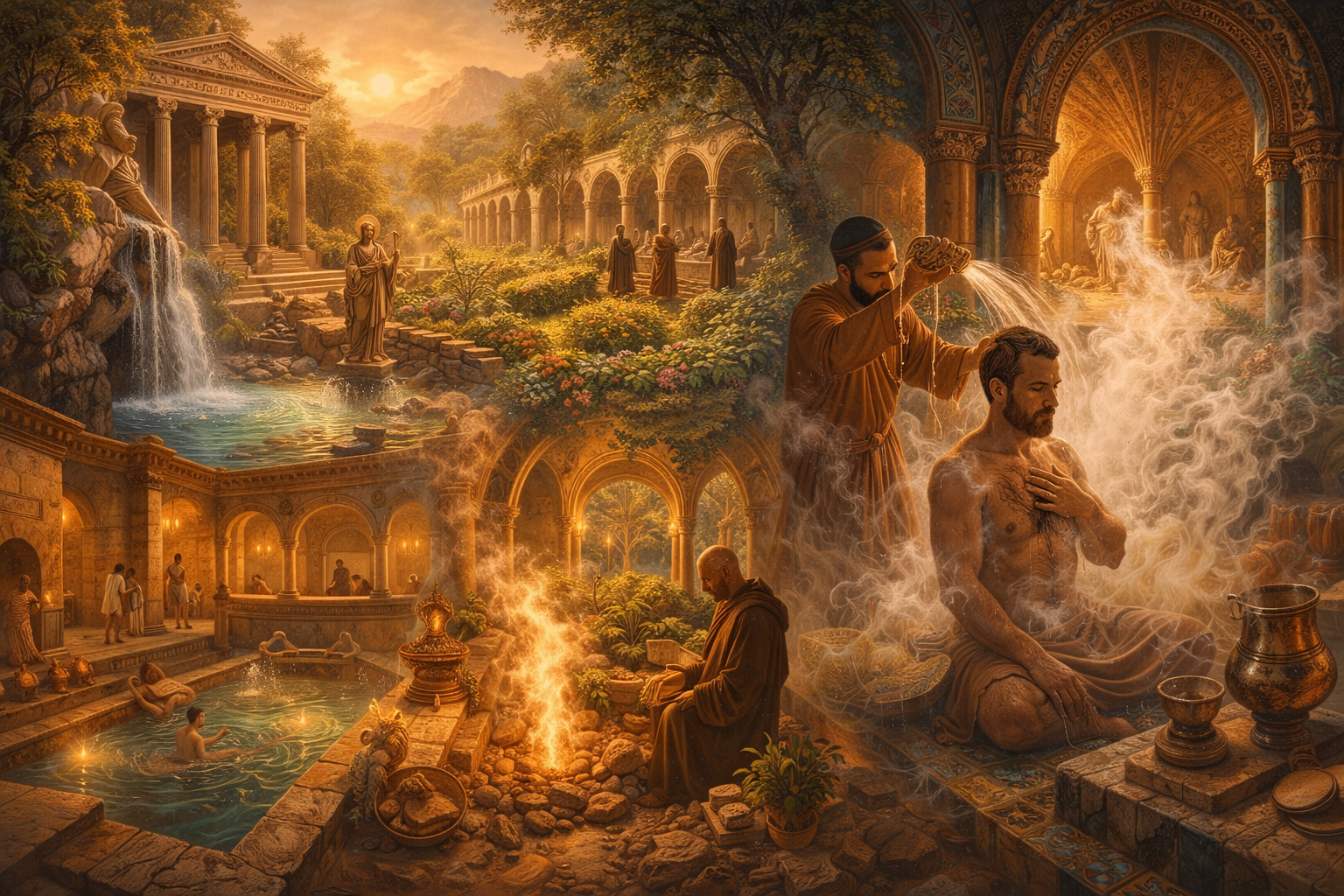
Healing Spaces, Baths & Sacred Environments examine the places, structures, and environmental settings through which cultures have pursued cleansing, restoration, ritual healing, bodily care, and the renewal of life. In the history of ideas, healing has often been shaped not only by remedies, regimens, and practitioners, but also by environments understood as therapeutic, purifying, protective, or spiritually charged, including baths, springs, sanctuaries, temples, gardens, monastic spaces, hammams, hospitals, hospices, and other settings where architecture, water, atmosphere, and ritual formed part of the work of restoration.
This category explores bathing cultures, sacred springs, temple healing, pilgrimage environments, Roman baths, Islamic hammams and ablution spaces, monastic and hospital care settings, ritual cleansing, healing landscapes, and the relationship between built space, environment, embodiment, and care. It considers how places may be understood as restorative in physical, symbolic, communal, and spiritual terms, how water and atmosphere can become part of healing practice, and how environments can shape experiences of purity, relief, balance, renewal, exclusion, discipline, and belonging.
Healing spaces, baths, and sacred environments play an important role in comparative inquiry because they show that healing has often depended not only on substances or interventions, but on the spatial, ritual, sensory, and ecological worlds in which care takes place. By engaging these traditions seriously, this category deepens understanding of healing as an environmental and civilizational practice, while broadening reflection on the relationship between place, architecture, ritual, water, atmosphere, access, and the restoration of body and spirit.
Why This Series Matters
Healing spaces matter because many societies have understood cure, purification, and restoration as impossible to separate from place. A spring, bathhouse, shrine, monastery, hospice, infirmary, garden, or sanctuary may be treated not merely as a convenient location for care, but as an active participant in it. Architecture can channel movement, water can signify cleansing, atmosphere can calm or elevate, and ritual setting can alter how suffering is interpreted and endured. UNESCO’s treatment of Epidaurus as one of the earliest organized sanatoria captures this insight clearly: healing environments have long been organized as institutions of bodily and spiritual restoration rather than as neutral containers for treatment. :contentReference[oaicite:1]{index=1}
The Civilizational Frame of Healing Space
Healing spaces should be understood as a cross-civilizational field rather than a single institution type. Greek sanctuaries, Roman baths, Islamic hammams, ritual ablution spaces, monastic infirmaries, pilgrimage shrines, healing springs, thermal resorts, gardens, and modern therapeutic hospitals belong to different traditions, but all suggest that environments can be designed, consecrated, or interpreted for restoration. What unites them is not one doctrine, but the recurring idea that place itself can purify, regulate, protect, soothe, and transform. :contentReference[oaicite:2]{index=2}
Water, Cleansing, and Renewal
Water is one of the deepest recurring elements in healing environments. Baths, springs, ritual washings, thermal waters, and immersion sites appear across cultures because water can be practical and symbolic at the same time: it cleanses the body, marks transition, prepares the worshipper or patient, and often signifies renewal. The long history of thermal and mineral baths and the repeated association of springs with pilgrimage and cure show how water became one of humanity’s most enduring healing media. :contentReference[oaicite:3]{index=3}
Sacred Springs, Pilgrimage, and Curative Water
Sacred springs and immersion sites combine geography, movement, expectation, and ritual. In pilgrimage settings, healing water is often inseparable from journeys of hope, discipline, suffering, and communal devotion. In such spaces, cure is not always conceived as guaranteed physical recovery; it may also involve purification, consolation, endurance, or reorientation of the self. :contentReference[oaicite:4]{index=4}
Temple Healing, Sanctuary Architecture, and Ritual Care
Temple healing is one of the foundational forms of sacred therapeutic environment. Healing sanctuaries often joined architecture, offerings, sleep, washing, movement, and divine mediation into one institutional setting. These places show that healing has often been spatially staged: the body moves through precincts, approaches sacred water or shrines, enters incubation or rest zones, and participates in a ritualized geography of restoration. :contentReference[oaicite:5]{index=5}
Epidaurus, Incubation, and the Early Sanatorium
The sanctuary of Asklepios at Epidaurus remains one of the clearest anchors for this category. UNESCO describes it as an early organized sanatorium and as an important site in the history of the transition from sacred to more systematic medical care. That makes Epidaurus especially useful for this pillar because it brings together incubation, dream, architecture, rest, sacred precinct, and therapeutic expectation in one setting. :contentReference[oaicite:6]{index=6}
Roman Baths, Civic Life, and Public Restoration
Roman baths belong near the center of this category because they joined bathing, hygiene, water engineering, sociability, architecture, and restoration on a remarkable scale. They were not simply places to wash. They were civic and bodily infrastructures through which public order, leisure, status, bodily maintenance, and social exchange were organized together. :contentReference[oaicite:7]{index=7}
Hammams, Ablution, and Islamic Worlds of Purification
Islamic worlds of cleansing and bodily preparation also belong centrally here. Hammams, ritual washing spaces, and the practices of wuḍūʾ and ghusl make water, purification, discipline, and architecture part of everyday embodied life. These spaces matter not because ablution is identical with medicine in a narrow sense, but because bodily preparation, sacred order, environmental setting, and restoration can converge in one spatial culture of care. :contentReference[oaicite:8]{index=8}
Monastic Infirmaries, Hospices, and Religious Care
Healing spaces also include monastic and religious environments where seclusion, prayer, order, routine, and care become part of therapeutic life. The infirmary, cloister, hospice, and monastery represent historical forms of healing architecture in which care is shaped by discipline, silence, rhythm, and regulated communal life. Even when not centered on baths or springs, these spaces still belong here because healing is embedded in a spatial-moral environment rather than only in an intervention. :contentReference[oaicite:9]{index=9}
Hospitals, Hospices, and the Institutionalization of Care
A strongest-sense pillar should also include hospitals and organized care environments as later but related developments in the history of healing space. The question of whether hospital design can itself be therapeutic has been explicitly discussed in health-systems literature, and the European Observatory notes that therapeutic design became a debated modern issue in hospital history. This matters because it extends the category beyond sacred or ritual environments into institutional infrastructures where architecture, layout, light, green space, privacy, and circulation can shape outcomes. :contentReference[oaicite:10]{index=10}
Healing Waters Beyond the Mediterranean
The strongest version of this pillar should widen beyond the Mediterranean frame. Healing waters are not exclusively Greco-Roman, Christian, or Islamic phenomena. Thermal environments, sacred bathing, ritual immersion, and curative springs also belong to South Asian, East Asian, African, and Indigenous settings, even when the theological or cosmological logic differs. Expanding the category this way helps prevent it from appearing Mediterranean-forward and clarifies that water-centered restoration is a global civilizational pattern rather than one regional specialty. :contentReference[oaicite:11]{index=11}
Gardens, Landscapes, and Therapeutic Atmosphere
Healing environments are not limited to built structures. Gardens, green spaces, mountain pilgrimage routes, thermal landscapes, and carefully designed atmospheres can all function therapeutically. WHO Europe’s work on green space and health supports the broader principle that environments affect mental wellbeing, stress, and public health. Historically, gardens and landscapes have often been treated as places of recovery, retreat, breathing, and sensory balance, suggesting that healing can be spatially ecological rather than purely clinical. :contentReference[oaicite:12]{index=12}
Steam, Light, Sound, Scent, and the Sensory Life of Healing Space
A full account should also foreground sensory atmosphere. Healing spaces often work through heat, steam, light, shade, enclosure, scent, silence, chant, echo, and the tactile feel of stone, water, cloth, and air. These environments do not simply symbolize care; they shape bodily experience. The sensory organization of a bath, sanctuary, cloister, or therapeutic garden can alter expectation, calm, vulnerability, and readiness for restoration. Modern therapeutic-design literature strengthens this point by recognizing the health value of light, greenery, accessibility, and humane environmental design. :contentReference[oaicite:13]{index=13}
Architecture, Ritual Movement, and the Disciplined Body
Healing spaces matter because they choreograph movement. Baths guide sequences of entry, immersion, sweating, cooling, and rest. Sanctuaries guide approach, offering, incubation, purification, and return. Ablution spaces train washing and bodily readiness. Monastic and hospital care spaces regulate time, privacy, silence, and daily rhythms. Architecture in these contexts is not inert enclosure. It disciplines the body by giving restoration a spatial order. :contentReference[oaicite:14]{index=14}
Gender, Access, Purity, and the Social Life of Bathing
A strongest-sense pass should also ask who could enter healing spaces, under what conditions, and with what expectations. Baths and purification sites have often been shaped by gender, modesty, status, purity rules, ritual qualification, or communal norms. Access to water, privacy, and bodily cleansing has historically been social as well as physical. This matters because healing spaces are not only restorative; they are also regulated environments in which bodily legitimacy and social belonging are negotiated. :contentReference[oaicite:15]{index=15}
Danger, Contagion, Exclusion, and the Ambivalence of Healing Space
Healing spaces should not be framed only as benevolent. They can also be sites of exclusion, segregation, contagion anxiety, moral regulation, or spiritual danger. Institutions of care have long separated bodies by impurity, illness, class, gender, or perceived threat. A truly comprehensive pillar should therefore include the ambivalence of healing space: the same environment that purifies or protects some people may discipline, exclude, or stigmatize others. Modern hospital and public-health literature reinforces the point that design and access conditions can help or harm depending on how environments are organized. :contentReference[oaicite:16]{index=16}
Hygiene, Bathing, and the Public Health Dimension of Space
Healing spaces also have a public-health dimension. Baths and hygienic infrastructures can reduce physical burden, while hospitals and service environments may either support or harm health depending on their design and management. WHO-linked public-health literature notes explicitly that places where healing occurs can themselves affect outcomes. This makes spatial design part of the history of care, not merely an architectural afterthought. :contentReference[oaicite:17]{index=17}
Faith-Healing Sites and Modern Pilgrimage Environments
Modern pilgrimage environments continue this long history. Sites associated with miracle reports, immersion, shrine visitation, and collective prayer still function as healing landscapes, whether or not cure is defined in biomedical terms. Their continued force shows that sacred environments remain powerful because they gather water, hope, memory, movement, and communal witnessing into one therapeutic frame. :contentReference[oaicite:18]{index=18}
Therapeutic Architecture and the Modern Afterlife of Healing Environments
The modern afterlife of healing space includes spa culture, health tourism, hospital gardens, evidence-based design, salutogenic planning, and contemporary interest in therapeutic architecture. WHO and Observatory materials show that hospital design, shaded green space, universal accessibility, and humane environmental features are now treated as relevant to healing capacity, mental health, stress reduction, and user wellbeing. This does not make modern therapeutic design identical to sacred spring or shrine culture, but it does show a deep continuity: humans still ask environments to heal. :contentReference[oaicite:19]{index=19}
The Comparative Logic of Healing Environments
The comparative value of this category lies in showing that many cultures have treated healing as environmental. A bath, sanctuary, spring, cloister, garden, hospital ward, or washing space can purify, calm, regulate, prepare, or restore because it shapes the body’s relation to water, air, light, sound, movement, sequence, and social expectation. To compare these environments is therefore to compare civilizational assumptions about what bodies need, how disorder is relieved, and how space participates in care. :contentReference[oaicite:20]{index=20}
Core Themes in This Series
One major theme in this field is water: cleansing, immersion, bathing, and renewal. A second is sacred environment: shrines, springs, and consecrated spaces as active parts of healing. A third is architecture: built settings that guide rest, washing, prayer, seclusion, or care. A fourth is atmosphere: light, sound, steam, scent, enclosure, and landscape as therapeutic conditions. A fifth is ritual preparation: ablution, pilgrimage, incubation, and entry into states of purification. A sixth is public and institutional care: baths, sanctuaries, hospices, and hospitals as organized infrastructures of restoration. A seventh is access and ambivalence: healing space as socially regulated, sometimes exclusionary, and never purely neutral. :contentReference[oaicite:21]{index=21}
Articles in This Series
- What Are Healing Spaces, Baths & Sacred Environments?
- What Makes a Space Healing?
- Water, Cleansing, and the Long History of Renewal
- Healing Waters Across Civilizations
- Sacred Springs and the Curative Imagination
- Temple Healing and the Architecture of Restoration
- Epidaurus and the Early History of the Sanatorium
- Incubation, Dream, and Ritual Sleep in Ancient Healing
- Roman Baths, Civic Life, and the Public Body
- Thermal Waters, Spa Culture, and the Built Environment of Cure
- Hammams and the Culture of Purification
- Islamic Ablution, Ghusl, and the Disciplined Body
- Monastic Infirmaries and the Early Architecture of Care
- Hospices, Hospitals, and Therapeutic Design
- Baths, Purity, and the Social Regulation of the Body
- Steam, Light, Scent, and the Sensory Life of Healing
- Healing Gardens, Landscapes, and Restorative Environments
- Pilgrimage, Cure, and the Geography of Hope
- Gardens, Light, and the Modern Science of Restorative Space
- Why Healing Environments Still Matter
Related Reading
- Ancient Near Eastern and Mediterranean Healing Traditions
- Greek & Roman Medicine
- Islamic Medicine
- Shamanism, Ritual & Spiritual Healing
- Tea, Ritual & Everyday Philosophy
Primary Sources and Archives
- UNESCO World Heritage Centre (n.d.) Sanctuary of Asklepios at Epidaurus. Available at: https://whc.unesco.org/en/list/491/ (Accessed: 12 April 2026).
- WHO Europe (2023) Hospitals of the future. Available at: https://iris.who.int/bitstream/handle/10665/367954/WHO-EURO-2023-7525-47292-69380-eng.pdf (Accessed: 12 April 2026).
- WHO Europe (2017) Urban green space interventions and health. Available at: https://cdn.who.int/media/docs/librariesprovider2/euro-health-topics/environment/urban-green-space-intervention.pdf (Accessed: 12 April 2026).
Further Reading
- UNESCO World Heritage Centre (n.d.) Sanctuary of Asklepios at Epidaurus. Available at: https://whc.unesco.org/en/list/491/ (Accessed: 12 April 2026).
- World Health Organization Regional Office for Europe (2023) Hospitals of the future. Available at: https://iris.who.int/bitstream/handle/10665/367954/WHO-EURO-2023-7525-47292-69380-eng.pdf (Accessed: 12 April 2026).
- World Health Organization Regional Office for Europe (2017) Urban green space interventions and health. Available at: https://cdn.who.int/media/docs/librariesprovider2/euro-health-topics/environment/urban-green-space-intervention.pdf (Accessed: 12 April 2026).
- European Observatory on Health Systems and Policies (2008) Hospitals in a changing Europe. Available at: https://eurohealthobservatory.who.int/docs/librariesprovider3/studies—external/hospitals-in-a-changing-europe.pdf (Accessed: 12 April 2026).
References
- Bakır, B. (2006) ‘Anatolian medical architecture of the Seljuk and Ottoman periods’, EMHJ / WHO EMRO-linked publication. Available via WHO EMRO virtual library at: https://vlibrary.emro.who.int/ (Accessed: 12 April 2026).
- Błaśkiewicz, M. (2014) ‘Healing dreams at Epidaurus: analysis and interpretation of selected dream accounts’, Journal/source as indexed in PDF search. Available at: https://publisherspanel.com/api/files/view/6846.pdf (Accessed: 12 April 2026).
- Drampalos, E., Karamanou, M., Androutsos, G. and Poulakou-Rebelakou, E. (2015) ‘The influence of theory on the formation of the infirmary during antiquity and the Middle Ages’, International Journal of General Medicine, 8, pp. 385–390. Available at: https://pmc.ncbi.nlm.nih.gov/articles/PMC4648214/ (Accessed: 12 April 2026).
- European Observatory on Health Systems and Policies (2008) Hospitals in a Changing Europe. Available at: https://eurohealthobservatory.who.int/docs/librariesprovider3/studies—external/hospitals-in-a-changing-europe.pdf (Accessed: 12 April 2026).
- Furniss, D.A. (1968) ‘The monastic contribution to mediaeval medical care: aspects of an earlier welfare state’, Medical History, 12(3), pp. 244–250. Available at: https://pmc.ncbi.nlm.nih.gov/articles/PMC2236411/ (Accessed: 12 April 2026).
- ICOMOS / UNESCO (2008) City of Bath: mission and evaluation materials. Available at: https://whc.unesco.org/archive/2008/whc08-32com-inf8B1ADDe.pdf (Accessed: 12 April 2026).
- Konstantinidis, P. (2022) ‘What dreams may come: an incubation relief from the Asklepieion of Epidauros’, Kernos, 35. Available at: https://journals.openedition.org/kernos/pdf/4246 (Accessed: 12 April 2026).
- Kuş, Ö. (2025) ‘Ibn Hubal al-Baghdādī’s perspective on bathing and hammams’, Journal/source. Available at: https://pmc.ncbi.nlm.nih.gov/articles/PMC12478582/ (Accessed: 12 April 2026).
- Liwerska-Garstecka, A. (2024) ‘The role of incubation in ancient Greek Asklepieions’, Athens Journal of History. Available at: https://www.athensjournals.gr/history/2024-5924-AJHIS-HIS-Liwerska-Garstecka-05.pdf (Accessed: 12 April 2026).
- UNESCO (n.d.) Sanctuary of Asklepios at Epidaurus. Available at: https://whc.unesco.org/en/list/491/ (Accessed: 12 April 2026).
- UNESCO (n.d.) City of Bath. Available at: https://whc.unesco.org/document/163433 (Accessed: 12 April 2026).
- UNESCO (n.d.) The Pilgrim’s Way and related archive materials on Lourdes and healing waters. Available at: https://unesdoc.unesco.org/ (Accessed: 12 April 2026).
- UNESCO (n.d.) Great Spa Towns of Europe nomination materials. Available at: https://whc.unesco.org/uploads/nominations/1613.pdf (Accessed: 12 April 2026).
- World Health Organization Regional Office for Europe (2017) Urban Green Space Interventions and Health. Available at: https://cdn.who.int/media/docs/librariesprovider2/euro-health-topics/environment/urban-green-space-intervention.pdf (Accessed: 12 April 2026).
- World Health Organization Regional Office for Europe (2023) Hospitals of the Future. Available at: https://iris.who.int/bitstream/handle/10665/367954/WHO-EURO-2023-7525-47292-69380-eng.pdf (Accessed: 12 April 2026).