
Last Updated June 18, 2026
Beauty, Aesthetics, and Meaning examines how beauty, form, perception, art, design, music, symbolism, pattern, and creative practice shape human understanding. This article map introduces beauty not as surface decoration or private preference, but as a major way human beings encounter value, order, feeling, attention, cultural memory, and meaningful form.
Beauty belongs to more than art alone. It appears in nature, ritual, architecture, music, typography, public space, scientific elegance, mathematical pattern, craft, design, symbolic images, and everyday experience. Aesthetic experience helps people notice, interpret, remember, belong, grieve, celebrate, question, and imagine. It connects perception with judgment, emotion with form, and cultural tradition with human self-understanding.
This article map functions as the umbrella pathway for the Meaning category’s aesthetics cluster. It provides the broad integrative frame for related article maps on the philosophy of art, color and design, music theory, mathematical pattern, symbolism and style, and creative composition. Its central question is simple but deep: how do forms become meaningful?
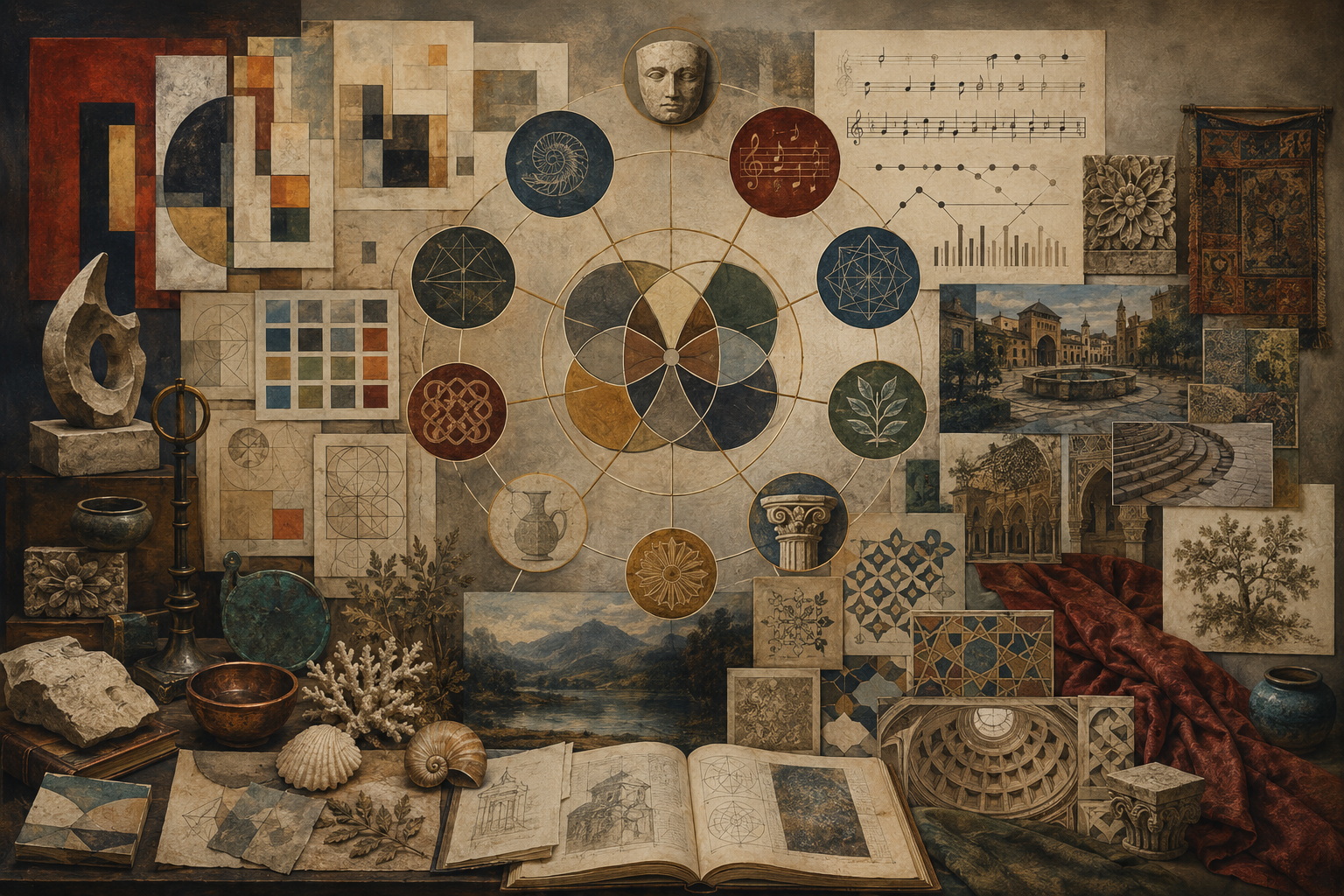
Beauty, Aesthetics, and Meaning provides the umbrella frame for the Meaning category’s work on aesthetic experience. It asks how beauty becomes intelligible, why form matters, how perception becomes judgment, how art and design organize attention, how music gives shape to feeling, how symbols carry cultural memory, and how creative practice gives form to human experience.
This map does not reduce beauty to pleasure, prettiness, ornament, taste, or entertainment. Beauty can be difficult, tragic, sublime, unsettling, sacred, public, ordinary, fragile, or morally charged. Aesthetic experience can clarify attention, disclose hidden relations, intensify memory, dignify space, organize emotion, and make meaning available before language fully catches up.
The articles in this map move from foundations of beauty and aesthetic experience into form, pattern, perception, art, design, music, symbolism, culture, taste, interpretation, ethics, power, responsible research practice, computational tools, and human flourishing. Together, they give the Meaning category a broad intellectual gateway into the study of beauty as one of the ways human beings understand the world.
GitHub Repository
This article map is supported by companion research scaffolding for aesthetic concepts, visual archives, symbolic records, design studies, music-pattern notes, pattern inventories, interpretive matrices, computational experiments, and reproducible studio-lab workflows.
Complete Code Repository
The Beauty, Aesthetics, and Meaning companion repository includes article-level folders, aesthetic concept maps, visual-source metadata, pattern and symbolism inventories, design and music notes, interpretive matrices, documentation, Python workflows, R summaries, SQL catalogs, notebooks, calculators, Canvas cards, and reproducible studio-lab scaffolding for research across beauty, art, design, music, symbolism, pattern, and creative meaning.
Beauty, Aesthetics, and Meaning as an Umbrella Field
Beauty, Aesthetics, and Meaning is the umbrella field for studying how aesthetic forms become meaningful. It includes beauty, aesthetic experience, art, design, music, symbolism, pattern, style, composition, public space, ritual form, and creative practice. These domains differ in method and medium, but they share a central concern: how form shapes human understanding.
Beauty is often misunderstood as decoration, prettiness, or subjective preference. This map treats beauty more seriously. Beauty can be a mode of attention, a response to relation, a perception of order, a feeling of fittingness, a moment of recognition, a source of wonder, or an experience of value that is difficult to translate into ordinary explanation.
Aesthetics gives this inquiry its philosophical and interpretive frame. It asks how people judge, experience, dispute, cultivate, and communicate aesthetic value. Meaning gives the field its larger purpose. It asks what aesthetic experience does in human life: how it shapes identity, culture, memory, ethics, public life, spirituality, perception, and imagination.
This map therefore functions as a gateway into multiple related disciplines. It opens toward philosophy of art, design, typography, color theory, music theory, mathematical pattern, symbolic interpretation, cultural meaning, creative practice, and responsible form-making.
Why Beauty Belongs Under Meaning
Beauty belongs under Meaning because beauty is one of the ways human beings recognize significance. People experience beauty not only when something is pleasant, but when something appears ordered, alive, fitting, moving, strange, powerful, dignified, luminous, or worthy of attention. Beauty often marks the moment when perception deepens into value.
Beauty also belongs under Meaning because aesthetic forms carry more than sensory appeal. A song can hold grief. A building can express public authority. A garden can create contemplative order. A typeface can signal trust. A ritual object can carry sacred presence. A monument can preserve or contest memory. A pattern can organize belonging. An artwork can make visible what ordinary language struggles to name.
The study of beauty therefore cannot be isolated from culture, ethics, psychology, design, music, art, symbolism, and public life. Standards of beauty can cultivate care, dignity, attention, and shared meaning. They can also exclude, stereotype, manipulate, idealize, commodify, or naturalize power. Beauty is never only aesthetic; it is also social, historical, and ethical.
Under Meaning, beauty becomes part of a larger inquiry into how forms shape human worlds. It connects perception with interpretation, feeling with judgment, art with culture, design with accessibility, music with emotion, and public form with shared life.
What This Article Map Studies
This article map studies beauty, aesthetic experience, form, feeling, attention, perception, pattern recognition, harmony, contrast, tension, proportion, balance, rhythm, repetition, variation, the sublime, wonder, art, design, music, symbolism, style, composition, taste, judgment, cultural formation, aesthetic education, interpretation, collective memory, nonverbal meaning, accessibility, aesthetic manipulation, public beauty, responsible interpretation, computational exploration, visual archives, human flourishing, and algorithmic culture.
At the foundational level, the map asks what beauty is and why human beings seek it. At the perceptual level, it studies attention, awareness, pattern, proportion, rhythm, and form. At the artistic and symbolic level, it studies how art, design, music, symbols, style, and composition become meaningful. At the cultural level, it studies taste, tradition, interpretation, education, collective memory, and nonverbal forms of meaning.
At the ethical level, the map studies power, exclusion, accessibility, manipulation, appropriation, public space, and responsible interpretation. At the research-practice level, it studies how beauty can be approached through philosophy, art history, design, psychology, anthropology, music, computation, archives, and concept mapping without reducing aesthetic experience to formulas or data alone.
The goal is to create a broad intellectual pathway for aesthetic inquiry. This map introduces the major questions before the related maps deepen specific domains.
Major Themes in Beauty, Aesthetics, and Meaning
One major theme is attention. Beauty slows perception and asks people to notice relation, form, texture, rhythm, atmosphere, proportion, and presence. Aesthetic experience often begins when ordinary seeing becomes attentive seeing.
A second theme is form. Meaning is shaped by arrangement. The same subject can become solemn, playful, sacred, tragic, official, intimate, or unsettling depending on form. Shape, rhythm, color, scale, sequence, material, and composition all participate in meaning.
A third theme is pattern. Human beings recognize meaning through recurrence, symmetry, contrast, variation, rhythm, and transformation. Pattern links mathematics, art, music, design, ritual, nature, and memory.
A fourth theme is culture. Beauty and taste develop within traditions, institutions, communities, histories, educations, and practices. Aesthetic judgment is personal, but it is never only private.
A fifth theme is power. Beauty can dignify and heal, but it can also exclude, idealize, persuade, manipulate, rank, commodify, or obscure harm. A responsible study of beauty must examine whose standards are centered and whose experiences are ignored.
A sixth theme is flourishing. Beauty can support attention, belonging, care, learning, spiritual life, civic dignity, and human flourishing. A world without beauty would not simply be less pleasant. It would be less hospitable to meaning.
Beauty, Aesthetics, and Meaning Article Map
The map below organizes the Beauty, Aesthetics, and Meaning series into six parts, moving from foundational questions about beauty and aesthetic experience into form, pattern, art, design, music, symbolism, culture, taste, interpretation, ethics, research practice, and future directions.
Part I — Foundations of Beauty and Meaning
- Beauty as a Mode of Human Understanding (planned) — Introduces beauty as more than preference or decoration: a way human beings perceive order, value, relation, and significance.
- Aesthetic Experience as a Form of Knowledge (planned) — Examines how aesthetic experience can disclose truths about perception, emotion, memory, culture, and human attention.
- Form, Feeling, and Meaning (planned) — Studies how form organizes feeling and how emotional experience becomes meaningful through shape, rhythm, color, sound, image, and structure.
- Why Human Beings Seek Beauty (planned) — Explores the human desire for beauty in art, nature, ritual, design, architecture, music, and everyday life.
- Attention, Perception, and Aesthetic Awareness (planned) — Connects aesthetics to attention, perception, noticing, sensory judgment, and the cultivation of awareness.
- The Difference Between Beauty, Pleasure, and Meaning (planned) — Distinguishes beauty from mere enjoyment and explains why meaningful aesthetic experience may also be difficult, tragic, sublime, unsettling, or morally complex.
Part II — Form, Pattern, and Perception
- How Forms Become Meaningful (planned) — Explores how visual, musical, spatial, and symbolic forms acquire meaning through relation, context, repetition, expectation, and interpretation.
- Pattern Recognition and Aesthetic Order (planned) — Studies why human beings perceive patterns as meaningful and how order, recurrence, symmetry, and variation shape aesthetic experience.
- Harmony, Contrast, and Tension (planned) — Examines harmony and contrast as aesthetic principles across art, music, design, literature, architecture, and symbolic systems.
- Proportion, Balance, and Visual Satisfaction (planned) — Introduces proportion, balance, scale, and compositional order as foundations of aesthetic perception.
- Rhythm, Repetition, and Variation (planned) — Studies rhythm as a principle of time, visual sequence, music, design, pattern, ritual, and embodied experience.
- The Sublime, Wonder, and Awe (planned) — Examines aesthetic experiences that exceed ordinary beauty: vastness, terror, transcendence, mystery, wonder, and awe.
Part III — Art, Design, Music, and Symbol
- Art as a Way of Knowing (planned) — Frames art as a form of inquiry that reveals, questions, interprets, and reimagines human experience.
- Design as Organized Meaning (planned) — Explores design as the structuring of attention, usability, trust, hierarchy, visual identity, and public communication.
- Music as Emotional Form (planned) — Studies music as a nonverbal form of meaning shaped by rhythm, tone, harmony, silence, expectation, and embodied feeling.
- Symbols, Images, and Cultural Memory (planned) — Examines how symbols, images, motifs, icons, and objects carry memory, identity, sacredness, authority, and cultural meaning.
- Style as a Carrier of Ideas (planned) — Explores style as more than appearance: a recognizable system of form that carries historical, cultural, institutional, and emotional meaning.
- Composition as Meaning-Making (planned) — Studies composition as the arrangement of parts into meaningful wholes across art, writing, music, design, architecture, and performance.
Part IV — Culture, Taste, and Interpretation
- Taste, Judgment, and Cultural Formation (planned) — Examines how taste develops through education, class, culture, experience, exposure, institutions, and interpretive communities.
- Beauty Across Traditions (planned) — Explores how different cultures, philosophies, religions, and artistic traditions understand beauty, order, ornament, restraint, harmony, and form.
- Aesthetic Education and the Cultivation of Perception (planned) — Studies how aesthetic judgment can be trained through attention, comparison, practice, interpretation, and exposure to works.
- Interpretation and the Life of Forms (planned) — Examines how aesthetic forms continue to generate meaning as they move across time, audiences, institutions, and cultural contexts.
- Aesthetic Experience and Collective Memory (planned) — Explores how monuments, rituals, songs, images, public spaces, and artistic traditions preserve or contest collective memory.
- Meaning Beyond Words: Image, Sound, Gesture, and Form (planned) — Studies nonverbal meaning across visual art, music, ritual, performance, design, architecture, and symbolic action.
Part V — Ethics, Power, and Responsibility
- Beauty, Power, and Exclusion (planned) — Examines how standards of beauty can include, exclude, rank, idealize, marginalize, or naturalize power.
- Accessibility and Aesthetic Responsibility (planned) — Connects beauty and design to accessibility, readability, usability, sensory difference, inclusive form, and public responsibility.
- Aesthetic Manipulation and Persuasion (planned) — Studies how beauty, style, rhythm, imagery, color, typography, and symbolic form can persuade, manipulate, or distort judgment.
- Appropriation, Influence, and Cultural Form (planned) — Examines the difference between influence, borrowing, homage, adaptation, extraction, appropriation, and symbolic harm.
- Public Beauty, Civic Space, and Shared Worlds (planned) — Explores architecture, monuments, urban design, parks, memorials, public art, and the aesthetics of civic life.
- Responsible Interpretation of Aesthetic Form (planned) — Studies how to interpret art, design, symbols, music, and cultural forms with context, humility, evidence, and ethical care.
Part VI — Capstone and Research Practice
- How to Study Beauty Without Reducing It (planned) — A methodological article on studying beauty through philosophy, art history, psychology, anthropology, design, music, and computation without flattening it.
- Computational Tools for Aesthetic Exploration (planned) — Explores how code can support color studies, pattern analysis, visual comparison, music structures, archives, and generative experiments without replacing judgment.
- Aesthetic Research Notes, Concept Maps, and Visual Archives (planned) — A practical article on building research systems for aesthetic study: source notes, image archives, comparison tables, concept maps, and interpretive records.
- Beauty, Meaning, and Human Flourishing (planned) — Examines how beauty relates to attention, dignity, care, belonging, spiritual life, learning, public culture, and human flourishing.
- The Future of Aesthetics in an Algorithmic Culture (planned) — Studies AI-generated images, algorithmic taste, platform aesthetics, synthetic media, design automation, authorship, and the future of human judgment.
- Beauty, Aesthetics, and Meaning: A Capstone (planned) — Brings the full map together, showing how beauty, art, design, music, symbolism, pattern, and creative form belong within a larger theory of meaning.
Python Workflow: Aesthetic Archives, Pattern Records, and Meaning Maps
A useful Python workflow for this article map is an aesthetic archive and meaning-map workflow. The workflow can begin with structured records for aesthetic concepts, images, artworks, design examples, musical structures, symbolic motifs, cultural contexts, ethical cautions, and related article sections. Python can then generate CSV tables, JSON records, Markdown summaries, concept indexes, image metadata sheets, and lightweight visual maps for research planning.
This workflow belongs naturally with articles on form, pattern, aesthetic experience, art, design, symbols, style, composition, public beauty, and computational tools for aesthetic exploration. For example, a Python script can organize a visual archive by theme, medium, aesthetic principle, cultural context, source tradition, interpretive question, and ethical caution.
The workflow should not imply that beauty can be automated or mechanically scored. Its purpose is research support. Python can help make examples, assumptions, comparisons, and archives more transparent, but aesthetic judgment remains interpretive, contextual, embodied, and human.
R Workflow: Aesthetic Themes, Interpretive Comparisons, and Research Summaries
A useful R workflow for this article map is an aesthetic-theme and interpretive-comparison workflow. A structured teaching dataset can include article titles, aesthetic concepts, media, cultural contexts, interpretive questions, ethical themes, and research sources. R can summarize recurring themes, compare article domains, generate tables, and support article planning.
This workflow belongs naturally with articles on taste, judgment, beauty across traditions, accessibility, public beauty, aesthetic manipulation, human flourishing, and the future of aesthetics in algorithmic culture. For example, R can help summarize which articles focus on perception, which focus on design, which focus on culture, which focus on ethics, and which focus on computation.
As with the Python workflow, the goal is not to reduce aesthetic meaning to data. The goal is to make the research architecture easier to review, extend, and audit. Aesthetic interpretation remains philosophical, cultural, sensory, and ethical. R simply helps organize the map’s themes and relationships.
Ethics, Power, and Responsible Aesthetic Interpretation
Beauty is not innocent simply because it feels uplifting. Standards of beauty can dignify, heal, and cultivate care. They can also exclude, idealize, stereotype, commodify, manipulate, or naturalize hierarchy. A serious study of beauty must therefore ask who defines beauty, whose bodies or traditions are centered, whose forms are dismissed, and how aesthetic authority is produced.
Aesthetic responsibility also includes accessibility. A design can be visually refined and still fail readers. A public space can be beautiful to some and hostile to others. A color palette can look elegant and still be unreadable. A museum, archive, website, or civic space can elevate certain forms of culture while making others invisible. Beauty must be studied in relation to access, usability, context, and public care.
Responsible interpretation requires humility. Aesthetic forms often carry cultural, sacred, political, or historical meanings that cannot be understood from appearance alone. A pattern, symbol, garment, melody, ritual object, architectural form, or artistic style may require context, source knowledge, community authority, and ethical restraint.
The goal is not to make beauty subordinate to moral instruction. The goal is to understand that beauty participates in real human worlds. Aesthetic inquiry should preserve wonder while also remaining attentive to power, history, harm, and responsibility.
Beauty, Aesthetics, and Meaning in a Wider Intellectual Context
Beauty, Aesthetics, and Meaning belongs within a wider knowledge architecture because aesthetic experience connects perception, culture, design, art, music, mathematics, symbolism, ethics, and public life. It sits under Meaning because it studies how forms become significant and how human beings encounter value through perception, feeling, pattern, and interpretation.
This map connects to aesthetics and the philosophy of art through beauty, taste, judgment, artistic value, and interpretation. It connects to color theory and typography through visual communication, hierarchy, accessibility, and design systems. It connects to music theory through rhythm, harmony, time, and emotional form. It connects to mathematics, art, and pattern through proportion, symmetry, recurrence, and formal structure. It connects to symbolism through icons, motifs, ritual forms, and cultural memory. It connects to creative form through composition, craft, revision, and responsible making.
The map also connects to ethics, sustainability, public policy, and civic life through public beauty, accessibility, shared spaces, monuments, institutional design, and the aesthetics of common worlds. Beauty is not only private experience. It shapes how people inhabit public life.
By giving beauty and aesthetics an umbrella article map, the site treats aesthetic meaning as a serious part of human understanding. People do not live by information alone. They live through form, rhythm, image, sound, symbol, place, and shared worlds of beauty and meaning.
Related Reading
- Aesthetics and the Philosophy of Art
- Color Theory, Typography, and Design
- Music Theory, Form, and Meaning
- Mathematics, Art, Music, and Pattern
- Symbolism, Style, and Cultural Meaning
- Creative Form, Composition, and Interpretation
- Storytelling and Narrative Systems
- Culture, Ritual, and Symbolic Life
Further Reading
- Adajian, T. (2022). ‘The Definition of Art’, Stanford Encyclopedia of Philosophy. Available at: https://plato.stanford.edu/entries/art-definition/.
- Albers, J. (1963). Interaction of Color. New Haven: Yale University Press. Publisher page available at: https://yalebooks.yale.edu/book/9780300146936/interaction-of-color/.
- Arnheim, R. (1974). Art and Visual Perception: A Psychology of the Creative Eye. Berkeley: University of California Press.
- Burke, E. ([1757] 1998). A Philosophical Enquiry into the Origin of Our Ideas of the Sublime and Beautiful. Oxford: Oxford University Press.
- Dewey, J. (1934). Art as Experience. New York: Minton, Balch & Company.
- Eco, U. (1989). The Open Work. Translated by A. Cancogni. Cambridge, MA: Harvard University Press.
- Gadamer, H.-G. (2004). Truth and Method, 2nd rev. edn. London: Continuum.
- Goodman, N. (1976). Languages of Art: An Approach to a Theory of Symbols, 2nd edn. Indianapolis: Hackett.
- Kant, I. ([1790] 2000). Critique of the Power of Judgment. Translated by P. Guyer and E. Matthews. Cambridge: Cambridge University Press.
- Langer, S.K. (1953). Feeling and Form: A Theory of Art. New York: Charles Scribner’s Sons.
- Saito, Y. (2007). Everyday Aesthetics. Oxford: Oxford University Press.
- Shelley, J. (2022). ‘The Concept of the Aesthetic’, Stanford Encyclopedia of Philosophy. Available at: https://plato.stanford.edu/entries/aesthetic-concept/.
- W3C Web Accessibility Initiative. (2023). Web Content Accessibility Guidelines 2.2. Available at: https://www.w3.org/TR/WCAG22/.
- Zangwill, N. (2023). ‘Aesthetic Judgment’, Stanford Encyclopedia of Philosophy. Available at: https://plato.stanford.edu/entries/aesthetic-judgment/.
References
- Adajian, T. (2022). ‘The Definition of Art’, Stanford Encyclopedia of Philosophy. Available at: https://plato.stanford.edu/entries/art-definition/.
- Albers, J. (1963). Interaction of Color. New Haven: Yale University Press. Publisher page available at: https://yalebooks.yale.edu/book/9780300146936/interaction-of-color/.
- Arnheim, R. (1974). Art and Visual Perception: A Psychology of the Creative Eye. Berkeley: University of California Press.
- Barthes, R. (1977). Image Music Text. Translated by S. Heath. New York: Hill and Wang.
- Berleant, A. (1992). Art and Engagement. Philadelphia: Temple University Press.
- Burke, E. ([1757] 1998). A Philosophical Enquiry into the Origin of Our Ideas of the Sublime and Beautiful. Oxford: Oxford University Press.
- Carroll, N. (1999). Philosophy of Art: A Contemporary Introduction. London: Routledge.
- Cassirer, E. (1944). An Essay on Man: An Introduction to a Philosophy of Human Culture. New Haven: Yale University Press.
- Dewey, J. (1934). Art as Experience. New York: Minton, Balch & Company.
- Eco, U. (1989). The Open Work. Translated by A. Cancogni. Cambridge, MA: Harvard University Press.
- Gadamer, H.-G. (2004). Truth and Method, 2nd rev. edn. London: Continuum.
- Geertz, C. (1973). The Interpretation of Cultures. New York: Basic Books.
- Goodman, N. (1976). Languages of Art: An Approach to a Theory of Symbols, 2nd edn. Indianapolis: Hackett.
- Hume, D. ([1757] 1987). ‘Of the Standard of Taste’. In Essays, Moral, Political, and Literary. Indianapolis: Liberty Fund.
- Kant, I. ([1790] 2000). Critique of the Power of Judgment. Translated by P. Guyer and E. Matthews. Cambridge: Cambridge University Press.
- Langer, S.K. (1953). Feeling and Form: A Theory of Art. New York: Charles Scribner’s Sons.
- Scruton, R. (2009). Beauty. Oxford: Oxford University Press.
- Saito, Y. (2007). Everyday Aesthetics. Oxford: Oxford University Press.
- Shelley, J. (2022). ‘The Concept of the Aesthetic’, Stanford Encyclopedia of Philosophy. Available at: https://plato.stanford.edu/entries/aesthetic-concept/.
- Simon, H.A. (1996). The Sciences of the Artificial, 3rd edn. Cambridge, MA: MIT Press. Publisher page available at: https://mitpress.mit.edu/9780262691918/the-sciences-of-the-artificial/.
- W3C Web Accessibility Initiative. (2023). Web Content Accessibility Guidelines 2.2. Available at: https://www.w3.org/TR/WCAG22/.
- Zangwill, N. (2023). ‘Aesthetic Judgment’, Stanford Encyclopedia of Philosophy. Available at: https://plato.stanford.edu/entries/aesthetic-judgment/.