
Last Updated May 28, 2026
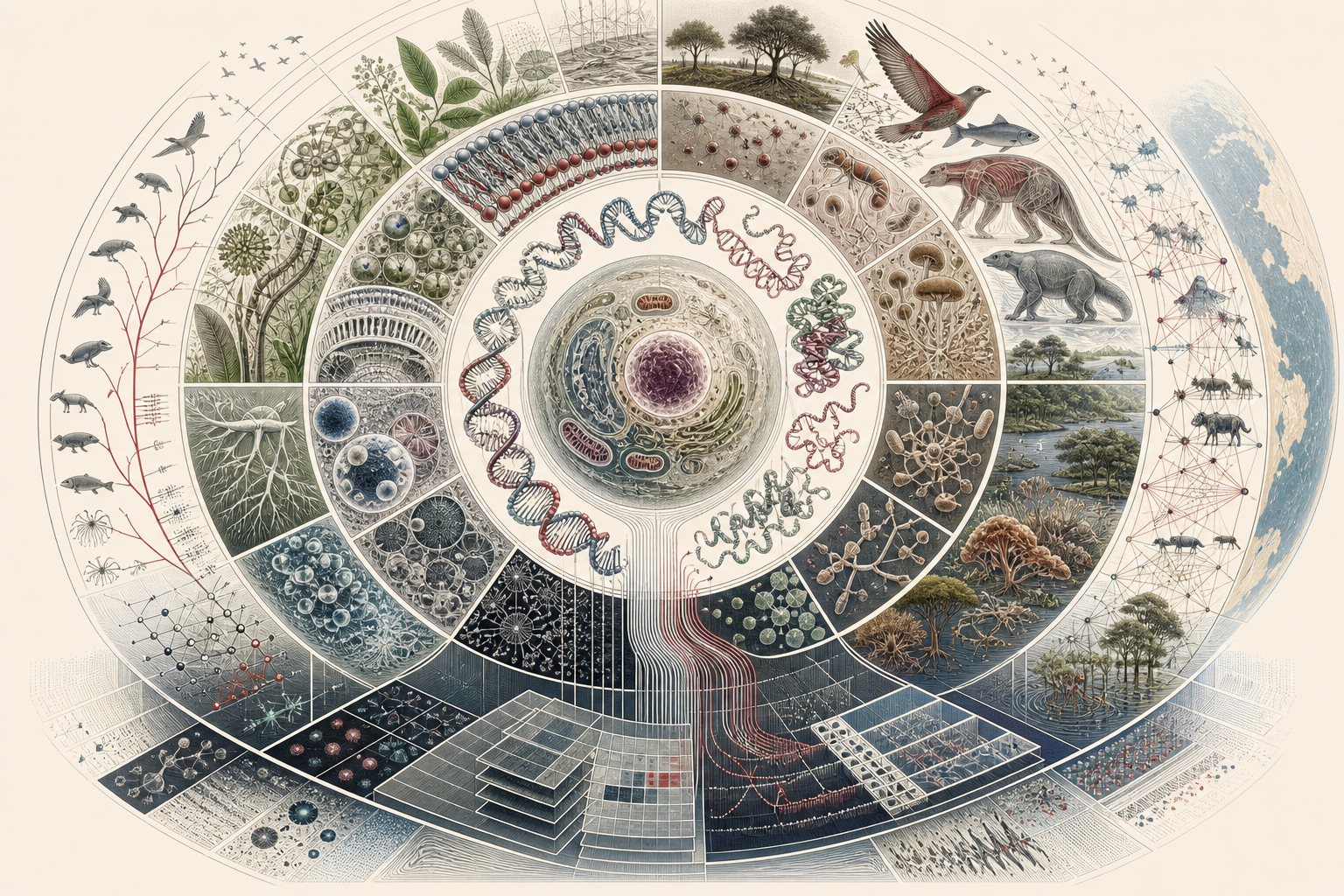
Biology examines life in all its forms, from molecules and cells to organisms, populations, ecosystems, and the evolutionary history of living systems across deep time. It asks how living systems are organized, how they maintain themselves, how they reproduce and develop, how hereditary information is stored and transmitted, how organisms adapt and diversify, and how life persists under changing ecological, material, and planetary conditions. As a foundational natural science, biology provides one of the principal frameworks through which human beings understand living order, diversity, vulnerability, interdependence, and the conditions that make life possible on Earth.
This content pillar brings together the major domains through which biology interprets the living world. It treats biology not merely as a catalog of organisms or a collection of specialized subfields, but as a disciplined framework for understanding living organization across scales: from biomolecules, cells, and developmental processes to physiology, heredity, behavior, evolution, biodiversity, ecosystems, and the biosphere itself. Across medicine, environmental science, agriculture, public health, genomics, biotechnology, conservation, restoration ecology, food systems, and sustainability, biology provides an indispensable language for explaining life, adaptation, resilience, fragility, and the material conditions of flourishing.
Main Library
Publications
Article Map
Biology
Related Topic
Chemistry
Related Topic
Earth Science
Related Topic
Environmental Science
This series also approaches biology as a field that increasingly depends on quantitative reasoning, statistical inference, computational modeling, biological data analysis, experimental reproducibility, and open scientific workflows. Many of the most important biological questions now require not only observation and experiment, but programmable environments capable of tracing change across time, scale, variation, and complexity. For that reason, this pillar integrates biology with mathematics, R, Python, Julia, C++, Fortran, C, Rust, SQL, notebooks, reproducible data practices, and open scientific code. Mathematics clarifies rates, variation, inheritance, feedback, regulation, networks, population change, ecological interaction, and dynamic biological processes. R supports biostatistics, ecology, genomics, experimental design, visualization, biodiversity metrics, and reproducible reporting. Python supports simulation, bioinformatics, machine learning, automation, image analysis, scientific computing, and computational representations of complex biological systems. Julia supports high-performance scientific computing, differential equations, systems modeling, and biological simulation. C++, Fortran, C, and Rust support performance-critical modeling, numerical kernels, embedded biosensing, safe scientific tooling, and infrastructure for reproducible biological computation. SQL supports biological metadata, experiment logs, sample tracking, ecological observations, and reproducible research infrastructure. Together, these tools make it possible not only to describe living systems, but to measure, model, simulate, test, reproduce, and interrogate them with greater rigor.
Biology therefore appears here not only as an observational and experimental science, but also as a historical, theoretical, quantitative, computational, ethical, ecological, medical, technological, and civilizational one. The aim of the series is to preserve the conceptual richness of biological thought while also showing how contemporary biology increasingly relies on mathematical structure, statistical reasoning, data analysis, modeling, simulation, and computation in order to understand living systems under real conditions of uncertainty, heterogeneity, nonlinearity, interdependence, and change. In that sense, this series treats biology not simply as the study of life, but as one of the deepest and most demanding ways human beings have developed for thinking about organized complexity in the material world.
Biology as a Foundational Science
Biology occupies a central place within the natural sciences because it explains how living systems are structured, maintained, reproduced, regulated, and transformed. Chemistry helps clarify the molecular basis of life, and physics helps define the energetic and material constraints under which organisms and ecosystems exist, but biology is uniquely concerned with life as life: with organization, metabolism, development, heredity, adaptation, behavior, interaction, and the persistence of living order across time. It spans molecular, cellular, organismal, ecological, and evolutionary scales while asking how living systems sustain themselves and how they change.
This foundational role does not mean that biology can be reduced either to chemistry or to environmental description. Biology is distinctive because it investigates the forms and processes through which living systems maintain internal order, exchange matter and energy with their surroundings, reproduce, generate variation, respond to stress, and participate in broader webs of life. It serves as one of the most important bridges between molecular mechanisms, ecological systems, evolutionary history, medicine, conservation, food systems, biotechnology, public health, and questions of survival, resilience, and flourishing.
Biology is therefore both integrative and plural. It includes laboratory sciences, field sciences, theoretical sciences, observational sciences, quantitative sciences, and computational sciences. It draws on microscopy, molecular sequencing, experimentation, classification, comparative anatomy, ecological monitoring, phylogenetic inference, statistics, mathematical modeling, genomic analysis, computational notebooks, and historical reconstruction. Across these methods, biology seeks not a single level of explanation, but a layered understanding of living systems in which mechanism, development, environment, and history remain inseparable.
Biology as a Science of Organized Complexity
Biology may be understood as one of the great sciences of organized complexity. Living systems are neither simple mechanical aggregates nor formless collections of matter. They are structured, self-maintaining, historically evolved systems whose properties emerge from relation, regulation, exchange, and constraint. Cells organize molecular processes into living function. Organisms coordinate tissues, signals, metabolism, and behavior. Populations change through heredity, competition, cooperation, drift, and selection. Ecosystems stabilize and reorganize through flows of matter, energy, interaction, and disturbance. At every level, biology encounters systems whose behavior cannot be understood by listing parts alone.
For that reason, biology has always demanded forms of thinking capable of moving between levels of scale. It must explain how local mechanisms generate larger patterns, how inherited structure shapes future possibility, how variation accumulates into transformation, and how living order persists despite entropy, scarcity, competition, cooperation, predation, disease, and environmental change. In the contemporary world, these problems increasingly require quantitative and computational tools, but they remain biological in the deepest sense because they concern life as organized process.
This makes biology especially important within a broader intellectual project concerned with systems, sustainability, and long-horizon responsibility. The living world is not a passive background to human action. It is a dynamic, interdependent, vulnerable order whose stability depends on innumerable forms of biological relation. To study biology seriously is therefore to study the conditions under which life continues, adapts, or breaks down.
Biology as a Quantitative and Computational Science
Modern biology is increasingly quantitative. Living systems are not only observed and described; they are measured, modeled, compared, visualized, simulated, and analyzed using formal methods. Population change can be represented mathematically. Genetic inheritance can be expressed probabilistically. Enzyme activity can be modeled through rates and nonlinear functions. Ecological interaction can be studied through differential equations, network structures, and dynamic feedback. Evolutionary change can be analyzed statistically across populations and over deep time. Biological knowledge therefore increasingly emerges through the combination of empirical observation, mathematical reasoning, computational analysis, and reproducible workflows.
This does not mean that biology ceases to be descriptive, historical, or field-based. Rather, it means that modern biological understanding often depends on moving across modes of inquiry. A researcher may observe organisms in the field, sequence a genome in the laboratory, analyze the resulting data in R, build a simulation in Python, document the workflow in a computational notebook, store metadata in SQL, and interpret the results in light of evolutionary theory, ecological context, or physiological mechanism. Biology has become one of the clearest examples of a science in which conceptual understanding, measurement, formal reasoning, and computation must work together.
For that reason, this series treats mathematics, statistics, R, Python, Julia, SQL, scientific computing, and reproducible workflows as increasingly important parts of biological literacy. Some articles in the series remain primarily conceptual, historical, ecological, or philosophical. Others lend themselves naturally to rates of change, probability, statistical inference, visualization, simulation, sequence analysis, network reasoning, epidemiological modeling, systems biology, microscopy analysis, or machine learning. The aim is not to force code into every article, but to build a Biology pillar that reflects how the life sciences are actually practiced.
What Biology Studies
Biology studies living systems across multiple levels of organization. At the molecular and cellular level, it examines the chemical basis of life, the structure and function of cells, the flow of genetic information, metabolism, signaling, and the processes that allow living systems to maintain internal order. At the organismal level, it investigates anatomy, physiology, development, reproduction, behavior, and the varied strategies through which plants, animals, fungi, and microbes survive and reproduce.
At broader scales, biology studies populations, species, communities, ecosystems, and the biosphere. It asks how organisms interact with one another and with their environments, how energy and nutrients move through living systems, how species emerge and disappear, how biodiversity is structured, and how evolutionary and ecological processes shape the history of life. It also examines symbiosis, competition, cooperation, parasitism, adaptation, extinction, and the continual reorganization of life under changing conditions.
Biology further studies life as a historical phenomenon. Every organism carries the marks of earlier evolutionary processes, and every ecosystem reflects layers of biological and environmental change. Biology is therefore not only concerned with how living systems function now, but with how they came to be, how they have diversified, and how they may respond to future pressures.
What This Pillar Covers
This pillar brings together the major domains through which biology interprets the living world. It begins with life as a scientific problem and with the historical emergence of biological thought, then moves through cell theory, biomolecules, genetics, heredity, development, metabolism, physiology, evolution, ecology, biodiversity, and the organization of life across levels of scale. From there, it expands into molecular biology, genomics, microbiology, mycology, plant biology, animal biology, neurobiology, immunology, behavior, systems biology, conservation biology, restoration ecology, biotechnology, synthetic biology, epidemiology, agriculture, food systems, and the ethical and civilizational implications of biological knowledge.
The pillar also incorporates quantitative and computational biological reasoning where appropriate. Some topics naturally involve mathematical structure, including growth, heredity, evolution, epidemiology, ecological interaction, systems regulation, and the analysis of biological variation. Others lend themselves especially well to statistical inference, visualization, reproducible notebooks, data pipelines, simulation, machine learning, or computational workflows. In those cases, articles may incorporate mathematical interpretation, R-based analysis, Python-based modeling, Julia-based simulation, SQL metadata, GitHub-based code examples, or full-stack computational scaffolding. This allows the series to remain conceptually rich while also becoming methodologically stronger.
Taken together, these domains form a coherent intellectual architecture. Biology is not simply the study of organisms in isolation. It is a far-reaching mode of explanation that connects molecules to cells, cells to tissues, tissues to organisms, organisms to populations, populations to ecosystems, and ecosystems to planetary conditions and evolutionary time. It shows that life is patterned, dynamic, contingent, historical, and relational, and that living systems can be studied scientifically without losing sight of their complexity.
The series also treats biology as a field that links the descriptive and the applied. Biological knowledge informs medicine and public health, agriculture and food systems, biodiversity protection, ecological restoration, genetic engineering, environmental monitoring, biological data science, and questions of planetary habitability. For that reason, the pillar is designed not only to introduce biological concepts, but to clarify why biological thinking remains indispensable for understanding the contemporary world.
Mathematics, Computation, and Simulation in Biology
Mathematics provides part of the formal language through which biology understands variation, interaction, regulation, and change. Rates of growth and decay, probability distributions, inheritance patterns, dynamic equilibria, diffusion processes, epidemiological spread, and population change can all be clarified through mathematical reasoning. Biology often relies less on symbolic derivation alone than physics does, but it depends deeply on quantitative structure: calculus for rates and dynamics, probability for inheritance and uncertainty, statistics for inference, linear algebra for multivariate systems and population models, graph theory and networks for interdependence, and differential equations for physiological, ecological, and epidemiological change.
Computation is especially valuable where biological systems are too complex, heterogeneous, data-rich, or nonlinear for direct intuition alone. R supports biostatistics, reproducible research, ecological modeling, genomics, phylogenetics, experimental design, and data visualization. Python supports simulation, scientific computing, automation, image analysis, machine learning, bioinformatics, ecological forecasting, microscopy pipelines, genome parsing, and computational notebooks. Julia supports high-performance differential equation modeling, dynamical systems, computational ecology, epidemiology, and systems biology. C++, Fortran, C, Rust, and Go support performance-critical simulation, numerical kernels, scientific utilities, embedded biosensing, command-line workflows, and reproducible biological infrastructure. SQL supports sample metadata, experiment logs, observation tables, reproducible provenance, and research data organization.
Used together, mathematics, computation, numerical methods, notebooks, SQL metadata, and open code repositories help make biology more explicit, testable, reproducible, and scalable. They allow biological patterns to be measured rather than merely described, uncertainty to be quantified rather than assumed away, and complex systems to be explored through models as well as through observation. In this series, those tools are integrated where they deepen explanation rather than distract from it. The result is a Biology pillar that remains faithful to the life sciences while also acknowledging that modern biological literacy increasingly includes quantitative and computational competence.
Major Domains of Biology
Biology includes a wide range of major domains, each of which illuminates a different dimension of living organization. Molecular biology examines the structure and function of biological macromolecules and the mechanisms through which genetic information is replicated, expressed, and regulated. Cell biology studies the cell as the fundamental unit of life, including membranes, organelles, transport, signaling, division, and intracellular organization. Genetics and genomics investigate heredity, variation, inheritance, and the large-scale structure and interpretation of genomes.
Developmental biology explains how organisms emerge from single cells through differentiation, pattern formation, morphogenesis, and regulated growth. Physiology studies how organisms function, maintain homeostasis, and regulate internal processes. Evolutionary biology explains how life changes across generations through mutation, selection, drift, speciation, and extinction. Ecology examines the interactions among organisms and environments, including populations, communities, food webs, nutrient cycles, ecosystem dynamics, and the biosphere.
Other major biological domains extend and deepen this framework. Microbiology studies the bacterial, archaeal, viral, and microbial worlds that underlie much of Earth’s biochemical and ecological functioning. Mycology examines fungi as decomposers, symbiotic partners, pathogens, and essential participants in terrestrial life systems. Botany and plant biology study primary production, plant form, development, signaling, and plant-environment interaction. Zoology and animal biology explore the organization, diversity, behavior, and evolution of animal life. Immunology studies defense, recognition, inflammation, and the body’s responses to internal and external threat. Neurobiology examines nervous systems, signaling, perception, coordination, and the biological basis of behavior. Conservation biology studies biodiversity loss, extinction risk, restoration, and the protection and repair of living systems under rapid environmental change. Systems biology investigates life as an interconnected, dynamic network whose properties often emerge from interaction rather than from isolated parts alone.
Many of these domains are now inseparable from quantitative and computational methods. Systems biology depends heavily on modeling and network analysis. Population genetics relies on probability and statistical reasoning. Ecology increasingly uses computational models, remote sensing, geospatial data, and reproducible analysis. Genomics depends on large-scale data processing, sequence comparison, and algorithmic interpretation. Epidemiology depends on mathematical and statistical models of spread, exposure, and risk. Even organismal biology increasingly intersects with imaging, measurement, and computational analysis. The biological sciences therefore continue to broaden not only in subject matter but also in formal and technical depth.
Why Biology Matters
Biology matters because it helps explain what life is, how it persists, and how it changes. It clarifies how organisms grow and function, how hereditary information is stored and transmitted, how species emerge and diversify, how ecosystems maintain stability or undergo disruption, and how living systems respond to stress, scarcity, competition, cooperation, disease, and environmental change. In doing so, biology shapes medicine, public health, agriculture, biotechnology, conservation, and many of the most consequential questions facing modern societies.
Biology also matters because the contemporary world is increasingly shaped by biological disruption and biological power. Climate change, biodiversity loss, zoonotic disease, antimicrobial resistance, food insecurity, water stress, genetic engineering, synthetic biology, ecological degradation, and the destabilization of habitats all require biological understanding. The science of life is no longer confined to classrooms, laboratories, or field stations. It has become central to questions of governance, ethics, technology, security, sustainability, and long-term planetary responsibility.
At the same time, biology matters because it reveals the depth of interdependence that structures life on Earth. No organism exists in complete isolation. Every living thing depends on larger networks of energy, nutrients, relationships, habitats, and inherited biological constraints. Biology therefore helps clarify not only the mechanisms of life, but the fragility of the conditions under which life can continue.
Biology also matters because modern decisions increasingly depend on data, models, and statistical interpretation. Questions of epidemic spread, habitat loss, conservation planning, crop resilience, genetic risk, and ecosystem change now rely not only on observation but on modeling, inference, and computation. A biologically literate society must therefore be able to move between the living world as experienced, the living world as measured, and the living world as modeled.
Biology and Human Self-Understanding
Biology changes how human beings understand themselves. It places human life within a larger evolutionary and ecological context, reveals deep continuities across living systems, and shows that human beings are neither separate from nor outside the wider history of life. It illuminates embodiment, inheritance, development, aging, vulnerability, disease, adaptation, and the layered biological conditions that shape survival and flourishing.
Yet biology also complicates self-understanding. It shows that life is not static, that categories are often more dynamic than they appear, and that living systems are shaped by both inheritance and environment, by both constraint and plasticity. It asks human beings to understand themselves at once as organisms, as ecological participants, and as historically evolved beings whose knowledge now gives them unprecedented power to alter living systems.
For that reason, biology has philosophical as well as scientific significance. It raises enduring questions about the meaning of life, the boundaries of intervention, the status of nonhuman life, the ethics of experimentation, the value of biodiversity, and the responsibilities that follow from human power over biological processes. As biology becomes increasingly data-rich, computational, and interventionist, those ethical questions become even more pressing. A serious Biology pillar should therefore not end with facts alone. It should also clarify the wider implications of biological knowledge for ethics, stewardship, and civilization.
Biology Article Map
The map below organizes the Biology knowledge series into conceptual domains, moving from foundations and first principles toward cells, heredity, evolution, organisms, ecosystems, computation, biotechnology, sustainability, and the wider human significance of biological knowledge.
The Biology article map is organized to move from foundations and first principles into cellular and molecular organization, heredity and evolution, organismal systems, ecological systems, quantitative and computational biology, biological technology, medicine, agriculture, sustainability, and the wider intellectual significance of biological knowledge. The article list below is mapped directly to the uploaded CSV source of truth, so every linked article corresponds to a current Biology-series URL.
Foundations of Biology
- What Is Biology? Life, Evolution, and Living Systems — An opening article defining biology as the scientific study of life across molecules, cells, organisms, populations, ecosystems, and evolutionary time. This piece clarifies the identity of the field, its scope within the natural sciences, and its importance for understanding living order, adaptation, interdependence, and biological complexity.
- Observation, Experiment, and the Methods of Biological Inquiry — A methodological treatment of how biological knowledge is produced through field observation, laboratory experiment, comparative analysis, microscopy, sequencing, monitoring, statistical inference, modeling, and reproducible scientific practice. This article emphasizes the plural methods required to study living systems responsibly.
- Classification, Taxonomy, and the Ordering of Life — A focused article on naming, classifying, and organizing biological diversity. It explains taxonomy, systematics, phylogenetics, species concepts, evolutionary relationships, and the continuing importance of classification for ecology, conservation, genomics, medicine, and biodiversity science.
- Cell Theory and the Basic Unit of Life — A foundational article on the cell as the basic unit of living organization. It explains cell theory, membranes, cytoplasm, organelles, cellular metabolism, cell division, microscopy, and why cellular life provides the structural and functional basis for all biological systems.
- Life, Death, and the Problem of Biological Definition — A conceptual article on the difficulty of defining life, distinguishing living from nonliving systems, and understanding death as biological process. It examines metabolism, reproduction, information, homeostasis, evolution, viruses, dormant states, cellular death, and the boundary problems that make biology philosophically rich.
- Biology and the Scientific Understanding of Living Order — A synthetic article explaining how biology studies order without reducing living systems to machines. This piece connects organization, regulation, heredity, development, metabolism, evolution, ecological relation, and historical contingency into a broader account of living order.
Cells, Molecules, and Living Organization
- Biomolecules and the Chemical Basis of Life — A study of proteins, nucleic acids, carbohydrates, lipids, metabolites, and the molecular architecture of living systems. This article bridges chemistry and biology by showing how molecular structure supports metabolism, heredity, signaling, membranes, catalysis, and biological function.
- Water, Energy, and the Material Conditions of Life — An article on the physical and chemical conditions that make life possible, including water, energy gradients, temperature, pH, solubility, membranes, nutrients, and chemical disequilibrium. This piece connects biological organization to the material constraints of habitability.
- Cell Structure, Membranes, and Organelles — A detailed treatment of cellular organization, including membranes, nuclei, mitochondria, chloroplasts, ribosomes, cytoskeleton, endomembrane systems, transport, compartmentalization, and the internal architecture that allows cells to regulate biological function.
- Metabolism, Energy, and Biological Function — An article on how living systems acquire, transform, store, and use energy. It covers metabolic pathways, ATP, respiration, photosynthesis, fermentation, anabolic and catabolic processes, energy coupling, and the role of metabolism in sustaining living order.
- Enzymes, Regulation, and Biochemical Pathways — A focused article on enzymes as biological catalysts and biochemical pathways as regulated systems. It explains enzyme kinetics, specificity, inhibition, feedback, allosteric regulation, metabolic networks, and the control logic that makes cellular chemistry biologically coordinated.
- Molecular Biology and the Flow of Genetic Information — A core article on DNA, RNA, transcription, translation, replication, gene expression, regulatory sequences, proteins, and the molecular flow of biological information. This piece explains how molecular biology transformed the study of heredity and cellular function.
- Cell Signaling, Communication, and Biological Coordination — An article on how cells sense, signal, and coordinate behavior through receptors, ligands, second messengers, phosphorylation cascades, transcriptional regulation, cell-cell communication, and signal networks that link molecular events to biological response.
Genetics, Development, and Heredity
- Genes, Inheritance, and the Principles of Heredity — A foundational article on genes, alleles, inheritance, Mendelian patterns, dominance, segregation, independent assortment, linkage, recombination, and the probabilistic logic of heredity. This piece connects classical genetics to modern molecular understanding.
- DNA, RNA, and the Molecular Logic of Life — A treatment of nucleic acids as information-bearing molecules, including DNA structure, RNA diversity, base pairing, replication, transcription, translation, mutation, regulation, and the molecular logic that connects sequence to biological function.
- Genomics and the Expansion of Biological Knowledge — An article on genome sequencing, comparative genomics, genome annotation, variation, gene regulation, functional genomics, bioinformatics, and how large-scale biological data transformed genetics, medicine, evolution, ecology, and biotechnology.
- Mutation, Variation, and the Sources of Novelty — A focused article on mutation, recombination, genetic variation, chromosomal change, population variation, evolutionary novelty, and the biological tension between genetic stability and the variation required for adaptation and diversification.
- Development, Differentiation, and the Making of Organisms — A study of how organisms develop from single cells through gene regulation, cell differentiation, pattern formation, morphogenesis, signaling gradients, tissue formation, and developmental constraints that shape biological form.
- Epigenetics, Regulation, and Gene Expression — An article on chromatin, DNA methylation, histone modification, regulatory RNA, gene expression, cellular memory, developmental plasticity, and the mechanisms through which biological systems regulate hereditary information without changing DNA sequence itself.
Evolution and Biological Change
- Evolution and the History of Life — A flagship article on evolution as the central organizing framework of biology. It explains descent with modification, common ancestry, variation, selection, drift, adaptation, speciation, extinction, and the deep history through which life has diversified on Earth.
- Natural Selection, Adaptation, and Fitness — A focused treatment of natural selection, adaptation, reproductive success, fitness landscapes, tradeoffs, constraints, environmental pressures, and the biological logic through which traits become more or less common across generations.
- Population Genetics and the Mathematics of Inheritance — A quantitative article on allele frequencies, Hardy-Weinberg equilibrium, genetic drift, selection, migration, mutation, recombination, effective population size, and the mathematical foundations of evolutionary change in populations.
- Speciation, Diversity, and the Tree of Life — An article on how new species arise and how biological diversity is organized. It covers reproductive isolation, geographic separation, ecological divergence, phylogenetic trees, lineage branching, and the evolutionary structure of life’s diversity.
- Microevolution, Macroevolution, and Deep Time — A synthesis of short-term evolutionary change and large-scale patterns across geological time. This piece connects population-level processes to extinction, adaptive radiation, major transitions, fossil evidence, and the long temporal scale of life’s history.
- Extinction, Contingency, and Biological Transformation — An article on extinction as a central force in biological history. It examines mass extinction, background extinction, contingency, ecological collapse, recovery, evolutionary bottlenecks, and the vulnerability of living systems to environmental disruption.
- Coevolution, Symbiosis, and the Dynamics of Mutual Change — A study of reciprocal evolutionary change among species, including host-pathogen dynamics, mutualism, parasitism, pollination, microbiomes, endosymbiosis, arms races, and the relational character of biological adaptation.
Organisms, Physiology, and Behavior
- Plant Biology and the Life of Primary Producers — An article on plants as primary producers and ecological engineers, covering photosynthesis, vascular systems, roots, leaves, reproduction, growth, signaling, adaptation, plant-microbe interactions, agriculture, forestry, and the role of plants in planetary life-support systems.
- Animal Biology and the Organization of Complex Life — A study of animal form, function, evolution, physiology, behavior, reproduction, sensory systems, movement, development, and ecological roles. This article situates animal life within broader questions of complexity, adaptation, and biological diversity.
- Microbiology and the Hidden Majority of Life — An article on bacteria, archaea, viruses, microbial metabolism, microbial communities, disease, symbiosis, biogeochemical cycles, biotechnology, and the enormous biological importance of microscopic life across ecosystems and human health.
- Fungi and the Networks of Decomposition and Exchange — A treatment of fungi as decomposers, symbionts, pathogens, network builders, nutrient recyclers, and ecological connectors. This article examines mycelial systems, mycorrhizae, fungal reproduction, wood decay, soil ecology, and the role of fungi in living landscapes.
- Physiology and the Regulation of Living Systems — An article on how organisms maintain internal function through homeostasis, transport, circulation, respiration, osmoregulation, thermoregulation, endocrine signaling, neural control, metabolism, and the integration of tissues and organs into living systems.
- Immunology and Biological Defense — A focused article on immune recognition, innate immunity, adaptive immunity, inflammation, antibodies, T cells, B cells, memory, vaccination, autoimmunity, allergy, infection, and the biological systems that defend organisms while also creating risks of dysregulation.
- Neurobiology and the Organization of Living Response — A study of nervous systems, neurons, synapses, sensory processing, motor control, neural circuits, learning, behavior, plasticity, and the biological organization of perception and response in animals.
- Behavior, Communication, and Biological Strategy — An article on behavior as biological adaptation, including signaling, cooperation, competition, mating, parental care, navigation, social behavior, learning, communication, and the ecological and evolutionary contexts in which behavior becomes strategic.
- Reproduction, Life Cycles, and Biological Continuity — A treatment of reproduction, life cycles, sexual and asexual strategies, gametes, fertilization, development, reproductive tradeoffs, life-history theory, and the biological mechanisms through which life persists across generations.
Ecology, Systems, and the Biosphere
- Ecology and the Interdependence of Life — A foundational article on organisms, environments, populations, communities, ecosystems, energy flow, nutrient cycling, food webs, disturbance, resilience, and the interdependence that structures life on Earth.
- Population Dynamics and Ecological Modeling — A quantitative article on population growth, carrying capacity, density dependence, predator-prey systems, competition models, demographic structure, stochasticity, and the use of mathematical and computational models in ecology.
- Populations, Communities, and Ecosystem Dynamics — A synthesis of ecological organization from populations to communities and ecosystems. This article covers species interactions, trophic structure, succession, disturbance, resilience, ecosystem function, and the dynamic character of living systems.
- Biodiversity and the Structure of Living Systems — An article on genetic, species, functional, phylogenetic, and ecosystem diversity. It explains why biodiversity matters for resilience, ecosystem services, evolutionary potential, conservation, restoration, food systems, and planetary stability.
- Biogeochemical Cycles and the Conditions of Habitability — A bridge article on carbon, nitrogen, phosphorus, water, sulfur, oxygen, microbes, soils, oceans, atmosphere, ecosystems, and the biological regulation of planetary conditions that support life.
- Biomes, Habitats, and the Geography of Life — A study of forests, grasslands, deserts, tundra, wetlands, freshwater systems, oceans, mountains, soils, climate gradients, habitat structure, and the spatial organization of life across Earth’s environments.
- The Biosphere and Planetary Life Support Systems — A planetary-scale article on the biosphere as the integrated living layer of Earth. It examines life-support systems, climate regulation, nutrient cycling, biodiversity, soils, freshwater, oceans, and the conditions that make planetary habitability possible.
- Conservation Biology and the Protection of Life — A major article on biodiversity loss, extinction risk, habitat fragmentation, invasive species, protected areas, population viability, conservation genetics, environmental justice, and the scientific effort to protect living systems under rapid change.
- Restoration Ecology and the Repair of Living Systems — An article on ecological repair, degraded landscapes, restoration targets, reference ecosystems, resilience, succession, soil recovery, rewilding, monitoring, adaptive management, and the science of helping damaged ecosystems recover function and integrity.
Quantitative and Computational Biology
- Mathematical Biology and the Logic of Living Systems — A spine article on the use of mathematics to represent growth, inheritance, diffusion, metabolism, population change, epidemiology, feedback, oscillation, networks, and ecological interaction. This piece establishes the formal layer beneath computational biology.
- Probability, Variation, and Biological Inference — An article on probability as a foundation for genetics, evolution, ecology, epidemiology, experimental uncertainty, sampling, stochasticity, survival, mutation, inheritance, and biological reasoning under uncertainty.
- Statistics, Uncertainty, and Measurement in Biology — A methodological article on data, sampling, uncertainty, experimental variation, confidence intervals, hypothesis testing, regression, measurement error, reproducibility, and the statistical interpretation of biological evidence.
- Biostatistics and Experimental Design in Biology — A focused treatment of study design, replication, randomization, controls, power, ANOVA, generalized linear models, survival analysis, experimental design, observational data, and the statistical discipline required for credible biological research.
- Differential Equations in Population and Physiological Modeling — A quantitative article on ODE and PDE models for growth, decay, epidemiology, pharmacokinetics, physiology, diffusion, predator-prey dynamics, resource limitation, and biological change over time.
- Nonlinearity, Feedback, and Biological Regulation — An article on nonlinear biological systems, feedback loops, homeostasis, bistability, oscillation, thresholds, tipping points, regulatory networks, control systems, and emergent behavior in cells, organisms, and ecosystems.
- Networks, Systems, and Biological Complexity — A systems article on gene-regulatory networks, metabolic networks, protein interactions, ecological networks, food webs, microbiomes, feedback, modularity, robustness, and the network structures through which biological complexity becomes organized.
- Data, Measurement, and Reproducibility in the Life Sciences — A methodological article on biological data quality, metadata, protocols, reproducible workflows, open code, notebooks, version control, sample tracking, data provenance, and the scientific infrastructure needed for trustworthy biological research.
- R for Biological Data Analysis and Visualization — A practical article on using R for cleaning, analyzing, visualizing, and communicating biological data. It covers tidy data, exploratory analysis, statistical models, plots, reproducible reports, and biological workflows across laboratory and field research.
- R for Biostatistics, Ecology, and Genomics — An applied article on R for statistical analysis in ecology, genomics, biodiversity, experimental biology, phylogenetics, population analysis, generalized models, reproducible reports, and biological data science.
- Python for Simulation, Bioinformatics, and Scientific Workflows — A practical article on Python for biological modeling, sequence analysis, data pipelines, simulation, notebooks, automation, scientific computing, visualization, and reproducible workflows in the life sciences.
- Python for Biological Modeling and Automation — An applied article on Python for ecological simulations, population models, epidemiological spread, image processing, biological automation, data integration, machine learning, and programmable scientific workflows.
- Genomics, Sequence Analysis, and Biological Data — A computational biology article on sequence data, genome assembly, alignment, annotation, variant analysis, comparative genomics, gene expression, bioinformatics pipelines, and the interpretation of large biological datasets.
- Computational Ecology and Environmental Modeling — An article on ecological simulation, species distribution modeling, population forecasting, spatial data, remote sensing, biodiversity indicators, habitat modeling, environmental uncertainty, and reproducible ecological computation.
- Modeling Disease, Epidemiology, and Biological Spread — A quantitative article on infectious disease dynamics, exposure, transmission, susceptibility, \(R_0\), compartment models, stochastic spread, surveillance data, uncertainty, and the biological modeling of epidemics and ecological disease systems.
- Image Analysis, Microscopy, and Computational Biology — An article on microscopy data, segmentation, cell tracking, fluorescence imaging, morphology, feature extraction, computer vision, machine learning, and the computational interpretation of biological images.
- Systems Biology and Complexity in Living Networks — A major article on biological systems as dynamic networks, including gene regulation, metabolic pathways, signaling, feedback, omics data, network modeling, robustness, adaptation, and the computational study of life as organized complexity.
- Machine Learning in the Life Sciences — A modern article on machine learning for genomics, imaging, ecology, protein analysis, drug discovery, epidemiology, classification, prediction, feature learning, uncertainty, interpretability, and responsible computational biology.
- Computational Notebooks and Reproducible Biological Research — A methodological article on notebooks, literate programming, reproducible analysis, data provenance, version control, executable documentation, visual outputs, and the role of transparent workflows in biological science.
Biology in Human Knowledge and Practice
- Biotechnology, Intervention, and the Power to Alter Life — An article on biotechnology as the deliberate use and modification of living systems, including genetic engineering, cell culture, sequencing, biologics, diagnostics, agriculture, medicine, industrial biotechnology, and the expanding human power to intervene in life processes.
- Synthetic Biology and the Engineering of Biological Systems — A focused treatment of synthetic biology, genetic circuits, engineered organisms, biosensors, metabolic engineering, design-build-test-learn cycles, standardization, biological design, and the ethical implications of engineering living systems.
- Evolutionary Medicine and the Biological Understanding of Disease — An article on disease through evolutionary reasoning, including host-pathogen conflict, immune tradeoffs, mismatch, aging, cancer, antibiotic resistance, reproductive biology, and the ways evolution clarifies medical vulnerability.
- Agriculture, Food Systems, and the Management of Life — A systems article on crops, livestock, soils, agroecology, plant breeding, food webs, pests, disease, biodiversity, nutrition, biotechnology, climate stress, and the biological foundations of food systems and human survival.
- Biology, Ethics, and the Human Understanding of Life — A capstone-style article on the ethical implications of biological knowledge, including experimentation, biodiversity, biotechnology, genetic intervention, animal life, ecological responsibility, public health, and the responsibilities that follow from human power over living systems.
Measurement, Experiment, and Biological Practice
One of biology’s enduring contributions is its ability to make living systems observable, comparable, and experimentally intelligible without stripping them of complexity. Biological knowledge depends not only on theory, but on reliable observations, shared classifications, calibrated instruments, reproducible protocols, field records, laboratory procedures, statistical designs, controlled experiments, and disciplined forms of comparison. The history of biology is therefore also a history of microscopes, field notebooks, herbaria, specimen collections, sequencing technologies, culture systems, imaging platforms, sensors, ecological surveys, clinical studies, statistical models, and the effort to render living processes measurable in consistent and transferable ways.
This matters far beyond laboratory practice. Biological measurement supports medicine, public health, environmental monitoring, biodiversity protection, agriculture, food systems, epidemiology, biotechnology, conservation, and ecological restoration. A disease outbreak, a restoration project, a genetic association study, a crop trial, a microbial survey, or a conservation assessment all depends on the transformation of living complexity into careful evidence. Biology therefore requires humility about uncertainty: living systems vary, adapt, interact, and change. Biological measurement must account for heterogeneity, sampling bias, organismal difference, ecological context, developmental stage, evolutionary history, and the limits of any single method.
Modern biological practice increasingly depends on combining observation, experiment, instrumentation, statistics, computation, and reproducible documentation. A serious biological claim may draw on field sampling, microscopy, sequencing, experimental manipulation, statistical analysis, mathematical modeling, computational workflows, and open data. This makes biology one of the clearest examples of a science in which knowledge is produced through layered evidence rather than through one method alone.
Biology, Technology, and the Modern World
Biology has become one of the central sciences shaping modern life. Its influence extends through medicine, vaccines, antibiotics, diagnostics, genomics, agriculture, conservation, biotechnology, epidemiology, public health, environmental regulation, food production, reproductive technologies, ecological restoration, and planetary sustainability. Many of the most important questions facing contemporary societies are biological questions: how diseases spread, how ecosystems collapse or recover, how crops respond to heat and drought, how genes influence risk, how microbial communities shape health, how biodiversity supports resilience, and how human intervention alters living systems.
Biology also underlies many of the most powerful technologies of the present century. Sequencing technologies make hereditary information visible at scale. Molecular biology enables gene editing, diagnostics, synthetic biology, and targeted therapeutics. Microbiology supports biotechnology, fermentation, antimicrobial research, environmental remediation, and the study of microbiomes. Ecology supports conservation planning, restoration, biodiversity monitoring, habitat modeling, and climate adaptation. Computational biology and machine learning increasingly support drug discovery, protein analysis, genomic interpretation, epidemiological forecasting, and ecological prediction.
Yet biological power also creates biological responsibility. Technologies that alter genomes, engineer organisms, reshape ecosystems, manage reproduction, or intervene in disease systems cannot be judged only by technical capability. They require ethical reasoning, public accountability, ecological awareness, and attention to uneven distributions of risk and benefit. Biology therefore belongs not only to laboratories and field stations, but to public life, law, governance, medicine, agriculture, conservation, and long-term questions about the future of life on Earth.
Biology, Computation, and Scientific Simulation
Computation has become central to contemporary biology because living systems generate complex, heterogeneous, high-dimensional, and dynamic data. Genomes, transcriptomes, proteomes, microbiomes, ecological observations, microscopy images, epidemiological records, phylogenetic trees, environmental sensors, and experimental datasets all require computational methods for storage, interpretation, visualization, and reproducibility. Biological computation is not merely a convenience. It is increasingly part of how biological knowledge is produced.
Simulation is especially important when biological systems cannot be understood through direct observation alone. Population models can explore extinction risk, disease spread, or ecological recovery. Systems biology models can examine feedback, signaling, pathway dynamics, and cellular regulation. Evolutionary simulations can explore selection, drift, mutation, recombination, and adaptation. Ecological simulations can examine habitat change, species interactions, nutrient flow, climate stress, and restoration scenarios. Machine learning can help identify patterns in biological images, genomic sequences, ecological data, and complex experimental systems, while also raising questions about interpretability, bias, uncertainty, and biological meaning.
For that reason, this Biology pillar treats computational practice as a major component of modern life science. It includes R for statistics and ecology, Python for simulation and bioinformatics, Julia for high-performance biological modeling, C++ and Fortran for numerical kernels and simulation infrastructure, C and Rust for systems-level tools and biosensing pipelines, SQL for metadata and sample tracking, Go for practical scientific services and reproducible utilities, and computational notebooks for transparent explanation. The goal is not to replace biological judgment with code, but to strengthen biological reasoning through reproducible, inspectable, and methodologically explicit workflows.
Biology in a Wider Intellectual Context
Biology occupies a distinctive place in human knowledge because it studies the living conditions under which human beings themselves exist. It places humanity within evolution, ecology, embodiment, inheritance, vulnerability, development, aging, disease, and dependence on the biosphere. It reveals continuity between humans and other living systems while also clarifying the distinctive responsibilities that emerge from human technological power.
Biology also reshapes philosophical, ethical, and political questions. It challenges ideas of human separateness from nature, complicates simple accounts of identity and heredity, and forces reflection on the value of nonhuman life. It raises questions about intervention, experimentation, biodiversity, animal welfare, genetic modification, public health, environmental justice, and the protection of vulnerable communities and ecosystems. As biological knowledge becomes more powerful, its moral stakes become harder to avoid.
In a wider intellectual context, biology therefore connects natural science with sustainability, medicine, agriculture, ethics, law, economics, systems thinking, technology, and cultural self-understanding. It is a science of life, but also a science of dependence, relation, fragility, resilience, and responsibility. The study of biology is not only the study of what living systems are. It is also a way of asking what conditions allow life to continue, what kinds of intervention are justified, and what responsibilities follow from understanding life well enough to alter it.
Related Reading
- Natural Science
- Physics
- Chemistry
- Earth Science
- Environmental Science
- Sustainable Development
- Planetary Boundaries
- Systems Modeling
- Data Systems & Analytics
Further Reading
- Alberts, B., Heald, R., Johnson, A., Morgan, D., Raff, M., Roberts, K. and Walter, P. (2022) Molecular Biology of the Cell. 7th edn. New York: W.W. Norton. Available at: https://wwnorton.com/books/9780393884852
- Campbell, N.A., Urry, L.A., Cain, M.L., Wasserman, S.A., Minorsky, P.V. and Orr, R.B. (2020) Campbell Biology. 12th edn. New York: Pearson. Available at: https://www.pearson.com/en-us/subject-catalog/p/campbell-biology/P200000003740
- Futuyma, D.J. and Kirkpatrick, M. (2017) Evolution. 4th edn. Sunderland, MA: Sinauer Associates. Available at: https://global.oup.com/academic/product/evolution-9781605356051
- Gotelli, N.J. and Ellison, A.M. (2013) A Primer of Ecological Statistics. 2nd edn. Sunderland, MA: Sinauer Associates. Available at: https://global.oup.com/academic/product/a-primer-of-ecological-statistics-9781605350646
- National Human Genome Research Institute (n.d.) Genome.gov. Available at: https://www.genome.gov/
- National Library of Medicine (n.d.) NCBI Bookshelf. Available at: https://www.ncbi.nlm.nih.gov/books/
- R Core Team (n.d.) The R Project for Statistical Computing. Available at: https://www.r-project.org/
- Python Software Foundation (n.d.) Python. Available at: https://www.python.org/
- Wickham, H., Çetinkaya-Rundel, M. and Grolemund, G. (2023) R for Data Science. 2nd edn. Sebastopol, CA: O’Reilly Media. Available at: https://r4ds.hadley.nz/
- Downey, A. (2024) Think Python. 3rd edn. Sebastopol, CA: O’Reilly Media. Available at: https://greenteapress.com/wp/think-python-3rd-edition/
- Wilkinson, D.J. (2018) Stochastic Modelling for Systems Biology. 3rd edn. Boca Raton: CRC Press. Available at: https://doi.org/10.1201/9781351000918
References
- Alberts, B., Heald, R., Johnson, A., Morgan, D., Raff, M., Roberts, K. and Walter, P. (2022) Molecular Biology of the Cell. 7th edn. New York: W.W. Norton. Available at: https://wwnorton.com/books/9780393884852
- American Institute of Biological Sciences (n.d.) About AIBS. Available at: https://www.aibs.org/about/
- American Institute of Biological Sciences (n.d.) Careers in Biology. Available at: https://www.aibs.org/careers/
- Campbell, N.A., Urry, L.A., Cain, M.L., Wasserman, S.A., Minorsky, P.V. and Orr, R.B. (2020) Campbell Biology. 12th edn. New York: Pearson. Available at: https://www.pearson.com/en-us/subject-catalog/p/campbell-biology/P200000003740
- Darwin, C. (1859) On the Origin of Species by Means of Natural Selection. London: John Murray. Available at: https://darwin-online.org.uk/contents.html#origin
- Dobzhansky, T. (1973) ‘Nothing in Biology Makes Sense Except in the Light of Evolution’, The American Biology Teacher, 35(3), pp. 125–129. Available at: https://doi.org/10.2307/4444260
- Downey, A. (2024) Think Python. 3rd edn. Sebastopol, CA: O’Reilly Media. Available at: https://greenteapress.com/wp/think-python-3rd-edition/
- Futuyma, D.J. and Kirkpatrick, M. (2017) Evolution. 4th edn. Sunderland, MA: Sinauer Associates. Available at: https://global.oup.com/academic/product/evolution-9781605356051
- Gotelli, N.J. and Ellison, A.M. (2013) A Primer of Ecological Statistics. 2nd edn. Sunderland, MA: Sinauer Associates. Available at: https://global.oup.com/academic/product/a-primer-of-ecological-statistics-9781605350646
- National Human Genome Research Institute (n.d.) National Human Genome Research Institute. Available at: https://www.genome.gov/
- National Library of Medicine (n.d.) NCBI Bookshelf. Available at: https://www.ncbi.nlm.nih.gov/books/
- National Research Council (2009) A New Biology for the 21st Century. Washington, DC: National Academies Press. Available at: https://nap.nationalacademies.org/catalog/12764/a-new-biology-for-the-21st-century
- Odum, E.P. and Barrett, G.W. (2005) Fundamentals of Ecology. 5th edn. Belmont, CA: Thomson Brooks/Cole. Available at: https://www.cengage.com/c/fundamentals-of-ecology-5e-odum/
- Python Software Foundation (n.d.) Python. Available at: https://www.python.org/
- R Core Team (n.d.) The R Project for Statistical Computing. Available at: https://www.r-project.org/
- Raven, P.H., Johnson, G.B., Mason, K.A., Losos, J.B. and Singer, S.R. (2022) Biology. 13th edn. New York: McGraw-Hill. Available at: https://www.mheducation.com/highered/product/biology-raven-johnson/M9781260169614.html
- Watson, J.D., Baker, T.A., Bell, S.P., Gann, A., Levine, M. and Losick, R. (2013) Molecular Biology of the Gene. 7th edn. San Francisco: Pearson. Available at: https://www.pearson.com/en-us/subject-catalog/p/molecular-biology-of-the-gene/P200000007736
- Wickham, H., Çetinkaya-Rundel, M. and Grolemund, G. (2023) R for Data Science. 2nd edn. Sebastopol, CA: O’Reilly Media. Available at: https://r4ds.hadley.nz/
- Wilkinson, D.J. (2018) Stochastic Modelling for Systems Biology. 3rd edn. Boca Raton: CRC Press. Available at: https://doi.org/10.1201/9781351000918
- Wilson, E.O. (1992) The Diversity of Life. Cambridge, MA: Harvard University Press. Available at: https://www.hup.harvard.edu/books/9780674058170