
Last Updated May 4, 2026
Chinese Medicine examines one of the major healing traditions in world history through concepts of qi, yin and yang, the Five Phases, organ networks, channels, blood, essence, spirit, pattern diagnosis, seasonal rhythm, emotional life, nourishment, herbal formulation, acupuncture, moxibustion, preventive care, and the cultivation of ordered vitality. As a major category within the Healing Traditions knowledge series, it studies Chinese medicine first through classical texts, internal categories, diagnostic methods, materia medica, therapeutic traditions, cultivation practices, and historical transmission, and only after that through modern scholarship, clinical research, public health, and contemporary integrative medicine.
Chinese medicine is not merely a collection of remedies or techniques. It is a medical-philosophical system in which the human body is understood through relation, process, correspondence, circulation, transformation, and dynamic balance. Classical Chinese medicine developed through sustained reflection on qi, yin-yang relation, Five-Phase movement, zang-fu organ networks, channel theory, climatic influence, emotional life, seasonal adaptation, nourishment, and the patterned movement of vitality through the body. In that respect, it belongs as much to the history of ideas as to the history of healing.
This category explores the Huangdi neijing, the Nanjing, the Shanghan lun, the Shennong bencao jing, the Maijing, the Bencao gangmu, qi and blood, essence and spirit, yin-yang theory, Five-Phase correspondence, zang-fu functional systems, channels and meridians, pulse diagnosis, tongue diagnosis, pattern differentiation, acupuncture, moxibustion, herbal formulas, dietetics, seasonal regimen, emotional physiology, cultivation of life, women’s health, pediatrics, medical ethics, terminology, evidence, safety, and the modern global afterlives of Chinese medicine.
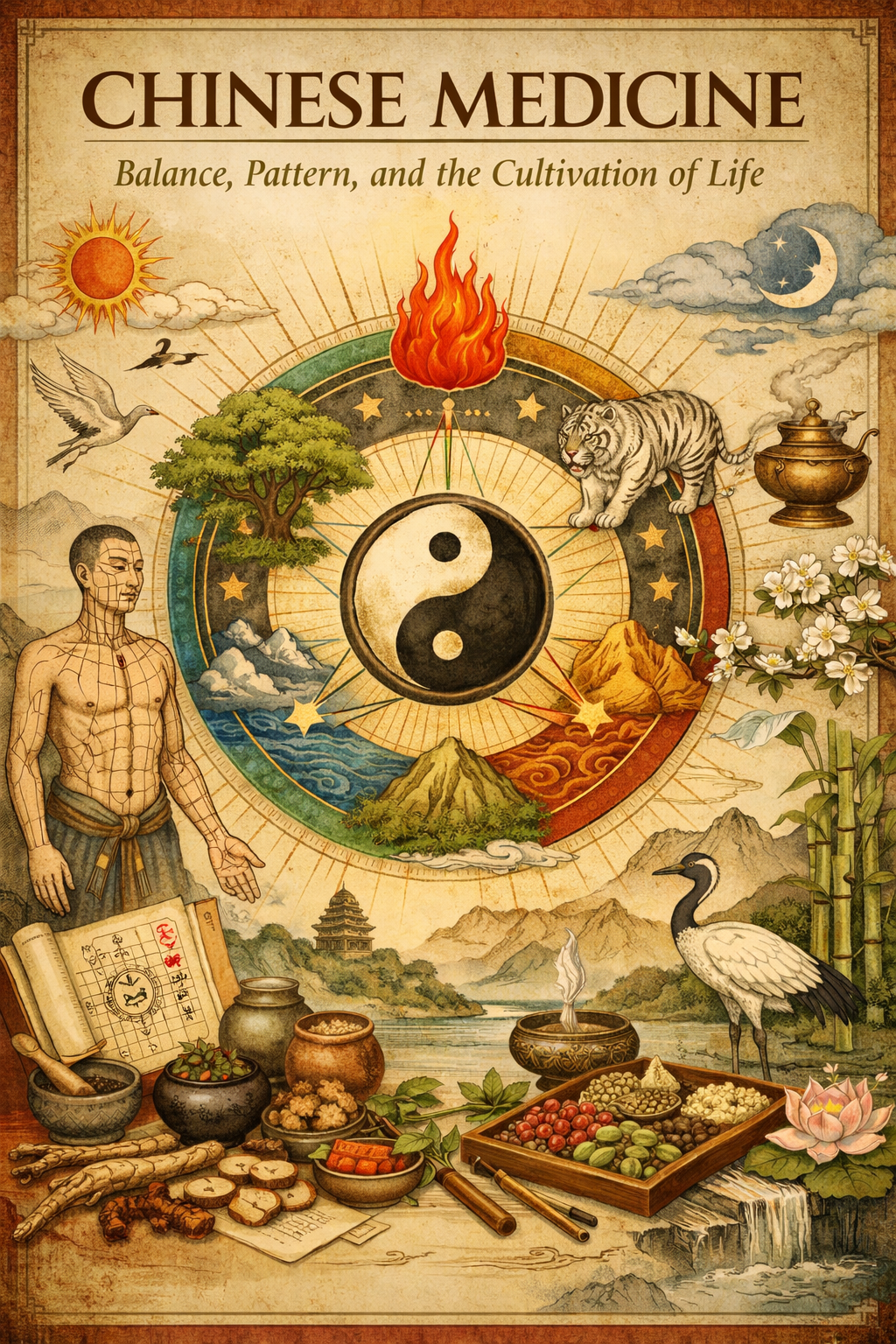
Chinese medicine is especially important to the broader architecture of this site because it connects Healing Traditions to Vital Energy Healing Traditions, Herbalism & Traditional Knowledge, Diet, Nourishment & Food as Medicine, Ayurveda and South Asian Healing Traditions, Islamic Medicine, East Asian Traditions, Chinese Thought, Biology, Environmental Science, and Psychology. It shows how a healing tradition can join practical care to philosophy, seasonal ecology, emotional life, diagnostic pattern, and long-term cultivation.
The goal of this pillar is not to present Chinese medicine as a substitute for contemporary biomedical care, nor to romanticize every traditional claim as clinically proven. It is to understand Chinese medicine as a historically deep, internally coherent, and globally influential healing tradition while maintaining responsible public-facing language about evidence, safety, terminology, translation, standardization, and modern clinical evaluation. Chinese medicine deserves serious study because of its civilizational depth; modern therapeutic claims still require careful evaluation.
Chinese medicine is best approached as a layered tradition rather than a single frozen system. Classical, medieval, early modern, Republican, state-standardized, diaspora, and global integrative forms of Chinese medicine are not identical. They inherit, reinterpret, codify, simplify, expand, and institutionalize earlier materials under changing historical conditions. A publication-ready pillar must therefore treat Chinese medicine as both archive and living practice: classical and modern, textual and clinical, philosophical and material, local and global.
Why This Series Matters
Chinese medicine matters because it preserves one of the world’s major healing traditions and one of the most sophisticated historical systems for thinking about relation, rhythm, pattern, vitality, diagnosis, prevention, and the regulation of life. It is not simply a set of procedures such as acupuncture, moxibustion, or herbal therapy. It is a medical-philosophical tradition that understands the body as a living field of movement, transformation, correspondence, circulation, nourishment, depletion, excess, blockage, and dynamic balance.
This series also matters because Chinese medicine offers a different way of imagining medical knowledge. Diagnosis depends not only on symptoms in isolation, but on the interpretation of patterns. Pulse, tongue, complexion, voice, appetite, temperature, sleep, bodily rhythms, elimination, emotional tone, seasonal context, and environmental exposure all become diagnostically meaningful within a larger interpretive system. Therapy is correspondingly plural: acupuncture, moxibustion, herbal formulas, dietary regulation, manual therapies, and cultivation practices are all intelligible within the same larger logic of patterned adjustment.
Chinese medicine is also one of the clearest examples of medicine as prevention and cultivation. The ideal of care is not merely to respond after disease becomes severe, but to regulate life in such a way that disorder is prevented, corrected early, or kept from deepening. This gives the tradition special relevance to a site concerned with systems, resilience, ecological relation, and the ethics of long-term care.
Chinese medicine provides a major bridge between Healing Traditions, East Asian thought, vital-energy traditions, herbal knowledge, dietetics, environmental attunement, and the psychology of embodied life. It helps show that healing traditions are not only technical systems. They are civilizational accounts of how life should be read, regulated, protected, and restored.
The Civilizational Frame of Chinese Medicine
Chinese medicine developed within a broader world of Chinese cosmology, philosophy, textual scholarship, statecraft, ritual order, household practice, literati medicine, pharmacology, Daoist cultivation, Buddhist influence, regional healing, and modern institutional standardization. It cannot be separated from the larger intellectual history of China, especially traditions concerned with qi, yin-yang relation, correlative thought, seasonal order, moral cultivation, and the harmonization of human life with larger patterns.
Its civilizational frame matters because Chinese medicine does not imagine the body as a sealed machine. The body is porous to season, climate, diet, emotion, labor, rest, age, and environment. Health depends on ordered movement and proper relation. Disorder arises through excess, deficiency, stagnation, heat, cold, dampness, dryness, wind, inversion, depletion, and disharmony among systems that should remain dynamically coordinated.
Chinese medicine also developed through institutions and texts. It includes canonical classics, commentarial traditions, medical lineages, materia medica compilations, formula traditions, pulse manuals, acupuncture charts, case records, local therapeutic practices, and modern state-standardized frameworks. This means Chinese medicine is both conceptual and archival. It is an evolving body of learned knowledge, not only a set of inherited techniques.
A serious pillar must therefore hold together two facts: Chinese medicine has deep philosophical and cosmological foundations, and it has always been practical. It was concerned with actual bodies: fever, pain, weakness, pregnancy, digestion, sleep, emotional disturbance, aging, epidemics, trauma, depletion, and the ordinary difficulty of maintaining life.
Scope and Orientation
Chinese medicine is best approached as an integrated healing tradition rather than a bundle of disconnected practices. The subject includes medical cosmology, theories of qi and blood, yin-yang and Five-Phase correspondences, zang-fu organ-system thinking, channels and meridians, pulse diagnosis, tongue diagnosis, herbal formulation, acupuncture, moxibustion, preventive regimen, seasonal adjustment, dietary care, emotional regulation, and the larger philosophical assumptions that make those practices intelligible.
Its conceptual language is fundamentally relational. Health is not ordinarily imagined as the mere absence of pathology, but as the appropriate ordering of processes: movement and rest, warming and cooling, ascent and descent, interior and exterior, nourishment and transformation, reserve and expression. Disorder emerges through blockage, depletion, excess, inversion, mistiming, or disharmony among systems that should remain dynamically coordinated.
The field also demands historical discrimination. “Chinese medicine” is not a single doctrine extending unchanged across millennia. Classical, medieval, early modern, modern, state-standardized, diaspora, and globalized forms of Chinese medicine do not simply repeat one another. They inherit, reinterpret, and systematize earlier materials under changing historical conditions.
Translation poses another challenge. Terms such as qi, jing, shen, yin, yang, and the names of organ networks do not map neatly onto modern biomedical vocabulary. Much confusion in modern discussion arises from false equivalence: treating classical Chinese medical terms as if they were merely archaic names for modern anatomical or physiological entities. A serious treatment must resist that reduction.
The Classical Archive of Chinese Medical Thought
The classical archive of Chinese medicine is anchored above all in the Huangdi neijing, but it extends through later works such as the Nanjing, Zhang Zhongjing’s Shanghan lun, the Shennong bencao jing, Wang Shuhe’s Maijing, and Li Shizhen’s Bencao gangmu. These works do not present medicine as isolated intervention against discrete disease entities in the modern biomedical sense. They describe patterns of disharmony, relations among internal systems, climatic and seasonal effects, the circulation of qi and blood, and the restoration of ordered movement within the organism as a whole.
This archive matters because it shows Chinese medicine as textual, interpretive, and cumulative. Later works did not merely repeat earlier classics. They clarified, debated, systematized, expanded, specialized, and reorganized earlier medical thought. The tradition developed through commentary, compilation, practice, disagreement, and adaptation.
The archive also reveals the breadth of Chinese medical inquiry. Some texts emphasize cosmology and physiology; others emphasize difficult interpretive questions, cold-damage disorders, formulas, pulse diagnosis, materia medica, or therapeutic substances. Together they form a many-layered tradition of diagnosis, theory, clinical reasoning, and medical writing.
For this pillar, the classical archive should be treated as one of the core intellectual infrastructures of the tradition. Chinese medicine is not reducible to technique because the techniques are intelligible only within a textual and conceptual world.
The Huangdi Neijing and the Foundations of Chinese Medicine
The Huangdi neijing, often translated as the Yellow Emperor’s Inner Classic, is foundational to the surviving classical archive of Chinese medicine. It is central to theories of qi, yin and yang, channels, organ networks, seasonal order, disease causation, prevention, diagnosis, and the relation between the human body and the larger patterns of heaven, earth, and time.
The importance of the Neijing lies not only in individual doctrines, but in its way of seeing. The body appears as a patterned field of movement and relation rather than as a set of isolated parts. The physician’s task is to understand how internal processes correspond to external rhythms: season, climate, age, diet, emotion, work, rest, and environmental exposure.
The Neijing also gives Chinese medicine a strong preventive orientation. The best medicine is not imagined only as intervention after crisis, but as early correction, ordered living, and the avoidance of deep disorder. This preventive logic is one of the most durable themes in the tradition.
A dedicated article on the Huangdi neijing should therefore treat it as more than a historical text. It is one of the great medical-philosophical works of world civilization, shaping how body, nature, time, and therapeutic action were imagined across centuries.
The Nanjing and the Problem of Medical Interpretation
The Nanjing, often translated as the Classic of Difficult Issues, occupies an important place in the development of Chinese medical interpretation. It engages difficult questions, clarifies earlier doctrines, and contributes to the systematization of pulse, channels, physiology, and diagnostic reasoning. Its very form suggests that Chinese medicine developed not only through assertion, but through interpretive problem-solving.
This matters because medical traditions mature through difficulty. A classic generates questions; later texts respond, explain, reconcile, and refine. The Nanjing shows Chinese medicine as a tradition of commentary and analysis rather than simple inheritance.
The Nanjing is also important for the history of translation and scholarly interpretation. Many of its categories are difficult to render into modern languages without distortion. Its questions require readers to understand Chinese medicine on its own terms before translating its concepts into comparative frameworks.
For the article series, the Nanjing should anchor a cluster on medical interpretation, commentary, and the difficulty of conceptual precision. It is one of the strongest places to show that Chinese medicine is not merely practical technique, but a learned tradition of reasoning.
The Shanghan Lun and the Logic of Formula Tradition
Zhang Zhongjing’s Shanghan lun, commonly translated as the Treatise on Cold Damage, is central to the history of Chinese formula tradition and clinical reasoning. It became one of the major textual foundations for treating externally contracted disorders, disease progression, and staged patterns of illness. Its influence lies in the way it links diagnosis, pattern, disease course, and formula selection.
This text matters because Chinese herbal medicine is not simply a list of individual herbs. Formula tradition depends on combination, hierarchy, guidance, moderation, and the matching of formula architecture to a pattern of disharmony. The Shanghan lun helps reveal how formula thinking became one of the tradition’s most sophisticated clinical arts.
The text also emphasizes temporality. Illness changes; patterns progress; treatment must respond to stage, depth, presentation, and strength. The physician must therefore read disease dynamically rather than statically. This is one reason the text became so influential in East Asian medical history.
For the pillar, the Shanghan lun provides a bridge between classical theory and practical therapeutics. It shows Chinese medicine as a tradition of pattern-based prescription, not merely symbolic cosmology.
Materia Medica: From the Shennong Bencao Jing to the Bencao Gangmu
Chinese medicine also developed one of the world’s great materia medica traditions. The Shennong bencao jing, or Divine Farmer’s Classic of Materia Medica, is central to early classification of medicinal substances, while Li Shizhen’s Bencao gangmu, or Compendium of Materia Medica, became one of the most important early modern syntheses of medicinal knowledge in China.
This matters because Chinese herbal medicine is deeply classificatory and combinatory. Substances are understood through properties, tastes, thermal qualities, channels entered, actions, toxicity, preparation, and formula role. A medicinal substance is not interpreted only as an isolated active ingredient. It participates in a therapeutic pattern.
Materia medica also links Chinese medicine to ecology, agriculture, trade, biodiversity, pharmacy, and the material culture of care. Medicinal knowledge depends on plants, minerals, animal products, soils, harvesting, processing, storage, preparation, and textual transmission. Healing is therefore not only conceptual; it is material and environmental.
A mature pillar should treat materia medica as one of Chinese medicine’s central intellectual achievements. It is where observation, classification, environment, textual authority, pharmacy, and clinical practice converge.
Qi and the Processual Body
Qi is central to Chinese medicine, but it should not be flattened into a single English equivalent such as “energy” without qualification. Qi is a way of thinking about animation, movement, function, transformation, relation, circulation, and patterned vitality. It is not simply a substance in the modern material sense, nor merely a metaphor. It belongs to a different conceptual world in which life is understood through dynamic process.
This matters because qi helps explain the processual character of the body in Chinese medicine. The body is not imagined as static. It warms, cools, rises, descends, circulates, stores, transforms, nourishes, protects, and responds. Disorder can arise when qi is blocked, deficient, rebellious, sinking, stagnant, or misdirected. These are pattern categories, not direct biomedical diagnoses.
Qi also links medicine to cultivation practices. Breathing, movement, diet, rest, emotional regulation, and seasonal attunement are all relevant because they affect the ordering of life processes. The cultivation of qi therefore bridges clinical medicine, regimen, martial practice, Daoist cultivation, and everyday self-care.
For comparative study, qi is one of the most important concepts in world healing traditions. It should be compared carefully with other vital-energy frameworks without assuming simple equivalence. Qi is not prana, pneuma, spirit, electricity, or metabolism, though each comparison may illuminate some aspect of how cultures have imagined vitality.
Yin and Yang as Medical Principles of Dynamic Balance
Yin and yang are among the most important organizing principles in Chinese medicine. They do not merely name opposites. They describe reciprocal relation, alternation, complementarity, generation, restraint, and dynamic balance. Heat and cold, activity and rest, exterior and interior, excess and deficiency, ascent and descent, brightness and darkness, movement and storage may all be understood through yin-yang relations.
In medical reasoning, yin-yang provides a way to interpret disorder relationally. A symptom is not only what it appears to be in isolation; it belongs to a pattern of relative excess, deficiency, heat, cold, movement, stagnation, or imbalance. Therapy seeks not simply to suppress a symptom, but to restore appropriate relation.
This dynamic model gives Chinese medicine much of its internal coherence. It allows the physician to interpret the body as a field of paired processes that must remain coordinated. When one pole overwhelms, depletes, fails, or fails to restrain the other, disorder develops.
A serious article on yin and yang should avoid cliché. Yin-yang is not a decorative symbol of balance. It is an analytical framework that organizes diagnosis, therapy, physiology, cosmology, and self-cultivation within Chinese medical thought.
The Five Phases and Correlative Medical Cosmology
The Five Phases—wood, fire, earth, metal, and water—provide one of the central frameworks for understanding transformation, correspondence, seasonal movement, organ relations, emotional tendencies, colors, tastes, directions, cycles of generation, and cycles of control. They belong to a correlative mode of thought in which the body, cosmos, environment, and social order may be understood through patterned correspondences.
This matters because Five-Phase thinking gives Chinese medicine a framework for relation across domains. The body is not isolated from season, climate, emotion, taste, direction, or temporal rhythm. The Five Phases allow physicians and theorists to map the movement of processes through cycles rather than only through linear causes.
Five-Phase theory should be presented carefully. It is not modern chemistry, and the “phases” are not material elements in the same sense as the periodic table. They are dynamic categories of transformation and correspondence. Their medical significance lies in how they organize relationships among bodily systems, environmental rhythms, and therapeutic reasoning.
For the article architecture, Five-Phase thought should be treated as a major bridge between Chinese medicine, Chinese philosophy, environmental rhythm, and symbolic systems. It is one of the clearest examples of medicine as correlative cosmology.
Zang-Fu Theory and Functional Organ Networks
The zang-fu framework is central to Chinese medicine, but it should not be reduced to modern anatomical organs. Zang-fu categories describe functional networks, relationships, storage and transformation, emotional associations, fluid movement, qi dynamics, and physiological patterns. A term such as “Liver” or “Spleen” in Chinese medicine does not simply mean the anatomical liver or spleen as understood in modern biomedicine.
This distinction is essential for responsible translation. Confusion arises when classical organ-network terms are interpreted as direct anatomical claims. Chinese medicine often uses organ names to refer to broader functional systems, including emotional, digestive, circulatory, reproductive, and regulatory patterns.
Zang-fu theory also helps organize diagnosis. Symptoms are not interpreted only by location, but by the network of relations they suggest. Pain, appetite, fatigue, emotional disturbance, menstrual irregularity, temperature sensation, sleep, pulse, tongue, and digestive function may all be read as part of a zang-fu pattern.
For this pillar, zang-fu theory provides one of the strongest examples of why Chinese medicine must be read on its own conceptual terms. The system is not primitive anatomy. It is functional relational medicine.
Channels, Meridians, and the Logic of Circulation
Channels and meridians are central to Chinese medical theory and therapeutic practice, especially acupuncture and moxibustion. They organize the movement of qi and blood, connect regions of the body, relate surface and interior, and provide pathways through which disorder may be interpreted and treated. The channel system is therefore a map of relation and circulation rather than a simple anatomical diagram.
This matters because the channel system makes the body therapeutically navigable. Acupuncture points are not isolated spots; they belong to pathways, networks, and functional associations. Treatment may aim to move, regulate, warm, clear, tonify, disperse, or harmonize according to the pattern being interpreted.
Channels also connect local symptoms to systemic interpretation. Pain in one region may be understood through channel pathways, internal organ relations, external invasion, stagnation, deficiency, or heat-cold patterns. This is one reason Chinese medicine often treats beyond the immediate site of discomfort.
A dedicated article on channels and meridians should therefore focus not only on acupuncture maps, but on the deeper logic of circulation, relation, surface-depth connection, and therapeutic regulation.
Jing, Shen, Blood, and Fluids
Chinese medicine also works through categories such as jing, shen, blood, and body fluids. These terms help organize vitality, essence, consciousness, nourishment, moisture, circulation, and the integrity of life. They are not simple equivalents of modern biochemical substances or psychological states. They belong to an integrated medical-philosophical vocabulary.
Jing is often associated with essence, inheritance, development, reproduction, aging, and deep vitality. Shen may be associated with spirit, consciousness, mental-emotional life, clarity, and the presence of ordered awareness. Blood nourishes and circulates, while fluids moisten, support, and sustain bodily processes. Together, these categories allow Chinese medicine to think across physiology, vitality, reproduction, aging, emotion, and mental life.
This matters because Chinese medicine does not separate body and mind in the same way many modern systems do. Mental and emotional states are embodied; bodily depletion can affect spirit; stagnation can affect emotional life; and nourishment can affect clarity. The person is read as a coordinated field.
For the pillar, jing, shen, blood, and fluids should become a major bridge between vital-energy traditions, psychology, reproductive life, aging, and the medical imagination of resilience.
Diagnosis as Pattern Recognition
Classical Chinese diagnosis depends on interpreting constellations of signs rather than isolating single symptoms. Pulse, tongue, complexion, voice, appetite, thirst, temperature sensation, sleep, stool, urine, pain, emotional condition, menstrual history, fatigue, sweating, and seasonal context acquire meaning through relation. The physician asks what pattern of disharmony is being expressed through the patient’s whole presentation.
This makes diagnosis interpretive rather than merely classificatory. The same symptom may belong to different patterns, and different symptoms may be unified by one underlying pattern. A headache, for example, is not treated as one thing in the abstract; it may be interpreted through channel involvement, heat, cold, wind, stagnation, deficiency, phlegm, blood stasis, or other patterns depending on the whole presentation.
Pattern diagnosis is one of the strongest reasons Chinese medicine should be studied as a coherent system. Therapeutic choice depends on pattern differentiation. Acupuncture points, herbs, formulas, diet, and regimen all depend on the interpreted configuration of the patient’s condition.
Modern comparison should be careful here. Pattern diagnosis is not identical to biomedical diagnosis. It has its own logic, categories, and standards of coherence. Scholarly interpretation should explain it as an internal diagnostic system rather than forcing it into direct equivalence with modern disease categories.
Pulse Diagnosis and the Interpretation of Pattern
Pulse diagnosis is one of the most distinctive diagnostic arts in Chinese medicine. The pulse is interpreted not only for rate, but for quality, depth, strength, rhythm, shape, and position. Pulse reading became a major sign-based method for inferring internal patterns, organ-network relationships, excess, deficiency, heat, cold, stagnation, and other forms of disharmony.
The importance of pulse diagnosis lies not only in technique, but in what it reveals about the Chinese medical imagination. The body is understood as readable through subtle signs. Internal condition is expressed at the surface. The physician’s hand becomes an instrument of interpretation.
The Maijing, or Pulse Classic, is especially important in the history of pulse diagnosis because it helped preserve and systematize pulse categories. This makes pulse diagnosis both clinical practice and textual tradition. It has to be learned through body, language, teaching, and repeated experience.
For modern readers, pulse diagnosis should be approached historically and critically. Its importance in Chinese medicine is undeniable, but contemporary claims about diagnostic reliability require careful evaluation. A serious pillar can respect the tradition while still acknowledging modern questions of evidence and reproducibility.
Tongue Diagnosis, Appearance, and Clinical Observation
Tongue diagnosis and visual observation are also central to Chinese medical assessment. Tongue body, coating, color, moisture, shape, and texture may be interpreted as signs of internal condition. Complexion, posture, voice, smell, spirit, and bodily appearance also contribute to diagnostic pattern. The body is read as a field of signs.
This matters because Chinese medicine depends on close observation. It is not vague intuition. It involves trained attention to recurring sign patterns. The physician’s task is to gather multiple forms of evidence and interpret them together rather than treating one sign as decisive in isolation.
Tongue diagnosis also reveals the tradition’s attention to digestive, fluid, heat, cold, and systemic conditions. The tongue becomes a visible surface through which the state of internal processes may be inferred within Chinese medical reasoning.
Like pulse diagnosis, tongue diagnosis should be presented responsibly. It is central to the tradition’s internal method, but modern clinical evaluation of diagnostic reliability is a separate question. A scholarly pillar should distinguish historical significance, internal logic, and contemporary evidence.
Acupuncture, Regulation, and the Reordering of Vital Flow
Acupuncture is one of the most widely recognized practices associated with Chinese medicine, but it should be understood within the broader logic of channels, qi, pattern diagnosis, excess, deficiency, heat, cold, stagnation, and regulation. It is not merely local needling. In classical reasoning, acupuncture intervenes in a patterned system of circulation and relation.
The therapeutic aim may be to move what is stagnant, tonify what is deficient, disperse what is excessive, clear heat, warm cold, harmonize organ networks, regulate channels, or rebalance surface and interior. Point selection depends on the pattern being interpreted, not only the location of a symptom.
Acupuncture also reveals the embodied and procedural side of Chinese medicine. Treatment involves touch, location, technique, timing, insertion, manipulation, patient response, and practitioner judgment. It is a material practice grounded in a conceptual map.
For publication-ready framing, acupuncture should be discussed with both historical seriousness and evidence caution. It is a central Chinese medical therapy with global presence, but claims about effectiveness vary by condition and study quality. Responsible interpretation avoids both dismissal and exaggeration.
Moxibustion, Warmth, and Therapeutic Stimulation
Moxibustion is another major therapeutic practice in Chinese medicine. It uses the heat of burning moxa, often derived from mugwort, to warm points or regions of the body. Within Chinese medical reasoning, moxibustion is associated with warming, moving, supporting yang, dispelling cold, and stimulating therapeutic change.
This practice matters because warmth is not incidental in Chinese medicine. Cold, deficiency, stagnation, and impaired movement are major interpretive categories. Heat can be therapeutic when properly used, just as excessive heat can be pathological. Moxibustion therefore belongs to the larger logic of thermal regulation.
Moxibustion also shows that Chinese medicine is not only needling or herbs. It includes heat, smoke, touch, sensation, timing, and embodied therapeutic stimulation. The patient’s experience of warmth is itself part of treatment.
A dedicated article on moxibustion should examine its history, internal logic, uses, safety considerations, smoke exposure concerns, pregnancy-related caution, and modern clinical evaluation. As with other therapies, scholarly seriousness requires both contextual understanding and responsible safety language.
Herbal Formulas and the Combinatory Intelligence of Chinese Medicine
Chinese herbal medicine is one of the world’s great formula traditions. It is not simply a catalogue of substances. It is a combinatory system in which herbs are selected, balanced, guided, moderated, and arranged according to the patient’s pattern. Formulas may include chief, deputy, assistant, and envoy roles, allowing a therapeutic prescription to operate as a structured whole.
This combinatory intelligence matters because it distinguishes formula thinking from single-substance thinking. One herb may address a central pattern, another may support or moderate its effects, another may guide the formula to a region or channel, and another may reduce harshness or harmonize the mixture. The formula becomes a therapeutic architecture.
Herbal medicine also raises important safety and evidence questions. Herbs can have pharmacological effects, interact with medications, be misidentified, be contaminated, or vary in potency depending on preparation and sourcing. Some substances historically used in Chinese medicine raise conservation or ethical issues, especially when animal-derived or endangered species are involved.
A serious pillar should therefore treat herbal formulas as a major intellectual achievement while also foregrounding quality control, safety, practitioner oversight, modern regulation, and evidence evaluation.
Diet, Nourishment, and the Medical Philosophy of Everyday Life
Diet is central to Chinese medicine because everyday nourishment shapes qi, blood, fluids, digestion, warmth, strength, and resilience. Food is not only fuel. It has qualities, thermal tendencies, tastes, seasonal appropriateness, and effects on bodily patterns. Eating becomes part of medicine because ordinary life continually forms or disturbs the body.
This dietary orientation makes Chinese medicine especially important for the broader Diet, Nourishment & Food as Medicine pillar. Food and medicine exist on a continuum. A meal may support health, burden digestion, generate dampness, warm the body, cool excess heat, nourish blood, or contribute to imbalance depending on the person, season, condition, and preparation.
Chinese dietetics also emphasizes contextual fit. A food is not simply “healthy” in all conditions. The appropriateness of food depends on constitution, climate, digestive strength, illness pattern, age, pregnancy, recovery, and environmental situation. This makes Chinese medicine a major historical example of personalized dietetics.
For modern readers, this section can be framed as medical history and comparative nutrition philosophy, not as universal dietary prescription. The scholarly value lies in understanding how a civilization interpreted nourishment as part of the ordering of life.
Season, Climate, and the Ecology of Health
Chinese medicine treats the body as permeable to climate, season, weather, and environmental change. Wind, cold, heat, dampness, dryness, and summerheat are not merely meteorological categories; they become medical categories when they affect the body’s pattern of regulation. Health is therefore ecological and temporal as well as physiological.
This matters because Chinese medicine strongly emphasizes alignment with seasonal rhythm. The body should not be managed in the same way under all conditions. Diet, rest, exertion, clothing, exposure, activity, and emotional discipline may need to change with season and climate. Health is an adaptive process.
Environmental orientation also links Chinese medicine to broader ecological thinking. The human body is not sealed off from air, water, humidity, temperature, labor, agriculture, food availability, and seasonal cycles. Medicine becomes a way of maintaining relation with place and time.
This section is especially valuable because it connects healing traditions to environmental science, ecology, resilience thinking, and the ethics of living within planetary and seasonal rhythms. Chinese medicine gives one of the richest historical accounts of the seasonal body.
Emotion, Organ Systems, and the Moral Physiology of Life
Chinese medicine treats emotional life as embodied. Anger, joy, worry, grief, fear, and other affective states are not simply psychological events detached from physiology. They may be understood in relation to organ networks, qi movement, blood, spirit, and internal regulation. The body and emotional life form one field of interpretation.
This matters because Chinese medicine offers a deeply integrated model of psychosomatic life. Emotional disturbance can affect bodily processes, and bodily disorder can affect mental-emotional clarity. This does not mean emotions should be reduced to organs. It means that the tradition interprets emotion through embodied relational patterns.
The term “moral physiology” is useful here because emotional life is also tied to conduct, moderation, cultivation, and self-regulation. The care of the body includes the care of affective life. Harmony is not only physiological; it is also behavioral and ethical.
This branch creates strong links to Psychology, Chinese Thought, Vital Energy Healing Traditions, and Healing Traditions more broadly. It shows that many healing systems have long refused a sharp separation between mind and body.
Prevention, Regimen, and the Cultivation of Balance
Chinese medicine gives unusual weight to prevention, regimen, and the cultivation of life. The physician does not only treat disorder after it becomes severe. The deeper ideal is to preserve balance, respond early to subtle disharmony, adjust habits with the seasons, nourish vitality, regulate emotion, and maintain the movement of qi and blood before disease becomes entrenched.
This preventive ideal links medicine to everyday life. Sleep, diet, breath, movement, moderation, emotional balance, seasonal adaptation, avoidance of excess, and practices of cultivation all become part of health. Medicine is therefore not limited to the clinic. It extends into the rhythm of daily living.
Chinese medicine also developed practices of self-cultivation, sometimes connected with Daoist traditions, breathing, movement, meditation, and the nourishment of life. These practices cannot all be reduced to formal medical treatment, but they belong to the same broad civilizational concern with preserving vitality and ordering life.
For this pillar, prevention and cultivation are essential themes. They show that Chinese medicine is not only a response to illness, but a long-term discipline of attunement.
Women, Children, Aging, and Life Stages
A strong Chinese Medicine pillar should also address women’s health, children’s medicine, aging, reproductive life, postpartum care, and the changing needs of the body across life stages. Chinese medicine includes long traditions of gynecology, pediatrics, fertility-related care, pregnancy support, menstruation-related diagnosis, postpartum recovery, and the management of weakness or decline in later life.
This matters because healing traditions are not only organized around adult male bodies. Family, reproduction, infancy, aging, and household care are central to the lived history of medicine. Chinese medicine developed concepts and practices for bodies changing through time: growing, menstruating, conceiving, giving birth, recovering, aging, weakening, and convalescing.
Life-stage medicine also reinforces the tradition’s emphasis on context. What is appropriate for a child may differ from what is appropriate for an elder. Pregnancy, postpartum recovery, chronic weakness, adolescence, and old age require different readings of strength, nourishment, depletion, and vulnerability.
A publication-ready treatment should include both historical seriousness and critical awareness. Traditional medical writings may preserve important forms of care while also reflecting gendered assumptions, social hierarchy, and historical limits.
Ethics, Medical Conduct, and the Figure of the Healer
Chinese medicine also belongs to a moral world. The healer’s conduct, discipline, observation, restraint, knowledge, and responsibility matter. Medicine is not merely technical procedure; it requires judgment, attentiveness, proper interpretation, and the ethical seriousness of care. The patient’s conduct also matters through diet, sleep, work, emotional life, sexual activity, and responsiveness to season.
The figure of the healer is therefore not only a technician. The healer reads patterns, interprets subtle signs, chooses therapeutic direction, adjusts treatment, and acts within a relational field of trust. Medical authority depends on knowledge, practice, character, and the ability to interpret complexity.
Ethics also enters through the avoidance of harm. Appropriate treatment requires correct pattern identification, careful dosage, safe preparation, awareness of patient strength, and recognition of when a condition requires other forms of care. This is especially important in modern integrative contexts where patients may combine Chinese medicine with biomedical treatment.
For the site’s broader architecture, this section connects Healing Traditions to Ethics & Moral Philosophy, Psychology, and professional responsibility. Healing traditions are always also traditions of conduct.
Modernity, Standardization, and Global Afterlives
Chinese medicine’s modern life is complex. It exists in classical textual study, family lineages, hospitals, state institutions, university programs, diaspora clinics, acupuncture schools, herbal pharmacies, global wellness markets, public health systems, and integrative medicine research. Modern Chinese medicine has been standardized, translated, institutionalized, and globalized in ways that both preserve and transform older traditions.
This modern afterlife matters because standardization changes a tradition. Terminology, diagnosis, training, formulas, point prescriptions, evidence standards, and clinical categories may be reorganized for education, regulation, research, and international communication. Standardization can create clarity, but it can also simplify or flatten regional and historical diversity.
Globalization also produces tension. Chinese medicine can become a respected field of cross-cultural medical inquiry, but it can also be reduced to consumer wellness, exotic aesthetics, quick remedies, or decontextualized techniques. Acupuncture may circulate without classical theory; herbal products may circulate without adequate safety controls; concepts may be translated too quickly into misleading English equivalents.
A serious pillar should therefore treat modern Chinese medicine as both inheritance and transformation. It is not simply ancient tradition surviving intact, nor merely modern invention. It is a living, contested, regulated, commercialized, researched, and globally translated medical field.
Evidence, Safety, Translation, and Responsible Integration
A publication-ready Chinese Medicine pillar should include clear language on evidence, safety, translation, and responsible integration. Chinese medicine deserves serious historical and conceptual study, but contemporary therapeutic claims require appropriate standards of evidence, safety assessment, regulation, and clinical caution. This is especially important because readers may encounter acupuncture, herbs, supplements, moxibustion, cupping, or dietary advice in modern wellness settings.
Herbal products can have biological effects, which is precisely why safety matters. Potential concerns include contamination, adulteration, incorrect species identification, heavy metals, pesticide residues, drug interactions, inappropriate dosage, pregnancy-related risks, and use without qualified guidance. Animal-derived substances may also raise conservation, ethical, and legal concerns. Moxibustion, cupping, and acupuncture have their own safety considerations and should be practiced by trained professionals where used.
Translation is another safety and scholarship issue. Terms such as qi, blood, Liver, Spleen, dampness, heat, wind, essence, and spirit should not be translated as direct biomedical equivalents without explanation. Responsible integration requires conceptual humility: understand Chinese medicine in its own framework, evaluate specific modern claims with appropriate evidence, and avoid both romanticization and dismissal.
This section protects the article’s credibility. It allows the site to respect Chinese medicine as a major healing tradition while maintaining public-facing responsibility around health information.
Core Themes in This Series
One major theme in this field is relation: the body as a network of processes rather than an isolated machine. A second is movement: qi, blood, fluids, warmth, and vitality must circulate, transform, descend, ascend, nourish, and regulate. A third is pattern: diagnosis depends on interpreting constellations of signs rather than isolated symptoms alone.
A fourth theme is balance: yin and yang, excess and deficiency, heat and cold, movement and storage, surface and interior must remain dynamically coordinated. A fifth is correspondence: the Five Phases and correlative thought link body, season, emotion, organ networks, taste, direction, and transformation. A sixth is prevention: health is cultivated through regimen, seasonal adaptation, nourishment, emotional moderation, and early correction.
Additional themes include material medicine, the use of herbs, formulas, minerals, and therapeutic substances; embodied practice, including acupuncture, moxibustion, breathing, movement, and manual therapies; translation, the difficulty of bringing classical concepts into modern languages; evidence, the need to evaluate contemporary claims responsibly; and global afterlife, the transformation of Chinese medicine through modern institutions, research, regulation, and international circulation.
Chinese Medicine Pillar Map
The following article map is designed as a serious research agenda for the Chinese Medicine pillar, with emphasis on classical texts, medical cosmology, qi, yin-yang, Five-Phase thought, organ networks, channels, diagnosis, acupuncture, moxibustion, herbal formulas, dietetics, seasonal care, emotional life, ethics, translation, evidence, safety, and modern global afterlives.
Chinese Medicine is organized to move from foundational concepts and classical texts into qi, yin-yang, Five-Phase cosmology, zang-fu networks, channels, pattern diagnosis, therapeutic practices, materia medica, preventive regimen, emotional life, life-stage care, modern standardization, and responsible integration. The goal is to treat Chinese medicine as a full civilizational healing tradition: textual, diagnostic, philosophical, ecological, ethical, practical, material, and globally translated.
Foundations, Concepts, and Civilizational Frames
- What Is Chinese Medicine? (planned)
Introduces Chinese medicine as a major healing tradition organized around qi, pattern, balance, correspondence, diagnosis, and therapeutic regulation. - Why Chinese Medicine Still Matters (planned)
Explains the tradition’s significance for comparative medicine, preventive care, vital-energy thought, dietetics, ecology, and global healing systems. - Chinese Medicine as a Relational Healing Tradition (planned)
Studies the body as a field of relation, process, movement, rhythm, and dynamic coordination. - The Body as Process in Chinese Medical Thought (planned)
Explores the body as circulation, transformation, nourishment, storage, expression, depletion, blockage, and regulation. - Chinese Medicine in the Civilizational History of Healing (planned)
Situates Chinese medicine alongside Ayurveda, Greek and Roman medicine, Islamic medicine, African healing traditions, and Indigenous healing systems. - Healing, Nature, and Order in Chinese Thought (planned)
Connects medicine to broader Chinese ideas of nature, order, season, balance, self-cultivation, and cosmological relation.
Classical Texts and Medical Authority
- The Classical Archive of Chinese Medical Thought (planned)
Introduces the major classical texts and explains Chinese medicine as a textual, interpretive, and cumulative tradition. - The Huangdi Neijing and the Foundations of Chinese Medicine (planned)
Studies the foundational classic through qi, yin-yang, channels, organ networks, prevention, diagnosis, and seasonal order. - The Nanjing and the Problem of Medical Interpretation (planned)
Explores the Classic of Difficult Issues as a work of clarification, commentary, and conceptual refinement. - Zhang Zhongjing and the Shanghan Lun (planned)
Studies cold-damage disorders, staged illness, formula selection, and the clinical logic of pattern-based treatment. - The Shennong Bencao Jing and the Early Materia Medica Tradition (planned)
Examines early classification of medicinal substances, properties, toxicity, and therapeutic value. - Wang Shuhe and the Maijing (planned)
Studies pulse diagnosis as a textual and clinical art of interpreting internal condition through surface signs. - Li Shizhen and the Bencao Gangmu (planned)
Explores the Compendium of Materia Medica as a monumental synthesis of medical, botanical, pharmaceutical, and scholarly knowledge. - Commentary, Compilation, and the Transmission of Chinese Medical Knowledge (planned)
Studies how Chinese medicine developed through commentary, teaching, formula lineages, case records, and textual preservation.
Medical Cosmology and the Patterned Body
- Qi and the Processual Body in Chinese Medicine (planned)
Explores qi as movement, function, relation, vitality, transformation, and patterned animation. - Yin and Yang as Medical Principles of Dynamic Balance (planned)
Studies yin-yang relation as the logic of complementarity, excess, deficiency, warming, cooling, activity, and rest. - The Five Phases and Correlative Medical Cosmology (planned)
Examines wood, fire, earth, metal, and water as dynamic categories of transformation and correspondence. - Zang-Fu Theory and the Functional Ordering of the Body (planned)
Studies organ networks as functional systems rather than simple equivalents of modern anatomical organs. - Meridians, Channels, and the Logic of Circulation (planned)
Explores channels as maps of relation, surface-depth connection, circulation, and therapeutic regulation. - Jing, Shen, Blood, and Fluids in Chinese Medicine (planned)
Examines essence, spirit, blood, fluids, vitality, mental-emotional life, aging, and bodily nourishment. - Heat, Cold, Wind, Dampness, Dryness, and Environmental Pathogens (planned)
Studies climatic categories as medical concepts linking body, season, weather, and vulnerability. - Excess, Deficiency, Stagnation, and Depletion (planned)
Explores core pattern categories through which Chinese medicine interprets disorder and therapeutic direction.
Diagnosis, Signs, and Pattern Differentiation
- Chinese Medicine and the Art of Pattern Differentiation (planned)
Introduces diagnosis as the interpretation of patterns rather than isolated symptoms alone. - Pulse Diagnosis and the Interpretation of Pattern (planned)
Studies pulse quality, depth, strength, rhythm, position, and the reading of internal condition through touch. - Tongue Diagnosis, Appearance, and Clinical Observation (planned)
Examines tongue body, coating, color, moisture, complexion, voice, and appearance as diagnostic signs. - Questioning, Listening, Looking, and Touching in Chinese Diagnosis (planned)
Explores the classical diagnostic arts of observation, inquiry, listening, smelling, and palpation. - Symptoms, Signs, and the Logic of Relational Diagnosis (planned)
Studies why the same symptom can belong to different patterns depending on the whole presentation. - Case Records and Clinical Reasoning in Chinese Medical History (planned)
Examines medical cases as evidence of pattern reasoning, therapeutic adjustment, and practitioner judgment.
Therapeutic Practices and Regulation
- Acupuncture, Regulation, and the Reordering of Vital Flow (planned)
Studies acupuncture as channel-based regulation of qi, blood, excess, deficiency, stagnation, heat, and cold. - Moxibustion, Warmth, and Therapeutic Stimulation (planned)
Explores moxibustion as warming, stimulating, supporting, and regulating therapy within Chinese medical logic. - Cupping, Manual Therapies, and the Surface of the Body (planned)
Examines therapies that act through skin, surface, circulation, stagnation, pain, and bodily response. - Needles, Points, and the Therapeutic Geography of the Body (planned)
Studies acupuncture points as part of a mapped therapeutic body rather than isolated procedural sites. - Tonifying, Dispersing, Warming, Cooling, and Harmonizing (planned)
Explores the major therapeutic directions through which Chinese medicine seeks to correct pattern imbalance. - Chinese Medicine and the Management of Pain (planned)
Studies pain through stagnation, obstruction, deficiency, cold, heat, trauma, and channel involvement.
Herbalism, Materia Medica, and Therapeutic Substances
- Herbal Formulas and the Combinatory Intelligence of Chinese Medicine (planned)
Explores formula architecture, herb roles, pattern matching, moderation, guidance, and therapeutic balance. - Chinese Materia Medica: Substances, Qualities, and Classification (planned)
Studies taste, temperature, channel entry, toxicity, preparation, and therapeutic action in Chinese pharmacology. - Formula Families, Classical Prescriptions, and Clinical Adaptation (planned)
Examines how classical formulas are adapted to patterns, patients, seasons, and changing presentations. - Herbs, Minerals, Animal Products, and Ethical Sourcing (planned)
Studies the material range of Chinese materia medica with attention to safety, legality, conservation, and ethics. - Processing, Preparation, and the Pharmacy of Chinese Medicine (planned)
Explores decoctions, powders, pills, roasting, steaming, toxicity reduction, and pharmaceutical technique. - Safety, Contamination, and Quality Control in Chinese Herbal Medicine (planned)
Examines adulteration, heavy metals, pesticides, drug interactions, dosage, practitioner oversight, and regulation.
Diet, Regimen, and Cultivation of Life
- Diet, Nourishment, and the Medical Philosophy of Everyday Life (planned)
Studies food as part of medicine through taste, temperature, season, constitution, digestion, and pattern fit. - Season, Climate, and the Ecology of Health (planned)
Explores seasonal adaptation, environmental exposure, climate, weather, and the body’s ecological vulnerability. - Preventive Medicine and the Cultivation of Balance (planned)
Examines early correction, daily order, seasonal living, self-care, and the prevention of deep disorder. - Yangsheng and the Nourishment of Life (planned)
Studies life-cultivation practices involving breath, movement, moderation, diet, rest, emotion, and longevity. - Qigong, Breath, Movement, and Embodied Regulation (planned)
Explores embodied practices that cultivate regulation, vitality, attention, and bodily integration. - Sleep, Rest, Labor, and the Rhythms of Health (planned)
Studies how daily rhythms, overwork, rest, fatigue, and bodily timing affect disorder and recovery.
Mind, Emotion, Life Stages, and Social Care
- Emotion, Organ Systems, and the Moral Physiology of Life (planned)
Explores emotional life as embodied and related to organ networks, qi movement, spirit, and conduct. - Shen, Spirit, and Mental-Emotional Life in Chinese Medicine (planned)
Studies spirit, clarity, consciousness, sleep, emotion, mental disturbance, and embodied psychological life. - Women’s Health and Gynecology in Chinese Medicine (planned)
Centers menstruation, fertility, pregnancy, childbirth, postpartum recovery, and gendered medical assumptions. - Pediatrics and the Vulnerable Body of the Child (planned)
Examines childhood care, development, digestion, vulnerability, family medicine, and pediatric traditions. - Aging, Essence, and Longevity in Chinese Medicine (planned)
Studies jing, decline, vitality, resilience, life cultivation, and the medical imagination of aging. - Household Medicine, Family Care, and Everyday Healing (planned)
Explores domestic remedies, food therapy, family knowledge, women’s care, and non-institutional healing practices.
Modernity, Translation, Evidence, and Global Afterlives
- Chinese Medicine Between Classical Theory and Modern Research (planned)
Explores the relationship between historical concepts, modern clinical studies, evidence standards, and interpretive caution. - Chinese Medicine and the Problem of Translation (planned)
Studies terminology, false equivalence, organ-name confusion, and the challenge of translating classical categories responsibly. - Standardization and Traditional Chinese Medicine in the Modern State (planned)
Examines how modern institutions standardized, taught, regulated, and globalized Chinese medicine. - Acupuncture in Global Integrative Medicine (planned)
Studies acupuncture’s international circulation, evidence debates, regulation, training, and clinical use. - Chinese Herbal Medicine in Global Markets (planned)
Examines commercialization, quality control, safety, sustainability, intellectual property, and global demand. - Chinese Medicine, Evidence, Safety, and Responsible Integration (planned)
Concludes the modern cluster by balancing historical seriousness with clinical caution, public health responsibility, and safety awareness.
This structure allows the category to remain rooted in classical Chinese medical thought while also addressing modern evidence, safety, translation, standardization, and global circulation. It gives the pillar enough depth to support historical, philosophical, clinical, ecological, and public-facing work without reducing Chinese medicine to either romanticized tradition or isolated techniques.
Closing Perspective
Chinese Medicine gives the Healing Traditions knowledge series one of its most important civilizational foundations. It shows how medicine can become a theory of relation, rhythm, vitality, environment, and pattern. The body is not simply treated as a machine, but as a living field of qi, blood, fluids, essence, spirit, warmth, movement, nourishment, depletion, stagnation, emotion, season, and environmental exposure.
The strongest reason to study this field is that it widens the meaning of medical knowledge. Chinese medicine asks how signs should be read, how disorder becomes patterned, how herbs should be combined, how channels relate surface and interior, how seasons shape vulnerability, how emotions affect the body, and how ordinary life can preserve or disturb balance. It is a healing tradition and a diagnostic art of relation.
This pillar inks Healing Traditions to Vital Energy Healing Traditions, Herbalism, Diet and Nourishment, East Asian Traditions, Chinese Thought, Psychology, Biology, Environmental Science, and comparative medical history. Chinese medicine reminds us that healing is never only technical. It is also textual, diagnostic, ecological, philosophical, material, ethical, and deeply shaped by how a civilization imagines the movement of life.
Related Reading
- Healing Traditions
- Vital Energy Healing Traditions
- Herbalism & Traditional Knowledge
- Diet, Nourishment & Food as Medicine
- Ayurveda and South Asian Healing Traditions
- Islamic Medicine
- Greek & Roman Medicine
- Ancient Near Eastern and Mediterranean Healing Traditions
- African Healing Traditions
- Shamanism, Ritual & Spiritual Healing
- East Asian Traditions
- Chinese Thought
- Religious Studies
- Biology
- Environmental Science
- Psychology
Primary Sources and Archives
- Huangdi neijing: Suwen: Foundational surviving medical classic of the Chinese tradition, central to correlative medical cosmology, diagnosis, prevention, and the ordering of bodily life. Chinese text available through Chinese Text Project: https://ctext.org/huangdi-neijing/suwen (Accessed: 12 April 2026).
- Huangdi neijing: Suwen, English interface: Chinese Text Project English interface for parallel engagement with the classical source: https://ctext.org/huangdi-neijing/suwen/ens (Accessed: 12 April 2026).
- Unschuld, Paul U. and Tessenow, Hermann, Huang Di Nei Jing Su Wen: Major philological translation and commentary for serious scholarly work on the Suwen. Available at: https://books.google.com/books/about/Huang_Di_Nei_Jing_Su_Wen.html?id=a-yBuhBcRD8C (Accessed: 12 April 2026).
- Unschuld, Paul U., Nan Jing: The Classic of Difficult Issues: Major scholarly translation of one of the central early interpretive texts in the tradition. Available at: https://books.google.com/books/about/Nan_Jing.html?id=XHslDQAAQBAJ (Accessed: 12 April 2026).
- Zhang Zhongjing, Shanghan lun: Foundational text for cold-damage disorders, formula tradition, and pattern-based clinical reasoning.
- Shennong bencao jing: Early materia medica tradition central to the classification of medicinal substances.
- Wang Shuhe, Maijing: Important source for the history of pulse diagnosis and medical interpretation.
- Li Shizhen, Bencao gangmu: One of the most important early modern syntheses of medicinal knowledge in China.
- WHO International Standard Terminologies on Traditional Chinese Medicine: Important for standardized terminology, concept precision, and the modern problem of translation across systems. Available at: https://www.who.int/publications/i/item/9789240042322 (Accessed: 12 April 2026).
- NCCIH Traditional Chinese Medicine overview: Useful for contemporary institutional framing of major practices, current evidence, and safety concerns. Available at: https://www.nccih.nih.gov/health/traditional-chinese-medicine-what-you-need-to-know (Accessed: 12 April 2026).
Internal Interpretive Traditions
- Classical textual traditions: Huangdi neijing, Nanjing, Shanghan lun, Shennong bencao jing, Maijing, Bencao gangmu, commentary, compilation, and case literature.
- Cosmological and philosophical traditions: qi, yin-yang, Five-Phase thought, correlative cosmology, Chinese philosophy, Daoist cultivation, seasonal order, and the relation between body and cosmos.
- Diagnostic traditions: pulse diagnosis, tongue diagnosis, visual observation, questioning, listening, palpation, pattern differentiation, and clinical reasoning.
- Therapeutic traditions: acupuncture, moxibustion, cupping, manual therapies, herbal formulas, dietary regulation, and life-cultivation practices.
- Materia medica traditions: herbs, formulas, substances, processing methods, pharmacy, toxicity, preparation, and the classification of medicinal materials.
- Household and regional traditions: food therapy, domestic remedies, family care, postpartum practices, women’s knowledge, regional healing, and practical transmission outside formal institutions.
- Modern institutional traditions: standardized traditional Chinese medicine education, hospitals, research institutes, international terminology, integrative medicine, regulation, and global professionalization.
Modern Scholarship
- Raphals, L. Work on Chinese philosophy and Chinese medicine.
- Perkins, F. Work on science and Chinese philosophy.
- Unschuld, P.U. and Tessenow, H. Work on the Huang Di Nei Jing Su Wen.
- Unschuld, P.U. Work on the Nan Jing.
- World Health Organization materials on standardized terminology in traditional Chinese medicine.
- National Center for Complementary and Integrative Health materials on traditional Chinese medicine, evidence, and safety.
- Chinese Text Project resources for direct engagement with classical source materials.
Further Reading
- Chinese Text Project (n.d.) Huangdi neijing: Suwen. Available at: https://ctext.org/huangdi-neijing/suwen (Accessed: 12 April 2026).
- National Center for Complementary and Integrative Health (n.d.) ‘Traditional Chinese Medicine: What You Need To Know’. Available at: https://www.nccih.nih.gov/health/traditional-chinese-medicine-what-you-need-to-know (Accessed: 12 April 2026).
- Perkins, F. (2017) ‘Science and Chinese Philosophy’, Stanford Encyclopedia of Philosophy. Available at: https://plato.stanford.edu/archives/spr2017/entries/chinese-phil-science/ (Accessed: 12 April 2026).
- Raphals, L. (2015) ‘Chinese Philosophy and Chinese Medicine’, Stanford Encyclopedia of Philosophy. Available at: https://plato.stanford.edu/entries/chinese-phil-medicine/ (Accessed: 12 April 2026).
- Unschuld, P.U. (2016) Nan Jing: The Classic of Difficult Issues. Available at: https://books.google.com/books/about/Nan_Jing.html?id=XHslDQAAQBAJ (Accessed: 12 April 2026).
- Unschuld, P.U. and Tessenow, H. (2003) Huang Di Nei Jing Su Wen: An Annotated Translation of Huang Di’s Inner Classic – Basic Questions. Available at: https://books.google.com/books/about/Huang_Di_Nei_Jing_Su_Wen.html?id=a-yBuhBcRD8C (Accessed: 12 April 2026).
- World Health Organization (2022) WHO International Standard Terminologies on Traditional Chinese Medicine. Available at: https://www.who.int/publications/i/item/9789240042322 (Accessed: 12 April 2026).
References
- Chinese Text Project (n.d.) Huangdi neijing: Suwen. Available at: https://ctext.org/huangdi-neijing/suwen (Accessed: 12 April 2026).
- Chinese Text Project (n.d.) Suwen – English interface. Available at: https://ctext.org/huangdi-neijing/suwen/ens (Accessed: 12 April 2026).
- National Center for Complementary and Integrative Health (n.d.) ‘Traditional Chinese Medicine: What You Need To Know’. Available at: https://www.nccih.nih.gov/health/traditional-chinese-medicine-what-you-need-to-know (Accessed: 12 April 2026).
- Perkins, F. (2017) ‘Science and Chinese Philosophy’, Stanford Encyclopedia of Philosophy. Available at: https://plato.stanford.edu/archives/spr2017/entries/chinese-phil-science/ (Accessed: 12 April 2026).
- Raphals, L. (2015) ‘Chinese Philosophy and Chinese Medicine’, Stanford Encyclopedia of Philosophy. Available at: https://plato.stanford.edu/entries/chinese-phil-medicine/ (Accessed: 12 April 2026).
- Unschuld, P.U. (2016) Nan Jing: The Classic of Difficult Issues. Available at: https://books.google.com/books/about/Nan_Jing.html?id=XHslDQAAQBAJ (Accessed: 12 April 2026).
- Unschuld, P.U. and Tessenow, H. (2003) Huang Di Nei Jing Su Wen: An Annotated Translation of Huang Di’s Inner Classic – Basic Questions. Available at: https://books.google.com/books/about/Huang_Di_Nei_Jing_Su_Wen.html?id=a-yBuhBcRD8C (Accessed: 12 April 2026).
- World Health Organization (2022) WHO International Standard Terminologies on Traditional Chinese Medicine. Available at: https://www.who.int/publications/i/item/9789240042322 (Accessed: 12 April 2026).
- World Health Organization (2022) WHO International Standard Terminologies on Traditional Chinese Medicine, IRIS record. Available at: https://iris.who.int/handle/10665/352306 (Accessed: 12 April 2026).