Religious Studies

Religious Studies examines the sacred texts, ritual systems, interpretive traditions, cosmologies, institutions, and moral worlds through which human societies have sought to understand existence, obligation, suffering, transcendence, and the structure of reality. In the history of ideas, religion has shaped conceptions of law, community, authority, salvation, memory, and the relationship between visible life and invisible order across civilizations.

This category explores the study of religion through scripture, commentary, ritual, myth, ethics, law, symbolism, and lived practice, including the ways traditions define truth, preserve continuity, negotiate difference, and respond to historical change. It considers how religious worlds organize meaning, structure belonging, authorize power, and generate enduring debates about justice, destiny, liberation, and the good life.

Religious Studies plays an important role in comparative inquiry because religion remains one of the central ways human beings have interpreted the cosmos, organized collective life, and confronted mortality, moral struggle, and ultimate questions of meaning. By engaging religious traditions seriously, this category deepens understanding of civilization, symbolic order, and the intellectual, ethical, and spiritual frameworks that have shaped human history.

Non-figurative editorial illustration of blank manuscripts, luminous pathways, repaired stone forms, water channels, olive branches, grain-like offering textures, unmarked vessels, and sacred geometry representing sacrifice, offering, atonement, repentance, mercy, and moral repair in Abrahamic traditions.

Sacrifice, Offering, and Atonement in Abrahamic Traditions

Sacrifice, offering, and atonement stand near the center of Abrahamic sacred history, but they do not mean the same thing in Judaism, Christianity, and Islam. In Judaism, sacrifice is rooted in Temple worship, priestly service, Passover, Yom Kippur, covenant, purification, repentance, and the later rabbinic transformation of worship after the Temple’s destruction. In Christianity, sacrifice is reinterpreted through Jesus’ death and resurrection, Paschal theology, Eucharistic memory, forgiveness, reconciliation, and new covenant theology. In Islam, sacrifice is purified through tawhid: Ibrahim’s obedience, Isma‘il’s submission in Islamic tradition, Hajj, Eid al-Adha, qurbani or udhiyah, halal discipline, humane treatment, charity, and the Qur’anic insistence that neither meat nor blood reaches Allah, but taqwa does.
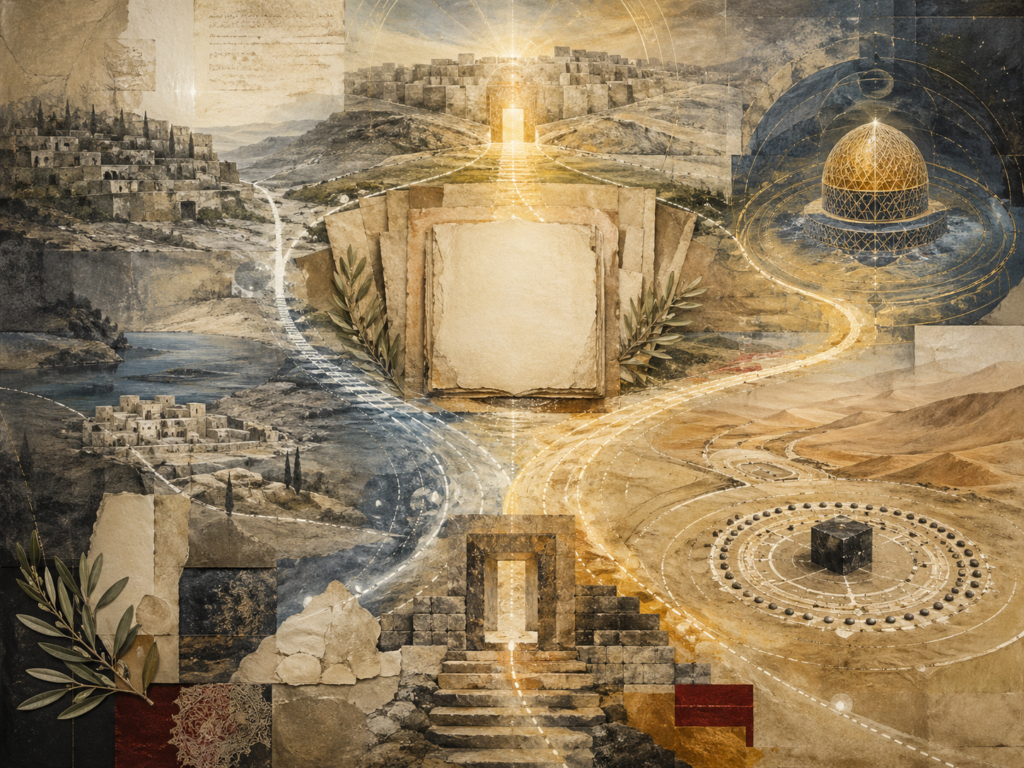
Non-figurative editorial illustration of luminous pilgrimage pathways, blank manuscripts, sacred threshold architecture, desert horizons, circular route geometry, water traces, olive branches, and abstract sanctuary forms representing pilgrimage, sacred geography, and the journey to God.

Pilgrimage, Sacred Geography, and the Journey to God

Pilgrimage, sacred geography, and the journey to God show that Abrahamic religion is not only a matter of belief, law, scripture, or private devotion. It is also a movement through place, memory, body, longing, exile, repentance, power, and return. In Judaism, Jerusalem, Temple memory, pilgrimage festivals, exile, heavenly Jerusalem, and sacred longing shape a religious geography that should not be collapsed into modern state sovereignty. In Christianity, Jerusalem, the life of Jesus, resurrection memory, martyr sites, relics, Rome, Compostela, and threatened Levantine Christian landscapes form a pilgrim imagination. In Islam, Hajj centers Makkah, the Ka‘bah, Abraham, Hagar, Ishmael, ihram, tawaf, Sa‘i, Arafat, sacrifice, equality, repentance, and submission to Allah, while Jerusalem, al-Aqsa, and the Dome of the Rock remain central to Islamic sacred memory.

Non-figurative editorial illustration of blank manuscripts, luminous pathways, olive branches, water traces, abstract table forms, sacred-time geometry, and dawn light representing Passover, Easter, Ramadan, and the memory of deliverance.

Passover, Easter, Ramadan, and the Memory of Deliverance

Passover, Easter, and Ramadan are not interchangeable festivals, but each forms sacred memory through time, body, worship, discipline, and deliverance. In Judaism, Passover remembers Israel’s liberation from Egypt, the blood of the lamb, unleavened bread, household ritual, covenantal identity, and the command to tell the story across generations. In Christianity, Easter is interpreted through Jesus’ death and resurrection as Paschal mystery, new creation, victory over death, and deliverance from sin, while remaining historically rooted in Jewish Passover memory. In Islam, Ramadan is the month of Qur’anic revelation, fasting, mercy, repentance, charity, Night of Power, and liberation from heedlessness and appetite through taqwa. This article compares sacred deliverance across the three traditions while preserving their real differences.

Non-figurative editorial illustration of blank legal manuscripts, threshold architecture, luminous pathways, olive branches, water traces, stone forms, and sacred geometry representing law, state power, and religious freedom in Abrahamic history.

Law, State Power, and Religious Freedom in Abrahamic History

Law, state power, and religious freedom have always been among the most difficult questions in Abrahamic history. Jewish, Christian, and Islamic traditions all contain sacred law, communal authority, moral commandment, public obligation, and visions of justice before God. Yet each tradition has also lived under changing political conditions: covenantal peoplehood, exile, empire, caliphate, church-state alliance, minority status, colonial rule, modern nationalism, secular constitutionalism, and international human rights. This article compares how Abrahamic traditions have negotiated religious law and political authority while preserving real differences among Torah and halakhah, Christian moral and ecclesial law, and Islamic sharia and fiqh. It also asks how religious freedom can protect conscience, worship, minority communities, and moral accountability without reducing faith to private preference or handing sacred authority to coercive power.

Non-figurative editorial illustration of blank covenant manuscripts, stone-tablet forms, luminous pathways, water traces, olive branches, threshold architecture, and sacred geometry representing covenant, commandment, and conscience in Abrahamic ethics.

Covenant, Commandment, and Conscience in Abrahamic Ethics

Covenant, commandment, and conscience stand at the center of Abrahamic ethics. Jewish, Christian, and Islamic traditions do not treat moral life as private preference or social convention alone. Human beings live before God, receive instruction, answer commandments, discern good and evil, and are accountable for the shape of the heart as well as outward action. In Judaism, covenant and mitzvot form Israel’s life through Torah, halakhah, memory, study, and embodied obedience. In Christianity, commandment is interpreted through Christ, love of God and neighbor, grace, conscience, Spirit, natural law, and moral formation. In Islam, Qur’an, Sunnah, sharia, fitrah, taqwa, nafs, and accountability before Allah shape moral discernment. This article compares Abrahamic ethics while preserving real differences over covenant, law, conscience, revelation, salvation, and moral authority.

Non-figurative editorial illustration of blank manuscripts, grain, water channels, vessels, olive branches, luminous pathways, sacred geometry, and a restrained table-like stone form representing dietary law, fasting, and the sanctification of the body.

Dietary Law, Fasting, and the Sanctification of the Body

Dietary law, fasting, and the sanctification of the body show that Abrahamic sacred law reaches into appetite, hunger, gratitude, restraint, purity, community, and moral formation. In Judaism, kashrut disciplines eating through Torah, halakhah, distinction, holiness, household practice, communal identity, and reverence for life. In Christianity, food is reinterpreted through Jesus, the early church’s Gentile mission, fasting, Eucharistic life, ascetic discipline, conscience, and charity rather than through Jewish dietary obligation. In Islam, halal and haram, tayyib food, lawful slaughter, Ramadan fasting, voluntary fasting, and restraint of appetite form the body in submission to Allah. This article compares food and fasting across the Abrahamic traditions while preserving real differences over covenant, law, grace, purity, worship, and sacred embodiment.

Non-figurative editorial illustration of blank manuscripts, circular sacred-time geometry, olive branches, still water, luminous pathways, balanced stone forms, and threshold architecture representing Sabbath, sacred time, and the discipline of rest.

Sabbath, Sacred Time, and the Discipline of Rest

Sabbath, sacred time, and the discipline of rest reveal that Abrahamic law is not only about what human beings do, but also about what they stop doing before God. In Judaism, Shabbat sanctifies the seventh day through creation, covenant, liberation, worship, household practice, communal joy, and disciplined cessation from ordinary labor. In Christianity, Sabbath is reinterpreted through Jesus, resurrection, the Lord’s Day, Eucharistic worship, mercy, and debates over law, grace, Sunday rest, and eschatological rest. In Islam, Friday Jumu‘ah is not a Sabbath in the Jewish sense, but it orders weekly time around communal prayer, remembrance of Allah, and the temporary suspension of trade. This article compares sacred time across the Abrahamic traditions while preserving their real theological differences.

Non-figurative editorial illustration of blank covenant parchment, layered manuscripts, paired stone forms, water channels, olive branches, luminous pathways, and sacred geometry representing marriage, family, and covenant in Abrahamic law.

Marriage, Family, and Covenant in Abrahamic Law

Marriage, family, and covenant stand at the intersection of sacred law, embodied life, kinship, sexuality, obligation, mercy, inheritance, and moral formation. In Judaism, marriage and family are shaped by Torah, halakhah, covenantal memory, ketubah, household holiness, children, ancestry, divorce law, and communal responsibility. In Christianity, marriage is interpreted through creation, Jesus’ teaching, fidelity, sacrament or covenant, family as domestic church, chastity, forgiveness, and debates over law, grace, and vocation. In Islam, marriage is a solemn moral contract ordered toward tranquility, affection, mercy, lawful intimacy, family protection, mahr, mutual rights, children, inheritance, and accountability before Allah. This article compares Abrahamic marriage and family law while preserving real differences over covenant, sacrament, contract, gender, divorce, authority, vulnerability, and sacred community.

Non-figurative editorial illustration of blank manuscripts, grain, water channels, olive branches, vessels, luminous pathways, and sacred geometry representing charity, almsgiving, and the moral economy of Abrahamic faith.

Charity, Almsgiving, and the Moral Economy of Abrahamic Faith

Charity, almsgiving, and the moral economy of Abrahamic faith reveal that property is never merely private possession before God. Jewish, Christian, and Islamic traditions all treat wealth as a test, a trust, and a field of moral obligation. In Judaism, tzedakah, gleaning, debt release, care for the stranger, and Maimonides’ levels of giving place economic life under covenantal justice. In Christianity, almsgiving, care for the poor, works of mercy, and the warning against performative righteousness shape the moral meaning of wealth. In Islam, zakat and sadaqah integrate worship, purification, redistribution, and social responsibility before Allah. This article compares Abrahamic giving not as optional generosity alone, but as a sacred economy of justice, mercy, dignity, gratitude, and accountability.

Scroll to Top