
Last Updated May 3, 2026
Tragedy, Drama, and Collective Memory explores dramatic literature as one of humanity’s most powerful public arts of reckoning. Unlike lyric, epic, or narrative prose, drama does not simply recount conflict after the fact. It places action before witnesses. It makes memory present-tense, embodied, affective, and communal. Through voice, gesture, silence, confrontation, staging, repetition, and public spectatorship, dramatic literature transforms private suffering into shared reflection and turns historical, political, familial, and sacred crisis into something a community must watch, hear, and judge together. In this sense, drama does not merely preserve memory. It reactivates memory in public.
This category examines tragedy, sacred drama, historical drama, court theater, vernacular performance traditions, modern political theater, documentary drama, postwar performance, and dramatic responses to war, tyranny, exile, communal breakdown, sacrifice, state violence, kinship crisis, and social transformation. It considers how dramatic forms mediate between ritual and literature, spectacle and moral reflection, civic life and emotional release, law and violence, kinship and state power, individual blindness and collective consequence. It also studies how tragedy in particular becomes a privileged medium of collective memory by staging irreparable loss, inherited guilt, public grief, sacrifice, recognition, and the consequences of human action under conditions that no community can fully master or forget.
Current Space
Literature & Cultural Memory
Related Topic
Classical Literature
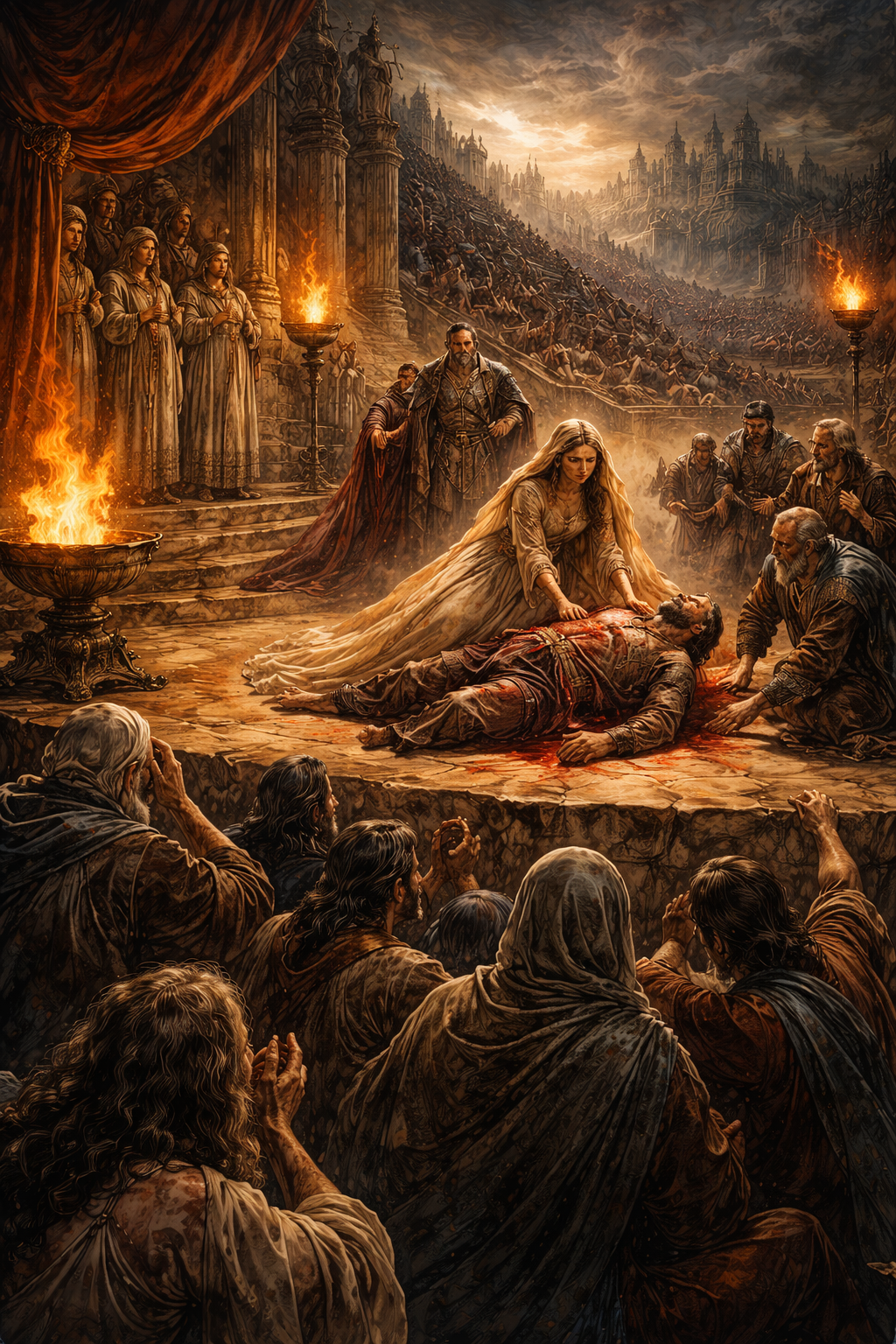
Drama differs from other literary forms not only because it is performed, but because it is witnessed in common. It gathers bodies into relation: actors, choruses, rulers, suppliants, rebels, mourners, judges, exiles, victims, messengers, tyrants, citizens, and spectators. Memory here is not stored solely in text. It is transmitted through re-enactment, embodiment, suspense, repetition, and return. Each performance restages a crisis, renews a warning, tests a meaning again, or reopens a wound a culture has not settled. The theater becomes a civic and symbolic space in which a society confronts what it fears, mourns, condemns, rationalizes, inherits, or cannot repair.
Tragedy, Drama, and Collective Memory is therefore a study of literature as staged thought. It asks how performance traditions preserve violence, conflict, sacrifice, law, guilt, and moral fracture while also creating space for recognition, mourning, warning, reinterpretation, and collective self-knowledge. By linking drama to ritual, politics, religion, law, spectatorship, public speech, embodiment, and historical trauma, this category clarifies how societies remember themselves not only through narrative and archive, but through repeated confrontation with the human condition under the pressure of witnesses.
Why This Field Matters
This field matters because drama is one of the clearest ways literature becomes public memory. A society may preserve its crises in chronicles, archives, epics, laws, monuments, rituals, and inherited narratives, but drama does something different: it stages conflict before witnesses. It makes memory social, embodied, affective, and immediate. A people does not merely learn what happened; it sees suffering enacted, hears accusation and lament, watches hesitation and blindness unfold, and confronts the consequences of human action in real time.
Tragedy matters especially because it is one of literature’s deepest forms of public thinking. It does not simply represent catastrophe. It places irreconcilable claims in confrontation: divine law and civic law, kinship and state, justice and revenge, mercy and punishment, loyalty and survival, knowledge and blindness. It shows not only that disaster occurs, but how human beings become entangled in forces they cannot fully comprehend or master and for which they remain answerable nonetheless.
The field also matters because drama makes spectatorship ethically serious. To watch a tragedy is not only to consume representation. It is to enter a public situation in which pity, fear, shame, anger, grief, recognition, and judgment are collectively organized. Drama asks what it means to witness suffering, what kind of knowledge performance produces, and how a community responds when its deepest norms are staged under pressure.
For this reason, drama is indispensable to the study of cultural memory. It shows how societies return to unresolved wounds: civil war, tyranny, exile, sacrifice, betrayal, dynastic ruin, state violence, religious crisis, colonial trauma, and family breakdown. The stage becomes one of the places where a culture thinks aloud about what it cannot simply solve.
Drama as Present-Tense Memory
One of the defining powers of drama is that it makes remembered conflict feel present. Even when the action belongs to mythic antiquity, sacred history, dynastic past, or political aftermath, the stage gives it a now. The audience watches action unfold under the pressure of time, speech, and embodiment. This present-tense quality distinguishes dramatic memory from many other literary forms. It does not merely say that a crisis happened. It places the community in front of it again.
This is one reason drama is so central to collective memory. It makes remembrance experiential rather than only descriptive. The audience does not simply inherit conclusions; it undergoes suspense, dread, recognition, pity, anger, or shame as part of the act of remembering. The past is socially reactivated as an event of attention.
The present tense of drama also makes memory unstable. A play can be repeated, but it is never exactly the same event. Each performance gives an inherited conflict to a new audience, a new political climate, a new stage, a new set of bodies, and a new historical pressure. Dramatic memory therefore lives in the tension between continuity and renewed immediacy.
This is why old tragedies can remain painfully contemporary. Their plots may come from distant myth, monarchy, sacred history, or older political orders, but their structures of recognition, guilt, coercion, revenge, grief, and public witnessing can return with startling force whenever a society confronts its own unresolved violence.
Theater as Civic Space
Theater is not only a place of entertainment. It is one of the principal civic spaces in which a community can watch itself. In tragedy and other dramatic forms, questions of justice, kinship, sacrifice, governance, divine law, war, tyranny, and social fracture are placed before an assembled public. The stage becomes a symbolic polity: a site where a society encounters its own norms, fears, and unresolved contradictions in visible form.
This civic dimension is essential to collective memory. Drama does not preserve memory in private alone. It gathers witnesses. It creates a situation in which a community must attend together to what it would otherwise disperse, suppress, or deny. The theater is therefore both artistic and political: a place where memory becomes public action through collective attention.
In ancient civic drama, the public character of theater was explicit. Plays were embedded in festivals, ritual calendars, civic identity, and public debate. But the civic force of drama extends far beyond ancient Greece. Court theater, religious pageantry, vernacular performance, revolutionary drama, documentary theater, protest performance, and postwar theater all show that the stage repeatedly becomes a place where power, memory, and collective identity are negotiated.
The civic power of drama lies not in offering simple consensus, but in making conflict visible. A community may leave the theater unsettled, divided, chastened, or newly aware of what it has inherited. That unsettledness is part of drama’s public function.
Performance, Repetition, and Reactivated Memory
Dramatic memory is not preserved only once. It is reactivated through repetition. Every performance restages a crisis, reopens a question, renews a warning, or tests a meaning again. Unlike a narrative stored silently on the page, drama remembers through re-enactment. Gesture, blocking, costume, pause, timing, music, silence, and speech do not merely represent a remembered past; they bring it back into the present of spectatorship.
This repeated life of drama matters because memory in performance is never static. Each staging interprets anew. The same tragedy may speak differently to different political orders, generations, and wounds. Drama preserves because it repeats, but it also changes because repetition is never pure recurrence. The stage is thus a medium of both continuity and renewed judgment.
Reperformance also gives dramatic texts a distinctive afterlife. A play can become canonical, but performance prevents it from becoming purely archival. Actors, directors, translators, designers, audiences, and historical contexts continually reshape its public meaning. The stage keeps the text open to pressure from the present.
This is why adaptation and revival are not secondary to dramatic memory. They are part of how drama remembers. A society returns to old plays in order to ask whether their structures of guilt, power, sacrifice, and recognition still describe the world it inhabits.
Ritual, Sacrifice, and the Origins of Dramatic Memory
Many dramatic traditions remain close to ritual, festival, sacrifice, funerary practice, divine invocation, and public ceremony. Drama emerges historically and conceptually near collective acts through which communities mark danger, sanctity, transition, mourning, or purification. Tragedy in particular often bears the memory of sacrificial logic, ritualized suffering, and the public management of violence.
This ritual inheritance helps explain why drama can preserve communal fear and grief with such force. It is not only literature spoken aloud. It is patterned confrontation with what threatens or founds the community: death, guilt, vengeance, impurity, curse, divine anger, dynastic crisis, civic fracture, or the need for expiation. The stage retains the gravity of ritual even when later forms become more secular, psychological, or overtly political.
Sacrifice is especially important because tragedy often stages societies at the point where violence is made meaningful, justified, displaced, or exposed. The victim, the scapegoat, the condemned ruler, the sacrificed child, the polluted house, the cursed lineage, and the defeated city all reveal the troubling relation between communal order and suffering.
A serious account of drama must therefore attend to its ceremonial force. Performance can entertain, but it can also bind, mourn, purify, indict, commemorate, and reopen sacred or historical wound. The theater carries ritual memory even when it questions the rituals it inherits.
Tragedy and the Knowledge of the Irreparable
Tragedy is one of the great forms through which societies think the irreparable. Some wrongs cannot be undone. Some deaths cannot be answered by compensation. Some acts cannot be absorbed back into order. Tragedy preserves this knowledge without disguising it. It reveals blindness, excess, inherited curse, divided obligation, and the terrible cost of partial knowledge, but it also reveals that recognition often arrives too late to restore what has been broken.
This is why tragedy preserves memory with such depth. It stages the moment when a society cannot easily resolve the relation between justice and suffering, law and violence, guilt and inheritance, responsibility and fate. What remains is not explanation alone, but difficult knowledge that must be revisited. Tragedy remembers by refusing easy repair.
The irreparable is not the same as the meaningless. Tragedy does not simply declare that suffering has no order. Rather, it shows that certain forms of knowledge come after loss, not before it. Recognition may clarify guilt, responsibility, or truth, but it does not resurrect the dead, restore the broken city, or remove the stain of violence. This belated knowledge is one of tragedy’s deepest structures.
Tragedy’s power lies in forcing a community to remain with what cannot be repaired. It teaches that some conflicts cannot be solved by sentiment, optimism, punishment, or institutional procedure. They must be remembered, mourned, interpreted, and carried as part of collective knowledge.
Time, Reversal, Recognition, and Dramatic Memory
Dramatic memory is shaped by distinctive temporal forms. Suspense, delay, revelation, reversal, recognition, and aftermath all structure how an audience encounters what is remembered. Often the most decisive events have already occurred before the play begins: a murder, a curse, a betrayal, a war, an abandonment, a violation of law, a broken oath. The stage becomes the place where consequences unfold and where hidden causes become visible.
This temporal structure makes drama especially powerful as a medium of collective memory. The audience may know what characters do not. The future may be visible in advance through prophecy or irony. Recognition may arrive at the instant when action can no longer be reversed. Drama thus remembers not simply by recounting the past, but by making time itself a structure of moral discovery.
Reversal is central because it reveals how quickly human confidence can collapse. The powerful become exposed, the ignorant become knowing, the secure become ruined, the judge becomes implicated, the avenger becomes polluted, the rescuer becomes destroyer. Through reversal, drama teaches that human beings often misunderstand the very situations in which they act most decisively.
Recognition is equally central because it binds memory to truth. A character comes to know what has been hidden, denied, misread, or falsely narrated. But in tragedy, recognition often arrives too late. The truth appears, but not in time to prevent catastrophe. This delayed knowledge gives dramatic memory its severity.
Body, Gesture, and the Embodiment of Conflict
Drama remembers through bodies. Suffering in drama is not merely described; it is embodied. The judged body, the wounded body, the royal body, the sacrificial body, the grieving body, the exiled body, the criminal body, the masked body, the disappearing body all become carriers of memory on stage. Embodiment is one of the major ways drama differs from other literary forms.
Gesture matters as much as speech. Kneeling, refusal, embrace, recoil, procession, collapse, ritual movement, stillness, and withheld touch all shape the memory of conflict. The body does not simply illustrate meaning. It is one of the places where conflict becomes visible and memorable to the community.
The stage body also carries public meaning. A king’s body may represent sovereignty; a corpse may expose the failure of law; a blinded body may become the mark of belated knowledge; a mourning body may make private loss visible to the community; a prisoner’s body may reveal the violence of the state. Drama turns bodies into sites where political and moral order becomes legible.
This embodiment is one reason performance cannot be reduced to text. The written play may preserve language, but performance makes memory visible through posture, vulnerability, distance, movement, and presence. The body remembers what speech cannot always contain.
Voice, Speech, and Public Action
Speech in drama is never merely descriptive. It accuses, confesses, commands, laments, persuades, curses, testifies, deceives, protests, prophesies, and judges. Drama is one of literature’s great arts of public utterance. Through dialogue, monologue, proclamation, oath, supplication, argument, and lamentation, it preserves the language by which societies articulate conflict.
This gives dramatic memory a particular force. A community does not simply see what happened; it hears how power speaks, how grief sounds, how guilt evades, how witness testifies, how prophecy warns, and how resistance names what authority wishes concealed. Voice in drama is not only character speech. It is public action in verbal form.
Dramatic speech also tests the limits of language. Characters often speak at moments of crisis when ordinary expression breaks down: before death, after betrayal, under accusation, in grief, in exile, in revelation, under divine or political pressure. The stage preserves speech under duress. It shows how language behaves when law, kinship, desire, fear, and memory collide.
Because drama is dialogic, speech is almost always contested. No voice fully owns the stage. Commands meet refusal; prophecy meets denial; lament meets political calculation; testimony meets evasion; accusation meets counter-accusation. Drama remembers through conflict among voices.
Chorus, Community, and Collective Voice
One of drama’s most distinctive contributions to collective memory is the possibility of a voice that is not fully individual. The chorus in ancient tragedy is the clearest example, but the broader principle extends well beyond it. Drama often includes intermediary forms of communal voice: witnesses, crowds, ritual speakers, narrators, chanting groups, public assemblies, or recurring forms of collective speech. These mediate between singular suffering and collective interpretation.
The chorus matters because it embodies memory as shared response. It fears, warns, mourns, interprets, hesitates, and endures. It is often the social conscience of the play, though not always an adequate one. More broadly, collective voice helps transform private disaster into public memory and collective apprehension.
Collective voice also dramatizes uncertainty. The community may not know how to interpret what it sees. It may be afraid to speak, too slow to act, or unable to prevent catastrophe. The chorus may mourn without saving, understand without controlling, warn without being heard. This limitation is part of its tragic function.
Through collective voice, drama stages the problem of communal responsibility. What does a community know? What does it fail to know? When does it witness, when does it enable, and when does it remember too late? These questions make chorus and spectatorship central to collective memory.
Offstage Violence, Report, and the Unseen
Drama often remembers catastrophe through what is not directly shown. Messenger speeches, cries from within, narrated massacres, reported suicides, descriptions of battle, unseen mutilation, and offstage acts of violence are among the most powerful devices in tragic literature. The unseen is not a weakness of drama. It is one of its major ways of shaping memory.
This mediated violence matters because it draws the audience into imaginative participation. Horror is carried by report, anticipation, and verbal image rather than spectacle alone. Drama thus preserves not only what is visible, but the force of what a community can barely endure seeing. The stage remembers through absence as well as embodiment.
Offstage violence can also preserve ethical distance. Some acts are too sacred, too terrible, or too morally charged to be shown directly without becoming spectacle. By placing violence offstage, drama can intensify its force while refusing voyeurism. The audience hears the consequences, watches the survivors, and confronts the aftermath rather than consuming violence as display.
Messenger speech is especially important because it turns report into public memory. A witness tells what occurred beyond the stage, and the community must receive the account. The unseen becomes known through language, imagination, and collective response.
Law, Judgment, and the Failure of Order
Drama often stages law at the point of breakdown. Decrees, trials, verdicts, punishments, oaths, succession disputes, and acts of public judgment reveal the fragility of political and legal order. Tragedy is especially alert to situations in which law fails to reconcile competing claims: divine and human command, family duty and civic duty, revenge and justice, mercy and punishment, truth and necessity.
This makes drama a privileged archive of public order under strain. It remembers not only crimes and penalties, but the insufficiency of institutions themselves. The stage becomes a place where law is exposed as partial, contested, or complicit in violence. Collective memory here is legal, moral, and political at once.
Law in drama often appears too rigid, too late, too self-interested, or too weak to contain the violence it seeks to regulate. A decree may intensify disorder. A trial may expose injustice. A punishment may reproduce the crime it condemns. A ruler may confuse legal authority with moral truth. Drama therefore remembers law not only as order, but as crisis.
This does not mean drama rejects law altogether. Rather, it asks what kind of order can answer suffering without denying it. Tragedy often shows that law must confront what exceeds procedure: grief, kinship, sacred obligation, inherited violence, and the dead who still claim memory.
Kinship, Power, and Inherited Guilt
Many dramatic traditions place family at the center of public catastrophe. Dynasties, marriages, sibling conflict, parent-child obligation, succession crises, blood guilt, betrayal, and inheritance all show how private kinship becomes inseparable from public order. Drama often reveals that what a society calls political crisis is already rooted in the family, and what appears as family conflict already bears civic consequence.
This is one reason tragedy so often remembers through inherited guilt. Characters bear more than individual psychology. They carry dynastic curses, wounded histories, ancestral debts, civic fears, sacred obligations, or ideological fractures. The stage preserves these burdens in a form the audience must witness.
Family in tragedy is rarely merely domestic. The house is a political structure, a sacred inheritance, a memory system, and a site of violence. A father’s crime may return through children; a ruler’s ambition may destroy kinship; a marriage may become an alliance or a trap; a burial may test the limits of law; a child may become the sacrificial object through which communal order reveals its brutality.
Through kinship, drama shows that memory is inherited before it is understood. Characters often enter conflicts they did not begin but cannot escape. The family becomes the first theater of historical consequence.
War, Exile, Tyranny, and Historical Violence
Drama has long been one of the chief arts through which societies remember war, defeat, conquest, civil conflict, tyranny, imprisonment, exile, and historical violence. These experiences are not only narrated; they are embodied and publicly re-staged. The defeated speak. The exiled return or fail to return. Tyrants command. Survivors lament. Witnesses hesitate. The stage becomes an archive of conflict through presence rather than report alone.
This is why dramatic literature remains so important in times of fracture. It can preserve what official history often flattens: the speech of the conquered, the pain of displacement, the breakdown of trust, the afterlife of violence in family and civic life. Drama remembers history not only as event, but as continuing structure of feeling.
War drama often turns attention from victory to aftermath. The returning soldier, the captive woman, the ruined city, the widowed household, the traumatized survivor, the tyrant’s court, the prison cell, and the exiled body all reveal what triumphalist memory tends to conceal. Drama can therefore become a counter-memory to official narratives of glory.
Exile is especially dramatic because it places identity under pressure. The exile speaks from displacement, outside the protection of home, law, and recognition. Through exile, drama remembers the vulnerability of belonging itself.
Sacred Drama, Court Theater, and World Performance Traditions
The field of dramatic memory is broader than tragedy narrowly defined. Sacred drama preserves theological history, exemplary suffering, salvation, and moral instruction in performative form. Court theater stages hierarchy, dynastic legitimacy, ceremony, stylized emotion, and the aesthetics of power. Vernacular performance traditions preserve popular grievance, communal humor, local memory, social inversion, and embodied intelligence outside elite literary culture.
A strongest-sense pillar must also recognize that the relation between performance and collective memory is a world-literary phenomenon, not only a Greek-to-modern European line. Ritual drama, courtly performance, masked theater, sacred reenactment, vernacular stage cultures, and modern political theater across civilizations all show that societies remember through embodiment, recurrence, and staged confrontation. Greek tragedy is foundational, but it does not exhaust the field.
Sacred drama often makes cosmology performable. It stages creation, fall, judgment, sacrifice, salvation, divine-human relation, martyrdom, or moral instruction as public memory. Court theater, by contrast, may aestheticize power, hierarchy, and ceremony, but it can also reveal the fragility and theatricality of authority itself.
World performance traditions remind us that dramatic memory is not bound to a single canon, stage architecture, or textual model. Mask, dance, music, gesture, chant, stylized movement, improvisation, and ritual repetition all expand what “drama” means as a medium of cultural memory.
Modern Political Theater and Post-Traumatic Stage Memory
Modern drama often inherits catastrophe under altered historical conditions: industrial war, genocide, dictatorship, colonial violence, surveillance, displacement, ideological fracture, and post-traumatic public culture. Political theater, documentary drama, testimony on stage, absurdist and anti-tragic forms, and postwar experimental performance all reconfigure how collective memory appears. The stage may no longer promise catharsis or moral settlement. It may instead preserve disorientation, repetition, witness, interruption, silence, or unresolved mourning.
Yet this only confirms drama’s continuing centrality. Even where certainty collapses, performance remains a powerful means of reactivating memory in public. Modern stage traditions remember not only through plot and character, but through fragmentation, testimony, repetition, and the refusal of closure.
Political theater often turns spectatorship into responsibility. It asks the audience not only to feel but to recognize structures: class power, state violence, colonial domination, propaganda, censorship, war, and the forms of ordinary complicity that sustain injustice. Documentary drama and testimonial performance extend this function by bringing archive, witness, and public memory directly onto the stage.
Post-traumatic drama often resists narrative completion because trauma itself resists ordinary closure. Silence, repetition, broken dialogue, absurdity, and disrupted form become ways of staging damaged memory without falsely resolving it.
Spectatorship, Affect, and Communal Reckoning
Drama is one of literature’s great arts of spectatorship. A community does not merely receive information; it watches, waits, fears, pities, recoils, recognizes, and judges. The audience is not incidental to dramatic memory. It is part of the structure through which memory becomes collective. Tragedy especially depends on shared affect: fear, pity, dread, grief, shame, awe, or uneasy recognition are all modes by which a community processes what it sees.
This means that collective memory in drama is not only textual or thematic. It is affective. It lives in the experience of watching together, in the public shaping of response, and in the unstable boundary between the staged event and the witnesses assembled before it. The emotional politics of theater are therefore part of the field’s core.
Spectatorship also raises ethical questions. What does it mean to watch suffering? When does witnessing become recognition, and when does it become consumption? How does drama prevent catastrophe from becoming spectacle? How does it transform affect into memory rather than mere sensation?
The strongest drama does not allow spectators to remain untouched observers. It implicates them in the act of judgment. The audience must ask what it knows, what it has tolerated, what it fears, what it mourns, and what kind of community it becomes by watching.
Adaptation, Revival, and the Afterlife of Performance
Drama is ephemeral in one sense and extraordinarily durable in another. A performance disappears when it ends, yet the play survives through revival, adaptation, quotation, translation, reinterpretation, memorial staging, educational canon, and political reuse. One of the deepest reasons drama matters for collective memory is that it can be re-staged under new conditions. The same tragic structure can be made to speak again to different regimes, wounds, and publics.
This afterlife matters because collective memory is never fixed. A society returns to old dramas in order to renegotiate old questions: justice, revenge, sacrifice, civil war, guilt, sovereignty, mourning, legitimacy. Drama preserves because it remains performable. Its memory is durable precisely because it can be re-embodied and recontested.
Adaptation is therefore not a secondary or derivative practice. It is one of drama’s major modes of survival. A tragedy translated into a new language, staged after a dictatorship, relocated to a colonial context, taught in a classroom, filmed for a new audience, or performed in protest becomes part of the work’s continuing public life.
The afterlife of performance shows that drama remembers by returning. Each revival asks whether the old wound still speaks, whether the inherited form still judges, and whether the community is ready to hear what it once staged before.
Major Questions of Interpretation
This pillar is organized around several major questions. How does drama preserve memory differently from epic, lyric, or narrative? What does performance add to remembrance? How do ritual, sacrifice, law, kinship, power, and public speech become staged forms of unresolved social tension? Why does tragedy remain such a powerful form for thinking irreparable loss, blindness, guilt, and justice? How do body, voice, chorus, irony, offstage report, and spectatorship shape collective memory?
The pillar also asks how reperformance, adaptation, translation, revival, and political reuse keep dramatic memory alive across time. What does a society do when it stages an old catastrophe in a new historical moment? How do modern and post-traumatic forms preserve memory when catharsis no longer seems adequate? How do sacred drama, court theater, vernacular performance, political theater, and documentary drama expand the field beyond tragedy narrowly understood?
These questions keep the category from becoming a genre survey. They open drama as a field of ritual, civic, political, emotional, and literary inquiry. Tragedy, Drama, and Collective Memory is not only about plays as written texts. It is about the stage as one of the great places where societies think, feel, and remember in public.
Expanded Article Architecture
The following structure gathers the pillar into a long-range architecture suitable for a major literature and cultural memory knowledge series. It is designed to support tragedy studies, dramatic theory, ritual and performance history, civic theater, world performance traditions, modern political drama, adaptation studies, and the public memory of catastrophe. All entries below should be treated as planned unless already completed elsewhere on the site.
Foundations of the Field
- Tragedy, Drama, and the Public Memory of Conflict (planned)
- Why Drama Matters in Cultural Memory (planned)
- The Stage as Civic Space (planned)
- Performance and the Social Life of Memory (planned)
- Why Communities Return to Tragedy (planned)
- Drama as a Communal Art of Reckoning (planned)
- Theater, Witness, and the Public Life of Suffering (planned)
- Drama as Literature in the Presence of Others (planned)
Ritual, Sacrifice, and Origins
- Ritual and the Origins of Tragedy (planned)
- Sacrifice, Purification, and Dramatic Form (planned)
- Funerary Memory and the Theater of Mourning (planned)
- Festival, Ceremony, and Civic Drama (planned)
- How Ritual Becomes Literature (planned)
- The Sacred Background of Performance (planned)
- Invocation, Procession, and the Ceremonial Body of Drama (planned)
- Violence, Expiation, and the Ritual Logic of Tragedy (planned)
Tragic Form and Moral Knowledge
- What Tragedy Knows About Catastrophe (planned)
- The Irreparable in Tragic Drama (planned)
- Blindness, Recognition, and Irreversible Action (planned)
- Inherited Guilt and the Structure of Tragic Memory (planned)
- Fate, Responsibility, and the Limits of Control (planned)
- Why Tragedy Refuses Easy Resolution (planned)
- Moral Cognition on the Stage (planned)
- Tragedy and the Late Arrival of Knowledge (planned)
- Catastrophe, Responsibility, and the Problem of Meaning (planned)
Time, Irony, and Recognition
- Present Tense and the Memory of the Stage (planned)
- Dramatic Irony and the Audience’s Knowledge (planned)
- Recognition Scenes and the Shock of Truth (planned)
- Reversal, Delay, and the Shape of Catastrophe (planned)
- What Has Already Happened Before the Play Begins (planned)
- Aftermath as Dramatic Memory (planned)
- Prophecy, Suspense, and the Future Already Known (planned)
- The Too-Late Knowledge of Tragic Form (planned)
Body, Voice, and Collective Witness
- The Suffering Body in Drama (planned)
- Gesture, Silence, and Embodied Meaning (planned)
- Speech as Public Action in Tragedy (planned)
- Confession, Accusation, and Dramatic Truth (planned)
- Witnessing Violence Through Performance (planned)
- Why the Body Remembers on Stage (planned)
- The Royal Body, the Wounded Body, and the Sacrificial Body (planned)
- Lament, Cry, and the Sound of Public Grief (planned)
Chorus, Community, and Spectatorship
- The Chorus as Collective Memory (planned)
- Fear, Pity, and the Audience in Tragedy (planned)
- Public Emotion and the Politics of Watching (planned)
- The Crowd, the Witness, and the Social Voice (planned)
- How Spectators Become Part of the Drama (planned)
- Communal Reckoning Through Performance (planned)
- The Chorus and the Limits of Collective Knowledge (planned)
- Audience Responsibility and the Ethics of Witnessing (planned)
Law, Power, and Broken Order
- Law and Its Limits in Tragic Drama (planned)
- Judgment, Punishment, and Public Order (planned)
- State Power and Moral Fracture on Stage (planned)
- Succession, Sovereignty, and Dynastic Crisis (planned)
- Justice After Violence in Dramatic Literature (planned)
- When Institutions Fail in Tragedy (planned)
- Courtroom Scenes and the Memory of Judgment (planned)
- Divine Law, Civic Law, and the Tragic Conflict of Orders (planned)
- Trial, Verdict, and the Fragility of Public Truth (planned)
Kinship, Family, and Inherited Violence
- Family as the First Political Theater (planned)
- Blood Guilt and Generational Memory (planned)
- Siblings, Parents, and Dynastic Ruin (planned)
- Marriage, Alliance, and Catastrophe in Drama (planned)
- Household Conflict and Public Consequence (planned)
- Why Tragedy Returns to the Family (planned)
- The House as Memory System in Tragic Drama (planned)
- Children, Sacrifice, and the Future as Victim (planned)
War, Exile, and Historical Violence
- War on Stage and the Memory of Defeat (planned)
- Exile as Dramatic Condition (planned)
- Tyranny, Usurpation, and Political Fear (planned)
- Civil Conflict in Tragic Literature (planned)
- How Drama Preserves the Speech of the Conquered (planned)
- Historical Violence and the Stage of Witness (planned)
- Messenger Speeches and Offstage Catastrophe (planned)
- Captive Women, Ruined Cities, and the Countermemory of War (planned)
- Exile, Return, and the Broken Grammar of Belonging (planned)
Sacred, Courtly, and World Performance Traditions
- Sacred Drama and the Performance of Salvation History (planned)
- Court Theater and the Aesthetics of Power (planned)
- Vernacular Performance and Popular Memory (planned)
- Religious Pageantry and Communal Identity (planned)
- Ritual Theater Beyond the Classical Canon (planned)
- How Different Dramatic Traditions Remember Differently (planned)
- Masked Performance and the Memory of Social Roles (planned)
- Music, Dance, and Gesture in World Dramatic Memory (planned)
- Medieval Sacred Drama and the Public Memory of Redemption (planned)
Modern Political and Post-Traumatic Drama
- Political Theater and Public Reckoning (planned)
- Documentary Drama and Testimony (planned)
- Drama After War and Genocide (planned)
- Absurdism and the Memory of Rupture (planned)
- Stage Memory After Dictatorship (planned)
- Why Modern Drama Often Refuses Catharsis (planned)
- Drama and Censorship (planned)
- Testimony, Archive, and the Ethics of Documentary Theater (planned)
- Postcolonial Drama and the Return of Historical Violence (planned)
- Theater After Trauma and the Refusal of Closure (planned)
Adaptation, Revival, and Afterlife
- Why Tragedy Must Be Reperformed (planned)
- Adaptation as Cultural Reinterpretation (planned)
- Classical Tragedy in Modern Political Contexts (planned)
- Translation and the Mobility of Dramatic Memory (planned)
- Revival, Repetition, and Historical Return (planned)
- Quotation, Education, and Civic Myth (planned)
- The Afterlife of the Stage (planned)
- Reperformance as Memory Work (planned)
- How Old Plays Become New Public Arguments (planned)
Authors, Traditions, and Deep-Dive Studies
- Aeschylus and the Memory of Blood Justice (planned)
- The Oresteia and the Passage from Vengeance to Law (planned)
- Sophocles and the Tragedy of Recognition (planned)
- Antigone and the Conflict Between Kinship and State (planned)
- Oedipus Tyrannus and the Catastrophe of Knowledge (planned)
- Euripides and the Drama of Ruptured Community (planned)
- The Trojan Women and the Stage Memory of Defeat (planned)
- Seneca and the Roman Afterlife of Tragedy (planned)
- Shakespeare and the Theater of Political Catastrophe (planned)
- King Lear and the Unmaking of Sovereignty (planned)
- Macbeth and the Theater of Ambition, Blood, and Fear (planned)
- Racine and the Discipline of Tragic Passion (planned)
- Büchner, Brecht, and Political Theater (planned)
- Beckett and the Memory of Breakdown (planned)
Closing Perspective
Tragedy, Drama, and Collective Memory reveals one of literature’s most powerful capacities: the ability to make societies witness themselves in public. Through embodied conflict, ritual structure, public speech, irony, spectatorship, and repeated performance, drama preserves not only events but the emotional, moral, and political knowledge those events leave behind. It remembers through bodies, voices, law, kinship, grief, sacrifice, and return. It makes visible what a community cannot resolve and cannot afford to forget.
This is what makes the category so important within Literature & Cultural Memory. Drama does not merely narrate catastrophe after the fact. It stages confrontation in the presence of witnesses. It transforms memory into performance, spectatorship into reckoning, and repetition into survival. As a long-range knowledge series, this pillar is meant to follow tragedy and drama across their many traditions and historical uses, showing how the stage remains one of the great places where human beings publicly remember violence, sacrifice, injustice, and the unstable limits of power, law, compassion, and repair.
The strongest reason to study tragedy and drama as collective memory is that performance refuses forgetfulness. A community may try to bury violence in law, myth, ideology, spectacle, or silence, but drama can bring the wound back into public view. It does not always heal; often it cannot. But it can make witnessing unavoidable, and in that unavoidable witnessing lies one of literature’s deepest civic and moral powers.
Related Reading
- Literature & Cultural Memory
- Classical Literature and Civilizational Memory
- Poetry, Memory, and Imagination
- Shakespeare and Early Modern Literature
- Dante, Epic, and Medieval Memory
- Ethics and Moral Philosophy
- Political Philosophy and Justice
- Religion and Society
Further Reading
- Aristotle (n.d.) Poetics. Translated by S.H. Butcher. Internet Classics Archive, MIT. https://classics.mit.edu/Aristotle/poetics.html
- Bushnell, R. (ed.) (2005) A Companion to Tragedy. Malden, MA: Blackwell. https://www.wiley.com/en-us/A%2BCompanion%2Bto%2BTragedy-p-9781405107358
- Carlson, M. (2003) The Haunted Stage: The Theatre as Memory Machine. Ann Arbor, MI: University of Michigan Press.
- Easterling, P.E. (ed.) (1997) The Cambridge Companion to Greek Tragedy. Cambridge: Cambridge University Press. https://www.cambridge.org/core/books/cambridge-companion-to-greek-tragedy/57636964B37CA6A04DCEACF8253B611E
- Hall, E. and Harrop, A. (eds.) (2010) Theorising Performance: Greek Drama, Cultural History and Critical Practice. London: Duckworth.
- McDonald, M. and Walton, J.M. (eds.) (2007) The Cambridge Companion to Greek and Roman Theatre. Cambridge: Cambridge University Press. https://www.cambridge.org/core/books/cambridge-companion-to-greek-and-romantheatre/07CA0A915651D5A8FC320A59477BEE29
- Nussbaum, M.C. (2001) The Fragility of Goodness: Luck and Ethics in Greek Tragedy and Philosophy, rev. edn. Cambridge: Cambridge University Press.
- Rehm, R. (2002) The Play of Space: Spatial Transformation in Greek Tragedy. Princeton, NJ: Princeton University Press.
- Taplin, O. (1978) Greek Tragedy in Action. London: Methuen.
- Taylor, D. (1991) Theatre of Crisis: Drama and Politics in Latin America. Lexington, KY: University Press of Kentucky.
- Goldhill, S. (1986) Reading Greek Tragedy. Cambridge: Cambridge University Press.
- Foley, H.P. (2001) Female Acts in Greek Tragedy. Princeton, NJ: Princeton University Press.
- Worthen, W.B. (2010) Drama: Between Poetry and Performance. Chichester: Wiley-Blackwell.
- Boal, A. (2000) Theater of the Oppressed. Translated by C.A. and M.-O. Leal McBride. London: Pluto Press.
References
- Aeschylus (n.d.) Aeschylus. Scaife Viewer, Perseus Digital Library. https://scaife.perseus.org/library/urn%3Acts%3AgreekLit%3Atlg0085/
- Aristotle (n.d.) Poetics. Translated by S.H. Butcher. Internet Classics Archive, MIT. https://classics.mit.edu/Aristotle/poetics.html
- Bushnell, R. (ed.) (2005) A Companion to Tragedy. Malden, MA: Blackwell. https://www.wiley.com/en-us/A%2BCompanion%2Bto%2BTragedy-p-9781405107358
- Carlson, M. (2003) The Haunted Stage: The Theatre as Memory Machine. Ann Arbor, MI: University of Michigan Press.
- Easterling, P.E. (ed.) (1997) The Cambridge Companion to Greek Tragedy. Cambridge: Cambridge University Press. https://www.cambridge.org/core/books/cambridge-companion-to-greek-tragedy/57636964B37CA6A04DCEACF8253B611E
- Euripides (n.d.) The Trojan Women. Scaife Viewer, Perseus Digital Library. https://scaife.perseus.org/library/urn%3Acts%3AgreekLit%3Atlg0006.tlg011/
- Foley, H.P. (2001) Female Acts in Greek Tragedy. Princeton, NJ: Princeton University Press.
- Goldhill, S. (1986) Reading Greek Tragedy. Cambridge: Cambridge University Press.
- McDonald, M. and Walton, J.M. (eds.) (2007) The Cambridge Companion to Greek and Roman Theatre. Cambridge: Cambridge University Press. https://www.cambridge.org/core/books/cambridge-companion-to-greek-and-romantheatre/07CA0A915651D5A8FC320A59477BEE29
- Nussbaum, M.C. (2001) The Fragility of Goodness: Luck and Ethics in Greek Tragedy and Philosophy, rev. edn. Cambridge: Cambridge University Press.
- Rehm, R. (1992) Greek Tragic Theatre. London: Routledge.
- Rehm, R. (2002) The Play of Space: Spatial Transformation in Greek Tragedy. Princeton, NJ: Princeton University Press.
- Sophocles (n.d.) Oedipus Tyrannus. Scaife Viewer, Perseus Digital Library. https://scaife.perseus.org/library/urn%3Acts%3AgreekLit%3Atlg0011.tlg004/
- Taplin, O. (1978) Greek Tragedy in Action. London: Methuen.
- Taylor, D. (1991) Theatre of Crisis: Drama and Politics in Latin America. Lexington, KY: University Press of Kentucky.
- Worthen, W.B. (2010) Drama: Between Poetry and Performance. Chichester: Wiley-Blackwell.